Significant outcomes
• We found a positive correlation between serum neuropeptide Y (NPY) and religious commitment in a group of young, healthy women.
• Oxytocin (OXT) levels were not significantly correlated with religious commitment, likely due to the higher prevalence of use of oral contraceptives in less religious individuals.
Limitations
• The use of oral contraceptives was a confounding factor in the OXT analysis.
• The present study consists of a relatively homogenous group of female American college students limiting the generalisability of the results.
• The scores on the Religious Commitment Inventory may be biased by social desirability resulting in higher self-reported levels of religious commitment.
Introduction
Many studies have revealed a complex relationship between religious practices and mental and physical health (Reference AbdAleati, Mohd Zaharim and Mydin1). This research has shown that religion and spirituality promote health and well-being (Reference Clements and Ermakova2–Reference Schafer8), and that religion can be an important source of protection and resilience, helping individuals to cope with stressors (Reference AbdAleati, Mohd Zaharim and Mydin1,Reference Davis3,Reference Reutter and Bigatti7,Reference Hill, Pargament, Hood, McCullough, Swyers, Larson and Zinnbauer9–Reference Pargament and Raiya12). Religious cues may facilitate prosociality (Reference Norenzayan and Shariff13), cooperation (Reference Anderson and Mellor14) and in-group assistance (Reference Ottoni-Wilhelm15), but at the same time promote out-group competition and hostility (Reference Brewer16–Reference Xygalatas, Klocová, Cigán, Kundt, Maňo, Kotherová, Mitkidis, Wallot and Kanovsky19). Religion promotes resilience to stress by modulating personal traits, by providing meaning to traumatic life events, and by mediating emotional responses (Reference Koenig and Cohen4,Reference Pargament and Cummings5). Religious practice also has an interpersonal dimension, providing a sense of community, social connectedness and support (Reference Pargament and Cummings5). However, the neural mechanisms by which religion promotes resilience and prosocial tendencies or antisocial behaviours remain largely unknown. Here we investigate whether religious commitment is related to serum levels of NPY and OXT.
Neuroactive hormones affect physiological processes that influence human behaviour (Reference Carter20). NPY is one of the most abundant peptides in the brain (Reference Reichmann and Holzer21), and plays a role in many physiological functions such as energy homeostasis, food intake, circadian rhythm and cognition (Reference Eaton, Sallee and Sah22–Reference Zhang, Bijker and Herzog27). NPY has a well-established role in promoting general well-being, anxiety regulation and stress-resilience (Reference Reichmann and Holzer21,Reference Heilig28). However, a link between NPY and religious practices has not yet been explored. Most research on OXT indicate its positive role in social behaviours in humans and non-human mammals, including reproduction, social attachment, parental care, pair-bonding, prosocial behaviour, parochial altruism, social cognition (Reference Zak29–Reference Zak, Kurzban and Matzner41), social affiliation (Reference Bartz, Zaki, Bolger and Ochsner42,Reference Van Cappellen, Way, Isgett and Fredrickson43) and in-group conformity (Reference Stallen, De Dreu, Shalvi, Smidts and Sanfey44). Recent studies have found that both saliva and blood levels of OXT were positively correlated with spirituality (Reference Holbrook, Hahn-Holbrook and Holt-Lunstad36,Reference Kelsch, Ironson, Szeto, Kremer, Schneiderman and Mendez45) and that intranasal OXT administration significantly increased spirituality (Reference Van Cappellen, Way, Isgett and Fredrickson43).
Aims of the study
This study tests the hypothesis that there is a positive relationship between religious commitment and the neurohormones NPY and OXT. We further hypothesise that NPY and OXT levels will correlate with the intrapersonal and interpersonal aspects of religious commitment, respectively.
Methods
Participants
We recruited 60 healthy female students, with a median age of 21, from Claremont Graduate University and Scripps College through flyers and email announcements. Exclusion criteria were: exhibiting clinically significant suicidal ideation; exhibiting psychotic features; substance abuse disorder (according to Diagnostic and Statistical Manual of Mental Disorders, Fourth Edition, Text Revision) within the past 6 months; any current or past psychiatric disorders that could interfere with study adherence; treatment with psychoactive medications (other than mood stabilisers or Ambien) (Reference Winterdahl, Miani, Vercoe, Ciovica, Uber-Zak, Rask and Zak46), which were assessed during in-person interviews. Questionnaires were administered and blood samples were collected after obtaining written consent and the approval of The Institutional Review Boards of Scripps College and Claremont Graduate University, and in compliance with national legislation and the Code of Ethical Principles for Medical Research Involving Human Subjects of the World Medical Association (Declaration of Helsinki).
Serological measurements
We performed all testing between 6 pm and 8 pm to control for diurnal variations of hormones. A total of 28 ml of blood was drawn from an antecubital vein, using two 8 ml ethylenediaminetetraacetic acid whole-blood tubes and one 12 ml serum-separator tube using VacutainerTM (Becton, Dickinson and Company, Franklin Lakes, NJ, USA) blood collection kits. After phlebotomy, each tube was immediately put on ice. The tubes were then placed in a refrigerated centrifuge and spun at 239 g at 4°C for 12 min. The supernatant was pipetted into 2 ml polypropylene Fisherbrand microtubes (Thermo Fisher Scientific, Waltham, MA, USA). The microtubes were immediately placed on dry ice and then transferred to an −80°C freezer until analysis. All tests were performed at the Endocrine Core Laboratory of the Yerkes National Primate Research Center at Emory University, Atlanta, Georgia, USA. Commercial radioimmunoassay (RIA) or enzyme-linked immunosorbent assay (ELISA) kits from American Laboratory Products Company, Windham, NH (NPY, RIA), DiaSorin Inc., Stillwater, MN (adrenocorticotrophim hormone), Diagnostic Systems Laboratories, Webster, TX (cortisol, prolactin, estradiol), Beckman Coulter, Webster, TX (testosterone), Siemens, Los Angeles, CA (progesterone), and Assay Designs, Ann Arbor, MI (OXT), were used. All inter-assay and intra-assay coefficients of variation were within acceptable bounds (<15%) (Reference Winterdahl, Miani, Vercoe, Ciovica, Uber-Zak, Rask and Zak46).
Psychometric measures
Religious commitment levels were measured using the Religious Commitment Inventory-10 (RCI-10) (Reference Worthington, Wade, Hight, Ripley, McCullough, Berry, Schmitt, Berry, Bursley and O’connor47). The participants also completed a demographic survey and additional psychological surveys to assess their general psychological health, including the Jacobs Neglect, Abandonment and Abuse protocol (J-NAAP) (Reference Jacobs48), the Experiences in Close Relationships-Revised (ECR-R) (Reference Fraley, Waller and Brennan49), the Beck Depression Inventory (BDI) (Reference Beck, Ward, Mendelson, Mock and Erbaugh50), the Satisfaction with Life Scale (SWLS) (Reference Diener, Emmons, Larsen and Griffin51) and the Resilience Scale (RS) (Reference Wagnild and Young52).
The RCI-10 (Reference Worthington, Wade, Hight, Ripley, McCullough, Berry, Schmitt, Berry, Bursley and O’connor47) measures the degree to which individuals adhere to their religious beliefs, values, and practices, and use them in daily life (Reference Worthington53). The RCI-10 scores are measured on a 5-point Likert scale from 1 = ‘Not at all true of me’ to 5 = ’totally true of me’. The questionnaire assesses both intrapersonal (6 items) and interpersonal (4 items) aspects of religious commitment, with items such as ‘Religion is especially important to me because it answers many questions about the meaning of life’ and ‘I enjoy spending time with others of my religious affiliation’.
The J-NAAP (Reference Jacobs48) assesses traumatic or stressful life events such as loss or abandonment, serious neglect, physical abuse, emotional abuse and sexual abuse. The ECR-R (Reference Fraley, Waller and Brennan49) measures individuals on two subscales of attachment: attachment-related anxiety (i.e. the extent to which people are insecure vs. secure about responsiveness and availability of romantic partners) and attachment-related avoidance (i.e. the extent to which people are uncomfortable being close to others vs. secure depending on others). The BDI (Reference Beck, Ward, Mendelson, Mock and Erbaugh50) measures symptoms of depression and assesses the severity, intensity and depth of depression. The SWLS (Reference Diener, Emmons, Larsen and Griffin51) assesses subjective well-being and the RS (Reference Wagnild and Young52) measures personality characteristics that moderate the effects of stress.
Statistical analysis
Descriptive statistical data are presented as median, 25th- and 75th percentile. To define the linear association between serological measurements and psychometric measures, Spearman’s ρ correlation coefficients were calculated. Dependent variables were rank transformed before analysis of covariance (ANCOVA) to allow for non-parametric analyses. Mann–Whitney U test was used to compare groups. The significance level was set at 5%.
Results
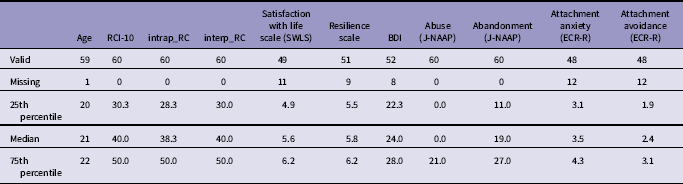
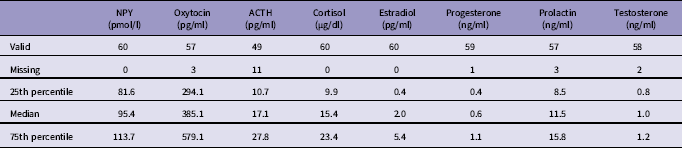
Psychometric measures and serological measurements are summarised in Tables 1 and 2. Of particular note, the median RCI-10 was 40 out of a possible 50.
Psychometric measures

BDI, Beck Depression Inventory; ECR-R, Experiences in Close Relationships-Revised; J-NAAP, Jacobs Neglect, Abandonment, and Abuse protocol; RCI-10, Religious Commitment Inventory-10 (RCI-10). Intrapersonal and interpersonal religious commitment subscales are abbreviated intrap_RC and interp_RC, respectively.
Serological measurements

ACTH, adrenocorticotrophim hormone; NPY, neuropeptide Y.
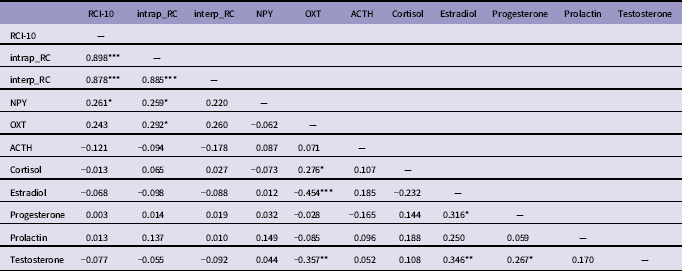
Religious commitment correlated significantly with NPY [r s(58) = 0.26, p < 0.05], but not with OXT [r s(55) = 0.24, p = 0.07]. The intrapersonal religious commitment subscale was correlated with both NPY [r s (58) = 0.26, p < 0.05] and OXT [r s(55) = 0.29, p < 0.05]. Interpersonal religious commitment and NPY [r s(60) = 0.22, p = 0.09] were not significantly correlated. However, the relationship between interpersonal religious commitment and OXT narrowly missed statistical significance [r s(55) = 0.26, p = 0.05]. The correlations between RCI-10, its subscales and hormones are summarised in Table 3.
Spearman’s ρ correlations between religious commitment and serological measurements

ACTH, adrenocorticotrophim hormone; NPY, neuropeptide Y; OXT, oxytocin; RCI-10, Religious Commitment Inventory-10. Intrapersonal and interpersonal religious commitment subscales are abbreviated intrap_RC and interp_RC, respectively.
* p < 0.05
** p < 0.01
*** p < 0.001.
We found a negative correlation between OXT and estradiol [r s(55) = −0.45, p < 0.001], and, in turn, estradiol and progesterone [r s(57) = 0.32, p < 0.05]. Since synthetic estradiol and progesterone are the active ingredients of oral contraceptives, we corrected for the use of oral contraceptives when correlating the intrapersonal religious commitment subscale and OXT. A ranked ANCOVA analysis with the use of oral contraceptives as a fixed factor showed no correlation between the intrapersonal religious commitment subscale and OXT [F(1,44) = 0.57, p = 0.46]. Participants were asked if they used oral contraception and 28 out of 50 participants answered positively. In this small sample, women not using oral contraception scored significantly higher on both the intrapersonal and the interpersonal religious commitment subscales compared to women using oral contraception, see Table 4. Correlations were also found between OXT and cortisol [r s(55) = 0.28, p < 0.05] and OXT and testosterone [r s(55) = −0.36, p < 0.001]. No significant correlations were found between NPY and other serological measures.
Comparison of religious commitment in oral contraceptive users and non-users

RCI-10, Religious Commitment Inventory-10. Intrapersonal and interpersonal religious commitment subscales are abbreviated intrap_RC and interp_RC, respectively.
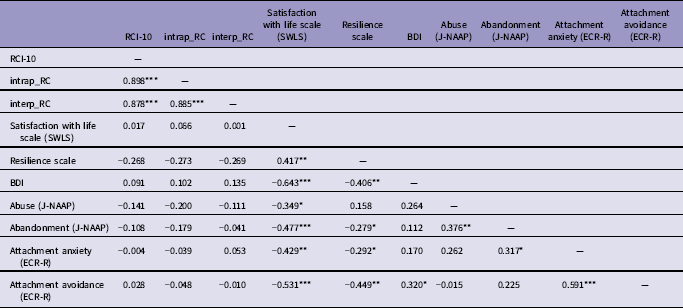
As expected, several highly significant correlations were observed between psychological scales (see Table 5). However, Spearman’s ρ analyses did not reveal significant correlations between RCI-10, its subscales and other psychological measures. No significant correlations were observed between NPY and resilience [r s(49) = −0.04, p = 0.76], nor between any of the other psychological scales and NPY and OXT.
Spearman’s ρ correlations between religious commitment and psychometric measures

BDI, Beck Depression Inventory; ECR-R, Experiences in Close Relationships-Revised; J-NAAP, Jacobs Neglect, Abandonment, and Abuse protocol; RCI-10, Religious Commitment Inventory-10. Intrapersonal and interpersonal religious commitment subscales are abbreviated intrap_RC and interp_RC, respectively.
* p < 0.05
** p < 0.01
*** p < 0.001.
Discussion
This study revealed a positive correlation between serum NPY levels and religious commitment in a group of healthy, young women. Previous research suggests several reasons why NPY would be related to religious commitment. The resilience property of religion, for example, is often linked to living a meaningful life and emotional regulation (Reference Pargament and Cummings5). Several lines of evidence indicate that NPY has an important role in adaptation to stress and may help eliminate stress responses (Reference Reichmann and Holzer21). Stress involves several biochemical responses, prominently corticotropin-releasing factor (Reference Sajdyk, Shekhar and Gehlert25). Both NPY and corticotropin-releasing factor are present in brain regions involved in mediating stress and anxiety, including pituitary, brainstem, hypothalamus, cerebral cortex and the amygdala (Reference Sajdyk, Shekhar and Gehlert25). A number of studies have shown that NPY has anxiolytic effects (Reference Sajdyk, Shekhar and Gehlert25) by modulating corticotropin-releasing factor induced responses (Reference Heilig, Koob, Ekman and Britton54). The oppositional effects of corticotropin-releasing factor and NPY on stress have been observed in the amygdala, hippocampus, hypothalamus, locus coeruleus and the septal nucleus (Reference Sajdyk, Shekhar and Gehlert25). Furthermore, NPY has been associated with resilience after stress or trauma (Reference Reichmann and Holzer21). Preclinical and clinical studies have identified the NPY as a mediator between stress exposure and the development of maladaptive versus resilient phenotypes. Enhancing NPY signalling promotes a pro-resilience phenotype (Reference Kautz, Charney and Murrough55). Our findings suggest that the resilience property of religion, especially emotional regulation, might be mediated by NPY. Our inability to find a correlation between NPY and self-reported resilience indicates that NPY has no or only an indirect effect on resilience or that the RS may not measure the forms of resilience influenced by NPY (Reference Wagnild and Young52).
The study design does not allow us to establish the causality between religious commitment and NPY. Recent studies indicate that NPY expression is in part driven by variations in the NPY gene, suggesting that genetic variations may predispose some individuals to low or high NPY expression (Reference Mickey, Zhou, Heitzeg, Heinz, Hodgkinson, Hsu, Langenecker, Love, Peciña, Shafir, Stohler, Goldman and Zubieta56,Reference Zhou, Zhu, Hariri, Enoch, Scott and Sinha57). Low levels of NPY expression are associated with greater reactivity in the amygdala to threat-related facial images and the experience of more negative emotions during painful stressors compared to high NPY genotypes (Reference Mickey, Zhou, Heitzeg, Heinz, Hodgkinson, Hsu, Langenecker, Love, Peciña, Shafir, Stohler, Goldman and Zubieta56–Reference Enman, Sabban, McGonigle and Van Bockstaele58). This suggests that individuals who are genetically predisposed to having high levels of NPY may have greater resilience to stress compared to low NPY genotypes. Our study indicates that individuals who produce more NPY may modulate stress by participating in religious services and joining religious communities. However, it is still unclear which factors, other than genetic predisposition, influence NPY expression.
It is plausible that participation in a community of faith is related to greater OXT expression. A correlation between OXT and religious commitment would be consistent with findings showing that saliva and plasma OXT levels are positively correlated with self-reported measures of spirituality (Reference Holbrook, Hahn-Holbrook and Holt-Lunstad36,Reference Kelsch, Ironson, Szeto, Kremer, Schneiderman and Mendez45) even when controlling for variables associated with spirituality, such as church attendance, positive affect, relationship status and sex (Reference Holbrook, Hahn-Holbrook and Holt-Lunstad36). This relationship has also been supported by studies using intranasal OXT administration (Reference Van Cappellen, Way, Isgett and Fredrickson43) that increased self-reported measures of spirituality. However, in our study, the correlation between OXT and intrapersonal religious commitment did not survive adjustment for the use of oral contraception. Synthetic steroid hormones, present in oral contraceptives, can influence OXT receptor expression in similar fashion as endogenous progesterone and/or estrogens. For example, estrogen receptor β activation increases OXT peptide transcription (Reference Nomura, McKenna, Korach, Pfaff and Ogawa59), whereas progesterone is known to both inhibit OXT binding to its receptor (Reference Grazzini, Guillon, Mouillac and Zingg60) and alter OXT receptor densities in limbic regions (Reference Patchev, Schlosser, Hassan and Almeida61). The present results showed a trend toward a correlation between OXT and interpersonal religious commitment (p = 0.05). This indicates a potential role of OXT in the interpersonal dimension of religion.
In our study population, we found that oral contraception users scored significantly lower on both religious commitment and its subscores compared to non-users. This could be an effect of different attitudes towards pre-marital sex. Oral contraceptives have been shown to suppress OXT-induced brain reward responses to the partner’s face in a functional magnetic resonance imaging study (Reference Nawijn, van Zuiden, Koch, Frijling, Veltman and Olff62). Whether oral contraceptives could blunt responses to spiritual experiences has yet to be explored.
The present study did not find a correlation between religious commitment and psychological measures, whereas previous research has found that religiosity was associated with lower levels of depression (Reference Smith, McCullough and Poll63), less attachment anxiety and attachment avoidance (Reference Pollard, Riggs and Hook64), and greater happiness and satisfaction with life (Reference Ferriss65,Reference Okulicz-Kozaryn66), as well as resilience (Reference Pargament and Cummings5). The difference could be due to the homogeneity of our study population. Individuals who choose to volunteer for studies tend to be healthier, wealthier and better educated (Reference Jordan, Watkins, Storey, Allen, Brooks and Garaiova67), which might explain the insignificant correlations as well as the moderate sample size. In addition, only physically and psychologically healthy women were recruited, reducing the incidence of mood disorders, such as anxiety and depression, as well as significant trauma history.
Our results also depend on how religious commitment was measured. For example, a meta-analysis found that specific forms of religious motivation and coping influence the effect of religiosity in depression, indicating that intrinsic more than extrinsic religious motivation was associated with less depression (Reference Smith, McCullough and Poll63). Furthermore, as mentioned above, the RCI-10 focusses on religious practices rather than beliefs. Interestingly, the results revealed a borderline significant negative correlation between religious commitment and resilience (p = 0.057). This relationship may arise because of different types of resilience: resilience as a personality trait (the RS (Reference Wagnild and Young52)) and resilience due to other factors, such as social support, meaningfulness and positive affect through one’s faith (Reference Pargament and Cummings5). Thus, in order to get a clearer understanding of the relationship between religious commitment and resilience it is necessary to break down the different components by which religion might promote resilience.
A limitation of the study is the use of the ELISA method rather than RIA, as routinely done in many social and behavioural studies that focus on changes in OXT levels (Reference Zak, Kurzban and Matzner40). However, OXT degradation products are likely to contribute to reported OXT levels with ELISA so the values obtained may not be comparable with those found in other studies (Reference Szeto, McCabe, Nation, Tabak, Rossetti and McCullough68). Nevertheless, the correlations should be reproducible in future studies using either of the two methods.
Participants’ religious affiliations were not recorded, so this makes generalisability difficult. To get a clearer understanding of the biology of religious beliefs and practices, one must investigate different genders, nationalities, religious affiliations and demographics. In addition, the results of self-reported religious commitment may be biased by socially desirable responses (Reference Furnham69). There are social benefits of belonging to a religious community, so participants may perceive religiosity as a socially desirable trait, thereby reporting higher levels of religious commitment than they genuinely possess. Nevertheless, college students tend to be among the least religious demographic group so our results may underestimate the effects that NPY and OXT have on a more varied sample of participants. Indeed, participants were barred from social interactions upon entering the lab so that social interactions would not influence basal NPY or OXT levels. These levels might be considerably different when people attend religious services. Recent research has shown that social interactions, both religious and secular, that cause the release of OXT, eliminated in-group bias monetary transfers compared to those who did not have an increase in OXT, suggesting that religious attendance may promote prosocial behaviours (Reference Terris, Beavin, Barraza, Schloss and Zak70).
We found that basal serum NPY significantly correlated with religious commitment, demonstrating, for the first time, an association between NPY and religion. We speculate that NPY may be related to the resilience property of religiosity. However, further studies in a large sample size and with additional psychological measures are necessary to confirm these ideas.
Acknowledgements
Authors’ Contribution: P.J.Z. organised the study, recruited participants, conducted the interviews and performed blood sampling. M.W. and P.J.Z. formed the hypothesis and designed the analysis. M.T. analysed the data with help from A.M. and A.S.P. M.T. and M.W. wrote the first draft of the manuscript. A.M., A.S.P., P.M. and P.J.Z. commented on the manuscript and all authors approved the final version.
Funding
This work was supported by the John Templeton Foundation to P.J.Z.
Declarations of Interest
None.
Ethical Standards
The authors assert that all procedures contributing to this work comply with the ethical standards of the relevant national and institutional committees on human experimentation and with the Helsinki Declaration of 1975, as revised in 2008.