INTRODUCTION
Bones are among the most important materials found in archaeological sites. In addition to the fascinating archaeozoological information that can be obtained from the study of fossil bone assemblages, the bone material itself often contains preserved organic material. The major organic component of modern bone is type I collagen, and it is also the major organic component in relatively well-preserved fossil bones. Type I collagen is therefore a very important material for high-resolution radiocarbon (14C) dating. The material dated is the insoluble collagen itself or individual amino acids derived from collagen (Stafford et al. Reference Stafford, Duhamel, Haynes and Brendel1982; McCullagh et al. Reference McCullagh, Marom and Hedges2010). The vast majority of the methods for dating collagen are variations of the method proposed by Longin (Longin Reference Longin1971), which is based on the analysis of the acid insoluble residue that remains after the dissolution of the bone inorganic phase with acid (Brown et al. Reference Brown, Nelson, Vogel and Southon1988; Law and Hedges Reference Law and Hedges1989; Hedges and van Klinken Reference Hedges and van Klinken1992; Taylor Reference Taylor1992). The major component of this acid insoluble fraction is collagen, and the procedures used for removing all other contaminants take advantage of the insolubility of this fraction.
Some fossil bones, however, do not contain an acid insoluble fraction after the mineral has been dissolved in acid. The absence of this fraction has been ascribed to various environmental factors such as temperature, soil pH, microbial activities and more (Hedges and Millard Reference Hedges and Millard1995; Hedges Reference Hedges2002; Collins et al. Reference Collins, Nielsen-Marsh, Hiller, Smith, Roberts, Prigodich, Wess, Csapò, Millard and Turner-Walker2002b; Jans et al. Reference Jans, Nielsen-Marsh, Smith, Collins and Kars2004). One approach for dating these bones could be the dating of the inorganic bioapatite phase (Haynes Reference Haynes1968; Haas and Banewicz Reference Haas and Banewicz1980; Cherkinsky Reference Cherkinsky2009; Zazzo and Saliège Reference Zazzo and Saliège2011). As the carbonate in apatite can exchange during the burial, the question of mineral integrity is crucial. Therefore, there is a need to ensure that what is dated is indeed the pristine carbonate. In a recent comprehensive review by Zazzo and Saliège (Zazzo and Saliège Reference Zazzo and Saliège2011) on 14C dating of bioapatites it was suggested that bioapatite is a reliable material to date only in the case of calcined bones or for skeletal remains in arid environments.
Another approach exploits other organic constituents of the bone besides collagen as the so-called non-collagenous soluble proteins that are often preserved even when the collagen insoluble fraction has degraded (Gillespie Reference Gillespie1989; Collins et al. Reference Collins, Nielsen-Marsh, Hiller, Smith, Roberts, Prigodich, Wess, Csapó, Millard and Turner-Walker2002a). The non-collagenous proteins that have been 14C dated after purification include osteocalcin, osteonectin and other phosphoproteins, proteoglycans and glycoproteins (Termine Reference Termine1988; Gillespie Reference Gillespie1989; Weiner and Bar-Yosef Reference Weiner and Bar-Yosef1990; Ajie et al. Reference Ajie, Kaplan, Slota and Taylor1990; Tuross and Stathoplos Reference Tuross and Stathoplos1993). Some of the results are inconsistent (Ajie et al. Reference Ajie, Kaplan, Slota and Taylor1990; Brandt et al. Reference Brandt, Wiechmann and Grupe2002) and the analytical complexity of the methods involved has prevented the dating of these proteins from becoming routine in most 14C laboratories. Here we present a different approach to dating bone collagen that is based on the ability of collagen peptides to self-assemble from solution (Gross and Kirk Reference Gross and Kirk1958).
The collagen molecular structure is composed of three polypeptide α-strands that wrap around each other to form a triple helix (Katz and Li Reference Katz and Li1973; Fraser et al. Reference Fraser, MacRae and Suzuki1979).The triple helices self-assemble into fibrils by formation of inter- and intra-molecular bonds, including covalent cross-links between α-chains (Otsubo et al. Reference Otsubo, Katz, Mechanic and Yamauchi1992; Kadler et al. Reference Kadler, Holmes, Trotter and Chapman1996). When the collagen is partially degraded it loses this triple helical conformation and unfolds (Collins et al. Reference Collins, Child and Turner1995). This unfolding or “gelatinization” makes it soluble. But, it is well known that under appropriate conditions, namely ambient temperature and physiological pH and ionic strength, these “disassembled” collagen peptides can spontaneously reassemble into collagen fibrils (Gross and Kirk Reference Gross and Kirk1958; Fessler Reference Fessler1974). Different mechanisms that facilitate this self-assembly process have been proposed (Wood and Keech Reference Wood and Keech1960; Wood Reference Wood1960; Fessler Reference Fessler1974; Holmes et al. Reference Holmes, Capaldi and Chapman1986), based on the common assumption that collagen peptides themselves possess the “internal parameters” (Ramachandran and Sasisekharan Reference Ramachandran and Sasisekharan1968; Fraser et al. Reference Fraser, MacRae and Suzuki1979) that are necessary for self-assembly (Helseth and Veis Reference Helseth and Veis1981).
So while all the methods for collagen extraction deal with the acid insoluble residue left after demineralization of the bone, we focus here on the soluble peptides derived from the breakdown of the collagen chains that are left in the resulting acid soluble fraction. It has been shown that many fossil bones do contain soluble peptides of collagen (Elster et al. Reference Elster, Gil-Av and Weiner1991).
The strategy we use after mineral dissolution in acid is to slowly desalt and neutralize this fraction by dialysis against water at ambient temperature. Under these conditions soluble collagen peptides can interact with each other and self-assemble into fibrils. This process can be visualized by turbidity of the supernatant (Zhu and Kaufman Reference Zhu and Kaufman Laura2014) and the formation of a precipitate in the dialysis bags. In the paper by Brock et al. (Reference Brock, Geoghegan, Thomas, Jurkschat and Higham2013), it was shown that the final acid insoluble “collagen” product, extracted using different extraction procedures, is in fact an aggregate of collagen with other both organic and inorganic substances. Ideally, this self-assembly process should exclude many of the other molecules in the acid soluble phase, including contaminating molecules of a different age. We monitor the products obtained using mainly infrared spectroscopy, as the spectra can reveal both the presence of collagen and some of its contaminants (DeNiro and Weiner Reference DeNiro and Weiner1988; D’Elia et al. Reference D’Elia, Gianfrate, Quarta, Giotta, Giancane and Calcagnile2007; Weiner Reference Weiner2010). The FTIR sensitivity to contaminations is very much depends on the specific contaminant and the sharpness of its peaks. Therefore, it might be difficult to quantify it based only on the peak heights. For the particular application presented in this paper, the most important contaminants are probably humic substances and non-collagenous proteins. Both of these have a broad absorption around 1050 cm–1, a region in which pure collagen does not absorb.
MATERIALS AND METHODS
Bone Samples
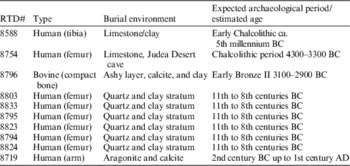
The bones analyzed in this study came from five different sites in Israel. Archaeological and geological information such as the type of bone, burial environment and estimated archaeological periods are summarized in Table 1. Samples with thick cortical bone were preferentially selected. Bones collected had different appearances. Mostly they were light in color with the sediments included in the inside. They were mostly grey or beige and very friable.
List of bones analyzed. For every bone sample, represented by the laboratory number (RTD), the type of the bone, burial environment and the expected archaeological period are specified.

FOURIER TRANSFORM INFRARED SPECTROMETRY (FTIR)
A few milligrams of sample were homogenized and powdered in an agate mortar and pestle. A small amount (about 100 micrograms) of the powder was mixed with FTIR grade KBr and pressed into a 5-mm pellet using a Specac hydraulic press. The homogenization of the sample and mixing with KBr are done for production of a well-homogenized pellet for the analysis and elimination of possible optical artifacts, which can arise when large particles are analyzed. The measurements were carried out on a Nicolet 380 spectrometer. Infrared spectra were obtained at 4 cm–1 resolution for 32 scans.
Prescreening of Bones
At this stage of method development, the final amounts of the reassembled collagen are still unpredictable. For a preliminary, rough approximation of the amount of bone powder needed for extraction of both insoluble and soluble fractions of collagen, we used a prescreening procedure.
The bones were analyzed for the mineral crystallinity based on their “splitting factor” calculated from the height and separation of the phosphate absorption peaks at 603 cm−1 and 565 cm−1 in the infrared spectrum of the bone powder (Weiner and Bar-Yosef Reference Weiner and Bar-Yosef1990; Wright and Schwarcz Reference Wright and Schwarcz1996). The splitting factor provides information regarding the size of the crystals and the atomic order of the lattice. The splitting factor serves as a proxy for general bone preservation.
Collagen Extraction
After the prescreening the bones were pretreated according to the procedure presented in Yizhaq et al. (Reference Yizhaq, Mintz, Cohen, Khalally, Weiner and Boaretto2005) and Boaretto et al. (Reference Boaretto, Wu, Yuan, Bar-Yosef, Chu, Pan, Liu, Cohen, Jiao, Li, Gu, Goldberg and Weiner2009). Each bone was ground to a fine powder with an agate mortar and pestle. Depending on the initial amount of bone, varying amounts of 1N HCl (100–400 mL) were added stepwise until the bone mineral was dissolved. As the starting weights of the bone were relatively high we used 1N HCl for demineralization. The relatively high acid concentration was necessary to keep the resulting solution volumes small enough for continued processing.
After complete demineralization of the bone the sample was centrifuged for 3 min at 3000 rpm. The pellet (insoluble fraction collagen, IF) and the supernatant (soluble fraction collagen, SF) were separated and from hereon, each fraction was treated separately.
Acid Insoluble Collagen—IF
The cleaning procedure for the collagen samples chosen for dating was based on the AAA technique (De Vries and Barendsen Reference De Vries and Barendsen1954). The pellet was washed with distilled water and centrifuged until the suspension reached pH 7. Then the pellet was resuspended in 7 mL of 0.1% NaOH for 15 min and centrifuged again for 7 min at 3000 rpm. If the resulting supernatant after rising is still colored, this decontamination step needs to be repeated. The clear and colorless supernatant was removed and the pellet was washed with distilled water to pH 7. Finally the atmospheric CO2 adsorbed during the alkali treatment was removed by adding 10 mL of 1N HCl for 30 min and washing the pellet until the supernatant reached pH 3. Gelatinization was achieved by heating the pellet in an acid solution pH 3 to 70°C for 20 hr (Law and Hedges Reference Law and Hedges1989). The solution was then filtered through a polyethylene filter (Ezee-filter®) and then by ultrafiltration (Vivaspin 20). The filtrate was lyophilized (HetoLyoLab 3000) to produce dry collagen (Brown et al. Reference Brown, Nelson, Vogel and Southon1988).
Acid Soluble Collagen—SF
The supernatant collected during the demineralization of the bone was centrifuged again for 3 min at 3000 rpm and then filtered through a polyethylene filter (Ezee-filter®), to ensure removal of small particles such as clay and quartz. Spectra/Por®3 dialysis bags with molecular cutoff of 3.5 kD that is suitable for retaining both the collagen molecule and its peptides, were used for dialysis of the resulting solution against water. We chose dialysis tubing with no glycerin as preservative. Prior to use the bags were soaked in distilled water for an hour and then rinsed thoroughly. The solution was placed in the bag, which was closed with dialysis tubing Spectra/Por® clamps. The dialysis bag was then placed in a 3-L glass beaker containing distilled water that was continuously stirred. The water was changed after 1 and 3 hr, and then after 15 hr. At that stage the pH of the solution was 5–6. Sodium azide (0.01%) was added to the solution to prevent bacterial growth. After about 6 hr the sodium azide solution was changed again to distilled water and left overnight. The final pH of the solution was 6–7. The content of the dialysis bag with usually visible precipitation was then centrifuged for 10 min at 3500 rpm and the pellet was subsequently lyophilized (HetoLyoLab 3000) to produce dry reassembled collagen (SF).
Stable Isotope Analysis
Stable isotope analysis was performed on both IF and SF of 3 bone samples. Collagen samples of 0.50–0.55 mg were weighed into tin foil capsules (Elemental Microanalysis Ltd. 5×3.5 mm #D1015). Sample δl3C values were determined with an elemental analyzer (Carlo Erba 1108) linked to a continuous flow isotope ratio mass spectrometer (Optima, Micromass, UK).
Target Preparation and 14C Measurement
Collagen samples were weighed into prebaked (1 hr at 900°C) quartz tubes and sealed with 200 mg CuO in a vacuum line. The combustion to CO2 was done at 900°C for 3 hr.
The reduction from CO2 to graphite was performed in the presence of H2 using 2 mg of Fe as a catalyston a laboratory graphitization line. Prior to reduction the Fe catalyst was activated at 400°C with H2. The graphitization process was carried out at 600°C, with continuous removal of water formed during the process by a Peltieri cooling system, for 12 hr. The resulting graphite was then pressed at 180 psi into an aluminum cathode and its 14C content was measured at the DANGOOR Research Accelerator Mass Spectrometry Laboratory at the Weizmann Institute. All the 14C dates were corrected for isotopic fractionation based on the stable carbon isotope ratio (δ13C value) and reported in pMC in accordance with the established international convention (Stuiver and Polach Reference Stuiver and Polach1977).
RESULTS
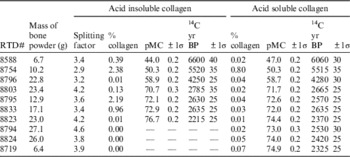
The main aim of this study was to examine the feasibility of using reassembled acid soluble collagen peptides for dating. It was therefore important to date some samples using both the “conventional AAA method” namely the acid insoluble collagen (IF), as well as using the re-assembled soluble collagen (SF). Ten different bones were analyzed for this purpose. The same bone powder was used for the extraction of the two different fractions of collagen.
The splitting factor values calculated for the bones ranged from 2.9 to 4.6 and are presented in Table 2. Only one archaeological bone, RTD 8754, falls in the range of 2.5–3.1 that is reported for fresh bones (i.e. well-preserved bone) (Weiner and Bar-Yosef Reference Weiner and Bar-Yosef1990; Stiner et al. Reference Stiner, Kuhn, Weiner and Bar-Yosef1995; Sillen and Parkington Reference Sillen and Parkington1996). Three of the bones, RTD 8803, 8823, and 8794, had splitting factors higher than 4, suggesting greatly degraded bone mineral (Weiner and Bar-Yosef Reference Weiner and Bar-Yosef1990; Smith et al. Reference Smith, Nielsen-Marsh, Jans and Collins2007). Based on the notion that we are dealing with poorly preserved bones, we used the maximum amount of bone powder available for collagen extraction, namely between 6.4 and 27.1 g. The 14C results obtained, presented both as pMC and as 14C yr BP with corresponding standard deviations, are summarized in Table 2.
Summary of the 14C results obtained for the 10 analyzed bones. 14C results are given as pMC and as 14C yr BP with corresponding standard deviations. For every bone sample, represented by the laboratory number (RTD), the initial weight of the bone powder, the splitting factor, and weight percentage of the resulting collagen both from the acid insoluble and soluble fractions are given.

Taking into account the error in the age of the insoluble and reassembled fractions, most of the samples are in good agreement. The age of the soluble fraction collagen is sometimes younger and sometimes older than the insoluble fraction collagen and there is no clear correlation with the age of the sample. It should be noted that 3 out of 10 samples, RTD 8794, 8824, and 8719, have results only for the soluble fractions as there was no collagen in the insoluble fractions.
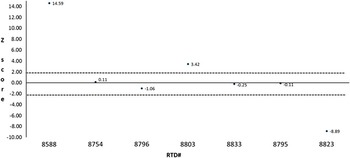
For evaluating the reliability of the results obtained from the soluble fractions we carried out the Z-score test to compare the results of the acid soluble fraction to the standard insoluble fraction results (Figure 1). The Z-score of 2 standard deviations is highlighted. Two samples RTD 8588 and RTD 8823 have extremely high and low Z-scores. Three samples: RTD 8754, 8833, and 8795 are in the range of 1 standard deviation, sample RTD 8796 has Z-score of –1.06 and sample RTD 8803 has Z-score of 3.42.
Z-score values for the 7 pairs of insoluble and soluble fraction collagens analyzed. The Z-score of 2.0 standard deviations is highlighted by dotted line.

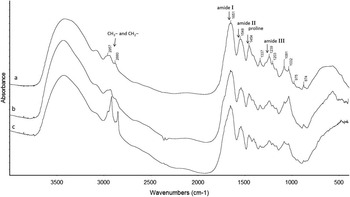
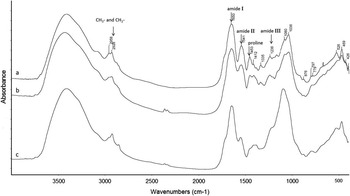
To confirm the presence of collagen and to assess its quality, we monitored the extraction process using FTIR spectroscopy. Figure 2 shows representative spectra of the acid insoluble fraction collagen (b) and the soluble fraction collagen (c) for sample RTD8754 in comparison to a spectrum of a fresh pure collagen (a). This sample (RTD 8754) produced a good agreement between the 14C dates obtained for both collagen fractions. Both spectra (b) and (c) show the characteristic peaks of collagen, namely 1645, 1545, 1450, and 1239 cm−1 representing Amide I and II, proline peak sand the Amide III, respectively. These peaks show the presence of well-preserved collagen. Note that the spectrum of the acid soluble fraction collagen has stronger C-H group peaks (2919, and 2850 cm−1) than in the spectrum of the acid insoluble fraction. This may indicate the presence of organic substances in the acid soluble fraction other than collagen.
FTIR of (a) pure, fresh bone collagen; (b) acid insoluble fraction of sample RTD 8754; and (c) acid soluble fraction collagen of sample RTD 8754.

Figure 3 shows spectra of the acid insoluble fraction collagen (a) and the soluble reassembled fraction (b) for sample RTD 8588. There is a clear difference in pMC between the two fractions (Z score=14.59). Both spectra show the characteristic peaks of collagen as described above. Remnants of quartz (1,080, 797, and 779 cm−1) and clay (1,036, 526, and 469 cm−1) are also present, but there is no clear indication from the FTIR spectra showing the presence of exogenous organic material that could explain the discrepancy between the two fractions. Figure 3 also shows the spectrum of the soluble reassembled fraction for sample RTD 8794. This bone sample yielded only a soluble fraction. This sample has a strong Amide I peak and a weak Amide II peak, it exhibits strong C-H group peaks as well. It may indicate presence of other organic material besides collagen as for instance non-collagenous proteins which do have a strong polysaccharide component. Additional peaks can be assigned to quartz and clay minerals (as described above) that were not removed during the procedure.
FTIR of (a) acid insoluble fraction of sample RTD 8588; (b) acid soluble fraction collagen of sample RTD 8588; and (c) acid soluble fraction collagen of sample RTD 8794.

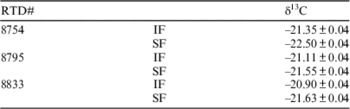
Additional characterization of the soluble collagen fractions in comparison to the insoluble collagen fractions was done by measuring the δ13C of both fractions for 3 bones. The results obtained presented in Table 3.
δ13C values obtained for IF and SF of 3 analyzed bones. The results are given with corresponding standard deviations.

The obtained δ13C values are in the range expected for human collagen (Van Der Merwe and Vogel Reference Van Der Merwe and Vogel1978; Ambrose et al. Reference Ambrose, Butler, Hanson, Hunter-Anderson and Krueger1997; Richards and Hedges Reference Richards and Hedges1999). Although the values for the SF are somewhat lighter, the minor divergence suggests that there is no significant contamination from external source of carbon.
DISCUSSION
Here we present a method for extracting and dating collagen using the reassembled acid soluble fraction of archaeological bones. We rely on the ability of the collagen peptides to reassemble, and in this way we can harvest the reassembled fraction simply by centrifugation. Furthermore, we assume that the reassembly process excludes many of the contaminants that are also present in the acid extract.
To validate the method, we simultaneously extracted both insoluble and soluble collagen fractions from the same starting bone powder. As the method for extraction of acid insoluble collagen is known and well-validated, we regard the 14C concentration of this fraction as the “gold standard” to which we compare the results of the reassembled soluble fraction. Overall, 10 bones were dated. For the 7 samples that yielded both insoluble and soluble collagen, a comparison was possible. The fractions in 2 samples were significantly different; in one RTD 8588, the soluble fraction is much younger than the insoluble fraction and in the other, RTD 8823, it is much older. Besides these two soluble fractions all other 14C results obtained were in good agreement with the expected archaeological age. We also note that in the 5 samples where the 14C concentrations are comparable in both fractions, the deviations are both negative and positive indicating that there is no inherent bias due to methodological issues. At this stage of the research, whether or not there is a correlation between IF and SF weight percentages in the same bone is not yet clear. Interestingly the best agreement or lower z-score is found for the samples with the IF percentage above or very close to 1%.
Three of the samples could be dated only by the soluble fraction collagen. We see this as proof of concept, namely that in some cases when the bone insoluble fraction collagen is degraded, the collagen peptides in the soluble fraction can be reassembled and used for dating. All of the samples that had only soluble collagen fraction yielded ages in the expected archaeological- chronological frame.
We demonstrate here that FTIR can be used to monitor the presence and the quality of the collagen fractions obtained. As the FTIR is not always sensitive or indicative enough regarding possible organic contamination in the sample we suggest using additional quality criteria in the future, such as stable isotope measurements of carbon and nitrogen as a routine part of the procedure. One interesting possibility that needs to be developed in future is that if these quality controls show that the reassembled fraction is contaminated, it is possible to dissolve the fraction again in acid and by using the same procedure allow it to reassemble. This second reassembly process is expected to remove most if not all the remaining contaminants.
CONCLUSIONS
Here we present a method for dating bones in which the normally used acid insoluble collagen fraction is absent. We take advantage of the ability of collagen peptides to reassemble and then harvest the reassembled fraction by centrifugation. Five out of the 7 bones tested by comparing acid insoluble and soluble collagen fractions yielded comparable results. Furthermore, 3 of the 10 bones tested did not have any preserved acid insoluble fractions, but did produce reassembled collagen fractions, demonstrating that this new method for dating bones may prove invaluable for poorly preserved bones.