The number of adults with congenital heart disease (CHD) has been continuously increasing over the last few decades, and almost 90% of children with CHD now survive into adulthood.Reference Moons, Bovijn, Budts, Belmans and Gewillig 1 , Reference Marelli, Mackie, Ionescu-Ittu, Rahme and Pilote 2 Of the entire population with CHD, over 65% are 18 years of age or older.Reference Marelli, Ionescu-Ittu, Mackie, Guo, Dendukuri and Kaouache 3 Many of these adults face challenges, both cardiac and non-cardiac, such as acquired co-morbidities later in life.Reference Baumgartner, Bonhoeffer and De Groot 4 In order to evaluate treatment, symptoms, and the burden of illness, the use of patient-reported outcomes has become important, as patient-reported outcomes are descriptions that come directly from patients about how they feel or function in relation to their health and well-being.Reference Fitzpatrick 5 – 8 Patient-reported outcomes have received increased attention over the past few decades in many fields including CHD.
Since patient-reported outcomes are used in order to capture patients’ perspectives of their health and illness,Reference Marshall, Haywood and Fitzpatrick 9 it is a prerequisite for accurate evaluation to use representative samples, where the patients investigated are representative of the patients seen in clinical care.Reference Lee, Monz, Clemens, Brueckmann and Lip 10 A lack of representativeness is prevalent in clinical cardiovascular research,Reference Hordijk-Trion, Lenzen and Wijns 11 and there are numerous clinical studies with selected patient samples that differ substantially from the real-world population.Reference Lee, Monz, Clemens, Brueckmann and Lip 10 , Reference de Boer, Lenzen and Oemrawsingh 12 , Reference Björklund, Lindahl and Stenestrand 13 Hence, the generalisability of the findings of these studies is hampered. In the context of adults with CHD, there are, to the best of our knowledge, no clinical studies that have focussed on investigating the representativeness of the included sample.
When patients are recruited from registries that comprise demographic, clinical, and health status data, the characteristics of participants and non-participants can be directly compared. This gives a unique possibility to investigate the representativeness of the included sample. The aim of the present study was to compare the demographic, clinical, and health status characteristics of participants and non-participants with CHD in a large patient-reported outcome survey in Sweden.
Methods
Source for patient recruitment
All the data collected for this study came from the national registry SWEDCON (SWEDish registry of CONgenital heart disease) (http://www.ucr.uu.se/swedcon.se). The selected patients belonged to the Swedish cohort “Assessment of Patterns of Patient-Reported Outcomes in Adults with Congenital Heart disease – International Study” (APPROACH-IS).Reference Apers, Kovacs and Luyckx 14 , Reference Apers, Luyckx and Thomet 15 APPROACH-IS is an international, multicentre research project that aims to investigate patient-reported outcomes in adults with CHD. The primary aim was to assess potential differences in four categories of patient-reported outcomes – perceived health status, psychological functioning, health behaviours, and quality of life – in adults with CHD, who are living in different areas of the world. The project is conducted in 24 centres from 15 countries across five continentsReference Apers, Kovacs and Luyckx 14 and included a total of 4028 adults with CHD.Reference Apers, Luyckx and Thomet 15 The Swedish branch of this international study consists of three large tertiary-care centres for adult patients with CHD: Gothenburg, Stockholm, and Umeå. Eligible participants from these centres were selected randomly from SWEDCON, and the patients were categorised based on response or non-response to the self-reported questionnaire from APPROACH-IS. The study was approved before the data search by the Regional Ethical Review Board of Western Sweden (D-nr 744-14) and by the board of directors of SWEDCON.
The national registry SWEDCON was created in 2009 and approved by the Swedish Data Protection Authority. The intention with SWEDCON is to cover CHD in all ages, from birth until death. Since 2014, even fetal examination data are registered in SWEDCON. In 2014, there were 19,236 adult patients with CHD, aged 19 years or older, registered in SWEDCON. The adult patients seen at an adult CHD centre are usually already included in SWEDCON, as most have been seen previously at a paediatric heart centre in Sweden. If not, the patient is included in SWEDCON on the first visit to the adult CHD centre. All patients who consent to be part of the registry – or whose parent(s) consent if the patient is under 18 years of age – are included in SWEDCON. Each patient is informed about the possibility that their data could be used for research purposes and is also informed about the possibility to refuse permission. SWEDCON is built from data collected at every consecutive clinic visit, giving detailed longitudinal information on patients of all ages with CHD. The part of SWEDCON focussing on the adult population consists of the following variables: social and demographic variables (for example, age, gender, marital status, housing, highest education, and employment status) medical data (for example, diagnosis, medication, catheterisation or catheter-based interventions, type of surgery, and need for pacemaker) physiological data (for example, electrocardiogram and echocardiogram), and physical function scored by a cardiologist according to the NYHA classification system. At every visit, reported symptoms are documented and all registered data are updated. In addition, a standardised health status instrument, the EQ-5D questionnaire,Reference Brooks 16 , Reference Dolan 17 which includes five health dimensions (including mobility, mobility, self-care, usual activity, pain/discomfort, and anxiety/depression), and the EQ-visual analogue scale are also used. The EQ-5D questionnaire is sent out before the visit to all adult patients together with the notification of their next appointment at the adult CHD centre. The patient is asked to fill out the questionnaire at home and hand it in at the clinic visit. At some centres, the patients receive the questionnaire during the clinic visit instead and are then asked to fill it out and hand it in.
Patients and sample
Patients eligible for APPROACH-IS were identified and selected in SWEDCON. They had to be in follow-up at one of the three participating adult CHD centres. Inclusion criteria for APPROACH-IS were as follows: (a) diagnosis of CHD, defined as a structural abnormality of the heart or intra-thoracic great vessels that is present at birth and is actually or potentially functionally significant, including mild, moderate, and severe heart defects,Reference Mitchell, Korones and Berendes 18 (b) being 18 years of age or older, (c) being diagnosed with CHD before the age of 10, (d) having regular follow-up at an adult CHD centre or being included in a national or regional registry, and (e) having the physical, cognitive, and language capabilities required to complete the self-report questionnaires. Exclusion criteria were as follows: (a) previous heart transplantation, (b) primary pulmonary hypertension, or (c) impaired cognitive abilities.Reference Apers, Kovacs and Luyckx 14
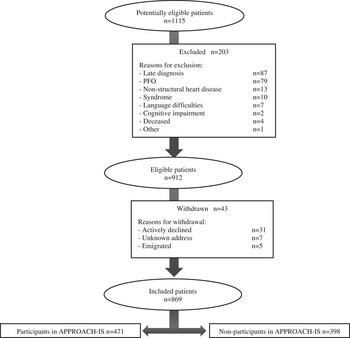
The recruitment goal of APPROACH-IS was to enroll 200 adults with CHD from each centre.Reference Apers, Kovacs and Luyckx 14 In order to compensate for a potential non-response rate of up to 50%, as is generally anticipated in postal surveys, we widened the search to 400 adults from each centre. However, when applying inclusion and exclusion criteria in APPROACH-IS, 400 patients could be randomly selected from Gothenburg and 400 from Stockholm but only 315 fulfilled the criteria in Umeå, because this centre is somewhat smaller than the other two. Thus, a total of 1115 patients in the SWEDCON database were included. As some criteria were not available in the SWEDCON database, the medical files for each patient were also reviewed after the response from the patient. Examples of information from the medical files were whether the patient was diagnosed in adulthood, whether the patient had cognitive impairment or a syndrome, mood or anxiety disorder, and whether the patient had any cardiac admissions during the past year. This step was carried out in order to describe the medical background and investigate whether patient-reported outcomes vary as a function of medical variables. Of the initial 1115 selected patients, 912 patients were eligible after the review of medical records (Fig. 1).
Flow chart of the inclusion process.

Statistical analysis
All analyses in the present study were based on SWEDCON data, in which participation or non-participation in APPROACH-IS was categorised. For descriptive statistics, continuous variables were represented as medians and interquartile ranges as the data were not normally distributed, and categorical variables were expressed as absolute numbers and proportions. For group comparisons between participants and non-participants, the Mann–Whitney U test was used for continuous variables and the chi-square test was used for categorical variables. If the assumptions for the chi-square test were not met, Fisher’s exact test was applied. The level of significance was p<0.05.
In order to calculate the magnitude of the difference, we calculated effect sizes. For continuous variables, an effect size for the Wilcoxon test was calculated by r=Z/√n, where Z is the normal approximation of the Wilcoxon test statistic – that is, the Mann–Whitney U. For categorical variables, Cohen’s w was calculated. The cut-offs for Cohen’s w and r were as follows: 0.1–0.3=small difference; 0.3–0.5=moderate difference; and >0.5=large difference.
Results
Demographic and clinical characteristics
Of the 912 eligible patients, 43 patients (4.7%) either actively declined to participate in APPROACH-IS or could not be reached (Fig. 1), and of the 869 included patients 471 (54.2%) returned the completed questionnaire, categorised as participants, and 398 patients (45.7%) did not return the questionnaire, categorised as non-participants. Thus, these 869 patients form the basis for all the comparisons below.
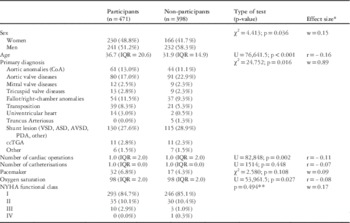
We found statistically significant differences between participants and non-participants for sex, age, primary diagnosis, the number of cardiac operations, and oxygen saturation (Table 1). Participants were more often female, were older on average, more often had high complexity heart defects, and had undergone more cardiac operations; however, the effect sizes were small, except for the difference in primary diagnosis, for which a large effect was found (w=0.89) (Table 1). For the number of catheterisations, the need of a pacemaker, and the distribution of the NYHA functional class, no differences between participants and non-participants were observed.
Demographic and clinical characteristics of participants and non-participants.

ASD=atrial septal defect; AVSD=atrioventricular septal defect; IQR=interquartile range; PDA=patent ductus arteriosus; U=Mann–Whitney U test; VSD=ventricular septal defect
* Cut-offs for Cohen’s w and Cohen’s r: 0.1–0.3=small; 0.3–0.5=moderate; >0.5=large
** Fisher’s exact test
Self-rated health and symptoms
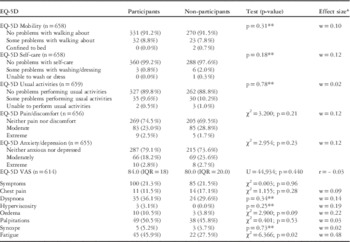
A vast majority of the patients reported no problems in any of the five EQ-5D dimensions (Table 2). Problems were reported most frequently in the pain/discomfort dimension (27.1%) and in the anxiety/depression dimension (23.3%), with no statistically significant differences between participants and non-participants. Regarding how health was rated on the visual analogue scale EQ-visual analogue scale, there were no differences between participants and non-participants. Note that the response rates to all EQ-5D dimensions and the EQ-visual analogue scale did not differ between participants (n=335; 71.1%) and non-participants (n=273; 68.6%) (χ2=0.658; p=0.417). Symptoms were reported by 21.3% of the participants and by 21.4% of the non-participants (Table 2), and except for fatigue, which had a moderate effect size (w=0.48), there were no statistically significant differences regarding reported symptoms between the two groups.
Health status (EQ-5D), health perception (EQ-VAS), and reported symptoms of participants (n=471) and non-participants (n=398)

IQR=interquartile range; U=Mann–Whitney U test
* Effect size by Cohen with cut-offs for Cohen’s w and r: 0.1–0.3=small; 0.3–0.5=moderate; >0.5=large
** Fisher’s exact test
Discussion
In order to establish whether the participating patients in the Swedish branch of APPROACH-IS could be seen as representative of Swedish adults with CHD in general, we compared the demographic, clinical, and health status characteristics of participants and non-participants. We found significant differences between participants and non-participants but mostly with small effect sizes. The differences were generally smaller than in other research trials, both in the cardiovascular fieldReference Björklund, Lindahl and Stenestrand 13 and in general,Reference Vind, Andersen, Pedersen, Jørgensen and Schwarz 19 where participants and non-participants have been compared. The reason for finding smaller differences compared with other cardiovascular trials may be because adults with CHD as a group are more similar in many respects than other cardiovascular patient groups. The level of severity of the heart defect may differ, but experiences in common from childhood may make the group less diverse than, for instance, patients who suffer from acquired heart disease later in life.
Another major reason for the smaller differences could be the fact that we were able to avoid selection bias in our study: all patients were selected from SWEDCON using the same inclusion and exclusion criteria, with additional health variables derived from the patients’ medical records. All our patients were thus cared for in tertiary-care centres and had successfully completed the transfer into adult care. Our results also highlight the benefit of recruiting patients from registries as a way to obtain samples that are representative of the population of interest.
The results showed significant differences in both age and sex between participants and non-participants, but the magnitude of the differences was generally small. Similar to earlier findings,Reference Apers, Luyckx and Moons 20 the impact of age and sex in patient-reported outcomes within this group of patients has been ambiguous. Some earlier studies have shown that women tend to score lower on quality of life than men,Reference Vigl, Niggemeyer, Hager, Schwedler, Kropf and Bauer 21 , Reference Fteropoulli, Stygall, Cullen, Deanfield and Newman 22 whereas other studies showed no differences between the sexes.Reference Silva, Vaz and Areias 23 , Reference Teixeira, Coelho and Proença 24 The same is shown for age: a better quality of life was associated with higher age,Reference Silva, Vaz and Areias 23 or with lower age,Reference Vigl, Niggemeyer, Hager, Schwedler, Kropf and Bauer 21 or quality of life was not associated with age.Reference Teixeira, Coelho and Proença 24 Even if the significant differences we found were to have an impact on the APPROACH-IS study results, the impact would be low, as indicated by the small effect sizes.
Our results further showed a significant difference in primary diagnosis between participants and non-participants, with a large effect size. Significantly more participants had a more complex heart defect, which is in contrast to many other cardiovascular research trials. Other studies have generally shown that participants are healthier and present a lower morbidity and mortality rate than non-participants.Reference Galea and Tracy 25 In epidemiological research studies, it is also shown that participants – responders – are healthier than non-participants – non-responders.Reference Björklund, Lindahl and Stenestrand 13 Unfortunately, the question of why patients with a more complex heart defect tend to participate more often in APPROACH-IS could not be answered by the data in our study. The reason could be connected to other findings within the field, showing that feelings of gratefulness and being committed to life are prevalent among adults living with a complex CHD.Reference Berghammer, Brink, Rydberg, Dellborg and Ekman 26 Being born with a highly complex CHD could in many cases lead to a childhood characterised by a strong awareness of the fragility of life and knowledge of belonging to the first generation of patients with complex, corrected CHD who have survived into adulthood. When speculating about reasons for participating in research studies, one may think that it is connected with the feelings of being committed to life, which might give a strong motivation of also wanting to give something back. This phenomenon has also been shown earlier among heart transplant recipients and is known as “the gift of life”.Reference Rauch and Kneen 27 In this respect, “giving something back” could be achieved through participation in research studies, where the participants are able to tell their stories or provide information on how they are doing and how they feel.
Whether the severity of the diagnosis has an impact on patient-reported outcomes has previously been of interest. Earlier findings have hardly shown any relationship between the two.Reference Overgaard, Schrader and Lisby 28 Where the diagnosis did play a role, it was rather connected with differences in functional class and physical limitations.Reference Teixeira, Coelho and Proença 24 In our study, we also compared functional class and found no differences between the participants and the non-participants. This means that the results from the Swedish branch of APPROACH-IS will not be impacted by the higher number of participants with a more complex heart condition.
Participants and non-participants were also comparable with respect to their self-rated health scores with no significant differences found in any of the dimensions. Both the participants and the non-participants reported the highest occurrence of problems in the pain/discomfort dimension and in the anxiety/depression dimension. It is already known that problems are reported more commonly in these two dimensions. Burström et alReference Burstrom, Johannesson and Diderichsen 29 showed the same tendency when investigating self-rated health within the Swedish general population some years ago. Regarding symptoms, a total of 21% of our sample reported symptoms, and the symptom that differed significantly between the groups was fatigue, showing a moderate effect size. This might be explained by the fact that the APPROACH-IS participants had more complex heart defects, and this severity might be naturally associated with a higher occurrence of fatigue.
Methodological considerations and limitations with the study
A major strength of this study is that the SWEDCON registry provides valuable background variables and clinical information on all patients, which allowed a direct comparison between participants and non-participants. The strength of a well-functioning registry such as SWEDCON is that in addition to medical data and evaluation from the cardiologist it includes self-reported patient-reported outcome data from the patients, which provides a more complete picture of the population under study. Another strength of recruiting study participants from a registry is the potential to provide a non-biased sample on which representativeness could be investigated. By using the registry, we were able to show that the Swedish participants in APPROACH-IS were representative of the Swedish population of adults with CHD. On the other hand, one limitation could be that registries may not provide all of the desired information; for the present study, some of the information had to be collected from the patients’ medical journals instead of SWEDCON. Moreover, one general limitation when using a registry is that the participants and the non-participants are described at a population level instead of individual level. This could lead to difficulty in evaluating other pertinent factors in depth. Another general limitation when using a registry is that the outcome is dependent on other factors such as data registration methods and the level of detail used in the coding of the variables.
Conclusions
The present study shows that our participants and non-participants are relatively comparable groups, and thus the Swedish participants in APPROACH-IS could be seen as representative of the population of adults with CHD in Sweden. Our results also highlight the benefit of recruiting patients from registries as a way to obtain samples that are representative of the population of interest and this study can also be used as an example of this method. Our results reveal some differences in age, gender, and diagnosis between participants and non-participants, but the differences are small, which means that the impact would be low. Another finding was that patients with a more complex heart defect participated to a greater extent, which could not be explained in this study.
Acknowledgements
The authors thank Daniel Andulv for valuable help with data entry of the questionnaires from APPROACH-IS and for reviewing the medical files. We also thank Eva Thydén for valuable help with data entry and for checking data entry errors and Marcus Gustafsson for invaluable help with the final check of the data files. For the process of performing the Swedish part of the APPROACH-IS study, we specifically thank the in-site coordinators Anita Strandberg and Pia Karlström-Hallberg in Stockholm and in-site coordinator Anna-Karin Kronhamn in Umeå for their dedication and enthusiastic involvement in the project.
Financial Support
This study was supported by the Swedish Heart-Lung Foundation through grant number 20130607 and by the University of Gothenburg Centre for Person-Centered Care (Gothenburg, Sweden). Furthermore, the international APPROACH-IS project was endorsed by and conducted in collaboration with the International Society for Adult Congenital Heart Disease (ISACHD).
Conflicts of Interest
None.
Ethical Standards
The authors assert that all procedures contributing to this work comply with the Declaration of Helsinki of 1975, as revised in 2008, and have been approved by the Regional Ethical Review Board of Western Sweden at Gothenburg University.