

Many workplace initiatives, such as team building exercises, are intended to foster cooperation and to consolidate relationships (Dyer, Reference Dyer1995). Other approaches, exemplified by self-managed teams (Yeatts & Hyten, Reference Yeatts and Hyten1998), are instituted to promote autonomy. Finally, some practices, including coaching and mentoring (Fitzgerald, Moss, & Sarros, Reference Fitzgerald, Moss and Sarros2009), are adopted to promote the capabilities and competence of individuals. Since the1980s, at least during periods of economic growth or stability, the level of investment into these trends and similar consulting programs has soared by around 20% a year (O’Mahoney, Reference O’Mahoney2010).
According to the tenets of self-determination theory, these three objectives — relationships, autonomy, and competence — epitomise the core needs of all individuals (Deci & Ryan, Reference Deci and Ryan2000). When these needs are satisfied, individuals experience the hallmarks of wellbeing (Reis, Sheldon, Gable, Roscoe, & Ryan, Reference Deci and Ryan2000), including positive emotions and intrinsic motivation (Sheldon & Filak, Reference Sheldon and Filak2008). Many of the initiatives, approaches and practices of organisations, therefore, should enhance the wellbeing of employees.
Yet, reams of data seem to belie this rosy outlook. Stress has become increasingly rampant in many workplaces (American Psychological Association, 2007). Over the past few decades, the incidence of anxiety (Twenge, Reference Twenge2000) and depression (Twenge & Campbell, Reference Twenge and Campbell2008) has soared, especially in the younger residents of industrialised nations. Furthermore, these problems often seem intractable. After treatments for depression and similar problems, the rate of relapse approximates 40% (Wilson, Duszynski, & Mant, Reference Wilson, Duszynski and Mant2003). Therefore, despite the raft of practices in organisations and societies that, putatively, fulfill the core needs of individuals, mental health has not always improved and, in some instances, has even deteriorated.
This article invokes a theory that could explain this divergence between the initiatives of organisations and the wellbeing of individuals. In particular, according to this theory, many of the practices and initiatives that foster one of these core needs, such as autonomy, may tend to impede the other core needs, such as competence. Past research, however, has not considered or assessed this proposition. This article garners evidence that both corroborates this position and uncovers opportunities to circumvent this conflict, unearthing unrecognised opportunities to enhance wellbeing. The upshot of these arguments is that many workplace interventions may enhance the autonomy, competence, or relationships of individuals, but not improve wellbeing overall. Instead, organisations should implement only the subset of initiatives that simultaneously fulfill two or more of these fundamental needs.
Self-Determination Theory
Self-determination theory dismisses the assumption, promulgated during the early decades of the 1900s (Skinner, Reference Skinner1953), that people are motivated only to secure rewards or to elude punishment. Instead, according to self-determination theory, behaviour is shaped by a natural and universal impetus to grow and develop (Deci, Reference Deci1975). In particular, the self is intrinsically motivated to assimilate the isolated fragments and facets of the psyche — their beliefs, values, and desires, for example — to construct a cohesive and integrated whole (Ryan, Reference Ryan1995).
Yet, three sets of conditions can impede this trajectory. First, in many circumstances, individuals feel incompetent or ineffectual (cf., White, Reference White1959). Consequently, they do not believe they can change their behaviour or inclinations. They cannot fulfill their intrinsic need to integrate their psyche coherently (Sheldon, Ryan, & Reis, Reference Sheldon, Ryan and Reis1996). Their behaviours, for example, may contradict their desires. Consistent with this account, when people receive unfavourable feedback, or are exposed to events that dent their sense of competence, they are not as inclined to perceive their activities as inherently interesting or intrinsically motivating (e.g., Fisher, Reference Fisher1978; Vallerand & Reid, Reference Vallerand and Reid1984).
Second, individuals do not always feel they are granted the right to pursue their values and inclinations. They feel compelled to inhibit these natural tendencies (Deci & Ryan, Reference Deci, Ryan and Kernis1995). Consequently, they do not perceive themselves as causal agents, able to shape their behaviour (cf., deCharms, Reference deCharms1968). Their beliefs, values, and desires, for example, are not perceived as private experiences, amenable to assimilation. Their intrinsic pursuit of growth, therefore, is thwarted (Deci & Ryan, Reference Deci and Ryan2000). Indeed, as research shows, if people feel their autonomy is impeded — as a consequence of financial incentives (Deci, Koestner, & Ryan, Reference Deci, Koestner and Ryan1999), surveillance (Lepper & Greene, Reference Lepper and Greene1975), or similar measures (Harackiewicz, Manderlink, & Sansone, Reference Harackiewicz, Manderlink and Sansone1984) — they are not as likely to feel their activities are inherently interesting or intrinsically motivating.
Third, consistent with attachment theory (Bowlby, Reference Bowlby1988), if people have not developed close, supportive relationships, they do not feel secure or safe enough to explore their environment or to develop themselves (see also Mikulincer, Shaver, & Rom, Reference Mikulincer, Shaver and Rom2011). Instead, they feel concerned about the possibility of rejection or punishment, manifesting as either a fixation or aversion to relationships (Mikulincer, Shaver, Bar-on, & Ein-Dor, Reference Mikulincer, Shaver, Bar-on and Ein-Dor2010). They do not feel they will be supported if problems unfold (Collins & Feeney, Reference Collins and Feeney2004; Collins & Read, Reference Collins and Read1990). They are not, therefore, as inclined to embrace the changes that development entails and cannot fulfill their need to grow. Aligned to this premise is that caring and warm colleagues or leaders tend to foster a sense of intrinsic motivation (Ryan & Grolnick, Reference Ryan and Grolnick1986; Ryan, Stiller, & Lynch, Reference Ryan, Stiller and Lynch1994).
Therefore, when competence, autonomy, and relatedness are cultivated, individuals experience a sense of intrinsic motivation (Sheldon & Filak, Reference Sheldon and Filak2008). They pursue activities that foster coherence. This sense of coherence manifests as wellbeing (Ryan, Reference Ryan1995). As many studies, including experiments (Sheldon & Filak, Reference Sheldon and Filak2008), have established, when individuals feel these three core needs are satisfied, their wellbeing tends to improve (Reis et al., Reference Reis, Sheldon, Gable, Roscoe and Ryan2000; Sheldon & Elliot, Reference Sheldon and Elliot1999).
The Compatibility of Competence, Autonomy, and Relatedness
One of the explicit assumptions of self-determination theory is that all three needs — competence, autonomy, and relatedness — are necessary to foster intrinsic motivation and wellbeing (Deci & Ryan, Reference Deci and Ryan2000). Competence, for example, may not obviate the importance of autonomy or relatedness. Indeed, some research has explicitly corroborated this assumption. For example, as Dysvik, Kuvaas, and Gagne (Reference Dysvik, Kuvaas and Gagne2013) demonstrated, if individuals are not granted autonomy, then competence and relatedness do not enhance intrinsic motivation significantly, representing a multiplicative effect. To foster wellbeing in employees, therefore, organisations need to adopt measures that satisfy all three needs.
Yet, as this paper demonstrates, many if not most workplaces interventions will fulfill one of these needs but impede one or both of the other needs. Two complications may provoke this problem. First, at any time, people are often motivated to pursue only one of these three needs. Consequently, while they strive to satisfy one need, individuals will often dismiss the two other needs.
For example, according to the recent research, when their right hemisphere, relative to the left hemisphere, is especially activated, individuals feel motivated to establish relationships with other people rather than forge power (Kuhl & Kazen, Reference Kuhl and Kazen2008). These individuals, therefore, may not initiate behaviours that foster autonomy or competence, because these needs are central to the pursuit of power (cf., Fast & Chen, Reference Fast and Chen2009) but not to the formation of relationships. Consequently, when individuals feel motivated to establish relationships, they might choose courses of action that foster relationships but impede their autonomy and dent their competence.
Second, even if more than one need could be primed at the same time, individuals may still be unable to foster relatedness, autonomy, and competence simultaneously. The conditions that satisfy these three needs tend to oppose each other.
The remainder of this paper corroborates this claim and delineates solutions that overcome this paradox. Specifically, this paper first clarifies the conditions that foster relatedness, autonomy, and competence. Next, this paper shows how these conditions often contradict or impede one another. Finally, this paper delineates some measures that reconcile these contradictions and therefore promote wellbeing.
The Determinants of Need Fulfillment
The Antecedents of Relatedness
The conditions, culture, and climate of a workplace can affect the extent to which individuals will seek cooperative, supportive relationships. From an evolutionary perspective, individuals become aggressive, rather than cooperative, whenever the hierarchies that govern their community are pronounced but unstable (Kirkpatrick, Waugh, Valencia, & Webster, Reference Kirkpatrick, Waugh, Valencia and Webster2002). Accordingly, the distribution of authority in workplaces should determine whether or not employees tend to be cooperative.
Specifically, in some workplaces, employees tend to assume that every individual occupies one echelon of a hierarchy (Sidanius & Pratto, Reference Sidanius and Pratto1999). Some constituencies are presumed to be inherently superior to other constituencies, called a social dominance orientation (Pratto, Sidanius, Stallworth, & Malle, Reference Pratto, Sidanius, Stallworth and Malle1994). When individuals adopt this perspective, they perceive their environment as a contest, in which everyone strives to scale the hierarchy and outperform their rivals (Duckitt, Wagner, de Plessis, & Birum, Reference Duckitt, Wagner, de Plessis and Birum2002). As research shows, when people embrace a social dominance orientation, they conceptualise the world as competitive and hostile (Duckitt & Fisher, Reference Duckitt and Fisher2003) — an assumption that compromises trust (Cozzolino, Reference Cozzolino2011) and impedes the formation of cooperative relationships (McAllister, Reference McAllister1995).
In other workplaces, employees tend to adopt a more egalitarian perspective (Sidanius & Pratto, Reference Sidanius and Pratto1999). The environment is perceived as benign instead of competitive (Duckitt et al., Reference Duckitt, Wagner, de Plessis and Birum2002). In these surroundings, individuals more readily establish trusting relationships.
Several workplace interventions may inspire employees to espouse this egalitarian perspective. To illustrate, individuals can be inspired to identify with superordinate groups rather than specific constituencies (Jetten, O’Brien, & Trindall, Reference Jetten, O’Brien and Trindall2002). If the same inspiring vision or goal is promulgated to every division of a workplace, individuals may be more inclined to identify with their organisation instead of their team (Berson & Avolio, Reference Berson and Avolio2004; Lickel et al., Reference Lickel, Hamilton, Wieczorkowska, Lewis, Sherman and Uhles2000). Alternatively, if managers depict the challenges that all communities must withstand (Moghaddam, Reference Moghaddam2009), such as climate change, people may conceptualise themselves as members of the human race, orienting their attention to the qualities and characteristics that all humans share, called a humanity self-construal (Harb & Smith, Reference Harb and Smith2008).
When people identify with superordinate groups, such as the human species, they are not as attuned to the permeable and ambiguous boundaries that separate the divisions within an organisation or nation (Gaertner, Mann, Murrell, & Pomare, Reference Gaertner, Mann, Murrell and Pomare1990). The behaviour of specific divisions does not threaten their identity (Gaertner et al., Reference Gaertner, Mann, Murrell and Pomare1990). Social dominance orientation — a mindset that is often provoked by threats from rivals (Morrison & Ybarra, Reference Morrison and Ybarra2008) — will thus abate. Instead, these individuals will feel motivated to establish cooperative relationships (e.g., Buchan et al., Reference Buchan, Brewer, Grimalda, Wilson, Fatas and Foddy2011).
Many studies corroborate these arguments. When individuals identify with a superordinate collective, they are more inclined to trust and like the members of this identity (e.g., Gaertner, Dovidio, Anastasio, Bachman, & Rust, Reference Gaertner, Dovidio, Anastasio, Bachman and Rust1993; Gaertner, Dovidio, & Bachman, Reference Gaertner, Dovidio and Bachman1996). They perceive more people as supportive, moral, and trustworthy.
To sustain this attachment to superordinate groups, individuals need to direct their attention to the attributes and values that all members share (Jetten, Spears, & Manstead, Reference Jetten, Spears and Manstead1998; Jetten, Spears, & Postmes, Reference Jetten, Spears and Postmes2004). That is, if individuals become more attuned to the similarities rather than differences between people (cf., Mussweiler, Reference Mussweiler2001), they are more likely to perceive these people as members of a superordinate community, such as an organisation or nation (Jetten, Spears, & Manstead, Reference Jetten, Spears and Manstead1996). They are, therefore, more likely to behave cooperatively (Sanna, Chang, Parks, & Kennedy, Reference Sanna, Chang, Parks and Kennedy2009). Furthermore, they are more inclined to recognise similarities between themselves and other individuals, also fostering trust (e.g., Miller, Downs, & Prentice, Reference Miller, Downs and Prentice1998).
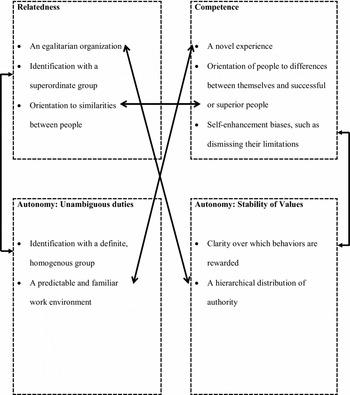
In short, to satisfy the need of individuals to establish relationships, organisations should strive to instill an egalitarian ideology, in which individuals identify with a superordinate group and orient their attention to the similarities between people. These three features are enumerated in the top left quadrant of Figure 1.
Conditions in organisations that foster relatedness, autonomy, and competence.

The Antecedents of Autonomy: Unambiguous Duties
These antecedents of relatedness do not, however, promote autonomy. This conflict between relatedness and autonomy can be distilled from some of the research into regulatory focus theory (Higgins, Reference Higgins1997). To demonstrate, individuals sometimes pursue their hopes and aspirations of the future, called a promotion focus (Higgins, Reference Higgins1987). They strive to accomplish goals that seem important and significant. During other times, however, individuals are motivated to satisfy their immediate duties and obligations, called a prevention focus (Higgins, Reference Higgins1987). They attempt to overcome shortfalls rather than forge progress (Crowe & Higgins, Reference Crowe and Higgins1997).
This orientation to duties instead of aspirations impedes autonomy. To demonstrate, aspirations tend to be encoded as broad, abstract goals that are germane to many contexts, such as ‘Improve skills’ (Forster & Higgins, Reference Forster and Higgins2005). Individuals can explore a variety of avenues to pursue these aspirations (Marguc, Forster, & Van Kleef, Reference Marguc, Forster and Kleef2011). Indeed, this orientation to aspirations tends to promote originality and flexibility (Friedman & Forster, Reference Friedman and Forster2001).
In contrast, duties tend to be encoded as specific, concrete demands, such as ‘Improve ability to sew’ (Forster & Higgins, Reference Forster and Higgins2005). While they fulfill their duties, individuals are granted few choices or alternatives. Their creativity and originality declines (Friedman & Forster, Reference Friedman and Forster2001), and they become more inclined to conform or comply with established standards (Leikas, Lonnqvist, Verkasalo, & Lindeman, Reference Leikas, Lonnqvist, Verkasalo and Lindeman2009). These constraints impede choice and autonomy.
If people do not feel they can satisfy their duties, they do not pursue their aspirations (Schmidt & DeShon, Reference Schmidt and DeShon2007), impeding their sense of autonomy. Specifically, until their duties are fulfilled, individuals feel like they have breached their obligations. They anticipate rejection or some other punishment, evoking apprehension and anxiety (Higgins, Reference Higgins1987; Strauman, Reference Strauman1989). This anxiety tends to orient the attention of individuals to more immediate, specific details (Derryberry & Reed, Reference Derryberry and Reed1998), such as the eyes of a rival, instead of future, abstract aspirations. Aligned to this premise is the finding that individuals prioritise unfulfilled duties over unfulfilled aspirations (Schmidt & DeShon, Reference Schmidt and DeShon2007).
In many circumstances, individuals cannot satisfy their duties, impeding their autonomy. In some instances, individuals are not even certain of which duties they should fulfill. They may be inflicted with many conflicting duties, obligations, responsibilities, and norms (McDonald, Fielding, & Louis, Reference McDonald, Fielding and Louis2013). One manager, for example, may insist they demonstrate initiative, whereas another manager may insist they behave cautiously. Alternatively, the preferences of each manager may be ambiguous or erratic. Consequently, these individuals will not feel they can fulfill all their duties, evoking anxiety (Higgins, Reference Higgins1987), and obstructing their autonomy.
To clarify the duties and obligations of individuals, managers often codify the roles and responsibilities of employees. Position descriptions, key performance indicators, and similar measures are all intended to clarify duties and to override uncertainty (Cornelius, Reference Cornelius2001). Yet, as many theories imply — such as team mental models (Cannon-Bowers, Salas, & Converse, Reference Cannon-Bowers, Salas, Converse and Castellan1993), team situation awareness (Banks & McKeran, Reference Banks and McKeran2005), group learning (e.g., Edmondson, Reference Edmondson1999), and psychological contracts (Rousseau, Reference Rousseau1995) — not all the duties of individuals cannot be translated into words and codes. Instead, individuals learn which duties, obligations, and norms they should observe tacitly and gradually.
Rather than merely codify the roles of employees to clarify their duties, the literature on epistemic motivation uncovers two inclinations that override uncertainty. The first inclination is called seizing (Kruglanski & Webster, Reference Kruglanski and Webster1996; Roets, Van Hiel, & Cornelis, Reference Roets, Hiel and Cornelis2006). Specifically, to override feelings of uncertainty, individuals usually derive conclusions rapidly and prematurely, usually from the most salient information in their immediate environment (Neuberg, Judice, & West, Reference Neuberg, Judice and West1997). For example, they may distill their duties and responsibilities from the norms and standards of their immediate workgroup (Hogg, Reference Hogg, Stroebe and Hewstone2000; Shah, Kruglanski, & Thompson, Reference Shah, Kruglanski and Thompson1998). They will, therefore, emulate the behaviour of other individuals in their social environment. Consistent with this possibility, when individuals feel uncertain, they are especially inclined to imitate or conform to the norms of their groups (e.g., Smith, Hogg, Martin, & Terry, Reference Smith, Hogg, Martin and Terry2007).
Yet, if the members of these groups are diverse and do not conform to a unified constellation of norms, individuals are not as sure of which duties to observe. Therefore, to override uncertainty, individuals tend to gravitate to more homogenous groups (Hogg, Reference Hogg, Yzerbyt, Judd and Corneille2004; Kruglanski, Shah, Pierro, & Mannetti, Reference Kruglanski, Shah, Pierro and Mannetti2002). Indeed, as research shows, when people feel uncertain, they join groups defined by unambiguous and impermeable boundaries in which members share common values, goals, consequences, and attitudes (Hogg, Reference Hogg, Yzerbyt, Judd and Corneille2004). They shun diverse and indeterminate groups (Hogg, Reference Hogg, Yzerbyt, Judd and Corneille2004)
The second inclination that overrides uncertainty complements seizing and is called freezing (Kruglanski & Webster, Reference Kruglanski and Webster1996). After individuals distill their duties, obligations, and responsibilities, they shun experiences that may refute these premature assumptions. They confine themselves to predictable settings, in which their assumptions are likely to be reinforced (Webster & Kruglanski, Reference Webster and Kruglanski1994). They eschew unpredictable, unfamiliar, or novel environments (Neuberg et al., Reference Neuberg, Judice and West1997; Webster & Kruglanski, Reference Webster and Kruglanski1994), uncertain of which behaviours may be punished in these settings.
Accordingly, if individuals are not certain of their duties, they cannot pursue their aspirations, and their sense of autonomy wanes. To promote certainty, and ultimately autonomy, individuals prefer to identify with homogenous, impermeable groups and operate in predictable and familiar, rather than novel or uncertain, environments. These two features appear in the bottom left quadrant of Figure 1.
At first glance, these propositions might seem counterintuitive: a feeling of certainty often coincides with unambiguous rules and unequivocal constraints — rules and constraints that may diminish autonomy. Yet, contrary to this assumption, research indicates that a feeling of certainty decreases the degree to which people feel compelled to conform, instilling a sense of choice and autonomy (Smith et al., Reference Smith, Hogg, Martin and Terry2007).
The Antecedents of Autonomy: Stability of Values
When individuals feel they can satisfy their duties, they become more likely to pursue their aspirations for the future (Schmidt & DeShon, Reference Schmidt and DeShon2007). Yet, as research into self-infiltration has shown, people are not always aware of their aspirations, goals, or values (Baumann & Kuhl, Reference Baumann and Kuhl2003). They sometimes confuse the goals and aspirations they have chosen to pursue with the actions they feel compelled to complete (for neuroanatomical correlates, see Baumann, Kuhl, & Kazen, Reference Baumann, Kuhl and Kazen2005).
If individuals are not certain of their aspirations, they may inadvertently conform to the demands of other people rather than exercise their freedom (Kazen, Baumann, & Kuhl, Reference Kazen, Baumann and Kuhl2003). That is, they may immerse themselves in activities that deviate from their values and aspirations. They may not, therefore, enjoy the benefits of autonomy (Deci & Ryan, Reference Deci, Ryan and Kernis1995). Consequently, to experience autonomy, individuals need to be aware of their values and aspirations of the future.
Self-discrepancy theory (Higgins, Reference Higgins1987), coupled with regulatory focus theory (Higgins, Reference Higgins1997), offer researchers some insight into the conditions that clarify the aspirations of individuals. Specifically, according to these theories, throughout their life, individuals learn which behaviours will be punished immediately. These behaviours are distilled and stored as duties and obligations that people feel compelled to fulfill (Higgins, Reference Higgins1987, Reference Higgins1997). In addition, individuals also learn which behaviours will be rewarded and valued in the future. These behaviours are also abstracted, but stored as hopes and aspirations that people feel inspired to achieve (Higgins, Reference Higgins1987, Reference Higgins1997).
However, if the values of organisations and societies change erratically over time, analogous to an incoherent worldview (Greenberg et al., Reference Greenberg, Pyszczynski, Solomon, Rosenblatt, Veeder, Kirkland and Lyon1990), people cannot be sure which behaviours will be rewarded and valued. They are not certain which achievements will translate to praise, approval, promotions, respect, or wealth. Consequently, individuals are not sure of which aspirations to pursue: People do not commit to goals they do not believe will attract rewards (cf., Vroom, Reference Vroom1982). Because they cannot readily choose behaviours that align with their aspirations, these individuals do not experience the benefits of autonomy.
Therefore, to foster autonomy, many individuals gravitate to settings in which the values and priorities are stable over time rather than erratic and unpredictable. They often cherish the status quo and denigrate wholesale changes, analogous to the status quo bias (Moshinsky & Bar-Hillel, Reference Moshinsky and Bar-Hillel2010). They justify the prevailing systems and defend the existing institutions (Jost & Hunyady, Reference Jost and Hunyady2002, Reference Jost and Hunyady2005). Indeed, as studies show, this inclination of individuals to defend the prevailing institutions can temper feelings of uncertainty, at least temporarily (Jost & Hunyady, Reference Jost and Hunyady2005; Jost et al., Reference Jost, Napier, Thorisdottir, Gosling, Palfai and Ostafin2007).
To justify and to protect these institutions and values, individuals like to uphold the hierarchies that underpin their organisation or society (Jost, Blount, Pfeffer, & Hunyady, Reference Jost, Pelham, Sheldon and Sullivan2003). They reject equality in pay or power, concerned that such changes may shift the distribution of authority and, therefore, decimate the existing values (Jost, Pelham, Sheldon, & Sullivan, Reference Jost, Pelham, Sheldon and Sullivan2003). Research has indeed shown that people who cherish the status quo and defend the prevailing systems do not endorse equality (Jost et al., Reference Jost, Blount, Pfeffer and Hunyady2003; see also McCoy & Major, Reference McCoy and Major2007).
Accordingly, as depicted in the bottom right quadrant of Figure 1, to foster autonomy, individuals strive to clarify which behaviours are rewarded. To facilitate this goal, they prefer stable work environments, in which the distribution of authority seldom changes.
Indeed, consistent with this premise, Zitek and Tiedens (Reference Zitek and Tiedens2011) showed that employees tend to prefer organisations in which the distribution of authority is hierarchical and stable rather than egalitarian and unstable. They perceive organisations that are characterised by a hierarchical and stable distribution of authority as more familiar, efficient, and suitable.
Yet, although employees may prefer a stable distribution of authority, they may not embrace all variants of hierarchy. For example, they may still gravitate to organisations that seek and cherish the contributions of all employees, regardless of position: hence, a stable distribution of authority does not necessarily entail disempowerment or disrespect of other individuals.
The Antecedents of Competence
The antecedents of competence are not the same, and indeed contradict the antecedents of relatedness and autonomy. To cultivate their knowledge, skills, qualities, and capabilities, individuals often expose themselves to unfamiliar experiences and seek unexplored opportunities. These novel experiences have been shown to expedite growth and development (Maddux, Adam, & Galinsky, Reference Maddux, Adam and Galinsky2010). For example, after individuals embed themselves in unfamiliar cultures, they often become more creative as well as receptive to novel perspectives (Fee & Gray, Reference Fee and Gray2012; Leung & Chiu, Reference Leung and Chiu2010; Maddux & Galinsky, Reference Maddux and Galinsky2009).
Research has affirmed this association between the motivation of individuals to enhance competence and the appeal of novel opportunities. For example, when people adopt a learning orientation, in which their primary motivation is to develop their expertise, they are more likely to embrace changes in organisations (e.g., Wang & Takeuchi, Reference Wang and Takeuchi2007).
These novel experiences do not only facilitate learning and development but also affect the cognitive style of individuals. Specifically, in unfamiliar surroundings or cultures, individuals often compare themselves to successful, rather than unsuccessful, people on various attributes (Lockwood, Shaughnessy, Fortune, & Tong, Reference Lockwood, Shaughnessy, Fortune and Tong2012), called an upward comparison. They become more attuned to differences between themselves and exemplary individuals. They might, for example, discover they do not speak as eloquently as successful people.
In response to these insights, many individuals feel motivated to improve and to refine their skills and qualities. They strive to change or regulate their behaviour (Muller & Fayant, Reference Muller and Fayant2010). Other individuals, however, may not feel they can change or improve (Michinov & Monteil, Reference Michinov and Monteil1997). They perceive these comparisons as a threat to their perception of themselves rather than an opportunity to grow (Nussbaum & Dweck, Reference Nussbaum and Dweck2008).
If people do not feel they can develop their repertoire of skills and qualities, upward comparisons can evoke negative emotions, such as envy (Fischer, Kastenmuller, Frey, & Peus, Reference Fischer, Kastenmuller, Frey and Peus2009). To override these emotions, individuals who do not feel they can improve often bias their assumptions. They may, for example, underestimate the qualities of rival communities (Hong et al., Reference Hong, Coleman, Chan, Wong, Chiu, Hansen and Fu2004).
Therefore, in response to upward comparisons, rather than actually modify their qualities, people may inflate their attributes and trivialise their limitations, collectively called self-enhancement biases (Bosson, Brown, Zeigler-Hill, & Swann, Reference Bosson, Brown, Zeigler-Hill and Swann2003). Research has demonstrated the prevalence of these biases. For example, in general, individuals are not as able to recall unfavourable, compared to favourable, information about themselves, called the recall bias (Croyle et al., Reference Croyle, Loftus, Barger, Sun, Hart and Gettig2006). They also overestimate the importance of traits that represent their strengths, called the self-image bias (Lewicki, Reference Lewicki1983, Reference Lewicki1984).
In short, to develop their competence, people often seek novel experiences. In these environments, they become more inclined to recognise differences between themselves and superior or successful individuals, often provoking envy (Fischer et al., Reference Fischer, Kastenmuller, Frey and Peus2009). To override these negative emotions, they sometimes bias their perception of themselves and may, for example, overestimate their importance of their strengths or talents and trivialise their limitations (Lewicki, Reference Lewicki1983, Reference Lewicki1984).
Conflicts Between the Antecedents of These Core Needs
The Tension Between Relatedness and Autonomy
Figure 1 not only enumerates the antecedents to relatedness, autonomy, and competence but also shows how these antecedents contradict one another. For example, as depicted in Figure 1, when individuals identify with a superordinate group, such as an organisation or species, they are more likely to form or maintain strong relationships. In contrast, when individuals identify with a homogenous group, their duties are more likely to seem unambiguous, fostering autonomy. Superordinate groups, however, usually entail an amalgam of diverse and distinct constituencies and, therefore, are not homogenous. Consequently, a key determinant of relatedness conflicts with a key determinant of autonomy, as represented by the leftmost arrow in Figure 1.
Likewise, if the organisation is egalitarian, people are more likely to establish strong relationships. Yet, if the organisation is hierarchical, which behaviours are rewarded will seem consistent over time, priming a sense of autonomy. Egalitarian ideologies conflict with hierarchical ideologies (Jost & Thompson, Reference Jost and Thompson2000). Again, a vital antecedent of relatedness conflicts with a vital antecedent of autonomy, as represented by the diagonal arrow that begins in the top left quadrant.
The Tension Between Autonomy and Competence
Similarly, some of the conditions and measures that promote competence diverge from some of the conditions and measures that promote autonomy. For example, when individuals perceive the work environment as predictable and familiar, they are more likely to feel their duties are unambiguous — promoting autonomy — but are not as likely to develop their competence (e.g., Maddux & Galinsky, Reference Maddux and Galinsky2009), as depicted by the diagonal arrow that begins in the bottom left quadrant.
In addition, to promote autonomy, individuals strive to clarify their aspirations. Yet, as research shows, when these goals are apparent, individuals become more attuned to the aspirations they have not fulfilled (Higgins, Reference Higgins1999). They become aware of their shortcomings and limitations (Higgins, Reference Higgins1999), overriding the self-enhancement biases that can promote a sense of competence, as depicted by the rightmost arrow.
The Tension Between Relatedness and Competence
Finally, some of the conditions that foster strong relationships also conflict with some of the conditions that foster competence. For example, while people consolidate their relationships, they tend to orient their attention to the similarities between people. In contrast, while they strive to develop their competence, people tend to orient their attention to the differences between themselves and another person, typically a successful individual (Lockwood et al., Reference Lockwood, Shaughnessy, Fortune and Tong2012). These orientations to similarities and differences are mutually exclusive (e.g., Mussweiler, Reference Mussweiler2001). Relatedness and competence, therefore, coincide with contradictory mindsets and may thus conflict with each other, as represented by the horizontal arrow.
Practical Implications: Opportunities to Resolve these Conflicts
As Figure 1 indicates, many of the conditions that enable individuals to fulfill one of the core needs impede the other core needs. Many workplace interventions, therefore, may not be as beneficial as hoped. These interventions may, for example, foster relationships or autonomy but dent the competence of individuals or vice versa. This section delineates five overarching themes or interventions that could reconcile these tensions between the core needs.
A Multicultural Ideology
If a multicultural ideology inculcates an organisation, employees are more likely both to establish strong relationships and to feel their duties are unambiguous, fostering autonomy. Specifically, the need in individuals to identify with both superordinate and homogenous groups can be reconciled.
To demonstrate, some people tend to dismiss the differences between various cultures, ethnicities, communities, and divisions. They orient their attention to the qualities that everyone shares, called a colour-blind ideology (Wolsko, Park, Judd, & Wittenbrink, Reference Wolsko, Park, Judd and Wittenbrink2000). Other people, in contrast, embrace these differences, called a multicultural ideology (Wolsko et al., Reference Wolsko, Park, Judd and Wittenbrink2000). They recognise that every community uniquely contributes to society, cultivating a vibrant, enlightened, and progressive environment (Apfelbaum, Norton, & Sommers, Reference Apfelbaum, Norton and Sommers2012).
When people adopt a multicultural ideology, they perceive themselves as members of a rich tapestry of diverse communities. In this sense, they feel aligned to this assortment of constituencies, symbolising an attachment to a superordinate constellation. Consistent with this premise, after people embrace a multicultural ideology, they become more inclined to engage or debate, rather than dismiss or neglect, other cultures (Vorauer & Sasaki, Reference Vorauer and Sasaki2011).
Yet, because they appreciate the differences between various cultures, people in multicultural societies are more willing to preserve their unique traditions. They do not feel the need to relinquish their differences and blend into their surroundings, but are willing to pursue their distinct goals and aspirations (cf., Vorauer, Gagnon, & Sasak, Reference Vorauer, Gagnon and Sasaki2009), reflecting loyalty to a homogenous community. A multicultural ideology, therefore, enables individuals to identify with both the superordinate environment and their more homogenous community.
Managers can implement a variety of interventions to foster this multicultural ideology. For example, after employees are encouraged to contemplate the perspective of other communities, such as foreign customers, they become more likely to espouse this multicultural philosophy (Todd & Galinsky, Reference Todd and Galinsky2012).
Equality of Privileges
When the resources that people covet, such as income or other benefits, are distributed evenly across the organisation, employees can establish strong relationships without obscuring their aspirations or compromising their autonomy. That is, in these work environments, individuals can enjoy the benefits of both egalitarian and hierarchical organisations.
To demonstrate, people like to perceive their society as fair and just (Lerner, Reference Lerner1980). If income and other privileges vary dramatically across the organisation, individuals are more likely to assume that some people are more deserving of these resources — and thus more worthy — than other people, reinforcing a social dominance orientation (Sidanius & Pratto, Reference Sidanius and Pratto1999). In contrast, if these privileges are distributed quite evenly across the organisation, individuals are inclined to assume that everyone is equally worthy, reversing this social dominance orientation. This decrease in social dominance orientation promotes a cooperative, rather than competitive, orientation (Duckitt et al., Reference Duckitt, Wagner, de Plessis and Birum2002) and epitomises an egalitarian ideology (Sidanius & Pratto, Reference Sidanius and Pratto1999).
Yet, equality of income and privileges does not preclude a stable hierarchy. Although most, if not all, employees may covet a sizeable income, they do not all want to be granted the authority to reach decisions. That is, the need for power varies appreciably across individuals (McClelland, Reference McClelland and Wheeler1980). Consequently, the authority to reach decisions can be confined to a subset of individuals. The distribution of power and authority, and hence the values of management, will tend to remain stable over time. Employees will be sure of which behaviours are rewarded and which aspirations to pursue.
Attempts to redress the inequalities of income that permeate many organisations could, therefore, facilitate the formation of relationships but foster autonomy, ultimately enhancing wellbeing. Many studies corroborate this possibility. That is, inequality of income across nations (e.g., Oishi, Kesebir, & Diener, Reference Oishi, Kesebir and Diener2011), states (Wilkinson & Pickett, Reference Wilkinson and Pickett2009), or levels of management (Neville, Reference Neville2012) is, in general, positively associated with various indices of satisfaction and wellbeing.
Experimentation
If employees are encouraged to experiment with novel variations of established routines (cf., Smith, Wagaman, & Handley, Reference Smith, Wagaman and Handley2009), they may be able to extend their competence and expertise while their duties still appear to be unambiguous, promoting autonomy. These individuals may be able to exploit the benefits of both novel experiences and predictable environments.
For example, in some workplaces, a manager may inspire employees to challenge themselves, experimenting with novel variations, largely to uncover potential innovations and efficiencies (Greif & Keller, Reference Greif, Keller, West and Farr1990). Employees may even feel inspired to commit errors deliberately, transcending existing boundaries (Keith & Frese, Reference Keith and Frese2005).
These variations may enhance the skills and competence of employees. Specifically, as studies show, when individuals experiment with variations or departures from the established routines, they learn more effectively (Heimbeck, Frese, Sonnentag, & Keith, Reference Heimbeck, Frese, Sonnentag and Keith2003). They garner more insight and understand more of the subtleties of these tasks than do other people (Chillarege, Nordstrom, & Williams, Reference Chillarege, Nordstrom and Williams2003; Ivancic & Hesketh, Reference Ivancic and Hesketh2000). They can also extend these capabilities to other tasks and circumstances effectively (Keith & Frese, Reference Keith and Frese2005).
Yet, although these employees may experiment with novel variations, their work environment will not seem unpredictable. Instead, in these environments, employees are overtly encouraged to commit errors and to breach entrenched duties (Frese et al., Reference Frese, Brodbeck, Heinbokel, Mooser, Schleiffenbaum and Thiemann1991). They do not, therefore, feel they will be punished unexpectedly in response to unfulfilled duties, diminishing anxiety (Higgins, Reference Higgins1987) and other negative emotions (for evidence, see Keith & Frese, Reference Keith and Frese2005). Because they do not feel vulnerable to unexpected punishment, the environment seems more predictable. Accordingly, individuals can experiment with novel variations but perceive their environment as predictable.
An Emphasis on Development
When organisations underscore and enhance the capacity of individuals to develop their skills and attributes, employees feel they can increase their competence without masking their aspirations or impeding their autonomy. Specifically, in these environments, individuals may not be concerned about their limitations but may still be cognisant of which behaviours are rewarded.
To illustrate, in some organisations, employees may first be encouraged to concede, rather than to conceal, their shortcomings and limitations (e.g., Moss & Couchman, Reference Moss and Couchman2012). People who articulate their limitations during their performance appraisal may be granted opportunities to participate in courses and workshops rather than penalised or relegated. Second, managers may attempt to cultivate an incremental theory of malleability — the assumption that individuals can fundamentally improve their competence and intelligence (Dweck, Reference Dweck2006; Nussbaum & Dweck, Reference Nussbaum and Dweck2008). An incentive scheme, in which rewards depend on the capabilities that people develop, instead of the outcomes they achieve, tends to reinforce this assumption (Robins & Pals, Reference Robins and Pals2002). Finally, managers could enhance the capacity of people to inhibit undesirable tendencies and to develop more adaptive inclinations. For instance, activities and events that evoke positive emotions increase the capacity of people to sustain mental effort and to fulfill this goal (Tice, Baumeister, Shmueli, & Muraven, Reference Tice, Baumeister, Shmueli and Muraven2007).
After this suite of changes is introduced, employees can acknowledge their shortcomings but dismiss the adverse consequences of these limitations. That is, when individuals feel they can enhance their capabilities fundamentally, they perceive these limitations as an opportunity to develop rather than as a threat to their perception of themselves (Dweck, Reference Dweck2006; Nussbaum & Dweck, Reference Nussbaum and Dweck2008). In this sense, they can dismiss the complications of their limitations. They feel they can override these deficiencies and fulfill their need to be competent.
Likewise, because individuals are willing to acknowledge their limitations, they are not as susceptible to the self-image bias (Lewicki, Reference Lewicki1983, Reference Lewicki1984). That is, they will not trivialise the importance of behaviours they have yet to master. Instead, they are willing to ascertain which behaviours are valued and rewarded in their organisation and society, accurately and impartially, unconcerned about the possibility they will uncover more shortfalls in their repertoire. Consequently, when employees genuinely feel they can develop their capabilities, they do not perceive their limitations as detrimental, but are still willing to clarify which behaviours are rewarded.
The Pursuit of Social Justice
Finally, in some workplaces, employees are inspired to redress injustices and to participate in activities or initiatives that are intended to assist disadvantaged communities. These pursuits not only benefit deprived communities, but also inject meaning into the lives of employees, diminishing the incidence of mental exhaustion and burnout (e.g., Grant & Sonnetag, Reference Grant and Sonnetag2010). In addition, these activities or initiatives may also foster relationships and competence.
To demonstrate, before employees participate in endeavours that are intended to assist disadvantaged people, they often conceptualise members of these communities as abstract concepts and not as sentient human beings. That is, employees like to differentiate themselves from these individuals, called the self-protective similarity bias (Gump & Kulik, Reference Gump and Kulik1995). Because of this sense of distance or detachment, they do not appreciate the extent to which these disadvantaged individuals experience the same urges, emotions, and inclinations as all humans, called dehumanisation (for evidence, see Haslam, & Bain, Reference Haslam and Bain2007, Study 3).
In contrast, consistent with construal level theory (Liberman, Trope, & Stephan, Reference Liberman, Trope, Stephan, Kruglanski and Higgins2007), while employees interact with disadvantaged people, this abstract mindset subsides. Instead, these employees become sensitive to the rich, nuanced, and complex features of each person. They recognise these individuals share the same experiences that are common to all humans, such as curiosity and passion (Haslam & Bain, Reference Haslam and Bain2007). Consequently, these employees become more attuned to the similarities that all humans share. They no longer classify people into hierarchical tiers, as shown by Brown (Reference Brown2011).
Nevertheless, although humans may share experiences in common, these employees become more sensitive to the diversity of privileges and opportunities across communities. They may, for example, become more aware of the impediments to education that many communities endure (Brown, Reference Brown2011). They realise, therefore, that everyone shares qualities that are common to all humans, but not qualities that epitomise human progress, such as knowledge or skills (for studies into this distinction, see Haslam, Bain, Douge, Lee, & Bastian, Reference Haslam, Bain, Douge, Lee and Bastian2005).
During this journey, employees may feel helpless, unable to solve the injustices that permeate society (e.g., Dane, Reference Dane2000). They feel an urge to develop their capabilities and to overcome these feelings of futility. This urge, coupled with an awareness that knowledge and opportunities vary appreciably across society, tends to incite upward comparisons. That is, motivated by an urge to improve (Michinov & Monteil, Reference Michinov and Monteil1997), these employees will compare themselves to people who have successfully redressed injustices.
These pursuits, therefore, may underscore some unrecognised similarities across communities, but nevertheless encourage upward comparisons. These two inclinations foster strong relationships and extensive capabilities respectively.
Conclusion
Anxiety, depression, and similar concerns can be notoriously intractable. This article invokes self-determination theory to delineate a series of paradoxes that may impede attempts to improve wellbeing. Specifically, to enhance wellbeing, organisations or societies should cultivate the conditions that foster relationships, autonomy, and competence. Yet, the conditions that enable individuals to fulfill one of these needs tend to conflict with the conditions that enable individuals to fulfill the other needs.
At first glance, these conflicts imply that wellbeing may be unattainable. This article, however, uncovered some possible approaches or ideologies — such as multiculturalism, equality of privileges, experimentation, an emphasis on development, and the pursuit of social justice — that could override these conflicts. Each of these approaches cultivates the features of some condition that fosters one need but precludes the features that impede other needs. For example, if privileges are distributed evenly across the organisation, all employees are perceived as equally worthy, fostering cooperation, but without the need to dismantle the hierarchies of authority, central to autonomy. This framework, therefore, uncovers many opportunities for researchers to substantiate the benefits of these approaches to psychological wellbeing.
Two strands of future research could substantiate this framework. First, some studies could be undertaken to establish whether the conditions that were enumerated in Figure 1, such as egalitarian organisations, identification with homogenous collectives, and familiar environments, are positively associated with one basic need but negatively associated with another basic need. Second, other studies could be conducted to ascertain whether multiculturalism, equality of privileges, experimentation with novel practices, an emphasis on development, and the pursuit of social justice do indeed fulfil more than one need simultaneously.
One of the implications of this framework is that many ineffective, or even detrimental, initiatives may be perceived as beneficial and thus persist unabated. That is, when these initiatives are evaluated, sometimes only the benefits, but not the drawbacks, are measured. The adverse effects of these initiatives might thus be overlooked. Accordingly, managers should gauge the degree to which initiatives enhance autonomy, competence, and relatedness — and, in the future, persist only with the subset of practices and programs that fulfill two or more of these needs concurrently.