1. IntroductionFootnote 1
Situated at the extreme south west periphery of the British Isles, Cornwall's territorial isolation bred cultural isolation which has been construed and reconstrued over time, giving Cornwall a distinctive cultural flavour. Initially borne out by facts of geography, Cornwall, or ‘Kernow’, experiences a dynamic yet enduring peripheral existence (see Payton, Reference Payton1992). This article explores how Anglo-Cornish dialectFootnote 2 words can be used as a means of identity construction, that is, how a Cornish way of speaking is used to construct identities associated with a Cornish way of being. I hypothesise that those who desire greater Cornish autonomy are more likely to use Anglo-Cornish dialect lexis than those who favour further socio-cultural assimilation with England.
The South East of England, and London in particular, typically dominates not only historical narratives of the U.K., but the contemporary socio-cultural and political landscape too (see Payton, Reference Payton1992; Deacon, Reference Deacon2007). Yet, there is a great deal of historical, socio-cultural, and ideological diversity within the U.K. This is particularly exemplified in Cornwall. Indeed, D. H. Lawrence (Reference Lawrence, Zytaruk and Boulton1916/1981: 503) noted that ‘I like Cornwall very much. It is not England . . . it is old, Celtic, pre-Christian’. This sense of difference is visible in Cornwall at many levels of society and social practice, including language. In this article, I explore such differences by investigating patterns of vocabulary variation in the Anglo-Cornish dialect. I consider how Anglo-Cornish dialect words are used in Cornwall to mark socio-economic, cultural, and ideological distance from England.
Early variationist sociolinguists observed that linguistic features, e.g. presence of postvocalic /r/, predictably co-occur with social facts such as age, social class, and gender (see Labov, Reference Labov1972). Not only did those working within this early (variationist) sociolinguistic paradigm identify regular social distributions of linguistic features, they also detected predictable patterns of variation between different contexts of language use, or ‘styles’, such as careful or casual speech (see Labov, Reference Labov1972). Indeed, Snell (Reference Snell2018: 667) observes that early sociolinguistic work on style assumed that ‘all speakers follow the same general pattern with regards to stylistic variation: speakers systematically increase their use of “standard” forms (and decrease their use of vernacular forms) as their perception of the formality of the situation increases’ (original emphasis).
More recent approaches to sociolinguistic style, suggest that linguistic features ‘index’, i.e. ‘construct’ or ‘evoke’ (Johnstone, Andrus & Danielson, Reference Johnstone, Andrus and Danielson2006: 81), social identities including stances, persona types, and membership to socio-demographic groups (Moore & Podesva, Reference Moore and Podesva2009). An association between a linguistic feature, e.g. /t/ release, and a social feature, e.g. ‘politeness’ (see Eckert, Reference Eckert2008) can develop due to a perceived regularity of co-occurrence between /t/ release and polite individuals. Many people are aware that the variety of language people use, even specific linguistic features, can provide clues about where they are from, who they are, and sometimes even what they think. In light of these associations, speakers can stylise their use of language in order to present a desirable social identity, analogous to the ways in which clothing or hairstyle can be used to construct personas such as ‘cool’, ‘rebellious’, or ‘street’ (see Eckert, Reference Eckert2008).
Language can also index affiliation to a regional population. Building on Labov's (Reference Labov1963) seminal work on accent and identity in Martha's Vineyard, sociolinguistic studies of regional identity within England have been largely limited to the Midlands and the North (e.g. Watt, Reference Watt2002; Llamas, Reference Llamas2007). The gap of research on sociolinguistic variation in the South, particularly pertaining to regional identity (although, see Dann, Reference Dann2019), can to some extent be attributed to the trope of cultural homogeneity in the South of England.
Although lexis is a reliable diagnostic of a speaker's regional provenance, little research has explored the social meaning of vocabulary (although, see Kiesling, Reference Kiesling2004; Snell, Reference Snell2018; Sandow, Reference Sandowin prep.). The rich lexical stock of the Anglo-Cornish dialect and the profound sense of local identity of many Cornish people provide an apposite context in which to explore the social life of words. In order to understand the variety of potential social meanings that can be indexed by Anglo-Cornish dialect lexis, one must first appreciate the social dynamics of present-day Cornwall.
2. Cornwall and Cornish identity
Cornwall's duality of place, that is, the constitutionally anomalous and ambiguous position as not quite a nation yet much more than a county, is a ‘fundamental tension’ among its population (Deacon, Reference Deacon2007: 2). Although the need for structural change in Cornwall is broadly a consensus view, the direction and manner of execution of such change is widely contested. This lack of agreement has engendered an ideological tug-of-war between those who favour further assimilation with England and those who advocate greater Cornish autonomy. The current existing parameters of the centre-periphery relationship between (particularly the South East of) England and Cornwall satisfy neither those who desire greater Cornish autonomy, nor those who wish for Cornwall to be more closely aligned to social and cultural practices in (the rest of) England.
Although Cornish identity is perpetually evolving and developing new socio-historical strata, this research focuses on one specific iteration of Cornish identity, that is, the ‘Industrial Celt’ (see Deacon, Reference Deacon2018; Sandow, Reference Sandowin prep.). This identity is comprised of two key components, namely, the Celtic and the industrial. Indeed, Cornwall's Celtic past remains a key ingredient to Cornish identities and is enduringly visible through Celtic iconography, myths, and language (Kernewek). Equally important to this iteration of Cornishness is an industrial identity which was forged into the (proto)national consciousness of Cornwall during the 17th and 18th centuries. Ethnographic participant observation in mid-west Cornwall indicated that orientations towards this Cornish identity is a dimension where locally meaningful linguistic variation is manifested. In order to explore these observations, I conducted a sociolinguistic study on lexical variation in Cornwall.Footnote 3
Specifically, I focus on Redruth, an ex-mining town located in mid-west Cornwall. Redruth is emblematic of Cornwall's historical overreliance on and overspecialisation in the mining industry. During Cornwall's mining boom in the early 18th century, an area on the outskirts of Redruth was known as the richest square mile in the world, yet Redruth is now suffering a dual social and economic stagnation which can largely be attributed to Cornwall's peripheral status (see Payton, Reference Payton1992). Indeed, Cornwall is now, allegedly, the second poorest region in Northern Europe (Inequality Briefing, 2014), with areas of Redruth the second poorest within Cornwall (Cornwall Council, 2015). The nature of Redruth's socio-economic history has shaped the town's identity. On the level of the community, these feelings can be observed in political polls and voting patterns. For example, in 2014, a Survation poll found that 57% of people from Redruth are in favour of greater devolved power for Cornwall. This indicates that people from Redruth are keen to change the structural paradigm of their peripheral existence. I propose that such attitudes are visible at the level of language, specifically vocabulary.
3. The study
This study is concerned with lexical variation of one specific concept, namely, lunch box. In the Anglo-Cornish dialect, the concept lunch box can be realised through the Anglo-Cornish crib (box), or croust (tin), as well as the supra-local English lunch box.Footnote 4 It is important to note that crib and croust strongly index a Cornish identity and are particularly associated with Cornwall's mining history (see Sandow, Reference Sandowin prep.). I consider how lexical variation can be accounted for by a variety of social and contextual factors, such as variation between speakers (inter-speaker variation) and between the same speaker in varying speech styles (intra-speaker variation).
3.1. Method
The study was restricted to a sub-population of the Redruth community. Specifically, it was limited to men due to their well-attested higher rate of local vernacular usage (see Chambers & Trudgill, Reference Chambers and Trudgill1998). Interviews were conducted with 21 white participants aged between 22–80 who self-identified as Cornish, and for whom Redruth was either their place of domicile or their place of work.
Each participant took part in an interview which consisted of lexical elicitation tasks, an identity questionnaire, and a semi-structured conversation regarding Cornwall with a specific focus on dialect and local identity. Firstly, participants completed two spot-the-difference tasks, namely, a ‘table’ scene and a ‘living-room’ scene (see Figures 1 and 2, respectively).Footnote 5 In these tasks, the participants’ attention was focused not on language but on task-completion. Yet, in order to complete the task, by identifying the differences, it was necessary that they use lexical items for the concepts which differ between the two frames. In this case, each task contained an example of a lunch box which differed in colour between each frame. As the lunch box stimulus occurs in two spot-the-difference scenes, speakers each provided two tokens for this variable in this task. In the spot-the-difference tasks, the participants’ attention-to-speech is limited as their primary cognitive load is concerned with completing the task. Thus, this task can be considered to elicit a relatively casual speech style.
The ‘table’ spot-the-difference task scene

The ‘living-room’ spot-the-difference task scene

The spot-the-difference tasks contrast with a ‘naming task’, where participants were told, ‘in this task I'm interested in which words you use’. Participants were shown a prototypical image of a concept, in this case, a lunch box, and asked to name it. In their response, each participant provided one token of the investigated concept. In this task, informants’ attention to speech was markedly high. The key difference between the two types of elicitation procedure is the shift in attentional target, from task completion in the spot-the-difference tasks, to the use of vocabulary in the naming task. A comparison of the usage data elicited from each of these procedures can be considered an analysis of style (cf. Labov, Reference Labov1972). Casual speech is elicited from the spot-the-difference tasks, and careful speech is elicited from the naming task.Footnote 6 In both tasks, all speakers were exposed to a lunch box stimulus, which minimises variation in referential meaning.
As well as completing tasks designed to elicit lexical usage, speakers were also asked to reflect on their sense of place in relation to Cornwall. Participants completed an identity questionnaire (IdQ [cf. Llamas, Reference Llamas1999]) which was adapted specifically for the Cornish context of this research (see Appendix I). Participants were asked to rate the extent to which they agreed with ten statements pertaining to Cornwall from 1 (strongly disagree) to 5 (strongly agree), creating an aggregate score out of 50, where a high score reflected a strong sense of Cornish identity. Additionally, in order to complement this quantitative approach, I engaged in discussions with participants about the Anglo-Cornish dialect and Cornish identity.
4. Results
Patterns of Anglo-Cornish lexical usage are conditioned by ideological and contextual factors. An analysis of lexical variation and IdQ data indicate a distinction in usage patterns of Anglo-Cornish lexis between those with ‘low’ (˂35) IdQ scores and ‘high’ (≥35) IdQ scores. Those who scored above 35Footnote 7 are referred to in the rest of this article as ‘Kernowcentrics’ (n = 12) and those who scored below 35 are given the label ‘Kernowsceptics’ (n = 9). Kernowcentrics are typically characterised by a belief that being Cornish is central to their conceptualisation of self. It was clear from interviews with Kernowcentrics that they, typically, do not accept the status-quo of Cornwall's peripherality. Rather, they orientate themselves towards an alternative structural paradigm, of which Cornwall is at the centre. On the other hand, Kernowsceptics are generally critical of many Cornish people's desire for autonomy and favour further, even total, assimilation with (the rest of) England.Footnote 8 In relation to the centre-periphery model, Kernowcentrics generally desire greater social and cultural distance between the centre (South East England) and the periphery (Cornwall), whereas Kernowsceptics tend to want to minimise this socio-cultural distance.
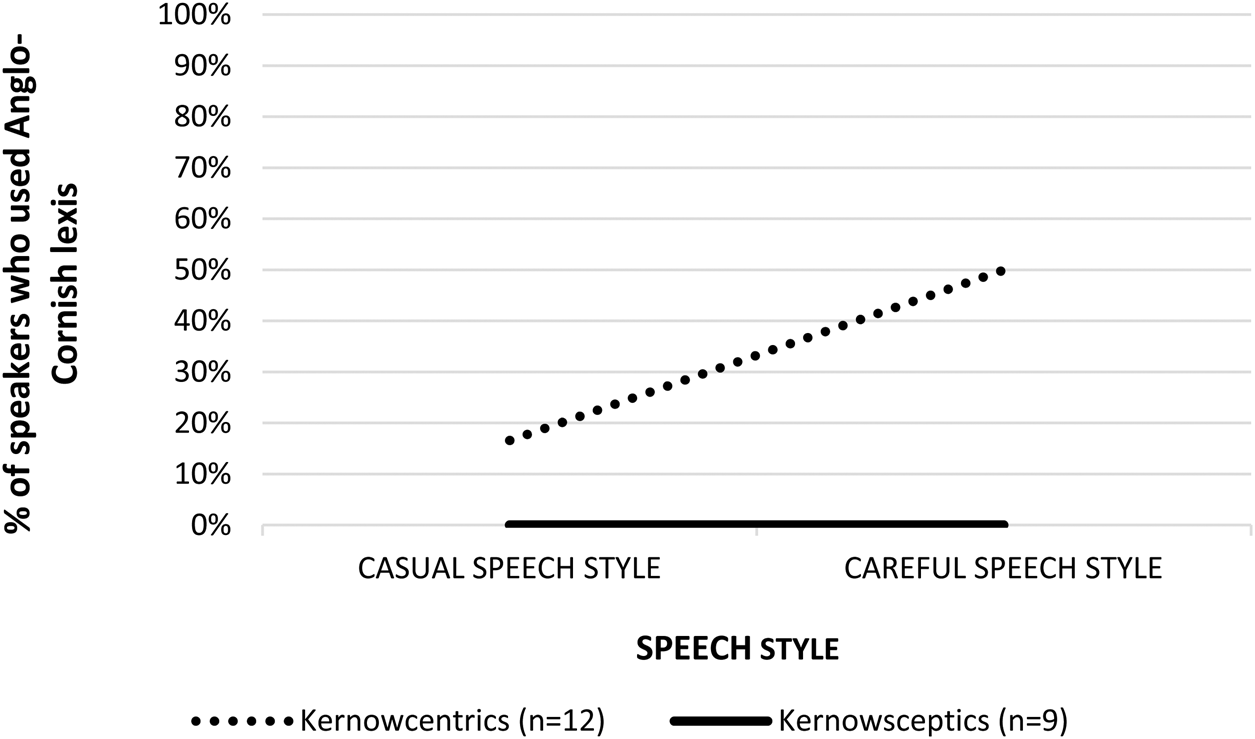
Overall, Anglo-Cornish dialect lexis was elicited from six of the 21 speakers, while the other 15 all used exclusively Standard English variants, e.g. lunch box. These six speakers were not homogenous in their socio-economic class or their age. What united them was an ideological orientation, namely, Kernowcentrism.Footnote 9Figure 3 shows that no Kernowsceptics used the investigated Anglo-Cornish lexical variants, whereas half of Kernowcentrics did so. One can observe from Figure 3 who is using Anglo-Cornish dialect lexis. Specifically, Figure 3 shows that Anglo-Cornish lexis was used by 50% (n = 6) of those with a Kernowcentric ideology and not at all by Kernowsceptics. In order to understand the socio-psychological motivations for this variation, it is also important to explore the contexts in which such vocabulary is being used. Figure 3 also presents the usage data across casual and careful speech styles for Kernowcentrics and Kernowsceptics.
Style, ideological orientation, and use of Anglo-Cornish dialect lexis

Figure 3 shows that the Anglo-Cornish variants crib or croust were employed by two KernowcentricsFootnote 10 in the casual speech style (spot-the-difference tasks) and by six Kernowcentrics in the careful speech style (naming task). That is, when Kernowcentrics are highly aware that their word usage is being observed, they are more likely to use local dialect lexis. Of those who used Anglo-Cornish variants, five used crib and one used croust.
5. Discussion
When speakers are highly attuned to the social meaning of the available lexical options, such as that crib and croust index Cornishness, they can strategically stylise their use of language in order to index social attributes which they perceive to be desirable. When paying attention to their presentation-of-self (see Goffman, Reference Goffman1956), some Kernowcentrics stylistically shift towards an idealised, Cornish, self. In the specific context of the interview, the Cornish aspect of many individuals’ selves was foregrounded and performed through socio-indexically laden lexis. The direction of the stylistic variation evident in Figure 3 is the inverse of the canonical sociolinguistic style pattern, which predicts local dialect variants to decrease in frequency as the attention-to-speech increases. I suggest that this distribution of Anglo-Cornish lexical variants is an inverted style pattern (see Stuart–Smith, Reference Stuart–Smith2014: 254). This pattern, where stigmatised variants are found more frequently in careful speech styles has also been observed in studies of phonetic and phonological variation such as Gafter (Reference Gafter2016) and Reed (Reference Reed2016). I argue that the inverted style pattern in this study can be attributed to a performance of local identity (cf. Schilling–Estes, Reference Schilling-Estes1998).
This seemingly surprising pattern of stylistic variation can be accounted for by Bourdieu's (Reference Bourdieu1977) linguistic marketplace model. This interpretation suggests that language varieties accrue linguistic capital, as part of a broader model of symbolic capital. However, it is not the case that all speakers within a community agree on the value, or the ‘exchange rate’ (see Skeggs, Reference Skeggs1997:11), of the symbolic capital conferred by particular lexical items or, more broadly, whole varieties of language. Typically, it is the case that the standard variety is afforded greater prestige, and, therefore, greater symbolic capital, than overtly stigmatised regional varieties such as Anglo-Cornish. Some speakers, characterised in this study by a Kernowcentric ideology, possess a subverted language ideological value system, in which Anglo-Cornish supplants the standard as the variety which confers the greatest symbolic capital. In the standard language market, Anglo-Cornish lacks status, but in this alternative Cornish marketplace, dialect forms can assert status (cf. Eckert, Reference Eckert2000; Snell, Reference Snell2018). Early sociolinguistic work on stylistic variation largely assumed a standard language ideological orthodoxy which considered the standard variety to be the most favourable (although, see covert prestige, Trudgill, Reference Trudgill1972). Yet, many Kernowcentrics feel disenfranchised and disengaged with institutions associated with the standard language variety. As a result, they do not conform to the standard language ideological orthodoxy, which stigmatises their local variety. Instead, they revert to a local prestige. This subverted language ideology is visible on the level of lexical usage for many Kernowcentrics.
Kernowcentrics’ inverted style-shifting is consistent with informants’ meta-linguistic commentaries. For example, a younger Kernowsceptic, RonFootnote 11, observed that ‘some people like to cement the fact that “I am definitely Cornish, a traditional Cornishman, and I'm going to speak really Cornish so that you know that”’. This was echoed by an older Kernowcentric, Piran, who stated that ‘[the Anglo-Cornish dialect] is a performance, a deliberate performance’. This is significant in terms of centre-periphery relations, whereby Kernowcentrics do not align their value system with the overtly proscribed standard, but, instead, revert to an alternative local prestige.
6. Conclusions
The key findings of this study are that lexical usage patterns can be accounted for by ideological orientation and that, stylistically, crib and croust exhibit an inverted pattern of intra-speaker variation. In the context of centre-periphery relations, local words are being used to increase social and ideological distance between Kernowcentric individuals and Cornwall on the one hand, and England on the other. By analysing the Anglo-Cornish dialect forms crib and croust this article has, despite its relatively small sample size, showcased the value of exploring both social and stylistic variation from a lexical perspective. Using a novel methodological framework to elicit lexical variants on a stylistic continuum, local forms were employed most frequently in a careful speech style. This inverted stylistic distribution suggests that speakers are using their sociolinguistic repertoire in order to perform ‘Cornishness’ and strategically broadcast a locally oriented ideology which is not evident in their unmonitored speech style. Although the informants who used Anglo-Cornish dialect lexis varied in their socioeconomic class and age (see Sandow & Robinson, Reference Sandow, Robinson, Braber and Jansen2018), they were all united in their broadly Kernowcentric ideology. This study has used ideology as a lens on patterns of linguistic (lexical) heterogeneity and presented a data set which is consistent with Eckert's (Reference Eckert2008: 456) claim that ‘[i]deology is at the center of stylistic practice’.
Those with a Kernowcentric ideology, that is, a favourable view of Cornwall and Cornish social practices, typically confer positively valorised social meanings on Anglo-Cornish dialect lexis and ultimately use such words in order to stylise their local identity. Those with a weaker sense of local identity did not wish to sign-post their affiliation to Cornwall and, therefore, did not employ the Anglo-Cornish variants crib or croust. Kernowcentric individuals use local dialect words as a stylistic resource in order to signal their ideological non-conformity in relation to what they perceive to be an undesirable structural paradigm of centre-periphery relations.
Appendix I: Identity Questionnaire

 RHYS J. SANDOW is a PhD candidate and doctoral tutor in Linguistics at the University of Sussex. His doctoral research focuses on the role of regional identity in linguistic, especially lexical, variation and change. He is also interested in the social meaning of lexis and the relationship between lexical usage and perception. In addition to his primary research, Rhys has conducted research on lexicography, health discourses, and Cornish studies. He has published on lexical variation and identity. Email: rs411@sussex.ac.uk