





1. Introduction
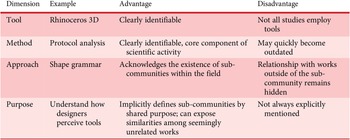
Recent years have seen an increased interest in systematic reviews of scientific literature. This interest reflects our need for resources that can help utilize the plethora of information available for review. Researchers working in design computing, a rapidly growing field, stand to greatly benefit from such resources in making sense of the scientific landscape. As identifying relationships is fundamental to sensemaking (Klein, Moon & Hoffman Reference Klein, Moon and Hoffman2006), we set out to identify the shared themes underlying design computing research. Table 1 lists several dimensions that may serve as the basis for grouping research works, along with some of their advantages and disadvantages.
Examples of potential classification dimensions

Table 1. Long description
Four classification dimensions are compared. Tool: example, Rhinoceros 3D; advantage, clearly identifiable; disadvantage, not all studies employ tools. Method: example, protocol analysis; advantage, clearly identifiable and a core component of scientific activity; disadvantage, may quickly become outdated. Approach: example, shape grammar; advantage, acknowledges sub-communities within the field; disadvantage, the relationships with works outside the sub-community remain hidden. Purpose: example, understanding how designers perceive tools; advantage, implicitly defines sub-communities by shared purpose and can expose similarities among seemingly unrelated works; disadvantage, the purpose is not always explicitly mentioned.
As shown in Table 1, the ‘purpose’ dimension can serve as a useful device for organizing works in the field. However, organizing works by their purpose is a challenging task, as purposes are often implicit and thus require extraction. In this work, we attempt to identify the purposes of research works and use them to organize the field. To extract the purpose of a research work, we focus on the research question pursued as a proxy for the underlying purpose.
Research questions are fundamental to any research activity and can potentially reveal links between seemingly unrelated works (e.g., two researchers may employ different methods to answer the same question and may thus have a shared purpose). Our primary objective is to expose common questions that are explored by researchers, regardless of any specific design domain, technology or method. Therefore, our research question is: What questions are currently being explored by design computing researchers across the field?
A taxonomy for organizing research works in design computing was recently proposed by Kahlon & Fujii (Reference Kahlon and Fujii2025), based on the complete proceedings of a single international conference (Design Computing and Cognition; DCC). This taxonomy can serve as a springboard for mapping the broader field of design computing, but its applicability beyond the conference remains to be examined. In this article, we apply the above taxonomy to the recent proceedings (2024) of two other major conferences in the field, focusing on (1) architectural design (CAADRIA) and (2) engineering and product design education (E&PDE). The choice to focus on recent works is motivated by the fact that technological developments give birth to new questions more often than they eradicate older ones. For example, before the advent of computer systems, questions regarding best practices in utilizing these systems could not arise. However, decades after the introduction of computational tools into design, manual design processes (e.g., sketching on paper) continue to be of interest to researchers (in tandem with more recent practices such as digital sketching).
The result of our analysis is a revised taxonomy that helps organize the questions pursued by researchers in design computing and is grounded in hundreds of research works. To help utilize this classification system, we provide an index of research works associated with each of the questions identified.
Researchers in design computing can use our findings to explore the gamut of questions pursued by other researchers in the field, as well as to retrieve example papers focusing on their question/s of interest. Relatedly, educators can use the proposed classification system for providing an overview of the overarching themes in the field, as well as recommend readings based on specific research questions. Finally, the dataset produced by this investigation may be useful for developing AI models for automating the classification of research works based on the questions pursued.
2. Background
2.1. Design computing
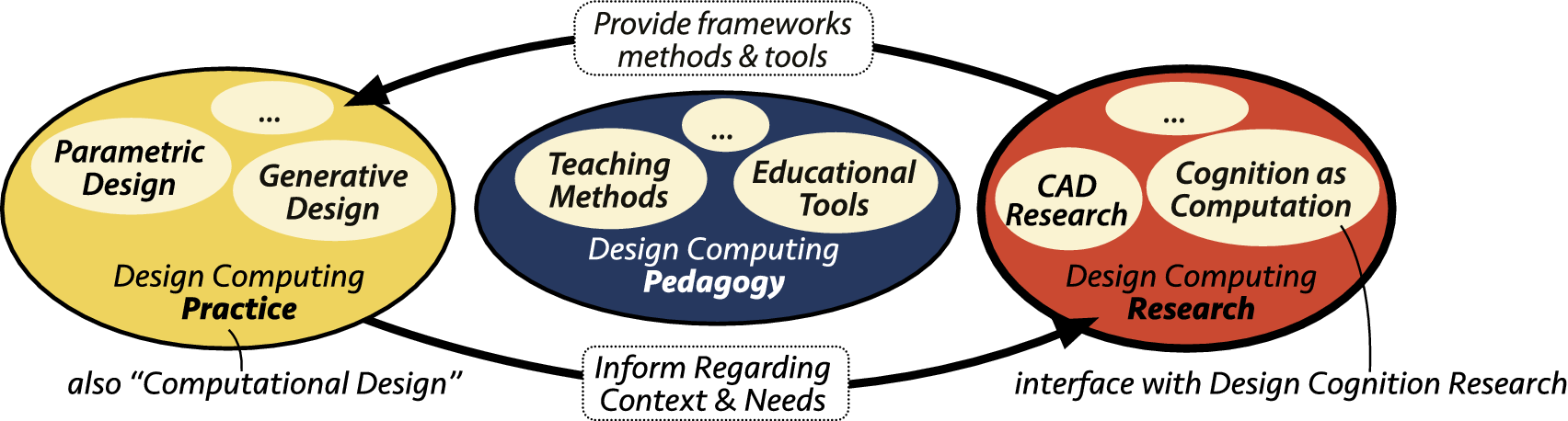
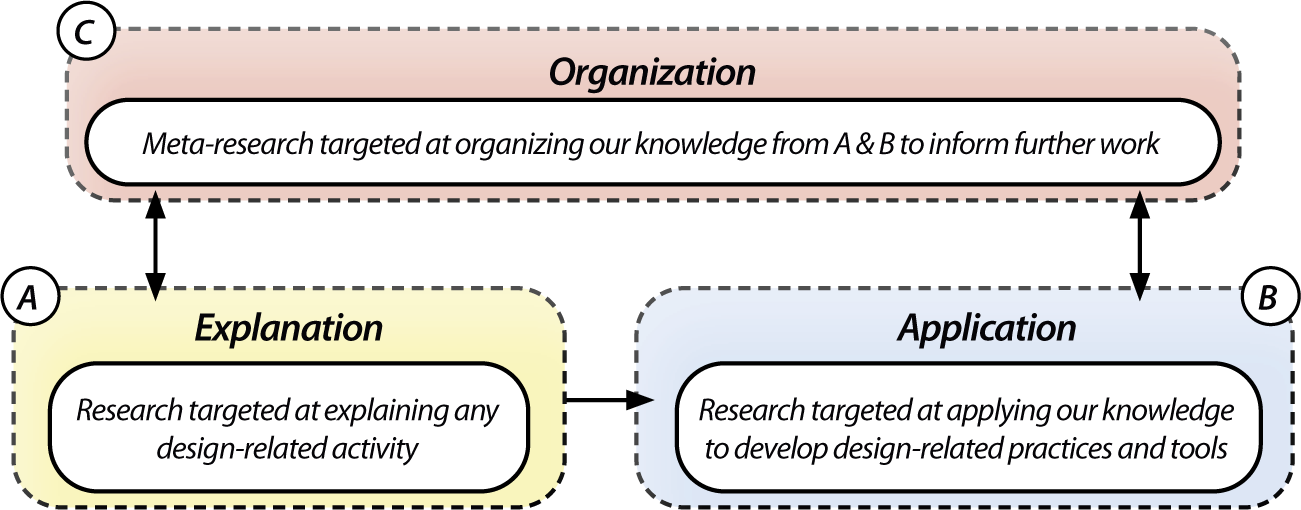
Fundamentally, design computing includes three kinds of activities: practice, research and pedagogy (Gero & Maher Reference Gero, Maher, Martens, Linzer and Voigt1997). Design computing research strives to produce knowledge (models/frameworks) and tools that can be employed in design computing practice, while design computing pedagogy focuses on utilizing such knowledge and tools for educating our future designers and researchers. The relation between these activities is conceptualized below (Figure 1). This work contributes to a better understanding of the landscape of design computing research activity.
Conceptualizing the landscape of design computing.

Design computing is a cross-disciplinary endeavor. Historically, the field was strongly associated with architectural design. For example, the pioneering Key Center for Design Computing and Cognition at the University of Sydney (established in the late 1960s) was situated within the institute’s School of Architecture, Design and Planning. Also, Johnson’s (Reference Johnson2016) well-known overview of design computing has framed it as a discipline that links computer science, design, and the built environment. Academic literature, however, shows that the field encompasses a wide range of domains, e.g., product design (McKay et al. Reference McKay, Ang, Chau, de Pennington and Gero2006), graphic design (Bokil Reference Bokil and Chakrabarti2015), engineering design (Fitzhorn Reference Fitzhorn1994), service design (Kannengiesser & Gero Reference Kannengiesser and Gero2015), interaction design (Hu et al. Reference Hu, Kahlon, Nakatani and Fujii2023), fashion design (Lee, Yang & Sun Reference Lee, Yang and Sun2021) and more.
2.2. Making sense of design computing research
Works providing an overview of design computing practice can be found (Johnson Reference Johnson2016). However, works that provide us with an overview of the field of design computing research are scarce. Therefore, it is important to expand our body of knowledge concerning the structure of design computing research.
In Reference Gero, Maher, Martens, Linzer and Voigt1997, Gero and Maher laid the groundwork for organizing design computing research by identifying three main goals in the field (Reference Gero, Maher, Martens, Linzer and Voigt1997): (1) to develop theories and models of design processes, (2) to utilize the output of 1 for creating design tools and (3) to utilize the output of 1 for design education. This framework was recently used by Kahlon & Fujii (Reference Kahlon and Fujii2025) for extracting a set of research questions that are shared among works in the field, resulting in a taxonomy consisting of five overarching questions and 20 sub-questions. The questions identified there can help create a general map for the field. However, as the above taxonomy was derived from a single international conference, it is essential to examine its generalizability for the proceedings of additional conferences, communities and so forth. To do so, we apply their taxonomy to two other international conferences and then reorganize it, as needed, to encompass a larger number of research works in the broader field.
2.3. Manually extracting research questions from design computing literature
Considering the plethora of articles and materials available, comprehensively mapping research questions in the field would demand automation. Indeed, computational tools have been used for literature reviews in design computing. For instance, Bhatt & Martens (Reference Bhatt and Martens2006) have attempted to map the activity in computer-aided architectural design research, a subset of design computing research, by visualizing relationships between concepts in the form of a network, based on an analysis of 3,000 papers. Additional examples can be found in Topuz & Çakici Alp (Reference Topuz and Çakici Alp2023), who have investigated the usage of programming languages and algorithms in the context of architectural design research, as well as in Kahlon, McComb & Fujii (Reference Kahlon, McComb and Fujii2025), who have explored chronological changes across the proceedings of a given conference via supervised machine learning.
Evidently, there are major benefits of using computational tools in literature reviews, as these allow researchers to:
-
• Process extremely large amounts of information, as demonstrated by Bhatt & Martens’ work (Reference Bhatt and Martens2006), which synthesized thousands of records
-
• Minimize error in analysis processes that focus on the technical details of the investigation (keywords, year of publication, etc.), as reflected in the study by Topuz & Çakici Alp (Reference Topuz and Çakici Alp2023).
-
• Generalize insights from small sets of samples to larger ones, as demonstrated by Kahlon, McComb & Fujii (Reference Kahlon, McComb and Fujii2025)
Despite these benefits of using computational approaches for literature reviews, classifying works by their shared research question is computationally difficult for multiple reasons:
-
• Articles do not always specify their research question(s) explicitly, so that effective extraction depends on the ability of a human reader to derive it via conceptual “reverse engineering”
-
• Even when the questions addressed are stated explicitly, their level of abstraction can hide commonalities between related questions—consider “(how can we) allow end users to personalize their tableware sets, namely to determine the shape of its elements (?)” (Costa & Duarte Reference Costa, Duarte, Gero and Hanna2015, p. 437) and “…how the extraction and presentation of patent data could be improved for designers (?)” (Vasantha et al. Reference Vasantha, Corney, Maclachlan, Wodehouse and Gero2017, p. 209), which are instances of ‘how can we build better digital tools for supporting design practice?’
-
• Utilizing supervised machine learning requires us to manually produce training data that matches research works with the questions pursued (currently unavailable)
-
• Utilizing unsupervised machine learning may produce clusters of works based on dimensions that are not necessarily intelligible for human researchers (Hu et al. Reference Hu, Jiang, Dong, Liu and He2026), and thus require further interpretation according to an existing framework
Therefore, human annotation of a large number of research works can help organize the field in at least three ways: (1) by providing a taxonomy for classifying research works which can serve as a baseline for further manual classification, (2) by providing a means for interpreting the results of automated clustering and (3) by producing data for training models via supervised learning techniques, to help automate the process of classifying works in the future.
3. Aim and significance
Our research aims to help researchers and educators navigate the landscape of design computing research. This article offers (1) a taxonomy for classifying works in design computing research by their research question that is potentially generalizable to a large number of papers and (2) an index listing example papers. These provide an overview of the current activity in design computing research and can help retrieve specific works based on one’s goals/interests.
4. Method
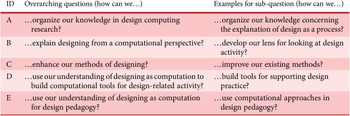
A taxonomy for organizing works in design computing by their research question was developed by Kahlon & Fujii (Reference Kahlon and Fujii2025), based on previous work by Gero & Maher (Reference Gero, Maher, Martens, Linzer and Voigt1997). The taxonomy proposed by Kahlon & Fujii (Table 2), which organizes the field into five overarching questions and 20 sub-questions, was derived from a survey of a single conference. To examine its potential for generalization, we apply it to the recent proceedings (2024) of two other well-known international conferences in the field, then reorganize it to account for the complete set of papers surveyed.
Overview of the taxonomy used in this study for classifying research works (Kahlon & Fujii Reference Kahlon and Fujii2025)

Table 2. Long description
The original taxonomy contains five overarching questions. A asks how to organize knowledge in design computing research, exemplified by organizing knowledge about explaining design as a process. B asks how to explain designing computationally, exemplified by developing lenses for describing design activity. C asks how to enhance methods of designing, exemplified by improving existing methods. D asks how understanding of designing as a form of computation can support computational tools, exemplified by building tools for design practice. E asks how that understanding can support design pedagogy, exemplified by using computational approaches in design pedagogy.
To structure our survey, we draw on PRISMA and organize the activity into two stages of paper selection (which further involves retrieval, screening, and determination of eligibility) and classification and synthesis. PRISMA is an approach for systematizing academic literature reviews by providing researchers with a set of preferred reporting items (Page et al. Reference Page, McKenzie, Bossuyt, Boutron, Hoffmann, Mulrow, Shamseer, Tetzlaff, Akl, Brennan, Chou, Glanville, Grimshaw, Hróbjartsson, Lalu, Li, Loder, Mayo-Wilson, McDonald, McGuinness, Stewart, Thomas, Tricco, Welch, Whiting and Moher2021). This approach has been applied in a wide range of disciplines (Pritchett, Gillberg & Minnis Reference Pritchett, Gillberg and Minnis2013; O’Dea et al. Reference O’Dea, Lagisz, Jennions, Koricheva, Noble, Parker, Gurevitch, Page, Stewart, Moher and Nakagawa2021; How, Tan & Miksza Reference How, Tan and Miksza2022; Sirisha et al. Reference Sirisha, Kumar, Narahari and Srinivasu2025), including design (Hay et al. Reference Hay, Duffy, McTeague, Pidgeon, Vuletic and Grealy2017; C. Valentine Reference Valentine2024).
Furthermore, to complement our manual survey, we applied a computational approach to explore the automated clustering of works based on their full-text content. PDFs of all eligible papers were embedded using the SPECTER2 language model (Singh et al. Reference Singh, D’Arcy, Cohan, Downey and Feldman2022), reduced in dimensionality with t-SNE, and clustered using HDBSCAN (Campello, Moulavi & Sander Reference Campello, Moulavi, Sander, Pei, Tseng, Cao, Motoda and Xu2013). The resulting data-driven clusters were compared with our manual classification to assess alignment and examine the potential for semi-automated mapping of the field.
The rest of this section is organized as follows. First, we describe the processes of paper selection (Section 4.1) and classification and synthesis (Section 4.2). Then we elaborate on the computational approach used for exploring clusters of papers and the ways it was employed to detect groups of works in design computing research (Section 4.3).
4.1. Paper selection
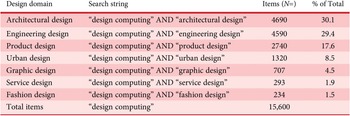
When selecting our target venues, we have considered the distribution of literature in the field across different design domains. An examination of Google Scholar search results across seven design domains (Table 3) shows that over 75% of the literature indexed by the search engine is associated with the following three domains: architectural design, engineering design, and product design. Therefore, these domains must be considered in paper selection. Accordingly, in addition to the DCC conference surveyed in the original work (Kahlon & Fujii Reference Kahlon and Fujii2025), we have surveyed the recent proceedings (2024) of the following international conferences:
-
• Computer-Aided Architectural Design Research in Asia (CAADRIA); representative of architectural design
-
• Engineering and Product Design Education (E&PDE); representative of engineering and product design
Distribution of design computing literature by design domain based on Google Scholar search results

Table 3. Long description
Google Scholar results total 15,600 items for ‘design computing’. By domain: architectural design, 4,690 items (30.1%); engineering design, 4,590 (29.4%); product design, 2,740 (17.6%); urban design, 1,320 (8.5%); graphic design, 707 (4.5%); service design, 293 (1.9%); fashion design, 234 (1.5%). Each domain was searched by combining ‘design computing’ with the corresponding domain phrase.
While no manual survey can feasibly cover the complete range of questions pursued in the field, our choice of venues can be seen as a reasonably representative sample, for several reasons. First, as noted above, the conferences include literature concerning all three major categories of architectural design (CAADRIA), engineering design, and product design (both E&PDE), as well as literature that is interdisciplinary in nature (DCC). Second, considering that design computing includes activities of research, practice, and pedagogy (Gero & Maher Reference Gero, Maher, Martens, Linzer and Voigt1997), surveys of design computing research should include both works concerning practice and pedagogy. This is reflected in the inclusion of both CAADRIA (largely practice-oriented) and that of E&PDE (largely pedagogy-oriented). Finally, our focus on recent literature is motivated by the fact that development in research often results in opening new venues of inquiry, thus expanding the range of questions that can be asked. For example, prior to the advent of generative artificial intelligence, questions concerning the usefulness of such systems for designing could not arise. By contrast, older questions concerning the nature of manual designing continue to be of interest to researchers, despite the development of new tools and methods.
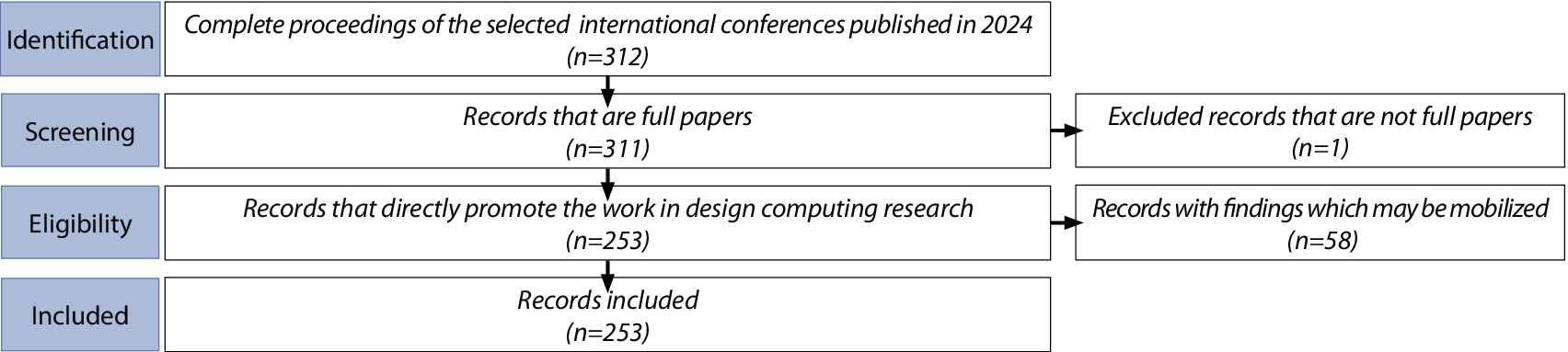
At the initial stage of the selection process, all items were screened to identify those which are not full research/review papers (e.g., abstracts, workshop proposals, etc.), resulting in the removal of one item.
Next, considering that the conferences under consideration are not restricted to design computing, we set out to determine the eligibility of each of the remaining items based on the following criterion: has the paper made a direct contribution to design computing research? A direct contribution was defined as creating/extending/applying a computational framework, model or tool in any design-related activity. This criterion enabled us to (1) include a diverse range of contributions that are directly relevant to the field and (2) only exclude those containing findings that require additional interpretation or mobilization to be regarded as relevant to design computing research. For example, records that dealt with teaching using computational tools without reference to designing (e.g., Kröpfl, Ortner-Pichler & Landschützer Reference Kröpfl, Ortner-Pichler and Landschützer2024) were excluded. However, related records that explicitly linked their investigation with designing, e.g., the work by Barrie (Reference Barrie2024) that focused on design activity in the context of engineering design, were included. Additionally, if a single record reported on more than one investigation, each was regarded separately when extracting research questions. For example, Tunçer et al. have reported on a survey and on an experiment in Virtual Reality (VR). As the former was not deemed a direct contribution, only the latter activity (that involves the usage of a computational tool for hypothesis testing) was included in this survey.
In both stages of screening and determining eligibility, we first examined the title and abstract of the record, then confirmed or altered our decision by consulting its full text. The exact number of records selected from each conference is given in Table 4, and the complete process of paper selection described above is summarized in Figure 2.
Focused conferences and the number of papers selected from each

Table 4. Long description
CAADRIA, focused on architecture: 161 total 2024 items, 1 screened out, 1 excluded by eligibility, 159 included. DCC, focused on design computing and cognition: 33 total, 0 screened out, 3 excluded by eligibility, 30 included. E&PDE, focused on engineering and product design education: 118 total, 0 screened out, 54 excluded by eligibility, 64 included. Grand total: 312 items, 1 screened out, 58 excluded by eligibility and 253 included.
Paper selection process.

4.2. Classification and synthesis
Classification was conducted by a specialist in design computing with over a decade of experience in research and practice activities, spanning multiple disciplines and scales (architectural design, industrial design and interaction design), thus mitigating the bias associated with working in a single discipline. Boundary cases in which deliberation was required were decided following a discussion between the coder and a senior researcher in design computing with over 30 years of experience in the field (both parties are among the co-authors of this work).
Deliberation proceeded as follows: (1) introducing the full text of the record under consideration; (2) introducing one or more questions that can potentially match with it, the reasons for selecting these, and the difficulties that arise when attempting to assign each; (3) receiving feedback concerning the fit between the record and the questions under consideration, which confirms/rejects/reassigns a question to the record. Disagreements were resolved through a simple process of adjudication: (1) for a given question q’, revisit its fit by stepping up to a higher-level question q and examining its fit with the record; (2) consider reassignment to another higher-level question or lower-level question through deliberation until agreement is reached; (3) if different questions were assigned to the record and no agreement could be reached, both questions were maintained as valid matches, to err on the side of inclusion.
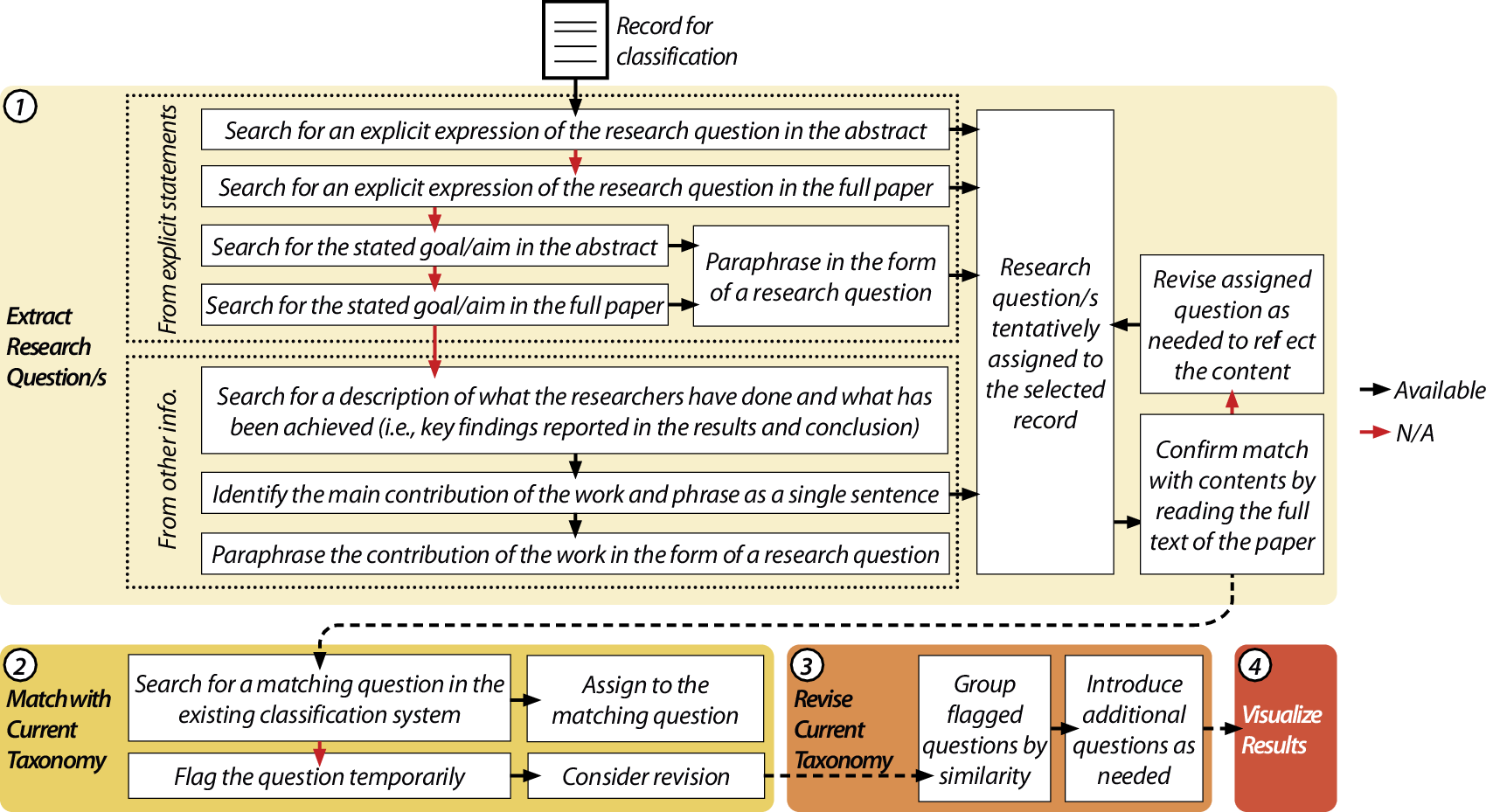
The processes of classification and synthesis were done in four stages: (1) extraction of research questions, (2) matching extracted research questions with the existing classification system, (3) revision of the classification system based on new findings and (4) visualization of the classification results and organization in the form of an index. Each of these four stages is elaborated below. Figure 3 summarizes and illustrates the entire classification procedure for clarity and reproducibility. As the classification process is iterative by nature, the reader should bear in mind that certain steps may be executed multiple times per item.
Paper classification and synthesis process.

Figure 3. Long description
The diagram presents the four-stage paper classification and synthesis process. In Stage 1, the research question pursued by each record is extracted from explicit statements or inferred from the paper’s content. In Stage 2, the extracted question is matched with an overarching question. If no suitable match is found, the record is flagged. In Stage 3, flagged records are examined together to identify commonalities and determine whether the taxonomy should be revised. The revised taxonomy is then used to reconsider the classification of the records. In Stage 4, the final classification results are visualized and organized in the form of an index. The process is iterative, with the taxonomy gradually refined.
In Stage 1, we set out to extract the primary research questions pursued in the record under consideration. In cases where the question pursued was not explicitly stated by the authors, we turned to the claimed goal/objective/aim of the authors. If neither was clearly mentioned, the full text of the paper was used to extract the questions pursued by identifying the primary issue, which was elucidated by the paper. Whether the question was explicitly stated or derived, its coherence with the full text of the paper was confirmed prior to making our decision. Note that certain studies pursued more than one question. For example, the work by Wu et al. has dealt with the improvement of an existing ontology that helps describe designing as a form of computation, as well as with the development of a tool using this ontology (Reference Wu, Wang, Cheng and Kwok2024). Therefore, it was matched with two questions – ‘How can we develop our lens for looking at designing?’ and ‘How can we build tools for supporting design practice?’ – accordingly.
In Stage 2, the research questions extracted at the previous stage were matched with the list of questions identified by Kahlon & Fujii (Reference Kahlon and Fujii2025, p. 22). As mentioned above, certain studies pursued more than one question. Therefore, multi-label assignment was allowed. For each study, we first attempted to match its extracted question(s) with one of the five overarching questions (A, B, C, D or E) and then with its sub-questions. To do so, it was occasionally essential to rephrase the extracted question at a different level of abstraction to enable matching with the questions in the current taxonomy. For example, the specific question of ‘What is the influence of the level of abstraction of a stimulus on creativity as reflected in designers’ brain activity?’ explored by Wang et al. (Reference Wang, Gong, Peng, Soomro, Wang, Georgiev and Gero2024a) can be seen as an instance of the more general question of ‘How can we use computational tools for studying design cognition phenomena?’ etc.
In Stage 3, under the assumption that not all records necessarily fit within the current taxonomy, papers pursuing questions that lacked a clear match were flagged, and notes concerning possible revisions to the taxonomy were taken. Then, similar papers were grouped and used to suggest modifications/additions to the taxonomy. This enabled us to reconsider the current taxonomy to better capture the diverse activity in the field.
In Stage 4, we visualized the results of the classification process to reflect the distribution of research questions pursued, both within each conference and overall. This yielded a useful overview of the questions examined by researchers. Additionally, we have organized the results of the classification in the form of a simple index by listing one study for each question pursued, as well as providing the complete results in Appendix A.
Finally, to examine the reliability of classification, we have executed a post-hoc blind audit on a sample of 14% of the selected records (N = 36/253), extracted using stratified random sampling (N = 12 from each venue). The sampled records were reclassified by the same coder after a washout period exceeding six months, thus mitigating the effect of recall on reclassification. Agreement between originally assigned categories and re-assigned ones was measured using percentage agreement while considering the results of all three subtasks involved in the classification process (assigning an overarching question, assigning a sub-question, and assigning a sub-sub-question). For each subtask, we calculated two scores. First, an absolute misalignment rate was calculated, reflecting the number of records that were misclassified out of the total number of records in the audit. Second, an alignment score was calculated to consider the fact that alignment of the results can be partial due to multi-label classification. The alignment score was calculated as
$ \left(A+\left(B+C+D\right)*0.5\right)/N $
 , where A represents the total number of records that were precisely aligned, B and C represent the possibility of one set of assigned categories containing another (e.g., question X was assigned to a record once, then questions X and Y were assigned to it later), D represents a partial overlap (e.g., questions X and Y were assigned to a record once, while questions Y and Z were assigned to it later), and N is the total number of papers reclassified in the audit.
4.3 Exploratory computational clustering using machine learning
In parallel with the manual classification, we conducted a computational analysis to investigate the potential for automated clustering of the records.
Full-text content was extracted from the PDFs of all eligible records and embedded using the SPECTER2 language model (Singh et al. Reference Singh, D’Arcy, Cohan, Downey and Feldman2022). We selected SPECTER2 because it is designed for scholarly-document representation and thus provides a reasonable off-the-shelf basis for measuring similarity among records in the exploratory clustering analysis performed here. The resulting embeddings were reduced in dimensionality using t-distributed stochastic neighbor embedding (t-SNE). To identify groups of similar records, we applied the HDBSCAN clustering algorithm to the high-dimensional embeddings, allowing as few as 2 samples per cluster (although this limit was not reached). The remaining parameters were left at library defaults (Campello et al. Reference Campello, Moulavi, Sander, Pei, Tseng, Cao, Motoda and Xu2013).
This process provided an additional, independent perspective on the thematic structure of the record set, allowing us to compare and contrast human-coded categories with algorithmically discovered clusters and to consider the implications for semi-automated mapping of the design computing research landscape.
5. Results
The processes of classification and synthesis have yielded three overarching categories for classifying research questions in design computing research. In the following subsections we present each category in detail, including the questions and sub-questions associated with it (Sections 5.1–5.3). We provide ample examples by referring to papers in our sample, including at least one example from each conference surveyed, where available.
Concerning the results reported in Sections 5.1–5.3, agreement rates between the original classification process and the post-hoc audit were as follows. On the subtask of classifying records by the overarching question pursued, absolute misalignment stood at ~8.33%, and the overall alignment score was ~86.1%. On the lower-level task of classifying records by sub-questions, absolute misalignment was similar (~8.33%), and the alignment score was slightly lower than in the previous subtask (80.55%). Finally, on the lowest-level classification subtask of classifying records by sub-sub-questions, absolute misalignment was highest (~13.88%), and the alignment score was lowest, yet remained at an acceptable level considering the complexity of the classification task (~70.83%).
The results reported in Sections 5.1–5.3 are then synthesized in the form of a taxonomy for classifying research works in design computing, given in Section 5.4. After presenting the taxonomy, we elaborate on its relationship with past taxonomies, which helped develop it. Finally, we present the results from our computational exploration of automated clustering using machine learning (Section 5.5).
5.1 Category A – explaining design-related activities
Work in this category focuses on obtaining new knowledge concerning the explanation of design phenomena, including how human designers engage in designing, how we teach or learn to design, and more. The general question that unites works in this category is—how can we explain design-related phenomena from the standpoint of design computing research? This question is then elaborated into two primary sub-questions, focusing on the explanation of design practice and of design pedagogy. We elaborate on each of these in Sections 5.1.1 and 5.1.2, respectively. An overview of this category is given in Table 5.
Overview of questions pursued in category A

Table 5. Long description
Category A concerns explanation of design-related phenomena. For design practice, the question is how to understand design practice from the standpoint of design computing research; its sub-questions ask how to develop lenses for describing designing as computation, build computational tools for inquiry into design, and use lenses and tools to study designing computationally. For design pedagogy, the question is how to understand design pedagogy from the standpoint of design computing research; the listed sub-question asks how to use lenses and tools to study design pedagogy computationally.
5.1.1. Explanation of design practice
The first sub-question in category A reflects our desire to understand how we engage in designing—how can we understand design practice from the standpoint of design computing research? This includes the explanation of designing with computational tools, as well as the application of computational tools or approaches for explaining design activity. Three sub-questions are nested under this question.
First, certain works help develop our ways of viewing design activity—how can we develop our lens for looking at designing from a computational perspective? For example, Lim (Reference Lim2024) has proposed a framework for conceptualizing the usage of AI tools in designing (“seeing-instructing-seeing”), based on interviews held with design professionals and experiments with novice designers. Relatedly, Urquhart, Petrakis & Wodehouse (Reference Urquhart, Petrakis and Wodehouse2024) have proposed a framework for understanding users’ engagement with digital tools (“orders of engagement”) as a basis for enhancing interaction design practices.
Second, researchers are creating tools for augmenting our ability to study design—how can we build computational tools for inquiry into design? For example, Yildirim et al. (Reference Yildirim, Globa, Brambilla and Gocer2024) have explored the augmentation of virtual reality (VR) space with smell to enhance our ability to study users’ responses to multisensory architectural environments. Relatedly, the visualization tool proposed by Paravizo & Crilly (Reference Paravizo, Crilly and Gero2024) for exploring design spaces can be utilized for design cognition research.
Third, the theoretical lenses and tools developed by researchers pursuing the above questions are applied for the purpose of explaining design activity—how can we use our lenses and tools to study designing from a computational perspective? Here, we distinguish between testing hypotheses by employing computational approaches and tools and testing hypotheses about computational tools. As examples for testing hypotheses via computational approaches and tools, consider the work by Kelly et al. (Reference Kelly, Greentree, Sosa, Evans and Gero2024), who have applied linkography (Goldschmidt Reference Goldschmidt2014) in conjunction with knowledge concerning framing (Dorst Reference Dorst2015) to visualize framing activity in designing based on protocols; the work by Shi & Economou (Reference Shi, Economou and Gero2024), who have applied the lens of shape grammar (Stiny Reference Stiny1980) to formally represent a traditional Chinese architectural element; the work by Huang, Song & Qiu (Reference Huang, Song and Qiu2024), who have analyzed the relationships between environmental attributes and cycling behavior using linear and spatial regression models; and the work by Sitarama & Agogino (Reference Sitarama and Agogino2024), who have tried to predict the success of product design teams from design data by computing a newly proposed index (“creative tension balance”) for measuring team performance. As examples for testing hypotheses about computational tools, Arisman et al. (Reference Arisman, Widiastuti, Indraprastha and Sudradjat2024) have examined the usage of generative design for the purpose of form finding among architects at the schematic design stage, and Rodriguez-Ferradas et al. (Reference Rodriguez-Ferradas, Cantós, Viñeta and Morer2024) have studied the application of AI tools in industrial design. Relatedly, focusing on the usage of generative AI by designers, D’souza & Dastmalchi (Reference D’souza, Dastmalchi and Gero2024) have studied the relationship between prompts and the production of creative output.
5.1.2. Explanation of design pedagogy
The second sub-question in category A reflects our desire to understand how we engage in design pedagogy—how can we understand design pedagogy from the standpoint of design computing research? Surveyed papers in this category have focused on the more specific question—how can we use our lenses and tools to study design pedagogy from a computational perspective? As with the corresponding sub-question in Section 5.1.1, we distinguish between studying design pedagogy by using computational tools and studying design pedagogy focusing on the usage of tools. Concerning the former, the tool developed by Paravizo & Crilly (Reference Paravizo, Crilly and Gero2024) mentioned earlier was also suggested as a means for inquiring into human cognition in design pedagogy. Concerning the latter, computational tools often change the ways in which we teach and learn, which prompts the study of these changes. For example, Loh & Jahn (Reference Loh and Jahn2024) have reported on a case study of using Augmented Reality (AR) technology in architectural design education to examine its impact on the process of designing and fabricating a room-scale installation. Additionally, Bartlett, Mills & Hagins (Reference Bartlett, Mills and Hagins2024) have studied the effectiveness of AI-powered sketching tools in helping students generate concepts with a high degree of legibility; Jiménez Romanillos & Andersson (Reference Jiménez Romanillos and Andersson2024) have used Bloom’s taxonomy (Reference Bloom, Engelhart, Furst, Hill and Krathwohl1964) to learn about the usage of AI tools by students in a product development course; and Chen, Lucchini & Simpson (Reference Chen, Lucchini and Simpson2024) have observed students’ usage of AI tools for producing culturally relevant designs. Such studies occasionally focus on understanding users’ perceptions regarding computational tools. For instance, Koolman et al. (Reference Koolman, Clay, Li, Jiang, Goldstein, Xie, Demirel, Sha and Gero2025) have studied the attitudes of students toward various design approaches, including computational and non-computational ones.
5.2. Category B – applying our knowledge for enhancing design-related activities
Works in this category focus on utilizing the knowledge produced in category A and organized in category C for enhancing our tools and practices. The general question that binds works in this category is—how can we apply our knowledge in design computing research to enhance our future tools and practices? This question is then elaborated into two sub-questions, given in Sections 5.2.1 and 5.2.2, respectively. An overview of this category is given in Table 6.
Overview of category B

Table 6. Long description
Category B concerns applying design computing knowledge to enhance future tools and practices. For design practice, the question asks how to apply knowledge to enhance practice, with sub-questions on using current computational approaches or tools and creating new approaches or tools. For design pedagogy, the question asks how to apply knowledge to enhance pedagogy, with sub-questions on using current computational approaches or tools in pedagogy and creating new approaches or tools for pedagogy.
5.2.1. Applying our knowledge for enhancing design practice
The first sub-question in category B reflects our desire to enhance our design-related practices—how can we apply our knowledge in design computing research for enhancing design practice? The two questions nested under this question are presented below.
First, researchers are using our existing approaches and tools to enhance design—how can we use our current computational approaches/tools in design practice? For example, Jowers, Clarke & Moat (Reference Jowers, Clarke, Moat and Gero2024) have used structural simulation for creating a “catalog” that helps match variations of honeycomb-shaped designs with their structural performance. Such a catalog expands our body of knowledge concerning the behavior of complex geometry, which can inform its application in design. While the previous example shows how a tool can be utilized to expand our body of knowledge concerning design, researchers are also producing knowledge concerning the usage of the tools themselves. For instance, Feng et al. (Reference Feng, Hélie, Panchal and Gero2024) have proposed a way to make efficient use of Large Language Models (LLMs) by prompting them with personas, thereby helping designers to increase the diversity of output when using this technology. Relatedly, R. Valentine (Reference Valentine2024) explored prompt engineering for utilizing AI in product design. Additionally, Sun, Meng & Wang (Reference Sun, Meng and Wang2024) have highlighted the limitations of applying various indices for measuring the compactness of urban form in different settings and matched each with a scenario in which it is effective. A further distinction can be made between developing our practices of designing with computational tools (described thus far) and those for the design of artifacts that include a computational component. As an example for the latter, consider the study by Lai (Reference Lai2024), who has explored the construction of an architectural element that responds to the users’ emotional state.
Second, the development of computational tools opens new possibilities for designing—how can we develop new practices through computation? For example, Guo et al. (Reference Guo, Zhang, Zhang, Li and Kong2024) have proposed a brain-computer interface for interactive spatial design using an electroencephalogram (EEG). As design is increasingly becoming interlinked with fabrication processes, the phrase “new practices” should be understood in a broad sense, which includes the conversion of design documentation (Gero Reference Gero1990) to physical prototypes. For example, Benros, Hashemi & Su (Reference Benros, Hashemi, Su and Gero2024) have implemented a shape grammar to streamline the process of architectural design and fabrication using robotic extrusion, then used it for the construction of a physical micro-house. Relatedly, Skevaki et al. (Reference Skevaki, Kladeftira, Pittiglio and Parascho2024) have proposed an interactive workflow for the design and fabrication of timber assemblies, which facilitates effective human-robot collaboration.
5.2.2. Applying our knowledge for enhancing design pedagogy
The second sub-question of category B reflects our desire to enhance our design pedagogy—how can we apply our knowledge in design computing research for enhancing design pedagogy? The two questions nested under this sub-question are presented below.
First, to utilize developments in design computing for the benefit of design pedagogy, we must produce knowledge concerning the utilization of existing/emerging tools and approaches—how can we use our current computational approaches/tools in pedagogy? Typical studies suggest ways to reconsider/adapt our curricula considering the technological developments. For example, Barrie (Reference Barrie2024) has questioned the relevance of traditional technical drawing practices in the current age, Calixto & Croffi (Reference Calixto and Croffi2024) have proposed a framework for teaching computational design to undergraduate and graduate students, Contreras Garcia (Reference Contreras Garcia2024) has attempted to integrate VR into a first-year product design class, and more. Beyond content-focused adaptations to curricula, effective ways to utilize computational tools for the benefit of pedagogy are also being proposed. For example, Silva et al. (Reference Silva, Buzzo, Hernández-Ramírez and Ayanoglu2024) have proposed ways to help reduce bias among learners when using generative AI, thereby facilitating ethical usage in educational environments.
Second, we can also enhance design pedagogy by developing computational tools/approaches to support teaching and learning—how can we create new approaches/tools for design pedagogy? For example, Hadiatmadja (Reference Hadiatmadja2024) proposed the possibility of augmenting digital design education in architecture using an AI-powered conversational avatar. Relatedly, an AI-driven system for personalized learning of CAD was proposed by Kravchenko & Green (Reference Kravchenko and Green2024). Additionally, Kelly et al. (Reference Kelly, Greentree, Sosa, Evans and Gero2024) have proposed an approach for automatically visualizing information concerning design cognition in near-real-time, which is potentially applicable for supporting design pedagogy.
5.3. Category C—organizing our knowledge in design computing research on a meta-level
Work in this category focuses on the organization of knowledge in design computing research, to bring clarity regarding our current understanding, expose research gaps, synthesize findings, and more. The general question that unites works in this category is: how can we organize our knowledge in design computing research? This question is then elaborated into three sub-questions, as explained hereafter. An overview of this category is given at the end of this subsection in Table 7.
Overview of category C

Table 7. Long description
Category C has the purpose of organizing knowledge in the field. Its overarching question is how to organize knowledge in design computing research. Three sub-questions ask how to organize knowledge concerning: the explanation of design-related activities; the enhancement of design-related activities; and the structure of the field as a whole.
First, certain works survey our knowledge regarding the explanation of design-related phenomena—how can we organize our knowledge concerning the explanation of design-related activities? For instance, to help study design creativity, Wang et al. (Reference Wang, Soomro, Gong, Georgiev and Gero2024b) reported on a PRISMA review of papers in which EEG was employed for this purpose and highlighted the neurocognitive indices that may be used by such studies. Note that “design-related activities” encompass design practice, design pedagogy, as well as other activities (marketing, management, etc.).
Second, meta-level research is being conducted focusing on developing and applying better practices and tools—how can we organize knowledge concerning the enhancement of design-related activities? An example is the work by Bordas et al. (Reference Bordas, Le Masson, Thomas and Weil2024), who have examined the literature on generative artificial intelligence to provide an overview of the content that can be generated by these tools in design. Further, in the context of tools for the architecture, engineering, and construction industry (AEC), Rafizadeh et al. (Reference Rafizadeh, Belek Fialho Teixeira, Donovan and Schork2024) have proposed a taxonomy for organizing the kinds of automation enabled by computational tools. Moreover, to support the navigation of design spaces, Paravizo & Crilly (Reference Paravizo, Crilly and Gero2024) have reviewed existing studies on design space representation. Finally, to shed light on the roles of AI in the context of design education, Ge & Fan (Reference Ge and Fan2024) have surveyed the literature on using AI in design pedagogy, as reflected in the perceptions of educators.
Third, researchers are also attempting to describe the overarching structure of the field itself—how can we organize our knowledge concerning the field as a whole? Works pursuing this question strive to identify relationships, hierarchies, etc., among diverse sets of papers and articles. For example, Kahlon & Fujii (Reference Kahlon, Fujii and Gero2024) have surveyed and classified the complete proceedings of an international conference (DCC) to map the shared themes that unite diverse works.
5.4 Proposing a taxonomy for classifying research works in design computing
Synthesis of the research questions identified has resulted in a revised taxonomy for classifying questions in design computing research. An overview of the revised taxonomy is given in Table 8, and a detailed version, which includes all sub-questions and example papers, is given in Table 9. These tables are followed by key statistics regarding the distribution of papers surveyed across the research questions identified. The complete mapping of all surveyed papers onto the research questions pursued is provided in Appendix A (Table A1), which employs the same coding scheme as Tables 8 and 9.
Three activities in design computing research

Table 8. Long description
The revised taxonomy has three activities. A, Explanation: explaining any design-related activity; type of activity, research. B, Application: applying knowledge to enhance design-related activity; type of activity, research. C, Organization: organizing knowledge in the field; type of activity, meta-research.
Proposed taxonomy for classifying works by research questions

Table 9. Long description
The taxonomy has three branches. A, Explain: A1 concerns understanding design practice, with A1–1 developing lenses for describing designing as computation, A1–2 building computational inquiry tools, and A1–3 using lenses and tools to study designing; A2 concerns understanding design pedagogy, with parallel sub-questions A2–1 to A2–3. B, Apply: B1 concerns enhancing design practice, with B1–1 using current computational approaches or tools and B1–2 creating new ones; B2 applies the same distinction to design pedagogy. C, Organize: C1 organizes knowledge explaining design-related activities, C2 organizes knowledge enhancing design-related activities, and C3 organizes knowledge concerning the field as a whole. The table also states the knowledge produced by each sub-question and provides example papers; A2–1 and A2–2 have no example paper in the surveyed sample.
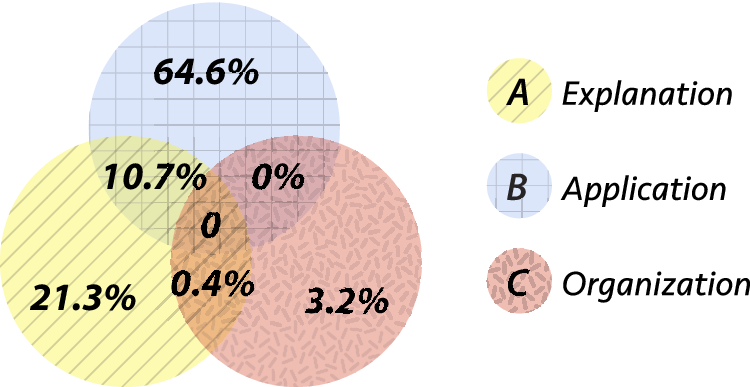
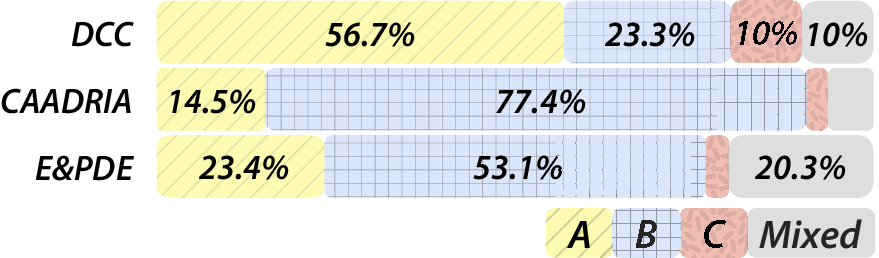
When examining the overall distribution of the papers surveyed across the questions in Tables 8 and 9, the following observations can be made. First, as evident from Figure 4, most studies have focused on questions of application, followed by those focusing on explanation, then by those focusing on organization. At the same time, the venues surveyed have shown differences in terms of their foci, and not all have prioritized application over explanation. For example, over half of the studies in DCC have focused on explanation, as compared with one quarter in E&PDE and nearly 15% in CAADRIA (Figure 5). Finally, classifying the paper population by sub-questions has shown that approximately three quarters of the studies explored a single question (N = 194), one fifth of the studies explored two questions in parallel (N = 54), and a few studies explored three (N = 3) or four (N = 2) sub-questions in parallel. The distribution of papers across sub-questions is visualized in Figure 6. This figure shows a dominance of studies focusing on developing new approaches and tools for enhancing design practice (B1–2, 99 occurrences), followed by works interested in enhancing our ability to use existing methods and tools (B1–1, 68 occurrences), then by studies aiming to use our theoretical lenses and tools to obtain empirical knowledge of design practice (A1–3, 53 occurrences), etc.
Overview of the distribution of papers across the three categories of activity.

Distribution of papers across the categories of activity by venue (values ≥ 10% are shown).

Occurrences of low-level sub-questions (values denote the total records exploring each sub-question).

The revised taxonomy is simpler both at its highest level of organization (three questions instead of five) and at its lowest level of organization (13 sub-questions instead of 20). The following three major categories subsume all the works surveyed:
-
• Papers directed at explaining design-related phenomena (category A)
-
• Papers directed at applying our knowledge for enhancing design-related activity (category B)
-
• Papers directed at organizing our research output from the above categories (category C)
In this, the explanation of design practice as well as that of design education are acknowledged subcategories of a larger category that deals with the explanation of design-related activities (category A). The acts of enhancing our design methods and developing tools for practice/pedagogy are acknowledged as activities of knowledge mobilization and are thus nested under a single parent (category B). Category C, which corresponds to the first category in the original taxonomy, was organized to mirror the general structure of the field and now contains three questions, each corresponding to one category (A, B and C). Note that, referring to Table 9, questions A2–1 and A2–2 were added for considerations of symmetry, despite the absence of corresponding papers in our sample. Rather than invalidating the potential importance of these questions, this absence may point to a research gap to be filled by future work.
Finally, all questions in the proposed taxonomy are of a single form (‘how can we…?’) that is design-oriented (i.e., one that focuses on how things may be in the future). This phrasing was chosen since research is a purposeful activity of knowledge production that aims to produce a preferable situation (Simon Reference Simon2008) in which we have acquired new knowledge. In other words, inquiry into design is, to some extent, analogous with design (Fujii, Nakashima & Suwa Reference Fujii, Nakashima and Suwa2013). Our phrasing, however, is intended to cover a large range of related questions of different forms. For example, the question of ‘given two tools, which one would designers prefer?’ may be included in B1–1 (if the motivation of researchers is to formulate new methodologies which involve tools) or in B1–2 (if the motivation of the researchers is to create new tools), etc.
5.5 Computational exploration of paper clusters
The clusters that were computationally extracted from the data are given in Figure 7. Colored groups of points indicate strong data-driven clusters of papers. The remaining items (in gray) did not display a sufficiently strong correlation. In total, eight clusters were identified. Each cluster is described below, from the smallest one to the largest one. The descriptions include the number of papers in the cluster and common features that can be identified among the papers within it, as well as the relationship with the research questions pursued according to our survey.
Paper clusters detected using HDBSCAN.

First, in cluster 6 (N = 6) we find papers that explore urban design from several viewpoints, such as automating the classification of spatial data (Jia, Zhang & Narahara Reference Jia, Zhang and Narahara2024), or relating morphological characteristics with environmental performance (Bai & Zhang Reference Bai and Zhang2024). In this cluster, 4/6 items employ or discuss machine learning as the general computational approach employed.
Second, the shared property among the papers in cluster 1 (N = 7) is the usage of technological means for obtaining bodily information from human designers/users. In 6/7 cases, EEG was used, albeit for different purposes. For example, while Jia et al. (Reference Jia, Zhang and Narahara2024) used it to learn about users’ experience of architectural space, Gerothodoros et al. (Reference Gerothodoros, Karagianni, Geropanta and Parthenios2024) have used it for creating an interactive space that responds to users’ emotions in real-time. With respect to the questions pursued, 6/7 papers were classified under category B. Among these, four occurrences of one sub-question were noted (‘How can we use our current computational approaches/tools in design practice?’) as well as four occurrences of another (‘How can we create new approaches/tools for design practice?’). Papers in cluster 2 (N = 7), which is related to cluster 1, all used EEG technology. However, while the work in cluster 1 was dominantly focused on questions in category B (6/7 items), the work in cluster 2 was primarily focused on questions in category A (5/7 items). Further note that all papers in cluster 1 belonged to the CAADRIA conference, while those in cluster 2 belonged exclusively to the DCC conference.
Third, the papers in cluster 4 (N = 7) included two primary usages of computational tools for spatial design—for exploring human behavior (movement, circulation) and its relation to an existing space (Gao, Zhang & Huang Reference Gao, Zhang and Huang2024; Huang et al. Reference Huang, Song and Qiu2024) or for designing/redesigning a space while considering human behavior (Dai, Huang & White Reference Dai, Huang and White2024). In a single case, a computational system for spatial design was developed, yet human behavior was not explicitly considered (Wen, Ye & Yu Reference Wen, Ye and Yu2024). Three papers in this cluster matched with the same question in category A (‘How can we use our lenses and tools to study designing from a computational perspective?’) while four others matched with the same question in category B (‘How can we create new approaches/tools for design practice?’).
Fourth, all items in cluster 7 (N = 15) matched with category B (‘How can we apply our knowledge in design computing research for enhancing design practice?’), and specifically with one of its lowest-level questions (‘How can we create new approaches/tools for design practice?’). Overall, the common theme that unites the papers in this cluster is their concern with physical prototyping and fabrication. All the papers in this cluster belonged to a single conference (CAADRIA). Note that relevant works that were published in other venues and clearly matched the cluster’s theme (e.g. Benros et al. Reference Benros, Hashemi, Su and Gero2024) were not included.
Fifth, in cluster 3 (N = 17), over half of the papers pursued questions in category A (11/17), while eight out of these pursued the same sub-question (‘How can we use our lenses and tools to study designing from a computational perspective?’). Further, 11/17 papers reported on studies related to human design processes, yet from different perspectives. For example, Kelly et al. (Reference Kelly, Greentree, Sosa, Evans and Gero2024) developed a way to visualize design cognition data, while Baudoux & Goucher-Lambert (Reference Baudoux, Goucher-Lambert and Gero2024) studied the interaction of human designers with a generative tool to help utilize it in designing. Additionally, seven papers in this cluster pursued more than one question in parallel. All papers in this cluster belonged to a single conference (DCC).
Sixth, all papers in cluster 5 (N = 20) matched with the same question in category B (‘How can we create new approaches/tools for design practice?’). Among these, only one paper pursued another question in parallel (also included within category B). All papers in this category included the implementation of a computational system except one. Papers in this cluster belonged exclusively to a single conference (CAADRIA).
Finally, cluster 8 (N = 61) was relatively diverse, with papers pursuing all the major questions in our classification system (A, B and C). Despite this diversity, all items in this cluster have discussed digital tools, and more than two-thirds (48/61) have explicitly dealt with topics related to AI. Also note that all papers in this cluster belonged to a single conference (E&PDE).
Overall, results show partial alignment between the automatically produced clusters and the research questions pursued. The best alignment was demonstrated between questions in category B and the computational output (which was occasionally perfect), followed by category A (which was always partial). No computationally produced cluster clearly matched with questions in category C.
6. Discussion
6.1. Implications
6.1.1. Organizing design computing research
The revised taxonomy is simpler at its highest and lowest levels, yet accounts for the whole paper population under examination (N = 253). As the papers were extracted from three different conferences, which are characterized by unique perspectives with respect to design computing research, the taxonomy demonstrates potential for applicability to a diverse range of works across the field. The implications of the proposed taxonomy with respect to our understanding of design computing research are now discussed.
Design computing research is a subset of design science. To distinguish design science from other scientific activity, Simon (Reference Simon2008) suggested that the natural sciences focus on understanding how things are at the moment, while the sciences of the artificial (i.e., design science) reflect our desire to shape them in the future (also see Coyne et al. Reference Coyne, Rosenman, Radford, Balachandran and Gero1990, p. 11). However, this view of design science cannot account for the complete range of activity in design computing research—research in the field aims to both understand how things are (category A) and how we can shape them in the form of our desires (category B). For clarity, research activity in the proposed category A is akin to “pure” research, in the sense that its primary focus is on factual determination (Kuhn Reference Kuhn1994) with respect to the current state of designing, teaching design, etc., while research activity in category B is akin to applied science. Of course, the output of category A can be used for the purpose of developing methods and applications (thereby supporting category B), but it may also serve a purpose in itself—that of explaining a phenomenon that is not yet sufficiently understood. In fact, some scientists regard explanation as the primary goal of science and the ability to utilize explanations for other purposes (e.g., prediction) as secondary (Deutsch Reference Deutsch1997). Regardless of the relative importance of explanation versus application, design computing researchers can aim for either (or simultaneously for both). Therefore, the classification system highlights the descriptive as well as normative facets of the activity in design computing research.
With respect to the relation of the proposed framework to past works that have helped to organize the field, Gero and Maher have identified the following goals as fundamental to the activity in the field (Reference Gero, Maher, Martens, Linzer and Voigt1997): (G1) the desire to develop theories/models/methods of design processes; (G2) the desire to develop design tools using G1; and (G3) the desire to use G1 for teaching. In our proposed classification system, the descriptive part of G1 (the desire to produce explanations) is mapped onto category A, which also includes our desire to explain the act of teaching design. At the same time, the normative part of G1 (the desire to develop better methods for designing, etc.) maps onto category B, which also includes our attempts to improve any design-related activity. G2 and G3 are both subsumed within category B, which includes other normative activities (such as developing tools for pedagogy). Therefore, the proposed classification system preserves the fundamental structure exposed by Gero and Maher while embedding it within a broader context of purposes and distinguishing descriptive activities from normative ones. As the new classification system was developed by revising an existing taxonomy (Kahlon & Fujii Reference Kahlon and Fujii2025), we have documented the revisions made to the original taxonomy and the mapping of older items onto new ones. The information is provided in Appendix B, which includes the rationale for high-level revisions (Table B1), as well as specific mappings of previous low-level questions onto the newly introduced ones (Table B2).
6.1.2. Insights from the computational detection of clusters
Our computational exploration of automated clustering based on textual similarity has partially aligned with our manual classification. The implications of this are now discussed.
First, it is striking that, in certain cases, the automated clustering aligned completely with the proposed taxonomy. For example, all of the papers in cluster 7 matched with category B1, which reflects one of the main concerns in design computing—that of using our knowledge to enhance our practices and tools. The same applies to the papers in cluster 5, which also matched with category B in our proposed taxonomy. A similar result was observed with respect to our proposed category A, which matched with ~70% of the papers in the automatically detected cluster 2. These facts imply the plausibility of our categories as useful devices for classifying the activity in the field and demonstrate the potential of computational systems to help detect purpose-based clusters using unlabeled data. Yet, this will require further verification using larger and more diverse samples. The fact that no cluster corresponded with questions in category C may be attributed to the small number of relevant papers in the sample surveyed (e.g., review papers, etc.).
Second, as the computational method employed did not specify a predetermined criterion for clustering other than textual similarity, automated detection also resulted in clusters that did not clearly display a shared purpose. For example, cluster 8 did not display uniformity in terms of the questions pursued. In fact, eight different questions were pursued by works in this cluster (a significant portion of the works in this cluster did, however, share a common theme—the focus on AI). A similar result was observed on a smaller scale in cluster 6. This raises an important question regarding the organization of the research in design computing—what are the different dimensions that can be useful for organizing research works? Exploring this question can help to develop a multidimensional map that considers clusters from multiple complementary perspectives, which may be useful for a wide range of readers.
Finally, the eight clusters identified were all “pure” clusters in the sense that each contained proceedings from a single conference, occasionally excluding relevant works from other conferences. This suggests that differences in style or terminology adopted by a given community have an impact on the automated clustering result. At the same time, computational sensitivity to nuances may be conducive to detecting differences between groups of papers that look similar but are in fact different in terms of the question pursued. For example, papers in clusters 1 and 2 both dealt with neurocognitive measurement but were nonetheless assigned to different clusters. Indeed, the papers in each of these focused on two different types of questions (application versus explanation, respectively).
6.2. Limitations and future work
The main limitations of the current work are highlighted, and future directions for constructing a robust taxonomy for design computing research are suggested.
First, the manual classification process was based on the recent proceedings of three different conferences, which helped to diversify the set of papers examined. However, papers from certain design domains were underrepresented (e.g., fashion design). Therefore, it is important to further increase the diversity of papers when mapping the field, to examine the applicability of the classification system to the broader activity in design computing research, and to revise it accordingly. Since the overarching questions are assumed to be domain-independent, further investigation into other domains is expected to primarily contribute to elaborating (and potentially reorganizing) our lower-level questions, which is important for identifying tightly linked clusters of works. Relatedly, a multi-year sampling that draws upon past periods in which major shifts have occurred (e.g., before the advent of CAD) may enable us to uncover questions that were once pursued but have been marginalized over time. Efforts to manually classify research questions can also benefit from including multiple human classifiers, which can strengthen our confidence in the validity of the results obtained, given that inter-rater reliability is established (Larsen et al. Reference Larsen, Lukyanenko, Mueller, Storey, Parsons, VanderMeer and Hovorka2025).
Second, while the automated clustering performed in this study has yielded initial insights into the potential usefulness of the categories identified, further evaluation of the computational results is needed (e.g., stability tests, sensitivity analysis, etc.). Future studies can attempt to rigorously produce computational clusters, preferably by comparing the performance and output of multiple classification models and by considering the parameters by which clusters are evaluated for quality (Yao & Zeng Reference Yao and Zeng2026).
Third, the result of the automated clustering procedure has emphasized the need to consider the dimensions by which papers are clustered. As an initial step in mapping the field, we have focused on the aspect of purpose, which is fundamental to any research activity. However, as any paper population may be dissected differently by various criteria, it is important to determine those criteria that are useful for researchers. Having identified these, we can then examine the potential of automated classification to capture them and help organize the literature in the field.
Fourth, as we continue extracting and organizing the fundamental questions in the field, it would be useful to link them with the approaches and methods through which they are explored. Since the latter may be updated in short time spans due to methodological and technological advancements, it may be necessary to create a dynamic digital map that can continuously adapt to the changing landscape of design computing research. To do so, it would be essential to draw on computational approaches for automated extraction of such information, which will also enable us to consider a larger paper population in drawing a map for the whole field.
Finally, in tandem with organizing the field as a self-contained unit, it seems useful to examine its relationship with other important subfields in the broader landscape of design science, such as design cognition (Hay, Cash & McKilligan Reference Hay, Cash and McKilligan2020). Note that some links are implicit in the proposed classification system (e.g., category A contains the usage of computational tools for explaining cognitive activity in designing), yet we would do well to make these explicit to better delineate the areas of concern for each sub-field as well as their interfaces.
7. Conclusion
An existing taxonomy for classifying works in the field of design computing research was applied to a set of 253 papers extracted from three well-known international conferences, leading to the proposal of a revised taxonomy. The proposed taxonomy organizes the questions pursued by researchers into three major categories: (A) explanation, (B) application and (C) organization (Figure 8). For all three categories, multiple sub-questions are enumerated, and example papers are provided in the form of an index.
Classification systems overview.

The proposed taxonomy and index can help researchers position their work within a broader context and identify related questions. Additionally, it can help educators to draw fundamental distinctions between works in the field, thereby supporting design computing pedagogy. Furthermore, an examination of the relationship between our proposed categories and computationally detected clusters has demonstrated partial alignment between the two, thereby providing initial evidence for the potential usefulness of the taxonomy as a means for organizing works in design computing research. Future work can explore the utilization of computational approaches to identify alternative dimensions for organizing larger collections of works, as well as for further verification or revision of the categories proposed.
Acknowledgements
We thank the anonymous reviewers for their helpful comments and suggestions, which have contributed to improving this manuscript.
Financial support
This research received no specific grant from any funding agency, commercial or not-for-profit sectors.
Competing interests
The authors declare none.
Appendix A
The complete classification results are reported below (Table A1). Record is assigned with IDs (1–253). Each record includes the venue, the title of the paper, a stable identifier in which it can be accessed (DOI), and the research questions associated with it, in two levels – high level questions (referred to as simply as “questions”), and lower-level questions (referred to as “sub-questions”). Question and sub-questions are denoted by letters and numbers, in accordance with the classification system reported in Tables 7 and 8. Finally, note that a single record may correspond with multiple questions and sub-questions.
Complete classification of selected papers by the research questions pursued

Table A1. Long description
The appendix contains 253 records, one per selected paper. Columns give a sequential ID, conference venue, stable identifier or DOI, paper title, assigned high-level question category or categories, and assigned lower-level sub-question or sub-questions. Multiple assignments are permitted because a paper may pursue more than one research question. Codes correspond to the taxonomy reported in Tables 8 and 9: A denotes explanation, B application, and C organization, with numbered codes identifying their lower-level questions. The table provides the complete record-level mapping used in the study.
Appendix B
The proposed classification system is based on the previous work by Kahlon & Fujii (Reference Kahlon and Fujii2025). For purposes of traceability, we report on the mapping of older categories onto new ones, including the specific changes made and the rationale for these. Table B1 provides an overview of the changes made and the subsumption of older overarching categories into new ones. Table B2 serves as a detailed record regarding the mapping of each question in the previous classification system onto a question in the newly proposed system. For clarification, a new category Z was introduced when it was found that two other categories, X and Y, share a joint purpose at a higher conceptual level. For example, enhancing our methods of designing (previously category C) can be seen as a part of the effort to change how we design. This also applies to our efforts to develop our tools (previously category D). Therefore, both were subsumed into the newly introduced category of applying our knowledge to enhance our design processes (category B under new notation). By contrast, when two items, X and Y, belong to a single parent, the same parent, Z, yet cannot be considered as conceptually identical in terms of the purpose pursued, a new low-level category is introduced. Conceptual similarity is evaluated by phrasing the difference between the questions pursued in the form of a single-sentence concise statement. For example, questions regarding using computational approaches for pedagogy (Li Reference Li and Gero2004) and questions regarding keeping our curricula up to date (Tsiliakos et al. Reference Tsiliakos, Bassing, Tian, Gong, Huang and Liu2024) are considered as conceptually different, as the latter does not necessarily involve using a computational approaches, but rather developing one.
Overview of taxonomy revision logic

Table B1. Long description
The table consists of seven columns: Previous category (I D and Definition), a transition arrow, New category (I D and Definition), Explanation of change, and Rationale for change.
* Row 1: Previous I D A (organizing knowledge on a meta-level) maps to New I D C. The change is a notational reordering because explanation and application serve as inputs for organization.
* Row 2: Previous I D B (explaining designing from a computational perspective) maps to New I D A (explaining any design-related phenomenon). This reflects a reordering where explanation precedes application.
* Row 3: Previous I D B also includes the explanation of design education, which is subsumed into the broader New I D A due to conceptual similarity.
* Rows 4, 5, and 6: Previous I D C (enhancing methods), I D D (building tools), and I D E (teaching design) are all merged into New I D B (applying knowledge for enhancing design processes). The explanation states these are all normative activities focused on knowledge mobilization to change practices. The rationale is that knowledge from explanation activities is mobilized for application.
Mapping of research question across taxonomies

Table B2. Long description
The table is organized into five columns. The first two columns represent the Previous classification system (I D and Question), the middle column contains right-pointing arrows, and the final two columns represent the Matching items in the new classification system (I D and Question).
Key mappings include:
* I D A maps to I D C: How can we organize our knowledge in design computing research on a meta-level?
* I D B maps to I D A: How can we explain any design activity?
* I D C maps to I D B: How can we apply our knowledge to develop our practices/tools?
* I D D and E both map to I D B: How can we apply our knowledge to enhance design-related activity?
* I D A 1, A 2, and A 3 map to I D C 1, C 2, and C 3 respectively, focusing on organizing knowledge of processes, tools, and the field as a whole.
* I D B 1-1 maps to I D A 1-1: How can we develop our lens for looking at designing from a computational perspective?
* I D B 2-2, B 3, and B 4 map to I D A 1-3, focusing on capturing design knowledge and obtaining empirical knowledge.
* I D C 1, C 2, D 1, and D 2 all map to I D B 1-2: How can we create new approaches/tools for design practice?
* I D D 3 maps to I D B 2-2: How can we create new approaches/tools for design pedagogy?
* I D D 4 maps to I D A 1-3: How can we build computational tools for inquiry into design?
* I D D 5 is marked as Removed, as it is external to designing and out of scope.
* I D E 1 maps to I D B 2-1: How can we use our current computational approaches/tools in pedagogy?
* I D E 2 maps to I D A 2-3: How can we obtain empirical knowledge about design pedagogy from the viewpoint of design computing.







 Open access

