INTRODUCTION
The Atlantic humpback dolphin Sousa teuszii is endemic to nearshore waters of the eastern tropical Atlantic (ETA), with a geographical range that extends from Western Sahara south to Angola (Van Waerebeek et al., Reference Van Waerebeek, Barnett, Camara, Cham, Diallo, Djiba, Jallow, Ndiaye, Samba Ould Bilal and Bamy2004; Weir, Reference Weir2011a; Weir et al., Reference Weir, Van Waerebeek, Jefferson and Collins2011). The conservation status of the species was recently upgraded to ‘Vulnerable’ by the IUCN (2013), based on its restricted geographical range and naturally low abundance, and on evidence that it may have declined in recent decades. Due to a lack of dedicated cetacean research programmes in most of its confirmed and potential range states, the distribution and ecology of the Atlantic humpback dolphin remain very poorly-known (Van Waerebeek et al., Reference Van Waerebeek, Barnett, Camara, Cham, Diallo, Djiba, Jallow, Ndiaye, Samba Ould Bilal and Bamy2004; Weir, Reference Weir2011a).
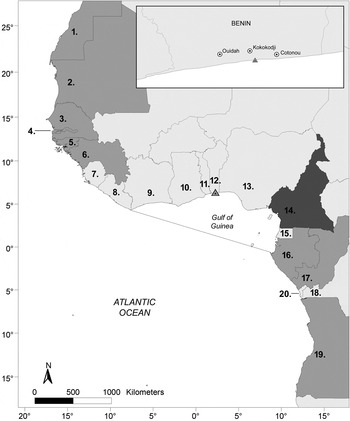
To date, the Atlantic humpback dolphin has been confirmed to occur in 10 ETA countries, comprising (north to south): Western Sahara; Mauritania; Senegal; The Gambia; Guinea-Bissau; Guinea; Cameroon; Gabon; Republic of the Congo; and Angola (Van Waerebeek et al., Reference Van Waerebeek, Barnett, Camara, Cham, Diallo, Djiba, Jallow, Ndiaye, Samba Ould Bilal and Bamy2004; Weir et al., Reference Weir, Van Waerebeek, Jefferson and Collins2011) (Figure 1). While sighting or by-catch records support recent (i.e. since 2000) occupancy of most of those range states, several are confirmed predominantly from older data raising questions about the current status of the species in those countries. For example, the holotype record for the Atlantic humpback dolphin was described in 1892 from a carcass found floating in the Bay of Warships in Cameroon (Kükenthal, Reference Kükenthal1892); the species has not been verified in Cameroon waters since. Its current occurrence in Western Sahara is also uncertain; the most recent published records from that range state are four sightings recorded in Dakhla Bay in 1996, almost 20 years ago (Notarbartolo di Sciara et al., Reference Notarbartolo di Sciara, Politi, Bayed, Beaubrun and Knowlton1998). Additionally, several of the range states are confirmed from a relatively small number of published records. For example, only a single by-catch record has been verified for Guinea (Bamy et al., Reference Bamy, Van Waerebeek, Bah, Dia, Kaba, Keita and Konate2010).
Confirmed range states of the Atlantic humpback dolphin (Sousa teuszii) and (inset) the location of the Benin sighting on 3 November 2013. The oceanic border of the Gulf of Guinea (extending from Cape Palmas in Liberia to Cap Lopez in Gabon: IHO, 1953) is shown. Range state shading (from Weir et al., Reference Weir, Van Waerebeek, Jefferson and Collins2011): pale grey—previously unconfirmed; medium grey—confirmed; dark grey—confirmed from 1892 holotype record only (Cameroon). Countries: 1—Western Sahara; 2—Mauritania; 3—Senegal; 4—The Gambia; 5—Guinea-Bissau; 6—Guinea; 7—Sierra Leone; 8—Liberia; 9—Côte d'Ivoire; 10—Ghana; 11—Togo; 12—Benin; 13—Nigeria; 14—Cameroon; 15—Equatorial Guinea; 16—Gabon; 17—Republic of the Congo; 18—Democratic Republic of the Congo; 19—Angola; 20—Cabinda (Angola).

Given its preference for shallow nearshore habitat, the Atlantic humpback dolphin is not expected to occur around offshore islands such as the Cape Verde Islands or São Tomé and Príncipe. Therefore, a further nine potential mainland range states exist where the species has not yet been documented (Figure 1). This includes approximately 3,065 km of coast extending from Sierra Leone to Nigeria, which encompasses the entire northern coast of the Gulf of Guinea (Figure 1). If the 1892 Cameroon holotype record is excluded, the present-day gap in occurrence continues southwards through the eastern Gulf of Guinea to Equatorial Guinea.
Here we present photographic verification of a recent Atlantic humpback dolphin sighting in the waters of Benin. This is the first record of the species in Benin, and additionally represents the first confirmed record of the species along the northern Gulf of Guinea coast. It provides evidence that the contemporary large gap in confirmed distribution may predominantly be the result of a lack of survey effort rather than a genuine gap in species range.
BENIN RECORD
On the afternoon of 3 November 2013 a large number of people gathered along the coast of Benin to observe the partial solar eclipse which commenced at 11:56 Coordinated Universal Time (UTC) and ended at 15:03 UTC. The eclipse was viewed by S.Z. from a vantage point on a 25 km stretch of sandy beach located between Cotonou and Ouidah, known as the ‘Route de Pêche’. Shortly after the eclipse ended, a small group of dolphins was observed (15:24 UTC) just offshore from the beach by a number of people including S.Z. Relevant environmental conditions during the sighting were favourable, including excellent visibility (to the horizon), low swell height (<1 m) and Beaufort Sea State 2 (no whitecaps). The dolphins were located around 50 m off the beach at position 06°20′43″N and 02°17′51″E, approximately 14.5 km west of Cotonou port (Figure 1). While water depth was not available, this location is in very shallow water over a sandy seabed, immediately adjacent to a linear stretch of beach.
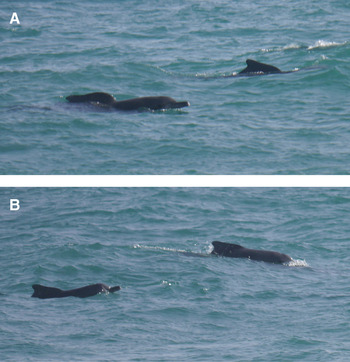
The sighting comprised four animals (seemingly all of adult size). They were observed for a 2 min period, during which they travelled steadily along the coast in a westerly direction, in close proximity to where the surf was breaking over a shallow bank. A short series of digital images was taken from the beach with a 100–300 mm lens (Figure 2). Key characteristic features of Sousa teuszii were noted by S.Z. in the field and can be confirmed from the images, particularly the raised dorsal hump midway along the back and the pronounced slender beak.
Verification images for the first Atlantic humpback dolphin (Sousa teuszii) record in Benin, 3 November 2013 (photographs: Sander Zwart). The characteristic raised dorsal hump and slender rostrum of this species can be clearly observed.

DISCUSSION
This is the first record of the Atlantic humpback dolphin in Benin, increasing the number of confirmed range states for the species to 11. Previous cetacean survey work carried out in Beninese coastal waters (in October 2000, September 2001 and October 2002: Van Waerebeek et al., Reference Van Waerebeek, Tchibozo, Montcho, Nobime, Sohou, Sohouhoué and Dossou2001; Van Waerebeek, Reference Van Waerebeek2002), and investigation of biological collections in Cotonou, did not produce any Atlantic humpback dolphin records (Van Waerebeek et al., Reference Van Waerebeek, Barnett, Camara, Cham, Diallo, Djiba, Jallow, Ndiaye, Samba Ould Bilal and Bamy2004). Nevertheless, the species clearly occurs in Beninese waters on at least an occasional basis. The Benin sighting location is consistent with the nearshore, shallow-water habitat occupied by this species throughout its documented range (Van Waerebeek et al., Reference Van Waerebeek, Barnett, Camara, Cham, Diallo, Djiba, Jallow, Ndiaye, Samba Ould Bilal and Bamy2004; Weir, Reference Weir2011a), which includes similar areas of exposed coastline comprising sandy beach and a dynamic surf zone (Collins et al., Reference Collins, Ngouessono and Rosenbaum2004; Weir, Reference Weir2009). The record has important implications for future cetacean conservation and management plans developed by Benin, since the Atlantic humpback dolphin is a species highly vulnerable to impacts such as by-catch, targeted captures and habitat loss/degradation associated with coastal development (Van Waerebeek et al., Reference Van Waerebeek, Barnett, Camara, Cham, Diallo, Djiba, Jallow, Ndiaye, Samba Ould Bilal and Bamy2004; Weir, Reference Weir2011a; Weir et al., Reference Weir, Van Waerebeek, Jefferson and Collins2011; Weir & Pierce, Reference Weir and Pierce2012).
Benin has approximately 120 km of coast, and the sighting occurred towards the centre of its relatively short coastline. Nothing can be concluded regarding the likely site fidelity or movements of this specific group of dolphins. However, it is reasonable to speculate that, given the short spatial extent of the Beninese coastline, the likelihood of a present-day occurrence of the Atlantic humpback dolphin in neighbouring Togo and Nigeria is greatly increased by this record, as is the potential for transboundary movements between these countries.
The Benin record has wider implications regarding our understanding of the distribution and conservation of the Atlantic humpback dolphin. The currently confirmed range states are clustered at either end of the geographical range of the species, comprising north-west African countries (Western Sahara to Guinea) and countries bordering the south-east Atlantic (Gabon to Angola) (Figure 1). Between those two regions is a large area of unconfirmed occurrence extending from Sierra Leone to Equatorial Guinea (with the exception of the single holotype record from Cameroon; Kükenthal, Reference Kükenthal1892). Many of the countries within this region have received little or no cetacean research focus, and consequently the lack of records cannot be interpreted as an absence of the Atlantic humpback dolphin. However, it has been speculated that the lack of records in some countries where effort has occurred, specifically during the cetacean by-catch monitoring work in Ghana (Van Waerebeek et al., Reference Van Waerebeek, Ofori-Danson and Debrah2009) and during experimental humpback whale-watching excursions in Benin (Van Waerebeek, Reference Van Waerebeek2002), may represent genuine contemporary distribution gaps (Van Waerebeek et al., Reference Van Waerebeek, Barnett, Camara, Cham, Diallo, Djiba, Jallow, Ndiaye, Samba Ould Bilal and Bamy2004).
The Benin sighting, located towards the centre of the distribution gap (Figure 1), supports the notion that the lack of records does (at least in some regions) reflect a paucity of field research rather than a genuine absence of the species. Even in those countries with established cetacean monitoring programmes, such surveys are unlikely to record Atlantic humpback dolphins unless they systematically sample the habitats where the species is most likely to occur. Most marine mammal sighting surveys carried out in the northern Gulf of Guinea region to date have either been focused on humpback whales Megaptera novaeangliae (e.g. Van Waerebeek, Reference Van Waerebeek2002) or related to offshore geophysical surveys (e.g. Weir, Reference Weir2011b), neither of which routinely target core Atlantic humpback dolphin habitat (i.e. shallow water in the immediate coastal zone and estuaries). Similarly, while useful in confirming species presence within a region, by-catch monitoring programmes would need to incorporate the spatial distribution of fishing effort (and therefore the habitats ‘sampled’) before meaningful conclusions on species absence could be reached.
A single sighting is insufficient to indicate that a viable population of Atlantic humpback dolphins is present in Benin or the northern Gulf of Guinea. Indeed, the conservation status of the species remains very unclear throughout its range and previous concerns regarding low population sizes, high exposure to potential anthropogenic impacts and a limited nearshore distribution continue to be highly relevant. Nevertheless, the Benin sighting provides continued optimism for locating extant populations of the Atlantic humpback dolphin in other potential range states including Sierra Leone, Liberia, Côte d'Ivoire, Ghana, Togo, Nigeria, Equatorial Guinea and the Democratic Republic of the Congo. As previously highlighted (Van Waerebeek et al., Reference Van Waerebeek, Barnett, Camara, Cham, Diallo, Djiba, Jallow, Ndiaye, Samba Ould Bilal and Bamy2004; Weir et al., Reference Weir, Van Waerebeek, Jefferson and Collins2011), determining the status of this species should be a conservation priority and urgently requires systematic and focused research effort throughout its geographical range (both confirmed and potential range states).
ACKNOWLEDGEMENTS
This research received no specific grant from any funding agency, commercial or not-for-profit sectors. We thank the two anonymous referees for their comments that improved the draft manuscript.