The need for accessible diagnostic devices
Diagnosis is a critical part of the management of disease. Although diagnostic tests by themselves contribute a relatively small amount to the total costs of health care, the results of diagnoses determine the subsequent treatment and its costs. In the developed world, diagnostic testing is commonly carried out using dedicated instruments in well-equipped central laboratories. The procedure-based reimbursement system common to the United States and other developed countries encourages the development of sophisticated, and expensive, tests. This type of laboratory-based technology is inappropriate, however, for many applications, especially in resource-limited settings. Affordability, portability, ease-of-use, and the ability to operate with little or no supporting equipment are particularly important for tests used in the developing world, in public health, at the point of care, in drug testing and monitoring, and in agriculture (veterinary, food, environmental testing).
As described in the introductory article of this issue, the potential of paper as a substrate for colorimetric diagnostic testing has already been demonstrated,Reference Martinez, Phillips, Whitesides and Carrilho 1 – Reference Dungchai, Chailapakul and Henry 4 but there remains a substantial opportunity for paper-based devices that can replicate other commonly used modes of detection—particularly electrochemical detection—while retaining low cost and simplicity. The realization of this opportunity depends on our ability to build electrochemical and electronic capabilities on paper substrates.
Paper-based approaches to bioanalysis
As a matrix for chemical and biochemical analysis relevant to diagnosis, paper offers five properties that contribute to meeting these requirements: (1) the capillary wicking of aqueous solutions along the cellulose fibers of the paper matrix provides a means of transporting fluids that does not require external energy; (2) the porosity and biocompatibility of paper allow reagents to be stored or immobilized in the paper device; (3) the light weight and flexibility of paper simplify the logistics of transport and storage; (4) the patterning and processing of paper can use established methods to form microfluidic channels in paper; and (5) the low cost and combustibility of paper make it suitable for disposable and safe single-use tests.
Paper-based systems are, of course, already extensively used. Test strips for urinalysis use an array of paper test pads, supported on a plastic strip, to perform up to 11 colorimetric (color changing) assays in urine (glucose, protein, ketones, pH, nitrite, bilirubin, urobilinogen, leukocyte esterase, specific gravity, ascorbic acid, and blood). 5 Immunochromatographic, “lateral-flow” assays move a sample (and analyte) between different zones on a linear nitrocellulose strip by passive wicking; the zones perform the different steps of an immunoassay (capture of an antigen, addition of a labeled antibody for detection, washing) to produce a colored line in the presence of the analyte of interest.Reference O’Farrell, Wong and Tse 6 The most common example of a lateral-flow assay is the home-based test for pregnancy.
Micro-paper-based analytical devices (μPADs)
In 2007, we described a new design for a microfluidic device made from paper (a micro-paper-based analytical device, or μPAD). These devices use hydrophobic barriers patterned on hydrophilic paper by photolithography,Reference Martinez, Phillips, Butte and Whitesides 7 printing with PDMSReference Bruzewicz, Reches and Whitesides 8 or dissolved polystyrene,Reference Olkkonen, Lehtinen and Erho 9 or solid wax applied by a commercial printerReference Lu, Shi, Jiang, Qin and Lin 10 , Reference Carrilho, Martinez and Whitesides 11 to create microfluidic channels that guide the transport of fluids into discreet test zones. It is also possible to extend the topology of the microfluidic channels into the third dimension by stackingReference Martinez, Phillips and Whitesides 12 or foldingReference Lu, Ge, Ge, Yan and Yu 13 , Reference Liu, Xiang, Lu and Crooks 14 sheets of paper to join multiple layers. As in the case of urinalysis test strips, the test zones of a colorimetric μPAD contain the reagents (enzymes, indicator dyes, buffers) required to generate a change in color in the presence of the analyte of interest. The results can be read by eye or imaged photographically and analyzed by computer.
Advantages and limitations of colorimetric μPADs
The portability, affordability, and simplicity of colorimetric μPADs make them attractive for use in remote areas, but the interpretation of the results may require expertise or image analysis that is not available at the point of care. Telemedicine offers one potential strategy with which to approach this problem. In this strategy, a cell-phone camera at the point of care captures a photograph of the colorimetric result and transmits the image to a central location where trained personnel (or a computer) analyze the image and transmit the results back to the user by text message.Reference Martinez, Phillips, Carrilho, Thomas, Sindi and Whitesides 15 Even with the addition of telemedicine, however, colorimetric μPADs are not appropriate in every situation. Interferences from the color of the sample, inconsistencies in lighting, or the presence of particulate contaminants may confuse the interpretation of the colorimetric result. For example, colorimetric assays of blood are complicated by the presence of (red) hemoglobin from whole or lysed (when the cellular contents are released due to rupture of the cellular membrane) red blood cells.
Electrochemical readout as an alternative to colorimetry/fluorimetry
Electrochemical analysis is a useful alternative (or complement) to colorimetric analysis for quantifying the results of a diagnostic test, since the measured current or voltage generated by the electrochemical device is insensitive to color contamination and can be transformed into a numeric output by inexpensive electronics. Electrochemical analysis can, in principle, be used either independently of or in combination with colorimetric analysis.
There are several examples of successful electroanalytical systems already in large-scale use in point-of-care or clinical laboratory settings.Reference D’Orazio 16 These include personal glucose meters (which are widely used in the management of diabetes), the iSTAT Handheld Blood Analyzer (which is used in hospitals to measure electrolytes and other biomarkers in blood), 17 and the ORIGEN Analyzer (a clinical instrument for performing quantitative immunoassays based on electrochemiluminescence).Reference Blackburn, Shah, Kenten, Leland, Kamin, Link, Peterman, Powell, Shah and Talley 18
Electrochemical capabilities of EμPADs
Adding paper-based electrodes to a μPAD yields a paper-based device capable of performing electrochemical measurements (an EμPAD).Reference Nie, Nijhuis, Gong, Chen, Kumachev, Martinez, Narovlyansky and Whitesides 19 , Reference Dungchai, Chailapakul and Henry 20 Carbon-based materials (graphite, graphene, or carbon nanotubes), gold, and platinum are appropriate choices for the working and counter electrodes because they are electrochemically inert over a wide range of working potentials. Electrodes constructed from Ag/AgCl paste are included in electrochemical measurements that require a reference electrode.
Electrochemical measurements made in paper differ from those performed in free solution due to the presence of the cellulose matrix, which largely blocks convection (in stationary fluids), acts as a barrier to diffusion (by increasing the tortuosity of the diffusion path), occupies some of the volume that would otherwise be occupied by fluid, and blocks a portion of the electrode surface (∼30%, depending on the type of paper and fabrication method used).Reference Nie, Nijhuis, Gong, Chen, Kumachev, Martinez, Narovlyansky and Whitesides 19 Conversely, the presence of the cellulose matrix is advantageous for hydrodynamic measurements; capillary flow in paper can drive the transport of analytes over the surface of the electrode, resulting in increased sensitivity.
Amperometric analysis of simple metabolites
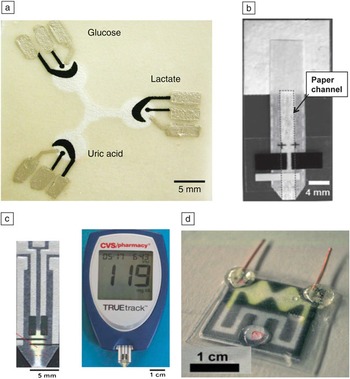
Amperometric EμPADs measure the current resulting from the oxidation or reduction of electroactive species at a fixed applied potential. Only a few metabolites with low redox potentials, such as ascorbic acid and uric acid, can be measured directly by this technique. More commonly, amperometry is coupled with an enzymatic assay that consumes the analyte of interest and generates an electroactive product (Equations 1 and 2 describe the enzymatic and redox reactions involved in the amperometric detection of glucose). Many groups have demonstrated paper-based sensors for glucose, lactate, ethanol, and cholesterol using this principle ( Figure 1 a–c).Reference Nie, Nijhuis, Gong, Chen, Kumachev, Martinez, Narovlyansky and Whitesides 19 – Reference Liu and Crooks 24


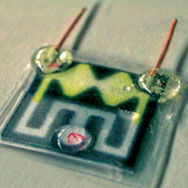
Electrochemical microfluidic paper-based analytical devices (EμPADs) for diagnostic and environmental testing. (a) Multiplexed amperometric device for the analysis of glucose, lactate, and uric acid. (Reprinted with permission from Reference 20. © 2009 American Chemical Society.) (b) Square-wave voltammetry device for the determination of lead in drinking water. (Reprinted with permission from Reference 19. © 2010 Royal Society of Chemistry.) (c) Amperometric EμPAD integrated with a commercial glucometer. (Reprinted with permission from Reference 22. © 2010 Royal Society of Chemistry.) (d) Adenosine-sensing EμPAD with aptamer-based recognition and a potentiometric concentration cell. (Reprinted with permission from Reference 14. © 2012 Wiley-VCH Verlag GmbH & Co. KGaA, Weinheim.)

Voltammetric analysis of trace metals
Voltammetric methods for the analysis of trace metals (e.g., metals such as lead or mercury, present in trace quantities in a supply of drinking water) take advantage of the transition from soluble ions to an insoluble solid that occurs when metals are reduced.Reference Osteryoung and Osteryoung 25 Figure 1b shows a paper-based voltammetric device. The measurement occurs in two distinct stages (see Equations 3 and 4): During an initial deposition stage, which can last several minutes, a reducing potential applied at the working electrode causes metal ions to deposit onto the electrode surface in the form of a solid metal, alloy, or amalgam; during the subsequent measurement, or “stripping” stage, the potential rapidly scans toward more positive values in a linear or square-wave sweep and causes the deposited metals to reoxidize. This oxidation is observed as a peak in the current at the characteristic redox potential for each metal.


EμPADs employing biomolecular recognition
There are examples of electrochemical lateral-flow test strips and EμPADs that incorporate antibodies,Reference Du, Wang, Wang, Lu and Lin 26 – Reference Jagadeesan, Kumar and Sumana 32 aptamers,Reference Liu, Xiang, Lu and Crooks 14 or complementary DNAReference Lu, Ge, Ge, Yan and Yu 13 to capture or label target molecules. The biomolecular recognition changes the electrochemical properties of the system as a result of enzyme-catalyzed production of an electroactive species (Figure 1d),Reference Wang, Lu, Wang, Du, Zou, Wang, Smith, Timchalk, Liu and Lin 27 , Reference Yan, Zang, Ge, Ge and Yu 30 – Reference Jagadeesan, Kumar and Sumana 32 mellitin-induced rupture of liposomes containing ferrocyanide,Reference Lee, Kim, Shin, Lee and Park 29 localization of cadmium quantum dots on the working electrode,Reference Liu, Lin, Wang, Wu, Wai and Lin 28 or charge repulsion of electroactive species at the electrode surface.Reference Lu, Ge, Ge, Yan and Yu 13
Paper-based electronic systems
The potential of EμPADs for application in resource-limited settings is restricted by the fact that nearly all of the existing devices require an external potentiostat. Although it may not be possible to completely eliminate this requirement, the increasing sophistication of paper-based electronic devices offers hope that some electronic functions may be integrated into the paper-based device itself. Alternatively, the devices needed to carry out more complicated electrochemical measurements using simple, paper-based strips are being developed.
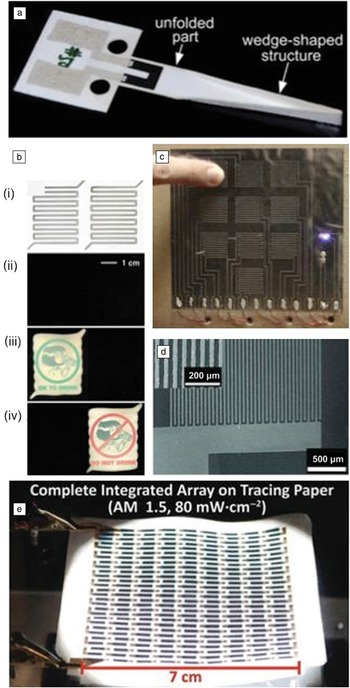
There are a number of recently established techniques for patterning electrodes,Reference Dungchai, Chailapakul and Henry 20 wires,Reference Siegel, Phillips, Dickey, Lu, Suo and Whitesides 33 and piezoresistorsReference Liu, Mwangi, Li, O’Brien and Whitesides 34 on paper, including screen printingReference Renedo, Alonso-Lomillo and Martinez 35 , Reference Wring, Hart, Bracey and Birch 36 direct-writing with a pen/pencil dispensing conductive material,Reference Russo, Ahn, Adams, Duoss, Bernhard and Lewis 37 , Reference Mirica, Weis, Schnorr, Esser and Swager 38 physical deposition of metals, or spraying conductive inks through stencils.Reference Siegel, Phillips, Dickey, Lu, Suo and Whitesides 33 Liu and co-workers demonstrated a piezoresistive force sensor that consisted of a carbon resistor printed on a paper cantilever ( Figure 2 a). Folding the end of the cantilever beam to form a wedge-shaped structure increased the sensitivity of the sensor because the increased rigidity of the folded section concentrated the mechanical strain on the (unfolded) piezoresistor.Reference Liu, Mwangi, Li, O’Brien and Whitesides 34 The same patterning techniques can also be used to form resistive heating elements on paper. Siegel and co-workers demonstrated a paper-based display that used a resistive heating element to change a layer of thermochromic ink from opaque to transparent and reveal a message selected to summarize the result of a test (Figure 2b).Reference Siegel, Phillips, Wiley and Whitesides 39
Paper-based electronic devices. (a) Piezoresistive paper cantilever for mechanical sensing. (Reprinted with permission from Reference 34. © 2011 Royal Society of Chemistry.) (b) Thermochromic display: (i) resistive heating elements, (ii) no current applied to resistors, and (iii–iv) activation of left and right resistors for the display of different test results. (Reprinted with permission from Reference 39. © 2009 Royal Society of Chemistry.) (c) Capacitive touch pads fabricated by “disconnection” on metallized paper. (Reprinted with permission from Reference 40. © 2012 Wiley.) (d) SEM image of interdigitated electrodes of a paper-based transistor. (Reprinted with permission from Reference 45. © 2009 American Institute of Physics.) (e) A large-area array of photovoltaic circuits, patterned on tracing paper using a multistep vapor printing process, illuminated by a halogen lamp (AM 1.5, 80 mW·cm–2). (Reprinted with permission from Reference 52. © 2011 Wiley.)

An alternative strategy for forming circuits on paper involves patterning “disconnects” by removing material from a sheet of metallized paper with laser-based ablation.Reference Mazzeo, Kalb, Chan, Killian, Bloch, Mazzeo and Whitesides 40 This method can be used to create inexpensive paper-based capacitive touch pads capable of replacing the buttons or keypads required for collecting user input (Figure 2c).
Proof-of-concept studies have demonstrated the potential of fabricating active electronic devices on paper (e.g., ring oscillatorsReference Eder, Klauk, Halik, Zschieschang, Schmid and Dehm 41 and transistors,Reference Fortunato, Correia, Barquinha, Pereira, Goncalves and Martins 42 – Reference Nilsson, Kugler, Svensson and Berggren 46 Figure 2d). Nevertheless, there is still a need to develop manufacturing processes and reduce the cost of fabrication if paper-based transistors are to price comparably with silicon-based electronic components: a standard operational amplifier containing 20 transistors costs ∼ US $0.20, or $0.01 per transistor; 47 microprocessors containing more than one billion transistors cost less than $300, or <$0.000001 per transistor. While paper-based microprocessors are not practical at this point, patterning tens or hundreds of transistors on disposable substrates might enable simple signal processing or amplification that would facilitate electrochemical measurements.
Recent academic demonstrations have shown the storage of energy with paper-based supercapacitorsReference Weng, Su, Wang, Li, Du and Cheng 48 and batteriesReference Hilder, Winther-Jensen and Clark 49 – Reference Nyström, Razaq, Strømme, Nyholm and Mihranyan 51 and the generation of power by solar cellsReference Barr, Rowehl, Lunt, Xu, Wang, Boyce, Im, Bulović and Gleason 52 (Figure 2e). The integration of these elements into EμPADs could, in the future, eliminate the need for external power sources.
Combining paper-based electronics and bioanalysis
One of the advantages of using electrodes patterned on paper is that the analyte only makes contact with a small, low-cost, disposable strip. When external electronics are used to control and analyze electric potentials and currents, they are designed to make no contact with the analyte, and thus do not require sterilization or cleaning between uses. The disposable strips only require passive elements that can also have chemically functionalized conductive regions. Disposable electrodes are also preferable to reusable electrodes in a point-of-care setting because they eliminate the need for reconditioning of the electrode surface.
Glucometers are an excellent example of a successful electrochemical diagnostic device that combines disposable test strips with a portable electrochemical reader.Reference Wang 53 They are affordable, easy to use, highly engineered, and globally available; their availability will also increase as the incidence of diabetes and similar metabolic syndromes continue to rise. Based on the success of the glucometer, early applications of EμPADs may follow a similar model.
As an alternative to glucometers, there is a growing interest in adapting “smart” mobile phones (smartphones), which combine capabilities for telecommunications, photography, and computing, to act as readers for point-of-care diagnosis.Reference Ruano-Lopez, Agirregabiria, Olabarria, Verdoy, Bang, Bu, Wolff, Voigt, Dziuban, Walczak and Berganzo 54 , 55 Most current examples use the built-in camera to capture and process the result of a colorimetric test, but new accessory devices for smartphones, such as the iMultimeter (an iPhone-based multimeter), 56 can be used to measure electrical potentials. With the addition of simple electronic components such as capacitors, switches, and resistors, these devices could act as readers for a variety of electrochemical measurements.Reference Liu, Xiang, Lu and Crooks 14 Although smartphones obviously facilitate the communication of results by telemedicine, they are expensive, and the advanced networks required for data transmission are not yet available in many resource-limited environments.
In the future, paper-based devices for performing electrochemical measurements may be completely self-contained and disposable. One existing example, by Liu and co-workers, used a paper-based fluidic battery to power the amperometric oxidation of glucose or hydrogen peroxide, and a spot of electrochromic dye (Prussian blue) that changed color in response to the amperometric current.Reference Liu and Crooks 24 The results could be read by eye, as in a colorimetric assay (based on the appearance or disappearance of the Prussian blue spot), and the device required no external electronics.
Outlook
With ingenuity, there is the possibility of developing paper-based analogs of many electrochemical and electrical systems now used in medicine that could meet the requirements of low-cost systems. For example, Novell et al. demonstrated paper-based electrodes that incorporated ion-selective membranes for the measurement of [K+], [NH3 +], and pH.57 An EμPAD based on the same principle could be used to quantify serum electrolytes and provides a less expensive and more portable alternative to the iSTAT Handheld Blood Analyzer.
Electrochemiluminescence is a powerful detection technique for immunoassays because, in contrast to enzyme-based assays, where the observed signal varies with time, the timing of the chemiluminescent emission is controlled by the electrochemical system. This advantage is important in point-of-care settings, because medical personnel juggling multiple patients may be unable to return to interpret the results of a test with precise timing. Paper-based electrochemiluminescent devices have already been demonstrated for the detection of immunoassays.Reference Delaney, Hogan, Tian and Shen 58 , Reference Ge, Yan, Song, Yan, Ge and Yu 59
Diagnostic techniques based on the amplification and detection of nucleic acids offer excellent sensitivity and the ability to identify specific strains or mutations in a pathogen of interest. These techniques are particularly challenging to implement in resource-limited settings because the amplification processes require elevated temperatures or thermal cycling.Reference Chin, Linder and Sia 60 Paper-based resistive heating elements could be printed directly onto a μPAD to permit on-device amplification. Developed methods for patterning electrodes in paper-based electronics could also be used in the measurements of body temperature, pulse, and blood pressure.
Conclusion
EμPADs have already been adapted for a wide variety of different types of measurements and analytes. Translating these advances into real point-of-care devices will, however, require a range of new or improved features.
In most bioassays, the characteristic of the assay that ultimately determines performance is biology (the specificity/binding constant/kinetics of the antibodies, enzymes, etc.), not electronics. New amplification strategies that increase the sensitivity of EμPADs and reduce the time required for analysis will permit the application of the techniques developed thus far to a wider range of analytes. Amplification strategies that remove the time-dependence of the measured signal, or the dependence on environmental factors, are particularly valuable in point-of-care settings.
The requirement for external equipment to power the electrochemical measurement and detect and process the resulting signal should drive innovations in handheld readers. Despite the advantages of glucometers (low cost, ease of use, availability), they are limited by their design in the types of measurements that they can perform. The development of more versatile portable electrochemical readers that are inexpensive and simple will be an important step for making EμPADs broadly useful. Paper-based electrical devices such as circuit boards, thermochromic displays, buttons, and resistors can perform some of the simpler electronic functions required by EμPADs; the methods used in the fabrication of other, more complex components, including paper-based energy storage devices, transistors, and other active elements on paper, require further development.
Integration of bioanalysis with telemedicine is a core theme for the future of public health and point-of-care medicine. Electrochemical systems seem particularly well suited for integration with mobile-phone-based systems, since the disposable biosensor (paper) is light, inexpensive, and easy to use, and the output can be an electrical signal.
Acknowledgments
This work was funded by the Bill and Melinda Gates Foundation under award number 51308, the N/MEMS S&T Fundamentals MF3 Center (DARPA), and by a postdoctoral fellowship from the Natural Sciences and Engineering Research Council of Canada (E.J.M.).