The human history of the eastern North American Arctic, consisting of the Canadian Arctic Archipelago, adjacent mainland, and Greenland, is made up of two primary archaeological traditions (Friesen Reference Friesen, Mason and Max Friesen2017; Friesen and Mason Reference Friesen, Mason, Max Friesen and Mason2016; Maxwell Reference Maxwell1985). The earlier of the two, Paleo-Inuit (also known as Paleo-Eskimo), entered the Eastern Arctic from Alaska around 3000 BC. It lasted for over 4,000 years, with later phases referred to as Dorset. The more recent of the two traditions is Inuit (also known as Neo-Eskimo or Northern Maritime). Early Inuit, known as the Thule culture or tradition, arrived in a series of migrations from Alaska during the thirteenth century AD, replacing their Dorset predecessors (Figure 1).
The Eastern North American Arctic, showing maximum extent of Late Dorset settlement as well as areas occupied by the earliest Thule migrants.

One of the most persistent debates in Arctic archaeology relates to the transition between these two traditions—Dorset Paleo-Inuit and Thule Inuit. Despite decades of fieldwork, interpretation, and argument, there is still no final agreement on the basic question of whether Dorset and Thule ever met. This leads to further questions: How did Thule migrants so rapidly and completely populate the Eastern Arctic if it was already inhabited? If Dorset died out before Thule arrived, what factors led to their demise? If Thule and Dorset met, were their interactions peaceful or antagonistic? These questions speak to fundamental aspects of Arctic human history, such as the effectiveness of different adaptations to marginal environments, the role of climate change in regional histories, and the degree of difference between Paleo-Inuit and Inuit technologies and social organization.
Resolution of these issues depends largely on the chronology of Late Dorset occupations. Although the Thule migration into the Eastern Arctic is now relatively well dated to the thirteenth century AD, the timing of the end of Late Dorset has achieved no such consensus. A number of Late Dorset occupations have produced dates that fall into the critical period after AD 1200. Most, however, were obtained decades ago and are now suspect for a number of reasons, chief among which is the possibility that dated samples were derived from mixed Dorset-Thule contexts. As a result, Park (Reference Park, Max Friesen and Mason2016) has proposed a temporal hiatus between Late Dorset and Thule during which the Eastern Arctic was unoccupied. This hiatus is presented as varying in duration depending on region, but generally as beginning between AD 800 and 900 and ending with the arrival of Thule between AD 1000 and 1200. This line of argument implies that most or all Dorset dates later than AD 900 are actually from Thule contexts that were misidentified as Late Dorset. Consequently, the current debate is between two highly divergent positions. In the first, Late Dorset died out by AD 900, before Thule arrived centuries later. In the second, Late Dorset persisted to at least the late thirteenth century and still occupied some regions of the Eastern Arctic when Thule arrived.
This article presents 56 new AMS radiocarbon dates that resolve a significant part of the debate by confirming that Dorset settlement continued in at least one region for decades—and perhaps as much as a century—after Thule had settled in adjacent parts of the Eastern Arctic. The two societies, therefore, overlapped in time and must have impacted each other.
The Dorset-Thule Succession: Categories of Evidence
Many categories of evidence have been marshalled to examine the possibility of interaction between Dorset and Thule, and by extension, the continuation of Dorset settlement at least as late as the thirteenth century AD. These have been reviewed in detail elsewhere (e.g., Appelt et al. Reference Appelt, Damkjar, Friesen, Max Friesen and Mason2016; Appelt and Gulløv Reference Appelt, Gulløv, Maschner, Mason and McGhee2009; McGhee Reference McGhee, Gilberg and Gulløv1997; Maxwell Reference Maxwell1985; Park Reference Park1993, Reference Park, Appelt, Berglund and Gulløv2000, Reference Park, Max Friesen and Mason2016), so they will be outlined only briefly here in three categories: Inuit traditional knowledge, direct evidence for interaction, and radiocarbon dates.
Inuit Traditional Knowledge
Inuit historical accounts, as still remembered by many Elders and recorded in a variety of sources from different regions of the Eastern Arctic, describe meetings between Inuit and “Tuniit.” Tuniit are often described as strong, timid people who occupied the Eastern Arctic before Inuit arrived (summarized in Bennett and Rowley Reference Bennett and Rowley2004). Meetings between Tuniit and newly arrived Inuit are a part of several of these accounts—often with an initial period of coexistence followed by conflict and, finally, Tuniit flight. Most scholars consider these accounts to likely refer to meetings with Dorset (Kleivan Reference Kleivan and Grønnow1996; Maxwell Reference Maxwell1985; McGhee Reference McGhee1996), although the picture is complicated by the fact that, in some cases, recent Inuit attributed a Tuniit affiliation to Thule Inuit (i.e., not Dorset) archaeological sites (e.g., Mathiassen Reference Mathiassen1927).
Given the potential timing of Dorset-Thule overlap in the Eastern Arctic in the late thirteenth and early fourteenth centuries, these oral histories would have had to be maintained for approximately 600 years when first recorded, which is well within the range of time that oral histories have been shown to preserve historical events accurately (Echo-Hawk Reference Echo-Hawk2000). Furthermore, meetings between Thule and Dorset would have been fundamentally important events in Inuit history—combining a major migration with meetings with new and very different people—which would make them more likely to be preserved in long-term oral histories (Martindale Reference Martindale2006). Nonetheless, it is difficult to directly associate specific Tuniit stories with specific events or locations in the past. Consequently, additional forms of data are needed to confirm the overlap of these two very different peoples in the Arctic.
Direct Evidence for Interaction
Worldwide, the most common category of archaeological evidence used to indicate interaction is the direct exchange of material objects between two groups, in the form of food, raw materials, or finished artifacts. In the present case, Dorset artifacts are frequently recovered from Thule contexts, but they usually represent equivocal evidence for interaction for two reasons. First, Thule semi-subterranean houses were commonly excavated by their builders into abandoned Dorset houses and middens, making it likely that the later Thule houses would incorporate intrusive Dorset artifacts (Maxwell Reference Maxwell1985). Second, Thule individuals may have collected Dorset items from earlier Dorset sites and deposited them in their houses. Park (Reference Park1993) has quantified the functional categories of Dorset artifacts found in Thule houses in some single-component Thule sites, finding that a higher-than-expected proportion of them fall into a narrow range of categories—mainly figurative carvings (“art”) and harpoon heads. This is consistent with Thule having collected these artifacts from abandoned Dorset sites. While these circumstances cannot be taken to indicate that Dorset artifacts in Thule contexts never result from direct interaction, they do underline the absence of well-documented instances of contemporaneous mixed Dorset-Thule assemblages within Thule dwellings or sites.
The opposite situation, in which Thule artifacts are found in undisturbed Dorset contexts, is very different. This could result either from direct exchange between the two peoples or from Dorset collecting artifacts from recently abandoned Thule sites. Either of these circumstances would indicate chronological overlap between Dorset and Thule. Demonstration of such a situation depends on the integrity of the archaeological context. It can only be considered valid if there is good excavation control with the Thule artifact(s) found in an undisturbed primary Dorset context. There are very few instances in which this situation applies, although two published examples, at Brooman Point in the Central Arctic (McGhee Reference McGhee, Gilberg and Gulløv1997) and Qeqertaaraq in northwest Greenland (Appelt and Gulløv Reference Appelt, Gulløv, Maschner, Mason and McGhee2009), provide plausible instances of Dorset acquisition of Thule implements. However, their extreme rarity makes this a tenuous data category.
Another potentially relevant data category consists of material culture traits, including artifact or decorative styles as well as attributes of house architecture, which may have been passed from Thule to Dorset or Dorset to Thule. As was true for exchange, traits passing from Dorset to Thule could in some cases result from Thule Inuit copying Dorset material culture traits found on abandoned sites (Park Reference Park1993)—although some suggested traits, including the use of snow knives for the construction of snow houses, are harder to explain since they require technical knowledge as well as artifact form to pass from one society to the other. Traits moving the other direction—from Thule to Dorset—have occasionally been proposed, for example, in aspects of house architecture. These are rare, however, and somewhat controversial (e.g., Savelle et al. Reference Savelle, Dyke, Poupart, Maschner, Mason and McGhee2009).
Finally, longer periods of relatively close interaction would be expected to be visible in evidence for gene flow between the populations. Most recent analyses, however, indicate no substantial contribution of Dorset to the DNA of Thule or more recent Inuit populations (Raghavan et al. Reference Raghavan, DeGiorgio, Albrechtsen, Moltke, Skoglund, Korneliussen, Grønnow, Appelt, Gulløv, Max Friesen, Fitzhugh, Malmström, Rasmussen, Olsen, Melchior, Fuller, Fahrni, Stafford, Grimes, Priscilla Renouf, Cybulski, Lynnerup, Lahr, Britton, Knecht, Arneborg, Metspalu, Cornejo, Malaspinas, Wang, Rasmussen, Raghavan, Hansen, Khusnutdinova, Pierre, Dneprovsky, Andreasen, Lange, Geoffrey Hayes, Coltrain, Spitsyn, Götherström, Orlando, Kivisild, Villems, Crawford, Nielsen, Dissing, Heinemeier, Meldgaard, Bustamante, O'Rourke, Jakobsson, Thomas P, Gilbert and Willerslev2014; cf., Zhou et al. Reference Zhou, Xie, Quoibion, Ambalavanan, Dionne-Laporte, Spiegelman, Bourassa, Xiong, Dion and Rouleau2019). Given our complete lack of thirteenth- or fourteenth-century Dorset skeletal remains, we are unable to assess whether Thule interaction left a genetic trace in Late Dorset. This lack of extensive gene flow between Inuit and Dorset is not unexpected, given the lack of archaeological evidence for intensive direct contact and mixing of cultural elements.
Radiocarbon Evidence for Chronological Overlap
Consequently, while Inuit traditional knowledge provides a baseline of information plausibly indicating meetings with Late Dorset people, most potential categories of direct evidence for contact are rare or equivocal. This may result in part from the fact that the Eastern Arctic is vast, with relatively little archaeological fieldwork, so only a small number of relevant archaeological contexts (particularly Late Dorset sites) have been examined closely. Given this situation, arguably the most important category of evidence needed to understand the Dorset-Thule transition consists of chronological information. If the two traditions overlapped in time, they almost certainly impacted one another.
The key dates are those for the arrival of Thule from Alaska and for the final stages of Late Dorset, sometimes referred to as Terminal Dorset. Arctic radiocarbon dating is currently emerging from a period of reassessment, with many earlier-obtained dates rejected due to several issues that include sample contamination, inadequate sample preparation, and suboptimal sample types (currently, terrestrial mammal bones and charcoal from local shrubs are preferred materials in order to avoid issues with “old” driftwood and imprecise regional correction factors for marine mammal dates). The date for the arrival of Thule has recently been reevaluated, and there is an emerging consensus based on recently obtained AMS radiocarbon dates that the Thule migration from Alaska to the Eastern Arctic occurred during the thirteenth century, perhaps as late as AD 1250 (Friesen Reference Friesen, Friesen and Mason2016; Friesen and Arnold Reference Friesen and Arnold2008; McGhee Reference McGhee, Appelt, Berglund and Gulløv2000). Particularly noteworthy in this respect is the site of Nelson River on Banks Island in the western Canadian Arctic. Nelson River is widely considered to represent among the earliest Thule sites in the Eastern Arctic due to the presence of traits associated with the Birnirk and Punuk traditions that precede Thule in Alaska. Although decades-old radiocarbon dates from Nelson River had suggested an age of around AD 1000, three new dates on terrestrial mammal bone range from 820 ± 70 to 740 ± 40 BP. When calibrated, they overlap in the mid-to-late thirteenth century AD (see Friesen and Arnold Reference Friesen and Arnold2008 for further discussion). There are currently not enough recently acquired radiocarbon dates to allow more precise modeling of the timing of the initial Thule migration.
The dating of the termination of the Late Dorset period, however, remains unresolved. If Late Dorset had died out by the beginning of the second millennium AD (Park Reference Park, Max Friesen and Mason2016), then Thule would have arrived in an Eastern Arctic devoid of people. If, on the other hand, Dorset occupations extended until the mid-thirteenth century or later, they would have still occupied some regions of the Eastern Arctic when Thule arrived. The remainder of this article presents radiocarbon evidence that resolves this question.
Materials and Methods
This research is focused on 56 new AMS radiocarbon dates from three sites in the Central Arctic. Description of the sites and contexts from which the dated samples were collected are presented below. In this section, I discuss general aspects of the materials and methods used.
Of the 56 dated samples, 54 are on bone collagen and two are on charcoal. Most samples were drawn from faunal “level bags,” consisting of all faunal remains collected from a particular stratum within a specific excavation unit. All but one of the bone dates are on caribou (Rangifer tarandus). Caribou and other terrestrial herbivores are considered to be an optimal material for Arctic radiocarbon dating because they are not subject to the marine reservoir effect, for which we have relatively poor correction factors in the region (Coulthard et al. Reference Coulthard, Furze, Pienkowski, Nixon and England2010). In addition, most caribou bones represent food that would have been consumed the same year the animal died, thus providing an accurate date for the components from which they were drawn. The one non-caribou specimen is a small fragment of marine mammal bone, as indicated by stable isotopes. The two charcoal dates are both on willow (Salix sp.), a local shrub which in the Arctic is generally considered a “next best” material where terrestrial bone is not available, despite the fact that it can be “too old”—individual shrubs may have died a significant length of time before they were used as fuel by the site's occupants (Friesen Reference Friesen, Mason and Max Friesen2017).
The new dates presented here were all processed at the W. M. Keck Carbon Cycle AMS facility at the University of California, Irvine, which uses a well-described and refined method of pretreatment, particularly for bone. This method involves cleaning, decalcification, gelatinization, and ultrafiltration (for further details see dos Santos et al. Reference dos Santos2011). Calibration of dates was performed in OxCal 4.3 (Bronk Ramsey Reference Bronk Ramsey2009), using the IntCal13 calibration curve (Reimer et al. Reference Reimer, Bard, Bayliss, Warren Beck, Blackwell, Ramsey, Buck, Cheng, Lawrence Edwards, Friedrich, Grootes, Guilderson, Haflidason, Hajdas, Hatté, Heaton, Hoffmann, Hogg, Hughen, Felix Kaiser, Kromer, Manning, Niu, Reimer, Richards, Marian Scott, Southon, Staff, Turney and van der Plicht2013).
While the primary goal of this article is simply to present and interpret these new calibrated dates, a limited Bayesian analysis of the full date range was performed using OxCal 4.3 (Bronk Ramsey Reference Bronk Ramsey2009). In relation to archaeological chronologies, Bayesian analysis refers to a set of statistical methods for combining chronological estimates with various categories of prior knowledge to produce a more reliable combined chronology than would otherwise be possible (Bayliss Reference Bayliss2015:680). It has recently revolutionized the interpretation of radiocarbon dates, with ever-increasing use over the past 30 years (e.g., Bayliss Reference Bayliss2009; Buck and Meson Reference Buck and Meson2015; Hamilton and Krus Reference Hamilton and Krus2018). In particular, it is often used to infer the order and timing of archaeological events within a site or region, through incorporation of prior knowledge such as site stratigraphy and artifact typological change (see Ledger et al. [Reference Ledger, Forbes, Masson-Maclean, Hillerdal, Derek Hamilton, McManus-Fry, Jorge, Britton and Knecht2018] for a recent Arctic example). In the present study, however, the analysis is not intended to infer the order of archaeological events within the Late Dorset period, largely because there is very little prior knowledge that can be brought to bear on the analysis. The material culture throughout the Late Dorset period is very uniform and cannot be used to suggest earlier or later dates for any components discussed below. Furthermore, there are no a priori reasons to assume any of the three sites was occupied earlier or later than any other; and within each site, dated samples are drawn from a range of widely scattered contexts whose stratigraphy and other attributes cannot be traced directly from context to context. As a result, the modeling performed below is of a more basic type: all of the Late Dorset dates are considered as a single phase, using a standard phase model in OxCal 4.3. This model makes the assumption that all events within the group are equally likely to occur at any point between the beginning and end of the phase (Bronk Ramsey Reference Bronk Ramsey2009:343–5; see Figure 2 for the relevant OxCal CQL script format). The model is used to estimate the start and end dates (boundaries) of the phase.
CQL code used to construct model in OxCal 4.3.

Late Dorset Radiocarbon Dates from Iqaluktuuq, Southeastern Victoria Island
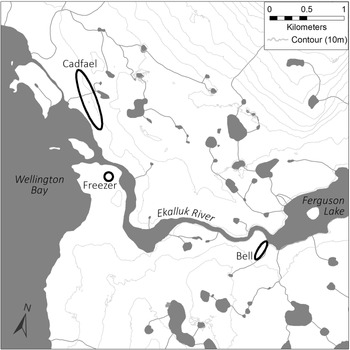
In order to address the issue of the timing of the end of Dorset, this article presents a new suite of AMS radiocarbon dates from the Iqaluktuuq region of southeastern Victoria Island (Figure 3). Iqaluktuuq is the name of a 3 km stretch of the Ekalluk River that drains Ferguson Lake into Wellington Bay on the Arctic Ocean near Cambridge Bay, Victoria Island, Nunavut (Friesen Reference Friesen, Maschner, Mason and McGhee2009; Howse and Friesen Reference Howse and Max Friesen2016; Taylor Reference Taylor1967). The region is home to dense aggregations of two critical summer-fall resources: Arctic char (Salvelinus alpinus), an anadromous fish species with a major upstream run in late August; and caribou (Rangifer tarandus), whose southward fall migration is constricted at this location leading to highly concentrated movements. The combination of these two major resources led to substantial human settlement, and significant archaeological sites, for most major periods in Eastern Arctic culture history. Due to local sea ice conditions, however, the region does not contain significant numbers of the large-bodied marine mammals that formed the focus of economies during many periods in other areas of the Arctic; in particular, walrus, bowhead whale, narwhal, and beluga whale are either extremely rare or completely absent. Ringed seals and bearded seals do occur but are best hunted on the sea ice rather than from land.
The Iqaluktuuq region on southeastern Victoria Island, with locations of three Late Dorset sites.

Three sites with well-defined Late Dorset components are presented here. They were initially excavated by Taylor (Reference Taylor1967, Reference Taylor1972) and subsequently by Friesen (Reference Friesen2004, Reference Friesen, Maschner, Mason and McGhee2009), who reported an initial round of radiocarbon dates. All dates outlined below, however, are previously unreported and were obtained from excavations occurring between 2000 and 2010.
The discussion below privileges this new set of dates, with less emphasis on the 15 dates acquired earlier for the same sites (Table 1; described in Friesen Reference Friesen2004). These previously acquired dates range in age from 1225 ± 125 to 820 ± 50 BP. They are considered less reliable than the new dates because they were not prepared with modern pretreatment techniques, including ultrafiltration, and are therefore more likely subject to contamination issues. Contamination, much of which may result from the presence of ubiquitous marine mammal fat and other tissues in archaeological contexts, has long been suspected to be a significant source of error in Eastern Arctic archaeological chronology, and it has recently led to widespread reconsideration and, in many cases, rejection of radiocarbon dates acquired in past decades (Arundale Reference Arundale1981; Friesen and Arnold Reference Friesen and Arnold2008; McGhee Reference McGhee, Appelt, Berglund and Gulløv2000). Following are brief descriptions of the three Late Dorset sites.
Previously Published Late Dorset Radiocarbon Dates for the Bell, Freezer, and Cadfael Sites (Friesen Reference Friesen2004:688).

Note : All samples are on caribou bone with the exception of TO-10044, which could only be identified as terrestrial mammal. “TO” lab numbers refer to AMS dates; “S” lab numbers are radiometric dates.
The Cadfael Site
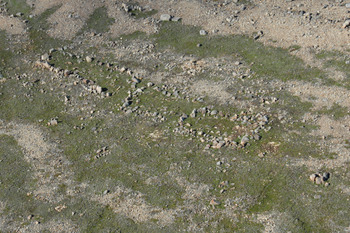
The Cadfael site (NiNg-17) is a very large Late Dorset warm-season aggregation site. It stretches for over 750 m along the cobble beach ridges on the shore of Wellington Bay and contains the remains of four longhouses (elongated boulder-outlined features ranging in length from 17 to 43 m), 24 hearth rows (rows of identical cooking-related features), and many other stone features, including caches and isolated hearths (Figure 4).
Longhouse 2 at the Cadfael site. This 38 m long structure yielded eight radiocarbon dates from buried contexts in its interior and exterior middens, ranging from 985 ± 15 to 635 ± 15 BP. (Color online)

Evidence for Inuit (as opposed to Dorset) activities in the vicinity of the Cadfael site is limited but important to review in the present context in order to assess the possibility of intrusive dating samples. Several recent Inuit graves are located on the high ground above the site; these were not investigated or disturbed. A single tent ring located separate from and at a lower elevation than the remainder of the site is probably related to an Inuit occupation; it was not radiocarbon dated. None of the many individual hearths and storage caches at the site is clearly identifiable as Inuit in origin, although given the generalized nature of many of these features, occasional Inuit use of such surface features cannot be ruled out—indeed, it is likely, given the proximity of the Cadfael site to known Inuit occupations. In particular, Longhouse 4 (the longhouse closest to the river and known Inuit sites) has been largely dismantled and rebuilt into two large features that are likely caches. This may have been done by Inuit rather than Dorset, although there is no way to date this rebuilding event. The one category of definite Inuit features in the main part of the site is a caribou drive system, consisting of several rows of small inuksuit (stone cairns) and shallow talu (shooting pits for use with bow and arrow) that extend across the middle part of the site. These are clearly of Inuit origin, given the differences in building style between Inuit and Dorset drive systems in the region (Friesen Reference Friesen2013), and the fact that they exhibit less lichen growth than the adjacent Dorset longhouses and hearth rows. None of the features associated with Inuit activities yielded samples dated for the present study.
Over two field seasons (2001 and 2005), parts of three of the longhouse interiors at Cadfael were excavated, as well as several shallow middens outside the ends of the longhouses, at least one hearth in each hearth row, several caches, and the aforementioned tent ring at a lower elevation. All dates reported here were obtained from excavations in the longhouse interiors, adjacent exterior middens, and hearth rows. Excavations in the longhouses and middens had similar shallow stratigraphy. Level 1 consisted of surface vegetation including a thin root mat, usually varying in depth from 2 to 6 cm. Level 2 was the primary “culture layer” that consisted of relatively dark organic soil as well as bones and artifacts accumulated above and between the beach cobbles on which the site is located. It varied in depth from 6 to over 20 cm. Level 3 represents deeper excavation among the beach cobbles, with low densities of artifacts and bones sometimes encountered. In most units, Level 3 was excavated to a depth of 5–10 cm, at which point completely sterile deposits were encountered. These levels were divided into sublevels where any changes in sediment were observed. When originally occupied by Late Dorset people, the beaches were probably composed of barren cobbles, with very little vegetation or soil development. Over the site's 300- to 400-year period of Late Dorset occupation, it is assumed that cultural materials were subject to significant disturbance due to frequent tent construction within the longhouses, foot traffic, and other activities across its surface. In some cases, therefore, artifacts in Levels 2 and 3 may have been mixed and disturbed during the Late Dorset occupation. However, given the lack of any Inuit tent rings within the main site area or other sources of significant subsurface disturbance during the post-Dorset period, it is assumed that any artifacts or bones relating to Inuit surface activities would be deposited on the surface—that is, in Level 1. Relative to longhouses and middens, hearths generally had similar but much shallower stratigraphy with less soil and vegetation. Often, bones and artifacts collected from them were very close to the surface, but they were still excavated and collected by level. In several cases, they were dated despite the insecure context because the project research design was intended to determine the chronological sequence in which hearth rows and longhouses were constructed and used.
In all excavated contexts in longhouses, middens, and hearth rows, all but two diagnostic artifacts were associated with Dorset Paleo-Inuit culture. The two exceptions were spent bullets, one in each of two hearth rows, which result from recent hunting activity. The total artifact sample of more than 1,800 objects consists mainly of more than 1,300 lithic flakes, but it also includes many finished Dorset artifacts of chert, copper, soapstone, antler, and bone, including 13 harpoon heads, 7 needles, 99 microblades, and 2 burin-like tools. Not a single Inuit artifact was recovered from these contexts, either in the form of a finished implement or as a fragment with a diagnostic attribute such as a drilled hole (Dorset made holes by gouging, whereas Inuit usually used drills). Consequently, the buried components of the longhouses and middens (below Level 1) can be reliably associated with the Late Dorset occupation of the site. This is less true for hearth rows. Other than the two bullets mentioned above, the few diagnostic artifacts recovered are all associated with Dorset, but in some cases, there is an increased possibility of intrusive materials due to their limited depth. Given the proximity of the site to the major Thule occupation at the Bell site and several other smaller Thule occupations, as well as the presence of a probable adjacent Inuit tent ring and the clear evidence for Inuit caribou hunting at the site, there is an expectation that surface (as opposed to buried) contexts could be impacted by Inuit activities.
In total, 36 new dates were acquired for the Cadfael site: 33 on caribou bone, one on marine mammal bone, and two on willow (Salix sp.) charcoal. Most dates were run on samples from relatively deeply buried contexts to avoid possible contamination from Thule and more recent Inuit activities. Selection of deep samples, however, created a bias against “younger” components; therefore, several dates were run from lower Level 1 (surface vegetation) and upper Level 2 (culture layer) contexts in an attempt to determine the terminal dates of the Late Dorset occupation, despite the increased possibility of intrusive samples. In addition, research design required that at least one date be acquired for each hearth row that yielded datable materials. Since most hearth rows are surface features with little soil development, these are also not considered to be fully “sealed” Late Dorset contexts.
Of these 36 dates from Cadfael, four are rejected for the present study, as follows: One bone sample (UCIAMS 112635) was determined to be from a marine mammal based on stable isotopes and is therefore subject to the marine reservoir effect, for which we do not have an accurate regional correction (ΔR). A second bone sample (UCIAMS 75158), while yielding a date, did not contain enough collagen to be considered reliable. Two additional dates are considered intrusive. They are separated from the remainder of the Cadfael dates by a temporal gap and are too recent for the Late Dorset period. They therefore relate to Thule and recent Inuit surface activities at the site. Importantly, both come from contexts that were expected to be at risk of disturbance by recent, surface activities. One of these two (UCIAMS 112634) was the only dated sample from Level 1 (surface vegetation) at Cadfael, from within Longhouse 1. It was dated in an explicit attempt to acquire the youngest dates at the site, but it clearly represents a caribou bone discarded by later Inuit on the site's surface. The second (UCIAMS 75299) is from Level 2 in a hearth row—again, a context that is expected to have an increased risk of intrusive bone.
The Freezer Site
The Freezer site (NiNg-8) is the simplest of the three. Located on a knoll near the mouth of the Ekalluk River, this site contains a disturbed stone dwelling as well as a shallow midden of varying density across much of the knoll. The site is near areas used intensively by recent Inuit, and it still sees activity today relating to the commercial char fishery and musk ox harvest.
Excavations consisted of two 1 × 1 m test units: one is in the densest area of the Dorset midden that had been test excavated by Taylor (Reference Taylor1967) in 1965, and the second is in a shallower area 15 m distant. Stratigraphy was similar to that at Cadfael described above. Layer 1, surface vegetation, averaged 4 cm in depth. The “culture layer,” the lower parts of which were mixed with beach cobbles, ranged from 20 to 40 cm in depth. In each test pit, a single recent Euro-American artifact was found, probably fallen in from the very loose and poorly consolidated edge of the excavation. No Thule or more recent Inuit artifacts were recovered, however, indicating that the buried component is associated primarily—or more likely, exclusively—with a Dorset occupation. A total of four caribou bones were dated from Freezer, two from each of the excavated squares.
The Bell Site
The Bell Site (NiNg-2) is a complex multicomponent site that contains evidence for Middle Dorset, Late Dorset, Thule Inuit, and recent Inuit occupations. It contains a minimum of 10 Dorset semi-subterranean houses, although others are likely obscured by the dense midden of up to 70 cm in depth that blankets the entire site. Some Dorset houses are also probably overlain by the six Thule semi-subterranean houses on the site. Also present are several tent rings, caches, and other features.
Because the Bell site has seen such intensive activity over the past two millennia, with each new generation potentially disturbing deposits produced by its predecessors, not all excavated contexts are suitable for dating. Several contexts at the site, however, represent Dorset components that are considered relatively unmixed based on stratigraphy as well as analysis of their artifact assemblages. These components often incorporate small numbers of diagnostic Middle Dorset artifacts, probably a result of Late Dorset people excavating house pits into earlier Middle Dorset middens. In many cases, some degree of disturbance within the Dorset strata is likely, due to factors such as human activities, cryoturbation, or bioturbation (particularly from lemming burrowing). For all strata yielding the samples dated in this article, however, there is no observable mixing of Thule artifacts from later occupations (with minor exceptions in House 6 and the House 6 midden). Note that there are many excavated contexts at Bell which were dominated by Thule Inuit artifacts, or which were clearly mixed. No samples from these contexts are included in the present consideration of Late Dorset dating.
Sixteen new dates, all on caribou bones, were obtained from seven widely separated contexts at the Bell Site.
House 6. Two dates are from House 6, a Late Dorset semi-subterranean house that was fully excavated (Ryan Reference Ryan2012). Both samples are drawn from Level 4, the floor level. This level was dominated by Dorset artifacts, but three Thule implements indicated a low level of disturbance from mixed-fill Level 3 directly above it.
House 6 midden. A single 1 × 1 m test unit was excavated in the midden directly in front of Late Dorset House 6. The midden area was frost-heaved and bisected by an ice wedge, leading to unclear stratigraphy. It was excavated in 10 levels to a maximum depth of 35 cm. The House 6 midden contained a single Thule artifact from the relatively shallow Level 3, but otherwise exclusively Dorset artifacts. Although most are consistent with Late Dorset, two Middle Dorset harpoon heads indicate some mixing of components that predate the occupation of House 6. Three dated samples were drawn from Levels 2, 5, and 9.
House 8. A 1 × 1 m test unit was excavated in the middle of House 8, a Dorset semi-subterranean dwelling. It was excavated in five levels, to a maximum depth of 41 cm. Although the single test unit did not allow clear definition of the depositional context of all strata, Level 4 was interpreted as the primary floor level. All artifacts were from the Dorset period, with no apparent mixing of later, Thule components. The few artifacts diagnostic of subperiods within Dorset indicate some contribution from both Late and Middle Dorset occupations. Three samples were dated from Levels 3, 4, and 5.
Test Pits. The remaining eight dates are from four separate 1 × 1 m test units in the site-wide midden. Test Pit 1 was excavated in three primary levels, to a maximum depth of 44 cm. Artifacts in Levels 1 and 2a included both Dorset and Thule specimens, while Levels 2b and 3 were unmixed Dorset contexts. For the present research, two new samples were dated from this test pit, recovered from Levels 2b and 3b.
Test Pit 2 was excavated in eight levels, to a maximum depth of 80 cm. Levels 1–6 were Thule dominated or mixed. Levels 7 and 8 contained only Dorset artifacts. For the present research, two samples were dated—one each from Levels 7 and 8.
Test Pit 3 was excavated in seven levels to a maximum depth of 45 cm. Levels 1–5 were Thule-dominated or mixed. Levels 6 and 7 contained only Dorset artifacts. A single sample was dated for the present research, recovered from Level 6b (the lower part of Level 6).
Finally, Test Pit 4 was excavated in seven levels, to a maximum depth of 45 cm. This test pit contained exclusively Dorset artifacts, even in its upper levels. Three samples—from Levels 2, 4, and 7—were dated for the present research.
Two of the 16 dates from the Bell site are considered intrusive (UCIAMS 74948 from Bell House 6 Level 4, and UCIAMS 106719 from Bell House 8 Level 3)—both are “too old” for Late Dorset by approximately 1,000 years, but they fall within the known Middle Dorset temporal range at Iqaluktuuq. They represent the background “noise” of Middle Dorset contexts at Bell that were disturbed during the Late Dorset occupation, which is seen in the presence of low frequencies of diagnostic Middle Dorset artifacts in various assemblages that are otherwise dominated by Late Dorset material culture.
Results
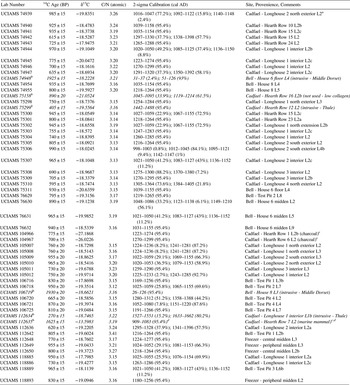
The three sites yielded a total of 56 new dates (Table 2). Of these, six are excluded from the following analysis for reasons described above. In several cases, multiple dates were obtained from specific Late Dorset excavation units. While most are correlated with the relevant stratigraphy, in three cases there are “reversals” within the Late Dorset strata—here defined as dates in higher strata being earlier than dates beneath them and not overlapping at a 2-sigma calibration level. These occur in square N49W50 in Longhouse 1 at Cadfael, Test Pit 2 at Bell, and House 8 at Bell. These reversals likely result from the disturbance processes associated with intensive occupations at both sites during the Late Dorset period. In particular, later Late Dorset house pits at Bell would have been excavated into earlier Late Dorset contexts, leading to repeated exposure and redeposition of artifacts and ecofacts in otherwise later contexts. These processes are seen in the occasional presence of much earlier Middle Dorset artifacts in otherwise Late-Dorset-dominated contexts, as outlined above. Importantly, however, in no case did any of these Bell site Dorset contexts yield a Thule period date, which confirms the artifact analysis that indicated that there was no significant mixing of post-Dorset materials in these contexts.
Late Dorset AMS Radiocarbon Dates from the Iqaluktuuq Region.

a “L” in comments field refers to excavation level.
b Six italicized dates were excluded from analysis. See text for explanation.
c Two dates indicated as charcoal are both Salix sp. One date is an unidentified marine mammal bone. All other dates are on caribou bone.
d Marine mammal specimen was calibrated using Calib (Stuiver et al. Reference Stuiver, Reimer and Reimer2018), the MARINE13 calibration dataset (Reimer et al. Reference Reimer, Bard, Bayliss, Warren Beck, Blackwell, Ramsey, Buck, Cheng, Lawrence Edwards, Friedrich, Grootes, Guilderson, Haflidason, Hajdas, Hatté, Heaton, Hoffmann, Hogg, Hughen, Felix Kaiser, Kromer, Manning, Niu, Reimer, Richards, Marian Scott, Southon, Staff, Turney and van der Plicht2013), and the closest available regional marine reservoir correction (Delta R) of 232 ± 30, from Bathurst Inlet (Coulthard et al. Reference Coulthard, Furze, Pienkowski, Nixon and England2010).
The 50 dates that form the core of this analysis (Figure 5) range from 990 ± 15 to 595 ± 15 in radiocarbon years BP, with no gap of more than 40 radiocarbon years (870–830 BP). When the dates are calibrated, however, the situation is less straightforward because both the beginning and end of the sequence correspond with plateaus or “wiggles” in the radiocarbon calibration curve. The beginning of the sequence is associated with a plateau lasting from 1000 to 880 BP, corresponding to approximately cal AD 1020–1200. The end of the sequence is affected by a plateau lasting from 680 to 550 BP, corresponding to approximately cal AD 1280–1420. Bearing these issues in mind, initial interpretation of the date range in Figure 5 indicates continuous Late Dorset occupation from the eleventh century to the early fourteenth century. Importantly, samples dating later than cal AD 1200 (ca. 830 BP or later) were recovered from all three sites, and from multiple locations within Cadfael and Bell. This is most noteworthy at Cadfael, where thirteenth-century (or later) dates were recovered from buried contexts in the interiors or associated middens of all four longhouses, as well as five hearth rows (Table 2). As a final note on the overall pattern of dates, there is a degree of bimodality, with most dates falling before or after the late twelfth century. Reasons for this distribution are unclear, although it may indicate a period of partial depopulation during the region's overall Late Dorset occupation.
Calibrated radiocarbon dates from Late Dorset contexts at Iqaluktuuq, arranged from earliest to latest. For each date, the light gray outline indicates the unmodeled calibrated probability range, and the dark gray indicates the modeled calibrated probability range. Also indicated are the modeled start (top) and end (bottom) of the combined date range when considered as a single phase. Analysis performed in OxCal 4.3 (Bronk Ramsey Reference Bronk Ramsey2009).

In order to further define the span of the Late Dorset occupation at Iqaluktuuq, the 50 new dates from the three sites were combined and considered as a single phase, with start and end ranges modeled in OxCal (see Figure 5). Due to problems introduced by the initial calibration plateau, the start of the Late Dorset occupation is not precisely defined and is modeled to have occurred between cal AD 1006 and 1109 (95% confidence interval). The end of the sequence, however, is more tightly constrained and is modeled to have occurred between cal AD 1304 and 1345 (95% confidence interval).
The discussion thus far has ignored the 15 previously acquired dates listed in Table 1, which are considered less reliable than the newly acquired dates due to the possibility of contamination. In fact, it is noteworthy that in several instances these are among the oldest on each site—precisely what is expected for terrestrial samples contaminated by marine-derived carbon. Despite this, a second analysis was run in OxCal, combining both sets of dates for a total of 65 samples. This analysis returned similar results, with the start of the Late Dorset occupation modeled as occurring between cal AD 978 and 1034 (95% confidence interval) and ending between cal AD 1305 and 1340 (95% confidence interval). In the present context, it is particularly important to note the close correspondence of the end dates: both analyses indicate the Late Dorset occupation ended during the first half of the fourteenth century.
Discussion and Conclusion
The most important implication of these dates is that Late Dorset continued to occupy parts of the Eastern Arctic until the first half of the fourteenth century, after the arrival of Thule Inuit from Alaska during the mid-thirteenth century. Dorset persistence to the early fourteenth century indicates that the two societies overlapped in the Eastern Arctic for at least 50 and perhaps as many as 100 years. As mentioned previously, there are not enough recently acquired early Thule dates to provide a more precise estimate of the temporal overlap. People of the two traditions must have had knowledge of one another, which made an impact on their respective behaviors, regardless of the intensity of direct interaction. Furthermore, eliminating a hypothetical gap between Dorset and Thule indicates that the Eastern Arctic as a whole was occupied continuously throughout its 5,000-year record of human settlement, and that Paleo-Inuit society was resilient enough to maintain a continuous occupation until it was faced with competition.
It is currently unclear whether Iqaluktuuq is a rare outlier in the Late Dorset world or simply one among several variant Terminal Dorset occupations occurring in different regions. There is so little recent fieldwork relating to the Dorset period Arctic-wide, and so few recent radiocarbon dates run with modern sample preparation methods relating to Late Dorset occupations, that it is quite possible that other regions, when adequately dated, will see Late Dorset persisting to the late thirteenth or early fourteenth century. Based on current data, the Late Dorset occupation of northwest Greenland almost certainly lasted until at least the end of the thirteenth century (Appelt and Gulløv Reference Appelt and Gulløv1999, Reference Appelt, Gulløv, Maschner, Mason and McGhee2009; Darwent and Foin Reference Darwent and Foin2010; Darwent et al. Reference Darwent, Darwent, LeMoine and Lange2007), potentially overlapping with the early Ruin Island phase of Thule occupations in that region (McCullough Reference McCullough1989). The central High Arctic (LeMoine et al. Reference LeMoine, Helmer and Grønnow2003), Somerset Island (Damkjar Reference Damkjar, Appelt, Berglund and Gulløv2000), western Victoria Island (Savelle et al. Reference Savelle, Dyke, Whitridge and Poupart2012), Foxe Basin (Savelle and Dyke Reference Savelle and Dyke2014), and northern Labrador (Desrosiers Reference Desrosiers, Curtis and Desrosiers2017; Renouf Reference Renouf2003) have also produced isolated dates that may point to Late Dorset populations persisting into the thirteenth century or later. The situation in Nunavik (northern Quebec) is currently unresolved, but it is also a good candidate for Late Dorset occupations with the potential for overlap with Thule (Labrèche Reference Labrèche2015; Pinard and Gendron Reference Pinard, Gendron, Maschner, Mason and McGhee2009; Plumet Reference Plumet and McCartney1979, Reference Plumet1989), particularly given a new genetic analysis that may indicate some gene flow between Paleo-Inuit and Inuit in the region (Zhou et al. Reference Zhou, Xie, Quoibion, Ambalavanan, Dionne-Laporte, Spiegelman, Bourassa, Xiong, Dion and Rouleau2019).
What is it about Iqaluktuuq that led to its occupation by Late Dorset up to the early fourteenth century? Part of the answer may be that southeastern Victoria Island was probably not as attractive to early Thule migrants as many other regions. There is currently no evidence for earliest Thule in the immediate region, implying that pioneering Thule did not settle here, perhaps because it did not contain the bowhead whales and walrus that were economically and socially prized in many other regions (see Figure 1). This does not mean Thule were incapable of living here; they did settle the region around AD 1400, but probably in a second wave of Thule settlement after many other regions were already occupied (Friesen and Norman Reference Friesen and Norman2016). It is also possible, however, that a relatively large Late Dorset population at Iqaluktuuq presented a socially risky situation for Thule, which contributed to its late settlement—perhaps pointing to a rare instance where Thule avoided Dorset, rather than vice versa. This receives some support from the fact that the subsistence economies of Dorset and Thule appear to have been quite similar at the Bell site, based on extensive faunal analysis (Howse and Friesen Reference Howse and Max Friesen2016). Consequently, southeastern Victoria Island may have been a region in which Thule Inuit held a relatively minor competitive advantage over Dorset, despite Thule's more diverse and specialized subsistence and transportation technologies.
Beyond the conclusion that Dorset and Thule did indeed overlap in time, what are the implications of these dates? Perhaps most importantly, although we do not have enough data to understand fully the processes leading to the end of the Dorset tradition, this new chronological information clearly indicates that Paleo-Inuit culture, which had lasted through many changing configurations as well as cycles of expansion and contraction for over 4,000 years in the Eastern Arctic, did not somehow die out of its own accord due to factors such as climate change during the Medieval Warm Period. Instead, interaction with Thule Inuit must be an important factor in any discussion of the disappearance of Dorset.
In terms of the nature of interaction between the two societies, this combination of temporal overlap with minimal direct evidence for interaction supports a general “avoidance” model for Dorset-Thule interaction. In this view, Dorset were rapidly displaced due to both Thule society's technological superiority—which allowed them to successfully harvest a wider range of resources, including whales—and Thule social organization, which was characterized by a more hierarchical structure and an origin in Alaska where territoriality and interregional conflict were common (Friesen Reference Friesen, Appelt, Berglund and Gulløv2000; McGhee Reference McGhee, Gilberg and Gulløv1997). Occasional direct contact was probably overshadowed by Dorset avoiding interaction by moving to less desirable locations, briefly, before dying out. Also potentially critical was the likely Thule disruption of the well-documented Late Dorset interaction networks, which may have been a key to Late Dorset social and economic stability. Once Thule arrived, the interruption of these interaction networks, and the “social safety net” they represented, may have hastened the demise of each regional Late Dorset group (Appelt and Gulløv Reference Appelt, Gulløv, Maschner, Mason and McGhee2009; Appelt et al. Reference Appelt, Damkjar, Friesen, Max Friesen and Mason2016).
Significantly, this scenario matches the Inuit accounts of meetings with Tuniit. The Eastern Arctic occupations of these two peoples did overlap in time, and they probably met, but Late Dorset endured for only a few generations after Inuit arrived.
Acknowledgments
My greatest thanks go to my research partners, the Kitikmeot Heritage Society of Cambridge Bay, Nunavut. The fact that the dates line up with the stratigraphy at these three sites is a tribute to the skill and perseverance of all archaeological field crews on the Iqaluktuuq Project. Thanks also to Alice Telka of Paleotec Services in Ottawa, John Southon of the W. M. Keck Carbon Cycle Accelerator Mass Spectrometry Laboratory, Mike O'Rourke for the maps, and Marie-Annick Prévost for translating the abstract. I also greatly appreciate the comments of four anonymous reviewers. Samples were collected subject to Nunavut Archaeology Permits 00-009, 01-020A, 02-030A, 04-09A, 05-008A, 07-008A, and 10-021A. Funding was generously provided by the Social Sciences and Humanities Research Council, the Canadian Government Program for the International Polar Year, the Polar Continental Shelf Project, and the Northern Scientific Training Program.
Data Availability Statement
All information on the radiocarbon dates is included in Table 2.