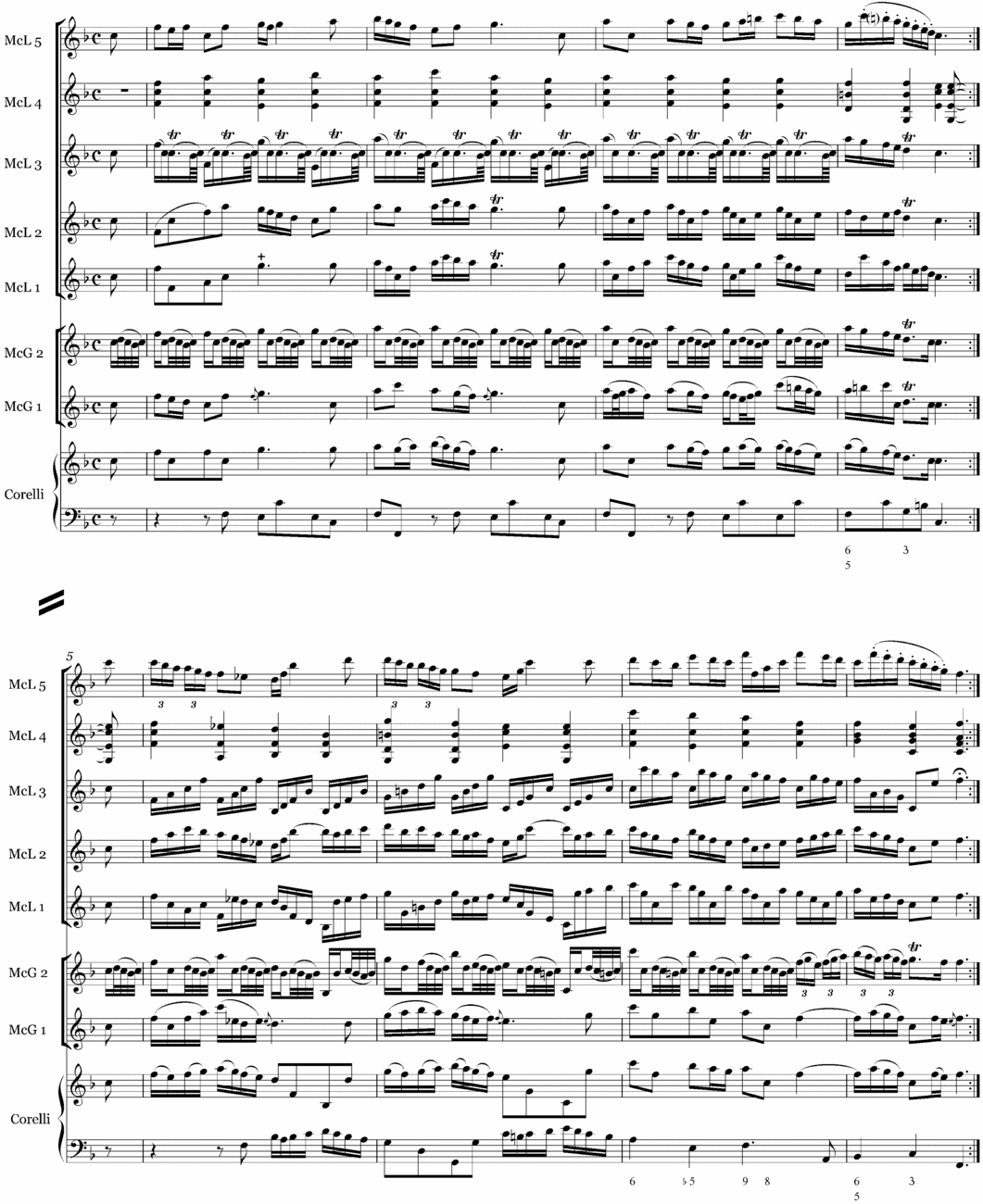
In a whimsical letter from 1761, the Scottish poet Andrew Erskine facetiously chided James Boswell for his inability to play the jaw harp: ‘I have often wondered, Boswell, that a man of your taste in music, cannot play upon the Jews [sic] harp’. Erskine urged his friend to rectify this shortfall, noting that proficiency on the rustic instrument would enable him to play such pieces as ‘Corelli's solo of Maggie Lauder, and Pergolesi's sonata of The Carle he came o'er the Craft’. These bogus works by Italian composers, apparently based on legitimate Scots tunes (‘Maggie Lauder’ is still well known today), were ‘excellently adapted to’ the instrument, according to Erskine.Footnote 1 His entreaty to Boswell culminated in a farcical ‘Ode Upon a Jew's Harp’, which he pronounced ‘exceeds Pindar as much as the Jew's harp does the organ’.Footnote 2
In his landmark monograph Music and Society in Lowland Scotland in the Eighteenth Century, David Johnson reads the joke at the centre of Erskine's letter as lying in what he considers to be an unlikely alliance of ‘folk and classical music’, the former represented by the jaw harp and the two Scots tunes, and the latter by the sonata (or ‘solo’) genre and the two Italian composers, Corelli and Pergolesi.Footnote 3 This reading, however, ignores the vogue in the mid-eighteenth century for Scottish vernacular tunes decked out in Italianate forms, harmonies and figuration.Footnote 4 This hybrid style, which Johnson would later acknowledge as the ‘Scots drawing room style’, included song settings as well as instrumental pieces, some of which mould the Scots fiddle tradition of the variation set to the Corellian sonata da camera.Footnote 5 Indeed, the names of such pieces, for instance Francesco Geminiani's sonata on ‘The Last Time I Came o'er the Moor’ or Alexander Munro's sonata on ‘Fy, Gar Rub Her o'er wi’ Strae’, take the very form that Erskine satirized in ‘Corelli's solo of Maggie Lauder’ and ‘Pergolesi's sonata of The Carle he came o'er the Craft’.Footnote 6 Given the popularity of mixed-heritage pieces of this sort in Scotland, Johnson's reading of Erskine's joke as lying in the ‘disparity’ of the juxtaposed elements is dubious. More likely, Erskine intended to send up the upper- and middle-class amateurs ‘of taste’ for whom the ostentatious mingling of pan-European and local musical traditions had become so fashionable.
Recent scholarship about the convergence of local and imported musical traditions in eighteenth-century Scotland centres on the elite milieu that Erskine mocked, particularly the sphere of activity surrounding the Edinburgh Musical Society.Footnote 7 The city's largest and most expensive social club in the eighteenth century, the Edinburgh Musical Society was run by gentlemen members who employed professional musicians to reinforce their ranks.Footnote 8 Though the Society was formally established in 1727, a ‘Musick Club’ with a similar make-up had existed in Edinburgh since the 1690s, its origins coinciding with the beginnings of other early developments of the Scottish Enlightenment.Footnote 9 The Society ran until 1798, making it the longest-lived of eighteenth-century Edinburgh's social clubs. Matthew Gelbart argues that the Scots drawing-room style was consciously created as part of a larger aesthetic project intended to foster a pan-Scottish national identity in the decades following the 1707 Act of Union with England.Footnote 10 Gelbart identifies the spearhead of the project as the poet Allan Ramsay, whose 1720 poem ‘To the Musick Club’ encouraged the members of the incipient Edinburgh Musical Society to lift up vernacular Lowland and Highland musics:
The way to go about elevating Scottish music, according to Ramsay, was to ‘mix’ vernacular Scottish music – represented metonymically by the Lowland tunes ‘[The Broom of] Cowdon Knows’ and ‘Winter Nights Are Long’, and by the Highland bagpipe ‘Pibrough’ – with music imported from Italy – represented by ‘Correlli's soft Italian Song’. Gelbart reads the subsequent appearance of printed collections in which ‘refined’ Scots tunes are dressed up in Italianate clothing as a realization of this vision.Footnote 12 With the notable exceptions of James Oswald and Geminiani, many of the composers of these collections were associated with the Edinburgh Musical Society: Munro, a professor of anatomy at the University of Edinburgh, was a member, while Adam Craig, Alexander Stuart, Francesco Barsanti, William McGibbon and Charles McLean were hired professionals who played in the Society's orchestra. In Gelbart's analysis of the convergence of vernacular music and Italian music in eighteenth-century Scotland (which forms part of his larger argument about the origin of the modern ideas of ‘art music’ and ‘folk music’ in Europe), the convergence is cast primarily as a moulding of vernacular tunes to the forms of pan-European art music and its cultural institutions.Footnote 13 As Gelbart acknowledges, the protagonists in his narrative are mainly a cast of literati, philosophers and wealthy amateur musicians who wrote about music.Footnote 14 Proverbially, then, ‘Maggie Lauder’ assumes the idiom and function of ‘Corelli's solo’ through a project of gentrification. For the most part, working musicians play no more than a supporting role in this narrative. Even McGibbon, the professional at the helm of the Edinburgh Musical Society orchestra and leading Scottish musician of his generation, is a rarely appearing actor. His published collections of Scots tunes, in this narrative, simply help to give material form to Ramsay's vision for the elevation of Scottish music.Footnote 15
In this article, I explore the convergence of ‘Maggie Lauder’ and ‘Corelli's solo’ in the mid-eighteenth century from an alternative angle. To illuminate this perspective I present two cases in which Corelli's works are taken over into vernacular contexts. The first case considers the assimilation of the Gavotta from Sonata No. 1 of the Sonate da camera a tre, Op. 2 (1685), into vernacular repertories in Britain and America from the eighteenth century to the present. Still today, under anonymous cover, the gavotte circulates among traditional musicians, through oral tradition, notation, sound recording and YouTube. Unlike the Scots drawing-room style, which amounted to the gentrification of a popular musical idiom, the case of the Op. 2 gavotte exemplifies the vernacularization of elite pan-European music. I use the term vernacularization to refer to the way in which music originally belonging to an elite, international tradition is absorbed into localized or specialized traditions of music-making, typically involving musicians and audiences from a broader mixture of social classes. This process usually involves the movement of works that have previously circulated primarily through printed editions into oral or quasi-oral tradition. The vernacularization of the Gavotta shines light on a heritage that seemingly lies beyond the conventional associations of Corelli as nobleman, virtuoso and, in Michael Talbot's words, the first composer whose reputation is owed ‘in large part to the activity of music publishers’.Footnote 16 As Lorenzo Bianconi argues, ‘the six great instrumental publications of Corelli’ were the principal basis for the ‘ennoblement’ and ‘elevation’ of instrumental music ‘to a truly classical dignity in the early years of the eighteenth century’.Footnote 17 The circumstances of the transmission of Corelli's works as melodies – in some cases, even as anonymized melodies – by dancing masters, fiddlers, fifers and other vernacular musicians do not have an obvious place within this purview.
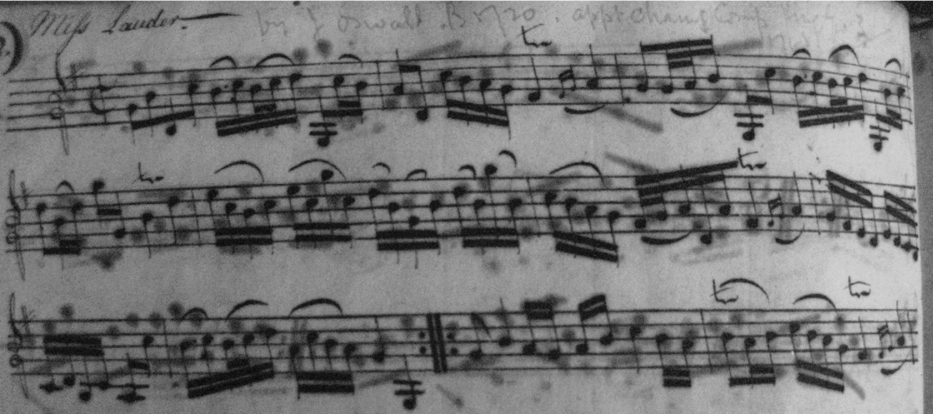
While the case of the Op. 2 gavotte involves a piece by Corelli that became fully assimilated into vernacular contexts, my second case study reveals Corelli's music at the threshold of oral tradition, pointing to a process by which fiddlers could bring short da camera movements into their repertory. It centres on a large cache of ornaments for Corelli's Sonate per violino e violone o cimbalo, Op. 5 (1700), in a little-known Scots fiddle notebook catalogued at the Jean Gray Hargrove Music Library of the University of California Berkeley as Manuscript 957.Footnote 18 In this manuscript, compiled by the prolific transmitter of Scots tunes David Young (fl. 1722–1760), ‘Corelli's solo’ and ‘Maggie Lauder’ literally come together, though not in the way that Erskine satirized. Among the 180 pieces that make up the manuscript are an anonymous set of four variations on the tune ‘Maggie Lauder’ (entitled ‘Miss Lauder’ in the manuscript; the opening strain is reproduced as Figure 1) and movements from Corelli's ‘Solos’, Op. 5. The latter include ‘plain’ transcriptions of select movements from the original 1700 edition of Op. 5 and, especially interesting for this article, six sets of variations by William McGibbon (1696–1756) and Charles McLean (c1712–c1772) on Op. 5 fast dance movements together with eleven sets of elaborate graces by McGibbon for slow movements from the same collection. I argue that the relationship between ‘Maggie Lauder’ (and Scots fiddle tunes in general) and Corelli's sonatas on display in Manuscript 957 owes less to the orchestrated fusion of distinct cultures and musical styles that Gelbart uncovers in writings from the period and more to two overlapping components of a cosmopolitan fiddle tradition held together by the skilled bodies of the fiddlers themselves and their instrument, the Italian violin.
‘Miss Lauder’, opening. Manuscript 957, Jean Gray Hargrove Music Library, University of California Berkeley, 48. Used by permission

Perhaps the most overlooked of these fiddlers is McGibbon. In the decades after his death, McGibbon's reception was bound up with polarized views surrounding the co-existence of elite pan-European and vernacular Scottish styles of music; he was variably a hero and a corrupter of the national tradition. Twentieth-century studies have tended to emphasize McGibbon's legacy as a composer of Italian works, thereby casting him as somewhat of an outlier in the history of the Scots fiddle tradition, in contrast to Niel Gow (1727–1807), usually regarded as an early insider of the tradition.Footnote 19 In recent research on music in eighteenth-century Scotland, the conspicuous absence of any critical discussion of McGibbon, one of the most prominent Scottish musicians of that century, emphasizes the elite-oriented focus of enquiry. One of the texts that has been treated in recent studies is A Comparative View of the State and Faculties of Man with Those of the Animal World by the Aberdonian physician-professor John Gregory, which has been discussed for the distinction it draws between ‘national’ and ‘cultivated’ music.Footnote 20 Gregory dismissed the perspective of working musicians outright, in time-honoured tradition:
No Science ever flourished, while it was confined to a set of Men who lived by it as a profession. . . . The interested views of a trade are widely different from the enlarged and liberal prospects of Genius and Science. When art is confined in this manner, every private practitioner must attend to the general principles of his craft, or starve.Footnote 21
As a working musician from a humble background, McGibbon was one of the ‘private practitioners’ whose livelihood depended on music. The discovery of the Scottish Op. 5 ornaments affords an opportunity to reassess McGibbon's status in the history of Scottish music and to reconsider the relationship between ‘cultivated’ Italian and vernacular Scottish styles from the perspective of the ‘confined’ world of music as a trade.
COSGILL'S DELIGHT
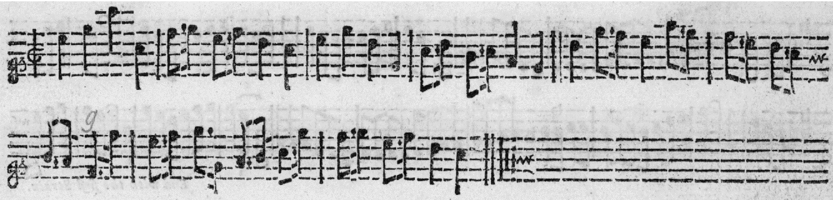
Today, we can hear the country-dance tune ‘Mr Cosgill's Delight’ on an album of the John Kirkpatrick Band ( (Online)). The track opens with the tune ‘Long Odds’, which segues into ‘Mr Cosgill's Delight’ at 1′07″.Footnote 22 Under Kirkpatrick's fingers, the tune is a cheerful hornpipe full of jaunty offbeats. Like many traditional dance tunes, it contains two strains, both short, that the accordionist repeats again and again, each time with increasingly ebullient ornamentation. ‘Mr Cosgill's Delight’ is an old tune, appearing in print under this name as early as the mid-1720s, in John Young's second edition of the third volume of The Dancing-Master: or Directions for Dancing Country-Dances (London, ?1728) (Figure 2).Footnote 23 The tune recorded by Kirkpatrick is essentially the same as the one transcribed by Young, though the accordionist's rendition includes syncopations not reflected in Young's version. The tune continues to appear in printed collections today, while also circulating through oral tradition and virtual channels.Footnote 24 One YouTube video shows fiddler Laurel Swift teaching ‘Mr Cosgill's Delight’ to a live and online audience.Footnote 25
‘Mr. Cosgills Delight’, from John Young, The Dancing-Master: or Directions for Dancing Country-Dances, volume 3, second edition (London, ?1728), 83. © The British Library Board, Music Collections K.1.b.8. Used by permission

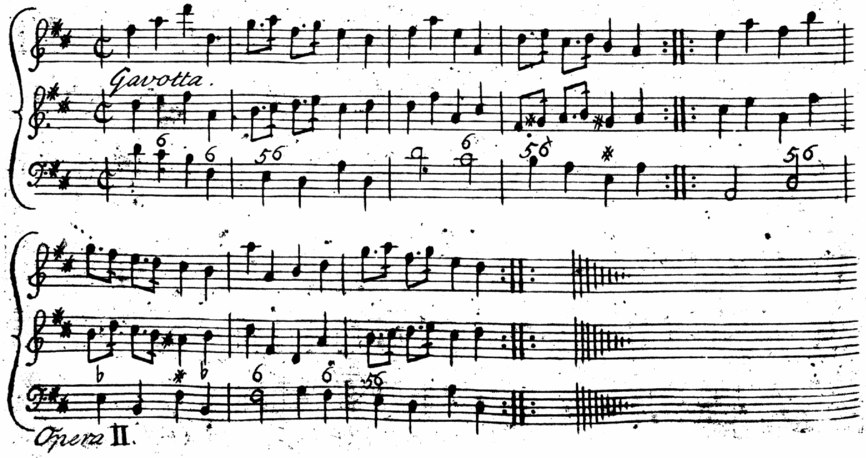
Readers familiar with the Gavotta from Sonata No. 1 of Corelli's Op. 2 trio sonatas (Figure 3) may notice the close resemblance of ‘Mr Cosgill's Delight’ to the first-violin part of that movement. Indeed, aside from the transposition and some bubbly embellishments, ‘Mr Cosgill's Delight’ is virtually identical to Corelli's Gavotta. The same tune also appears under the generic name ‘Gavot’ in Thomas Bennet's violin manuscript of 1718Footnote 26 and under the less enigmatic title ‘Corelli's Gavot’ in eighteenth- and nineteenth-century collections from both sides of the Atlantic. We find it in Wright's Compleat Collection of Celebrated Country Dances, published in London around 1740, and in a notebook of the American Captain George Bush, which he began compiling in 1779.Footnote 27 The Compleat Tutor for the Fife, published by George Willig in Philadelphia in 1805, also contains ‘Corelli's Gavot’ (Figure 4).Footnote 28
Arcangelo Corelli, Sonata Op. 2 No. 1/iv, ed. J. C. Pepusch (London[, 1740])

‘Corelli's Gavot’, from George Willig, The Compleat Tutor for the Fife (Philadelphia, 1805), 29. Gilmore Music Library, Yale University, MT356 C737. Used by permission

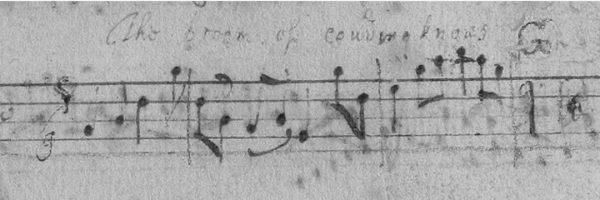
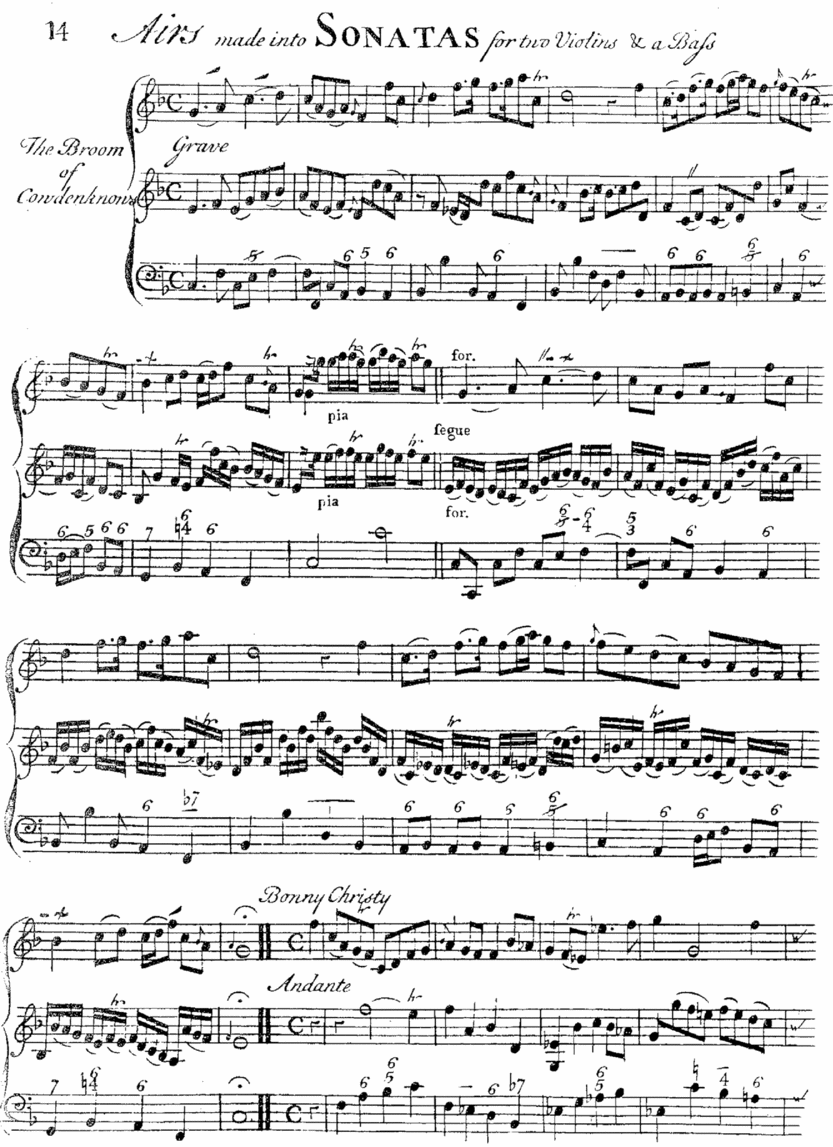
This assimilation of Corelli's Gavotta into vernacular music in England and the United States is of a different nature from the assimilation that Ramsay called for. As an illustration of the latter type of assimilation, we can look to one of the metonyms that Ramsay used for Scottish music in his poem ‘To the Musick Club’: the tune ‘The Broom of Cowden Knowes’ (Example 1). Versions of the tune, which continues to circulate today, appear in sources dating from as early as the mid-seventeenth century.Footnote 29 One eighteenth-century source, the James Gairdyn Manuscript,Footnote 30 shows a variant of ‘The Broom of Couden Knows’ on the cusp of oral tradition: the tune appears only as an incipit, probably as an aide-mémoire to a Scots dance violinist (Figure 5).Footnote 31 Yet in other contexts, the tune is brought squarely into the pan-European literate musical tradition. One such context is Geminiani's A Treatise of Good Taste in the Art of Musick, published in 1749 and dedicated to Frederick, Prince of Wales. In one of several arrangements of Scots tunes in the treatise, Geminiani transforms ‘The Broom of Cowden Knowes’ into the opening Grave of a trio sonata (Figure 6).Footnote 32 The first violin plays the tune twice to the accompaniment of an active figured bass. On the first iteration of the tune, the second violin provides a countermelody and, on the second iteration, breaks that countermelody into diminutions that busily fill in the rhythmic space between the slower moving notes of the first violin. Geminiani provided bowings, as did the scribe of the Gairdyn manuscript, but Geminiani's notation is more specific, with indications for various ornaments (named and defined in Geminiani's introductory essay to the print) that include ‘plain shakes’, ‘turn'd shakes’, ‘swells’, ‘apogiaturas’ and ‘beats’. All in all, this arrangement of ‘The Broom of Cowden Knowes’ shows the trappings of the pan-European literate mainstream, arranged by a named composer (an Italian, no less) into a trio-sonata movement within a treatise on ‘good taste’ and written down using notational conventions (including figured bass and ornament signs) that are typically found in Italian violin music from the same period.
‘The Broom of Cowden Knowes’

Incipit of ‘The Broom of Couden Knows’. National Library of Scotland, MS Glen 37 (the Gairdyn Manuscript), fol. 3v. Used by permission

Francesco Geminiani, ‘The Broom of Cowdenknows’, from ‘Airs Made into Sonatas for Two Violins & a Bass’, A Treatise of Good Taste in the Art of Musick (London, 1749), 14

By contrast, the case of ‘Mr Cosgill's Delight’ / ‘Corelli's Gavot’ shows a movement of a canonical work of the literate, pan-European mainstream being unleashed on the vernacular wilds. Corelli's Gavotta is hardly a unique instance of a piece by a known composer becoming assimilated into a vernacular repertory.Footnote 33 What makes this case particularly compelling is that it implicates Corelli – a composer whose legacy was (and remains) so bound up with the literate, canonical instrumental tradition in the eighteenth century. Writing in 1708, Sébastien de Brossard pronounced Corelli's sonatas to be the ‘model’ for the sonata da camera genre.Footnote 34 By the second half of the eighteenth century, Corelli's music was so popular that rhetoric of universality crops up repeatedly in characterizations of the composer and his music. For instance, Jean-Benjamin Laborde declared that ‘his renown knows no boundaries’ (‘sa renomée n'a pas de bornes’); the Scottish physician John Gregory, that ‘the truth is Corelli's stile’; John Hawkins, that ‘his music is the language of nature’; and Charles Burney, that his music was ‘universally admired’.Footnote 35 Even criticism of Corelli's music emphasized the apparent universal nature of its influence. Geminiani's famous criticism that his master's compositions lacked ‘great fancy, or rich invention in melody or harmony’ only reinforced the equation of Corelli's style with a set of default parameters, which served as the foundation for enrichment according to the different tastes of the multitudes of musicians who engaged with the famous Italian's works.Footnote 36
Yet it is clear that much of the admiration voiced for the universality of Corelli's music related specifically to achievements within a more circumscribed domain. The boundaries of this domain emerge, for instance, in a remark made by Burney:
We are now arrived at a memorable aera for the violin, tenor, and violoncello; when the works and performance of the admirable ARCANGELO CORELLI rendered them respectable, and fixed their use and reputation, in all probability, as long as the present system of Music shall continue to delight the ears of mankind.Footnote 37
It was specifically within this ‘present system of Music’, the elite, literate system that Burney saw to have been transformed by the social uplift of the violin family, that Brossard held up Corelli's sonatas as a ‘model’. Yet this was just one of a multitude of contexts for string playing in eighteenth-century Europe, some of which were familiar to Burney. ‘The national melody of the northern inhabitants of this island’, by which Burney was referring to Scottish music, was one such tradition close to home.Footnote 38
The example of ‘Mr Cosgill's Delight’ illuminates the life of Corelli's music at the fringes of Burney's ‘present system of Music’. In the hands of folk musicians then and now, the Gavotta is anonymous and unbound from the constraints of a single authoritative text. Detached from the ‘model’ form of the sonata da camera and joined up with country dances or military marches, we encounter Corelli's work in an environment not accounted for in eighteenth-century writings on the composer. Hawkins wrote that ‘men remembered, and would refer to passages in [Corelli's music] as to a classic author’.Footnote 39 But exactly what kind of ‘classic author’ was Corelli in the vernacular context? ‘Mr Cosgill's Delight’ would suggest an anonymous Aesop-like storyteller whose tales are retold again and again over the course of centuries, changing in accordance to the values of each new teller and the expectations of each audience.
A MALLEABLE MONUMENT
The idea of Corelli's music as retellings resonates with the legacy of the Sonate Op. 5. The difference is that whereas the retellings of ‘Mr Cosgill's Delight’ lie on the periphery of ‘the present system of Music’ that Burney conceived, many of the retellings of Op. 5 – preserved as notated ornaments and arrangements – lie at its heart. Of Corelli's six published works, none had more influence than Op. 5. Generations of violinists were brought up on the collection, which was printed more times than any other volume of instrumental music during the eighteenth century.Footnote 40 Burney called it a ‘classical book for forming the hand of a young practitioner on the violin [that] has ever been regarded as a most useful and valuable work by the greatest masters of that instrument’ – no less than the basis ‘on which all good schools for the violin have been since founded’.Footnote 41 He reported that Giuseppe Tartini ‘refused to teach any other music to his disciples, till they had studied the Opera quinta, or Solo's, of Corelli’.Footnote 42
Perhaps it was because of such widespread use that Op. 5 was also a malleable monument. The painstaking effort that Corelli supposedly took to set down the definitive version of his sonatas in print stands in stark contrast to the multiplicity of ornamented versions of the sonatas that survive from the eighteenth and nineteenth centuries.Footnote 43 They are preserved in some thirty sources that together present a fascinating window onto the diverse ways in which musicians interacted with Op. 5.Footnote 44 The ornaments range from compositional exercises to impressionistic notations of virtuosic performance. Specimens for bowed and plucked strings, keyboard and woodwinds survive from all over western Europe, from Italy to England, Spain to Sweden. The ornamenters include famous virtuosos, Geminiani, Tartini and Matthew Dubourg among them, as well as anonymous teachers and pupils. Among the earliest ornaments are Corelli's own graces for the slow movements of Sonatas Nos 1–6, published by Estienne Roger in 1710 and reprinted throughout the century.Footnote 45 The widespread dissemination of two ‘authoritative’ versions of Op. 5 weakened the dependence of the work's identity on the particularities of a single text. In a way, this is not so different from the case of traditional tunes, for which there is no single ‘correct’ version.
BERKELEY MANUSCRIPT 957 AND WILLIAM MCGIBBON
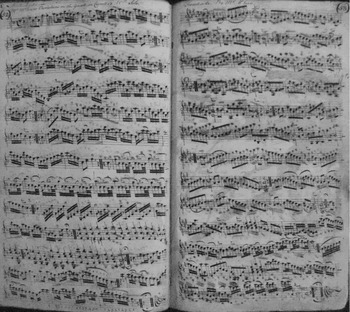
Copied around 1740 by the writing master and fiddler David Young, Manuscript 957 provides a fascinating context for the Op. 5 ornaments.Footnote 46 Even by the cosmopolitan standards of English-language fiddle books from the eighteenth century, the manuscript's content is unusually diverse.Footnote 47 In addition to the inclusion of Op. 5 ornaments, what makes this manuscript notable is its mixture of multi-movement Italian works with fiddle tunes and variations: concertos from Tessarini's Op. 1 with ‘Lumps of Puddings’, a duo concerto from Vivaldi's L'Estro armonico with ‘Bung Your Eye’, an Italian-style ‘Solo’ by McGibbon with ‘Sweet as Sugar Candie’, and a galant prelude from a variation sonata by the anatomy professor Munro with the ancient British standard ‘Johny Cock Up Thy Beaver’. McGibbon's and Charles McLean's ornaments for Corelli's sonatas are juxtaposed with elaborate variation sets on tunes such as ‘The East Nuik of Fife’, ‘Caber Fei’, ‘Black Jock’ and ‘Pinkie House’.Footnote 48 Through the homogenizing agent of Young's hand, variations on Corelli's Op. 5 blend seamlessly with variations on Scots tunes, as we see in Figure 7, where McLean's variations on the gavotte from Corelli's Sonata No. 10 share an opening with McLean's variations on ‘Tweedside’.
Manuscript 957, 52–53. Used by permission

While the pieces by Corelli in the manuscript are attributed, other tunes by known composers creep in anonymously. These include popular seventeenth-century melodies, among them two pieces entitled ‘Sibell’: the original ‘Descente de Cybell’ from Lully's Atys and Purcell's ‘In imitation of Cibell’ (z678).Footnote 49 We find another unattributed piece by Purcell in the manuscript ‘What Shall I Do to Show Her How Much I Love Her?’ from Dioclesian. Other anonymized pieces include numbers from operatic productions that played in London during the 1730s: ‘The Submissive Admirer’ originated as a minuet in Handel's Arianna in Creta, and ‘Stella, Darling of the Muses’ is derived from the aria ‘Semplicetta Tortona’ from Giovanni Battista Pescetti's Demetrio.Footnote 50 (The latter, in fact, appears twice in the manuscript, once as a straight tune and once as a set of variations by McLean.) Under anonymous cover, these and other pieces of diverse origins assimilate into a Scots fiddle repertoire.
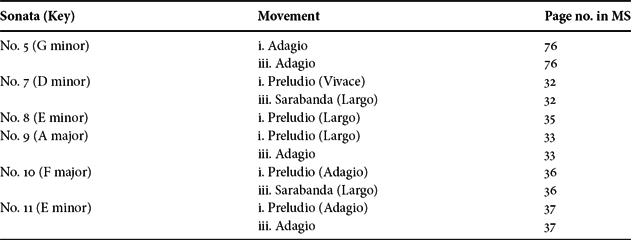
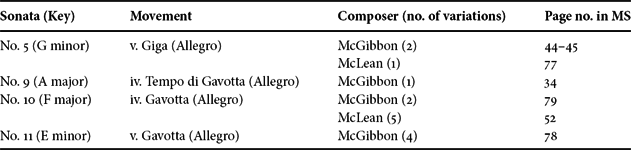
The cache of Op. 5 ornaments preserved in Manuscript 957 includes fifteen sets of ornaments by McGibbon and two by McLean. Eleven of McGibbon's ornaments are graces for slow movements from Sonata Nos 5, 7, 8, 9, 10 and 11 (Table 1). The other ornaments are variation sets for fast dances. McGibbon composed sets for the Giga of Sonata No. 5, Tempo di Gavotta of No. 9, Gavotta of No. 10 and Gavotta of No. 11. McLean composed sets for two of the same movements: the Giga of Sonata No. 5 and the Gavotta of No. 10 (Table 2). Thus, with the exception of the graces and variations for Sonata No. 5, the ornaments are for movements of the da camera sonatas, the shorter works that make up the second half of Op. 5.Footnote 51 Indeed, most of the ornaments that postdate Corelli's own graces (which are for the first six sonatas) are for movements from the second half of the collection.Footnote 52
Graces by William McGibbon for Arcangelo Corelli, Sonate a violino e violone o cimbalo, Op. 5. Manuscript 957, Jean Gray Hargrove Music Library, University of California Berkeley

Variations by William McGibbon and Charles McLean for Corelli, Sonate a violino e violone o cimbalo, Op. 5. Manuscript 957

The Op. 5 ornaments by McGibbon, particularly the graces, are among the most virtuosic records of violin playing from eighteenth-century Scotland. Though McGibbon was the leading Scottish musician of his generation and, for thirty years, a central figure in the musical life of Edinburgh, his historical significance has received little sustained attention. While McGibbon was a composer of published works, his reputation appears to have rested primarily on his charisma as a performer, which explains in part the minor role he plays in accounts of music in Scotland. The graces, however, give us an unprecedented glimpse of McGibbon the master musician and invite us to compare him, doing what he did best, to other masters.
McGibbon was born in Glasgow into a family of professional musicians in 1696.Footnote 53 His father was ‘violer’ Duncan McGibbon, and his uncle was oboist Malcolm McGibbon.Footnote 54 The family was not well off financially, and we can imagine that William, as a talented child, was probably put to work at an early age to help support the family, playing the violin around town.Footnote 55 Writing in 1792, William Tytler claimed that the young McGibbon went to London to train with the violinist William Corbett.Footnote 56 It is likely, given his family's circumstances, that McGibbon served as an apprentice.Footnote 57 Considering that Corbett spent much time in Italy during the 1710s, the period of McGibbon's presumed apprenticeship, McGibbon may have accompanied his master there.Footnote 58 While a trip to Italy was a rite of passage for many young British men born into wealthy families, for a Scottish fiddler of McGibbon's background, it was an unusual opportunity.
More unusual still was that, after receiving his training abroad, McGibbon returned to the periphery of his native land, possibly by 1717, but certainly by 1726.Footnote 59 He soon became the first leader of the semi-professional orchestra of the Edinburgh Musical Society, a position he held until his death in 1756. In the Society's seventy-year history, he was the only leader of the orchestra to have been born in Scotland. Despite his central role, his salary was dwarfed by those of his Italian-born colleagues.Footnote 60 For instance, in 1739 McGibbon was paid £25, whereas the Italian expatriate woodwind player Francesco Barsanti was paid £50.Footnote 61 With the support of members of the Edinburgh Musical Society and other subscribers, McGibbon published six collections of sonatas (solo, duo and trio) between the late 1720s and late 1740s, none of which appears to have been reissued.Footnote 62 His earliest collection, of trio sonatas, was published in or before 1727, making these the earliest sonatas to have been printed in Scotland.Footnote 63 Several lost orchestral works by McGibbon are listed in record books of the Edinburgh Musical Society.Footnote 64 That McGibbon enjoyed a unique status among local composers is reflected in records of music purchased by the Edinburgh Musical Society. Of the fourteen musical works purchased by the Society between 1727 and 1735, four were by McGibbon – more than any other composer.Footnote 65 The influence of Corelli, which was inescapable for British violinists of this generation, is evident in McGibbon's oeuvre. Explicit Corellian references include Sonata No. 5, subtitled ‘In Imitation of Corelli’, from McGibbon's 1734 set of trio sonatas and lost concerti grossi based on sonatas from Corelli's Opp. 2 and 5.
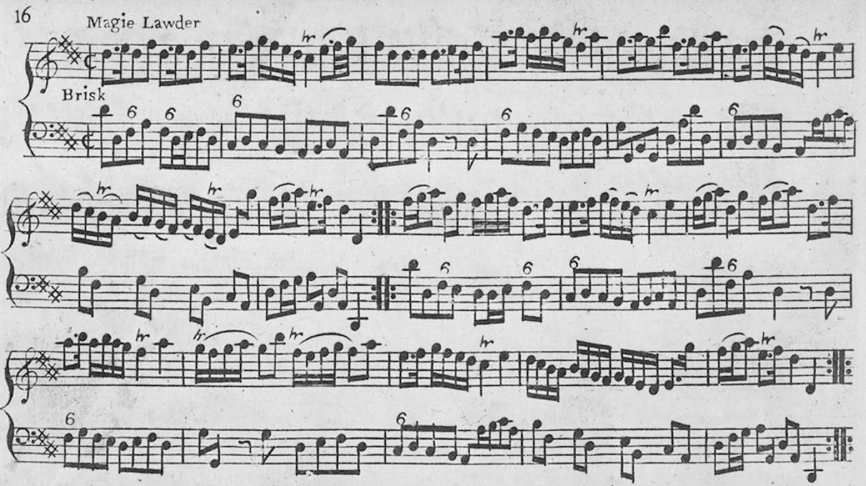
Following the success of the first collections of Scots tunes published in Edinburgh by James Oswald and others, McGibbon issued three volumes of A Collection of Scots Tunes for the Violin or German Flute and a Bass for the Violoncello or Harpsichord in 1742, 1746 and 1755. The Collection enjoyed far greater renown than McGibbon's other publications and has informed conflicting interpretations of McGibbon's legacy in Scottish music history.Footnote 66 The arrangements of tunes that make up the Collection include a figured bass line and, often, one or more variations. McGibbon's setting of ‘Magie Lawder’ (Figure 8) exemplifies the literate, pan-European presentation of tunes in such collections, with a walking bass line, slurred bowings and trills.
William McGibbon, ‘Magie Lawder’, A Collection of Scots Tunes, three volumes (Edinburgh, 1742; reprinted Edinburgh: Robert Bremner, c1768), volume 1, 16

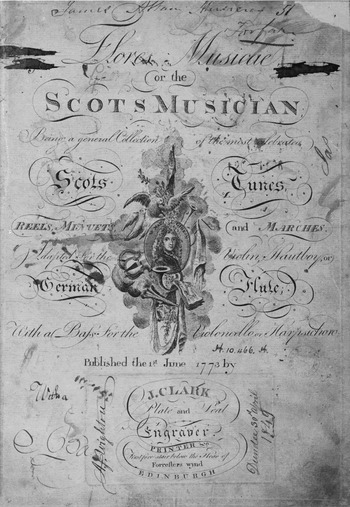
John Clark, Flores Musicae, or the Scots Musician (Edinburgh, 1773), title-page. Wighton Collection, Dundee Central Library. Used by permission

This amalgam of Scots tunes and the stylistic markings of an elite European musical tradition generated a range of responses among eighteenth- and nineteenth-century writers, from those who identified McGibbon as a champion of contemporary Scots music to those who saw him as an antagonist to it. In John Clark's Flores Musicae, or The Scots Musician of 1773, McGibbon is presented as the literal figurehead of Scots music: a miniature portrait of him appears in the centre of the title-page of the collection (Figure 9a).Footnote 67 He was afforded a similar status in John Glen's Early Scottish Melodies of 1900, in which another portrait of McGibbon appears on the frontispiece. He is thought to be the musician ‘Macgibbon’ whose death Robert Fergusson equated with the death of Scots music itself in his ‘Elegy on the Death of Scots Music’.Footnote 68 And, as will soon become clear, he is undoubtedly the salt-of-the-earth ‘fidler’ whom the satirist James Wilson (under the pseudonym Claudero) praised in ‘On Seeing a Scots Fidler in Laced Clothes’, a poem that has not, to my knowledge, been previously linked to McGibbon.
In both poems, McGibbon represents an authentic, indigenous musical tradition under siege by a decadent, Italian one. In Fergusson's poem, published in 1772, ‘crabbit queer variety / of sounds fresh sprung frae Italy, / A bastard breed!’ have replaced the ‘saft-tongu'd melody’ of Scotland, ‘which now lies dead’. The death of McGibbon himself is lamented in the seventh and eighth stanzas of the eleven-stanza poem:
Doubts have been raised about the identification of William McGibbon with the ‘Macgibbon’ of the poem on the grounds that, as a composer of Italianate sonatas and concertos, McGibbon would have seemed a dubious hero of Scots music.Footnote 70 However, Claudero's poem, published in 1765, provides a precedent for precisely this association. Like Fergusson's poem, it expresses nostalgia for a golden age of Scots music and discontent with contemporary music, which Claudero saw as corrupted by the influx of Italian style. ‘On Seeing a Scots Fidler in Laced Clothes’ upholds McGibbon as the model Scots musician who avoided the decadent trappings of Italian music that the poet observed in contemporary fiddlers:
Evidently, Claudero's critique of the fiddlers was based primarily on transgressions of dress and manners. Only towards the end of the poem does the critique shift to music, seemingly as an afterthought:
Owing to the placement of these lines at the very end of the poem, we are left with the sense that the perceived ‘Scottishness’ of the fiddlers has little to do with the music they played and much to do with their presentation. Claudero's indifference toward music is underlined in a note that follows the poem that states generically, ‘This to be set to a Scots tune’. Clearly it was the idea of Scots music with which Claudero was primarily concerned. The antithesis to the ‘foppish’, effeminate fiddlers, as Claudero considered them, is McGibbon, whom Claudero cast as masculine and of ‘plain simple dress’:
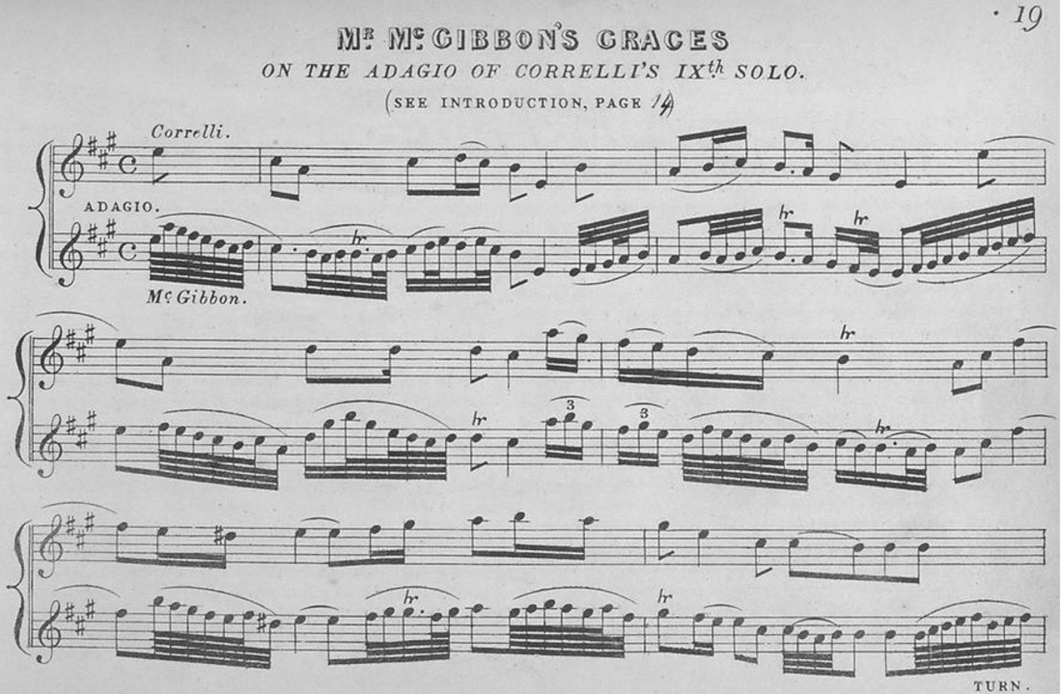
For Claudero, McGibbon's ‘collection’ (the galant Collection of Scots Tunes) evidently transcended its Italianate trappings to represent authentic musical Scottishness. Other observers, however, emphasized McGibbon's difference in relation to authentic Scots music. For instance, Alexander Campbell, the music teacher of Sir Walter Scott, saw McGibbon as a corrupting influence on Scots melody: ‘His sets of our native tunes, like every thing of the same kind that comes through the hands of professed musicians, savour strongly of pedantic garnish’.Footnote 74 (This disdain for the cluttering-up of a ‘natural’ music echoes Roger North's famous rebuff of Corelli's ornaments for his Op. 5 as creeping ‘vermin’.Footnote 75) However, by the nineteenth century, McGibbon's style was not so much an undesirable aestheticization of Scots tunes as it was a curious, archaic species. At least this was the case for James Davie, an Aberdonian music publisher who came into possession of Manuscript 957 in 1837. He included McGibbon's graces for the first movement of Corelli's Sonata Op. 5 No. 9 in the second series of Davie's Caledonian Repository, published some time between 1840 and 1855.Footnote 76 Davie stated his motivation for publishing in clinical terms: ‘We shall make an extract [of McGibbon's graces] as a specimen of this composer's style, which may also afford an idea of the manner of playing about a century ago’.Footnote 77 McGibbon's graces appear in the print along with Corelli's original version of the movement, apparently to invite a scientific analysis of a historic style (Figure 10).
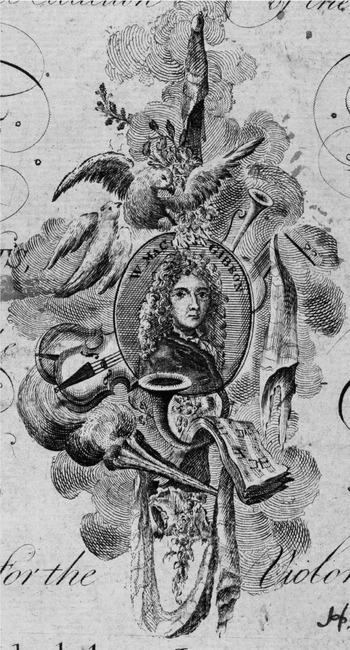
The polar opposition of Campbell's assessment of McGibbon as a corrupter of Scots music to Claudero's praise of McGibbon as a hero of Scots music is worth considering further. Claudero, who died in Edinburgh 1789, is said to have lived there ‘for upwards of thirty years’, so he may have known McGibbon personally before his death in 1756.Footnote 78 Claudero's characterization of McGibbon may have been coloured by favourable impressions that the musician had made not only on Edinburgh's elites, but on its lower classes as well. Though Claudero described McGibbon as wearing ‘plain, simple dress’, in contrast to the ‘lace’-clad ‘fribbles’ (frivolous people), the miniature portrait of McGibbon on the title page of Flores Musicae (Figure 9b) shows the composer wearing fine clothes, including a wig and lace.Footnote 79 Evidently, Claudero was able to overlook such inconvenient truths, perhaps on account of McGibbon's personal integrity and charisma as a performer.
John Clark, Flores Musicae, or the Scots Musician, title-page, detail

‘M.r M.cGibbon's Graces on the Adagio of Correlli's IX.th Solo’, from James Davie, Davie's Caledonian Repository, series 2, volume 1 (Aberdeen, c1850), 19

That Claudero's impression of McGibbon's ‘collection’ was dominated by its Scottishness rather than by its Italian features suggests that the function of printed collections of chamber music as commodities of a bourgeois market was implicitly understood. No print template existed in the mid-eighteenth century for presenting Scots tunes in a way that a later writer like Campbell would judge to be ‘authentic’. Tunes in print were translations of a sort and were acknowledged as such. However, by Campbell's time, McGibbon's arrangements were not just impressions of tunes that were in the air, but rare documents of the early history of a national tradition.Footnote 80 The Collection of Scots Tunes was not just the symbol that it had been to Claudero, but a precious cultural artefact. Campbell apparently resented what he saw as tampering with this heritage – by a lowly professional, no less.
The neat ontological separation of Scottish music from Italian music – or, later, European music in general – that we find in eighteenth-century writings finds limited resonance in the actual activities of McGibbon and other professional musicians working in Edinburgh. The image of McGibbon that emerges from the little information about his life is one of a violinist immersed from a young age in the Lowland Scottish fiddling tradition, as well as in the imported Italian idiom of violin playing. Practised on the same instrument, presumably using a basically similar, if not identical technique, the categories of ‘Italian’ and ‘Scottish’ music were far more intertwined in McGibbon's working knowledge than their portrayal in nationalist poetry or philosophical treatises from the period would suggest.Footnote 81 In ‘To the Musick Club’, Ramsay mythologized Italian and Scottish musics as arising from a once singular, universal music, likening this musical splintering to the rifting apart of universal language at the building of the Tower of Babel (the ‘daring crime’ on ‘old Shinar's plain’):
The poem conveys Ramsay's sense that the restoration of Italian and Scottish musics to a state of ‘extatick concord’ required the vision of a poet and the conscious effort of composers to realize that vision.Footnote 83 Yet in the bodies of McGibbon and others like him, Italian and Scottish music were already in a state of ‘extatic concord’ – no intervening poet required.
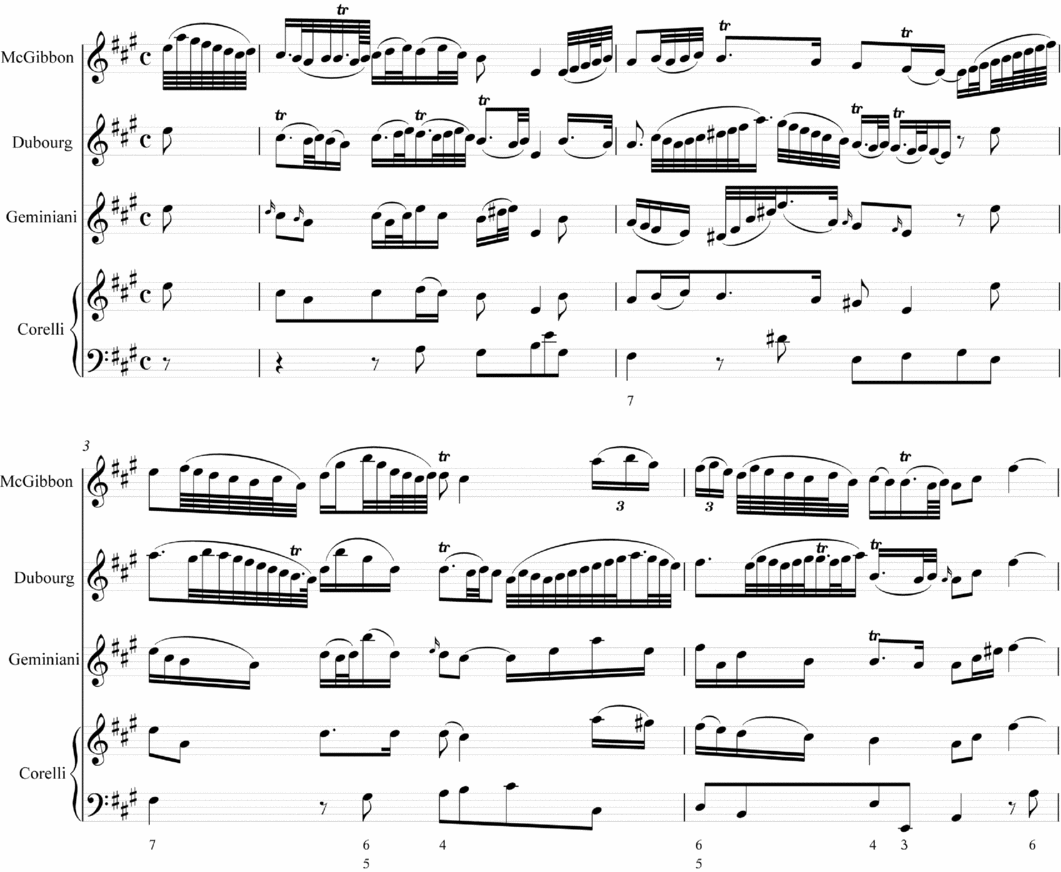
Arcangelo Corelli, Sonata Op. 5 No. 9/i (Rome: Gasparo Piera Santa, 1700), with graces by Francesco Geminiani, Matthew Dubourg and William McGibbon, bars 1–4

ORNAMENTS BY MCGIBBON FOR OP. 5
Considering the status of Corelli's Op. 5 in the eighteenth century as an essential book for learning Italian violin technique, we can assume that McGibbon studied Op. 5 while under Corbett's tutelage, and McGibbon's ornaments for Op. 5 may have originated during this time. He may also have been influenced by a visitor to Edinburgh in 1729: the renowned violinist Matthew Dubourg (1703–1767). In June of that year, Dubourg spent some weeks in the city to give performances sponsored by the Edinburgh Musical Society.Footnote 84 Dubourg's ornaments for Op. 5 were recorded in a manuscript, previously owned by Alfred Cortot and Marc Pincherle, that is now lost, though microfilms of it exist.Footnote 85 Neal Zaslaw reports that the contents of the manuscript ‘apparently date from before 1721’, thus pre-dating Dubourg's Edinburgh visit.Footnote 86 Interestingly, McGibbon's and Dubourg's ornaments are for movements from the same six Op. 5 sonatas (Nos 5 and 7–11). Example 2 juxtaposes Corelli's original part for the first few bars of the first movement of Sonata No. 9 with graced versions by McGibbon, Dubourg and Dubourg's teacher, Geminiani. McGibbon's and Dubourg's ornaments are notably denser than Geminiani's. The ornaments of the two British violinists also have a similar pacing, with virtuosic passages balanced with static moments. Of the latter, they have two in common: the crotchet e1 on the third beat of the first bar and the unornamented triadic ascent in the final two beats of the fourth bar.
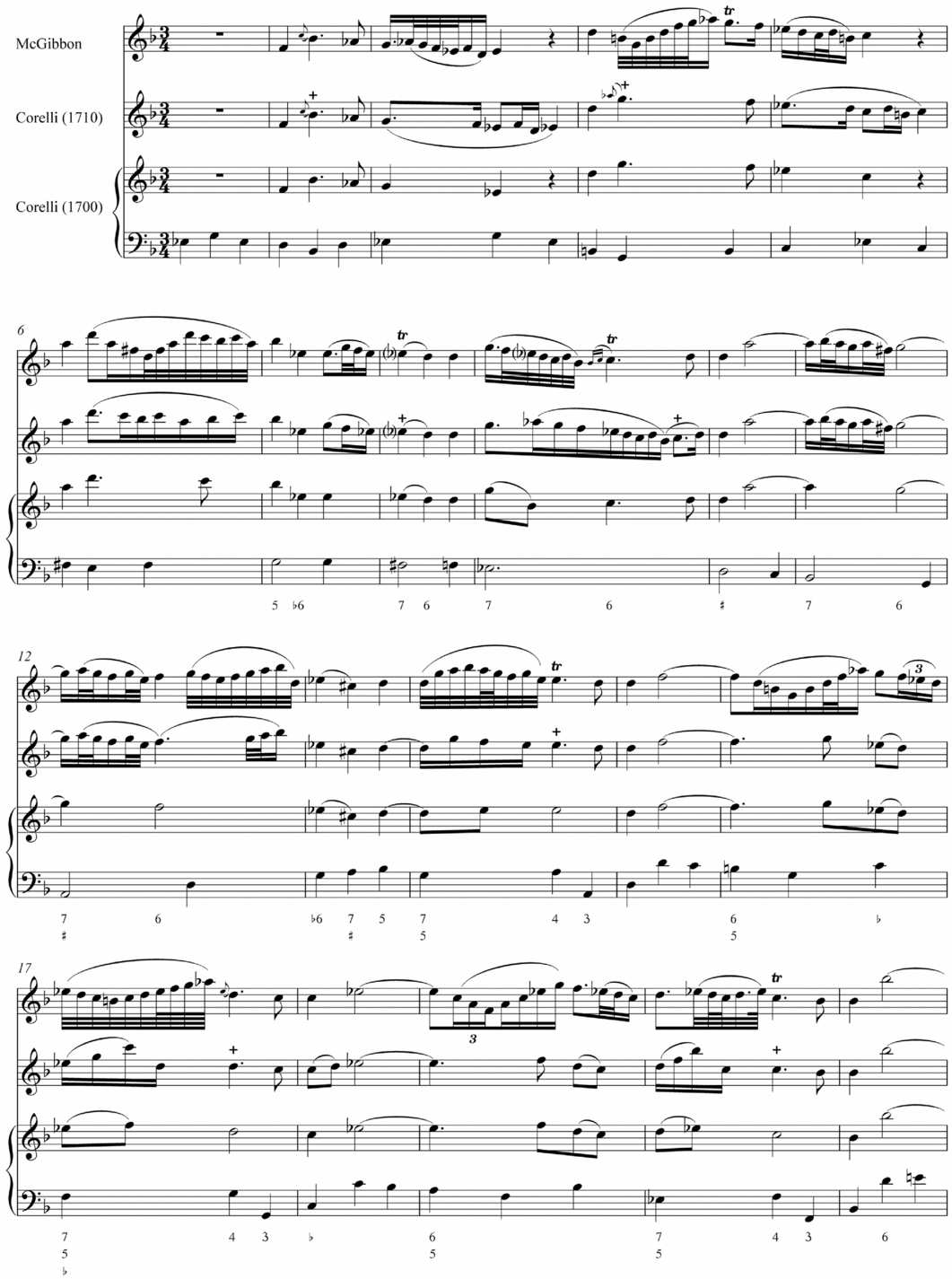
McGibbon's ornaments show similarities with other sets of ornaments that were probably familiar to him. Of his eleven sets of graces, two are for movements that were also ornamented by Corelli. Comparing Corelli's and McGibbon's graces for the third movement of Sonata No. 5 (Example 3), we find that a striking number of passages that remain unembellished in the 1710 graces by Corelli were also left plain by McGibbon (bars 10, 13, 15 and 21). We also see that the Scot's graces include ornaments that are identical (or nearly identical) to Corelli's (bars 2, 7, 8 and 11–12, as well, of course, as the cadential trills in the latter halves of bars 14 and 20) and others that are rhythmically contracted but otherwise the same (bars 5 and 9). These are not so much literal borrowings, in the sense of figures transferred from one page to another, as they are haptic memories of Corelli's graces. One senses that Corelli's ornaments lay reflexively in McGibbon's fingers and that they functioned, to some extent, as the ‘plain’ tune for McGibbon's own, more complex ornaments. Similarities between McGibbon's variations on the Tempo di Gavotta of Sonata No. 9 and those of Geminiani (as transmitted by Hawkins) suggest that McGibbon was familiar with them or some version thereof, perhaps as communicated to him by Dubourg.Footnote 87 Specifically, the opening of McGibbon's first variation (Example 4a) uses the material found in bars 35–42 of Geminiani's variation (Example 4b). The nature of the resemblance is again one that suggests oral rather than written transmission, as if McGibbon took up a gesture played by another violinist rather than copying the passage from a manuscript. The repositioning of Geminiani's mid-variation figuration pattern at the beginning of McGibbon's variation is analogous to ubiquitous instances in fiddle music of recombining variations by others with one's own (I will return to this practice below).
Corelli, Sonata Op. 5 No. 5/iii, with graces by Corelli and McGibbon, bars 1–21

McGibbon, variation on Corelli, Sonata Op. 5 No. 9/iv, bars 1–8

Geminiani, variation on Corelli, Sonata Op. 5 No. 9/iv, bars 35–42

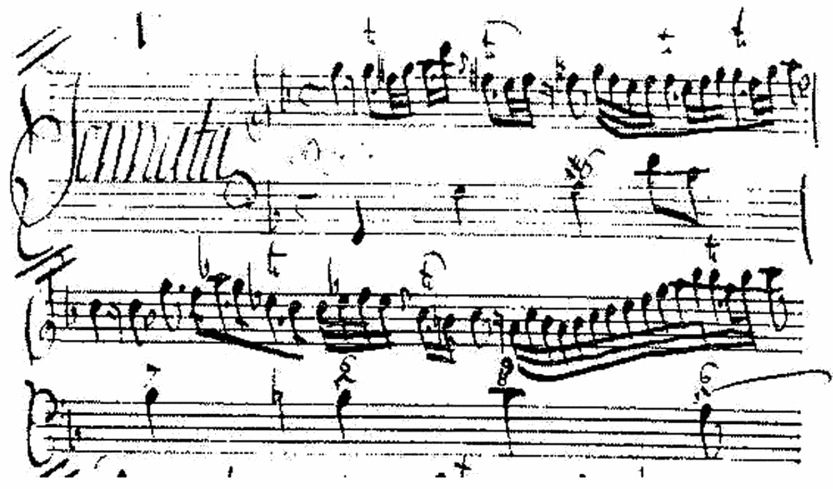
Matthew Dubourg, graces for Corelli, Sonata Op. 5 No. 5/i, bars 1–2. Microfilm of lost manuscript, ‘Correlli's solos grac'd by Doburg’, Hargrove Music Library, University of California Berkeley, Microfilm A2337

William McGibbon, graces for Corelli, Sonata Op. 5 No. 5/i, bars 1–2. Manuscript 957, 76. Used by permission

In general, McGibbon's ornaments have a pronounced metrical sense, even in the case of complex graces, such that they could be played effectively with only a simplified, vamped bass or even without accompaniment – a performance practice more often associated with fiddle traditions than with solo sonatas published with a continuo part. In Example 2 the triplets across bars 3–4 in McGibbon's graces for the first movement of Sonata No. 9 help to stabilize a beat that could easily become lost in a sea of demisemiquavers. By contrast, the rhapsodic graces of Dubourg depend on the metrical stability that a bass accompaniment provides. McGibbon uses metrically stabilizing triplets elsewhere, including the graces for the third movement of Sonata No. 5 (Example 3) at bars 16 and 19. The notation of McGibbon's ornaments also conveys the priority given to metre within his performance aesthetic. Despite their complexity, his ornaments are usually notated in a rhythmically accurate way, unlike Dubourg's, which are transcribed with a more impressionistic attitude toward the relative duration of adjacent notes. This is apparent, for example, in a comparison of the opening bars of the graces by the two violinists for the first-movement Adagio of Sonata No. 5 (Figure 11).
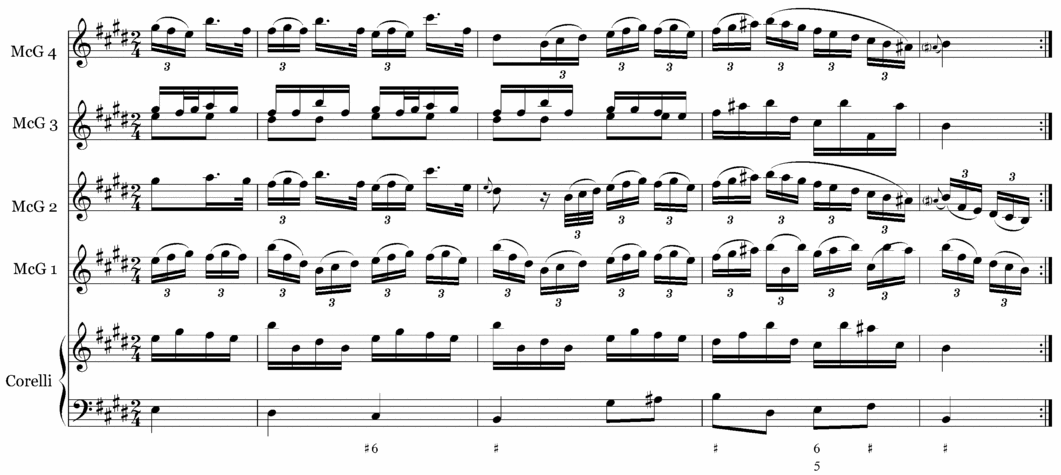
The variations by McGibbon for Op. 5 are similarly autonomous rhythmically, in the sense that they rarely rely on an external impulse from a bass part. Here too McGibbon differs from Dubourg. In the Gavotta for Sonata No. 11, for instance, in Dubourg's first variation, the violin part plays off impulses provided by the bass (Example 5a, especially the slurred, syncopated e2 and f♯2 on beats 3 and 4 of bar 2), whereas McGibbon's variations require no external rhythmic reference (Example 5b).Footnote 88 Moreover, the denser figuration of McGibbon's variations makes them harmonically self-sufficient and thus less reliant on a figured bass. McGibbon's preference for ‘autonomous’ variations (from a rhythmic-harmonic perspective) appears to have affected the selection of Op. 5 fast dance movements for which he composed variations. For instance, no variations by him survive for the rest-filled Giga of Sonata No. 9, which was, however, treated to variations by Geminiani and Dubourg. Rhythmic autonomy is a characteristic of Scots fiddle variations, which fiddlers could perform either unaccompanied or with a simple improvised accompaniment from a bass or keyboard. Indeed, in A Collection of Favourite Scots Tunes, an anthology that commemorates Charles McLean, two versions of the bass line are given for the first tune, ‘Had awa frae me Donald’, with the instruction ‘This tune may be play'd with Either of the Basses’ (Figure 12). One version is very simple – a drone on a low A. The other version contains figuration and inverted chords. A further instruction relates that the simple drone version of the bass line can replace the figured bass line that is provided for the second movement Gigg (‘The notes at the beginning may be Continued thro’ the whole Tune, as a Ground Bass Instead of the Figured Bass’).
Dubourg, first variation on Corelli, Sonata Op. 5 No. 11/v, bars 1–4

McGibbon, four variations on Corelli, Sonata Op. 5 No. 11/v, bars 1–4

‘Had awa frae me Donald’, A Collection of Favourite Scots Tunes (Edinburgh, c1772), 1

OP. 5 MOVEMENTS TREATED TO VARIATION BY BOTH MCGIBBON AND MCLEAN
The historical relationship between McGibbon's and McLean's ornaments for Corelli's Op. 5 is a matter of speculation. It seems likely that McGibbon's ornaments served as an impetus to McLean to compose his own variations. We can assume that the two violinists played together in 1737–1738, when McLean was hired to play in the Edinburgh Musical Society orchestra, which McGibbon led at the time.Footnote 89 Prior to his engagement in Edinburgh, McLean had been a music teacher in Montrose and principal of the music school in Aberdeen.Footnote 90 He may also have been an organist.Footnote 91 Johnson surmises that McLean moved some time after 1740 to London, where he took over a flat from the violinist Michael Christian Festing, another ornamenter of Op. 5.Footnote 92 The only printed collection of McLean's music issued during his lifetime, Twelve Solo's or Sonatas for a Violin and Violoncello, with a Thorough Bass for the Harpsichord (Edinburgh, 1737), of which the final four sonatas are ‘adapted for the German flute’, shows McLean's familiarity with a range of compositional styles, including the Corellian sonata. However, an anthology published posthumously, A Collection of Favourite Scots Tunes with Variations for the Violin &c And a Bass for the Violoncello & Harpsichord By the Late M.r Ch.s McLean and other Eminent Masters (Edinburgh: N. Stewart, c1772) suggests that, in the years following his death, McLean was remembered principally as an arranger of Scots tunes. Other variations by McLean on Scots tunes are transmitted in Manuscript 957 and the Mcfarlan Manuscript – another, large source copied by David Young (the scribe of Manuscript 957). As I will argue, McLean, like McGibbon, drew on the same skills in composing variations on Scots tunes as he did in generating variations for Corelli's Op. 5.
McGibbon's pair of variations and McLean's single variation on the Giga from Sonata No. 5 further reveal a tendency to conceive Op. 5 movements as violin solos, in which harmonic agreement with any accompanimental part is not always a primary consideration (Example 6). We see this in incidental clashes of the melodic lines with the underlying harmonies. In McGibbon's second variation, for example, the f♯2 in bar 32 conflicts with the underlying G minor harmony. In McGibbon's first variation, the D harmony outlined by the leap down to the d1 on the downbeat of bar 4 and the subsequent a1 does not correspond with the C-minor-seventh harmony indicated in the bass. This is unlikely to be a scribal error. McGibbon probably intended the resonant open string d1 rather than the c1 that would harmonize with the figured bass. In McLean's variation, clashes include the first beat of bar 2 and the false relation on the downbeat of bar 21. Such ‘conflicts’ give the impression that McGibbon and McLean composed the variations as solos, with only secondary consideration given to the underlying harmonies. Dubourg took a similar approach, as evident from a passage in his third variation on the Gavotta from Sonata No. 11; in bar 21 of Example 7, the violin outlines an F sharp major harmony that conflicts with the B major chord indicated by Corelli. That a tendency to conceive of the violin part as tonally autonomous can be seen in the ornaments supplied by other violinists suggests that it is not just a fiddle sensibility that is being demonstrated but an Italian violin one as well.
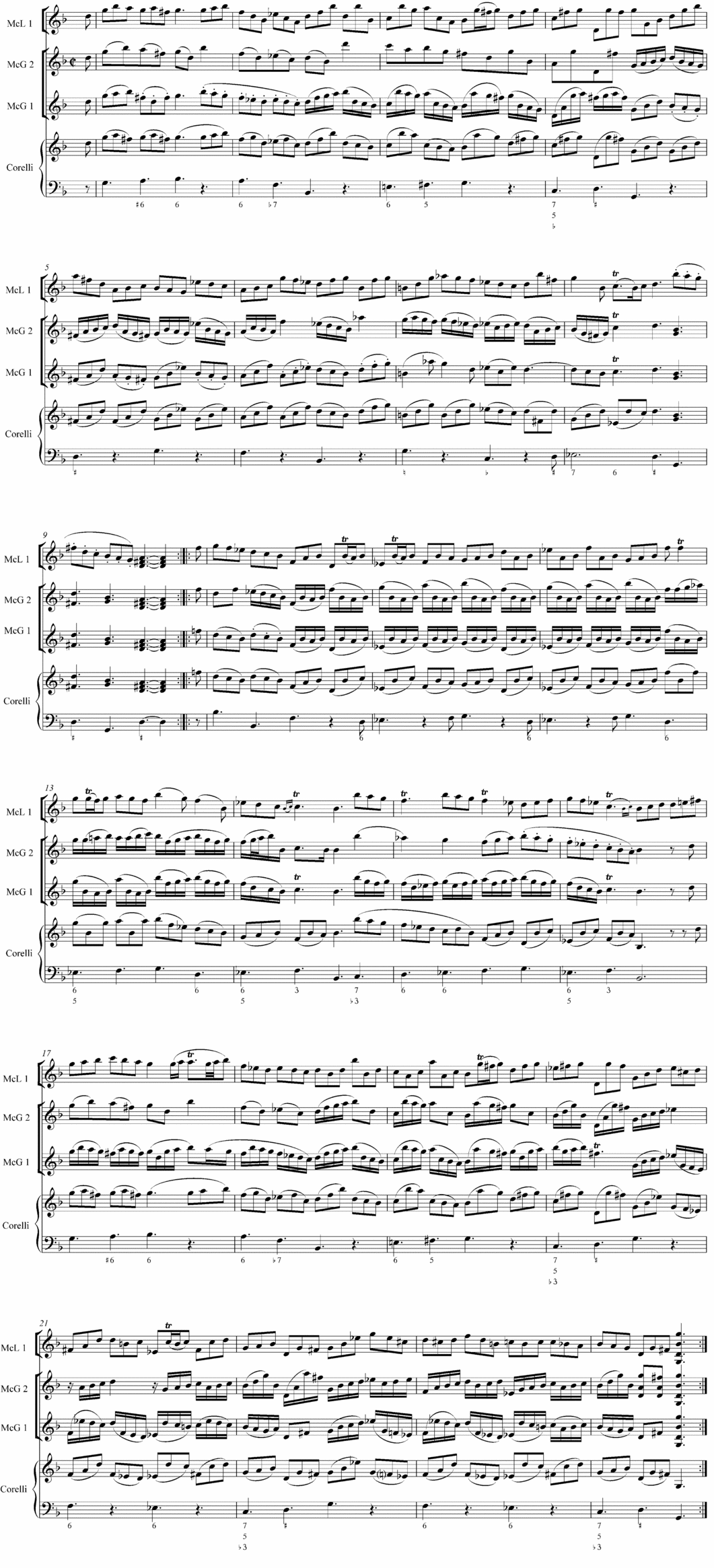
McGibbon and Charles McLean, variations on Corelli, Sonata Op. 5 No. 5/v

Dubourg, third variation on Corelli, Sonata Op. 5 No. 11/v, bars 2–4

The variations on the Giga by the two Scottish violinists at times adopt a liminal tonal vocabulary, somewhere between the Italian and Scots idiom. For instance, both McGibbon and McLean avoid the leading note on successive internal cadences in the second section of the Giga (Example 6). In bar 14, all three of the Scottish variations approach the tonicized B flat major from above without including the A of the F major chord, unlike Corelli's original violin part. The same cadential outline recurs two bars later in McLean's variation and the first variation of McGibbon. In both instances in McGibbon's first variation (bars 14 and 16), the absence of a fourth-scale degree (E♭) lends a pentatonic sense to the cadences.
Of the two variation sets by McLean (for the Giga of Sonata No. 5 and the Gavotta of Sonata No. 10), the variations on the Giga are the more experimental. McLean was a seasoned fiddler and composer of numerous variations for fiddle tunes, but the basic ‘tune’ that the Giga provides, with its long phrases and minor tonality, was an atypical basis for variation playing within the Scots fiddle tradition. In contrast, the Gavotta from Sonata No. 10 in F major, more than any other movement in Op. 5, resembles a vernacular fiddle tune – enough that it could have had the same destiny as ‘Mr Cosgill's Delight’ (see Example 8). A mere eight bars long – two four-bar strains – the violin part, taken alone, never moves beyond a diatonic scale (though there is a momentary tonicization of C major in the underlying harmony). Its short length invites violinists to extend it through multiple strains of variation. Indeed, more variations survive for this gavotte than for any other Op. 5 movement.Footnote 93 The Gavotta was famously used by Tartini as the basis of L'Arte del arco, a set of pedagogical variations that numbered seventeen in its earliest publication but later expanded to thirty-eight and subsequently fifty.Footnote 94 Robert Seletsky notes that the very existence of different versions of Tartini's variations points to oral tradition, which was ‘a function of the teacher–pupil relationship in Tartini's Padua “School of Nations”’.Footnote 95 But whereas Tartini's variations are laboratory-like in documenting advanced bowing techniques, the two variations by McGibbon and five by McLean on the Gavotta bring Corelli into a living, vernacular tradition.Footnote 96 The variations of both Scottish violinists emphasize vigorous, sometimes noisy rhythmic variation over melodic interest. One could imagine them played in the same contexts as variations on vernacular tunes – at dances, weddings and ceilidhs, in theatres, on ferries, city streets and country roads. Contra dancers have also spotted the potential: as recently as 1993 the Gavotta has been choreographed under the title ‘Corelli's Maggot’.Footnote 97
McGibbon and McLean, variations on Corelli, Sonata Op. 5 No. 10/iv

The ‘plain’ tune as notated at the beginning of McLean's five variations itself suggests that the way in which McLean conceived the Gavotta was not so different from the way he conceived vernacular tunes. It differs from the original Gavotta by Corelli, but not enough that it could be considered a variation (Example 9). In McLean's version, the figuration in bar 6 is simplified, the f2 on the downbeat of the final bar is not tied over from the previous bar, and the cadences are slightly different. McLean's version also lacks Corelli's slur markings, suggesting a more rustic approach to the bowing. The nature of these discrepancies gives the impression that McLean had either learned the tune through oral tradition or that he had been playing it off book for so long that his memory of the notated version had changed.
Corelli, Sonata Op. 5 No. 10/iv, with McLean's version of the same

Some of the figuration that McLean used in his variations on the Gavotta is characteristic of the Scots fiddle idiom but not the Italian equivalent. For instance, the arpeggiation pattern in bars 6–7 of the third variation, with its direct fifths, is of the same string-based harmonic logic as the direct shifts illustrated in an excerpt from a variation set on ‘Sweden's March’ from the Shiels Manuscript of 1820–1821 (Example 10).Footnote 98 Other figuration patterns that McLean used in the Gavotta variations are also found in variations on Scots tunes. For instance, the descending thirds in bar 6 of the second variation can be found elsewhere in Manuscript 957, in the variation set on ‘Miss Lauder’ (‘Maggie Lauder’) (Example 11). The upbow-staccato tag that McLean used to lead into the cadences in the fifth variation is a favourite figure of his. We find it, for example, in his variations on ‘The Birks of Invermay’ (Example 12a) as well as ‘Black Jock’ (Example 12b).
‘Sweden's March’, fourth variation, bars 1–5. Shiels Manuscript, Reid Library, University of Edinburgh

‘Miss Lauder’, fourth variation, bar 1. Manuscript 957, Jean Gray Hargrove Music Library, University of California Berkeley MS 957

McLean, ‘The Birks of Invermay’, sixth variation, bar 8. Manuscript 957

McLean, ‘Black Jock’, nineteenth variation, bars 3–5. Robert Bremner, A Curious Collection of Scots Tunes (Edinburgh, 1759)

Comparing McLean's and McGibbon's variations on this Gavotta, we again see similarities that may suggest that the compositional process was interactive. In particular, it appears that the first strain of McLean's third variation is an attempt to outdo the corresponding strain of McGibbon's second variation (Example 8). We can also imagine the two violinists, who worked alongside each other, combining their variations, perhaps with others known to them (Dubourg also left variations on the Gavotta), into one long, collectively composed set. Some extended variation sets on traditional tunes are the work of multiple individuals. For instance, the setting of ‘Black Jock’ cited above comprises thirty strains (amounting to fifteen variations, since the tune comprises two strains), including three strains from a set on the same tune by McLean.Footnote 99
OWNED AND REWORKED
For music historians, aural tradition, face-to-face interaction and haptic memory lie within what Michel de Certeau called the ‘mute jurisdiction of practices’.Footnote 100 But, as I hope to have illustrated, the network of ornaments by McGibbon, McLean, Dubourg, Geminiani and Corelli himself for Corelli's Op. 5 can actually help us to sound out this tacit domain. Closely examining these notated ornaments underlines, paradoxically, the importance of embodied action and interaction in the transmission and evolution of style as it pertains to the performance of the Op. 5 sonatas. Like Scots tunes, Corelli's music (and Op. 5 in particular) endured across time and place. Robert Burns characterized ‘our Scots airs’ as ‘the language of nature’ – the same phrase, it might be recalled, that Hawkins used to describe Corelli's music. Both ‘languages of nature’ were communally owned and reworked by individuals and collectives.
This phrase, ‘owned and reworked’, recalls Ramsay's entreaty to the Edinburgh Musical Society to ‘own and refine’ Scottish music by mixing it with ‘Correlli's soft Italian Song’. But there are key differences between the two phrases in meaning and connotation. As we have seen, the ostentatiously hybrid style that materialized in the years following Ramsay's plea became the musical vogue at the centre of Erskine's ‘Jew's harp’ joke that sent up the ‘enlarged and liberal’ world (to use John Gregory's words) – a world that was preoccupied with music as a marker of status and, as Gelbart shows, identity. But the ornaments by McGibbon and McLean for Op. 5 direct us to a different side of the co-existence of Scottish and Italian music in eighteenth-century Scotland. For McGibbon and McLean, both employees of the Edinburgh Musical Society, music was first and foremost labour. In the sense that McGibbon and McLean performed Italian music and Scottish music with the same body and on the same instrument, the identity of violinist and fiddler merged and, with it, the repertories.
‘Refined’ and ‘reworked’ both point to musical translations of one sort or another. Ramsay's use of ‘refined’ referred to a translation between social classes (specifically, one from low to high). ‘Reworked’, by contrast, signals a translation between physical acts of music-making, emphasizing the violinist's agency, without any hierarchical implications. The materiality of the violin itself comes into focus here. In the context of music in eighteenth-century Lowland Scotland, the Italian violin belongs to both indigenous fiddle music and Italian violin music. Others have already noted that through fiddlers’ adoption of the Italian violin and its associated playing techniques, Scots fiddling took on the idioms of Italian violin playing.Footnote 101 What I would add is that this retooling of the Scots fiddle tradition provided the material parameters for the expansion of fiddle music into the performance spaces populated by professionally crafted Italian violins, including the concert stage, salon, music club and the virtual space of the printed music book. The adoption of the Italian violin by fiddlers eased not only the assimilation of vernacular melody into Italian music (as in the Scots drawing-room style) but also the passage of Italian melody into vernacular music (as in ‘Mr Cosgill's Delight’).
Erskine's joke about Italian sonatas on Scots tunes for jaw harp hinged on the fact that gentlemen amateurs did not originally ‘own’ indigenous Scots music – and perhaps not Italian music either, for that matter. By contrast, McGibbon and McLean could lay reasonable claim to ‘owning’ both Italian music and the tunes indigenous to Lowland Scotland on account of their background and social status – before Ramsay called upon the gentlemen members of the Edinburgh Musical Society to ‘own’ the vernacular tunes for themselves. These two working musicians were not merely the front-line proxies of Ramsay and the Society's membership in an elite-led project to gentrify vernacular Scottish music. They were themselves protagonists, their embodied technical knowledge acting as a direct conduit between the two musical traditions. The Op. 5 ornaments show that in the bodies of working Scottish violinists, Italian violin playing and Scots fiddling held much more common ground than they did in the writings of Ramsay, Gregory and other eighteenth-century commentators on Scottish music for whom music was a piece of a grander social agenda.