1. Introduction
The composite cratonic South China Craton (SCC) is one of the largest continental fragments in eastern Asia and consists of the Yangtze Block in the NW and the Cathaysia Block in the SE (Fig. 1). After the amalgamation of these two blocks during the Jiangnan Orogen at 1000–830 Ma (Wang et al. Reference Wang, Zhou, Griffin, Wang, Qiu, O Reilly, Xu, Liu and Zhang2007; Zhao et al. Reference Zhao, Zhou, Yan, Zheng and Li2011), the SCC was rifted in response to the break-up of Rodinia (Li et al. Reference Li, Zhang and Powell1995; Li et al. Reference Li, Li, Zhou and Kinny2002; Yu et al. Reference Yu, O Reilly, Wang, Griffin, Zhang, Wang, Jiang and Shu2008), and a Late Neoproterozoic basin, called the Nanhua basin (Wang & Li, Reference Wang and Li2003; Wang et al. Reference Wang, Zhou, Deng, Fu, Duan and Guo2015), formed as a failed rift basin in the craton. This basin was transformed into an orogeny in response to widespread Early Palaeozoic intracontinental orogenic events in southern China (Faure et al. Reference Faure, Shu, Wang, Charvet, Choulet and Monie2009; Charvet et al. Reference Charvet, Shu, Faure, Choulet, Wang, Lu and Le Breton2010; Wang et al. Reference Wang, Griffin, Yu and O'Reilly2010b; Shu et al. Reference Shu, Jahn, Charvet, Santosh, Wang, Xu and Jiang2014), which are assumed to have been associated with the final assembly of the supercontinent Gondwana during the Late Neoproterozoic to the Early Palaeozoic (Xu et al. Reference Xu, Cawood, Du, Huang and Wang2014a, b).
A simplified regional map highlighting the distribution of pre-Devonian sequences in South China.

Recently, a great deal of discussion has focused on Lower Palaeozoic successions of the SCC and their detrital zircon spectra, which indicate predominately Early Neoproterozoic and Latest Neoproterozoic to Early Cambrian sources (Wang et al. Reference Wang, Griffin, Yu and O'Reilly2010b; Wu et al. Reference Wu, Jia, Li, Deng and Li2010; Xu et al. Reference Xu, Du, Cawood, Zhu, Li and Yu2012, Reference Xu, Cawood, Du, Hu, Yu, Zhu and Li2013, Reference Xu, Cawood, Du, Huang and Wang2014a, b; Li et al. Reference Li, Jia, Wu, Zhang, Yin, Wei and Li2013; Yao, Li & Li, Reference Yao, Li and Li2014a; W. H. Yao et al. Reference Yao, Shu and Santosh2014b, Reference Yao, Li, Li, Su and Yang2015; Yu et al. Reference Yu, Du, Cawood, Xu and Yang2014; Chen et al. Reference Chen, Sun, Long, Zhao and Yuan2016; Yao & Li, Reference Yao and Li2016). The ages of these zircons vary distinctly from those of the underlying Lower to Middle Neoproterozoic successions of the SCC (L. J. Wang et al. Reference Wang, Griffin, Yu and O'Reilly2010, Reference Wang, Yu, Griffin and O'Reilly2012; Hofmann et al. Reference Hofmann, Linnemann, Rai, Becker, Gärtner and Sagawe2011; Wang & Zhou, Reference Wang and Zhou2012; W. Wang et al. Reference Wang, Griffin, Yu and O'Reilly2013; Li, Li & Li, Reference Li, Li and Li2014), which lack Early Neoproterozoic detritus and are therefore interpreted to have been located far from the centre of Rodinia in the Neoproterozoic (Yu et al. Reference Yu, O Reilly, Wang, Griffin, Zhang, Wang, Jiang and Shu2008; Hofmann et al. Reference Hofmann, Linnemann, Rai, Becker, Gärtner and Sagawe2011; Ma et al. Reference Ma, Yang, Li, Dai, Zhang and Zhou2016). In Early Palaeozoic reconstructions of Gondwana, the SCC has previously been proposed to be an isolated block separated from East Gondwana (Torsvik & Cocks, Reference Torsvik, Cocks and Bassett2009) or adjacent to Laurentia (Wu et al. Reference Wu, Jia, Li, Deng and Li2010; Li et al. Reference Li, Jia, Wu, Zhang, Yin, Wei and Li2013); however, the existence of similar Early Neoproterozoic and Latest Neoproterozoic to Early Cambrian detritus suggests a spatial link between the SCC and East Gondwana (Wang et al. Reference Wang, Griffin, Yu and O'Reilly2010b; Xu et al. Reference Xu, Du, Cawood, Zhu, Li and Yu2012, Reference Xu, Cawood, Du, Zhong and Hughes2014b; Cawood et al. Reference Cawood, Wang, Xu and Zhao2013; Yao et al. Reference Yao, Li, Li, Su and Yang2015; Yao & Li, Reference Yao and Li2016). Nevertheless, how and when these similar detritus grains were transported to the SCC remain unclear.
The models that favour a SCC – East Gondwana link typically place the SCC among other Asian microcontinent fragments (such as Qiangtang, Lhasa, Sibumasu, Indo-China and Tarim) along the northern margin of East Gondwana in the Early Palaeozoic (Zhu et al. Reference Zhu, Zhao, Niu, Dilek, Wang, Ji, Dong, Sui, Liu, Yuan and Mo2012; Hu et al. Reference Hu, Li, Wang, Xie and Wu2013, Reference Hu, Zhai, Jahn, Wang, Li, Lee and Tang2015; Y. J. Wang et al. Reference Wang, Griffin, Yu and O'Reilly2013b; Burrett et al. Reference Burrett, Zaw, Meffre, Lai, Khositanont, Chaodumrong, Udchachon, Ekins and Halpin2014; Zhang et al. Reference Zhang, Dong, Li, Deng, Zhang and Xu2014). The details of the relative locations and tectonic settings of these continental fragments, however, remain controversial. One interpretation is that the northern margin of East Gondwana had a passive continental margin facing north during the Early Palaeozoic (Murphy & Nance, Reference Murphy and Nance1991; Miller et al. Reference Miller, Thöni, Frank, Grasemann, Klötzli, Guntli and Draganits2001), and that the regional unconformity between Ordovician and Cambrian strata resulted from extensional tectonic events after the Pan-African orogeny (Miller et al. Reference Miller, Thöni, Frank, Grasemann, Klötzli, Guntli and Draganits2001). Another school of thought is that the northern margin of East Gondwana was converted to an active continental margin in response to the final assembly of East Gondwana (Cawood, Johnson & Nemchin, Reference Cawood, Johnson and Nemchin2007; Y. J. Wang et al. Reference Wang, Griffin, Yu and O'Reilly2013b), which is defined by accretion (Cawood et al. Reference Cawood, Zhao, Yao, Wang, Xu and Wang2017) or collision events (Yao et al. Reference Yao, Shu and Santosh2014b) between North India and South China during the Ediacaran and Cambrian.
In this contribution, we present new detrital zircon U–Pb ages and Hf isotopes from eight samples collected from the Upper Neoproterozoic to Silurian strata across the basin along the SE margin of the Yangtze. Based on these results, together with previously published detrital zircon data, we explore the potential sources for the sediments of the Upper Neoproterozoic to Silurian strata in the SE Yangtze to better address the provenance evolution of the SCC and its relationship with East Gondwana in the Early Palaeozoic.
2. Geological setting
The pre-Neoproterozoic crustal growth histories of the Yangtze and Cathaysia blocks of the SCC remained relatively different until their first amalgamation during the Neoproterozoic Jiangnan Orogeny (also called the Jinning Orogeny and the Sibao Orogeny by various authors, e.g. Zhao & Cawood, Reference Zhao and Cawood1999, Reference Zhao and Cawood2012; Wang et al. Reference Wang, Zhou, Griffin, Wang, Qiu, O Reilly, Xu, Liu and Zhang2007; Li et al. Reference Li, Li, Li, Lo, Wang, Ye and Yang2009; Charvet, Reference Charvet2013). The pre-Neoproterozoic basement of the Yangtze Block is represented by (1) Archean rocks of the Kongling Complex in the northern part of the block (3.3–2.9 Ga and 2.1–1.8 Ga; Qiu et al. Reference Qiu, Gao, McNaughton, Groves and Ling2000; Zheng et al. Reference Zheng, Griffin, O'Reilly, Zhang, Pearson and Pan2006; Jiao et al. Reference Jiao, Wu, Yang, Peng and Wang2009; Gao et al. Reference Gao, Yang, Zhou, Li, Hu, Guo, Yuan, Gong, Xiao and Wei2011) and (2) minor outcrops of 1.7–1.0 Ga metavolcanic and metasedimentary rocks along the SW margin of the block (Li et al. Reference Li, Li, Zhou and Kinny2002; Greentree et al. Reference Greentree, Li, Li and Wu2006; Zhao et al. Reference Zhao, Zhou, Li, Sun, Gao, Sun and Yang2010), whereas that of the Cathaysia Block is characterized by (1) Upper Palaeoproterozoic (2.0–1.6 Ga) granites and granitic gneisses of the Badu, Chencai, Mayuan and Tianjingping complexes in the Wuyi area in the NE part of the block (Yu et al. Reference Yu, Wang, O Reilly, Griffin, Zhang, Li and Shu2009, Reference Yu, O Reilly, Zhou, Griffin and Wang2012; Li et al. Reference Li, Li, Wartho, Clark, Li, Zhang and Bao2010) and (2) the c. 1.43 Ga Baoban Complex and the coeval Shilu Group metavolcaniclastic rocks of Hainan Island in the SW part of the block (Li et al. Reference Li, Li, Zhou and Kinny2002, Reference Li, Li, Li and Ding2008).
The Neoproterozoic suture zone between the Yangtze and Cathaysia blocks is referred to as the Jiangnan Orogen, the Jiangnan Belt (Charvet et al. Reference Charvet, Shu, Shi, Guo and Faure1996) or the Jinning Belt (Faure et al. Reference Faure, Shu, Wang, Charvet, Choulet and Monie2009). The c. 1500 km long suture zone is located near the present NE-trending Jiangshan–Shaoxing Fault (Fig. 1); however, the western extent of this belt remains uncertain. Voluminous Precambrian sedimentary strata and Neoproterozoic (1.0–0.7 Ga) igneous rocks are restricted to the area between the Cili–Baojing Fault and the Shizong–Mile–Luodian Fault (Fig. 1) (Zhao & Cawood, Reference Zhao and Cawood2012; Cawood et al. Reference Cawood, Wang, Xu and Zhao2013; Charvet, Reference Charvet2013; Y. J. Wang et al. Reference Wang, Griffin, Yu and O'Reilly2013a), which is considered as the western extent of the Jiagnan Orogen in this contribution. The amalgamation of the Yangtze and Cathaysia blocks caused a rapid change in the tectonic setting, resulting in the formation of post-orogenic extensional basins and a depositional hiatus in South China. These processes are recorded by deposition of Upper Neoproterozoic rift sedimentary rocks that unconformably overlie the basement rocks (Du et al. Reference Du, Wang, Wang, Qiu, Jiang, Deng and Yang2013; Wang et al. Reference Wang, Zhou, Deng, Fu, Duan and Guo2015), and by contemporaneous mafic intrusions along the SE and NW margins of the Yangtze Block (Wang et al. Reference Wang, Zhao, Zhou, Liu and Hu2008; Zhou, Wang & Qiu, Reference Zhou, Wang and Qiu2009; Shu et al. Reference Shu, Faure, Yu and Jahn2011; Lin et al. Reference Lin, Peng, Jiang, Polat, Kusky, Wang and Deng2016).
The Cambrian to Ordovician successions in Cathaysia feature typical slope and shallow-water facies with siliciclastic-dominated strata. These successions grade into carbonate-dominated strata in the Yangtze, which represent platform-type facies (Wang et al. Reference Wang, Griffin, Yu and O'Reilly2010b; Xu et al. Reference Xu, Du, Cawood, Zhu, Li and Yu2012; Shu et al. Reference Shu, Jahn, Charvet, Santosh, Wang, Xu and Jiang2014, Reference Shu, Wang, Cawood, Santosh and Xu2015; Yao, Li & Li, Reference Yao, Li and Li2014a). In the Yunkai and Hainan domains of Cathaysia, the unconformity between the Cambrian and Ordovician strata was developed (termed the Yu'nanian Orogeny, e.g. Wang et al. Reference Wang, Griffin, Yu and O'Reilly2010b; Xu et al. Reference Xu, Cawood, Du, Zhong and Hughes2014b) and dies out to the north across the SCC where the Cambrian and Ordovician strata are conformable (BGMRGZP, 1987). In the Yunkai and Hainan domains, the Lower to Middle Cambrian both consist of interstratified quartz sandstone, mudstone, siltstone and phyllite (BGMRGXP, 1985; Xu et al. Reference Xu, Cawood, Du, Zhong and Hughes2014b). The Upper Cambrian succession is absent. The Lower to Middle Cambrian successions are unconformably overlain by Lower Ordovician succession, which consist of conglomerate, sandy conglomerate and quartz sandstone (BGMRGXP, 1985).
The conformably overlying Silurian siliciclastic sedimentary rocks in Yangtze are absent across most of Cathaysia, and range in age from Lower Silurian in the SE Yangtze to Upper Silurian in the NW and NE Yangtze (Xu et al. Reference Xu, Du, Cawood, Zhu, Li and Yu2012). From Cathaysia to the NW Yangtze, angular unconformities between the pre-Devonian and Upper Palaeozoic strata gradually change to disconformities, and mark the main phase of Early Palaeozoic orogeny in South China (Wang et al. Reference Wang, Griffin, Yu and O'Reilly2010b; Y. J. Wang et al. Reference Wang, Griffin, Yu and O'Reilly2013a).
3. Stratigraphic section and samples
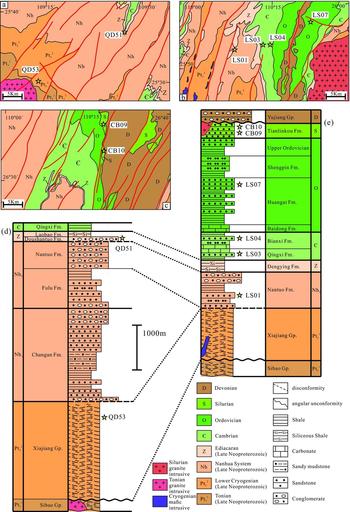
Siliciclastic rock samples were systematically collected from the Upper Neoproterozoic to Silurian strata along the SE margin of the Yangtze (Fig. 1). Eight samples analysed for this study are from three sampling locations including the Congjiang area in the southeastern Guizhou province, the Longsheng area in the northwestern Guangxi province, and the Chengbu area in the southwestern Hunan province.
Two sandstone samples (QD53 and QD51) were collected from the Congjiang area in the southeastern Guizhou province, located to the west of the Anhua–Luocheng Fault and adjacent to the 835 Ma Yuanbaoshan granitic pluton (Fig. 2a). The Congjiang stratigraphic section consists of Upper Neoproterozoic (Cryogenian to Ediacaran) strata, comprising thick, locally micaceous, quartzite, chlorite–quartz–sericite phyllite, silty sericite phyllite, and mica schist (BRMRGZP, 1987; Ma et al. Reference Ma, Yang, Li, Dai, Zhang and Zhou2016).
A regional geological map and sampling localities in the study area. (a) The Congjiang area in the southeastern Guizhou province; (b) the Longsheng area in the northwestern Guangxi Province; (c) the Chengbu area in the southwestern Hunan province; (d) the stratigraphy of the Congjiang area showing the sampling positions; and (e) the stratigraphy of the Longsheng and Chengbu area with sampling positions.

Four sandstone samples (LS01, LS03, LS04 and LS07) were collected from the Longsheng area in the northwestern Guangxi province (Fig. 2b), located in the area to the east of the Anhua–Luocheng Fault. The Longsheng section consists of Ediacaran–Ordovician siliciclastic strata, comprising intercalations of shale, siltstone and sandstone (BGMRGXP, 1985), whereas the Silurian strata are absent and the Devonian conglomerate unconformably overlies the Ordovician strata.
Two sandstone samples (CB09 and CB10) were collected from the Chengbu area in the southwestern Hunan province (Fig. 2c), located to the east of the Anhua–Luocheng Fault and adjacent to the 430–400 Ma Miaoershan granitic pluton. The Chengbu section consists of Cambrian–Silurian strata, comprising the Cambrian–Ordovician siltstone and interlayered thin sandstone and Silurian fine-grained sandstones (BGMRHNP, 1988). The Silurian strata are intruded by the Miaoershan granite pluton, and both the pluton and the bedrocks are unconformably overlain by the Devonian conglomerate.
4. Analytical methods
4.a. Zircon separation and cathodoluminescence (CL) imaging
Zircons were separated using conventional heavy liquid and magnetic techniques. The zircons were then purified by means of handpicking under a binocular microscope at the Langfang Regional Geophysical Survey, Hebei Province, China. Cathodoluminescence (CL) images were obtained using a JXA 8100 electron microprobe with a MonoCL3 system operated at 15 kV and 20 nA, at the State Key Laboratory of Geological Processes and Mineral Resources, China University of Geosciences (Wuhan). The CL images of representative zircons in this study are presented in Figure 3.
Cathodoluminescence (CL) images of the analysed zircon grains. The white or black circle represents the analytical plot on the zircon grain of LA-ICP-MS analysis, with the outer (red) circle representing the εHf(t) values.

4.b. Zircon LA-ICP-MS U–Pb dating
The U–Pb dating of the zircons was conducted by LA-ICP-MS at the State Key Laboratory of Geological Processes and Mineral Resources, China University of Geosciences, Wuhan. The detailed operating conditions for the laser ablation system and ICP-MS instrument and the data reduction are given in Liu et al. (Reference Liu, Hu, Gao, Gunther, Xu, Gao and Chen2008, Reference Liu, Gao, Hu, Gao, Zong and Wang2010). A pulsed 193 nm ArF excimer laser at a repetition rate of 10 Hz was used for ablation. The energy density of laser ablation that was used in this study was 14 J cm−2. The diameter of the analysis spot was 32 μm. An Agilent 7500a ICP-MS was used to measure the ion-signal intensity of the zircons. Helium was used as a carrier gas, and argon was used as the make-up gas and mixed with the carrier gas via a T-connector before entering the ICP. Nitrogen was added to the central gas flow (Ar + He) of the Ar plasma to enhance instrument sensitivity (Hu et al. Reference Hu, Gao, Liu, Hu, Diekiterc and Gunther2008). Each analysis comprised a background acquisition of c. 20–30 s (gas blank) followed by 50 s of data acquisition from the sample. Each ablation was collected as an individual Agilent Chemstation file and processed offline. Offline selection of the background and analytic integrations, as well as instrument drift correction and quantitative calibration for the U–Pb dating, were performed using ICPMSDateCal (Liu et al. Reference Liu, Hu, Gao, Gunther, Xu, Gao and Chen2008, Reference Liu, Gao, Hu, Gao, Zong and Wang2010). Zircon 91500 was used as external standard for U–Pb dating, and was analysed twice every five analyses. Time-dependent drifts of U–Th–Pb isotopic ratios were corrected using a linear interpolation (with time) for every five analyses according to the variations of 91500 (Liu et al. Reference Liu, Gao, Hu, Gao, Zong and Wang2010). Uncertainty of preferred values for the external standard 91500 was propagated to the ultimate results of the samples. All of the U–Pb ages were calculated using the Isoplot 3.0 Excel macro of Ludwig (Reference Ludwig2003). All U–Pb ages are quoted at 1 sigma error with 90 % confidence level. Unless otherwise stated, the age data shown in the figures and in the discussions are 207Pb/206Pb ages for grains older than 1.0 Ga, and 206Pb/238U ages for grains younger than this age.
4.c. Zircon Lu–Hf isotopic analysis
The Lu–Hf isotopic analyses were conducted using a Neptune Plus MC-ICP-MS (Thermo Fisher Scientific, Germany) in combination with a Geolas 2005 excimer ArF laser ablation system (Lambda Physik, Göttingen, Germany) that is hosted at the State Key Laboratory of Geological Processes and Mineral Resources. The energy density of laser ablation used in this study was 5.3 J cm−2. A ‘wire’ signal smoothing device is included in this laser ablation system, by which smooth signals are produced even at very low laser repetition rates down to 1 Hz (Hu et al. Reference Hu, Liu, Gao, Xiao, Zhao, Gunther, Li, Zhang and Zong2012b). More details on analytical and calibration procedures can be found in Hu et al. Reference Hu, Liu, Gao, Liu, Yang, Zhang, Ting, Lin, Zong, Li, Chen and Zhou(2012a).
Interference of 176Lu on 176Hf was corrected by the directly obtained βYb value from the zircon sample itself in real time (Liu et al. Reference Liu, Gao, Hu, Gao, Zong and Wang2010). The 179Hf/177Hf and 173Yb/171Yb ratios were normalized to 179Hf/177Hf = 0.7325 and 173Yb/171Yb = 1.1248 (Blichert-Toft, Chauvel & Albarède, Reference Blichert-Toft, Chauvel and Albarede1997) using an exponential correction for mass bias. Interference of 176Yb on 176Hf was corrected by measuring the interference-free 173Yb isotope and using 176Yb/173Yb = 0.7876 (McCulloch, Rosman & De Laeter, Reference McCulloch, Rosman and De Laeter1977) to calculate 176Yb/177Hf. Similarly, the relatively minor interference of 176Lu on 176Hf was corrected by measuring the intensity of the interference-free 175Lu isotope and using the recommended 176Lu/175Lu = 0.02656 value (Blichert-Toft, Chauvel & Albarède, Reference Blichert-Toft, Chauvel and Albarede1997) to calculate 176Lu/177Hf ratios. Offline selection and integration of analyte signals, and mass bias calibrations were performed using ICPMSDataCal (Liu et al. Reference Liu, Gao, Hu, Gao, Zong and Wang2010).
5. Results
5.a. Zircon U–Pb ages
5.a.1. Sandstone samples from southeast Guizhou
All U–Pb analytical data are represented in Table S1 as online Supplementary Material at https://doi.org/10.1017/S0016756818000511. Sample QD53 was collected from the Upper Neoproterozoic Xiajiang Group (Cryogenian) sandstone layers in the Congjiang area in SE Guizhou (Fig. 2d). A total of 56 concordant (>90 %) ages ranging from 1936 to 693 Ma were obtained. Except for four pre-Neoproterozoic zircon ages at 1062 ± 83 Ma, 1220 ± 18.4 Ma, 1756 ± 18.9 Ma and 1936 ± 17.9 Ma, a single cluster at 890–693 Ma is dominant in the age spectrum.
Sample QD51 was collected from sandstones in the Upper Neoproterozoic Doushantuo Formation (Ediacaran) in the Congjiang area (Fig. 2d). A total of 37 concordant ages were obtained that are characterized mainly by 880–562 Ma ages with one age at 1482 Ma. Two main peaks occur at 610 Ma and 800 Ma.
5.a.2. Sandstone samples from northeast Guangxi
Sample LS01was collected from sandstones in the Upper Neoproterozoic Nantuo Formation (Cryogenian) in the Longsheng area (Fig. 2e). A total of 64 concordant ages were obtained (Fig. 4) that range from 2656 to 630 Ma. A predominating Neoproterozoic age range from 916 to 630 Ma makes up 73 % in all analyses in this sample, with a main peak at 790 Ma. Remaining analyses range from 2656 to 1915 Ma, with two sub-peaks at 2.0 Ga and 2.6 Ga.
Relative probability density diagram of ages with concordance between 90 % and 110 % for the analysed samples.

Sample LS03 is from sandstones of the Lower Cambrian Qingxi Formation in the Longsheng area (Fig. 2e). A total of 76 concordant ages (Fig. 4) range from 3386 to 520 Ma. Ages mainly fall into five groups at 600–560 Ma, 1177–700 Ma, 1650–1278 Ma and 2668–2411 Ma. There are three isolated zircon ages at 660 Ma, 3018 Ma and 3386 Ma. The main range contains two sub-peaks at 799 and 977 Ma.
Sample LS04 was collected from sandstones of the Upper Cambrian Bianxi Formation in the Longsheng area (Fig. 2e). A total of 75 concordant ages range from 3776 to 529 Ma (Fig. 4). Ages mainly fall into five groups, with 607–529 Ma, 1131–777 Ma, 1677–1409 Ma, 2.5–2.4 Ga and 2.8–2.6 Ga. The main range occurs as three sub-peaks at c. 830 Ma, 960 Ma and 1098 Ma.
Sample LS07 is from Ordovician sandstone in the Huangai Formation exposed in the Longsheng area (Fig. 2e). A total of 77 concordant ages range from 2656 to 523 Ma (Fig. 4). Ages are mainly represented by two main groups at 580–523 Ma and 1100–780 Ma and several minor peaks at 1.4–1.2 Ga and 2.6–2.5 Ga.
5.a.3. Sandstone samples from southwest Hunan
Sample CB09 was obtained from the sandstones of the Silurian Tianlinkou Formation in the Chengbu area (Fig. 2e). Sixty-four concordant ages from this sample range from 2739 to 416 Ma (Fig. 4). Ages mainly fall into two groups at 440–416 Ma and 1128–770 Ma; others range from 2.7 to 1.2 Ga. Sample CB10 was collected from the Silurian Tianlinkou Formation in Chengbu (Fig. 2e). A total of 61 concordant ages (Fig. 4) were obtained that range from 2658 to 413 Ma. Two main groups at 457–413 Ma and 1225–719 Ma predominate and others range from 2.6 to 1.4 Ga.
5.b. Zircon Hf isotopes
Zircon Hf isotope compositions were analysed on 44 zircons from sample LS04 and 58 zircons from sample LS07. Hafnium isotope analytical data are presented in Table S2 in the online Supplementary Material at https://doi.org/10.1017/S0016756818000511. Zircons from these two samples exhibit overlapping ranges of εHf(t) values (Fig. 5). The zircons with ages older than 700 Ma from both samples have similar broad εHf(t) values ranging mainly from −13.7 to +5.6, except for several analyses that have values smaller than −17. The 654–524 Ma zircons in Ordovician sample LS07 have higher εHf(t) values (−17.6 to +5.3) than the 566–529 Ma zircons in Cambrian sample LS04 (−19.3 to −10.4), except for one analysis in sample LS07 that has an εHf(t) value of −25.7.
Plots of zircon εHf(t) values versus U–Pb ages of the detrital zircons from the Cambrian and Ordovician strata in this study. The detrital zircon from North India (Zhu et al. Reference Zhu, Zhao, Niu, Dilek and Mo2011; Spencer, Harris & Dorais, Reference Spencer, Harris and Dorais2012) and West Australia (Veevers et al. Reference Veevers, Saeed, Belousova and Griffin2005) are shown for comparison.

6. Discussion
6.a. Sources of detritus
The detrital zircon age spectra of three Precambrian samples (QD53, QD51 and LS01) share a common unimodal age distribution, with a dominant age range between 900 and 600 Ma, and lack ages older than 900 Ma. An additional sub-peak at 622–558 Ma is observed in sample QD51.
However, the features of the overlying Lower Palaeozoic samples (LS03, LS04, LS07, CB09 and CB10) differ from those of the underlying Upper Neoproterozoic samples. The Cambrian to Silurian samples display a common ‘multi-peak’ distribution pattern with age peaks at 600–520 Ma, 1100–780 Ma, 1.6–1.2 Ga and 2.8–2.5 Ga. An additional peak at 460–416 Ma is present in the Silurian samples (CB09 and CB10).
6.a.1. Provenance of the Cryogenian to Ediacaran samples
The magmatism accounting for the source of the Neoproterozoic detritus in the Cryogenian and Ediacaran samples with ages ranging from 900 to 700 Ma and peaks around 820 and 880 Ma exists in the vicinity of the Jiangnan Orogenic belt adjacent to the study area. The collision of the Yangtze and Cathaysia Blocks along the Jiangnan Orogenic belt in the Mid-Neoproterozoic (1000 to 850 Ma) resulted in a widespread magmatic activity along a 1200 km long NEE-trending belt (Li et al. Reference Li, Li, Li, Lo, Wang, Ye and Yang2009; Zhou, Wang & Qiu, Reference Zhou, Wang and Qiu2009; Charvet, Reference Charvet2013; Wang et al. Reference Wang, Zhou, Griffin, Zhao, Yu, Qiu, Zhang and Xing2014). Following this collision, the SE margin of the Yangtze Block underwent a regional-scale extension leading to the formation of a rift basin and emplacement of large volumes of 820–700 Ma mafic dykes (Li et al. Reference Li, Li, Zhou and Kinny2002; Shu et al. Reference Shu, Faure, Yu and Jahn2011; Yao, Shu & Santosh, Reference Yao, Shu and Santosh2014; Cui et al. Reference Cui, Jiang, Wang, Wang, Zhuo, Deng, Liao, Wu, Jiang and Wei2015; Lin et al. Reference Lin, Peng, Jiang, Polat, Kusky, Wang and Deng2016). Therefore, the 820–700 Ma zircons in the detrital zircon age spectra of the Cryogenian to Ediacaran samples in this study are interpreted to have originated from 820–700 Ma syn-rift magmatism within the Nanhua rift basin. In addition, the 900–860 Ma syn-subduction and 860–820 syn-collisional magmatic rocks along the SE margin of the Yangtze Block provided material to the Cryogenian to Ediacaran sandstones.
Five zircon grains from sample LS01 are younger than 700 Ma, with ages between 698 and 630 Ma, and seven grains from sample QD51 have ages between 678 and 632 Ma, suggesting that the SE margin of the Yangtze also received detritus derived from the Upper Cryogenian magmatic rocks. The 700–630 Ma magmatism was associated with the opening of the Neoproterozoic Nanhua rift basin and has been documented in the N and NW margins of the Yangtze Block (Ling et al. Reference Ling, Ren, Duan, Liu, Mao, Peng, Liu, Cheng and Yang2008, Reference Liu, Gao, Hu, Gao, Zong and Wang2010). The record of this magmatic activity, however, has rarely been recognized in the SE margin of the Yangtze Block. The 700–630 Ma detritus from Upper Neoproterozoic successions of the basin is inferred to have been sourced from a remnant of the oldland that was exposed synchronously with rifting along the NW Yangtze (Liu, Xu & Xu, Reference Liu, Xu and Xu1995). Therefore, we suggest that the southward transportation of sediments might have been permitted from the NW to SE margins of the Yangtze Block.
The ten youngest zircons from the Ediacaran sample QD51 cluster within 622–558 Ma, with peaks at 560 Ma and 620 Ma. Although the distributions of 650–518 Ma tuff layers in the western segments of the Jiangnan Orogen indicate that the SCC was within the area affected by the Late Ediacaran to Early Cambrian volcanism (e.g. Jenkins, Cooper & Compston, Reference Jenkins, Cooper and Compston2002; Condon et al. Reference Condon, Zhu, Bowring, Wang, Yang and Jin2005; Lan et al. Reference Lan, Li, Zhu, Zhang and Li2015), the contemporaneous plutons that may represent potential sources are unknown in the SCC because they were either far away or are covered by the Lower Palaeozoic sedimentary rocks.
Conversely, the sources of the 630–550 Ma detritus have been previously interpreted to be exotic (Yu et al. Reference Yu, O Reilly, Wang, Griffin, Zhang, Wang, Jiang and Shu2008; Duan et al. Reference Duan, Meng, Zhang and Liu2011; Li, Li & Li, Reference Li, Li and Li2014; Chen et al. Reference Chen, Sun, Long, Zhao, Wang, Yu and Yuan2017). For example, they might be located either in the 600–500 Ma Prydz–Darling orogen along the west margin of Australia–Antarctica (Veevers et al. Reference Veevers, Belousova, Saeed, Sircombe, Cooper and Read2006; Veevers, Reference Veevers2007; Veevers & Saeed, Reference Veevers and Saeed2011), or in the 650–550 Ma East African Orogen (Meert, Reference Meert2003; Veevers, Reference Veevers2007; Robinson et al. Reference Robinson, Foden, Collins and Payne2014). Decelles et al. (Reference Decelles, Gehrels, Quade, Lareau and Spurlin2000) suggested that the 650–550 Ma East African Orogen provided the Neoproterozoic detritus to the Ediacaran basin where strata were deposited in the Nepal area of North India.
In order to best estimate the provenance of the 650–550 Ma zircons in the Upper Ediacaran strata presented in this study and other places in the SCC like Cathaysia (Yu et al. Reference Yu, O Reilly, Wang, Griffin, Zhang, Wang, Jiang and Shu2008, Reference Yu, O Reilly, Wang, Griffin, Zhou, Zhang and Shu2010; Xu et al. Reference Xu, Cawood, Du, Zhong and Hughes2014b; W. H. Yao et al. Reference Yao, Shu and Santosh2014b, Reference Yao, Li, Li, Su and Yang2015) and the northern and western margins of the Yangtze (L. J. Wang et al. Reference Wang, Griffin, Yu and O'Reilly2013; Chen et al. Reference Chen, Sun, Long, Zhao, Wang, Yu and Yuan2017), we plotted the εHf(t) values of these grains (Fig. 6) and compared them to those from several candidate potential source areas before reviewing their transporting capability. The εHf(t) values of 650–560 Ma in the Ediacaran strata in the northern and western margins of the Yangtze show positive values (+8 to +1); however, the contemporaneous detritus in the contemporary Cathaysia strata have a wider range of εHf(t) (+2 to −17) values. The εHf(t) values of the 650–560 Ma zircons in the rocks of northern and western Yangtze are comparable to those in the Late Neoproterozoic juvenile arc magmatic rocks in the Arabian–Nubian Shield as the northern extension of the East African Orogen (Robinson et al. Reference Robinson, Foden, Collins and Payne2014; Moghadam et al. Reference Moghadam, Li, Griffin, Stern, Thomsen, Meinhold, Aharipour and O'Reilly2017) and the Paterson Orogen in NW Australia (Martin, Collins & Kirkland, Reference Martin, Collins and Kirkland2017). Considering that Australia was separated from the composite India–SCC in Ediacaran times (Xu et al. Reference Xu, Cawood, Du, Zhong and Hughes2014b; Cawood et al. Reference Cawood, Zhao, Yao, Wang, Xu and Wang2017), and the εHf(t) values of 650–560 Ma zircons in the Cathaysia section of the SCC are similar to those in the Upper Neoproterozoic magmatic rocks in South India, including Madurai (Santosh et al. Reference Santosh, Hu, He, Li, Tsunogae, Shaji and Indu2017) and Sri Lanka Santosh et al. Reference Santosh, Tsunogae, Malaviarachchi, Zhang, Ding, Tang and Dharmapriya(2014b), we propose that the Late Ediacaran detritus in the SCC was mainly derived from the Arabia–India terrain rather than the India–Australia terrain.
U–Pb and εHf(t) data from: (a) South China; (b) India and Qiangtang; (c) Arabian–Nubian Shield; (d) Lhasa–Australia–Antarctica. Sources of data: (a) Cathaysia Cambrian (Xu et al. Reference Xu, Cawood, Du, Zhong and Hughes2014b; W. H. Yao et al. Reference Yao, Shu and Santosh2014b, Reference Yao, Li, Li, Su and Yang2015); Cathaysia Ediacaran (Yu et al. Reference Yu, O Reilly, Wang, Griffin, Zhang, Wang, Jiang and Shu2008, Reference Yu, Wang, O Reilly, Griffin, Zhang, Li and Shu2009); Yangtze Cambrian (Chen et al. Reference Chen, Sun, Long, Zhao, Wang, Yu and Yuan2017); Yangtze Ediacaran (L. J. Wang et al. Reference Wang, Griffin, Yu and O'Reilly2013); (b) Sri Lanka Santosh et al. Reference Santosh, Tsunogae, Malaviarachchi, Zhang, Ding, Tang and Dharmapriya(2014b); Qiangtang (Zhu et al. Reference Zhu, Zhao, Niu, Dilek, Wang, Ji, Dong, Sui, Liu, Yuan and Mo2012); Tethyan Himalaya (Zhu et al. Reference Zhu, Zhao, Niu, Dilek, Wang, Ji, Dong, Sui, Liu, Yuan and Mo2012); Madurai (Santosh et al. Reference Santosh, Hu, He, Li, Tsunogae, Shaji and Indu2017); Madagascar (Zhou et al. Reference Zhou, Rasoamalala, Razoeliarimalala, Ralison and Luo2015); (c) Arabian–Nubian Shield (Robinson et al. Reference Robinson, Foden, Collins and Payne2014; Moghadam et al. Reference Moghadam, Li, Griffin, Stern, Thomsen, Meinhold, Aharipour and O'Reilly2017); (d) West Australia (Veevers et al. Reference Veevers, Saeed, Belousova and Griffin2005; Martin, Collins & Kirkland, Reference Martin, Collins and Kirkland2017); Paterson Orogen (Martin, Collins & Kirkland, Reference Martin, Collins and Kirkland2017); Lhasa (Zhu et al. Reference Zhu, Zhao, Niu, Dilek, Wang, Ji, Dong, Sui, Liu, Yuan and Mo2012); Prydz Bay (Veevers & Saeed, Reference Veevers and Saeed2008).

The 650 to 550 Ma zircons only occupy a small portion of the total detrital age population in the Uppermost Neoproterozoic samples in our study area. Previous studies suggested that Uppermost Neoproterozoic sandstones were deposited in a failed intracontinental rift in the SE margin of the Yangtze in the Late Neoproterozoic (Wang & Li, Reference Wang and Li2003; Shu et al. Reference Shu, Jahn, Charvet, Santosh, Wang, Xu and Jiang2014, Reference Shu, Wang, Cawood, Santosh and Xu2015), indicating that it is very unlikely for SE Yangtze to receive detritus derived from the drainage system of Arabia across the ocean domain. However, Zhao et al. (Reference Zhao, Feng, Metcalfe, Milan, Liu and Zhang2017) proposed an alternative model that the 650–600 Ma detritus was likely derived from volcanic arc ashes associated with Latest Neoproterozoic to Early Palaeozoic subduction along the northern margin of East Gondwana (L. J. Wang et al. Reference Wang, Griffin, Yu and O'Reilly2013). Moreover, an extraordinary transport path from the East African Orogen and East Antarctica to the northern margin of India was proposed by Myrow et al. (Reference Myrow, Hughes, Goodge, Fanning and Williams2010), suggesting that they might have provided sediments to Cathaysia. On the basis of new zircon age and Hf isotope data, we hence propose that the 650–560 Ma zircons in the Ediacaran strata in the SCC were likely derived from the volcanic ashes from the Uppermost Neoproterozoic volcanic rocks in the northern extension of the East African Orogen and from the coeval magmatic rocks in South India.
6.a.2. Provenance of the Cambrian to Ordovician samples
The Cambrian to Ordovician samples have similar detrital zircon age spectra, but differ from those of the underlying strata, indicating a notable change in the provenance and transportation of detritus. The 1.1–0.9 Ga peak is notably absent from the Neoproterozoic samples, but is dominant in the Cambrian to Ordovician samples. Several 1.0–0.9 Ga ages have been reported from South China (Zhang et al. Reference Zhang, Wang, Fan, Zhang and Yang2012; Y. J. Wang et al. Reference Wang, Griffin, Yu and O'Reilly2013d; Li, Li & Li, Reference Li, Li and Li2014). The provenance of Upper Neoproterozoic to Ordovician samples from the SE margin of the SCC is therefore interpreted to be the uplifted Precambrian basement in the SCC, which suggests recycling of basement rocks (Wu et al. Reference Wu, Jia, Li, Deng and Li2010; Li et al. Reference Li, Jia, Wu, Zhang, Yin, Wei and Li2013; Jiang et al. Reference Jiang, Sinclair, Niu and Yu2014).
However, evidence from palaeocurrent and palaeogeographic studies suggests that the provenance of detritus to the basin along the SE margin of the SCC in the Ediacaran and Cambrian is an Early Neoproterozoic orogenic belt outboard of the SCC, rather than the c. 1.0 Ga basement outcrops within Cathaysia that were submerged in the Late Neoproterozoic (Wang et al. Reference Wang, Griffin, Yu and O'Reilly2010b; Xu et al. Reference Xu, Cawood, Du, Hu, Yu, Zhu and Li2013; Yao, Li & Li, Reference Yao, Li and Li2014a; W. H. Yao et al. Reference Yao, Shu and Santosh2014b). In current Gondwana reconstruction models, potential candidate orogens that may represent the source of this Early Neoproterozoic detritus include (1) the 990–900 Ma Rayner and Eastern Ghats belts (Fitzsimons, Reference Fitzsimons2000; Boger, Wilson & Fanning, Reference Boger, Wilson and Fanning2001) between India and Antarctica; (2) the 1.09–1.03 Ga Maud–Namaqua–Natal belts (Fitzsimons, Reference Fitzsimons2000; Boger, Wilson & Fanning, Reference Boger, Wilson and Fanning2001) between Africa and Antarctica; and (3) the 1.3–1.1 Ga Wilkes–Albany–Fraser belts (Cawood & Korsch, Reference Cawood and Korsch2008; Ksienzyk et al. Reference Ksienzyk, Jacobs, Boger, Košler, Sircombe and Whitehouse2012) between West Australia and East Antarctica.
These Early Neoproterozoic belts in East Gondwana were cross-cut by several Latest Neoproterozoic to Early Cambrian orogenic belts (Fitzsimons, Reference Fitzsimons2000; Cawood & Buchan, Reference Cawood and Buchan2007; Zhu et al. Reference Zhu, Zhao, Niu, Dilek, Wang, Ji, Dong, Sui, Liu, Yuan and Mo2012; Santosh et al. Reference Santosh, Maruyama, Sawaki and Meert2014a), including the 560−530 Ma Kuunga Orogen (Meert, Reference Meert2003; Boger & Miller, Reference Boger and Miller2004) and the 560−520 Ma Pinjarra Orogen (Fitzsimons, Reference Fitzsimons, Yoshida, Windley and Yoshida2003; Veevers, Reference Veevers2004), both of which were associated with the internal convergence of East Gondwana, as well as the 550−470 Ma North India Orogen (Cawood, Johnson & Nemchin, Reference Cawood, Johnson and Nemchin2007) and the 530−480 Ma Terra Australia Orogen (Cawood Reference Cawood2005; Cawood & Buchan, Reference Cawood and Buchan2007). We prefer interpreting the 550–520 Ma detritus in the Cambrian to Ordovician samples to have been derived from exotic sources like the syn-orogenic detritus originated from the Latest Ediacaran to Cambrian Orogen within East Gondwana, because coeval magmatism is rarely reported in South China except for some sparse metamorphic ages between 530 and 490 Ma in Cathaysia (Zhang et al. Reference Zhang, Wang, Fan, Zhang and Zhang2011; Li et al. Reference Li, Lin, Xing, Jiang and He2017). The uplifted basement rocks of the Early Neoproterozoic belts in East Gondwana hence were probably responsible for the input of the 1.1–0.9 Ga detritus in the SCC.
On the basis of comparisons of zircon age spectra (Fig. 7) and zircon εHf(t) values (Fig. 5), we suggest that the Cambrian to Ordovician samples share common provenance with the sandstones along the northern margin of East Gondwana, such as India. In addition, the 560−520 Ma grains in the Cambrian sample LS04 show restricted εHf(t) (−12 to −10) values, similar to those in the Cambrian to Ordovician strata in Cathaysia (Xu et al. Reference Xu, Cawood, Du, Zhong and Hughes2014b; W. H. Yao et al. Reference Yao, Shu and Santosh2014b). These ages are similar to the age of the rocks in the Prydz Belt (Veevers & Saeed, Reference Veevers and Saeed2008) and Lhasa (Zhu et al. Reference Zhu, Zhao, Niu, Dilek, Wang, Ji, Dong, Sui, Liu, Yuan and Mo2012) along NW Australia–Antarctica, and Madagascar in South India (Zhou et al. Reference Zhou, Rasoamalala, Razoeliarimalala, Ralison and Luo2015) that represent potential sources for the Early Cambrian grains in the SCC. The 650−560 Ma grains in the Cambrian strata in the SCC show a wide range of εHf(t) (−32 to +9) values, with most grains having positive εHf(t) (0 to +9) values; these grains are likely have been derived from the Paterson Orogen in Australia (Martin, Collins & Kirkland, Reference Martin, Collins and Kirkland2017). In conclusion, we suggest that the Cambrian–Ordovician sedimentary rocks deposited along the SE Yangtze Block were predominantly derived from the Latest Neoproterozoic to Early Ordovician magmatic rocks in South India and West Australia.
A summary of detrital zircon age distributions of samples from strata in the SCC and the potential sources. Sources of data: A – Y. J. Wang et al. Reference Wang, Griffin, Yu and O'Reilly2013d and references therein; B – e.g. Goodge, Walker & Hansen, Reference Goodge, Walker and Hansen1993; Y. J. Wang et al. Reference Wang, Griffin, Yu and O'Reilly2013b and references therein; D – Fitzsimons, Reference Fitzsimons2000 and references therein; E – Fitzsimons, Reference Fitzsimons2000 and references therein; Valeriano et al. Reference Valeriano, Simões, Teixeira and Heilbron2000; Neves et al. Reference Neves, Bruguier, Vauchez, Bosch, Da Silva and Mariano2006, Reference Neves, Bruguier, Da Silva, Mariano, Da Silva Filho and Teixeira2015; Silva et al. Reference Silva, Ferreira, Lima and Sial2016; I – e.g. Jenkins, Cooper & Compston, Reference Jenkins, Cooper and Compston2002; Condon et al. Reference Condon, Zhu, Bowring, Wang, Yang and Jin2005; J – e.g. Zhou, Wang & Qiu, Reference Zhou, Wang and Qiu2009; Wang et al. Reference Wang, Zhou, Griffin, Zhao, Yu, Qiu, Zhang and Xing2014; the identical age clusters are divided as: I, the early Palaeozoic magmatisms in South China (460−400 Ma); II, the early Palaeozoic magmatisms along the north margin of East Gondwana (520−460 Ma); III, Pan-African aged events in Africa (650−500 Ma); IV, Brasiliano Orogeny in West Africa (630−600 Ma); V, Neoproterozoic magmatisms in SCC (900−680 Ma); VI, the Rayner – Eastern Ghats belts (990−900 Ma); VII, the Maud–Namaqua–Natal belts (1.09−1.03 Ga); VIII, the Wilkes–Albany–Fraser belts (1.3−1.1 Ga). N – number of samples; n – number of concordant zircon analyses.

6.a.3. Provenance of the Silurian samples
In the age spectra of the Silurian samples, the peaks older than 500 Ma are identical to those of the pre-Silurian samples, indicating that the provenance of detritus of those ages changed little since the Early Palaeozoic, or the provenance of the Silurian samples is mainly the recycled materials from the underlying strata. The 460−410 Ma orogeny (Y. J. Wang et al. Reference Wang, Griffin, Yu and O'Reilly2010, Reference Wang, Fan, Zhang and Zhang2013a) had begun by the time these strata were deposited, and the exposed Cambrian to Ordovician strata may therefore have been the source of the Silurian sedimentation in the basin along the SE margin of the SCC (Yao, Li & Li, Reference Yao, Li and Li2014a; W. H. Yao et al. Reference Yao, Shu and Santosh2014b).
The only difference between the Silurian sample age spectra and those of the older samples is the distribution within the 460−410 Ma age range. This age interval coincides with the timing of the massive 440−390 Ma S-type granite and migmatites (Wang et al. Reference Wang, Griffin, Yu and O'Reilly2010b; Y. J. Wang et al. Reference Wang, Griffin, Yu and O'Reilly2013a; Zhang et al. Reference Zhang, Santosh, Zhu, Chen and Huang2015). Therefore, both syn- and post-orogenic magmatic activities supplied abundant materials to the basin along the SE margin of the SCC. Additionally, the morphology of detrital zircons from the Silurian samples indicates multiple stages of recycling during sedimentation. The provenance of the Silurian sediments in the basin is inferred to include recycled pre-Silurian strata and an input of syn- and post-orogenic magmatic material from the intracontinental orogen of South China.
6.b. Provenance change of Cryogenian–Ordovician sediments in South China and its implications
The occurrence of the 622−558 Ma detritus in the sample QD51 from Upper Ediacaran reveals the first input from exotic sources into the SE Yangtze in the the Late Ediacaran. The change in provenance revealed in this contribution is represented by 550−520 Ma and 1.5−0.9 Ga detritus in the Cambrian samples. Moreover, the εHf(t) values of the 650−550 Ma zircons in the SCC indicate that coeval detritus was likely shed from the northern extension of the East African Orogen and interior of India in the Ediacaran. The εHf(t) values of 650−500 Ma zircons in the Cambrian sedimentary rocks of the SCC suggest additional possible source areas in NW Australia–Antarctica.
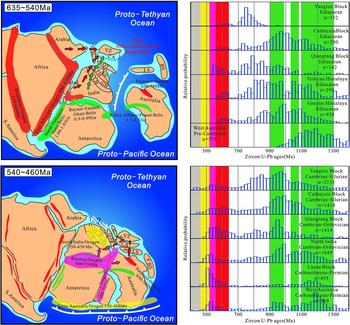
Based on our data and comparisons with the detrital zircon ages from the nearby continents, we propose a new model that places the SCC at the periphery of the NW margin of India in the Ediacaran, including the transportation of the detritus from India and Arabia to the SCC (Fig. 8). On the basis of tectono-stratigraphic correlations (Jiang, Sohl & Christie-Blick, Reference Jiang, Sohl and Christie-Blick2003; W. H. Yao et al. Reference Yao, Shu and Santosh2014b), palaeontological similarities (Peng et al. Reference Peng, Hughes, Heim, Sell, Zhu, Myrow and Parcha2009) and palaeomagnetic evidence (Li, Evans & Zhang, Reference Li, Evans and Zhang2004; Zhang, Reference Zhang2004), previous studies proposed a link between India and the SCC as early as the Ediacaran. However, the distinct detrital zircon age spectra of the Ediacaran strata from Yangtze and East Gondwana contradict the link between these two areas (Fig. 8). An alternative explanation is that the Cathaysia side of the SCC was submerged (L. J. Wang et al. Reference Wang, Griffin, Yu and O'Reilly2010; W. H. Yao et al. Reference Yao, Shu and Santosh2014b), and the depositional centre of the basin in the SE Yangtze Block had not migrated northward sufficiently by the Ediacaran (Yao & Li, Reference Yao and Li2016). Therefore, the Early Neoproterozoic detritus that was deposited in the Qiangtang, India and Cathaysia, was absent in the Yangtze Block in the Ediacaran. In contrast, the Ediacaran strata in the Yangtze Block were predominantly derived from the Middle to Late Neoproterozoic basement in the Yangtze and the Latest Neoproterozoic volcanic ashes from the Arabian–Nubian Shield (Fig. 6).
The model for the reconstruction of the Ediacaran to Silurian East Gondwana and the role of the SCC suggested by the regional comparison of detrital zircons among the Asian microcontinents fragments. Sources of data: 1, Yangtze Block: L. J. Wang et al. Reference Wang, Griffin, Yu and O'Reilly2010; Hofmann et al. Reference Hofmann, Linnemann, Rai, Becker, Gärtner and Sagawe2011; Xu et al. Reference Xu, Du, Cawood, Zhu, Li and Yu2012, Reference Xu, Cawood, Du, Hu, Yu, Zhu and Li2013; Li et al. Reference Li, Jia, Wu, Zhang, Yin, Wei and Li2013; Yao, Li & Li, Reference Yao, Li and Li2014a; W. H. Yao et al. Reference Yao, Shu and Santosh2014b, Reference Yao, Li, Li, Su and Yang2015; Chen et al. Reference Chen, Sun, Long, Zhao and Yuan2016; 2, Cathaysia Block: Wan et al. Reference Wan, Liu, Xu, Zhuang, Song, Shi and Du2007; Yu et al. Reference Yu, Wang, O Reilly, Griffin, Zhang, Li and Shu2009, Reference Yu, O Reilly, Wang, Griffin, Zhou, Zhang and Shu2010, Reference Yu, O Reilly, Zhou, Griffin and Wang2012; L. J. Wang et al. Reference Wang, Griffin, Yu and O'Reilly2010; Wu et al. Reference Wu, Jia, Li, Deng and Li2010; Xu et al. Reference Xu, Cawood, Du, Zhong and Hughes2014b; W. H. Yao et al. Reference Yao, Shu and Santosh2014b, Reference Yao, Li, Li, Su and Yang2015; Yu et al. Reference Yu, Du, Cawood, Xu and Yang2014; 3, Qiangtang Block: Wang, Li & Chao, Reference Wang, Li and Chao2016; 4, Tethyan Himalaya: Webb, Reference Webb2011; 5, Greater Himalaya: Martin et al. Reference Martin, Decelles, Gehrels, Patchett and Isachsen2005; Gehrels et al. Reference Gehrels, Decelles, Ojha and Upreti2006, Reference Gehrels, Kapp, Decelles, Pullen, Blakey, Weislogel, Ding, Guynn, Martin and Mcquarrie2011; 6, West Australia: Ksienzyk et al. Reference Ksienzyk, Jacobs, Boger, Košler, Sircombe and Whitehouse2012; 7, North India (including the Cambrian to Ordovician samples from the Lesser, Tethyan and Greater Himalaya): Gehrels et al. Reference Gehrels, Decelles, Ojha and Upreti2006, Reference Gehrels, Kapp, Decelles, Pullen, Blakey, Weislogel, Ding, Guynn, Martin and Mcquarrie2011; Myrow et al. Reference Myrow, Hughes, Searle, Fanning, Peng and Parcha2009, Reference Myrow, Hughes, Goodge, Fanning and Williams2010; Hughes et al. Reference Hughes, Myrow, McKenzie, Harper, Bhargava, Tangri, Ghalley and Fanning2011; Long et al. Reference Long, McQuarrie, Tobgay, Rose, Gehrels and Grujic2011; Webb, Reference Webb2011; McQuarrie et al. Reference McQuarrie, Long, Tobgay, Nesbit, Gehrels and Ducea2013; 8, Lhasa Block: Gehrels et al. Reference Gehrels, Kapp, Decelles, Pullen, Blakey, Weislogel, Ding, Guynn, Martin and Mcquarrie2011; Zhu et al. 2011. n – number of concordant zircon analyses. QT – Qiangtang Block. IC– Indochina. LS – Lhasa Block. BS – Baoshan Block.YZ – Yangtze Block. CA – Cathaysia Block. Sr – Sri Lanka. Mad – Madagascar. TH – Tethyan Himalaya. GH – Great Himalaya. LH – Lesser Himalaya. GI – Great India.

Previous Early Palaeozoic reconstruction models placed the SCC along the northern margins of Gondwana, with specific positions varying from the NW to NE margin of North India adjacent to Arabia or Australia, based on inconsistent faunal, palaeomagnetic and provenance explanations (Xu et al. Reference Xu, Cawood, Du, Zhong and Hughes2014b; W. H. Yao et al. Reference Yao, Shu and Santosh2014b; Cawood et al. Reference Cawood, Zhao, Yao, Wang, Xu and Wang2017; Chen et al. Reference Chen, Sun, Long, Zhao, Wang, Yu and Yuan2017; Wang et al. Reference Wang, Zeng, Zhou, Zhao, Zheng and Lan2017). W. H. Yao et al. (Reference Yao, Shu and Santosh2014b) proposed that the SCC collided with North India during Ediacaran to Ordovician times. This model was disputed for the lack of evidence to place the SCC as a downgoing plate for the inferred collision event (Cawood et al. Reference Cawood, Zhao, Yao, Wang, Xu and Wang2017). Moreover, unconformity between the Cambrian and Ordovician strata in the Yunkai area along the southernmost margin of the SCC was observed (Wang et al. Reference Wang, Griffin, Yu and O'Reilly2010b; Xu et al. Reference Xu, Cawood, Du, Hu, Yu, Zhu and Li2013; Jiang et al. Reference Jiang, Sinclair, Niu and Yu2014), and two amphibolite–granulite facies metamorphic events on the Cathaysia side of the SCC at 533 Ma and 495 Ma were recently reported (Zhang et al. Reference Zhang, Wang, Fan, Zhang and Zhang2011; Li et al. Reference Li, Lin, Xing, Jiang and He2017). These authors proposed that the Early Palaeozoic tectonic and metamorphic events in the SCC likely belong to the assembly of Australia and India–SCC during the Cambrian and Ordovician (Meert, Reference Meert2003; Boger & Miller, Reference Boger and Miller2004; Veevers, Reference Veevers2004).
As part of an ongoing debate on this region, new models have been proposed to explain the Early Palaeozoic ocean–continental configuration of the Gondwana proto-Tethyan margin, such as an archipelago ocean, an Andean-type active plate margin or a passive continental margin (Miller et al. Reference Miller, Thöni, Frank, Grasemann, Klötzli, Guntli and Draganits2001; Cawood, Johnson & Nemchin, Reference Cawood, Johnson and Nemchin2007). In addition, Late Cambrian to Early Ordovician (510−480 Ma) granites occurring in the South Qiangtang were proposed to develop in the collision and post-collisional setting (Hu et al. Reference Hu, Zhai, Jahn, Wang, Li, Lee and Tang2015). These granites appear to be related to the accretion of other Asian microcontinental fragments (e.g. SCC), as the proto-Tethyan ocean subducted to the north margin of East Gondwana (Zhu et al. Reference Zhu, Zhao, Niu, Dilek, Wang, Ji, Dong, Sui, Liu, Yuan and Mo2012).
However, the presence of a broad Cambrian ocean between the SCC and North India – South Qiangtang has been disputed on the basis of the following observations: (1) the absence of subduction- or collision-related magmatism in the Late Ediacaran to Ordovician strata in the SCC (e.g. Wang et al. Reference Wang, Griffin, Yu and O'Reilly2010b; Shu et al. Reference Shu, Jahn, Charvet, Santosh, Wang, Xu and Jiang2014); (2) the sedimentary facies across Cathaysia to Yangtze are continuous without records of Early Palaeozoic ophiolites in the SCC (e.g. Jiang et al. Reference Jiang, Sinclair, Niu and Yu2014; Yao, Li & Li, Reference Yao, Li and Li2014a); and (3) the 1.1−0.9 Ga detritus derived from North India was able to reach the Cathaysia side of the SCC as early as the Ediacaran and to be transported northward to the Yangtze side of the SCC in the Cambrian. Accordingly, we propose a progressive filling of an intracontinental foreland basin between North India and Yangtze in the Cambrian, rather than an ocean–continental configuration process, to account for the transportation of detritus to Yangtze.
Based on our data, the input from Australia–Antarctica sources was observed in the Cambrian sedimentary strata in the SCC. Operation of a dextral strike-slip motion between the SCC and the North India margin during the Cambrian was proposed by Cocks & Torsvik (Reference Cocks and Torsvik2013) to account for the contradictory faunal and palaeomagnetic link between the SCC and nearby continents in Ediacaran to Cambrian times. The mechanism for such a strike-slip motion, however, is still poorly constrained. The transportation of the 650−560 Ma detritus from the Paterson Orogen in Australia (Martin, Collins & Kirkland, Reference Martin, Collins and Kirkland2017) to the Cambrian basin in the southern margin of the SCC corresponds to the timing of the 560−520 Ma Pinjarra Orogen (Fitzsimons, Reference Fitzsimons, Yoshida, Windley and Yoshida2003; Veevers, Reference Veevers2004) which led to the collision of Australia and India and the final assembly of East Gondwana (Santosh et al. Reference Santosh, Maruyama, Sawaki and Meert2014a). Thus, we suggest that the Australia–SCC link can explain the convergence between India and Australia, allowing the transportation of the 650−560 Ma detritus from the Paterson Orogen in NW Australia to the SCC.
7. Conclusions
1. Zircon age peaks in the Cryogenian and Ediacaran siliciclastic sedimentary rocks in the South China Craton (SCC) suggest that they are derived predominantly from 900−700 Ma proximal magmatic rocks in the block. The 662−558 Ma ages, however, indicate that the SE margin of Yangtze experienced arc volcanism along the north margin of East Gondwana in the Neoproterozoic, suggesting a spatial link between the SCC and East Gondwana as early as the Late Ediacaran.
2. The Cambrian to Ordovician siliciclastic sedimentary rocks display zircon age populations between 1.1and 0.9 Ga and between 600 and 500 Ma that are strikingly different from those revealed by the underlying strata. The εHf(t) values in these zircon grains are similar to those in the Prydz Belt, Lhasa and Madagascar. Northwestern Australia–Antarctica and India were the main source areas of the Cambrian siliciclastic sedimentary rocks in the SCC. The source area appears to have switched from NW India to NE India in the Cambrian, suggesting the SCC was affected by the intracontinental subduction between South China and South Qiangtang, and the assembly of India and Australia.
3. The Silurian siliciclastic sedimentary rocks display similar age peaks to the underlying strata except for 460−410 Ma detrital zircon ages, indicating inputs from the syn-orogenic sources from the Early Palaeozoic orogeny of South China.
Acknowledgements
The Chinese Geology Survey (Grant No. 12120114016701) and the National Natural Science Foundation of China (Grant No. 41472190) are gratefully acknowledged for funding for this study. Ali Polat acknowledges the support of China University of Geosciences at Wuhan and the Natural Sciences and Engineering Research Council of Canada (NSERC). We also acknowledge Prof. Yongsheng Liu for his assistance in the LA-ICP-MS U–Pb zircon analysis conducted at the State Key Laboratory of Geological Processes and Mineral Resources, China University of Geosciences, Wuhan. Prof. P. A. Cawood, Prof. J. Charvet, Prof. M. Faure and Prof. Liangshu Shu are thanked for their constructive comments which greatly helped improve the manuscript.
Supplementary material
To view supplementary material for this article, please visit https://doi.org/10.1017/S0016756818000511