Introduction
The lichen genus Porpidia Körb. (Körber Reference Körber1855) has been the subject of a number of taxonomic studies in recent decades including Hertel (Reference Hertel1975, Reference Hertel1977), Inoue (Reference Inoue1983), Hertel & Knoph (Reference Hertel and Knoph1984), Knoph (Reference Knoph1984), Schwab (Reference Schwab1986), Gowan (Reference Gowan1989a , Reference Gowan b ), Gowan & Ahti (Reference Gowan and Ahti1993), Buschbom & Mueller (Reference Buschbom and Mueller2004), Fryday (Reference Fryday2005) and Orange (Reference Orange2014). Porpidia generally displays few taxonomically useful characters and many of these are very variable. In addition, the homology of character states within and among groups is difficult to assess, consequently problems arise in the delimitation of species. There are also numerous unidentified collections which probably represent undescribed taxa. Molecular data have gained importance in lichen systematics and now have a significant impact on the classification and taxonomy of the genus Porpidia. Buschbom & Mueller (Reference Buschbom and Mueller2004) investigated the phylogeny of the genus using nuclear ribosomal large subunit RNA and nuclear β-tubulin markers. The analyses indicated that the genus Porpidia could be divided into three infra-generic groups: the P. macrocarpa group, the P. albocaerulescens group and the P. speirea group. Orange (Reference Orange2014) investigated the phylogeny of the genus using the internal transcribed spacer (ITS) and nuclear ribosomal large subunit. The analyses separated P. contraponenda (Arnold) Knoph & Hertel and the new species P. irrigua Orange. These two molecular studies have greatly enhanced our understanding of the infra-generic relationships.
During our study on the lichen flora of Mt. Changbai in Jilin Province, China, a species of Porpidia new to science was found. We present a brief diagnosis, an extended description, and a phylogenetic analysis based on ITS-sequence data. The phylogeny will make it possible to re-evaluate morphological and chemical characters in the group, and to conduct detailed studies of species delimitations within the monophyletic subgroups.
The Changbai Mountain Range straddles the border between China and North Korea (41°41'–42°51'N, 127°43'–128°16'E). The range extends from the north-east Chinese provinces of Heilongjiang, Jilin and Liaoning to the North Korean provinces of Ryanggang and Chagang. Most peaks exceed 2000 m in height, with the highest being Paektu Mountain. Mt. Changbai sits in the temperate zone with a continental mountain climate and an annual average temperature of −7°C to 3°C.
Materials and Methods
The specimens studied were collected from Jilin Province, China, and are preserved in the Lichen Section of the Botanical Herbarium, Shandong Normal University, Jinan, China (SDNU). The specimens were examined using standard microscopic techniques and hand-sectioned under a NIKONSMZ 645 dissecting microscope. Anatomical descriptions are based on observations of these preparations under a NIKON Eclipse E200 microscope. Sizes of the thallus, apothecium, hymenium and exciple were based on five measurements for each specimen. Dimensions of ascospores based on ten measurements per specimen are presented as the range with outlying values given in parentheses. Secondary metabolites of all the specimens were identified using TLC and solvent C as described by Orange et al. (Reference Orange, James and White2010). The medulla was tested for an amyloid reaction using IKI (10% aqueous potassium iodide).
DNA was extracted from frozen specimens using the SanPrep Column DNA Gel Extraction Kit, following the manufacturer’s instructions. PCR amplification was carried out using Tiangen Taq in 50 ul tubes. The two internal transcribed spacer regions and the 5.8S region (ITS1-5.8S-ITS2) of the nuclear ribosomal genes were amplified, using the primers ITS1F (Gardes & Bruns Reference Gardes and Bruns1993) and ITS4 (White et al. Reference White, Bruns, Lee and Taylor1990). The PCR thermal cycling parameters were: initial denaturation for 3 min at 94°C, followed by 3 cycles of 30 s at 94°C, 30 s at 52°C, and 90 s at 72°C, then 35 cycles of 30 s at 94°C, 30 s at 52°C and 90 s at 72°C; and a final extension step at 72°C for 10 min. PCR products were visualized on agarose gels stained with ethidium bromide. Sequencing was performed by Sangon Biotech Co. Ltd (Shanghai) with an ABI 3730 XL DNA Analyzer.
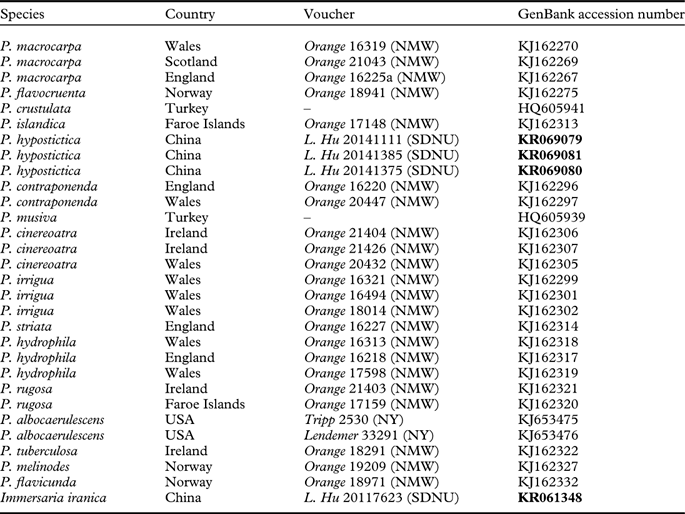
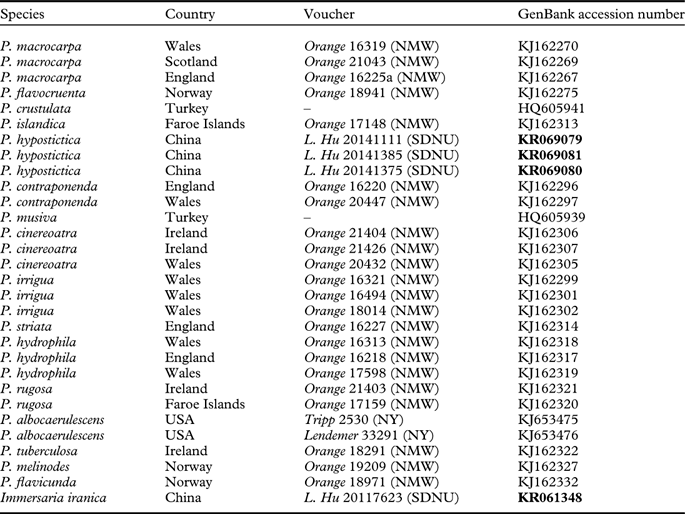
BLAST searches in GenBank were performed to ascertain that all sequences used in the phylogenetic analyses originated from the lichens and not from contaminating organisms such as parasymbiotic fungi. Contigs were assembled and edited using the program Geneious v6.1.2 (Biomatters Ltd, Auckland, New Zealand). Sequences were aligned using the program MAFFT v7. For ITS sequences, we used the L-ING-i alignment algorithm with the remaining parameters set to default values. Three Porpidia specimens representing the new species P. hypostictica, collected from Jilin Province in mainland China, were selected for the phylogenetic analysis. Sequences generated for this study were complemented with sequences from GenBank representing additional specimens or species. Immersaria iranica Valadb., Sipman & Rambold was selected as outgroup. Specimens used in the analyses are shown in Table 1.
Specimens used in the phylogenetic analyses of Porpidia species. New sequences are in bold
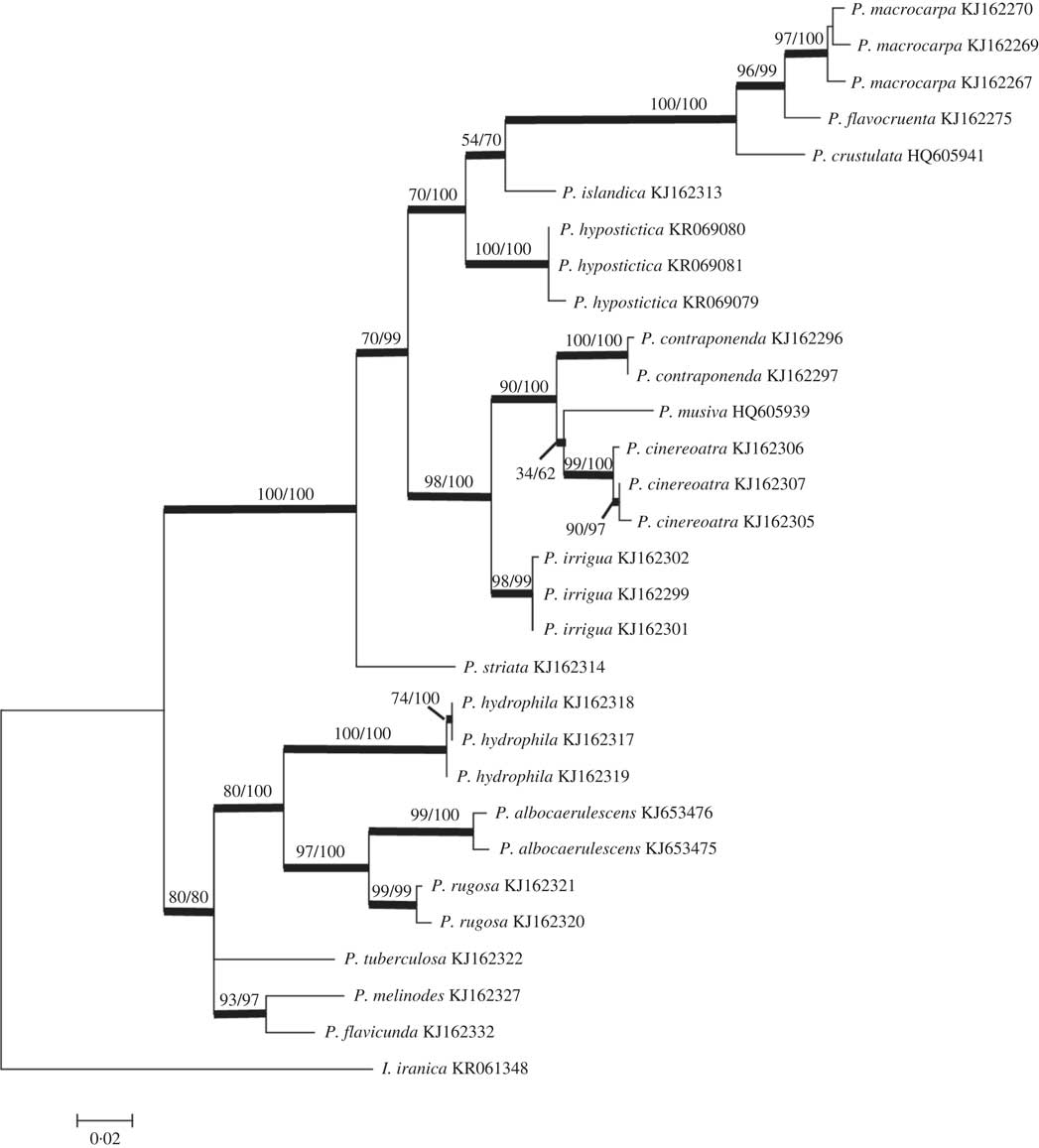
Bayesian analyses were carried out using locus-specific model partitions (ITS1, 5.8s rDNA, ITS2) in MrBayes v3.2.3. The nucleotide substitution models of the three loci were selected using the Akaike Information Criterion in jModelTest v2.1.7. The Bayesian analysis was run for 10 000 000 generations with four independent chains and sampling every 1000th tree. All model parameters were unlinked. Two independent Bayesian runs were conducted to ensure that stationarity was reached and the runs converged at the same log-likelihood level (verified by eye and with AWTY option). After discarding the burn-in, the remaining 7500 trees of each run were pooled to calculate a 50% majority-rule consensus tree. Maximum likelihood (ML) analyses were conducted in MEGA6 (Tamura et al. Reference Tamura, Stecher, Peterson, Filipski and Kumar2013). Phylogenetic relationships and support values were investigated using the Maximum Composite Likelihood method. The percentages of replicate trees (1000 replicates) in which the associated taxa clustered together in the bootstrap test (Felsenstein Reference Felsenstein1985) are shown next to the branches (Fig. 1). The clades that received a bootstrap support of 70% through ML and posterior probabilities of 0·95 were considered significant. Phylogenetic trees were visualized using FigTree v1.4.2.
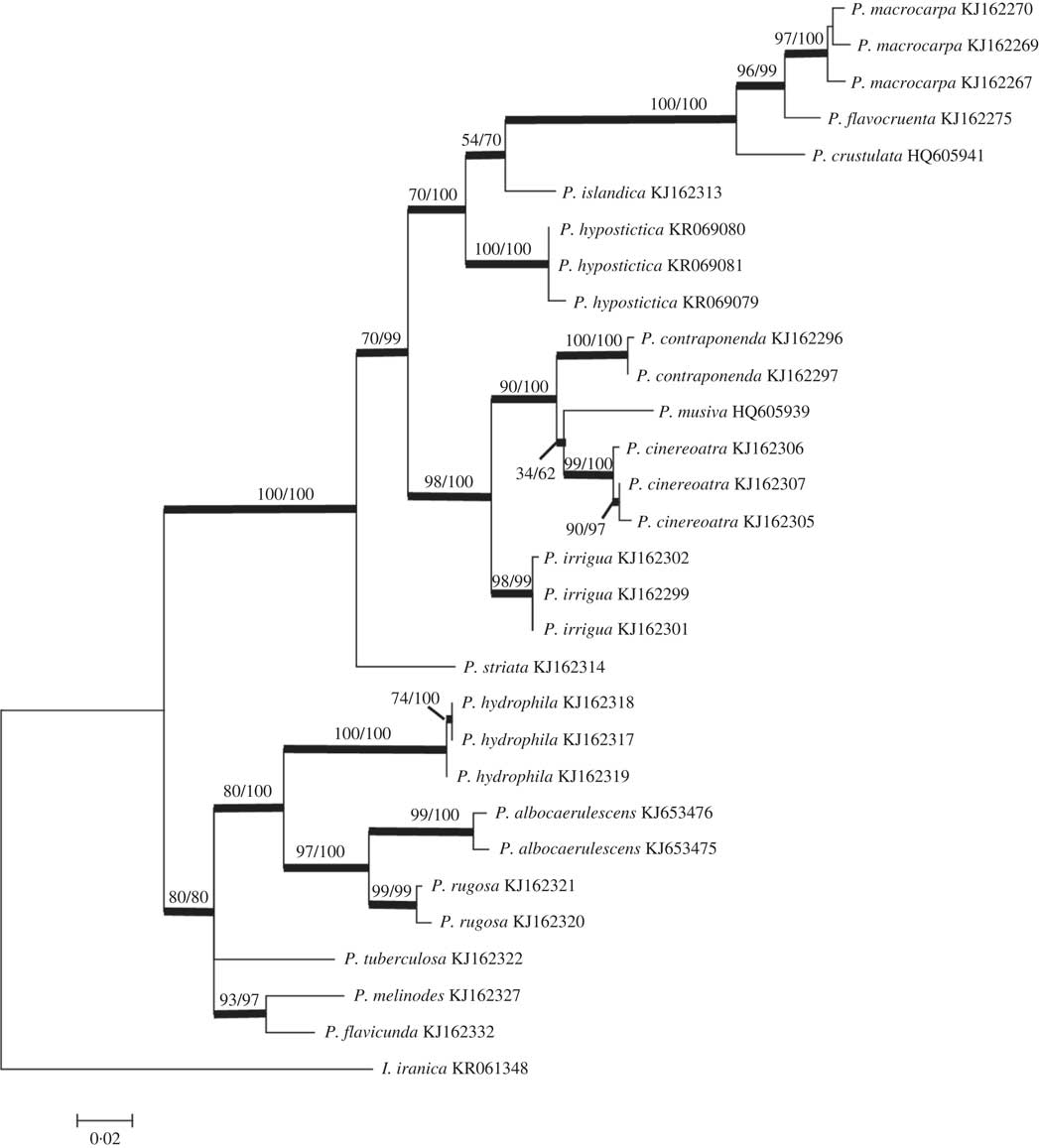
Maximum likelihood phylogram for Porpidia species, based on the nuclear ribosomal ITS1-5.8S-ITS2 region. Immersaria iranica was used as outgroup. Posterior probabilities ≥95% and ML bootstrap values ≥70% are listed to the left and right of slashes respectively.
Results and Discussion
Porpidia hypostictica L. Hu & Z. T. Zhao sp. nov.
MycoBank No.: MB 814973
Thallus white to grey-white, with yellow, oxidized patches near the margin; apothecia sessile, up to 2·3 mm diam., ascospores 17·5–25·0 µm long. Thallus containing hypostictic acid as the only major compound.
Type: China, Jilin Prov., Changbai Co., Mt. Changbai, 41°35'4·95"N, 127°51'51·69"E, alt. 1300 m, on rock, 25 July 2014, Ling Hu 20141385 (holotype—SDNU; GenBank: KR069081).
Thallus continuous, saxicolous, usually rimose, sometimes areolate, 0·2–0·7(–1·0) mm thick, surface white to grey-white with yellow, oxidized patches near the margin; medulla I−; prothallus inconspicuous; soredia and isidia absent.
Apothecia sessile, up to 2·3 mm diam., scattered or clustered in small groups; disc dark brown to black, plane to commonly convex, occasionally slightly orange pruinose; margin distinct when young, 90–140 µm wide, epruinose. Exciple with brown pigment, pigment dense at margin and dilute to moderately dense within, (100–)120–175 µm wide, without crystals; hyphae 5–8 µm diam. Hypothecium brown to dark brown, without crystals. Hymenium hyaline, 110–130(–150) µm high; epihymenium olive-brown to brown. Asci clavate, 8-spored, tholus with an I+ blue tube-structure; ascospores ellipsoid, simple, colourless, halonate, 17·5–23·0(–25·0)×7–10 µm.
Pycnidia usually present, sometimes frequent, black, slightly raised, orbicular to somewhat elongate, with raised and white pseudothalline margin; conidia simple, colourless, bacilliform, 10–14×0·7–1·2 µm.
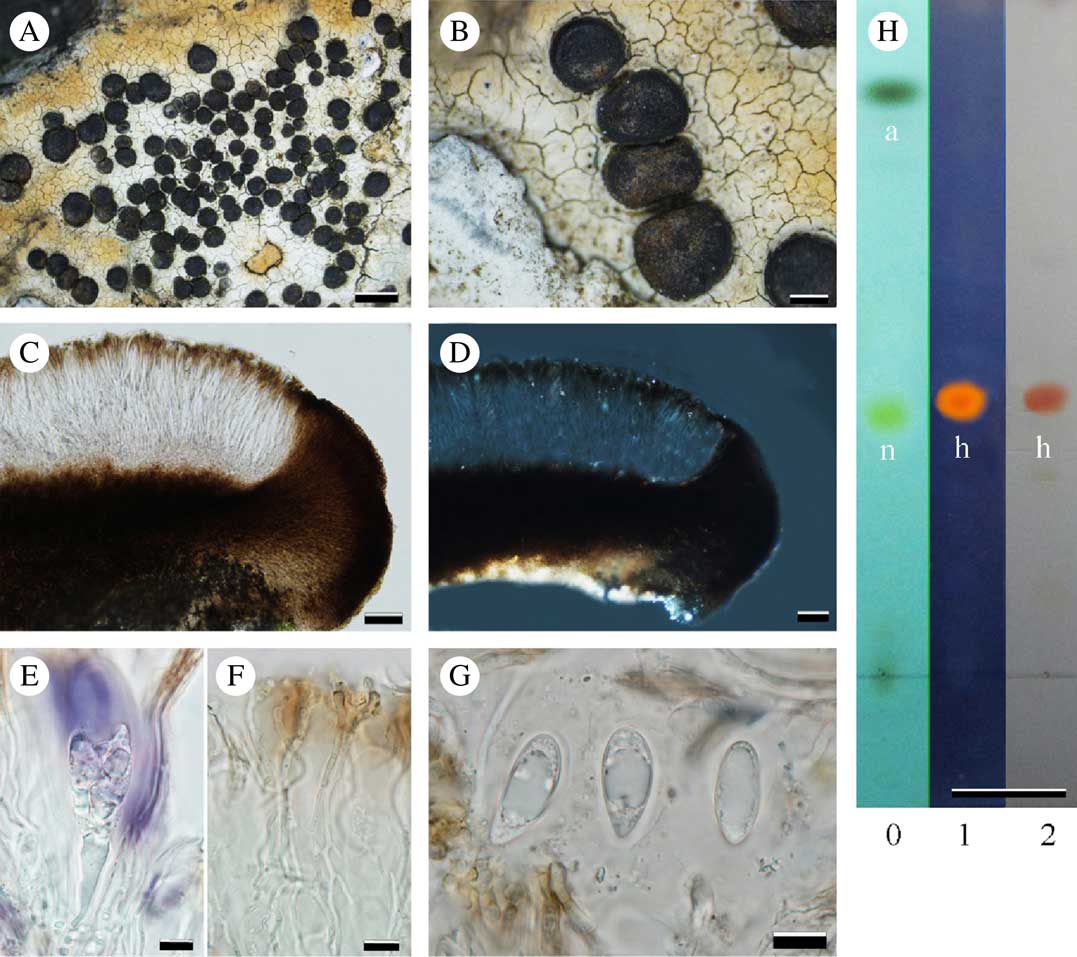
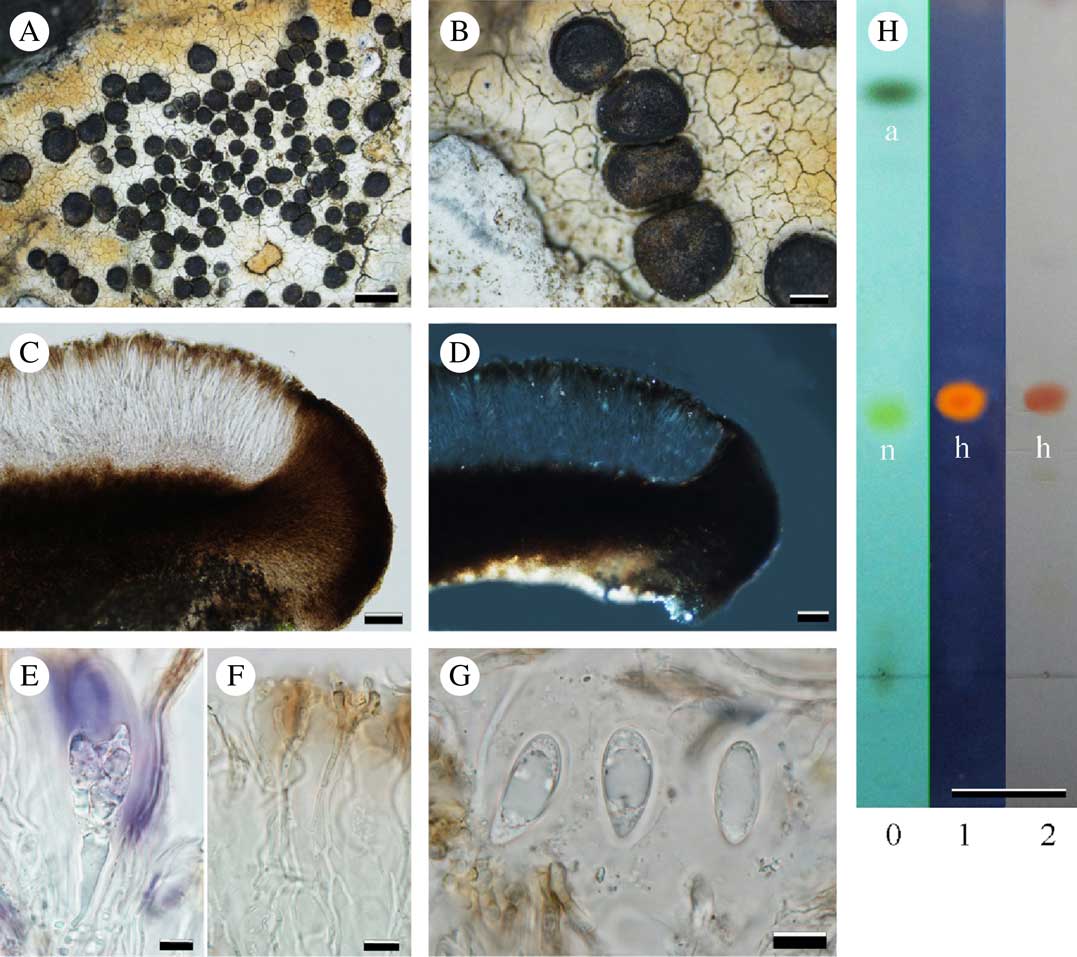
Chemistry. Cortex and medulla K+ orange, C−, KC−. Hypostictic acid detected by TLC (Fig. 2).
Porpidia hypostictica (Hu 20141385, SDNU). A, thallus; B, apothecia; C, apothecium section; D, epihymenium and exciple without crystals; E, amyloid reaction of ascus; F, paraphyses; G, ascospores; H, chromatograms of whole thallus extracts (solvent C):0=control extract from Lethariella cladonioides which contains atranorin and norstictic acid viewed in natural light; 1 & 2=P. hypostictica (located using fluorescence under longwave (365nm) UV light (1) or natural light (2)). Compounds detected: a=atranorin; n=norstictic acid; h=hypostictic acid. Scales: A=2 mm; B=500 µm; C & D=50 µm; E, F & G=10 µm; H=1 cm.
Comments. The new species is similar to Porpidia macrocarpa (DC.) Hertel & A. J. Schwab in having a yellow oxidized surface, large apothecia, large ascospores, a wide exciple and olive-brown to brown epihymenium. However, P. hypostictica can be distinguished by the presence of stictic acid. This new species resembles P. thomsonii Gowan by having a similar thallus surface, dark exciple, and similar thick excipular cells. Porpidia thomsonii, on the other hand, has smaller apothecia, a lower hymenium, smaller ascospores, and a thinner thallus containing stictic acid. In the phylogenetic tree, P. hypostictica and other species clustered into different monophyletic clades, demonstrating that P. hypostictica is a distinct species.
Specimens examined. China: Jilin Prov.: Fusong Co., Mt. Changbai, 42°3'N, 127°47'E, 2300 m, on rock, 2014, Ling Hu 20141095, 20141097, 20141112 (SDNU), Weicheng Wang 20141074, 20141371, 20141111, 20141113 (SDNU); Changbai Co., Mt. Changbai, 41°35'N, 127°51E, 1300 m, on rock, 2014, Feixiang Shi 20141384, 20141383, 20141370 (SDNU), Ling Hu 20141385, 20141372, 20141374, 20141375 (SDNU).
We thank Dr Qiang Ren (SDNU) and Dr Xin Zhao (SDNU) for providing great help during the study. This work was supported by the National Natural Science Foundation of China (31400015, 31570017).