In the central Punjab town of Malerkotla, the partition of India and Pakistan in 1947 is remembered as the community's finest hour and evidence of the moral fiber and secular values of the citizenry.Footnote 1 Although much of Punjab experienced serious interreligious violence during this period, no one died in Malerkotla. Instead, this former princely state became a safe haven for Muslims migrating to Pakistan. Malerkotla became Muslim majority in 1947 and remains so today—the only such place in Indian Punjab. By and large harmonious interreligious relations continue to characterize Malerkotla, even during times of communal strife elsewhere. Indeed, Malerkotla is widely known as an “oasis of tolerance” (The Hindu, April 1, 2005) and enjoys a reputation as a communal utopia.Footnote 2 But this idealized identity is also highly complex. Peace, it turns out, is just as multicausal as conflict, and Malerkotla's placid public image masks multiple contributing and challenging factors. Indeed, though it is rarely publicly acknowledged, Malerkotla's pre-partition history is replete with interreligious conflicts. Yet, having overcome the strains of 1947, from partition forward, the perception takes root that Malerkotla is a place free of interreligious tension.
This is a study of the process through which the peace at partition became an ethical mandate for continued pacific interreligious relations. This shared ethos of harmony is manifest in the collective representations of Malerkotla, enacted at its shared sacred sites, and written into its histories. Importantly, even when such representations, enactments, and writings contain variant or contradictory elements, the variations and contradictions do not undermine the collective and occasionally collaborative project of bolstering Malerkotla's civic identity. The shaping of this identity is particularly observable through the rituals and stories that constellate around the tomb shrine and cult of Shaikh Sadruddin Sadri Jahan, commonly known as Haider Shaikh, the Sufi saint who founded Malerkotla in 1454. Residents and devotees frequently credit the saint with preserving the town from violence during stressful periods. Haider Shaikh's tomb shrine, or dargah, is also the location of a vibrant multireligious cult, among the most popular such sites in Indian Punjab. Muslims, Hindus, and Sikhs, both resident and nonresident, visit the dargah daily and at festival times, praying for the same blessings—children, health, wealth, employment, and so on—as they have for generations. Pilgrims and residents link their traditions centering on Haider Shaikh and his tomb to Malerkotla's unique history, giving substance to the town's idealized harmonious identity. Through memorializing practices, this identity becomes hegemonic and disciplinary, allowing variation but limiting opposition.
Discursive practices—the telling of stories, the writing of histories—are not the only means of constructing and construing Malerkotla's civic identity. Bodily practices—rituals, pilgrimages, and physical presence—located in the shared space of the shrine are also important. The tomb cult is central to this process, as spaces associated with the holy dead are also locations for the circulation of capital—social, political, and spiritual, as well as financial. Because caste and religious divisions are no barrier to attendance at most dargahs, these shrines facilitate interpersonal engagement across social and religious lines. Political leaders of all parties and faiths visit the shrine to demonstrate their secular credentials. The descendents of the saint are the caretakers of the tomb, and they are also politically prominent, being both elected officials and related to the erstwhile royal family.Footnote 3 In Malerkotla, the tomb cult is a major source of revenue, not just for the saint's family but also for local merchants and residents who rent space, sell goods, and feed thousands of pilgrims.
As the protector of Malerkotla during numerous crises, especially partition, Haider Shaikh plays a central role in the collective memory of the town. As Jan Assmann describes it, cultural memory, such as that concerning the founding saint, “comprises that body of reusable texts, images and rituals specific to each society in each epoch, whose ‘cultivation’ serves to stabilize and convey that society's self-image” (Kansteiner Reference Kansteiner2002, 182). Haider Shaikh and his cult stabilize and convey Malerkotla's self-image through narratives and rituals that center on the shrine. The dargah itself, in Wulf Kansteiner's terms, is a spatial expression of Malerkotla's cultural memory, part of the “objectified culture, that is, the texts, rites, images, buildings, and monuments which are designed to recall fateful events in the history of the collective. As the officially sanctioned heritage of a society, they are intended for the longue durée” (2002, 191). The shrine is particularly suited to this role because, as Edward S. Casey asserts, one of the qualities of place is its ability to incorporate without conflict the many elements that constitute its being: “There is a peculiar power to place and its ability to contain multiple meanings, diverse intentions, contradictory interactions. Surpassing the capacity of humans to sustain such a gathering, place permits a simultaneity and a filtering of experience, history, imagination, action” (Reference Casey, Feld and Basso1996, 26). Haider Shaikh's dargah draws together and sustains the shared practices of pilgrims and the shared histories of the region within a single space, shaping and stabilizing the collective memory and identity of Malerkotla. The dargah of Malerkotla's founder is a central component in building the town's collective identity as a zone of peace grounded in a moral economy of stability and secularism.
As the founder of Malerkotla, Haider Shaikh's shrine and hagiographic tradition serve as the physical and imaginary repositories of Malerkotla's civic identity and have a significant “shaping influence” on the collective identity of the town (Portelli Reference Portelli2001, 1). Notions of appropriate moral practice within the dargah provide structure to the interactions there and help produce Malerkotla's collective ethos. As a spatial expression of the town's collective memory, commemorative rites such as those occurring at the dargah connect bodily memory with place memory, enabling residents and visitors “to honor the past by carrying it intact into new and lasting forms of alliance and participation” (Casey Reference Casey1987, 257). Thus, the meaning of the shared shrine is inscribed in the community through the public performance of collective and individual identities at the site.Footnote 4 The efficacy of these practices is evident, as few residents or visitors contradict the dominant perception of Malerkotla as a peaceful place. Even those who object to saint worship or to visiting the sacred sites of other religions do not openly oppose these traditions. This is significant, as shrine visitation is controversial within Islam, officially disapproved of in Sikhism, and discouraged or even targeted by militant Hindus.Footnote 5 Yet Muslims, Sikhs, and Hindus all persist in the practice with great enthusiasm. Ritual exchanges and interpersonal interactions at Haider Shaikh's tomb exemplify the dominant ideal of interreligious harmony by integrating the town's unique experience at partition into the history of the saint, such that 1947 and Haider Shaikh come to symbolize Malerkotla's pacific civic identity.
Local Logics
Before addressing the particular rituals and testimonies relating to Haider Shaikh, it is important to outline the other common justifications for Malerkotla's freedom from communal violence. These reasons for peace are not mutually exclusive and are often cited in combination depending on the speaker, context, and circumstance. Indeed, the availability of multiple explanations is itself useful in generating cultural memories that sustain the core ethos of harmony. For example, some people say that the town has always been peaceful. History, however, belies this assertion. In fact, prior to 1947, the Muslim princely state was often at war with its non-Muslim neighbors.Footnote 6 The internal history of the town is likewise replete with intra- and inter-religious conflicts. Relations were especially fraught in the 1920s and 1930s—a time of heightened tension throughout the region. At one point, several thousand Muslim residents departed Malerkotla to protest the perceived Hindu bias of the Muslim ruler. In another incident, a Hindu was killed in a riot triggered by a dispute over the timing of rituals between a temple and a mosque. Thus, the general peace during the partition was no mere extension of the pre-partition status quo. The stark contrast between pre- and post-partition interreligious relations indicates that the watershed of 1947 also led to a cleansing of past histories that conflicted with the needs of the present.
The most popular explanation for Malerkotla's harmony concerns the blessings of the tenth Sikh guru, Gobind Singh. The guru is said to have blessed the kingdom upon hearing of Nawab Sher Muhammad Khan's vociferous objection to the execution of the guru's two youngest sons, who had been captured by Mughal forces at Sirhind in 1705. Though the guru and the nawab remained on opposite sides of the battle, Khan's protest is an important feature of Sikh and Punjabi history, symbolizing the possibility of rising above sectarian divisions to stand for justice. The guru's blessing is often cited as an explanation for why Malerkotla was not attacked by Sikhs in 1947. Yet in the 242 years between the blessing and partition, numerous battles occurred in which Sikh forces were not so restrained.Footnote 7 Thus, although the guru's blessing is also insufficient as a single explanation for the peaceful status quo, the pervasiveness of the story indicates how deeply linked this Sikh blessing is to the collective imaginings about Malerkotla. Indeed, pilgrims commonly link the power of the guru's blessing to Haider Shaikh, claiming that the blessing was given to the saint, not to his descendent Sher Muhammad Khan. This misattribution explains the saint's power as deriving from the guru, perhaps validating visitation for some non-Muslims. It also creates an important imaginative link between the saint and the guru, deepening the connection between Haider Shaikh and his Sikh devotees.
A more pragmatic explanation for the peace in Malerkotla is its post-partition status as the only substantial Muslim community in Punjab. This demographic profile increases the town's appeal as a symbolically powerful electoral constituency. Thus, the argument goes, local Muslims and non-Muslims protect their privileged position by ensuring a pacific civic identity. This explanation also revolves around partition, before which Malerkotla was a princely state where electoral politics were limited and during which Muslims moved into the territory in large numbers. This prominent profile requires Malerkotla's citizens to maintain public personae as “good” Muslims, docile and placid citizens of India with undivided loyalty and pacific natures, but willing to lay down their lives for India—even against “their Pakistani brothers” (Pandey Reference Pandey1999, 620). To that end, Muslims stand for election from and belong to political parties that elsewhere would be considered antithetical to Muslim interests, such as the Sikh nationalist Shiromani Akali Dal (SAD) party. This is particularly remarkable as the SAD chief minister, Prakash Singh Badal (1997–2002, 2007–present), forged an alliance with a Hindu nationalist party, the Bharatiya Janata Party (BJP), in the late 1990s.Footnote 8 The member of the legislative assembly from Malerkotla during Badal's first administration was a Muslim descended from the shaikh who belonged to the SAD. According to this argument, the Malerkotla constituency has greater leverage than it would otherwise have because of the nature of ethnic politics in India, where demonstration of secular credentials is essential for credibility—even among ethnic nationalist parties.Footnote 9 Yet, clearly, this demographic situation alone is no guarantee of peace. Similar potential incentives have had no such effect in Kashmir or other Muslim majority zones in India.
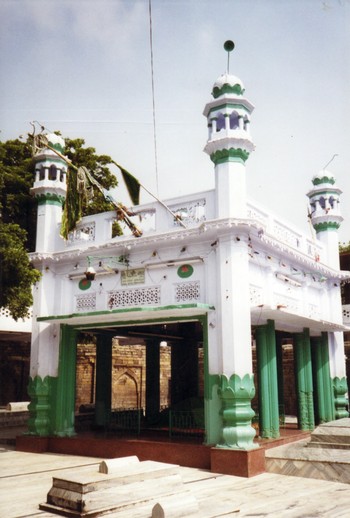
Turning to the explanation for peace that is central to this analysis, many residents attribute Malerkotla's partition experience and current interreligious harmony to the protective power of the myriad saints buried in the area. In particular, they talk about Haider Shaikh, the founder of the territory (see figure 1). As mentioned previously, Sikhs, Muslims, and Hindus all attend his dargah, and it is one of the most popular such sites in Indian Punjab, with upwards of 100,000 pilgrims attending the June fair. Nonetheless, there are shared places such as this throughout India, and clearly their mere existence does not prevent violence. Yet because saints' tombs attract those who reject unitary religious identities and loyalties, they are important indices of the quality of interreligious relations in a given locale. Places where religious militancy has been ascendant in India have seen attacks on shared sites. This occurred in the famous demolition of the Babri Masjid in 1992 by Hindu extremists and in the destruction of the tomb of Wali Gujarati in the Gujarat riots of 2002. Thus, the nature and quality of the relationships between Sikhs, Muslims, and Hindus at Haider Shaikh's dargah potentially reveal a great deal about local interreligious relations.
The dargah of Haider Shaikh.

One significant way in which this dargah functions for residents and devotees as a means to subvert the division imposed by partition is simply by providing an ongoing point of encounter among Sikhs, Muslims, and Hindus. As the only locale in Indian Punjab with a majority Muslim population, Sikh and Hindu visitors inevitably experience interreligious encounters that they could avoid by attending one of the many dargahs elsewhere in the state that are managed nowadays by Hindus and Sikhs. Instead, not only do they verbally validate one another's presence, but also they adopt each others' ritual practices, attend the same spiritual gatherings, visit at the same time of day, make the same offerings, consult the same ritual specialists, and in some cases become possessed by the saint's spirit. These exchanges and encounters reject communalism, India's term for religious sectarianism, antagonism, and politicization. Many devotees I interviewed asserted that their presence was motivated, in part, by a desire to repudiate such divisiveness.
In many ways, shared religious practices in Punjab reverse the impact of partition. Prior to 1947, united Punjab's population was majority Muslim (53 percent).Footnote 10 Subsequently, the percentage of Muslims on the Indian side of the border dropped below 1 percent and remains under 2 percent today.Footnote 11 Throughout Punjab, I encountered people who looked back at the pre-partition period as a utopian time when there was a common Punjabi culture steeped in saint's shrines, redolent with good local foods, and alive with the sounds of sacred poetry and lovelorn ballads. The idealized Punjab knew no caste, creed, or communalism. This Punjabi jeremiad longs for the dreamtime of a shared life before it was broken by the British, by the Muslims, and by the Hindus—in short, broken by outside forces, not by violence committed by Punjabis themselves.Footnote 12 In Malerkotla and at Haider Shaikh's dargah, the idealized past can, at least temporarily, seem presently real. This enables visitors and residents to repress the events of partition; to refuse to accept its resulting social, religious, and geographical divisions; and to inhabit a pre-1947 space. As one newspaper reporter described the town, “Malerkotla is the only place where one can get the flavour of Punjab before 1947” (Jolly Reference Jolly1997).
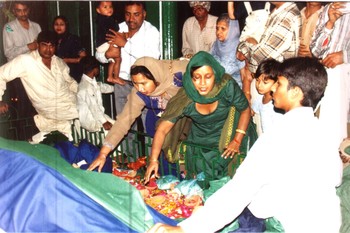
The shared devotional life at the dargah has long been the rule. Indeed, the Maler Kotla State Gazetteer of 1904 puzzles over the saint's festivals by saying, “It is strange that these fairs are mostly attended by Hindus, though Sadr-ud-Din was a Muhammadan Saint.” Nowadays, every Thursday, Sikhs, Muslims, and Hindus jostle for space near the tomb (see figure 2). The nostalgic experience is intensified at Haider Shaikh's tomb because reaching the dargah necessitates coming through a mostly Muslim neighborhood. For Hindus and Sikhs visiting from outside Malerkotla, this would be an unfamiliar and possibly intimidating experience. Yet having reached the dargah, one finds (on a nonfestival day) an atmosphere of calm and welcoming serenity. Moving through the space, pilgrims and caretakers, residents and visitors find themselves face to face with Haider Shaikh and with each other. Through these encounters, devotees of all religions inhabit the same space, necessitating physical and sometimes verbal interactions with one another, as well as with the saint. Through observation and dialogue, they learn appropriate rituals and modes of address. They become acquainted with Haider Shaikh and his history and perforce recognize one another's common humanity in their shared purposes in making the pilgrimage. Maintaining the multiconfessional community of the saint requires that these exchanges be conducted so that both the devotional and social purposes of the pilgrimage are sustained. Given the diversity of pilgrims at the dargah, this is an intense and interesting choreography.
Festival at Haider Shaikh's dargah.

Peace at Partition
During partition, it is estimated that 200,000 to 1 million people were killed, often in the most gruesome of ways. Trainloads of refugees traveling in both directions were slaughtered. Neighbors turned on neighbors. They were violent and dangerous times. As an officer in the Malerkotla army recalled, “[T]he main irrigation canal which crossed the Malerkotla state at Ahmedgarh, for days together was full of bloated dead bodies. But there was little we could do except watch them float by” (Jolly Reference Jolly1997). The displaced migrants numbered around 15 million—7 million Muslims and 8 million Hindus and Sikhs. Sixty years later, there is no end to the personal and scholarly efforts to understand how a people could divide in such a gruesome and damaging way, leaving deep scars and abiding enmities.Footnote 13
In striking contrast to the rest of Punjab, the handling of partition is a point of pride in Malerkotla, as few people left and no one died. The ruling Nawab and his son remained, and in a local poll conducted in the early 1990s, many residents cited their loyalty to the nawab as their reason for staying in Malerkotla (Sultana Reference Sultana1993, 78). Other reasons for staying included loyalty to various local leaders, belief in the greater viability of the Indian state, the expectation of gaining land rights in independent India, faith in their personal and economic security in Malerkotla, and love of their homeland. Also frequently mentioned, both in the earlier survey and in my own interviews, was the belief that those who stayed would be safe because of Guru Gobind Singh's blessing. In my interviews in 2000 and 2001, even respondents who did not believe in the Guru were convinced that the widespread Sikh belief in the Guru's blessing saved Malerkotla, making it unnecessary for Muslims to leave.
While few Muslims left, many came. In 1947, some 200,000 refugees descended upon the town, more than tripling the urban population.Footnote 14 Strained to the limits by this dramatic increase, the Nawab repeatedly begged the British for help, but was refused. The humanitarian crisis in the camps at Malerkotla was negligible compared to the bloodshed elsewhere in the region, and it was doubtless a lower priority. Refugee camps were set up all over the kingdom, including the Nawab's palace grounds. An Indian Army officer, Major Gurbax Singh Gill, who visited Malerkotla State on September 13, 1947, described the situation, saying, “[U]p till now there has been no trouble in the State but with the arrival of the refugees from outside the State the situation has become somewhat tense. Spears and axes are carried by both communities whom I saw moving along the road.”Footnote 15 From all available records, that tension never became violent. A retired Muslim schoolteacher interviewed in 2001 elaborated on the situation:
People did not migrate from here, but people from other states came here. They were kept in camps and when the situation pacified, they were sent on. First they were staying in people's houses, and diseases spread, like diarrhea. Not much was left with people to feed them. So they started giving them porridge. Then an order was given that the people should be put in camps. They were forcibly taken out of houses, the camps were first put on the Nabha road, and then these were flooded, so the camps were shifted to Id-Gah road. Then from there the people were shifted to Pakistan. (January 22, 2001)
The schoolteacher looking back in 2001 and Major Gill in 1947 both depicted Malerkotla as a town under enormous strain. Yet it was also a safe haven where hospitality was freely given, even if resources were limited.
A local imam echoed and extended this representation of Malerkotla's hospitable culture, weaving the peace of the past into his characterization of the community in the present day. In an interview, he described the town then and now as compassionate, saying,
Here there was peace. We cannot know why here there was peace and elsewhere there was not. People here are more compassionate than other places. You won't encounter such compassionate people in any other place. People eat together; give [each other] money. There are no beggars here. If someone doesn't have a place to stay that is traveling, here they will be taken into the house. (February 15, 2001)
The imam's explanation for the lack of violence at partition does not describes a particular historical event, but the moral quality of the community. Shifting from the past to the present tense, the imam connected the compassionate people of 1947 who resisted violence with the residents of today who share their resources and welcome visitors.
Numerous residents attributed the peaceful character of the town to the exemplary ethical conduct of Malerkotla's citizenry. Even those locals who reported that some Hindus and Sikhs abandoned their homes fearing the large influx of Muslim refugees also declared that their property was perfectly secure and that the nawab guaranteed their safe return. Army officer Khushi Mohammad corroborated this in a newspaper interview: “Not only did we have to guard the state from outside aggression, but we had been ordered to protect non-Muslim property from local attempts at arson or looting” (Jolly Reference Jolly1997). The retired schoolteacher cited previously affirmed this, saying, “[F]rom Malerkotla Hindus migrated or ran away, leaving their houses. The Nawab posted police at their houses, but nobody did any damage to their houses or belongings.” Hindu residents also claimed that there was a zero-tolerance policy for looting of property, and that the nawab made efforts to be visible among all communities during the crisis.
The successful management of partition in Malerkotla produced a solidarity between Hindus and Muslims that had not existed previously. Indeed, as mentioned earlier, the town's pre-1947 history is replete with interreligious conflicts.Footnote 16 In the 1930s, there were clashes between Hindus and Muslims, yet during the troubles of 1946–47, the community drew together. In at least one case, a Hindu mistri, or craftsman, made weapons to sell in the neighborhood, including to Muslims.
Everyone ran away. My mother was ill and we needed money, so I made some weapons from a big piece of iron lying at home meant for cutting cotton. The head of [a local Hindu organization] called me and asked, “You are selling weapons to Muslims?” I said, “There is no difference. If a Muslim dies, then also we will die. If a Hindu dies then we are still surrounded by Muslims.” (March 10, 2001)
Clearly, although the mistri's decision to sell weapons to Muslims was called into question by some local Hindu leaders, he still felt that all of their fates were united against the chaos around them. This attitude and practical, if ambivalent, cooperation exemplify the pragmatic workings of coexistence in an extremely stressful situation.
These accounts depict a residential and devotional community that on the whole refuses to accept the linking of national and religious identities associated with the division of India. Instead, the comparatively successful management of the strains of 1947 has profoundly shaped Malerkotla's collective memory and identity. Through people's memories, a picture emerges of a town comprising complex, fluid personalities who pragmatically negotiated their way through a traumatic period in the region's history. Yet these are not merely the empty protestations of the popular media; such statements reflect the reality on the ground. In ascribing the peace at partition to the plural, open quality of the town and to the nonsectarian blessings and protection of Haider Shaikh and Guru Gobind Singh, residents generate a shared historical paradigm. Through repetition and memorialization, this paradigm is rendered into a disciplinary history that determines the scope of possible representations of the past. In the “competitive arena of memory politics,” the winning story of Malerkotla is of a peaceful secular society (Kansteiner Reference Kansteiner2002, 179).
Ritual Practice
The ritual practices at Haider Shaikh's dargah also resist religious division. Rituals are an integral part of the process of forming a collective identity as a secular and pacific community. As Anthony Giddens points out, “[W]ithout ordered ritual and collective involvement, individuals are left without structured ways of coping with tensions and anxieties….Traditional ritual…connected individual action to moral frameworks and to elemental questions about human existence” (Reference Giddens1991, 204). In Malerkotla, where traditional rituals are alive and well, two rituals in particular, pilgrimage and possession, blur the distinctions among Hinduism, Islam, and Sikhism. At Haider Shaikh's tomb, pilgrims partake in a nonsectarian Punjabi pietistic culture characterized by shared histories, aesthetics, and moral values.Footnote 17 For non-Muslims, the pilgrimage represents a choice to seek out a living Islamic center in post-partition Indian Punjab. In a more literal blurring, religious divisions are subverted at the dargah through the possession of Hindu and Sikh devotees by the spirit of the Muslim saint. These rituals link individuals to the ethical ideals that the Shaikh and his shrine represent.
Pilgrimage
As noted earlier, Haider Shaikh's tomb has been a multiconfessional site at least since the nineteenth century. Nonetheless, there are considerable theological differences among Hindus, Sikhs, and Muslims and observable, if minor, variations in terms of daily ritual practice at Haider Shaikh's dargah. For example, Hindus and Sikhs may refer to the saint as God, a concept that is abhorrent to most Muslims. Yet anybody can and does offer sweets, a green or blue cloth cover or chadar for the tomb, small clay horses, incense, oil lamps, henna, money, goats, or other objects. Like the offerings, the ritual specialists are also multiple, as space is made for various modes of interaction with Haider Shaikh—through his descendants, the khalifahs, and through visiting disciples, or chelas, whom he possesses.
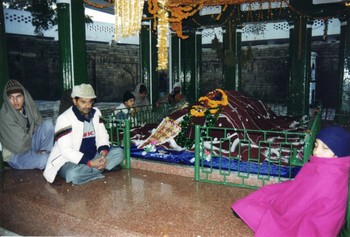
Although Hindus and Sikhs come in larger numbers to the festivals, on an average day in the early hours, visitors are few and mostly, but not exclusively, Muslim. Many locals come daily at this time, and most of those typically present are khalifahs, members of the family descended from the saint (see figure 3). Visitors have various habits of prayer, but there are some standards. Prior to entering the dargah, shoes are removed. Most pilgrims proceed directly to the tomb. Some bow and touch their forehead, kiss, or sometimes press each eye to the marble surface. Some reach under the chadar to contact the tomb or to lift the cover up to their eyes and lips. Some people walk around the tomb, while others simply sit. Some Muslims do not bow, believing this to be shirk, or making something comparable to God. Most Muslims who stay to pray will do so, if space permits, on the left side of the tomb, where they sit with their backs to the qibla (the direction of Mecca). As the dead in Islam are interred with their faces turned toward Mecca, sitting at this place means they are facing the saint, which is not only proper adab (etiquette), but also provides the most direct connection. Hindus and Sikhs sit everywhere, but often at the tomb's foot. Most pilgrims bring offerings; those who do not are also usually Muslim. Many people will place incense and/or small oil lamps in a small structure directly behind the main tomb. Some pilgrims consult with the khalifahs about their particular reasons for attending. Many of these encounters demonstrate the kind of basic human needs that most profoundly bind people together in their desire for grace, advice, and sympathy.
The khalifahs.

In one such instance, two Hindu women arrived on a quiet afternoon. They appeared unsure of how to proceed and cautiously approached the tomb where two elderly khalifah women were sitting.Footnote 18 They gave a few rupees and some sweets, bowed, walked around, and lit oil lamps in the area behind the grave. Returning to the foot of the tomb where these transactions take place, they received some tabarruk, then hesitantly asked the khalifahs for help with their dilemma. The younger Hindu woman was the elder's daughter-in-law, and she had not conceived after two years of marriage. One of the khalifahs told them to pray to the shaikh, and the young women would surely get a son. The older woman replied that she believed in the saint, but her daughter-in-law did not. The daughter-in-law interjected that she did not exactly not believe, she simply did not know yet. She did know that her mother-in-law had great faith in the saint. One of the khalifahs told her that so many women had had sons from praying here, she could be sure that she would also be blessed if she prayed from the heart. The women asked whether they should make some particular vow or offering. They were told no, they should do whatever they feel in their hearts, and to give according to their need and ability. The women then started talking generally about the daughter-in-law's diet, health, and habits. Such exchanges are commonplace but are nonetheless significant. This conversation was a profoundly intimate interaction between strangers of disparate religious affiliation who are connected through a single spiritual figure. The conversation exemplifies the kind of mutual support that often occurs between pilgrims to the dargah and its denizens. Though some of these experiences are momentary, even fleeting, the mundane quality of such encounters speaks to the shared moral universe of the participants.
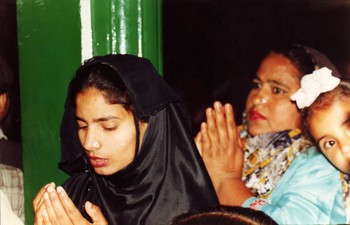
Significantly, most pilgrims to Haider Shaikh are aware of theological and ritual variation among religions. This awareness emerged slowly from numerous interviews. Many visitors initially responded to queries concerning ritual and conceptual differences with stock phrases suggesting vaguely that all religions are the same, the paths are many but the goal is one, and the like. On further discussion, people pointed out several external distinctions such as styles of prayer. In particular, pilgrims remarked that some Muslims do not bow to the tomb but that almost all Hindus and Sikhs will touch their foreheads. Several non-Muslim visitors expanded on this by confirming the distinction that Muslims pray through the saint to God, whereas Hindus and Sikhs pray directly to the saint—a significant theological discrepancy. Still, in the confines of the shrine, I never met a person who felt that this variation was problematic or had an impact on the efficacy of rituals, vows, or offerings. Most merely shrugged, clearly unconcerned by the implications of such contradictory notions for the efficacy of their prayers. Others actually affirmed the differences as evidence of a divine dispensation for each religion. Overall, difference for the devotees did not necessitate division (see figure 4).
Muslim and Sikh prayers.

Possession
A second way in which religious partition is ritually resisted is through certain devotees, mostly Hindus and Sikhs, who claim the ability to channel the Shaikh's spirit. Inside the dargah, the khalifahs accept offerings, give blessings and advice, and return some part of the offering (usually flowers or sweets) now infused with the saint's spiritual power, called baraka. Inside and outside the shrine, possessed devotees called chelas, a Sanskritic term for disciples, enter into trance states during which they communicate with Haider Shaikh. Thus, the saint is present at the dargah in two ways. Through his blood descendants, his baraka is available and transmittable to pilgrims through contact. Many devotees, particularly Hindus and Sikhs, will touch a khalifah to obtain this residual power. Haider Shaikh is also continually present through his spirit (the terms paun, Hindi for “breath,” and ruh, Arabic for “spirit,” are both used), which enters certain devotees. Having become manifest and accessible through these chelas, the Shaikh dispenses advice, treatments, and blessings.
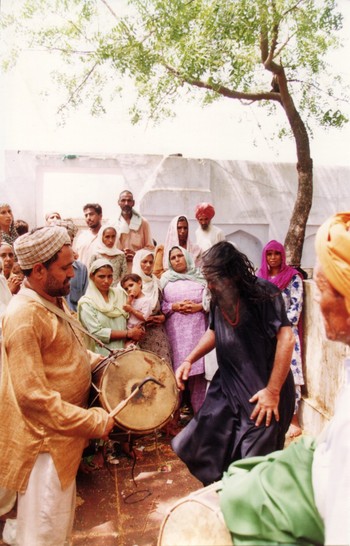
Chelas come to the shrine for festivals and, in lesser numbers, on Thursday nights along with groups of followers, ranging from a few to a few hundred. On one occasion within the tomb enclosure, I counted seven people in states of active possession and several others exhibiting the paraphernalia of the chela. This includes wearing the garb of a renunciant, often green, blue, or black (colors typically associated with Sufi saints), but sometimes a chela wears the Hindu renunciant's saffron. Many chelas arrive in processions accompanied by a drummer and their disciples. They often carry iron rods or chains that may be used to flay themselves during possession. Some chelas approach the tomb in a trance, others go into trance upon arrival, and some come, bow, circle, and leave with no observable alteration.
Although chelas pay respects at the dargah and receive blessings from the khalifahs, the main focus of the chelas and their entourages are the chaunkis (see figure 5). All around the shrine, pilgrims set up satellite ritual spaces in shelters by the tomb, in the streets under tents, in rooms rented out by locals, or wherever there is space. Some groups establish more substantial presences with banners, camps, and food distribution centers. The format of the chaunki is fairly standard.Footnote 19 The main chela or a senior disciple arranges a small altar, usually on the floor or ground. The altar consists of several small lamps, some sweets, and a few rupees. After a brief prayer in praise of Haider Shaikh, musicians play a devotional song accompanied by a drummer. After this first song, either the principal chela or one of the senior disciples comes forward and bows before the altar. If Haider Shaikh is so inclined and the chela is a fit vehicle, the invocation is successful, and the chaunki begins. The spirit of the saint is present.
Chaunki at Haider Shaikh.

The presence of Haider Shaikh is signaled most typically by head rolling of varying degrees of intensity, usually accompanied by music. The head rolling ranges from a slight nodding to a whirling of the entire torso. Most chelas, both men and women, have long hair, making this an especially dramatic event. This practice appears to be long established at Haider Shaikh, as noted in Denzil Ibbetson's 1883 ethnographic account from the dargah: “At first the woman sits silent with her head lowered and then begins to roll her head with hair disheveled” (Ibbetson, MacLagan, and Rose Reference Ibbetson, MacLagan and Rose1883, 644–45). After some period of head rotation, the chela stops, and so does the music. The chela speaks, first praising Haider Shaikh, inspiring responses of jay Babaji—“victory to Haider Shaikh”—from the gathering. The music and the head rolling resume, usually for a shorter period. The chela stops, the music stops, and the question-and-answer period commences. The chela usually asks what the concerns of the assembly are. For example, he or she inquires who has come with “child work” or job-related issues or health problems. Some audience members will rise, and one is selected. The music resumes and the chela's head rolls. Then the music stops and the chela addresses the petitioner, both telling about his or her situation and asking questions from the supplicant. The situation is slowly clarified by alternating rounds of music-accompanied trance with questioning until all are satisfied that the problem is discovered and an appropriate remedy prescribed. The source of the problem may be one of multiple causes: black magic or curses, failure to properly propitiate the shaikh or some deity, or bad personal habits. Remedies tend to require prayer to Haider Shaikh, attendance at the dargah, offerings (such as goats or a particular quantity of grain or pulse), giving money, forsaking meat and alcohol, and so on. Once the diagnosis and prescription for a person's problem has come to a close, the chela reenters the trance briefly and then solicits the next problem. This goes on until the saint's spirit leaves. Sometimes sessions end when a chela announces that the spirit has left. Other times, Haider Shaikh's departure becomes apparent when a chela makes repeated assertions that the supplicant says are incorrect. Some sessions last hours, others just a few minutes. In some cases, the chela is unable to control the physical possession in order to interact with the congregation, indicating that the chela is not yet spiritually prepared to be “played” by the saint.
Significantly, the chelas and their followers tend to have very fluid notions of religious identity. As stated earlier, the vast majority of chelas at Haider Shaikh's tomb are Sikh and Hindu.Footnote 20 The penetration of their inclusive spiritual view becomes evident in the language they use to describe their connection to Haider Shaikh. They combine traditions and languages, stories and practices in a process that evokes Tony K. Stewart's model of translation as means of understanding interreligious encounter. By consciously interchanging terms for religious practices and principles in their “search for equivalence,” devotees appropriate and authenticate their own and one another's practices (Stewart Reference Stewart2001, 387). For example, pilgrims insisted that the absence of exclusivist religious identities is one reason why they attend this particular tomb of the Muslim saint they call hamare sanjhe pir, “our shared saint.” The translation of traditions is evident in the following conversation with a Hindu chela from the town of Dabwali. Here he explains how he met his guru in language that flows from one religious idiom to another, creating conceptual and practical linkages between traditions (see figure 6):
Hindu chela.

Chela: We met at a diwan (gathering). I expressed my desire [for initiation] and he said okay I will be your guru.
AB: What type of instruction did you get from him?
Chela: A way to remember the pir as we remember God. This is our ‘ibadat (devotional practices).
AB: Do you have some japa (repetitive prayers) or mantra?
Chela: Yes it is japa or in pir's language it is kalam. In Hinduism it is called mantra.
AB: How do you teach your disciples?
Chela: There is no training. We say, just serve the pir, do the japa and cleave your heart to his heart. (June 5, 2001)
This dialogue exemplifies how a Hindu devotee of a Muslim saint discursively integrates the two religions in language authentic to each tradition. Having met at a diwan (a Persian term for an audience space), the chela acquires a guru. The title of guru is a common Hindu and Sikh term for a religious teacher. His guru had taught him ‘ibadat, an Islamic word for devotional practices and habits. In my response, I assumed from his Hindu name and use of the term “guru” that I should use a Hindu term for recitation practices—japa—but the chela explained that in “pir's language,” it is kalam—Arabic for “speech” (or theology), which in South Asian usage means Islamic writings, such as devotional poetry. He also equated kalam with Hindu mantras. Finally, in describing the discipline of pir worship, the chela switched back to japa rather than his previous insistence on kalam or the usual Muslim term for repetitive remembrance, zikr. This switch may reveal his concern to communicate in the language that I used. It also indicates that the chela himself regarded the concepts of japa and kalam as interchangeable means of denoting the devotional remembrance of a divine being.
In another example, a chela from Sirsa and his disciples actively resisted singular religious identification. He labeled himself as both Hindu and Muslim, validating this by saying that all are equal in the estimation of Haider Shaikh. A disciple followed up with the pragmatic and popular view that one should adopt “good points,” and acknowledge effective power, no matter what religion is the source.
AB: You are Hindu, but the Baba is Muslim.
Sirsa chela: I am also Muslim.
AB: Please explain.
Sirsa chela: I am explaining: he is Muslim, so I am also Muslim. If he is Hindu I am also Hindu.
AB: Then there is no difference?
Sirsa chela: I do not have any problem.
AB: So there is no difference between Hindu and Muslim religions?
Sirsa chela: Those who bow their heads are all Hindu.
AB: Do they follow different rituals?
Sirsa chela: No.
AB: People of all religions come, but do they hold different views?
Sirsa chela: No.
Disciple: It is like this; whichever religion our hearts follow, we follow that. We see which religion has good things and we adopt the good things of that religion. We are not concerned with whether the religion is Hindu or Muslim, we are concerned with humanity only. In whichever religion we see good points, we follow that. We find power in this pir so we come.
The Sirsa chela then brought the subject to a close, saying “I also take food from Muslim houses; I take from Hindu houses. I don't think whether he is a Muslim, Hindu, sweeper or leatherworker. In my guru's eyes [i.e., Haider Shaikh] all are equal, so I feel this way also” (March 29, 2001). The Sirsa chela, his disciple, and many others refused to reduce their religious beliefs, practices, and identities to a single label, preferring to emphasize the egalitarian and nonsectarian ethos of the saint's cult. In this way, the disciple explained that religion is a matter of the heart and humanity, not sect. The Sirsa chela reinforced his lack of chauvinism by asserting that he takes food from anyone, commensality being a major indicator of the quality of interreligious relations (and the orthodoxy of those involved). Thus, when this chela says he eats anywhere, he is also insisting that caste, ethnic, and religious distinctions do not have any ultimate meaning. Clearly, this is a powerful draw for many pilgrims who cited Haider Shaikh's disregard for caste, class, or creed as an explanation of his plural appeal.Footnote 21
In addition to the possession of non-Muslims by a Muslim saint, other, more general practices integrate Hindu, Sikh, and Muslim practices within their shared sacred space. Hindu and Sikh devotees often employ a Muslim style of prayer, holding their hands before their faces in the typical posture of dua’, or supplicatory prayer. Many Sikh devotees perform seva, or service, at the tomb, mopping, sweeping, and cleaning it after festivals. Seva is a particularly important feature of the Sikh faith that typifies the Sikh ethic of work as pious practice. Sikh groups also sponsor langar, or communal kitchens, to feed the pilgrims—a tradition established by the founding gurus. Such practices at the Muslim shrine resonate with Sikh devotional idioms, integrating their habits into the Islamic space.
The Muslim saint's tradition frees Sikh and Hindu devotees from the obligations and restrictions advocated by their orthodoxies. At least for the duration of their pilgrimage, they participate in the type of shared piety associated strongly with pre-partition Punjabi culture. Thus, they enjoyed the opportunity not only to remedy their personal needs but also to heal temporarily the 1947 evisceration of the region. Glenn Bowman (Reference Bowman1993) reported a similar unifying dynamic at saints' shrines in the Palestinian territories where Muslims and Christians worshipped together. There, the opportunity to publicly gather and manifest a shared Arab culture also served as an act of resistance to the Israeli occupation that affects Palestinian Muslims and Christians alike. In Bowman's study in Palestine, as in my study in Punjab, the openness of a shrine is deliberately maintained through actions and interactions among the constituents that are orchestrated to allow for a lack of uniformity of belief and practice. Indeed, the communities in which such places are situated often value shared sites precisely for their quality of openness. As Bowman puts it, “[W]hile the miraculous power seen to be resident there served as a general pretext for the gathering of local persons of Muslim and various Christian persuasions, the specific reasons people gave for attending ranged from the need for cures through the demands of religion, to the pleasures of conviviality” (Reference Bowman2002, 220). Thus, a common primary motivator for allegiance to the shrine, its miraculous power, facilitates and perhaps even draws from another powerful factor in the site's appeal: its multireligious constituency. Similarly, in India many Muslims, Sikhs, and Hindus who are uncomfortable with polarizing policies and communal discourses find the shrine to be a convenient place to reject and resist such divisiveness.
Sharing rituals across religious traditions is also specifically recommended as a means to heal conflict between religious communities by conflict resolution experts such as Marc Gopin. Gopin suggests that sharing rituals promotes “the kind of peacemaking that becomes embedded in the entire cycle of human experience, and not, therefore exposed to dissolution when life turn either from joy to suffering or vice versa” (Reference Gopin2005, 182). The weekly visitations on Thursdays and the larger seasonal festivals in spring and fall bring Muslims, Sikhs, and Hindus together on a cyclical and predictable schedule. The two forms of ritual interaction at Haider Shaikh's dargah—pilgrimage and possession—place the shrine at the center of a community that defies religious division or definition and builds a strong foundation for a resilient response to future internal or external stresses. The powerful association of Haider Shaikh and his spiritual power with the preservation of Malerkotla in times of interreligious tension solidifies the perception of Malerkotla as the one place where partition never happened and where future discord will be effectively managed.
Discursive Practice
In addition to visiting his tomb and interacting with his spirit, residents and pilgrims tell stories about Haider Shaikh that shape his significance for themselves and the town he founded. Alessandro Portelli describes this process in his article “The Death of Luigi Trastulli,” in which he outlines the mechanisms of memory and how memory of even a “brief episode has exerted a shaping influence on the town's identity and culture.” These shaping events then become identity markers (Portelli Reference Portelli2001, 1). In this way, Haider Shaikh and his role in preserving Malerkotla during partition are linked to the town's ethos of harmony, becoming identity markers for residents and pilgrims. Through their oral and written narratives about Haider Shaikh, pilgrims and residents construct a moral economy in which the currency is one's ability to transmit the “authentic” legacy of the saint. This moral legacy is founded upon Malerkotla's primary symbolic identity as a place where partition never happened and all religions get along. While Richard Eaton and others have researched the Sufi shrine's function as a “nexus of circulation” for material, political, and spiritual power, the circulation of ethical values is less well understood (Eaton Reference Eaton and Metcalf1984, 337). In Malerkotla, Haider Shaikh's hagiographers construct a shared moral universe as they produce a multivocal space in which differing religious voices locate themselves in relation to the saint and each other.
Oral Testimonies
In their stories, people from all walks of life locate themselves within Haider Shaikh's tradition and communicate their values and concerns through the structuring pattern of his life story. This practice creates a shared discursive field in which Haider Shaikh is a key marker of the quality of interreligious relations and an index of the collective moral fiber. And so khalifahs, residents, and pilgrims attribute Malerkotla's peace during and since partition to the saint's blessings. Yet it is not merely the metaphysical blessings of the buzurgs (pious elders, meaning saints) that guarantee peace or explain the shrine's appeal. In the following exchange, a khalifah who served as a numbardar (village official) asserted that blessings result from the tomb's provision of an environment conducive to positive encounters. This emerged when I inquired why Malerkotla had experienced no violence during partition. The numbardar replied,
Numbardar: It is only due to the blessings of the buzurgs. Here people have never fought for caste and religion. All people have lived in unity in time of joys and sorrow, marriages and death.
AB: Why?
Numbardar: The love between people is so strong that they never thought that they were Hindu, Muslims or Sikhs. At the shrines of the buzurgs people exchange love (aapas me muhabbat bante) with each other
AB: But why is this is only possible here and other places it is not?
Numbardar: The main thing is the blessing of the buzurgs. On all four sides there are buzurgs and buzurgs here. All around the boundary of Malerkotla there are buzurgs. It is only through their blessing that all Muslims, Hindus, and Sikhs are one. (January 28, 2001)
Although the numbardar's explanation incorporated many saints, his central point was that “people exchange love” at the tombs of the pious dead. In this way, he attributed the peace in town not just to the metaphysical blessings of entombed saints but also to the physical and social encounters facilitated by their entombment. In his view, this daily opportunity for peaceful interaction freed Malerkotla from significant conflict. This pragmatic view of the value of shrine attendance was not just the view of the numbardar—a Muslim with familial connections to the shrine. In a further example, a local Scheduled Caste Hindu leader claimed that the peace was attributable to people's strong faith in these saints. He stated, “This place is safe because people believe deep in their hearts in these saints and through the strength of their belief they have remained peaceful” (February 21, 2001). But he also claimed that he personally attended Haider Shaikh's dargah for a more pragmatic purpose—to show that he is not prejudiced against the locally dominant Muslim community. For him, shrine attendance is less about personal faith in Haider Shaikh and more about the social and political value of encountering one's neighbors and publicly displaying an open and nonsectarian ethos. Thus, surrounded by buzurgs, Malerkotla is also surrounded by venues where people forge interreligious connections and manifest their secular values. Because the khalifah families are deeply involved in local politics (and in all political parties), participation in the tomb cult bolsters their temporal and spiritual authority. The power of the shrine is as mundane as it is spiritual, deriving from the practical dynamics of shrine worship that almost inevitably require interreligious engagement.
For some, Haider Shaikh's power is the only possible explanation for Malerkotla's avoidance of the violence that devastated much of Punjab. How else could this place have escaped the fate of Patiala or Gurdaspur? Many people I interviewed believed Haider Shaikh's spiritual force preserved the town. For example, I asked a Hindu chela from outside of town whether he had heard the story that Malerkotla was a zone of peace where no one was killed in partition. He replied,
Chela: Yes. No Sikh was killed and no Muslim was killed. In its boundary no one was killed.
AB: Why?
Chela: Because of the power of Babaji [i.e., Haider Shaikh] and I can't explain that.
AB: No other reason?
Chela: No, if there had been some other reason, then this would have been the case in other places as well. Other places men and women were murdered. (May 31, 2001)
For this nonresident chela, not only was Malerkotla's reputation as a peaceful place true, but the uniqueness of this status at the time of partition provided compelling evidence of Haider Shaikh's power over his spiritual territory or wilayat. The polyphony of voices such as this chela's opens up a range of positions concerning Haider Shaikh's role in establishing a safe and secular society. Whether pragmatic or metaphysical, these explanations link the town's peace to saint worship, a practice that perforce involves interreligious encounter.
Written Narratives
In addition to these oral testimonies from pilgrims and residents, there are a number of written accounts of Malerkotla dealing with Haider Shaikh's significance as preserver of peace and moral order in Malerkotla. In this section, I examine two post-partition narratives. The first text is a chapbook (pamphlet) about Haider Shaikh written by the current gaddi nishin (chief custodian) of the dargah, Anwar Ahmad Khan (Bigelow Reference Bigelow and Metcalf2009a). Khan's text establishes Haider Shaikh's greatness, enumerates his miracles, gives guidance for proper propitiation, and maximizes his appeal to all pilgrims. The second is an entry in a hagiographical dictionary, or tazkira, written by a local religious teacher, Sufi Mohammad Ismail (Bigelow Reference Bigelow and Renard2009b). Ismail's text focuses on Malerkotla's position as a bastion of Islam in an overwhelmingly non-Muslim region, foregrounding Haider Shaikh's role as founder and patron saint of the community. Though their methods, audiences, and conclusions are quite different, both authors place Haider Shaikh at the center of their construction of moral being in Malerkotla in the present day. Khan asserts that the saint's blessings are secured not through one's religious affiliation but through the purity of one's heart and steadfastness of belief. Ismail, on the other hand, derives an ethical mandate from the preservation of this community during partition in order to save Islam in Indian Punjab.
Khan's small, undated chapbook was printed locally but not widely distributed. It is available in Hindi and Punjabi, but it was likely originally written in Urdu. The chapbook includes many commonly known stories about Haider Shaikh. These stories describe Haider Shaikh's role as the founder of the settlement through a privileged relationship with the fifteenth-century ruler of North India, Bahlol Lodhi. The chapbook also demonstrates Haider Shaikh's pious character, his miraculous powers, and the proper etiquette for pilgrims. Khan's vocabulary choices reveal that he knows the pilgrims include Sikhs and Hindus as well as Muslims. Like the chelas quoted earlier, he links spiritual concepts and practices by switching linguistic registers. For example, the common terms in Punjab for desires and wishes presented at a shrine are mang (from the Hindi and Punjabi mangna—to beg, demand, request) or iccha (Hindi—desire) or sometimes kam (work). But he also employs the Arabic term murad (desire). In another example, “to offer” is alternately signified by the terms cadhana (Hindi) and pesh karna (Persian derived Urdu). This switching between terms generates equivalence between words that resonate within all three traditions, allowing readers to find familiar meanings and link them to new concepts.
The chapbook includes repeated exhortations to observe proper behavior when visiting the shrine in order to avoid angering the saint. No other criteria for attendance at the shrine are given, but disrespect is clearly not tolerated. Khan writes, “[T]he belief is that unless they observe every prescribed rule, then Babaji will become angry at them and thus their desire will not be fulfilled.” In an interview, Khan's son elaborated, “If somebody does not keep his dress properly, then Babaji gets annoyed. Otherwise he is a gentle-natured buzurg. But if somebody makes a mistake, then he shows his power. He gets annoyed” (November 1, 2001). These directives indicate that the ability to adhere to proper ethical conduct and faith in the saint determines a pilgrim's eligibility for blessings and the granting of desires, not his or her religious identity.
The pamphlet is noticeably devoid of Islamic phrasing and references. Haider Shaikh's Muslim identity is a pervading theme, but the text lacks even the most standard formulaic blessings for the saint, such as rehmat allah alayhi—“may the mercy of God be upon him”—which proliferate in most tazkira texts. Khan only once invokes such blessings, but on the Prophet, not the saint. By not emphasizing Haider Shaikh's Sufi lineage or Islamic identity, the audience remains broad. Likewise, the vocabulary avoids technical Islamic terminology, and the style and format resemble devotional pamphlets concerning Hindu saints and deities. Islamic practices appear only in the closing section called “His teachings and advice,” but the instructions are fairly general. No justifying precedents from prophetic practice or the Qur'an are given for vague recommendations, such as to constantly remember God. In most guides to Muslim living, “teachings and advice” would derive their authority and legitimacy from a host of canonical references, without which the behavior or practice would be open to criticism as bida' (harmful innovation). The absence of such authoritative sources helps to expand the audience.
By contrast, Sufi Mohammad Ismail's text is clearly directed to Muslims. Written in Urdu, it is a modern tazkira (biographical index) of Punjab's saints called Bagh al-anbiya' punjab (The Garden of the Prophets of Punjab). This book, in the standard format of tazkira literature, gives brief hagiographies of thirty-two saints of Punjab and Haryana, including West Punjab, now in Pakistan. Like Khan, Ismail credits Haider Shaikh with Islamizing the region. Unlike the gaddi nishin, Ismail does address Haider Shaikh's spiritual heritage and training and does not emphasize miracles. Also unlike Khan, Ismail is uninterested in Malerkotla's modern reputation as a zone of peace. His principal concern is to establish that Malerkotla remained untouched during partition because of Islam. God preserved Malerkotla through Haider Shaikh's miraculous power because it was through the saint's agency that Islam came to the region.
Although he downplays the miraculous tales typical of hagiographies that are attractive to pilgrims, Sufi Ismail does not disavow the possibility of miracles. On the contrary, Haider Shaikh is described as an “unveiler of miracles” and a “victory giving holy man.” Still, the supremacy and omnipotence of Allah is reaffirmed through Qur'anic passages or formulas and the invocation of blessings on the saints and the Prophet. This contrasts notably with Khan's account, which mentions Allah rarely and gives no verse of the Qur'an, not a single hadith, nor even the simplest du'a (prayer) to connect Haider Shaikh's tradition to orthodox Islam. Ismail, perhaps unsurprisingly, makes no mention of the multireligious appeal of the tomb cult.
Ismail's narrative takes off at the time of partition, which he is old enough to remember. He vividly details Malerkotla's uniquely peaceful status as an island of Islam during the chaos of 1947. He describes the chaos that plagued the rest of Punjab where “murder of Muslims was becoming a normal thing,” and the dire refugee situation as “looted and ravaged refugees came in caravan loads filling Malerkotla.” After setting the grim scene, Ismail turns to the issue of Malerkotla's salvation. In his mind, there are two reasons why Malerkotla of all places was preserved: the will of God and the blessing of Haider Shaikh.
In all of Punjab, only in Malerkotla did peace and security remain. The whole of Punjab today is empty of Muslims.… If the Merciful God had not desired or caused it, then today Malerkotla also would be empty of Muslims.
…The other [reason for peace] is the buzurg Hazrat Sheikh Sadruddin Sadri Jahan's power and miracles. He whose original throne this is. It is he because of whom Islam has come to this whole place. From this town of Maler the (kingdom) city of Malerkotla was made. God bestows His grace on whom He chooses.
Otherwise when on all sides fire burned, then and now, how were we saved in the middle of this? Yes, only because God saved us were we saved and God preserves us still. (Ismail Reference Ismail1995, 176–77)
Clearly, Ismail believes that God saved Malerkotla so that there should remain a Muslim area in Punjab. Without God's protection, no forces could have withstood the onslaught that ravaged the region. Because Malerkotla was saved, and because Malerkotla is a Muslim area, the Muslims of that area must realize that they have been charged with a mission—to work for the glorification of God.
Ismail links God's protection and the preservation of Malerkotla to the baraka, or spiritual power, of Haider Shaikh. He also credits Haider Shaikh with the Islamicization of the region and the foundation of the settlement. Yet these things, too, are possible only because “God bestows His grace on whom He chooses.” This is a Qur'anic formula, presented in Arabic, that appears in numerous places throughout both the Qur'an and Ismail's text.Footnote 22 Such quotations evoke early Islamic history, placing the events of the recent past on a continuum with the events in the Qur'an. Because Malerkotla did not experience violence during partition and is the only place in East Punjab where there is a Muslim population, for Ismail, God's will was made manifest. Malerkotla was saved in order that “some work be done for God's religion.”
These written and oral narratives combine to create an image of Malerkotla as a unique and privileged place distinct from the rest of Punjab because of its partition experience. Although the emphases vary, these interlocutors all place Haider Shaikh at the center of the story of Malerkotla's management of the trials of 1947. The repetition of such testimonies in multiple contexts by a wide variety of writers and speakers solidifies the town's civic identity as a zone of peace and links the past and present peace to its saintly founder. Furthermore, tales of Haider Shaikh and partition provide models for a moral life and an ethical society—whether pluralistic or essentially Muslim.
Conclusion
Through their narratives and rituals, residents and nonresidents collectively represent and instantiate Malerkotla's civic identity as a uniquely peaceful and uniquely Muslim community. The combination of narrative and ritual practices is particularly important in solidifying this characterization because the pre-partition situation in Malerkotla was by no means uniformly harmonious. The dominant historical narrative extends the peace at partition back in time, by crediting it to the town's fifteenth-century founder, and forward in time, by linking it to the ongoing shared sacred and civic life of the community. The large and active repertoire of tales concerning partition and complex of narratives and testimonials linking the founding figure of Haider Shaikh to the pacific relations of the present day indicate the centrality of the saint and the events of 1947 to the realization of Malerkotla's pacific self-image. Bolstered by a broad repertoire of explanations for the peace at partition, the consolidation of Malerkotla's civic identity is not confined to a single political, religious, ethnic, or social orientation.
Although the ultimate validation of Malerkotla's preservation and peace is remarkably consistent across religious and residential lines, the explanations, emphases, and examples often diverge. This allows each group or individual to situate themselves and their communities in relation to the saint and partition in culturally authentic terms. The coherence of the multiple explanations for the past and present reality of Malerkotla lies in their overall impact and the fact of their repetition, which strengthens this unity in multiplicity. Similarly, there is no uniformity in the ritual practices relating to Haider Shaikh and Malerkotla. Theologies, behaviors, details, facts, beliefs, and so on may change. Yet there remains an overwhelming consistency in terms of moral values and ethical principles. The network of rituals taking place in a single shared space connects and binds together multiple feelings and multiple faiths. By continuing these stories and the practices that sustain them, Malerkotla residents and visitors help to create the necessary conditions for the type of coalition building, trust, and nonsectarian political economy that continues to sustain the multireligious community. Such exchanges are also specifically recommended by conflict resolution experts as a means to facilitate dialogue and promote healing. Such dialogue must be accompanied by practices that instantiate the collective values and interests of the multireligious community. In the context of post-partition shrine worship in Punjab, the ritual life of the dargah is as important as the histories and testimonials for reducing stress and actuating Malerkotla's idealized identity. Because the cult and tradition of the town's founder is open to a variety of actors and interlocutors, it is one of the key arenas through which to understand the process of community identity formation and how shared memories and practices stabilize Malerkotla's self-image as a zone of peace.
Acknowledgments
This article benefited greatly from the participants in the North Carolina Center for South Asian Studies colloquium. In particular, I would like to acknowledge David Gilmartin and Sandria Freitag for their careful readings and insights.