

Corruption continues to produce profoundly negative consequences for societies around the world (Rothstein & Varraich, Reference Rothstein and Varraich2017). Massive anti-corruption efforts have largely failed to reduce daily forms of corruption, such as bribery (Fisman & Golden, Reference Fisman and Golden2017a). This failure stems in part from traditional anti-corruption approaches that underestimated the social embeddedness of systemic corruption (Rothstein, Reference Rothstein2011) and a general neglect of the behavioural features of corruption on the individual level (Heywood, Reference Heywood2018). Instead, social norms accounts combining social and individual factors have gained popularity as theoretical frameworks for studying corruption (Kubbe & Engelbert, Reference Kubbe and Engelbert2018).
Prominent social norms frameworks distinguish between an injunctive and a descriptive element of social norms (Goffman, Reference Goffman1969; Paprzycka, Reference Paprzycka1999; Bicchieri, Reference Bicchieri2016; Cialdini et al., Reference Cialdini, Reno and Kallgren1990). The injunctive element conveys what is considered as acceptable, while the descriptive element refers to what is considered as common (Tankard & Paluck, Reference Tankard and Paluck2016). Recent theories on corruption highlight the descriptive element of social norms as a crucial predictor of corrupt behaviour (Rothstein, Reference Rothstein2011; Marquette & Peiffer, Reference Marquette and Peiffer2015; Stephenson, Reference Stephenson2018). For example, current theories on corruption suggest that people in high-corruption contexts often engage in petty forms of corruption because they believe that others around them do so too – even though they themselves might consider it wrong and unacceptable (Rothstein, Reference Rothstein2000).
Evidence from controlled lab experiments suggests that social nudges targeted at changing perceived social norms can reduce bribery (Köbis et al., Reference Köbis2015). However, field evidence for such social norms campaigns reducing bribery is lacking – as recent systematic literature reviews on social norms of corruption reveal no studies that test social norms as an anti-corruption tool in the field (Köbis et al., Reference Köbis, Jackson, Iragorri-Carter, Mungiu-Pippidi and Heywood2020). Could similar social nudges also transform people's beliefs and reduce bribery in the field, where people are exposed to a multiverse of information in their environment? In pursuit of answers, we conducted a pre-registered (https://osf.io/akp24/?view_only=500ad1877f6b411693044469f840e94f), financially incentivized lab-in-the-field experiment in a country struck by high levels of corruption: South Africa. Our results provide first promising insights illustrating changes in perceived descriptive norms and bribery in a corruption game.
Theories on the persistence of corruption
Corruption is widely defined as the ‘abuse of public office for private gain’ (Nye, Reference Nye1967; Rose-Ackerman, Reference Rose-Ackerman and Rose-Ackerman2006). The interdisciplinary literature unanimously describes stark differences in corruption levels around the globe (Heywood, Reference Heywood and Heywood2014). Influential theoretical accounts have formalized these global differences in frequency-dependent equilibria models (Andvig & Moene, Reference Andvig and Moene1990; Bardhan, Reference Bardhan1997). These models outline that societies either rest in a state of low or high corruption. To illustrate this view, consider the classical example of bribing a police officer to avoid a fine for a minor traffic violation. In a country where bribery rarely occurs (= low-corruption equilibrium), offering a bribe likely leads to bigger trouble than paying the fine – the reason being the danger of the police officer reporting and punishing bribe attempts. However, in a context where bribery is commonplace (= high-corruption equilibrium), paying bribes represents the ‘best choice’ to get ahead. Here, corruption is theorized to be a social trap – meaning that once corruption has become systemic, it tends to reinforce itself (Stephenson, Reference Stephenson2018). One major reason for this stems from the fact that legal enforcement institutions themselves fall prey to the high levels of corruption (Persson et al., Reference Persson, Rothstein and Teorell2012). In the absence of reliable punishment, corruption turns into a collective action problem (Rothstein, Reference Rothstein2000).
In the corrupt practice of bribery, for each individual, the decision ‘to bribe or not to bribe’ reflects a social dilemma: a conflict between short-term self-interest (= reaping the benefits of bribery) and long-term collective interest (= corruption-free society) (Köbis et al., Reference Köbis2016, Reference Jackson and Köbis2018). As in other social dilemma-type situations (Kerr & Kaufman-Gilliland, Reference Kerr and Kaufman-Gilliland1997; Bicchieri & Dimant, Reference Bicchieri and Dimant2019), the expected benefit from bribery hinges on the belief about the behaviour of others. In short, the collective action problem of bribery consists of people bribing as they think it is common, even though they might not approve of it.
Towards a social norms perspective of corruption
Social norms accounts can capture these dynamics and have therefore received increased attention among scholars seeking to understand and change socially entrenched practices (Efferson & Vogt, Reference Efferson and Vogt2018), as well as among corruption researchers (Kubbe & Engelbert, Reference Kubbe and Engelbert2018) and for anti-corruption policy (Scharbatke-Church & Chigas, Reference Scharbatke-Church and Chigas2016; Jackson & Köbis, Reference Jackson and Köbis2018). That is, using social norms as an analytical lens allows us to study the occurrence of a particular corrupt practice by combining social and individual factors (Bicchieri, Reference Bicchieri2016; Cislaghi & Heise, Reference Cislaghi and Heise2018). In particular, frameworks distinguishing between injunctive (= acceptability) and descriptive (= frequency) norms are well suited to analysing the collective action problem of corruption, as has been shown in recent lab studies (Köbis et al., Reference Köbis2015; Zhao et al., Reference Zhao, Zhang and Xu2017; Abbink et al., Reference Abbink2018; Schram et al., Reference Schram, Di Zheng and Zhuravleva2019).
The perceptions of social norms are, however, subject to distortions (Perkins & Wechsler, Reference Perkins and Wechsler1996). In fact, people often overestimate actual levels of corruption, in part due to its secretive nature, which often prevents an actual observation of corrupt practices (Mény, Reference Mény1996; Pinker et al., Reference Pinker, Nowak and Lee2008). In many societies, narratives about corruption exist, signifying that ‘everybody does it’, which further perpetuate the exaggerated perceived descriptive norms about corruption – and eventually sustain the outlined social trap of corruption. As many traditional anti-corruption policies have largely failed to escape this corruption trap (Mungiu-Pippidi, Reference Mungiu-Pippidi2017), new hope has been placed in behavioural approaches to fighting corruption, most importantly (social) nudging.
Behavioural approaches to reducing corruption: social norm nudging
Applying behavioural economics and (social) psychology to public policy has increased over the last decades (Camerer et al., Reference Camerer2003; Thaler & Sunstein, Reference Thaler and Sunstein2008; Oliver, Reference Oliver2015). Such behavioural approaches are also gaining increasing popularity in fighting corruption (e.g., see OECD, 2018). Although behavioural approaches can contribute in manifold ways to public policy (Oliver, Reference Oliver2013; Loewenstein & Chatter, Reference Loewenstein and Chatter2017), here we focus on the most popular behavioural policy tool, namely nudging. According to Thaler and Sunstein (Reference Thaler and Sunstein2008, p. 6), nudging refers to ‘any aspect of the choice architecture that alters people's behaviour in a predictable way without forbidding any options or significantly changing their economic incentives.’
More specifically, we zero in on social norm nudging, defined as ‘a nudge whose mechanism of action relies on social norms, i.e., on providing social information or eliciting social expectations with the intent of inducing desirable behaviour’ (Bicchieri & Dimant, Reference Bicchieri and Dimant2019, p. 2). Norm-nudging campaigns are based on the outlined social norms theories in assuming that people's decisions are often subject to social influences. When crafted carefully, such norm nudging can prove successful in changing behaviour, as evidenced by a large corpus of studies across a wide array of practices (for a meta-analysis, see Manning, Reference Manning2009).
When it comes to corrupt conduct, however, the insights so far merely rely on lab studies. For example, findings from Barr and Serra (Reference Barr and Serra2010) suggest that perceived descriptive norms about corruption are indeed malleable. Other lab studies suggest that providing social information about low levels of bribery among peers reduces people's own propensity to bribe – hence providing the first causal evidence running from descriptive norms to corrupt behaviour (Köbis et al., Reference Köbis2015). As an extension of these findings, we tested the effectiveness of norms nudges as a vehicle for reducing corruption in the field.
We distributed posters with descriptive norms messages about bribery throughout Manguzi, a medium-sized town in the region of KwaZulu-Natal (South Africa). Perceived levels of corruption have remained high throughout South Africa, and in the post-apartheid governments, fortifying socioeconomic inequalities within the country (Koelble, Reference Koelble, Kubbe and Engelbert2018; Peiffer et al., Reference Peiffer2019). However, survey data from South Africa, including the southern region of KwaZulu-Natal, show a positive trend, with self-reported bribery frequencies decreasing over recent years (Transparency International, 2013, 2017, Ethics Institute, 2016, 2017). Making use of this reduction, we displayed information about the decreasing levels of bribery on the posters.
We are by no means the first to attempt to reduce corruption through information campaigns (Johnsøn et al., Reference Johnsøn, Taxell and Zaum2012; Peiffer & Walton, Reference Peiffer and Walton2019). However, we deviate from previous approaches in two main ways: first, instead of trying to increase awareness about the negative impact of corruption, we use a social norms approach targeting the beliefs about the behaviours of others. More precisely, to avoid backfire effects of social nudges (Bicchieri & Dimant, Reference Bicchieri and Dimant2019), the message displayed trends in descriptive norms (see also Mortensen et al., Reference Mortensen2019). Hence, instead of static information (e.g., ‘12 percent of South Africans bribe’), the poster conveyed dynamic trends (‘Less and less South Africans bribe’). As a second main difference from previous information campaigns, we evaluated the intervention with incentivized behavioural data within a mobile lab erected in the field. Therein, we assessed social norms and corrupt behaviour with a novel bribery game. We tested the following pre-registered hypotheses:
H1:
Perceived descriptive social norms about bribery are lower during the Poster treatment compared to the Baseline treatment.
H2:
Perceived injunctive social norms about bribery do not statistically differ between both treatments.
H3:
The levels of bribery in the bribery game are lower during the Poster treatment compared to the Baseline treatment.
Method
Incentivized norms assessment
We used the incentivized norms elicitation method introduced by Krupka and Weber (Reference Krupka and Weber2013). This method consists of scenarios in which ‘Person A’ has various choices and participants judge the frequency and acceptability of a given decision. Participants receive financial rewards for accuracy (i.e., when their evaluation matches that of another randomly selected participant). Hence, incentives exist to reveal their actual belief about the collectively shared view regarding frequency and appropriateness as opposed to their own personal judgement. The method thus consists of a coordination game to assess social norms. While incentivized norms assessment methods require more substantive explanation and instruction, they have the advantage of overcoming some of the challenges that non-incentivized measures of social norms face, such as social desirability concerns (Bicchieri et al., Reference Bicchieri, Lindemans and Jiang2014).
The current study contained three such scenarios, one of which described a bribery transaction. For each scenario, we used three social norms items to measure both descriptive and injunctive norms. First, to assess descriptive norms, participants indicated their beliefs about the frequency of a given course of action. Second, to measure injunctive norms, participants indicated their beliefs about the social appropriateness of this behaviour. For both questions, we matched a participant's response to that of another randomly selected participant. Providing the same answer earned both participants R5 (≈ €0.3). As a third question, we asked participants for their personal appropriateness rating of the behaviour. For this question, we did not match participants’ answers and provided no incentives, as it measured participants’ private perceptions. Instructions on the screen extensively explained this procedure and two test questions ensured participants’ understanding (see all material on OSF at https://osf.io/ufv6g/?view_only=cc334f24ba8a4bab82803bcbd4c8ad4e).
Social dilemma bribery game
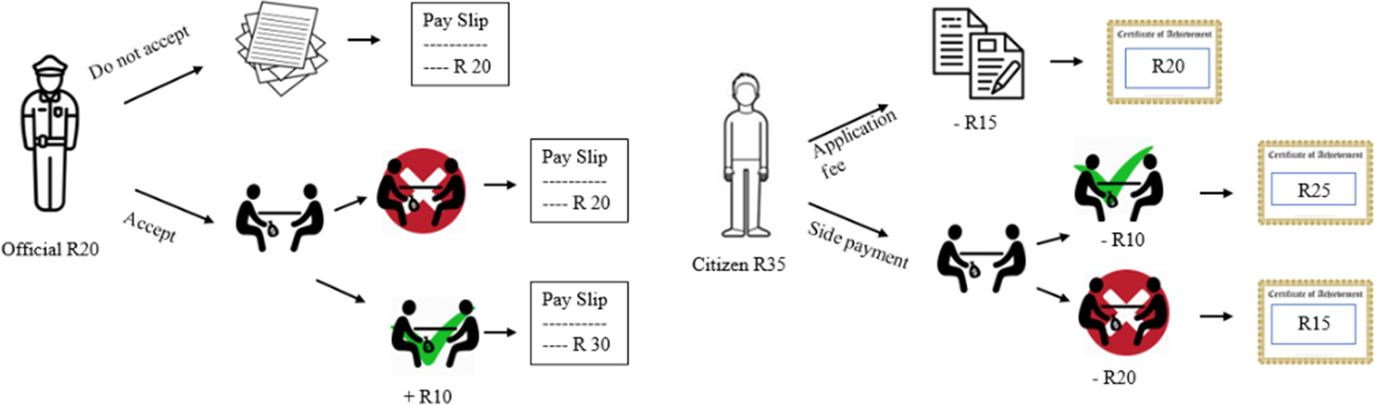
We used a corruption game that models bribery as a social dilemma to reflect the psychological decision structure that is existent in highly corrupt contexts. In this 10-player game, participants take the role of ‘citizens’ and ‘public officials’. Reflecting commonly occurring transactions between citizens and public officials, citizens seek to obtain a certificate (e.g., a driving license) that is valuable to them (R35). A citizen can either apply for the certificate by paying the regular application fee of R15 or can pay a bribe of R10 to avoid the application fee. The public official equally has two options: either process the application and earn a wage of R20 or earn additional money by accepting the bribe of R10. Importantly, each successful bribery transaction incurs a loss of R2 on all 10 players, reflecting the social cost of bribery (see Figure 1). The payoffs are outlined in more detail below.
Illustrations of the corruption game modelling the social dilemma structure for the decision to engage in bribery for both the public official (left) and the citizen (right).

Payoffs for the citizen
The earnings of the citizen depend on three factors: first, the citizen's own decision to pay the application fee or bribe; second, when opting to bribe, the payoff depends on whether the public official accepts the bribe; and third, the citizen's payoff also depends on all other players in the matching group (i.e., whether the other citizen/public official pairs successfully coordinate on bribing, which results in a social cost of R2 on all 10 players). If the public official accepts, the citizen receives the certificate without having to pay the application fee; at the same time, such successful bribery incurs a cost on all players in the matching group. Therefore, the citizen's final payoff is:
 $${\rm R}35\, - \,{\rm R}10\, - \,{\rm R}2\, - \,{\rm S}$$
where S denotes the social cost of corruption generated by the other pairs belonging to the matching group (i.e., S = R2 × Number of bribes accepted in the other pairs of the matching group). If instead the public official rejects the bribe, the citizen has to pay the application fee of R15 and an additional cost of R5, resulting in a payoff of:
 $${\rm R}35\, - \,{\rm R}15\, - \,{\rm R}5\, - \,{\rm S}$$
Finally, if the citizen decides not to offer the bribe, the citizen has to pay the application fee of R15, resulting in a payoff of:
 $${\rm R}35\, - \,{\rm R}15\, - \,{\rm S}$$
Payoffs for the public official
The public official's payoffs depend on the same three factors influencing the citizen's payoff: first, on whether the matched citizen offered a bribe or not; second, on the public official's own decision to accept or reject the bribe; and third, on the successful bribery transactions by other citizen/public official pairs. If the citizen does not offer a bribe, the public official earns the wage of R20 and the final payoff is:
 $${\rm R}20\, - \,{\rm S}$$
If the public official instead is offered a bribe and accepts the offer, the payoff is:
 $${\rm R}20 + {\rm R}10\, - \,{\rm R}2\, - \,{\rm S}$$
Finally, if the official is offered a bribe and rejects the offer, the payoff is:
 $${\rm R}20\, - \,{\rm S}$$
Whatever the behaviour of the other pairs in the matching group, the public official has an incentive to accept the bribe when offered one. In this way, the public official increases their payoff by R8. Anticipating this, the citizen has an incentive to offer the bribe. In this case, the citizen can increase their payoff by R3. Engaging in corruption thus represents a dominant strategy while leading to socially worse outcomes – a social dilemma (Köbis et al., Reference Köbis2016). Indeed, if all five pairs refrain from corruption, the payoff for both citizens and public officials is R20. If instead all of the pairs engage in corruption, the public officials obtain R20 but the citizens obtain only R15. These relatively small amounts reflect the notion that the majority of bribery transactions in KwaZulu-Natal are petty in nature, as recent survey evidence suggests that the majority of the amounts paid for bribes do not exceed R100 (≈ €6.40; see Dobie, Reference Dobie2017). Moreover, we deliberately chose not to include punishment in the game in order to reflect that the likelihood of being caught and prosecuted for petty forms of bribery is very low, if not absent in South Africa (Peiffer et al., Reference Peiffer2019).
We used the strategy method (Brandts & Charness, Reference Brandts and Charness2011) in which each player makes a decision as a citizen and as a public official. In matching groups of 10, one decision per participant is randomly chosen and matched to that of another participant. We use a lightly framed version of the game, which means that we used the labels ‘citizen’ and ‘public official’ but referred to the bribe as a ‘side payment’ to reduce social desirability concerns. To ensure that participants understood the logic of the game, we displayed figures illustrating the structure of the game (see Figure 1) and assessed participants’ understanding using three test questions prior to the game.
Additional measures
Besides standard demographic information (age, gender, education), we included three control measures. First, we assessed on which day of the month participants received their salary. This payment differs across professions and indicates the sector that the participant worked in and whether the participant was employed at all. Second, we examined whether participants recalled seeing the poster. We asked participants if they had noticed a poster that reminded them of the topic of the study (Y/N), and if yes, whether they could recall any of the words mentioned on the poster. We also included a one-item measure of perceived corruptness of the side payment (‘How corrupt do you think the transaction was?’), with answers given on a seven-point scale ranging from ‘not corrupt at all’ to ‘very corrupt’.
Payment method
In addition to a show-up fee of R25 (≈ €1.50), participants received between R25 and R45 (≈ €1.50–2.73) for completing the study, which took 27.6 minutes on average. These earnings corresponded to two to five hours of wages based on current minimum wage levels for the Extended Public Works Programme (R11/hour). Participants received their payment within 48 hours after completion of the study via Instant Money Transaction. This process sends a voucher together with a PIN to a mobile phone number via SMS. Participants could redeem this voucher without any identification at any ATM or Money Market counter, hence ensuring privacy. We deleted all mobile phone numbers upon successful payment. The payment method did not allow for the payment of precise amounts (e.g., R23.50). To determine whether the final payment would be rounded upwards or downwards, we let participants roll a die and report the result (for more details on this, see Table S1 in the Supplementary Online Materials (SOM)).
Treatments in the experiment
The experiment consisted of two treatments. First, during the Baseline treatment, Research Assistant 1 (RA1; blind to the hypotheses of the study) conducted the lab-in-the-field experiment as outlined above. Data for the Baseline treatment were collected in two waves: from 16 July 2018 to 28 July 2018 (week 1) and from 5 September 2018 to 6 September 2018 (week 7). We initially scheduled this baseline treatment for the first week of the study (prior to the poster treatment) and for the fourth week (after the poster treatment). However, due to unforeseen difficulties in the data collection, we had to postpone this second assessment to the seventh week, which we separately pre-registered prior to data collection (see the section on amendment to pre-registration in the SOM).
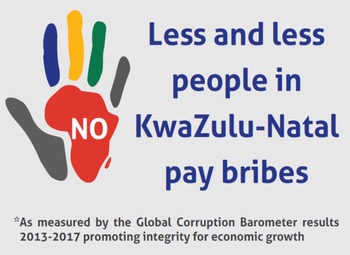
Second, during the Poster treatment, Research Assistant 2 (RA2; blind to the purpose of the study) put up 20 posters displaying the following message: ‘Less and less people from KwaZulu-Natal pay bribes’ (see poster in Figure 2). The factual validity of this statement stems from large national surveys (see Transparency International, 2013, 2017; Ethics Institute, 2016, 2017) that show a decrease in self-reported bribery. RA2 placed the posters in several locations throughout town, mostly on signposts next to the road, as well as in other places where pamphlets are often displayed. The supplementary material shows the exact locations on a map and contains photographs of the poster sites (see OSF at https://osf.io/ufv6g/?view_only=cc334f24ba8a4bab82803bcbd4c8ad4e). The posters were also put up at the entrance of the building in which the mobile lab was installed. It is important to note that the posters were not on display within the lab, including the waiting area. Data for the Poster treatment were collected from 30 July 2018 to 4 August 2018 (week 2). We determined the sample size before any data analyses (for a priori calculations, see the pre-registration details on OSF).
The poster containing a descriptive norms trend message. The version in isiZulu is available on OSF (https://osf.io/ufv6g/?view_only=cc334f24ba8a4bab82803bcbd4c8ad4e).

Results
Overall, 311 participants took part in the experiment (Baseline: n = 187; Treatment: n = 124). As a sign of successful randomization, we find no difference between treatment and baseline groups across main demographic variables (see Table S2 in the SOM). Moreover, the two waves of the Baseline treatment (pre- and post-poster) are largely equivalent as well, merely differing with regards to participants in the second wave being slightly younger, having obtained higher levels of education and indicating slightly more polarized views about the social injunctive norm regarding bribery (see full overview in Table S3 in the SOM).
An unforeseen anomaly occurred in the data collected on 30 July. After completing the study, one participant revealed to RA1 that most of the subjects participating in that day coordinated their responses to the descriptive norms item prior to the experiment. They were peers working in the same office and gathered information about the most profitable answers to the descriptive norms question in the past week. This means that participants coordinated on the most common answer during the data collection of the Baseline treatment. In fact, 21 out of 24 subjects participating in the experiment on 30 July gave exactly that same answer in the descriptive norms question, earning them the maximum payoffs for that task (see Figure S1 in the SOM). Given this irregularity, we control for data stemming from that day using a dummy variable in the analyses, below referred to as ‘collusion dummy’.
Descriptive and injunctive norms
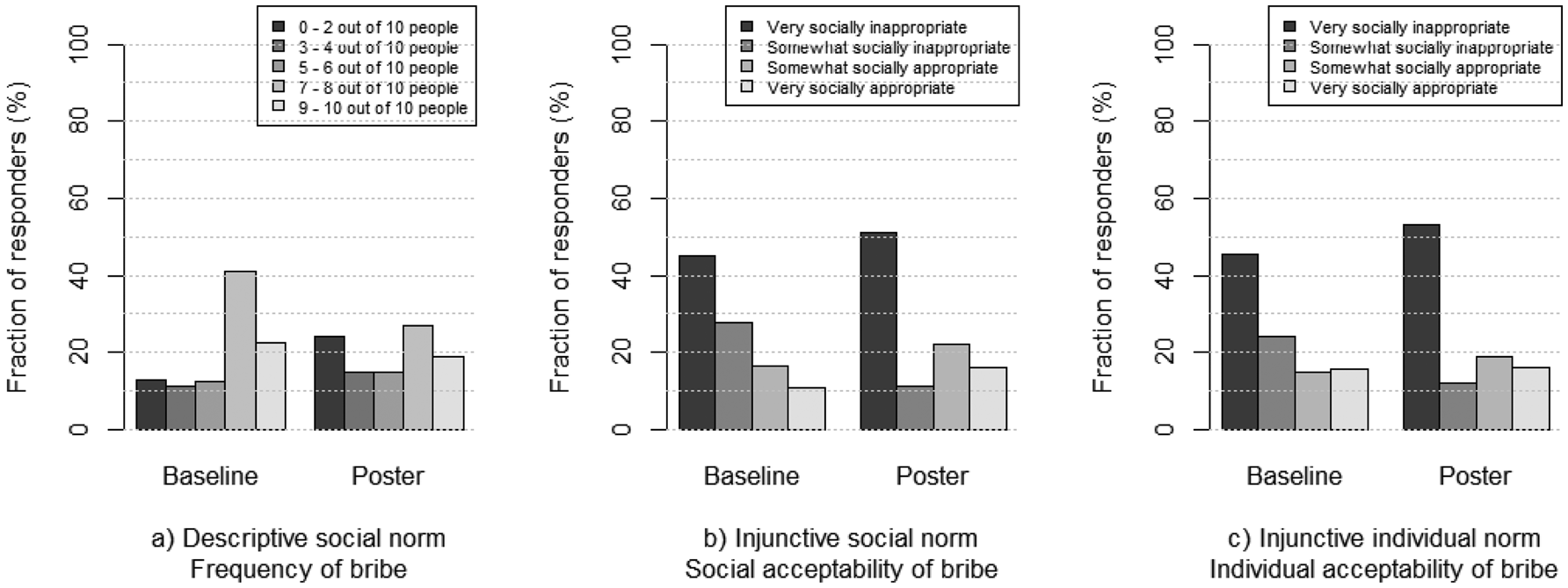
Overall, we observe that the majority of respondents believe that most people pay bribes, as 60.77% indicate that more than 70% of people pay bribes. This pattern is robust to controlling for the collusion dummy of 57.49% of respondents believing that more than 70% of people pay bribes. This pattern supports the basic premise of a coordination problem in that the majority of people think that the majority of people bribe.
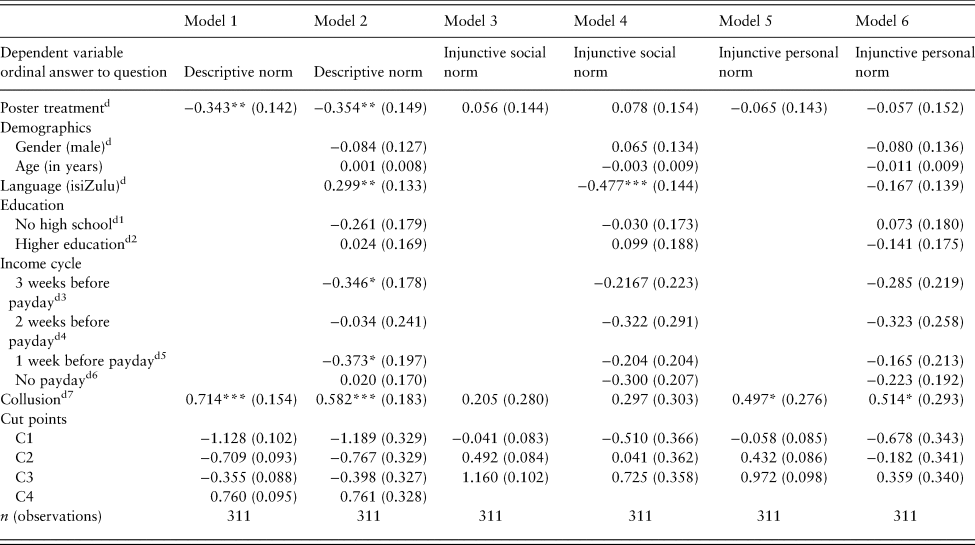
To test H1, predicting that these perceptions would decrease during the poster treatment, we conducted ordered probit regression analyses predicting the incentivized descriptive norm variable. With our data (i.e., a categorical dependent variable that can be ordered), this regression technique is better suited than linear regression analysis because it does not assume the same distance between categories. The ordered probit regression permits us to estimate whether there is a directional shift in the probability of observing an answer from lower to higher categories while controlling for other explanatory variables. Controlling for the data collection anomaly, we observe a significant shift towards lower perceived descriptive norms, both when only including the treatment dummy (Model 1, Table 1) and when additionally controlling for demographic characteristics (Model 2, Table 1). Hence, we find evidence that the poster reduced perceived descriptive norms about bribery, confirming the first hypothesis (see also Figure 3).
Distributions of answers to (a) the socially incentivized descriptive norms item, (b) the socially incentivized injunctive norms item and (c) the personal injunctive norm item for the sample, excluding the day of observation with evidence for answer coordination.

Regressions for the descriptive and injunctive norms. Data are presented as coefficients (SE) of the ordered probit model with robust standard errors.

Note: Superscript ‘d’ indicates the use of a dummy variable. ‘Poster’ is the treatment dummy variable; ‘Gender (male)’ is a dummy variable with value 1 for male participants; ‘Age’ is the age of the responder in years; ‘Language (isiZulu)’ is a dummy variable with value 1 for those participants that completed the questionnaire in Zulu language; 1. ‘No high school’ is a dummy variable with value 1 for those participants that did not complete high school; 2. ‘Higher education’ is a dummy variable with value 1 for those participants that obtained a diploma higher than high school; 3. ‘3 weeks before payday’ is a dummy variable with value 1 if the participant's wage is paid in the third week from the date of participation; 4. ‘2 weeks before payday’ is a dummy variable with value 1 if the participant's wage is paid in the second week from the date of participation; 5. ‘1 week before payday’ is a dummy variable with value 1 if the participant's wage is paid in the week of the date of participation; 6. ‘No payday’ is a dummy variable for unemployed participants; 7. ‘Collusion’ is a dummy variable with value 1 for all participants that participated in the experiment on 30 July (= known incidence of collusion).
*p < 0.10; **p < 0.05; ***p < 0.01.
Next, we report descriptive statistics for both injunctive norm items (social and individual). First, a majority of participants (67.52%) believe that others consider bribing to be (very) socially inappropriate (68.99% when controlling for collusion). Second, the majority of participants (66.24%) also considered bribery themselves to be (very) socially inappropriate (67.94% when controlling for collusion). Both results suggest that a majority of people collectively and individually disapprove of bribery, even in corrupt societies.
To test H2, predicting no shifts in both injunctive norm items across both treatments, we again conducted ordered probit regression analyses. Table 1 depicts the results for social and individual injunctive norms. In support of H2, the findings reveal no statistically significant directional shift in the frequency of answers neither without (Models 3 and 5) nor with controlling for demographic characteristics (Models 4 and 6). There is instead a reduction in the frequency of the answer ‘Somewhat socially inappropriate’ in favour of all of the other answers. The parameters for the treatment dummy across all models (Models 3–6) do not significantly differ from zero, indicating that perceptions of injunctive norms did not shift.
As an additional (non-pre-registered) test for potential shifts towards higher social inappropriateness of bribery during the poster treatment, we conducted Bayesian analysis. For this analysis, we dichotomized the social and individual injunctive norm items into a dummy of 0 (= (very) inappropriate) and 1 (= (very) appropriate). The results reveal Bayes factors of BF01 >18.84 for the social injunctive norms and BF01 >11.99 for the individual injunctive norms.Footnote 1 Together, these results constitute strong evidence (Jeffreys, Reference Jeffreys1961) that the null hypothesis of no shift is more likely than an alternative hypothesis that predicts a shift towards higher social inappropriateness during the poster treatment. Overall, the results confirm H2 and provide convergent validity for the poster treatment specifically targeting descriptive norms.
Bribery behaviour
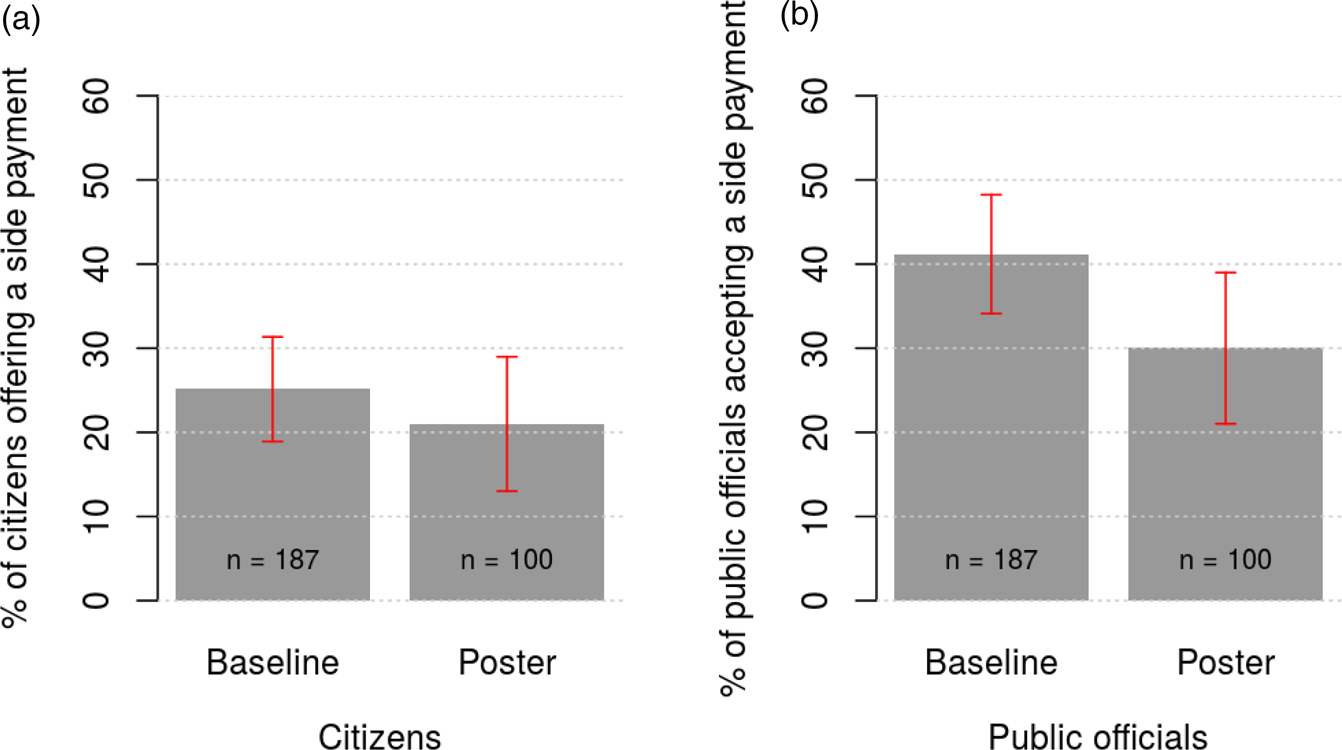
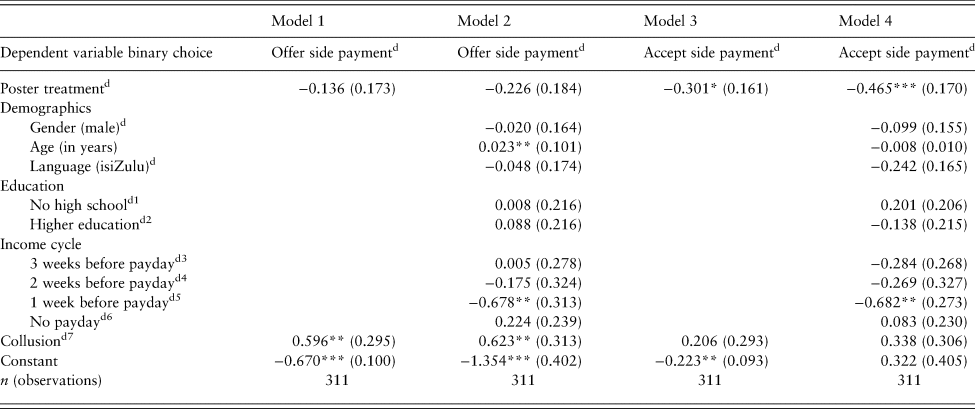
Next, we test H3, predicting that bribery levels in the corruption game drop during the Poster treatment. As Figure 4 illustrates, the percentage of subjects offering bribes (Figure 4(a)) and accepting bribes (Figure 4(b)) decreases during the Poster treatment compared to the Baseline treatment. To test the significance of these differences, we conducted binary regression analyses with robust standard errors for the day of data collection (see Table 2). For the citizens’ bribe offers, the reduction in bribery during the Poster treatment is not significant, neither when tested alone (Model 1) nor when controlling for demographic variables (Model 2). For the public officials’ bribe acceptance, the reduction of bribery during the Poster treatment is p = 0.062 when analysed alone (Model 3) and p < 0.001 when controlling for demographic variables (Model 4). Hence, although the reduction of bribe offers in the role of citizens is not statistically significant, we do find some evidence that is statistically significant for a reduction in bribe acceptance in the role of public officials.
Fractions of participants (a) offering a side payment in the role of citizens and (b) accepting side payments in the role of public officials across Baseline and Poster treatments.

Regressions of the decisions in the bribery game. Data are presented as coefficients (SE) of the probit model with robust standard errors. Models 1 and 2 are for the citizens’ decisions; Models 3 and 4 are for the public officials’ decisions.

Note: Superscript ‘d’ indicates the use of a dummy variable. ‘Poster’ is the treatment dummy variable; ‘Gender (male)’ is a dummy variable with value 1 for male participants; ‘Age’ is the age of the responder in years; ‘Language (isiZulu)’ is a dummy variable with value 1 for those participants that completed the questionnaire in Zulu language; 1. ‘No high school’ is a dummy variable with value 1 for those participants that did not complete high school; 2. ‘Higher education’ is a dummy variable with value 1 for those participants that obtained a diploma higher than high school; 3. ‘3 weeks before payday’ is a dummy variable with value 1 if the participant's wage is paid in the third week from the date of participation; 4. ‘2 weeks before payday’ is a dummy variable with value 1 if the participant's wage is paid in the second week from the date of participation; 5. ‘1 week before payday’ is a dummy variable with value 1 if the participant's wage is paid in the week of the date of participation; 6. ‘No payday’ is a dummy variable for unemployed participants; 7. ‘Collusion’ is a dummy variable with value 1 for all participants that participated in the experiment on 30 July (= known incidence of collusion).
*p < 0.10; **p < 0.05; ***p < 0.01.
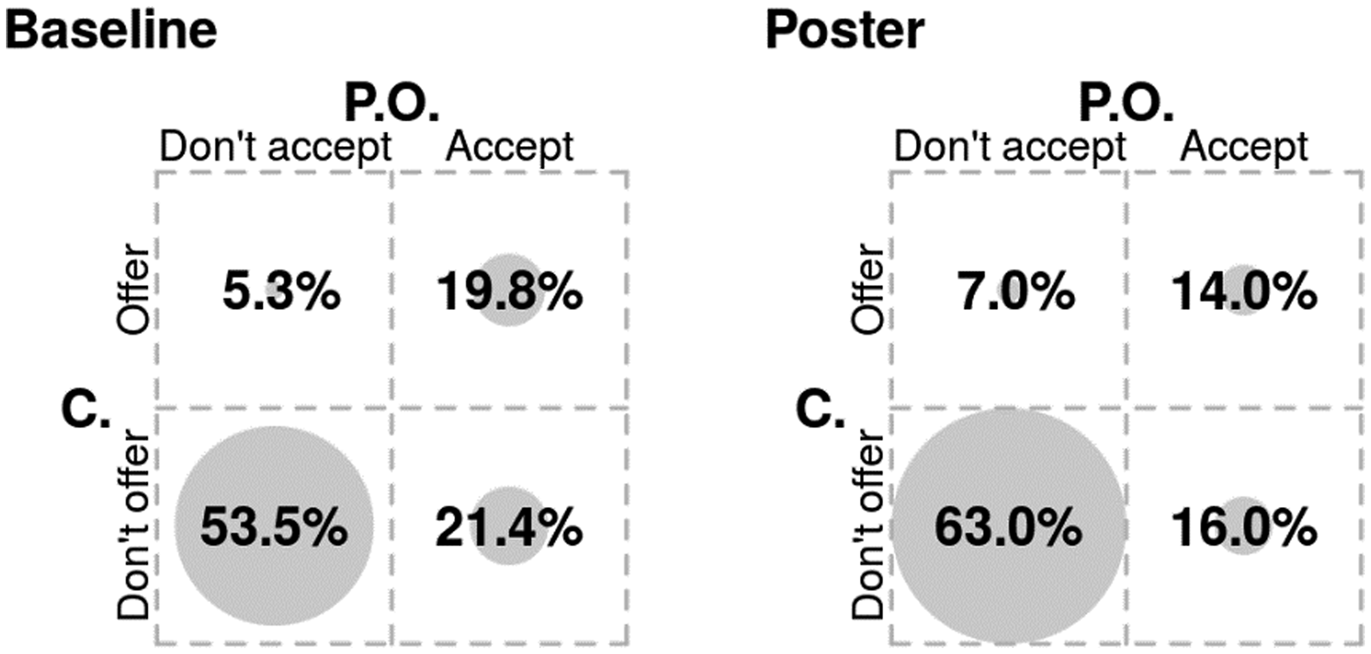
Finally, Figure 5 illustrates the association between the decisions made by the participants in the roles of citizens and public officials. The choice pattern reveals a high degree of consistency in the choices across both roles, with the majority of the participants either opting for or against bribery in both roles. Overall, we find a higher propensity towards bribery when acting as a public official compared to when acting as a citizen (see higher percentages in the ‘accept’ columns vs. in the ‘offer’ rows in Figure 5). Moreover, McNemar's test reveals a greater propensity towards bribery when deciding as a public official versus as a citizen in the Baseline treatment (p < 0.001). In the Poster treatment, the greater propensity for bribery as a public official (vs. as a citizen) is p = 0.093 – again indicating a reduction of public officials willing to accept bribes in the Poster treatment. Overall, we find a decrease in unconditional bribery (accept/offer) of 5.8 percentage points and an increase in unconditional rejection of bribery (don't offer/don't accept) of 9.5 percentage points.
Association between participants’ choice to offer a side payment in the role of a citizen (C.) and accepting a side payment in the role of a public official (P.O.) across Baseline (left) and Poster (right) treatments.

Recognition of the poster
Analysing the question of whether participants have recently seen a poster related to the topics of the survey, we observe that 39.6% (72/182) declared that they had seen a poster in the Baseline treatment and 70% (70/100) declared that they had seen a poster in the Poster treatment. Of the participant who declared that they had seen a poster when our poster was present, 92.9% (65/70) were able to recall the poster's content. Results for the analysis without the subjects who did not recall the content of the poster when our poster was present are reported in Tables S6 and S7 in the SOM.
Discussion
These results provide the first behavioural insights into the effectiveness of descriptive norms information as a vehicle for anti-corruption in the field. First, the norms nudge on posters reduced people's own perceived descriptive norms regarding bribery while leaving their perceived injunctive norms unaffected. Second, the poster treatment also affected participants’ willingness to accept bribes in an incentivized bribery game – providing the first indications that norms trend messages outside of the lab can reduce both perceptions and behaviours of corruption inside the mobile lab. We discuss the findings in light of their relevance for theory and policy on the social norms of corruption.
From a theoretical perspective, the results support a ‘corruption trap’ view (Stephenson, Reference Stephenson2018). For one, our results show that people perceived bribery as commonplace. This insight confirms previous views that in Manguzi (South Africa) side payments such as the one modelled in our bribery game are often considered the standard way to operate (Gitau, Reference Gitau2011). At the same time, we find the first evidence using incentivized norms measures that people consider bribery as inappropriate – both personally and socially. It thus appears that people often bribe not because they consider it the right thing to do, but rather because they have few other options due to the perceived high frequency of bribery around them (Bardhan, Reference Bardhan1997; Rothstein, Reference Rothstein2000; Fisman & Golden, Reference Fisman and Golden2017b; Köbis et al., Reference Köbis, Iragorri-Carter, Starke, Kubbe and Engelbert2018).
The findings also confirm previous theorizing postulating that when descriptive and injunctive norms are incongruent, descriptive norms often exert a stronger pull (Bicchieri & Dimant, Reference Bicchieri and Dimant2019). Here, we replicate previous findings from the lab (Köbis et al., Reference Köbis2015) showing that indeed the descriptive element seems to trump the injunctive element of social norms when it comes to the decision to engage in bribery. Importantly, we note that the findings suggest neither that injunctive norms do not matter at all nor that descriptive norms necessarily overshadow injunctive norms for other corrupt practices or in other social contexts. Instead, we argue that distinguishing between descriptive and injunctive norms provides a useful framework for investigating the respective social and behavioural elements of corruption in a particular context (Heywood, Reference Heywood2017; Hoffmann & Patel, Reference Hoffmann and Patel2017).
The findings also contribute to the growing literature on norm nudges, providing insights into how they can be used for anti-corruption. For one, by recognizing that no single monolithic corruption norm exists in a given society, anti-corruption efforts can be tailored to the social normative pressures of a particular corrupt practice. Prominent theories on social norms emphasize the importance of identifying the relevant reference network (i.e., the ‘range of people whom we care about when making particular decisions’; Bicchieri, Reference Bicchieri2016, p. 14). Here, cognizant of the importance of tailoring norms messages to the relevant reference network, we opted to refer to participants being from KwaZulu-Natal rather than South Africa. Such approaches could be extended by messages that target even more specific reference networks from which social normative pressures around corruption emanate. For example, whether public officials extract side payments also depends on the normative pressures on the office floor, stemming both horizontally from peers and vertically from superiors (Jackson & Köbis, Reference Jackson and Köbis2018). Moreover, we focus both in the poster and in the design of the game on bribery because it entails an interactive form of corruption in which beliefs about the counterpart are of particular importance. Future efforts could examine whether similar information campaigns also have an effect on less interactive forms of corruption, such as embezzlement.
We do note, however, that merely relying on norm nudges to fight the deeply rooted behaviour of corruption does not suffice. Akin to other domains such as obesity (Oliver & Ubel, Reference Oliver and Ubel2014), for anti-corruption, nudges alone are unlikely to solve the problem, as behavioural approaches in general should not be seen as a substitute but rather as a supplement to traditional (anti-corruption) policies (Loewenstein & Chatter, Reference Loewenstein and Chatter2017). Recognizing the importance of social norms in explaining corrupt practices is essential for more traditional anti-corruption approaches to succeed. For example, the relative ineffectiveness of many public salary increase programmes (see the systematic literature review reported in Soraperra et al., Reference Soraperra2019) in part stems from the persistence of social norms around corruption. A case in point: a salary increase programme within the tax administration in Uganda backfired because increased wages also increased social normative expectations for public officials to provide for their family, leading public officials to extract more bribes (Fjeldstad, Reference Fjeldstad2005; Baez-Camargo, Reference Baez-Camargo2017).
Policies for lasting social norms change regarding corruption
Our intervention targeting social norms revealed that perceived social norms and bribery inclinations regressed back to pre-treatment levels – hence the effect was temporary, which is not uncommon for nudging interventions (Frey & Rogers, Reference Frey and Rogers2014). To increase the chances for enduring reductions of corruption, social norms messaging campaigns should be accompanied by complementary polies. Based on previous work on social norms change, particularly promising approaches consist of: (1) community involvement; (2) information campaigns via other media channels; and (3) social network analysis. Let us briefly address some of the implications of our study for each of these approaches.
First, community meetings featuring discussions about normative practices can contribute to cascades of social norms change (Bicchieri & Mercier, Reference Bicchieri and Mercier2014) – an approach that has already been successfully tested in other domains, such as voting behaviour (Banerjee et al., Reference Banerjee2011). The individual and social disapproval of corruption observed in the current study could facilitate the collective action against bribery, as it provides a breeding ground for the creation of new norms, especially if these norms are observably implemented by peers (Dimant, Reference Dimant2015).
Second, complementary approaches could use the immense anti-corruption potential of (free) media (Starke et al., Reference Starke, Naab and Scherer2016). In particular, radio programmes, TV shows such as soap operas or even children's anti-corruption books could help to provide new narratives around social norms of corruption (for examples, see Pailey, Reference Pailey2013, Reference Pailey2019). These measures have been evaluated in various domains, showing promising potential even to change culturally embedded and hidden collective practices such as female genital cutting (Paluck, Reference Paluck2009; Vogt et al., Reference Vogt2016) – yet empirical evidence for their effectiveness to curb corruption is lacking.
Third, to unleash the full potential of localized social norms campaigns, such efforts could be combined with social network approaches (Tankard & Paluck, Reference Tankard and Paluck2016). Mapping and tracking information dispersion within a given social network has been proposed in recent anti-corruption policy work (Hoffmann & Patel, Reference Hoffmann and Patel2017; Jackson & Köbis, Reference Jackson and Köbis2018), as it has shown promising potential in other domains, such as high-school bullying (Paluck et al., Reference Paluck, Shepherd and Aronow2016). In sum, social nudges alone do not suffice to curb corruption, yet they can serve as an important complementary step to accompany ‘heavy lift’ policies, such as structural reforms (Sunstein, Reference Sunstein2015; Loewenstein & Chatter, Reference Loewenstein and Chatter2017).
Evidence-based anti-corruption
For the design of research evaluating these and other behavioural interventions to fight corruption, several points deserve mention. First, as a method for evaluating anti-corruption policies, our study presents the use of a lab-in-the-field design with a behavioural measure of corruption. Obtaining ‘hard’ evidence for the reduction of corruption represents a thorny challenge due to its secretive nature and the high social desirability concerns (Olken, Reference Olken2009). Reviewing field studies on the effectiveness of information campaigns for anti-corruption, Winters, Testa and Fredrickson in fact state that the majority of studies do not use corruption as the dependent variable, but ‘rather some observable behaviour that is assumed to affect corruption’ (Winters et al., Reference Winters, Testa, Fredrickson, Serra and Wantchekon2012, p. 234). Such indirect measures can be problematic when trying to understand the actual corrupt practices. We propose that behavioural measures such as bribery games can serve as tools to pilot test and evaluate interventions and thus contribute to evidence-based anti-corruption (Mungiu-Pippidi, Reference Mungiu-Pippidi2017).
Second, we introduce a new game that models the bribery transactions as a social dilemma. Based on recent theoretical developments in behavioural science, we argue that such a game reflects the actual psychological decision-making process in a highly corrupt context more accurately than many other corruption games (Köbis et al., Reference Köbis2016). Although bribing in the game surely differs in multiple ways from the ‘real world’, we argue that the data obtained here bear merit, at least because participants did perceive the side payment as corrupt, underlining the internal validity of the measure (see Table S11 in the SOM). Furthermore, previous research using bribery games shows a large overlap between corrupt behaviour in the lab and in the field, providing external validity (Armantier & Boly, Reference Armantier and Boly2012).
Third, we pre-registered the experiment in which we outlined the data collection and analysis strategy. However, several unforeseen occurrences led us to deviate from this pre-registration plan (see complete list in the SOM). Most importantly, we had to include an additional control variable due to an unforeseen coordination scheme that took place on the first day of the poster treatment. Although we instructed the research assistant to take measures to prevent such schemes from occurring and no further evidence of similar incidences exist, we cannot exclude the possibility that also during other days participants coordinated on responses prior to the study. While we argue that controlling for this day of data collection is justified in order to get the most empirically valid answer to our key questions, the occurrence of this scheme represents a remarkable finding in and of itself.
Finally, given that our study was conducted over a relatively short time frame in a single location, a logical candidate to overcome some of the limitations is to run a full-fledged randomized controlled trial (RCT). Although RCTs could indeed potentially provide valuable new insights into the workings of social norms of corruption in the field, it is important for follow-up research to consider several famously voiced drawbacks of that approach when seeking to evaluate anti-corruption policies (Bédécarrats et al., Reference Bédécarrats, Guérin and Roubaud2019; Deaton, Reference Deaton2010). The first main point of criticism posits that RCTs often narrowly focus on short-term impacts (Bédécarrats et al., Reference Bédécarrats, Guérin and Roubaud2019). To overcome this limitation and to test the longevity of interventions, we see particular potential in adopting a long-term perspective. The use of longitudinal methods could allow us to evaluate existing approaches to changing social norms around corruption, such as whether new narratives in public media can indeed change norms around corruption (Pailey, Reference Pailey2019). As a second point of criticism, many RCTs neglect the mechanisms and processes that drive the effect of an intervention (Bédécarrats et al., Reference Bédécarrats, Guérin and Roubaud2019). In light of the importance of dual-process models to explain the mechanisms of nudging (Oliver, Reference Oliver2013) and (un)ethical behaviour (Köbis et al., Reference Köbis2019), gaining new insights into the cognitive processes of norm nudging appears especially fruitful. That is, future work could address whether the mechanism behind belief updating observed here primarily stems from an intuitive or a deliberative process. As a final critical point, RCTs ‘are subject to a host of political influences as much in their design and execution as in the dissemination of their results’ (Bédécarrats et al., Reference Bédécarrats, Guérin and Roubaud2019, p. 10), making upscaling a challenging matter. In addition, research on nudging campaigns shows that the messenger of the social norms information can influence the effectiveness of the intervention. Upscaling a norm nudging campaign via government institutions could thus potentially face the challenge that the messenger is not trusted (e.g., see Stibe & Cugelman, Reference Stibe and Cugelman2016) – put differently, people might reject an official norms message campaign because it is an official norms message campaign (Arad & Rubinstein, Reference Arad and Rubinstein2015). When taking these recently voiced considerations into account, future policy-orientated research could thereby provide further relevant insights for anti-corruption approaches building on behavioural insights.
Conclusion
Behavioural interventions using social nudges have traditionally steered away from tackling ‘some of the world's biggest and most complex social dilemmas’ (van der Linden, Reference van der Linden2018, p. 211). To fill this gap, we conducted a lab-in-the-field experiment that took on a daunting task: changing people's perceptions about corruption and subsequently lowering their willingness to engage in bribery with the mere distribution of posters. In light of the deeply socially entrenched character of systemic corruption and the fact that people form beliefs about corrupt practices through a multitude of channels (media, own experience, social interactions), it is a striking observation that a descriptive norms poster successfully changed incentivized social perceptions and people's willingness to engage in bribery in the subsequent game played for real money. By providing field evidence for the effectiveness of informational campaigns to change beliefs and behaviours, these results could potentially mark the first step towards an escape path from the corruption trap and illustrate the importance of behavioural approaches to anti-corruption.
Supplementary material
To view supplementary material for this article, please visit https://doi.org/10.1017/bpp.2019.37
Acknowledgements
We thank Margarita Leib, Shaul Shalvi as well as workshop participants at the Department of Experimental Psychology at Oxford University, Department of Social Psychology at the University of Cologne, Max Planck Institute for Research on Collective Goods and the conference participants at the 2018 Advances with Field Experiment Conference (AFE), the 2019 International Meeting Series on Experimental and Behavioral Economics (IMEBESS) and the 2019 conference of Subjective Probability, Utility, and Decision Making (SPUDM) for useful comments. We also thank Marijke Bezuidenhout, Phumzani Ntuli and Phumlani Ngwenya for their help with data collection.
Funding
This project has received funding from the European Research Council (ERC) under the European Union's Horizon 2020 research and innovation programme (grant agreements: ERC-StG-637915; ERC-AdG 295707) from Research Priority Area Behavioral Economics (University of Amsterdam, proposal number 201806260406). The authors declare that they do not have any conflict of interests.