Introduction
How can we understand that citizens from time to time begin supporting policy measures they have initially rejected? We posit that legitimacy is a critical factor and suggest that postimplementation changes in policy attitudes are the result of a process that unfolds throughout the whole policy cycle, from initial proposal to final implementation of the measure. Building on this, we theorise that perceived legitimacy, i.e., whether the it arises from the rightful source and process of authoritative decisionmaking and whether its content pertains to a normatively justifiable interest (cf. Beetham Reference Beetham1991), affects public support differently across the input, throughput and output stages of the policy cycle. At the same time, we suggest the presence of a halo effect, that is, a spill-over of policy attitudes from one phase to another. Certainly, we acknowledge that theories of the policy process apply a wide range of different imagery in order to conceptualise its complexity, rather than being a linear progression through a set of separated and functionally sequenced stages: e.g., waves (e.g. Freeman Reference Freeman2012), streams (e.g. Kingdon Reference Kingdon1995) and dynamic multiactor rounds (e.g. Hall and McGinty Reference Hall and McGinty1997; Theisman Reference Teisman2000). However, we here refer to a process of introducing a specific policy measure as being a more sequential subset of such dynamic processes, where real-time political events (i.e. formal decisionmaking, implementation of a measure or evaluations through referendums) mark the critical junctures of transition from one stage to another.
As acknowledged by McConnell (Reference McConnell2010), evaluating whether policy outcomes are successful can be conducted in numerous ways depending on one’s initial perspective. Despite the here assumed relevance of legitimacy for determining the success or failure of public policies, the majority of research in the field of policy studies has evaluated policies either based on its resulting programs’ ability to achieve stated goals in an efficient and effective way, or by scrutinising the process leading up to a policy decision (cf. Gormley Reference Gormley2007; Montpetit Reference Montpetit2008; Wallner Reference Wallner2008). While both of these evaluation criteria are reasonable, this study rather places the political ramifications of a policy decision centre stage. From this perspective, the success or failure of a policy depends, additionally, on the level of public support it enjoys.
However, in all societies, it is unavoidable that politicians from time to time decide upon and eventually implement policies that lack support among parts of the citizenry (see, e.g. the discussion on “target populations” by Schneider and Ingram Reference Schneider and Ingram1993). Starting with the seminal work of V. O. Key (Reference Key1961), there is now a rather large body of literature that examines between-election democracy, including research on how public opinion is both influenced by policy, and responds to that policy over time. Although evidence on the mechanisms by which opinion affects policy decisions is mixed, there is ample evidence that public opinion both constrains (Sobel Reference Sobel2001; Foyle Reference Foyle2004) and directs the actions of decisionmakers (Stimson Reference Stimson2007; Soroka and Wlezien Reference Soroka and Wlezien2010). At the same time, research also points towards the reverse relationship where shifts in policy give rise to both positive and negative opinion feedback. People’s changing demand for more or less policy has been suggested to be an effect of either the direct material impacts of public policies (Pierson Reference Pierson1993), political learning (Soss Reference Soss1999) or changes in normative worldviews brought on by new policy (Svallfors Reference Svallfors2010). In short, then, research verifies Schattschneider’s (Reference Schattschneider1935) suggestion that new policy may indeed be conducive to new politics. A range of studies have focused on exploring the mechanisms behind public responsiveness, from Stimson’s (Reference Stimson1991) account of shifts in “policy mood”, to Wlezien’s (Reference Wlezien1995; Wlezien and Soroka Reference Wlezien and Soroka2012) subsequent exploration of the “thermostatic” model of responsiveness, which examines public opinion during the policy-making process. In particular, these studies provide ample evidence of how negative public feedback occurs very quickly after decisions are made, but before policy is implemented.
However, in many instances, initial negative public attitudes gradually alleviate or even transform into broadened public acceptance and support as the public experiences, and thus responds to, different aspects of the policy (Page and Shapiro Reference Page and Shapiro1983; Naurin Reference Naurin2009). Empirical evidence is found in relation to numerous major policy decisions ranging from, e.g., the – eventually (Rothstein Reference Rothstein2009) – highly popular Swedish decision to revert to right-hand traffic in 1967 (which only about 15% of the voters supported in the preceding referendum), across the rather recent introductions of smoking bans in most major cities around the world, to the implementation of single policy measures such as the congestion pricing mechanisms (CPMs) in London (Transport for London 2004) and Milan (Rotaris et al. Reference Rotaris, Danielis, Marcucci and Massiani2010).
Although the public policy-public opinion nexus is rather well researched from an Eastonian (Reference Easton1953) systems perspective where policy outcomes affect both the incentives and the resources of the mass public (cf. Przeworski et al. Reference Przeworksi, Stokes and Manin1999; Naurin Reference Naurin2009), significantly fewer studies theorise and scrutinise the internal dynamics of the policy cycle and the mechanisms that drive changes in public policy attitudes across different stages of the policy process. An interesting exception, however, is a recent special issue (Esaiasson and Wlezien Reference Esaiasson and Wlezien2017) attempting to unfold the processes of responsiveness, such as: the degree to which misrepresentation causes “cost of ruling” effects (Wlezien Reference Wlezien2017), whether responsiveness is more vote-rewarding than the provision of favourable policies (Esaiasson et al. Reference Esaiasson, Giljam and Persson2017), if citizens whose ideological stances are well reflected by the incumbent government are more or less in favour of the idea that a government should primarily be responsive to the preferences of the majority (Rosset et al. Reference Rosset, Giger and Bernauer2017) and the study of feedback from citizens to politicians and how political responses to this feedback eventually find their way back to the public (Hagemann et al Reference Hagemann, Hobolt and Wratil2017). A key learning from these articles is that people’s judgements about politicians’ responsiveness actions appear to depend on whether or not they get the policies they have strong preferences for, but more research on more specific mechanisms are simultaneously called for (Esaiasson and Wlezien Reference Esaiasson and Wlezien2017, 707).
Based on this, the aim of the article is therefore to better grasp how feedback effects actually play out between citizens and policymakers, adopting such an internal dynamics approach. In order to test our theoretical predictions, we make use of a unique panel data set, allowing for a systematic comparison of public policy attitudes and their antecedents, across the whole process from deciding upon until fully implementing a congestion tax in the Swedish city of Gothenburg. We find that legitimacy is important in explaining policy support and that there is a lingering effect where support in one phase depends on legitimacy in both the present and previous phases of the policy cycle.
Theory and hypotheses: the mechanisms of policy support
To grasp the dynamics of policy support as the policy process moves across the stages in a policy cycle, it is essential to consider if and how the mechanisms and factors likely to affect support, change over time. We start from the proposition that the antecedents of policy support stem from the perceived legitimacy of the policy. Accordingly, if perceptions of legitimacy, and what legitimacy entails, change throughout the process, this should subsequently be manifested through corresponding changes in public policy support. Hence, we are interested in the evolvement of legitimacy and support across the whole policy cycle. Moreover, we want to understand how legitimacy is created in the different stages, along with its interplay with public support. For this, we propose a simple model in the modeling the policy process section, which we then analyse econometrically in the results section.
Legitimacy
Indisputably, legitimacy is one of the most foundational concepts in the social and political sciences, although rarely associated with support or compliance on the specific policy level. Most commonly, it has an intimate relationship with political power and authority and is frequently treated as an independent, explanatory factor behind phenomena such as regime performance and as a necessary trait for actors, e.g., states, international regimes and political institutions, who aspire to avoid being ousted through elections or revolutions (Lipset Reference Lipset1981). Elsewhere, legitimacy is seen as a prerequisite for political authority, creating the right for government to expect obedience from its citizens when exercising its power (Buchanan Reference Buchanan2002), as well as a prerequisite for voluntary support and compliance within new governance regimes (Ostrom Reference Ostrom2005), therefore determining the costs associated with monitoring and enforcing public compliance.
Input, throughput and output legitimacy
There are theoretical reasons to expect, as we do here, that the sources of legitimacy shifts along the phases of the policy cycle. Broadly following Scharpf’s (Reference Scharpf1999) Lincolnesque distinction between “government by the people” and “government for the people” (cf. Hodson and Maher Reference Hodson and Maher2002; Skogstad Reference Skogstad2003), legitimacy can be evaluated either by the processes forgoing the acquisition of power and the procedures permeating political decisionmaking (input legitimacy), or by the consequences of those decisions (output legitimacy). Focussing on the input side assists us in identifying the structural problems facing contemporary political institutions, such as decision-making accountability and control through elections (e.g. Føllesdal and Hix Reference Føllesdal and Hix2006). However, considering outputFootnote 1 legitimacy may also be crucial, especially in the study of a specific policy or policy tool, as it contributes to our understanding of the public’s longer-term reactions and responses to these policies (Finger and Finon Reference Finger and Finon2011). Thus, for output legitimacy to be generated, decisions need to conform to the public’s expectations and work for the benefit of the public.
However, several studies have also recognised that merely focussing on input and output is insufficient if we are to fully understand the relation between legitimacy and public attitudes (Schmidt Reference Schmidt2013; Doberstein and Millar Reference Doberstein and Millar2015). To comprehensively explain why some systems perform better than others, scholars therefore propose also analysing throughput legitimacy, as distinct from traditional representation (input) or performance (output). This allows for a specific focus on the quality of inclusion, interaction and procedures that can nuance the legitimacy-inducing aspects of the decision-making process, particularly in multilevel governance structures.
Policy legitimacy
As a product emerging from a political system, the legitimacy of a specific public policy is mainly viewed as dependent on the legitimacy of the broader system itself. This means that previous studies on the success or failure of policies and policy instruments, with a few notable exceptions (cf. Citrin and Muste Reference Citrin and Muste1999; Schneider et al. Reference Schneider, Nullmeier and Hurrelmann2007; Montpetit Reference Montpetit2008), have systematically disregarded the proposition that the legitimacy for a single policy might also be a highly significant component affecting its overall performance (Skocpol Reference Skocpol1997). Thus, following Peters (Reference Peters2005), legitimacy is not only a matter to for macrolevel politics, but is equally significant also for the microlevel such as the implementation and use of specific policy instruments. In these cases, it seems reasonable to assume that not only the substantive outputs of a policy, but also the processes and procedures prevalent throughout the policy cycle, affect policy legitimacy and subsequently also support.
On the policy level, distinguishing between input, throughput and output allows for the analysis of how the sources of legitimacy, and thus the drivers of policy support, vary as the process moves forward through the policy cycle: from initial decisionmaking (input), across implementation (throughput), to evaluation of substantive outputs. By the same token, as political legitimacy can generate support for an authority and, in the longer term, also a propensity among the public to subordinate to it, we propose that policy legitimacy can serve a similar function as a driver behind policy support.
The changing shape of legitimacy across the input, throughput and output phases implies that policy support should also be viewed as dynamic. Initially, input legitimacy is highly influenced by the approval of and trust in the policymaker to be able to execute approved policies (cf. Hetherington Reference Hetherington2005; Norris Reference Norris2011). In turn, this input legitimacy, together with the expected, yet unknown, policy output, affects support in the input phase. In the throughput phase, perceptions of processes of implementation and their procedural effects are likely to alter both legitimacy and policy support. An initiated policy which has very little support may reduce trust in the policymakers, which in turn reduces legitimacy. Support in the throughput phase may then be altered by both the updated legitimacy and updated expectations about policy output. In the output phase, the now known consequences of decisions are also considered and compared with previous expectations. Hence, legitimacy and policy support are closely interlinked through the whole policy process and, in the next section, we will formally propose how this structure may be viewed. This reasoning suggests that a policy should not be considered a finished project once a formal political decision has been made, but rather as being caught in a constant process of development, over time making it increasingly difficult to isolate decisionmaking from implementation and output from process (see Figure 1).
Types of legitimacy and their position in relation to the stages of the policy process.
Note: It illustrates the synchronous relationship between the phases constituting a policy process, i.e., the formulation, implementation, and evaluation of policy, and the different forms of legitimacy (input, throughput, and output). As the two arrows suggest, the output of, and public reaction to, one policy decision sets the agenda for future policy formulation thus creating a cyclical motion over time.

Modeling the policy process
We sketch a simple model that illustrates our theoretical reasoning that goes through the three steps (t=1 indicates the input phase, t=2 the throughput phase and t=3 the output phase) of the policy process in accordance with Figure 1. In t=1, we focus on input legitimacy L 1, expressed as the positive function:
 $$L_{1} {\equals}L(A_{1} ),$$
where A 1 measures the approval and agreement of the procedures and of the decisionmakers in the initial phase (e.g. Norris Reference Norris2011). In order to explain policy support in this initial phase, we add the effect of expected policy outcomes to input legitimacy. To account for expected outcomes we include both consequences for the individual in terms of perceived changes in costs and benefits (e.g. Frey Reference Frey1997; Schuitema et al. Reference Schuitema, Steg and Forward2010) and for the collective in terms of the policy’s ability to reach collective goals (e.g. Lubell et al. Reference Lubell, Zahran and Vedlitz2007; Jagers and Hammar Reference Jagers and Hammar2009). Policy support for individual i, in the input phase can thus be expressed as:
 $$Y_{1} {\equals}y(E(C_{{i }} ),E(G),L_{1} )$$
where Y 1>0 implies approval of the policy and Y 1<0 implies objection towards it. E indicates the expectations operator. C i is the individual’s private consumption and G the (positive) effect generated by the policy. For given levels of C i and G, support is higher if the policy is perceived to be legitimate than when policymaking is done illegitimately.
In the throughput phase, political approval may be affected by the policy. The decisionmakers are evaluated by the citizens who compare the decision and policy with their personal attitudes. If they approve of the policy, their political approval is likely to increase, while policy disapproval instead may reduce the trust in and approval of responsible decisionmakers. The change in political approval, A, from input to throughput phase can be described as:
 $$\matrix{ {A_{2} {\minus}A_{1} } \hfill & {\equals} \hfill & {a(Y_{1} {\asterisk}D_{2} ),} \hfill \cr {D_{2} } \hfill & {\equals} \hfill & {\left\{ {\matrix{ {\alpha _{1} \,\gt\,1} \hfill & {{\rm if}\,Y_{1} \,\lt\,0} \hfill \cr 1 \hfill & {{\rm otherwise}} \hfill \cr } } \right.} \hfill \cr } $$
a is a positive function, implying that the stronger the policy support in the input phase, the more one will approve of the politicians who made the decision. The inclusion of D suggests that due to disappointment aversion, the marginal effect on approval would be stronger for those who objected to the decided policy than for those who approved of it (e.g. Gul Reference Gul1991).
When it comes to legitimacy in the throughput phase, it would still be affected by approval [like in (1)] and the change in legitimacy is expressed as a consequence of altered approval in the following way:
 $$\matrix{ {L_{2} {\minus}L_{1} } \hfill & {\equals} \hfill & {l\left[ {\left( {A_{2} {\minus}A_{1} } \right){\rm {\asterisk}}F_{2} } \right],} \hfill \cr {F_{2} } \hfill & {\equals} \hfill & {\left\{ {\matrix{ {\beta _{2} \,\gt\,1} \hfill & {{\rm if}\,A_{2} {\minus}A_{1} \,\lt\,0} \hfill \cr 1 \hfill & {{\rm otherwise}} \hfill \cr } } \right.} \hfill \cr } $$
Note that this implies that legitimacy becomes indirectly affected by policy support (as policy support affects the difference in approval). Also for the change in legitimacy, we assume an asymmetry so that a reduction of legitimacy following reduced approval is stronger than the increase following an approval increase of the same magnitude.
Turning to policy support in the throughput phase, it may differ from that in the input phase due to the altered legitimacy or due to changes in the expected outcomes:
 $$Y_{2} {\minus}Y_{1} {\equals}y({\rm E}_{2} ({\rm C}_{{{\rm i }}} ){\minus}{\rm E}_{1} ({\rm C}_{{{\rm i }}} ),{\rm E}_{2} ({\rm G}){\minus}{\rm E}_{1} ({\rm G}),{\rm L}_{2} {\minus}{\rm L}_{1} )$$
When we move on to the output phase, the updating mechanisms are the same as in the throughput phase. If one, in the throughput phase, perceives that the policy is becoming better or worse than one perceived in the input phase, this may affect political approval. Hence, we think of a potential change in A also between the throughput and output phases:
 $$\matrix{ {A_{3} {\minus}A_{2} } \hfill & {\equals} \hfill & {a((Y_{2} {\minus}Y_{1} ){\asterisk}D_{3} ),} \hfill \cr {D_{3} } \hfill & {\equals} \hfill & {\left\{ {\matrix{ {\alpha _{2} \,\gt\,1} \hfill & {{\rm if}\,Y_{2} {\minus}Y_{1} \,\lt\,0} \hfill \cr 1 \hfill & {{\rm otherwise}} \hfill \cr } } \right.} \hfill \cr } $$
Also here, we allow for disappointment aversion to make the change in approval stronger if the policy turned out to be disappointing (support in throughput phase lower than in the input phase) than if it exceeded the initial expectations (increased support). Note that the parameter α 2 may well differ from α 1, hence the disappointment effect may be stronger in one phase than in another. The mechanisms for updating legitimacy and, lastly, support for the output phase are analogous to those in the throughput phase:
 $$\matrix{ {L_{3} {\minus}L_{2} } \hfill & {\equals} \hfill & {l\left[ {\left( {A_{3} {\minus}A_{2} } \right){\asterisk}F_{3} } \right],} \hfill \cr {F_{3} } \hfill & {\equals} \hfill & {\left\{ {\matrix{ {\beta _{3} \,\gt\,1} \hfill & {{\rm if}\,A_{3} {\minus}A_{2} \,\lt\,0} \hfill \cr 1 \hfill & {{\rm otherwise}} \hfill \cr } } \right.} \hfill \cr } $$
 $$Y_{3} {\minus}Y_{2} {\equals}y(C_{i} {\minus}{\rm E}_{2} ({\rm C}_{{{\rm i }}} ),{\rm G}{\minus}{\rm E}_{2} ({\rm G}),{\rm L}_{3} {\minus}{\rm L}_{2} ),$$
Concerning support, note that outcomes for the individual and society are no longer expected values. In the output phase, the true outcomes have been revealed and may have turned out better or worse than expected in previous phases, which may affect support; support is likely to increase if outcomes turn out better than previously expected. Hence, political approval, legitimacy and support are interlinked over the whole policy cycle. When we take this model to the data in the results section, we will run regressions of exactly the abovementioned equations.
The abovementioned equations describe all changes in every step of the policy cycle and should give us a fairly good view of what happens in the transition between different phases. However, let us now regard each phase at a time and see how we can express legitimacy at different stages and, thereby, how support in one phase may be built up by legitimacy in all current and previous phases, what we define as a halo effect. Let us start with legitimacy. Legitimacy in the throughput phase, L
2 could be expressed as the sum of input legitimacy from (1) and the change in (4). Likewise, output legitimacy, L
3 is attained by adding the difference in (7) to L
2. However, to allow for persistence in preferences, we let the effective legitimacy in phase t=2 and t=3,
 $\hat{L}_{t} $
, be:
 $$\matrix{ {\hat{L}_{t} } \hfill & {\equals} \hfill & {L_{1} {\plus}\mathop{\sum}\limits_{k{\equals}2}^t {\gamma _{k} \left( {L_{k} {\minus}L_{{k{\minus}1}} } \right)} } \hfill \cr {\gamma _{k} } \hfill & \in \hfill & {[0,1]} \hfill \cr } $$
Hence, we could express effective legitimacy in the throughput and output phases as
 $$\matrix{ {\hat{L}_{2} } \hfill & {\equals} \hfill & {L_{1} {\plus}\gamma _{2} (L_{2} {\minus}L_{1} ){\equals}(1{\minus}\gamma _{2} )L_{1} {\plus}\gamma _{2} L_{2} } \hfill \cr {\hat{L}_{3} } \hfill & {\equals} \hfill & {L_{1} {\plus}\gamma _{2} (L_{2} {\minus}L_{1} ){\plus}\gamma _{3} (L_{3} {\minus}L_{2} ){\equals}(1{\minus}\gamma _{2} )L_{1} {\plus}(\gamma _{2} {\minus}\gamma _{3} )L_{2} {\plus}\gamma _{3} L_{3} } \hfill \cr } $$
where (L 2−L 1) is defined in (4) and (L 3−L 2) in (7). No persistence against the policy would imply that γ 2=γ 3=1, i.e., only present legitimacy explains effective legitimacy in a certain phase. No change of legitimacy over the policy process, or even the full policy cycle, would instead imply that γ 2=γ 3=0.
Policy support in each phase follows the same structure as the one in the input phase, shown in (2), but where the relevant legitimacy measure is the effective one,
 $\hat{L}_{t} $
, determined in (9):
 $$Y_{t} {\equals}y(E_{t} (C_{{i }} ),E_{t} (G),\hat{L}_{t} ),\,t{\equals}1,2,3$$
Depending on the phase, the measures of C
i
and G are either expected values or actual values based on the individual’s own experience after implementation. Note that
 $\hat{L}_{t} $
in phase t>1 may also depend on legitimacy perceived in previous phases, depending on the values of γ
2 and γ
3. This exposure shows how legitimacy and the determinants of policy support can be decomposed in the three phases. Input legitimacy may thus have long-lasting effects on policy support in all phases (unless γ
2=1).
Hypotheses
With guidance from the model above, we can formulate a set of hypotheses that will be tested empirically in the results section. We will analyse both policy support and legitimacy in a policy process consisting of three phases (as measured by how the decision and implementation processes were perceived). Our theoretical model allows us to formulate the following hypotheses:
H1: Legitimacy is positively related to policy support in all phases of the policy process.
H2: Legitimacy and its sources vary across the different phases of the policy process.
Concerning legitimacy, Equation 9 opens up different possibilities. Hypothesis 2 tests whether γ 2=γ 3=0 (i.e. whether there are changes in the sources of legitimacy) or rather: γ t >0, t=2, 3 (i.e. whether effective legitimacy changes over time). According to (4) and (7) we should look for changes in legitimacy as a consequence of altered approval as we proceed across the policy process. Moreover, (10) indicates that there is an interconnected relationship between legitimacy and policy support at the input, throughput and output phases, respectively (i.e. γ t ∈ (0, 1), t=2, 3). Thus,
H3: Public policy support in one phase of the policy cycle is positively related to legitimacy in both the present and the previous phase(s) of the policy cycle.
Method, measurements and descriptives
In order to test the hypotheses emerging from the theory outlined above, we undertake a detailed study of a specific policy that allows us to test the proposed mechanisms: the implementation of a CPM in Gothenburg, the second largest city in Sweden. The reasons for choosing this policy instrument are several. First, it is a well-defined policy, constituting a typical policy cycle with a clear beginning and end (it is fully implemented). Second, based on previous experience, one can expect that public opinion will vary over time since it is a common proposition that the acceptability of CPMs tends to increase over time, especially if people experience the positive effects of the mechanism (Rienstra et al. Reference Reinstra, Rietveld and Verhoef1999; Odeck and Bråthen Reference Odeck and Bråthen2002; Schade and Schlag Reference Schade and Schlag2003; Tretvik Reference Tretvik2003; Jaensirisak et al. Reference Jaensirisak, Wardman and May2005). Third, we have access to unique public opinion panel data starting before the decision to implement the tax and lasting until well after a local referendum was held about a year and a half after the tax was launched.
A CPM is a policy tool aimed at charging the users of certain goods and services for the negative externalities generated by the peak demand in excess of available supply (Giuliano Reference Giuliano1992). In terms of traffic, the CPM can take various forms, e.g., as fees, taxes or road pricing. There are also diverse potential set-ups, including area charging, corridor- or link-based tolls and cordon boundary charging (Liu et al. Reference Liu, Meng and Wang2013). This pricing mechanism has been used in several public utilities and public services for setting higher prices during congested periods as a means to better manage the demand for the service, either in order to avoid expensive new investments just to satisfy peak demand, or because it is not economically or financially feasible to provide additional capacity to the service. Prominent examples are the congestion charges in London (Transport for London 2004), Stockholm (Stockholmförsöket 2006; Winslott-Hiselius et al. Reference Winslott-Hiselius, Brundell-Freij, Vagland and Byström2009) and Milan (Rotaris et al. Reference Rotaris, Danielis, Marcucci and Massiani2010).
The rather recent Gothenburg congestion tax (Swedish: Trängselskatt i Göteborg), is a CPM implemented as a taxFootnote 2 levied on most vehiclesFootnote 3 entering and exiting central Gothenburg, including some main roads that pass by the city. The primary purpose of the congestion tax is to reduce traffic congestion and improve the environmental situation in central Gothenburg, as well as to get financing for a number of large road and rail construction projects in and around Gothenburg (Transportstyrelsen 2014). The congestion tax zone encompasses essentially the entire Gothenburg city centre, including the E6 main road that passes the city. This means that cars that are only passing through the city are taxed, too. In order to discourage these cars from choosing other routes that are also congested or considered unsuitable for such traffic, the tax is being charged for some additional places as well. In this way the system is different from the congestion charge in, e.g., Stockholm, where only entrances and exits to the central city are taxed. Technically, the Gothenburg CPM system is based upon unmanned electronic control points at all entrances to the zone. The congestion tax is applied when passing these stations in both directions. The amount of tax payable depends on the time of day a motorist enters or exits the congestion tax zone.Footnote 4
The Gothenburg congestion tax was introduced on 1 January 2013, primarily to reduce traffic and improve the environmental situation in central Gothenburg, as well as to help finance a number of large road and rail construction projects in and around the city (Transportstyrelsen 2016). In Figure 2, we illustrate the timing of the data collection in relation to key events during the congestion tax policy process. Since panel data are gathered during a longer period, we can observe and analyse potential changes in legitimacy and policy support during the whole policy cycle.
Key events and timing of data collection for the Gothenburg congestion tax.

The data were collected through a panel survey across seven waves, from May 2012 to October 2014. The first wave took place seven months before the tax was implemented, which we refer to as the input phase. From that phase, we have information about the approval of the incumbent politicians (which according to Equation 1 should be important for input legitimacy), measures of legitimacy and policy support as well as expectations on future outcomes. Then followed a second wave in December 2012, three weeks before the implementation of the congestion tax, in January 2013. In May 2013, a third wave of data collection was conducted in order to measure (potential changes in) the same variables during the throughput phase. At this point in time, the tax had been in place for some months, but all aspects were not settled and people had not become fully accustomed to it. Data collection encompassing fewer observations and questions, along with a significant drop in response rate, continued in November 2013, June 2014 and September 2014. We let the wave from September 2014 represent the output phase; the tax had been in place more than 20 months and was about to be evaluated in a referendum. This specific policy process could be said to have been concluded when the referendum took place. The last wave was carried out in October 2014, just after the referendum. Hence, we make use of three waves clearly distinct in time and corresponding to the input, throughput and output phases of the policy process: May 2012 (wave 1), May 2013 (wave 3) and September 2014 (wave 6).
Before the first wave of data collection, we recruited 7,888 potential participants from two sources. Primarily, participants were recruited through a pop-up ad on the website of the main local daily newspaper in the Gothenburg region (Göteborgs-Posten) reaching out to more than 400,000 readers (year 2013), which yielded 4,998 participants who registered their e-mail addresses for the panel study. In addition, a second supplementary participant recruitment method was used, consisting of a large-scale mailed invitation to a random sample from the Swedish population register, and it resulted in an additional 2,890 participants who registered their e-mail addresses for the panel study. The second additional recruitment round was undertaken in order to ensure more variation in the sample. Further, this second sample consisted of two strata in order to include a sufficient number of people living inside the planned toll zones, which was expected to be an influential factor on public attitudes towards congestion taxes (Eliasson Reference Naurin2009). Residential area had to be a selection criterion because the share of people living inside the planned toll zone in the entire Gothenburg region is very small, approximately 8%.
Of the 7,888 people who registered their e-mail address in the panel, 70% (N=5,521) responded to the first panel wave, about 65% (N=5,127) to the second wave, and 60% (N=4,732) to the third wave. In the last wave we use for our analysis – the sixth wave in September 2014 – we have 1,422 respondents, but some of them were recruited in later phases. This implies that this study has a within-subjects design with 980 respondents participating in all three waves that we make use of in the regressions. As our sample is not perfectly representative of the population, we control for gender, education, age and subjective income in all regressions. The socioeconomic characteristics for the whole sample, as well as for our subsample, are displayed in Appendix 1.1.
Our policy support variable (Y t in the theoretical model) was captured by a single item repeated across the waves, where respondents were asked, “What is your general opinion about the congestion tax in Gothenburg?” The response alternatives ranged from 1 (very negative) to 7 (very positive). Hence, four indicated neutrality (neither positive nor negative). Changes in the dependent variable over time are displayed in Appendixes 1.2, 1.3 and 1.4.
To measure our variable of main interest, legitimacy, we focus on three items where the respondents were asked to indicate how democratic, how open and how fair they perceived the decision-making process to be. Response alternatives ranged from 1 (not at all democratic/not at all open/highly unfair) to 7 (completely democratic/completely open/highly fair) and are presented in Appendix 1.5. In the last wave, only information about the democracy aspect was available, and as the three measures are highly correlated, we use this variable as a proxy for the legitimacy variable, L t in our regression analyses in the results section.
According to theory, the legitimacy of the political process is likely to be affected by the approval of the responsible decisionmakers (cf. Norris Reference Norris2011). In our data this approval was measured by political trust, using a set of items on both a general level, focussing on trust in national political authority, and more specifically on local political institutions. In the first and second wavesFootnote 5 the respondents were asked to indicate their level of trust in the Swedish government, the Swedish parliament, the municipal council, the municipal executive board, and the municipal public administration. Response alternatives ranged from 1 (very high trust) to 5 (very low trust), with three labelled as neither high nor low trust (see Appendix 1.6). As might be expected, the correlation between political trust on the municipal level and the respondents’ view of the process is rather high. There are also strong correlations between political trust at the local level and support for the congestion tax, while the corresponding correlations are approximately zero for trust towards national politicians.
In addition, to gauge the policy version of output legitimacy we also included a number of items tapping into citizens’ expectations and experiences of the policy and its consequences. When the policy has been in place for some time, citizens have not only experienced the personal effects of the policy but have also received and consumed information regarding societal impacts. The respondents were therefore asked to indicate the extent of agreement with a number of questions tapping into both personal and societal consequences. All items were measured on a 7-point scale and displayed in Appendix 1.7.
Results
In the following, we use regression analysis to establish the relationships between legitimacy and policy support that were put forward in the theory and hypotheses: the mechanisms of policy support section. All regressions are run by ordinary least squares (OLS).Footnote 6
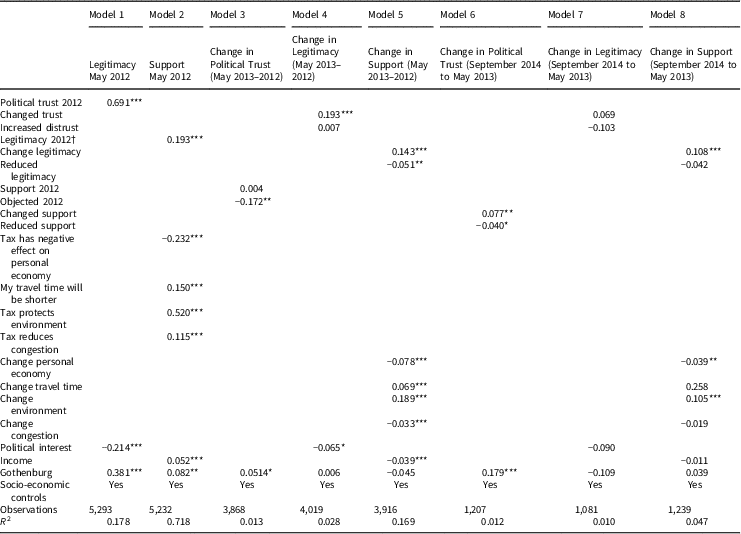
Table 1 shows the results from regressions closely following the theoretical model in the modeling the policy process section and describing the changes over the entire policy cycle. The number of the model in the table, directly correlates to the corresponding equation number. We expect that there is a high degree of persistence, both in legitimacy and in policy support, and we are interested in what causes potential differences across the policy cycle. Hence, we undertake the analysis in terms of differences.Footnote 7
Regressions of differences in legitimacy and support, ordinary least squares

Note: All results are controlled for gender, age, and education.
† Input legitimacy is instrumented by predicted values.
Standard errors in parentheses, ***p<0.01, **p<0.05, *p<0.1.
In the input phase, we first regress legitimacy as proxied by perceived democracy in the political process on political trust and political interest in addition to the socioeconomic control variables (model 1). We see that the more one trusts the municipal politicians, the higher is input legitimacy, as proposed in Equation 1. Next (model 2), we analyse support in the input phase. According to Equation 2, input legitimacy should play a role, as well as expected effects on one’s own situation and on society. Just looking at the raw data, support and legitimacy are extremely highly correlated, which make us suspect that both to a large extent depend on the same (unobserved) factors. Just using the legitimacy variable without further actions in the regression would therefore mostly capture these factors and we would not get a reliable result on how legitimacy really affects support. In order to reduce this endogeneity problem, we instrument legitimacy in model 2 with the predicted value from model 1. In this way, we get a variable which does not (at least to a much lower extent) contain the unobserved components that we suspect are the same as in the support variable.
Hence, in model 2 we regress input support on instrumented input legitimacy and expectations about outcomes, both on the personal level and for society. Appendix 1.7 presents a large number of such personal and societal outcomes. Many of them are highly correlated and some are missing in the last phase. Hence, we have chosen two variables catching personal outcomes and two catching societal ones. The regression results indicate that input legitimacy indeed is an important explanatory factor for initial support. Support is also higher for those who expect their travel time to be shorter and the environment to improve as consequences of the tax, while expectations of worsened private economy and congestion reduces support. The tax would affect the traffic situation within Gothenburg, and we see that those living in Gothenburg were initially more supportive than those living in surrounding municipalities. Note though that several of the variables included in the regression in model 2 are significantly correlated, which makes the magnitudes of the coefficients somewhat unreliable. However, the qualitative results (i.e. signs) are valid.
When we move to the throughput phase, political approval may change as a consequence of the policy as indicated by the theoretical model. Hence, the difference in trust for local politicians between May 2012 and May 2013 is regressed on support for the congestion tax in May 2012. In order to allow for asymmetric responses, we apply a kink design with possibly different slopes depending on support or objection to the congestion tax in 2012. The results are presented in model 3 and reveal that political trust is only changed from the input to the throughput phase if one disapproves of the decided policy. Those who opposed the congestion tax trusted the politicians less after the decision was made than before. Equation 4 suggests that the change in political trust should be transmitted to a change in legitimacy and the regression results of model 4 confirm that throughput legitimacy is indeed positively correlated with altered political trust. However, data does not indicate the theoretically suggested asymmetry in the transmission, but increased trust means increased legitimacy and reduced trust reduced legitimacy of the same magnitude. Model 5 presents the changed support from input to throughput phase (resembling Equation 5). The change in legitimacy explains a large part of the altered support, but also changed expectations about the tax’s consequences (some of them might even be revealed values at this stage). The changes to the last phase – the output phase – are presented in the three last models in Table 1. The mechanisms are the same as in the transition from the input to the throughput phase. In model 6, we see that the changed support has a significant effect on political trust in both directions, i.e., if one perceived the congestion tax as better (worse) in the throughput phase than one expected in the input phase, political trust is increased (decreased) in the output phase. However, model 7 does not indicate a transmission to output legitimacy. This does not come as a surprise considering the descriptives in Table A 1.5: the change from input to throughput legitimacy was much larger than the change from throughput to output legitimacy. However, among those who actually consider output legitimacy to be different from throughput legitimacy, support also differs between the output and throughput phases; this is shown in model 8. Moreover, the changes in the perceived outcome variables play a lesser role in the transition from the throughout to the output phase. Perhaps this is not so surprising. In the input phase all measures were only expectations, but already in the throughput phase a large part of the uncertainty has diminished.
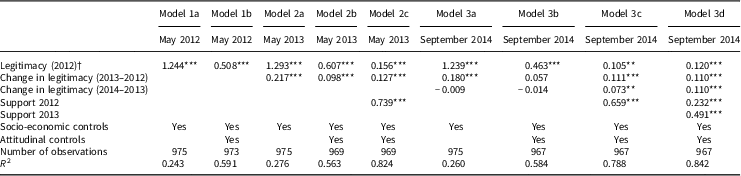
We can thus conclude that the changes in legitimacy over the policy cycle seem to be strongest between the input and throughput phases and that altered support affects political trust. Moreover, from Table 1 it is clear that legitimacy is a highly important explanatory factor for support in all three phases. In order to analyse this relation further, we turn to Table 2, which contains the results from OLS regressions where the dependent variable is support for the congestion tax in the input, throughput and output phases, respectively. Here, we want to specifically analyse the role of the three kinds of legitimacy on support in each phase. For comparability, we restrict the sample to those who took part in all three waves of the survey; hence sample size is radically reduced from those in Table 1. Moreover, when the analysis is not in terms of differences, the endogeneity problem increases, so we should be careful when interpreting the results. In order to at least reduce that problem, we once more instrument input legitimacy by the predicted values of model 1 in Table 1. In model 1a, we do not control for any attitudinal factors, i.e., the expectations on own economy and travel time and on environment and congestion, but only for the same socioeconomic factors as presented in Table 1. We find that input legitimacy is indeed a very powerful explanatory variable for support in the input phase. In model 1b, the inclusion of attitudinal controls radically reduces the effect of legitimacy itself. This should come as no surprise as Table A 1.8 reveals a significant correlation between several of the explanatory variables. However, there is still a significant impact from input legitimacy on initial support. In the throughput phase, May 2013, the congestion tax had been in place for almost five months. Analysing the support in model 2a, we still analyse input legitimacy, but also the potential change in perceived legitimacy between 2012 and 2013.Footnote 8 The effect of throughput legitimacy could therefore be interpreted as the sum of the coefficients of legitimacy in 2012 and the difference. We see that throughput legitimacy is more important than input legitimacy in the throughput phase. This result remains when we also control for the attitudinal aspects in the throughput phase (although also in this phase, the legitimacy estimates are reduced). People tend to be persistent in their views and the support in 2013 could to a large degree be explained by support in 2012.Footnote 9 Therefore, we also control for support in 2012 in model 2c. Due to the extremely high correlation, interpreting the coefficient of initial support makes little sense. However, our focus is on the importance of legitimacy; even when we include the highly explanatory support variable, legitimacy remains significant, still with throughput legitimacy being more important than input legitimacy.
Ordinary least squares regressions for support for the congestion tax
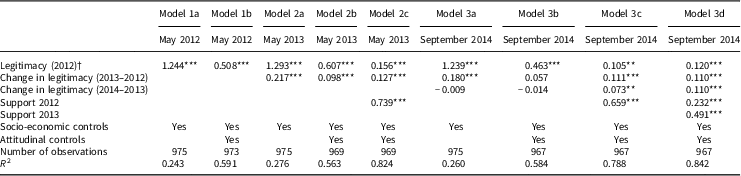
Note: Standard errors in parentheses, ***p<0.01, **p<0.05, *p<0.1.
† Instrumented by predicted value.
The output phase, just before the referendum in September 2014, is analysed in the same way as the throughput phase, i.e., we undertake the analysis in three steps. In models 3a and 3b the results for output support are very similar to those of throughput support. From the results in Table 1 and from the descriptive statistics we know that much less happened between the throughput and output phases than between the input and throughput phases, in terms of both support and legitimacy. This is corroborated by the results in 3a and 3b, where the small change in legitimacy is not reflected in total output support. However, in 3c when we control for initial support (which explains a large part of output support),Footnote 10 all three legitimacy variables turn out to be significant. People are highly persistent in their support during the whole policy cycle and the best predictor for current support is actually previous support. However, when we control for that effect and analyse what difference legitimacy makes given previous support, we find that although legitimacy in the current phase is most important, legitimacy in previous phases also plays a significant role. Note specifically that input legitimacy is significantly related to output support also when we control for persistence in terms of initial support. As a robustness check, we include support in both previous years in 3d. We should not rely too much on these results because of the extremely high correlation between the support variables. However, the take-home message from this is that legitimacy in the input, throughput and output phases are all of importance for output support also when we control for support in both previous phases.
Discussion
Our main theoretical argument suggests that the policy process is dynamic, implying that the drivers of public policy support, and therefore support itself, are changing over the time, during which policy is being decided on and implemented. However, we also argue that perceived legitimacy in the input phase may indeed have lingering effects that have an impact on support also in the throughput and output phases. In order to test these hypotheses on the case of the Gothenburg congestion tax policy process, we conducted a set of operations enabling us to analyse how the antecedents of public support for the congestion tax varies across the input, throughput and output phases, respectively. Doing so, we found that input legitimacy, itself a function of institutional trust and positive perceptions of the decision-making processes and procedures, indeed is a dominating explanatory factor for policy support in the input phase. In addition, there are lingering effects of input legitimacy on policy support in the subsequent throughput and output phases, although this effect is reduced as factors more readily connected to the more immediate phase become increasingly decisive. In addition, we found that perceptions of policy outcomes affect support in all three phases being studied, but they have slightly different effects as these perceptions change from mere expectations to actual experiences. Furthermore, change in support between the input and throughput phases depends significantly on change in legitimacy perceptions, and in our particular case this is especially so if legitimacy was reduced between 2012 and 2013.
Taken together, these results imply support for all our hypotheses because with the data we have used, we find that (1) legitimacy is a significant driver of policy support in all phases of the policy process, (2) the sources of legitimacy vary across these phases, (3) public policy support in one phase of the policy cycle is a function of legitimacy in both the present and the previous phases of the policy cycle and (4) the relationship between pre- and post-implementation legitimacy appears to be hierarchical as the importance of legitimacy in the present phase is more important than legitimacy in previous phases.
Conclusions
A range of political science research on policy feedback loops have demonstrated how public opinion reacts to policy decisions. To date, this literature has mainly focused on the attitudinal effects of policy outputs or outcomes. However, the question of if, and the processes by which, policy attitudes change during the process of deciding on and implementing a policy, has been less explored. Apart from the theoretical relevance of better understanding these processes to grasp the dynamics of the public opinion-public policy nexus, knowledge about the mechanisms of public opinion in this respect also pertains, empirically, to the overall effectiveness of and political possibilities of introducing various policy measures and of setting political priorities. In particular, it highlights how, and by which mechanisms policy legitimacy and support changes throughout the policy cycle, which should provide relevant insights also to the actors involved in the policy processes. According to our findings, building up legitimacy early on in the policy process is of significance as it creates a halo effect where initial support spills over and affects attitudes in later phases of the process.
In this article, we use unique panel data to explore the process of changing policy attitudes in a policy-cycle perspective, tracing public policy support and its antecedents across two and a half years from initial political decisionmaking to the postimplementation period covering the input, throughput and output phases of the policy process. Specifically, we demonstrate how public support for the introduction of a large-scale congestion tax in the Swedish city of Gothenburg is affected by changes in perceptions of legitimacy, pertaining both to the processes and procedures of decisionmaking and to the expectations and experience of substantial outcomes resulting from the congestion tax. Our analysis shows that although first impressions last, as legitimacy in the input phase retains significance for policy support in later phases, the nature of legitimacy also changes during the policy process, as new experiences, rather than expectations, come to the fore. Furthermore, our results suggest that the policy process indeed is dynamic and we show clear interactions between policy support and legitimacy that help us understand how policy attitudes develop. When aiming to better understand how and why public opinion changes as a result of policy implementation, attitudes in the output phase cannot be taken at face value. Rather, this dynamic relationship between political events and public policy support points to the significance of exploring the mechanisms behind policy attitudes in each phase of the policy cycle, as the perceptions of legitimacy that drive public policy support are not the same throughout the process from decisionmaking to implementation and policy evaluation. Attitudes towards a policy and expectations of its effects in one phase may very well affect the perceived legitimacy in future phases, which in turn affects future attitudes and so on.
This study is a first attempt to thoroughly scrutinise the dynamics of the policy cycle by analysing how perceptions of legitimacy, both towards the inputs of the policy process and its proposed outcomes, change over time to affect policy support in different phases. Although this approach reveals a great deal of the antecedents of public policy attitudes, and will be a way forward for future empirical research into the policy-opinion dynamic, further studies might focus on the political side of the story by more closely, analysing the specifics of the decisionmaking and implementation processes and how the debate surrounding new policy is played out in the media and among political elites, potentially affecting both initial public attitudes and the retrospective formation of policy support. Furthermore, another avenue for future research is to more closely scrutinise how and to what extent policy legitimacy is determined by the variation in actors active at each stage of a policy process, as trust in, e.g., national politicians might very well differ from that in local-level public servants. Lastly, this is a single case-study focussing a specific policy cycle in Sweden, which calls for a certain amount of caution in drawing out the broader implications of our results. Further research is needed to continue to scrutinise feedback effects across both policy issues and political contexts.
Supplementary material
To view supplementary material for this article, please visit https://doi.org/10.1017/S0143814X19000023
Acknowledgements
The authors wish to extend their thank you to the three anonymous reviewers, the editor of JOPP, as well as the participants at the Böttö Workshop on Responsiveness - Identifying new research focuses and methods.
Data Availability Statement
Replication materials are available in the Journal of Public Policy Dataverse at https://doi.org/10.7910/DVN/UCQAVW