Introduction
The codling moth, Cydia pomonella (Linnaeus) (Lepidoptera: Tortricidae), is an important direct insect pest of apples (Malus Miller; Rosaceae) in the United States of America and around the world (Hoyt et al. Reference Hoyt, Leeper, Brown and Croft1983; Barnes Reference Barnes1991). Female codling moth lay eggs on apple leaves and fruit, and once emerged the larvae seek out fruit and feed internally on the apple flesh (Hoyt et al. Reference Hoyt, Leeper, Brown and Croft1983; Howitt Reference Howitt1993). The codling moth usually has two generations per year in the eastern United States of America and internal feeding by the larvae destroys the marketability of the crop (Howitt Reference Howitt1993).
The organophosphates (OPs), azinphosmethyl and phosmet, were the insecticides traditionally relied upon for codling moth control in the United States of America (National Agricultural Statistics Service 2005). Because of the United States Environmental Protection Agency (2006) phase-out of azinphosmethyl, and increasing evidence of resistance (Knight et al. Reference Knight, Brunner and Alston1994; Reuveny and Cohen Reference Reuveny and Cohen2004; Mota-Sanchez et al. Reference Mota-Sanchez, Wise, Vander Poppen, Gut and Hollingworth2008; Whalon et al. Reference Whalon, Hollingworth and Mota-Sanchez2008), a wide range of new OP-replacement and reduced-risk insecticides, including neonicotinoid, spinosyn, avermectin, and insect growth regulator (IGRs) classes of compounds, are now being used in apple integrated pest management (IPM) programmes (United States Environmental Protection Agency 1997; Wise and Whalon Reference Wise and Whalon2009; Wise et al. Reference Wise, Schilder, Zandstra, Hanson, Gut and Sundin2015).
Michigan, United States of America commonly receives 8–12 mm of rain per month during the period when apple farmers are managing the first generation of codling moth (Enviro-weather Automated Weather Station Network 2008), with individual rain events ranging from ~2.54 to 50.8 mm. This has important implications for the fate of insecticides sprayed and their efficacy against this insect pest. Overestimation of wash-off following a rainfall event can result in unnecessary reapplication of insecticides, while inaction may result in unacceptable crop injury (Pimentel et al. Reference Pimentel, Acquay, Rice, Silva, Nelson and Lipner1992). Research on in the impact of precipitation on insecticides has been mostly on the older organophosphate, carbamate, and pyrethroid compounds used in field crops (McDowell et al. Reference McDowell, Willis, Southwick and Smith1984; Willis et al. Reference Willis, McDowell, Smith and Southwick1992, Reference Willis, McDowell, Southwick and Smith1994, Reference Willis, Smith, McDowell and Southwick1996; Zhou et al. Reference Zhou, Rowland, Fauzi, Mantoura and Lane1997). More recently, however, Hulbert et al. (Reference Hulbert, Isaacs, Vandervoort and Wise2011, Reference Hulbert, Isaacs, Vandervoort, Earhardt and Wise2012) showed precipitation-related losses of residues on grapes and blueberries for several old and newer classes of insecticides. In these studies, the impact of precipitation wash-off on performance varied depending on the compound’s relative toxicity to the target pest, persistence, plant-penetrative attributes, and level of simulated rainfall.
Studies have shown that persistence and plant-penetrative attributes of organophosphate, neonicotinoid, spinosyn, and IGRs on apple fruit and foliage vary widely (Wise et al. Reference Wise, Coombs, Vandervoort, Gut, Hoffmann and Whalon2006). There are no recent studies describing the impact of precipitation on residues and associated performance on key insect pests of apple. Therefore there is a need for scientific investigation so that apple growers can make evidence-based decisions about insecticide application and reapplication.
The purpose of this study was to evaluate the effects of rainfall and field ageing on the performance of insecticides used to control codling moth. The objectives were to: (1) compare the relative toxicity of select insecticides to codling moth neonates, (2) determine the effect of rainfall on their efficacy against codling moth larvae, and (3) document the pattern of residue wash-off resulting from simulated rainfall events.
Materials and methods
Insect material
Codling moth larvae were obtained from an on-going laboratory colony at the Michigan State University (MSU) Trevor Nichols Research Center (TNRC) in Fennville, Michigan, United States of America (42.5951°N, 86.1561°W). The larvae were reared on artificial diet, and were incubated at 21 °C, 60% relative humidity and 16:8 hour (light:dark) photoperiod until adult eclosion. Afterwards, moths (~50%:50% male:female) were transferred into 1-L containers and allowed to mate and lay eggs.
Materials tested
The treatment chemicals and labelled application rates used were phosmet (Imidan 70 W; Gowan Corporation, Yuma, Arizona, United States of America) at 2.35 kg active ingredient (AI)/ ha (3 lb formulated product per acre), thiacloprid (Calypso 4F; Bayer Corporation, Kansas City, Missouri, United States of America) at 210 g AI/ha (6 oz formulated product per acre), emamectin benzoate (Proclaim 5SG; Syngenta, Greensboro, North Carolina, United States of America) at 16.8 g AI/ha (4.8 oz formulated product per acre), acetamiprid (Assail 30SG; United Phosphorous Inc., Abingdon, Virginia, United States of America) at 105 g AI/ha (5 oz formulated product per acre), novaluron (Rimon 0.83EC; Chemtura USA Corporation, Middlebury, Connecticut, United States of America) at 145.3 g AI/ha (20 oz formulated product per acre), chlorantraniliprole (Altacor 35WG; DuPont, Wilmington, Delaware, United States of America) at 73.5 g AI/ha (3 oz formulated product per acre), and spinetoram (Delegate 25WG; Dow AgroSciences LLC, Indianapolis, Indiana, United States of America) at 91 g AI/ha (5.2 oz formulated product per acre). Treatment concentrations were selected based on labelled field rates recommended in the Michigan Fruit Management Guide (Wise et al. Reference Wise, Schilder, Zandstra, Hanson, Gut and Sundin2015). The buffering agent, TriFol (Wilbur-Ellis Company, Fresno, California, United States of America), was added at 0.0625% by volume to the phosmet treatment to prevent alkaline hydrolysis.
Field plots and treatment applications
Treatment plots consisted of two 15-year-old semi-dwarf apple trees, Malus pumila Miller (Rosaceae) cultivar Red Delicious, at the MSU TNRC, replicated five times in a completely randomised design. Tree spacing was 4×6 m, with two within-row buffer trees and one buffer row separating plots. Regular maintenance applications of fungicides were applied to all treatment plots. Insecticide treatments were applied with an FMC 1029 airblast sprayer (FMC Corp., Jonesboro, Arkansas, United States of America) calibrated to deliver 935 L/ha (100 gallons/acre) of water diluent. Applications were made on 5 June 2007 and 15 June 2008, approximately two weeks after petal fall stage in apples (16–20 mm diameter fruit), and in the time period representative for control of first generation of codling moth. Average daily high temperatures for the week following the application dates were 24 °C and 21 °C respectively, and there was no precipitation during these seven-day field ageing periods.
Bioassays
Bioassays were conducted in 2007 and 2008 to compare the effects of simulated rainfall on the efficacy of the field-sprayed insecticides described above. Time and resource constraints related to the logistics of this study prevented all treatment regimens to be conducted in the same year. Apple shoots (~250–300 mm length) of at least 10 leaves and five fruit were collected from the treatment trees 24 hours and seven days after field applications, each from the row-facing outside portion of tree canopy (1.5–2.0 m high) to assure spray deposition. Shoots were then randomly selected for exposure to two different simulated rainfall events and a third was omitted from simulated rainfall. Because of limited handling capacity, in 2007 the simulated rainfall events equaled 2.54 and 12.7 mm, and in 2008 they equaled 25.4 and 50.8 mm. Shoots were placed in water-soaked OASIS floral foam bricks (Smithers-Oasis Co., Kent, Ohio, United States of America) and then placed in a Generation 3 Research Track Sprayer rainfall simulator (DeVries Manufacturing, Hollandale, Minnesota, United States of America) in replicate order front to back, in transects 90° to the direction of the track. The rainfall simulator was set up with the AI 11008VS nozzle (TeeJet Technologies, Wheaton, Illinois, United States of America), and run at 69 kPa (10 PSI) and 0.8 km/hour. Pre-study test runs provided target times for achieving rainfall treatment regimens. Three rain gauges were placed inside the rainfall simulator to accurately assess the amount and uniformity of simulated rain events. Shoots not assigned to receive rainfall were not placed in the rainfall simulator.
Each bioassay chamber included one shoot, pruned to five leaves and two fruit to fit, and placed in water-soaked OASIS floral foam in a clear polypropylene 950-mL container (Fabri-Kal, Kalamazoo, Michigan, United States of America). The foam was covered with sealing wax (Gulf Wax, distributed by Royal Oak Sales, Roswell, Georgia, United States of America) to preserve the integrity of the plant tissue by reducing evaporation of water. Holes were punched in the lid to reduce condensation of water vapour inside the container. Each bioassay chamber was considered an experimental unit, with a total of five replicates for each insecticide treatment and rainfall amount combination.
As soon as bioassay arenas were prepared, sections of wax paper containing five codling moth eggs that had completed their embryonic development (black-head stage) were taped to apple shoots (base of fruit pedicels) and allowed to hatch. The bioassay chambers were held in the laboratory at 21 °C and a photoperiod of 16:8 (light:dark) hours, and the number of live codling moth larvae were recorded after seven days by carefully splitting fruit with a knife.
Relative toxicity was determined by comparing the number of live codling moth larvae across treatments by an analysis of variance (ANOVA) on arcsine square root transformed values. Mean separation was done using Tukey’s honestly significant difference (HSD) test. For each individual treatment compound, the effects of rainfall (2007: 0, 2.54, and 12.7 mm; 2008: 0, 25.4, 50.8 mm) and time (24 hours and seven-day field-aged residues) on performance were determined by two-way ANOVA on arcsine square root transformed values. Mean separation was done using Tukey’s HSD test. These analyses were conducted in R version 2.12.1 (R Development Core Team 2010).
Insecticide residue analysis
In 2008 a parallel series of leaf and fruit samples were taken 24 hours post application from replicate 1–3 field plots, and these received the same rainfall regimen (0, 25.4, 50.8 mm) as the shoots used in the bioassays.
To determine the amount of residue on the leaf and fruit surfaces, 10-g samples of plant material were placed in 50 mL of high-performance liquid chromatography (HPLC)-grade acetonitrile (EMD Chemicals Inc., Gibbstown, New Jersey, United States of America) and sonicated for 15 seconds. The acetonitrile was decanted through 5 g of reagent-grade anhydrous sodium sulfate (EMD Chemicals Inc.) to remove water. The sample was dried via rotary evaporation and brought up in 1 mL acetonitrile for HPLC or GC analysis. To determine the subsurface residues remaining leaf and fruit samples were ground in 50 mL of HPLC grade dichloromethane (Burdick & Jackson, Muskegon, Michigan, United States of America). The extracts were passed through 5 g of anhydrous sodium sulfate. The samples were dried via rotary evaporation and brought up in 1 mL acetonitrile. Any remaining particulates were removed by passing the sample through a 0.45-µm Acrodisc 13-mm syringe filter (Pall, East Hills, New York, United States of America).
Samples were analysed for thiacloprid, emamectin benzoate, and spinetoram residues with using a 2690 separator module HPLC, with a 2487 dual-wavelength absorbance detector (Waters, Milford, Massachusetts, United States of America). The column was a C18 reversed-phase column with 4.6-mm bore and 5-mm particle size. Flow rates were set at 1 mL/minute. The mobile phase started at 90:10 water:acetonitrile with formic acid (0.01%) and reduced to 70:30 between 12 and 13 minutes at 35 °C. The detector was set at 255 nm and monitored for M/Z ions 126.01 and 253.03 for thiacloprid, 885.78 and 908.79 for emamectin benzoate, and 745.86 for spinetoram.
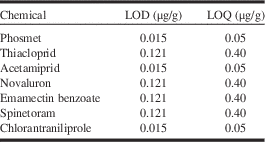
Novaluron, acetamiprid, phosmet, and chlorantraniliprole were analysed using GC/MSD (Agilent 6890 Gas Chromatograph with a 5973 N Mass Spectra Detector (MSD); Agilent Technologies, Santa Clara, CA, USA) equipped with a Zebron ZB-5ms 30 m, 0.25 mm I.D. and a 0.25 µm film thickness. For the GC/MSD analysis settings the oven was held at 115 °C for five minutes with a ramp of 9 °C per minute to 280 °C, followed a ramp of 30 °C per minute to 310 °C. The inlet was held at 200 °C in a pulsed splitless mode with 78324 Pa and a pulse pressure of 103421 Pa, a purge flow of 50.0 mL/minute of helium gas. The MSD transfer line was held at 285 °C. The mass spectrometer was monitoring for ions 188 and 69 for novaluron, 223, 152, and 166 for acetamiprid, 160, 317 for phosmet, and 162, 238, and 240 for chlorantraniliprole. The injector was rinsed three times with acetone and three times with dichloromethane between and also before each injection to eliminate contamination between injections. All compounds were quantitated against a standard curve, and recovery data recorded as µg of AI per gram (ppm) of plant substrate. Limit of detection and limit of quantitation recoveries ranged from 50% to 150% (Table 1).
The limit of detection (LOD) and limit of quantitation (LOQ) values for each treatment compound in 2008 residue analysis.

Note: The LOD and LOQ recoveries ranged from 50% to 150%.
The effects of rainfall on fruit and leaf surface and subsurface residues were determined by comparing 25.4 or 50.8 mm values to 0 rainfall using Dunnett’s test, with mean separations using the least significant difference (P=0.05) on arcsine square root transformed data (Kerchove Reference Kerchove2005).
Results
Relative toxicity
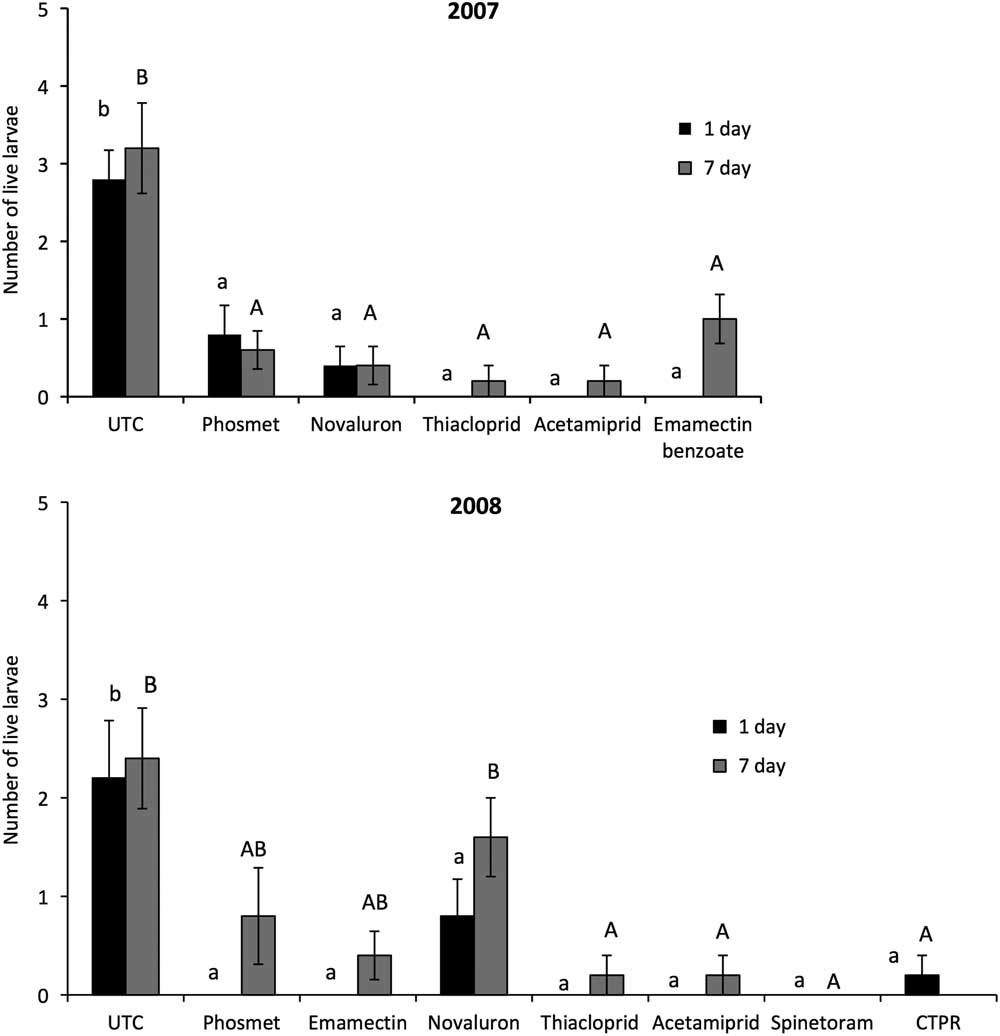
In 2007, the survival of codling moth larvae exposed to 24-hour field-aged insecticide residues was significantly lower for all treatments compared with those exposed to untreated apples shoots (F=17.416; df=5, 24; P<0.001) (Fig. 1). Similarly, the survival of codling moth larvae exposed to seven-day field-aged residues was significantly lower for all treatments compared with the untreated check (F=8.2956; df=5, 24; P<0.001).
Mean (±SEM) number of codling moth larvae alive after exposure to 24-hour or seven-day field-aged insecticide residues from 2007 to 2008 field-based bioassays. Lower-case letters above bar show significant differences among mortality after one-day field ageing and upper case letters show significant differences among mortality after seven-day field ageing. Bars with the same letter in the same case are not significantly different (P<0.05). Data were arcsine square-root transformed before ANOVA. Mean separation calculated using Tukey’s honestly significant difference test. Data shown are non-transformed means. UTC, untreated control; CTPR, chlorantraniliprole.
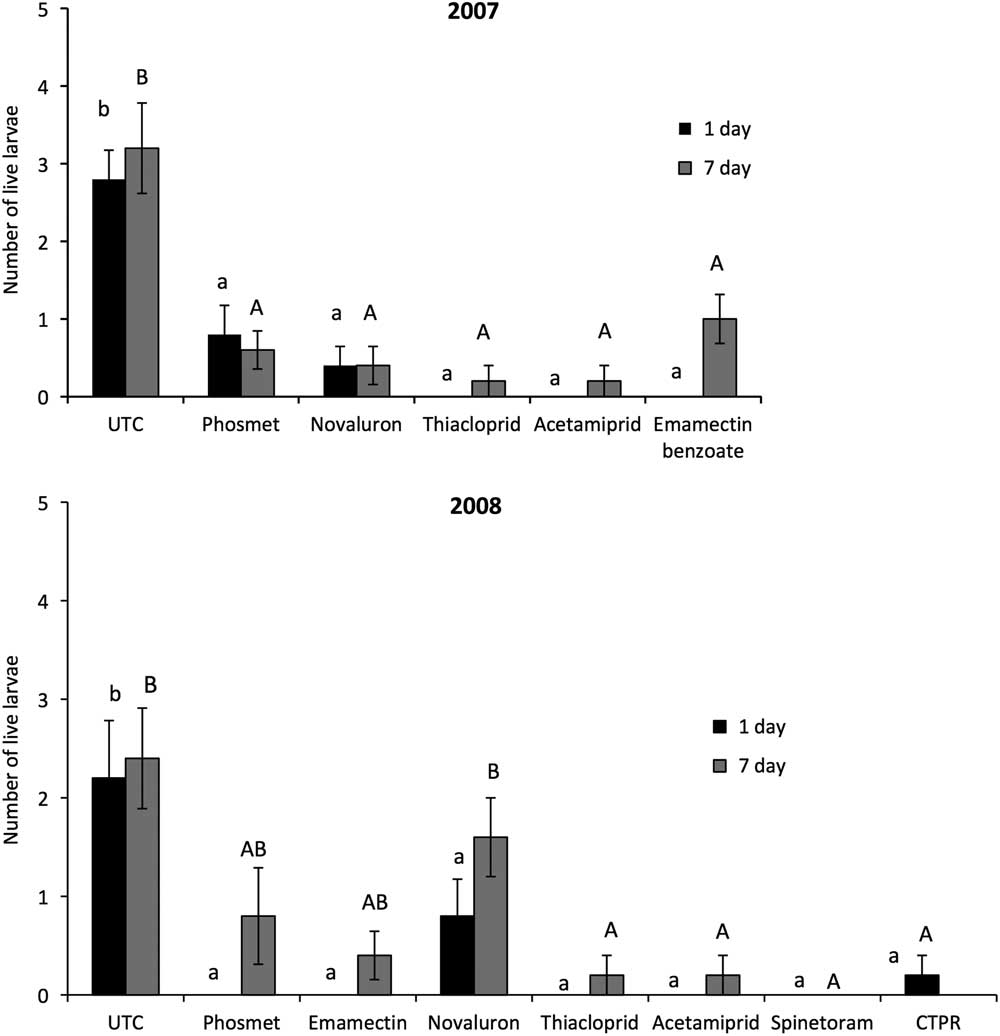
In 2008, the survival of codling moth larvae exposed to 24-hour field-aged insecticide residues was significantly lower for all treatments compared with those exposed to untreated apples shoots (F=12.504; df=5, 24; P<0.001) (Fig. 1). The survival of codling moth larvae exposed to seven-day field-aged residues was significantly lower for thiacloprid, acetamiprid, spinetoram, and chlorantraniliprole compared with the untreated check and novaluron, while survival on phosmet and emamectin benzoate-treated shoots was statistically similar to both (F=8.2956; df=5, 24; P<0.001).
Effect of rainfall and field ageing
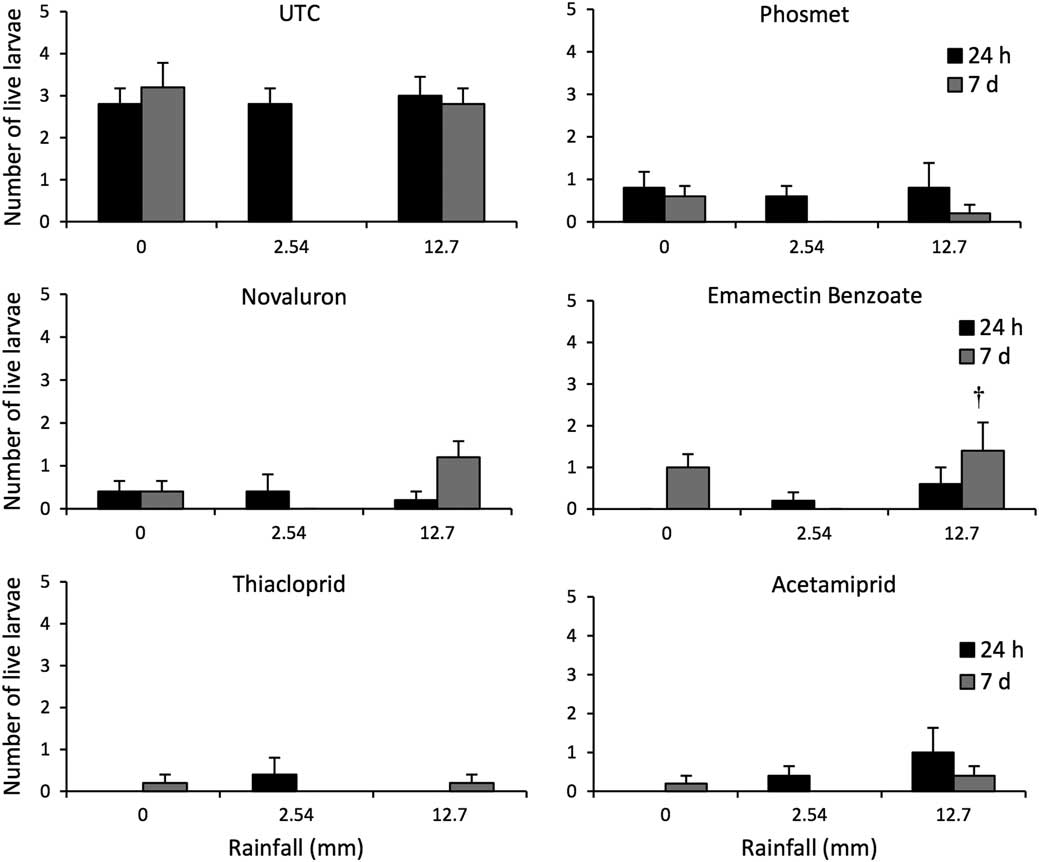
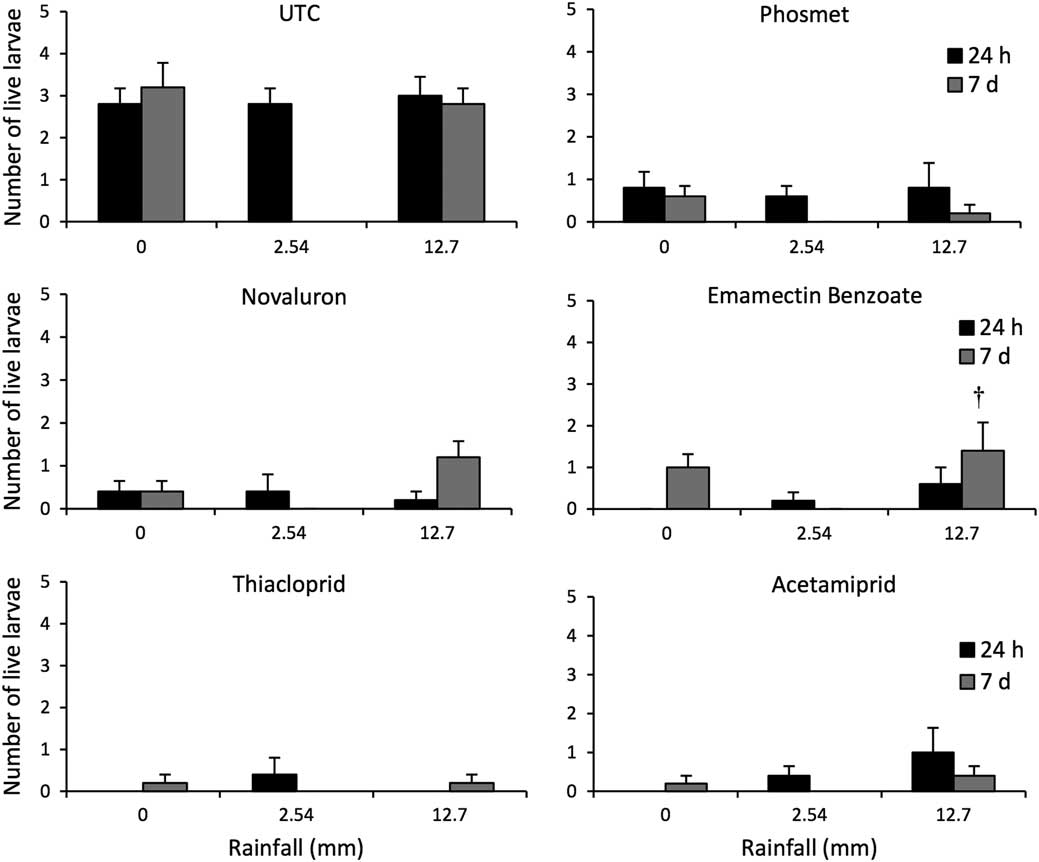
In 2007, there was no significant effect of time (field ageing) or rainfall on the survival of codling moth larvae on untreated apple shoots (time: F=0.3316; df=1, 21; P=0.5708; rainfall: F=0.1589; df=1, 21; P=0.6942), or on shoots treated with phosmet (time: F=0.8099; df=1, 21; P=0.3784; rainfall: F=0.7727; df=1, 21; P=0.3893), novaluron (time: F=3.0959; df=1, 21; P=0.09305; rainfall: F=0.5953; df=1, 21; P=0.44898), thiacloprid (time: F=0.3605; df=1, 21; P=0.5547; rainfall: F=0.0959; df=1, 21; P=0.7599), or acetamiprid (time: F=0.0636; df=1, 21; P=0.8034; rainfall: F=2.5947; df=1, 21; P=0.1221) (Fig. 2). For emamectin benzoate-treated apple shoots, there was no significant effect of rainfall (F=1.1079; df=1, 21; P=0.304506), but there was a significant effect of field ageing on the survival of codling moth larvae (F=8.0684; df=1, 21; P=0.009796).
Mean (±SEM) larvae alive after exposure to 24-hour or seven-day field-aged insecticide bioassays, with apple shoots treated with 0, 2.54, and 12.7 mm of simulated rainfall in 2007. A significant effect field ageing (†) is shown for 24-hour or seven-day separately. Data were arcsine square-root transformed before two-way ANOVA (α=0.05). Non-transformed means are shown. The seven-day, 2.54-mm-rainfall bioassay data were compromised, thus were removed from the analysis. UTC, untreated control.
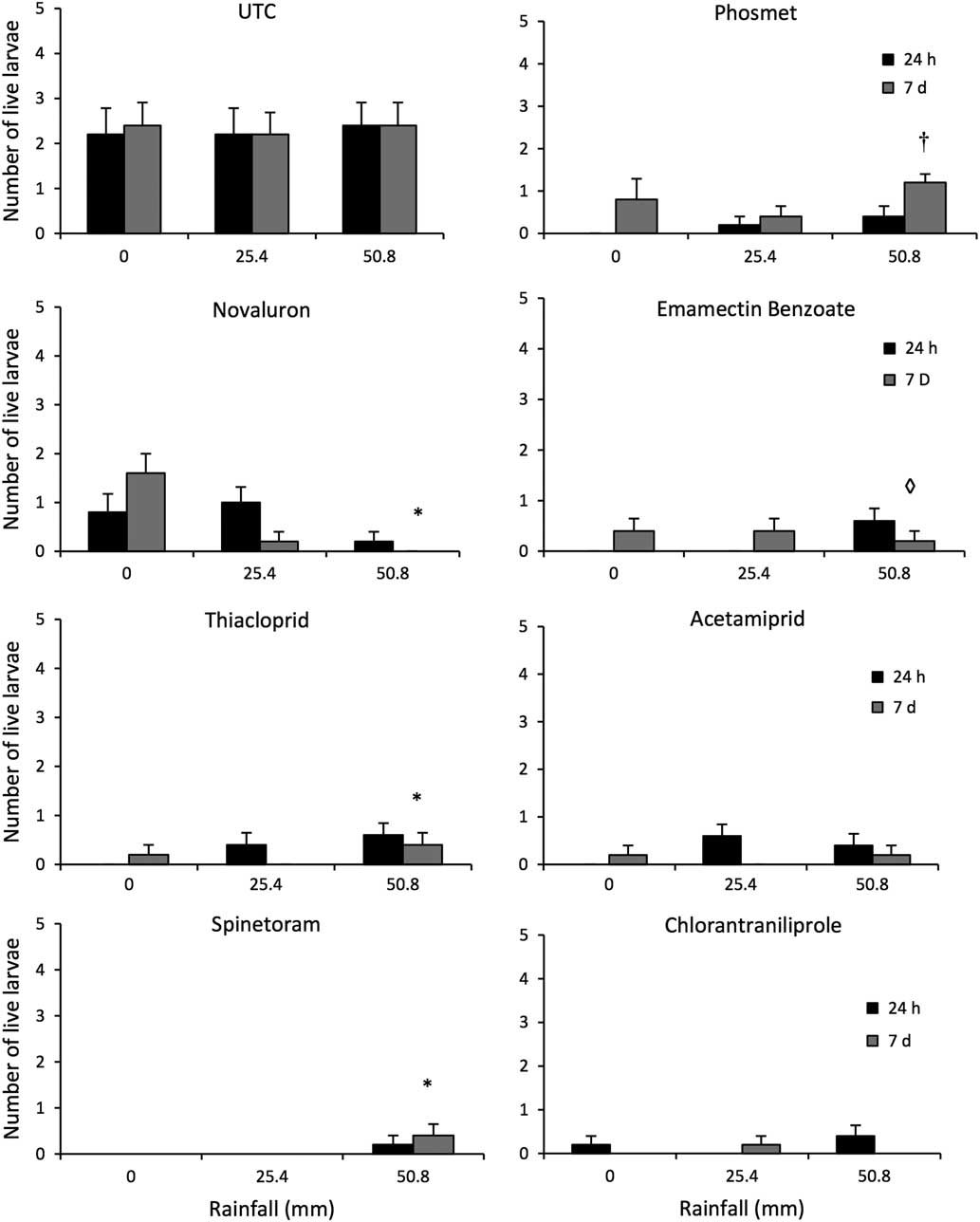
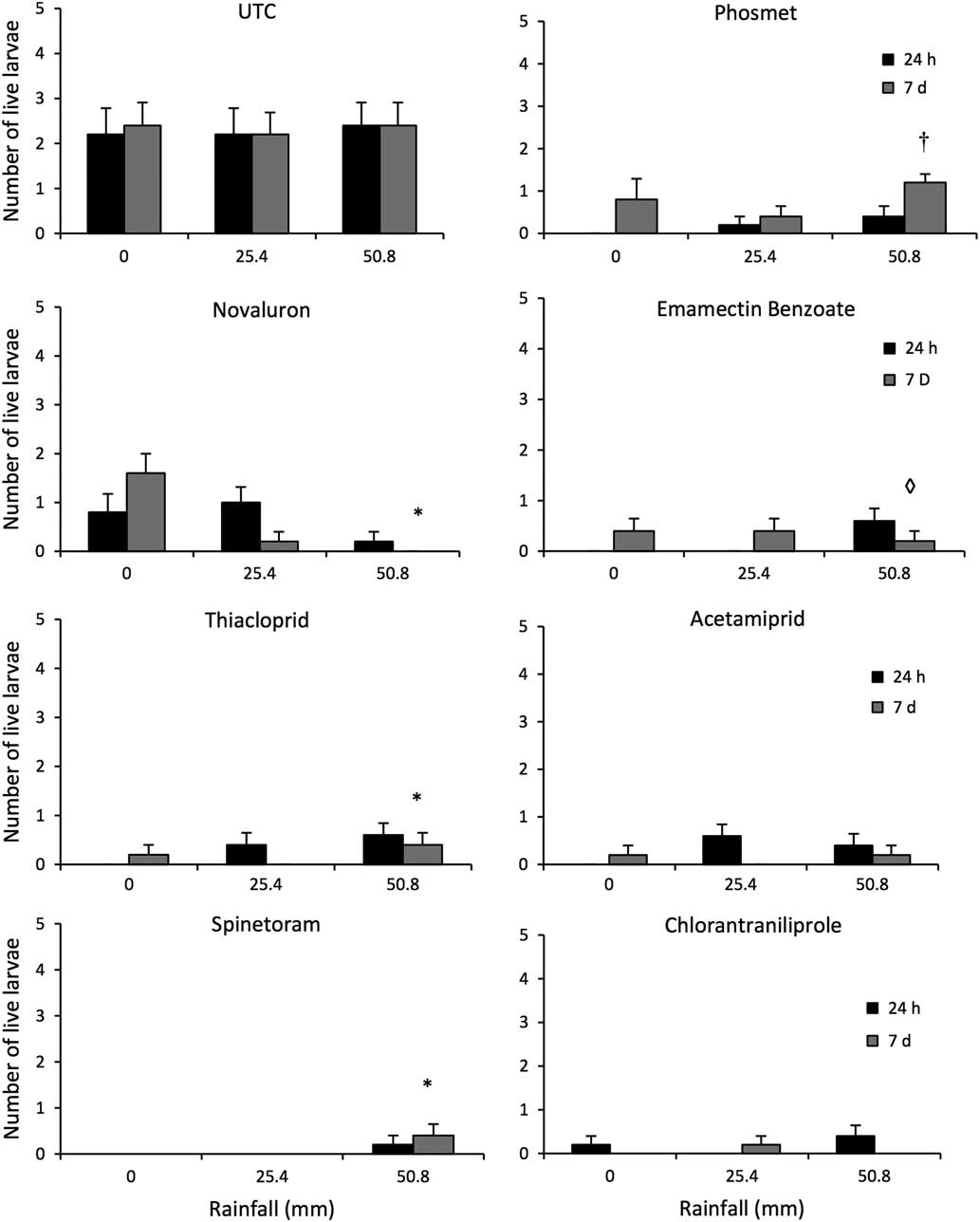
In 2008, there was no significant effect of time (field ageing) or rainfall on the survival of codling moth larvae on untreated apple shoots (time: F=0.0324; df=1, 21; P=0.8586; rainfall: F=0.0409; df=1, 21; P=0.8413) (Fig. 3). For phosmet-treated apple shoots, there was no significant effect of rainfall (F=3.9976; df=1, 21; P=0.05612), but there was a significant effect of field ageing on the survival of codling moth larvae (F=7.1919; df=1, 21; P=0.01255) (Fig. 3). For novaluron-treated apple shoots, there was no significant effect of field ageing (F=0.3260; df=1, 21; P=0.5729510), but there was a significant effect of rainfall (50.8 mm level) on the survival of codling moth larvae (F=15.6733; df=1, 21; P=0.0005203). For thiacloprid-treated apple shoots, there was no significant effect of field ageing (F=0.7324; df=1, 21; P=0.39993), but there was a significant effect of rainfall (50.8 mm level) on the survival of codling moth larvae (F=4.3944; df=1, 21; P=0.04594). For acetamiprid-treated apple shoots, there was no significant effect of time or rainfall on the survival of codling moth larvae (time: F=1.6714; df=1, 21; P=0.2074; rainfall: F=1.1143; df=1, 21; P=0.3009). For emamectin benzoate-treated apple shoots, there was no significant effect of field-ageing (F=0.7324; df=1, 21; P=0.39993) or rainfall (F=1.0986; df=1, 21; P=0.30422) on the survival of codling moth larvae, but there was a significant time×rainfall interaction (F=4.3944; df=1, 21; P=0.04594). For spinetoram-treated apple shoots, there was no significant effect of field ageing (F=0.4; df=1, 21; P=0.53261), but there was a significant effect of rainfall (50.8 mm level) on the survival of codling moth larvae (F=5.4; df=1, 21; P=0.02822). For chlorantraniliprole-treated apple shoots, there was no significant effect of field ageing (F=0.4; df=1, 21; P=0.53261), but there was a significant effect of rainfall (50.8 mm level) on the survival of codling moth larvae compared with the 25.4 mm level (F=5.4; df=1, 21; P=0.02822).
Mean (±SEM) larvae alive after exposure to 24-hour or seven-day field-aged insecticide bioassays, with apple shoots treated with 0, 25.4, and 50.8 mm of simulated rainfall in 2008. A significant effect of rainfall (*) or field ageing (†) or interaction (◊) is shown for 24-hour or seven-day separately. Data were arcsine square-root transformed before two-way ANOVA (α=0.05). Non-transformed means are shown. UTC, untreated control.
Insecticide residue analysis
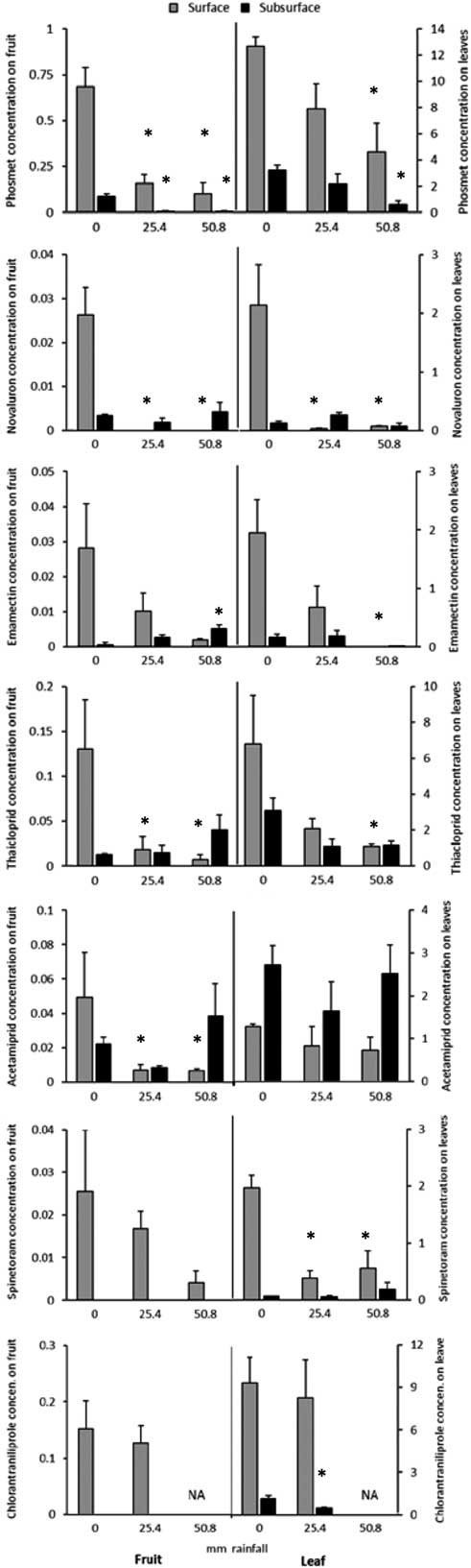
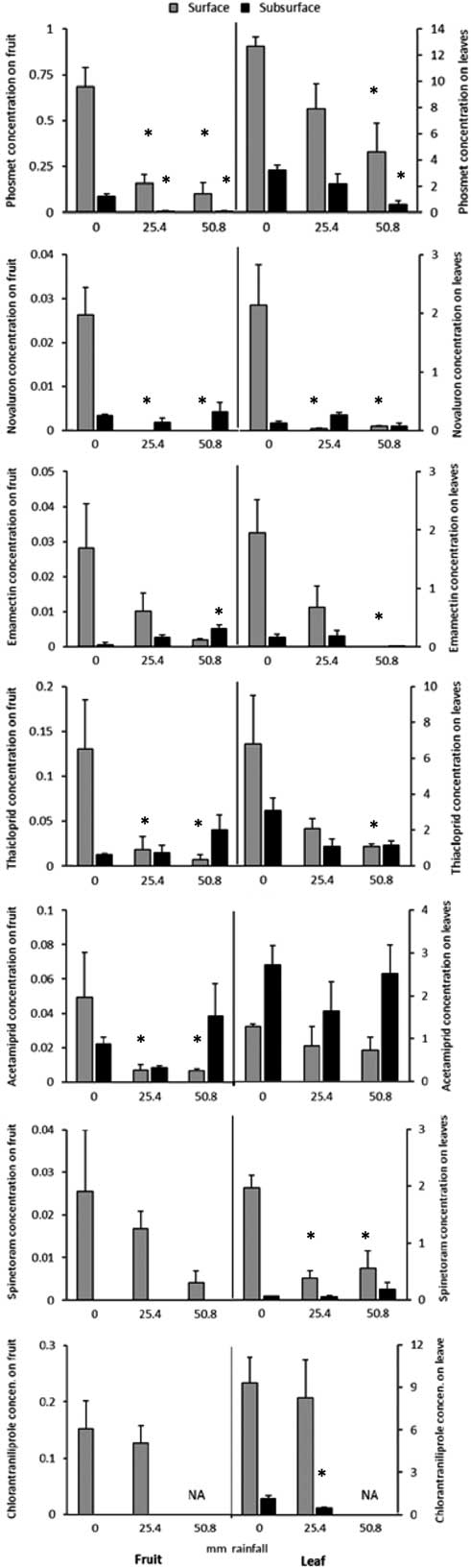
Residue profiles provide evidence for wash-off of insecticide residues from the fruit and leaves of apples, with patterns varying by compound and plant substrate (Fig. 4). There were significant wash-off losses of phosmet residues from fruit surface (F=19.48; df=2, 6; P=0.0024) and subsurfaces (F=30.35; df=2, 6; P=0.0007) following 25.4 and 50.8 mm of rainfall, and from leaf surfaces (F=7.58; df=3, 12; P=0.0042) and subsurfaces (F=6.07; df=3, 12; P=0.0362) following 50.8 mm of rainfall. Total wash-off losses of phosmet from 25.4 to 50.8 mm of rainfall were ~79% and 88% on fruit and 36% and 67% on leaves, thus rainfastness was somewhat better on leaf tissue than fruit. There were significant wash-off losses of novaluron residues from fruit surfaces (F=17.49; df=2, 6; P=0.0031) following 25.4 and 50.8 mm of rainfall, and from leaf surfaces (F=9.14; df=3, 12; P=0.0151) following 25.4 and 50.8 mm of rainfall. Total wash-off losses of novaluron from 25.4 to 50.8 mm of rainfall were ~95% and 82% on fruit and 87% and 93% on leaves. There were significant wash-off losses of emamectin benzoate residues from leaf surfaces (F=6.63; df=3, 12; P=0.0302) following 50.8 mm of rainfall. Total wash-off losses of emamectin benzoate from 25.4 to 50.8 mm of rainfall were ~57% and 76% on fruit and 58% and 99% on leaves, with proportionally greater losses of surface residues than from subsurface. There were significant wash-off losses of thiacloprid residues from fruit surface (F=7.27; df=2, 6; P=0.0249) following 25.4 and 50.8 mm of rainfall, and from leaf surfaces (F=5.41; df=3, 12; P=0.0454) following 50.8 mm of rainfall. Total wash-off of thiacloprid from 25.4 to 50.8 mm of rainfall were ~77% and 67% on fruit and 68% and 77% on leaves, but a greater proportion of losses from surface residues compared with subsurface. There were significant wash-off losses of acetamiprid from fruit surface (F=7.71; df=2, 6; P=0.0219) following 25.4 and 50.8 mm of rainfall, but not from fruit subsurfaces or leaf surfaces and subsurfaces. Total wash off of acetamiprid from 25.4 to 50.8 mm of rainfall were ~78% and 62% on fruit and 38% and 19% on leaves, with proportionally greater losses of surface residues than from subsurface. There were significant wash-off losses of spinetoram residues from leaf surfaces (F=14.7; df=2, 6; P=0.0049) following 25.4 and 50.8 mm of rainfall. Total wash-off losses of spinetoram from 25.4 to 50.8 mm of rainfall were ~34% and 84% on fruit and 78% and 63% on leaves. There were significant wash-off losses of chlorantranilaprole residues from leaf subsurfaces (F=5.93; df=1, 4; P=0.0716) following 25.4 mm of rainfall. Total wash-off losses of chlorantranilaprole from 25.4 mm of rainfall were ~13% and fruit and 17% on leaves. The 2008 residue samples for chlorantranilaprole were compromised, thus were re-run for 25.4 mm simulated rainfall in 2009 using same methods as described above.
Mean (±SEM) micrograms of active ingredient per gram of surface and subsurface residues on fruit and leaves after 24-hour field ageing, for apple shoots treated with 0, 25.4, and 50.8 mm of simulated rainfall in 2008. NA – no residue data for 50.8 mm chlorantranilaprole. A significant effect of rainfall (*) is shown for 24-hour or seven-day separately. Data were arcsine square-root transformed before Dunnett’s test, with mean separations using least significant difference (P=0.05). Non-transformed means are shown.
Discussion
This study provides new information about the rainfastness attributes of insecticides used in apple production, and the impact of wash-off on the performance of compounds for residual control of codling moth. The first practical conclusion from this study is that there is little justification for immediate insecticide re-application following rainfall events below 12.7 mm. Although grower judgment may vary depending on pest pressure or market threshold for crop injury, this study suggests that lower rainfall amounts will not directly reduce the level of insecticide performance.
Under higher-level rainfall events (25.4–50.8 mm), there appears to be several distinct patterns of impact that precipitation has on the performance of insecticides. One pattern represents the cases where significant residue losses from rainfall correspond to significant reductions in pest control. This pattern was demonstrated most clearly for spinetoram, where 50.8 mm of rain (2008) resulted in significantly lower levels of codling moth control.
A second pattern observed was in cases where high proportions of residue losses were observed from rainfall events, but pest control was not immediately compromised. Phosmet was shown to be highly susceptible to wash off, especially on fruit, but this did not lead to higher numbers of live codling moth larvae. This is most likely a function of the high-labelled field rates allowed in apples. When applied at its full recommended rate (Wise et al. Reference Wise, Schilder, Zandstra, Hanson, Gut and Sundin2015), the concentration of phosmet on the plant surface is enough to withstand 67% wash off and still have sufficient residues to kill the target pest. An additional factor that may compensate for losses from wash off is that phosmet as a neurotoxin would have contact toxicity to larvae moving across leaf and fruit surface. Compounds that rely on ingestion for optimal activity may not perform as well following such losses from wash off.
The neonicotinoids, thiacloprid, and acetamiprid, demonstrated a unique pattern in that surface residues (especially on fruit) were sensitive to wash off, but the portion of residues that moved systemically inside plant tissues were relatively rainfast. The fact that acetamiprid showed high proportions of systemic (subsurface) residues may also explain why its resulting performance (on codling moth larvae) was less influenced by rainfall than that seen for thiacloprid.
The last pattern represents cases where compounds demonstrated relatively high resistance to residue wash off, and in turn performance on the target pest was maintained compared with the untreated check. Chlorantraniliprole followed this pattern, especially in maintaining surface residues on fruit.
Relative toxicity, in the context of the labelled field rates used for commercial apple production, is an important part of understanding the potential impact of rainfall on insecticide performance. The treatment materials tested at recommended field rates in this study showed generally similar levels of toxicity to codling moth larvae, except novaluron was statistically weaker in 2008 than the top performing compounds. As our study targeted codling moth larvae as the key point of measure, novaluron being primarily an ovicidal material cannot be fully compared with the other compounds (Charmillot et al. Reference Charmillot, Gourmelon, Fabre and Pasquier2001; Magalhaes and Walgenbach Reference Magalhaes and Walgenbach2001; Brunner et al. Reference Brunner, Beers, Dunley, Doerr and Granger2005). Its unique mode of action and life-stage activity may also explain the ambiguous results reported in this study (Gocke et al. Reference Gocke, Kim, Wise and Whalon2009). None-the-less, compounds that are applied at rates that exceed minimum requirements for control are likely to overcome the negative effects of precipitation, although serious questions about environmental stewardship and IPM sustainability should be raised.
The results of this study will help apple growers make informed decisions on the application and reapplication of insecticides before and after rainfall events. We have developed a “rainfastness decision chart” as a practical research-based guide for apple growers to use in their IPM programme so that unnecessary pesticide sprays can be eliminated and increase the efficiency and sustainability of domestic fruit production (Wise et al. Reference Wise, Schilder, Zandstra, Hanson, Gut and Sundin2015).
Acknowledgements
The authors appreciate the help of Ryan Vanderpoppen and the MSU Trevor Nichols Research Center farm staff for their technical assistance, and Agrochemical companies for supplying commercial trade materials for testing. Funding for this this research was provided by Michigan Apple Committee.