I. INTRODUCTION
Due to the increasing demands of light weight and low cost components in aerospace and transportation industries, aluminum alloys have been widely used. Reference Lin, Li, Xia and Jiang1,Reference Shaeri, Salehi, Seyyedein, Abutalebi and Park2 Admired for the high strength, high toughness, and good fatigue resistance, Al–Zn–Mg–Cu alloy is considered as the ideal material for high-performance aircraft components, such as fuselage frames, wing stringers, and wing skins. Reference Shi, Lai and Chen3,Reference Rokni, Zarei-Hanzaki, Widener and Changizian4 Generally, the mechanical properties of aluminum alloys are closely related to their microstructures, which are greatly influenced by thermo–mechanical processing. Reference Lin and Chen5–Reference Shaterani, Zarei-Hanzaki, Fatemi-Varzaneh and Hassas-Irani11 In past, considerable researches have been done to study the influences of heat treatments on microstructures. Some studies Reference Park and Ardell12–Reference El-Amoush16 show that intragranular precipitates can be dispersed and refined when the Al–Zn–Mg–Cu alloys were heat treated in T6 temper. Moreover, previous investigations Reference Marlaud, Deschamps, Bley, Lefebvre and Baroux17–Reference Lin, Zhang, Liu and Liang20 found that the discontinuously-distributed intergranular precipitates and refined intragranular precipitates can be obtained by the retrogression and re-ageing treatments. Furthermore, the effects of stress-aging treatment on precipitates were investigated by Lin et al., Reference Lin, Liu, Chen, Huang, Chen, Ma, Jiang and Li21,Reference Lin, Jiang, Chen, Wen and Zhou22 and they found that the amount of aging precipitates and the width of precipitate free zone (PFZ) increase with the increase of creep aging temperature and external stress.
Generally, the service life of structural components working at high temperature conditions is determined by the creep resistance of aluminum alloys. Reference Li, Lin, Zhou, Xia and Jiang23–Reference Lin, Xia, Ma, Jiang and Chen27 In recent years, some researchers devoted to studying the creep behaviors of Al–Zn–Mg–Cu alloys. Mahathaninwong et al. Reference Mahathaninwong, Zhou, Babcock, Plookphol, Wannasin and Wisutmethangoon28 discussed the effects of pre-treatment on the creep-rupture behaviors of semi-solid casted 7075 aluminum alloy. Yousefiani et al. Reference Yousefiani, Mohamed and Earthman29 studied the creep-rupture behaviors of the annealed and overheated 7075 aluminum alloys, and found that grain boundary sliding contributes to the dislocation creep mechanism in annealed alloy. Srivastava et al. Reference Srivastava, Williams, McNee, Greenwood and Jones30 researched the creep behavior of 7075 aluminum alloy at low stress range, and found that the creep mechanism turns from Nabarro–Herring creep to power law creep when the stress is higher than 5 MPa.
Although considerable researches have been conducted on the microstructural evolution of Al–Zn–Mg–Cu alloy during heat treatments, Reference Leacock, Howe, Brown, Lademob and Deering31–Reference Liu, Jiang, Li, Yang and Hu34 few studies reported the influences of pre-treatments on precipitate microstructures and creep-rupture behavior of Al–Zn–Mg–Cu alloys. Therefore, in the present study, the effects of pre-treatments on the precipitate microstructures and creep-rupture life of a typical Al–Zn–Mg–Cu alloy are investigated. Meanwhile, the creep deformation mechanisms of the pre-treated alloys, as well as the evolution of precipitate microstructures during creep, are studied. Furthermore, the relationship between the pre-treatment, microstructural evolution, and creep-rupture behavior of the studied Al–Zn–Mg–Cu alloy are discussed in detail.
II. MATERIAL AND EXPERIMENTS
The material used in this study is a commercial Al–Zn–Mg–Cu alloy. The chemical compositions of the studied alloy is 5.8Zn–2.3Mg–1.5Cu–0.21Cr–0.16Fe–0.07Si–0.05Mn–0.02Ti–(bal.)Al. Creep test specimens with the diameter of 10 mm and the gauge length of 50 mm were machined along the rolling direction of as-received aluminum alloy sheet. According to AMS2772E, the following heat treatment processing was used. The specimens were first solution treated at 470 °C for 1 h, and then quenched by cold water. To investigate the effects of pre-treatment on precipitates and creep-fracture behavior of the studied alloy, two groups of solution-treated specimens were aged for 5 h and 24 h, respectively. According to the previous studies, Reference Danh, Rajan and Wallace35,Reference Li, Peng, Li, Jia, Chen and Zheng36 the aging conditions with 5 h and 24 h at 120 °C are called as the under-aged and peak-aged treatments, respectively. Additionally, after solution treatment and water quenching, the specimens were stored in the refrigerator to avoid natural aging. The creep experiments were carried out on a MTS-GWT2015 test machine (MTS Systems Corporation, Minneapolis, Minnesota) at the applied stress of 160 MPa and the temperature of 210 °C.
To investigate the effects of pre-treatment and creep deformation on precipitate microstructures, transmission electron microscopy (TEM) observations were carried out. The TEM samples were made in the plane which is perpendicular to the tensile axis of specimens. The foils were first mechanically polished to about 80 μm, and then twin-jet electro-polished using a solution of hydrogen nitrate and methanol (1:4 in volume) below −20 °C. TEM observations were performed using a Titan G2 60-300 microscope with energy-disperse spectrometer (EDS; FEI Company, Eindhoven, The Netherlands). The fine probe EDS was used to observe the distributions of Al, Zn, Mg, and Cu atoms at grain boundaries and grain interior. Compositional information of intergranular precipitates was obtained through high-angle annular dark field (HAADF) images with the scanning TEM (STEM) mode. The fracture surfaces and microvoids were observed using scanning electron microscope (SEM) and optical microscopic, and the metallographic specimens were made in the plane which is parallel to the tensile axis near fracture surfaces.
III. RESULTS AND DISCUSSION
A. Effects of pre-treatments on aging precipitates
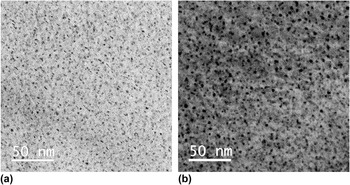
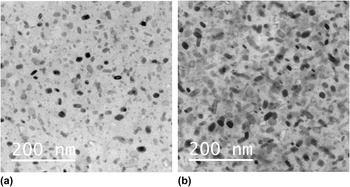
The intragranular precipitates of the studied alloy after under-aging and peak-aging treatments are shown in Fig. 1. From Fig. 1, some refined and dispersed precipitates can be found within grains. According to the previous studies, Reference Park and Ardell37,Reference Du, Sun, Shao, Zhou and Chen38 these precipitates are globular η′ phase (MgZn2) and rod-like η phase (MgZn2). Obviously, the intragranular precipitates sizes of the peak-aged alloy are larger than those of the under-aged alloy. Furthermore, the density of intragranular precipitates in the under-aged alloy is higher than that in the peak-aged alloy. It suggests that the precipitation of solute atoms from the supersaturated solid solution is easy for the peak-aged alloy.
TEM micrographs of the intragranular precipitates in: (a) under-aged alloy; (b) peak-aged alloy.

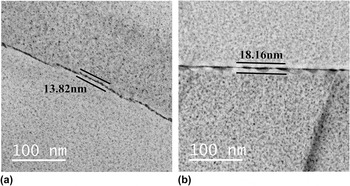
Figure 2 shows the effect of pre-treatments on intergranular precipitates in the studied Al–Zn–Mg–Cu alloy. From Fig. 2(a), it can be found that the intergranular precipitates of the under-aged alloy are very small, and continuously distributed along the grain boundaries with a narrow PFZ. Figure 2(b) shows the intergranular precipitates and PFZ in the peak-aged alloy. As shown in Fig. 2, the size of precipitates and the width of PFZ in the peak-aged alloy are larger than those in the under-aged alloy. Furthermore, the widths of PFZ can be measured as 13.82 and 18.16 nm for the under-aged and peak-aged alloys, respectively. According to the previous studies, Reference Li, Yang, Feng, Huang, Luo, Lou and Ru39,Reference Xu, Zhao, Ma and Zhang40 the intergranular precipitates are η phases, and the nucleation and growth of intergranular precipitates are significantly affected by the grain boundary segregation of alloying elements.
TEM micrographs of the intergranular precipitates in: (a) under-aged alloy; (b) peak-aged alloy.

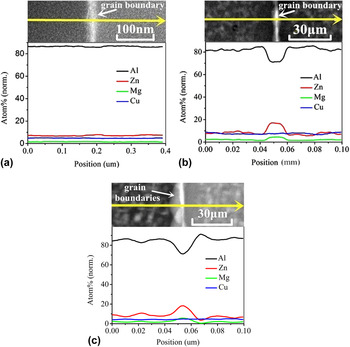
Figure 3 shows the HAADF images of the solution-treated, under-aged, and peak-aged alloys. Also, the EDS line scans along the yellow arrow are given in Fig. 3. For the solution-treated alloy, the contents of alloying element (including Al, Zn, Mg, and Cu) slightly change from grain interior to grain boundaries, as shown in Fig. 3(a). Compared to the solution-treated alloy, segregation of Mg and Zn atoms occurs with the depletion of Al atoms at grain boundaries for the under-aged and peak aged alloys, as shown in Figs. 3(b) and 3(c). Meanwhile, the segregation of solution atoms at grain boundaries leads to the formation of PFZ near grain boundaries. Reference Sankaran, Perez and Jata13 The contents of Mg and Zn atoms at grain boundaries are higher than those within grains. However, the content of Al atoms at grain boundary is lower than that within grains.
HAADF images and line scans across the grain boundaries in: (a) solution-treated alloy; (b) under-aged alloy; (c) peak-aged alloy.

According to the previous studies, Reference Lejcek41,Reference Faulkner42 the change of Mg content is caused by the nonequilibrium segregation of Mg atoms during aging. The vacancy supersaturation in the matrix of the studied alloy occurs after solution treatment and water quenching. Due to the high binding energy between the vacancies and Mg atoms, Mg atoms are trapped by vacancies. Reference Panseri, Gatto and Federighi43 Therefore, Mg atoms exist in Mg-vacancy complex form. Reference Panseri and Federighi44 Because grain boundary is an idea sink of vacancy, the Mg-vacancy complexes decompose into Mg atoms and vacancies near the grain boundaries. Consequently, the vacancies disappear on the grain boundaries while the Mg atoms are left. To keep equilibrium of the complex concentration at grain boundaries, intragranular complexes diffuse from grain interior to grain boundaries. Meanwhile, the Mg atoms are dragged by the moving vacancies. Reference Xu, Wang and Song45 As a result, the content of Mg atoms at grain boundaries gradually increases. Li et al. Reference Li, Yang, Feng, Huang, Luo, Lou and Ru39 considered that the change of Zn content is caused by the nonequilibrium co-segregation of Zn atoms and Mg atoms during aging, because the binding energy of Zn and Mg atoms (0.34 eV) is larger than that of Zn atoms and vacancy (0.06 eV). Due to the strong attraction of Mg and Zn atoms, the content of Zn atoms at grain boundaries also gradually increases with increasing the content of Mg atoms. Reference Jiang, Lin, Phaniraj, Xia and Zhou26 Bakker et al. Reference Bakker, Bonzel, Bruff, Dayananda, Gust, Horváth, Kaur, Kidson, LeClaire, Mehrer, Murch, Neumann, Stolica and Stolwijk46 found that the diffusion constants of Zn, Mg, Cu atoms in Al matrix at 150 °C are 4, 3, and 0.1, respectively. Moreover, because the diffusion rate of Cu atoms is much lower than those of Mg and Zn atoms, the content of Cu atoms only slightly varies in the aging process at 120 °C. Similar experimental findings were obtained by Marlaud et al. Reference Marlaud, Deschamps, Bley, Lefebvre and Baroux47
B. Effect of pre-treatments on creep-rupture behaviors
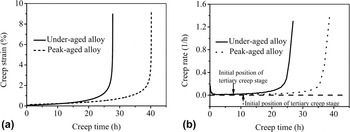
Figure 4 shows the variations of creep strain and creep rate with creep time of the pre-treated Al–Zn–Mg–Cu alloys. Obviously, the creep curves shown in Fig. 4(a) can be divided into three stages, including the transient, steady, and accelerating creep stages. Also, the transient creep stage of the under-aged and peak-aged alloys are both very short (about 1.5 h). During the transient creep stage, the creep rate rapidly decreases to a minimum value, as shown in Fig. 4(b). After the transient creep stage, the creep rate remains constant at a minimum in steady creep stage. Figure 4(b) shows that there is little difference of the steady creep rates between the under-aged and peak-aged alloys. Moreover, the creep strains of the under-aged and peak-aged alloys are both very small in steady creep stage. In the tertiary (accelerating) creep stage, the creep rate rapidly increases, then the creep rupture occurs. As shown in Fig. 4(b), it can be found that the tertiary creep stage of the under-aged alloy begins earlier than that of the peak-aged alloy, and the creep rate of the under-aged alloy is much higher than that of the peak-aged alloy. As a result, the creep-rupture life of the under-aged alloy is much shorter than that of the peak-aged alloy.
Variations of creep strain and creep rate with creep time of studied alloys at the applied stress of 160 MPa and creep temperature of 210 °C: (a) creep strain versus creep time; (b) creep rate versus creep time (the initial positions of tertiary creep stage are indicated by arrowheads).

C. Microstructural observations after creep rupture
1. Precipitate microstructures
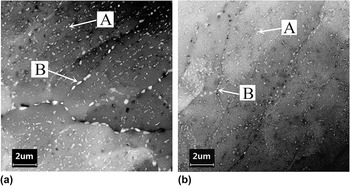
Figure 5 shows the TEM images of intragranular precipitates in the creep-ruptured alloys. From Figs. 1 and 5, it can be found that the intragranular precipitates become coarse after creep rupture, compared to the pre-treated alloys. This is because that the under-aged and peak-aged alloys are both overaged after creep rupture, and the matrix of the creep-ruptured alloys are almost solute depleted. Furthermore, after creep rupture, the mean size and the density of intragranular precipitates in the peak-aged alloy are both larger than those in the under-aged alloy. Therefore, it can be concluded that some solute atoms locally precipitate, and certain large-sized precipitates are generated in the under-aged alloy during creep. Figure 6 shows the STEM morphology of the creep-ruptured alloys. From Fig. 6(a), some large-sized intragranular precipitates regularly arranged within grains, and the sizes of these intragranular precipitates are about 100–400 nm. Moreover, these large-sized precipitates are greatly larger than those precipitates (below 40 nm) shown in Fig. 5(a). Additionally, similar phenomenon appears in the matrix of the peak-aged alloy after creep rupture, as shown in Figs. 5(b) and 6(b). Still, this phenomenon in the under-aged alloy is more obvious, compared to the peak-aged alloy.
TEM micrographs of intragranular precipitates of the creep-ruptured alloys by: (a) under-aging treatment, (b) peak-aging treatment.

STEM morphologies of the creep-ruptured alloys by: (a) the under-aging treatment, (b) the peak-aging treatment (A and B indicate large-sized intragranular and intergranular precipitate, respectively).

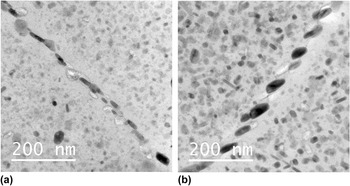
Figure 7 shows the TEM images of the intergranular precipitates in the creep-ruptured alloys. Similarly, the coarsening of the intergranular precipitate occurs in the creep-ruptured alloys, as shown in Figs. 2 and 7. Furthermore, it can be found that the mean size of intergranular precipitates in Fig. 7(a) is below 60 nm. However, the size of intergranular precipitates shown in Fig. 6(a) is about 300–900 nm. Similar phenomenon also occurs in the peak-aged alloy, as shown in Figs. 6(b) and 7(b). Additionally, after creep rupture, the mean size of large-sized intergranular precipitates in the under-aged alloy is larger than that of the peak-aged. While the mean size of small-sized intergranular precipitates in the under-aged alloy is smaller than that of the peak-aged alloy.
TEM micrographs of intergranular precipitates of the creep-ruptured alloys by: (a) under-aging treatment, (b) peak-aging treatment.

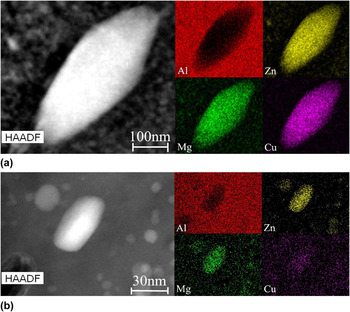
To comparatively analyze the microstructures in the under-aged and peak-aged alloys after creep rupture, the precipitate evolution during creep is discussed. Generally, the accepted precipitation evolution can be described as the nucleation, growth and coarsening of precipitates. Reference Ratke and Voorhees48,Reference Oriani49 Because the activation energy for precipitate coarsening is higher than that for solute (Mg, Zn) diffusion, diffusion-controlled growth happens preferentially. Reference Dorward50 For the under-aged alloy, there are some free solution atoms within grains. At the beginning of creep, the condition for nucleation is satisfied. Due to the lower nucleation energy and higher apparent diffusion rate, precipitates can nucleate and grow up preferentially at grain boundaries and dislocations. Reference Fribourg, Bréchet, Chemin and Deschamps51 However, with the consumption of solution atoms, the degree of supersaturation gradually decreases. Correspondingly, the driving force of nucleation decreases. When the concentration of solution atoms decreases to a critical level, Ostwald ripening becomes the primarily mechanism of precipitate evolution. Reference Kahlweit52 Ostwald ripening refers to the competitive growth of particles which result in the growth of large particles with the expense of small particles. Reference Voorhees53 Due to the reduction of surface-to-volume ratio of precipitates by Ostwald ripening, the surface energy per unit volume decreases. Generally, Ostwald ripening occurs at the later stage of microstructure evolution. Reference Liu, Jiang, Li, Yang and Hu34 Therefore, the intergranular precipitates in the under-aged alloy can be divided into two kinds. i.e., some nucleate during pre-treatment, and others nucleate during creep. This conclusion can be confirmed by the elemental maps of precipitates. The difference of element distribution between the large-sized and small-sized intergranular precipitates in the under-aged alloy after creep rupture is shown in Fig. 8. The elemental maps indicate that the segregation of Cu element occurs on large-sized intergranular precipitates, and the content of Cu element in small-sized intergranular precipitates is much lower. Because the distribution of Cu element is uniform after pre-treatment, the segregation of Cu element mainly occurs during creep. According to the previous studies, the coarsening rate of precipitates is higher in the alloy where the content of Cu element in precipitates is lower. Reference Yousefiani, Mohamed and Earthman29 But, as shown in Fig. 8, the size of precipitates with lower content of Cu element is smaller than that with higher content of Cu element in the under-aged alloy after creep rupture. It indicates that coarsening is not the primary evolution mechanism of large-sized precipitates. Therefore, the large-sized precipitates nucleate at the beginning of creep test.
HAADF images and the elemental maps of intergranular precipitates for the under-aged alloy after creep rupture: (a) large-sized, (b) small-sized.

Due to the lack of free solution atoms, Ostwald ripening is the primary mechanism of precipitate evolution in the peak-aged alloy from the beginning of creep test. Furthermore, a few of tiny phases re-dissolutioned during creep tests. The solution atoms derived from the re-dissolutioned phases also precipitate at the grain boundaries and dislocations, but the mean size of the large-sized precipitates is smaller than that in under-aged alloy, as shown in Fig. 6(b).
2. Fracture morphologies
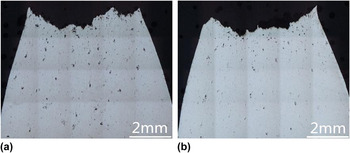
The longitudinal sections of the creep-ruptured samples are shown in Fig. 9. The necking can be easily found in the under-aged and peak-aged alloys, and the rupture mode is ductile. Meanwhile, a large number of microvoids distribute near fracture surfaces. Furthermore, the number of microvoids in the under-aged alloy is larger than that in the peak-aged alloy.
Longitudinal sections of the creep-ruptured samples by: (a) under-aging treatment; (b) peak-aging treatment.

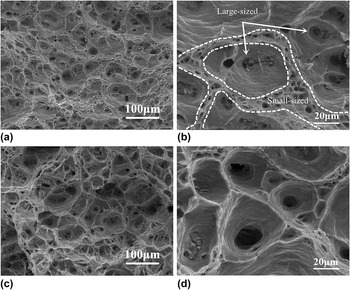
Figure 10 shows the fracture surfaces of the under-aged and peak-aged alloys. The fracture surfaces of the studied alloys are all covered with dimples, showing the typical transgranular fracture characteristic. It suggests that the deterioration of creep properties is due to the nucleation, growth, and coalescence of microvoids. From Fig. 10(a), two kinds of dimples, large-sized and small-sized dimples, can be detected on the fracture surface of the under-aged alloy. Generally, the large precipitates are incoherent with the matrix, and easily induces the nucleation of microvoids. The external stress accelerates the growth of microvoids, and the coalescence of microvoids contribute to the final fracture of specimens. Reference Zhou, Lin, Deng and Jiang54 The large-sized dimples distribute densely on the whole surface, and some particles are found at the bottom of them. These particles, which are proved to be Fe-rich phases by EDS point measurements, are coarse insoluble precipitates appear in casting or solidification processes. Except for the large dimples, some small dimples on the fracture surface of the under-aged alloy can be found. Figure 10(b) gives the high-magnitude figure of dimples. Small dimples continuously distribute at some tearing edges of large dimples. These small dimples can be regard as intergranular dimples derived from large-sized intergranular precipitates. Due to the impediment of large-sized intergranular precipitates on grain boundary sliding, these precipitates induce the nucleation of microvoids on grain boundaries, especially at transverse grain boundaries. Reference Kassner and Hayes55 These microvoids accelerate creep damage because the continuously distributed microvoids are easy to coalesce.
SEM micrographs of the fracture surfaces of creep-ruptured samples by: (a–b) under-aging treatment; (c–d) peak-aging treatment.

Compared to Fig. 10(a), almost no small-sized dimple is found on the fracture surface of the peak-aged alloy shown in Fig. 10(c). All the dimples in the fracture surface of the peak-aged alloy are relatively large, as shown in Figs. 10(c) and 10(d). The density of large dimples in the peak-aged alloy is similar to that in the under-aged alloy. It is because that the pre-treatment temperature is lower than the dissolution temperature of coarse insoluble precipitates, the pre-treatment at 120 °C has little effect on the coarse insoluble precipitate. Reference Maximov, Duncheva, Anchev and Ichkova24 The average size of large dimples on the fracture surface of the peak-aged alloy is slightly larger than that of the under-aged alloy. The depth of large dimple on the fracture surface of the peak-aged alloy are deeper than that of the under-aged alloy. It suggests that the dimples in the peak-aged alloy are hard to coalesce, compared to the under-aged alloy.
IV. CONCLUSIONS
In this study, the effects of pre-treatment on precipitate microstructures and creep-fracture behavior of a Al–Zn–Mg–Cu alloy are discussed in detail. The important findings can be summarized as follows:
-
(1) Creep-rupture life of the peak-aged alloy is much longer than that of the under-aged alloy under the tested conditions.
-
(2) Solution atoms continue to precipitate in the under-aged alloy during creep. The nucleation and growth up of these precipitates preferentially occur at grain boundaries and dislocations.
-
(3) The fracture mode of the under-aged and peak-aged alloys are both transgranular dimple fracture. A mount of small-sized dimples appear on the fracture surface of the under-aged alloy, while the dimples on the fracture surface of the peak-aged alloy are very large. The nucleation of small-sized dimples is induced by large precipitates at grain boundaries. The coalescence of small size dimples in the under-aged alloy accelerates creep damage.
ACKNOWLEDGMENTS
This work was supported by the National Natural Science Foundation Council of China (Grant Nos. 51375502, 51305466), the National Key Basic Research Program (Grant No. 2013CB035801), the Project of Innovation-driven Plan in Central South University (Grant No. 2015CX002), the Natural Science Foundation for Distinguished Young Scholars of Hunan Province (Grant No. 2016JJ1017), and the Graduate Degree Thesis Innovation Foundation of Central South University (Grant No. 2015zzts202).