INTRODUCTION
One of the major research questions in first language acquisition is whether children's grammar is compatible with the hierarchical nature of language. We investigate this issue, focusing on Japanese, which was once treated as a non-hierarchical language (Farmer, Reference Farmer1980; Hale, Reference Hale, Otsu and Farmer1980; Reference Hale, Pustejovsky and Sells1982). Our goal is to demonstrate that despite the insufficiency of input, preschool Japanese-speaking children can correctly interpret numeral floating quantifiers whose interpretation depends on hierarchical phrase structure rather than on the linear ordering of the floating quantifier and its referent.
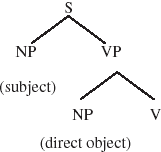
Linearity and hierarchy for sentence comprehension are key notions in the two experiments presented in this article. In (1) and (2), the linear ordering of words from left to right is the same: the subject is followed by the direct object, which in turn is followed by the verb, representing the canonical word order in Japanese.
(1)

(2)
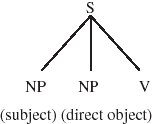
Even so, these representations differ in terms of how the constituents are organized to form a sentence. Hierarchical phrase structure refers to the organization of a sentence in which certain constituents dominate others (e.g. Chomsky, Reference Chomsky1957). In the structure shown in (1), the subject NP is hierarchically higher than the direct object NP because the subject NP occupies the same hierarchical position as that of the VP, and the direct object NP is under the VP node. In contrast, the flat structure in (2) exhibits no hierarchical difference between the two NPs due to the lack of the VP node. In this representation, the sentence is merely a string of words.
Although linearity plays an important role in real-time sentence processing by the human parser (e.g. Frazier, Reference Frazier1978), it is not sufficient to account for the nature of a variety of core syntactic phenomena, including co-reference, agreement and movement (e.g. Chomsky, Reference Chomsky1981; Reference Chomsky1986). Syntactic rules and constraints on these phenomena apply to hierarchical phrase structure.
Children's syntactic knowledge related to hierarchical phrase structure has been widely investigated, but only a few studies have inquired whether children apply a linguistic constraint on the linear ordering of constituents or on hierarchical phrase structure. Crain and Nakayama (Reference Crain and Nakayama1987) were the first to investigate this issue. They elicited a yes/no question from three- to five-year-old English-speaking children for a sentence involving a relative clause, as in (3). They aimed to examine whether children produced a question form as in (4) or (5).
(3) The boy who is watching Mickey Mouse is happy.
(4) Is the boy [who is watching Mickey Mouse] happy?
(5) *Is the boy [who watching Mickey Mouse] is happy?
If children apply subject–auxiliary inversion to hierarchical phrase structure, thereby treating it as a structure-dependent rule, they should produce the question form as in (4) because the auxiliary verb to be moved is the one outside the relative clause indicated by the square brackets. If, on the other hand, children refer to the linear ordering of the constituents in a sentence, they may move the auxiliary verb in the relative clause to the sentence-initial position as in (5), simply because this auxiliary verb is linearly closer to the sentence-initial position. This indicates the application of a structure-independent rule.
The results indicated that the older group of children (mean age=5 ; 3) produced the correct question form 80 percent of the time. The younger group of children (mean age=4 ; 3) produced many ungrammatical sentences, but they never moved the auxiliary verb from the relative clauses, according to Crain and Nakayama's (Reference Crain and Nakayama1987) analysis. Based on these results, Crain and Nakayama (Reference Crain and Nakayama1987) suggest that the children apply the structure-dependent rule.
More recently, Lidz and Musolino (Reference Lidz and Musolino2002) investigated children's interpretations of sentences involving negation and quantified NPs. They addressed the hierarchy–linearity issue and tested the following type of ambiguous sentence:
(6) Donald didn't find two guys.
One interpretation of (6) can be paraphrased as ‘It is not the case that Donald found two guys’. In this reading, negation takes scope over the quantified NP two guys, with negation taking a hierarchically higher position than that of the quantified NP. They call this interpretation the isomorphic reading because the linear ordering of the negation and the quantified NP matches their scope relations. That is, the negation, which takes scope over the quantified NP, precedes the quantified NP. The other interpretation can be paraphrased as ‘There are two guys that Donald didn't find’. In this case, the quantified NP takes scope over negation: the quantified NP takes a hierarchically higher position than that of negation in the abstract level of the hierarchical semantic representation. Lidz and Musolino (Reference Lidz and Musolino2002) call this interpretation the non-isomorphic reading because the linear ordering of the negation and the quantified NP does not match with their scope relations: the quantified NP that takes scope over negation follows the negation.
Using a truth value judgement task, Lidz and Musolino (Reference Lidz and Musolino2002) tested English-speaking children (mean age=4 ; 4) to examine whether they accept each interpretation. The results disclosed that the children accepted the isomorphic reading 81 percent of the time and the non-isomorphic reading 33 percent of the time. Children's preference for the isomorphic reading seems to reflect the fact that in the surface syntax English negation not only precedes the quantified NP linearly but also takes a hierarchically higher position than the quantified NP.
In order to examine whether the children's preference is due to linearity or hierarchy, Lidz and Musolino (Reference Lidz and Musolino2002) tested Kannada-speaking children (mean age=4 ; 5). Unlike in English, the negative morpheme follows the quantified NP in Kannada. Therefore, if the preference is due to the linear ordering of the quantified NP and the negative morpheme, Kannada-speaking children should show a preference opposite to that of English-speaking children. On the other hand, if the preference is due to hierarchy, then Kannada-speaking children should show the same preference as English-speaking children since the negative morpheme is located in a structurally higher position than the quantified NP, although the negative morpheme linearly follows the quantified NP in Kannada. The results revealed that Kannada-speaking children had the same preference as English-speaking children did: they preferred the reading in which negation takes scope over the quantified NP (75% acceptance) to the other reading (22·9% acceptance). This finding indicates that the children's preference is due to their access to hierarchical representation.
These previous studies provide us with evidence that preschool children can make reference to the hierarchical nature of language. An important aspect of these studies is that the hierarchical nature of language is very difficult to learn from input alone. For example, Crain and Nakayama (Reference Crain and Nakayama1987) suggest that there is no explicit indication of subject–auxiliary inversion in hierarchical phrase structure due to the fact that both structure-independent and structure-dependent rules are compatible with a yes/no question in simple sentences, thereby raising a learnability problem. An empirical investigation of the input data has advanced the poverty of stimulus argument with regard to this phenomenon (Legate & Yang, Reference Legate and Yang2002; Pullum & Scholz, Reference Pullum and Scholz2002).
Children learning Japanese floating quantifiers are likely to face the same problem: the interpretation of the floating quantifiers is based on hierarchical phrase structure and since the hierarchical relations need not coincide with their linear relations, the structures would seem to be difficult to learn purely from the input. Thus, this article first explores the nature of input available to children with regard to the floating quantifiers, and then examines children's knowledge of hierarchical phrase structure to which the constraint on quantifier floating applies. Before turning to them, we present general properties and constraints on the interpretation of floating quantifiers in Japanese in the next section.
GENERAL PROPERTIES AND QUANTIFIER FLOATING IN JAPANESE
Some major properties of Japanese include the use of case-marking morphology on argument NPs, argument ellipsis, and a relatively free ordering of constituents. As shown in (7), arguments are marked with case markers: the subject is marked with nominative -ga and the direct object with accusative -o. In addition, these arguments can be dropped from the sentence, as in (8)–(10), as long as the information regarding them is available in the given context.
(7) Gakusei-ga hon-o yonda.student-nom book-acc read‘Students read books.’
(8) Hon-o yonda.book-acc read‘X read books.’
(9) Gakusei-ga yonda.student-nom read‘Students read X.’
(10) Yonda.read‘X read Y.’
(11) Hon-o gakusei-ga yonda.book-acc student-nom read‘Students read books.’
Moreover, although a main verb usually stays in the sentence-final position, the order of the other words is relatively free. Thus, an OSV order, as shown in (11), is also possible and the meaning of the sentence is basically the same as the SOV version in (7).
Owing mainly to this free word-order phenomenon (e.g. Hale, Reference Hale, Pustejovsky and Sells1982; Reference Hale1983), Japanese was once claimed to have a flat structure (Farmer, Reference Farmer1980; Hale, Reference Hale, Otsu and Farmer1980; Reference Hale, Pustejovsky and Sells1982). This property is referred to as non-configurationality because grammatical relations, such as subject and direct object, may not be specified in terms of the hierarchical phrase structure configuration (see Baker, Reference Baker, Baltin and Collins2001, for a summary of non-configurationality). As shown in the previous section, what is crucial for hierarchical phrase structure is the existence of a VP. The VP node ensures the hierarchical difference between the subject NP and the direct object NP in the sentence. In the structure that lacks the VP node, there is no hierarchical difference between the two NPs, whereas in the structure that has a VP, the subject NP is hierarchically higher than the direct object NP.
Now we will see evidence for a VP in Japanese by looking at the phenomenon of quantifier floating. A Japanese numeral quantifier consisting of a numeral (e.g. san ‘three’) and a classifier (e.g. -nin for counting people) is used in two ways, as shown in (12) and (13).
(12) San-nin-no gakusee-ga koronda.three-cl.gen student-nom fell down‘Three students fell down.’
(13) Gakusee-ga san-nin koronda.student-nom three-cl fell down‘Three students fell down.’
In (12), a numeral quantifier precedes the noun it modifies, and the genitive case marker -no is attached to it. On the other hand, in (13) a numeral quantifier follows the noun that it modifies. Although it has been discussed whether the numeral quantifier in (13) floats out of the NP from its original position in (12) (see, for example, Ishii, Reference Ishii1998; Maling, Reference Maling1976; Mihara, Reference Mihara1998; Postal, Reference Postal1974; Sportiche, Reference Sportiche1988), it is sufficient, at least for our purposes, to observe that the numeral quantifier in (13) basically receives the same interpretation as that in (12). We will use the well-known traditional term ‘quantifier floating’ to refer to this phenomenon and the term ‘floating quantifier’ to refer to such a quantifier as shown in (13).
A subject–object asymmetry on floating quantifiers emerges when SOV is compared with OSV. In the following examples from Kuroda (Reference Kuroda1983), the floating quantifiers and their ‘host NPs’ (i.e. the NPs that the quantifiers modify) are adjacent to each other in (14) and (15) but not in (16) and (17). The subject–object asymmetry shows up only in the latter pair.
(14) Gakusee-ga san-nin hon-o katta.student-nom three-cl book-acc bought‘Three students bought a book.’
(15) Gakusee-ga hon-o san-satu katta.student-nom book-acc three-cl bought‘A student bought three books.’
(16) *Gakusee-ga hon-o san-nin katta.student-nom book-acc three-cl bought‘Three students bought a book.’
(17) Hon-o gakusee-ga san-satu katta.book-acc student-nom three-cl bought‘A student bought three books.’
The sentences in (14) and (15), the adjacent patterns, are grammatical. In these sentences, floating quantifiers and their host NPs are linearly side-by-side. Whether the quantifier modifies the subject as in (14) or the direct object as in (15) does not affect the grammaticality of these sentences. On the other hand, in the non-adjacent patterns (16) and (17), only the latter is grammatical. In the ungrammatical sentence (16), in which the quantifier modifies the subject, the floating quantifier san-nin ‘three people’ is not adjacent to its host NP gakusee-ga ‘students’ because of the intervening direct object. However, in the similar pattern in (17), in which the quantifier modifies the direct object, the sentence is grammatical even though the floating quantifier san-satu ‘three volumes’ and its host NP hon-o ‘books’ are not adjacent, owing to the intervening subject. If Japanese had a flat structure, then the contrast in the grammaticality between (16) and (17) would not be predicted: the linear distance between the floating quantifier and its host NP in the sentence-initial position is the same in (16) and (17).
Many studies discuss quantifier floating to demonstrate that the canonical word order of Japanese is SOV, the OSV order is derived from the SOV, and a hierarchical asymmetry exists between the subject and the direct object because of the VP (e.g. Haig, Reference Haig1980; Kuroda, Reference Kuroda and Kunihiro1980; Reference Kuroda1983; Miyagawa, Reference Miyagawa1989; Saito, Reference Saito1985; Takezawa, Reference Takezawa1987). In this view, the subject is outside the VP, and the direct object is inside the VP in the canonical SOV sentences. The ungrammaticality of (16) is the result of separating the floating quantifier and its host NP by the VP node.Footnote 1 Stating this explicitly, Miyagawa (Reference Miyagawa1989: 30) suggests the mutual c-command requirement as follows.Footnote 2
(18) Mutual c-command requirement: For a predicate to predicate of a NP, the NP or its trace and the predicate or its trace must c-command each other.
(19)
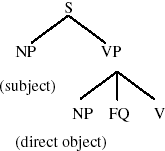
The mutual c-command requirement basically shows that the floating quantifier and its host NP must be sisters immediately dominated by the same node. According to this requirement, the ungrammaticality of (16) is straightforward. As shown in (19), the subject is outside the VP and it c-commands the floating quantifier, whereas the floating quantifier is inside the VP and cannot c-command the subject; therefore, they do not satisfy the mutual c-command requirement. It should be stressed that the ungrammaticality is not due to the linearity, as is obvious in (17), in which the OSV word order is derived from the SOV in (15) by fronting the direct object, as shown in (20).
(20)

When the direct object is fronted, a gap is created in its original position as indicated by t (trace) in (20). This trace is inside the VP and still available in the structural configuration. The floating quantifier san-satu does not c-command the fronted direct object, but Miyagawa's proposal allows the trace of the direct object to c-command the floating quantifier and to be c-commanded by the quantifier. Therefore, the requirement is satisfied just as its SOV counterpart in (15).Footnote 3
The correct application of this constraint requires children's mastery of some basic properties of Japanese, including case markers and scrambling. It has been observed that preschool children often make comprehension errors for reversible sentences in which both the subject and the direct object are animate NPs (e.g. Hakuta, Reference Hakuta1982; Hayashibe, Reference Hayashibe1975; Iwatate, Reference Iwatate1980), but this does not necessarily mean that the children cannot make use of a case-marking cue for sentence comprehension. When a sentence is provided in context, five-year-old children can make use of a case-marking cue to single-argument sentences (Suzuki, Reference Suzuki2007) and even three- and four-year-old children can correctly interpret OSV sentences (Otsu, Reference Otsu, Hoekstra and Schwartz1994). These studies suggest that preschool children demonstrate knowledge of case makers, but their use in sentence comprehension is unstable, and is affected by word-order difficulty associated with sentence reversibility.
As for the knowledge of scrambling, in which filler–gap dependencies between the moved object and its trace are involved, as in (20), previous studies in English are suggestive. Both Love (Reference Love2007) and Roberts, Marinis, Felser and Clahsen (Reference Roberts, Marinis, Felser and Clahsen2007) reported the effects of filler–gap dependencies in the comprehension of relative clauses by English-speaking children. By using a cross-modal picture priming task, Roberts et al. (Reference Roberts, Marinis, Felser and Clahsen2007) investigated five- to seven-year-old children's on-line processing of relative clauses and found that the filler was reactivated in the gap position. This finding is consistent with the results in Love (Reference Love2007), who used a similar task for four- and five-year-olds. The results of these studies suggest that some English-speaking preschool children refer to the trace of the filler in real-time sentence processing. In terms of Japanese, the results of the on-line data from Japanese scrambling (Suzuki, Reference Suzuki, Costa, Castro, Lobo and Pratas2010) also suggest support for the view that children's processing involves filler–gap dependencies.
In sum, these previous studies suggest that preschool children may have difficulty in using a case-marking cue but that filler–gap dependencies are available in their grammar. Taking them into account, we investigate children's knowledge of the syntactic constraint on quantifier floating.
THE NATURE OF THE INPUT
In this section, we report the types and frequency of the parental input regarding quantifier floating and show that Japanese-speaking children are likely to receive very little, if any, information regarding the syntactic constraint on floating quantifiers. We used the Child Language Data Exchange System (CHILDES) database (MacWhinney, Reference MacWhinney2000; Oshima-Takane, MacWhinney, Sirai, Miyata & Naka, Reference Oshima-Takane, MacWhinney, Sirai, Miyata and Naka1998) of spontaneous speech by Japanese-speaking caregivers. We selected the Tai (Miyata, Reference Miyata2004) and Arika corpora (Nisisawa & Miyata, Reference Nisisawa and Miyata2009) as representatives of child-directed speech to relatively younger children and relatively older children, respectively. The age range of the child in the Tai corpus is from 1 ; 5 to 3 ; 1, and that in the Arika corpus is from 3 ; 0 to 5 ; 1. We are concerned with how numeral floating quantifiers are used with their referents by the caregivers.
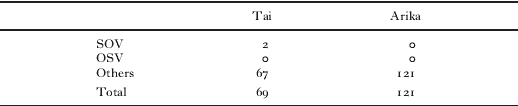
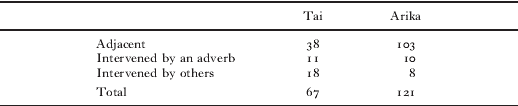
Focusing on mothers' utterances, we first extracted all utterances containing a noun or nouns followed by a numeral quantifier. The Tai corpus contains 426 and the Arika corpus 880 of those utterances. Then, we removed the utterances that did not contain both a floating quantifier and its referent as well as numeral quantifiers of idiomatic expressions (e.g. hitori-de ‘by oneself’), expressions of units (e.g. a monetary unit, dates and ages), and adverbial phrases (e.g. ni-kai ‘twice’). The exclusion of these utterances left a total of 190 mothers' utterances of floating quantifiers with their referents: 69 in the Tai corpus and 121 in the Arika corpus, as Table 1 shows. Among these utterances, there were only two SOV sentences and no OSV sentence.Footnote 4 The others are the utterances containing a noun followed by a numeral quantifier referring to it (e.g. SV, OV, XV).
Mothers' utterances that include a floating quantifier and its referent
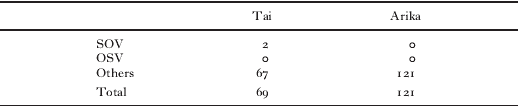
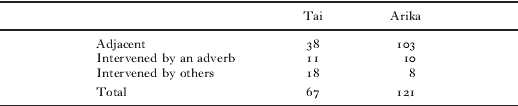
These results clearly indicate that the parental input offers very little information about SOV and no information about OSV regarding the interpretation of floating quantifiers. On the other hand, the input data provide children with an opportunity for learning the adjacent pattern of a floating quantifier and its referent. Among the ‘Others’ category in Table 1, we found that a large number of utterances exhibit the adjacent pattern. As summarized in Table 2, 56·7% (38/67) in the Tai corpus and 85·1% (103/121) in the Arika corpus are cases in which there is no intervening element between a floating quantifier and its referent. Further, if we include the sentences in which only one adverb intervenes between a floating quantifier and its referent, then the percentages rise to 73·1% (49/67) in the Tai corpus and 93·4% (113/121) in the Arika corpus. Based on these data in the input, children can easily learn the correct association of a floating quantifier and its referent in the adjacent pattern, but at the same time may easily make an overgeneralization that linear proximity is the requirement for the interpretation of floating quantifiers.
Breakdown of the ‘Others’ category in mothers' utterances that include a floating quantifier and its referent
In this situation, children learning to interpret floating quantifiers must face a challenging learnability problem. That is, despite the apparent insufficiency of input, they must acquire the syntactic constraint on hierarchical phrase structure. Now that it is empirically evident that linguistic input underdetermines the linguistic knowledge that adult native speakers have and that children must acquire, the next step is to explore such knowledge in children's grammar.
EXPERIMENTS
Our research question is whether Japanese-speaking preschool children can correctly interpret floating quantifiers in SOV and OSV sentences. If children's grammar is compatible with the hierarchical nature of language, they should correctly associate floating quantifiers with their references in both SOV and OSV sentences shown in (21) and (22), both of which include floating quantifiers that modify direct object NPs.
(21) Kaeru-ga [VP nezumi-o ni-hiki tatakimasita]. (SOV)frog-nom mouse-acc two-cl hit‘A frog hit two mice.’
(22) Nezumi-o kaeru-ga [VP ____ ni-hiki tatakimasita]. (OSV)mouse-acc frog-nom two-cl hit‘A frog hit two mice.’
In hierarchical phrase structure, only one referent satisfies the mutual c-command requirement in SOV and OSV. On the other hand, if children's grammar is not consistent with hierarchical phrase structure but is consistent with the flat one, then there is no hierarchical difference between the subject and the direct object because there is no VP. Such structure equally allows children to select a subject or direct object referent for the floating quantifier followed by a verb in SOV in (21) and OSV in (22). There is still another possibility that children make interpretation errors based on linear proximity, as evidenced in the adjacent pattern in (21). This linear proximity may play a role in the children's interpretation, and this is certainly consistent with the input data. The input data we analyzed included a great number of utterances in which a floating quantifier and its referent NP are adjacent or linearly close. Based on these facts, children may employ a linear-proximity strategy by which they take the linearly close NP as a referent of a floating quantifier. In this case, we predict that children fail to interpret the OSV pattern in (22) by taking the subject as a referent of the floating quantifier, whereas they may reach the correct interpretation of the SOV pattern in (21).
The main purpose of the two experiments in this study is to examine whether children can interpret floating quantifiers correctly, particularly when the quantifiers are not adjacent to their host NPs as opposed to cases in which they are linearly adjacent. The first experiment also aims to investigate what types of errors children make in interpreting floating quantifiers, if any, specifically in relation to word-order difficulty. The second experiment was designed to decrease the word-order and task difficulties involved in the first experiment.
EXPERIMENT 1
METHOD
Participants
Forty Japanese-speaking preschool children participated in Experiment 1. Their ages ranged from 4 ; 0 to 6 ; 11 (mean age=5 ; 5). The children were divided into three age groups: fifteen four-year-olds, thirteen five-year-olds and twelve six-year-olds. As a control group, fifteen adult native speakers of Japanese were tested. They were university students pursuing non-language-related majors.
Procedure
A picture selection task was used to examine children's sentence comprehension. An experimenter aurally presented a test sentence to a child such that the prosody was as natural and neutral as possible. The child's task was to select one of the four pictures that best matched the given sentence. Before the experimental session, we conducted a session for practice and screening. In this session, we attempted to familiarize the child with the task and examined whether the child knew the usage of -hiki, numerals, and the names of animals and items used in the test sentences. Adult participants were tested in the same way as children. All participants were tested individually in a quiet place.
Materials
The test sentences consisted of two types with six tokens each for SOV in (23) and OSV in (24), in which floating quantifiers modify the direct object (see Appendix A).
(23) Kaeru-ga [VP boo-de nezumi-o ni-hiki tatakimasita]. (SOV)frog-nom stick-with mouse-acc two-cl hit‘A frog hit two mice with sticks.’
(24) Nezumi-o kaeru-ga [VP boo-de ___ ni-hiki tatakimasita]. (OSV)mouse-acc frog-nom stick-with two-cl hit‘A frog hit two mice with sticks.’
These test sentences had animal names and action verbs that are familiar to Japanese preschool children. For the animal entities, the classifier -hiki is used because it is reported to be acquired early when compared with other classifiers (Yamamoto & Keil, Reference Yamamoto and Keil2000). The classifier -hiki is typically used for counting small animals and is compatible with both animals used in the sentence.
Further, we used a manner/instrumental adverb such as boo-de ‘with sticks’, assuming that it occurs under the VP node (e.g. Rizzi, Reference Rizzi1990). This adverb occurring within the VP (hereafter ‘VP adverb’) indicates that the following floating quantifier is also within the VP. The OSV sentence without a VP adverb is possibly construed as in (25), in which the floating quantifier outside the VP is associated with the subject NP. Therefore, it is important to ensure that the floating quantifier is within the VP.
(25) Nezumi-o kaeru-ga ni-hiki [VP ____ tatakimasita].mouse-acc frog-nom two-cl hit‘Two frogs hit a mouse.’
If the floating quantifier is inside the VP with the VP adverb, it cannot be associated with the subject NP. This is independently confirmed by judgements on sentences such as (26), in which the floating quantifier ni-hiki is semantically compatible with the subject kaeru-ga ‘frog’ but not with the direct object isi-o ‘stone’.Footnote 5
(26) *Kaeru-ga boo-de ni-hiki isi-o tatakimasita.frog-nom stick-with two-cl stone-acc hit
In this case, the sentence is unacceptable because the VP adverb boo-de forces the floating quantifier ni-hiki within the VP; therefore, the mutual c-command between the floating quantifier and the subject NP is blocked.Footnote 6
Each of the test sentences was presented to children along with four pictures, shown in Figure 1, depicting each of the four plausible combinations of the floating quantifier and two argument NPs in the test sentence. For expository purposes, we use (23) and (24) with Figure 1 to explain the children's response patterns.Footnote 7 The correct response is to choose Picture A, in which a frog is the agent and mice are the patients, with a floating quantifier modifying the latter. All other choices were considered to be errors and classified as a Floating-Quantifier error (FQ error), in which a floating quantifier is incorrectly associated with an agent NP, or a Word-Order error (WO error), in which the thematic roles of subject and direct object are incorrectly captured. Choosing Picture D indicates FQ error; Picture B, WO error; and Picture C, both FQ and WO errors (FQ-WO error).

RESULTS AND DISCUSSION
Seven children were excluded from the results and analyses: three could not demonstrate their knowledge of numerals and quantifiers; one was unable to follow the experimenter's directions; and three could not deal with the task although they completed the experimental session (two of them selected the upper-left pictures for all sentences, and one child did not listen to the test sentences). That left thirty-three children available for analyses: ten four-year-olds, eleven five-year-olds and twelve six-year-olds (age range: 4 ; 2–6 ; 11; mean age=5 ; 6).
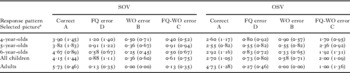
The results are summarized in Table 3. As the table clearly indicates, these children were most likely to select the correct picture for both the SOV and OSV patterns. A two-way repeated-measures ANOVA revealed a significant main effect of word order (F(1, 30)=23·623, p<0·001, ηp2=0·441) because the children performed better for SOV than for OSV. On the other hand, there was no significant main effect of age group (F(2, 30)=1·483, p=0·243, ηp2=0·090) and no interaction effect between word order and age group (F(2, 30)=0·286, p=0·753, ηp2=0·019). Thus, the data from three age groups are collapsed into one for the discussion. In the case of the adult control group, a paired t-test showed a significant effect of word order (t(14)=3·090, p<0·01, r=0·64) because the scores on SOV are higher than those on OSV.
Mean scores (out of 6) and standard deviations for response patterns in Experiment 1

a Pictures in this column correspond with those in Figure 1.
The fact that the children selected the correct pictures more often than any other pictures for both the SOV and the OSV patterns suggests that they can interpret floating quantifiers correctly even when the quantifier and its host NP are not adjacent to each other as well as when they are adjacent. Even so, the statistical results reflecting children's relatively poor performance for OSV compared with SOV appear to imply that children depend on linear proximity rather than hierarchical phrase structure for the interpretation of the floating quantifier. However, further analyses of the children's error patterns suggest that most of their errors can be attributed to word-order difficulty. The errors are not rooted in their reference to linear proximity of the floating quantifier and its plausible referent.
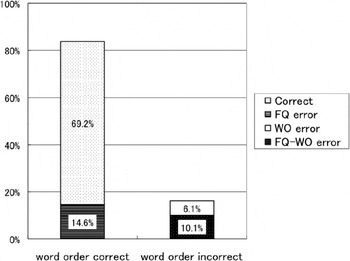
We demonstrate this by examining children's errors involving word order in detail. As Figure 2 shows, this type of error (word order incorrect) for SOV sentences was observed 16·2 percent of the time (WO error: 6·1%, FQ-WO error: 10·1%), whereas that for OSV sentences was observed 42·9 percent of the time (WO error: 9·6%, FQ-WO error: 33·3%) as in Figure 3, suggesting that the errors involving word order in OSV are the main source of difficulties in this experiment. Among them, FQ-WO errors in OSV were remarkably frequent (33·3%). Our interpretation of this particular error (e.g. selecting Picture C: a mouse hitting two frogs) is that, as shown in (27), the sentence-initial NP was incorrectly taken as the subject, and the floating quantifier ni-hiki right before the verb was related to the closest semantically compatible NP kaeru ‘frog’, which is incorrectly taken as the direct object.
(27)

Interpreting the OSV sentence incorrectly as an SOV, the children may have simply preferred the linearly closer NP as the referent of the floating quantifier. However, this does not necessarily mean that the children adopted the linear-proximity strategy for the interpretation of floating quantifiers. If they had done so, this strategy should also have appeared even when they did not make the errors involving word order for OSV. In that case, we expect that FQ errors in OSV (e.g. selecting Picture D: two frogs hitting a mouse) are also frequent, with the floating quantifier being incorrectly related to the linearly closer NP. However, such errors occurred only 12·1 percent of the time. When children interpreted the OSV word order correctly, they selected the sentence-initial direct object far more frequently than the linearly closer subject as a referent of the floating quantifier. This strongly suggests that the children did not simply follow linear proximity for the interpretation of floating quantifiers.
Percentages of response patterns for SOV in terms of correct/incorrect word order in Experiment 1.

Percentages of response patterns for OSV in terms of correct/incorrect word order in Experiment 1.

Word-order difficulty is also obvious in the performance by the adult control group. As in the case of children, adults' performance on SOV was significantly better than that on OSV, and most frequently occurring errors were FQ-WO errors in OSV. In this regard, the adults' and the children's performances are parallel although the adults' performance was far better than the children's. Adults' difficulty with OSV is often observed in the literature on sentence processing studies (e.g. Mazuka, Ito & Kondo, Reference Mazuka, Ito, Kondo and Nakayama2002; Tamaoka, Sakai, Kawahara, Miyaoka, Lim & Koizumi, Reference Tamaoka, Sakai, Kawahara, Miyaoka, Lim and Koizumi2005). Since adults have difficulty with processing OSV, this difficulty should be even more apparent in children.
We now focus on the cases in which word order was correctly captured (word order correct). For SOV sentences, children's responses of this type consist of the correct response (69·2%) and FQ error (14·6%), as shown in Figure 2. In these cases, children selected the correct picture much more frequently than the incorrect one. For OSV sentences, children's responses of word order correct involve correct responses (44·9%) and FQ error (12·1%). As shown in Figure 3, the children selected the correct picture much more frequently than the incorrect one, suggesting that even when the NP and its floating quantifier were not adjacent to each other, the children took the floating quantifier as referring to the fronted direct object much more frequently than to the linearly closer subject, when they captured the word order correctly.
Taking these results into account, we suggest that the children's interpretation of the floating quantifier is based on hierarchical phrase structure. However, the overall low scores could undermine this claim. We believe that two factors are responsible for these low scores. One major factor, as is obvious from the discussion above, is word-order difficulty. When the sentences are reversible and provided in the OSV order, they affect the children's use of a case-marking cue for sentence comprehension. Thus, it is ideal to assess the children's interpretation of the quantifiers independent from the errors rooted in their word-order difficulty. The other factor is task difficulty. In this experiment, there were four pictures from which the children had to choose one. This task is more demanding than an alternative-choice test in a typical picture selection task and is likely to affect children's attention and concentration. Accordingly, we conducted another experiment in which we attempted to decrease both word-order difficulty and task difficulty.
EXPERIMENT 2
METHOD
Participants
Thirty-three Japanese-speaking preschool children participated in Experiment 2. Their ages ranged from 4 ; 2 to 6 ; 11 (mean age=5 ; 6). We divided them into three age groups: ten four-year-olds, eleven five-year-olds and twelve six-year-olds. We also tested fifteen adult native speakers of Japanese as a control group. All children and adults participated in Experiment 1.
Procedure
A picture selection task was used. Each child was aurally provided with a test sentence with natural and neutral prosody, and was asked to select a picture that matched the given sentence. Before the experimental session, a practice and screening session was conducted, aimed at familiarizing the children with the task and examining whether the children knew the usage of the numeral quantifier ni-hiki ‘two animals’ and the names of animals used in the test sentences. All children were successful in this session. Adult participants were tested in the same way as the children. Experiment 2 was conducted individually in a quiet room immediately after Experiment 1.
MATERIALS
In order to decrease word-order difficulty, we used the following types of test sentences: SOV in (28) and OSV in (29).
(28) Inu-ga [VP maeasi-de hebi-o ni-hiki tatakimasita].dog-nom forepaw-with snake-acc two-cl hit‘A dog hit two snakes with its forepaw.’
(29) Hebi-oi inu-ga [VP maeasi-de t i ni-hiki tatakimasita].snake-acc dog-nom forepaw-with two-cl hit‘A dog hit two snakes with its forepaw.’
Each test sentence expresses that two animals were involved in an action in a particular manner, denoted by a verb and a VP adverb, but only one of them has distinctive characteristics that enable it to perform the action. Sentences (28) and (29), for example, mean that ‘A dog hit two snakes with its forepaw’. Since only the dog has paws, it is clear that the dog is the agent and the snakes are the patients. Assuming that the word-order difficulty in OSV observed among children in Experiment 1 is ascribed to sentence reversibility, we believe that this semantic congruency should help the children to understand the sentence as an OSV and enable them to interpret the dog as the agent, even though it is the second NP of the OSV sentence in (29). Accordingly, the number of pictures needed in this picture selection task was two, as shown in Figure 4, which decreased the task difficulty. The correct response for (28) and (29) is selecting the picture on the left in Figure 4. Selecting the picture on the right indicates an FQ error.

Another reason to use a VP adverb, as in Experiment 1, is to ensure that the floating quantifier is within a VP, based on the suggestion that the adverb is under the VP node. There were six tokens each for SOV and OSV sentences (see Appendix B).
RESULTS AND DISCUSSION
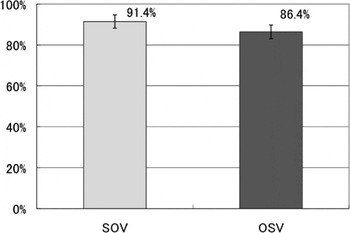
Table 4 provides the results in mean scores and standard deviations, and Figure 5 shows the overall correct percentages and standard errors for SOV and OSV.
Percentages of correct responses by all children in Experiment 2.

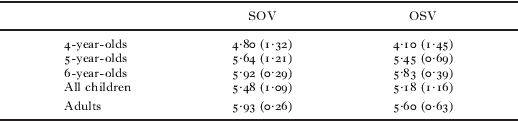
Mean scores (out of 6) and standard deviations for correct responses for SOV and OSV in Experiment 2
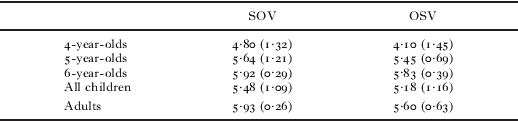
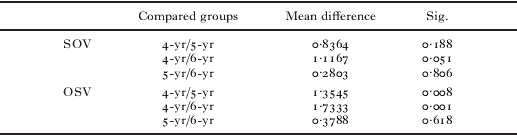
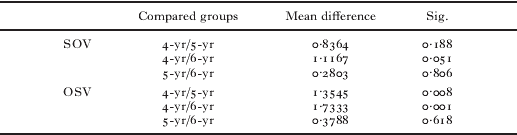
A two-way repeated-measures ANOVA revealed no significant difference between SOV and OSV (F(1, 30)=2·780, p=0·106, ηp2=0·085). However, a significant effect of age group was found (F(2, 30)=9·323, p<0·01, ηp2=0·383). There was no interaction effect between word order and age group (F(2, 30)=0·948, p=0·399, ηp2=0·059). A post-hoc test, the Scheffé, revealed significant differences between four-year-olds and the two older groups for the OSV pattern, as summarized in Table 5. For the adult control group, the effect of word order was not significant (t(14)=−2·092, p=0·055, r=0·49).
Results of a post-hoc comparison in Experiment 2
The overall scores in Experiment 2 were very high, and the scores on OSV were as high as those on SOV. A substantial increase was thus observed in the scores in Experiment 2 compared with those in Experiment 1. We believe that these increases are due to the manipulation of word-order difficulty and task difficulty.
Most importantly, it was found that the children do not follow the linear-proximity strategy. As we previously stated, if children simply followed the linear-proximity strategy for the interpretation of floating quantifiers, they would be correct on SOV but incorrect on OSV. This is because the floating quantifier and its host NP are adjacent to each other in the SOV pattern, whereas in the OSV pattern the floating quantifier is linearly closer to the subject than the fronted direct object. However, the children were able to correctly identify the direct object as a referent of the floating quantifier in OSV 86·4 percent of the time.
The results also revealed that the scores of the four-year-olds were lower than those of the older children. The Scheffé identified exactly where the differences were: the correct response rate of the four-year-olds in OSV sentences was 68·3 perent (mean scores=4·10), which is significantly lower than those of the children in the two older groups. Note, however, that this is statistically above chance (t(9)=2·400, p=<0.05), reflecting the fact that the children associated the floating quantifier with the direct object more frequently than they did with the subject. In order to examine whether the younger children's low scores were due to the linear-proximity strategy or other reasons, we looked at the children's individual scores.
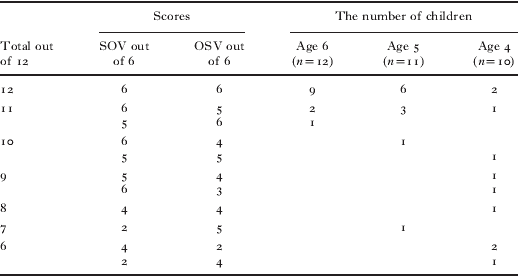
As shown in Table 6, the scores of most children in the two older groups were perfect (scored 12) or nearly perfect (scored 11), but there were remarkable variations in response patterns by the four-year-olds. In this younger group, three children achieved perfect or nearly perfect scores, but three children scored only 6 in total, and the rest were scattered in between.
The number of children in terms of scores and age groups in Experiment 2
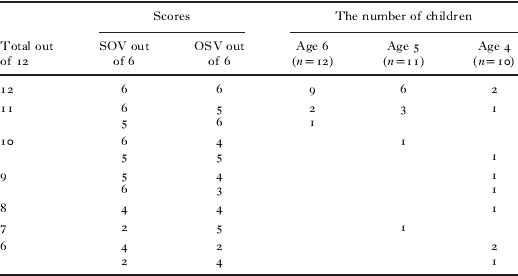
If these children had followed the linear-proximity strategy, their responses would have been correct on all SOV sentences and wrong on all OSV sentences; however, it is clear from Table 6 that there was no such pattern. Yet, there was one child who scored perfect (scored 6) in SOV and 50 percent correct (scored 3) in OSV sentences. This child had no problem relating the floating quantifier and its host NP that were adjacent to each other. This child's perfect response on SOV may appear to suggest the use of the linear-proximity strategy. However, the chance performance on OSV should be interpreted to mean that the child might have randomly selected one of the two argument NPs as a host NP of the floating quantifier. Thus, we conclude that no child in this experiment employed the linear-proximity strategy for the interpretation of the floating quantifier.
GENERAL DISCUSSION
The results of the two experiments show that Japanese-speaking children's grammar is compatible with the hierarchical nature of language. The children correctly associated a floating quantifier with its referent not only in the SOV but also in the OSV sentences. Therefore, their interpretation of floating quantifiers follows the mutual c-command requirement and thus is syntactically constrained. Like other studies on different languages (Crain & Nakayama, Reference Crain and Nakayama1987; Lidz & Musolino, Reference Lidz and Musolino2002), this study has demonstrated that Japanese-speaking children apply a syntactic constraint on hierarchical phrase structure.
The children's knowledge of this kind is not dependent on inductive learning from the input, as we have empirically demonstrated that parental input underdetermines the syntactic knowledge regarding the interpretation of floating quantifiers. We have disclosed many utterances in the parental input in which floating quantifiers and their referent NPs are adjacent or linearly close. These patterns are compatible with both the rule in terms of linear ordering of constituents and the rule in terms of hierarchical phrase structure. Crucially, it is impossible from the input for children to learn the interpretation rule that is structurally dependent on hierarchical phrase structure because there are no input data that disconfirm linear proximity of a floating quantifier and its referent NP. Nonetheless, there was no child who employed the linear-proximity strategy, and many of the children's responses point to the interpretation rule that is dependent on hierarchical phrase structure. This fact supports the view that the children's grammar is equipped with hierarchical phrase structure and that the acquisition of the syntactic constraint on floating quantifiers is guided by certain abstract principles not specified in the input.
One may still ask why the four-year-olds showed relatively poor performance compared with older children and adults. There is no possibility that the four-year-olds have a flat structure. Having a flat structure should have resulted in either no preference for the subject or direct object as a referent of a floating quantifier in both the SOV and OSV patterns, or a preference for the subject in the OSV and the direct object in the SOV if they follow the linear-proximity strategy. However, neither of these results occurred in our analyses on the individual performances of the four-year-olds.
The alternative account is that the four-year-olds' errors are due to performance factors. In this view, children's grammar is essentially identical to adults' in the sense that the same syntactic constraint applies to the same hierarchical structure (e.g. Lust, Reference Lust, Ritchie and Bhatia1999; Pinker, Reference Pinker1984). What is particular about the four-year-old children is their limited resources for processing information, which causes difficulty in sentence comprehension tasks. Our manipulations to decrease task difficulty and word-order difficulty may have been insufficient for some younger children to demonstrate their grammatical competence.
A general performance factor that affects young children's comprehension difficulty may lie in sentence length. The test sentence was relatively long, containing an adverb, a numeral and a classifier, in addition to two argument NPs and a transitive verb. Processing the information conveyed by such a long sentence may not be an easy task for young children. A more specific contributor to children's performance difficulties might be the children's unstable use of a case-marking cue for sentence comprehension. As mentioned above, previous studies observed that young preschool children's knowledge of case markers is often affected by word-order difficulty. They may easily follow the canonical pattern of thematic role alignment: the most typical or canonical ‘agent–patient–verb’ pattern associated with SOV in Japanese. This is remarkable in reversible sentences in which both the subject and direct object are animate, and the results of Experiment 1 reflect this fact. Although the test sentences used in Experiment 2 are not reversible, they contain animate entities for both the subject and direct object, which may not have allowed the young children to ignore the canonical ‘agent–patient–verb’ pattern. Their reliance on this pattern often overrides their knowledge of case markers, and it must be very difficult for them to reinterpret the NPs in OSV once given particular thematic roles during real-time sentence processing. This type of comprehension difficulty is evidenced in Trueswell, Sekerina, Hill and Logrip (Reference Trueswell, Sekerina, Hill and Logrip1999), who observed that English-speaking children are not easily able to recover from the garden-path effect in resolving sentence ambiguity. For the present case of the OSV sentences, as soon as children hear the first two NPs, they try to give them agent and patient roles in that order. Then, when they hear a VP adverb ‘with forepaw’ for the OSV sentence as in (29), repeated here as (30), they should realize that the first NP ‘a snake’ is inconsistent with the role of agent and the VP adverb.
(30) Hebi-oi inu-ga [VP maeasi-de t i ni-hiki tatakimasita].snake-acc dog-nom forepaw-with two-cl hit‘A dog hit two snakes with its forepaw.’
However, their limited resources for sentence processing may not allow them to reinterpret the thematic relations of the argument NPs. As a result, younger children are perplexed by the semantic incongruence, thus causing their poor performance.
This processing difficulty is not specific to four-year-old children. In the adults' performance, there were remarkable effects of word order, although the effects were stronger for younger children than for older children and adults. In this way, the interpretation of scrambled sentences places a great burden on the parser, which sometimes causes comprehension errors in younger children's performance.
CONCLUSION
For the interpretation of floating quantifiers, children exposed to Japanese have been found to face a learnability problem, as the input is insufficient or even misleading. Our experiments revealed that preschool children have hierarchical phrase structure for the interpretation of floating quantifiers. It is surprising that no child employs the linear-proximity strategy, which is easy to learn from the input data.
We observed children's general success in the comprehension tasks, but the younger group of children failed to correctly interpret floating quantifiers in the OSV sentences. We suggest that the children's failure is rooted in performance factors. Word-order difficulty often overrides young children's knowledge of case markers and causes difficulty in sentence processing. However, this does not undermine our claim that their interpretation of floating quantifiers is structurally dependent on hierarchical phrase structure because even young children never followed the linear-proximity strategy. This fact suggests that children would not formulate the structure-independent rule in the course of language development. By contrast, they acquire structure-dependent rules, despite the insufficiency of the input. An important corollary of this conclusion is that children have knowledge of hierarchical phrase structure from the onset of language acquisition.
APPENDIX A: TEST SENTENCES IN EXPERIMENT 1
1. Kaeru-ga boo-de nezumi-o ni-hiki tatakimasita.
‘A frog hit two mice with sticks.’
2. Neko-ga te-de inu-o ni-hiki tatakimasita.
‘A cat hit two dogs with hands.’
3. Nezumi-ga hane-de saru-o ni-hiki kusugurimasita.
‘A mouse tickled two monkeys with feathers.’
4. Inu-ga te-de kitune-o ni-hiki kusugurimasita.
‘A dog tickled two foxes with hands.’
5. Kitune-ga sentakubasami-de kaeru-o ni-hiki tsunerimasita.
‘A fox pinched two frogs with clothespins.’
6. Saru-ga te-de neko-o ni-hiki tunerimasita.
‘A monkey pinched two cats with hands.’
7. Inu-o saru-ga boo-de ni-hiki tatakimasita.
‘A monkey hit two dogs with sticks.’
8. Nezumi-o kitune-ga te-de ni-hiki tatakimasita.
‘A fox hit two mice with hands.’
9. Neko-o inu-ga hane-de ni-hiki kusugurimasita.
‘A dog tickled two cats with feathers.’
10. Kaeru-o nezumi-ga te-de ni-hiki kusugurimasita.
‘A mouse tickled two frogs with hands.’
11. Kitune-o neko-ga sentakubasami-de ni-hiki tunerimasita.
‘A cat pinched two foxes with clothespins.’
12. Saru-o kaeru-ga te-de ni-hiki tunerimashita.
‘A frog pinched two monkeys with hands.’
APPENDIX B: TEST SENTENCES IN EXPERIMENT 2
1. Saru-ga te-de neko-o ni-hiki osimasita.
‘A monkey pushed two cats with its hands.’
2. Kirin-ga nagai kubi-de buta-o ni-hiki osimasita.
‘A giraffe pushed two pigs with its long neck.’
3. Zoo-ga hana-de raion-o ni-hiki tatakimasita.
‘An elephant hit two lions with its trunk.’
4. Inu-ga maeasi-de hebi-o ni-hiki tatakimasita.
‘A dog hit two snakes with its forepaw.’
5. Kani-ga hasami-de mimizu-o ni-hiki hasamimasita.
‘A crab pinched two earthworms with its claws.’
6. Kabutomusi-ga tuno-de sakana-o ni-hiki hasamimasita.
‘A beetle trapped two fish with its horn.’
7. Neko-o saru-ga te-de ni-hik osimasita.
‘A monkey pushed two cats with its hands.’
8. Buta-o kirin-ga nagai kubi-de ni-hiki osimasita.
‘A giraffe pushed two pigs with its long neck.’
9. Raion-o zoo-ga hana-de ni-hiki tatakimasita.
‘An elephant hit two lions with its trunk.’
10. Hebi-o inu-ga maeashi-de ni-hiki tatakimasita.
‘A dog hit two snakes with its forepaw.’
11. Mimizu-o kani-ga hasami-de ni-hiki hasamimasita.
‘A crab pinched two earthworms with its claws.’
12. Sakana-o kabutomusi-ga tuno-de ni-hiki hasamimasita.
‘A beetle trapped two fish with its horn.’