1. Introduction
The recognition that institutions have profound implications for the behavior of economic actors and for economic outcomes at the individual, firm, and national levels has resulted in a large and growing body of research on institutional characteristics and their implications for firms and markets (Kostova et al., Reference Kostova, Beugelsdijk, Scott, Kunst, Chua and Essen2020). Institutions are stable social structures consisting of regulative, cultural-cognitive, and normative elements that provide stability and meaning to social life (Scott, Reference Scott1995). Institutions can be formal or informal. Formal institutions specify the ‘rules of the game’ (North, Reference North1990) that govern economic activities within a country. They reduce risk, uncertainty, and transaction costs for economic actors.
Within the growing body of research on institutional differences, a stream of research which originated in finance and has subsequently attracted growing interest among International Business (IB) researchers focuses on the implications of legal origins for various aspects of economic activity (Cumming et al., Reference Cumming, Filatotchev, Knill, Reeb and Senbet2017; La Porta et al., Reference La Porta, Lopes-de-Silanes, Shleifer and Vishny1998). Each country, over its long history, has developed its own distinct set of rules that regulate and constrain all aspects of human activity including economic activity. Despite these intercountry differences in terms of specific provisions of laws, legal systems are broadly divided into two distinct categories: common law and civil law systems.
La Porta (Reference La Porta1996) suggests that the origin of a country's legal system affects the development of a domestic capital market. Similarly, Rajan and Zingales (Reference Rajan and Zingales1998) argue that the efficiency and integrity of the legal system are preconditions for a sophisticated capital market. One area of economic life where the differences in legal systems have important consequences is in terms of laws and enforcement mechanisms that protect the rights of investors and creditors. Generally speaking, countries whose formal institutions are based on Common Law tend to offer stronger legal rights and better protection to shareholders, especially minority shareholders, than those that follow Civil Law (La Porta et al., Reference La Porta, Lopes-de-Silanes, Shleifer and Vishny1998).
The efficient market hypothesis (Fama, Reference Fama1970) is one of the foundational theories of modern finance. According to this hypothesis, in an efficient market, all available information is already reflected in the price of a security such as a stock or bond. Analysis of prior stock behavior cannot help to predict subsequent price movements. Instead, in an efficient market, prices follow a random behavior. The logic of the random walk idea is that if the flow of information is unimpeded and the information is reflected immediately in stock prices, tomorrow's price change will reflect only tomorrow's news and will be independent of current price changes (Malkiel, Reference Malkiel2003).
Ever since the publication of Fama's (Reference Fama1970) seminal work, researchers have attempted to put the efficient market thesis to empirical verification. Researchers have examined various markets around the world, for different time periods and for different data frequencies. Lim and Brooks (Reference Lim and Brooks2011) provide a very detailed review of weak-form market efficiency literature. Both overall stock market indices and individual stocks have been empirically analyzed to verify whether they indeed follow a random walk. Three major conclusions emerge from this body of empirical work. First, different markets exhibit different levels of efficiency. Second, even within the same country, different time periods exhibit different levels of efficiency. Third, for the same country and same time period, individual stocks vary in their price efficiency. Thus, it is clear that an assumption of universal efficiency is not warranted by research evidence, and deviations from efficiency are widely prevalent. This led Grossman and Stiglitz (Reference Grossman and Stiglitz1980) and Malkiel (Reference Malkiel2003) to comment that markets cannot be perfectly efficient, because in that case there would be no incentive for investors to discover the information that is reflected so quickly in market prices.
Given the observed differences in market efficiency across countries, an important and perhaps obvious question is what accounts for these differences. Kawakatsu and Morey (Reference Kawakatsu and Morey1999) and Harvey (Reference Harvey1995) suggest that emerging countries have low trading volumes and slow incorporation and adaptation of current information. However, many emerging markets such as Brazil, India, South Africa, and China have trading volumes equal to or higher than many developed markets. Moreover, recent advances in information technology make incorporation of the latest information into prices much easier. Therefore, neither low trading volume nor slow incorporation of information can be considered as valid explanations for the observed differences in price efficiency. A theoretically more appealing explanation has been offered by Mobarek et al. (Reference Mobarek, Mollah and Bhuyan2008) who suggest that poor information disclosure, absence of effective regulatory bodies, and low standards of law enforcement may be the main causes of distortions in less developed financial markets.
There is considerable research going back decades which suggests that differences in institutional characteristics such as stringencies of disclosure requirements, control on inside trades, thinness of markets, and discontinuities of trading may result in deviations from random walk (Ang and Pohlman, Reference Ang and Pohlman1978; Solnik, Reference Solnik1973). Therefore, it seems reasonable to expect that countries with better investor protection laws will have more efficient stock exchanges. Given the general recognition that legal systems, and more specifically the protection of the rights of minority investors, can have a significant effect on the efficiency of the stock markets of a country, we find it surprising that so far there has been no systematic empirical investigation concerning the differential efficiencies of the stock markets of Common Law and Civil Law countries. The objective of our paper is to examine if the stock markets of Common Law countries are more efficient than those of Civil Law countries.
We conduct our analysis of efficiency differences using multifractal detrended fluctuation analysis (MF-DFA), a method originally developed in econophysics (Diniz-Maganini et al., Reference Diniz-Maganini, Rasheed, Yaşar and Sheng2023; Matia et al., Reference Matia, Ashkenazy and Stanley2003; Wang et al., Reference Wang, Liu and Gu2009). The use of MF-DFA to assess the price efficiency of individual securities as well as entire markets has become increasingly popular in recent years (Al-Yahyaee et al., Reference Al-Yahyaee, Mensi and Yoon2018; Zunino et al., Reference Zunino, Tabak, Figliola, Pérez, Garavaglia and Rosso2008) and has proved to be a reliable approach for measuring the level of efficiency of financial time series in the long run.
Our paper contributes to the IB literature in three ways. First, we identify and empirically examine differences in the efficiency of stock markets between Common Law and Civil Law countries. Second, by demonstrating that the differences in price efficiencies can be explained by institutional differences, we contribute to the literature on institutional differences and their implications for economic outcomes. Third, we make a methodological contribution by demonstrating that multifractal analysis is a useful and novel methodological approach to study the complex dynamics of stock markets in the long run.
The remainder of this article is organized as follows. Section 2 reviews prior literature and presents the hypotheses. Data, methodology, and results are described in section 3. The final section provides a discussion of results and conclusions.
2. Literature review and hypothesis
Financial theory is very much based on the assumption that markets are efficient. Butler and Malaikah (Reference Butler and Malaikah1992) suggest that inefficiency of a country's equity markets may have negative consequences for the allocative efficiency of resources within an economy and, therefore, for economic growth. Therefore, it is important to examine if there are differences in the efficiency of stock markets across countries and to identify the underlying reasons for such differences. A market is considered to be efficient if market prices fully reflect all available information (Fama, Reference Fama1970). In such markets, market participants cannot make unusual future economic gains on the basis of past information. Stock price movements in an efficient market resemble a random walk. That is, they are not predictable on the basis of past information. The more random or unpredictable the prices are in a market, it is considered as more efficient.
Over the years, a significant body of research has accumulated that empirically examines the efficiency of different markets. The evidence so far has been mixed, with researchers finding certain markets exhibiting the characteristics of an efficient market and others failing to do so. For example, Poterba and Summers (Reference Poterba and Summers1988) analyzed monthly and annual returns for the American market and 17 other European countries between 1871 and 1985 and found that stock returns show positive serial correlation over short periods and negative correlation over longer intervals. Fama and French (Reference Fama and French1988) set up 10 stock portfolios and analyzed their monthly returns between 1926 and 1985 and found that stock returns are predictable; Lo and Mackinlay (Reference Lo and Mackinlay1988) found evidence rejecting the random walk hypothesis for 625 U.S. stocks. Evidence in support of market efficiency in other countries comes from Cheung and Coutts (Reference Cheung and Coutts2001) for Hong Kong, Buguk and Brorsen (Reference Buguk and Brorsen2003) for Turkey, Kim and Shamsuddin (Reference Kim and Shamsuddin2008) for Japan, Korea, and Taiwan, and Ryaly et al. (Reference Ryaly, Kumar and Urlankula2014) for India, South Korea, Singapore, Hong Kong, and Japan. Evidence of lack of efficiency comes from Srinivasan (Reference Srinivasan2010) for India and Metghalchi et al. (Reference Metghalchi, Chen and Hayes2015) for Spain. These differences may be due to the methodologies used to measure efficiency, frequency of data used (daily versus weekly), or actual differences in the efficiency level of the stock markets of different countries.
A small number of studies have undertaken comparative assessments of stock market efficiencies of different countries. Di Matteo et al. (Reference Di Matteo, Aste and Dacorogna2005) compared the stock markets of 32 countries and found that in general, the stock indices of developed countries were more efficient than those of emerging countries. Zunino et al. (Reference Zunino, Tabak, Figliola, Pérez, Garavaglia and Rosso2008) also arrived at a similar conclusion as they found market efficiency is associated with the stage of market development. Kawakatsu and Morey (Reference Kawakatsu and Morey1999) in their study of 16 emerging markets found that market liberalization did not have a significant effect on market efficiency. In a somewhat surprising set of findings, Sensoy and Tabak (Reference Sensoy and Tabak2016) reported that after the 2008 financial crisis, most of the emerging stock markets recovered in terms of improved market efficiency, whereas this recovery was very slow or did not even happen in developed markets. Kim and Shamsuddin (Reference Kim and Shamsuddin2008) attributed the differences in pricing efficiency of markets in their study to the level of equity market development as well as the transparency of corporate governance.
Recent research in finance, strategic management, and international business has increasingly recognized the important role that institutions – both formal and informal – play in economic life (Guiso et al., Reference Guiso, Sapienza and Zingales2006; Jackson and Deeg, Reference Jackson and Deeg2008; North, Reference North1990; Peng et al., Reference Peng, Sun, Pinkham and Chen2009). Prominent among various research streams that have investigated the role of institutions is the Law and Finance School (LFS). A major institutional difference among countries that has far-reaching consequences for a broad range of rules and regulations as well as economic outcomes is the legal systems that they follow. In the last quarter century, proponents of this school have carried out extensive research on how the legal origins of countries and the specific characteristics of different legal systems have profound implications for the behavior of economic actors within each country, primarily because law motivates actors by signaling appropriate behavior (Schnyder et al., Reference Schnyder, Siems and Aguilera2021). It also has long-term implications for economic outcomes for each of these countries because such outcomes are the results of the behavior of economic actors.
There is increasing evidence that legal institutions have implications for economic outcomes of countries and governance of individual firms. It has been found, for example, that legal institutions affect the cost of capital (Hail and Leuz, Reference Hail and Leuz2006) and the capital structure of firms within a country (Fan et al., Reference Fan, Titman and Twite2012). Country-level institutional characteristics have been found to account for most of the variation in governance quality of firms (Doidge et al., Reference Doidge, Karolyi and Stulz2007). Kuvshinov and Zimmermann (Reference Kuvshinov and Zimmermann2022) report that Common Law countries tend to have higher market capitalization. Firms in Common Law countries have been found to invest more in R&D (Brown et al., Reference Brown, Martinsson and Petersen2013; Hillier et al., Reference Hillier, Pindado, Queiroz and La Torre2011) and perform better in terms of technology innovation (Wen et al., Reference Wen, Zhang and Chang2022). Institutional quality has strong implications for a country's ability to attract foreign private equity (Mingo et al., Reference Mingo, Junkunc and Morales2018) and information voids affect capital flow into countries (Kingsley and Graham, Reference Kingsley and Graham2017). Common Law countries have also been found to have lower levels of corruption (Boateng et al., Reference Boateng, Wang, Ntim and Glaister2020). Strong legal systems are associated with less earnings management (Burgstahler et al., Reference Burgstahler, Hail and Leuz2006). Firms in Civil Law countries are slower in reporting losses (Ball et al., Reference Ball, Kothari and Robin2000). Accounting quality is a function of the firm's overall institutional setting of the country (Soderstrom and Sun, Reference Soderstrom and Sun2007).
Instead of examining the consequences of legal origins in general, many researchers have focused on specific aspects of a country's legal system. Morck et al. (Reference Morck, Yeung and Yu2000) found that strong property rights promote informed arbitrage in stock trading. Kim et al. (Reference Kim, Ng, Wang and Wang2019) found that active enforcement of insider trading regulation can improve stock market efficiency. The legal system characteristic that has attracted the most attention is the protection of the rights of minority shareholders. Common Law countries are generally considered as more protective of shareholder interests than Civil Law countries (Armour et al., Reference Armour, Deakin, Sarkar, Siems and Singh2009). Levine (Reference Levine1999) found that specific characteristics of the legal environment, such as creditor protection, effective contract enforcement, and accurate financial reporting, lead to the development of better financial intermediaries as well as economic growth. Strong legal protection for shareholders is a necessary condition for diffuse equity ownership (Denis and McConnell, Reference Denis and McConnell2003). Investor protection also has implications for debt levels of firms. Low investor protection seems to lead to high levels of debt, with the French legal system exhibiting the highest average debt (Pathak et al., Reference Pathak, Das Gupta and Jalali2021). In countries with strong creditor protection, firms have been found to have better access to debt (Cumming et al., Reference Cumming, Lopez-de-Silanes, McCahery and Schienbacher2020). Legal systems also affect the terms of bank loans (Qian and Strahan, Reference Qian and Strahan2007). Firms have been found to enjoy higher valuations in countries with better protection of minority shareholders (La Porta et al., Reference La Porta, Lopez-de-Silanes, Shleifer and Vishny2002). When shareholder protection is weak, managers are reluctant to disgorge free cash flows (Dittmar et al., Reference Dittmar, Mahrt-Smith and Servaes2003). Stronger shareholder protection, especially of minority shareholders, has been found to be related to greater efficiency of capital allocation (Wurgler, Reference Wurgler2000) as well as higher levels of M&A activities (Rossi and Volpin, Reference Rossi and Volpin2004). Country-level legal and regulatory institutions have also been found to facilitate foreign ownership, access to external financial capital, and international M&A activity (Cumming et al., Reference Cumming, Filatotchev, Knill, Reeb and Senbet2017). Legal origin has also been found to have implications for the disclosure practices of firms (Riaz et al., Reference Riaz, Ray, Ray and Kumar2015). Thus, the consensus is that compared to countries that follow Civil Law, countries whose formal institutions are based on Common Law tend to offer legal rights and better protection for external shareholders. As a result, countries that follow Common Law legal systems tend to encourage the development of financial markets, while those based on Civil Law have fewer opportunities to raise capital through stock markets. Civil Law countries, typically, have a greater concentration of ownership, which leads to higher transaction costs (La Porta et al., Reference La Porta, Lopes-de-Silanes, Shleifer and Vishny1998).
Although a variety of implications of differences in legal systems have been examined in prior literature (see La Porta et al. (Reference La Porta, Lopez-de Silanes and Shleifer2008) for a detailed review), one issue that has not been investigated so far is whether differences in legal origins lead to differences in the efficiency of stock markets. This is a surprising omission in prior research, given how important it is for a country to have efficient stock markets. Prior research, however, offers several tentative explanations for the differences in price efficiency across countries. Ang and Pohlman (Reference Ang and Pohlman1978), for example, suggested that differences in institutional characteristics such as disclosure requirements, rules relating to insider trades, thinness of markets, and discontinuities of trading may account for differences in market efficiency. Mobarek et al. (Reference Mobarek, Mollah and Bhuyan2008) found that lack of disclosure of information, inefficiency of regulatory bodies, and low standards of law enforcement are the main causes of distortions in less developed financial markets. The degree to which a country protects private property rights affects both the extent to which information is incorporated into stock prices and the sort of information that is incorporated. Zunino et al. (Reference Zunino, Tabak, Figliola, Pérez, Garavaglia and Rosso2008) claim that the more developed the market is, the more efficient its price behavior. Taken together, these results suggest that institutional differences are indeed important in explaining differences in price efficiencies of stock markets. Therefore, it is important to investigate the implications of what perhaps is the most important institutional difference, namely, the legal origin of countries.
Given that the Common Law tradition is associated with development of financial markets, better access to finance, higher ownership dispersion, and lighter government regulation and ownership (La Porta et al., Reference La Porta, Lopes-de-Silanes, Shleifer and Vishny1998), we expect Common Law countries to have more efficient financial markets than Civil Law countries. Therefore, we hypothesize that:
H1: Stock markets of Common Law countries are more efficient than stock markets of Civil Law countries.
3. Data, methodology, and results
3.1. Data
For our analysis of the efficiency of daily price returns, we considered the indices of 34 stock exchanges for a period of 21 years, from January 2000 to December 2020. We decided to have a sample stretching over two decades because stock prices in the short term could be influenced by characteristics such as financial crises and oscillations due to the growth or contraction of the economies. Given these fluctuations, we compute the price efficiency using rolling windows of 7 years each.
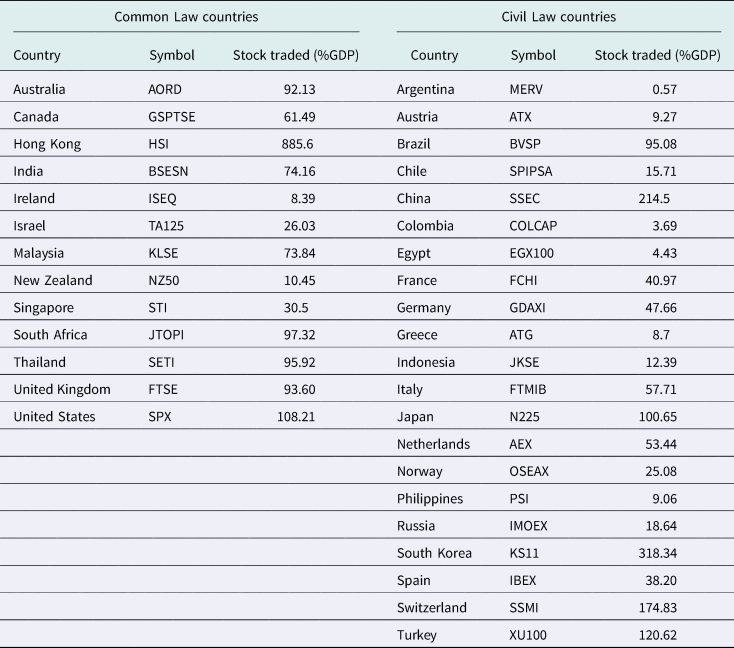
The legal system of the country, on the other hand, is temporally invariant and its effects are pronounced over the long term. Further, the analytical methodology that we used to calculate price efficiency (described in the next section) requires high-frequency or long-term data to better capture the movements of a time series. The countries in our sample vary substantially in terms of the number of stocks listed and the average trading volume. The daily stock index values were collected from Refinitiv. Data on the total volume traded in each exchange were collected from the World Bank website. Table 1 presents the list of countries included in our sample, the Thomson Reuters code for the index, and the value of the stock traded as a percentage of GDP for 2020.
Sample description

Symbol collected from the index in the Thomson Reuters Database. Stock traded (%GDP) collected from the World Bank database. The values for Netherlands, United Kingdom, Ireland, France, and Italy are from 2018 and the other are from 2020.
3.2. Methodology
3.2.1. Estimation of price efficiency
Prior research has used a number of different methodological approaches to determine whether prices in a market are efficient or not. Earlier studies on market efficiency measured efficiency through various statistical methods, such as the capital asset pricing model (DeBondt and Thaler, Reference DeBondt and Thaler1985, Reference DeBondt and Thaler1987; Zarowin, Reference Zarowin1990), and the unit root and augmented Dickey–Fuller methods (Baillie and Bollerslev, Reference Baillie and Bollerslev1989; Meese and Singleton, Reference Meese and Singleton1982). Other authors have used mean reversion and/or variance ratio test as evidence of random walk (Bali et al., Reference Bali, Demirtas and Levy2008; Chaudhuri and Wu, Reference Chaudhuri and Wu2003; Fama and French, Reference Fama and French1988; Lo and Mackinlay, Reference Lo and Mackinlay1988; Poterba and Summers, Reference Poterba and Summers1988). Although each of these approaches represents powerful statistical techniques to ascertain whether a financial time series is efficient or not, they do not allow a way to compare the level of efficiencies of two time series.
Finance research has seen increasing application of multifractal analysis ever since Mandelbrot (Reference Mandelbrot1999) and Mandelbrot and Hudson (Reference Mandelbrot and Hudson2004) suggested that multifractal models derived from econophysics are ideal for the analysis of stock prices. An interesting characteristic of fractals is that when split into parts, each part is a reduced-scale version of the whole. From galaxies to coastlines, we see this property in a number of naturally occurring phenomena: ‘… [M]ovements of a stock or currency all look alike when a market chart is enlarged or reduced so that it fits the same time and price scale. This quality defines the charts as fractal curves and makes available many powerful tools of mathematical and computational analysis’ (Mandelbrot, Reference Mandelbrot1999: 71). In one of the earliest empirical applications of the multifractal approach, Calvet and Fisher (Reference Calvet and Fisher2002) subjected exchange rates, equity indices, and individual stock prices to multifractal analysis. Their analysis confirmed that they indeed conform to multifractal patterns exhibiting thick tails and long-memory volatility persistence. While there are many approaches to conducting multifractal analysis, the MF-DFA approach proposed by Kantelhardt et al. (Reference Kantelhardt, Zschiegner, Koscielny-Bunde, Havlin, Bunde and Stanley2002) represents a significant improvement over other approaches. It has been used in a number of recent finance studies (Al-Yahyaee et al., Reference Al-Yahyaee, Mensi and Yoon2018; Diniz-Maganini et al., Reference Diniz-Maganini, Rasheed and Sheng2021; Tiwari et al., Reference Tiwari, Aye and Gupta2019; Wang et al., Reference Wang, Liu and Gu2009; Zunino et al., Reference Zunino, Tabak, Figliola, Pérez, Garavaglia and Rosso2008). A major advantage of this method over others is its ability to directly compare the price efficiency of one price series over another. Although prior approaches could only classify a series as efficient or inefficient, MD-DFA can provide a precise estimate of how much more or less efficient the prices of one financial series are over another. A detailed description of the MF-DFA method is available in Kantelhardt et al. (Reference Kantelhardt, Zschiegner, Koscielny-Bunde, Havlin, Bunde and Stanley2002). A brief outline of the method is provided in Appendix A. The MF-DFA analysis allows us to estimate several key parameters, including the generalized Hurst exponent h(q) and the intermittency degree α. These parameters are important indicators of the efficiency of a time series.
For monofractal time series characterized by a single exponent over all time scales, h(q) and α are independent of q. For multifractal time series, h(q) and α varies with q. The degree of multifractality is defined as follows:

And the intermittency degree is defined as follows:

The lower the value of the Δh and Δα parameters, the higher the efficiency of the time series (Sensoy and Tabak, Reference Sensoy and Tabak2016; Wang et al., Reference Wang, Liu and Gu2009; Zunino et al., Reference Zunino, Tabak, Figliola, Pérez, Garavaglia and Rosso2008). We used the scale exponents equal to 10 to denote smaller and larger price efficiency variations in this paper following a number of prior studies (Diniz-Maganini et al., Reference Diniz-Maganini, Rasheed and Sheng2021; Wang et al., Reference Wang, Liu and Gu2009; Zunino et al., Reference Zunino, Tabak, Figliola, Pérez, Garavaglia and Rosso2008). We used Δh and Δα of equations (1) and (2) to measure the efficiency level of all sampled countries’ stock indices.
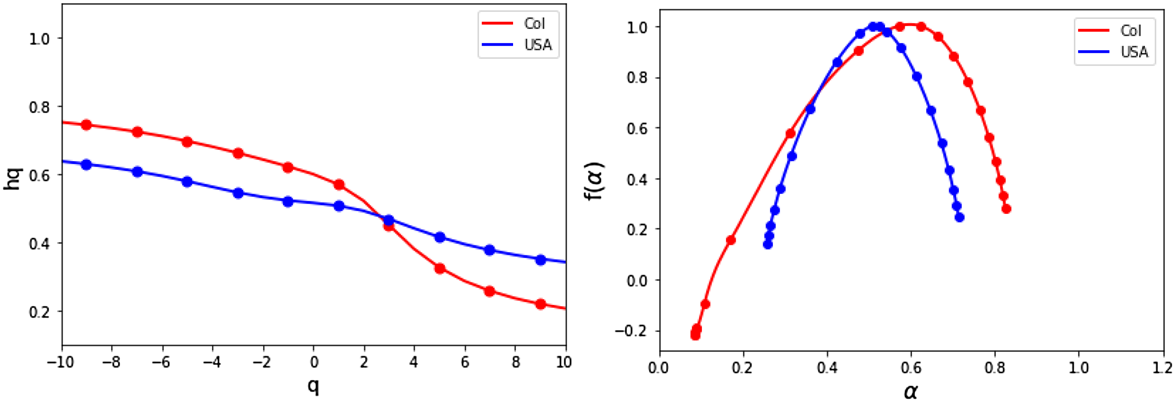
We illustrate our use of MF-DFA in Figure 1. As we use moment 10 to calculate the MF-DFA, the calculated h(q) values are functions of q between −10 and 10. On the left, the blue line represents the USA, and the red line represents Colombia. Δh is the difference between the maximum h(q) and the minimum h(q), that is, h(10) − h(−10), representing the efficiency of a financial time series; the smaller this variation is, the more efficient the analyzed series is. The graph on the right visually presents the maximum and minimum for parameter α for USA and Colombia. One indicator of the efficiency and multifractal behavior of a time series is the width of the parabola (i.e. the difference between the maximum and minimum parameters). The smaller the width, the more efficient the time series. Figure 1 clearly indicates that the U.S. stock index is more price efficient than that of Colombia.
Generalized Hurst Exponents (Δh) and intermittency degree (Δα) for Colombia (COLCAP) and United States (SPX) Stock Index.

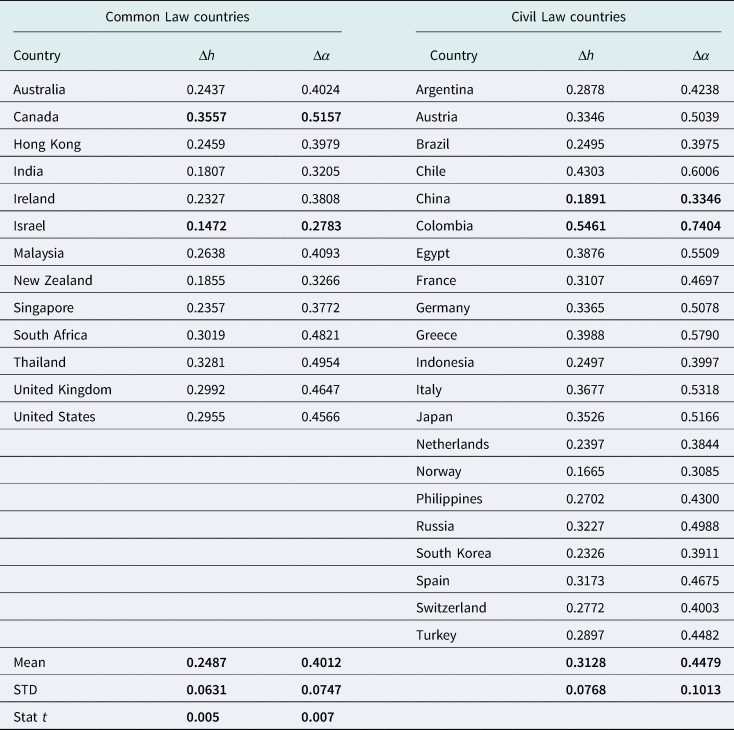
The results of our MF-DFA analysis are presented in Table 2. Table 2 provides the values of Δh and Δα for the indices of the Common Law countries. The values of Δh vary between 0.1472 and 0.3557 for Common Law countries and between 0.1891 and 0.5461 for Civil Law countries (bold in Table 2). The average of Δh for Common Law countries is 0.2487 and 0.3128 for Civil Law countries. As we mentioned before, the higher the Δh, the lower the price efficiency. Table 2 shows that Common Law countries have lower Δh values than Civil Law countries, and the average of Δh values is also lower, suggesting that the indices of Common Law countries are more price efficient. A t-test comparing the means shows that the Δh values for Civil Law countries are higher than for Common Law countries (p < 0.005), further suggesting that the stock indices of Common Law countries are more price efficient than Civil Law countries.
Generalized Hurst exponents (Δh) and intermittency degree (Δα) for the indexes analyzed over a 21-year period

The values of Δα vary between 0.2783 and 0.5157 for Common Law countries and between 0.3346 and 0.7404 for Civil Law countries (bold in Table 2). The average of Δα for Common Law countries is 0.4012 and 0.4479 for Civil Law countries. As we mentioned before, the higher the Δα, the lower the price efficiency. Table 2 shows that Common Law countries have lower Δα values than Civil Law countries, and the average of Δα values is also lower, suggesting that the indices of Common Law countries are more price efficient. A t-test comparing the means shows that the Δα values for Civil Law countries are higher than for Common Law countries (p < 0.007), providing further evidence that the stock indices of Common Law countries are more price efficient than Civil Law countries.
As the Δα and Δh values measure efficiency and are practically proportional, the results with both variables were similar. We used Δα values for all our remaining analyses.
3.2.2. Some stylized facts
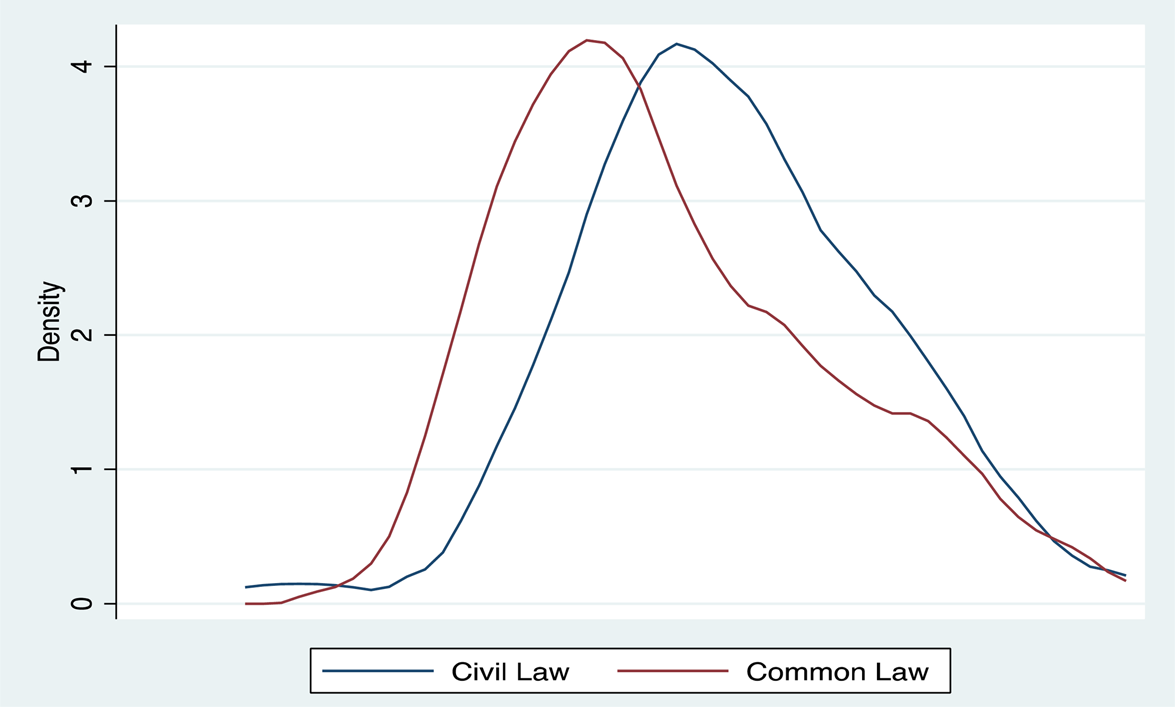
We start by providing detailed stylized comparisons before presenting our econometric models. Kernel density estimates can give a simple visual comparison between the price efficiencies of the stock indices of Common Law and Civil Law countries. The kernel density estimates are illustrated in Figure 2, which shows that on average the price efficiency is greater for Common Law countries than for Civil Law countries. Note that the higher the values of our dependent variable, the lower the price efficiency.
Distribution of price efficiency by legal origin: kernel density estimates.

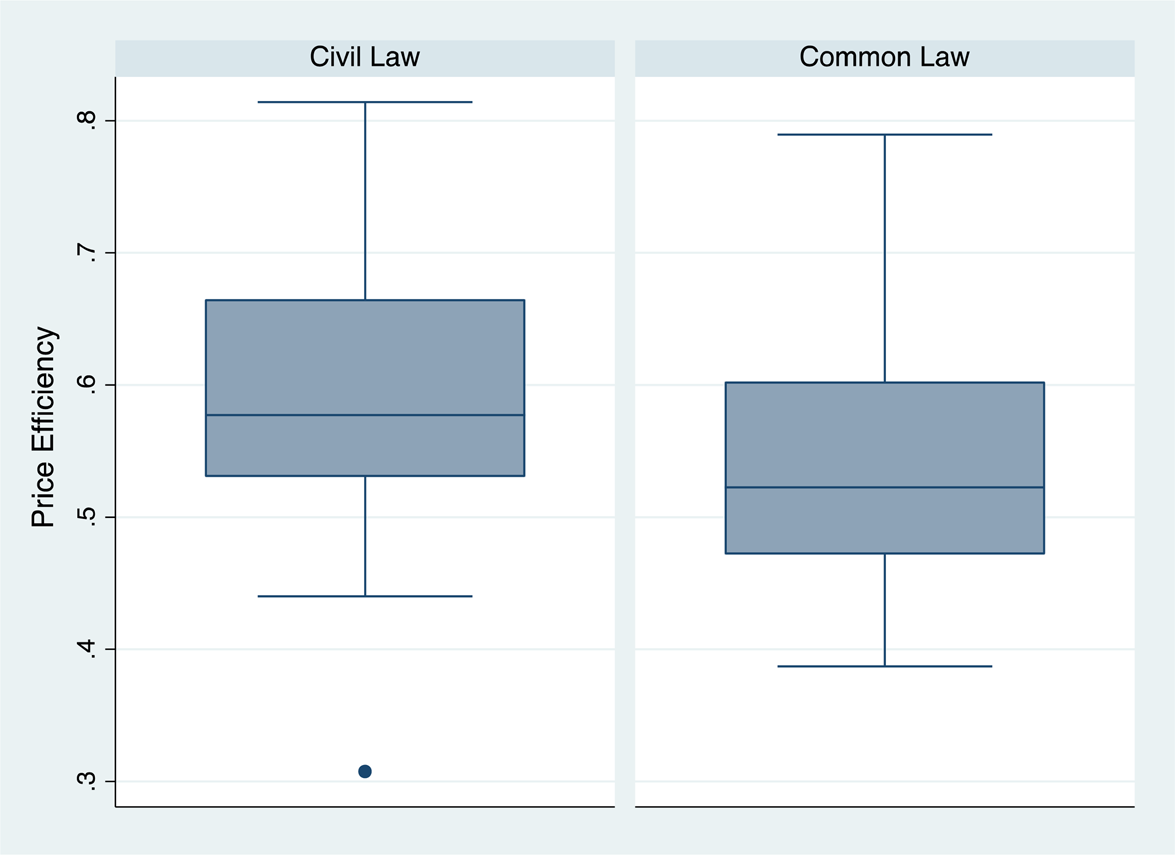
Additional evidence of efficiency differences between Common Law and Civil Law countries can be seen from box plots (Figure 3) separately for the Civil Law and Common Law countries. For both groups of countries, the box plot provides the median efficiency (horizontal line inside the box); the upper and lower quartiles of efficiency (the edges of the box denote the 25th and 75th percentiles); the extreme values (the ends of the whiskers), and the outliers (dots outside the box). It is clear from this graph too that the median efficiency is greater for the Common Law countries than for Civil Law countries. Again, note that the higher the values of our dependent variable (price efficiency), the lower the price efficiency.
Distribution of price efficiency by legal origin: box plots.

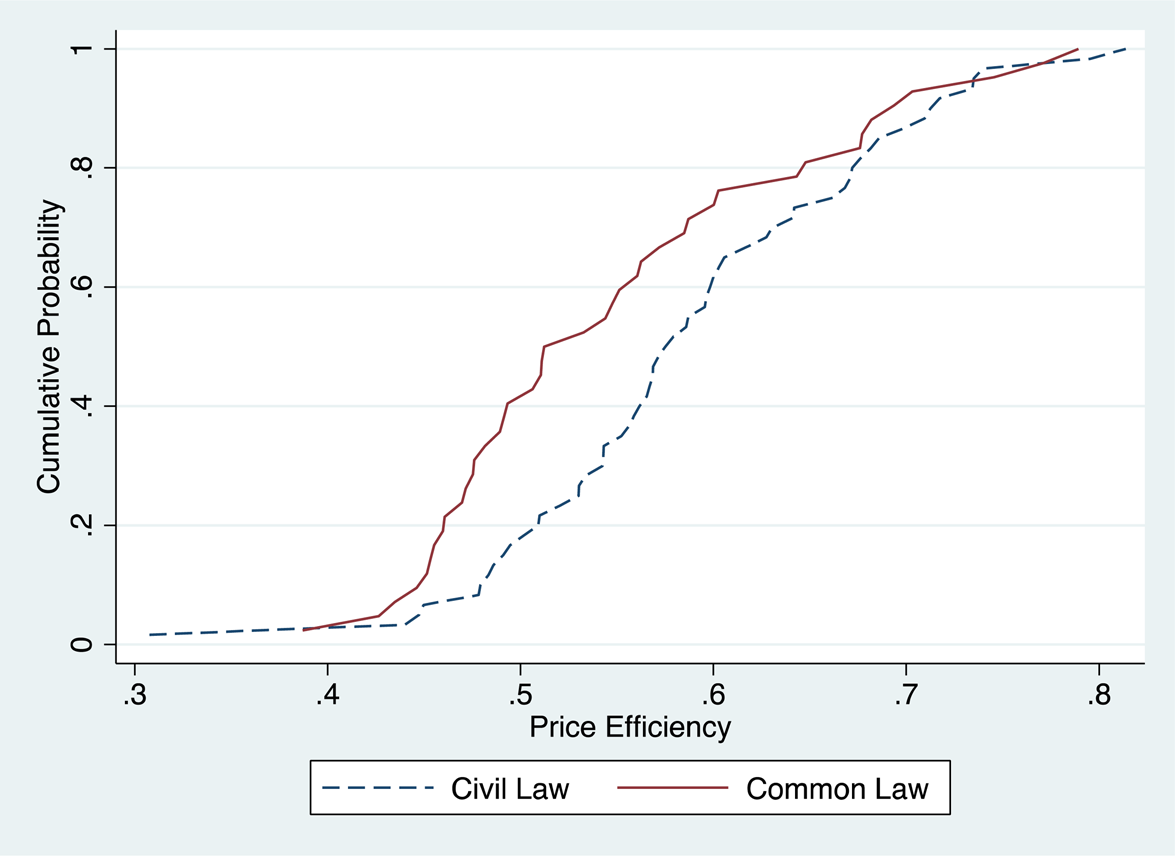
Lastly, we examine price efficiency distribution by using empirical cumulative distribution functions (Figure 4). The graph shows that on average the price efficiency is higher for Common Law countries than for Civil Law countries.
Empirical cumulative distribution functions by legal origin.

Taken together, these figures compellingly demonstrate that the stock markets of Common Law countries have higher efficiency than Civil Law countries, providing preliminary support for our hypothesis. We next test the prediction of our hypothesis by using econometric approaches that enable the examination of causal relationships.
3.2.3. Econometric modeling of efficiency differences
Having estimated the efficiencies of the stock markets of each of the countries in our sample, our next step is to test our hypothesis by estimating an econometric model of efficiency differences that controls for country-specific determinants of price efficiency. Accordingly, we estimated the following model:

where i denotes countries; t denotes the time periods (2000–2006; 2001–2007, 2002–2008, 2003–2009, 2004–2010, 2005–2011, 2006–2012, 2007–2013, 2008–2014, 2009–2015, 2010–2016, 2011–2017, 2012–2018, 2013–2019, and 2014–2020); E proxies the price efficiency; and Legal Origin is a dummy variable equal to 1 if a country's legal system is based on Common Law and 0 if it is based on Civil Law (see La Porta et al., Reference La Porta, Lopez-de Silanes and Shleifer2008). We included in our model a number of control variables that may influence price efficiency. These can be grouped as proxies for economic development and stability (per capita gross domestic product and inflation rate), financial development or liquidity (stock traded), and financial and trade integration with the rest of the world (openness to trade and financial integration). LnGDP is the natural log of the real per capita gross domestic product, which is included to control for the economic development of countries. It was obtained from the World Development Indicators database. We controlled for inflation because it has been found that inflation depresses stock market activity by depressing share prices (Feldstein, Reference Feldstein1980). Inflation proxies the inflation rate, which is from the World Development Indicators database. Prior studies find that market efficiency is higher in more liquid markets than in relatively less liquid markets (Chordia et al., Reference Chordia, Roll and Subrahmanyam2008; Chung and Hrazdil, Reference Chung and Hrazdil2010). Therefore, we controlled for the value of shares traded. Stocktraded was computed by multiplying the total number of shares traded, both domestic and foreign, by their corresponding price, which was also obtained from the World Development Indicators database. As greater integration with foreign financial markets is likely to have a positive impact on market efficiency, we controlled for this using two different proxies. First, Openness to Trade is a proxy for globalization or trade integration, which is calculated by dividing the total trade (exports plus imports) by GDP in constant prices, and was obtained from the World Development Indicators data. Financial Integration is a proxy of the financial integration of the countries, which is computed as the ratio of net foreign direct investment plus net portfolio investment to GDP, and was obtained from http://unctadstat.unctad.org (see Prasad et al., Reference Prasad, Rogoff, Wei and Kose2003, Reference Prasad, Rajan and Subramanian2007). a t is a vector of time dummy variables, which control for the unobservable common factors such as global business cyclesFootnote 1; a i represents the unobserved country-specific factors that are time invariant such as geographic features; and u it is a disturbance term that represents the unobservable factors that vary both across countries and time.
We use country-level panel data that covers 34 countries and 15- 7-year rolling windows. Our original sample covers data from 2000 to 2020. We compute the price efficiency using a rolling window of 7 years, and we use the 7-year rolling averages of the independent variables. We use a 7-year window because we need at least 7 years of data to measure our proxy for price efficiency. It also helps to mitigate the impact of business cycles.
We estimated equation (3) by using both pooled ordinary least squares (OLS) and panel data generalized estimating equations (GEE) model, which is also known as the population-averaged model for panel data (Liang and Zeger, Reference Liang and Zeger1986). GEE treats time-invariant unobservable factors (a i) random and allows the within-country correlation or the error correlation to change with the lag length, rather than limiting it to be identical at all potential lags as in the standard random-effects model. By allowing us to specify different error correlation structures, the GEE model yields more efficient estimators. It also produces consistent results if the independent variables are uncorrelated with a i. As discussed below, this is likely in our case as our main variable of interest (legal origin) has been treated as exogenous in the literature. We specified a first-order autoregression correlation structure for within-country correlations, but our results were robust to using exchangeable (as in the standard random-effects model) or unstructured within-country correlation structures. We obtain robust standard errors.
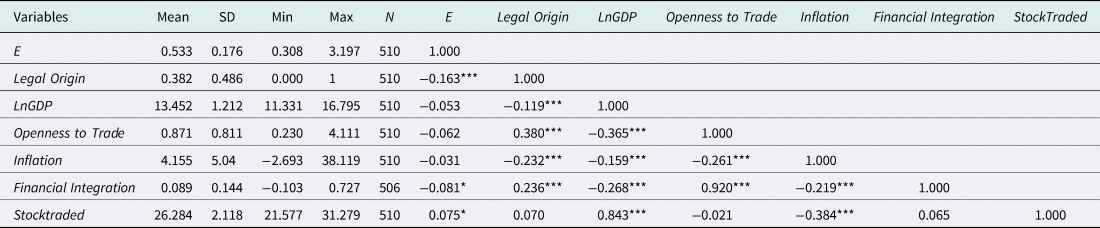
Table 3 presents descriptive statistics and correlations among the variables in our study. The correlation coefficient between Openness to Trade and Financial Integration variables is high, but the variance inflation factors for both variables are smaller than 10, indicating that multicollinearity does not threaten the results. However, our results are robust to including Openness to Trade and Financial Integration variables separately in our regression.
Descriptive statistics and correlation matrix

***p < 0.01, **p < 0.05, *p < 0.1.
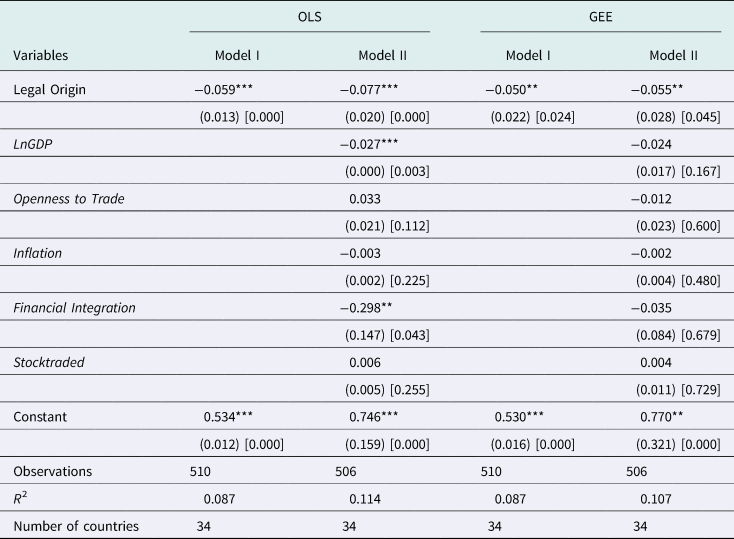
The results of our econometric analysis are presented in Table 4, where our results from both OLS and GEE support our hypotheses. The first and second columns show the results from a regression of price efficiency on legal origin dummy variable and time dummies only with the OLS method. In the first column, the coefficient on the legal origin dummy variable is statistically significant (b = −0.059, p = 0.000). The results in the second column are obtained by including all the control variables specified in equation (3). The coefficient on our main variable of interest, legal origin, is still economically and statistically significant (b = −0.077, p = 0.000).
Parameter estimates from OLS and GEE

Dependent variable (DV) = price efficiency (Δα).
Robust standard errors in parentheses. p values in square brackets. All models include time dummies to control for common factors such as business cycles.
***p < 0.01, **p < 0.05, *p < 0.1.
The third and fourth columns show the results from a regression of price efficiency on legal origin dummy variable and time dummies using the GEE method. In the third column, the coefficient on the legal origin dummy variable is statistically significant (b = −0.050, p = 0.024). The results in the fourth column are obtained by including all the control variables specified in equation (3). The coefficient on our main variable of interest, legal origin, is still economically and statistically significant (b = −0.055, p = 0.045).
Thus, our hypothesis is supported. Price efficiency is significantly higher for Common Law countries than for Civil Law countries, even after we control for other potential determinants of efficiency. Specifically, the price efficiency is about 4.2 percentage points higher for Common Law countries than for Civil Law countries. Note that the lower values of our price efficiency index indicate higher degree of efficiency.
One may argue that the potential presence of endogeneity may be a threat to the results. However, the legal origin variable has been viewed as an exogenous variable and used as an instrumental variable for the structure of laws and some other main variables of interest in the economic growth regressions (see La Porta et al., Reference La Porta, Lopes-de-Silanes, Shleifer and Vishny1998). For instance, La Porta et al. (Reference La Porta, Lopez-de Silanes and Shleifer2008) wrote: ‘legal traditions were typically introduced into various countries through conquest and colonization and, as such, were largely exogenous’. Thus, it is unlikely that our coefficient on the legal origin dummy variables is biased due to potential endogeneity.
4. Discussion and conclusion
Ever since La Porta et al. (Reference La Porta, Lopes-de-Silanes, Shleifer and Vishny1998) suggested that differences in legal origins of countries may be the underlying reason for a number of economic phenomena, researchers have engaged in a vigorous exploration of the implications of the differences in legal origins of countries (Djankov et al., Reference Djankov, La Porta, Lopez-de-Silanes and Shleifer2002, Reference Djankov, McLiesh and Shleifer2007; Musacchio, Reference Musacchio2008). They argued that countries whose formal institutions are based on Common Law tend to offer legal rights and better protection to shareholders, especially minority shareholders, than those that follow Civil Law. We argued in this paper, that an inevitable consequence of higher recognition of the rights of shareholders and a regime of better disclosure is greater market efficiency.
The results of our analysis of the daily stock index values of 34 countries for a period of 21 years provide strong evidence that there are indeed differences in the price efficiency of the stock markets of different countries. Our results also suggest that the stock markets of Common Law countries are clearly more price efficient than the stock markets of Civil Law countries. Given that our sample included most large economies in the world and consideration of data for an extended period of time, the results can be considered as strong support for the theoretical argument that institutional differences matter for economic outcomes.
We believe that our study makes several important contributions. First, this is the first direct comparison of the price efficiencies of different markets. Given that the efficient market hypothesis is one of the foundational theories of modern finance, it is important that researchers undertake a comparative analysis of the efficiencies of the markets. Second, we are able to rule out the alternative explanation that trading volumes of the markets can explain the level of efficiency. Our results suggest that even after controlling for several country-level factors, including differences in the levels of trading volume, institutional differences still matter. To that extent, our study is also a contribution to the growing literature on institutional differences, which now occupies center stage in research in international business and finance.
Our paper also makes a methodological contribution to the IB area. Andriani and McKelvey (Reference Andriani and McKelvey2007) made an impassioned plea that IB research should supplement its reliance on Gaussian statistics with Pareto-based statistics based on power laws. Our examination of price efficiency using multifractal analysis responds to this call. Power law phenomena are prevalent in a wide variety of social and business contexts, and methods derived from econophysics hold considerable promise in providing fresh insights into such phenomena.
Our study also has major policy implications. Given that efficient stock markets are a necessary precondition for capital accumulation and the efficient allocation of resources, Civil Law countries will need to consider how to strengthen the rights of minority investors and reduce information asymmetries through better disclosure requirements if they want to improve the efficiency of their capital markets. Today, stock markets of different countries are locked in competition to attract more companies, including foreign companies, to list their shares with them (Filatotchev et al., Reference Filatotchev, Bell and Rasheed2016). In such an environment of competition, firms from Civil Law countries will likely be tempted to list their stocks in the exchanges of Common Law countries to improve the price efficiency of their individual stocks.
Our study is not without limitations. First, we have treated all Civil Law countries as the same, although there are important differences between French, German, and Scandinavian Civil Law traditions within Civil Law. Second, Jackson and Deeg (Reference Jackson and Deeg2008) suggested that despite the recognition of the importance of institutions, IB research has taken a rather ‘thin’ view of institutions, using summary indicators rather than detailed descriptions of institutions. Third, in addition to legal origin, other formal and informal institutional characteristics may also have an impact on market efficiency. Thus, examining the implications of legal origins for stock market efficiency may be considered a starting point in studying the determinants of stock market efficiency. Considering the pervasive economic consequences of legal origins (La Porta et al., Reference La Porta, Lopez-de Silanes and Shleifer2008), however, we believe it is the appropriate starting point for exploring stock market efficiency. Fourth, it is equally important to investigate the impact of legal origins on other important stock market characteristics such as volatility, bid-ask spreads, and short interest in addition to market efficiency. Finally, how major legal changes in a country such as the Market in Financial Instruments Directive (MiFID) in the EU (Aghanya et al., Reference Aghanya, Agarwal and Poshakwale2020) or the implementation of market abuse rules (Cumming and Johan, Reference Cumming and Johan2019) might lead to changes in efficiency also merits investigation.
Wurgler (Reference Wurgler2000) suggests that developed financial markets can improve the efficiency of capital allocation in a country. Price efficiency is clearly one of the indicators of the development and sophistication of the financial markets of a country. Thus, one of the mechanisms through which legal origins affect the trajectory of economic growth in a country could be the efficiency of stock markets and the resulting allocative efficiency of capital.
The main contention of the proponents of LFS has been that regardless of the operationalizations used to capture legal systems, Common Law traditions produce better outcomes than Civil Law systems (Schnyder et al., Reference Schnyder, Siems and Aguilera2021). Critics, on the other hand, have faulted LFS for not giving enough credit for factors such as history and politics (Roe and Siegel, Reference Roe and Siegel2009). Our purpose in this article is not to make a judgment of the superiority of one legal tradition over another. Instead, our results demonstrate that legal origins matter for economic outcomes. Further, our results clearly show that stock markets in Common Law countries exhibit higher levels of price efficiency than the stock markets of Civil Law countries.
Appendix A: Multifractal detrended fluctuation analysis (MF-DFA)
We describe below an algorithm for the MF-DFA method, based on Kantelhardt et al. (Reference Denis and McConnell2002). The generalized MF-DFA procedure consists of six steps. The first three steps are essentially identical to the conventional DFA procedure.
Step 1: We start by calculating the log returns for the time series. Then, let x 1, x 2,…, x N be a series of N temporally equidistant measurements. Given its mean value x we determine a new series of Y(1), …, Y(N) values given by:

Subtraction of the mean x is not compulsory, since it would be eliminated by the later detrending in the third step.
Step 2: Divide the series Y(i) into N s ≡ int(N/s) non-overlapping segments of equal length s. Since the length N of the series is often not a multiple of the considered time scale s, a short part at the end of the profile may remain. In order not to disregard this part of the series, the same procedure is repeated starting from the opposite end. Thereby, 2N s segments are obtained altogether.
Step 3: Calculate the local trend for each of the 2N s segments by a least-square fit of the series. Then determine the variance:

For each segment v, v = 1, …, N s and

For v = N s + 1, …, 2N s. Here, y v(i) is the fitting polynomial in segment v.
A comparison of the results for different orders of DFA allows us to estimate the type of the polynomial trend in the time series.
Step 4: Average over all segments to obtain the qth order fluctuation function:

where in general, the index variable q can be any real value except zero. For q = 2, it yields the traditional DFA. We repeat steps 2–4 for different values of s. For financial time series, usually this is done for values of q from −10 to 10.
Step 5: Determine the scaling behavior of the fluctuation functions by analyzing log-log plots F q(s) versus s for each value of q:

The function h(q) is the generalized Hurst exponent.
Step 6: Equation (5) can be rewritten as F q(s) = AS h(q). After taking logarithms on both sides, we have:

We finally determine the scaling behavior of the fluctuation functions by analyzing the log–log plot of the all the Fq (s) versus s. If the original series of x i values has long range correlations, there exists a range of scales, s min < s < s max, in which F q(s) ~ s h(q) where h(q) is the generalized Hurst exponent and it can be estimated as the slope of the log–log plot of Fq (s). If the series is monofractal and stationary, then, h(q) is equal to the Hurst exponent h, i.e. independent of q. Otherwise, for a multifractal time series, the generalized Hurst exponent is a decreasing function of q.
Another way to confirm multifractality in a time series is through multifractal spectrum analysis, which is based on the following relationship between generalized Hurst exponent h(q) obtained from MF-DFA and the Renyi exponent τ(q):

Then, through a Legendre transform, we get

and

From equation (6) we can define the level of efficiency as:

From equation (8) we can define the intermittency degree as:

The higher the values of ‘Δh’ and ‘Δα’, the lower the price efficiency of a time series.