1. INTRODUCTION
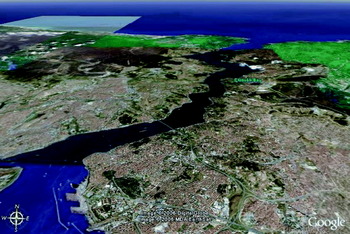
The Strait of Istanbul is approximately 31 km long, with an average width of 1·5 km. At its narrowest point between Anadoluhisarı and Rumelihisarı, it measures a mere 660 m (Kentimİstanbul, 2003). It takes several sharp turns, forcing the ships to alter course at least 12 times, sometimes executing turns of up to 80 degrees. Navigation is particularly difficult at the narrowest point, as the vessels approaching from opposite directions cannot see each other around the treacherous bends as shown in Figure 1.
The Strait of Istanbul.

The current international legal regime governing the passage of vessels through the Turkish Straits (Istanbul and Çanakkale) is the 1936 Montreux Convention. Although this instrument provides full authority over the Straits to the Turkish government, it asserts that in time of peace, merchant vessels are free to navigate the Straits without any formalities (Montreux Conv., 1937). When the Convention was put in place, fewer than 5,000 vessels used to pass through the Strait of Istanbul annually. Today, the changes in the shipping and navigational circumstances have led to an eleven-fold increase in the maritime traffic through the Strait. Several reasons contributed to this immense increase in traffic. The Turkish Straits provide the only maritime link between the Black Sea riparian States and the Mediterranean Sea, forcing these States to rely on the Straits for most of their foreign trade. The opening of the Main-Danube canal has linked the Rhine to the Danube, connecting the North Sea and Black Sea. Traffic originating from the Volga-Baltic and Volga-Don waterways has also increased in recent years.
However, the most alarming increase in traffic is observed in the number of vessels carrying dangerous cargoes. The fall of the Soviet Union in 1991 has led to the emergence of newly independent energy-rich states along the Caspian Sea. Currently, most of the oil and gas from Azerbaijan, Turkmenistan and Kazakhstan reach the western markets through the Turkish Straits.
In order to ensure the safety of navigation, life, property and to protect the environment, the Turkish State unilaterally adopted the 1994 Maritime Traffic Regulations for the Turkish Straits and Marmara Region. In 1998, the rules were revised and the 1998 Modified Regulations were adopted (Official Gazette, 1998). These regulations include extensive provisions for facilitating safe navigation through the Straits in order to minimize the likelihood of accidents and pollution. The most important provision is the implementation of new Traffic Separation Schemes (TSS), which set new traffic lanes for transiting vessels.
The Strait of Istanbul has motivated us to develop a scheduling algorithm to aid decisions on sequencing vessel entrances as well as giving way to vessel traffic in either direction. The scheduling algorithm is demonstrated using a numerical example. The algorithm is then validated by comparing its results with data from the VTS schedules for 10 different dates in 2005.
2. REGULATIONS IN THE STRAIT OF ISTANBUL
The state agencies principally involved with current policy formulation and regulation of the Turkish Straits are Turkey's Prime Ministry Undersecretariat for Maritime Affairs, and the Maritime Department of the Foreign Ministry. Since 1936, these departments have administered the Straits in accordance with the general principles of the Montreux Convention.
As mentioned earlier, the 1936 Montreux Convention provides full authority and control over the Straits to the Turkish government. However, a crucial exception is articulated in Article 2, which states that “in time of peace, merchant vessels shall enjoy complete freedom of transit and navigation in the Straits, by day and by night, under any flag and with any kind of cargo, without any formalities” except sanitary control as stated in (1932). Furthermore, it states that “pilotage and towage remain optional”. The convention later asserts in Article 28 that the principle of transit and navigation established under Article 1 shall “continue without limit of time”. This provision is the main point of contention between Turkey and the Black Sea riparian States over Turkey's right to regulate traffic in the Straits.
Even though the Montreux Convention helped establish a reasonable regime for vessel transit in 1936, it did not state any provisions on navigational safety or environmental protection. When the instrument came into force in 1936, only about 4,500 ships passed through the Straits annually; and the majority of them were small vessels carrying general cargoes. Today, the shipping and navigational circumstances have changed dramatically, leading to an immense increase in maritime traffic. Inevitably, the traffic congestion and the inherent navigational difficulties within the Strait lead to accidents, endangering Istanbul, its inhabitants and the environment.
In an effort to regulate the maritime traffic scheme in order to ensure the safety of navigation, life and property and to protect the environment in the region according to Maritime Traffic Regulations for the Turkish Straits and the Marmara Region (1994), the Turkish State unilaterally adopted the 1994 Maritime Traffic Regulations. The International Maritime Organization (IMO) approved a set of Rules and Regulations on the Straits, ratifying most of the measures taken by Turkey (Official Gazette, 1998).
As a result of severe criticisms from the Black Sea riparian States, especially Russia, and the urging of the IMO, Turkey revised the provisions and adopted the 1998 Modified Regulations. The regulations aim to monitor the safe passage of vessels carrying dangerous cargoes, establish new traffic schemes within the Straits, and to minimize risk by suspending or restricting traffic under dangerous meteorological conditions.
The most important provision is the implementation of new Traffic Separation Schemes (TSS), which set new traffic lanes for transiting vessels. The TSS were adopted in compliance with Reg. 10 of the Convention for Preventing Collision at Sea (COLREGS) and approved by the IMO General Assembly in November 1995. The 1998 Regulations restrict the passage of vessels longer than 200 metres to daytime. Further, automatic pilots for navigation are prohibited (Official Gazette, 1998).
On December 30, 2003, the Turkish Government introduced a Vessel Traffic Service (VTS) in the Turkish Straits, thus completing the legal framework in force to improve the safety of navigation, protect life and the environment in these waters. The VTS provides the necessary navigational assistance and monitoring for the safe passage of vessels.
Complementing the Montreux Convention and the 1998 Regulations are three major legal instruments for regulating transit vessel traffic in the Straits; namely The International Convention of Safety of Life at Sea (SOLAS, 1974), the Convention on the International Regulations for Preventing Collisions at Sea (COLREGS, 1972), and the International Convention on Standards of Training, Certification and Watchkeeping for Seafarers (STCW, 1978).
SOLAS establishes minimum standards to ensure that a ship is fit for international transport on the oceans. COLREGS, on the other hand, sets forth detailed rules on the operation of vessels, including safe speeds, right of way, actions to avoid collisions, signalling, fishing vessels and provisions for traffic separation schemes. STCW entails basic requirements for training, certification and watch-keeping for seafarers. The rules and regulations regarding safe passage of transit vessels through the Strait are categorized below (Official Gazette, 1998).
2.1. Sailing Plans (SP 1 and SP 2)
Vessels approaching the Strait are required to provide sailing plans prior to their passage. Sailing Plan 1 (SP 1) is the report that all transit vessels submit 24–72 hours prior to their arrival. In addition to SP 1, vessels are also required to submit another report called Sailing Plan 2 (SP 2) some two hours prior to their arrival which provides further details to the authorities.
2.2. Speed
The navigational speed limit at the Strait is 10 knots, unless a higher speed is needed to maintain good steerage.
2.3. Distance between Vessels
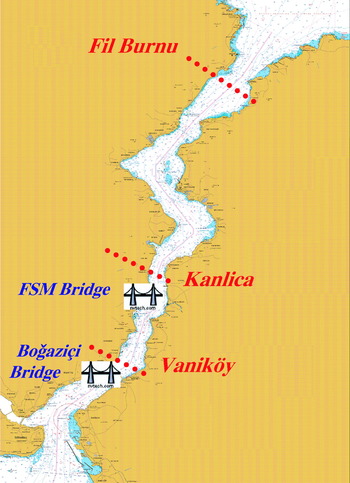
Transiting vessels must maintain a minimum pursuit distance of 8 cables (0·920 miles) to the closest vessel travelling in the same direction, while passing through the Strait. Dependent on the type of the vessels and prevailing meteorological conditions, this minimum distance may be increased by the authorities. The passage of vessels carrying dangerous or hazardous cargo is regulated under Reg. 25d, which states that when a northbound (southbound) vessel greater than 150 metres in length carrying dangerous cargo enters the Strait, no northbound (southbound) vessel with the same characteristics is permitted until the former vessel reaches the Fil Burnu (Boğaziçi Bridge). Fil Burnu and Boğaziçi Bridge are shown in Figure 2.
Key Locations in the Strait of Istanbul.

2.4. Draft
Due to two suspension bridges crossing the Strait of Istanbul, the maximum air draft is limited to 58 metres. Transiting vessels with air drafts of 54 to 58 metres have to be escorted by tugboats.
2.5. Temporary Traffic Suspensions
Traffic in the Strait may be suspended temporarily in the case of force majeure situations, such as extreme meteorological conditions, collision, grounding, fire, public security, pollution and similar occasions, surface or underwater construction, and the existence of navigational dangers. In addition:
• Oncoming traffic is suspended when a vessel with a length of 250 to 300 metres passes through the Strait.
• Traffic is suspended in both directions when a vessel greater than 300 metres in length transits the Strait.
2.6. Surface Currents
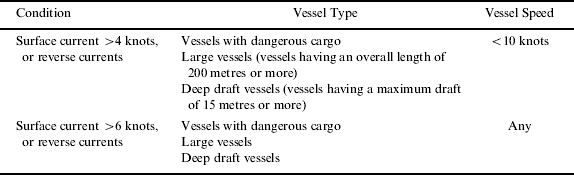
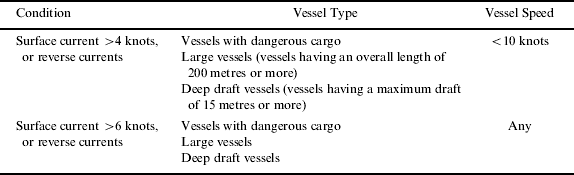
Table 1 depicts the conditions regarding the safe passage of vessels under various surface currents.
Regulations regarding surface currents.
Vessels are not allowed to enter the Strait of Istanbul if the conditions below are realized.
2.7. Restricted Visibility
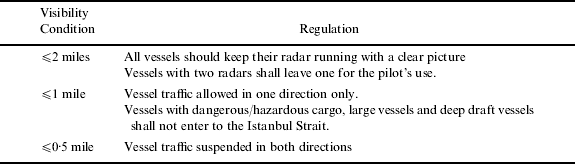
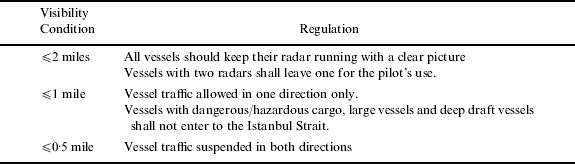
The passage of vessels may be restricted under certain visibility conditions as given in Table 2 to ensure safe navigation.
Regulations regarding visibility conditions.
3. VESSEL CLASSES
The Strait of Istanbul is regarded as one of the most congested waterways in the world. Its traffic volume is roughly four times and three times greater than that of the Panama and Suez canals, respectively. More than 50,000 transit vessels pass through the Strait annually, carrying various cargoes ranging from dry goods to petroleum products.
After arriving at the entrances, the vessels may anchor for various reasons including health inspection, loading food or refueling. All vessels, anchored or not, wait in the queue until they are allowed to transit. The Strait is divided into two traffic lanes. Vessels are permitted to enter the Strait one at a time from each entrance. Vessel traffic may be interrupted due to poor visibility, high currents, and other factors such as lane closures caused by vessel accidents or sporting events. Vessels do not stop in the Strait since they may create a high-risk situation for other vessels and the environment.
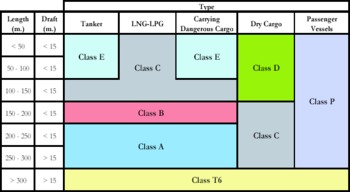
The Turkish authorities categorize transit vessels based on criteria such as the vessel size, vessel passage type, vessel draft and the type of cargoes. Based on the cargo they carry, vessels are categorized as tankers, dangerous and hazardous cargo carriers, LNG & LPG carriers, general cargo vessels, and passenger vessels. In terms of length, the vessels are grouped in categories of (⩽50 m), (50–100 m), (100–150 m), (150–200 m), (200–250 m), (250–300 m) and (>300 m). Transit vessels are also categorized as stopover and non-stopover vessels depending on whether they are scheduled to stop at a nearby Turkish port somewhere in Marmara or the Black Sea.
The vessel classes created for scheduling purposes are shown in Table 3. Class T6 and Class A vessels have priority over any other vessel since they can only pass through the Strait during the daytime. In addition, Class T6 vessels have priority over Class A vessels since their passage is subject to special permissions from the authorities and it requires two-way traffic suspension. On the other hand, Class B vessels (which have similar characteristics to that of Class A vessels except their shorter lengths) are assigned lower priority regarding daytime transit (since they can make a nighttime passage). The rest of the vessels have the following priority structure for scheduling purposes: C>P>E>D.
Vessel classes for scheduling vessel entrances into the Strait.

4. VESSEL SCHEDULING
Turkish Straits Vessel Traffic Services schedules the vessels entering the Strait based on their waiting times and priorities. In addition to regulations in place, the number of vessels in both directions and the number of available pilots play a role in the scheduling decisions. In this study, we have developed a mathematical model of the current scheduling practice at the VTS to incorporate it into a simulation model. Our goal has been to incorporate this algorithm into a simulation model that is to be used for risk analysis purposes (Uluscu et al., Reference Ulusçu, Özbas, Altıok and Or2008). It should be noted that with slight modification, the scheduling algorithm can be applied to any other strait or waterway that has two-way traffic. The fundamental philosophy of the algorithm is to schedule the vessels with highest waiting time first while giving priority to large vessels carrying dangerous cargo. Different scheduling policies are used for daytime and nighttime vessel traffic.
4.1. Daytime Schedule
The passage of Class T6 vessels is subject to special permissions from the authorities. When a Class T6 vessel enters the Strait, two-way traffic is suspended during its passage as mentioned in Section 3. On the other hand, when a Class A vessel enters, only the incoming traffic (opposite direction) is suspended. Also, according to the rules set by the VTS, on a given day the daytime traffic is suspended at most once in each direction.
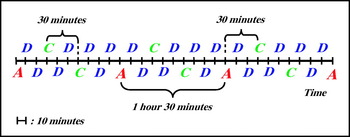
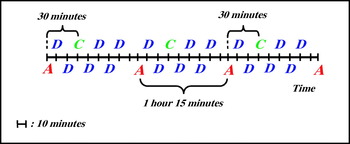
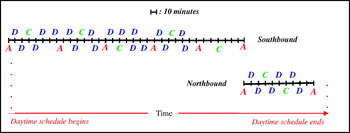
In order to comply with the regulation concerning the required pursuit distance between vessels, Class A vessels enter the Strait every 75 and 90 minutes from the north and south entrances, respectively. However, Class C vessels may follow each other at 30-minute intervals. Furthermore, Class D, E, and P vessels may enter every 10 minutes. A typical order of vessels entering the Strait during daytime is given in Figures 3 and 4 for the northbound and southbound traffic, respectively.
Typical schedule for northbound vessels entering the Strait.

Typical schedule for southbound vessels entering the Strait.

Since Class T6 and Class A vessels can only pass through the Strait during daytime, the total number of these vessels passing in a day is limited by the daytime duration. This duration is seasonal and changes throughout the year.
As a result of our collaboration with the VTS, we have incorporated their limitations and arguments, and developed a scheduling algorithm to plan the daytime traffic in the Istanbul Strait. The objective is to answer the following questions for any given day:
• Which direction should be opened to daytime traffic first?
• How many northbound and southbound Class T6 and Class A vessels should pass?
• How many Class C, P, D, and E vessels should pass between scheduled Class A vessels?
In the next section, we present an algorithmic view of the scheduling system at the Istanbul VTS.
4.2. Daytime Vessel Scheduling Algorithm
Every morning two hours before sunrise VTS operators determine the daytime transit vessel schedule for the day. Since Class T6 and Class A vessels can only pass through the Strait of Istanbul during the daytime, VTS gives these types of vessels priority for daytime scheduling and they first decide on the Class T6 and Class A vessels that will pass that day in both directions, based on the list of vessels that have submitted their SP 2 but have not entered the Strait. Then, they schedule the rest of the vessels to enter, between consecutive Class A vessels based on sequencing rules such as the ones depicted in Figures 3 and 4. However, since two-way traffic is suspended during the passage of Class T6 vessels, no other vessel is scheduled until a Class T6 vessel leaves the Strait.
4.2.1. Scheduling Class T6 and Class A Vessels
No other vessel is scheduled after the last Class A vessel in the open direction (the next scheduled vessel being the first Class T6 or Class A vessel in the opposite direction). The number of Class T6 and Class A vessels that will pass in a specific day is determined by considering the following VTS policies:
• Daytime duration as dictated by sunrise and sunset times.
• Vessels with higher waiting times are scheduled to enter the Strait first.
• Class T6 vessels have priority over Class A vessels.
• Stopover vessels have priority over non-stopover vessels.
• Southbound stopover vessels have priority over northbound stopover vessels.
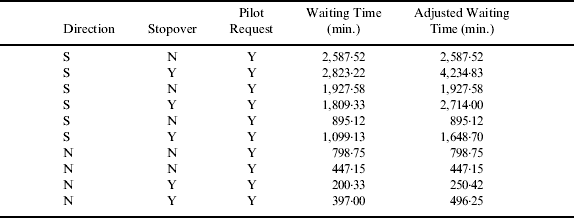
Therefore, the Class T6 and Class A vessels are first sequenced in decreasing order of adjusted waiting times (W a) within their respective classes. The two sequenced vessel groups are then combined in a tentative list, in which Class T6 vessels precede Class A vessels. This list includes all vessels ready to enter the Strait from both directions.
4.2.2. Adjusted Waiting Times
The adjusted waiting time of vessel j is defined by
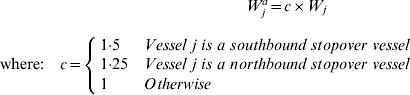

The constant c introduced above is a vessel handling policy priority factor used to adjust the waiting time of a vessel to capture the VTS policies mentioned above (which state that a southbound stopover vessel has priority over a northbound stopover vessel, which has priority over any non-stopover vessel). Values of c are decided upon jointly with the Strait of Istanbul VTS.
4.2.3. A Tentative Vessel List
Next, the number of Class T6 and Class A vessels in the tentative list that will be able to enter the Strait that day is determined considering the start time (ST) and the maximum operational duration (SD) of the daytime schedule. ST and SD values in different seasons are given in Table 4. The desired time lags between consecutive Class T6 and Class A vessels, as mentioned in Section 4.1, are given in Table 5. The time differential is due to direction of the surface current (north to south) which leads to the fact that the time to navigate from the south entrance to Fil Burnu is greater than the one from the north entrance to the Boğaziçi Bridge.
Start time and maximum operational duration.

Time gap between consecutive Class T6 and Class A vessels

The time lags shown in Table 5 correspond to the times it takes for a northbound vessel to reach Fil Burnu and a southbound Class A vessel to reach the Boğaziçi Bridge, respectively. In other words, northbound traversal of the Strait is approximately 30 minutes longer than southbound traversal. Therefore, the time gap between the last northbound or southbound Class A vessel and the following vessel from the opposite direction should be 120 or 105 minutes, respectively.
Starting from the top of the tentative list, the vessels are added to a secondary list one by one and the cumulative passage time (CPT) is calculated using the information given in Tables 4 and 5 until CPT>SD. Then, the last vessel for which CPT>SD is put back to the tentative list and CPT is assigned to its previous value. The new list forms the initial schedule of Class T6 and Class A vessels that will enter the Strait that day from both directions.

where:
m: Total number of Class T6 and Class A vessels in the initial schedule
m (S): Number of southbound Class T6 and Class A vessels in the initial schedule
m (N): Number of northbound Class T6 and Class A vessels in the initial schedule.
Through our discussions with the VTS operators, we concluded that there was a tendency to schedule more Class T6 and Class A vessels from the entrance, which had more set  vessels (Class P, E, and D) waiting. Scheduling more Class T6 and Class A vessels in a direction (or equivalently, allowing more time for traffic flow in that direction), has a decreasing effect on the vessel congestion in that direction. Another key factor that influenced the operators' preferences was whether there were sufficiently many set vessels to schedule between consecutive Class A vessels. Therefore, in order to mimic the scheduling policies used by the operators, we considered the following factors in addition to the factors listed above:
(1) Average waiting time of the Class T6 and Class A vessels
(2) Average waiting time of set
 vessels
(3) Sufficient number of set
vessels to be scheduled between Class A vessels(4) Average waiting time of Class C vessels
(5) Sufficient number of Class C vessels to be scheduled between Class A vessels
(6) Average waiting time of set
ˈ vessels(7) Sufficient number of set
ˈ vessels to be scheduled between Class A vessels
where
- : Set of Class P, E, and D vessels
- ˈ: Set of Class P, C, E, and D vessels not requesting pilot.
4.2.4. Final Number of Class T6 and A Vessels
In order to determine the final number of Class T6 and Class A vessels in the schedule, we consider three different scenarios.
• Scenario 1 is the base scenario, which represents the initial schedule with m (S) southbound and m (N) northbound Class T6 and/or Class A vessels. This scenario includes the most waited Class T6 and Class A vessels, but it is also desired that there are sufficiently many Class C, set
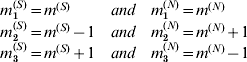
, and set ˈ vessels to fill the time windows between consecutive Class A vessels in each direction.• In Scenario 2, the number of northbound Class T6 and/or Class A vessels is increased by 1 (i.e., m (N)+1) and the number of southbound vessels is decreased by 1 (i.e., m (S)-1) without changing the total number of vessels in the schedule (m). The purpose is to check to see if scheduling more northbound vessels during daytime will result in a better schedule at the end. To do so, the last southbound vessel in the initial schedule is taken out and instead the first northbound vessel in the tentative list is added.
• On the other hand, Scenario 3 includes m (S)+1 southbound and m (N)−1 northbound Class T6 and/or Class A vessels. In this scenario, more southbound vessels are scheduled while the total number of vessels in the schedule, m, remains the same. Similar to the procedure explained above, the last northbound vessel in the initial schedule is taken out and instead the first southbound vessel in the tentative list is added.
Let m (l)i be the number of Class T6 and Class A vessels scheduled in direction l in scenario i. Therefore,
Note: If m (S) ∈ {0, 1}, then we only consider scenarios 1 and 3.
If m (S) ∈ {0, 1}, then we only consider scenarios 1 and 2.
The main goal of the scheduling algorithm is to schedule the vessels with higher adjusted waiting times first while filling the time windows between consecutive Class A vessels as much as possible. Therefore, in order to compare the scenarios, and determine which one gives the best schedule, the following objective function is evaluated for each:

where:
Z i: Weighted average of vessel waiting times of scenario i
- :Average adjusted waiting time of Class T6 and A vessels in scenario i in both directions
GW (l)i: Generalized waiting time of vessels other than Class T6 and A vessels in direction l in scenario i (l ∈ {N, S}
K 1: Weight of Class T6 and A vessel waiting times (K 1=1)
K 2: Weight of the generalized waiting times of vessels other than Class T6 and A (K 2=0.75)
 :Average adjusted waiting time of Class T6 and A vessels in scenario i in both directions
As mentioned before, it is desired to schedule first Class T6 and Class A vessels with higher adjusted waiting times. The first portion of the objective function (K 1× ) represents the average waiting time of Class T6 and Class A vessels in the schedule according to a particular scenario. The higher is this value the higher is the objective function, Z i.
In addition, it is also important to maximize the utilization of the time windows between consecutive Class A vessels This means leaving as few empty vessel slots as possible, in scheduling the other vessels with higher adjusted waiting times to time windows between consecutive Class A vessels. This is emphasized by the (k 2 × (GW i(N) + GW i(S)) term in the second part of the objective function. The generalized waiting time expression is further explained below.
Furthermore, Class T6 and Class A vessels have priority over other vessels in the daytime schedule. Therefore, multiplicative constants K 1 and K 2 indicating the relative importance of Class T6 and Class A vessels, and other vessels, respectively, are used. Current values of K 1 and K 2 are assumed to be 1 and 0·75, respectively, as decided upon jointly with the VTS.
4.2.5 Generalized Waiting Time of Other Vessels
The generalized waiting time of vessels other than Class T6 and Class A vessels in direction l in scenario i, GW (l)i, is defined by:

where:
- : Average adjusted waiting time of class j vessels in direction l in scenario i
q {j},i(l): Sufficiency constant of class j vessels in direction l in scenario i
 : Average adjusted waiting time of class j vessels in direction l in scenario i
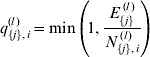
The sufficiency constants introduced above are calculated using Equation (6). A sufficiency constant is the ratio of the existing number of vessels to the necessary number of vessels to fill the time slots between consecutive Class A vessels. It corresponds to the utilization of a specific time slot.
where:
E {j}(l): Existing number of class j vessels in direction l
N {j},i(l): Necessary number of class j vessels in direction l between Class A vessels in scenario i
4.2.6. Necessary Number of Vessels between Class A Vessels
The necessary number of Class C vessels in direction l to sail between Class A vessels in scenario i is defined by:

where:
m {T6},i(l): Number of Class T6 vessels scheduled in direction l in scenario i
K C(l): Number of Class C vessels that may be scheduled between two consecutive Class A vessels in direction l.
In Equation (7), m i(l) − m {T6},i(l) gives the number of consecutive Class A pairs, while m i(l) − m {T6},i(l) − 1 gives the number of time intervals between them. Furthermore,  is the number of Class C vessels in direction l that may be scheduled according to the schedule in scenario i. As can be seen in Figures 3 and 4, the number of Class C vessels that may be scheduled between two consecutive Class A vessels is:
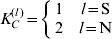 . Also, the max term in Equation (7) ensures that
N {C},i(l) is greater than 0 in case there are no time intervals in scenario i.
The necessary number of set vessels in direction l to sail between Class A vessels in scenario i is defined by

where:
K
(l): Number of set vessels that may be scheduled between two consecutive Class A vessels in direction l
Similarly,  in Equation (8) gives the total number of set vessels in direction l that may be scheduled according to scenario i. As can be seen in Figures 3 and 4, the number of set vessels that may be scheduled between two consecutive Class A vessels is:
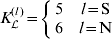 .
In order to obtain the necessary number of set vessels in direction l, N {},i (l), the number of empty time slots for Class C vessels represented by  is also added. N {C},i(l) − E {C}(l) represents the shortage of Class C vessels, which may be replaced by set vessels, while the max term ensures that only a positive shortage of Class C vessels is accounted for.
4.2.7. Vessels not requesting pilots
The necessary number of set ˈ vessels in direction l not requesting pilot to be scheduled between Class A vessels in scenario i is calculated using:

where
K
ˈ(l): Number of set ˈ vessels that may be scheduled between two consecutive Class A vessels in direction lP (l): Number of available pilots in direction l
Accordingly,  in Equation (9) gives the total number of set ˈ vessels in direction l that may be scheduled according to the schedule in scenario i. As can be seen in Figures 3 and 4, the number of set ˈ vessels that may be scheduled between two consecutive Class A vessels is:
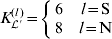 .
In order to obtain the necessary number of set ˈ vessels in direction l, N {ˈ},i(l), the number of available pilots in scenario i represented by 2P (l) − m i(l) is subtracted. 2P (l) represents the maximum total number of pilots that may be available for the course of a daytime schedule in direction l. The number of available pilots in direction l, P (l, is multiplied by 2 because according to the ST and SD values introduced earlier and the current practice of taxiing the pilots from one entrance to another, it is concluded that each available pilot may be utilized twice during a daytime schedule in each direction. Then, the number of Class T6 and Class A vessels scheduled in direction l in scenario i, m i(l) is subtracted from 2P (l) to ensure that each Class T6 and Class A vessel receives a pilot.
In addition, the existing number of set ˈ vessels in direction l is defined by

where:
E {jˈ}(l): Existing number of class j vessels in direction l not requesting pilot
To obtain the necessary number of vessels not requesting pilot, in addition to the number of Class D, E, and P vessels not requesting pilot, the minimum of existing and necessary number of Class C vessels not requesting pilot, 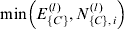 , should be taken into account. If there are more than the necessary number, these should not count towards the
E {ˈ}(l) since Class C vessels can be replaced by Class D, E, and P vessels in the schedule but not vice versa.
4.2.8. Scenario comparison
In order to determine the number of Class T6 and Class A vessels that will pass through the Strait in each direction, we evaluate Z i for each alternative scenario i, i = {1, 2, 3}.
• If Z 1 ≥ max (Z 2, Z 3), then we choose Scenario 1 (the original tentative schedule) with m 1(S) = m (S) and m 1(N) = m (N).
• If Z 2 ≥ max (Z 1, Z 3), then we choose Scenario 2 with m (S) − 1 southbound and m (N) + 1 northbound Class T6 and Class A vessels that will pass during the daytime schedule.
• Otherwise, if Z 3 ≥ max (Z 1, Z 2), then Scenario 3 is the best scenario with m 3(S) = m (S) + 1 and m 3(N) = m (N) − 1.
The objective function introduced in Equation (4) can be shown in further detail below:

As can be seen in Equation (11), if there are sufficient number of vessels to schedule between Class A vessels in scenario i, (i.e. all sufficiency constants being unity), then the scenario including the vessels with the higher average adjusted waiting times is the best option. Furthermore, the first part of the equation ( ) has the highest value in Scenario 1. Thus, the value of this term decreases in Scenario 2 and Scenario 3; on the other hand the second part of the equation incorporating the sufficiency constants might increase. Therefore, the idea in comparing the additional two scenarios to the base scenario is to see if the increase in the vessel sufficiency is greater than the decrease in the average adjusted waiting time of the Class T6 and Class A vessels.
Eventually, the goal is to continue scenario comparisons until there is no more improvement in the objective function. For example, if Scenario 2 gives the best objective function in the first iteration, then an additional scenario with m (S) − 2 southbound and m (N) + 2 northbound Class T6 and Class A vessels is compared to Scenario 2. The iterations are then repeated until a new scenario does not improve the objective function. In the current application we have implemented only one iteration as described above.
4.2.9. Scheduling Class P, C, E, and D Vessels
As mentioned before, once the Class T6 and Class A vessels that will pass that day in each direction is determined, the rest of the vessels are scheduled between consecutive Class A vessels according to the order plans depicted in Figures 3 and 4.
Set vessels (Class P, E, and D) are scheduled at 10-minute intervals between consecutive Class A vessels in the same direction. According to the VTS, passenger vessels have priority over any other type of vessels and tankers have priority over dry cargo vessels. Therefore, set vessels are scheduled based on the following order of priority: P > E > D. In case there are no set vessels available, that time slot is left empty. In addition, Class C vessels are scheduled at 30-minute intervals between consecutive Class A vessels in the same direction. If there are no Class C vessels available, then a set vessel may be scheduled instead. If there are no set vessels available either, then that time slot is left empty.
Class P, E, D, and C vessels are scheduled within their classes and directions according to a similar ordering policy. First, the vessels are listed in a decreasing order of adjusted waiting times. Then, the vessels necessary to fill the corresponding time slots between consecutive Class A vessels are removed from the list. This removed group of vessels is then separated in two groups: vessels requesting pilot and others. These two groups are then sorted in decreasing order of speed. Finally, the two sorted groups are combined into one final list where the vessels requesting pilot are listed first. The vessels are scheduled starting from the top of this final list.
4.2.10. Initial Direction of Daytime Schedule
After determining the daytime schedule in both directions, operators at the VTS select the direction of traffic. Based on the discussions with the operators, the following factors are identified as the most influential in determining the starting direction of the daytime schedule.
• Total number of vessels waiting at both entrances;
• Total waiting time of all vessels scheduled according to the chosen scenario;
• Number of Class T6 and Class A vessels scheduled according to the chosen scenario.
In order to compare the vessel congestions in the southbound and the northbound entrances, a score value is assigned to each direction. The score value of direction l, S (l) is defined by:

where:
lˈ: The opposite direction
E All(l): Total number of vessels waiting in the queue in direction l
TW (l): Total waiting time of all vessels in direction l scheduled to pass
The aim is to start the daytime schedule in the direction with:
• greater number of vessels waiting,
• higher total waiting time of vessels, and
• greater number of Class T6 and Class A vessels scheduled in the chosen scenario.
Each component in Equation (12) corresponds to the relative value of a factor for a direction, compared to the total value for both directions. All three terms represent ratios instead of individual values and they can therefore be added together. The multiplicative constants a, b and c indicate the relative importance of the three criteria listed above. Current values of a, b and c are 0·5, 0·3 and 0·2, respectively as used by the VTS. Finally, the direction with higher score is selected as the initial direction of the daytime traffic.
The daytime schedule described above is the initial schedule determined two hours before the daytime starts. Additionally, at the end of daytime traffic schedule in each direction, the schedule is updated if CPT>SD and there is any new Class A vessel waiting in the queue.
4.3. Night-time Schedule
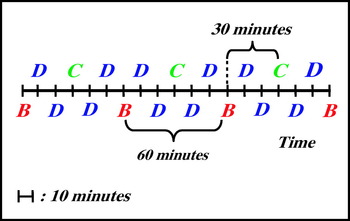
In contrast with the daytime traffic, there is two-way traffic flow during the night-time. Class B vessels are the most critical vessels in terms of their cargo type and length, among all the vessels that can pass through the Strait at night-time. These vessels may enter the Strait at 60-minute intervals. Again, Class C vessels may enter at 30-minute intervals while Class D, E and P vessels may enter at 10-minute time intervals. A typical ordering of vessels entering the Strait at night-time is given in Figure 5.
A typical schedule of vessels entering the Strait during the night-time.

The 1998 Regulations state that, while a large vessel carrying dangerous cargo (oil tanker, chemical tanker, LNG, LPG, etc.) passes through the Istanbul Strait, another vessel carrying dangerous cargo cannot enter the Strait from the opposite direction regardless of its length. Therefore, while a Class B or C vessel navigates the Strait at night, no Class B, C, or E vessel is allowed to enter in the opposite direction. Each night, depending on the vessel congestion at the entrances, the VTS allows the passage of the aforementioned classes, first in one direction and then in the other. This procedure is carried out once in a given night. Thus, in order to schedule the nighttime traffic, we use the daytime vessel scheduling algorithm explained in Section 4.1, with Class A vessels replaced by Class B vessels.
5. NUMERICAL EXAMPLE
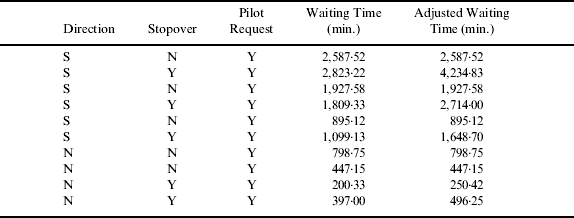
In this section, deployment of the algorithm and resulting time windows and scheduling practices will be demonstrated by using the data representing the vessel traffic on May 13, 2005 in the Strait of Istanbul, where the daytime started at 6:30 am and had a duration of 735 minutes. On this particular date, there were no Class T6 and Class P vessels waiting in the queue. The list of Class A vessels that had submitted their SP 2 by 4:30 a.m. is listed in Table 6. The resulting northbound and southbound schedules for all vessels (through the deployment of the algorithm) is given in Figure 6.
List of Class A vessels that had submitted their SP 2 on May 13, 2005.
Final daytime schedule for May 13, 2005.

6. VALIDATION
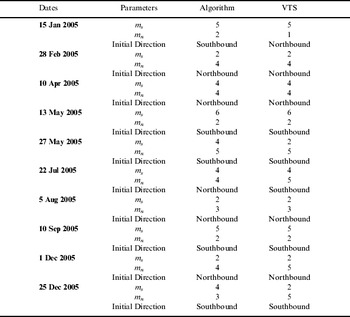
Table 7 shows the numerical results obtained by the daytime scheduling algorithm versus the actual VTS schedules for 10 different dates in the 2005 data. In six out of the ten dates, the schedules generated by the algorithm match those of the VTS. Even though it appears that the rest of the results do not match the actual schedules, further analysis reveals that the differences come from individual operator decisions at the VTS. Although the operators adhere to the regulations, we observe that in some cases they have used their judgment to make exceptions to the established rules.
Schedules by the proposed algorithm compared with VTS schedules.

For example, on 1 December, the VTS scheduled one more northbound Class A vessel than the scheduling algorithm. In order to do that, the VTS allowed some of the northbound Class A vessels to enter the Strait at 75-minute intervals instead of the minimum requirement of 90 minutes. We observe the same practice on July 22. In addition, on January 15 and May 27, the algorithm scheduled more Class A vessels compared to the actual VTS schedule. The difference is the result of traffic suspension due to unknown reasons.
The only example in which the schedule from the algorithm differs from the actual VTS schedule is on December 25. Still, although the number of scheduled Class A vessels is different, the initial direction of the daytime traffic is identical in both the algorithm and the VTS schedule.
Therefore, we conclude that the scheduling algorithm is successful 90% of the time at mimicking the current scheduling practice at the Istanbul VTS.
7. VESSEL SCHEDULING IN ANY STRAIT OR WATERWAY
So far, we have looked at the scenario of the Strait of Istanbul and developed a scheduling algorithm involving the relevant specific considerations. However the algorithm can easily be generalized to apply to any given waterway including straits and channels that have two-way traffic with one direction open at a time. A similar algorithm can also be established for any strait or channel, considering the key parameters such as vessel priorities, minimum time displacement between vessels, their waiting times, maximum operational duration per day, number of vessels waiting at each entrance and schedules of vessels and entrance openings at the start of each day.
ACKNOWLEDGEMENT
The research is in part supported by the National Science Foundation (NSF OISE-0423262), TUBITAK (104Y207), Turkish Scientific and Technical Research Foundation and BAP (07M104), Scientific Research Projects Fund of Bogazici University. We are indebted to the Turkish Straits Vessel Traffic Services Authority for providing us with data on vessel traffic in the Strait of Istanbul.