Introduction
The detected prevalence of thyroid nodules has increased substantially with advances in ultrasound technology, with some series reporting nodules in up to 70 per cent of adults.Reference Guth, Theune, Aberle, Galach and Bamberger1 The majority are benign; outcomes for differentiated thyroid cancer are excellent, with the 10-year survival rate exceeding 90 per cent.Reference Jukić, Blažeković, Franceschi, Ovčariček, Butković and Dabelić2
In the UK, ultrasound is the first-line investigation for thyroid nodules and this guides decisions regarding fine-needle aspiration (FNA) and follow-up. The British Thyroid Association (BTA) uses a sonographic U-classification (U1–U5), with escalation primarily determined by ultrasound features rather than nodule size. U3–U5 nodules generally proceed to FNA, and guidance does not specify a lower size threshold for consideration. Selective investigations of incidental nodules detected on CT or MRI are recommended, based on clinical and imaging risk factors.Reference Perros, Boelaert, Colley, Evans, Evans and Gerrard3
In contrast, international systems integrate size into biopsy decision-making. The American College of Radiology Thyroid Imaging Reporting and Data System (ACR TI-RADS) recommends size-based FNA thresholds according to ultrasound risk, with smaller nodules typically observed.Reference Tessler, Middleton, Grant, Hoang, Berland and Teefey4 American Thyroid Association (ATA) guidance similarly applies pattern-specific cut-offs (for example ≥1 cm for high or intermediate suspicion and ≥1.5–2 cm for lower risk patterns).Reference Haugen, Alexander, Bible, Doherty, Mandel and Nikiforov5 European TI-RADS (EU-TIRADS) recommends FNA for nodules of ≥10 mm, ≥15 mm and ≥20 mm with selective exceptions.Reference Russ, Bonnema, Erdogan, Durante, Ngu and Leenhardt6 Collectively, these frameworks aim to avoid the biopsy of small, low-risk nodules.
The purpose of this study was to evaluate the real-world management and outcomes of small (≤20 mm) U3–U4 thyroid nodules in a UK district general hospital. We set out to determine whether U-grade or size governed the selection for FNA and whether size adds discrimination beyond U-grade when selecting for surgical procedure or anticipating malignancy. We also explored whether a cautious size-based variance to the BTA pathway, particularly for sub-centimetre nodules, could safely reduce investigation and follow-up.
Materials and methods
We conducted a single-centre retrospective cohort study at a UK district general hospital, assessing the outcomes and management of small sonographically indeterminate or suspicious thyroid nodules. The study window for index ultrasound examinations was 1 January 2022 to 31 December 2022, with a follow-up to 30 June 2025.
The study followed the Strengthening the Reporting of Observational Studies in Epidemiology (STROBE) guidelines. Local approval was obtained as a service evaluation and formal Research Ethics Committee approval was not required.
Participants
Thyroid ultrasound reports were retrieved from the Radiology Information System (CRIS). A free-text search was performed to identify examinations containing the terms ‘U3’, ‘U4’ or ‘U5’ within the index window. All reports were manually verified and cross-checked with prior imaging to confirm eligibility.
Clinical, cytological and pathology data were obtained from electronic hospital systems, including Integrated Clinical Environment (ICE) (cytology) and clinic correspondence, multidisciplinary team documentation and operative records (CITO).
Inclusion criteria were thyroid nodules graded U3–U5 on the index ultrasound and with a maximum diameter ≤20 mm.
Exclusion criteria were nodules documented on any prior ultrasound, post-operative surveillance examinations and insufficient documentation to confirm U-grade or size.
No U5 nodules met the index-window criteria.
Unit of analysis
Analyses were performed at the nodule level. When patients contributed multiple eligible nodules, all nodules were included. To account for this, we used patient-clustered robust standard errors.
A pre-specified sensitivity analysis was undertaken that restricted inclusion to one nodule per patient (highest U-grade, or if tied, the largest).
Variables and definitions
U-grade was recorded as reported by the radiologist. For analysis, mixed grades were simplified and recoded as U3/4 to U4 and U2/3 to U3. Size bands were defined by maximum diameter on the index ultrasound: ≤10 mm, 11–15 mm and 16–20 mm.
Cytology results were recorded for the initial FNA and any subsequent procedures. For analysis, the final Thy category was taken as the most recent cytology within the follow-up window.
Ultrasound surveillance was defined as ≥1 follow-up ultrasound during the study timeframe. Nodules were considered stable when no interval change was reported by the interpreting radiologist; no quantitative growth threshold was pre-specified.
Surgical procedures including neck dissection and radio-iodine therapy were recorded.
Outcomes
The primary outcome was histologically confirmed thyroid malignancy among surgically resected nodules.
Secondary outcomes included uptake of FNA at the index assessment and during follow-up, cytological outcomes, surgical intervention, post-intervention morbidity and outcomes among nodules managed without FNA.
Statistical analysis
Baseline characteristics were summarised by U-grade and size band. Determinants of FNA uptake and surgical intervention were estimated using modified Poisson regression to generate risk ratios (RRs), with robust standard errors clustered at the patient level. Models were adjusted for U-grade, size band, age and sex when available.
Final cytological outcomes were analysed using Poisson regression with robust standard errors to estimate relative risks for benign cytology (Thy2) and for high-risk cytology (combined Thy4/Thy5).
Among surgically resected nodules, malignancy rates across size bands were compared using Fisher’s exact test. Firth penalised logistic regression was used to assess the association between size (≤10 mm vs >10 mm) and malignancy, to account for small sample size and separation.
Missing data amounted to fewer than 10 per cent for key variables, and complete case analysis was undertaken. All tests were two-sided with a significance threshold of α = 0.05. Data were collated in Microsoft Excel and analyses were undertaken using the R programming language (version 4.5.1).
Results and analysis
Between 1 January and 31 December 2022, 282 thyroid ultrasound reports contained U3–U5 classifications. 171 reports were excluded as the nodule had been already present on prior imaging. Of the remaining reports, 128 distinct nodules were identified; two were excluded as they were labelled U2 and 45 were excluded as measuring >20 mm. The final cohort therefore comprised 81 nodules in 73 patients (Figure 1).
Flow diagram showing cohort selection and exclusions.

The mean age of the patients was 55 ± 15 years and (79.5 per cent) of patients were women. Of the 81 nodules, 53 (65.4 per cent) had been classified as U3, 28 (34.6 per cent), were classified as U4 and there were no eligible U5 nodules.
Size distribution was similar across bands: ≤10 mm 28/81 (34.6 per cent), 11–15 mm 29/81 (35.8 per cent) and 16–20 mm 24/81 (29.6 per cent). Within each band, the majority of nodules were U3 (≤10 mm 19/28 (67.9 per cent), 11–15 mm 18/29 (62.1 per cent) or 16–20 mm 16/24 (66.7 per cent) (Table 1)
Distribution of ultrasound grade by nodule size band

Table 1 Long description
Counts and within-size-band percentages of ultrasound grades U3 and U4 are reported across three nodule size bands, plus overall totals for 81 nodules. Overall, 53 nodules are U3 (65.4 percent) and 28 are U4 (34.6 percent). For nodules 10 mm or smaller, 19 are U3 (67.9 percent) and 9 are U4 (32.1 percent), total 28. For 11 to 15 mm, 18 are U3 (62.1 percent) and 11 are U4 (37.9 percent), total 29. For 16 to 20 mm, 16 are U3 (66.7 percent) and 8 are U4 (33.3 percent), total 24. The U3 to U4 split is broadly consistent across size bands, with only small variation and no clear size-related shift. Some grades were combined into single categories for analysis, so the reported U3 and U4 counts include recoded mixed-grade cases.
Mixed grades were simplified for analysis (U3/4 recoded as U4, U2/3 recoded as U3).
.
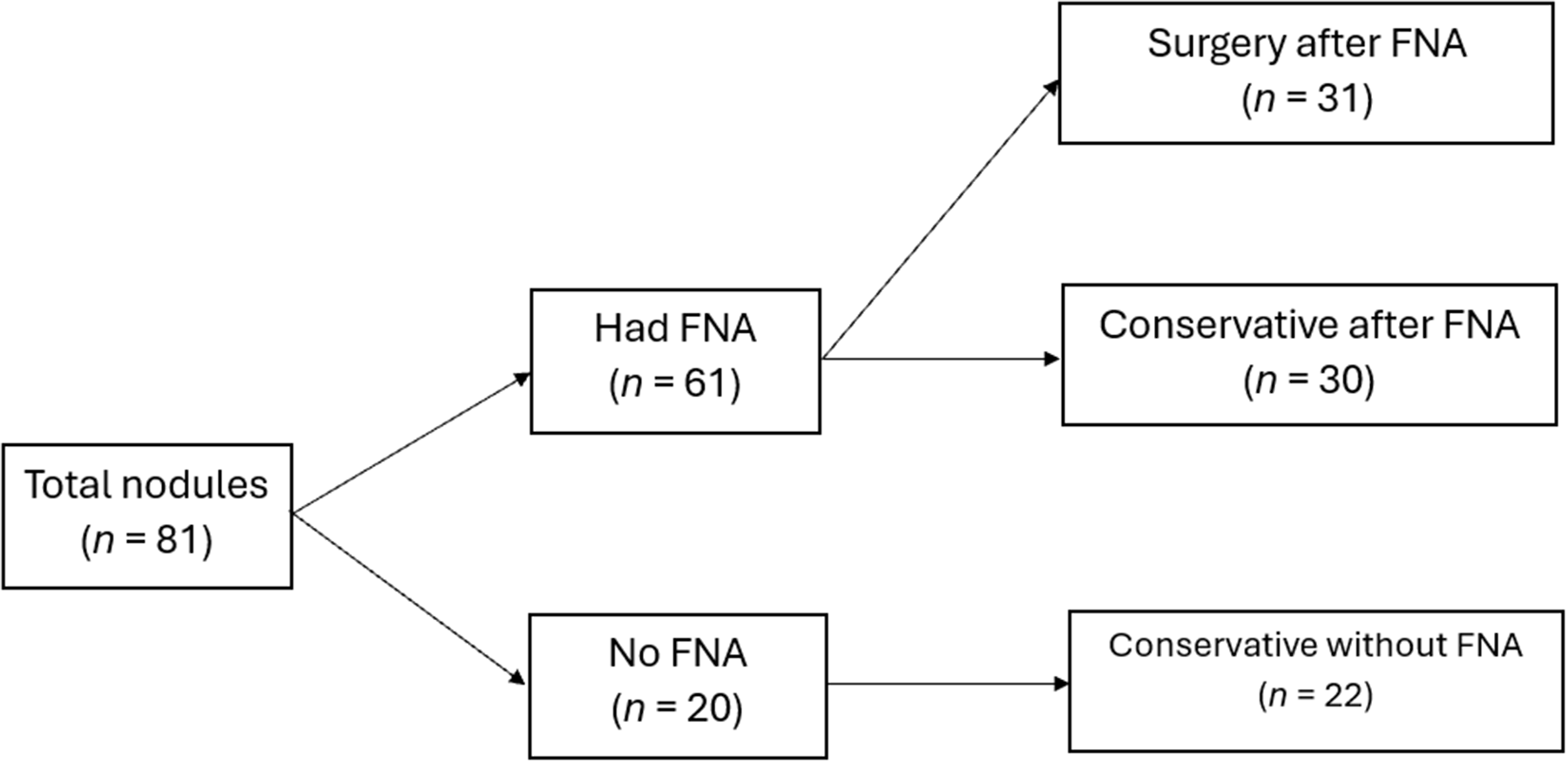
Overall, 61/81 nodules (75.3 per cent) underwent FNA either at the index ultrasound or following clinical assessment; 20/81 (24.7 per cent) were managed without FNA (Figure 2)
Management pathways and outcomes of included thyroid nodules.

.
On initial FNA, 17/61 (27.9 per cent) nodules were classified as non-diagnostic (Thy1). Thirteen of these nodules underwent repeat FNA, with four remaining as Thy1 on subsequent sampling. After adjustment for U-grade and age, ≤10 mm nodules had a higher but not statistically significant risk of non-diagnostic cytology compared with 16–20 mm nodules (adjusted RR 2.04, 95 per cent CI 0.70-5.91, p = 0.19).
U4 nodules were more likely to undergo FNA than U3 nodules, although this did not reach statistical significance (adjusted RR 1.40, 95 per cent CI 0.83–2.32, p = 0.195). Compared with 16–20 mm nodules, ≤10 mm nodules were less likely to undergo FNA (adjusted RR 0.77, 95 per cent CI 0.40–1.45, p = 0.413), whilst 11–15 mm nodules showed a similar uptake (adjusted RR 0.93, 95 per cent CI 0.51–1.71, p = 0.817). Overall, there was a trend towards higher FNA use in U4 nodules; nodule size did not independently influence FNA uptake.
Final Thy categories among nodules undergoing FNA were: Thy1 in 9/61 (14.8 per cent), Thy2 in 12/61 (19.7 per cent), Thy3a in 2/61 (3.3 per cent), Thy3f in 17/61 (27.9 per cent), Thy4 in 9/61 (14.8 per cent) and Thy5 in 11/61 (18.0 per cent). One patient yielded an alternative diagnosis of tonsillar carcinoma (Table 2)
Final Thy score by U-grade and size band

Table 2 Long description
Counts are grouped by ultrasound grade (U3 and U4), thyroid cytology category (Thy1 to Thy5 plus Other for U4), and three nodule size bands (10 mm or less, 11 to 15 mm, and 16 to 20 mm), with row totals for each Thy category. U3 totals 35 cases, higher than U4 with 26. In U3, Thy3f is the largest category with 13 cases spread across all sizes (4 at 10 mm or less, 4 at 11 to 15 mm, and 5 at 16 to 20 mm). U3 Thy2 totals 9 (2, 4, 3 across the size bands), while Thy4 and Thy5 each total 5 and are evenly distributed between the two larger size bands with one case at 10 mm or less. In U4, the highest totals are Thy1 and Thy5 with 6 cases each; Thy5 is concentrated in 11 to 15 mm (5 of 6), while Thy1 is mostly 10 mm or less and 11 to 15 mm (4 and 2) with none in 16 to 20 mm. U4 also includes small counts in Thy3a (2, all in 16 to 20 mm) and Other (1, in 16 to 20 mm). Blank cells in the Total rows indicate that only overall totals are provided there, not size band subtotals.
.
U4 nodules showed a lower proportion of Thy2 cytology compared with U3 nodules (12.0 per cent vs 25.7 per cent), although this association was not statistically significant after adjustment for size (RR 0.46, 95 per cent CI 0.10–1.53, p = 0.239). High-risk cytology (Thy4/5) was more frequent in U4 nodules than U3 nodules (40.0 per cent vs 28.6 per cent), but this did not reach statistical significance after adjustment (RR 1.33, 95 per cent CI 0.54–3.28, p = 0.531).
Cytology distributions were similar across size bands, with no significant association between size and either benign or high-risk cytology (all p > 0.3).
Thirty-one out of 81 nodules (38.3 per cent) underwent surgical procedure. Surgical rates increased with size: 7/28 (25.0 per cent) for ≤10 mm nodules, 13/29 (44.8 per cent) for 11–15 mm nodules and 11/24 (45.8 per cent) for 16–20 mm nodules. Overall, ≤10 mm nodules demonstrated a lower likelihood of surgical procedure compared with 16–20 mm nodules (RR 0.50, 95 per cent CI 0.24 – 1.03, p = 0.060).
All resected nodules had pre-operative cytology (Thy5 n = 11, Thy4 n = 8, Thy3f n = 9, Thy3a n = 1, Thy1 n = 2). Two Thy1 nodules (U4 ≤10 mm and U3 ≤10 mm) underwent surgical procedure following the multidisciplinary team discussion due to radiological concern and patient preference.
Procedures comprised 11 total thyroidectomies and 19 hemithyroidectomies, of which seven patients went on to have completion thyroidectomy. Among malignant cases, 11/31 (35.5 per cent) received radio-iodine therapy and 2/31 (6.5 per cent) had neck dissection (Table 3)
Surgical and oncological outcomes by nodule size band

Table 3 Long description
Outcomes are reported by thyroid nodule size bands of 10 mm or smaller, 11 to 15 mm, and 16 to 20 mm, plus an overall total. There were 81 nodules in total: 28 in the smallest band, 29 in the middle band, and 24 in the largest band. Surgery was performed in 31 of 81 nodules overall, with higher surgery percentages in the two larger size bands (about 45 percent each) than in nodules 10 mm or smaller (25 percent). Among those who had surgery, thyroid cancer was found in 26 of 31 overall, with the highest proportion in the 11 to 15 mm band (12 of 13) and the lowest in the 10 mm or smaller band (5 of 7). Radio-iodine therapy among malignant surgical cases occurred in 11 of 26 overall, increasing by size band from 1 of 5 in the smallest group to 5 of 12 in the middle group and 5 of 9 in the largest group. Neck dissection among malignant surgical cases was uncommon, occurring in 2 of 26 overall, with none in the smallest band and one case each in the middle and largest bands. Percentages are accompanied by confidence intervals, which are wide in some groups due to small numbers, so differences between size bands should be interpreted cautiously.
.
On final histopathology, 26/31 surgically resected nodules (83.9 per cent) were classified as malignant (predominantly papillary) and 5/31 (16.1 per cent) were classified as benign adenomas or hyperplastic nodules.
By size among resected nodules, cancer was present in 5/7 (71.4 per cent) ≤10 mm, 12/13 (92.3 per cent) 11–15 mm and 9/11 (81.8 per cent) 16–20 mm (Table 3). Overall, 21/31 (67.7 per cent) were papillary; 5/31 (16.1 per cent) were papillary microcarcinoma (≤10 mm) (Table 4)
Histopathological outcomes by nodule size band among surgically resected nodules

Table 4 Long description
Histology outcomes for surgically resected nodules are reported, grouped by three nodule size bands and summarized with counts and percentages within each histology row. Papillary cases total 21 and are distributed as 5 in nodules 10 mm or smaller, 9 in 11 to 15 mm, and 7 in 16 to 20 mm, with the highest share in the 11 to 15 mm band. Follicular cases total 2 and occur only in the 11 to 15 mm band. Mixed papillary plus follicular cases total 2 and occur only in the 16 to 20 mm band. Mixed papillary plus benign totals 1 and occurs only in the 11 to 15 mm band. Benign cases total 5 and are spread across all size bands, with 2 in 10 mm or smaller, 1 in 11 to 15 mm, and 2 in 16 to 20 mm. Percentages shown are within each histology category, and several categories have very small totals, so apparent differences by size should be interpreted cautiously.
.
Cancer rates did not differ significantly across size bands among surgical nodules (Fisher’s exact test p = 0.495). In Firth penalised logistic regression, nodule size (≤10 mm vs >10 mm) was not associated with malignancy (OR 0.60, 95 per cent CI 0.08-5.17, p = 0.59).
Of the 50 nodules (61.7 per cent) not managed surgically, 30 (60.0 per cent) underwent FNA and 20 (40.0 per cent) were managed without FNA. Most nodules underwent surveillance ultrasound (44/50, 88 per cent) with at least one surveillance ultrasound (median two scans, IQR 1–3).
In the no-FNA cohort (20/81, 24.7 per cent), most nodules were U3 (18/20, 90 per cent) and 10/20 (50 per cent) were ≤10 mm. On surveillance ultrasound, nine nodules were downgraded to U2, five remained stable, two were no longer visualised and two were lost to follow-up. One patient underwent total thyroidectomy for a contralateral Thy4 lesion and one was referred to endocrinology for suspected parathyroid disease.
There were no deaths attributable to thyroid disease or thyroid surgical procedure during the follow-up period. One patient with lung cancer had died; evaluation of their thyroid nodules was withheld because of co-morbidity.
Eighteen nodules (22.2 per cent) required a second FNA; 13 of these were due to initial non-diagnostic (Thy1) results. Post-operative complications occurred in 5/31 (16.1 per cent) patients, including transient voice change (n = 3), persistent mild dysphonia (n = 1), transient hypocalcaemia (n = 1), hypertrophic scarring (n = 1) and transient taste disturbance (n = 1). Some complications co-occurred within the same individuals.
Discussion
In this single-centre cohort of small (≤20 mm) U3–U4 thyroid nodules, ultrasound grade and cytology governed investigation and treatment with little influence of size. These findings are consistent with routine UK practice and the structure of BTA guidance, in which escalation is primarily driven by sonographic category and cytology, rather than size.Reference Perros, Boelaert, Colley, Evans, Evans and Gerrard3
Among surgically resected nodules, the malignancy yield was high (83.9 per cent). This reflects the selection of higher risk nodules for surgical procedure based on ultrasound and cytology and should not be interpreted as the overall prevalence of malignancy among all small U3–U4 nodules. In addition, verification bias is inherent because histology was available only for nodules that had undergone surgical procedure; therefore, malignancy in non-operated nodules could not be excluded definitively. However, 16.1 per cent of surgical specimens were benign, indicating that a proportion of patients had undergone operative intervention for non-malignant disease. Size did not distinguish malignancy within the surgical subset. Given the observed post-operative morbidity rate of 16 per cent, this reinforces the importance of careful patient selection and avoidance of unnecessary escalation, particularly for small low-risk nodules.
In contrast with BTA, international frameworks such as ACR TI-RADS, ATA and EU-TIRADS explicitly integrate size thresholds with sonographic features to ration biopsy of small nodules.Reference Tessler, Middleton, Grant, Hoang, Berland and Teefey4–Reference Russ, Bonnema, Erdogan, Durante, Ngu and Leenhardt6 Despite these differences in formal guidance, clinicians in our service appeared to apply pragmatic restraint for smaller U3 lesions, frequently favouring surveillance over immediate investigation.
Thy3 nodules showed the greatest heterogeneity in downstream management, reflecting their intermediate risk and the influence of co-morbidity and patient preference. In our cohort, some Thy3f nodules proceeded to surgical procedure (with high malignant yield), others were observed (medical unfitness or patient choice) and a small number were lost to follow-up. This variability mirrors everyday multidisciplinary team decision-making under BTA frameworksReference Perros, Boelaert, Colley, Evans, Evans and Gerrard3 and emphasises the value of documented rationale for observation and standardised re-sampling plans for persistent diagnostic uncertainty.
Two nodules were later upgraded to Thy3f after enlargement on imaging and the patients are now awaiting surgical procedure. The nearly one-third of initial FNAs that were non-diagnosed underlines the value of explicit safety-netting. This includes clear re-referral triggers (new symptoms, nodal findings, U-grade change or meaningful growth) and review intervals that fit service capacity.
For sub-centimetre (≤10 mm) U3 nodules without high-risk features, surveillance appears reasonable. For larger (10–20 mm) U3 nodules, surveillance may also be appropriate if no high-risk features are present and the patient can engage with follow-up. For U4 nodules, escalation should remain guided by ultrasound and cytological findings, as well as overall clinical context, rather than size thresholds alone.
Our findings align with long-term active surveillance data for papillary thyroid microcarcinoma (PTMC, ≤10 mm).Reference Miyauchi, Ito, Fujishima, Miya, Onoda and Kihara7, Reference Saravana-Bawan, Bajwa, Paterson and McMullen8 In the large Japanese series from Miyauchi et al. (Kuma Hospital, 30-year experience), only 3.8 per cent of incidences had ≥3 mm growth, with 10-year and 20-year growth rates of 4.7 per cent and 6.6 per cent, respectively. New nodal metastases occurred in 0.8 per cent overall, distant recurrence was exceptionally rare and there were no thyroid cancer deaths. Immediate surgical procedure yielded only a modest reduction in nodal events, whilst exposing patients to surgical procedure and its associated risks. Overall oncological outcomes were similar, supporting carefully selected surveillance for low-risk PTMC.Reference Miyauchi, Ito, Fujishima, Miya, Onoda and Kihara7
In our cohort, all surgically resected nodules had undergone prior FNA. Outcomes among conservatively managed nodules were broadly similar, regardless of whether FNA had been performed, with many lesions either downgraded or remaining stable on follow-up. Although malignancy was confirmed in four out of five patients who had undergone surgical procedure, long-term active surveillance data, such as those from Miyauchi et al.,Reference Miyauchi, Ito, Fujishima, Miya, Onoda and Kihara7 suggested that immediate surgical procedure may not always improve long-term morbidity or mortality for carefully selected low-risk thyroid cancers. These findings raise the possibility of overtreatment when biopsy and surgical procedures are applied to small, low-risk nodules, whilst also exposing patients to surgical risk, the psychological burden of a cancer diagnosis and the possible socioeconomic consequences.
Given the increased sensitivity of modern ultrasound and the limitation of imaging for reliably characterising very small lesions, there may be value in reconsidering how such nodules are labelled and communicated. Terminology implying indeterminate or suspicious disease may inadvertently drive anxiety and escalation. Future guideline refinement may wish to consider whether clearer surveillance-based pathways for selected sub-centimetre nodules could reduce unnecessary anxiety and intervention, whilst maintaining patient safety through structured follow-up. Any such changes would, however, require validation in larger, prospective cohorts to ensure diagnostic safety and consistency with international practice.
Limitations to this study include the retrospective single-centre design with small sample size yielding wide confidence intervals and limited precision. Case identification through free-text search (despite manual verification) may introduce ascertainment bias; the absence of U5 nodules limits applicability to the highest-risk nodules. Verification bias is also inherent, as histological confirmation was available only for surgically resected nodules, whilst conservatively managed nodules were assessed using cytology and imaging follow-up. Also, in the conservative cohort, there was reliance on the radiologist’s report of a ‘stable’ appearance rather than a quantitative growth rule. Finally, the three-year follow-up period is short relative to the long natural history of differentiated thyroid cancer; therefore, this study could not definitively establish long-term safety of surveillance, although international long-term data provide reassurance.Reference Miyauchi, Ito, Fujishima, Miya, Onoda and Kihara7
Summary
What is already known on the subject
• The prevalence of thyroid nodules has increased with widespread ultrasound use, with most nodules being classified as benign.
• In the UK, the British Thyroid Association recommends investigation primarily based on ultrasound (U) grade rather than the nodule size.
• International guidelines (ACR TI-RADS, ATA, EU-TIRADS) incorporate size thresholds to limit biopsy of small, low-risk nodules.
What this paper adds to our understanding
• In this study, nodule size did not independently predict malignancy or influence cytological outcomes. Sub-centimetre U3 nodules were less likely to undergo biopsy or surgical procedure, with many instances safely managed with surveillance.
• These findings support a surveillance-first approach for selected sub-centimetre U3 nodules within structured follow-up pathways.
Conclusion
In this real-world cohort of small U3–U4 thyroid nodules, management was guided predominantly by ultrasound grade and cytology, with little additional prognostic value from size. These findings support the more selective use of FNA in small U3 nodules, with the potential to reduce unnecessary procedures and the associated morbidity in NHS practice. Larger prospective studies are needed before any guideline change can be recommended.
Funding statement
No funds, grants or other support was received.
Competing interests
The authors have no relevant financial or non-financial competing interests to disclose.
Ethical standards
This study was registered with the Trust’s audit department. Formal Research Ethics Committee review was not required for the retrospective analysis of anonymised routinely collected data.