Introduction
Cost-effectiveness analysis (CEA) is a powerful analytic tool for assessing the value and efficiency of health care interventions. In a CEA, the incremental cost for generating a unit of health (measured in quality-adjusted life years (QALYs)) can be compared across alternative treatments. At the policy level, this type of comparison provides an indication of value for money across treatments competing over scarce resources. Cost-effectiveness methods are widely accepted internationally and are used in assessments of new and/or expensive health care interventions. For example, CEA results figure explicitly in the coverage decision-making process in many western nations, including the UK, Australia, Canada, and the Netherlands (Bryan et al., Reference Brock2007; Neumann, Reference Neumann, Rosen and Weinstein2005; Siegel, Reference Siegel2005; Al et al., Reference Al, Feenstra and Brouwer2004; Henry et al., Reference Henry, Hill and Harris2005). Despite its acceptability elsewhere, CEA continues to be used sparingly in the US, where the focus in coverage tends to be safety and efficacy data exclusively (Garber, Reference Garber2004). Academics and policy analysts have called for cost-effectiveness studies to inform US health policy decisions (Neumann et al., Reference Neumann2005; Garber, Reference Garber2004; Gillick, Reference Gillick2004). Of course, cost issues are not ignored by US health plans – many of whom are commercial entities and so have to provide returns to investors – but are managed through variable co-pays and deductibles for high cost products (Gold et al., Reference Gold, Franks, Siegelberg and Sofaer2007).
Neither Medicare nor Medicaid explicitly use cost-effectiveness studies in coverage determinations; indeed Medicare is barred by statute from considering costs in its determinations (Foote, Reference Foote2002). However, it would be wrong to suggest that CEA is universally ignored. Both the Department of Veterans Affairs (Aspinall et al., Reference Aspinall, Good, Glassman and Valentino2005) and the Department of Defense (Luce, Reference Luce2005) make some use of CEAs in formulary decisions and CE information has supplemented guideline development and technology assessment related to preventive services (Saha et al., Reference Saha, Hoerger, Pignone, Teutsch, Helfand and Mandelblatt2001; US Congress, 1992), and is thought to have positively influenced coverage for some of them (Banta and Luce, Reference Banta and Luce1983; Schauffler, Reference Schauffler1993; Neumann, 2004a). Other guideline enterprises also embed economic studies into their text (Wallace et al., Reference Wallace, Weingarten, Chiou, Henning, Hohlbauch, Richards, Herzog, Lewensztain and Ofman2002) and have been held to shape policy discussions (Neumann, 2004a). Further, some private plans are moving towards an explicit acceptance of CEA, for example, WellPoint has stated that CEA will begin to inform their formulary listing process (WellPoint, 2005), but such plans form a small minority (Neumann et al., Reference Neumann, Palmer, Daniels, Quigley, Gold and Chao2008). These examples are, however, exceptions to the rule – in general, CEA plays little formal role in evaluating new and/or expensive therapies in the US. The reasons given as to why this is the case are typically divided into three broad areas: external barriers, conflicts with fundamental ethical concerns, and methods issues.
Resistance related to external factors
Resistance by insurers to use of CEA has been linked to fear of negative public perceptions and resulting financial instability through two possible routes. First, private insurers worry that explicit acknowledgment of cost, as a consideration for coverage will diminish market share. Managed care's faltering acceptance has been attributed to consumer dissatisfaction with coverage policy that appeared driven by cost rather than clinical considerations (Garber, Reference Garber2001). Further, both government (Tunis, Reference Tunis2004) and private insurers have stated concerns that the public will perceive use of CEA as a means of health care ‘rationing’. Second, lawsuits stemming from negative coverage decisions, based on consideration of both cost and effectiveness evidence, have been viewed as an obstacle to use of CEA by insurers. Although the Supreme Court ruled unanimously in Pegram v. Herdrich in 2000 that managed care coverage decisions could include cost considerations (Bloche and Jacobson, Reference Bloche and Jacobson.2000), other rulings have suggested that cost criteria may not be acceptable as a defense against malpractice (Jacobson and Kanna, Reference Jacobson and Kanna2001).
‘Value-based’ resistance
Ethical and value assumptions are embedded within the methods of CEA (Brock, Reference Brock1998; Harris, Reference Harris1987; Menzel et al., Reference Menzel, Gold, Nord, Pinto-Prades, Richardson and Ubel1999). In brief, cost-effectiveness studies measure gains using QALYs, where life expectancy and health-related quality of life are combined in a single scale that allows a comparison of the dollar cost per health unit generated by alternative interventions. CEAs give a good snapshot of treatment efficiency but are silent on the equity or distributive impact of the intervention. This is because CEA starts with the assumption that QALYs gained via health interventions are equivalent, no matter to whom they go, and that the most efficient interventions are those that maximize QALYs across populations for the lowest cost. Three major ethical issues have been identified: no special priority is given to those who are worse off (i.e. sicker or at greater risk) (Gold et al., Reference Gold, Stevenson and Fryback2002; Harris, Reference Harris1988; Koch, Reference Koch2000; Rawles, Reference Rawles1989); people with limited treatment potential (i.e. people with a disability or chronic disease) are discriminated against when considering interventions for life-saving conditions unrelated to their disability (Russell et al., Reference Russell, Gold, Siegel, Daniels and Weinstein1996; Daniels Reference Daniels and Walker1985); and no qualitative distinction is made between treatments that are health-improving versus those that are life-saving (Hadorn, Reference Hadorn1991; Nord et al., Reference Nord, Pinto, Richardson, Menzel and Ubel1999).
Resistance related to methods and application challenges
Despite advances in methods, even insurers with in-house analytic capability may have difficulty in applying findings of CEA studies to their own setting (Neumann, Reference Neumann2005; Prosser et al., Reference Prosser, Koplan, Neumann and Weinstein2000). Generalizability of CEA results is a concern since costs differ across both different regions and different organizational arrangements so that costs incurred by a study population may not reflect the expenses the insurer will eventually bear. In addition, insurers’ time horizons typically focus on short-term costs and benefits, rather than long-term consequences used in formal CEAs.
The complexity of cost-effectiveness studies has increased markedly over recent years, such that many health care organizations lack the analytic capacity with which to evaluate CEAs methods (Reinhardt, Reference Reinhardt1997). These organizations are thus appropriately concerned about their limitations in evaluating study quality and relevance. Institutions may also have legitimate concerns about the validity of CEAs, particularly when analyses are funded by manufacturers of the product being reviewed (Bell et al., Reference Bell, Urbach, Ray, Bayoumi, Rosen, Greenberg and Neumann2006; Miners et al., Reference Miners, Garau, Fidan and Fischer2005).
Although CEA methods continue to require explication and refinement, it is likely that most health care decision makers are insufficiently familiar with the fine-grained limitations built into QALYs and other aspects of CEAs for these to figure as major sources of resistance. The literature suggests that it is the limit-setting aspect of the use of CEA that appears to most influence perceptions of consumers and decision makers. Objections to the idea that health service evaluation should include not only safety and effectiveness but also cost considerations, may be hard-wired at both the individual and institutional decision-making level.
Study objectives
This study sought to clarify the extent to which cost-effectiveness analysis is understood and accepted by decision makers in California, including regulators, private and public insurers, and purchasers. Based on the literature, we posited that many people in decision-making roles would not have been exposed to formal teaching about CEA. We therefore developed a workshop with the following components: an overview of CEA methods (including CEA's embedded ethical issues); a ranking exercise that asked decision makers for coverage priorities before and after cost-effectiveness information was provided; a presentation on how CEA studies are used in the UK's National Institute for Health and Clinical Excellence (NICE); and a facilitated discussion of obstacles and opportunities for use of CEA in the settings represented by the decision makers. Our objectives were to:
document, pre- and post-workshop, participants’ self-assessed knowledge of CEA;
develop an understanding of decision-maker receptiveness to CEA; and
learn what factors shaped decision-maker views on use of CEA for priority setting.
Methods
Sample and recruitment
We sought a purposive sample of California-based health care organizations that spanned a range of public and private perspectives regarding coverage of health care services. Organizations were selected in consultation with California Health Care Foundation and academic health care experts in California. We identified eight potential target organizations, six of whom were recruited (Kaiser-Permanente, Department of Health Services, Pacific Business Group on Health, Blue Shield of California, Integrated Healthcare Association, Department of Managed Health Care). The workshop was described as having twin objectives of research and organizational development. Organizations that agreed to participate were asked to identify 8–12 senior decision makers with varied institutional responsibilities to take part in a half-day workshop. As appropriate to the institution's function, we asked that participants cover a range of clinical, strategic, financial, or legal decision-making positions.
Pre-workshop survey
Individuals agreeing to participate received an introductory letter including a short description of the project, a pre-workshop survey, and a priority-setting exercise to be completed prior to the workshop. The pre-workshop survey collected demographic characteristics, information about the participants’ position and responsibilities within the organization, participant's assessments of their knowledge of CEA, and reports on their attitudes toward limit setting and rationing in US health care. In the priority-setting exercise, participants were asked to assume the role of ‘social’ decision maker regarding coverage of different services under the Medicare program. We used the Medicare program because of its unique status in the US as a universal coverage program that will eventually cover almost all Americans by virtue of old age or disability. We furnished respondents with short non-technical descriptions of 14 conditions, their associated treatments, and available information about each treatment's effectiveness (see Appendix) (Gold et al., Reference Gold, Sofaer and Siegelberg2007). The condition–treatment pairs represented a range of primary and secondary preventive interventions, chronic disease management interventions to improve health-related quality of life, and life-saving technologies. We also included treatments that had generated controversy when considered by the Medicare Coverage Advisory Committee, including left-ventricular assist devices, cardioverter-defibrillators, and lung volume reduction surgery. Participants were asked to place the condition-treatment pairs into three categories: five that they would definitely cover under Medicare, five that they would perhaps cover, and four that, under conditions of financial constraint, they would leave uncovered. The completed survey and ranking exercise were emailed or faxed back and tabulated prior to the session.
Workshop process
The half-day workshops were conducted between January and September of 2006. Informed consent was obtained from all workshop participants. The session had four components:
Overview of cost-effectiveness analysis: description of how cost-effectiveness analyses are used and conducted, including how QALYs are calculated and how they might be used to improve the efficiency of health care expenditures.
Discussion of ethical and normative issues: based on cases that highlighted ethical and normative concerns that have been identified with CEA, participants were asked to make hypothetical choices within the scenarios presented, discussing and debating their positions with colleagues.
Discussion of participant rankings of the 14 condition–treatment pairs: participants were shown the initial aggregated results of their and their colleagues’ coverage rankings. A moderator-facilitated discussion explored participant reasoning in their ordering of treatments for coverage. Cost-effectiveness ratios for each of the 14 condition–treatment pairs were then provided and members of the group were asked to reconsider and again record their priorities for coverage. There was no explicit steer that revisions to rankings in line with the CEA results was expected – participants were free to make any revisions they saw fit and to use or ignore any aspects of the information set provided. A facilitated exploration of reasons for changing or holding fast with the initial rankings followed.
Use of CEA in coverage policy: after a discussion of use of CEA in the UK, participants were asked to discuss their extent of interest and receptivity to using CEA and economic analysis within their own organization. Obstacles/barriers to the use of CEA were explored, and the moderators sought group views on methods for addressing challenges that were raised.
At the end of the workshop, participants were re-surveyed. The survey asked again about their understanding of CEA, and their views of the usefulness, clarity, and balance of the workshop. Questions on attitudes toward rationing were repeated, and respondents were asked for their views on the use of CEA in Medicare and in private insurance coverage decision making. Likert scales were used to test attitudes toward common normative and ethical issues raised in the CEA literature. Finally, respondents were asked how important specific institutional, methods and value issues were as barriers to use of CEA within their own organizations.
Data analysis
Quantitative survey data were analysed and are reported using summary statistics. For the data on respondent priorities for the 14 treatment-condition pairs, for each participant the average cost per QALY score was calculated for the five treatments he/she indicated as a priority for funding. Similarly, the average cost per QALY was calculated for the four treatments that were stated as low priorities for funding. Then the difference between average scores (i.e. average cost/QALY for unfunded treatments minus average cost/QALY for funded treatments) was calculated for each participant. These difference scores were established separately for round 1 (where no cost per QALY information was available to participants) and for round 2 (when the cost per QALY information had been distributed). Given the skewed distributions for the difference scores, and the relatively small sample, a non-parametric test (Wilcoxon) was performed to assess the statistical significance of the change between rounds 1 and 2. This analysis was restricted to participants who responded to both rounds.
The workshops were tape recorded and transcribed for qualitative analysis using NVivo software. This analysis focused on the discussion at the workshop's end in which participants discussed advantages and barriers to the use of CEA within their own setting. Prior to analysis, and based on both initial reading of the transcripts and responses thought to be likely by the investigators, a set of initial codes were developed. Two independent and trained coders applied these codes to the six transcripts. Investigators compared coding results for an initial transcript to identify codes that required further clarification. Coders also identified additional codes based on the transcripts themselves. Coders then completed coding all transcripts, achieving a high degree of inter-coder reliability. A review of passages associated with particular codes resulted in the analytic comments and illustrative quotes incorporated into this paper.
Findings
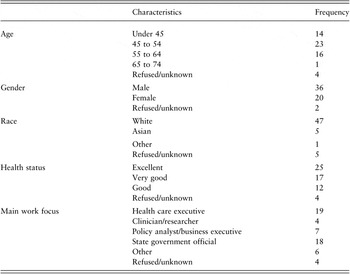
Participants in this research included representatives from private and public sectors, health care plans, state regulators, health care providers, and payers in California. In total 58 people participated in the workshops; the average number of participants per group was ten. Table 1 shows the characteristics of the total sample. Although only one person identified their main work focus as clinical, many participants were trained as clinicians, especially in the sessions held with health plans.
Workshop participant characteristics

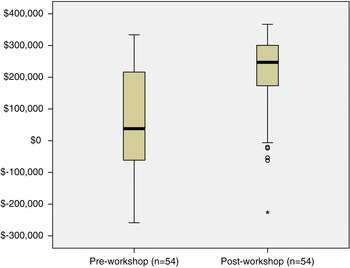
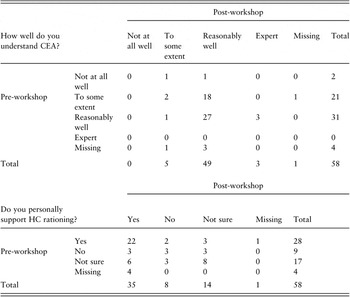
Two questions were asked in both the pre- and post-workshop surveys: ‘How well do you understand CEA?’ and ‘Do you personally support health care rationing?’ For the majority of participants, the self-reported level of understanding of CEA increased following the workshop, and the proportion of participants indicating that they supported health care rationing increased from 51% to 58% post-workshop (Table 2; p<0.05). Figure 1 presents changes in respondent priorities for coverage of the 14 condition–treatment pairs presented within the workshop. The figure shows differences between unfunded and funded treatments in terms of their average cost per QALY scores (i.e. the average cost per QALY for all unfunded treatments minus the average cost per QALY for all funded treatments). These difference scores are presented separately for round 1 (prior to providing cost per QALY information) and for round 2 (after this information had been distributed). If respondents were making choices in line with a CEA approach (i.e. giving priority to treatments with a low cost per QALY), one would expect the difference scores to be positive and large. The median (mean) difference in round 1 was $37,000 ($67,000) and in round 2 was $247,000 ($219,000) (p < 0.001).
Priority setting exercise: difference in mean cost per QALY scores between funded and unfunded treatments

Impact of the workshop sessions on CEA understanding and support for rationing

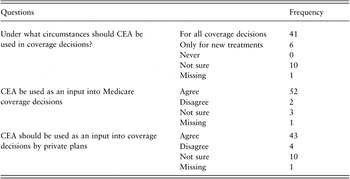
Table 3 gives results for three questions posed only in the post-workshop survey asking whether and in what circumstances CEA should be used in US health care. Seventy-two per cent of respondents felt CEA should be an input to all coverage decisions and 10% felt it was appropriate only for new treatments. The overwhelming majority supported the use of CEA by Medicare and also by private plans. Only two of the 57 respondents stated that CEA should not be part of the information considered by Medicare when making coverage decisions and only four gave that response regarding private plans.
Views on the use of CEA (post-workshop)

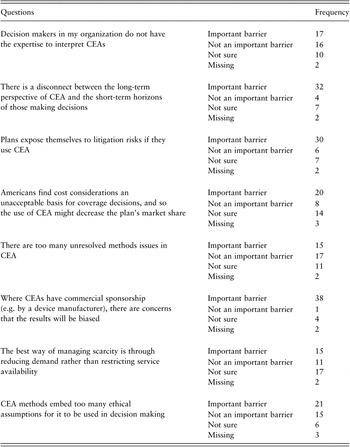
Also in the post-survey participants reflected on the limited use of CEA in US health care and responded to possible barriers in a US context (Table 4). Over two-thirds indicated that the following barriers were ‘important’ in limiting the use of CEA within their organizations:
The disconnect between the long-term perspective of CE analysts versus the short-term perspective of most decision makers
The risk of litigation
Commercial sponsorship of the CEA by the manufacturer of the product
Barriers to use of CEAa

Note: a These questions were not asked in the survey used for the first workshop and so we have a sample of 45 rather than 58.
The first two of the above three barriers were raised without the prompt of a specific survey question during the open-ended discussion of barriers to the use of CEA. Regarding the disconnect between short- and long-term considerations, one participant noted ‘we only budget for two years at a time so all the decision making is made looking at the short term rather than looking at the long term … how do you make decisions for that person that two or ten years from now won't be part of your healthcare system?’. Regarding the issue of litigation, one workshop participant noted ‘if we're denying access to therapies that we know are the most effective on the basis that the CE ratio is not favourable … we would just end up being sued for that, and that would be a real concern’. The issue of commercial sponsorship did not arise in the workshop discussions.
In the post-workshop survey, almost one-half of respondents identified as an important barrier that Americans would not find cost considerations an acceptable basis for coverage decisions and thus using CEA could decrease a plan's market share. However, a third was uncertain about this, and the remainder felt it was not an important barrier. During workshops, decision makers from health plans noted that many members of the public perceive them as being interested only in cost savings, which reduces their ability explicitly to embrace the language, let alone the tools, of cost effectiveness. Other participants saw value in sharing cost-effectiveness information with consumers and patients, so they could exercise personal choice based on the information.
There was quite an even split for the remaining barriers identified in the survey between those seeing them as real and those not doing so. Methodological concerns were not a major theme of the open discussion. In the concluding session, a few participants returned to the barrier of ethical problems inherent in CEA as discussed in the workshop. A recurring message as stated by one participant was that, ‘it's difficult, if not impossible, for a single organization to be making value judgments about CE and defend them in this society’. In another group it was noted, ‘to defer those policy decisions to a profit making company is where we are all skipping a heart beat’. This participant, from a state government agency, continued, ‘The place where that decision belongs is where people are making good decisions for all those people involved … My question … is how can we get our policy makers and legislatures … to better use data … to inform their decisions? And that is a huge gap in our policy making.’ In addition to this mention of the need for government action, respondents in another group asserted that if the Medicare program took the lead in using CEA, it would be far easier for other entities to do so.
Discussion
Decision makers have both self-declared (Neumann, Reference Neumann, Rosen and Weinstein2005; Tunis, Reference Tunis2004) and been described (Siegal, Reference Siegel2005; Luce, Reference Luce2005; Neumann, 2004b) as reluctant to make explicit use of CEA in coverage decisions, favoring a focus exclusively on safety and efficacy, with cost pressures managed in part through copays and deductibles. There have been anecdotal reports and a good deal of conjecture but little empirical data about whether US decision makers regard CEA as a useful input into coverage decisions, and what, if any, specific concerns they have about its use. The literature also lacks documentation of how well US decision makers feel that they grasp CEA methods. This research begins to fill some of these gaps, albeit in a sample that may lack generalizability across geographical regions.
We found that most senior decision makers in this California sample had at least some ‘going in’ understanding of CEA and that they noted a gain in mastery by the conclusion of the half-day session. In post-workshop surveys, they reported significant engagement in the discussions, direct relevance to their work, and by a wide margin found the workshops to be useful. The priority setting exercise suggested that decision makers change their priorities for treatment coverage when data on cost-effectiveness are provided. Participant priorities were seen to shift significantly to favour interventions that on average had lower cost-effectiveness ratios. These findings paralleled the rank order changes seen in members of the public selected from a New York City jury pool (Gold et al., Reference Gold, Franks, Siegelberg and Sofaer2007).
At the conclusion of the workshop, over 90% of participants felt that CEA should be used as an input to Medicare coverage decisions and a sizable majority felt that it should be used in private coverage decisions as well. Setting coverage on the basis of cost and CEA is, however, clearly challenging territory for private plans. The call for leadership from CMS to move forward on this issue was a recurrent theme within the discussions. Historically, Medicare's lead in shifting insurer's approaches in areas such as Resource Based Relative Value Scale (Jones, Reference Jones1996), as well as Diagnosis Related Groups, has been instrumental in creating change throughout the system. However, we acknowledge that the parallel with CMS taking a lead on CEA might not hold entirely given the additional concerns health plans might have around CEA relating, for example, to possible loss of market share.
This study has some limitations. First, the sample size of individuals and the number of groups were both small and it is possible that those who volunteered to attend were those more well disposed to CEA. However, the process adopted was one whereby our primary organizational contacts identified potential participants who they felt should be aware of this area rather than people skilled in CEA. Second, many of the participants were trained as clinicians but we do not have extensive details concerning their clinical specialties or experience. It is almost certainly the case that, in the exercise where they were asked to rank condition–treatment pairs, their clinical understanding of the scenarios varied and this may have influenced their approach to the exercise. Third, because California is a state with a high penetration of managed care where beneficiaries and policy makers may be more willing to accept the concept of financial trade-offs and limits on health care spending, decision makers in other States may see these issues differently. Fourth, it is possible that a Hawthorne effect is present in our data, and that framing effects of the workshops influenced participants’ willingness to apply economic criteria. However, the investigators are themselves concerned by some aspects of CEA, and strove for evenhandedness in presenting its methods. We devoted significant discussion time to underscoring potentially problematic ethical and normative issues associated with CEA.
The barriers identified both in the survey and in workshop discussion bear comment and consideration. First, our discussions suggest that there are both legal and regulatory issues that loom large for decision makers. The perception of potential litigation risk over treatment denials is a barrier that needs further discussion and analysis, within the policy, payer, and legal communities, as well as among the lay public who have been observed to be interested and able to engage these discussions (Gold et al., Reference Gold, Sofaer and Siegelberg2007; Sacramento Healthcare Decisions, 2006). In general terms, it is plausible that plans which explicitly position themselves as taking account of ‘value for money’ in their marketing might enjoy better protection from litigation. Further, purchasers and patients may be positively drawn to plans that feature more reasonable premiums, and lower or zero co-pays/deductibles, at the ‘expense’ of taking cost-effectiveness into consideration when making coverage decisions on new technologies. That said, the issue of litigation is complicated in many states by the regulatory frameworks within which health plans operate. For example, California's Knox–Keene legislation specifically proscribes the use of financial considerations in the making of medical necessity decisions, and so for managed care plans in particular coverage decisions made on the basis of CEA would likely be overturned during ‘independent review’.
The second set of barriers we uncovered was the concern of decision-makers about the independence and quality of available CEA studies. Decision makers harbor deep misgivings about commercially sponsored CEAs, suggesting that despite attempts on the part of industry to generate and implement guidelines for conducting research (Task Force on Principles for Economic Analysis of Health Care Technology, 1995), the concerns identified by Kassirer and Angel in 1994 (Kassirer and Angell, Reference Kassirer and Angell1994) remain largely unchanged.
Our research also suggests that many senior decision makers in health care lack an adequate foundation in CEA's methods. The decision makers recruited for this exercise were in large measure self-selected for either their interest in CEA, or their organization's perception that they should know about it. Nonetheless, nearly two-thirds saw lack of expertise as a definite or possible barrier to its use. Concerted efforts should be made to educate decision makers about how economic studies are designed and conducted. This would be useful in two ways: it would allow decision makers to make more critical use of CEAs, and it would permit them to provide better input to the academic community about problems that impede the utility of analyses. For example, nearly three-quarters of respondents felt that the short-term horizons of their budgeting mechanisms were not well reflected within a CEA. Academicians might respond to this by breaking down a study's cost information to be user-friendly in the budget process. Indeed, facilitating the discussion between health care organizations, academicians, and policy makers on the issues of short-term costs versus long-term efficiency in health production would be a valuable discussion to engage in the context of health care reform. Patient churning has historically made insurers and plans reluctant to take a long-term perspective. Currently, and especially if we achieve universal coverage, one entity's steeper up-front costs represents another's long-term savings, and vice versa. Insurers may better be able to accept the long-term perspective of CEA if studies drive national consensus toward implementing cost-effective interventions for all patients across insurance products.
The ethical concerns with CEA (such as the lack of special priority for the worse off) were discussed in detail as part of the workshop, with hypothetical choices posed which highlighted such issues. Participants were explicitly asked to indicate whether CEA embeds too many ethical assumptions for it to be used in policy making and, although many respondents did indicate this to be an important barrier, other issues were highlighted in larger numbers. Further, the open discussion session at the end of the workshop was an opportunity for such concerns to be expressed verbally but, once again, these issues did not come to the fore. This ‘dog that does not bark’ in this study may reflect the fact that, although such issues might be at the forefront of the debate amongst academics, decision makers tend to focus on practical concerns.
Finally, we are intrigued by the relative discordance between the near uniform acceptance of CEA as an input into coverage and the more guarded views of decision makers as a whole with respect to support of ‘rationing’. Although those personally supporting rationing increased from 48% at the inception to nearly 60% by the time of the workshop's conclusion, a sizable minority was either uncertain or negative about the concept, and indeed some individuals who started out in favour of rationing shifted to a negative perspective by the conclusion of the workshop.
What is this disconnect between widespread endorsement of CEA by the decision makers we met with, and their lesser acceptance of rationing? Maybe it's all in a word. The term ‘rationing’ has been a lightening rod for controversy both in the US and the UK. Renewing their two-decade long case for rationing health care in the US, Aaron et al. (2005) have recently described rationing as ‘the denial of some beneficial care to some people who have the financial means to pay for it’, underscoring their premise that an individual's wealth would not make health care more available. Although we are largely in agreement with their views, this is baldly put and hard medicine to swallow in a society where people are well accustomed to money conferring advantage in access to consumer goods. Framing the definition in terms of limits puts a negative spin, and does not make the case for quality or fairness (Tunis, Reference Tunis2007). In contrast, NICE's Chairman, Sir Michael Rawlins, in addressing concerns that a newly created NICE was to be a covert means to rationing in the NHS argued that NICE's mission is one of ‘prioritization’ – the longstanding and well-accepted tradition in medicine of triage, i.e. placing more attention on certain patients on the basis of their need and their ability to benefit from a given treatment.
In providing information on the health improvement received for the money invested, CEA allows decision makers to look both specifically and broadly at the value interventions bring to a population. This makes good sense as a starting place from which, accompanied by considerations of fairness and equity, a health care budget can be allocated (Daniels and Sabin, Reference Daniels and Sabin2002; Rawlins, Reference Rawlins2005). The debate in the US with respect to use of CEA might be largely tamed by thinking of CEA as an aid to priority setting, rather than a tool of rationing. Our discussions with California decision makers, supported by the recent US panel on this issue reported in Neumann et al. (Reference Neumann, Palmer, Daniels, Quigley, Gold and Chao2008), suggest that if CMS were to take the lead on this issue, many would follow quite cheerfully.
Acknowledgments
We are grateful to the California Health Care Foundation for their support of this project. This project spanned the period of Stirling Bryan's Harkness Fellowship, and we acknowledge funding from the Commonwealth Fund. Our thanks go also to participating organizations and decision makers who were generous of their time and their insights. We also thank the two journal referees for their insights and helpful suggestions.
Appendix: Condition/treatment pairs used in the coverage exercise
Treatment for erectile dysfunction
Physician counseling for smoking
Total hip replacement
Outreach for flu and pneumonia
Treatment for major depression
Gastric bypass surgery
Treatment for osteoporosis
Screening for colon cancer
Implantable cardioverter defibrillator
Lung-volume reduction surgery
Tight control of diabetes
Treating elevated cholesterol
Resuscitation after cardiac arrest
Left ventricular assist device