I. INTRODUCTION
Motivating the exploration of the better design technique is an essential need for increased antenna performances. Antenna engineers find an existing design that may have the desired electromagnetic characteristics. If this structure has an analytical expression that precisely predicts its performance, we try to find the optimal parameters. This paper describes the synthesis of nonuniformly excited and nonuniformly spaced linear arrays. The analysis of nonuniformly spaced linear arrays was first proposed by Unz [Reference Unz1], who developed a matrix formulation to obtain the current distribution necessary to generate a desired radiation pattern. Array geometry was calculated either by thinning array elements selectively or positioning the array elements randomly along the desired direction.
Skolnik employed dynamic programming for zeroing elements [Reference Skolnik, Sherman and Nemhauser2]. Mailloux and Cohen [Reference Mailloux and Cohen3] utilized the statistical thinning of arrays with quantized element weights to improve side lobe level (SLL) performance. The genetic algorithm and simulated annealing were used to thin an array [Reference Haupt4–Reference Meijer7]. Razavi and Forooragi [Reference Razavi and Forooraghi8] used pattern search algorithm for array thinning.
Harrington [Reference Harrington9] developed an iterative method to reduce the sidelobe levels of uniformly excited and nonuniformly spaced linear arrays (NULSAs). Literature described in [Reference Lee and Jhang10–Reference Kazemi and Hassani12] proposed different analytical methods for nonuniformly spaced array synthesis. In [Reference Lee and Jhang10], the particle swarm optimization was applied for optimization of nonuniformly spaced antenna arrays and SLL was reduced. In [Reference Ayestar, Las-Heras and Martinez11], with neural network and in [Reference Kazemi and Hassani12] with least mean square, nonuniformly spaced array was synthesized. Most works consider the minimization of the SLL at a fixed beam width without considering mutual coupling effect. In a few recent works driving point impedance matching has been derived with unequal spacing of elements [Reference Bray, Werner, Boeringer and Machuga13].
In this work, two different antenna optimization problems of designing unequally spaced parallel and collinear arrays are presented. Radiation patterns are synthesized to obtain a specified SLL and dynamic range ratio (DRR) at a fixed beamwidth. Coupling effect between different array elements is also taken into account. Induced electromotive force method is used to estimate the coupling effect of individual elements in terms of VSWR. Reported algorithms are applied to compute the excitation and geometry of the individual elements in order to optimize the array performances.
An improved particle swarm optimization (PSO)-based technique is proposed to accommodate these complex design problems of coupling compensation [Reference Shi and Eberhart14–Reference Benedetti, Azaro, Franceschini and Massa18]. Proposed method is adapted introducing velocity modulation technique where maximum particle velocity decreases as the number of iterations increases in order to favor the exploitation. Another improved differential evolution (DE)-based technique is also applied to the same problem and results obtained from both the algorithms are compared [Reference Storn and Price19–Reference Das, Abraham, Chakraborty and Konar22]. In the proposed DE scheme the scale factor and cross over rate are tuned depending on the fitness of individual population member. As the DE vector moves near to the optima it should suffer from lesser perturbation. So scale factor reduces decreasing the mutation step sizes. At the same time crossover rate also decreases allowing more genetic information to be passed to the offspring. On the contrary if the vector goes away from the optimal region DE parameters are tuned automatically for providing adequate population diversity.
Beside this the article presented a trade-off solution between different array objectives. It plotted the trade-off curves between minimum achievable SLL and number of elements for specified beam width. It also computed the curve featuring standing wave ratio (SWR) versus average array spacing for unequally spaced array. Moreover, the article presented a comparison of SLL performances of equally spaced linear array (ELSA) and NULSA for same average spacing.
II. FORMULATION
In this paper, two different array alignments are presented.
A) Parallel dipole array
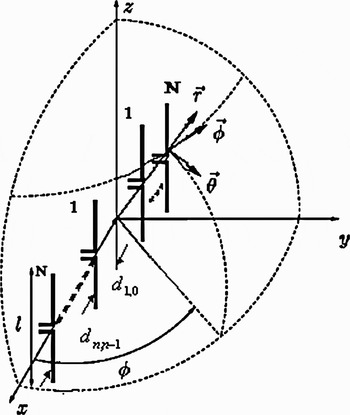
Consider a linear array of 2N half-wavelength long center-fed very thin parallel dipole antennas along the x-axis with inter-element spacing d n,n −1 between any two consecutive dipoles as shown in Fig. 1. Excitation and geometry both are assumed symmetric with respect to the center of the array in order to generate symmetric broadside pencil beam patterns in azimuth (x–y) plane.
Linear array of parallel dipoles along-axis.

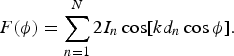
The far-field pattern F(ϕ) in the horizontal xy plane in absence of any ground plane is given by equation (1) as in [Reference Elliott23]. Element pattern has been assumed omnidirectional in horizontal plane in the absence of ground plane:
B) Collinear dipole array
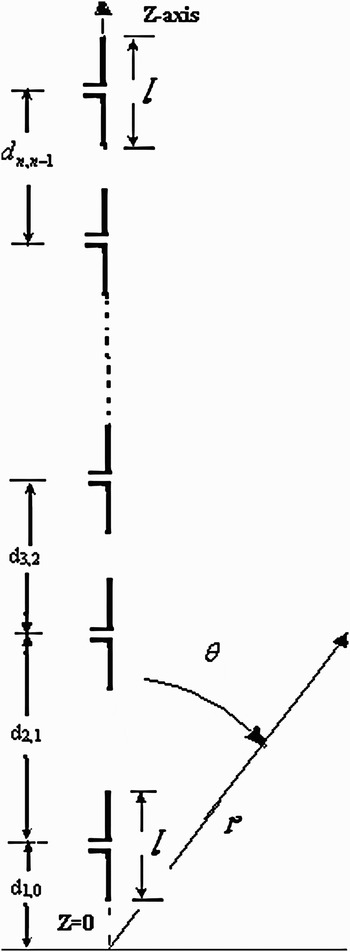
Next, a collinear array of 2N number of identical half-wavelength dipoles spaced a distance d n,n −1 apart (center to center) along the Z-axis as shown in Fig. 2 is considered. Excitation and geometry both are assumed symmetric with respect to the center of the array. Assuming sinusoidal current distribution of a very thin half-wavelength dipole directed along the Z-axis, the element pattern can be calculated using

Collinear dipole array.

The far-field pattern F(θ) in the principal plane (yz plane) considering the element pattern is given by

Normalized power pattern in dB for both the cases can be expressed as follows:

where γ = ϕ for parallel array and γ = θ for collinear array. For both the cases n is the element number, k = 2π /λ, the free-space wave number, λ is the wavelength at the design frequency, d n is the distance of center of the nth element from origin, ϕ and θ are the azimuth and polar angles of the far field, I n is the complex excitation current of nth element, [V] is the voltage matrix of size N × 1 obtained from the given expression

where Z is the mutual impedance matrix of size N. Self-impedances Z nn and mutual impedances Z nm are calculated using Hansen's expressions [Reference Hansen24] (which assume the current distribution on the dipoles to be sinusoidal).
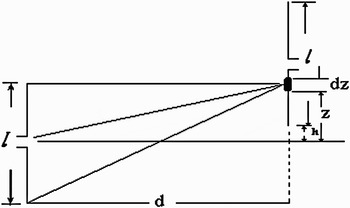
Using the rigorous electric field formulation of Schelkunoff and Friis [Reference Schelknuff and Friss25], and the geometry of Fig. 3, the mutual impedance can be written as
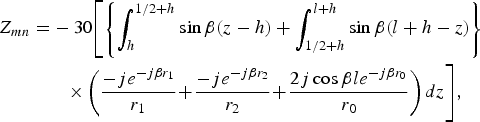
where 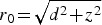 ,
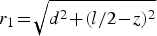 ,
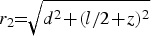 .
Two antennas separated by d and staggered by h.

Mutual impedance is approximated by putting h = 0 and l = λ/2 for parallel alignment and d = 0 and l = λ/2 for collinear arrangement and used for our design.
It is obvious that the value of Z n,m depends on the geometry of the dipoles and their mutual geometric relations. Improved PSO- and DE-based techniques are used to optimize the proposed antenna arrays shown in Figs 1 and 2. The radiation patterns produced by these arrays are required to satisfy the condition of minimum bearable SWR and specified SLL and DRR value. In order to optimize the arrays according to the above three conditions, a cost function J is formed as a weighted sum of three respective terms, as given by the following equation:

where SWR max is the maximum SWR offered by the array elements (SWR is different for every array element). SLL, SLL d, DRR, DRR d are obtained and desired values of corresponding terms. DRR is computed from the given expression

The characteristic impedance Z 0 of the transmission line that feeds the element for efficient radiation is considered 50 Ω. Reflection coefficient at the input of the nth element is derived by the expression

Using R nSWR is calculated at the input of the nth element,

For obtaining impedance matching condition, the maximum tolerable value of SWR is set at 2. The coefficients w 1 , w 2, and w 3 are weight factors and they describe the importance of the corresponding terms that compose the cost function. Proposed optimization techniques attempt to minimize the cost function to meet the desired pattern specification.
This paper carried out a simultaneous optimization of excitation and geometry to reduce SLL and SWR value. To generate desired pencil beam, excitation current amplitude is varied in the range 0–1. Excitation current phase is kept fixed at 0 degree. Spacing is computed randomly within the range 0.4–0.8 for the parallel array and from 0.7 to 1.1 for collinear array. All the array parameters are assumed symmetric about the center of the array. Algorithms run independently for several iterations to optimize both the configurations, parallel and collinear.
III. OVERVIEW OF PSO
PSO is a robust stochastic evolutionary computation technique based on the movement and intelligence of swarms looking for the most fertile feeding location [Reference Shi and Eberhart14–Reference Benedetti, Azaro, Franceschini and Massa18]. PSO's foundation is based on the principle that each solution can be represented as a particle in a swarm. Each agent has a position and velocity vector and each position coordinate represents a parameter value. The algorithm requires a fitness evaluation function that assigns a fitness value to each particle position. The position with the best fitness value in the entire run is called the global best. Each agent also keeps track of its best fitness value. The location of this value is called its personal best. Each agent is initialized with a random position and random velocity. The velocity in each of n dimensions is accelerated toward the global best and its own personal best to converge to the desired solution.
In PSO velocity and position of each particle is updated using the following equations:



where c 1, c 2 are acceleration constants, equal to 1.4945, w is the inertia weight decreases linearly from 0.9 to 0.4 up to 80% of the maximum number of iterations and thereafter it remains at 0.4 for rest of the iterations, and rand1 and rand2 are two uniformly distributed random numbers between 0 and 1.
Equation (12) is used to clamp the velocity along each dimension within a specified region if they try to cross the desired domain of interest. The maximum velocity is set to the upper limit of the dynamic range of the search. Later it is linearly modified from V dmax to 0.1*V dmax over the full range of search [Reference Jin and Rahmat-Samii15]. Thus the modification introduced in the particle velocity improves the balance between exploration and exploitation and leads to a better PSO. Position clipping technique is avoided in modified PSO algorithm. Moreover, the cost evaluations of errant particles (positions outside the domain of interest) are discarded to improve the speed of the algorithm.
IV. DIFFERENTIAL EVOLUTION
DE proposed by Storn and Price [Reference Storn and Price19, Reference Storn and Price20], Storn et al. [Reference Storn, Price and Lampinen21], and Das et al. [Reference Das, Abraham, Chakraborty and Konar22] is well known as a simple and efficient method of global optimization over continuous spaces.
DE utilizes NP D-dimensional parameter vectors as a population for each generation G:

For each parameter there may be a definite region where better search results are likely to be found. The initial population should cover the entire search space constrained by the specified minimum and maximum bounds:

Hence the jth component of the ith vector can be initialized as

where rand i,j (0,1) is a uniformly distributed random number lying between 0 and 1. The subsequent steps of DE are mutation, crossover, and selection, which are explained in the following subsections.
A) Mutation
DE creates a donor vector  corresponding to the best individual
 that generates minimum cost value in the population at generation G through mutation:

The indices r 1i and r 2i are mutually exclusive and randomly chosen integers. F i is called scaling factor that is tuned automatically depending on the value of the cost function generated by each vector.
If the objective function value of any vector nears the objective function value attained by  , F i is estimated as follows:
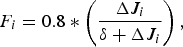
where δ = 10−14 + ΔJ i/10, ΔJ i = J(X i) − J(X best) and ΔJ i < 2.4.
The expression results a lesser value of F i causing lesser perturbation in the solution. So it will undergo a fine search within a small neighborhood of the suspected optima.
If ΔJ i > 2.4 F i is selected obeying the following relation:

Equation (18) results a greater value of F i that ultimately boosts the exploration ability of the algorithm within the specified search volume.
B) Crossover
To increase the potential diversity of the population, crossover operation is introduced. In crossover the donor vector exchanges its components with the target vector  to obtain the trial vector U i,G:

rand i,j (0,1) ∈ [0, 1] is a uniformly distributed random number and Cr i is a constant called crossover rate. j rand ∈ [1,2,…, D] is a randomly chosen index, which ensures that  gets at least one parameter from V i,G and does not become exact replica of the parent vector. The number of parameters inherited from the donor has a (nearly) binomial distribution.
The parameter Cr i is updated automatically depending on the value of the cost function produced by the donor vector. If the donor vector yields a cost value lesser than the minimum value attained by that population, Cr i value is chosen high to pass more genetic information into the trial vector otherwise it remains small. Cr i is determined accordingly:

where  , Cr min = 0.1, Cr max = 0.7, and Cr const = 0.95.
C) Selection
Selection is introduced to decide whether the target vector survives to the next generation. The trial vector is compared with the target vector using the following criterion:

If the new trial vector yields an equal or lower cost value, it substitutes the corresponding target vector in the next generation. Otherwise the target is retained in the population.
V. RESULTS AND DISCUSSIONS
Two linear arrays consist of 20 dipoles of length 0.5λ and radius 0.005λ are considered. In the first case, synthesis of parallel array has been illustrated. To generate pencil beam, excitation current amplitude and inter-element spacing is varied in the range 0–1 and 0.4–0.8 wavelengths, respectively. Phase is kept at 0°. Desired DRR value of amplitude distribution is prefixed at 7.
Because of symmetry, only 10 amplitudes and 9 inter-element distances are to be optimized. Algorithms are designed to generate a vector of 19 real values between 0 and 1. The first 10 values of the vector are mapped and scaled to the desired amplitude weight (0–1) range and the last 9 values are mapped and scaled to the desired intermediate spacing weight (0.4–0.8) range. It is assumed that the first element is placed at a prefixed distance (0.2) from the origin.
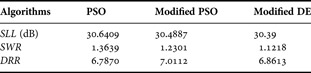
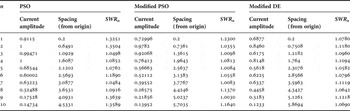
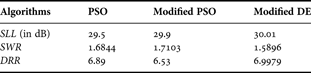
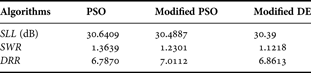
All three algorithms (PSO, modified PSO, and modified DE) are run for 100 iterations to compute amplitude weight and element spacing of each element. Table 1 shows the desired and obtained values of SLL, SWR, and DRR of the array in absence of ground plane. There is a good agreement between desired and synthesized results using all the algorithms. Table 2 presents the excitation, spacing from origin, and SWR value of each array element. Because of symmetry, remaining 10 elements are also be excited with the same parameters. Using the proposed technique SLL value can be further lowered along with a very good SWR.
Desired and obtained result for parallel array.
Current amplitude, spacing, and SWR value for parallel array.

Radiation patterns using the optimized data are plotted above. Figure 4 shows the normalized absolute power patterns (pencil-beam) in dB for nonuniformly spaced parallel array. Patterns are shown in phi space ranging from 0 to 180°.
Normalized absolute power patterns in dB for parallel array.

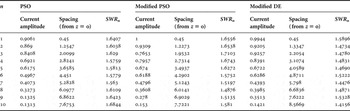
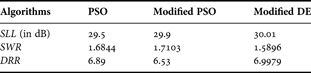
Next, the collinear array consists of 20 wire dipoles is analyzed. To optimize the array, excitation amplitude is set within the interval [0,1] and spacing is varied in the range 0.7–1.1 wavelength. Inter-element distance is measured from center to center where first element is placed at a prefixed distance (0.45) from the origin. Algorithms are run for 100 iterations and results are presented in Tables 3 and 4.
Desired and obtained result for collinear array.
Current amplitude, spacing, and SWR value for collinear array.

Ten elements are considered for optimization because of symmetry like before. Remaining 10 elements are excited with the same excitation and geometry.
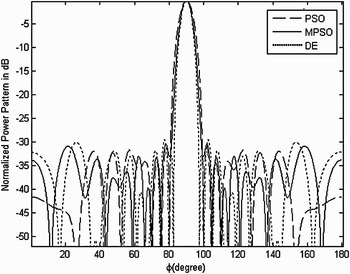
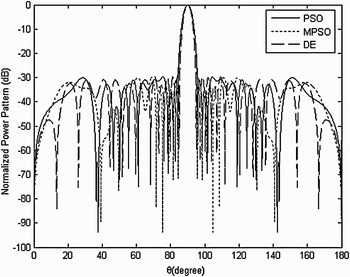
Radiation patterns using the optimized data are plotted above. Figure 5 shows the normalized absolute power patterns (pencil-beam) in dB for nonuniformly spaced collinear array. Patterns are shown in θ space ranging from 0 to 180°.
Normalized absolute power patterns in dB for collinear array.

Lowering the desired value of SLL it can be lowered further for the same beamwidth and same number of array elements. Parallel configuration is more effective to compensate mutual coupling effect than collinear one.
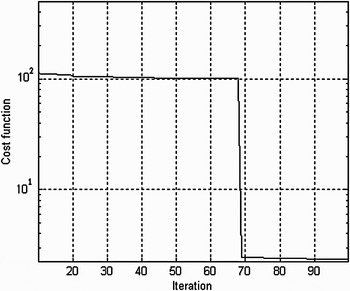
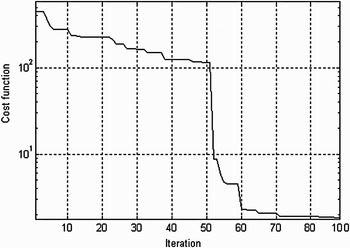
All three algorithms are run independently to justify their effectiveness. Convergence curves of the two best performing algorithms are presented in Figs 6 and 7. It is seen that DE algorithm converges faster and proved most effective to yield the global minimum compared to its other two competitors. It produces similar results over repeated runs, which is an indication of its robustness. Among the remaining two algorithms modified particle swarm optimization performed better. Use of velocity clipping technique in MPSO significantly improves its performances compared to standard PSO. Although the modifications introduced in PSO and DE slow down the execution speed of the algorithms compared to standard PSO.
Convergences curve of the cost function using modified PSO.

Convergences curve of the cost function using DE.

Standard PSO, modified PSO, and DE are compared in a statistical manner. Since the distribution of the best objective function values do not follow a normal distribution, the Wilcoxon rank sum test was used to compare the objective function mean values, standard deviations, and P values of each algorithm [Reference Hollander and Wolfe26] and those values are listed in table 5. Each algorithm was executed for 50 times and the best result for each run is considered.
Mean cost values, standard deviations, and P values.

DE yields statistically better results compared to other two optimization approaches. P values obtained through the rank sum test between the best algorithm and each of the contestants are presented. Here NA stands for “not applicable” and it occurred for the best performing algorithm. As the P values calculated for both the cases are less than 0.05 (5% significance level), null hypotheses is rejected and the results produced by DE are considered statistically significant.
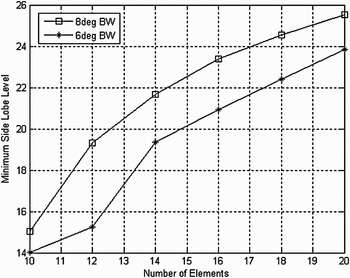
The article also studied the behavior of the trade-off curve between different array objectives. Figure 8 shows the tradeoff between minimum achievable SLL and number of elements for nonuniformly spaced parallel array. Patterns are simulated for different pre-specified beamwidths (6 and 8°). As the 3 dB beamwidth increases the tradeoff between SLL and number of antenna elements N becomes improved.
Minimum achievable SLL versus N for different BW using NULSA.

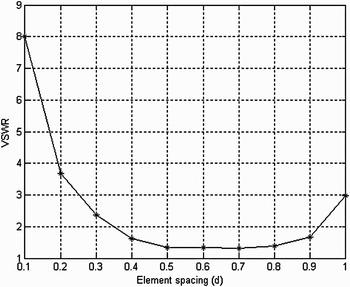
Figure 9 illustrates the tradeoff between VSWR and average element spacing for the nonuniformly spaced array. It is seen that minimum bearable VSWR is obtained when the average element spacing is set within an optimum range relative to the element excitation.
VSWR for different average element spacing for NULSA.

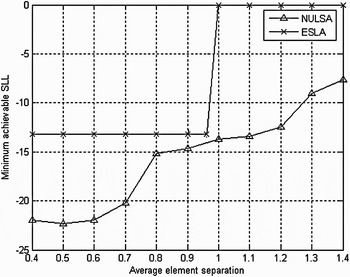
Finally Fig. 10 shows the improvement in tradeoff between minimum achievable SLL and average element spacing for NULSA compared to ESLA. In ESLA grating lobe appears for d > 0.95λ. However NULSA produces a reasonable SLL beyond this region. All the experiments are carried out assuming that the excitations of individual element are equal and all unity.
Minimum achievable SLL versus average element spacing for ESLA and NULSA.

The main objective of this paper is to illustrate the importance of the evolutionary multi-objective optimization techniques in the design of antenna arrays. The algorithms are applied to improve the radiation characteristics and compensate the coupling effect for nonuniformly spaced parallel and collinear array. Trade-off solutions presented in this section will make the array more suitable for using in wireless sensor networks. Proposed concept can be further extended in designing sparse array where maximum spatial resolution is needed incorporating the concept of Golomb ruler [Reference Moffet27–Reference Dollas, Rankin and Cracken29]. Coupling effect of these minimum redundancy arrays can be reduced by suitably computing the element excitation weight.
V. CONCLUSION
The use of optimization techniques based on PSO and DE in the synthesis of nonuniformly spaced linear array of half wave parallel and collinear dipoles is discussed here. Numerical results show that DE converges faster and with more certainty compared to other optimization approaches. It yields minimum fitness value and offers better statistical accuracy. Both the array alignments are analyzed in order to obtain lower value of SLL and SWR. In both the cases unknown excitation and unknown spacing are used and phase is prefixed at 0°. Result shows that the parallel array arrangement is more effective to minimize SWR. The excitation and geometry both are symmetric in nature that greatly simplifies the feed network. Mutual impedance matrix is calculated using induced EMF method. Fixing the DRR of excitation current amplitude to a lower value with little compromise on the design specifications further reduces the effect of coupling. It is seen that array performance is significantly enhanced by perturbing the inter-element spacing. The work also provides a trade-off solution between SLL-BW and number of array elements. SWR value is estimated for different average element separation for unequally spaced array. Finally, the work presents a comparison of SLL performances of ELSA and NULSA for same number of elements. Application of more powerful global search algorithm in antenna synthesis can be a topic of future research. Proposed technique is capable of optimizing more complex geometries and therefore is suitable for many applications in communication area.
 Banani Basu received her B.Tech and M.Tech degrees in electronics and communication engineering from Jalpaiguri Government Engineering College, India and WB University of Technology, India in 2004 and 2008, respectively. She spent 2 years as a lecturer in Bankura Unnayani Institute of Engineering in Bankura, India since 2005. Since 2008, she has been with National Institute of Technology, Durgapur, India as a Research Scholar. Her research interests are array antenna synthesis, soft computing, and electromagnetics. She has published six research papers in international journal of repute and eight papers in international conferences.