



Ranking among the most prevalent mental disorders, alcohol use disorder (AUD) is characterised by excessive and/or uncontrolled alcohol consumption that negatively impacts health and overall quality of life. Reference Carvalho, Heilig, Perez, Probst and Rehm1 Mortality associated with AUD is high, with suicide being one of the leading causes. Reference Gunnarsdottir, Kristbjornsdottir, Gudmundsdottir, Gunnarsdottir and Rafnsson2,Reference Roerecke and Rehm3 A recent meta-analysis of longitudinal studies revealed that AUD more than doubles the odds of death by suicide. Reference Lange, Kim, Lasserre, Orpana, Bagge and Roerecke4 Another meta-analysis found that AUD also triples the odds of suicide attempt. Reference Darvishi, Farhadi, Haghtalab and Poorolajal5 Alcohol-related disorders are in fact among the strongest predictors of suicidal behaviour. Reference Barak-Corren, Castro, Javitt, Hoffnagle, Dai and Perlis6 The risk of suicide attempts increases with the severity of AUD: compared with alcohol-dependent individuals without a history of suicide attempts, those with a history of suicide attempts show a higher number of AUD symptoms, as well as more alcohol-related physical and violence-related problems. Reference Preuss, Schuckit, Smith, Danko, Buckman and Bierut7
Despite these findings, the literature on the specific characteristics of AUD that increase the risk of suicide attempts remains limited. A recent prospective study, examining the relationship between alcohol use patterns and suicidal behaviour among college students, found that alcohol-related problems (e.g. failing to meet expectations or experiencing black-outs), but not overall alcohol consumption level, significantly predicted suicide attempt risk. Reference Coryell, Horwitz, Albucher, Zheng, Pistorello and Eisenberg8 One recent retrospective study investigating markers associated with suicide attempts in individuals with AUD reported that those who had attempted suicide exhibited higher rates of trauma exposure, co-occurring substance use disorders and psychiatric comorbidities, such as major depressive disorder and post-traumatic stress disorder. Reference Barr, Neale, Chatzinakos, Schulman, Mullins and Zhang9 A prospective study investigating suicidal behaviour in patients with AUD would provide valuable, complementary insights into these findings.
Aims
In the present cohort study, we examined the psychiatric and addictological characteristics associated with both past suicide attempts and prospective suicidal acts in patients with AUD. Specifically, we aimed to identify the factors associated with (a) past suicide attempts and (b) suicidal acts occurring within 2 years following admission to in-patient care for alcohol withdrawal management. We hypothesised that suicidal acts would be predicted by the severity of AUD, rather than by psychiatric comorbidities or sociodemographic characteristics.
Method
Study design
We conducted a multicentre, prospective cohort study, including in-patients with AUD hospitalised for alcohol withdrawal management, across eight specialised psychiatric centres in France (Colombes, Villejuif, Limeil-Brevannes, Meulan, Clichy, Enghien-les-Bains, Paris and Reims) between May 2007 and June 2009.
The authors assert that all procedures contributing to this work comply with the ethical standards of the relevant national and institutional committees on human experimentation, and with the Helsinki Declaration of 1975 as revised in 2013. All procedures involving patients were initially approved by the Committee for the Protection of Persons of the Saint-Louis Hospital in 2007 and subsequently during an extension in 2009 (CPP, no. 2006-A00353-48), and by the National Commission for Information Technology and Freedom (CNIL, no. 906200). All participants provided written informed consent. The STROBE reporting guideline was followed.
Patients
Patients aged 18–65 years, fluent in French, diagnosed with AUD according to DSM-IV criteria and admitted for in-patient alcohol withdrawal management were eligible. In-patient care in France is typically reserved for individuals who have either failed out-patient treatment, present with severe somatic or psychiatric comorbidities, face a high risk of withdrawal complications or have socioeconomic circumstances limiting the effectiveness of ambulatory care. 10
Exclusion criteria were unknown place of birth (necessary to subsequently obtain patients’ vital status), dementia, schizophrenia, somatic conditions deemed incompatible with 24-month follow-up and inability to complete a self-administered questionnaire.
Procedure
Inclusion visit
Within 7 days of admission, clinicians conducted face-to-face interviews to collect sociodemographic and clinical data related to AUD characteristics, addictive comorbidities, suicidal behaviour and psychiatric comorbidities.
Follow-up telephone interviews
Patients were contacted via telephone at 3, 6, 12, 18 and 24 months post-inclusion to assess the primary end-point, namely, the occurrence of suicidal acts.
Loss to follow-up management
Due to the high volatility of the patient population, a multi-step procedure was implemented to ascertain whether a suicidal act had occurred within 24 months of inclusion among patients lost to follow-up (LFU).
First, a meeting was convened with all investigators. Subsequently, telephone contact was attempted with all LFU patients and their designated relatives. In addition, medical records from the inclusion centres where these patients had been hospitalised were thoroughly reviewed. Finally, telephone interviews were conducted with treating physicians, addiction specialists and psychiatrists identified by LFU patients during the inclusion visit.
Measures
Primary end-point
The primary end-point was the occurrence of a suicidal act. Suicidal act was defined as either a non-fatal suicide attempt or completed suicide, and therefore encompassed all acts of self-harm performed with lethal intent, regardless of the outcome.
To ensure that acts of self-harm were suicidal acts, the item assessing suicidal intent from the Diagnostic Interview for Genetic Studies Reference Preisig, Fenton, Matthey, Berney and Ferrero11 (DIGS, described below) was used, when the patient was able to provide information. The act was classified as suicidal if the intent score was greater than or equal to 2, indicating a ‘certain intention to die’. In cases where no direct patient report was available, classification as a suicidal act required confirmation from at least two independent sources.
For patients with multiple suicide attempts during the follow-up period, only the first attempt was included in the analysis.
Other measures
All assessments were conducted during the face-to-face inclusion interview, to collect sociodemographic and clinical data.
The French version of DIGS Reference Preisig, Fenton, Matthey, Berney and Ferrero11 was used to assess sociodemographic and psychiatric morbidity. More specifically, this semi-structured interview explores the presence, history and severity of addictive and psychiatric comorbidities, as well as the history of suicide attempts (occurrence of a suicide attempt and the intention behind it). Reference Preisig, Fenton, Matthey, Berney and Ferrero11 Regarding AUD, DIGS incorporates questions based on DSM-IV criteria covering recent alcohol consumption, disorder history and various behavioural and health consequences of drinking.
Current suicidal ideation was evaluated using two instruments. The first, the Beck Hopelessness Scale (BHS), is a 20-item, self-report inventory yielding scores from 0 to 20, with higher scores indicating greater hopelessness. Reference Beck, Weissman, Lester and Trexler12 The second was the tenth item of the Montgomery–Asberg Depression Rating Scale (MADRS), in which clinicians rate suicidal ideation on a scale from 0 (‘enjoys life or takes it as it comes’) to 6 (‘explicit plans for suicide when there is an opportunity or active preparations for suicide’). Reference Montgomery and Asberg13
Current depression and anxiety symptoms were assessed using the Hospital Anxiety and Depression Scale (HADS). Reference Zigmond and Snaith14 This 14-item instrument includes 7 items each for depression and anxiety, scored from 0 to 3. Scores for each subscale range from 0 to 21, with scores of 11 or above indicating clinically significant symptoms.
Attention-deficit hyperactivity disorder (ADHD), which has been linked to an increased risk of suicide attempt, Reference Trivedi, Nandakumar, Yousefzadehfard, Goriparthi, Chaudhari and Vora15 was assessed using two scales. The Adult ADHD Self-Report Scale comprises 6 items measuring current symptoms, with each item rated on a 5-point Likert scale from 0 (‘never’) to 4 (‘very often’). Reference Kessler, Adler, Ames, Demler, Faraone and Hiripi16 The Wender Utah Rating Scale (WURS-25), a 25-item, retrospective questionnaire, assesses childhood ADHD symptoms using a similar Likert scale, with higher scores indicating greater severity. Reference Ward, Wender and Reimherr17
Intellectual functioning was estimated with the National Adult Reading Test (NART), which requires participants to read aloud 50 phonetically irregular words. Reference Nelson18
Statistical analyses
Data analysis was performed using Jamovi, version 1.6 for Windows (The Jamovi Project, Sydney, Australia; https://www.jamovi.org/).
Associations between history of suicide attempts prior to inclusion and baseline variables were examined using Student’s t-tests for continuous data and chi-squared tests for categorical data. Variables showing significant differences between groups were included as predictors in a logistic regression model, with variance inflation factors (VIFs) used to assess multicollinearity. 19
Prospective associations between baseline variables and the occurrence of suicidal acts during the 24-month follow-up were initially tested using univariate survival analyses employing the Kaplan–Meier method and log-rank tests. Variables showing a significant effect were entered into the multivariate Cox proportional hazards regression model.
Statistical significance was defined as a two-tailed P < 0.05. To control for multiple comparisons, Holm–Bonferroni correction was applied in univariate analyses. Unadjusted P-values were used to select variables for inclusion in multivariate analyses. Additional multivariate analyses, incorporating only variables with statistically significant corrected P-values, are presented in Supplementary Tables 1–3 available at https://doi.org/10.1192/bjp.2025.10386.
Results
Sample characteristics
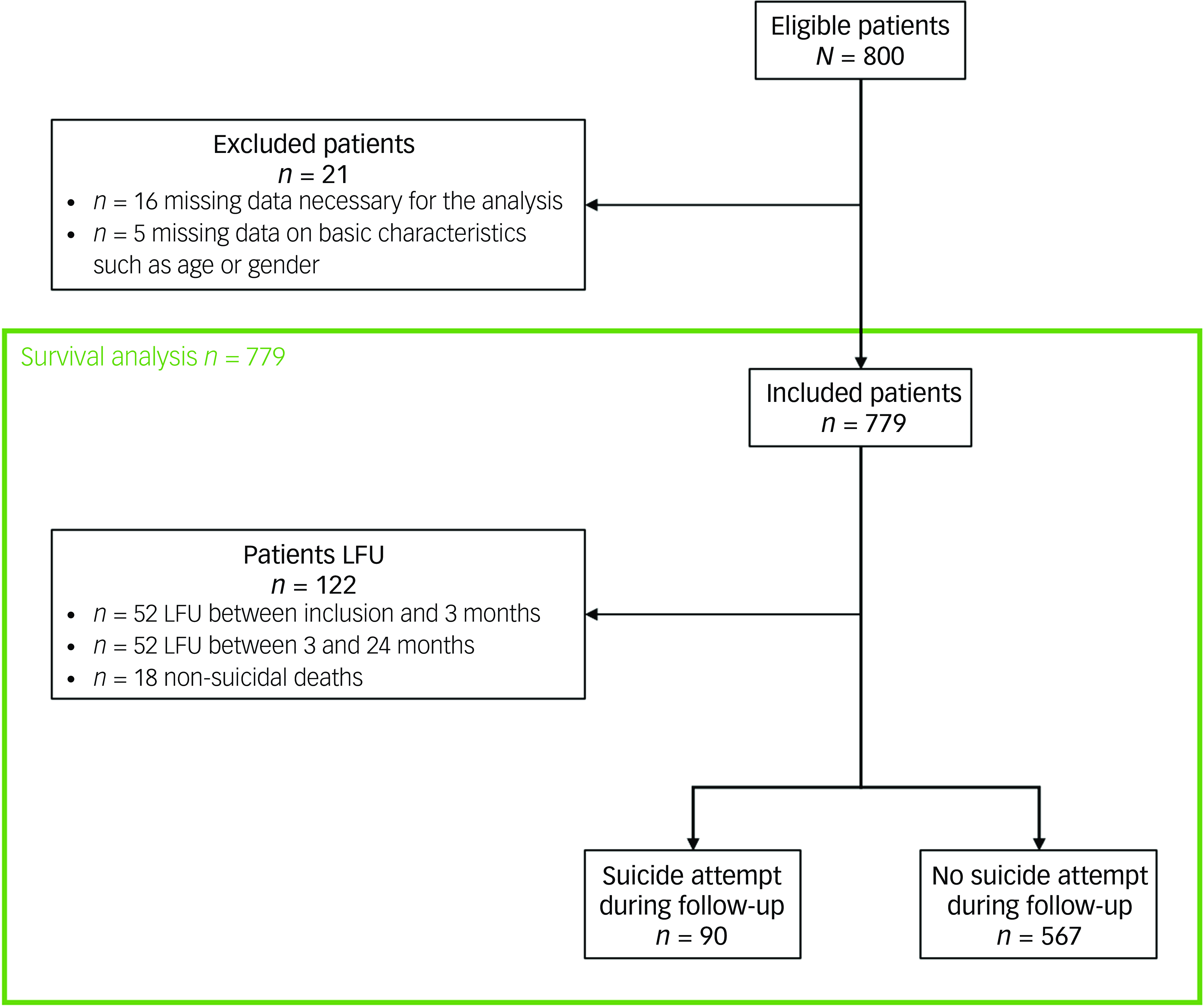
Among the 800 eligible patients identified during the 2-year inclusion period, 16 were excluded due to missing data required for risk factor analysis and 5 were excluded due to missing key demographic information such as age or gender. Thus, 779 patients were included in the study. Of these, 90 (11.5%) engaged in a suicidal act during follow-up, 567 (72.8%) did not and 122 (15.7%) were LFU (Fig. 1).
Study flow chart. LFU, lost to follow-up.

Compared with patients retained in the study, LFU patients differed significantly on two parameters: they were more frequently male (79.9 versus 65.8%, P = 0.009) and had lower verbal efficiency scores as assessed by NART (63.2 versus 65.1, P = 0.020).
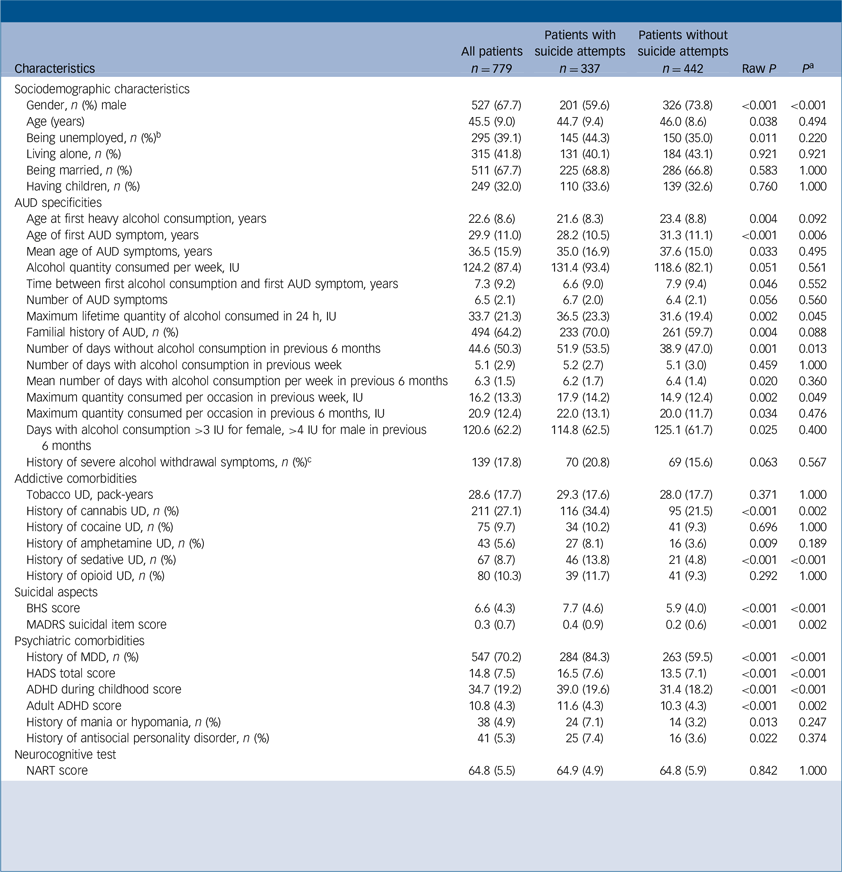
Sample characteristics are presented in Table 1.
Differences in AUD patients with, versus without, lifetime history of suicide attempts

Table 1 Long description
A table comparing characteristics of AUD patients with and without suicide attempts. The table has 20 rows and 6 columns. Column headers are Characteristics, All patients, Patients with suicide attempts, Patients without suicide attempts, Raw P, and P^a. Row labels include sociodemographic characteristics, AUD specificities, addictive comorbidities, suicidal aspects, psychiatric comorbidities, and neurocognitive test. Each row provides specific data points for each category. Notable trends include higher percentages of being unemployed, living alone, and having a history of cannabis and cocaine use disorders in patients with suicide attempts compared to those without.
ADHD, attention-deficit hyperactivity disorder; AUD, alcohol use disorder; BHS, Beck’s Hopelessness Scale (20-item suicidal ideation scale); HADS, Hospital Anxiety and Depression Scale (7 items for anxiety, 7 items for depression); IU, international alcohol unit (10 g ethanol); MADRS, Montgomery–Asberg Depression Rating Scale; MDD, major depressive disorder; NART, National Adult Reading Test; UD, use disorder.
a .Holm–Bonferroni correction was applied.
b .Unemployed refers to all non-working people, including students and retired people.
c .Severe alcohol withdrawal symptoms correspond to delirium tremens or alcohol withdrawal seizures.
Unless n (%) is stated, values correspond to mean (s.d.).
Past suicide attempts
Comparisons between the 337 patients (43.3%) with a history of suicide attempt and the 442 patients (56.7%) without such a history revealed multiple significant differences across sociodemographic variables, AUD characteristics and psychiatric comorbidities (Table 1).
The 25 variables with a significant raw P-value were entered into a multivariate logistic regression model. Age at first AUD symptoms was removed because of collinearity issues (VIF 8.3); without this variable, maximal VIF was 2.99. The model was associated with a Nagelkerke’s pseudo-R 2 of 0.25 and an area under the curve (AUC) of 0.75, and identified several factors independently associated with a history of suicide attempts. Compared with patients without prior suicide attempts, those with a history of suicide attempt were more likely to have a history of major depressive disorder (adjusted odds ratio (aOR) 2.77, 95% CI 1.76–4.37, P < 0.001) and female gender (aOR 1.90, 95% CI 1.23–2.94, P = 0.004). They also exhibited higher levels of suicidal ideation (aOR 1.42, 95% CI 1.06–1.89, P = 0.019) and hopelessness (aOR 1.05, 95% CI 1.00–1.11, P = 0.044) at admission.
Prospective risk of suicidal act
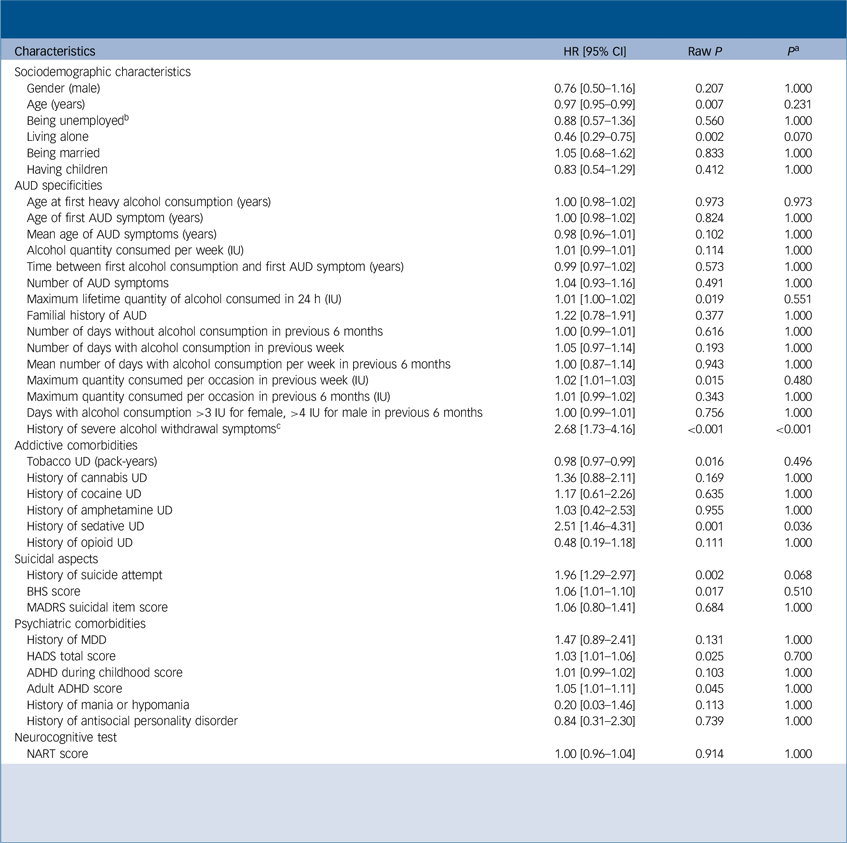
Univariate survival analyses identified 11 baseline variables associated with the occurrence of suicidal acts during the 24-month follow-up. Following Holm–Bonferroni correction, only two variables retained statistical significance (Table 2).
Association between baseline characteristics and the occurrence of suicide attempts during the 24 months following hospitalisation – univariate survival analyses

Table 2 Long description
A table with 42 rows and 4 columns. The columns are labeled Characteristics, HR (95% CI), Raw P, and P^a. The table lists various sociodemographic characteristics, AUD specificities, addictive comorbidities, suicidal aspects, psychiatric comorbidities, and neurocognitive tests. Each row provides the hazard ratio (HR) with 95% confidence interval (CI), raw P-value, and adjusted P-value (P^a) for each characteristic. Notable characteristics include gender, age, employment status, living situation, marital status, having children, age at first heavy alcohol consumption, age at first AUD symptom, mean age of AUD symptoms, alcohol quantity consumed per week, time between first alcohol consumption and first AUD symptom, number of AUD symptoms, maximum lifetime quantity of alcohol consumed in 24 hours, familial history of AUD, number of days without alcohol consumption in previous 6 months, number of days with alcohol consumption in previous week, maximum quantity consumed per occasion in previous week, maximum quantity consumed per occasion in previous 6 months, days with alcohol consumption >3 IU for female, >4 IU for male in previous 6 months, history of severe alcohol withdrawal symptoms, tobacco UD, history of cannabis UD, history of cocaine UD, history of amphetamine UD, history of sedative UD, history of opioid UD, history of suicide attempt, BHS score, MADRS suicidal item score, history of MDD, HADS total score, ADHD during childhood score, adult ADHD score, history of mania or hypomania, history of antisocial personality disorder, and NART score.
ADHD, attention-deficit hyperactivity disorder; AUD, alcohol use disorder; BHS, Beck’s Hopelessness Scale (20-item suicidal ideation scale); HADS, Hospital Anxiety and Depression Scale (7 items for anxiety, 7 items for depression); HR, hazard ratio; IU, international alcohol unit (10 g ethanol); MADRS, Montgomery–Asberg Depression Rating Scale; MDD, major depressive Ddsorder; NART, National Adult Reading Test; UD, use disorder.
a .Holm–Bonferroni correction was applied.
b .Unemployed refers to all non-working people, including students and retired people.
c .Severe alcohol withdrawal symptoms correspond to delirium tremens or alcohol withdrawal seizures.
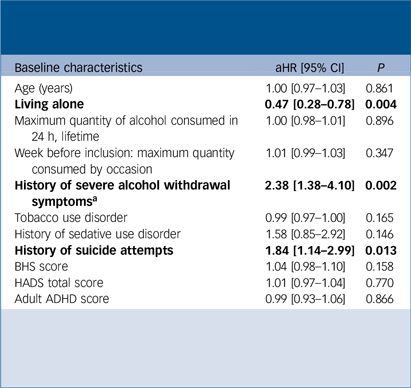
A multivariate Cox proportional hazards regression was performed, including all 11 variables from the univariate step, to evaluate their independent contributions. Three factors remained significantly associated with prospective suicidal acts: a history of severe alcohol withdrawal symptoms, defined as delirium tremens or seizures (aHR 2.38, 95% CI 1.38–4.10, P = 0.002) and a history of suicide attempts (aHR 1.84, 95% CI 1.14–2.99, P = 0.013) were predictive of suicidal acts, while living alone was associated with a decreased risk (aHR 0.47, 95% CI 0.28–0.78, P = 0.004; Table 3).
Association between baseline characteristics and the occurrence of suicidal acts during the 24 months following hospitalisation – multivariate Cox model

Table 3 Long description
A table with 11 rows and 4 columns. The columns are labeled Baseline characteristics, aHR (95% CI), and P. The rows list various baseline characteristics and their associated hazard ratios (aHR) with 95% confidence intervals (CI) and P-values. Row 1: Age (years), 1.00 (0.97-1.03), 0.861. Row 2: Living alone, 0.47 (0.28-0.78), 0.004. Row 3: Maximum quantity of alcohol consumed in 24 h, lifetime, 1.00 (0.98-1.01), 0.896. Row 4: Week before inclusion: maximum quantity consumed by occasion, 1.01 (0.99-1.03), 0.347. Row 5: History of severe alcohol withdrawal symptoms, 2.38 (1.38-4.10), 0.002. Row 6: Tobacco use disorder, 0.99 (0.97-1.00), 0.165. Row 7: History of sedative use disorder, 1.58 (0.85-2.92), 0.146. Row 8: History of suicide attempts, 1.84 (1.14-2.99), 0.013. Row 9: BHS score, 1.04 (0.98-1.10), 0.158. Row 10: HADS total score, 1.01 (0.97-1.04), 0.770. Row 11: Adult ADHD score, 0.99 (0.93-1.06), 0.866.
ADHD, attention-deficit hyperactivity disorder; aHR, adjusted hazard ratio; BHS, Beck’s Hopelessness Scale (20-item suicidal ideation scale); HADS, Hospital Anxiety and Depression Scale (7 items for anxiety, 7 items for depression).
a .Severe alcohol withdrawal symptoms correspond to delirium tremens or alcohol-withdrawal seizures.
In bold, variables with a significant P-value (<0.05).
Additionally, we analysed the occurrence of suicidal acts during the first 3 months of follow-up. Of the 90 suicidal acts observed over the 2-year follow-up, 23 (25.6%) occurred within the first 3 months. Univariate survival analyses identified three baseline variables as statistically significant. Following Holm–Bonferroni correction, only a history of severe alcohol withdrawal symptoms retained significance (Supplementary Table 4). In the multivariate Cox proportional hazards regression including all 3 variables, all were significantly associated with suicidal acts occurring in the first 3 months of follow-up: a history of severe alcohol withdrawal symptoms (aHR 4.27, 95% CI 1.99–9.15, P < 0.001), age at first heavy alcohol consumption (aHR 1.05, 95% CI 1.02–1.09, P = 0.003) and a history of suicide attempts (aHR 2.59, 95% CI 1.19–5.65, P = 0.017; Supplementary Table 5).
The role of severe alcohol withdrawal symptoms in suicidal patients
To further explore the association between severe alcohol withdrawal symptoms (delirium tremens or seizures) and suicidal risk, additional analyses were conducted. Seventeen variables, significantly associated with a history of severe alcohol withdrawal symptoms before the application of Holm–Bonferroni correction, were entered into a multivariate logistic regression model. One variable (mean age of AUD symptoms) was excluded due to collinearity. The model was associated with a Nagelkerke’s pseudo-R 2 of 0.16 and an AUC of 0.73, and identified two factors independently associated with a history of severe alcohol withdrawal symptoms: the maximal lifetime quantity of alcohol consumed over a 24-h period (aOR 1.02, 95% CI 1.01–1.04, P < 0.001) and the number of AUD symptoms (aOR 1.19, 95% CI 1.03–1.36, P = 0.014).
Discussion
In the present study, a history of suicide attempts among patients with AUD was significantly associated with a prior diagnosis of major depressive order (MDD), female gender and higher levels of suicidal ideation and hopelessness at admission. In contrast, when examining the prospective risk of suicidal acts over the 24-month follow-up period, different predictors emerged: a history of severe alcohol withdrawal symptoms (delirium tremens or seizures) and past suicide attempts were linked to an increased risk of suicidal acts, whereas living alone appeared to serve as a protective factor. A history of severe alcohol withdrawal symptoms and past suicide attempts was also associated with a higher incidence of suicidal acts during the first 3 months of follow-up.
Past suicide attempts
Within our cohort, 43% of patients reported a history of suicide attempts. Similar rates, from 36.6 to 43%, were observed in other AUD populations, Reference Wojnar, Ilgen, Jakubczyk, Wnorowska, Klimkiewicz and Brower20–Reference Preuss, Schuckit, Smith, Danko, Bucholz and Hesselbrock22 although another study reported a slightly lower rate of 27%. Reference Pandey, Bolstad, Lien, Walby, Myhre and Bramness23
Univariate analyses comparing patients with and without prior suicide attempts revealed markers suggestive of a more severe AUD course among those with a history of suicide attempts, including earlier onset of AUD symptoms and greater maximum quantities of alcohol consumed per occasion or within 24 h. Interestingly, patients with past suicide attempts also reported significantly more days of abstinence in the preceding 6 months. The combination of higher maximum alcohol consumption per occasion – reflecting greater severity – and a higher number of alcohol-free days during the preceding 6 months suggests an irregular drinking pattern characterised by intermittent heavy consumption interspersed with abstinence. This result implies that, besides the severity of the disorder, which has been linked to increased prevalence of past suicide attempts, Reference Preuss, Schuckit, Smith, Danko, Buckman and Bierut7,Reference Pandey, Bolstad, Lien, Walby, Myhre and Bramness23 consumption patterns may also heighten the risk of suicidal behaviour. Indeed, acute alcohol use is also a risk factor for suicidal acts. Reference Conner and Bagge24 High rates of acute alcohol use have also been noted among individuals with AUD who died by suicide. Reference Pfeifer, Bartsch, Hemmer and Reisch25 However, none of these factors remained significant in the multivariate analysis.
Univariate comparisons also showed that patients with a history of suicide attempts were more likely to have a history of sedative or cannabis use disorders and a history of MDD. They also exhibited higher levels of hopelessness, suicidal ideation, depression, anxiety and symptoms consistent with ADHD, both currently and during childhood. These findings align with prior research documenting higher rates of psychiatric and substance use comorbidities among AUD patients with prior suicide attempts. Reference Preuss, Schuckit, Smith, Danko, Buckman and Bierut7 More specifically, current depressive symptoms, hopelessness and suicidal ideation, substance use disorder and a history of MDD were found to be associated with a history of suicide attempts. Reference Pandey, Bolstad, Lien, Walby, Myhre and Bramness23,Reference Surrence, Miranda, Marroquín and Chan26–Reference Guvendeger Doksat, Zahmacioglu, Ciftci Demirci, Kocaman and Erdogan28 Multivariate analyses further confirmed that a history of MDD, suicidal ideation and hopelessness was independently associated with past suicide attempts.
The final significant factor in our multivariate model was female gender, a finding that is consistent with previous studies that have identified a higher prevalence of lifetime suicide attempts and suicidal ideation among females with AUD. Reference Barr, Neale, Chatzinakos, Schulman, Mullins and Zhang9,Reference Hsu, Chang, Chang, Chiu, Lin and Lane29 This gender difference has also been observed in general adolescent and young adult populations. Reference Miranda-Mendizabal, Castellví, Parés-Badell, Alayo, Almenara and Alonso30 However, some studies in AUD populations have found no significant gender differences in suicide attempt prevalence or incidence. Reference Preuss, Schuckit, Smith, Danko, Bucholz and Hesselbrock22,Reference Pandey, Bolstad, Lien, Walby, Myhre and Bramness23
Prospective risk of suicidal act
Over the 24-month follow-up, 11.5% of patients engaged in a suicidal act. This incidence is considerably higher than the 4.5% reported in a major prospective study of suicide attempts in patients with AUD. Reference Preuss, Schuckit, Smith, Danko, Bucholz and Hesselbrock22 This discrepancy may reflect differences in AUD severity, as our sample comprised in-patients, indicating more severe or complicated cases.
Univariate survival analyses identified 11 factors significantly associated with the occurrence of a suicidal act during follow-up; however, following Holm–Bonferroni correction, only two of these remained significant. First, patients who engaged in a suicidal act were more likely to have a history of severe alcohol withdrawal symptoms (delirium tremens or seizures). This factor is an indicator of AUD severity, and severe AUD is well documented as being associated with suicide attempts. Reference Preuss, Schuckit, Smith, Danko, Bucholz and Hesselbrock22,Reference Flensborg-Madsen, Knop, Mortensen, Becker, Sher and Grønbæk31 Second, a history of sedative use disorder was linked to an increased risk of suicidal acts, concurring with previous findings that substance use disorders predict suicidal behaviour in patients with AUD. Reference Preuss, Schuckit, Smith, Danko, Bucholz and Hesselbrock22,Reference Kõlves, Draper, Snowdon and De Leo32
In the multivariate survival analysis, three factors retained their significance; prior suicide attempts was one of these, consistent with data from the general population Reference Jha, Chan and Orji33 and among patients with AUD. Reference Preuss, Schuckit, Smith, Danko, Bucholz and Hesselbrock22,Reference Kõlves, Draper, Snowdon and De Leo32 Interestingly, it was not the predominant factor in the present analysis. Instead, a history of severe alcohol withdrawal symptoms (delirium tremens or seizures), already highlighted in univariate analyses, showed the strongest association with subsequent suicidal acts. Interestingly, this variable also emerged as significant in the alternative multivariate analysis including only variables with statistically significant corrected P-values (Supplementary Table 2). While research on alcohol withdrawal seizures is limited, two recent studies have reported an association between a history of suicide attempts and delirium tremens in patients with AUD. The first found that a history of suicide attempts was more prevalent among patients with a history of delirium tremens. Reference Bramness, Pandey, Moe, Toft, Lien and Bolstad34 The second, conducted by the same research team, reported that the association was significant only in males, which may be due to the limited number of females with a history of delirium tremens. Reference Pandey, Bolstad, Lien, Walby, Myhre and Bramness23 The present study lends further support to the notion that delirium tremens influences suicidal behaviour in patients with AUD. Importantly, the evidence comes, this time, from a prospective approach, demonstrating that a history of delirium tremens or alcohol withdrawal seizures is associated with an elevated risk of future suicidal acts. AUD severity is more pronounced in patients with a history of delirium tremens. Reference Bramness, Pandey, Moe, Toft, Lien and Bolstad34 Concordantly, our additional exploratory analysis revealed a positive association between a history of severe alcohol-withdrawal symptoms and markers of AUD severity, i.e. the maximal lifetime quantity of alcohol consumed in 24 h and the number of AUD symptoms. Thus, the impact of this factor may be mediated by a higher severity of AUD. Because the history of severe alcohol withdrawal symptoms is a readily obtainable piece of information, it has the potential to serve as an effective indicator of patients at risk of suicidal behaviour.
Finally, the last factor that retained its significance in the multivariate analysis was living alone, which was identified as a protective factor. This finding is surprising, because being single and loneliness are commonly cited as risk factors: being separated or divorced was identified as a significant risk factor in univariate analyses from a previous study. Reference Preuss, Schuckit, Smith, Danko, Bucholz and Hesselbrock22 However, there is also evidence that partner relationship disruptions are strongly associated with suicidal behaviour in people with AUD. Reference Sher35 Likewise, recent serious arguments with a spouse or family were found to be involved in suicides of patients with AUD. Reference Kõlves, Draper, Snowdon and De Leo32 Therefore, our finding may result from the fact that individuals living alone are less exposed to such arguments.
Our study used a 2-year follow-up period, balancing informativeness with feasibility. Indeed, this duration allowed for the detection of both proximal and distal suicidal acts. Extending follow-up further to capture more distal suicidal acts would increase the risk of higher attrition. Conversely, shorter follow-up periods are easier to implement. We conducted additional survival analyses for suicidal acts occurring within the first 3 months of follow-up, to identify factors associated with immediate suicidal risk. These analyses confirmed the significance of a history of severe alcohol withdrawal symptoms and previous suicide attempts as risk factors.
Limitations
Our study has several limitations. First, despite dedicated catch-up efforts, 15.7% of patients were lost to follow-up. This is common in AUD populations, particularly among those with severe illness requiring in-patient care. Reference Homman, Smart, O’Neill and MacCabe36,Reference Nadkarni, Bhat, Ebrahim and Patel37
Second, the study design limited the collection of prospective data to the occurrence of suicidal acts, thereby losing the ability to capture the impact of events occurring during the follow-up, such as relapse into drinking, changes in medication or substance use, or the onset of MDD. While this approach probably minimised attrition, it constrained the range of risk factors identified because these were based solely on baseline measurements.
Third, data on the lethality of suicidal acts are currently unavailable. This gap will be addressed in a subsequent study with an extended follow-up period, which will enable a more detailed assessment of the lethality of suicidal behaviour and overall mortality within this population, many of whom remain outside established care pathways.
Fourth, although it could be argued that histories of delirium tremens and alcohol withdrawal seizures warrant separate analysis, we combined these two variables given that they represent the most severe manifestations of alcohol withdrawal syndrome and frequently co-occur. Reference Canver, Newman and Gomez38,Reference Kádár, Gajdics, Pribék, Andó and Lázár39
Fifth, our sample is relatively old. While we acknowledge that societal and clinical contexts may have evolved since data collection, the core features of AUD and associations, such as the one we observed between suicidal acts and severe alcohol withdrawal symptoms, are likely to remain stable over time.
Sixth, suicidal ideation was measured using a single item from MADRS rather than a comprehensive instrument, which may limit the granularity of data on this risk factor.
Seventh, we did not employ the Severity of Alcohol Dependence Questionnaire, which could have facilitated comparison of AUD severity with other clinical populations.
Finally, as our sample was drawn exclusively from in-patient settings, representing individuals with severe AUD, the findings may not generalise to community populations or to those with less severe forms of AUD. Future research should seek to replicate these findings in broader and less severe clinical samples.
Taking into consideration these different limitations, the finding that the strongest predictor of suicidal acts within the 2 years following admission for alcohol withdrawal management was a history of severe alcohol withdrawal symptoms might be particularly relevant for clinicians. Indeed, the association between suicidal acts and a history of severe alcohol withdrawal symptoms is apparent even within the first 3 months. Given that this clinical information is readily obtainable, it offers a valuable indicator for identifying patients at elevated risk. These results underscore the need for vigilant monitoring and integrated care strategies addressing both addiction and psychiatric risk factors in this vulnerable population.
Supplementary material
The supplementary material is available online at https://doi.org/10.1192/bjp.2025.10386
Data availability
Data that support the findings of this study are available from the corresponding author, P.G., on reasonable request.
Author contributions
P.G. formulated the research question and designed the study. C.V., H.-J.A., P.B., C.D. and P.G. contributed to data acquisition. C.V., D.P. and P.G. analysed the data. C.V. and D.P. drafted the manuscript. All authors revised the manuscript.
Funding
The research was funded by Programme Hospitalier de Recherche Clinique (nos AOM05129 and AOM10045).
Declaration of interest
H.-J.A. is or was a member of advisory boards, data safety and monitoring board or steering committees for Bioprojet, Eos and Ethypharm, and has received sponsorship to attend scientific meetings, speaker honoraria or consultancy fees from Ethypharm, Kinnov Pharmaceuticals and Lundbeck. He is also a member of the American Society of Clinical Psychopharmacology’s Alcohol Clinical Trials Initiative (ACTIVE), which was supported over the past 36 months by Lilly, Imbrium, Alkermes, Dicerna, Ethypharm, Indivior, Kinnov Therapeutics, Otsuka and Pear Therapeutics. P.G. received, during the past 5 years, fees for presentations at congresses or participation in scientific boards from Angelini, Janssen, Lundbeck, Otsuka and Viatris. The other authors declare no conflict of interest.
Transparency declaration
The manuscript is an honest, accurate and transparent account of the study being reported; no important aspects of the study have been omitted, and any discrepancies from the study as planned have been explained.




eLetters
No eLetters have been published for this article.