Over the past two decades archaeology has seen the development of the archaeology of the contemporary as a subfield; that is, the deployment of archaeological methods and theoretical approaches to critically explore the contemporary era (Buchli and Lucas Reference Buchli and Lucas2001; Dawdy Reference Dawdy2010; González-Ruibal 2009; Reference González-Ruibal2019; Harrison and Schofield Reference Harrison and Schofield2010). Many of these studies have focused on the particular social and historical events that make the contemporary unique – homelessness (Zimmerman and Welch Reference Zimmerman and Welch2011), high modernism (González-Ruibal Reference González-Ruibal2019), undocumented migration (De Leon Reference De Leon2015), mass consumption (Mullins Reference Mullins2011) and environmental transformation (Pétursdóttir Reference Pétursdóttir2017). However, with the major exception of Susan Lawrence and Peter Davies’s work in Australia (Davies and Lawrence Reference Davies and Lawrence2019; Lawrence and Davies Reference Lawrence, Davies, Torres de Souza and Costa2018), few archaeologists have attended to the particular social and ecological stakes of one of the most defining material features of contemporary life: the long-term effects of toxic industrial waste. Describing the contemporary as the High Capitalocene, this article highlights the contemporary as a period caught between the boom-and-bust cycles of capitalist production and the long-term persistence of industrial waste. Drawing on an archaeological case study from Edmonton, Alberta, a major city in western Canada, we outline how the working-class shanty town community of Ross Acreage formed in relation to the industrial waste that suffused its landscape.
Founded in 1902, Ross Acreage developed as an informal shanty town situated along the Edmonton, Yukon and Pacific railroad tracks, and downstream of the numerous meat-packing plants and coal mines that also lined the tracks. While industry abandoned the area in the 1920s, leaving Ross Acreage with few job opportunities, the shanty town remained. From 1902 to 1954, life in Ross Acreage was organized by both the cycles of industrial production and abandonment, and the challenges of life in a landscape filled with industrial ruins and detritus. Over its 50 years of occupation, Ross Acreage was occupied by many different kinds of people (immigrants, industrial labourers and farmers), resulting in the mixing of many different ways of occupying the landscape. Drawing on data from both archaeological excavation and environmental testing at Ross Acreage, this article argues that the community of Ross Acreage was defined materially by its long-term relationship with industrial waste (more so than by class, race, ethnicity or even a shared sense of identity), what we term (following Lerner Reference Lerner2010) a ‘fence-line community’. Caught between the promise of jobs, the necessity of cheap land, the lure of industrial salvage and the dangers of industrial toxins, the community of Ross Acreage was formed out of the tension between the long-term effects of industrial waste and the force of capitalist production. As such, Ross Acreage represents a paradigmatic community of the High Capitalocene, a period in which we still live today.
Archaeology and the contemporary
Since its emergence as a subfield of archaeology, the archaeology of the contemporary has been buffeted by a single existential question: what/when is the eponymous contemporary? While this temporal query had troubled social theory long before the emergence of an archaeology of the contemporary, it is a question that gets to the heart of the subfield. Archaeologists have identified the contemporary as the ‘20th century’ (Harrison and Schofield Reference Harrison and Schofield2010), ‘the post-war period’, ‘the age within living memory’ (Schofield Reference Schofield2005) and the age of ‘neoliberalism’ (Vilches Reference Vilches and Resco2016). Since the archaeology of the contemporary is fundamentally interested in using archaeology to tackle the social and political concerns of the contemporary, how one defines the contemporary as a period frames the political and social stakes of the subfield and the critical potential of the archaeological method.
Despite the ongoing devastations of climate change, few archaeologists of the contemporary have identified industrial pollution and environmental justice as archaeological problems. Those archaeologists who have (figures like Susan Lawrence, Peter Davies and Þóra Pétursdóttir), have highlighted the changing relations between humans and their environment through the concept of the Anthropocene (Davies and Lawrence Reference Davies and Lawrence2019; Lawrence and Davies Reference Lawrence, Davies, Torres de Souza and Costa2018; Pétursdóttir Reference Pétursdóttir2017; Reference Pétursdóttir2020). Identifying the contemporary as the Anthropocene, these scholars highlight the anthropogenic transformation humans have caused to the globe over the past 200 years, and the persistent challenges these transformations pose. However, as Alfredo González-Ruibal (Reference González-Ruibal2019) points out, in linking environmental degradation with the universal anthropos, the term ‘Anthropocene’ ignores the deep-seeded social dynamics that drive this environmental change and occludes any phenomena that do not link directly to environmental degradation. Rather than a problem inherent to humanity, the excesses of industrial waste and anthropogenic change are themselves rooted in the social force of modernist rationality (ibid.). For González-Ruibal, instead of the Anthropocene, the contemporary can be better defined as the age of supermodernity (Auge Reference Auge2009), an era starting at the beginning of the 20th century that is marked by an excess and acceleration of modernist logics. Supermodernity identifies environmental degradation, industrial pollution and environmental injustice as a small part of a much larger social transformation, in which society is defined by an excess of time and space and the material excess of accumulating waste and ruination (González-Ruibal Reference González-Ruibal2019). Archaeology, as a theoretical and methodological perspective that specializes in the study of the archaeological record (and, as such, waste), has itself a unique relation to the contemporary era; because of this, archaeology ultimately provides not simply a useful but also a crucial avenue for critiquing and overcoming supermodernity.
While González-Ruibal makes a convincing case for the contemporary as an excessive and destructive era within the modern age – marked by acceleration and waste (the ‘super’ in supermodernity) – he makes a less convincing argument for what modernity actually is to begin with. We agree with González-Ruibal’s position that there is political importance and historical salience in identifying a temporal rupture (roughly in the 16th century) that marks the modern world as distinct from the premodern one. However, we disagree with his argument that capitalism (with the masses of industrial waste that capitalism produces) is derivative of modernity. The rupture that González-Ruibal so powerfully argues for does not serve as the impetus for the development of capitalism; the cause of this rupture itself rests within the historical and logical development of capitalism.
In a different approach (one to which González-Ruibal (ibid.) is admittedly sympatheticFootnote 1), Jason Moore (Reference Moore2016) argues that the modern era can be better thought of as the Capitalocene, a period not defined by the logic of modern rationalism, but by the development of the capitalist mode of production. More than just a theorization of the logic of capitalism, the Capitalocene is a theorization of how the capitalist mode of production remakes human/non-human relations and leaves behind a trail of social and ecological devastation in its wake. Originally theorized as a critique of the Anthropocene, the Capitalocene highlights how the capitalist mode of production emerges out of 16th-century England and represents a unique set of socio-natural relations tied to the exploitation of labour and the alienation of humanity from the non-human world. This period is marked by the development and globalization of human–non-human relations which are themselves mediated by the global production of abstract human labour. Rather than explaining ecological devastation through a monolithic vision of humanity (i.e. the Anthropocene), the historical periodization of the modern era as Capitalocene highlights how relations of inequality, exploitation and racism intersect with global environmental transformations and devastations driven by the hunt for surplus value.
Just as González-Ruibal marks a sub-period break between modernity and supermodernity in the early 20th century, the periodization of the Capitalocene can also incorporate finer sub-periods within it that account for changing dynamics within the acceleration of capitalist production as well as the emergence of different scales and forms of waste. We argue that the rapid acceleration marking the beginning of the current period of the Capitalocene – which we term the High Capitalocene – starts by the 1870s. The High Capitalocene is defined by the emergence of a fully globalized industrial capitalism, represented by the development of trans-oceanic steamships and transcontinental railways; the violent colonization of Africa, East Asia, and western North America by Euro-American powers; the mechanization of warfare; the reconfiguration of global labour regimes; and the acceleration of industrial production (and exploitation) under the inertia of relative surplus value. Like supermodernity, the High Capitalocene is defined not just by a foundational logic, but by the massive and wasteful destruction this logic leaves in its wake (Moore Reference Moore2016). This period is defined by the global proliferation of industrialized production and resource exploitation, as well as industrialized scales of waste. As this waste accumulates, it serves as an archive of the histories of labour, exploitation, colonization and industrial production. At the same time, this accumulating waste actively deforms landscapes, devastates ecologies, modifies biologies and harms communities long after industrial production has ceased.
Archaeology of the High Capitalocene
Like Moore, historical archaeologists Charles Orser (Reference Orser1996), Mark Leone (Reference Leone1995), and Matthew Johnson (Reference Johnson1996) have long defined the past five centuries as the era of capitalism. Historical archaeologists have drawn on the material remains of this period to reconstruct how the exploitative dynamic of capitalism drove global and local transformations (Croucher Reference Croucher2015; Leone Reference Leone1995; Matthews Reference Matthews2010; Mrozowski Reference Mrozowski2006). In particular, many scholars have interrogated the remains of capitalist waste as an archive of class relations and class struggle. Philip Duke and Dean Saitta (Reference Duke and Saitta1998), LouAnne Wurst (Reference Wurst2015), Daniel Sayer (Reference Sayer, Leone and Knaupf2015) and Randall McGuire and Reckner (Reference McGuire and Reckner2003) have studied the archaeological remains of working-class communities as a way of highlighting the exploitation of industrial capitalism and the solidarity of the working class. Following the framework of traditional Marxism, these scholars have mobilized the category of class as the central tension defining capitalism’s historical development, viewing the elucidation of the history of the working class as an essential component of overcoming capitalism (McGuire and Reckner Reference McGuire and Reckner2003; Wurst Reference Wurst2015). As McGuire and Reckner (Reference McGuire and Reckner2003, 219) argue, an archaeology of the working class has the potential to critique the capitalist fantasy of progress and, in doing so, to foster working-class solidarity and ‘working-class interests’ in the present.
In contrast to the traditional Marxist approach, the period of the High Capitalocene cannot be explained away by an analysis of class, the relations of production or a purely theoretical analysis of the logic of capital. In Australia, Susan Lawrence and Peter Davies have pointed out that most archaeologies of the industrial working class have focused too heavily on class to the detriment of understanding the broader contexts within which those class relations were taking place (Davies and Lawrence Reference Davies and Lawrence2019; Lawrence and Davies Reference Lawrence and Davies2012). Lawrence and Davies argue that, at its core, 19th-century industrialization was also a project of massive environmental transformation, a project of engineering landscapes to best exploit resources, exploit labour and appropriate Indigenous land. These geo-engineered landscapes of the past continue to influence our contemporary landscapes in intended and unintended ways (Davies and Lawrence Reference Davies and Lawrence2019).
The long-term social and ecological afterlives of these anthropogenic transformations do not simply map onto the goals of colonial or capitalist projects; they have unintended (or at least unconsidered) impacts that extend into the future. This is especially true of industrial waste. Long after its disposal, the persistent afterlives of waste continue to form and deform landscapes, communities and biologies, and in doing so intersect with (and complicate) the ongoing relations of value production and class reproduction. Moore (Reference Moore2016) argues that as industrial waste accumulates, it works in tension with the fundamental drive of capital to extract value, what he terms the accumulation of negative value. However, identifying this accumulating waste as simply a negation of value dangerously simplifies the ways in which both capital and industrial waste interact to make particular places, ecologies and communities. The persistence of waste extends the effects of past capitalist production, while also complicating capitalist endeavours in the present and the future. In some cases, industrial waste can serve as the medium for new value-creating projects (recycling, salvage and reprocessing). In other cases, industrial waste undercuts the ability of bodies and landscapes to serve as new sources of value and labour.
Understanding the High Capitalocene requires not just an interrogation of the logic of capitalism, but also an interrogation of industrial waste as itself a social and ecological force, a residual archive of production that continues to haunt present and future (re)productions. On the ground, the afterlives of industrial waste intersect with the production of new commodities, the reproduction of working-class life and the toxic harming of indigenous landscapes in often devastating but particular ways. Archaeology, as a discipline that reconstructs social life through waste, is a uniquely valuable method for exploring and identifying the communities and ecologies defined by these intersecting forces. A critical examination of the High Capitalocene’s archaeological record produces much more than simply a chronicle of the past; it uncovers the toxic stratigraphy of industrial waste as an active and ongoing participant in the historical development of our contemporary era. As such, archaeology provides a critical method that can elucidate the kinds of communities, ecologies and landscapes of the High Capitalocene, and in doing so help us better understand the period in a manner that might allow us to overcome its problems. In this paper, we draw on excavations of Ross Acreage, an early 20th-century shanty town in Edmonton, to show how this community was formed by the tension between the forces of industrial production and waste. Tacking between data from environmental tests and domestic material culture, this study argues that Ross Acreage is an example of a definitive type of community in the High Capitalocene.
Edmonton in the High Capitalocene
Edmonton (population 1.3 million) is a large city in central Alberta, situated along the deep North Saskatchewan river valley that marks the boundary between the Canadian prairies and the boreal forests to the north. Edmonton is a central node in the geography of the High Capitalocene. The large prairie city is a major centre for the global oil industry: Edmonton’s economy is largely dependent on the development and the processing of the North Athabascan oil sands. Long before the discovery of oil in Alberta, Edmonton had a long history as the primary site of colonial settlement, economic exploitation and environmental transformation in central Alberta and northern Canada more broadly. Originally founded as a key fur trading centre in the late 18th century, by the beginning of the 20th century Edmonton had become a major population centre and the focus of industrial development in central Alberta. While the colonial pressures of the fur trade reorganized the ecology and economy of the Canadian prairies throughout the 19th century, the power dynamics and waste of industrialization only began to affect the area towards the end of the century. We first see the manifestation of the High Capitalocene in the region in 1885, when the Canadian Pacific Railway began work to connect the prairies with both eastern Canada and British Columbia to the west. In the same year, the Canadian government’s newfound ability to mobilize its army via the partially built Canadian Pacific Railroad enabled the defeat of Métis and Cree communities who had combined forces in an effort to regain greater local autonomy.
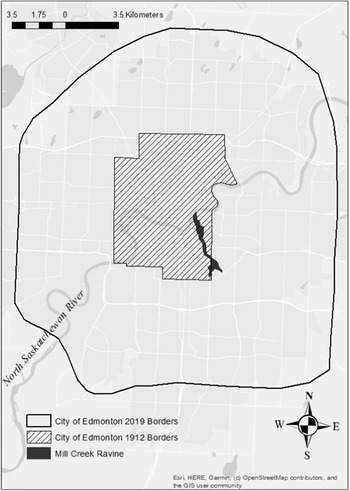
In Edmonton specifically, the High Capitalocene touched down in 1901, with the construction of a railway bridge across the North Saskatchewan river that connected Edmonton to the rest of Canada. This opened up central Alberta to a rush of Euro-Canadian settlers eager to make claims on the land of the recently defeated Métis and Cree communities. Known as the Edmonton, Yukon and Pacific Railroad (EY&P), this first line into Edmonton ran through the short but deep Mill Creek Ravine that runs north into the north Saskatchewan valley (Figure 1). By the time the railway was finished in 1902, Mill Creek Ravine was the first major industrial area of Edmonton, boasting five meat-packing plants, a brick factory, and numerous coal mines established along its banks.
The location of Mill Creek Ravine in the city of Edmonton.

The EY&P facilitated a rush of Euro-Canadian settlers (mainly from eastern Canada, Ukraine and the United Kingdom), almost tripling Edmonton’s population between 1901 and 1903 (from 2,600 to 7,000). Incoming settlers clustered in the downtown area, as well as near Mill Creek Ravine, looking for work in the meat-packing plants and coal mines. This booming population left Edmonton with a significant housing shortage. Many of the incoming settlers did not have sufficient funds to buy plots of land or to construct their own houses. Outside Edmonton’s downtown, the river valley and ravines were dotted with informal communities – clustered shacks and tents that shifted from year to year. By 1907, over 20 per cent of Edmonton’s population were living in tents (‘1,098 tents occupied in Edmonton by 3,294 tenters’, Edmonton Bulletin, 20 July 1907 PPP). In Mill Creek Ravine, a large shanty town called Ross Acreage was established mainly by immigrants from eastern Canada and the United Kingdom at the northern end of the railway. Close to employment opportunities at Vogel’s meat-packing plant, Gallagher Hull’s meat-packing plant, Anderson’s brickyard and Hehsdoerfer meat-packing plant, Ross Acreage grew into one of Edmonton’s largest informal communities, remaining occupied long after industry left the area in the 1920s. While other tent cities and shanty towns were quickly abandoned as Edmonton grew, Ross Acreage remained occupied until the 1950s, when it was finally evacuated and bulldozed by order of the city council. In a manner that is ubiquitous in the High Capitalocene, residents of Ross Acreage were forced to grapple with the boom-and-bust cycle of capitalist production, while at the same time dealing with life in a landscape filled with capitalist detritus.
Archaeology of Ross Acreage
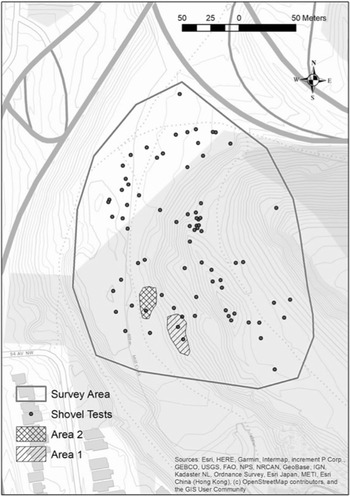
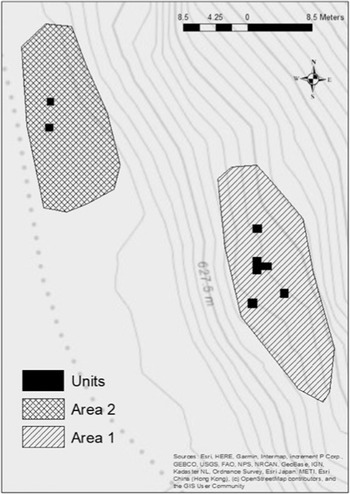
Like many shanty towns of the era, evidence for life in Ross Acreage is almost completely absent from the official archives, leaving archaeology as the primary method of analysis. Ross Acreage was the object of fieldwork carried out in Mill Creek Ravine in 2015 and 2016 (Figure 2). Survey and excavation identified the remains of two areas occupied during the first half of the 20th century. The southern section of the site (Area 1) is situated on a small flat embankment overlooking the Mill Creek valley. This small ledge is found up a steep embankment on the east side of the ravine, almost completely hidden from view from the path due to a dense covering of caragana shrub running along the slope. The northern portion of the site (Area 2) is situated on the far eastern edge of the Mill Creek flood plain (Figures 2 and 3). Area 2 was formerly the creek’s flood plain, but is now a flat grassy expanse due to the creek’s rerouting underground through a culvert after the demolition of Ross Acreage in 1950. The flood plain’s stratigraphy reflects the frequent historical flooding of the creek in spring and subsequent deposition of fine creek sediment, as well as the deposition of soil from the erosion of the ravine walls/ridge.
Survey area at the northern end of Mill Creek Ravine, including locations of shovel tests and boundaries of Area 1 and Area 2 within the larger site of Ross Acreage.

Location of excavation units in Areas 1 and 2.

Our excavations of Area 1 and Area 2 focused on the domestic remains of their past occupants, including faunal remains, serving vessels and storage vessels. These excavations also uncovered the remnants of shanty architecture, including evidence of a house platform and storage pit. The remains of domestic activity (tin cans, glass bottles, burnt coal, buttons and animal bones) provided insight into the changing fortunes of the residents of Ross Acreage, tracing the rise and fall of the economic fortunes of the community. The faunal remains in particular (wild animals like rabbit and squirrel, as well as domestic animals like cattle) reveal how these changing fortunes impacted the subsistence strategies of residents, telling us that they not only purchased packaged meat from the nearby packing houses, but also hunted and trapped small game from the ravine. This domestic waste points to the consumption patterns of specific Ross Acreage residences, how the community reproduced itself through the commodities they purchased, and the resources they gathered. This waste also points to the general patterns of life in the ravine and the mundane strategies residents used on a day-to-day basis over the fifty years of its semi-illicit occupation.
Alongside the investigation into the domestic life and subsistence practices of Ross Acreage residents, the other main focus was on evidence of industrial waste in the soil. Soil samples were taken from every archaeological level (determined through a mix of natural strata and 10-centimetre arbitrary levels). Ten of these samples were tested for arsenic, beryllium, cadmium, nickel, lead, antimony, selenium and vanadium. These heavy metals are common by-products of coal mining and coal mining waste (Lemly Reference Lemly and Fosdyke2009; Li et al. Reference Li, Li, Hou and Shao2018; National Research Council 2008) and the samples were tested to determine the effect of coal mining and coal mining waste on Mill Creek Ravine and Ross Acreage. The ten samples were chosen from across both Area 1 and Area 2: five were from a series of discrete creek silt layers covering occupation layers in Area 2, while the other five were taken from levels with high concentrations of coal waste in Area 1. Due to the long-term persistence of many of these heavy metals (the half-life of lead in soil is several hundred years (Alloway and Ayres Reference Alloway and Ayres1997), while the half-life of arsenic in soil is between six and 16 years (Eisler Reference Eisler1988)), their presence was taken as direct evidence of coal-mining waste both in the soil and in Mill Creek, and as a general proxy of the afterlives of industrial production in Mill Creek Ravine. Evidence from these heavy-metal tests showed that the garden spaces of this community were suffused with highly toxic heavy metals (primarily arsenic and beryllium) that continue to leach their toxins into the environment.
As Robert Nixon (Reference Nixon2011), Steven Lerner (Reference Lerner2010), and Christopher Hedges (Reference Hedges2012) point out, it is precisely in the mundane day-to-day activities that the ‘slow violence’ of toxic exposure occurs. By tacking back and forth between domestic archaeological remains and environmental data on the presence of heavy metals in the soil, this research demonstrates how the everyday practices of social reproduction forced the residents of Ross Acreage to live intimately with a landscape steeped in persistent harmful toxins and other kinds of industrial waste. Together, these two lines of evidence reveal how the degraded harms of industrial waste and the pressures of poverty intersect in the High Capitalocene.
The remains of Ross Acreage
Excavations of Areas 1 and 2 showed evidence of three different periods of occupation at Ross Acreage (Periods I, II and III). These periods were marked by clear stratigraphic distinctions, especially in Area 2, where the rapid accumulation of soil sediment in the flood plain highlights three distinct occupation surfaces. Shared material culture and similar terminus post quem across Areas 1 and 2 suggest that these three periods of occupation occurred at roughly the same intervals in both. The data indicate that these occupations are representative of Ross Acreage more generally, rather than simply the vagaries of a single shanty. Each occupation period is associated with a different material signature, including different types of housing architecture, faunal remains and domestic goods.
Period I can be dated to 1902–1908, and is characterized by material culture testifying to the presence of a very poor population that relied almost entirely on the ravine for fuel and subsistence. This archaeological evidence corresponds with the historical record, which documents the settlement of areas like Ross Acreage by the poorest of recently arrived settlers from eastern Canada who lacked the ability to purchase plots of land and resorted to setting up tenting communities throughout the river valley (‘1,098 tents occupied in Edmonton by 3,294 tenters’, Edmonton bulletin, 20 July 1907 PPP). Area 1 displays evidence of a raised living platform directly to the east of a small storage pit or cellar. The remnants of heavy-duty tarpaulin and the lack of more durable construction materials suggest that the structure on the platform was likely a canvas tent reinforced with a low-cost but heavy-duty cloth lining. In Area 2, a wide variety of construction materials, including fragments of wooden planks and concrete, indicates the presence of a shack, rather than a tent-and-platform structure.
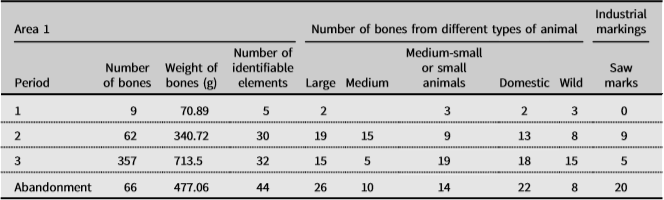
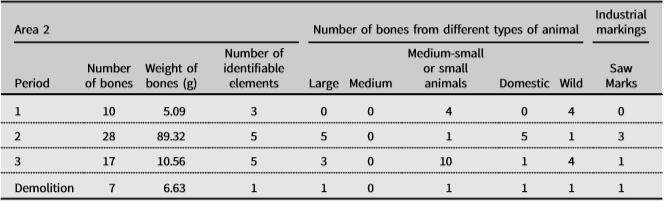
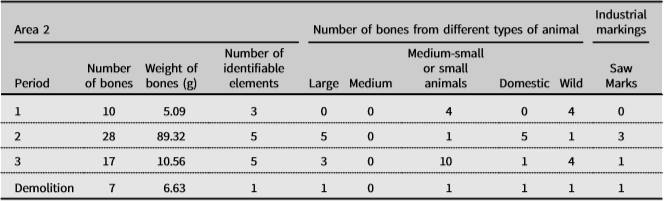
Faunal remains recovered from archaeological levels associated with Period I were limited across both areas (n = 19). Excavated specimens illustrate that the occupants of Ross Acreage relied heavily on fishing and hunting wild game, as opposed to purchasing commercially available meat. Some 78 per cent of identifiable bones (n = 9) recovered from Period I came from wild game such as jackrabbit and fish such as pike, associated with subsistence hunting and fishing (Tables 1 and 2). In Area 1, we identified two cattle bones. Both bovine specimens showed evidence of hand-cutting rather than mechanical sawing, indicating that the meat was likely purchased from a local butcher rather than an industrial packing house. In Area 2, eggshell remains may suggest that chickens were being raised locally in this period. The high percentage of wild species and locally raised food points to the productivity of Mill Creek Ravine as a landscape. It also unveils the paradox of industrial production. Despite living in an industrial landscape dominated by meat-packing (there were three meat-packing plants within one mile of the community), the inhabitants of Ross Acreage relied on hunting and fishing supplemented by the occasional purchase of local farm-raised meat.
Faunal data from Area 1

Faunal data from Area 2
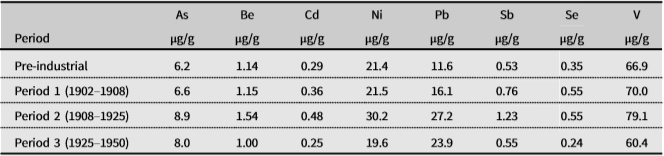
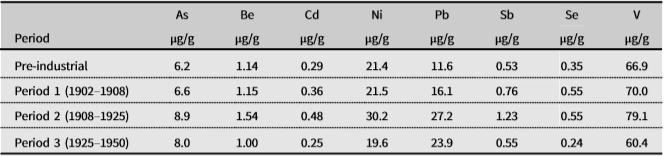
Just as the Period I residents of Ross Acreage relied on the ravine for their subsistence, they also relied on the heavily wooded ravine for wood for heating. There is extensive evidence of charcoal and burnt wood throughout the levels associated with Period 1. Small amounts of burnt coal recovered in Area 2 point to the limited ad hoc mining of exposed coal seams along the ravine bank by residents. This widespread use of wood over coal reflects how heavily wooded the ravine still was during this earliest period, in comparison to what we see in later periods. The small-scale use of coal as a heating source corresponds to the lack of industrial/professional coal mining in the ravine during Period I; the first major coal mining enterprise in Mill Creek Ravine opened in 1908. Testing of samples of creek silt collected from Area 2 during Period 1 show evidence for some limited ad hoc coal mining and coal mining waste in the ravine. The results of these tests (Table 3) show a minor increase (20 per cent) in coal mining waste in Mill Creek Ravine compared to silt recovered from pre-industrial levels. This suggests that some limited amount of coal extraction was taking place, but at a significantly lower scale than in the following occupation period.
Heavy-metal concentrations associated with coal mining found in creek silt in Area 2. Concentrations of heavy metals in this silt were used as a proxy for coal mining waste in the creek
Period II: new industries, new commodities, new toxins
Period II (1908–1925) corresponds to the height of industrial activity in Mill Creek Ravine. Spurred on by a ballooning population and rampant land speculation, the city of Edmonton collaborated with local and foreign businesses alike in order to facilitate large-scale industrial and infrastructural projects. New capital-heavy businesses popped up and older businesses expanded. In 1908, the Twin City Mine opened up 200 metres from Ross Acreage, a less than a five-minute walk upstream. Between 1908 and its closing in 1921, Twin City was the deepest mine in Edmonton, one of the most productive coal mines in the city, and a major employer of incoming labourers (‘Twin City coal in every kitchen’, Edmonton bulletin, March 1918 PPP). Its founding was part of a significant shift in the industrial activity of the ravine and the city in Period II. In Mill Creek Ravine, the atmosphere of free-flowing speculative investment helped fuel the expansion of Vogel’s meat-packing plant, the building of Gainer’s meat-packing plant, the expansion of the Edmonton Lumber Company, and the founding of the Arctic Ice Company, all in the narrow time frame of 1908–1909. Following global trends of industrial labour that mark the High Capitalocene, this industrial expansion was also accompanied by a new concern for workers’ rights and collective action. From 1905 to 1911 almost all skilled labourers in the city collectivized, forming 33 unions by 1911. Unskilled labourers, on the other hand, had only limited success organizing, due to their poverty, the large incoming settler population ready to fill their position should they strike, and significant animosity felt between different ethnic groups (Goyette Reference Goyette2004, 179).
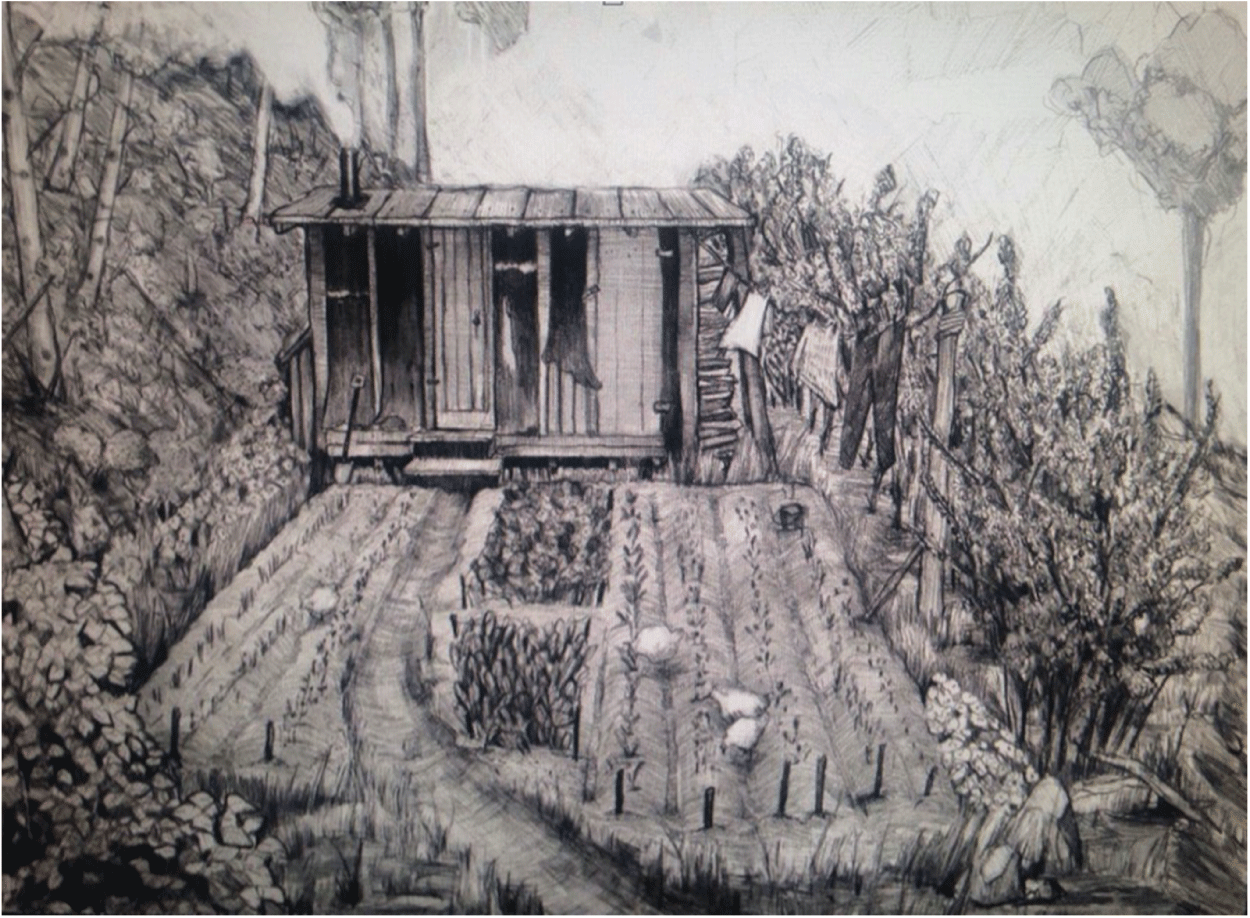
As industry flourished in Mill Creek Ravine, Ross Acreage changed as well. Mainly a tent city, the population of Period I was likely quite fluid. Recent settlers living in tents along the ravine would leave the community as the opportunity arose, moving out (and up) into newly built (and much warmer) wood-frame houses overlooking the ravine. As they vacated, incoming settlers took their place. However, after 1908, an increase in local industry within the ravine led to an increase in stable jobs for residents of Ross Acreage. This resulted in a shift away from a mobile migrant shanty town towards a more sedentary community of industrial labourers interested in more permanent residences and laying claim to land (Tingley Reference Tingley2005). Archaeological remains from Period II show that tents were replaced by shacks, shacks were renovated, garden plots were planted and residents planted hedgerows of caragana shrub to define the boundaries around their shanty plots (Figure 4). In Area 1, stratigraphic levels from Period II showed the remains of a four-posted wooden platform, built right next to the tent platform from Period I. The density of nails associated with this structure makes a strong case for the presence of not just a tent, but a small wooden shack, measuring roughly four metres by three metres. Large sheets of stapled tarpaper found alongside wire nails indicate that the walls and roof of the shack were sided with a thick tarpaper for waterproofing and insulation – not a negligible construction detail in Central Alberta. The remnants of a few fragile pieces of thick, brightly coloured texture wall lining (likely a form of heavy-duty cheap wallpaper such as Anaglypta) suggest that the interior of the shack was partially lined as a form of decoration and further insulation. Below the wooden platform, the storage pit from Period I was re-dug and lined with milled wood planks. Material culture found in the pit (glass bottles, tin cans, ironstone and stoneware crocks) testifies that the feature was used as a cellar.
Artist’s rendition of Area 1 during Period II. By Reed Stewart, artist.

Archaeological evidence from Period II shows that along with the construction of more permanent dwellings, residents of Ross Acreage began buying and using more commodities. The greater availability of wage-labour jobs and the rise of new cheap consumer goods radically changed how people subsisted in Ross Acreage. This was especially true in terms of purchased food and strategies of food storage. Tin cans are ubiquitous in Period II deposits, indicating the new role of shelf-stable consumable foods in the diets of Ross Acreage residents. Cans were found alongside high concentrations of sherds from ironstone crocks and glass bottles, all of which indicate the importance placed on preserving and storing foods. The remains of an ironstone plate and a china teacup were also found amongst the utilitarian wares and single-use containers. While the proliferation of commercial foodstuffs suggests a general increase in the income and well-being of Ross Acreage residents, the lack of food service items points to the generally poor working-class and utilitarian lifestyle lived by the occupants. At the same time, certain indulgences were too good to miss out on: during the First World War, mass-produced soft-pack cigarettes began flooding the North American market. Crumpled lead foil found throughout Period II contexts (likely from these early cigarette packs) suggests that cigarettes, at least, were worth the 25 cents per pack (Robinson Reference Robinson2014, 68).
Also reflecting changes in the local economy, Ross Acreage diets veered sharply away from hunted game and fish and towards purchased beef, mutton, and pork (Tables 1 and 2). The majority (66 per cent) of identifiable bones from this period come from domesticated animals (cows, sheep, pigs). Of these, two-thirds of identified domestic animal bones display evidence of mechanized sawing, a clear indication that they were processed in industrial meat-packing facilities. The commoditization of meat and the subsequent drop in meat prices brought the occupants of Ross Acreage to rely mainly on cheap purchased meat. However, purchased meat did not completely replace hunting and fishing. A number of squirrel, hare and pike bones found in both areas suggests that local hunting, trapping and fishing were still practised to some degree. Evidence of composting (tiny pieces of eggshell mixed with bone fragments in rich organic soil) suggests that a garden plot was tended directly to the north of Area 1. The presence of this garden, and the remains of ceramic crocks, suggest that vegetable gardening and vegetable storage (pickling, preserves, etc.) were increasingly important sources of reliable food in Ross Acreage and evidence of increased domestic and financial stability amongst residents.
The wide variety of material culture found in Period II contrasts with the stereotypical view of desperate and dejected life in a shanty town (Gravelle Reference Gravelle2015; Spradley Reference Spradley1970). A rapidly changing city provided opportunities for the improvement of impoverished communities such as Ross Acreage. Cheap and plentiful coal, and a large publicly owned, coal-fired power plant on the north side of the river (established in 1902), made citywide electricity cheap and accessible. Cloth-covered electrical wires along with fragmented shards of light-bulb glass in Period II contexts reveal that at least some households in Ross Acreage could afford electricity and used electrical lighting in their shanties – or at least were handy enough to steal electricity off the city grid. Furthermore, contrary to common presumptions about early 20th-century shanty towns, the population of Ross Acreage did not consist entirely of male bachelors. Two children’s toys found in Area 1 suggest that children – and likely whole families – lived in Rose Acreage. Along with these toys, the remnants of pencil lead and a piece of slate were likely used by school-aged children attending the nearby King Edward School, opened in 1914 (Olson Reference Olson2016, 123).
Along with the turn towards electricity as a lighting source, Period II marks the shift from wood to coal as the main heating source. Coal and coal-related material culture make up 12 per cent of all recovered materials, compared to less than 2 per cent for burnt wood. This is a distinct increase from Period 1, where coal-related material culture made up only 4 per cent of recovered materials. The rise in coal usage mirrors the development of the Twin City coal mine just down the road, which made coal cheap and accessible. While proximity to a very productive coal mine had its benefits, it also presented severe drawbacks. Situated on a floodplain, the shack in Area 2 was flooded out seasonally along with its large garden plot. Evidence of water staining and flood silt cover the occupation surfaces of Area 2. This flooding did not merely cause mess and seasonal disruption to those living in the floodplain, but regularly polluted their homes and gardens with run-off from two meat-packing plants and the large coal mine located just upstream. Ultra-trace heavy-metal analysis of flood silts from Period II shows elevated levels of heavy metals associated with coal mining – specifically arsenic, beryllium, cadmium, lead, nickel and antimony. On average, this silt has concentrations of heavy metals 61 per cent higher than silt from pre-industrial levels from prior to Period I (Table 3). Even today, 100 years after their deposition, concentrations of beryllium and arsenic continue to exceed acceptable concentrations for agricultural or garden soil according to World Health Organization guidelines (Moterjemi Reference Moterjemi2014, 112).
The effects of exposure to both beryllium and arsenic are well documented (Cooper and Harrison Reference Cooper and Harrison2009; Ratneike Reference Ratneike2003; Sarkar Reference Sarkar2002). Beryllium is a toxic metal and common by-product of coal mining and consumption, entering the air through burning and entering the water system through run-off and industrial waste produced by coal mining. Due to local coal burning and the run-off from the Twin City mine, a mix of river silt and soil in Area 2 has a beryllium concentration of 1.54 ppm (Table 3). This is six times greater than the ‘maximum tolerable soil concentration’ for agricultural or garden soil (0.2 ppm), according to studies from the World Health Organization (Moterjemi Reference Moterjemi2014, 112). Long-term exposure to these elevated levels of beryllium can cause a condition called chronic beryllium disease (Cooper and Harrison Reference Cooper and Harrison2009). This disease, while slow to present symptoms, can cause weakness, lethargy, weight loss and heart disease. Notably, beryllium levels in Mill Creek Ravine are very high even in pre-industrial levels. This is because of the significant amount of exposed coal seams that the creek drains through naturally.
Like beryllium, arsenic is a heavy metal commonly found in coal. Coal mining and burning are both significant sources of arsenic toxicity. Similar to beryllium, arsenic is released into local water through run-off from coal mining, as well as from coal storage facilities and mining spoils (Kolker et al. Reference Kolker, Palmer, Bragg and Bunnell2006). Through the burning process, arsenic and other heavy metals are concentrated into the resultant residue (ash and clinker, a burnt-coal by-product). In Area 2 a mix of river silt and soil sampled from the shanty area has a concentration of 8.9 ppm of arsenic, higher than the 8.0 ppm maximum tolerable concentration for agricultural or garden soil (Moterjemi Reference Moterjemi2014, 112). Arsenic is quite mobile, and it moves easily from the soil into plants, enhancing its ability to cause harm throughout the local ecology/environment. Arsenic bioaccumulates in plants and animals, particularly in tubers and leafy vegetables grown in contaminated soil (Bhattacharya et al. Reference Bhattacharya, Welch, Stollenwerk, McLaughlin, Bundschuh and Panullah2012; Chen et al. Reference Chen, Wu, Liu, Parvez, Slavkovich and Eunus2013). Chronic exposure to elevated levels of arsenic causes long-term health problems: liver and kidney damage, along with nerve damage and skin thickening (Ratneike Reference Ratneike2003). In Period II, the families living in shacks along the creek bed were likely exposed to elevated levels of arsenic and beryllium from the smoke of the coal that heated their homes, the water in which they washed their clothes, and the vegetables grown in their gardens and consumed at their tables.
Creek water was used for most domestic activities (cleaning, cooking and gardening) in Ross Acreage, due to a lack of city water service and a very limited supply of naturally occurring fresh water. One spring at the top of the ravine was the only source of fresh water for the two dozen families living south of Connor’s Road (Office of Waterworks, ‘May13th, Letter to City Commissioner’, 1929, CEA RG11 F89). In addition to toxic run-off from mining, creek water was also polluted with organic waste from Gainer’s and Vogel’s meat-packing plants, located just upstream. These packing houses dumped blood and other sundry animal waste into the creek on a daily basis. Newly built storm drains for the southern neighbourhoods of Edmonton also funnelled into Mill Creek, releasing car oil, residential chemicals and garbage into the creek as well.
In 1914, the industrial boom that had transformed life in Ross Acreage suddenly stalled. As pre-war tensions in Europe built up, foreign capital ceased to flow into the city. This loss of outside investment, combined with the departure of First World War volunteers, led to a complete bust in the real-estate market. Land speculation and visions of future earnings had served as the bread and butter of Edmonton’s economic and industrial development, and the implications of the real-estate collapse rippled through the industries lining Mill Creek. In 1915, companies were further hit when a massive flood swept through the North Saskatchewan river valley, including the northern end of Mill Creek. Many industrial enterprises located in the ravine, including Vogel’s Meatpacking and the Edmonton Lumber Company, shut down.
A combination of falling profits and fear that the river valley would flood again induced most enterprises in Mill Creek Ravine to close down or to relocate between 1915 and 1925 and stripped the area of employment opportunities well in advance of the Great Depression. This led Mill Creek Ravine to experience the flip side of the High Capitalocene, the flight of capital. Just as industrial capitalism creates landscapes of extraction and exploitation, it is also defined by the creation of landscapes of abandonment, blasted landscapes filled with waste and ruins (Tsing Reference Tsing2005; Kirksey, Shapiro and Brodine Reference Kirksey, Shapiro and Brodine2013). A clear break in the archaeological remains suggests that, by the early 1920s, many residents of Ross Acreage, including those who lived in the shanty plots of Areas 1 and 2, had left.
Period III: global depression
The closing of the Twin City mine in 1921 signified not simply the collapse of a single business, but the beginning of the end of coal mining as one of the main industries in the city of Edmonton. Edmontonians became increasingly concerned by the undermining effects of local mining, and increasingly fond of natural gas as a form of heating. In 1923, confronted with the damage to public infrastructure caused by undermining, the first by-law was passed to restrict coal mining occurring within city limits (Ironside and Hamilton Reference Ironside and Hamilton1973, 12). As the mining industry slowed, the river valley and ravines became cleared of industrial activity. At the north end of Mill Creek, a garbage incinerator was built where Anderson’s brick factory had been. The sites of Vogel’s meat-packing plant and the Twin City mine were left abandoned. Between 1925 and 1950 Ross Acreage was occupied a third and final time, defined by the Great Depression and the eventual economic recovery. During Period III, Ross Acreage was occupied by a different population, relying on a different subsistence strategy and leaving behind a different material record. Once inhabited by industrial labourers, Ross Acreage became occupied by destitute farmers. Once reliant on wages, purchased meat and canned goods to survive the winter, the Period III families of Ross Acreage turned back to hunting and gardening to survive.
As industry abandoned Mill Creek Ravine, the population of Ross Acreage also dissipated. However, towards the end of the 1920s, increasing numbers of impoverished farmers and their families were driven to urban settings like Edmonton as a result of successive years of drought throughout southern Alberta and Saskatchewan – the heartland of western Canadian agriculture. These farmers, many originally from Eastern Europe, began to set up camp in the marginal areas of Edmonton. After a decade of population decrease, Ross Acreage began to grow, filling back up with destitute immigrant farming families. As families began to settle in Ross Acreage they set up their homes amidst the ruins of old abandoned shacks, building from material salvaged from old homes and industrial ruins. New shanties were cobbled together with wood as well as salvaged bricks and concrete from the recent ruins that dotted the ravine.
Amongst these new occupants, a German family by the name of Bruner arrived in Ross Acreage in 1929 and built a new house in Area 1, slightly to the south of the abandoned tarpaper shack from Period II (Henderson’s Edmonton City Directory 1929, 70). The house was built out of a mix of wood, brick and concrete rubble salvaged from older, abandoned Ross Acreage shanties, as well as the industrial remains lining the creek. Firebricks, scavenged from an industrial furnace, were used to buffer the house from the heat of a coal-fire stove. In Area 2, an unknown family built a small tarpaper shack. Two post holes and a high concentration of construction material indicate that this new structure was built on a raised wooden platform, echoing earlier construction methods seen in Area 1 and improving upon the previous domestic occupation in Area 2. Again, these new residents pulled together a wide array of bricks, concrete, metal and wood from the surrounding ruins to cobble together a makeshift shack. Too impoverished to buy supplies, the residents salvaged across the ruined landscape of Mill Creek Ravine, finding new value in the waste and ruins that capital had abandoned.
Compared to Period II, Period III is marked by another significant change in domestic material culture. There was a sharp increase in non-utilitarian food service vessels such as plates, china tea service ware and glass candy bowls. The remains of the occupants’ clothing display a similar trend. While utilitarian clothing, represented by the presence of denim jean buttons, was worn, there is also evidence of non-utilitarian personal objects in the form of glass beads. A large yellow faceted glass bead, a type commonly produced in the Czech Republic, was recovered from a Period III context. The presence of this bead could indicate that the family once had disposable income for luxuries like jewellery. While this increase in non-utilitarian goods could suggest that the occupants of this period were wealthier than those of previous occupations, it is more likely that for many families during the Depression, this bead and these serving vessels were vestiges of a middle-class lifestyle that had been lost. The economic catastrophe of the early 1930s left many formerly comfortable families unemployed, bereft of any savings and destitute.
Even while the families of Ross Acreage maintained higher-quality material-culture objects than previous occupants, this material wealth was not reflected in their subsistence strategies, and thus likely reflects that formerly comfortable lifestyle rather than their standard of living in Ross Acreage. Faunal remains from Period III reveal a decrease in purchased meat and a sharp increase in locally hunted game (Tables 1 and 2). Half of all bones identified from this period came from small wild game that would have also been living in the ravine: pike, hare, muskrat, squirrel and rabbit. The presence of significant numbers of .22LR small-game cartridges, as well as a small leg trap, further testifies to the resurgence of hunting for daily sustenance in Period III. Material evidence of purchased meat declines sharply, marked by a decrease in industrially processed cuts of meat (i.e. mechanically sawed bones). While 43 per cent of all identified bones showed evidence of mechanical sawing in Period II, only 16 per cent of identified bones in Period III display such marks. Along with hunting, gardening and locally raised chickens were used to supplement diets during Period III with vegetables and eggs, as evidenced by the presence of terracotta gardening pots, compost and two articulated chicken skeletons. The decrease in purchased food, the increase of locally raised food, and the rise of hunting all point to the lack of cash wages in the community, and the necessity of relying on the ravine’s resources for sustenance – and, indeed, repurposed construction materials.
This shift in subsistence strategies is a clear material record of the poverty and hardship experienced in Ross Acreage during the Great Depression; however, at the same time it reflects a flexibility in subsistence strategies by resilient residents. Residents did not just use Mill Creek Ravine as source of food or building materials, but also for water and heat. With the closing down of most local mines and the inability of occupants to afford or access natural gas, residents scoured the local environment for heating sources. In Area 2, evidence shows that wood was used to supplement low coal reserves. In Area 1, excavation revealed a small hole or miniature mining shaft dug into the creek bank, following a coal vein – this was clearly an attempt by the Bruner family to locate coal sources for heat, and reveals the broader re-emergence of informal surface-based coal extraction in the ravine. The ad hoc nature of digging for coal (a common activity for impoverished communities in Edmonton (Ironside and Hamilton Reference Ironside and Hamilton1973, 10)) is materialized in the poor quality of burnt coal found in levels associated with Period III. Remnants of burnt coal range from glassy clinker to reddish-brown burnt coal. This means that residents were frequently burning coal that was barely more than creek clay in an effort to stay warm.Footnote 2 Such poor-quality coal contains a much higher moisture content than high-grade coal, as well as a much higher percentage of non-carbon volatile elements. As a result, not only does it burn at a much lower temperature, but it produces a thicker smoke, filled with higher concentrations of toxic heavy metals and carbon monoxide. In light of this data, the very long and cold winters (Edmonton averages 25 days per year below –20 Celsius/–4 Fahrenheit) presented a significant danger in light of coal shortages in Ross Acreage homes.
Due to a lack of city water service in Ross Acreage, creek water was used for most domestic activities (cleaning, cooking and gardening) (Office of Waterworks, ‘May 13th, Letter to City Commissioner’, 1929, CEA RG11 F89). Reliance on the creek as a water source was so widespread that in 1929 the city government commissioned a study to determine if Ross Acreage was a public-health concern. Undertaken by Dr Whitelaw and the chief sanitation officer, this study noted that 31 shacks had no access to city sewers and 29 had no access to running water, and that raw creek water was commonly used for domestic activities. According to Dr Whitelaw, Ross Acreage was a danger to public health, a potential vector for typhus, and one of the worst places he could imagine living (Office of Waterworks, ‘May 13th, Letter to City Commissioner’, 1929, CEA RG11 F89). Read alongside the public outcry over the unsanitary conditions of Ross Acreage recorded in the archives, material remains of pharmaceuticals from this period suggest an increased concern over health and hygiene in Period III. During this time, inhabitants began using new mass-produced commodities to protect against the unhealthy and toxic aspects of life in Mill Creek: combs were used for hygiene and as a measure against lice, while medicinal ampoules, Vaseline and other pharmaceuticals were used to fight off infection and sickness.
By Period III, the use of raw creek water for domestic purposes was mainly unhealthy due to the presence of numerous storm drains leading into the creek, but the one remaining meat-packing plant (Gainer’s) also continued dumping raw blood and animal waste. Period III also marked the beginning of the long-term effects of industry on the environment in Mill Creek Ravine. Its water was also unhealthy due to the build-up of industrial ruins and coal mining waste that lined its banks – past actions that extended their reach beyond the lifetime of those industries. On the one hand, heavy-metal testing of creek silt from Period III shows a significant decrease in the concentrations of heavy metals in Mill Creek compared to Period II. This is a direct result of the Twin City mine closure, resulting in an average decrease of 35 per cent in heavy-metal concentrations (Table 3). On the other hand, the high concentrations of beryllium and arsenic from the previous decade of coal production were still distributed throughout the landscape. While the decline of industry in Mill Creek may have ended the production of new coal waste, the polluted silt that suffused Ross Acreage in Period II continued to persist in the soil, and to leach its heavy metals into the environment, long after industry abandoned the area – and it continues to do so today. As Period III residents of Ross Acreage were forced to increasingly rely on Mill Creek Ravine for their subsistence, they were also dependent on a landscape filled with industrial waste.
Archaeological evidence from Period III shows the catch-22 of life in the High Capitalocene. The abandonment of industry, and the end of the exploitation of wage labour, does not allow a community to live beyond the influence of capitalist life. The ability of the residents of Period III to rely on Mill Creek Ravine for their food, water, heat and construction materials did not allow them to escape the effects of the industrialized economy (as some archaeologists of impoverished industrial communities have argued (Matthews Reference Matthews2010; Nassaney and Abel Reference Nassaney and Abel1993; Paynter Reference Paynter1989; Shackel Reference Shackel, Dobres and Robb2000; Starbuck Reference Starbuck2004)), but instead forced them to engage with the toxic nature of an industrialized economy on an intimate, daily basis. In some cases, this engagement was productive: new shanties and shacks were built with wood, brick and concrete salvaged from the ruined industrial buildings that lined the creek. Instead of buying meat, residents of Ross Acreage hunted, trapped and fished for protein, and relied on their gardens for fruits and vegetables. With the coal mine abandoned, and commercially available coal financially inaccessible, residents of Ross Acreage scrounged low-quality coal from the banks of the ravine, sometimes right in their own backyards. Stuck without connections to the city water main and sewers, residents relied on foul creek water. At the same time, this resourcefulness had harmful side effects. As they increasingly relied upon this degraded and abandoned landscape, they exposed themselves to increasing amounts of harmful toxins, released by the pursuit of capital that defined Edmonton’s early ‘boom’ phase in the ongoing boom–bust cycle of the High Capitalocene.
Life of a fence-line community
The transformations that distinguished the three periods of Ross Acreage’s occupations can be linked to regional and global economic developments. A surge in immigration from 1902 to 1908 led to the original foundation of Ross Acreage as a migrant shanty town. The rise of industrial production led to its transformation into a community of industrial labourers, who invested in durable architecture before a local recession left the ravine more or less abandoned. Finally, the devastation of the local and global economy from 1928 to 1935 led to its repopulation by disenfranchised farmers, driven from their homesteads to the south. The economic effects of industrialization had a significant impact at the scale of daily life as well. The development of industry and the availability of new mass-produced commodities provided the residents of Ross Acreage with wages and increasingly affordable goods for their daily lives. New industries facilitated the affordability of beer, milk, cigarettes and pharmaceuticals. Most importantly, industrial meat-packing provided a relatively cheap source of protein for Ross Acreage families. While industrialization and commoditization may have radically increased the number and affordability of new consumables, it also increased the poverty in Ross Acreage. Many commodities that were affordable during Period II ceased to be affordable in Period III.
Each major regional economic transformation led to a shift in Ross Acreage’s population, their subsistence strategies and their daily material lives. However, viewing the history of Ross Acreage purely through the lens of economic production elides the ways in which the different periods of occupation were intimately and materially intertwined. While this history of industrial production depicts three discrete occupations, and these three occupations are clearly represented in the stratigraphy, the material culture and the chemical composition of these strata, the ongoing presence of industrial waste troubles such an easy periodization. Unlike the neat archaeological periodizations of Ross Acreage (Periods I, II and III) which begin and end with historical and economic events, the persistence of industrial waste challenges the claim that industrial production can be cleanly defined as part of the past.
On macroscopic and microscopic levels, industrial detritus from meat-packing and coal mining accumulated in the landscape of Mill Creek Ravine throughout Periods I and II. While industry abandoned Mill Creek Ravine in the wake of Period II, this did not suddenly designate the area a post-industrial landscape. Period II, and the industrial production by which it was defined, did not truly end when industry left, but persisted in the guise of lively toxins in the soil, remaking ecologies and individual human bloodstreams, not just during Period III, but straight through to the present day. As economic circumstances changed, the residents of Ross Acreage dealt with this landscape and its industrial waste in different ways. In Period I residents hunted small game in a landscape filled with meat-packing waste. In Period II residents turned to canned goods and packaged meat to avoid exposure to coal mining waste. However, in Period III, poverty and unemployment forced recently arrived families to live intimately off an abandoned industrial landscape.
Even while not knowing each other, and living vastly different lives, the three different populations that occupied Ross Acreage over the course of its history were entangled with one another. Their entanglement was not solely the result of the materiality of waste (the way in which the decay of industrial waste continues to be socially and ecologically active long after industrial production ceases), nor was it solely the result of a shared structural position with regard to the capitalist system (i.e. shared class interests). Instead, this entanglement was the result of the intersecting forces of structural inequality, because of the way the capitalist mode of production produces poverty-stricken communities, and the material persistence inherent to industrial waste.
Caught between the inequality and waste endemic to industrial production, Ross Acreage is a community ubiquitous to the High Capitalocene. As environmental activist Steven Lerner points out in Sacrifice zone (Reference Lerner2010), in the modern industrial capitalist economy low-income communities are not just exploited for their labour; they are endemically exposed to industrial pollution in their homes. These are what Lerner calls ‘fence-line communities’, low-income communities which – due to the allure of cheap land and access to wages – are ‘exposed to disproportionately elevated levels of hazardous chemicals’ (ibid., 2). Fence-line communities are those directly adjacent to industrial production, faced with excessive levels of pollution and toxic harm. Based on the analysis of Ross Acreage, we refine this definition, identifying fence-line communities as a collection of inhabitants whose daily lives are influenced by immediately adjacent industrial refuse – a relationship which is neither removed from the relations of production nor constrained by the cessation of production, but which is deeply material. Fence-line communities are organized by the entanglement of production and pollution, class and toxicity, the lure of wages and cheap land entangled with the harms of a toxic landscape.
The first difference between this definition and Lerner’s lies in the question of time. Due to the long-term effects of industrial pollution, damages caused by sacrifice zones are not contained by their contemporary moment. Industrial toxins remain in the sediment and in bodies, causing harm over months, years, even decades. As Nixon (Reference Nixon2011) argues, it is this facet of industrial pollution that is the most harmful for marginal populations because it is the hardest to identify and the easiest for governments and industrial enterprises to ignore. Fence-line communities, therefore, continue to be produced long after industry has ceased. The second departure from Lerner’s definition lies in the question of scale. The remains of industrial production do not exist merely at a microscopic level but remain as visible refuse – rubble – that can be salvaged, remade and reused by impoverished communities. Fence-line communities, as we define them, are marked by ongoing cycles of industrial production and abandonment, toxic harms that intersect with local practices of subsistence, salvage, survival and creativity.
Each period of Ross Acreage’s history is represented by a different population, living different daily lives, facing starkly different historical and social contexts. However, these three periods are not three communities, but rather three different periods of life in a fence-line community, defined not by a continuity of population, but by a shared experience of living in a landscape filled with the same industrial refuse. The ongoing persistence of industrial detritus served as part of the foundational structure of the community. The occupants of Ross Acreage built lives within these structures, using incredible ingenuity and resourcefulness to scrape by. The tragic paradox of this community is that it was precisely in scraping by that they exposed themselves to the slow violence of their toxic industrial landscape. Furthermore, due to the persistent effects of many of these industrial pollutants, these engagements are ongoing. In the contemporary landscape of Mill Creek Ravine the buried and overgrown ruins of early 20th-century industry are now home to a large homeless population (CBC News, 5 May 2015), but the space has been recontextualized as a municipal park. The landscape in which these people live is still suffused with a mix of old and new toxins, and the creek is still the most polluted urban creek in Alberta (CBC News, 29 March 2017).
As a fence-line community Ross Acreage is a paradigmatic example of the type of community that proliferates in the High Capitalocene. Moreover, Mill Creek Ravine and the Ross Acreage community represent the landscapes and communities that define the High Capitalocene, and which must be interrogated in order to understand the full process of capitalist development. By attending to broad global dynamics, specific regional dynamics and particular material decompositions, this archaeological investigation highlights how the long-term afterlives of industrial pollution continue to engage with ongoing social and ecological dynamics long after the end of industrial production.
The shift in attention from the clean-cut periodizations of production to the complex entanglements of production and its afterlives allows archaeology to attend to the defining characteristics of the High Capitalocene. Through archaeology’s ability to excavate the daily lives of marginalized populations, track the social lives of industrial refuse, and situate the intersection of these dynamics within long time frames, archaeology has the capacity to unpack the life of a fence-line community in a manner that is inaccessible to other methodologies. The complex nature of fence-line communities only comes into focus through a long-term view and analysis, critically attentive to the numerous relationships that a community may have over time with an industrial landscape and the industrial refuse that marks it. In other words, fence-line community is an analytic rooted in archaeological practice, highlighting the unique and destructive material excesses of the High Capitalocene. The recursive and everyday practices we as archaeologists study are precisely those that expose individuals to the toxins and slow violences that define fence-line community life. Following Shannon L. Dawdy’s suggestion (Reference Dawdy2008) that in an era of climate change and environmental disasters, archaeologists should use their methodological focus on materiality and long-term historical dynamics to better understand human–environment (disastrous) interactions, the excavations of Ross Acreage reflect how archaeology has the unique ability to capture the intersection of global dynamics and daily activity in fence-line community sites.
Acknowledgements
None of this research would have been possible without the myriad students and volunteers who came out to assist on excavations during the 2016 and 2017 field seasons. Further thanks go to Shannon Lee Dawdy and Johanna A. Pacyga for their productive edits and comments. All mistakes, of course, are our own.
Kendra Jungkind is a faunal analyst and archaeologist from the Department of Anthropology at the University of Alberta.
Robert Losey is a Professor of Anthropology at the University of Alberta and a specialist in faunal remains and human–animal relations.
Haeden Stewart is an Assistant Professor of Anthropology at the University of Massachusetts, Amherst. Combining archaeological excavation, archival research and environmental science, his research investigates the long-term social and ecological effects of industrial waste in western Canada.