INTRODUCTION
Among ancient Mesoamerican cultures, water symbolized fertility, death, and rebirth, and was conceptualized as the conduit between the material and supernatural worlds. As such, water-associated features including springs, caves, cenotes (sinkholes), and sweat baths were often the focus of ritual activity (Brady Reference Brady1997; Houston Reference Houston1996). Maya rulers also sought to control and manipulate water within urban and agricultural environments for both practical and symbolic purposes. Water was a necessary subsistence resource, and it symbolized the ruler's divine ability to communicate with the gods and ancestors to ensure community prosperity through annual renewal and agricultural fertility (Lucero Reference Lucero2006a).
At the Late Classic site of Cancuen, Maya rulers constructed a small-scale water system consisting of spring-fed canals and reservoirs throughout the site's epicenter. A major feature within this system was a stone-lined reservoir positioned directly in front of the royal palace. Excavation of this feature revealed a large quantity of human and animal remains, as well as other artifacts. Human remains in the palace reservoir likely belong to the site's nobility, who may have been executed during the site's violent conquest and subsequent abandonment around a.d. 800 (Quintanilla Reference Quintanilla2013; Suasnavar et al. Reference Suasnávar, Robinson, Quezada, Ixpatá, Vásquez and Ixcot2007). In this paper, however, we focus primarily on the faunal remains recovered alongside human skeletons in the palace reservoir and other modified aquatic features. Through both inter- and intrasite analyses, we assess the function and use of the reservoirs by considering the potential association of the human and faunal remains and what additional ritual activities might account for the deposition of skeletal material in these watery features. The results are contextualized within broader discussions of how we identify ritual activity in the zooarchaeological record, and the role of water in ancient Maya ideological and political systems.
CANCUEN: A CLASSIC MAYA RIVERINE PORT SITE
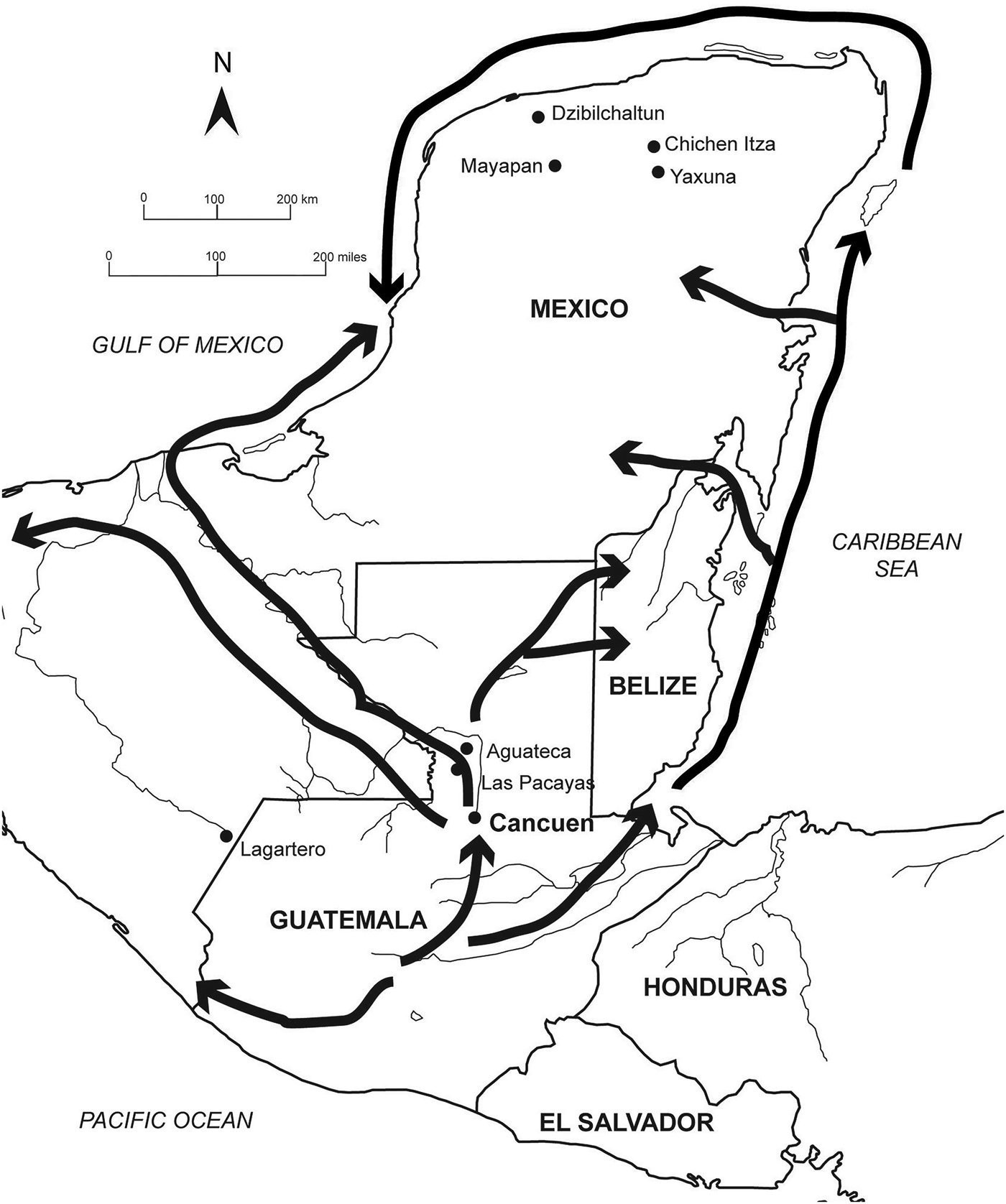
Cancuen is located on the Pasión River in the southwest Petén region of Guatemala (Figure 1). The site is strategically located at the point where the Pasión River becomes navigable via boat or canoe, which situated Cancuen at the start of a major water transportation route connecting the Maya highlands and lowlands via the Pasión and Usumacinta Rivers (Demarest et al. Reference Demarest, Andrieu, Torres, Forné, Barrientos and Wolf2014). Significantly, the Pasión River is just one of three major trade and transportation routes that converged at Cancuen. The site's strategic location thus played a critical role in its founding, function, and historical trajectory.
Location of Cancuen and other sites mentioned in the text with reference to major trade and transportation routes. Map by Thornton.

Evidence from excavation and epigraphy reveal that the site had a fairly short Late Classic occupation history spanning approximately 144 years from its founding in a.d. 656 to its violent overthrow and abandonment in a.d. 800 (Demarest Reference Demarest2013; Fahsen et al. Reference Fahsen, Demarest, Luin, Laporte, Suasnávar and Arroyo2003; Forné et al. Reference Forné, Alvarado and Torres2011). Throughout its relatively short history, Cancuen functioned as a port site heavily involved in the production, transport, and exchange of goods and resources including obsidian, jade, pyrite, ceramic vessels, cacao, cotton, salt, and marine shell (Demarest et al. Reference Demarest, Andrieu, Torres, Forné, Barrientos and Wolf2014). Goods and resources flowed through the site via six or seven natural and modified ports surrounding the site's epicenter, which was built on a narrow peninsula surrounded by the Pasión River.
Cancuen's peak of economic influence and activity occurred during the second half of the eighth century. Prior to this period, Cancuen was dominated by Calakmul (~a.d. 656–720), and later controlled by the Petexbatun polity with its capital at Dos Pilas (~a.d. 720–735; Fahsen et al. Reference Fahsen, Demarest, Luin, Laporte, Suasnávar and Arroyo2003; Demarest Reference Demarest2006). Following the disintegration of the Petexbatun polity (a.d. 740–760), Cancuen expanded into a wealthy, independent capital based on its paramount role in reconfigured trade routes that circumvented the middle Pasión and Usumacinta riverine corridors (Demarest et al. Reference Demarest, Martínez, Wolf, Torres, Belches, Andrieu, Luin, Mansky, Quintanilla, Laporte, Arroyo and Mejía2009). It was during this time, and specifically during the reign of Taj Chan Ahk (a.d. 757–796) and his son Kan Maax (a.d. 796–800), that Cancuen's epicenter grew substantially, including expansion of the site's royal palace, construction of a new ballcourt, and the creation of a ritual water system that flowed throughout the epicenter's major ritual and architectural complexes.
WATER SYMBOLISM AND MANAGEMENT AT CANCUEN
Control over the Pasión River trade routes was a major source of wealth and power for the Cancuen elites. One way this source of economic power was symbolically reflected and ideologically reinforced was through the use of water symbolism in elite iconography. In a stucco panel (Panel 3) from the royal ballcourt, Taj Chan Ahk is shown seated upon a throne in the shape of a water lily monster surrounded by a quatrefoil with water lilies in the corners. Taj Chan Ahk's headdress also bears a water lily being eaten by a fish (Barrientos et al. Reference Barrientos, Demarest, Alvarado, Martínez, Wolf, Luin, Laporte, Arroyo and Mejía2006; Demarest et al. Reference Demarest, Andrieu, Torres, Forné, Barrientos and Wolf2014:Figure 19; Fahsen and Barrientos Reference Fahsen, Barrientos, Barrientos, Demarest, Luin, Quintanilla and Mencos2006). Such water symbols are repeated throughout the site in stucco decoration adorning elite architecture. Depictions of Maya rulers as water lords is not uncommon due to the connection between dynastic rule and water's symbolic association with rebirth, renewal, prosperity, and communication with ancestors and the underworld (Fash Reference Fash, Andrews and Fash2005; Fash and Davis-Salazar Reference Fash, Davis-Salazar, Lucero and Fash2006; Lucero Reference Fash, Davis-Salazar, Lucero and Fash2006a). At Cancuen, however, the use of aquatic iconography may also directly reference and legitimize the port site's control over the Pasión River and its associated trade routes (Demarest Reference Demarest2013:394).
Description of the Cancuen Hydraulic System
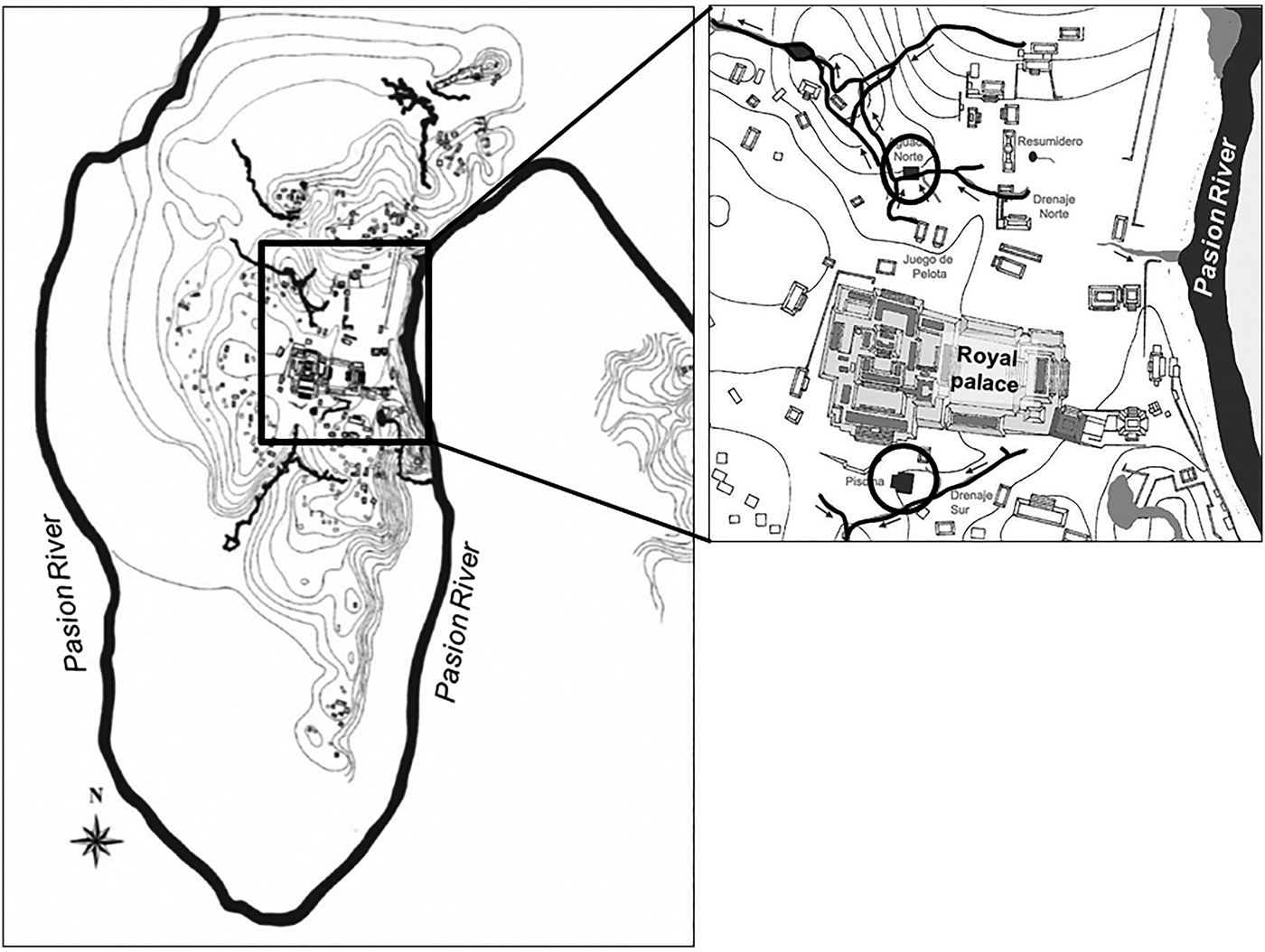
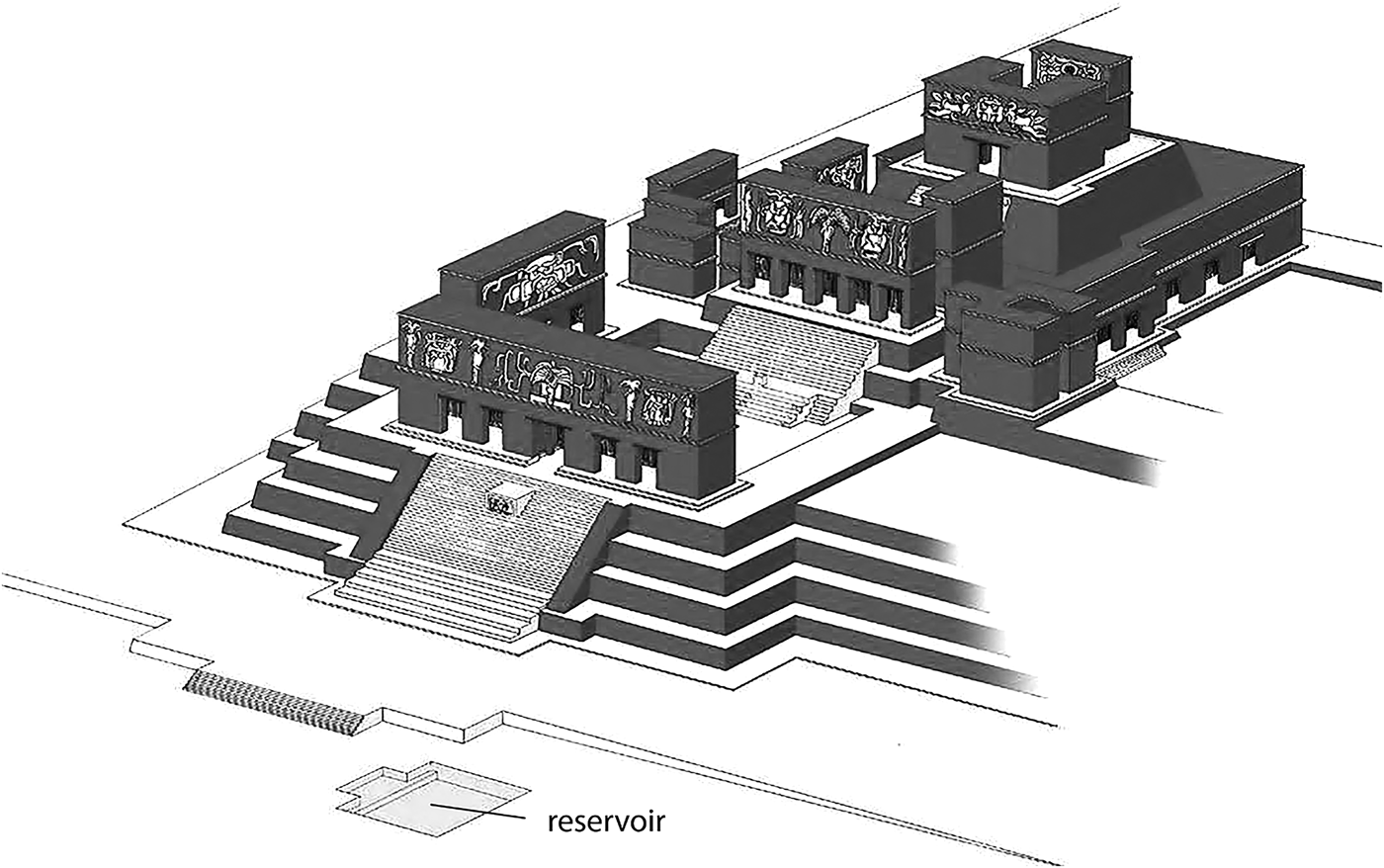
The connection between ideological and economic power via water symbolism at Cancuen is further illustrated through a ritual water system constructed within the site's epicenter. The water system consists of several stone-lined canals approximately 1–1.5 meters wide and 0.5–1.5 meters deep. The canals pass through and around various elite architectural complexes including the royal palace and ballcourt, public plazas, and elite residential groups (Figure 2; Alvarado Reference Alvarado2011; Barrientos et al. Reference Barrientos, Demarest, Alvarado, Martínez, Wolf, Luin, Laporte, Arroyo and Mejía2006). The system was fed by several natural springs, as well as by runoff channeled into the system from plastered plazas and building surfaces. In addition to the canals, two stone-lined and plastered reservoirs were constructed over natural springs (Alvarado Reference Alvarado2011; Barrientos et al. Reference Barrientos, Demarest, Alvarado, Martínez, Wolf, Luin, Laporte, Arroyo and Mejía2006). One of the reservoirs was constructed in front of the principal entrance to the royal palace (Figure 3). Based on its clear association with this structure, we refer to this feature as the palace reservoir. The palace reservoir measures approximately 8 × 10 m wide and 2.5 m deep. It was first paved with flat limestone slabs and blocks, then plastered and painted red. The palace reservoir is not fully rectangular and, instead, narrows at the western end where two sets of stairs lead down to an elevated bench where the reservoir floor is 0.5 m above the deeper eastern end. The shape of the palace reservoir represents a half quatrefoil, a water motif repeated in the site's stelae as well as those from the affiliated site of Machaquila (Barrientos Reference Barrientos2008). In Maya iconography, the quatrefoil symbol represents caves, which serve as subterranean entrances into the watery underworld, and as sources of rain which fuel fertility, prosperity, and rebirth (Fash and Davis-Salazar Reference Fash, Davis-Salazar, Lucero and Fash2006:137; Houston et al. Reference Houston, Taube, Matheny, Matheny, Nelson, Ware and Mesick2005). Based on the reservoir's location, it was likely reserved for use by the site's royal elite.
Cancuen hydraulic system showing locations of palace and north reservoirs (circled). Maps by Tomás Barrientos and Vilma Lorena Demarest.

Reservoir at base of the western staircase of Cancuen's royal palace. Drawing by Luis F. Luin.

Excavation of the palace reservoir revealed the remains of at least 31 individuals including men, women, and children. Many of the individuals show evidence of trauma indicating they met a violent death (Alvarado Reference Alvarado2011). Based on cranial deformation, dental inlays, and their association with a rich array of jade and shell adornments, the bodies have been identified as the site's nobility who were executed when the site was sacked and consequently abandoned around a.d. 800 (Quintanilla Reference Quintanilla2013; Suasnavar et al. Reference Suasnávar, Robinson, Quezada, Ixpatá, Vásquez and Ixcot2007). It is currently unclear whether the bodies were deposited in the reservoir immediately after being killed, perhaps to pollute the sacred water (Barrientos Reference Barrientos2008), or whether they were killed elsewhere and later deposited in the reservoir as an expedient mass burial. Regardless, the likelihood that the individuals represent the site's nobility is supported by the hasty burial of Cancuen's final ruling king (Kan Maax) and queen in shallow graves near the palace reservoir (Demarest et al. Reference Demarest, Quintanilla, Suasnavar, Iannone, Houk and Schwake2016). Artifacts recovered from the palace reservoir include 11 flint projectile points, ceramic figurines, modified and unmodified faunal remains, and polished jade and shell artifacts primarily representing objects of personal adornment. Ceramics were also abundant in the palace reservoir including several complete and semi-complete vessels. The majority of ceramics represent utilitarian forms such as water jugs and large bowls, with serving vessels such as polychrome plates present in lower quantities. Based on stylistic qualities, all recovered ceramics date to the Late Classic. Artifacts potentially associated with the human remains include the jade and shell adornments and flint projectile points. A lack of well-defined stratigraphy in the reservoir, however, makes it difficult to determine what additional artifacts were deposited before, after, or at the same time as the human remains.
A second stone-lined and plastered hydraulic feature, referred to as the north reservoir, was constructed over a natural spring in a major plaza located north of the royal palace (Figure 2). The north reservoir was fed not only by the natural spring, but also by canals draining runoff from much of the area north of the palace and by a canal linking the reservoir with another spring emerging under the western structure of the palace ballcourt. Unlike the palace reservoir, the north reservoir is truly rectangular, extending 7.3 m east to west, and 6 m north to south. The north reservoir reaches a maximum depth of slightly over 3 m at its western end. Slightly shallower depths occur on the eastern side where the paved floor is elevated onto an interior bench with multiple smaller tiers forming a stepped cascade.
Human remains and various types of artifacts were also recovered from within the north reservoir. The human remains are still being analyzed, so it is not yet possible to report the age, sex, and cause of death for the individuals, but the assemblage is composed of at least 15 complete skulls and numerous postcranial elements (Quintanilla Reference Quintanilla2013). In addition to the human remains, excavation of the north reservoir recovered two complete and 11 semi-complete ceramic vessels, worked and unmodified faunal remains, mano and metate fragments, a ground stone ax, and chert projectile points (Alvarado Reference Alvarado2011). Of particular note is the recovery of organic remains including two small textile fragments, a rounded piece of rubber, and wooden artifacts including a plate fragment, an ear flare with adhering red pigment, and a complete canoe paddle. Macrobotanical remains were also recovered including the seeds and rinds of squash (Cucurbita sp.) and other unidentified species (Alvarado Reference Alvarado2011).
A third set of hydraulic features including canals and two reservoirs was found in a residential group located northwest of the royal palace (Figure 2). Although the northwestern reservoirs are human-modified features, they lacked the fine stone paving characteristic of the palace and north reservoirs. The northwestern reservoirs also lacked faunal remains and will thus not be discussed in this paper. For comparative purposes, however, it is worth noting that both northwestern reservoirs contained a limited quantity of human remains associated with ceramic sherds and whole or semi-complete ceramic vessels (Ohnstad et al. Reference Ohnstad, Burgos and Arriaza2004). At least one vessel associated with a human mandible was ritually “killed” by punching out the bottom of the vessel.
Function and Use of the Cancuen Reservoirs
Although the Mayas frequently controlled, stored, and diverted water for subsistence purposes (Isendahl Reference Isendahl2011; Johnston Reference Johnston2004; Scarborough Reference Scarborough1998; Weiss-Krejci and Sabbas Reference Weiss-Krejci and Sabbas2002), the hydraulic system at Cancuen likely served a primarily ideological rather than practical function. This interpretation is based on the abundance of freshwater surrounding the site, the small-scale but elaborate form of the paved and plastered water system, and the fact that it connects and flows between several of the site's ritual and elite architectural complexes (Demarest et al. Reference Demarest, Andrieu, Torres, Forné, Barrientos and Wolf2014:206). Classifying the Cancuen hydraulic system as primarily ideological and symbolic does not necessarily preclude use of the various hydraulic features for subsistence purposes, and, in fact, most studies of Maya water management acknowledge the combined political, economic, and symbolic significance of water management (e.g., Davis-Salazar Reference Davis-Salazar2003; Kunen Reference Kunen, Lucero and Fash2006; Lucero Reference Lucero, Lucero and Fash2006b; Scarborough Reference Scarborough1998).
The use of these features may also have changed through time. For example, the less elaborately constructed northwestern reservoirs appear to have been used as domestic water sources and later as the foci of ritual activity (Alvarado Reference Alvarado2011:104). The palace and north reservoirs may have made similar shifts from domestic water sources to loci of ritual activity and symbolism, coinciding with their elaboration during the reign of Taj Chan Ahk (a.d. 760–800; Alvarado Reference Alvarado2011:105). In its final form, the finely paved and half-quatrefoil-shaped palace reservoir is the hydraulic feature most clearly associated with ritual activity.
Faunal remains deposited in the Cancuen reservoirs may reflect aspects of ritual activity and/or disposal taking place in association with these features. We also must consider the possibility, however, that the material remains represent more mundane trash deposits tossed into the reservoirs out of convenience during the period of site abandonment. This paper thus focuses on the faunal remains recovered from Cancuen's palace and north reservoirs to determine what activities resulted in their deposition within these aquatic contexts, and how this provides additional perspective on how the residents of Cancuen used and perceived these features. Interpretation of the remains is complicated, however, by the potential for the reservoirs to contain fauna deposited before, after, or at the same time as the human remains found within these contexts.
INTERPRETING RITUAL MAYA ANIMAL USE IN THE CANCUEN RESERVOIRS
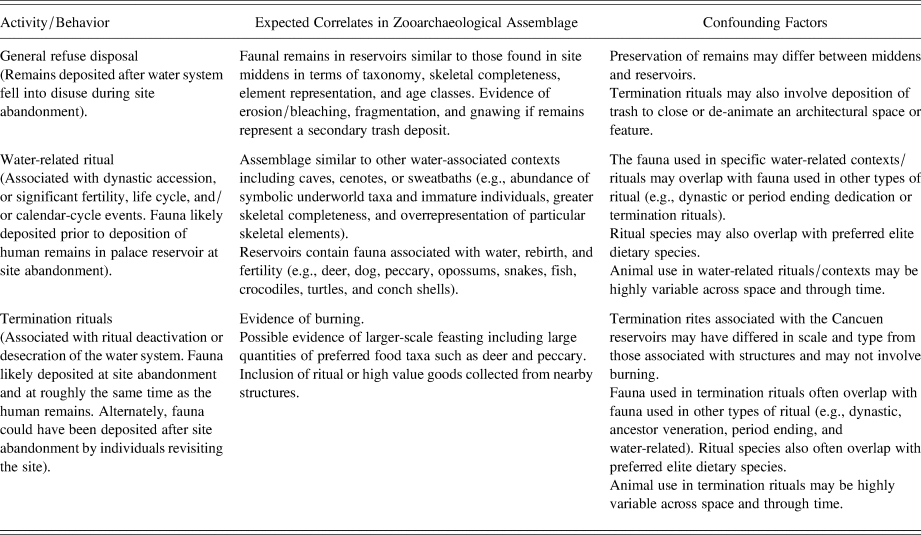
Expectations of how various behaviors and activities associated with the reservoirs would be reflected in the zooarchaeological assemblage are outlined in Table 1. The list of potential behaviors is not comprehensive, but instead provides a preliminary basis for interpreting the assemblage. Furthermore, we acknowledge that multiple uses and behaviors may be reflected in the faunal accumulations.
Expected zooarchaeological correlates of potential activities and behaviors associated with the Cancuen reservoirs.

Identifying Ritual Activity
The elaborate nature of the Cancuen hydraulic system and its location within the site's epicenter strongly suggest that the site's paved reservoirs served as loci of elite ritual activity. It is also reasonable to assume that ritual activity taking place in and around the reservoirs would have involved the use and deposition of animal remains based on well-documented ethnohistoric, iconographic, and zooarchaeological evidence for the incorporation of animals in Maya ceremonies as offerings and symbolic displays of identity, status, and power (Emery Reference Emery2003; Pohl Reference Pohl, Leventhal and Kolata1983; Pohl and Feldman Reference Pohl, Feldman and Flannery1982; Tozzer Reference Tozzer1941). Since the reservoirs are not closed contexts, however, we cannot rule out the disposal of more mundane trash in these features. Faunal remains from the reservoirs are thus compared to fauna from the site's residential middens. Although middens are not devoid of ritual refuse, we expect fauna associated with more exclusive ritual use of the reservoirs to diverge from midden deposits reflecting a broader range of animal use behaviors including subsistence and craft-production activities. Bone modification, including surface erosion and bleaching, gnawing, and fragmentation, can also indicate secondary trash deposits exposed to the elements before final deposition in the reservoirs.
Previous studies identified ritual Maya animal use based on a variety of traits including taxonomy, age profiles, element representation, skeletal completeness, and modification (e.g., burning, butchery; Brady Reference Brady1989; Emery Reference Emery, O'Day, Neer and Ervynck2004a; Pohl Reference Pohl, Leventhal and Kolata1983). More specifically, ritual faunal assemblages may contain larger quantities of symbolically charged taxa such deer, dogs, jaguars, fish, frogs/toads, and marine and freshwater mollusks (e.g., jute), which are associated with the underworld and concepts of fertility, rebirth, and renewal (Clarke and Sharpe Reference Clarke and Sharpe2017; Emery Reference Emery, O'Day, Neer and Ervynck2004a; Halperin et al. Reference Halperin, Garza, Prufer and Brady2003; Pohl Reference Pohl, Leventhal and Kolata1983; Pollock and Ray Reference Pollock and Ray1957; Tozzer and Allen Reference Tozzer and Allen1910:360; Wing and Steadman Reference Wing, Steadman, Andrews and Andrews1980). Young or immature animals are often more common in ritual assemblages based on their similar symbolic connotations (Carr Reference Carr and Fedick1996; Emery Reference Emery, O'Day, Neer and Ervynck2004a; Hopkins Reference Hopkins and Coggins1992; Pohl Reference Pohl1981, Reference Pohl, Leventhal and Kolata1983; Wing and Scudder Reference Wing, Scudder and Hammond1991). Ritual assemblages are further distinguished by skeletal-element distribution patterns including greater skeletal completeness, overrepresentation of cranial and hind-limb elements, or elements from the left side of the body (Emery Reference Emery, O'Day, Neer and Ervynck2004a; Koželsky Reference Koželsky2005; Pohl Reference Pohl1981, Reference Pohl, Leventhal and Kolata1983; Pollock and Ray Reference Pollock and Ray1957). While greater skeletal completeness can indicate animal sacrifice, body portion and side are indicative of preferential ritual use of select elements based on either symbolic connotations or preferential elite access via tribute. An overabundance of left elements in Maya ritual contexts has been explained through the ethnographic association of the left side with the setting sun and the underworld (Gossen Reference Gossen1974). Overrepresentation of hind-limb elements, especially of deer, may be associated with ethnohistoric and iconographic evidence for the use of deer haunches as elite tribute or ritual offerings (Tozzer Reference Tozzer1941; Tozzer and Allen Reference Tozzer and Allen1910).
Identifying the Types and Meanings of Ritual Activity
Beyond distinguishing the Cancuen reservoir faunal assemblages from mundane trash deposits, we consider what types of ritual meanings, behaviors, and actors could have been involved in their deposition within these watery contexts. A cogent discussion of this issue was presented by Emery (Reference Emery, O'Day, Neer and Ervynck2004a), who reminds us that ritual animal use can include everything from small-scale solitary rites associated with petitions for luck or fertility to public, community-wide ceremonies associated with elite accession, dedication, or termination rites. The amount and types of animals and animal products present in a ritual assemblage may thus vary greatly depending on the nature and meaning of the ritual carried out. It then becomes necessary to consider the type of ritual activity taking place within a particular context before interpreting animal-use patterns from ritual contexts (Emery Reference Emery, O'Day, Neer and Ervynck2004a:103).
Human remains present in the Cancuen reservoirs suggest that these features were used as expedient burial locations during the site's collapse and abandonment. Faunal remains deposited in the reservoirs may thus include bone and shell adornments worn by individuals interred in these contexts. Animals may also have been sacrificed and deposited in the reservoirs as burial offerings along with other animal remains documented as common burial goods such as isolated skulls, bone tools, stingray spines, and whole marine and freshwater shells (Carr Reference Carr and Pohl1985; Moholy-Nagy Reference Moholy-Nagy and Pohl1985, Reference Moholy-Nagy and Emery2004; Pohl Reference Pohl, Leventhal and Kolata1983; Teeter Reference Teeter and Emery2004). No clear pattern of animal use, however, has been associated with Maya burials, which are instead characterized by a diversity of symbolic, rare or high-status animal remains commonly found in other ritual contexts such as caches (Moholy-Nagy Reference Moholy-Nagy and Emery2004; Pohl Reference Pohl, Leventhal and Kolata1983:56). Despite a lack of consistent patterning in species representation, it is worth noting that preferred large-bodied food species such as deer and peccary are often underrepresented in burials and caches (Emery et al. Reference Emery, Thornton, Cannarozzi, Houston, Escobedo, Götz and Emery2013; Moholy-Nagy Reference Moholy-Nagy and Emery2004; Sharer Reference Sharer2015:159–160; Teeter Reference Teeter and Emery2004).
If the human bodies were interred in the reservoirs during site abandonment with the intention to pollute and desecrate the sacred water system and symbolically terminate the reign of the Cancuen elite, some of the animal remains could be associated with termination rituals taking place at the same time. Evidence of termination rituals has been identified elsewhere at Cancuen through artifact accumulations deposited on stairways, and in doorways and passages within the royal palace and other high-status structures (Arthur Demarest, personal communication 2018; Kovacevich Reference Kovacevich2006:461; Kovacevich et al. Reference Kovacevich, Quintanilla, Arriaza, Demarest, Barrientos, Kovacevich, Callaghan and Luin2003). Termination rituals taking place at site abandonment, however, could have taken on a variety of forms from highly public ceremonies to more exclusive lineage- or household-based events, and they may have been conducted with either desecratory or reverential intent (Navarro-Farr et al. Reference Navarro-Farr, Freidel, Prera, Stanton and Magnoni2008; Pagliaro et al. Reference Pagliaro, Garber, Stanton, Brown and Stanton2003; Stanton et al. Reference Stanton, Brown and Pagliaro2008; Tsukamoto Reference Tsukamoto2017). Due to this variation, their form, meaning, and material correlates may be equally diverse. Termination rituals also could have taken place well after the period of site abandonment if people returned to the site to conduct episodic pilgrimages or ceremonies (see discussion in Navarro Farr et al. Reference Navarro-Farr, Freidel, Prera, Stanton and Magnoni2008). Thus, although reservoir faunal remains associated with termination rituals are most likely contemporary with the human remains interred in these features, they could also be more recent.
Conversely, faunal remains may have entered the reservoirs prior to site abandonment. For example, a portion of the fauna could have been deposited as part of a dedication rite that symbolically activated the Cancuen hydraulic system. Blood sacrifice is a common component of such dedication rituals to animate or imbue the features with life (Becker Reference Becker, Saunders and de Montmollin1988; Mock Reference Mock and Mock1998:6). Within this context, a portion of the animal remains could represent dedication offerings or sacrifices. A variety of taxa are known from structure and monument caches that may have been dedicatory in nature. These taxa include white-tailed deer, dogs, felids, stingrays, fish, turtles, crocodiles, snakes, raptors, and freshwater and marine mollusks (Moholy-Nagy Reference Moholy-Nagy and Pohl1985, Reference Moholy-Nagy and Emery2004; Pendergast Reference Pendergast and Mock1998; Pohl Reference Pohl, Leventhal and Kolata1983; Teeter Reference Teeter and Emery2004). In many cases, the quantity of faunal remains interred in caches is relatively small, but in other instances caches contain larger numbers of redundant skeletal elements such as stingray spines (Teeter Reference Teeter and Emery2004), or the mandibles or crania of white-tailed deer (e.g., Hammond and Gerhardt Reference Hammond, Gerhardt and Hammond1991; Robin et al. Reference Robin, Gerhardt, Hammond and Hammond1991; Stanchly Reference Stanchly2007). Typically, structure and monument caches do not contain large quantities, or a diversity of skeletal elements from favored food species including deer and peccary.
Other types of rituals that could have taken place throughout the life cycle of Cancuen's reservoirs include dynastic rites associated with auspicious calendar or astronomical events, and water-related rituals typically conducted in association with caves, cenotes, and springs. The meaning and practice of these various types of rituals are not necessarily mutually exclusive. A relevant example of this is provided by the cuch ritual described by Pohl (Reference Pohl1981, Reference Pohl, Leventhal and Kolata1983) based on ethnographic and iconographic evidence. In its modern form, the cuch ritual is described as a fertility rite linked to the start of the New Year (Pohl Reference Pohl1981:524). Iconographic evidence also suggests that the ritual was connected to rites commemorating dynastic accession or the end of a calendar cycle through the merging of ideas related to Maya rulership and divine renewal of annual fertility and agricultural prosperity (Pohl Reference Pohl, Leventhal and Kolata1983:86, 99). Similar connections between rulership, fertility, and prosperity are drawn through the iconographic association of the Cancuen rulers with watery motifs (Demarest et al. Reference Demarest, Andrieu, Torres, Forné, Barrientos and Wolf2014). As the potential locus of water-associated fertility and dynastic rituals, the Cancuen reservoirs may contain fauna deposited before the human burials associated with site abandonment. The faunal assemblages could also be expected to share features with faunal samples from caves and cenotes used for similar purposes.
Known cenote assemblages all come from the northern Maya lowlands, and primarily date to the Postclassic period (a.d. 1000–1521). Like the Cancuen reservoirs, the cenotes at Dzibilchaltun, Mayapan, and Chichen Itza contain intermingled human and animal bones, but the majority of skeletal remains are faunal (Andrews and Andrews Reference Andrews and Andrews1980:245; Hopkins Reference Hopkins and Coggins1992; Pollock and Ray Reference Pollock and Ray1957; Wing and Steadman Reference Wing, Steadman, Andrews and Andrews1980). Dog and deer remains are consistently well-represented in cenote deposits, with peccaries, turkeys, rabbits, felids, opossums, iguanas, and turtles occurring less frequently or in smaller quantities (Alvarez Reference Alvarez1976; Hopkins Reference Hopkins and Coggins1992; Pollock and Ray Reference Pollock and Ray1957; Wing and Steadman Reference Wing, Steadman, Andrews and Andrews1980). A larger number of cave deposits is available for comparison with the Cancuen reservoirs. Animal use in caves often diverges from more mundane animal use through greater use and deposition of young individuals, symbolically charged taxa (e.g., dogs, deer, turkeys, and felids), greater skeletal completeness, and a lack of taphonomic modification (Anderson Reference Anderson2009; Emery Reference Emery, O'Day, Neer and Ervynck2004a; Ishihara Reference Ishihara2007; Pohl Reference Pohl, Leventhal and Kolata1983). Previous comparative analyses, however, have failed to identify any consistent traits that characterize pan-Maya animal use in cave and/or cenote contexts (Anderson Reference Anderson2009; Brady Reference Brady1989; Emery Reference Emery, O'Day, Neer and Ervynck2004a; Pohl Reference Pohl, Leventhal and Kolata1983). Moreover, there is often overlap between the preferential patterns of animal use identified in caves or cenotes and other high-status and ritual contexts (Emery Reference Emery, O'Day, Neer and Ervynck2004a; Pohl Reference Pohl, Leventhal and Kolata1983).
The location and construction of the Cancuen water system supports a ritual function for the site's spring-fed reservoirs, but the scale, type, and meaning of activities taking place in and around these features is less clear. Through intrasite comparisons, we assess how the site's inhabitants employed particular patterns of animal use to distinguish the reservoirs from other site areas or contexts. We also look more broadly at what the composition of the reservoir faunal assemblages reveals about the life history and use of these features through comparison of the reservoir fauna with expected material correlates of various types of recognized ritual animal use (e.g., burials, termination rites, and cave/cenote offerings). This narrow set of ritual categories is unlikely to reflect the true diversity of behaviors, actors, and meanings that composed ancient Maya ritual practices, but they serve as productive starting points for determining how, when, and why the animal remains were deposited in these features, and what role the reservoirs served in elite performance and ritual at Cancuen.
MATERIALS AND METHODS
Field Excavation and Sample Recovery
The site's hydraulic system was excavated between 2005 and 2007 as part of the Cancuen Regional Archaeological Project. In addition to project personnel, a team of researchers from the Guatemalan Forensic Anthropology Foundation (FAFG) participated in excavation of the palace reservoir due to the large quantity of human remains found within that context. The hydraulic features were horizontally excavated in units defined by a 2 × 2-m grid. Within units, faunal remains were recovered using trowel and handpick and quarter-inch (6.35 mm) sieving. Recovery methods used within the hydraulic system were similar to those applied throughout the site.
Both the palace and north reservoirs were excavated in three strata. The majority of faunal remains were recovered from the lower two levels (levels 2 and 3), which correspond to the features’ period of active use. The few faunal remains found in level 1 were removed from analysis due to their likely association with post-abandonment time periods. There is no clear stratigraphic separation, however, between artifacts and intermingled human and animal remains in levels 2 and 3. This may be due the features’ short duration of use since the hydraulic system was constructed less than fifty years before the site was attacked and largely abandoned (Barrientos Reference Barrientos2008:43). Stratigraphic associations were also complicated by the presence of natural springs that caused water to flow into the excavation units below the depth of ~0.5–0.8 m. In-flowing water complicated specimen recovery and, to some extent, stratigraphic control. It is thus difficult to tease apart discrete depositional events within the palace pool based on the position of artifacts in vertical space.
Zooarchaeological Methods
After field recovery, Thornton sorted and identified all zooarchaeological remains from the site of Cancuen. Preliminary taxonomic identifications were conducted using photographic references and zooarchaeological identification guides. Diagnostic specimens that were not easily identified were exported to the Florida Museum of Natural History (FLMNH) for identification using modern comparative specimens housed in the FLMNH Environmental Archaeology, Ornithology, and Malacology collections. Permission to export samples was provided by the Guatemalan Instituto de Antropología e Historia.
Thornton analyzed all faunal remains, but a small number of potentially intrusive specimens (number of identified specimens [NISP] = 51) have been omitted from the analysis. Potentially intrusive species include those fidelic to small ponds and wetlands including apple snails (Pomacea sp.), swamp eels (Synbranchidae), cane toads (Bufo marinus), and small-bodied turtles. Remains of these species were classified as intrusive when they were recovered from the upper stratum (level 1), or if they exhibited significantly better preservation in comparison to the other remains. Apple snails account for over 50% of the remains removed from the analyses, and were deemed intrusive based on preservation (i.e., presence of periostracum). There is some ambiguity regarding the interpretation of turtle remains within the reservoirs, but the majority appear to be associated with human use and disposal. This conclusion is based on the high representation of large-bodied Central American river turtles (Dermatemys mawii) which only inhabit larger lakes and rivers, and the fact that turtle carapaces of multiple species show evidence of artifacutal modification. An absence of turtle limb bones in the reservoirs also suggests that turtle bones were deposited through human agency and preferential use or deposition of turtle carapaces.
The faunal assemblage was analyzed using standard zooarchaeological procedures (see Grayson Reference Grayson1984; Reitz and Wing Reference Reitz and Wing2008). Data collected for each specimen include: closest taxonomic identification, element, element side, portion/completeness, pathology, and age and sex characteristics. Cultural and natural modifications on the remains were also noted (e.g., butchery, artifactual modification, burning, rodent or carnivore gnawing, root etching, staining, and weathering).
The zooarchaeological assemblage was quantified primarily according to the NISP. Whenever possible, fragments of the same element were refit and counted as a single specimen. Although NISP tallies have the potential to overestimate the contribution of species with large numbers of identifiable elements, such as turtles, other derived quantification measures, including the minimum number of individuals (MNI), tend to overestimate the contribution of rare species that may only be represented in the assemblage by one or two specimens (Grayson Reference Grayson1984; Lyman Reference Lyman2008). This is especially true in the relatively small Cancuen reservoir assemblages where several species are represented by single individuals.
To understand what types of activities resulted in the deposition of fauna in the Cancuen reservoirs, we compare the reservoir assemblages with faunal samples recovered from other site contexts (e.g., middens). The reservoir assemblages are broadly comparable to faunal samples from across the site due to the similar excavation and recovery procedures, but taphonomic factors could influence these comparisons since the inundated reservoir contexts may have protected the skeletal remains from post-depositional fragmentation and decomposition. Intrasite differences in fragmentation are thus assessed through ratios such as NISP:MNE with higher NISP:MNE indicating greater element fragmentation (Lyman Reference Lyman2008:251). Whole elements are excluded from these calculations as they increase both NISP and MNE equally. We acknowledge that this method is an imperfect measure of fragmentation that might be better assessed with metrics such as average specimen length (Morin et al. Reference Morin, Ready, Boileau, Beauval and Coumont2016), but NISP:MNE broadly reflects our overall observation of reduced fragmentation of faunal remains in the reservoirs compared to other contexts.
Since specimen fragmentation is related to specimen identifiability, we also compare contexts according to the percentage of vertebrate and mammalian NISP identified below the level of taxonomic class. For example, Maya zooarchaeological assemblages typically contain large quantities of unidentifiable mammalian long bone shaft fragments (Emery Reference Emery2004b; Thornton and Emery Reference Thornton and Emery2016:237). Lower percent NISP identified below class thus reflects greater quantities of highly fragmented, eroded, and nondiagnostic specimens.
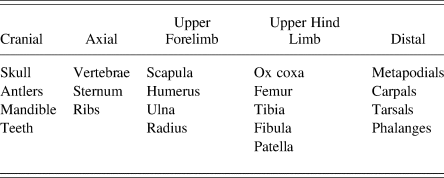
Skeletal element or body portion representation was also assessed for the three major vertebrate taxa identified in the Cancuen palace reservoir assemblage (white-tailed deer, peccaries, and dogs). Animal-portion analysis provides information regarding whether whole carcasses, particular cuts of meat, or isolated elements were deposited. Since MNE and NISP are correlated for mammalian taxa in the Cancuen reservoir assemblage (r = 0.98, p < .001), NISP is used for quantification as it is a less derived measure of abundance (Lyman Reference Lyman2008:263). Elements were divided across five skeletal portions (Table 2) to evaluate relative abundance according to observed versus expected ratios based on a complete mammalian skeleton. To prevent the upward skewing of cranial element representation, teeth were not counted as separate elements since many were associated with recovered mandibles and maxillae.
Skeletal element categories used for body portion representation.

RESULTS AND DISCUSSION
The densest concentration of faunal remains at Cancuen was recovered from inside the palace reservoir. This feature yielded 1,031 zooarchaeological specimens (NISP), which accounts for approximately 22 percent of the entire faunal assemblage recovered and identified from Cancuen to date. Faunal remains were also present, but much less abundant, in the north reservoir which contained an additional 217 specimens (NISP). Overall, the reservoir faunal remains were better preserved and less fragmented in comparison to fauna recovered from other site contexts (Table 3). The rarity of taphonomic effects such as erosion, trampling, bleaching, and gnawing in the reservoir assemblages further indicates that the remains were deposited relatively rapidly instead of being exposed in surface middens before final deposition. Due to enhanced preservation of the reservoir fauna, comparisons with site middens are conducted using subsamples restricted to specimens identified below the level of taxonomic class. Although this reduces sample size, comparisons of relative taxa abundance are less affected by differences in sample identifiability because it prevents midden species abundance from being diluted by larger numbers of unidentified remains.
Comparison of preservation and fragmentation across reservoir and non-reservoir contexts at Cancuen.

a Pooled remains from both the palace and north reservoirs. The two reservoir assemblages were similar to each other in terms of preservation/identifiability and fragmentation.
Palace Reservoir
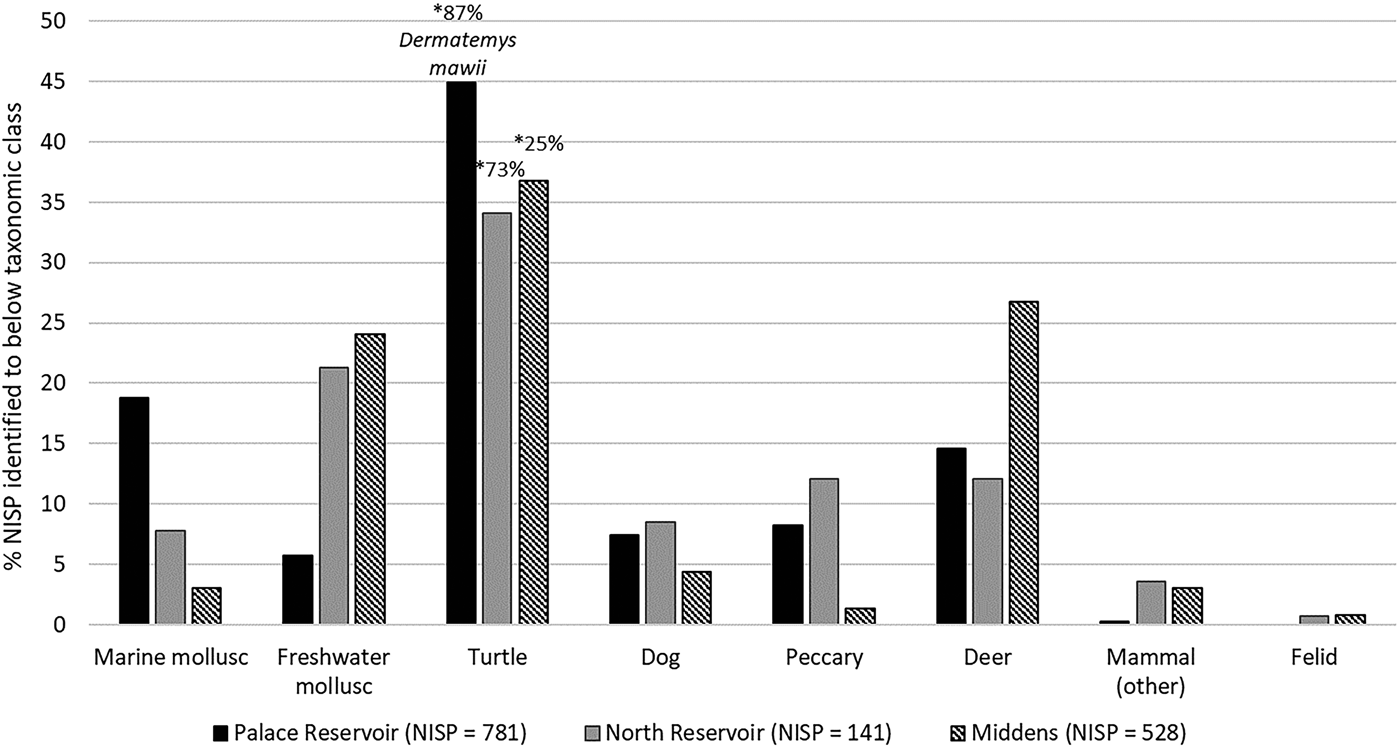
The palace reservoir contains a similar, but slightly less diverse range of fauna than middens located in the site's epicenter (Table 4). Despite general similarities in the range of fauna identified, the palace reservoir and midden contexts differ in their patterns of taxonomic abundance. The palace reservoir is richer in marine mollusks, crocodiles (Crocodylus sp.), dogs (Canis lupus familiaris), and peccaries (Tayassuidae), while smaller-bodied mammals (e.g., opossum, armadillo, agouti/paca, and rabbit) are underrepresented (Table 4, Figure 4). White-tailed deer (Odocoileus virginianus) are abundant in the palace reservoir, but they dominate the mammalian assemblage to a lesser extent than in middens due to the greater representation of dogs and peccaries in the palace reservoir. Although turtles are common throughout the site, the palace reservoir turtle assemblage is much less diverse, and is composed primarily of the large-bodied Central American river turtle (Dermatemys mawii; Figure 4). The meat of Dermatemys mawii is still highly sought after in portions of Central America today, and may have been preferentially used in the past by high-status Maya individuals or households (Pohl Reference Pohl and Pohl1985; Thornton Reference Thornton, Foias and Emery2012). The large carapace of this species was also desired for use as an instrument or container. Freshwater mollusks, including jute (Pachychilus sp.) and river clams (Unionidae), are relatively scarce in the palace reservoir in comparison to middens. Together, the observed taxonomic differences suggest that the palace reservoir faunal assemblage did not accumulate through general trash disposal after the feature fell into disuse. Instead, the fauna reflect intentional selection and deposition of valuable, non-local marine shell and preferred high-status dietary and ceremonial taxa in the palace reservoir.
Representation of major taxa in reservoirs and site middens. Asterisk (*) indicates percent of turtle remains identified as Central American river turtle (Dermatemys mawii). Graph by Thornton.

Taxonomic composition of Cancuen reservoirs and epicenter middens.

a Possible intrusive taxa in reservoir contexts.
Peccaries are particularly rare at Cancuen outside of the reservoirs. Trace amounts are present in high-status residential middens, but the majority of peccaries in non-reservoir contexts come from a potential termination ritual deposit on the floor of an interior room and external staircase of a high-status non-residential structure located 500 m northeast of the site's royal palace (Kovacevich Reference Kovacevich2006:461; Kovacevich et al. Reference Kovacevich, Quintanilla, Arriaza, Demarest, Barrientos, Kovacevich, Callaghan and Luin2003). Peccaries at Cancuen may therefore have been reserved for high-status consumption or ceremonial use, a pattern identified at other Maya sites (Hamblin Reference Hamblin1984:136; Pohl Reference Pohl and Brumfiel1994; Pollock and Ray Reference Pollock and Ray1957; Teeter Reference Teeter and Emery2004), and in cave and cenote contexts (Ishihara Reference Ishihara2007; Pollock and Ray Reference Pollock and Ray1957; Wing and Steadman Reference Wing, Steadman, Andrews and Andrews1980). One adult peccary in the palace reservoir exhibited evidence of healed trauma on a rib, distal humerus, and phalanx. Although wild animals can survive broken bones in the wild, it is also possible that this animal was trapped and reared on site until it was needed as a sacrifice or feast item (Hamblin Reference Hamblin1984; Pohl Reference Pohl and Brumfiel1994).
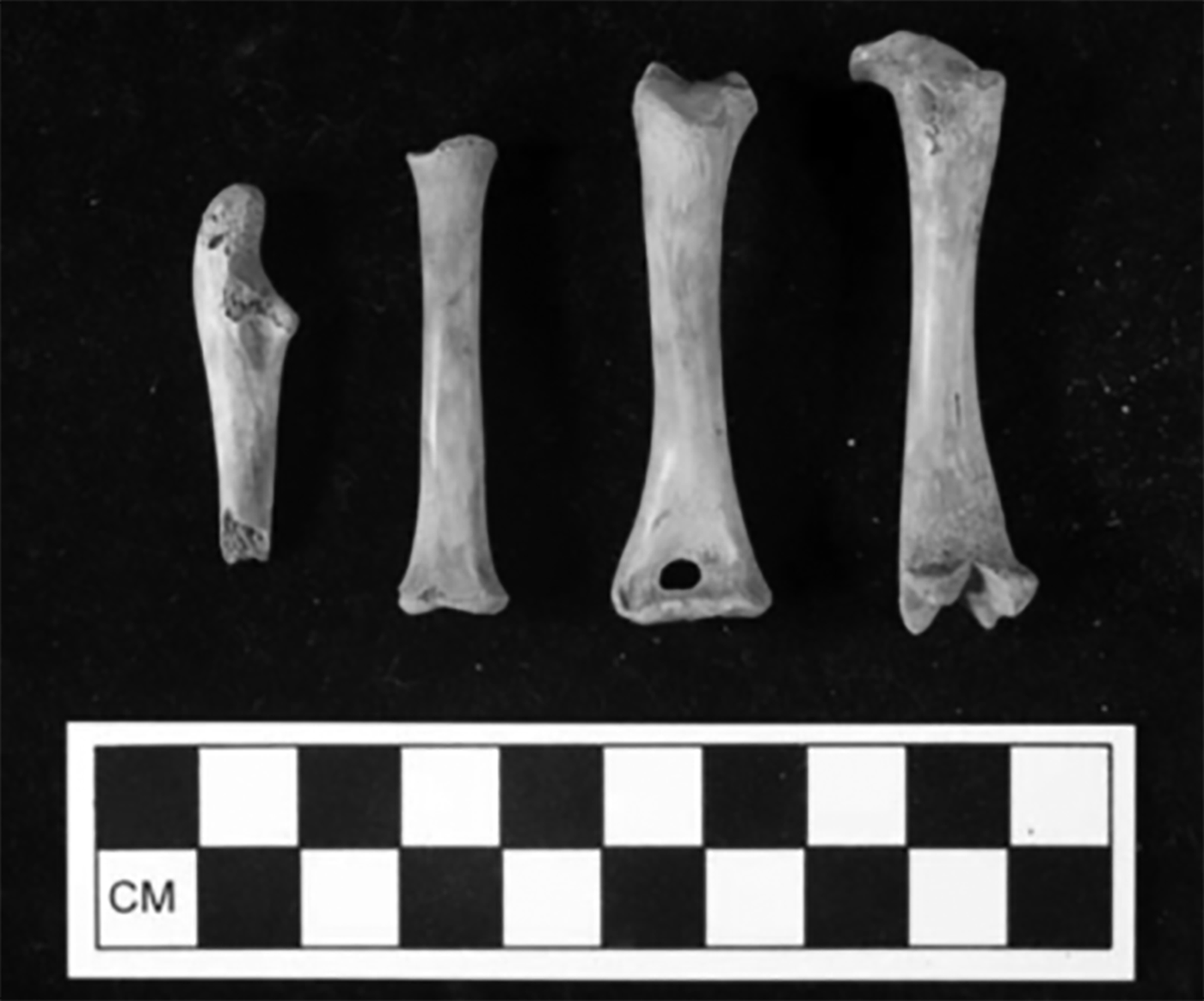
Dogs were also preferentially deposited at Cancuen in ceremonial contexts. Relatively complete skeletons of at least eight, and likely closer to fifteen, dogs were interred in the palace reservoir. All of the dogs in the palace reservoir were immature (<12 months old) based on dental eruption and epiphyseal fusion, with several being less than six months old (Figure 5). Subadult dog remains are absent from non-reservoir contexts at Cancuen. The immature dogs were likely deposited as whole sacrificial animals based the presence of skeletal elements from most body portions, and the recovery of multiple, spatially associated skeletal elements that appear to belong to the same individual. Small skeletal elements of the feet and tail were not identified in the palace reservoir assemblage, but their absence may be due to recovery methods. The select use of dogs as offerings in cave and cenote contexts has been documented elsewhere (Emery Reference Emery, O'Day, Neer and Ervynck2004a; Hopkins Reference Hopkins and Coggins1992; Ishihara Reference Ishihara2007; Pohl Reference Pohl, Leventhal and Kolata1983; Pollock and Ray Reference Pollock and Ray1957; Wing and Steadman Reference Wing, Steadman, Andrews and Andrews1980). Age classes are not always noted, but subadult dogs were preferentially included in a cave context at Las Pacayas (Cueva de los Quetzales; Emery Reference Emery, O'Day, Neer and Ervynck2004a) and in the cenote at Chichen Itza (Hopkins Reference Hopkins and Coggins1992). Ceremonial use of dogs, however, was not limited to caves and cenotes. Dogs also featured prominently in Classic-period feasting deposits (Brown Reference Brown, Dietler and Hayden2001; Koželsky Reference Koželsky2005), and were occasionally included in human burials (Emery et al. Reference Emery, Thornton, Cannarozzi, Houston, Escobedo, Götz and Emery2013:405; Hamblin Reference Hamblin1984; Pohl Reference Pohl, Leventhal and Kolata1983; Pollock and Ray Reference Pollock and Ray1957; Woodbury and Trik Reference Woodbury and Trik1953). Nonetheless, large accumulations of subadult dogs are uncommon at Maya sites, and they have only been reported from a few cave and cenote deposits in addition to the Cancuen reservoirs discussed here.
Examples of subadult dog (Canis lupus familiaris) skeletal elements. Photograph by Thornton.

Unlike dogs, other major taxa including deer and peccary are not represented by immature individuals in the palace reservoir despite the presence of young subadult (<12–15 months) remains in other site contexts. At least two of the white-tailed deer in the palace reservoir are very large adult males based on skeletal robusticity, the presence of antlers, and the shape of the pubic symphysis. Although young animals were often preferentially targeted for ritual use among the ancient Maya (Carr Reference Carr and Fedick1996; Emery Reference Emery, O'Day, Neer and Ervynck2004a; Pohl Reference Pohl1981, Reference Pohl, Leventhal and Kolata1983), selection for this attribute was limited to dogs in the palace reservoir.
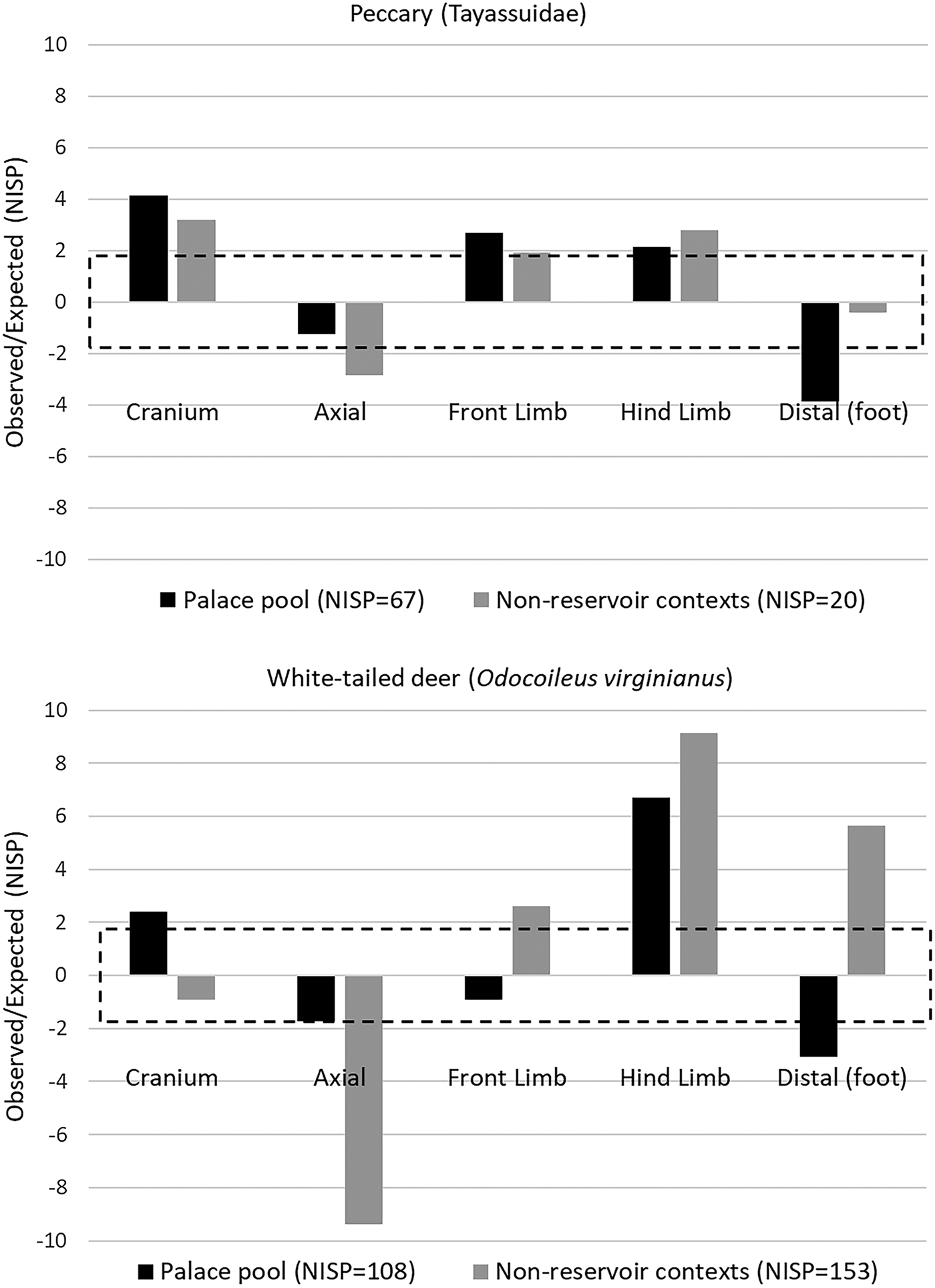
Dogs also appear to be the only mammalian taxa consistently interred as whole carcasses within this context. White-tailed deer and peccaries are represented by all major body portions, and several elements are of similar enough size and age to suggest the presence at least one largely complete individual of each species. Skeletal element distributions indicate over- and underrepresentation of particular body portions, however, which suggests that some of the deer and peccary were deposited as isolated skeletal elements or partial body segments. For white-tailed deer, cranial and hind-limb elements are overrepresented in the palace reservoir, while distal foot elements are underrepresented (Figure 6). Axial and forelimb elements are also underrepresented, but the difference is not statistically significant. If whole white-tailed deer were being sacrificed and deposited into the reservoir, we would expect greater representation of the robust and highly identifiable elements of the upper foot (metapodials, calcaneus, and astragalus) and lower forelimb (humerus, radius, and ulna), which are present in greater frequencies in non-reservoir contexts. Instead, it appears that additional cranial and upper hind-limb elements were added to the reservoir. Butchery marks observed on a white-tailed deer femur, tibia, and crania support this conclusion and indicate the presence of defleshed and/or segmented body portions in the assemblage. Haunches of white-tailed deer were preferred elite tribute items and ritual offerings (Tozzer Reference Tozzer1941; Tozzer and Allen Reference Tozzer and Allen1910). Their overrepresentation in the palace reservoir likely reflects this behavior, but a similar pattern was observed in high-status midden contexts within the site's epicenter. There is no indication that body portions from a certain side were preferentially disposed of in the palace reservoir (MNE: left = 18, right = 16).
Skeletal element distribution in palace reservoir for peccary (left), and white-tailed deer (right). Bars extending outside dashed box are statistically significant. Graphs by Thornton.

A pattern unique to the palace reservoir is the overrepresentation of cranial elements. Although this could be attributed to taphonomic factors, the overabundance of cranial remains likely reflect the preferential use of crania in ceremonial contexts. Support for this comes from several deer crania that show evidence of modification including cut marks related to defleshing and incomplete or complete antler removal. One cranium was also charred on its interior surface. Some of the crania therefore did not enter the reservoir as part of whole carcasses used as sacrificial offerings. Instead, they represent curated, defleshed crania used as headdresses, incensarios, or other ritual items deposited after use.
Within the palace reservoir, peccary limb element distribution patterns are less skewed than those of white-tailed deer (Figure 6). Based on age and size, many of the peccary remains come from a single young adult individual (~24–30 months old). The underrepresentation of feet in the palace reservoir seems to contradict this conclusion, but this pattern could be attributed to recovery methods since peccary foot elements are substantially smaller than those of white-tailed deer. Conversely, it could indicate the disposal of isolated peccary limbs or skins with the feet removed. Although nearly all of the peccary bones likely belong to a single individual, an additional cranium in the deposit may represent a defleshed and curated ritual skull. Other evidence of preferential ritual use of heads/skulls at Cancuen includes two nearly complete peccary crania, and the mandibles of both a peccary and tapir in a non-residential structure termination deposit (Kovacevich et al. Reference Kovacevich, Quintanilla, Arriaza, Demarest, Barrientos, Kovacevich, Callaghan and Luin2003).
In addition to mammals, turtles are also abundant in the palace reservoir (Figure 4). A substantial portion of the turtle remains comes from the fairly complete, but highly fragmented, carapaces of two Central American river turtles (Dermatemys mawii) and two pond turtles (Trachemys venusta and Rhinoclemmys areolata). Three of these nearly complete carapaces were artifactually modified including two pond turtle shell drums with evidence of abrasion in the center of the plastron. A similar scratched/abraded Rhinoclemmys areolata shell was recovered from the Cenote Xlacah at Dzibilchaltun (Wing and Steadman Reference Wing, Steadman, Andrews and Andrews1980:328). One of the Central American river turtle shells was also perforated through both the carapace and plastron at the anterior and posterior ends. The perforations likely facilitated suspension of this very large turtle shell, which may have been used as a drum. A two-tined deer antler with polish on the ends was also found in the palace reservoir and could have served as an accompanying drumstick as depicted in the Bonampak murals, which show turtle shell drums being struck with branched antlers (Carnegie Institution of Washington 1955). The presence of turtle shell drums, along with other musical instruments, including a deer tibia rasp and shell trumpet, indicates the importance of music in the ceremonial activities associated with this feature. Turtle shell instruments and conch shell trumpets were not identified in any other contexts at Cancuen.
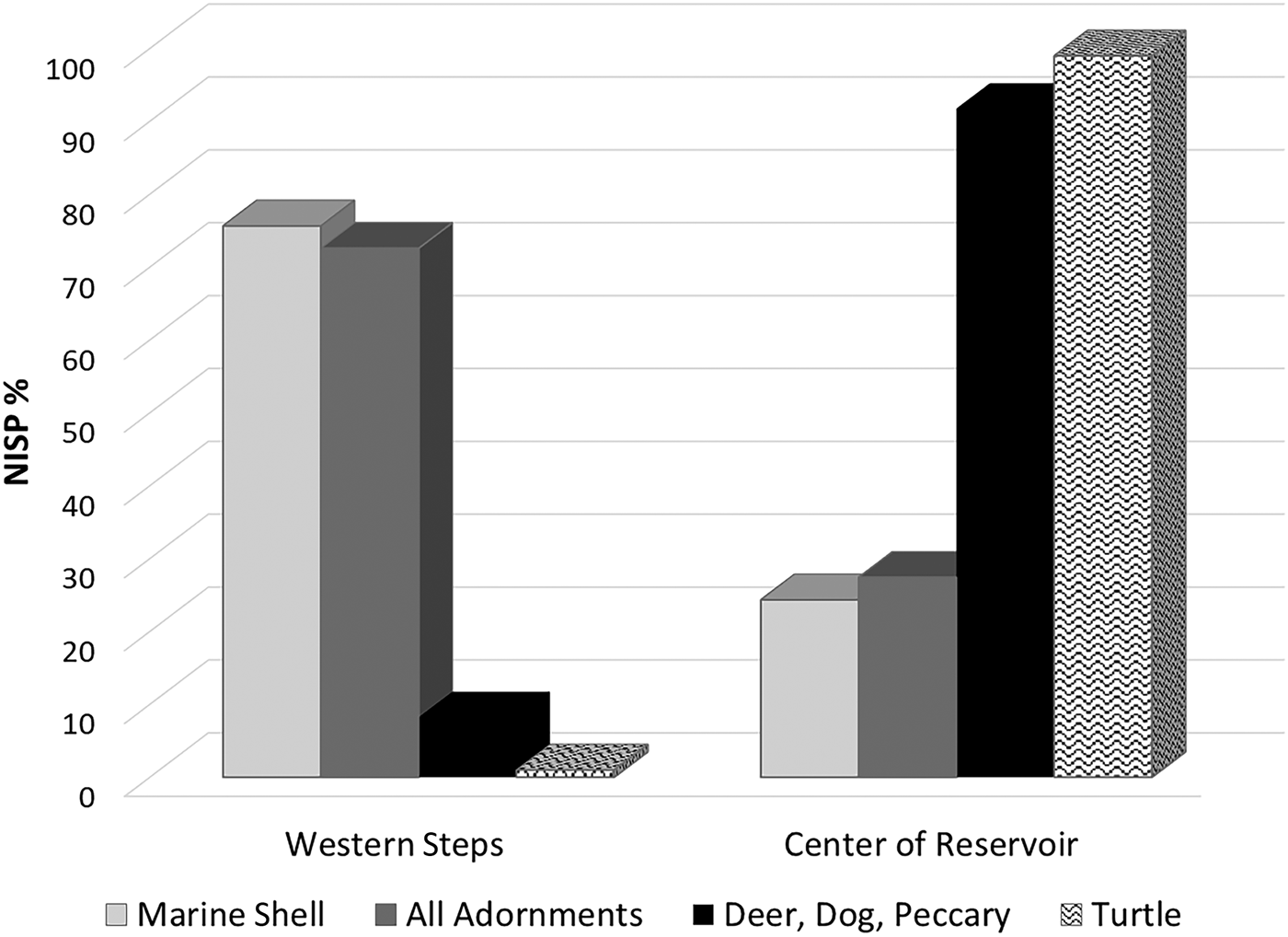
Including the bone and shell instruments, artifactually modified remains compose approximately 20 percent of the entire palace reservoir faunal assemblage. The vast majority of modified remains are marine-shell objects of personal adornment including beads, tinklers, and pendants. The numerous adornments were likely worn by the human individuals interred in this feature, perhaps as part of their typical elite regalia, or as “burial goods” donned before their death. The quantity and quality of the marine-shell adornments attests to the individuals’ high status, especially in regards to the abundance of spondylus shell (Spondylus sp.), which has a very restricted distribution at Cancuen. Large quantities of spondylus were recovered from the palace reservoir and the burial of the site's final ruler, Kan Maax, with only trace amounts found in other site contexts within and adjacent to the palace and ballcourt. Within the palace reservoir, bone and shell adornments are concentrated on the western steps leading down into the water, while unmodified faunal remains, as well as musical instruments, and bone picks/pins were concentrated in the deeper central portion of the feature (Figure 7). This spatial segregation could indicate that the faunal remains accumulated in the palace reservoir through multiple ritual episodes, or that separate spatial foci were used for different aspects of a single ritual event. More specifically, the human bodies, along with their bone and shell adornments, may have been deposited on the steps leading into the palace reservoir, while other faunal remains were deposited in the deeper, central portion of the feature.
Spatial distribution of faunal remains in the palace reservoir. Graph by Thornton.

North Reservoir
Despite its much smaller size (NISP = 217), the north reservoir faunal assemblage resembles the palace reservoir in its greater representation of preferred ritual and/or dietary taxa including dogs, peccaries, and the Central American river turtle (including one partially complete carapace; Figure 4). In addition to these major taxa, smaller quantities of other mammals including opossum (Didelphis sp.), rabbit (Sylvilagus sp.), and large felid (Panthera onca or Puma concolor) were identified (Table 4).
A unique connection between the palace and north reservoirs is the presence of subadult dog remains, which are absent from other site contexts. The north reservoir yielded cranial and postcranial remains of at least two puppies (<5 to 6 months old) and one older subadult (6–11 months old). Perforated teeth and a partial cranium and mandible belonging to two separate adult dogs were also identified, but these were not accompanied by postcranial remains. As in the palace reservoir, preferential selection of immature animals was limited to dogs. Although multiple immature dogs are present in the north reservoir, fewer skeletal elements were recovered for each individual in comparison to the palace reservoir. This could indicate that the dogs did not enter the north reservoir as whole, fleshed carcasses. The presence of isolated spots of charring on the adult cranium and mandible and the majority of puppy long bones further supports this hypothesis.
Charring, however, was not restricted to canid remains and was instead more widely observed on 13 percent of the north reservoir faunal specimens. Burning is more common in this feature than in the palace reservoir (1.7 percent), or site middens (1.4 percent), but the north reservoir remains are only charred in isolated spots, which suggests limited exposure to relatively low temperature fires. The burning likely occurred after disposal since the charring is not limited to the ends of mammalian long bones and one turtle shell exhibits burning patterns consistent with heating after the carapace was fragmented. It is unclear whether the remains were exposed to fire as part of ritual or mundane trash-disposal activities, but the prevalence of burning on the dog remains suggests targeted disposal treatment of this species. This contrasts with the palace reservoir puppies, which may have entered the reservoir as whole sacrificial animals.
Skeletal completeness of other major mammalian taxa, including deer and peccaries, further supports the conclusion that the north reservoir faunal assemblage did not accumulate through the interment of whole, sacrificial animals. Unmodified deer remains are limited to vertebrae, astragali, and the pelvis, which contrasts with the palace reservoir where deer skeletons were more complete, and cranial and upper hind-limb elements were overrepresented and foot elements underrepresented (Figure 6). The north reservoir thus lacks evidence of ritual deer crania use, and reflects the disposal of deer elements and body portions not typically selected for dietary or crafting purposes. In the north reservoir, peccaries are represented by a greater range of postcranial remains than deer, but the number of skeletal elements per individual peccary does not reflect the presence of whole animals. Unlike deer, peccaries are also represented in the north reservoir by cranial remains including a nearly complete adult cranium and a subadult mandible and partial cranium. This is consistent with the select use and deposition of peccary crania at Cancuen in ceremonial contexts including the palace reservoir and a building termination ritual. The presence of an adult dog cranium and mandible in the north reservoir may also reflect preferential use of crania for ceremonial purposes in this feature.
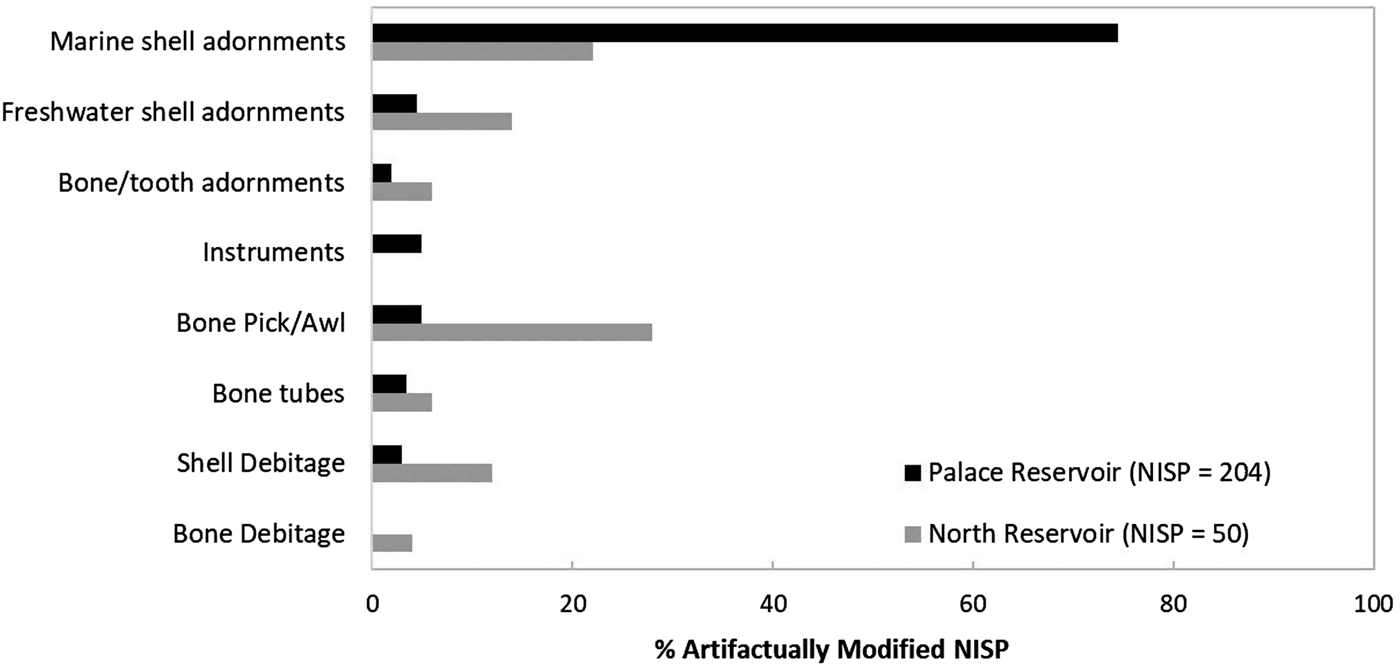
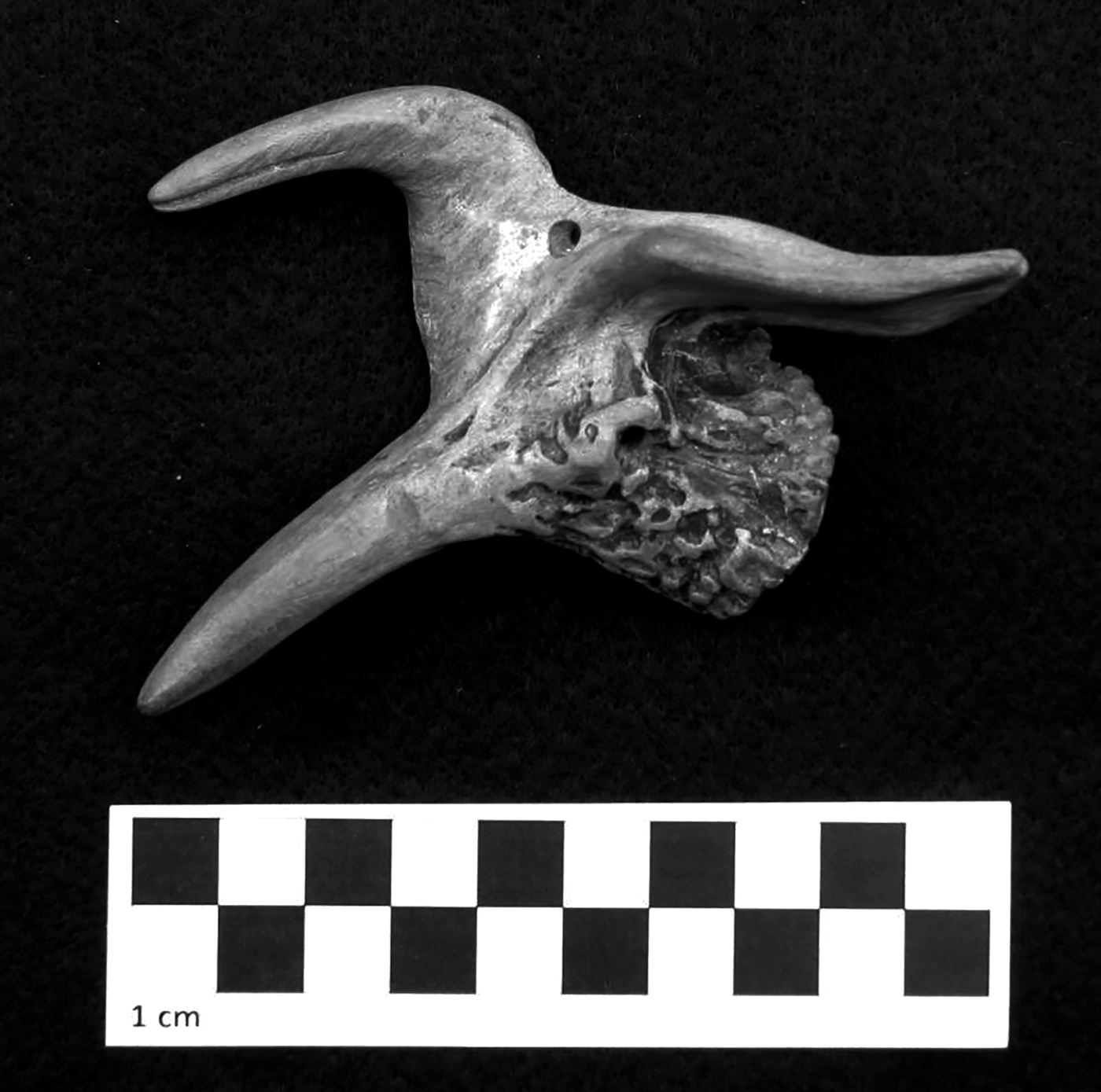
Artifactually modified remains account for 23 percent of the north reservoir faunal sample. Although this is similar to the amount observed in the palace reservoir (20 percent), the two features vary in their artifactual assemblages (Figure 8). Freshwater shell artifacts are more common than marine shell in the north reservoir. The difference is likely due to variation in the quantities and statuses of the human remains found in each context since many of the marine-shell adornments in the palace reservoir were likely being worn at the time of disposal. Small numbers of marine-shell adornments, including olive shell tinklers and beads, are also present in the north reservoir but they form part of a more diverse shell assemble that includes unmodified river clam shells, freshwater shell adornments, and small quantities of marine and freshwater shell debitage. In comparison to the palace reservoir, bone artifacts including tubes, awls, spatulas, pins/needles, and adornments are also more common in the north reservoir. Of particular note are several finely crafted bone awls, spatulas and pins, and a shaped white-tailed deer antler adornment (Figure 9). Small amounts of bone debitage were also present in the north reservoir indicating the inclusion of production debris as well as finished artifacts. Unlike the palace reservoir, no bone or shell instruments were recovered from this feature.
Comparison of artifact types in the Cancuen reservoirs. Graph by Thornton.

Modified white-tailed deer antler adornment from north reservoir. Photograph by Thornton.

Interpreting the Cancuen Reservoirs as Ritual Loci
Faunal assemblages from both the north and palace reservoirs suggest their use as ritual features. The reservoirs therefore did not simply serve as convenient locations to dispose of mundane trash during the process of site abandonment. If this were the case, we would expect greater similarity of the reservoir fauna to site middens, and less select use of favored and symbolic taxa and elements.
Despite the fact that both features contain ritually disposed faunal remains, the north and palace reservoirs differ in the scale and types of ritual activities indicated by the zooarchaeological assemblages. The north reservoir lacks the musical instruments and substantial quantity of major meat-bearing elements of deer and peccary present in the palace reservoir. There was thus less emphasis on music or processions, and the consumption or offering of food in the ceremonial activities associated with this smaller and less prominently placed aquatic feature. Although both reservoirs contain subadult dogs, canid skeletons are charred and less complete in the north reservoir, signifying that puppies were not sacrificed and disposed of in identical or simultaneous ritual events involving both aquatic features. Overall, the less complete nature of the skeletons and greater evidence of burning in the north reservoir may indicate inclusion of some secondary rather than primary faunal refuse. Regardless of these differences, both reservoirs are connected through their use as mortuary contexts and ritual disposal spaces for faunal remains and other artifacts. Based on context, ceremonial activities that likely contributed to the accumulated faunal assemblages in these features are abandonment period termination rituals, and single or episodic dedication, dynastic or period ending rites involving water symbolism.
Evidence of warfare along with a large quantity of human remains, broken ceramics, and other high-status artifacts in the Cancuen reservoirs conforms to desecratory termination rituals documented at other Maya sites (Barrett and Scherer Reference Barrett and Scherer2005; Harrison-Buck et al., Reference Harrison-Buck, McAnany, Storey, Tiesler and Cucina2007; Mock Reference Mock and Mock1998; Stanton and Gallareta Negrón Reference Stanton and Negrón2001; Suhler et al. Reference Suhler, Ardren, Freidel, Johnstone, Demarest, Rice and Rice2004). Desecrating, polluting, or ritually “killing” the Cancuen ritual water system would have played an important role in claiming power over the site and its ruling elite. As symbolic, human-modified portals to the underworld, the Cancuen reservoirs conform well to the liminal spaces often selected for termination deposits such as entryways, staircases, and central lines of structures (Mock Reference Mock and Mock1998:6). Desecrating the water system was also critical to symbolically terminating the ruling lineage's claim to economic power via the Pasión River trade and transportation route, which was embodied at Cancuen through water-based symbolism and iconography. Based on context, the reservoir faunal assemblages may thus contain animal remains deposited through termination rituals associated with violent conflict and abandonment of the site.
Faunal remains are not consistently present in termination deposits, but could be included via feasting activities (Barnett and Scherer Reference Barrett and Scherer2005; Stanton and Gallareta Negron Reference Stanton and Negrón2001; Suhler et al. Reference Suhler, Ardren, Freidel, Johnstone, Demarest, Rice and Rice2004; Tsukamoto Reference Tsukamoto2017), sacrificial offerings (Clarke and Sharpe Reference Clarke and Sharpe2017), or the removal of high-status ritual performance or display items from nearby structures (Emery Reference Emery, Inomata and Triadan2014; Inomata et al. Reference Inomata, Triadan, Ponciano, Terry and Beaubien2001). Fauna identified in structure termination deposits identified at Aguateca, Yaxuna, and Cancuen itself, are similar to the reservoir assemblages in their inclusion of large mammal skulls, bone and shell artifacts, and a relatively high diversity of taxa (Emery Reference Emery, Inomata and Triadan2014; Kovacevich Reference Kovacevich2006:461; Suhler et al. Reference Suhler, Ardren, Freidel, Johnstone, Demarest, Rice and Rice2004:481). Despite these basic similarities, the Cancuen reservoir assemblages diverge from these other examples based on the presence of largely complete subadult dogs and greater quantities of postcranial remains from deer and peccary. Unlike other termination deposits, there is also little evidence of burning or intentional architectural damage (Inomata et al. Reference Inomata, Triadan, Ponciano, Terry and Beaubien2001; Stanton et al. Reference Stanton, Brown and Pagliaro2008; Suhler et al. Reference Suhler, Ardren, Freidel, Johnstone, Demarest, Rice and Rice2004). This could be expected, however, based on the watery nature of the features, and their lack of accessible floors, walls, and roofs to deface or destroy. Instead, damage may have been inflicted by filling the reservoirs with human remains, scattered artifacts, and ritual trash, which served to defile or pollute the sacred waters.
In the absence of evidence for violent conflict and rapid abandonment at Cancuen, the reservoir faunal remains would more readily be interpreted as the result of water-related rituals taking place throughout the use life of the feature and, in fact, the reservoir assemblages bear some semblance to cave and cenote faunal accumulations. Young dogs, deer, peccaries, and turtles are all well-represented in cave and cenote deposits. Skeletons of these taxa also tend to be more complete in caves and cenotes, with preferential disposal of deer and peccary crania, and deer haunches and limbs from a particular side of the body (Emery Reference Emery, O'Day, Neer and Ervynck2004a; Pohl Reference Pohl, Leventhal and Kolata1983). Although no side preference was observed at Cancuen, the palace reservoir mirrors cave and cenote assemblages in its taxonomic composition and overall pattern of skeletal-element distribution.
The north reservoir conforms to these cave and cenote assemblages taxonomically, but diverges in terms of skeletal completeness and element representation. Despite this, the presence of an entire wooden oar in the north reservoir points to the likely importance of water-related symbolism in the ritual activities associated with this feature. The recovery of squash (Cucurbita sp.) remains may further support this conclusion based on its association with cave offerings (Morehart Reference Morehart, Prufer and Brady2005) and ethnographic accounts of squash seeds being combined with maize dough and water from a cenote to make a special type of tamale used in ceremonies petitioning rain (ch'a chaak; Salazar et al. Reference Salazar, Zizumbo-Villarreal, Brush and Marín2012:290). Therefore, although the north reservoir faunal assemblage conforms less well to cave and cenote deposits, other material remains suggest the deposition of some artifacts related to water-based rituals of dedication, fertility, or renewal. Some of the north reservoir faunal remains including the peccary crania and mandibles, turtle carapaces, and puppies may also be associated with water-based rituals, but it is difficult to rule out other possibilities since the remains are less complete and show greater burning than would be expected in cave and cenote deposits.
In contrast, the palace reservoir faunal assemblage contains some key features suggestive of water-associated renewal and fertility rites. The skeletons of robust male white-tailed deer, including a set of antlers with cut marks at the base, could represent the sacrificial deer that has its antlers removed as a critical aspect of the cuch ceremony. Iconographic depictions of the deer sacrifice also depict an individual blowing a shell trumpet and the ritual parading or presentation of a peccary head (Pohl Reference Pohl1981, Reference Pohl, Leventhal and Kolata1983), ritual elements that are also reflected in the palace reservoir faunal assemblage. The whole puppy skeletons in the palace reservoir are also consistent with descriptions of dog sacrifice associated with the cuch ritual and other New Year's rites (Tozzer Reference Tozzer1941:145).
Bone instruments including a deer tibia rasp and several turtle shell drums provide additional links to New Year and water- or fertility-related rituals. Iconographic and archaeological evidence specifically connect music with rain or water-conjuring rituals associated with caves, cenotes, or springs (Ishihara Reference Ishihara2008:181). For example, maize, wind, and rain gods are depicted playing drums and/or bone rasps in association with quatrefoil or witz (mountain) symbols representing caves (Coe Reference Coe1978:76; Houston et al. Reference Houston, Stuart and Taube2006:265; Saturno et al. Reference Saturno, Taube and Stuart2005). Archaeologically, higher concentrations of musical instruments have been recovered from cave/chasm contexts at the nearby sites of Las Pacayas (Cueva de los Quetzales) and Aguateca (Brady and Rodas Reference Brady and Rodas1995; Ishihara Reference Ishihara2008). The musical instruments in the Cancuen palace reservoir may thus be associated with water-related rituals.
Similarities between the palace reservoir assemblage and other cave and cenote ritual deposits thus suggest that episodic, water-related rites of fertility and renewal may have contributed to the accumulation of faunal remains in this feature. Ceramics from the palace reservoir further support this conclusion since they are primarily utilitarian forms such as water jugs and large bowls rather than serving vessels. Water jars and other storage vessels are common in caves and cenotes (Lucero and Kinkella Reference Lucero and Kinkella2015; Martos López Reference Martos López, Finamore and Houston2010; McNatt Reference McNatt1996), and water or rain rituals associated with the features often involved the carrying and pouring of ceremonial water (Taube Reference Taube, Fields and Zamudio-Taylor2001; Vail and Hernandez Reference Vail, Hernández and Braswell2014). Based on the reservoir's prominent location in front of the royal palace, these water-associated rituals would have been ideologically connected to dynastic rituals displaying and commemorating the ruler's divine connection to renewed annual fertility and agricultural prosperity. At Cancuen, conflated water and dynastic rituals also likely symbolized the site's control over the Pasión River trade and transportation routes (Demarest Reference Demarest2013:394).
An argument against the accumulation of faunal remains and other artifacts in the Cancuen reservoirs through dedicatory or episodic water-related rites is that the water would have been fouled through such activities. This could have been a major consideration based the relatively small size of these aquatic features and their proximity to elite residential structures. Ceremonial use of the reservoirs could have thus focused on the aesthetics of maintaining pure pools of water filled with symbolically charged water lilies (Lucero Reference Lucero2002:815). It is also possible, however, that the reservoirs played more active roles as ceremonial portals connecting the world of the living with the realm of the dead. As such, it would have been necessary to “feed” these spiritually charged portals through periodic offerings that would activate, animate and appease them. Although the presence of pure pools of water seems more appealing to a modern aesthetic, there is much evidence throughout Mesoamerica supporting the widespread deposition of artifacts in springs, caves, lakes, and cenotes (e.g., Andrews and Corletta Reference Andrews and Corletta1995; Brady and Rodas Reference Brady and Rodas1995; Coggins Reference Coggins1992; Ishihara Reference Ishihara2008; Lucero Reference Lucero2006a; Lucero and Kinkella Reference Lucero and Kinkella2015; Ortíz and Rodriguez Reference Ortiz and Rodríguez2000; Pollock and Ray Reference Pollock and Ray1957; Stone Reference Stone1992). This suggests that watery openings to the underworld were infrequently left alone, and were instead used as active loci for communication with the supernatural via ritual activity involving offerings and the deposition of material remains. If the reservoirs were used as ritual disposal or offering areas, fouling of the water could have been prevented by periodically cleaning the watery features. This raises the possibility that the faunal remains and other artifacts recovered from these features represent just the final offerings interred at or near the end of the use life of the features.
Concluding Remarks
Determining whether the Cancuen reservoirs were kept clean of artifacts and refuse during their use life could have been a critical means of distinguishing between water-related and termination rituals in these features. Unfortunately, a lack of stratigraphic separation within the Cancuen reservoirs prohibits us from determining the timing and periodicity of ritual disposal events that resulted in the accumulated faunal remains. Our interpretations are thus limited to contextual information and comparison with other faunal assemblages. Contextually, the human-modified water system at Cancuen seems like an ideal ritual locus for water-related dynastic rituals. Active ceremonial interaction with watery portals to the underworld was a critical aspect of ancient Maya ritual, which resulted in numerous deposits of artifacts and both human and animal remains found in aquatic features throughout the Maya region. The faunal remains and other artifacts recovered in the Cancuen reservoirs fit well within this corpus of ritual behavior. Intersite comparisons further show that the palace reservoir faunal assemblage resembles those from other watery features such as caves, cenotes, and springs. The connection is less evident in the north reservoir, possibly indicating smaller-scale water-related rituals, and/or less use of fauna as water-related offerings in this ritual context.
The water system's symbolic connection to dynastic power at Cancuen also made it a target for termination rites intended to sever or extinguish the source of elite spiritual, economic, and political power. The dumping of human bodies in the palace reservoir clearly points to desecratory termination rites involving the site's ritual water system, but it is unclear whether the majority of faunal remains were also deposited as part of these abandonment period ceremonies. If the reservoir faunal remains primarily represent end-use termination deposits, these ritual events manifested differently in the palace and north reservoirs. The palace reservoir assemblage could be interpreted as resulting from a large feasting or food-offering event accompanied by music and the display or use of ritual items such as deer and peccary crania taken from nearby elite structures. At the end of this event, the ritual items and refuse would have been deposited in the reservoir as ceremonial trash to effectively kill or terminate the feature. Ritual termination of the north reservoir would have involved less public display, smaller-scale offerings, and no clear evidence of feasting. Burnt remains in this feature could represent secondary refuse deposits, or specific offerings that were burned as part of a termination ritual prior to disposal.
Termination and water-based rituals, however, are not mutually exclusive and it is possible that multiple ritual events and activities contributed to the Cancuen reservoir assemblages. This issue is not unique to the reservoirs, as many archaeological contexts likely reflect discarded remains associated with a variety of mundane and ritual behaviors. The distinction is important for the Cancuen reservoirs, however, since dedicatory or repeated water-based rituals and end-use termination rites imply two opposing interpretations. In one scenario, the faunal remains represent reverential offerings to celebrate and petition ongoing prosperity and power at the site, while, in the other scenario, the remains served to de-animate the features and symbolically terminate the power of the ruling lineage.
Teasing apart which remains are associated with particular ceremonial activities is complicated not only by a lack of stratigraphy in the features, but also by extensive overlap and heterogeneity in the material signatures of various types of Maya ritual behavior (Pagliaro et al. Reference Pagliaro, Garber, Stanton, Brown and Stanton2003; Stanton et al. Reference Stanton, Brown and Pagliaro2008; Walker Reference Walker, Skibo, Walker and Nielson1995). For example, faunal remains may or may not form a component of termination rituals, and although some patterning exists, previous work has identified diversity and overlap in how faunal remains were used and incorporated in ritual contexts such as burials, caches, caves, and cenotes (Brady Reference Brady1989; Emery Reference Emery, O'Day, Neer and Ervynck2004a; Pohl Reference Pohl, Leventhal and Kolata1983). Such diversity complicates the interpretation of the zooarchaeological record, but it is not unanticipated. Although some artifacts likely held inherent ritual meaning, the function and meaning of many other objects was defined through the human actions and behaviors surrounding their use (Walker and Lucero Reference Walker, Lucero, Dobres and Robb2000:133). In other words, meaning in Maya rituals may be generated more through context and behavior than specific combinations of objects. We would thus not expect to see consistent, repeated patterns of ritual species and skeletal element use, especially when comparing assemblages separated by both space and time.
Although it is not possible to identify the specific ritual behaviors associated with the Cancuen reservoir faunal remains, the assemblage documents a unique example of ritual animal use associated with human-modified hydraulic features and a mass human interment. The faunal remains from these features also refine our understanding of the role Cancuen's water system played in the site's ideological and political systems. As a symbol of the ruling lineage's interconnected economic, political, and religious power, the Cancuen water system potentially served as an active focal point for periodic dynastic ritual displays that served to reify the ruling elites’ power and identity. During the site's abandonment, these same active and symbolically charged features were selected for desecration to sever the ruling elites’ claim to power. Although it is the violent events documented in the reservoirs that seems to characterize their use, these features likely played an active role in elite ritual and display prior to the site's abandonment.
RESUMEN
Excavaciones en el sitio maya del clásico tardío Cancuen (Departamento de Petén, Guatemala) dejaron al descubierto un sistema hidráulico de pequeña escala que incluye canales y depósitos forrados de piedra dentro del núcleo del sitio. La abundancia de otras fuentes de agua potable cercanas, junto con el carácter elaborada del sistema, demuestran que sirvió una función ideológica más que práctica. Los artefactos recuperados de los depósitos apoyan esta interpretación. Además, el depósito localizado enfrente del palacio real del sitio contuvo las osamentas de por lo menos 30 individuos asesinados quienes posiblemente representen los miembros de la corte real que fueron masacrados durante el colapso del sitio. Este artículo informa acerca de los restos faunísticos encontrados en los depósitos del sitio para seguir explorando la naturaleza y el grado de las actividades rituales y de desecho asociadas a estos contextos acuáticos. Se usan comparaciones inter- e intrasitio para contextualizar los resultados dentro de las discusiones más amplias del cómo identificar la actividad ritual en el registro zooarqueológico, así como del papel del agua en los sistemas ideológicos y políticos de los antiguos mayas.
La comparación con otras colecciones faunísticas presta apoyo a la idea de que los depósitos de Cancuen se usaron constantemente para rituales relacionados con el agua, así como rituales de terminación que se efectuaron antes y durante el derrocamiento violento y abandono del sitio. Por lo tanto, los restos faunísticos recuperados de estos rasgos refinan nuestro entendimiento del papel que jugó el sistema hidráulico de Cancuen en los sistemas políticos e ideológicos del sitio. Como un símbolo del poder económico, político e religioso interconectado del linaje gobernante, el sistema hidráulico de Cancuen fungió como un punto focal para despliegues rituales dinásticos periódicos que sirvieron para materializar el poder y la identidad de las élites gobernantes. Durante el abandono del sitio, se eligieron estos mismos rasgos, activos y simbólicamente cargados, para la profanación y la rotura de pretensión de poder de las élites gobernantes. A pesar de que son los eventos violentos documentos en los depósitos que pareciesen caracterizar su uso, estos rasgos probablemente jugaron un papel activo en los despliegues y rituales elitistas antes del abandono del sitio.
ACKNOWLEDGMENTS
Zooarchaeological analysis was supported with funding provided by the National Science Foundation (BCS-0622805) and the Foundation for the Advancement of Mesoamerican Studies, Inc. (Grant #06027). Broader excavation and analysis of the cultural materials from Cancuen were made possible by grants from the Alphawood Foundation, the National Geographic Society, the Vanderbilt University Ingram Chair Fund, the Vanderbilt Institute of Mesoamerican Archaeology and Development, the National Science Foundation, the Smithsonian Institution, and the Universidad del Valle de Guatemala. We extend our gratitude to the Guatemalan Instituto de Antropología e Historia (IDAEH) for permitting analysis and export of the faunal remains used in this study, and to Dr. Kitty Emery (Curator of the Florida Museum of Natural History Environmental Archaeology laboratory) for facilitating access to modern comparative specimens and providing feedback on the initial faunal analyses. We also thank and acknowledge the contribution of data analyses, laboratory assistance, editing, Spanish translation, and illustrations provided by Tomás Barrientos, Petra Cunningham-Smith, Jessica Devio, Luis Luin, Lori Phillips, Claudia Quintanilla, Paola Torres, and Mario Zimmermann. Finally, the thorough and thoughtful comments provided by our anonymous reviewers were greatly appreciated, as they helped to improve the manuscript.