

Democratic theory expects citizens to respond to what government does. At a minimum, voters dissatisfied with the state of the world in one or another policy area should “throw the rascals out” (Key and Cummings, Reference Key and Cummings1966). This is what is meant by electoral accountability. But voters are often lacking important information to work out the accountability equation. Causes of the information shortfall include the structure of institutions and voters’ own limitations (Cutler, Reference Cutler2004; Soroka and Wlezien, Reference Soroka and Wlezien2010). Yet politics can also play a part in electoral accountability. The argument of this paper is that contingent political dynamics interact with institutions of multilevel governance to facilitate or frustrate accountability.
Attribution of responsibility to governments is a necessary condition for electoral accountability in multilevel systems. This was recognized long ago by Hamilton in the Federalist Papers (Reference Hamilton and Rossiter1961 [1788]) and its contemporary intellectual expression is that “responsibility judgments are the principal mechanism through which citizens hold representatives accountable for their conduct” (Rudolph, Reference Rudolph2006: 99). “Prior to sanctioning…voters presumably decide on the extent to which incumbents are in fact responsible” (Peffley, Reference Peffley1984: 276). But the operation of responsibility judgments must vary across political institutions, across voters within institutional settings and across policy areas and levels of government for a given voter. Scholars have fairly recently begun to shed empirical light on the many challenges facing voters under federal and multilevel governance (Anderson, Reference Anderson2006b; Cutler, Reference Cutler2004; Cutler, Reference Cutler2008a; de Vries et al., Reference de Vries, Edwards and Tillman2011 Johns, Reference Johns2011; Rudolph, Reference Rudolph2003b; Rudolph, Reference Rudolph2006; Soroka and Wlezien, Reference Soroka and Wlezien2010).
That research establishes the value of asking survey respondents how much responsibility they place on each level or branch of government for a given policy domain or outcome. We now know a great deal about the cognitive processes of responsibility attribution, variation in those attributions and their accuracy across contexts, and institutions that make attributions more or less challenging for voters. Now that scholars have called attention to the fact that responsibility attribution may be a serious problem for accountability in multilevel governance (Arceneaux, Reference Arceneaux2006; Cutler, Reference Cutler2004; Johns, Reference Johns2011), there exists enough measurement of attributions in enough contexts to begin the task of linking specific attributes of contexts to electoral accountability in multilevel states.
This paper does so using the Canadian case. The key question in this paper is whether political conditions moderate the link between voters’ assessment of government performance and their voting decisions (see also Johns, Reference Johns2011). Accordingly, the paper examines multiple policy areas and both federal and provincial electoral settings.
Previous studies have treated, on one hand, variation in the quality of responsibility attributions across institutions, or on the other, variation across individuals in the accuracy and influence of attributions. The present paper adds political conditions as a source of variation. By this I mean the character of policies, their implementation, their interaction with the context, and the discourse that surrounds them in a given time and place. Understanding the way those political conditions affect the clarity of responsibility may also aid in the development of theories of mechanisms through which institutions affect electoral accountability.
The secondary contribution of the paper is to provide nuance to conclusions as to whether or not retrospective and policy voting is or is not moderated by responsibility attributions. Scholars examining one issue at a time—frequently just the economy—at one election at one level of government in one place may find significant coefficients indicating that responsibility moderates policy voting. They may be tempted to conclude that voters cope well with multilevel governance. But other times, on other issues, they may find little evidence of moderation and be unable or unwilling to publish the “non-findings.” Or, if they do, they may conclude, like Johns, that there is “very little evidence that issues weighed heavier in the decision making of those who laid responsibility for them at the door of the body being elected” (Reference Johns2011: 71). The present paper proposes a resolution to patterns of “findings” and “non-findings” on the question of responsibility attribution and vote choice.
The data source used in this paper is unique: panel surveys at the time of Canadian provincial and federal election campaigns including detailed questions about conditions and responsibility in multiple salient policy areas. By combining these data with qualitative media content analysis of those contexts, I identify the features of political conditions under which voters will use responsibility attributions in their voting decisions. To preview, in a highly intertwined federal state like Canada responsibility judgments only seem to moderate retrospective voting when a policy area is highly salient, when the level of intergovernmental debate or conflict is low, when policy development, funding, and service delivery are dominated by one level of government, and when media report the separate contributions of each government and link those contributions to separate consequences.
Politics, Responsibility and Voting Behaviour
Despite rich bodies of theoretical work on federalism and on electoral democracy separately, the classic literature on these topics lacks a normative “theory of federal electoral democracy” or a “democratic theory of federalism.” Since most policy areas in federations feature joint policy development and joint funding—“marble-cake federalism”—multiple governments usually bear joint responsibility for the policy outcomes. Accordingly, a simple normative theory of federal electoral democracy would posit that voters’ evaluations of policy outputs should affect their vote choices at a given level only inasmuch as that level's government is responsible for those outputs, no more or no less. Electoral accountability in federations is therefore healthier when voters allow their assessments of a government's responsibility to moderate the effect of those voters’ judgments of policy outputs on voting.
In the last decade or so, a set of new studies has confirmed that responsibility attributions do, sometimes, but only sometimes, play a role as a moderator of retrospective voting in polities with divided authority (Anderson, Reference Anderson2006a; Anderson, Reference Anderson2006b; Cutler, Reference Cutler2004; de Vries et al., Reference de Vries, Edwards and Tillman2011; Gomez and Wilson, Reference Gomez and Wilson2001; Hobolt and Tilley, Reference Hobolt and Tilley2013; Johns, Reference Johns2011; Marsh and Tilley, Reference Marsh and Tilley2010; Peffley, Reference Peffley1984; Rudolph and Grant, Reference Rudolph and Tobin Grant2002; Rudolph, Reference Rudolph2003a). The moderating effect is often weak, inconsistent across contexts and policy areas (Cutler, Reference Cutler2004; Johns, Reference Johns2011; Soroka and Wlezien, Reference Soroka and Wlezien2010), or found mostly among the most motivated and sophisticated citizens (Arceneaux and Stein, Reference Arceneaux and Stein2006; Wilson and Hobolt, Reference Wilson and Hobolt2010). Only in contexts where responsibility is clearest, under majority governments in unitary systems, do scholars find consistent moderating effects of responsibility attributions on vote choice (Marsh and Tilley, Reference Marsh and Tilley2010).
Canadian research exemplifies the variability in the moderating role of responsibility across contexts. Blais and colleagues (Reference Blais, Gidengil, Nadeau and Nevitte2002) found that support for the Liberal government in 2000 was significantly higher among those who “did not put all the blame on the federal government” for the state of health care in Canada. Cutler (Reference Cutler2004) showed that dissatisfaction with health care had an impact on voting, but only among citizens who thought the government in question was principally responsible. Yet in the same study the effects were different for judgments about the economy or energy prices, where those who thought both governments responsible punished the governments about half as strongly as those who thought one or the other solely responsible. In contrast, Anderson (Reference Anderson2006b) and Johns (Reference Johns2011) found unpredictable patterns of moderating by responsibility. The important consequence is that scholars looking to judge the effect of the institutions of federalism on electoral accountability, full stop, cannot say that the normative federal theory of voting applies, or fails, regularly.
This is probably because even the same voter under the same institutions might moderate electoral accountability with responsibility in some policy areas and at some times but not others. Using an expert survey to establish “correct” attributions, Wilson and Hobolt (Reference Wilson and Hobolt2010) find that voters’ attributions of responsibility to national governments and the EU are made more accurately in contexts where the EU issue is more politicized and the tone of that politicization is negative. That study calls attention to the potentially dynamic nature of both citizens’ motivation to seek information about responsibility as well as the quantity and quality of the available information. In this paper, then, I hold institutions and voters constant to look across contexts, levels of government and policy areas to advance our understanding of the transient political factors that affect not the accuracy but the impact of responsibility judgments as moderators of vote choice. My aim is not to test the proposition that federal institutions threaten electoral accountability but rather to suggest why there might be wide variation of results in the scholarship that does test that proposition.
Theory
I begin with simple retrospective voting (Blais et al., Reference Blais, Gidengil, Nadeau and Nevitte2002; Fiorina, Reference Fiorina1981; Fournier et al., Reference Fournier, Blais, Nadeau, Gidengil and Nevitte2003; Kieweit and Lewis-Beck, Reference Kiewiet and Lewis-Beck2011). Adding federalism, I assume that responsibility attribution moderates—that is, governs the strength of—the effect of voters’ judgments about the state of the world on their vote choice. One hopes, for instance, that Canadian voters do not hold their provincial government responsible for Canada's role in the Middle East.
I use the term responsibility moderation to describe the extent to which voters’ evaluations of government responsibility affect how much they punish or credit their governments for prevailing conditions. Taking into account the literature on the quality of the attributions cited above, I bracket the separate issue of the accuracy of voters’ responsibility attributions. It is entirely possible that most citizens never consciously think of the degree of responsibility that a government bears. However, I make a weaker assumption that when evaluating a government, voters make judgments about the state of the world that affect their evaluation of the government only if they can imagine a connection between that government and policy outcomes in a given domain.
To focus on the political factors potentially at work, then, it is necessary to hold both individual and institutional moderators constant. Therefore, to fix ideas I discuss political variation as if within one federal country, with no variation in the de jure division of powers. In other words, I am not comparing policy domains across countries but rather within countries and within and across levels of government and federal units. I use the same population so that variation in effects across policy areas is not due to different electorates, as would be the case in cross-national studies. In the data examined below, there is no significant variation in the institutions or the electorates.Footnote 1 Variation in responsibility moderation across issues, across time, and across levels of government must, in these data, come from the more contingent features of policy domains and the information environment.
Political conditions affecting responsibility attributions
What are these political contingencies? I conceptualize the relevant variation in the information environment for voters at the aggregate level of policy area in time and place.Footnote 2 The aim is to characterize the difference in the available information on, for example, the issue of pipelines in British Columbia or education in Quebec or taxes in Ontario, for the governing parties at both levels since they were first elected.
Attributions of responsibility should be more likely to be produced by survey respondents, more meaningful when produced, and moderate their retrospective judgments more strongly, to the extent that the following conditions are in place.
-
• Prominence. How much citizens care about the policy outcomes in question. At the individual level, the concern is usually called “salience.”
-
• Exclusivity. Changes to policy, funding and service delivery are made by only one level of government and outcomes are observed at that level of government.
-
• Clarity. The level of intergovernmental conflict is low.
-
• Publicity. The media:
-
o report the separate contributions of each government to policy outcomes, and
-
o link separate government actions to separate consequences.
-
I discuss each in turn.
Prominence (salience)
Voters’ concern with conditions in a given policy area motivates them to use performance judgments in their vote calculus and it creates an incentive to make responsibility attributions in the first place. Salience is affected by the importance of the policy domain in that context, the speed of change in policy, the style and pace of policy implementation, the response of opposition parties and policy opponents in civil society, the history of that policy area in that jurisdiction, the response of the media, and numerous other factors. The same policy change could be much more prominent and salient to voters in one context than in another. I expect that as issue prominence increases we should observe a stronger moderating role for responsibility.
Exclusivity (separation of policy innovation)
Even under a fixed division of authority there can be variation across policy areas and over time in the degree to which policy change is caused by a given level of government. At times, a national or subnational government will innovate in a shared policy area by direct legislative or administrative action or by adding or subtracting funding to the total spending in that domain. As the contribution to policy consequences from the levels of government is more clearly one-sided, voters will use responsibility judgments for that government more strongly in their voting calculus.
Media reporting of separate policy innovation
Responsibility moderation of retrospective voting will be greater as media coverage of an issue increases.
Minimal, or minimally public, intergovernmental conflict
If reporting of policy change in multilevel contexts faithfully reflects political discourse in that policy area, the clarity of responsibility in media reports will be a function of that discourse (Hobolt, Tilley, and Wittrock Reference Hobolt, Tilley and Wittrock2011). Tremendous contingent political variation is possible from this source alone. Given one level of government's policy actions, the other level of government and partisan groups at multiple levels will all make strategic calculations about how to respond.Footnote 3 To the extent this kind of intergovernmental and interparty conflict is low, voters can make responsibility attributions that are accurate and certain enough to be used to moderate performance judgments in vote choice.
Taken together, those are a highly contingent set of conditions. They boil down to the clarity voters will have about the causes of changes in the state of the world. The remainder of the paper argues in two stages that politics does matter for responsibility moderated voting. First, using survey data I evaluate the degree of responsibility moderation across 13 issues over elections in two provinces at both federal and provincial levels. I find wide variation in the degree to which responsibility attributions moderate vote choice. The second step is to try to interpret that variation—but not test it formally—with evidence on variation in the policy context and political discourse around those policies.
Measuring Responsibility
The survey data was collected during Canadian provincial election campaigns in Ontario and Saskatchewan in the fall of 2003 and then re-interviews of the same voters during and after the federal election campaign in June, 2004.Footnote 4 I will refer to these as the provincial study or “wave” and the federal study or “wave.” These data are by now a few years old, but it is hard to think how the voters, institutions, or politics would have changed since then to make the conclusions time bound.
Specific responsibility questions were asked about both governments separately. In Ontario: the state of health care, the economy, electricity and taxes. In Saskatchewan: the economy, health care and the farm crisis. The wording in the provincial election studies was:
I would like to ask you some questions about how much responsibility the federal government and the Ontario government have for some of the things going on in Ontario at the moment. On all of these questions I will use a scale from zero to ten where zero means that the government is not at all responsible and ten means that the government is fully responsible. In the middle, five means that the government is partly responsible for what is going on. If you're not sure, please say so.Footnote 5
These questions were designed to concentrate respondents’ thinking on current conditions in their province in contrast to questions in other studies that feel more like factual questions about the division of powers.Footnote 6 Respondents were also asked for their assessment of current conditions in all of these policy areas, with questions like “Now I'd like you to think about health care in Ontario. Overall, is health care better or worse than a few years ago?”Footnote 7
In a previous study, I showed that judgments about responsibility are both “real,” in the sense of having meaningful aggregate patterns, and that they are by no means expert (Cutler, Reference Cutler2008a). Variation across issues and levels of government is strikingly small, given that there is substantial variation in the de facto responsibility that lies with governments. Means for responsibility are between six and eight, indicating that many voters saw both governments as more than partly responsible across a range of issues. Moreover, few voters are willing to use the bottom end of the responsibility scale. With this limited variation in mind, the expectations for responsibility moderation in vote decisions should be modest.
Results: The Moderating Role of Responsibility
I require a statistical model of vote choice where the effects of judgments about policy are conditional on attributions of responsibility. The foundation is a retrospective voting model (Atkeson and Partin, Reference Atkeson and Partin1995; Fiorina, Reference Fiorina1981; Johns, Reference Johns2011; Marsh and Tilley, Reference Marsh and Tilley2010; Rudolph, Reference Rudolph2003a; Rudolph, Reference Rudolph2003b; Stein, Reference Stein1990). I therefore estimate a probit model where the dependent variable is the choice of an opposition party versus choice of the government. This embodies the crudest form of electoral accountability: an attempt to “throw the rascals out.” The central independent variables entering the model as determinants of vote choice are the voter's assessment of current conditions in a policy area, the responsibility attributed to the government in question for that policy area and an interaction of the two to test the hypothesis that increasing responsibility leads to an increasing gap between those who see conditions as positive and as negative.Footnote 8
The model estimated here is:
 $$\eqalign{& {\rm Prob}\left( \hbox{Vote for Opposition} \right)_{i} \,= {\rm \Phi} ({\rm \theta}\, \hbox{PID}_{\,pi} + {\rm \beta }_1 \hbox{CONDITIONS}_{ki}\,\cr &+{\rm \beta }_2\!\left( \hbox{RESPONSIBILITY}_{gi} \right) + {\rm \beta }_3\!\left( \hbox{RESPONSIBILITY}_{gi} {^*\hbox{CONDITIONS}}_{ki} \right)\cr &+{\rm \beta}_4 \left(\hbox{ISSUE FACTOR}_i \right) + \varepsilon_i)} $$
Where,
-
Ф is the standard normal cumulative distribution function;
-
θ is a vector of coefficients on p dummy variables measuring strong party identification;
-
β 1 , β2, β3 are coefficients relating judgment of conditions, responsibility, and their interaction on issue k to vote choice;
-
β 4 is a coefficient relating issue priorities to vote choice; and
-
ε i is the error term.
Voters who say conditions are good should have higher utility from the government than voters who say conditions are bad. The difference between these two groups in the probability of voting for an opposition party is expected to increase as responsibility is attributed to the government in question.
Beyond the policy and responsibility variables of interest there are two main controls. The first is strong party identification, as recommended by Canadian election researchers (Blais et al., Reference Blais, Gidengil, Nadeau and Nevitte2002). Party ID is included to make the estimation more efficient but also to reduce the influence of potential endogeneity in the responsibility attributions, as Rudolph has shown (Reference Rudolph2006b). The other control, the “issue factor,” is a score from a confirmatory factor analysis placing voters on a left-right scale on the main issues of the campaign.Footnote 9
The model accommodates a number of possibilities through the interaction term. Responsibility might moderate voting decisions, with the gap between voters with opposing judgments of conditions essentially zero at no responsibility and the gap increasing up to full responsibility. We might call these voters “good federal voters.” But it is possible that responsibility will have no interactive effect, with the gap remaining constant over the range of responsibility. Or, responsibility might have an effect on its own: voters with negative judgments would indeed be more anti-government, but responsibility, whether for good or bad conditions, would increase anti-government sentiment. Although this seems irrational, it might indicate that voters think of responsibility only in a negative sense, so that even for good conditions, increasing responsibility means more blame for whatever is wrong in the policy domain. Finally, responsibility's moderating effect might be asymmetrical—perhaps a “negativity bias” for responsibility where responsibility only moderates negative judgments of the status quo (Lau and Sears, Reference Lau and Sears1981) and governments do not get credit for positive outcomes.
I do not show probit estimates in the main text because they provide little useful information since the model is non-linear and non-additive and an interaction is of primary interest (Brambor et al., Reference Brambor, Clark and Golder2006). (Full estimates appear in the online appendix). Instead, I generate simulated predicted probabilities (Tomz et al., Reference Tomz, Wittenberg and King2003).
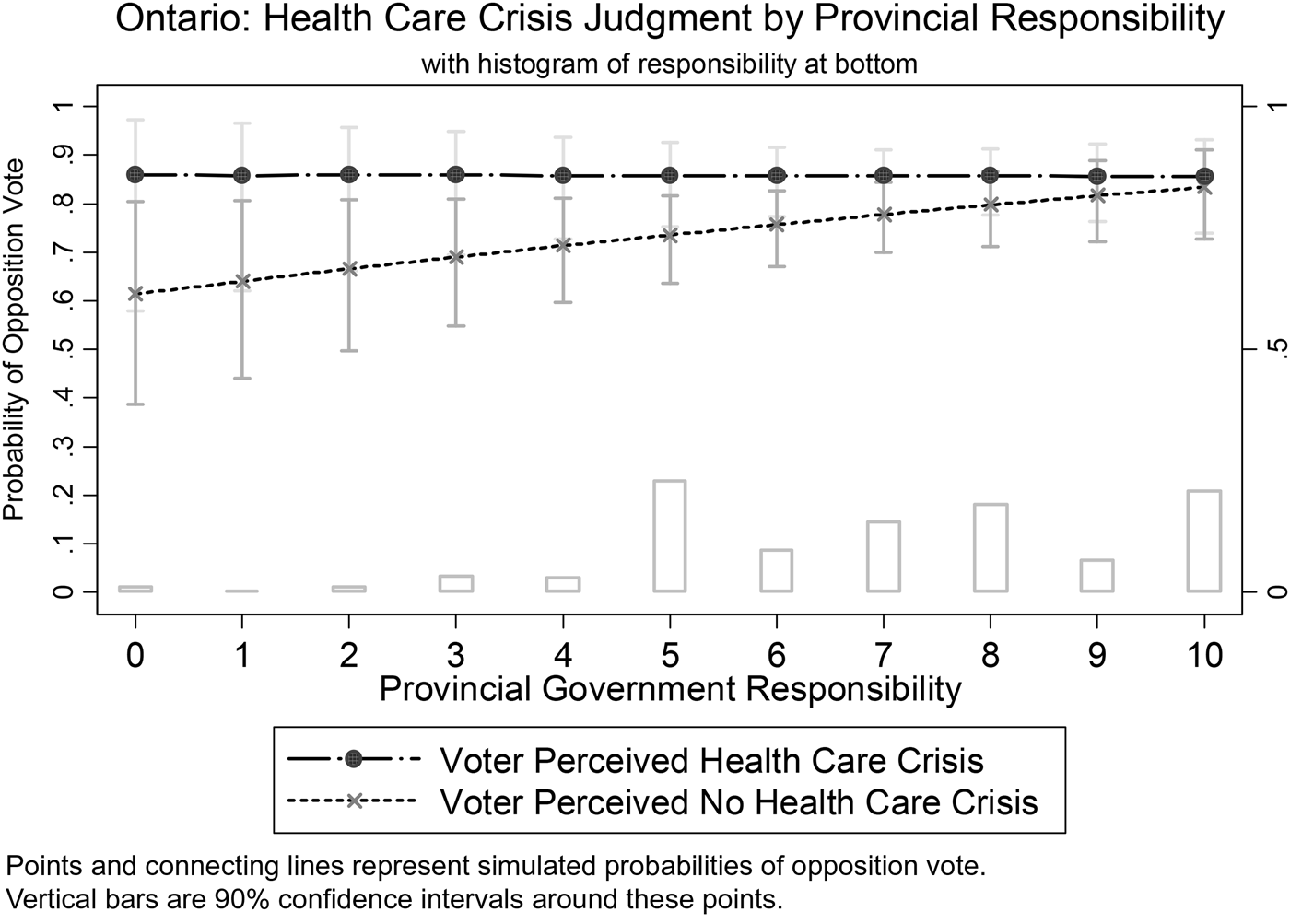
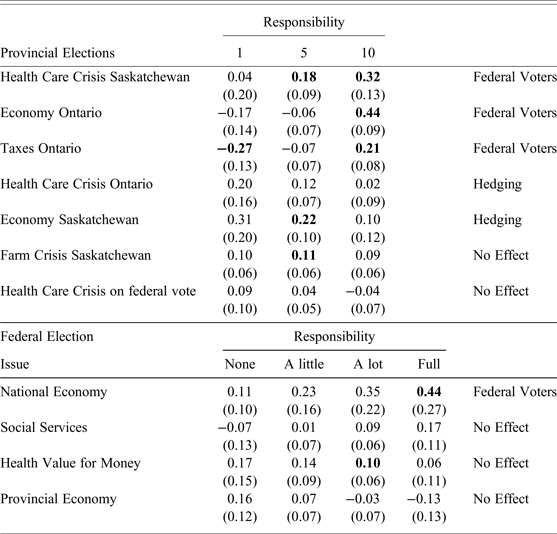
Tabular results for all 13 issues (from the three elections) appear in Table 1. Overall, the ideal theory of responsibility moderation receives only weak, inconsistent support across a total of 13 election-issue combinations, much as in Johns’ work (Reference Johns2011). Two figures help to understand the patterns of responsibility moderation in the data. Figures 1 and 2 plot predicted probabilities of a voter supporting an opposition party.Footnote 10 The graphs show two lines, representing the predicted vote when state-of-the-world judgments are good and bad, running over the range of responsibility. Recall how few respondents gave the government less than partial responsibility (5) for all of these issues (see histogram at bottom).
Good Federal Voters

Responsibility Hedging

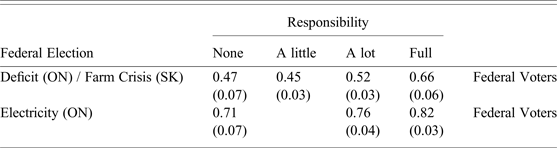
Effects of Judgments of Conditions on Voting by Level of Responsibility Main cell entries show the simulated difference in probability of an opposition vote between those who saw conditions as negative and positive at each level of responsibility Standard error of difference in parentheses below. Differences in bold are more than 1.64 times their standard errors. Cell entries on electricity and deficit/farm crisis are predicted probabilities of opposition vote because negative conditions assumed in the question on conditions. Standard error of predicted probability in parentheses below.

Figure 1 is a picture of the “good federal voters”: there is substantial responsibility moderation. In this example (health care, Saskatchewan) increasing attributions of responsibility forcefully separate the choices of voters with different assessments of the status quo. At low responsibility there is little difference between voters who see health care in crisis and those who think there are few problems in the system. As more and more responsibility is attributed to the provincial government, the gap in voting widens, nearly doubling from 18 per cent to more than 30 per cent as voters move from attributing partial to full responsibility (see also Table 1). This “good federal voters” pattern applies in six of our 13 cases.
Figure 2 is somewhat different. On this issue (health care, Ontario) the difference between the two lines is not statistically significant, but the pattern merits some discussion since it appears twice in the 13 issues. The upper line indicates that for those who say there is a crisis in the health care system the probability of casting an opposition vote is virtually constant across the range of responsibility. For this inherently negative judgment, even if the government was seen as only half-responsible, the effect on voting was the same as with full responsibility. But the lower line slopes as expected. Responsibility has a moderating effect among those who see a few problems in health care, making an anti-government vote increasingly likely.Footnote 11 I suggest calling the pattern in Figure 2 “responsibility hedging.” Those who think there is a crisis punish the government even if responsibility is shared, while giving any responsibility even if there are only some problems pushes citizens to throw the rascals out. In effect, the government loses either way in this scenario.
The final pattern, applying to five of our 13 cases, is where responsibility has no effect, either as moderator or on its own. In these “no effect” cases, even though we sometimes observe a gap in government support for those with opposing judgments (as we should), the level of responsibility does not significantly affect the size of this gap.
I used two other specifications that speak to other theoretical possibilities about responsibility moderation (results not shown). The first used a slightly different interactive variable: the government's share of the total responsibility given by the voter to both governments [govt resp ip / (govt resp ip + other level govt resp ip ; where p indexes policies)]. This tests the idea that voters are able to recognize the zero-sum nature of federal responsibility rather than treating each election and government separately and serially. No significant interactions were found. The second alternative specification entered federal and provincial government responsibility attributions as separate interactions. These indicated, very reassuringly, no effects from the responsibility attributions applying to the other level of government.
The chief concern of this paper is to understand which issues, in which places, fall into which of the moderation-type categories. Table 1 summarizes the evidence so far. The right-most column classifies the issues into one of the three categories described above. Rather than a detailed presentation in the text, I refer to the patterns in the results as I use qualitative evidence to discuss which issues-provinces-governments fall into each of the three categories.
To summarize, “good federal voters” appear in these elections at the provincial level on health care in Saskatchewan and the economy and taxes in Ontario, as well as in the federal election on the economy. Responsibility also has the expected effect for negative conditions on electricity in Ontario and on the federal government's responsibility for the Ontario provincial deficit and the farm crisis in Saskatchewan.Footnote 12 The “responsibility hedging” pattern holds in the provincial elections for the Saskatchewan economy and health care in Ontario.
There is no responsibility moderation for health care on federal vote intention in the provincial election study; the farm crisis in the Saskatchewan provincial election; the provincial economy on federal vote intention in the federal election; health care value-for-money in the province in the federal election; or the state of provincial social services in the federal election. These are not mere unimportant, peripheral issues that should never have been expected to influence voters’ decisions. Citizens cared about these issues and both governments had at least a moderate level of responsibility de facto, according to experts (Cutler, Reference Cutler2008a). That there is so little retrospective voting, and no responsibility moderation, ought to be of some concern to those hoping to see electoral accountability.
Political Conditions for Responsibility Moderation
As demonstrated in Figures 1 and 2, the results on the health care issue in Ontario and Saskatchewan look very different. And it turns out that the “responsibility hedging” pattern on health care in Ontario is what I find on the economy in Saskatchewan. So these different effects cannot be about the policy domain itself or institutions or the capabilities of voters, all of which are for our purposes identical in the two provinces. To the extent these patterns are systematic, political factors could be affecting the degree of responsibility moderation through the factors described earlier. In this section I use qualitative evidence on those factors to explain the variation in moderation just observed across 13 issues and levels. This is not a hypothesis-testing exercise but rather an interpretive attempt to account for the pattern of quantitative findings across the 13 issues.Footnote 13
I hired a research assistant to conduct a content summary of media coverage of each of the issues queried in the surveys, separately in Saskatchewan and Ontario, from the time the respective incumbent governments first took office until the elections in question.Footnote 14 Instructions to the assistant and the results are provided in the online appendix. The assistant produced point-form summaries of the coverage of major developments in each policy area, with special attention to any intergovernmental dialogue or disputes.Footnote 15 Online news sources were used: the Saskatchewan Leader-Post, the Toronto Star, the Globe and Mail, and the CBC provincial and national news websites. The review was at the most general level between four and six bullet points per six-month period. For example: “[Premier] Harris says that private sector and individuals will have to shoulder more responsibility for health care unless fed gov injects more money into system.”Footnote 16
Although a sophisticated quantitative content analysis might be preferable to this research strategy, it is hard to imagine how one could create coding dictionaries to capture the subtleties of intergovernmental politics. Our seemingly rather loose content analysis strategy can be justified by its similarity to how citizens process and retain political information. Citizens rarely store details from the full term of a government in their memory; rather, they probably take in some information, update their assessment of government performance and forget the details (Lodge and Stroh, Reference Lodge, Stroh, Iyengar and McGuire1993).
The final step was to summarize the assistant's reports so as to characterize the information that would have been available to citizens according to the conditions discussed in the theory section above. I describe the results in the remainder of the paper as I interpret the pattern of findings from the previous section. I hope readers familiar with the politics of these provinces in these years recognize the capsule histories that I provide on the basis of the assistant's summaries.
The ideal federal theory of voting holds in provincial elections on health in Saskatchewan and on the economy and taxes and electricity in Ontario, so I describe the political conditions there first and in greatest detail. In these domains provincial governments had undertaken important policy change that dominated political debate. These were signature policies of the two long-serving premiers, Romanow and Harris. The Romanow government had torn apart the status quo in health care, consolidating hospitals in both rural and urban areas and changing both governance and funding. Following this, as if to signal the magnitude of the changes, Romanow was chosen to head a national royal commission on health care. In Ontario, likewise, the Progressive Conservative (PC) government had made the deepest tax and spending cuts of all the provinces, going beyond what the federal government had done to fight the structural deficit. This neo-conservative “common-sense revolution” was a major break even from other PC governments at both levels.
In both places, the policies were a break with the past, clearly distinct from the federal government's policy agenda, were the most prominent retrospective issues in the 2003 provincial election campaigns, and there was less intergovernmental rancour and obfuscation than on the same issue in the other province (see below). Not surprisingly, the provincial governments found it impossible to deny responsibility by blaming the federal government, despite some tepid efforts to do so. Media coverage made it obvious that the provincial governments were doing something on their own and with real consequences in the province. It is therefore no surprise to find clear responsibility moderation in these domains. When these conditions are met, voters may well be able do what federalism asks of them; they can be “good federal voters.”
Turning to the national level I find the strongest pattern of responsibility moderation. It is for retrospective economic voting on federal election vote choice, where the literature has already shown clear effects that led scholars to a very optimistic view of voters’ ability to exert electoral accountability under divided authority (for example, Lewis-Beck and Stegmeier, Reference Lewis-Beck, Stegmaier, Dalton and Klingemann2007; Rudolph, Reference Rudolph2003a). In the media summaries from both provinces there are frequent references to national economic statistics, national economic policy changes and coverage of the opposition parties trying blame the federal government for economic trouble. The quantity and character of the economic information enables citizens to keep the national economy and their provincial one separate and therefore to use responsibility attributions to moderate their judgments of conditions on their vote choice.
In the other seven issue-province cases, voters had less clear information to help them distinguish the contributions of the two levels of government. Health care in Ontario and the economy in Saskatchewan are instructive cases, for different reasons. Recall that voters’ behaviour in these cases follows the responsibility hedging pattern. In Ontario, the media data confirm that the debate around health care had been dominated by federal-provincial squabbling and buck-passing. The two governments even went so far as to conduct expensive advertising campaigns against the other, with intergovernmental wrangling even featuring for a time on public transit billboard ads. The province questioned the federal financial contribution and the federal government struck back, claiming that Ontario's tax cuts had eroded health spending. The fiscal context was mightily confusing: health spending had indeed declined but both governments had cut income and corporate taxes, both governments had cut health spending, and Ontario resorted to a health care levy. To top it off, one year before the provincial election the federal Auditor General reported that it was impossible to determine the amount of federal funds actually being spent on health by the provinces. In that environment, citizens’ behaviour looks quite reasonable. In this context, those who gave responsibility to the province for health care conditions were essentially blaming it for shortcomings in the health system even if their judgments were not entirely negative.
The same “hedging” pattern is evident for the economy in Saskatchewan, but from a different information shortfall: little coverage indicating that the provincial government's actions had an impact on the economy. This is not surprising, as the economy is small and heavily affected by commodity prices and farm conditions. In my assistant's media summary, not once in the government's nine years in office was there major coverage of the provincial government doing something that directly affected Saskatchewan's economy. So here, the hedging pattern results from a lack of information to connect real-world conditions to government action.
The final pattern—no responsibility moderation whatsoever—appears on the “farm crisis” issue in the Saskatchewan election and on the impact of judgments of the state of provincial health care on current federal party support. On the farm issue as with the economy in Saskatchewan, media coverage attributed responsibility to external factors. While there was a provincial inquiry and task force, the opposition parties do not appear to have made much out of the government's action or inaction on the issue over their two terms in office. Moreover, as I show below, voters responded by using the issue in their federal voting choice with responsibility moderation.
The state of health care in both provinces appears not to have driven through to federal party support. Here too, the information linking federal actions to provincial health outcomes was weak to non-existent, especially given the important changes made by the Saskatchewan government referred to above. While it may seem encouraging that provincial voters do not punish the federal government for health care according to responsibility attributions, given the de jure division of powers, this is wrong conclusion to make: plenty of voters thought the situation was bad and gave the federal government some responsibility when asked directly, but failed on average to take this judgment to their federal vote choice (see also Cutler, Reference Cutler2004). Experts would surely say that federal changes to the health care funding regime had made a difference in the province. I suggest that the federal government got off the hook despite being seen as responsible for the state of provincial health care because the political conditions were not in place to help voters attribute responsibility and use it in their voting calculus.
Looking now to the bottom half of table 1a, we see that responsibility moderation only drives national level vote choice on the economy. There is no responsibility moderation on social services (in which the federal government has only a fiscal role), on health care value for money, or on the provincial economy. This is somewhat reassuring in that in these areas the federal government has only an indirect or merely persuasive role. And so we might begin to interpret the results as sensible given the federal government's de jure limited role in these areas. But in fact, most voters attributed “a little” or “a lot” of responsibility to the federal government (see Cutler, Reference Cutler2008a), so the fact that the “a lot” of responsibility respondents did not punish the government more than the “a little” respondents is not an endorsement of a normative theory of federal voting. The federal government's spending power and other levers should give it de facto significant responsibility for results on the ground in these policy domains. Surely, if there were no politically driven variation in the clarity of responsibility, voters who give the federal government “a lot” of responsibility for social services in their province, for example, should punish that federal government party if services are poor. Instead, the fact that the conditions given above—prominence, exclusivity, clarity, publicity—do not obtain in these areas for these elections means that “good federal voting” does not occur. What emerges from the federal results is that in federal elections there is little issue voting in de facto shared policy areas (social services, health, the provincial economy) even among the large majority of voters that attribute moderate levels of responsibility to the federal government.Footnote 17
Conclusion
Citizens are sometimes able to digest the information from marble-cake federalism to exert some democratically nourishing electoral accountability–but only sometimes. This paper contributes to our understanding of where and when. The pattern of findings on responsibility moderation across issues suggests that electoral accountability for government performance is contingent on politics. In its fullest sense, the electoral accountability expected in federal systems may be evident only under particular conditions.
On provincial issues where I observed responsibility moderation, the policies were a clear change from previous government policy, distinctive from federal government policy, reported prominently in the media and salient for voters. By the same token, national government responsibility for the economy is such a commonplace that it is not surprising the conditions were satisfied in that domain. One is tempted to say that these conditions are often met on economic matters for economically independent polities but rarely in other policy domains, especially ones with high levels of federal-provincial entanglement. This state of affairs is worrisome if one imagines that the economy should not necessarily dominate the criteria by which voters hold governments accountable.
As other scholars have shown, the moderating power of responsibility attributions varies across contexts (Rudolph, Reference Rudolph2003a). León (Reference León2010, Reference León2012) has even shown that variation across policy domains affects attributions when there are different paces of devolution in different domains and federal units, and Johns (Reference Johns2011) shows responsibility moderation only in specific times and places. The present paper adds the contingent variation in the politics of policy in different times and places to those accounts of contextual variation in responsibility moderation.
The focus here on relatively short-term politics is not to say that competent multilevel voting is unpredictable. In fact, some of these contextual influences are heavily determined by institutions and therefore these political factors can provide mechanisms for those institutional effects (see Wlezein and Soroka, Reference Wlezien and Soroka2011). In institutional contexts that promote policy change by separate levels of government, where the media are structured to provide separate reporting of each government's actions, and where there is not too much conflicting information on responsibility from political actors, voters may be better able to hold governments accountable for those policy changes. In the Canadian case—a famously entangled intergovernmental mess—these conditions are rare.
Clearly, there is something different about the impact of judgments of provincial-level policy outputs on voting at the federal level. Despite the fact that voters pin significant responsibility on the federal government for the provincial state of affairs—as well they should—citizens likely consider these policy areas less relevant for an evaluation of the federal government. The contrast between the potency of the responsibility for the national economy in federal vote choice and the impotence of judgments of the provincial economy on federal voting makes this clear. This is more evidence that there is something of an issue bias, meaning that voters do not in general use these shared policy areas in their evaluation of the federal government (Cutler, Reference Cutler2004).Footnote 18 Voters are probably correct in attributing responsibility to both governments and yet do not hold the federal government accountable in these policy areas (see also Blais et al., Reference Blais, Gidengil, Nadeau and Nevitte2002).
To take a broader view of these results we return to a stylized theory of federal voting that expects citizens to expertly attribute responsibility to multiple governments and then vote retrospectively only in proportion to these responsibility attributions. This is a tall order indeed. The conditions required are essentially those that would obtain under a “watertight compartments” version of federalism where only one government is involved in a given policy area. In most policy areas in Canada, however, both governments are involved in raising and spending funds, making policy and delivering services. Faced with judging conditions and responsibility in those shared policy domains, Canadians appear to have trouble voting retrospectively to hold their governments accountable. While our evidence on this front is only indirect, citizens already living under complex multilevel governance should worry that a flexible model of federalism probably threatens their ability to hold governments to account. Others at earlier stages of multilevel governance may want to shape institutions to avoid this threat to electoral accountability. Those dealing with already entrenched federal institutions could consider mechanisms that would promote clear information to citizens about government responsibility.
Supplementary materials
To view supplementary material for this article, please visit https://doi.org/10.1017/S0008423917000282.
Appendix Materials
Probit estimation of Federal Anti-Government Vote, Canada 2004
Probit estimation of Federal Anti-Government Vote, Canada 2004