The epigram: ‘Καὶ νόον αἰγλήεντα λίπες καὶ γνῶσιν ἐόντων, νύκτα δι᾿ ἀμβροσίην τὴν οὐ θέμις ἐξονομῆναι’ (‘You left behind a radiant intellect and knowledge of what exists, for the immortal night that should not rightfully be called by its name’) on the first page of Johann Eck’s 1519 edition and commentary of Pseudo-Dionysius’ Mystical theology, attests to the significance and lasting influence of the pseudonymous Church Father.Footnote 1 Pseudo-Dionysius’ writings were fundamental to the development of Christian mysticism as they introduced some of the basic elements of negative theology, the most esoteric type of theology, which attempts to reach God through negations, or meditation and contemplation on what he is not. Probably contrary to Eck’s intentions, the epigram also alludes to the difficulties that lie behind the composition of a systematic theological commentary on a text that discusses the unknowability of God, as, according to the second line of the epigram, Pseudo-Dionysius’ radiant intellect was left behind in order to reach that which is beyond naming.
This article will examine the 1519 edition and commentary on the Mystical theology by the German theologian Johann Eck (1486–1543). In this extraordinary and ambitious edition, Eck aimed to provide a detailed explanation of a text that, by the early sixteenth century, had been widely discussed, disseminated and interpreted, despite, but also because of the difficulties in its interpretation. The commentary is especially important because it highlights the complex interactions between scholasticism, humanism and late medieval devotional and mystical literature in intellectual circles of the Holy Roman Empire on the eve of the Reformation.
The aim of this article is to shed light on aspects of the early modern reception of Pseudo-Dionysius, decipher the complex web of influences that formed Eck as a scholar and theologian and determine the purpose behind his edition. Eck’s influences will be categorised into three areas: humanism, scholasticism and affective theology. The article will examine how each shaped his work. It will also discuss the prevailing influence of Nicholas of Cusa. In addition, Eck’s new insights and contributions regarding the negations of godly attributes and their relationship to God’s essence will be addressed. Finally, it will be argued that the purpose of Eck’s edition was two-fold: to renew scholastic theology and to revive mystical theology by introducing or recommending it to an audience of scholastic theologians.
Eck’s commentary has not garnered much scholarly attention. Its most extensive treatment was in a 1972 article by Georgette Epiney-Burgard, in which, as she herself stated, she presented a ‘simple outline of Eck’s ideas’.Footnote 2 More recently the commentary was analysed by Giovanni Tortoriello.Footnote 3 Tortoriello juxtaposes Eck’s treatment of mystical theology from a scholastic perspective with Luther’s dismissal of any type of philosophising that minimises the centrality of the cross. This article will take a different approach, focusing on the different strands of influence in Eck’s work with the aim of contributing to the study of the diverse traditions within German Christian humanism.
Johann Eck between scholasticism and humanism
The German historian Erwin Iserloh gave his biography of Eck the title Johann Eck: scholastic, humanist, controversialist. Footnote 4 Of these three attributes, historians have focused more on Eck’s role as a controversialist. Eck is best known today for his fierce defence of Catholicism during the early phase of the Reformation, particularly his multiple works against Luther, his debates against Luther and Karlstadt and his role in drafting and disseminating the bull Exsurge Domine. However, even though his later career as a Catholic polemicist overshadowed his earlier accomplishments, an examination of his early work and career trajectory reveals that he was, from a young age, a remarkably talented scholar.
Eck began his studies in liberal arts at the University of Heidelberg at the age of twelve. He soon left for the University of Tübingen, where he received the qualification of magister artium. According to Eck’s 1538 biographical note, Tübingen was the place where his first encounter with the humaniora littera took place. His most intellectually formative university years were spent at the University of Freiburg, where he studied theology from 1502 to 1510. Among his teachers were the Carthusian Gregor Reisch (1465–1525), author of the philosophical encyclopaedia Margarita philosophica, Johann Sutter, known as Brisgoicus (d. 1539) and the scholastic Georg Northofer (1454–1509).Footnote 5
By the age of twenty-four Eck had made a name for himself as an excellent young scholar. He joined the University of Ingolstadt at the behest of William iv, duke of Bavaria (1493–1550), and played a key role in the adaptation of northern universities to the new reality brought about by the rise of humanism and the printing revolution, as he was commissioned to prepare new editions of texts on logic with his own commentaries.Footnote 6
Eck’s background and primary interests characterise him as one of the ‘theologians’ in a period when scholastic theologians and humanists were often in conflict. His intellectual loyalties, however, were more ambiguous. In an article on the relationship of Johann Eck with humanism, Peter Walter demonstrated that Eck was recognised as a humanist by his peers and adopted humanistic language to represent himself. The greatest proof of his humanism, however, as he states, was his ad fontes approach to texts, his orientation towards a study of the authentic classical sources.Footnote 7 For Erika Rummel, his work in re-editing Aristotle’s works for the university shows him to be merely co-opting humanist language – as seen when he promised to ‘eliminate barbarism from the curriculum’ in the preface to his editions of Aristotle – in order to promote what was in effect a very conservative reform.Footnote 8 Johann Peter Wurm, in the entry for Eck in the Deutscher humanismus lexicon, refuses to categorise Eck as a humanist in the narrow sense, noting that among the studia humanitatis his passion was in philosophy, particularly logic. He categorises Eck as a representative of the self-renewal movement of late scholasticism and a ‘figure of transition’.Footnote 9
Nevertheless, Eck’s personal interests extended beyond university scholasticism. In a theological work on predestination entitled Chrysopassus praedestinationis, he wrote that he had started to work on a project on Pseudo-Dionysius with the intention of teaching negative theology more scholastico, using insights from ‘orphic, hermetic, platonic and peripatetic theology’.Footnote 10 His 1519 edition of Pseudo-Dionysius’ Mystical theology is proof that he pursued this intention.
The edition of Mystical theology
Eck took great care in preparing his edition. In a letter sent to Wolfgang Capito and Johannes Fabri on 26 October 1517 he wrote that:
A month ago, I produced a commentary on the Mystica Theologia, but it does not seem to me in the interest of scholars to publish it in Augsburg, since there is no printer there who has a learned corrector; and how can the printer himself be the judge of such a foreign and most rare matter, which breathes the utmost erudition? I have chosen Froben, who stands first among the printers in Germany. But I have decided on you, Wolfgang [Capito, as corrector], since you have more eyes than Argos. I think that you will readily take on the task because of its general usefulness to scholars … He [Froben] will do the greatest of all favours to all theologians – the purer and more refined kind.Footnote 11
In the end, having not managed to secure Froben, Eck published his work with the Augsburg printer Johann Miller.
Eck states his intention behind this edition in the dedicatory epistle to Christoph von Stadion, the bishop of Augsburg, where he asserts that he intends to leave nothing in the text obscure and unexplained.Footnote 12 Eck maintains that editing the text and publishing his commentary was necessary: the way of philosophising on the ‘first cause’ of everything (‘prima omnium causa’), represented by Dionysius, had been neglected for years. Following the path of great theologians who helped bring back negative theology, notably Nicholas of Cusa, he tried, through his edition, to make Mystical theology more easily available and save it from its state of neglect.Footnote 13
The text of Mystical theology and the commentary are accompanied by some additional texts. The edition begins with a poem dedicated to Dionysius the Areopagite, followed by the dedicatory letter to Christoph von Stadion. Also included is a biography, which adheres to the medieval legend conflating Dionysius the Areopagite with St Denis, the first bishop of Paris. A prologue outlines Eck’s general propositions, including a typology of the different genres of theology and a defence of the authenticity of the text. In a brief introduction, Eck states that his intent is to interpret and explain the text but also to condense it for clarity. He does so by providing a summary and paraphrase at the end of each chapter. He also includes a popular, abridged version of the text, known as the Extractio Vercellensis. The text of the Mystical theology itself is divided into parts and chapters. Certain passages from the text are flagged for deeper analysis: these are marked with numbers in the margin, each number corresponding to a specific propositio.
In his closing address to his readers Eck gives a glimpse of his method and sources. As he states, he extracted some of the sacred mysteries he discussed from old, dusty and barely legible books. He also included some of his own interpretations at his own risk (‘nostro marte vel cum periculo’).Footnote 14
The commentary and its influences
The Mystical theology, a Christian Neoplatonist text of the late fifth or early sixth century, was a fundamental text for Christian mystical theology.Footnote 15 Using Moses’s ascent to Mount Sinai as an analogy, the treatise discusses how the mystic must enter the ‘divine darkness’, a place that cannot be reached unless one abandons and transcends the senses and all cognitive functions. The main question that the medieval commentators on the text had to engage with was: how can someone enter this darkness and achieve communion with God? How can we know him who is beyond human understanding? In the Mystical theology, Dionysius leaves the relation between Moses and the ‘darkness’ obscure. Medieval commentators on the text tended to reduce this connection to either an extraordinary form of knowing or to affective experience.Footnote 16
Eck uses multiple sources to approach the text. He does not contribute many original ideas, but his commentary is remarkable in its richness and eclecticism. He cites a wide variety of authors including Church Fathers, scholastic theologians, Plato, Aristotle, Neoplatonist philosophers and medieval mystics. He is aware of the editions and commentaries on Pseudo-Dionysius by Lefèvre d’Étaples and Marsilio Ficino, published not long before his own, and occasionally cites them. Eck’s most important influence, however, was arguably a writer whose ideas unified the various concepts drawn from a broad range of influences: Nicholas of Cusa, whose hermeneutical scheme of the ‘coincidence of opposites’ provided a crucial methodological framework for Eck.
Humanism and Neoplatonism
Eck’s profile as a theologian with humanist leanings is reflected in his edition. The presentation of the text is unusual and attests to Eck’s interest in providing the reader with a complete picture of the linguistic complexities of Pseudo-Dionysius’ work, a preoccupation which reflects a reverence for sources that is humanist in character. The edition presents the original Greek text, a feature highly uncommon for this period, and makes another unusual choice in juxtaposing it with three different translations.
Eck was likely interested in providing a complete linguistic picture because of the existence of multiple Latin translations of the text. He bypasses the first Latin translation by the ninth-century theologian and philosopher John Scottus Eriugena, as well as the thirteenth-century translation by the scholastic Robert Grosseteste.Footnote 17 The three translations he chooses are by the twelfth-century scholars John Sarrazin, Ambrogio Traversari and Marsilio Ficino. The difficulties in translating the text had already been acknowledged by the medieval translators. In his introduction to his translation of the Celestial hierarchy, Sarrazin noted that while he opted to remain as close to the text as possible, in many cases he was not able to find equivalent terms and had to resort to ‘twisting the Greek words’ or garnering the meaning from the ‘sense of the author’.Footnote 18 Ficino was a harsh critic of all previous translations of Pseudo-Dionysius’ oeuvre, including the one by Traversari, as he believed that the translators did not grasp the complexities and nuances of Neoplatonic thought.Footnote 19 Eck likely decided to present the Greek text in its completeness, given the difficulties in translating some of the Greek terms and the discrepancies found in different translations. He does not show any preference for any of the three translations, as is demonstrated by their simple presentation in three columns without additional comments.Footnote 20
Eck’s humanist leanings are also evident in the text of his commentary, particularly through his engagement with ancient Greek philosophy. In explaining the simplicity of God’s mysteries, Eck draws on Platonic teachings about the One, as found in the Parmenides – a dialogue also favoured by Marsilio Ficino in his own commentary on the Mystical theology. According to Plato, the One, or the Christian God in Christian Platonism, is the source of all things and the most perfect and absolute of forms (‘perfectissima et absolutissima forma’). All descent from it results in diversity and multiplicity.Footnote 21 As Giovanni Tortoriello notes, there are many instances where Eck’s indebtedness to Ficino’s commentary is made clear.Footnote 22 An example comes from his discussion of a passage from Dionysius, in which he likens the process of finding God to that of a sculptor stripping a block of wood to unveil a statue. Eck uses additional examples taken from Ficino’s commentary on the Mystical theology to further explain this analogy.Footnote 23 In man is the image of God, hidden by additions: take away the body from the soul, imagination from reason, reason from understanding (‘intellectus’): take away, moreover, the intellectual multiformity from the singleness of the soul and separate the animal and intellectual condition from this unity and there, hidden, is the image of God which exists in every human. This image of God also exists within the entirety of the creation: the world is a statue of God, covered by many veils.Footnote 24
Plato is also used to fortify Eck’s arguments in favour of negative theology. In the Republic, Eck states, Plato declared God, whom he calls the ‘idea of the Good’, to be superior to the intellect and anything intelligible. He also explained that divine knowledge cannot be taught with words; rather, a spark may be kindled within a person through experience and continuous contemplation.Footnote 25 The words we use to describe higher things are fewer than those we use for lower things because, according to the Platonic scheme of emanation from the One, lower things are participatory and plural, whereas higher things are excellent and singular. Thus, the greater the importance of an object or concept, the fewer words we can use to describe it.Footnote 26
Eck also embraces the Renaissance concept of perennial philosophy, which was believed to be transmitted from a divine source, establishing a continuity between the wisdom of ancient pagan civilisations, such as the Egyptians and the Chaldeans, the Greek philosophers and biblical texts. Eck provides a genealogy of the scientia mysterialis beginning from the Egyptians and Hermes Trismegistus and passed on to the Greeks.Footnote 27 He notes the closeness of ideas expressed by Pseudo-Dionysius to Platonic philosophy, expressing his wonder at the fact that ‘this secret’ reached the ancient Greeks.Footnote 28 Throughout the commentary, Eck frequently references Hermes Trismegistus, whom he regarded as an ancient Egyptian sage who paved the way to divine knowledge.Footnote 29
Eck’s most cited author was Augustine, arguably the most authoritative Church Father and the most influential Christian Neoplatonist: his ideas on divine transcendence and the causal presence of God in his creation were profoundly important for the development of a distinctly Christian Neoplatonism which led to a long and fruitful medieval tradition.Footnote 30 The stages in the development of Christian Neoplatonism are represented in Eck’s commentary by medieval writers who wrote about the infinity and transcendence of God, notably ‘Theodorus’, the supposed writer of Clavis physicae – a work consisting of paraphrases and extracts from John Scotus Eriugena’s Periphyseon; Albert the Great, who connected the Aristotelian doctrine of transcendentals with a Platonic-Dionysian tradition of thought; and Nicholas of Cusa.Footnote 31
On love and knowledge: scholasticism and affective theology
Eck was a theologian rooted in the scholastic practices of medieval universities and the study of Aristotelian logic. In his commentary, he favours the original source of scholastic theology, citing Aristotle more than medieval scholastic theologians on topics such as the nature and function of the human intellect, the structure of the human soul, the implications of hylomorphism and the relationship between matter and form when discussing the divine.Footnote 32 He also discusses the interpretations of scholastic theologians who had previously written works on Pseudo-Dionysius, including Albert the Great, Thomas Aquinas, Petrus Hispanus, Robert Grosseteste and Francis of Meyronnes.Footnote 33
At the time, German university theologians were embroiled in a struggle between realists and nominalists, which became known as the Wegestreit. Realists and nominalists, or followers of the via antiqua and via moderna respectively, disagreed over the problem of ‘universals’, concepts that apply universally to many different individual instances. Realists believed that common attributes like beauty or kindness can be described as something real, existing outside the mind, whereas nominalists believed that they can only be thought of as concepts or linguistic inventions. This disagreement had broader implications: for example, nominalists believed that there were limits to human reason whereas realists were keener to believe that the rules of logic confirmed the teachings of Christian theology.Footnote 34
While remaining a multi-faceted thinker who absorbed elements from both movements, Eck was primarily influenced by nominalism: in Freiburg he was a scholarship holder at the Pfauenburse of the University of Freiburg, which was committed to the via moderna. His preference for nominalism can also be traced in his publications, particularly in his 1516 commentary on the Summulae logicales of Petrus Hispanus, the main work of late medieval logic which was used extensively in the circles of the moderni. Footnote 35
Given Eck’s nominalist sympathies, it is not surprising that he is critical of the moderate realist Thomas Aquinas’s reading of Pseudo-Dionysius and his emphasis on the intellect as the noblest among our faculties.Footnote 36 Eck’s commentary provides an exposition on the human mental faculties sensus, imaginatio, ratio and intellectus, emphasising their weakness in understanding God. Intellectus, the highest of them all, is still unable to grasp the divine essence. Eck acknowledges the importance of human intellect, which can be engaged in contemplation of the divine, but he believes that there is another ineffable force that pulls the human soul into the ‘divine darkness’. This force is an exalted form of love.
Late nominalist theologians like Jean Gerson and Gabriel Biel, who was a professor in Tübingen but died before Eck joined the university, had brought a perspective which combined nominalism and mystical theology in revolutionary ways. While other mystics believed that it is possible to achieve a direct, essential link to the divine, Gerson rejected these presumptions as heretical and acknowledged the limitations of human intellect. In Gerson’s theology, the mystic’s highest summit is not found in a union with the intellect or ‘being’ of God but in a union with God’s inscrutable will. The divine abyss with which the mystic is united in love is therefore to be found in a loving union with the will of God.Footnote 37
One of Eck’s most important influences was Francis of Meyronnes, who wrote a work entitled Flores Dionysii. Footnote 38 Francis was a follower of John Duns Scotus, who, despite being a realist, believed in the primacy of the will over the intellect. Duns Scotus had defended the primacy of love for God – which is connected more to will than to intellect – over knowledge of God. He also believed in the need for divine revelation for human reason to truly understand the God it seeks to love.Footnote 39
Eck recognises the existence of an affective theology in the prologue to his commentary. There, he makes a distinction between four different types of theology: ‘positive’, which is taught in schools, ‘symbolic’, which is communicated in sermons, ‘affective’, found in private devotions and meditations and finally, ‘mystical’. The latter he defines as negative, in contrast to the prior three which he considers as mostly affirmative.Footnote 40 Eck seems to use the terms mystical and negative interchangeably. He does recognise a mystical streak in affective theology as the soul can supersede the limits of human intellect through divine love.Footnote 41 However, mystical theology is the one with the help of which ‘the mind, transcending all creatures as well as itself, is taken away and ascends to the knowledge of God’.Footnote 42
Eck was influenced by the writings of the Carthusian Hugh of Balma, which were given to him by the Carthusian monks in Basel.Footnote 43 Hugh’s De theologia mystica, also known as Viae Sion lugent, written between 1246 and 1297, discusses the interior life and the ‘unitive way’ – the path in which the human spirit encounters divine wisdom through contemplation. Contemplation is described as cognitio dei per ignorantiam – a knowledge of God through unknowing. This form of contemplation culminates in an affective union, during which the soul rises and burns with joy and ecstatic love, acquiring a type of knowledge through experience that is described as more penetrating than anything intellect and reason can offer.Footnote 44
Hugh of Balma taught that union with God can only be achieved through a power inherent in the soul, which he calls the principalis affectio or ‘principal affection’. This power has a reach that far exceeds that of human knowledge, allowing the individual to ascend to God through love. Hugh of Balma himself followed Thomas Gallus, another commentator on Pseudo-Dionysius, who had associated this power with scintilla synderesis, or ‘spark of conscience’. The term synderesis, derived from a corruption of the Greek word syneidisis (meaning conscience), was originally used to denote the innate human ability to grasp the first principles of ethics and moral truths. Thomas Gallus was the first to use the word to designate the faculty of the human soul capable of (affective) union with God.Footnote 45
The coincidence of opposites
The coincidence of opposites is a philosophical concept propagated by Nicholas of Cusa. It suggests that two seemingly contradicting statements can both be true when referring to God, since his infinity cannot be understood as limited by any opposition, but rather as encompassing all things.Footnote 46 For Eck, the concept of the coincidence of opposites is crucial as it bridges discrepancies, differences and disagreements within theology. By embracing the paradox of a God that is at the same time immanent in all things and transcendent and unknowable, Eck aligns negative theology with common or positive theology. An example he gives is of the identification of God with truth. A ‘common theologian’, following the Gospel of John, can say that God is the truth, and a mystic can admit that God, being above and beyond all things, cannot be described as either truth or error. Both perspectives are correct. The one who affirms directs his eye to the creation and seeks to understand God through it, whereas the one who negates recognises the incomprehensibility and ineffability of God.Footnote 47
Following Nicholas of Cusa, Eck explains that the learned individual finds himself at the limits of knowledge, recognising that divinity cannot be fully understood because of God’s excellence and magnitude. Using a metaphor taken from Cusanus, Eck states that the sun is comprehensively invisible because of its ‘supreme visibility’. Most importantly, God is the highest truth and thus the primary object of the intellect. However, despite, but also because of his supreme intelligibility, God remains utterly incomprehensible. Anyone who wishes to approach him can only do so through an incomprehensible intuition, as though by a momentary rapture.Footnote 48 A mystic is therefore much more enlightened through the denial of all things rather than through the exercise of cognitive powers.
Eck turns to more examples of non-contradiction: Pico della Mirandola was correct to say that Plato, who places God above the intellect, and Aristotle, who describes God as intellect (Metaphysics, bk 12), were not opposed to one another but both intended to magnify and extol God.Footnote 49 In addition, following Francis of Meyronnes he sums up Dionysius’ message in a ‘peripatetic way’: everything found in creatures is to be attributed ‘virtually’ to God; everything found in creatures is negated in God as it is found ‘formally’ in creatures. Thus, the difficulties in the Dionysian texts can be resolved by resorting to the distinction between the formal and the virtual.Footnote 50 This distinction explains why, in this instance, negations are not opposed to affirmations. Eck explains this in the Aristotelian manner: the contradiction must be about the same thing, according to the same thing, similarly and at the same time.Footnote 51
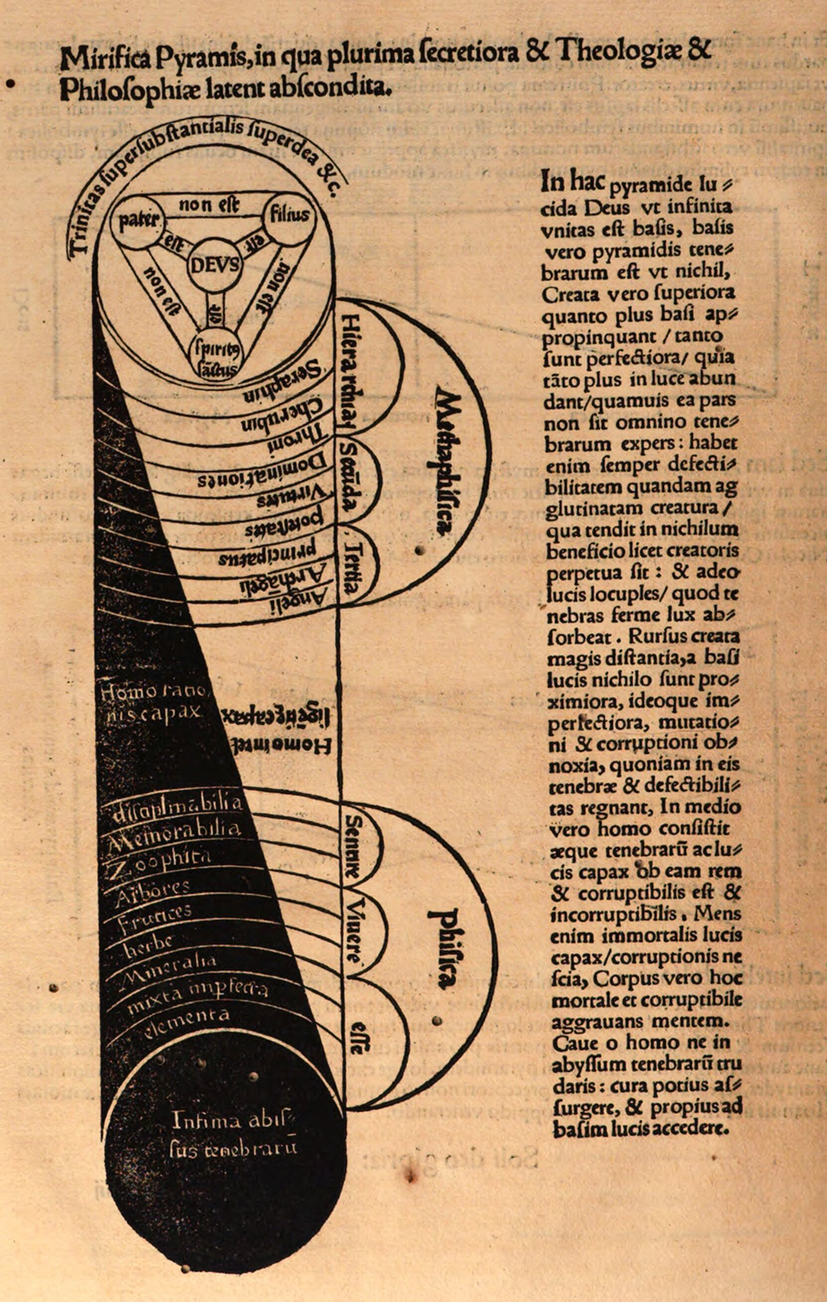
Cusanus expressed his conception of the coincidence of opposites using graphs and mathematics. In his work On conjectures (De coniecturis), he included a geometric figure designed for envisioning oneness and otherness and ‘light’ and ‘darkness’. The figure consists of two pyramids, a pyramida lucis and a pyramida tenebrae. The two pyramids intersect, as each pyramid’s peak touches the base of the other. Utter oneness and utter alterity are presented beyond the diagram. These triangles represent the interconnectedness in the relationship between opposites. The interplay between known and unknown and finite and infinite can be interpreted through an anagogical lens. In this sense Cusanus’ schemes are guides for contemplative thinking on the soul’s anagogical ascent towards the divine.Footnote 52
Eck reproduces Cusanus’ figure in his commentary. However, believing that Cusanus’ graph was not sufficiently clear he added another pyramid, in which he included the hierarchies of being, base and higher, animal, human and angelic, to show ‘the participation of light and darkness very distinctly’.Footnote 53 The graph combines two pyramids, one ascending into light and one descending into darkness showing the dialectics of ascent and descent from the infinite unity of God towards the darkness of the lowest abyss and vice-versa. At the bottom of the graph, there are ‘being’, ‘living’ and ‘sensing’ creatures, then there is man capable of reason and from there one moves higher towards the levels of the angelic hierarchy and the Triune God (see Figure 1).
Johann Eck uses this figure, which combines two pyramids, one ascending into light and one descending into darkness, to illustrate the dialectics of ascent and descent from the infinite unity of the Triune God towards the darkness of the lowest abyss and vice-versa. Reproduced from Bayerische Staatsbibliothek, Munich, Res/2 Dogm. 213 e–4#Beibd.1, fo. Eiiii v.,urn:nbn:de:bvb:12–bsb10866064–0. The image is in the public domain (CC0 1. 0).

Figure 1. Long description
A vertical woodcut diagram on a printed page. At the top is a bright circle containing a triangular shield of the Trinity. The center circle is labeled DEVS, connected by lines to three outer circles labeled pater, filius, and spiritus sanctus. The lines between them are labeled est and non est. This divine circle sits atop a white pyramid that tapers downward.
Inside the white pyramid, horizontal bands list celestial hierarchies: Seraphin, Cherubin, Throni, Dominationes, Virtutes, Potestates, Principatus, Archangeli, and Angeli. To the right, these are grouped by brackets labeled Hierarchia, Secunda, and Tertia, all under a larger bracket labeled Metaphysica.
Below the angels, the diagram transitions into a black pyramid that widens as it descends. In the middle section, the text Homo rationis capax appears. Below this, the bands continue with earthly categories: disciplinabilia, Memorabilia, Zoophita, Arbores, Frutices, herbe, Mineralia, mixta imperfecta, and elementa. These are grouped by brackets labeled Sentire, Vivere, and esse, under a larger bracket labeled phisica.
The bottom of the black pyramid ends in a solid black circle labeled Infima abyssus tenebraru. To the right of the diagram is a long block of Latin text explaining the dialectics of light and darkness.
Eck finds the doctrine of learned ignorance ‘wonderful’ and uses it to approach some of the most difficult passages of the Mystical theology. Pseudo-Dionysius, he says, denies existence, life, mind and reason from God, yet he also affirms that God is not without them.Footnote 54 According to a previous commentator, Josse Clichtove, in Lefèvre d’Étaples’s 1515 edition, Pseudo-Dionysius denies these attributes and names ‘contractedly and participatively’ but not simply and absolutely. Eck, however, believed that Clichtove’s interpretation stripped negative theology of its resonance and importance. He maintained that all things must be denied in God ‘in an eminent way’ (eminenter).Footnote 55 Eck believed that Pseudo-Dionysius denied the attributes we associate with God, such as goodness or virtue, in their full essence, as far as these are things that humans can say or understand. Indeed, humans cannot describe or characterise God in any way, since his eminence is so great that we cannot even begin to understand it.Footnote 56
This is the part of the commentary where Eck has something new to offer. He is particularly concerned about a passage in which Pseudo-Dionysius states that God ‘does not understand existence’ (‘οὔτε αὐτὴ γινώσκει τὰ ὄντα’): in this case Eck does not rely on the scheme of the coincidence of opposites for his interpretation. He makes sure to stress God’s omnipotence and omniscience giving examples from the poetry of Statius, Lucanus and Boethius and stating that the divine eye watches everything at all times.Footnote 57 He first gives the opinion of other theologians, for example that of Francis of Meyronnes, who offers a scholastic reading of the passage, maintaining that God does not understand existence directly as a ‘primary’ object but as a ‘secondary’ one, as the ‘primary’ object of God’s knowledge is only God himself. What Eck argues is that God knows creatures not as they are outside himself but as they are contained within him immutably, eminently and virtually, with a type of knowledge Eck calls ‘super-intuitive’.Footnote 58 Following in the spirit of Cusanus, Eck believes that God’s infinity contains and enfolds all things in an efficient and final cause, a position that was attacked for pantheism in the cardinal’s time but in the commentary is defended by Eck.Footnote 59
Eck’s treatment of the text shows how the wider availability of texts due to the invention of typography revolutionised the process of constructing editions. In earlier centuries commentators had limited access to diverse interpretations of texts and had to rely on what was available to them. By contrast, the wide variety of texts accessible to Eck facilitated the synthesis of ideas. Elizabeth Eisenstein in The printing revolution demonstrated how the recovery of ancient languages and texts and their dissemination through print initiated continuous incremental change, paving the way for further discoveries and more systematic critical approaches to textual analysis.Footnote 60 However, this abundance of new-found knowledge potentially limited Eck’s ability to form more independent and radical ideas, as he became more conscious of standing on the shoulders of giants.
The audience, purpose and significance of the edition
Eck’s commentary is intellectually sophisticated and rich in sources and references. It is, therefore, natural to assume that it was written for a highly educated audience. A connection between this edition and the University of Ingolstadt is not unlikely: Pseudo-Dionysius’ texts had been circulated and read in the context of medieval university culture since the thirteenth century, when a comprehensive collection in manuscript form including the translations of Eriugena and John Sarrazin, and four different commentaries, became the semi-official Pseudo-Dionysian corpus used by students of theology at the University of Paris.Footnote 61 Additionally, we know of a liber Dionysii cum commentis at the University of Paris, which was used as an exemplarium for students who could rent it and copy the text, as was the system in several medieval universities.Footnote 62
There are also passages from the commentary itself that point to an Ingolstadt context: Eck, discussing how fruitful the Gospel can be, despite its being very concise, mentions how ‘one of the fathers of our gymnasium spent twenty years lecturing on the first chapter of the Gospel of John’.Footnote 63 In the early sixteenth century the term gymnasium was used to refer to grammar schools but here it most likely refers to the university: in a printing rights document for Eck’s edition of Aristotle’s Dialectics, Eck is referred to as ‘artium & sacræ theologiæ professor gymnasii sui Ingoldstadiensi’.Footnote 64 The study of notes, which are present in several surviving copies, can also elucidate contemporary engagement with the text. In a copy at the Bavarian state library in Munich for example, an added note informs the reader that Petrus Appianus (1495–1552), a mathematician and a professor at the University of Ingolstadt, affirmed in a public lecture that Pseudo-Dionysius was in Egypt at the time of the eclipse on the day of Christ’s crucifixion: this is a comment on Lorenzo Valla’s criticism questioning the possibility of Pseudo-Dionysius witnessing the eclipse.Footnote 65
Eck’s dedicatory epistle hints at his two-fold purpose in preparing this edition: to contribute towards a renewal of scholasticism and to help revive and popularise negative theology. There are in-text references which hint at Eck’s effort to convince the ‘peripatetics’ of the value of negative theology. Eck anticipates the scholastics’ reservations: after all, one of his main concerns throughout the commentary is to respond to questions regarding the principle of non-contradiction, one of the most fundamental laws of logic. As we have seen, this is largely solved through the philosophical scheme of the coincidence of opposites. Aristotle, Eck admits, maintained that affirmation and negation cannot coexist. God, however, is above both affirmation and negation. The law of non-contradiction in Aristotelian logic only applies to finite beings and cannot be used to understand the simultaneous transcendence and immanence of God.
Moreover, Eck believed that Christian theology was weakened without the Christian Platonic spirituality of Pseudo-Dionysius. In his dedicatory letter he stated that this type of philosophising had been neglected. He wished to imitate Cusanus’ example in reviving negative theology, which he believed glorified God to a higher degree compared to positive theology, because to use positive terms to describe God would attribute to him finite power and capacities.Footnote 66 As he wrote to Wolfgang Capito, he hoped that theologians would find his publication important and useful, and he believed that the publisher of his book would make ‘the greatest of all favours to all theologians’.Footnote 67
Eck’s edition of Pseudo-Dionysius holds significant historical significance, as it highlights the diverse influences present in late medieval and early modern German Christian humanism in a period marked by the flowering of inward piety, the establishment of new universities throughout the Holy Roman Empire and the rise of humanist teaching outside the universities.Footnote 68 In this context, Eck’s work is difficult to categorise but we may describe it as representative of a relatively conservative Christian humanism that neither rejects scholasticism, nor embraces a fully ‘progressive’ humanism.
The space that Eck occupies between late medieval scholasticism and humanism makes him one of the most interesting figures in Northern humanism. The clash between humanists and scholastics in the sixteenth century is a topic that has been widely debated. It has been acknowledged that while there were occasionally significant controversies between the two sides there is danger in characterising the intellectuals of pre-Reformation Germany through a strict humanist-scholastic dichotomy, since many humanists valued aspects of scholasticism and vice-versa. Footnote 69 Men like Konrad Summenhart (d. 1502) and Konrad Wimpina (1465–1531) were capable of living in both the scholastic and humanist worlds.Footnote 70 Willibald Pirckheimer (1470–1530), Johannes Reuchlin (1455–1522) and Konrad Mutian (1470–1526), inspired by the Florentine Neoplatonists and equipped with skills in Greek and Hebrew, envisioned the ideal theologian as someone who would be not only well versed in logic and Aristotelian metaphysics but also in ancient languages and Platonic philosophy. Maarten Hoenen also notes that the scholastic engagement with pagan authors predates the fifteenth century and the rise of humanism: scholastics like Berthold of Moosberg and Heymeric of Campo sought a universal form of knowledge that encompassed both philosophy and theology.Footnote 71 As Erika Rummel observed, polarisation became more acute when humanists began using philological methods for interpreting biblical passages, an approach which made their intellectual activities appear threatening to university theologians and to established orthodoxy.Footnote 72
Although this is something beyond the scope of this article, the similarities between Eck’s pre-Reformation writings and those of his predecessors and peers deserve further exploration. This would help establish the extent of continuity between Eck’s work and that of scholars like Gabriel Biel, Johann Reuchlin and Gregor Reisch. It would also be important to consider the influence of Lefèvre d’Étaples and Giovanni Francesco Pico della Mirandola, the nephew of the more famous Pico, who was one of the most important links between Italian and German humanism and who had written a work defending the originality of the Dionysian corpus.Footnote 73 The study of Eck’s milieu, the scholars and humanists who contributed in this edition, either by lending him books, like Conrad Peutinger, or by writing short poems and dedications at the end of the book, like Jacob Wimpheling, Jacobus Spiegel and Heinrich Bebel, will also help reconstruct networks of German humanists in the eve of the Reformation.Footnote 74
In his autobiographical note, Eck claims that he was contemplating ‘explaining all Trismegistic, Orphic, Platonic, Egyptian and Arab philosophy, and even Dionysian theology in five sections’ before the first formative events leading up to the Reformation took place.Footnote 75 This edition and commentary turned out to be the last – and only – work within Eck’s potential future editorial project. Thus, it stands as a record of a threshold moment in history, just before the events and ideas of the Reformation came to dominate and redirect the humanist movement in the Holy Roman Empire.