Antisocial behavior, alcohol and substance use disorders, conduct disorder (CD), and a disinhibited personality style often co-occur (Armstrong & Costello, Reference Armstrong and Costello2002) and may produce substantial costs for the individual and the larger community. These constructs tend to be related to problems with personal distress, difficulties with the law, and challenges within interpersonal contexts. Research has shown all of these variables are subsumed under a latent construct of externalizing psychopathology (Achenbach, Reference Achenbach1966; Krueger, Reference Krueger1999), which is highly heritable (Krueger et al., Reference Krueger, Hicks, Patrick, Carlson, Iacono and McGue2002) and passed from parents to offspring (Hicks, Foster, Iacono, & McGue, Reference Hicks, Foster, Iacono and McGue2013; Hicks, Krueger, Iacono, McGue, & Patrick, Reference Hicks, Krueger, lacono, McGue and Patrick2004). More research is needed to expand models of externalizing problems. The current study seeks to do so by using behavior genetics methods to determine the degree to which one factor associated with childhood and adolescent externalizing behaviors, parental marital discord, moderates the genetic and environmental variance on externalizing problems.
The relative influence of genes and environment on externalizing problems at various ages throughout childhood and adolescence has already been established through the use of behavior genetics methods. These methods use biometric modeling of genetically informative family data (e.g., twins) to parse variance into heritable, or additive genetic, components (A); shared environmental components (C), which are experiences that make twins more similar to their co-twin and may include growing up in the same neighborhood, with the same objective socioeconomic status, and with the same parents; and nonshared environmental components (E), which are any experiences unique to the individual. In a sample of 3-year-olds, additive genetic factors explained approximately 51% of the variance in externalizing problems, and shared and nonshared environmental factors explained 30% and 19% of the variance, respectively; very similar estimates were found for the same sample at age 7 (van der Valk, van den Oord, Verhulst, & Boomsma, Reference van der Valk, van den Oord, Verhulst and Boomsma2003). These estimates may not necessarily be stable across the life course, however. Adolescent samples tend to produce greater estimates for the heritability of externalizing problems and near negligible estimates for shared environmental variance. For example, a behavioral disinhibition factor, created from indicators accepted to be on the externalizing spectrum, including CD, attention-deficit/hyperactivity disorder, substance use, and the personality trait of novelty seeking, resulted in estimates of substantial heritability (84% of the variance in the factor was due to additive genetic effects) and nonshared environmental variance (16%), but shared environmental influences were not found (Young, Stallings, Corley, Krauter, & Hewitt, Reference Young, Stallings, Corley, Krauter and Hewitt2000). A similar study using data from the Minnesota Twin Family Study (MTFS; Iacono, Carlson, Taylor, Elkins, & McGue, Reference Iacono, Carlson, Taylor, Elkins and McGue1999), collected when participants averaged 17 years of age, also found a highly heritable factor of behavioral disinhibition (additive genetic factors accounted for 81% of the variance; Krueger et al., Reference Krueger, Hicks, Patrick, Carlson, Iacono and McGue2002).
Estimates of genetic and environmental variance provided by these studies are sample-specific, averaged over differences within the population; left unaddressed is how genetic and environmental influences might vary as a function of differences within the population, particularly differences in terms of environmental adversity. Many studies have found that well-known risk factors at the phenotypic level (e.g., socioeconomic status, peer group, and parent–child relationship) moderate the heritability of psychopathology. These effects are referred to as Gene × Environment (G × E) interactions. In one of the best known early examples of G × E, Cadoret, Cain, and Crow (Reference Cadoret, Cain and Crowe1983) found aversive home environments interacted with a genetic vulnerability to adolescent antisocial behavior in a sample of adoptees, such that the presence of both predicted higher levels of antisocial behavior.
Another way to explore whether the genetic and environmental variance on externalizing problems differs as a function of another variable is to use biometric moderation models. The biometric moderation model is a quantitative method for determining G × E. An advantage of this model is that it provides estimates of how each ACE component varies as a function of the moderator variable, which allows researchers to also examine whether the magnitude of the shared or nonshared environmental variance becomes greater depending on level of the moderator as well as changes in heritability within the population. This is important because many univariate twin studies of adolescents and adults have been unsuccessful at uncovering effects of the shared environment (Turkheimer, Reference Turkheimer2000); however, one possibility is that these effects are only present in the most advantaged or disadvantaged environments (e.g., Hanscombe et al., Reference Hanscombe, Trzaskowski, Haworth, Davis, Dale and Plomin2012).
Recent research has applied biometric modeling methods to twin data in order to examine how the genetic and environmental variance on externalizing phenotypes differ as a function of environmental moderator variables (e.g., Button, Lau, Maghan, & Ely, Reference Button, Lau, Maughan and Eley2008; Dick et al., Reference Dick, Viken, Purcell, Kaprio, Pulkkinen and Rose2007; Tuvblad, Grann, & Lichtenstien, Reference Tuvblad, Grann and Lichtenstein2006). One study using the MTFS sample found multiple factors (i.e., antisocial peers, prosocial peers, parent–child relationship problems, academic achievement, and stressful life events) interacted with genetic and environmental influences on externalizing in a sample of adolescents, supporting a diathesis–stress model of psychopathology (Hicks, South, DiRago, Iacono, & McGue, Reference Hicks, South, DiRago, Iacono and McGue2009). That is, across each risk factor, genetic variance was greater in the more adverse environment, suggesting risky environments may generally act to increase genetic risk of externalizing problems. Several studies have also found moderation of shared and nonshared environmental effects. For instance, Button et al. (Reference Button, Lau, Maughan and Eley2008) found that genetic variance on externalizing behaviors was greatest at the lowest levels of punitive maternal discipline, whereas at high levels of punitive maternal discipline the shared and nonshared environmental variance on externalizing was more pronounced. In contrast to Hicks, South, et al., the results from Button et al. are consistent with a “social push” theory of psychopathology (Raine, Reference Raine2002), which posits that, in low-risk environments, genetic factors are essentially “pushing” an individual to engage in maladaptive behaviors. In other words, genetic risk factors are more likely to explain the presence of maladaptive behaviors in low-risk environments than are social or other environmental factors. In more adverse contexts, however, such as a setting with high levels of discipline from mothers, other environmental factors (e.g., peer influences, neighborhood, and trauma) may contribute more to externalizing outcomes, and thus the same level of genetic risk may not need be present in order to explain why a child is exhibiting externalizing problems. Although it is not clear why Hicks et al. and Button et al. found different patterns of moderation, numerous factors (e.g., differences in the risk factors assessed, participant characteristics, and/or how externalizing problems were measured) could account for each of these findings.
It is important to acknowledge that theoretical writings on the diathesis–stress and social push theories specifically posit how genetic influences on a phenotype would be moderated, but these theories are largely silent on how shared and nonshared environmental variance components would be moderated (if at all). Thus, researchers using these biometric G × E models usually posit directional hypotheses as to the moderation of genetic influences, but do not specify a priori the expected magnitude and direction of environmental moderation effects. However, abundant research over the past decade using quantitative biometric G × E moderation models to examine various forms of psychopathology (e.g., internalizing and externalizing) at various ages (e.g., adolescents and adulthood) provides evidence that environmental moderation is common across phenotypes, ages, and environmental moderators. Thus, although existing theory does not dictate the utility of examining environmental moderation, uncovering such effects holds promise for narrowing in on the types of environmental stressors (shared or nonshared) that may be relevant given a particular level of the phenotype.
To better understand the contexts that put individuals at risk for externalizing problems, it is necessary to explore other potential moderators beyond peers, parental discipline, academic achievement, and life stressors. One well-established risk factor for externalizing problems in child and adolescent samples that has not been well examined in studies of G × E is parents’ marital quality. Parents’ marital discord may be a particularly noteworthy factor to examine because, unlike some other environmental risk factors for externalizing (e.g., negative life events and community violence), it occurs at some level in every romantic relationship, is often quite proximal to the child (i.e., occurs in the presence of the child), and children have the potential to witness parental discord on a relatively frequent basis (e.g., Grych, Seid, & Fincham, Reference Grych, Seid and Fincham1992). Furthermore, children with comorbid externalizing problems may be at greater risk for perceiving conflict between parents (Wymbs, Pelham, Gnagy, & Molina, Reference Wymbs, Pelham, Gnagy and Molina2008), which makes marital discord a noteworthy construct to examine in the context of offspring externalizing problems. Unlike other risk factors for externalizing, marital discord can be easily assessed and, relative to larger systems such as neighborhood or community factors, has the potential to be more easily targeted through treatment. If parental marital discord is found to express the genetic predisposition for externalizing problems, intervening with the parents’ marriage early may lower the risk for the development of externalizing problems; there are many well-established and effective treatments for relationship distress (e.g., Jacobson & Christensen, Reference Jacobson and Christensen1998; Jacobson & Margolin, Reference Jacobson and Margolin1979). At a phenotypic level, parental marital discord and conflict have both been linked to child adjustment problems (e.g., Ablow, Measelle, Cowan, & Cowan, Reference Ablow, Measelle, Cowan and Cowan2009; Depner, Leino, & Chun, Reference Depner, Leino and Chun1992; McHale, Freitag, Crouter, & Bratko, Reference McHale, Freitag, Crouter and Bartko1991), and hostility between parents predicts offspring externalizing problems in subsequent years (Katz & Gottman, Reference Katz and Gottman1993; Kouros, Cummings, & Davies, Reference Kouros, Cummings and Davies2010). Interparental withdrawal is another mechanism predicting childhood psychological problems (i.e., externalizing and internalizing psychopathology). That is, withdrawal during interparental interactions is positively associated with increases in offspring psychopathology 1 and 2 years later (Sturge-Apple, Davies, & Cummings, Reference Sturge-Apple, Davies and Cummings2006).
Marital conflict and offspring conduct problems also share common genetic influences, meaning that the genetic variance on marital conflict are correlated with the genetic variance on offspring conduct problems; this finding suggests that the genetic mechanisms that promote conflict in parents may be inherited by children and contribute to their conduct problems (Harden et al., Reference Harden, Turkheimer, Emery, Slutske, D'Onofrio, Heath and Martin2007). Further, offspring psychopathology is partially accounted for by environmental influences associated with parental divorce (D'Onofrio et al., Reference D'Onofrio, Turkheimer, Emery, Slutske, Heath, Madden and Martin2005). Given that it is now widely accepted that genes and environment interact to influence behavior and health, exploring how parental discord may act as a moderator on genetic and environmental influences will help us understand the contexts (good marriage vs. distressed marriage) in which genes (relative to environment) are playing the largest role in offspring externalizing behavior. This has implications for better tailoring interventions to an individual level rather than providing each child presenting with externalizing problems the same form of treatment.
To our knowledge, there has only been one study to apply biometric moderation models to understand how parental relationships may moderate an externalizing phenotype. A recent study by Burt, Wildey, and Klump (Reference Burt, Wildey and Klump2015) found that different measures of parental relationship functioning (as assessed by mothers, fathers, offspring, and observer ratings) generally failed to moderate genetic and environmental influences on child's conduct problems; however, this study examined only one externalizing phenotype (vs. a factor of externalizing problems) in twins belonging to one age group (i.e., 6–10 years old). It may be more appropriate to examine latent factors of externalizing in genetics research in order to understand the mechanisms that promote various externalizing outcomes. Research has shown that a general vulnerability for externalizing disorders is highly heritable and greater than the heritability estimates for specific disorders (Hicks et al., Reference Hicks, Krueger, lacono, McGue and Patrick2004). Further, burgeoning evidence from molecular genetics research suggests that it may be more useful to examine latent externalizing composites than individual disorders (Dick et al., Reference Dick, Aliev, Wang, Grucza, Schuckit, Kuperman and Goate2008; Salvatore et al., Reference Salvatore, Aliev, Bucholz, Agrawal, Hesselbrock, Hesselbrock and Dick2015). Because examining an externalizing liability possesses the advantage of understanding the genetic underpinnings that contribute to this class of disorders, it is necessary to examine if and how parental marital discord moderates genetic and environmental influences on a factor of offspring externalizing problems in twins. Studying these processes at different ages also has implications for understanding the development of these outcomes.
The Current Study
The aim of the current study was to determine if and how genetic and environmental variance on offspring externalizing problems (i.e., a factor score comprising symptom counts of CD and oppositional defiant disorder [ODD], self-reports of delinquent behavior, and teacher reports of externalizing behavior) differs by level of parental marital discord. Even though Burt et al. (2014) found no evidence of genetic and environmental moderation on child conduct problems, it is possible that there could be moderation of a broad externalizing phenotype, and this moderation could be present at different developmental stages. To date, the majority of studies examining biometric G × E use cross-sectional data confined to one age group (e.g., Hicks, South, et al., Reference Hicks, South, DiRago, Iacono and McGue2009). An important addition to this work is to explore how genetic and environmental variance on externalizing differs by age. Externalizing symptomology changes over time, with externalizing problems increasing developmentally (Hicks et al., Reference Hicks, Blonigen, Kramer, Krueger, Patrick, Iacono and McGue2007); in addition, the magnitude of genetic and environmental influences on externalizing problems fluctuates as a function of age, and adult genetic risk of externalizing disorders modestly predicts clinical and subclinical adolescent externalizing problems (Hicks et al., Reference Hicks, Blonigen, Kramer, Krueger, Patrick, Iacono and McGue2007; Salavatore et al., 2015). Although some of the same influences contribute to externalizing problems at different ages, certain genetic and environmental influences may be brought online at different times (e.g., due to age-specific factors such as puberty and increased responsibilities). Therefore, the current study tested whether parental marital discord moderates genetic and environmental effects on externalizing problems differently by age (11- vs. 17-year-olds).
We hypothesized that parental marital discord would moderate genetic and environmental variance on a composite externalizing factor for both 11- and 17-year-olds, but we took an exploratory approach toward testing whether the patterns of moderation would differ between the two cohorts. The phenotypic association between parents’ marital distress and higher levels of externalizing behaviors in children and adolescents (Katz & Gottman, Reference Katz and Gottman1993; Mahoney, Jouriles, & Scavone, Reference Mahoney, Jouriles and Scavone1997; McHale et al., Reference McHale, Freitag, Crouter and Bartko1991) may in part be explained by greater opportunities for predispositions toward externalizing behaviors to manifest in families marked by marital discord. This would be indicative of a diathesis–stress model of externalizing psychopathology and would be consistent with much of the previous G × E research demonstrating that genetic influences play a greater role in externalizing problems, particularly latent factors of externalizing, in the riskier environment (e.g., Dick et al., Reference Dick, Viken, Purcell, Kaprio, Pulkkinen and Rose2007; Hicks, South, et al., Reference Hicks, South, DiRago, Iacono and McGue2009; Salavtore et al., 2015). Based off this literature, we did not suspect that patterns of moderation would differ between cohorts, per se, but we chose to examine both cohorts to determine whether any differences would emerge.
Methods
Participants
Participants were twin pairs from the MTFS. An overview of the design and procedures of MTFS is available elsewhere (Iacono et al., Reference Iacono, Carlson, Taylor, Elkins and McGue1999). Briefly, MTFS is an ongoing longitudinal study that identified twins born in Minnesota using public birth records. Initial assessment was conducted when twins were 11 or 17 years old. The current study utilized data from both cohorts. Male twins from the 11-year-old cohort were born between 1977 and 1982, and female twins were born between 1981 and 1985. From the 17-year-old cohort, male twins were born between 1971 and 1978, and female twins were born between 1975 and 1979. Individuals were eligible for participation if both members of the twin pair were living, if the family lived within a day's drive from the laboratory, and if neither twin exhibited a physical or intellectual disability that would prohibit them from engaging in the assessment. Approximately 18% of eligible families refused participation in the study. Brief telephone interviews and self-report measures were obtained from approximately 76% of the families who refused participation. Nonparticipating families did not differ from participating families on parental education, occupational status, or mental health. Representative of the Minnesota state population at that time, participants in the sample are primarily White; families are also fairly well educated (see Iacono et al., Reference Iacono, Carlson, Taylor, Elkins and McGue1999).
Determination of zygosity was done utilizing three methods: agreement of questionnaires of zygosity completed by parents, agreement of questionnaires as completed by MTFS staff in regard to physical similarity of twins, and comparison of twins on ponderal cephalic indices and fingerprint ridge count. If the estimates did not converge, a blood sample was requested and serological analysis was conducted. At the conclusion of the intake, the 11-year-old cohort consisted of a total of 756 twin pairs (253 male monozygotic [MZ], 233 female MZ, 123 male dizygotic [DZ], 147 female DZ). The 17-year-old cohort consisted of 626 twin pairs (188 male MZ, 223 female MZ, 101 male DZ, 114 female DZ). Although it is also important to understand the etiology of externalizing problems in children whose parents’ relationships has been dissolved, in the current analyses, only twins whose biological parents remained married to one another and completed the parental relationship quality measures were retained; this left 343 MZ and 190 DZ twin pairs in the 11-year-old cohort and 296 MZ and 147 DZ twin pairs in the 17-year-old cohort. Twin pairs for whom parental marital discord data was not available had significantly higher externalizing factor scores than those retained for the present analyses (t = –5.23, p < .001, d = 0.31 for the 11-year-old cohort; t = –4.85, p < .001, d = 0.32 for the 17-year-old cohort), although the effect size was small to medium.
Measures
Dyadic Adjustment Scale (DAS)
Biological parents of the twins reported on the quality of their current marital relationship using the DAS (Spanier, Reference Spanier1976). The DAS consists of four subscales: cohesion (5 items; α = 0.79 for 11; α = 0.82 for 17), which assesses frequency of positive interaction between the couple; consensus (13 items; α = 0.86 for 11; α = 0.89 for 17), which measures how much couples agree on a variety of issues; affectional expression (4 items; α = 0.74 for 11; α = 0.73 for 17), which assesses couple agreement on the expression of affection; and satisfaction (10 items; α = 0.86 for 11; α = 0.88 for 17), which measures perceived stability of marriage and management of arguments between partners. Items were summed to create the four DAS subscale scores. Parents reported on their marriage with regard to the previous 12 months. For the purposes of this investigation, biological mother reports were used unless only father reports were available. In the 11-year-old cohort, no mothers were missing scores for the DAS subscales. In the 17-year-old cohort, one mother was missing a score for the satisfaction subscale, three mothers were missing scores for the cohesion subscale, and one mother was missing scores on the affectional expression subscale; in these instances, subscale scores were supplemented with the father's scores. Because mother's scores were supplemented for twins in the 17-year-old cohort, intraclass correlations (ICCs) were computed for the association between mother and father reports. The ICCs were 0.65, 0.47, 0.43, and 0.55 for satisfaction, consensus, cohesion, and affectional expression, respectively. Further, scores between mother and father reports did not significantly differ from one another on any of the subscales except for affectional expression, though the effect was small (satisfaction: t = 0.26, p = .79, d = 0.02; consensus: t = –1.86, p = .06, d = 0.13; cohesion: t = –1.02, p = .31, d = 0.07; t = –2.00; p = .05, d = 0.14). For both cohorts, items were reverse coded such that higher scores reflect more marital discord.
Diagnostic Interview for Children and Adolescents—Revised (DICA-R)
CD and ODD were assessed via participant interviews with the DICA-R (Reich & Welner, Reference Reich and Welner1988) for lifetime mental disorders according to criteria from DSM-III-R (American Psychiatric Association, 1987). Although the constructs covered in the criteria within DSM-III-R are similar to those in DSM-5 (American Psychiatric Association, 2013), DSM-5 includes a specifier for CD. For ODD, DSM-5 groups symptoms into emotional and behavioral symptomatology and specifies behavior frequencies for symptoms (American Psychiatric Association, 2013). Mothers were also interviewed regarding their child's psychopathology. Interview data was reviewed by at least two advanced graduate students to verify the endorsement of symptoms. Symptoms were considered present if reported by either the twin or the mother. Information about reliabilities can be found in Iacono et al. (Reference Iacono, Carlson, Taylor, Elkins and McGue1999). CD and ODD included Criterion A symptoms of each disorder's respective diagnostic criteria. For CD, the criterion “has forced someone into sexual activity with him or her” was not included in assessment to circumvent possible mandated reporting.
Delinquent Behavior Inventory (DBI)
Assessment of child delinquent behavior was assessed with a 36-item self-report measure, referred to as the DBI. This measure was adapted from a measure used by Gibson (Reference Gibson1967) and contains ratings of personality and lifetime delinquent acts. Items were scored 0 (not endorsed) or 1 (occurred once or more than once) and summed. Higher scores reflect more delinquent acts. DBI scores were not generated for individuals missing more than 4 items from the scale.
Teacher reported externalizing (TRE)
Teacher reports of externalizing were assessed using items adapted from personality trait ratings, the Conners Teacher Rating Scale (Conners, Reference Conners1969), and the Rutter Child Scale (Rutter, Reference Rutter1967). Most participants had ratings from three teachers, and these reports were averaged to create an overall mean teacher rating score of externalizing behaviors. For the 11-year-old twins, the ICCs among teacher raters was 0.87. The ICC was 0.73 for 17-year-old twins. Higher scores indicate reports of more externalizing behaviors.
Data analysis
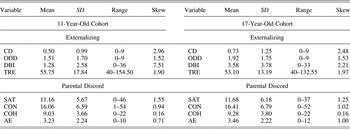
Confirmatory factor analysis (CFA) in Mplus (Muthén & Muthén, Reference Muthén and Muthén1998–2012) was used to evaluate the fit of composite parental marital discord and externalizing problems latent factors and create factor scores. A maximum likelihood robust estimator was used for each CFA to account for the nonnormality of some of the indicator variables (see Table 1 for descriptive statistics). The parental marital discord factor included the four subscales of the DAS with the metric set by fixing the satisfaction subscale to 1.0. Previous research has shown that the subscales of the DAS fit well into a general factor of relationship adjustment that is invariant across gender (South, Krueger, & Iacono, Reference South, Krueger and Iacono2009). The externalizing factor included the following indicators: symptom counts of CD and ODD from the DICA, DBI score, and TRE of externalizing. The metric of the factor was set by the CD symptom count score. Fit of the models was assessed using several fit indices, with root mean square error of approximation (RMSEA) values of approximately 0.06 or less and a comparative fit index (CFI) value of approximately 0.95 or greater indicating good fit of the data to the CFA model (Hu & Bentler, Reference Hu and Bentler1999).
Descriptive statistics

Note: CD, Conduct disorder; ODD, oppositional defiant disorder; DBI, Delinquent Behavior Inventory; TRE, teacher reported externalizing; SAT, satisfaction; COH, cohesion; CON, constraint; AE, affectual expression.
Biometrical modeling was used to examine whether parental marital discord moderates genetic and environmental influences on externalizing problems. This type of modeling utilizes twin data and a structural equation framework to decompose the variance in a trait into additive genetic influences (A), common environmental influences (C), and unique environmental influences (E). The E term also includes error. Biometric moderation models were run to determine if genetic and environmental components of variance on externalizing varied by level of parental marital discord (Purcell, Reference Purcell2002). The moderation models permit the use of different ACE estimates of externalizing problems for different levels of parental marital discord (see Figure 1). The ACE moderation model estimates genetic influences on externalizing after controlling for parents’ discord. This moderation model is an extension of the univariate ACE model and includes a β term for the estimate of the measured variable's (i.e., parental marital discord) moderation of genetic and environmental effects on the outcome (i.e., externalizing problems).
Biometric moderation model with parental marital discord moderating genetic and environmental variance on externalizing problems (model displayed for one member of the twin pair). A, Additive genetic; C, shared environment; E, nonshared environment. Moderation of externalizing by parental discord is signified by the product of a coefficient that categorizes the magnitude and direction of moderation (e.g., β X ) multiplied by the level of the moderator. Total phenotypic variance in externalizing is calculated by squaring and summing paths leading to the variance: P 2 = (a + β x M)2 + (c + β y M)2 + (e + β z M)2.

Mx software (Neale, Boker, Xie, & Maes, Reference Neale, Boker, Xie and Maes2003) fit data to biometric models. To correct for biases in fit of the model, scales were adjusted for effects of age and gender (see McGue & Bouchard, Reference McGue and Bouchard1984). Standardized residuals for factor scores from regression analyses including age, age2, Age × Gender, and Age2 × Gender were used in the biometric analyses. Full information maximum likelihood estimation with raw data was used to account for missing data. This technique allows the conservation of twin pairs wherein one twin within a pair has missing data.
For each cohort, two models were tested to assess effects of genetic and environmental moderation. The first model was a full moderation model, which included all of the main effects and interaction effects. The second model was a univariate no-moderation model, which did not contain the moderation parameters. Although some researchers test each moderation parameter (i.e., moderation of A, C, E) separately (e.g., Button et al., Reference Button, Stallings, Rhee, Corley, Boardman and Hewitt2009; Dick et al., Reference Dick, Viken, Purcell, Kaprio, Pulkkinen and Rose2007), the full ACE moderation model is reported and interpreted here because this model presents the most complete understanding of the moderation occurring on the genetic and environmental influences on externalizing problems (see Hicks, DiRago, Iacono, McGue, Reference Hicks, DiRago, Iacono and McGue2009; Jarnecke & South, Reference Jarnecke and South2014; Krueger, South, Johnson, & Iacono, Reference Krueger, South, Johnson and Iacono2008). The two models tested were compared using the likelihood ratio test and the Akaike information iriterion (AIC; Akaike, Reference Akaike1987). The likelihood ratio test measures goodness of fit, assessing degree of fit between model expectations and observed data. A nonsignificant χ2 difference test indicates that the more restrictive model with no moderation provides an appropriate fit to the data, and in general this more parsimonious model is preferred. The AIC penalizes for overparameterization while considering goodness of fit. Best fitting models include parsimonious descriptions of data and low AIC values.
Results
Biometric moderation of externalizing problems in younger cohort
The CFA for parental marital discord fit the data well, RMSEA = 0.00, 90% confidence interval (CI) [0.00, 0.04], and CFI = 1.00. Standardized factor loadings were 0.93, 0.79, 0.70, and 0.65 for satisfaction, consensus, cohesion, and affection expression, respectively. The externalizing factor also provided a good fit, RMSEA = 0.05, 90% CI [0.02, 0.09], CFI = 0.97, and produced standardized factor loadings of 0.72, 0.66, 0.41, and 0.53 for CD, ODD, DBI, and TRE, respectively. The DBI factor loading was low compared to the other factor loadings but still within acceptable limits (Tabachnick & Fidell, Reference Tabachnick and Fidell2007). The externalizing factor was not significantly correlated with the parental marital discord factor (r = .02, p = .56). Factor scores for both latent factors were extracted for use in biometric moderation analyses.
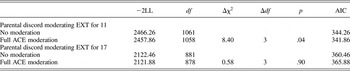
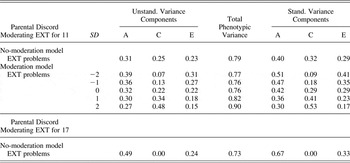
The full moderation model containing parental marital discord and externalizing problems fit significantly better than the no-moderation model (see Table 2), suggesting genetic and/or environmental influences on externalizing problems in offspring vary by level of parental marital discord. Parameter estimates and confidence intervals from this model are presented in Table 3. The confidence intervals around the estimates suggest that much of the moderation is present on the nonshared environmental path.
Fit statistics for moderation models

Note: –2LL, –2 log likelihood; AIC, Akaike information criterion; EXT, externalizing; ACE, genetic, shared, and nonshared environments.
Path estimates for moderation models

Note: EXT, externalizing; A, genetic path estimate to externalizing; Am, moderator of genetic path estimate; C, shared environment path estimate to externalizing; Cm, moderator of shared environment path estimate; E, nonshared environment path estimate to externalizing; Em, moderator of nonshared environment path estimate.
To provide a thorough understanding of the moderation, both unstandardized and standardized ACE estimates are reported. Unstandardized estimates presented a small and nonsignificant decrease in genetic influences, a relatively large but nonsignificant increase in shared environmental influences, and a significant and moderate decrease in nonshared environmental influences (see Table 4). Although the moderation parameter for genetic variance was not significant, the proportions of variance, presented in Table 4 and Figure 2, show that the heritability of externalizing problems decreased from low (a 2 = 51% at –2 SD below the mean) to high (a 2 = 30% at +2 SD) levels of parental marital discord. Shared environmental influences increased from low (c 2 = 9%) to high (c 2 = 53%) levels of parental marital discord, though, again, the CIs surrounding the moderated shared environmental parameter were not significant. Nonshared environmental influences significantly decreased from low (e 2 = 41%) to high (e 2 = 17%) parental marital discord.
Proportions of variance in externalizing problems for 11-year-old cohort. (a) Proportion of variance from the no-moderation model with parents’ marital discord, (b) proportion of variance in externalizing as a function of parents’ marital discord, (c) raw variance from the no-moderation model with parents’ marital discord, and (d) raw variance in externalizing as a function of parents’ marital discord. A, Genetic variance; C, shared environmental variance; E, nonshared environmental variance.

Estimates of unstandardized and standardized variance components

Note: EXT, externalizing; A, genetic; C, shared environment; E, nonshared environment.
Biometric moderation of externalizing problems in older cohort
The one-factor solution for parental marital discord fit well, RMSEA = 0.07, 90% CI [0.03, 0.12], and CFI = 0.99. Standardized factor loadings were 0.91, 0.74, 0.68, and 0.75 for satisfaction, consensus, cohesion, and affection expression, respectively. The externalizing factor also provided a good fit, RMSEA = 0.04, 90% CI [0.01, 0.08], and CFI = 0.99. It yielded standardized factor loadings of 0.66, 0.58, 0.66, and 0.63 for CD, ODD, DBI, and TRE, respectively. The factor score for externalizing problems was significantly correlated with the factor score for parental marital discord (r = .09, p = .01).
Here, the full moderation model failed to fit significantly better than the no-moderation model (see Table 2). Results suggest genetic and environmental influences on externalizing problems did not vary by level of parental marital discord. Although moderation was not found for this model, the ACE estimates for externalizing problems can be interpreted from the no-moderation model. Genetic influences accounted for 67% of the variance in externalizing problems, and the remainder of the variance (33%) was accounted for by nonshared environmental influences.
Discussion
The costs associated with externalizing problems may be severe to both the individual and the larger community. Exploring the nature of externalizing psychopathology in more depth may bring about greater understanding of how to conceptualize and treat disorders in this spectrum. In the current study, one step toward this goal was taken by exploring if and how genetic and environmental variance on offspring externalizing problems is moderated by parental marital discord in cohorts of different ages. Results suggest the nonshared environmental components of externalizing problems significantly varied as a function of parents’ marital discord only in a preteen sample and not a sample of older adolescents.
In the younger twin cohort, the proportion of variance in externalizing accounted for by genetic and nonshared environmental factors decreased as parents’ marital discord increased, though the CI surrounding the genetic parameters suggests that the change in genetic variance was not significant. Further, the proportion of variance accounted for by shared environmental factors increased as marital discord increased, though, again, the CI surrounding this parameter included 0. Even though the moderation parameters for shared environmental variance was nonsignificant, these results suggest that proportionally, shared environmental variance is contributing more to externalizing problems, relative to nonshared environmental variance, at high levels of parental marital discord. The unstandardized estimates present a similar pattern of results as the standardized estimates.
Findings from this study are inconsistent with recent work from Burt et al. (Reference Burt, Wildey and Klump2015), who found that parental relationship quality did not moderate the genetic and environmental variance of offspring conduct problems in a sample of 6- to 10-year-old twins. There are some notable differences between that study and the current study, which could explain the discrepant findings. First, the current study used factors of marital quality, comprised from each of the DAS subscales, and externalizing problems, which was created from a variety of indicators that included child, parent, and teacher reports. Previous research has shown that the broad construct of externalizing is more stable longitudinally than individual indicators of externalizing problems or disorders and may be better suited to detect effects in genetics research (Hicks et al., Reference Hicks, Krueger, lacono, McGue and Patrick2004; Krueger, Caspi, Moffitt, & Silva, Reference Krueger, Caspi, Moffitt and Silva1998; Salvatore et al., Reference Salvatore, Aliev, Bucholz, Agrawal, Hesselbrock, Hesselbrock and Dick2015; Vollebergh et al., Reference Vollebergh, Iedema, Bijl, de Graaf, Smit and Ormel2001). Burt et al. (Reference Burt, Wildey and Klump2015) looked at individual subscales of the DAS, child-report ratings of conflict, observer ratings of spousal interactions, and parent reports of conduct problems from the Child Behavior Checklist (Achenbach & Rescorla, Reference Achenbach and Rescorla2001). Second, the populations sampled differed between studies; the current study used a primarily European American sample from Minnesota whereas Burt et al. utilized a more ethnically diverse sample from Michigan. There has been a call recently to further explore ethnicity in genetics research (e.g., Bonham, Warshuaer-Baker, & Francis, Reference Bonham, Warshauer-Baker and Collins2005). This may be particularly useful to consider when examining G × E because ethnic minority groups tend to face a much more extensive set of risk factors to their health and well-being than European Americans (e.g., Zografos & Perez, Reference Zografos, Pérez, Pérez and Luquis2014). Other risk factors may simply be more or less pertinent to the moderation of genetic and/or environmental variance on externalizing problems in different populations.
In addition, our study was limited to families in which the biological parents’ marriage was intact whereas Burt et al. (Reference Burt, Wildey and Klump2015) included stepparents in their sample. While the quality of the marital relationship between a parent and a stepparent is important to consider, it may have different effects on offspring adjustment, particularly if the child feels less invested in the state of that relationship versus a relationship between his/her own birth parents. It will be necessary for future studies to replicate these findings in order to determine the true effect of parental marital discord on the genetic and environmental components of offspring externalizing problems. If parental marital discord does not moderate variance on conduct problems in young children but does moderate variance on an externalizing factor in slightly older children, this might suggest that genetic and environmental variance on the core components of externalizing problems are more likely to vary than effects on a specific externalizing phenotype (e.g., conduct problems).
Although the CI surrounding the shared environment moderation parameter included 0, the magnitude of the shared environmental effect appeared large compared to other twin studies, many of which have failed to find effects of the shared environment. This may suggest that the rearing environment is influential on children's externalizing problems and, proportionally speaking, plays a greater role on externalizing problems when that environment is marked by adversity. Future research should replicate these findings, however. The present analyses cannot reveal which environmental factors fall within the shared environment that makes twins more similar to one another and thus more likely to display externalizing problems, but speculations and hypotheses can be derived from previous research. For instance, children who belong to families where parental marital discord is present may be more likely to display externalizing problems because they are also exposed to less adaptive parenting styles. Previous research has shown that parents in distressed relationships tend to engage in more conflict with their child and monitor their children less than parents in more satisfied marital relationships (Fauber, Forehand, Thomas, & Wierson, Reference Fauber, Forehand, Thomas and Wierson1990; Gerard, Krishnakumar, & Buehler, Reference Gerard, Krishnakumar and Buehler2006).
For children raised in homes with more harmonious parent relationships, influences from the unique environment are more likely to contribute to externalizing problems than they are for children in homes with high parental discord. Offspring displaying externalizing problems, despite having parents whose relationship quality is high, may be doing so because other factors in their environment are contributing to the manifestation of their behaviors. For instance, peers may have a substantial influence on externalizing problems; having peer groups that use substances increases the likelihood of an adolescent using (Button et al., Reference Button, Stallings, Rhee, Corley, Boardman and Hewitt2009; Mason & Windle, 2000; Trucco, Colder, Bowker, & Wieczorek, Reference Trucco, Colder, Bowker and Wieczorek2011). When parental discord is low, genetic and shared environmental factors are still playing a role; thus, genetic and environmental variance works in conjunction to contribute to the manifestation of externalizing problems at this level of parental marital functioning. Our estimates that suggest that genetic variance is relatively greater in environments with low parental discord may seem in line with a social push perspective; however, given that the CI surrounding the genetic moderation parameter included 0 and that nonshared environmental variance was also higher in this context makes it unclear if any existing theories adequately explain the pattern of moderation uncovered.
Examining the same factor of externalizing in the 17-year-old cohort, there was no support for biometric moderation from parental marital discord. That is, genetic and environmental components of externalizing did not vary by level of parental marital discord. By the time children are 17 years old, they may not be seeing discord as frequently because as adolescents grow older they spend less time within the home and with their parents (Lam, McHale, & Crouter, Reference Lam, McHale and Crouter2012); this may also explain why common environmental influences explain a negligible amount of the variance in externalizing problems at this age. That is, as adolescents spend increasingly less time in the home, they may be more likely to encounter unique experiences that would be captured in the nonshared environmental component of variance rather than the shared environment. Another possibility to explain the lack of moderation at this age is that as children approach adulthood, family factors, such as parents’ marital functioning, are increasingly less likely to affect the expression of the genetic and environmental influences on the types of externalizing problems outlined here. This may be because of biological or neurodevelopmental changes (e.g., puberty and brain maturation) that take place during adolescence (see Smith, Chein, & Steinberg, Reference Smith, Chein and Steinberg2013) or because of a shift in environments (e.g., spending increased time with peers versus family). This is consistent with previous research, which has found the association between paternal marital adjustment and child externalizing problems diminishes across childhood (Mahoney et al., Reference Mahoney, Jouriles and Scavone1997).
Although no moderation was found for the 17-year-old cohort, it is important to consider how “externalizing problems” was defined because the types of externalizing behaviors that are more salient and perhaps more subject to influences from the family environment are likely to vary by developmental age (see Rutter, Kim-Cohen, & Maughan, Reference Rutter, Kim-Cohen and Maughan2006). Instead, genetic and environmental influences on other externalizing or deviant behaviors that tend to emerge during adolescence, such as substance use and risky sex (Clark, Doyle, & Clincy, Reference Clark, Doyle and Clincy2013; Mason et al., Reference Mason, Hitch, Kosterman, McCarty, Herrenkohl and Hawkins2010), may vary by level of parental marital discord. These behaviors may be important to examine further in future research.
The current study is not without its limitations. Because of the cross-sectional nature of the data, we were unable to infer if differences between cohorts were due to age or other differences (e.g., cohort) between samples. In addition, the measures of externalizing problems used in the current study may have been assessing slightly different expressions of the phenotype in the two cohorts. For example, the information that teachers have access to about a child's level of externalizing behaviors may be different at age 11 versus age 17. Conclusions cannot be drawn about the pattern of moderation that might exist for children of divorced or remarried parents or parents who show more extreme levels of discord; future research should further examine how the quality of different types of parental relationships (e.g., mother and stepfather) may moderate genetic and environmental influences on offspring externalizing. It is also worth noting that the very nature of the environmental risk factor examined in the present study may have had a distinct effect on the pattern of moderation that emerged. If additional moderators are examined in the future, other patterns of moderation may arise.
Despite these limitations, this study adds to our basic understanding of externalizing problems in children and adolescents and may have implications for clinical intervention efforts. For example, a preteen who is acting disruptively despite being raised in a supportive family environment may require different interventions than one who is raised in family marked by parental discord. In the first scenario, it might be important to explore what else is happening in the environment (e.g., peer influences and differential exposure of parental conflict between twins) that could contribute to the externalizing behaviors. In the second, because nonshared environmental influences contribute proportionally less to externalizing problems when the level of parental discord is high, it might be more appropriate to take a family-systems perspective, encouraging parents to work on their relationship and explore how it may contribute to the child's behaviors. Previous research has found improvements in offspring adjustment following the dissolution of high-conflict parent marriages (Amato & Booth, Reference Amato and Booth2001); thus, if parents can successfully resolve their discord before reaching the point of divorce, children may also benefit. Further, because moderation was not present for the adolescent cohort, the current research suggests that treatment for a child may need to be different than for an adolescent. For example, with an older adolescent, it may not be as important to focus on familial factors. However, early intervention for these issues is certainly preferred before externalizing patterns of behavior become entrenched (e.g., Dodge et al., Reference Dodge, Bierman, Coie, Greenberg, Lochman, McMahon and Pinderhughes2015).