INTRODUCTION
Prior to 1960, the vast majority of students attending selective colleges and universities in the United States were Whites of European origin. This fact reflected American demography at the time, as before that date eighty-six percent of all Americans were non-Hispanic Whites; but it also stemmed from active exclusion and discrimination against minorities. As late as the 1960s, more than two-thirds of all Whites supported racial segregation in schools (Schuman et al., Reference Schuman, Steeh, Bobo and Krysan1998). However, both demography and beliefs changed radically in the United States during the latter half of the twentieth century. The Civil Rights Movement successfully transformed racial attitudes, and a resurgence of immigration altered U.S. population composition. By 2000 only four percent of White Americans supported racial segregation in schools, and the share of non-Hispanic Whites in the population had fallen to sixty-eight percent. Among those aged eighteen and under, only sixty percent were non-Hispanic Whites, compared with seventeen percent Latinos, fifteen percent African Americans, four percent Asians, and one percent Native Americans. Clearly, the future of the United States is one of considerable racial and ethnic diversity.
As formerly under-represented minorities entered into elite domains of higher education during the 1970s and 1980s, the fortunes of various racial and ethnic groups diverged. In terms of grades and graduation rates, Asians generally performed as well or better than Whites whereas African Americans and Hispanics lagged significantly behind (Bowen and Bok, Reference Bowen and Bok1998; Bowen et al., Reference Bowen, Chigos and McPherson2009). These performance differentials partly reflect longstanding socioeconomic differences between groups, which correspond to significant differences in access to various forms of capital—human and financial capital, of course, but also social and cultural capital (Massey et al., Reference Massey, Charles, Lundy and Fischer2003). Nonetheless, controlling for socioeconomic background does not make the academic performance gaps disappear, and their durability has fueled a vociferous public debate about the merits and effects of affirmative action (Anderson Reference Anderson2004; Kellough Reference Kellough2006) as well as an academic debate on the causes of minority under-achievement (Pennell Reference Pennell2003).
The National Longitudinal Survey of Freshmen was launched to address issues raised in both debates. It interviewed the cohort of students entering twenty-eight selective colleges and universities in the fall of 1999 and followed them for the next four years.Footnote 1 Work based on these data, which are publicly available to users at http://nlsf.princeton.edu/, has studied the determinants of academic success during the early years of college. Charles et al. (Reference Charles, Fischer, Mooney and Massey2009), for example, estimated a series of statistical models that used multiple indicators of a variety of theoretically derived constructs to predict grades and persistence through the sophomore year. Their models indicated that gaps between Whites, Asians, Latinos, and Blacks were largely explained not by a few simple factors, but by a complex array of background characteristics and campus circumstances, including degree of academic preparation, choice of major, difficulty of courses taken, educational aspirations, campus living circumstances, involvement in campus organizations, financial aid issues, exposure to disadvantaged ecological settings, a perceived negative campus racial climate, pressure associated with stereotype threat, and stigma arising from affirmative action.
Here we extend our assessment of academic outcomes to encompass all years of college, not just the freshman and sophomore years; and rather than focusing only on the main effects of race and ethnicity (henceforth simply labeled “race”), we consider performance differentials between groups defined on the basis of gender as well as race. We not only model the determinants of grade achievement but also the likelihood of graduation within four and six years. We show that the main effects of race mask important heterogeneity in academic achievement when racial groups are broken down by gender, with Hispanic males, Black females, and especially Black males lagging significantly behind other race-gender groups. We conclude by identifying key determinants of grades and graduation rates to distill lessons for college administrators and policy makers.
PERFORMANCE DIFFERENTIALS AT SELECTIVE SCHOOLS
We begin by drawing on data from all five waves of the National Longitudinal Survey of Freshmen to summarize students' academic progress over four years of college. Details about the sampling design and interviewing methods used by the NLSF are available from Massey et al. (Reference Massey, Charles, Lundy and Fischer2003) and Charles et al. (Reference Charles, Fischer, Mooney and Massey2009), as well as from the project website. In brief, minority groups at each institution were over-sampled to meet a target of around 1000 respondents each among Whites, Blacks, Latinos, and Asians. Table 1 shows the final disposition of all survey waves. The total size of the baseline sample was 3924, interviewed with an eighty-six percent response rate. Among baseline respondents, 998 were White, 959 were Asian, 916 were Latino, and 1051 were Black. Group-specific response rates varied from eighty-three percent among Whites to eighty-nine percent among Blacks. This cohort of students was followed for the next four years and re-interviewed each spring, whether or not respondents continued in the same school. The response rate naturally fell with each successive wave, going from ninety-five percent in the spring of the freshman year to eighty-nine, eighty-four, and seventy-nine percent in the spring of the sophomore, junior, and senior years, respectively. The final completion rate was eighty-two percent for Whites, eighty percent for Asians, seventy-nine percent for Latinos, and seventy-six percent for African Americans—rates that are very high by contemporary social science standards (Yu and Cooper, Reference Yu and Cooper1983).
Completion Rates Achieved in Five Waves of the National Longitudinal Survey of Freshmen

Figure 1 depicts the average grade point average (GPA) earned during each year of college for eight race-gender groups. As can be seen, differences in grade achievement emerged immediately in the freshman year. Clustered closely together at the top of the grade distribution were (in descending order) White females, Asian females, Asian males, and White males, with freshmen GPA's ranging from 3.30 to 3.37. These groups were followed at a distance by Hispanic females at 3.14, Hispanic males at 3.05, Black females at 3.02, and Black males at 2.92. These grade differentials were significant, not only statistically but substantively because, despite their lower grades, Blacks and Latinos were more likely to aspire to graduate and professional education than Whites (Charles et al., Reference Charles, Fischer, Mooney and Massey2009).
GPA Earned by Different Race-Gender Groups across Four Years of College

In general, grade achievement improves as students move from their freshman to their sophomore year, with the notable exception of Black males. They are the only group whose average GPA did not rise. In fact, it declined very slightly between the freshman and sophomore years, going from 2.92 to 2.91. Although grades for Black males rose in the junior and senior years, this improvement was insufficient to offset the widening of the gap between the freshman and sophomore years, so that the GPA differential between Black and White males was greater at the end of college than at the beginning. Although the grades of Black females and Hispanic males improved through both the sophomore and junior years, they faltered in the senior year, and their achievement gaps also widened. The one exception to the pattern of widening differentials compared with Whites was Hispanic females, whose grade performance improved rapidly and steadily across all four years of college. By senior year their average GPA was in the same range as Whites and Asians, and actually exceeded that of Asian males.
Figure 2 continues our comparative analyses by showing the proportion of students in each race-gender group who graduated from college four and six years after entry. Graduation refers to earning a degree at any four-year college, not just the one entered as a freshman. Once again, Black males are the clear outlier. Only forty-eight percent graduated on time and even two years later only seventy-three percent had successfully finished. Although Hispanic males and Black females also lagged behind Whites and Asians, their graduation rates were significantly higher than those of Black males, and reached sixty-three percent after four years and eighty-three percent after six years. Given that Black females out-numbered Black males by a substantial margin upon entry as freshmen (see Massey et al., Reference Massey, Charles, Lundy and Fischer2003), these figures mean that the sex distribution among African Americans became even more skewed in the course of college. Indeed, whereas Black females outnumber Black males by 2 to 1 among entering freshmen, among college graduates after six years the ratio was 2.3 to 1. These data portend a continuing and rather stark demographic scarcity of males among the educated Black elite of the United States, a point to which we return in the conclusion.
Proportion Graduating after Four and Six Years of College

In terms of graduation rates, all of the other race-gender groups cluster tightly in a narrow range at the top of the figure, and differences between the groups diminish over time. After four years of college, for example, seventy to seventy-eight percent of all Asians and Whites and Hispanic females have graduated, with the lowest share being exhibited by Hispanic females and the highest by White females. After six years, the range has narrowed even more—from eighty-eight to ninety-two percent—with the same two groups occupying the top and bottom spots. As with GPA, Hispanic females generally perform well compared with Whites and Asians. Whatever is happening to undermine the academic performance of minority group members, it appears disproportionately to affect Hispanic males, Black females, and most notably Black males.
EXPLAINING THE DIFFERENTIALS
In the course of two books and a series of articles, investigators associated with the NLSF have employed a variety of theoretical approaches to specify and estimate models of academic achievement. Massey et al. (Reference Massey, Charles, Lundy and Fischer2003) focused on pre-college experiences and undertook a detailed analysis of the characteristics that students brought with them when they arrived on campus, including inter-group differences in family socioeconomic status, neighborhood conditions, school experiences, peer environments, and psychological conditioning. They sought to test theories attributing achievement gaps to inter-group differences in access to various forms of capital, and to this end the authors documented numerous differences in access to financial capital, human capital, social capital, and cultural capital. They also sought to test Fordham and Ogbu's (Reference Fordham and Ogbu1986) “burden of acting White” thesis by measuring the degree to which same-race peers supported or disparaged academic achievement, as well as Steele's (Reference Steele1997) hypothesis of stereotype threat by measuring the degree to which respondents subscribed to negative stereotypes about their group's abilities.
In models estimated to predict GPA during the first academic term, Massey et al. (Reference Massey, Charles, Lundy and Fischer2003) found that inter-group differences in grade performance were greatly reduced after controlling for differences in academic preparation, socioeconomic status, social preparation, and vulnerability to stereotype threat. Although the authors documented numerous differences in access to many specific indicators of social and cultural capital, most did not have much of an effect on academic performance once family economic status and parental education were controlled. The models did not support the “burden of acting White” hypothesis but did yield results consistent with the stereotype threat hypothesis.
Even after controlling for background differences, however, significant differences in academic performance persisted, with Hispanics earning a GPA that was 0.18 points below that earned by Whites and Asians, and African Americans earning a GPA that was 0.23 points lower. Charles et al. (Reference Charles, Fischer, Mooney and Massey2009) therefore expanded the analysis of Massey et al. (Reference Massey, Charles, Lundy and Fischer2003) to take into account social and academic experiences on campus as well as pre-college characteristics. Moreover, building on the work of Massey and Fischer (Reference Massey and Fischer2005), they undertook a more comprehensive examination of the stereotype threat hypothesis, and drawing on Massey and Mooney (Reference Massey and Mooney2007) they developed new measures of the degree to which individuals were likely beneficiaries of affirmative action and the degree to which institutions practiced affirmative action.
These expanded models revealed that earning good grades was substantially an academic process that, logically enough, depended on selecting an appropriate major, choosing the right blend of easy versus hard courses, making a strong academic effort, minimizing recreational time, having contact with faculty, joining academic or career groups on campus, having high educational aspirations, and being well prepared academically for the intellectual demands of an elite college education. In addition, having well-educated parents also conferred an important scholastic advantage. Although the process of grade achievement was mostly academic in nature, social circumstances on campus did play a significant secondary role. Living off-campus with family members or in a fraternity or sorority, for example, was associated with earning a lower GPA.
Beyond these effects, which were common to all groups, Black and Hispanic students faced unique challenges stemming from their status as minority group members. Those students who came from racially-segregated schools and neighborhoods experienced significantly greater levels of family stress while in college because people in their kin networks incurred more negative life events owing to living in disadvantaged residential areas. Minority students also earned lower grades because of burdens stemming from stereotype threat. Specifically, those who internalized negative stereotypes tended to engage in what social psychologists call “disidentification,” a psychological defense mechanism in which the domain where the threat occurs is dropped as a basis for self-esteem (Aronson et al., Reference Aronson, Quinn, Spencer, Swim and Stangor1998; Crocker and Major, Reference Crocker and Major1989; Steele and Aronson, Reference Steele and Aronson1995), which led to a reduction of academic effort among minority students that translated into lower grades. In addition, minority group members who expected other students and faculty to judge them invidiously on the basis of negative stereotypes experienced a heavier psychological performance burden that also undermined grade performance. Results indicated that the latter performance burden could be exacerbated by institutional practices of affirmative action that inadvertently stigmatized minority students as “less qualified.”
In terms of persistence, the steady accumulation of credits was strongly associated with the choice of major, number of courses taken per semester, and aspirations for an advanced degree. In addition, living off campus with friends or family members, devoting too much time to recreation, and incurring large debts were negatively associated with the accumulation of course credits. Finally, Black and Latino students again experienced special challenges associated with their minority status. The accumulation of course credits was significantly undermined by the perception of a negative racial climate on campus and by family stress linked to neighborhood disadvantage.
MODELING THE DIFFERENTIALS
In this analysis, we move beyond the foregoing results by considering the GPA students earned across all four years of college and assessing the influence of different factors on the likelihood of college graduation. As noted in the introduction, we also expand our lens to consider not just racial and ethnic differences in performance, but differences between groups defined on the basis of gender as well as race. Owing to the richness of the NLSF data set, we are able to investigate the effects not only of subtle psychological processes such as stereotype threat, but also the continuing consequences of school and residential segregation and racial climate and intergroup experiences on campus.
Our starting point is the comprehensive model developed by Charles et al. (Reference Charles, Fischer, Mooney and Massey2009), with a few additions. The specific constructs and indicators we use to predict GPA and graduation probabilities are shown in Table 2. In order to maximize the number of cases, we compute GPA for all students up to the point at which they dropped out of the sample, with a total of 3815 cases. We use institutional databases to measure college graduation for all students interviewed in the baseline survey, with a total of 3914 cases. Unlike Charles et al., we add controls for institutional selectivity by using dummy variables to represent the ten most selective and ten least selective institutions in terms of average SAT scores. We also included a dichotomous variable indicating whether the institution was in the Ivy League (Yale, Princeton, Penn, or Columbia). A student's choice of major was classified into one of six categories, each of which was indicated by a dummy variable: social-behavioral sciences, biological-physical sciences, math-computer science-engineering, humanities, professions, and a residual other category.
Variables Used in Models Predicting Cumulative College GPA and Probability of College Graduation

To control for the difficulty of courses we developed two indicators: the ratio of “easy” to “hard” course taken by each student and a self-rated scale of course difficulty. Full details about these and other social scales are included in Appendix B of Massey et al. (Reference Massey, Charles, Lundy and Fischer2003) and Appendix C of Charles et al. (Reference Charles, Fischer, Mooney and Massey2009). As explained in the latter source, we defined easy and hard courses by computing the average GPA for different courses and inspecting the distribution of grades to discern natural cut points. We found that students in courses with GPAs above 3.40 received a preponderance of A's and B's with few grades of C or lower and we labeled these “easy.” Those students in courses with an average GPA of 3.05 or less received few A's, many B's, a substantial number of C's, D's, and F's and we labeled these “hard.” The self-rated scale of course difficulty came from a question that asked students to estimate the difficulty of courses in six general subject areas on a 0–10 scale, which were averaged across subject areas to create a subjective index of course difficulty (α = 0.75).
The model developed by Charles et al. (Reference Charles, Fischer, Mooney and Massey2009) includes measures of four additional academic inputs: whether respondents received help from the institution, whether they received help from faculty, whether they received help from fellow students, and an effort index that drew upon 0–10 ratings provided by students for courses in different subject areas (α = 0.82). Educational aspirations were measured using dummy variables to indicate whether or not the respondent aspired to an M.A. or equivalent degree, and whether or not the respondent aspired to a Ph.D. or equivalent.
In order to assess peer culture, we developed three indices. The scale of peer support for academics was based on a series of questions that asked respondents to rate on a 0–10 scale how important it was among their friends to attend class regularly, to study hard, to get good grades, and to go to graduate or professional school (α = 0.76). The scale of peer support for social life was based on questions that asked respondents to rate on a 0–10 scale how important it was among their friends to be willing to party, to be popular, and to hang out with friends (α = 0.41—obviously not the most reliable of scales). Finally, the scale of social support was based on a series of questions that asked students to rate on a 0–10 scale the frequency with which they studied with other students, organized study groups, and sought help from their classmates (α = 0.77).
Financial issues facing each student were assessed using five indicators. Relative cost was indicated by the ratio of the yearly amount the family paid for the student to attend college over the value of the family's home. Relative debt was indicated by the amount borrowed per year divided by home value. We also included variables measuring the average amount of money a student charged per month on a credit card that was billed to parents or other family members, and the average amount per month a student received in transfers from parents or other family members. Finally, we constructed a scale to measure the degree to which students were experiencing difficulty with financial aid. Each student was asked to rate on a 0–10 scale how much they agreed with the statements “I am having problems with my financial aid” and “I often have to speak with a financial aid counselor about money matters.” We combined answers to these questions during the freshmen and sophomore follow-up surveys to create a four-item, 0–40 scale of difficulty with financial aid (α = 0.71).
To control for a student's living situation, we used dummy variables to indicate whether he or she had lived off campus during the first two years of college in one of three possible situations: in an apartment, in a fraternity or sorority, or with family members. The reference category was living in a dormitory. We also constructed a scale to measure the degree to which students were distracted in their living quarters by asking them to rate on a 0–10 scale how often they felt distracted by someone talking, playing music, watching TV, and partying in their freshman and sophomore years (α = 0.77); and we measured the extent to which students took evasive actions to avoid distraction by asking how often on a 0–10 scale they had to leave their living quarters or stay late in the library during their freshman and sophomore years to get schoolwork done (α = 0.71).
The diversity of each respondent's friendship network was determined from a question that asked students to describe their ten best friends, from which we computed the percent Asian, percent Black, and percent Latino. Classroom diversity was measured using each respondent's report of the share of non-White students in the first class they attended, and whether or not they ever had an Asian, Black or Hispanic professor during their first year in college. Given the importance of integration and belonging to persistence (Tinto Reference Tinto1993), we included also dummy variables to indicate a respondent's involvement in various campus organizations, including a career development group, varsity sports, intramural sports, a fraternity or sorority, a religious group, a political or environmental group, a race-oriented group (such as the Black Student Union), and groups a majority of whose members were White, Black, Asian, and Latino. The NLSF questionnaire included a detailed series of questions on time use from which we computed average hours spent per week on academic matters, extracurricular activities, recreation, work, personal maintenance, and sleep. We also computed the ratio of work hours to academic hours to indicate the degree to which work cut into scholarship.
To consider racial issues on campus we examined dating patterns and “racial climate.” We measured whether or not each respondent had ever dated outside his or her racial group, or ever had a partner outside his or her racial group. Contingent on having any romantic experience outside one's racial group, we then asked how often on a 0–10 scale they had experienced negative out-group reactions for having a date or partner outside the group (α = 0.78). The overall racial climate on campus was measured by an index constructed from a series of items that asked respondents to state on a 0–4 scale how often they had been made to feel self-conscious by classmates, professors, or just walking around campus; how often they had heard derogatory remarks about their group from students, professors, and others on campus; and whether they had ever been discouraged from talking in class or taking a course, or given an unfair grade because of race or ethnicity (α = 0.80).
Other key processes affecting minority students stemmed from ecological background, stereotype threat, and affirmative action. Ecological isolation was measured by computing the average percentage of Blacks and Latinos in the neighborhoods that respondents experienced at ages six, thirteen and eighteen, as well as the average diversity in their neighborhoods inhabited at the same ages (using the Theil Index). Exposure to disorder and violence in schools and neighborhoods was assessed using a severity-weighted index developed by Massey et al. (Reference Massey, Charles, Lundy and Fischer2003). Frequency with which various transgressions were experienced was weighted by the severity of the transgression as measured by the Sellin-Wolfgang (Wolfgang et al., Reference Wolfgang, Figlio, Tracy and Singer1985) crime severity scale (α = 0.78). Likewise, the family stress index weighted the frequency with which different negative life events occurred to members of a student's family (mortality, criminal victimization, other social problems) by the severity of the event using the stress scale developed by Holmes and Rahe (Reference Holmes and Rahe1967) (α = 0.50).
Stereotype threat was assessed along two dimensions. The degree to which negative group stereotypes were internalized was measured from a series of items that asked respondents to rate on a 0–10 scale the degree to which their own group was unintelligent, lazy, and gave up easily (α = 0.61). Stereotype externalization was based on a series of items that asked respondents to state on a 0–10 scale the degree to which different out-groups discriminate against members of their group, and the degree to which students and faculty held negative stereotypes that affected evaluations of their group (α = 0.59). Under the theory of stereotype threat, the internalization of stereotypes is hypothesized to result in disidentification with academic achievement as a domain of self-evaluation, which is expressed by a reduction of hours spent on academic pursuits and an increase in non-academic pursuits (Massey and Fischer, Reference Massey and Fischer2005). The externalization of stereotypes, meanwhile, is hypothesized to yield a psychological performance burden, which we measure using a series of questions that asked respondents to rate on a 0–10 scale the degree to which, if instructors and students know about difficulties they were experiencing in college, they would think less of them; the degree to which they think that excelling academically reflects positively on their group; the degree to which doing poorly academically reflects poorly on their group; and how conscious they were of how out-group members and instructors perceived them (α = 0.71).
Affirmative action was assessed at both the individual and institutional levels. To measure affirmative action at the individual level, we computed the difference between the SAT score earned by specific Black and Latino students and the institutional average SAT. For students with SAT scores that equaled or exceeded the institutional average, we coded the variable as 0. For those with scores below the institutional average we took the absolute value of the difference to indicate the relative likelihood that the student received an affirmative action benefit. The greater the value of this index, the greater the odds that the student in question received an affirmative action “bonus” in the admissions process (Massey and Mooney, Reference Massey and Mooney2007). To measure affirmative action at the institutional level we took the difference between the average SAT score earned by Black and Hispanic students on campus and the average SAT score earned by all students at that institution. The larger this gap, the more an institution used criteria other than test scores to determine minority admissions (Massey and Mooney, Reference Massey and Mooney2007).
Academic preparation was measured using four indicators: cognitive skills as measured by the student's SAT score, the number of advanced placement courses taken in high school, the GPA earned in high school, and the degree to which students felt their high schools had prepared them for college-level work on a 0–10 scale. Family educational background was assessed using dummy variables to indicate the number of degrees held by parents: no college degree among parents, one college degree, two college degrees, one advanced degree, and two advanced degrees. Family socioeconomic status was indicated by the natural logarithm of the home value and by dummy variables indicating whether or not the family was ever on welfare during the respondent's childhood and whether or not the family income exceeded $100,000.
Demographic background was assessed by measuring whether or not the student was foreign born, whether the respondent spent his or her entire childhood in a two-parent family, and the number of siblings under age eighteen. Social preparedness for college was measured in terms of susceptibility to peer influence, self-esteem, self-efficacy, and perceived social distance from Whites. Self-esteem (α = 0.86) and self-efficacy (α = 0.69) were measured using standardized scales developed by Rosenberg and Simmons (Reference Rosenberg and Simmons1971). Susceptibility to peers was measured by a seven-item scale that used a 0–4 continuum to rate the degree to which they thought it was important to think and act like others, hang out with others, feel comfortable with others, and value the same things as others; and the degree to which they worried about what others thought, worried about being called a nerd, and did things to make others like them (α = 0.59). Distance to Whites was measured using three items that asked students to rate on a 0–10 scale how close they felt to Whites in general, young White men in particular, and young White women (α = 0.87).
DETERMINANTS OF GRADE ACHIEVEMENT
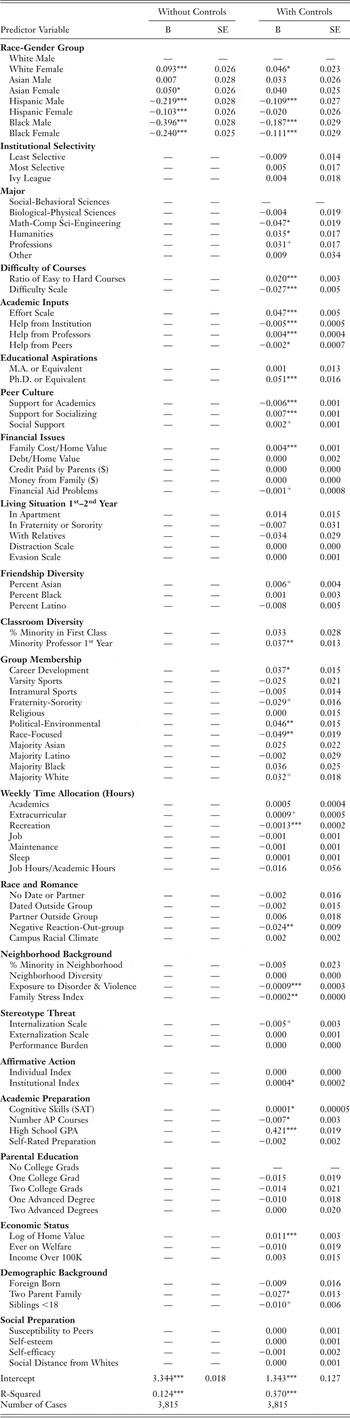
Table 3 shows two models estimated to predict cumulative GPA. Coefficients and standard errors for the first model are presented in the two left-hand columns. This model includes only dummy variables for the separate race-ethnic-gender groups, with White males serving as the reference category. The two right-hand columns present coefficients and standard errors for a model that includes the group dummies plus all of the independent variables specified in Table 2. The first two columns thus illustrate the significant differences in the GPA earned by the different race-ethnic-gender groupings.
Effect of Selected Variables on Cumulative College GPA

+ p < .10;
* p < .05;
** p < .01;
*** p < .001
Compared with White males, two groups earn higher grades, four groups earn lower grades, and one group is the same in statistical terms. As can be seen, Asian males and White males earned nearly identical GPA's, whereas Asian and White females earned significantly higher grades. The GPA for Asian females was 0.050 points above that of White males and the GPA for White females was 0.093 points above. In contrast, all Black and Latino students, whether male or female, earned significantly lower grades than White males. As already noted, Black males earn by far the lowest grades, with a deficit of −0.396 grade points compared with White males, followed by Black females at −0.240, Hispanic males at −0.219, and Hispanic females at −0.103.
The group coefficients in the right-hand columns reveal that these gaps are significantly reduced, though not always eliminated entirely, once inter-group differences in the independent variables are taken into account. In the full model, White males, Asian males, Asian females, and Hispanic females earn essentially the same GPA, whereas White females still earn a significantly higher GPA. Black males, Black females, and Hispanic males earn significantly lower GPA's, though controlling for inter-group differences in the variables under consideration cuts the magnitude of the grade differentials roughly in half.
Holding constant the difficulty of courses, the choice of major does not have much effect on GPA. Compared with a major in the social sciences, grades are a little lower for math, computer science, and engineering majors and a little higher for majors in the humanities and professions, but about the same for those in the biological and physical sciences. As one might expect, however, grades are quite strongly affected by the difficulty of courses. The higher the ratio of easy to hard courses, the higher the GPA; and the more difficult students perceived their courses to be, the lower their grades. In terms of academic inputs, grades are boosted by putting in greater study effort and by seeking help from professors. The coefficient associated with getting help from the institution is negative, however. This result does not imply that institutional support is counterproductive, but that people with low grades are likely to turn to the institution for help. The negative effect of receiving help from peers is more ambiguous—it could represent either the self-selection of poor students into peer assistance or the poor quality of assistance received from peers.
Aspirations matter, as indicated by the fact that those students aspiring to a Ph.D. or equivalent exhibit a GPA that is 0.05 points higher than other students. In terms of peer effects, general social support and peer support for socializing seem to yield better grades, whereas peer support for academics has a negative effect. This result lends support to the view that academic assistance received from peers is indeed of poor quality. Aside from the positive effect of taking a course from a non-White professor as a freshman, diversity in the classroom and among friends does not have much influence on grades, nor does the student's living situation.
Participation in campus organizations has more influence on grades, with membership in career development, political-environmental, and majority White groups being associated with a higher GPA and membership in a fraternity or sorority and a race-focused group being associated with a lower GPA. In general, then, belonging to socially-oriented groups seems to lower grade performance whereas belonging to mainstream, career-oriented, or political groups improves it. The more hours devoted to recreation the lower the grade performance; but the more time students devote to extracurricular activities on campus, the greater the GPA they achieve (though the latter effect lies on the margins of significance).
In terms of variables related to minority status, experiencing a negative reaction to dating outside of one's group is associated with lower grades, as is exposure to neighborhood disorder and violence while growing up, exposure to family stress concurrently, and the internalization of negative group stereotypes. Since the internalization of negative stereotypes is also associated with less academic effort and more time devoted to recreation (Charles et al., Reference Charles, Fischer, Mooney and Massey2009; Massey and Fischer, Reference Massey and Fischer2005), this result implies that stereotype threat is indeed significant in undermining minority grade performance, both directly and indirectly. In contrast to the results of Charles et al. (Reference Charles, Fischer, Mooney and Massey2009), who found that individual affirmative action boosted grades while institutional affirmative action lowered them, we found that affirmative action had no effect at the individual level and a positive effect at the institutional level, suggesting that the effects of institutional affirmative action are concentrated in the early years and dissipate over the course of the college career.
One of most significant effects in the entire model is for high school GPA. Students who earned good grades in high school are very likely to repeat that performance in college. Also significant, but much weaker in effect (as we will demonstrate below), is the SAT score. Students with more cognitive skills as measured by the SAT generally earn better grades. Contrary to expectations, however, the number of advanced placement courses taken as a high school student has a negative effect on GPA, though the effect is small in substantive terms. Economic status is also relevant. In general, students from wealthier families—those able to afford a larger share of the cost of college and those owning more valuable homes—earn higher grades. Likewise, experiencing difficulties with financial aid tends to lower grades, though again this effect is small and on the margins of significance.
Also of interest are those factors that are not significant in predicting grade performance. Other things equal, for example, cumulative GPA is not related to institutional selectivity, foreign birth, self-esteem, or self-efficacy. Moreover, although parental education was strongly predictive of grades earned in the very first term of college (Massey et al., Reference Massey, Charles, Lundy and Fischer2003), and was still significant though less predictive of grades during the first two years of college (Charles et al., Reference Charles, Fischer, Mooney and Massey2009), the number of degrees held by parents was not significantly related to cumulative GPA across all four years of college. Over the course of a college career, in other words, socioeconomic status matters in terms of parental wealth but not education; and grades are determined largely by a student's own academic preparation, scholarly effort, use of academic inputs, difficulty of courses taken, and the allocation of time, with racial harassment, exposure to neighborhood violence and disorder, family stress, and stereotype threat all serving to undermine the grade performance of minority students.
DETERMINANTS OF GRADUATION
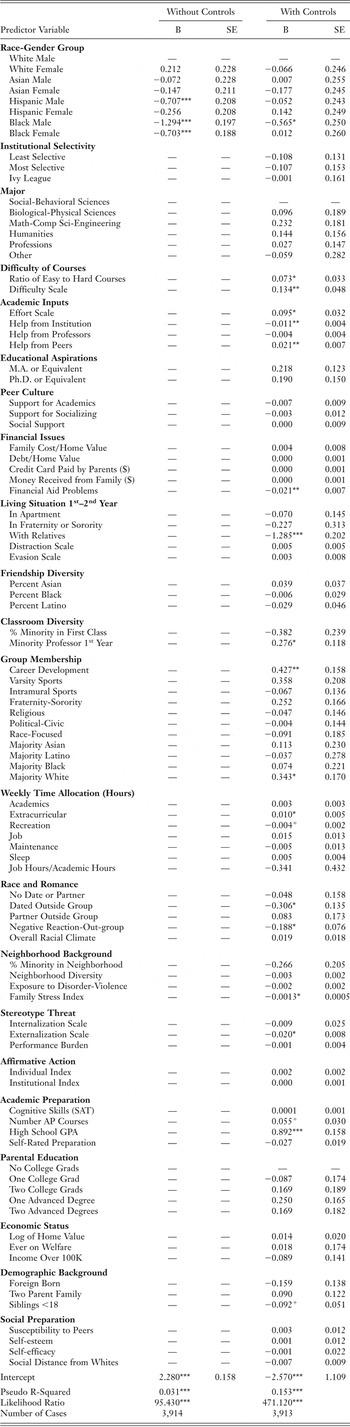
In Table 4 we present the results of two logit models estimated to predict the likelihood of graduating at the end of four years. As before, the left-hand columns present coefficients and standard errors indicating group-specific effects alone. Compared with White males, White females have a higher likelihood of on-time graduation, whereas Black males, Black females, and Hispanic males have a lower likelihood. The likelihood of on-time graduation is about the same for Asian Males, Asian females, and Hispanic females. The right-hand columns reveal that once the influence of independent variables is controlled, differentials in the likelihood of graduation are dramatically reduced. Indeed, with the exception of a lingering deficit exhibited by Black males, all of the differences disappear statistically. Compared with White males, and indeed all other groups, Black males are thirty-five percent less likely to graduate on time (1 − exp(−0.436) = 0.353).
Effect of Selected Variables on Likelihood of Graduation after Four Years

As with grades, the odds of on-time graduation from college are not affected by institutional selectivity, parental education, self-esteem, self-efficacy, or social distance from Whites. In addition, the probability of on-time graduation is unrelated either to whether the individual was a beneficiary of racial affirmative action or the degree to which the institution engaged in affirmative action, and was also uncorrelated with the racial-ethnic composition of friendship networks, educational aspirations, or SAT score. Controlling for course difficulty, the choice of major does matter, however, with those majoring in math, computer science, and engineering being less likely to graduate after four years, along with professional and other majors. Majors in the social sciences, biological or physical sciences, and humanities all display about the same likelihood of on-time graduation.
In terms of course difficulty itself, the higher the ratio of easy versus hard courses, the higher the odds of graduation within four years; and not surprisingly the greater the academic effort, the more likely a student is to graduate on time. Once again, the receipt of institutional help has a negative effect and lowers the odds of on-time graduation, again probably because poor students self-select into institutional assistance. As before, peer support for socializing increases the probability of on-time graduation whereas peer support for academics reduces it. Compared with students living in dormitories, those living off-campus in apartments or with family members are much less likely to graduate on time, whereas belonging to a career development group and a majority White group are associated with higher odds of on-time graduation. Consistent with these effects, time devoted to extracurricular activities is associated with a greater probability of graduating in four years. As was the case in the GPA model, time devoted to recreation has a pronounced negative effect on the odds of graduation—the more hours devoted to recreation the less likely an on-time graduation.
The odds of graduation are even more strongly tied to financial issues than are grades. The greater the share of the cost of college the family is able to absorb and the higher the value of the family home, the greater the likelihood of graduating in four years. Consistent with these results, having problems with financial aid is associated with significantly lower odds of an on-time graduation.
Out of all the indicators of academic preparation, only high school GPA significantly predicts the four-year graduation rate, and the effect is quite large. Each point increase in high school GPA raises the odds of on-time graduation by a factor of nearly three (exp(1.074) = 2.93). Among minority-relevant factors, on-time graduation is strongly reduced by the externalization of stereotypes, by exposure to disorder and violence while growing up, by family stress while in college, and by a higher share of minority students in the first class attended as a freshman.
Table 5 replicates the analysis of graduation using six-year probabilities. The addition of controls has the same effect on group coefficients as for four-year graduation rates. Whereas Hispanic males, Black males, and Black females all display lower odds of graduating within six years compared with White males, once controls are introduced only Black males stand out with a significantly lower rate of graduation. As with the four-year probabilities, graduation after six years is unrelated to institutional selectivity, parental education, self-esteem, self-efficacy, or social distance from Whites, SAT scores, the racial-ethnic composition of friendship networks, or educational aspirations. In addition, after six years neither peer culture nor the choice of major matter in determining the odds of graduation. Certain majors thus slow but do not prevent graduation from college.
Effect of Selected Variables on the Likelihood of Graduation after Six Years

After six years, course difficulty and academic effort continue to be important in determining the odds of graduation, with a higher ratio of easy to hard courses and greater academic effort raising the probability of final graduation. The odds of graduation also continue to be strongly and positively affected by high school GPA and by membership in career-oriented and majority organizations on campus. Paradoxically, the harder students perceived their courses to be, the more likely they were ultimately to graduate. Receiving help from peers was also associated with a higher likelihood of graduation, and as before receiving institutional help was associated with a lower probability of school completion.
Although students who came from families with more resources were more likely to graduate within four years, they were neither more nor less likely to graduate after six years. Only students' actual experience of problems with financial aid reduced the odds of six-year graduation. Thus economic resources per se tend to delay but not prevent college graduation, except when financial aid is problematic from the student's point of view. Likewise, the insignificant coefficient for apartment living suggests that off-campus accommodation delays but does not prevent graduation. Living with family members, however, continues to have a very strong negative effect, as does experiencing a high level of family stress. In terms of racial climate, dating outside the group, and experiencing a negative reaction from out-group members for doing so, reduce the odds of on-time graduation, as does a greater externalization of negative group stereotypes.
LESSONS FOR COLLEGE ADMINISTRATORS
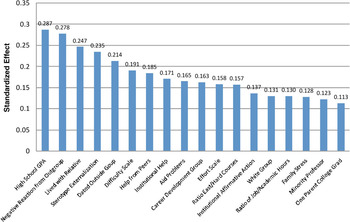
The foregoing models indicate that a complex array of personal and institutional factors determines college grade achievement and graduation propensities, but raw coefficients do not necessarily tell us which factors are most important in determining these outcomes. In order to discern which factors are central in explaining performance differentials, we use standardized regression coefficients to indicate effect sizes. Turning first to GPA, Figure 3 shows in descending order of absolute value the standardized coefficients for thirteen variables, which together account for half of the explained variation in the model.
Effect Sizes for Leading Determinants of Cumulative College GPA

As can be seen, the biggest effect in predicting college grades is that associated with high school GPA, whereas the SAT score is nowhere to be found among the strongest predictors. This finding thus supports putting greater emphasis on grades than test scores in the selection of minority applicants to selective colleges and universities (indeed in the selection of all applicants). The second strongest effect is academic effort, suggesting that in the interviewing and application process it is important for institutional agents to focus on identifying students who have a strong work ethic. Third on the list of the leading effects is receipt of help from the institution, which carries a negative sign because students who experience academic difficulties are selected into institutional assistance. The fact that institutional assistance has a relatively large effect suggests the great potential for institutional support, well-delivered, to improve grade outcomes of struggling students. Seeing professors outside of class also has a relatively strong—and in this case positive—effect on grades, suggesting that college counselors should strongly encourage students to seek contact with professors outside of class. The fact that peer support for academics is number nine in the list of effects, and that the sign is negative, indicates that students should be counseled not to rely on peers when they experience academic difficulties.
Home value and the relative ability of the family to absorb college costs are fifth and sixth in the list of key effects on grades, underscoring the important role that financial aid can play in equalizing outcomes. To the extent that financial aid packages offset the relative lack of income and wealth exhibited by disadvantaged students, grades can be expected to improve and inter-group achievement gaps lessen. The relatively sizeable effects of course difficulty and the ratio of easy to hard courses does not imply that college advisors should steer students into easy courses, but that students should be encouraged to create a balanced mix of easy and hard courses if they wish to earn a higher GPA.
The last two variables on the list of large effects are the experience of a negative reaction for dating outside the group and the degree to which an institution practices affirmative action. Experiencing a negative reaction to out-group dating significantly lowers grades and emphasizes the importance of maintaining an atmosphere of tolerance and civility on campus. The fact that institutional affirmative action has a positive effect on grades suggests that taking factors besides SAT scores into account in evaluating minority students does not set them up for failure.
Turning now to college persistence, Figure 4 shows standardized effects of variables that together account for half of the explained variance in four-year graduation rates. Again high school GPA leads the list of variables and the SAT score is once more nowhere to be seen, further underscoring the value of weighting grades more than test scores in evaluating prospective students. Although there is a sizeable gap in effect sizes between high school GPA and other variables in determining grades, the top two effects on the likelihood of graduation are nearly identical. The standardized effect of high school GPA is 0.346 and that for stereotype externalization is 0.344, powerfully emphasizing the importance of campus racial climate. Minority students who expect to be judged invidiously on the basis of negative stereotypes are markedly less likely to graduate on time. Fifth on the list of powerful effects was experiencing a negative reaction for out-group dating, making this factor even more central to college graduation than college grade achievement.
Effect Sizes for Leading Determinants of On-Time Graduation from College

As with cumulative GPA, a key factor in determining on-time graduation is family wealth, as indicated by home value and the relative amount of college costs borne by the family. As before, receiving institutional help is the third most powerful variable in the model. Thus institutions have two important points of intervention to improve the academic fortunes of students—by providing sufficient financial aid to offset inter-group differences in wealth and by providing better support services to students experiencing academic difficulty. Once again, the appearance of academic effort and time spent recreating on the list of key effects indicates the importance of selecting dedicated, hard-working students.
The potential for family issues to deter graduation is indicated by the fact that living off campus with family members and the family stress index are both on the list of most powerful effects. Living off campus in an apartment is also associated with a lower likelihood of graduating in four years. To maximize the odds of on-time graduation, colleges and universities should thus encourage on-campus residence in dormitories and be sensitive to the needs of students experiencing family difficulties. Likewise, belonging to mainstream and career development groups on campus are associated with a higher likelihood of graduating on time as is peer support for socializing, implying that students should also be encouraged to engage in extracurricular activities. The importance of long-term exposure to disorder and violence in conditioning academic outcomes is indicated by the rather strong effect of the disorder-violence index, which captures exposure to these negative externalities between the ages of six and eighteen years.
Finally, Figure 5 shows standardized effects for the most important variables in determining the likelihood of graduation from college after six years. Students who have not graduated in six years are probably relatively unlikely ever to graduate at all, and in this sense these are the leading factors in predicting the final or ultimate odds of graduating from college. As with the likelihood of on-time graduation, the odds of final graduation are most strongly affected by high school GPA. Course difficulty and the ratio of easy to hard courses continue to be important in determining the odds of successful college completion, as does membership in mainstream campus groups.
Effect Sizes for Leading Determinants of Ultimate Graduation from College

In general, however, minority group issues, financial factors, and family issues loom larger in determining the odds of final graduation. Dating outside one's racial group, experiencing a negative reaction for doing so, stereotype externalization, and family stress are all strongly predictive of not graduating, as is experiencing financial aid problems and a higher ratio of job to academic hours. On the positive side, taking a class from a minority professor and greater institutional commitment to affirmative action are both associated with a higher likelihood of ultimate graduation.
CONCLUSION
Considering the foregoing results, our final advice to counselors and administrators seeking to achieve campus diversity while minimizing race-gender achievement differentials and maintaining high standards at selective colleges and universities is, first, to weigh high school grades more than SAT scores in judging the academic potential of students and to devise better ways of identifying scholarly dedication, work ethic, and a willingness to forgo recreation for academics. Second, institutions should use financial aid packages effectively to equalize the financial burdens assumed by students and their families in going to college. Third, they should encourage contact with faculty members and membership in extracurricular groups and activities on campus, particularly those that bring minority students into greater contact with the broader population of students on campus. Fourth, institutions should steer students toward on-campus living in dormitories whenever possible and strongly counsel against living with family members. Fifth, they should improve academic support services for students experiencing academic problems and provide counseling and mental health services for students experiencing family difficulties. Finally, colleges and universities must strive to maintain an atmosphere of tolerance and acceptance on campus and do whatever they can to mitigate negative stereotyping by other students and faculty. Students also need to know that they can date and befriend whomever they wish without fear of retribution or harassment. If greater efforts are made in these domains, current differentials in grades and graduation rates by race and gender will surely diminish.
Our results also raise a broader issue of concern not just to college administrators and students, but to American society in general and that is the relative absence of Black males among the ranks of the educated Black elite. Although females now outnumber males among college students generally, the sex ratio is markedly more skewed among Blacks compared with any other racial or ethnic group. According to data from the Current Population Survey (CPS), for example, among White college students in 2008 females outnumbered males by around twenty percent; but among African American students, females outnumbered males by sixty-six percent. In addition, the size of the gender imbalance rose with education. Among African Americans aged twenty-five or more enumerated in the CPS, the gender imbalance was just ten percent among high school dropouts, but it rose to fourteen percent among high school graduates, thirty-five percent among college graduates, and forty-one among those with advanced degrees.
The data we analyzed here also suggest that the gender imbalance among Black college students rises with the selectivity of the institution. Whereas CPS data indicate that Black women outnumber Black men by thirty-five percent among college freshmen generally, at the selective institutions surveyed by the NLSF, Black females outnumber Black males by a remarkable 105 percent. Moreover owing to the significantly lower graduation probabilities exhibited by Black males six years later, the excess of Black females over Black males had risen to 133 percent among college graduates. These data imply that a long-term structural scarcity of males is being built into the demography of the educated Black elite. Under current conditions, at least thirty-five percent of all Black female college graduates will not be able to find a male partner unless they look outside the group or down the educational distribution, and among those graduating from selective colleges and universities, the majority of women cannot realistically hope to find a Black male partner of comparable education.
Where are all the Black men? The short answer is that many are in jail, in the military, or dead. The CPS only covers the civilian non-institutionalized population, and among CPS respondents aged twenty-five and older, women outnumber men by twenty-five percent among Blacks but just seven percent among Whites. Since Blacks and Whites have equal sex ratios at birth, the racial gap can only mean that many more Black than White males die, enlist in the military, or become incarcerated before age twenty-five. Moreover, among those Black males who do enter college, more than a quarter do not graduate within six years, as we have seen. Even the exhaustive set of variables included in our statistical models do not account for the poor academic performance of Black relative to White men, either in terms of grades or graduation probabilities. Indeed, after the inclusion of control variables, all race-gender differences in graduate rates disappear with the sole exception of Black males. This result means that the poor academic performance of Black males at selective schools either stems from factors not included in our models or that the determinants we consider operate in different ways in different groups, a possibility we will consider in the next phase of research by estimating models separately for students in each race-gender category.