INTRODUCTION
Ethiopia is endowed with a large number (22.8 million heads) of goats (CSA, 2011), classified into 14 types using phenotypic characterization, while a genetic characterization showed only eight distinctively different types (Tesfaye, Reference Tesfaye2004). Out of this, approximately 73 % are found in arid and semi-arid lowland areas (Bedhane et al., Reference Bedhane, Haile, Dadi and Alemu2013). Arsi-Bale goats are one of the breeds of Ethiopia distributed across wide agro-ecological zones, the majority in semi-arid areas and predominant in Halaba district (Kebede et al., Reference Kebede, Haile and Dadi2012).
The production system of the Halaba district is virtually traditional and contributes substantially to both subsistence and cash generation for smallholder farmers and national economy as an export commodity (Kocho et al., Reference Kocho, Abebe, Tegegne and Gebremedhin2011; Legesse et al., Reference Legesse, Abebe, Siegmund-schultze and Vallezarate2008). Goats in these areas provide their owners with important products like immediate cash income, meat, milk and functions like risk spreading and social values (Bedhane et al., Reference Bedhane, Haile, Dadi and Alemu2013; Kosgey et al., Reference Kosgey, Gadiyaram and Galipalli2006). Increasing human population, urbanization and incomes, coupled with changing consumer preferences are creating more demand for these animals and their products (Kosgey and Okeyo, Reference Kosgey and Okeyo2007).
The genetic improvement programmes are less successful in developing countries in the tropics. One of the reasons is poor adaptability of exotic breeds in tropical environment (Kosgey et al., Reference Kosgey, Gadiyaram and Galipalli2006), among others, lack of understanding smallholder farmers’ condition, that include insufficient inputs, poor housing and management, etc. Indigenous goats are resistant to diseases and parasites, tolerant to adverse climatic conditions, have endurance to sustain droughts and low and fluctuating nutrient availability. However, extreme climatic stresses and poor quality feeds limit the potential expression of genetic merits in goat flock (Baneh et al., Reference Baneh, Mojtaba and Ghodrat2012; Mabrouk et al., Reference Mabrouk, Najari, Roberto, Gaddor, Ben, Elgaaied and Juan2010). Deaths and sluggish early growth rate due to extreme droughts, poor nutrition and diseases are among the barriers limiting production potential of goats in southern Ethiopia. Knowledge of non-genetic factors on production traits allows a more accurate assessment of breeding values (Dadi et al., Reference Dadi, Duguma, Shelima, Fayera, Tadesse, Woldu and Tucho2008). Conservation, improvement and use of indigenous goat resources by enhancement of their growth capacities are essential (Kosgey and Okeyo, Reference Kosgey and Okeyo2007). To this end, on-farm monitoring and identification of the underlying factors affecting growth rate of kids is important to improve productivity (Legesse et al., Reference Legesse, Abebe, Siegmund-schultze and Vallezarate2008). Hence, this study was conducted to evaluate the effects of non-genetic factors on early growth performance of Halaba kids under smallholder management systems.
MATERIALS AND METHODS
Descriptions of the study area
Halaba district is situated in South Nations, Nationalities and Peoples Region (SNNPR), 310 km South of Addis Ababa. The study area is located at 7° 17′ N latitude and 38° 06′ E longitude, at about 10–15 km in diameter. Altitude of the district ranges from 1554 to 2149 meters above sea level (m.a.s.l) with the majority found at about 1800 m. The annual rainfall varies between 857 and 1085 mm and in a bimodal pattern with light rains between March and June and main rains from July to October (IPMS, 2005). There are three distinct seasons: dry (November, December, January and February), light rain (March, April, May and June) and heavy rain (July, August, September, and October). The annual mean temperature varies from 17 °C to 20 °C with a mean of 18 °C. Halaba is the district with mixed farming practices and the major crops grown include maize, sorghum, teff (Eragrostis tef), finger millet (Eleusine coracana), wheat, hot pepper, chat (Catha edulis) and haricot bean.
Breed description and flock management
Halaba goat is categorized under the Arsi-Bale breed (Tesfaye, Reference Tesfaye2004). The breed is part of the rift valley family, occupying all the agropastoral lowlands within the rift valley, from Lake Abaya in the south to South Shoa in the north. The Arsi-Bale goat is a relatively tall goat with a predominantly straight facial profile (98%). Males have curved (47%) and straight (41%) horns mainly pointing backwards (58%) with some pointed straight upward (28%). The coat colour varies between any of seven colours (white, black, brown, fawn, grey, roan and red), with the first three being most dominant.
Natural pasture and browses are major feed resources for goats in the area. Tethered feeding is a common practice during cropping season, with uncontrolled year-round breeding system. Bucks run with flock to mate with any doe in heat during the day. Goat flocks are confined in small pens within residence houses at night and during harsh climatic periods. Feeding on crop leftovers, aftermaths and free wandering across villages is commonly observed management practice during crop harvesting period. Kitchen leftovers and leaves and pods of acacia supplementation have been observed during dry season. Does at late pregnancy and young kids are kept around home while owners trek over other flocks to long distances, searching for browses and water.
Source and management of data
This on-farm flock monitoring study was conducted from 2008 to 2009 at three sites and the respective villages of Halaba district. A multistage stratified sampling technique was employed to select the participants, based on the size of land holding and goat density. In each site, adjacent villages were selected from goat keeping villages that have dry season road accessibility. In addition having at least three does (female goats) per household was the criteria for household selection. A total of 60 households were selected and monitored; from which 30, 15 and 15 households were selected from sheep dominant site (SDS), mixed flock site (MFS) and goat dominant site (GDS), respectively. Site grouping criteria has been described by Kocho et al. (Reference Kocho, Abebe, Tegegne and Gebremedhin2011). In addition, the SDS is a teff-haricot bean based system, with a very small land size, and tethered grazing; GDS is wheat-based farming system, characterized by larger land area and flock size, group herding, better feed availability and higher proportion of goat in the flocks while MFS is a hotpepper-maize based farming system, medium land size, tethered and free roaming as the major grouping criteria. All animals in the study flock were ear tagged at the start of the study and all additions were also immediately tagged. Within 24 h of parturition, date of birth, birth weight, type of birth, sex of kid and dam parity were recorded. Kids remained with their dams until weaning, which occurred at about 90 days. All kids were weighed at birth and then at 15-day intervals up to 3 months and monthly interval up to 12 months of age. All the weight measurements were recorded to the nearest 0.1 kg. Body weights at 30, 60, 90, 120 and 150 days of age were analysed separately. Live body weight at birth, 30, 60, 90, 120 and 150 days of age and ADG from birth until 30, 60, 90, 120 and 150 days (ADG; g/day) were utilized in the computation of growth rate. We monitored a total of 587 kids, of which 141 were from the SDS, 324 from the GDS, and 122 from the MFS. Due to high flock dynamics in the area through sale and other forms of exits, weights beyond 150 days have not been included in our final analysis.
Data were analysed using the general linear model (GLM) procedure of the SAS (SAS, 2009). In the analysis, all factors were considered as fixed effects except the error term considered as random effect. Duncan multiple range tests were used to separate significance of least squares means (LSMs). The following linear model was employed:
 \begin{equation*}
Y_{\textit{inhmjo}} = \mu + L_i + X_n + P_h + B_m + S_j + (PX)\;hn + (PB)\;hm + e_{\textit{ijhmno}}.
\end{equation*}
Where Yinlmjo is the observation on production traits (birth weight, weight at different ages and ADG)
μ = is the overall mean
Li = is the fixed effect of the ith location (i = SDS, GDS, MFS)
Xn = is the fixed effect of nth kid sex (n = male, female)
Ph = is the fixed effect of hth ewe parity (h = 1, 2, 3, 4, ≥ 5)
Bm = is the fixed effect of mth type of birth of kid (m = 1 = single, ≥2 = multiple)
Sj = is the fixed effect of jth season (j = dry, heavy rain, light rain)
(PX)hn = is the interaction effect of parity and sex on birth, 30, 60, 90, 120 and 150 days and ADGs from birth to 30, 60, 90, 120 and 150 days
(PB)hm = is the interaction effect of parity and type of birth on birth, 30, 60, 90, 120 and 150 days and ADG from birth to 30, 60, 90, 120 and 150 days weight
einhmjo = effect of random error.
RESULTS
Body weights
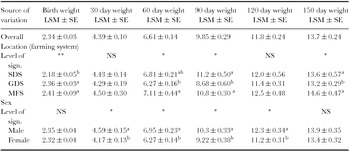
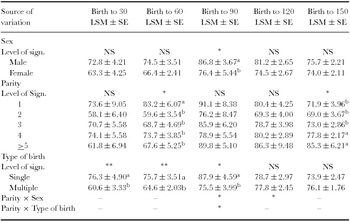
Body weight (kg) at birth, 30, 60, 90, 120 and 150 days were 2.34 ± 0.03, 4.39 ± 0.10, 6.61 ± 0.14, 9.85 ± 0.29, 11.8 ± 0.24 and 13.7 ± 0.24 kg, respectively (Table 1). Differences in farming system/flock density influenced (P < 0.05) body weights of kids at birth, 60, 90 and 150 days. Kids born in the SDS showed significantly (P < 0.01) lower birth weight compared to other locations. Kids born at the MFS had significantly (P < 0.05) higher weights at 60 and 90 days compared to the GDS while non-significant (P > 0.05) compared to the SDS. At 90 and 150 days, kids born at the SDS and MFS demonstrated higher body weights in comparison to the GDS.
Least square mean (LSM ± SE) analysis of variance for body weights (kilograms) from birth to 150 days of age of Halaba kids by location (sheep dominant site, SDS; goat dominant site, GDS; and mixed flock site, MFS) and sex.

Least squares means of different level in each fixed effect with different superscripts are different at indicated P value.
NS non-significant (P > 0.05).
*P < 0.05; **P < 0.01.
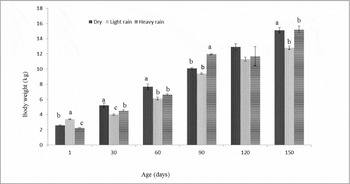
Season is one of the important sources of variation on body weight of kids (Figure 1). The effect of season was significant on body weights at all ages except at 120 day. Kids born during the light rain season had significantly (P < 0.001) higher birth weight than those born during the dry and heavy rain seasons. Likewise, kids born during the dry season had significantly higher birth weight compared to those born during the heavy rain season. Kids born during the dry season had higher (P < 0.0001) body weight at 30 days than those born during heavy rain season. Similarly, kids born during the heavy rain season had higher 30 days weight compared to those born during the light rain season. At 60 day, kids born during the dry season were heavier (P < 0.0001) than those born during the light and heavy rain seasons whilst at weaning (90 day), kids born during heavy rain season had heavier (P < 0.05) body weight compared to dry and light rain seasons. Kids born in the dry and heavy rain seasons showed significantly heavier (P < 0.001) weights at 150 days compared to the light rain season. The effect of sex was significant at 30, 60, 90 and 120 days (Table 1); male kids had higher (P < 0.05) body weights compared to the female counterparts.
Body weights of kids from birth to 150 days of age as affected by the season of birth in Halaba district, southern Ethiopia. Bars with different letters differ significantly at P value: non-significant, P > 0.05 (at 120 day); P < 0.001 (at birth); P < 0.05(at 90 day); P < 0.0001(at 30, 60 and 150 days).

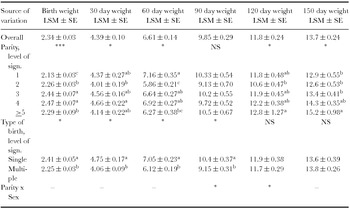
Does in parity three and four had significantly (P < 0.001) higher birth weight compared to parity one, two and five (Table 2). Likewise, parity five showed significantly higher (P < 0.01) birth weight compared to parity one. Parity effect was significant (P < 0.05) at 30 and 60 days, non-significant at 90 days weight, while the significance resumed at 120 and 150 days. Parity four showed significantly higher body weight at 30 days compared to parity two. Parity one had higher weight at 60 days compared to parity five and two. At 120 days of age, parity five demonstrated higher (P < 0.05) body weights compared to parity two. Similarly at 150 days of age, parity five showed significantly heavier weight compared to parity three and the lower parities.
Least square mean (LSM ± SE) analysis of variance for body weights (kilograms) from birth to 150 days of age of Halaba kids by parity and birth type.

Least squares means of different level in each fixed effect with different superscripts are different at indicated P value.
NS non-significant (P > 0.05).
*P < 0.05; ***P < 0.001.
Type of birth is also an important source of variation on weight at birth as well as at weaning (Table 2). Single born kids grew faster (P < 0.05) and reached weaning age earlier than multiple births. Type of birth influenced body weights of kids significantly from 30 to 90 days of age, and thereafter its effect disappeared. Single born kids were heavier (P < 0.05) birth weight compared to multiple counterparts and they maintained their superiority at 30, 60 and 90 days of age.
Average daily gain
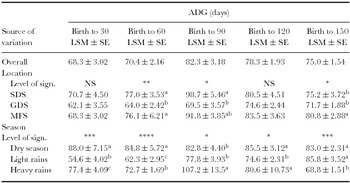
The overall mean and standard errors of ADG from birth to 30, 60, 90, 120 and 150 days were 68.3 ± 3.02, 70.4 ± 2.16, 82.3 ± 3.18, 78.3 ± 1.93 and 75.0 ± 1.54 kg, respectively (Table 3). Kids born in the SDS and MFS showed higher ADG from birth to 60 days (P < 0.01) while the SDS had higher (P < 0.05) ADG from birth to 90 days compared to the GDS. Kids born in the MFS had significantly higher (P < 0.05) ADG from birth 150 days compared to other locations.
Least square mean (LSM ± SE) analysis of variance for average daily weight gain (grams) from birth until 30, 60, 90, 120 and 150 days of age of Halaba kids by location (sheep dominant site, SDS; goat dominant site, GDS; and mixed flock site, MFS) and season.

Means with different letters (a, b) within a trait in a column are different at indicated P value.
NS non-significant (P > 0.05) *P < 0.05; **P < 0.01; ***P < 0.001, ****P < 0.0001.
Kids born during the dry season showed higher ADG (at 30 day; P < 0.001 and 60 day; P < 0.0001) compared to those born during the light and heavy rain seasons (Table 3). Similarly, kids born during the dry season had higher ADG at 120 days (P < 0.05) compared to the light rain season and at 150 days (P < 0.001) compared to the heavy rain season. The heavy rain season demonstrated significantly (birth to 60 days; P < 0.0001,) higher ADG compared to the light rainy season. Kids born during the heavy rain season had higher (P < 0.05) ADG from birth to 90 days compared to the dry and light rain seasons.
Variation due to sex was significant (P < 0.05) on ADG from birth to weaning and non-significant (P > 0.05) at other ages (Table 4). Males were 10.4 g day–1 heavier than those of females at weaning. Variation due to parity was significant (P < 0.05) on ADG from birth to 60 and birth to 150 days while it was non-significant (P > 0.05) at other ages. There was significant (P < 0.05) parity by sex interaction on ADG from birth to 90 and 120 days. Female kids born from the fifth parity were significantly lighter than other categories.
Least square mean (LSM±SE) analysis of variance for average daily weight gain (grams) from birth until 30, 60, 90, and 120 and 150 days of age of Halaba kids by sex, parity, and type of birth.

Means with different letters (a, b) within a trait in a column are different at indicated P value.
NS non-significant (P > 0.05).
*P < 0.05; **P < 0.01.
Type of birth influenced ADG of kids at all ages until weaning (Table 4). Single births were heavier (P < 0.01) compared to multiple births from birth to 30 and 60 days. The influence of birth type on ADG of kids disappeared after 120 days.
DISCUSSION
Effects of location/flock density group/farming system
Location (farming system) is an important source of variation in Halaba district because land size varies across the location that further determines the availability of feed for grazing and / or browsing. The higher birth weight of kids in GDS and MFS is partly attributed to the availability of browses due to larger landholding. The GDS is a production system dominated by goats due to the fact that browses are abundantly available (Kocho et al., Reference Kocho, Abebe, Tegegne and Gebremedhin2011). Dadi et al. (Reference Dadi, Duguma, Shelima, Fayera, Tadesse, Woldu and Tucho2008) showed similar systems of village sheep production in western Ethiopia. The lower birth weight in SDS found in this study is likely due to high human population pressure, land shortage and associated tethering pressure (Deribe et al., Reference Deribe, Girma and Azage2014) since most of the lands put under cultivation (Legesse et al., Reference Legesse, Abebe, Siegmund-schultze and Vallezarate2008). The lower pre-weaning weight gain of kids in the GDS, mainly during the dry season, is partly attributed to the trekking over of goat flock to long distances searching for water, and associated stress and weight loss.
Sex effects
Sex effect is not important at birth weight while as kids grew up, from 30 to 120 days, it becomes an important source of variation. These results agree with the previous reports (Annor et al., Reference Annor, Ahunu, Aboagye, Boa-Amponsem and Cassady2012; Baneh et al., Reference Baneh, Mojtaba and Ghodrat2012; Bedhane et al., Reference Bedhane, Haile, Dadi and Alemu2013) while others reported the significant effect of sex on birth weight (Mabrouk et al., Reference Mabrouk, Najari, Roberto, Gaddor, Ben, Elgaaied and Juan2010) and subsequent body weights (Dadi et al., Reference Dadi, Duguma, Shelima, Fayera, Tadesse, Woldu and Tucho2008). The superiority of males over females may be explained by the precocity, the sexual dimorphism in favour of body growth in males than females (Mabrouk et al., Reference Mabrouk, Najari, Roberto, Gaddor, Ben, Elgaaied and Juan2010). The superiority of male over female on body weights at 30, 60, 90 and 120 days of age and ADG from birth until 90 days, is consistent with other reports from similar eco-zones; for Arsi-Bale goats (Dadi et al., Reference Dadi, Duguma, Shelima, Fayera, Tadesse, Woldu and Tucho2008) and local Nigerian goats (Zahraddeen et al., Reference Zahraddeen, Butswat and Mbap2008) under similar management systems. Male kids had consistently heavier body weights to the age of 150 days than those for females (Mabrouk et al., Reference Mabrouk, Najari, Roberto, Gaddor, Ben, Elgaaied and Juan2010). On the other hand, Annor et al. (Reference Annor, Ahunu, Aboagye, Boa-Amponsem and Cassady2012) showed less general effect of sex on body weights and ADG at 90 and 120 days.
Effects of parity
Kids from higher parties were generally heavier than lower parties. Poor kid and dam management and influences of harsh (water stressed) environmental conditions at Halaba might have contributed for the observed decrement of kid weight after fourth to fifth parity. Except at 90 days weight, kids of higher parties showed higher body weights, due to the fact that dams reach physiological maturity (Dadi et al., Reference Dadi, Duguma, Shelima, Fayera, Tadesse, Woldu and Tucho2008). Zahradden et al. (Reference Zahraddeen, Butswat and Mbap2008) observed that there were consistently higher kid weights from higher parties. Dadi et al. (Reference Dadi, Duguma, Shelima, Fayera, Tadesse, Woldu and Tucho2008) showed that parity influenced body weight of kids up to 180 days of age and that the effect disappeared thereafter. On the other hand, previous studies also showed that parity did not have significant effect (P > 0.05) on 90 days weight (Annor et al., Reference Annor, Ahunu, Aboagye, Boa-Amponsem and Cassady2012; Dadi et al., Reference Dadi, Duguma, Shelima, Fayera, Tadesse, Woldu and Tucho2008) and pre-weaning growth rate (Annor et al., Reference Annor, Ahunu, Aboagye, Boa-Amponsem and Cassady2012). The aging effect of dams (after fifth parity) due to drought-induced heat stress and poor nutrition may attribute to decline in body weights of kids in fifth and above parities. This perhaps implies the maximum productive ages of does or the optimum age of culling them under such harsh environments. The faster weight gain of kids at 150 days is likely due to the adaptation of kids to roughage feeds and compensatory growth after weaning shock.
Effects of type of birth
The superiority of single kids over their multiple counterparts found in this study agrees with reports of other studies (Baneh et al., Reference Baneh, Mojtaba and Ghodrat2012; Dadi et al., Reference Dadi, Duguma, Shelima, Fayera, Tadesse, Woldu and Tucho2008; Tatek et al., Reference Tatek, Hailu, Mieso and Dadi2004; Zhardden et al., Reference Zahraddeen, Butswat and Mbap2008). This is due to the competition of young's for suckling the limited amount of milk of their dams among multiple births than single. Reports indicated that kids are weaned based on their weight rather than their age under farmers management conditions (Legesse, Reference Legesse, Abebe, Siegmund-schultze and Vallezarate2008). The superior body weights and ADG of single births over the multiple births confirms previous reports of local and other African countries (Dadi et al., Reference Dadi, Duguma, Shelima, Fayera, Tadesse, Woldu and Tucho2008; Mabrouk et al., Reference Mabrouk, Najari, Roberto, Gaddor, Ben, Elgaaied and Juan2010; Zahradden et al., Reference Zahraddeen, Butswat and Mbap2008). Zharadden et al. (Reference Zahraddeen, Butswat and Mbap2008) reported higher ADG of single kids from birth to 60 days (in favour of kids born single). After 90 days of age, the significant effect of type of birth disappeared. Mabrouk et al. (Reference Mabrouk, Najari, Roberto, Gaddor, Ben, Elgaaied and Juan2010) reported the non-significant differences between single and multiple kids in adult ages, similar to our findings. This could be explained by the compensatory growth in the older periods of growing (Mabrouk et al., Reference Mabrouk, Najari, Roberto, Gaddor, Ben, Elgaaied and Juan2010). Our results; however, contradict with results of Adama and Arowolo (Reference Adama and Arowolo2002) who reported the non-significant effect of type of birth on ADG of kids. In our study, single births gained 15.7 g day–1 (25.9%) and 11.1(17.2%) more ADG at 30 and 60 days compared to multiple births. The consistent ADG advantage (kids born single) may be related to pre-and early post-natal nutrient competition. Does with less inter-uterine space and in cases where they carry two or more foetuses, there is high competition among multiple births for nutrients.
Effects of season of birth
The higher birth weight of kids born during dry season is attributed to the better body condition of the dams due to good body reserves during late heavy rain and early dry season. Body weight's gains and losses were reported previously in similar traditional management situations where feed availability fluctuates within and across seasons (Bedhane et al., Reference Bedhane, Haile, Dadi and Alemu2013; Hailu et al., Reference Hailu, Mieso, Lama, Dadi, Tadle and Negatu2004). Similar to our findings, Zahradden et al. (Reference Zahraddeen, Butswat and Mbap2008) reported that winter kids had heavier birth weight than spring or summer births. Dadi et al. (Reference Dadi, Duguma, Shelima, Fayera, Tadesse, Woldu and Tucho2008), Hailu et al. (Reference Hailu, Mieso, Lama, Dadi, Tadle and Negatu2004) and Mabrouk et al. (Reference Mabrouk, Najari, Roberto, Gaddor, Ben, Elgaaied and Juan2010) also showed that kids born during dry season had higher pre-weaning growth performance than those during wet season. The superiority of birth weight in dry season is attributed to free feed selection and feeding upon quality feeds and less tethering pressure. Tethering pressure affects weight of dams and kids during light and heavy rain seasons, as majority of lands put under cultivation (Legesse et al., Reference Legesse, Abebe, Siegmund-schultze and Vallezarate2008). The incidence of pests and diseases are also relatively low in dry season. The body weight of kids depends on the condition of the dam, during late gestation and prior to weaning (Dadi et al., Reference Dadi, Duguma, Shelima, Fayera, Tadesse, Woldu and Tucho2008), reflecting that growth rate of kids is dependent on dam's size, condition and plane of nutrition (Legesse et al., Reference Legesse, Abebe, Siegmund-schultze and Vallezarate2008). The higher weaning weight of kids during the heavy rain season is due to feed availability both in quality and quantity immediate after kids stop suckling. This compensatory growth from 60 to 90 days (at about weaning age) slowed down after 120 days. This may also be explained when kids stop suckling, weaning shock might contribute for further slow growth until their digestive system is well developed for roughage digestion. Similar finding has been reported by Mabrouk et al. (Reference Mabrouk, Najari, Roberto, Gaddor, Ben, Elgaaied and Juan2010) who found stagnant growth of kids in heavy rain season at age of 120 or 150 days. In contrast, Annor et al. (Reference Annor, Ahunu, Aboagye, Boa-Amponsem and Cassady2012) reported higher body weights and faster gain of kids born during heavy and light rain seasons.
The non-genetic factors in this study were shown to influence daily gain and total body weight of lambs during early growth. Season of birth is generally more severe than other factors, and can be related to low rainfall of the area and associated fluctuation of feed resources in quantity and quality. The non-genetic factors estimated in this study are important and need to be taken into consideration in goat breeding plan under Halaba semiarid, tropical conditions. Gearing efforts towards managing dam age through replacement ewes, improved nutrition and healthcare would help farmers to exploit these huge indigenous goat genetic resources efficiently.
Acknowledgements
Smallholder sheep and goat owners are dully acknowledged for giving permission to use their animals. Improving Productivity and Market Success (IPMS) of Ethiopian farmers (International Livestock Research Institute, ILRI) and Southern Agricultural Research Institute (SARI) are dully acknowledged for supporting this on-farm study. The authors are also grateful to the staff of the Halaba Bureau of Agriculture.