


1. Introduction
Underwater target detection has a wide range of applications in marine environment monitoring and safety, and most existing target detection algorithms are implemented on Autonomous Underwater Vehicle (AUV). These AUV play a crucial role in enhancing marine monitoring and maintenance efforts [Reference Sun, Wan, Huang, Zhang, Bao, Li, Sheng and Yang1]. Due to the influence of complex sea conditions and refraction of light transmission, the images obtained by AUV and other underwater vision equipment have weak features such as feature blur, loss and distortion. Most of the existing methods based on deep network solve the problem of weak feature target recognition by image deblurring, feature co-occurrence relationship for feature correction [Reference Chen, Cui, Wei, Jin and Guo2], distortion correction [Reference Cai, Li, Chen and Chai3, Reference Pan, Huang, Lee and Chen4] and other methods. However, this kind of algorithm can easily lead to the loss of original spatial and semantic information of small targets [Reference Le, Vu and Vo5, Reference Cheng, Sun and Meng6], and increase the relevant modules and computing volume of the algorithm [Reference Sun, Li, Cai, Yuan and Zhang7].
The acquisition of images of different targets in underwater environments by underwater vision devices, such as autonomous underwater vehicles, can be challenging, leading to an uneven distribution of labels in the training set. As a result, most targets lack training data and labels, which makes it difficult for the algorithm to accurately identify such targets with low signal-to-noise ratio. The existing solution is to augment data, extract significant features from data images [Reference Cheng, Sun and Meng6] and optimize data sample expansion and network framework. Although this kind of method can effectively improve the recognition accuracy, it will also cause the loss of basic correlation features of sample images in the recognition process. Therefore, in this case, the improvement effect of the algorithm on the recognition accuracy is limited. Graph convolutional networks and recurrent relationship trees play a key role in image semantic feature extraction [Reference Qin, Qiu, Gao and Bai8, Reference Hou, Luo, Qin, Shao and Chen9]. Unsupervised presentation learning can distinguish different targets by means of feature similarity measurement, which is helpful for downstream classification and recognition tasks and can effectively solve the above problem.
This paper proposes an improved feature enhancement network method for underwater target recognition with weak features. As shown in Fig. 1, the method proposed in this paper builds an identification network by combining spatial and semantic enhancement, unsupervised feature contrast extraction and Rank & Sort (RS) Loss, which is robust to unbalanced samples. The network achieves high recognition accuracy under the condition of uneven target samples and distorted images. The integration of image recognition algorithms with AUV can significantly enhance the inspection accuracy and efficiency of AUV.
General framework of improved feature enhancement network for weak feature target recognition.

The main contributions of this paper are as follows:
-
1. This paper introduces a multi-scale spatial and semantic feature enhancement module. This module enhances the extraction of multi-scale spatial features by utilizing feature mapping with self-learning parameters. It integrates semantic information from various sensory inputs to accurately extract target feature information.
-
2. A multi-scale feature comparison module is developed in this paper to address issues related to target feature blurring and distortion. It achieves this by conducting multi-scale feature comparisons between positive and negative samples. This network module is designed to ensure the robustness of the recognition network, especially in scenarios involving small sample sizes for underwater target recognition.
-
3. We propose a multi-scale target sorting detector based on RS Loss to train the deep target recognition network, particularly to address challenges associated with highly unbalanced sample data. We conducted comprehensive experiments, and the results demonstrate the effectiveness of our method in significantly improving detection accuracy, particularly for weakly characterized targets.
2. Related work
The integration of deep learning techniques into underwater vehicles for detection and identification represents a pivotal research domain in marine maintenance. Sun [Reference Sun, Wan, Huang, Zhang, Bao, Li, Sheng and Yang1] introduced a kernelized correlation filter tracker and a novel fuzzy controller, which were trained using a deep learning model, resulting in favorable outcomes in visual tracking of underwater vehicles. Chu [Reference Chu, Wang, Lei and Luo10] utilized deep reinforcement learning based on a double-deep Q-network for autonomous underwater navigation, leading to effective path planning and obstacle avoidance. Tang [Reference Tang, Wang, Jin, Zhao, Huang and Yu11] developed a deep learning-based underwater target detection model and a real-time underwater target detection method, effectively addressing the challenges associated with side-scan sonar recognition.
Refraction of light caused the loss of image features, making it more difficult for the algorithm to accurately identify the target. Rich semantic information is a prerequisite to achieve the classification task, while accurate spatial information is a prerequisite to achieve the localization task for target detection [Reference Sun, Li, Cai, Yuan and Zhang7]. Cai [Reference Cai, Luo, Zhou, Xu and Chen12] constructed a target recognition network by multi-intelligence collaboration, multi-view optical field reconstruction and migration reinforcement learning to enhance target feature data from both data sources and feature frameworks, with significant improvements in simplified computation and target recognition accuracy. Lin [Reference Lin, Pan and Wang13] employed a planar detection algorithm based on the semantic web to construct planar odometry for robots operating in structured environments. Inflationary convolution allows the extraction of sufficient semantic information by expanding the field of perception without changing the size of the feature map [Reference Wang, Ma, Su and Wang14]. Cai [Reference Cai, Chen and Chai15] addressed the problem of distorted target recognition accuracy by supplementing missing salient features with spatial semantic information. Rabbi [Reference Rabbi, Ray, Schubert, Chowdhury and Chao16] used a super-resolution method for images to zoom in on objects, effectively solving the problem of feature loss and improving the detection performance of small targets in remote sensing images from the use of edge enhancement. The methods mentioned above excel at extracting detailed semantic information through deep features; however, they exhibit shortcomings in effectively utilizing spatial information and are less suitable for data characterized by imbalanced categories.
Multi-scale features contain richer spatial and semantic feature information and are beneficial for identifying weak targets at very low signal-to-noise ratios. Ma [Reference Ma, Gong, Xu and Zhang17] fuses advanced feature detail enhancement and multi-scale features for contextual semantic edge detection. Ju [Reference Ju, Luo, Wang and Luo18] proposes the attention mechanism for multi-scale target detection by adaptively learning the importance and relevance ideas of features at different scales with the Lee [Reference Lee and Yoo19] computed enhanced feature extraction networks by contrast learning. To cope with scale variations. Kuang [Reference Kuang, Li, Zhang, Wan and Ge20] utilized semantic information extraction and environment matching to enhance the localization capabilities of mobile robots, enabling them to operate more efficiently in their environment. Cai [Reference Cai, Qin and Xu21] conducted fuzzy small target feature extraction by combining hybrid dilation convolution with multi-scale features. Liu [Reference Liu, Du, Tian and Wen22] learns object features and contextual feature weights based on upsampling to fuse multi-layer feature maps to improve the detection performance of small object detection performance. Douadi [Reference Douadi, Dupuis and Vasseur23] developed a method for rapidly and precisely constructing navigation maps for robots by modeling spatially stabilized keypoints. Reference [Reference Wang, Wang, Zhang, Tian and Li24] designed a shallow feature enhancement module to enhance the representation of weak feature objects with the help of rich contextual information. Since reusing feature information leads to unclear weights, Fang [Reference Fang, Tian, Zhang, Zhang, Han and Han25] proposed a densified, lightweight top-down network structure for effective integration of multi-scale features. Gupta [Reference Gupta, Seal, Khanna, Herrera-Viedma and Krejcar26] pointed out that the drawback of multi-scale feature methods is mainly that spatial details are ignored until the final fusion stage, so each channel in the aggregated features is weighted according to the adjacent layers to enhance the distinguishing power of the feature representation. In summary, reducing the loss of spatial information while ensuring the acquisition of strong semantic information is the key to improving classification and localization accuracy. While the methods described above make comprehensive use of spatial information, they may not be suitable for datasets with semantic information loss and category imbalance. Balancing the preservation of spatial information while ensuring the acquisition of robust semantic information is pivotal for enhancing classification and localization accuracy.
For the problem that accurate recognition cannot be achieved for specific categories with complex features and uneven sample size, Wang [Reference Wang, Chen, Chen and Shi27] used similarity constraints to capture the intrinsic connection between available information and feature weights, and fusion ranking loss to capture the dependency between labels. Zhi [Reference Zhi28] proposed an end-to-end convolutional neural network based on multi-path structure. Gao [Reference Gao and Zhou29] used a multi-category attention region module that maintains the diversity of feature data in the attention region. Jiang [Reference Jiang, Huang, Geng and Deng30] extracts multi-scale features and learns multi-scale relationships between samples, which can alleviate the lack of performance of cross-entropy loss in the case of small samples. Khosla [Reference Oksuz, Cam, Akbas and Kalkan31] proposes RS Loss based on the properties of ranking, which can train models in the presence of highly unbalanced data.
In summary, while these methods exhibit advantages in specific aspects of target detection and under particular scenarios, they fail to provide an effective solution to the challenges of spatial and semantic feature loss, especially when dealing with the scarcity of underwater class-specific samples [Reference Zhang, Wang and Dai32]. To tackle these issues, this thesis introduces an improved feature enhancement network for enhancing the recognition accuracy of weak feature targets. Specifically, in situations where spatial and semantic features suffer varying degrees of loss, this thesis incorporates a spatial and semantic enhancement feature extraction module to enhance feature extraction. Moreover, to address the challenges arising from a shortage of samples in specific categories, often accompanied by feature blurring or distortion, this paper introduces a multi-scale feature comparison and selection module, aimed at precisely recognizing weak feature targets. By arranging the algorithm of this paper on the underwater vehicle, we can improve the inspection accuracy and efficiency of the underwater vehicle.
3. Proposed method
This section provides a comprehensive description of the overall architecture of the proposed improved feature enhancement network for recognizing weak feature targets. It comprises three primary components: a spatial and semantic enhancement feature extraction module, a multi-scale feature comparison selection module, and a multi-scale target ranking detector. The network architecture in this paper is configured with hyperparameters, such as convolutional kernel size and the number of feature channels, following the ResNet50 reference model.
3.1. Spatial and semantic enhanced feature extraction module
The weak light and complex background in underwater environment lead to the weak intensity of image objects acquired by Autonomous Underwater Vehicle (AUV), and the loss of spatial and semantic features to varying degrees, which seriously affects the accuracy of target recognition. The semantic information is sparse in the shallow feature map extracted by the traditional classification network, while the semantic information is rich in the deep feature map, but the spatial information decays seriously. To solve the above problems, In this paper, we introduce the spatial and semantic enhancement feature extraction module to improve the extraction of spatial and semantic features from the original classification network.
This article uses ResNet50 as the backbone network to extract features. The feature extraction network module has an overall composition of 6 layers of ResNet blocks. The input is a 256
 $\times$
256 pixel size image
 $x$
. The features extracted by each ResNet block are denoted as
 $f_q (x)$
. The multi-scale features of the image are extracted with different ResNet blocks
 $H={h_0,h_1,\ldots,h_i },i\lt 6$
. The different scale feature maps obtained from each ResNet block are used as input to obtain a new multi-scale feature map enhanced with spatial and semantic information by the spatial and semantic feature enhancement module. This module is divided into two parts, spatial feature enhancement and dense upsampling. The overall structure of the spatial and semantic enhancement feature extraction module is shown in Fig. 2.
Network framework diagram of spatial and semantic enhanced feature extraction module.

The spatial features are enhanced in a multi-branch parallel structure, and the context information of the target is extracted by enlarging the receptive field, which enriches the semantic information and avoids the attenuation of spatial information as much as possible. This network can enhance the ability to extract spatial and semantic features. Multi-branch formal structure extracts the features of different receptive fields. As shown in Fig. 3, each branch uses expansion convolution with different expansion rates to carry out convolution operations on the same feature graph, so as to obtain isoscale feature graphs with different receptive fields. The features extracted from different receptive fields were restored to the original size and number of channels by cascade fusion.
Spatial feature enhancement of multi-branch parallel structures and their perceptual field representation.

Dense upsampling is then used to generate a new multi-scale feature map. Dense upsampling prevents information decay, and the feature map obtained by upsampling not only uses a top-down approach to transfer information layer by layer but also adds a form of direct transfer to complement the previous feature map. The multi-scale feature selection module of the reference [Reference Wang, Wang, Zhang, Tian and Li24] was used to transfer the semantic information of the
 $16\times 16$
feature map to the
 $64\times 64$
feature map as an example. It is structured through two parallel branches. In one, a top-down approach, the
 $16\times 16$
feature map is first sampled to
 $32\times 32$
, fused with the original
 $32\times 32$
feature map, with the size of
 $32\times 32$
as the next sample, and then sampled to
 $64\times 64$
and
 $128\times 128$
in turn. In the other branch, it is directly sampled as
 $128\times 128$
, passed to the feature map of the corresponding size, which is used to guide the enhancement of shallow semantic features and avoid information loss.
Taking into account the impact of various texture details and objects on recognition results, the multi-scale model must determine the suitable size and number of feature maps for fusion. Each feature map of the multi-scale feature model is assigned a learnable parameter
 $\omega _{x}$
, and each feature map is adaptively merged by training to find the optimal proportion of each feature map in the fusion. This design avoids the degradation of feature extraction performance caused by the decay of spatial information. The element summation method first adjusts feature maps of equal scale to the same number of dimensions and then sums the corresponding elements. When fusion is complete, it then reverts to its original dimensions. The multi-scale enhanced features of the image are represented as:
 \begin{equation} F=\{f_{e0}(x),f_{e1}(x),f_{e2}(x),f_{e3}(x),f_{e4}(x)\} \end{equation}
where
 $x$
is the input test image.
 $f_{ei}(x)$
is the multi-scale enhancement feature output of the completed training enhancement feature extraction network.
Multi-scale feature comparison selection module structure.

3.2. Multi-scale feature comparison selection module
The shortage of samples in specific categories is compounded by issues like feature blurring or distortion. This challenging scenario results in the low-accuracy recognition of weak feature targets. To address this, the multi-scale feature contrast selection module characterizes feature contrast metrics through unsupervised learning. This, in turn, furnishes multi-scale prominent features and reference sample data to assist the target detector in accurately recognizing weak feature targets.
Data expansion by image distortion, blurring, cropping, flipping, etc. In this paper, the positive samples are the original example samples and the samples obtained by data expansion, while the negative examples are all other categories of strength samples in the sampled training batch and the expanded samples. The goal of feature comparison is to learn the similarity representation of samples. It should minimize or keep constant the feature distance for different pairs of positive examples while maximizing the feature distance between pairs of negative examples. The objective of the method is to select sample features from a series of labeled sample images
 $ X=x_1,x_2, \ldots,x_n$
that are close to the instance image features, thus complementing the semantic information of the instance features.
The entire multi-scale feature comparison selection module contains two encoder branches
 $ F_{q}$
and
 $ F_{p}$
, as shown in Fig. 4, with both branches applying the same spatial and semantic enhancements to the feature extraction network. The feature mapping module
 $\vartheta (\bullet )$
, which connects one after each feature-enhanced scale feature map, passes the feature vector
 $ f_{ei}(x)$
through a fully connected layer
 $\vartheta (\bullet )$
. Here, the feature mapping
 $\vartheta (\bullet )$
maps the multi-scale enhanced feature map of the image to the feature space vector
 $ z={z_1,z_2,z_3,z_4,z_5}$
. The similarity measure of the feature space is then performed by the cosine similarity function
 $ D(i,j)$
of the samples. Where
 $ x_i$
and
 $ x_j$
are the example image representations and the image representations in the training samples of the comparison batch, respectively.
In this paper, the multi-scale feature contrast loss used SCLLoss [Reference Khosla, Teterwak, Wang, Sarna, Tian, Isola, Maschinot, Liu and Krishnan33] function to train the two-branch space with semantically enhanced feature extraction model
 $ F_{\tau } (\bullet )$
and feature mapping
 $\vartheta (\bullet )$
. The contrast loss function is defined as follows:
 \begin{equation}{\mathcal{L}}_{MECL} = -\frac{\beta }{N} \sum _{i=1}^{N}\sum _{c=1}^{c}y_{i,c}\cdot \log _{}{\hat{y}_{i,c}} -\sum _{i=1}^{N}\frac{\lambda }{N_{y_{i}}-1}\sum _{j=1}^{N}\log _{}{\frac{exp(\vartheta (x_{i})\cdot \vartheta (x_{j})\diagup \tau )}{{\textstyle \sum _{k=1}^{N}exp(\vartheta (x_{i})\cdot \vartheta (x_{j})\diagup \tau )}}} \end{equation}
where N is the image batch size of the
 $F_p$
structure input, the input is the training image of
 ${x_i,y_i}_{i=1,\ldots,N}$
of the training images.
 $x_i$
is the image sample and
 $x_j$
is the label corresponding to the image sample.
 $N_{y_i}$
is the total number of instances in the batch with the same label as
 $y_i$
.
 $x_i$
denotes the positive sample images in the image training batch.
 $x_j$
is the negative sample images in the batch.
 $y_{i,c}$
denotes the input instance images of label data, and
 $\hat{y}_{i,c}$
denotes the probability that the model output instance is of category
 $C$
.
 $\beta$
and
 $\lambda$
are a scalar-weighted hyperparameter,
 $\beta =1-\lambda$
.
 $tau$
is an adjustable scalar temperature parameter that controls feature class differentiation.
The construction of salient features through image feature space comparison not only makes the number of negative samples larger but also improves the training effect. However, this approach presents challenges in terms of iteratively updating the encoder
 $F_p$
. To address this, we utilize the momentum updating approach introduced in literature [Reference Cai, Chen and Chai15]. This approach dynamically updates encoder
 $F_p$
using encoder
 $F_q$
. The parameter of encoder
 $F_q$
is denoted as
 $\vartheta _q$
, and the updating method is stochastic gradient descent. The parameter of encoder
 $F_p$
is denoted as
 $\vartheta _p$
, and the update method is
 $z\vartheta _p+(1-\vartheta _q)$
, with momentum coefficients
 $z\in \left \lbrack 0,1\right )$
.
 $\vartheta _p$
updates in accordance with the changes in
 $\vartheta _q$
. When the training of the multi-scale feature contrast selection module is completed, the multi-scale space and semantic features are extracted from the multi-scale enhanced features
 ${F}'_{e}$
obtained by branching
 $F_q$
of the network, and the multiple similar feature labels
 $y_{i,c}$
obtained by branching
 $F_p$
.
 ${F}'_{e}$
and
 $y_{i,c}$
were used to guide through the subsequent target recognition tasks.
3.3. Multi-scale target sequencing detector
To address the challenge of imbalanced samples in specific underwater categories, this paper presents an improved feature enhancement network for weak feature target recognition. This approach is based on RS Loss and constructs a multi-scale target sorting detector to perform recognition tasks across various scales. The recognition network ultimately achieves the most accurate results by continuously updating the feature comparison selection and prediction rankings.
Firstly, 5 scales of spatial and semantic enhancement features were input to the target detector to generate a series of Anchor Boxes and prediction category information. Then, an update sorting classification with continuous Intersection over Union (IoU) prediction task is performed. RS loss
 ${\mathcal{L}}_{RS}$
[Reference Oksuz, Cam, Akbas and Kalkan31] was used for the classification task, and the continuous prediction category information data consisted of two parts, the prediction categories generated by the instance image after the target detector and the multiple similar feature labels
 $y_{i,c}$
category data obtained in the multi-scale feature comparison selection module. The
 $\textbf{IoU} (\hat{b} _{i},b_i)$
between the predicted position box
 $\hat{b} _{i}$
and the true position box of the data
 $(b_i)$
is used as the continuous label. In the continuous IoUs prediction task, K-means is first used to generate Anchor Boxes with larger IoU values than ground truth, and the clustering centers of Anchor Boxes are overlapped with the centroids of ground truth to select the target candidate bounding boxes. The minimum outer rectangle of the two prediction boxes is then calculated by Distance-IoU, which is used to characterize the distance between the two target boxes. To compute the loss
 ${\mathcal{L}}_{r}$
of the multi-scale target sorting detector, we define
 $x_i$
as the real label of the instance image and
 $x_j$
as the label of multiple similar feature samples. The RS Loss, denoted as
 ${\mathcal{L}}_{RS}$
, is the difference between the current sorting error term
 $\ell _{RS}(x_i)$
and the desired sorting error term
 $\ell _{RS}^{*}(x_i)$
. It also includes the overall average error term for updating sorting, given by
 $({\ell _{S}}(x_{j})-{\ell _{S}^{*}}(x_{j}))p_{S}(x_{i}\mid x_{j})$
, where
 ${\ell _{S}}(x_{j})-{\ell _{S}^{*}}(x_{j} \geq 0)$
represents the positive case signal enhancement term for
 $x_{i} \in P$
, and
 $({\ell _{S}}(x_{j})-{\ell _{S}^{*}}(x_{j}))p_{S}(x_{i}\mid x_{j}) \leq 0$
represents the signal degradation term for
 $x_{j} \in P$
. Here,
 $p_{S}(x_{i}\mid x_{j})$
is the category probability mass function based on the probability mass function (pmf) of
 $\ell _{RS}(x_i)$
. The RS Loss
 ${\mathcal{L}}_{RS}$
is integrated into the multi-scale sorted target detector loss
 ${\mathcal{L}}_{r}$
, which is calculated as follows:
 \begin{equation}{\mathcal{L}}_{RS}=\frac{1}{\left |{\mathcal{P}} \right | } \sum _{x_{j}\in{\mathcal{P}} }^{} (\ell _{RS}(x_{i})-\ell _{RS}^{*}(x_{i})+({\ell _{S}}(x_{j})-{\ell _{S}^{*}}(x_{j}))p_{S}(x_{i}\mid x_{j})) \end{equation}
 \begin{equation}{\mathcal{L}}_{r}={\mathcal{L}}_{RS}+\frac{\left |{\partial{\mathcal{L}}_{RS}} \right |}{\left |{\partial \hat{s} } \right |}\Big/ \frac{\left |{\partial{\mathcal{L}}_{RS}} \right |}{\left |{\partial \hat{b} } \right |}{\mathcal{L}}_{box} \end{equation}
The multi-scale target sorting detector loss, denoted as
 ${\mathcal{L}}_{r}$
, combines RS Loss
 ${\mathcal{L}}_{RS}$
and IoU Loss. The iterative parameter for IoU Loss, represented as
 $\frac{\left |{\partial{\mathcal{L}}_{RS}} \right |}{\left |{\partial \hat{s} } \right |}/ \frac{\left |{\partial{\mathcal{L}}_{RS}} \right |}{\left |{\partial \hat{b} } \right |}$
, is computed using a magnitude-based tuning algorithm based on the L1 paradigm. Here,
 $\hat b$
and
 $\hat s$
denote the predicted boundaries, encompassing both box regression and classification header outputs.
 ${\mathcal{L}}_{box}$
corresponds to the IoU Loss.
4. Experimental
The experiments were conducted on a small server with 64G of memory and dual GPUs configured with RTX 3090Ti. Model algorithm simulations were performed on a Pytorch platform configured under Ubuntu 18.04.
4.1. Experimental dataset
The data for training and testing of the method in this paper are extracted from various sources, including CADDY, Underwater Image Enhancement Benchmark, Underwater Target dataset (UTD) and self-collected images. Among them, the UTD is a self-constructed public underwater dataset by the author’s team. This dataset, which is publicly available on GitHub at https://github.com/Robotics-Institute-HIST/Dataset.git, consists of 2616 images across various object categories, including AUV, submarine, Frogman and torpedo. These images encompass various environments, including turbid water, uneven light, overlapping targets and others, resulting in a dataset rich in diversity.
Our team also collected self-acquired images using AUV in different underwater scenarios with varying target categories, attitudes, and lighting environments. We obtained 200 effective images that were supplemented to the training process to enhance the diversity of the dataset and improve the model’s generalization ability. Specifically, in the multi-scale feature comparison module, our self-acquired dataset facilitates positive sample selection and accelerates the learning of target feature similarity. To ensure the applicability of the model, it was deployed on our team’s AUV to perform real-time recognition of self-mined images. This approach verified the accuracy and generalization ability of the model’s recognition effect. The target recognition algorithm is effectively integrated with the autonomous underwater vehicle to enhance the inspection accuracy and efficiency of the underwater vehicle. Using a combination of three publicly available datasets and self-collected images in equal ratio, this paper trained and tested the spatial and semantic enhancement feature extraction model and target recognition network using 1200 labeled images. The datasets were divided into training and testing sets in a 7:3 ratio.
4.2. Implementation details
For model training, an Adaptive Learning Rate (AdamW) optimizer was used to train the recognition method model. On the server side, the entire training process was iterated 50,000 times with the initial learning rate set to 0.01, and the weights decayed to 0.0001. The default numbers of suggested frames suggested features and iterations were 1000, 1000 and 60, respectively.
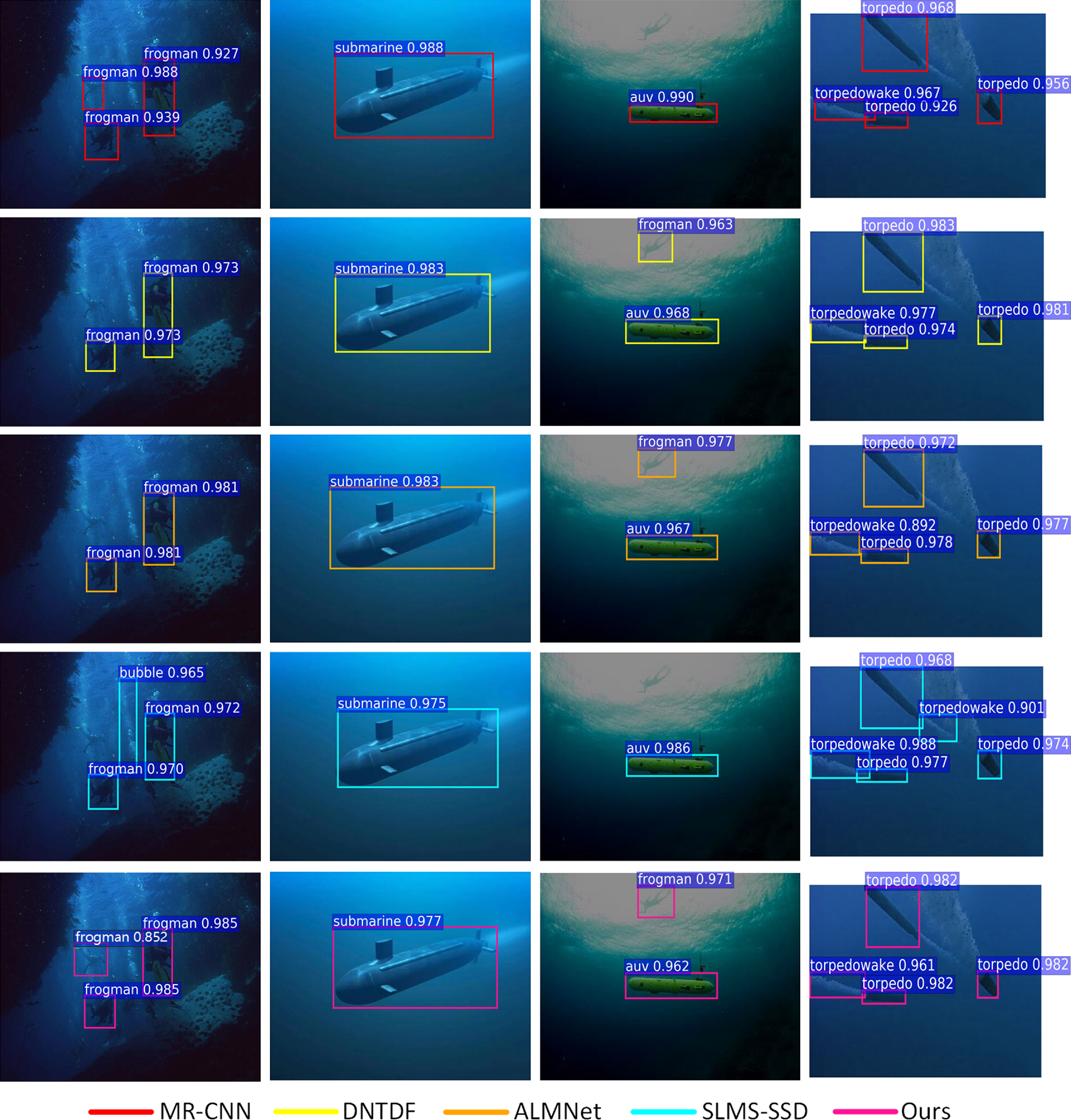
Obvious underwater recognition of specific categories of targets.
4.3. Experimental results
Experiments were conducted to validate the recognition of underwater targets by an improved feature enhancement network method for weak feature target recognition. As for different types of underwater weak feature target images, four sets of simulation experiments are designed in this section to verify the effectiveness of the proposed algorithm and compare it with MR-CNN [Reference Liu, Du, Tian and Wen22], SLMS-SSD [Reference Wang, Wang, Zhang, Tian and Li24], DNTDF [Reference Fang, Tian, Zhang, Zhang, Han and Han25] and ALMNet [Reference Gupta, Seal, Khanna, Herrera-Viedma and Krejcar26]. Experiments in this paper have been conducted to recognize several specific classes of target images, and four of them, Torpedo, Submarine, Frogman and AUV, were selected for analysis of recognition accuracy in this paper. The algorithms were evaluated in terms of category confidence, average recognition accuracy (mAP), and the number of frames per second (FPS) that the method network can process.
The first experiments were conducted with well-featured underwater category-specific target recognition, and the visualization results are shown in Fig. 5. In terms of position frame and category confidence, the comparison algorithm generally suffers from small target misses with weak features when it comes to frogman target image recognition. In contrast, the algorithm in this paper is able to recognize more accurately and with higher accuracy than the comparison algorithm. The underwater clear image test set recognition result data is shown in Table I, with the first four columns showing the accuracy in each category (same as Tables II and III ). The bold black font in the table indicates the outstanding metrics of each algorithm. The data show that this paper method has the highest recognition accuracy in both torpedo and frogman target categories recognition with 0.9062 and 0.8943 respectively. Among the recognition results of the AUV test sample images, SLMS-SSD method has the highest accuracy of 0.9862. Our paper method is only second to SLMS-SSD method accuracy of 0.0027. In the AUV test sample image recognition results, ALMNet has the best recognition result with an accuracy value of 0.9574. Its value is only higher than that of the present method at 0.0042. and the present method has the highest mAP value compared to the comparison algorithms with a value of 0.9343. In terms of algorithm speed comparison, SLMS-SSD exhibits the fastest recognition speed, boasting impressive FPS data of up to 42. While the method proposed in this paper cannot rival SLMS-SSD in speed, it nevertheless demonstrates a speed advantage when compared to other methods. Moreover, the method presented in this paper achieves the highest mean Average Precision (mAP) value, highlighting its effectiveness and accuracy.
Obvious data on the results of underwater category-specific target identification.

Results data for recognition of underwater blurred images.
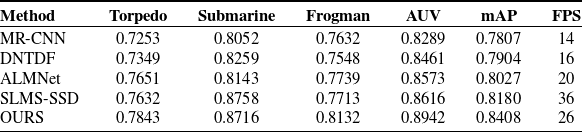
The recognition time and accuracy of distorted underwater image.

The target recognition results of underwater blurred images.

The recognition results of underwater distorted image.

The next step was to conduct experiments on target recognition of underwater blurred images. The recognition accuracy and visualization results of each method for blurred images are shown in Fig. 6 and Table II. Due to the interference of image blurring on the features, the recognition accuracy of each method is significantly reduced. The recognition data show that the mAP of the method in this paper is 0.8408, which is the highest when comparing methods, and is 0.0202 higher than the mAP value of the second-place SLMS-SSD method. mAP of the SLMS-SSD method is 0.8758, but only 0.0042 higher than the algorithm of this paper. Among the remaining category recognition results shown, the algorithm of this paper is relatively optimal. The recognition speed of this method is slightly inferior to that of the SLMS-SSD method, but it is 2.28% ahead in recognition accuracy.
In addition, experiments were carried out for the recognition of underwater distorted images. The recognition accuracy and visualization results for each method in the experiments are shown in Fig. 7 and Table III. The image distortion and blurred feature data were affected differently and the relative recognition had a different impact on the results. Different methods have different optimization strategies according to their own recognition contexts and therefore have different performance in the recognition results. As can be seen from the data of recognition results in the table, the mAP of this paper’s method is 0.7772 in recognizing underwater distorted targets. It still has the highest mAP value among the compared algorithms and is 3.84% higher than the SLMS-SSD method which is in the second place in terms of accuracy values. Our method has only the highest accuracy value in the comparison of recognition accuracy values for each category of targets. In addition, in terms of the recognition speed of each method for underwater distorted target images, our method is second only to the SLMS-SSD method with the highest FPS value.
In the three different experiments mentioned above, this paper’s method increases the computing time and makes the number of negative samples larger to improve the training effect by constructing salient features through image feature space comparison in the multi-scale feature comparison selection module. With a slight decrease in FPS compared to the SLMS-SSD method, the proposed method significantly enhances the recognition accuracy of images.
Finally, we conducted an ablation experiment to determine whether the spatial and semantic feature enhancement module and the multi-scale enhancement feature comparison selection module, contribute to improved feature extraction performance. ResNet50 was chosen as the backbone feature extraction network, and the results were validated on the dataset. The experimental findings are presented in Table IV. We used ResNet50 as the backbone for feature extraction. OURS-1 represents the recognition results with the addition of the spatial and semantic feature enhancement module, while OURS-2 represents the results with the inclusion of the multi-scale enhancement feature comparison selection module. OURS is the recognition result obtained by fusing both modules. As shown in Table IV, adding the spatial and semantic feature enhancement module to the backbone network led to a 0.0210 increase in mAP, demonstrating that the multi-scale feature fusion and inflationary convolution operation can enhance spatial and semantic feature extraction capabilities. Incorporating the enhanced feature comparison selection module into the multi-scale backbone network resulted in a 0.0174 increase in mAP, confirming that the feature comparison selection module can enhance accuracy in recognizing distorted targets within imbalanced categories. Combining these two modules in experiments led to the highest mAP, showcasing the significant mutual enhancement of the designed modules, collectively improving the detection performance of weak feature target recognition.
Ablation experiment identification result data.

5. Conclusion
Aiming at the difficulties such as serious interference in underwater environment and the difficulty of data acquisition by equipment and the scarcity of specific types of samples, this paper proposes an improved feature enhancement network method for weak feature target recognition. In this method, a multi-scale spatial and semantic feature enhancement module is constructed to extract the feature information of the extraction target accurately. Secondly, the influence of target feature distortion on classification is solved by the multi-scale feature comparison of positive and negative samples. Finally, RS Loss based on ranking is integrated to train the depth target recognition network and solve the problem of recognition accuracy under highly unbalanced sample data. This approach enhances the inspection accuracy and efficiency of underwater vehicles. The accuracy of the proposed method is 2.28% and 3.84% higher than that of the existing algorithms.
Financial support
The work was financially supported by the Key Research and Development Program of Henan Province (231111220700) and the Major Science and Technology Program of Henan Province (221100110500).
Competing interests
The authors declare that there are no competing interests regarding the publication of this article.
Ethical standards
None.
Author contributions
Lei Cai conceived and designed the study. Bingyuan Zhang, Yuejun Li and Haojie Chai conducted data gathering. Bingyuan Zhang wrote the article.



