FOCUS POINTS
• Recognize that a depressive episode belongs to the bipolar spectrum
• Provide an overview of treatment options currently available for bipolar depression
• Controversial issues concerning the use of antidepressants in bipolar depression
• Suggestions for the management of the different presentations of depression in the course of bipolar disorder.
Introduction
Bipolar disorder (BD) is a chronic, recurrent, and disabling illness, carrying an immense burden of both morbidity and all-cause mortality.Reference Judd, Akiskal and Schettler1 While past research was more focused on the manic phases of the disorder, in the last decade, several reports emphasized that depressive symptoms and episodes are the most prevalent dimension of the illness.Reference Bauer, Ritter, Grunze and Pfenning2, Reference Amit and Weizman3 Bipolar patients spend three times more days of their lives in a depressed state than in any other mood episode, with a significant degree of psychosocial impairment and disability.Reference Judd, Akiskal and Schettler1, Reference Post, Denicoff and Leverich4 Incomplete remission, with continuous presence of subsyndromal depressive symptoms, is common and has been demonstrated to contribute to both long-term dysfunction and disability, and to an increased risk of relapse.Reference Judd, Schettler and Akiskal5 Furthermore, suicide risk is higher in the depressive phases in both type I and type II BD.Reference Angst, Angst, Gerber-Werder and Gamma6
There is a growing awareness that bipolar depression is a current major diagnostic and therapeutic challenge. Several factors may complicate the diagnosis of bipolar depression, including incomplete clinical history, lack of patients’ insight, and the presence of high rates of psychiatric comorbidity with anxiety disorders and substance use disorders, which may worsen the illness course and increase the number of suicide attempts.Reference Young and Nemeroff7, Reference Vieta, Colom and Corbella8 For this reason, BD is often under-diagnosed on initial presentation, and high rates of misdiagnosis as unipolar major depressive disorder, ranging between 10% and 40% of the cases, have been reported.Reference Hirschfeld, Lewis and Vornik9 Misdiagnosis often leads to inappropriate treatment, which may compromise long-term outcome by inducing manic or mixed states, or by increasing mood cycling and affective instability.Reference Young and Nemeroff7
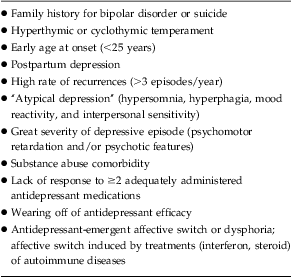
Diagnostic accuracy may be improved by clinicians’ careful screening for the presence of current and past symptoms of mania or hypomania in all patients presenting with depressive symptoms. Since bipolar patients typically are very concerned about the depressive phases of the illness and have impaired insight regarding hypomania or mania-related episodes, the involvement of family members or close friends in the diagnostic process can be helpful.Reference Goodwin and Jamison10, Reference Baldessarini, Vieta and Calabrese11 Moreover, even in the absence of a clear bipolar course of the illness (lifetime occurrence of manic or hypomanic symptoms), several demographic and clinical featuresReference Cassano, Akiskal and Savino12–Reference Hardoy, Cadeddu and Serra21 have been proposed as diagnostic indicators, suggesting that a depressive episode belongs to the bipolar spectrumReference Cassano, Dell'Osso and Frank22–Reference Dell'Osso, Armani and Rucci24 (Table 1).
Depression and bipolar spectrum: diagnostic indicators of “bipolarity” in patients with depressive episodeReference Cassano, Akiskal and Savino12–Reference Hardoy, Cadeddu and Serra21

Furthermore, it was estimated that more than two-thirds of depressed bipolar patients present an episode of depression with at least subtle concomitant manic features.Reference Goldberg, Perlis and Bowden25 By the current narrow Diagnostic and Statistical Manual of Mental Disorders, fourth edition, Text Revision (DSM-IV-TR) definition of mixed bipolar states, these individuals would be classified as purely depressed rather than mixed. Subsyndromal manic symptoms during a depressive episode, however, outline a more severe and complex clinical state than pure bipolar depression, with prognostic and therapeutic implications. The treatment of these mild mixed depressive states is poorly studied and less clearly defined, but they appear to predict a lower response to standard treatments, as well as to increase the trend toward emotional destabilization following antidepressants.Reference Baldessarini, Vieta and Calabrese11, Reference Goldberg, Perlis and Ghaemi26 In the next edition of DSM-V, the introduction of the “with mixed features” specifier has been proposed to identify these depressive episodes with subthreshold mixtures of manic symptoms.
Despite the disease burden of bipolar depression, little evidence is available to guide the treatment of this phase of the disorder in contrast to mania or hypomania. The goal of treatment of depression in BD is not only to achieve full remission of acute episodes and to prevent suicides, but also to obtain long-term stabilization by preventing relapses. Therapeutic options for bipolar depression are provided by all current treatment guidelines,Reference Kasper, Calabrese and Johnson27–Reference Grunze, Vieta and Goodwin31 and some convergence between them has been reported.Reference Nivoli, Colom and Murru32 However, evidence-based knowledge often derives from clinical trials conducted with strict inclusion criteria in samples that do not completely reflect the broad spectrum of bipolar depressed patients in clinical practice. Since a few studies have specifically investigated the treatment of depression in BD, many treatment options are often translated from unipolar to bipolar depression, and several other agents are used off-label in the daily clinical practice to treat depressed bipolar patients.
To date, there are still several unanswered questions about the management of bipolar depression. Among them, the major issue is the role of antidepressants and their potential risk of producing long-term mood destabilization.
This article will provide an overview of available treatment options for bipolar depression and some indications for the appropriate management of these patients in clinical practice.
Treatment Options of Bipolar Depression
Pharmacological treatment
Lithium
Although lithium has been generally considered the most effective compound for maintenance treatment of BD,Reference Geddes, Burgess and Hawton33 the evidence in bipolar depression is not as sound.Reference Baldessarini, Vieta and Calabrese11 The EMBOLDEN (Efficacy of Monotherapy SEROQUEL in Bipolar DEpressioN) trial failed to demonstrate a significant acute antidepressant effect of lithium when compared to placebo, as to be expected because of its delayed antidepressant action.Reference Young, McElroy and Bauer34 While its efficacy in preventing depressive episodes was not clearly shown, the major evidence supporting an important role of lithium in the treatment of bipolar depression is its well established antisuicidal efficacy.Reference Cipriani, Pretty, Hawton and Geddes35, Reference Baldessarini, Tondo and Davis36
Anticonvulsants
Lamotrigine
Despite the widespread notion that lamotrigine is effective on depressive symptoms of BD, as reported in different guidelines, specific trials in monotherapy yielded inconsistent findings.Reference Swartz and Thase37, Reference Bowden and Singh38 Recent meta-analysis of five randomized, placebo-controlled trials, which individually failed to show a statistically significant result, concluded that the effect of lamotrigine was modest, although the advantage of this compound was evident for the most severe patients at baseline.Reference Calabrese, Huffman and White39, Reference Geddes, Calabrese and Goodwin40 However, the first controlled multicenter study evaluating lamotrigine monotherapy in the treatment of bipolar I depressionReference Calabrese, Bowden and Sachs41 supported its efficacy and led to its inclusion as a first-line treatment for bipolar depression in several guidelines. Lamotrigine shows benefits in bipolar depression mainly in combination with other mood stabilizers,Reference Bowden and Singh38 particularly when co-administered with lithium.Reference van der Loos, Mulder and Hartong42 In addition, it was more effective than risperidone and inositol as an augmentation strategy in resistant bipolar I and II depression.Reference Nierenberg, Ostacher and Calabrese43 However, its use in acute bipolar depression is limited by the need for a slow upward dose taper to reduce the risk of skin reactions. Lamotrigine showed efficacy in the prophylaxis of BD, in particular for preventing depressive relapses.Reference Calabrese, Suppes and Bowden44, Reference Goodwin, Bowden and Calabrese45
Divalproex
Divalproex is a widely prescribed anticonvulsant for BD, but just four randomized trials in acute bipolar depression have been conducted, and their results are controversial.Reference Saunders and Goodwin46 A recent meta-analysis provided preliminary evidence that divalproex is effective for the reduction of depressive symptoms of acute bipolar depression.Reference Smith, Cornelius and Azorin47 Moreover, some evidence suggests that divalproex presents at least a moderate prophylactic efficacy for bipolar depression.Reference Bowden, Calabrese and McElroy48 The BALANCE (Bipolar Affective disorder: Lithium/ANtiConvulsant Evaluation) study suggested that divalproex was probably similar to lithium in preventing manic relapses, but less effective in preventing depressive relapses.Reference Geddes, Goodwin and Rendell49
Carbamazepine
While carbamazepine has shown efficacy in the treatment of acute manic or mixed states, the evidence for its use in acute bipolar depression is less consistent.Reference Saunders and Goodwin46 However, carbamazepine has been used in long-term prophylaxis, despite limited and uneven evidence of efficacy, particularly against recurrences of bipolar depression.Reference Greil, Kleindienst, Erazo and Müller-Oerlinghausen50
Atypical Antipsychotics
Quetiapine
All second-generation antipsychotics are effective antimanic agents, but only quetiapine demonstrated a striking acute effect for depression in bipolar I and II patients.Reference Saunders and Goodwin46 It is currently recommended by all guidelines as a first-line choice for the treatment of acute bipolar depression, and even as adjunctive treatment in patients already taking antimanic medications. Its efficacy in bipolar depression has been supported consistently in several placebo-controlled trials.Reference Young, McElroy and Bauer34, Reference Thase, Macfadden and Weisler51–Reference McElroy, Weisler and Chang54 Quetiapine has shown to produce significant and sustained reductions in the majority of core mood symptoms of depressive episodes, including suicidal thinking.Reference Thase, Macfadden and Weisler51, Reference Weisler, Calabrese and Thase52 In relapse prevention studies, either as monotherapy or when added to lithium or divalproex, quetiapine significantly reduced the time to relapse of a mood event.Reference Vieta, Suppes and Eggens55, Reference Hardoy, Garofalo and Carpiniello56
Olanzapine
Olanzapine monotherapy was found to be more effective than placebo in a short-term randomized controlled trial for the treatment of bipolar I depression.Reference Tohen, Vieta and Calabrese57 In comparison to olanzapine monotherapy, the combination of olanzapine with fluoxetine was superior for all measures of depressive symptoms, with higher rates and faster times of response and remission.Reference Tohen, Vieta and Calabrese57 The combination of olanzapine and fluoxetine was also shown to be more effective as an acute treatment in comparison with lamotrigine.Reference Brown, Mcelroy and Keck58 To date, the long-term use of olanzapine or olanzapine plus fluoxetine in patients with bipolar depression lacks consistent research support.Reference Baldessarini, Vieta and Calabrese11 Olanzapine monotherapy was superior to placebo in relapse prevention of subsequent mood episodes in a sample of bipolar I disorder patients who responded to open-label acute treatment with olanzapine for a manic or mixed episode.Reference Tohen, Calabrese and Sachs59 In comparison trials, it was not superior to lithium or divalproex in the prevention of depressive relapse.Reference Tohen, Ketter and Zarate60, Reference Tohen, Greil and Calabrese61
Other second-generation antipsychotics
Among other common second-generation antipsychotics, aripiprazole monotherapy did not show significant benefits in the acute treatment of bipolar depression,Reference Thase, Jonas and Khan62 although it demonstrated efficacy as an adjunctive treatment to antidepressants in patients with major depressive disorder.Reference Marcus, McQuade and Carson63 As a maintenance treatment, there is some evidence of efficacy in preventing manic, but not depressive, episodes.Reference Keck, Calabrese and McIntyre64 There is little and generally unconvincing evidence about the effectiveness of risperidone and ziprasidone for treating bipolar depression.Reference Baldessarini, Vieta and Calabrese11
Antidepressants
The role of antidepressants in the treatment of bipolar depression is a controversial issue.Reference Yerevanian65 It is estimated that antidepressants are prescribed routinely to bipolar depressed patients in about 50% of cases, often as augmentation strategy for depressive episodes not responding to mood stabilizers alone.Reference Baldessarini, Leahy and Arcona66, Reference Carta, Aguglia and Balestrieri67 However, the evidence of their efficacy in bipolar depression, especially as a long-term treatment strategy, is inconclusive, and their use has been associated with an increased risk of hypomanic/manic or mixed switch and cycle acceleration.Reference Sachs, Nierenberg and Calabrese68–Reference Licht, Gijsman, Nolen and Angst71 Particularly, the use of antidepressants in monotherapy is not recommended in patients with a history of manic episodes, and care should be taken also in patients with treatment-induced hypomania.Reference Goodwin28 As a consequence, few studies have explored the efficacy of these agents in monotherapy for bipolar I depression.Reference Amit and Weizman3 In a randomized clinical trial, fluoxetine monotherapy was found to be as effective as olanzapine or olanzapine/fluoxetine in both type-I and type-II bipolar patients, with no evidence of increased manic symptoms.Reference Amsterdam and Shults72 On the contrary, the EMBOLDEN II study revealed no statistically significant differences between paroxetine and placebo, in both bipolar I and II patients, and the active compound did not result in association with high rates of manic/hypomanic switch.Reference McElroy, Weisler and Chang54 In bipolar II patients, the risk of manic induction by antidepressant monotherapy is estimated to be lower, and beneficial effects of this drug class were reported.Reference Swartz and Thase37, Reference Altshuler, Suppes and Black73 One large study examining bipolar II patients treated with fluoxetine monotherapy concluded that it is a safe and effective short-term treatment for bipolar II depression, with a relatively low rate of syndromal hypomanic episodes.Reference Amsterdam and Shults74 A small placebo-controlled study gave further support to the effectiveness of escitalopram, another selective serotonin reuptake inhibitor (SSRI), in managing BD II.Reference Parker, Tully, Olley and Hadzi-Pavlovic75 In fact, this drug provoked significant improvement of depressive symptoms and of functional impairment of bipolar II patients over nine months, compared with placebo, with no mood destabilization in long-term use. SSRIs were therefore suggested to have a possible role as “mood stabilizers” for BD II.Reference Parker, Tully, Olley and Hadzi-Pavlovic75 In a short-term study, venlafaxine alone was superior to lithium monotherapy in both response and remission rates, with a low hypomanic switch rate.Reference Amsterdam and Shults76
A meta-analysis of 12 randomized controlled trials assessing antidepressant use in the short-term treatment of bipolar depression reported that antidepressants were effective and not associated with a higher incidence of affective switch.Reference Gijsman, Geddes and Rendell77 However, the studies that were reviewed had a short duration, and antidepressants were administered in combination with mood stabilizers in the majority of the patients. In contrast, a more recent meta-analysis of six trials comparing antidepressants to placebo or other standard treatments for bipolar depression failed to show a significant benefit of antidepressants over placebo or active drugs, even if they were not associated with an increased risk of switch.Reference Sidor and MacQueen78
In several studies, antidepressants in bipolar depression were investigated when co-administered with mood stabilizers. In their meta-analysis, Gijsman etal. Reference Gijsman, Geddes and Rendell77 showed a significant advantage in achieving response in the patients treated with antidepressants; these patients were also more likely to reach remission, as compared with the group treated with mood stabilizers plus placebo. In contrast, the long-term use of adjunctive treatment with paroxetine or bupropion did not significantly increase the rate of recovery compared with mood stabilizers alone, although it did not enhance the risk of mood destabilization.Reference Sachs, Nierenberg and Calabrese68
Overall, data on the risk of manic/hypomanic switch associated with the use of antidepressants in acute bipolar depression are still controversial.Reference Tondo, Baldessarini and Vázquez79 Methodological limitations, such as the small sample size; short duration of the studies, which does not allow researchers to evaluate the possible long-term destabilization; and the criteria adopted to define an affective switch, should be taken into account.Reference Amit and Weizman3, Reference Licht, Gijsman, Nolen and Angst71 To further complicate interpretation of data on antidepressant use in bipolar depression, there is the wide variability in the spontaneous course of BD. A higher risk of switch or treatment-emergent mixed symptoms seems to be associated with the use of tricyclic antidepressants or venlafaxine,Reference Gijsman, Geddes and Rendell77, Reference Post, Altshuler and Leverich80, Reference Vieta, Martinez-Arán and Goikolea81 while SSRIs and bupropion are considered the safest antidepressants.Reference Sachs, Nierenberg and Calabrese68, Reference Tondo, Vázquez and Baldessarini82 Although common, the co-treatment with a mood stabilizer does not seem to produce a major protective effect, as expected, in limiting the possible mood instability induced by antidepressants .Reference Sachs, Nierenberg and Calabrese68, Reference Post, Altshuler and Leverich80, Reference Undurraga, Baldessarini and Valenti83
In conclusion, the available evidence indicates a cautious use of antidepressants in bipolar patients, especially type I, and recommends that these drugs should be used for limited periods and in combination with antimanic agents in order to avoid manic switch, as suggested by almost all guidelines.Reference Kasper, Calabrese and Johnson27–Reference Grunze, Vieta and Goodwin31 However, the duration of treatment still remains an open question, and there is no consensus among current guidelines. Some studies showed a greater risk for depressive relapses following the interruption of treatment with antidepressants, with no reports of an increased risk for manic switching when treatment was continued.Reference Joffe, MacQueen, Marriott and Young84, Reference Altshuler, Post and Helleman85 This suggests a possible role of these drugs as maintenance treatment in association with mood stabilizers, at least for a subgroup of bipolar patients.Reference Altshuler, Post and Helleman85, Reference Ghaemi, Ostacher and El-Mallakh86
Further studies, carried out for longer periods in more heterogeneous samples that include the wide spectrum of bipolar conditions, are needed to fully assess the benefits of antidepressants in BD and to better define the characteristics of patients who are candidates for continuous treatment with antidepressants.
Experimental treatments
Recently, a number of novel treatments have been suggested for the treatment of bipolar depression. One of these is modafinil, an anti-narcoleptic and mild stimulant agent, although the efficacy and safety of this off-label approach is not clear. A placebo-controlled study in bipolar I depressed patients who responded inadequately to monotherapy with mood stabilizers showed higher response and remission rates in the group of patients treated with the addition of modafinil to the mood stabilizer than in the placebo-controlled group.Reference Frye, Grunze and Suppes87
Another novel agent proposed for bipolar depression is pramipexole, as some small studies have demonstrated its significant antidepressant effect when added to mood stabilizers in patients with bipolar depression.Reference Goldberg, Burdick and Endick88, Reference Zarate, Payne and Singh89
Preliminary data suggest a possible role of two N-methyl-D-aspartate (NMDA) receptor antagonists in the treatment of bipolar depression. The co-administration of i.v. ketamine with mood stabilizing drugs was found to have rapid antidepressant effect and improvement of suicidal ideation in patients with treatment-resistant bipolar depression.Reference Diazgranados, Ibrahim and Brutsche90–Reference Zarate, Brutsche and Ibrahim92 Memantine shows neuroprotective and pro-neurogenesis effects in several neurodegenerative diseases, and there is a small amount of evidence to support its efficacy as add-on therapy in improving cognitive performance and depressive symptoms in treatment-resistant bipolar depression.Reference Lu, Chen and Lee93
There is also inconsistent evidence that the administration of omega-3 fatty acids, in particular, eicosapentanoic and docosahexaenoic acids, in addition to standard mood-stabilizing treatments in bipolar depression is associated with a significantly higher improvement of depressive symptoms over placebo.Reference Frangou, Lewis and McCrone94 Nevertheless, another trial with eicosapentanoic acid as adjunctive treatment produced negative findings.Reference Keck, Mintz and McElroy95
Nonpharmacological treatment
Psychotherapy
The role of psychosocial interventions should be taken into account in the management of BD patients, since life events and other stressors appear to play major roles in shaping the expression of the illness, in both onset and relapses. In the Systematic Treatment Enhancement Program for Bipolar Disorder (STEP-BD) trial, bipolar I or II depressed outpatients were randomly assigned to one of three intensive psychosocial treatments or to a brief psycho-educational intervention, all in conjunction with pharmacotherapy. A duration of over 1 year of intensive psychosocial treatment as an adjunct to pharmacotherapy was associated with higher rates of recovery from bipolar depression, suggesting that psychotherapy has a potential role in enhancing stabilization from bipolar depression.Reference Miklowitz, Otto and Frank96
BD is associated with high levels of subsyndromal symptoms that provide a possible target for psychosocial interventions; consequently, most of the literature on this topic focuses on relapse prevention. Group psycho-education appears to be an effective psychotherapeutic adjunct to standard pharmacological treatment in BD I and BD II, as it was shown to reduce significantly the number of relapsed patients and of recurrences per patient, and to increase the time to a recurrence.Reference Colom, Vieta and Martinez-Aran97 The role of cognitive-behavioral therapy in relapse prevention remains uncertain.Reference Saunders and Goodwin46 A randomized controlled study supported the conclusion that cognitive-behavioral therapy specifically designed for relapse prevention in BD was useful in conjunction with mood stabilizers to prevent relapses and promote social functioning.Reference Lam, Watkins and Hayward98 On the contrary, in a larger pragmatic study, no significant benefit of additional cognitive-behavioral therapy was demonstrated when compared with common treatments.Reference Scott, Paykel and Morriss99 Combining family-focused therapy with pharmacotherapy has been examined for relapse prevention of BD, and it was shown to enhance post-episode symptomatic adjustment and to improve compliance to medications.Reference Miklowitz, George and Richards100 Finally, interpersonal and social rhythm therapy added to pharmacotherapy have been associated with shorter time to recovery from an episode of depression, longer survival time without a new affective episode, and an improvement of psychosocial and occupational functioning.Reference Frank, Kupfer and Thase101, Reference Frank, Soreca and Swartz102
Electroconvulsive therapy
Electroconvulsive therapy (ECT) should be considered an option for patients with severe and treatment-resistant bipolar depression, high suicide risk, catatonic or psychotic features.Reference Goodwin28–Reference Grunze, Vieta and Goodwin31 However, it is unclear whether the response to ECT in BD might be somewhat lower than in unipolar depression.Reference Baldessarini, Vieta and Calabrese11, Reference Dierckx, Heijnen, van den Broek and Birkenhäger103 While some studies have reported that ECT had a similar efficacy in both types of depressive patients,Reference Grunhaus, Schreiber and Dolberg104 there is some evidence of higher remission rates in unipolar patients, as compared with BD I and BD II patients.Reference Medda, Perugi and Zanello105 A recent meta-analysis investigating the relative efficacy of ECT in both forms of depression provides evidence for the equal efficacy of ECT in unipolar and bipolar depression.Reference Dierckx, Heijnen, van den Broek and Birkenhäger103
Management of Bipolar Depression
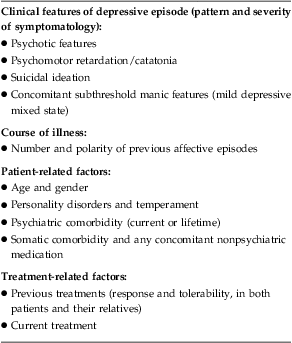
A series of preliminary assessments is necessary for the proper management of different presentations of bipolar depression (Table 2). The initial evaluation should include both symptomatological characteristics of the depressive episode, such as psychotic features, severe psychomotor retardation, suicide risk, concomitant subthreshold manic/hypomanic symptoms (mild mixed depression), and the previous course of illness. The treatment of the acute episode, in fact, will be different for patients presenting with a first depressive episode or with previous relapses, and the prevalent polarity of the relapses must be taken into account. Even the presence of psychiatric comorbidity, in particular with anxiety, substance abuse, and eating disorders, or of somatic comorbidity and intake of nonpsychiatric medications must be considered. Other factors that may influence the therapeutic decisions include response to previous psychopharmacological treatments (in both the patient and his or her relatives), age, and gender (e.g., fertile women), as well as personality and temperamental characteristics that may complicate the clinical presentation and affect compliance. Finally, an important element in choosing medications for acute bipolar depression lies in the assessment of the current treatment.
Variables influencing treatment choice
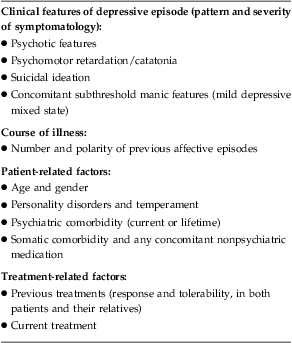
Preliminary assessment of these variables may guide the therapeutic choices.
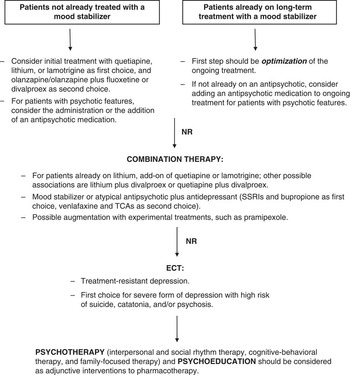
If the patient under maintenance treatment with a mood stabilizer suffers from a depressive relapse, it may be appropriate to evaluate the serum concentration of the drug (e.g., lithium or anticonvulsant) and the compliance of the patient. If any of these is inappropriate, the dosage of the mood stabilizer should be adjusted (optimization). Furthermore, if reduced thyroid functioning emerges, it may be useful to begin or increase the dosage of thyroid hormone. If treatment optimization is not sufficient and the severity of the episode is not so severe as to require hospitalization, adjunctive treatment with a second mood stabilizer or antidepressant may be considered. The addition of quetiapine to the current treatment is recommended by the guidelines as a first choice, or the addition of lamotrigine for patients already on lithium. In clinical practice, antidepressants are often administered in association with mood stabilizers to treat the acute episode. Among the various classes of antidepressants, the majority of guidelines recommend the use of SSRIs and of bupropion, with venlafaxine or tricyclics as second choice (Figure 1).Reference Kasper, Calabrese and Johnson27–Reference Grunze, Vieta and Goodwin31
Management of acute bipolar depression. Abbreviations: NR = non responders, SSRIs = selective serotonin reuptake inhibitors, TCAs = tricyclic antidepressants, ECT = electroconvulsive therapy.

If the patient presents with a depressive episode and is not currently being treated with a mood stabilizer, the severity of the episode, as well as the longitudinal course of the disorder, should be assessed. For patients with a clear bipolar course of the illness, the first step may be the use of a mood stabilizer; the choice of a mood stabilizer may depend on somatic comorbidity, as well as on frequency, severity, and prevalent polarity of the relapses and history of suicidality. Lithium still represents the mood stabilizer with the best evidence of efficacy in the maintenance treatment of BD, as well as in the prevention of suicide.Reference Geddes, Burgess and Hawton33, Reference Baldessarini, Tondo and Davis36 Nevertheless, the use of this compound in monotherapy in acute bipolar depression is limited by the delayed onset of the therapeutic effect. For this reason, in the most severe forms of depression, the addition of a second drug to lithium should be considered. Furthermore, over the last few years, the use of lithium has often been limited, particularly in the United States, because of its potential side effects and also because of the increased availability of other therapeutic options.Reference Blanco, Laje and Olfson106 Besides lithium, most guidelines indicate quetiapine as first choice in monotherapy, or as adjunctive therapy in combination with lithium or divalproex. Lamotrigine may be indicated, although evidence in favor of its efficacy in acute treatment is debatable. Even olanzapine may represent a therapeutic option for bipolar depression, particularly in combination with fluoxetine or other SSRIs (Figure 1).
If the patient is suffering from a depressive episode with psychotic features, the administration of antipsychotics in addition to the ongoing treatment should be considered. In the most severe forms of depression, with elevated risk of suicide or with severe psychomotor retardation, a prompt hospitalization and ECT may be necessary.
The therapeutic management of mild depressive mixed states,Reference Koukopoulos, Albert, Sani and Koukopoulos107 which often occur in comorbidity with anxiety disorders, eating disorders, personality disorders, impulse control disorders, and substance abuse, is particularly complex. In fact, these conditions respond poorly to classical treatments with mood stabilizers, and the use of antidepressants is associated with a worsening of the manic/hypomanic symptomatology, in particular of psychomotor agitation, with mood destabilization in the long-term, with a trend toward chronicity and an increased suicide risk.Reference Goldberg, Perlis and Bowden25, Reference Goldberg, Perlis and Ghaemi26, Reference Krüger, Young and Bräunig108 Some authors have reported a possible beneficial effect of divalproex in the treatment of depression with mixed features, as it may be indicated for the management of anxiety in comorbidity, and also of some atypical antipsychotics, in particular quetiapine and olanzapine.Reference Koukopoulos, Albert, Sani and Koukopoulos107 In clinical practice, combination with mood stabilizers (lithium and anticonvulsants) and/or atypical antipsychotics (quetiapine and olanzapine) is often necessary. Even the association of psychopharmacological treatment with psychotherapy/psycho-educational interventions could be particularly useful.Reference Swartz, Frank and Cheng109
Conclusions
Despite the availability of several treatment options for bipolar depression, the ensuing findings from the specific literature are often controversial, and many questions remain open. Therefore, in daily clinical practice, the therapeutic choices are often empirical and guided by the personal experience of the clinician, who must assess and manage a series of variables, thus making the presentation of bipolar depression extremely heterogeneous. These include the temperamental and personality characteristics of the patient, the presence of psychiatric and somatic comorbidity, and the exposure to previous treatments, as well as the tendency of the disorder to follow also spontaneously different courses.
The main debated question in the treatment of bipolar depression remains the use of antidepressants. Given their widespread use in clinical practice, over the last few years, many studies have tried to investigate the reason for this practice,Reference Undurraga, Baldessarini and Valenti83, Reference Pacchiarotti, Valentí and Bonnin110, Reference Pacchiarotti, Valentí and Colom111 and to identify clinical characteristics predictive of response to antidepressants.
Further naturalistic studies, with longer observation periods, are needed to assess whether effective treatments in the acute phase may be useful also in continuation and maintenance phases without inducing mood destabilization. Future directions should focus on better definition of response to treatment in different subtypes of bipolar depression by integrating the scientific knowledge with everyday clinical practice.