


INTRODUCTION
Most scholars of contentious politics agree that, in contemporary and historical contexts, women's participation has been important for understanding the emergence, conduct, and resolution of conflict across societies and over time. Scholarly attention to women's participation in violent dissent and rebellion, however, has lagged far behind its popular recognition. While contemporary news coverage, historical accounts, and a small body of empirical political science suggest wide variation in the roles and activities of women in militarized movements around the world, we still lack a deep understanding about the causes of this variation. As a result, it is difficult to know whether the growing number of anecdotes about women in leadership, rank-and-file, and support positions within violent political organizations reflect exceptional cases or broader patterns. We also lack detailed information about whether women's participation in political violence influences, or is influenced by, the violent political organizations in which they participate. We tackle this latter question directly, and ask: What explains the form and frequency of women's participation across violent political organizations (VPOs)? Footnote 1 As such, we offer new theoretical and empirical insights into the ways in which the industrial organization of violent rebellion impacts patterns of gender-based participation.
While the existing literature on women's participation in political violence is quite small, it nonetheless includes such seminal works as Kampwirth's (Reference Kampwirth2002) cross-conflict study of women in 20th-century Latin American insurgencies, Bloom's (Reference Bloom2007) individual-level research on contemporary female suicide bombers, and a variety of comparative historical studies whose focus has ranged from individual women soldiers in the Phillipine Huk Rebellion (Lanzona Reference Lanzona2009) to the all-female combat battalions of Dahomey, an historical West African kingdom corresponding to the southern part of present-day Benin (Alpern Reference Alpern2011). From these studies and others, the field has gained extensive knowledge about the varied forms of women's participation in violent groups. It has been difficult to determine either the uniqueness of these findings or their generalizability to broader patterns of women in conflict, however, given that much of the extant literature has focused on single-case histories, small-N qualitative studies, and first-person narratives emphasizing specific organizations, conflicts, and/or women.
In response to this difficulty, we introduce new data on women's participation in 166 violent political organizations active in 19 African countries from 1950 to 2011. The original dataset that we analyze includes detail on the presence and activities of women across organizations, as well as information on the degree to which individual group agendas, ideologies, and aims reflect gender awareness. Although we focus on a single region, our cross-national, cross-conflict, and cross-organizational research design provides important leverage for contextualizing the single or small-N case-oriented results of previous work.Footnote 2 It also allows us to compare patterns of women's participation across VPOs in a variety of background conditions and examine the generalizability of existing explanations for gender diversity in violent politics. Methodologically, we use both quantitative and qualitative approaches to evaluate our claims about the organizational basis of women's VPO participation.
The limited body of research in this area also tends to focus overwhelmingly on “supply-side” dynamics, or identifying some set of characteristics that might condition women uniquely towards violence. In contrast to this approach, we focus on the mesofoundations of women's participation and take a closer look at “demand-side” dynamics, or the ways in which different organizational preferences and behaviors work to facilitate or impede women's presence in VPOs.Footnote 3 Women's voluntary participation in violent politics is tied invariably to the availability of opportunities; in order for women to have a presence in an organization, its leadership must provide space for those interested in participating. Extant scholarship on women's conflict participation, however, tends to overlook the importance of organizational preferences in determining the demography of these groups, instead focusing on supply-side dynamics and motivating conditions. Our work refocuses attention on variation in organizations themselves as a central explanation for women's varying participation across VPOs.
Our statistical results show that indicators of group demand for women participants correlates positively and strongly with women's participation. They suggest further that associations between the presence and roles of women in VPOs and supply-side variables are likely more assumed than real. Specifically, we find that group size, recruitment platforms and tactics—all of which affect organizational “demand” for women—are more closely related to women's participation in violent political groups than women's aggregate willingness to serve or society-level respect for women's political rights—all common “supply” indicators. We use a representative case illustration comparing the Eritrean Liberation Front (ELF) and Eritrean People's Liberation Front (EPLF) in Ethiopia to further examine these dynamics, leveraging the benefits of deep description and qualitative data for speaking to questions of causality and change over time.
We begin with three assumptions about how and why VPO leadership and potential participants approach decision-making. First, though it is not necessary for both parties to share the same ultimate goals (i.e., the leader's motivation for recruiting women may not reflect women's motivations for participating), they do similarly choose purposefully among action alternatives and make choices so as to maximize benefits while minimizing costs. Second, each organization's ability to succeed depends on its ability to attract and retain (or readily replace) members who are willing and able to engage in violence (Gates Reference Gates2002). Finally, in order to be successful organization leaders must be able to persuade potential members to overcome collective action problems while also frustrating any opponents’ ability to do the same (Lichbach Reference Lichbach1995, 22–6).
SUPPLY DYNAMICS AND GENDER DIVERSITY IN VIOLENT POLITICAL ORGANIZATIONS
Scholars commonly cite revenge, representation and social role fulfillment as three key benefits that women seek from VPO participation. Bloom (Reference Bloom2005) notes that personal tragedies such as the loss of a husband, brother, or father to political violence and/or a desire to punish the state for diminished educational and financial opportunities often motivate women to seek revenge against the government. According to Alison (Reference Alison2009), a young Tamil woman once highlighted this reason precisely as her rationale for joining the Liberation Tigers of Tamil Eelam (LTTE), stating, “I want to do something. Staying at home and getting widowed at some stage or waiting to be sexually abused by Sinhalese Soldiers is no life” (137). Participation in VPOs can often offer women both a vehicle through which they may avenge their losses and a means for protecting their security, given women's distinction as particularly valuable targets of state violence and repression during civil conflict (Gardam and Charlesworth Reference Gardam and Charlesworth2000; Kaufman and Williams Reference Kaufman and Williams2010;; Mason Reference Mason1992).Footnote 4
Radical violent organizations can be a valuable substitute for traditional representation for individuals interested in supporting goals and expressing preferences that have been marginalized or overlooked by existing political structures (Cunningham Reference Cunningham2003; Molyneux Reference Molyneux1985). As issues of gender equality, women's liberation and economic rights are often excluded from mainstream political discourse, they tend to feature prominently among many revolutionary (and counter-revolutionary) women's policy preferences (Abeseykera Reference Abeysekera, Shresta and Thapa2007). For instance, in the Spanish Basque region “[I]t was ETA which insisted that there should be a women's organization set up because they saw that women did have special problems, not inside the movement, but in society” (MacDonald Reference MacDonald1991, 19). In another example, the tenacity of many Sri Lankan and Northern Irish women toward the issue of representation in their national resistance movements was a foremost reason for their inclusion in the LTTE and IRA, respectively (Alison Reference Alison2009: 125–6, 143). Adele Balasingham, a former high-ranking LTTE member, has noted that participation in the Tamil Tigers offered an invaluable “springboard from which women can organize, identify and articulate grievances and fight against the modes of oppression and exploitation perpetrated on them” (Balasingham Reference Balasingham1983, 6).Footnote 5
Relatedly, some women find they are better able to fulfill or challenge cultural prescriptions about the role of women in society and politics through involvement in violent politics. On one hand, service to or within the organization can be seen as an extension of the woman's “natural” role as a source of comfort and support to men (DeGroot Reference De Groot, De Groot and Peniston-Bird2000; Wood Reference Wood2008). On the other hand, others have been found to participate for social and political empowerment and as a means to challenge societal injustices and legal inequities (Bhadra et al. Reference Bhadra, Shresta, Thapa, Shresta and Thapa2007).Footnote 6
While these benefits are certainly real, they do not seem to differ significantly from benefits that might accrue to any potential participant, whether male or female. In fact, the above conclusions as to why women have participated in the aforementioned violent insurgent organizations mirror almost directly conclusions from gender-neutral research into why individuals join insurgencies. Desires for revenge for or protection from state repression are not uniquely female, particularly given that both men and women have been victims and perpetrators of violence in conflict (Carpenter Reference Carpenter2006; Cohen Reference Cohen2013). Real and perceived economic, social, and political grievances (Atran Reference Atran2003; Gurr Reference Gurr1970), security concerns (Eck Reference Eck2010), and congruence of one's personal preferences with organizational goals (Weinstein Reference Weinstein2005) have all been found to influence individual participation in political violence. Based on this observation, it appears that supply-side explanations alone are likely insufficient for explaining variation in how, when and why women participate in these groups.
ORGANIZATIONAL DEMAND FOR WOMEN PARTICIPANTS
That there are few “uniquely female” factors motivating women to take up violence suggests that, at the micro-level, the conditions under which women engage in violent political behavior may not differ substantially from those that encourage men's behavior. At the meso-level, however, there is considerable variation across VPOs in terms of how and why they might provide the organizational space for women's participation. Especially as they compete with other organizations for new members, prestige and public support, VPOs can be distinguished by their relative willingness to lower the costs of participation for women volunteers as well as by their approaches to strategic positioning among rival organizations. VPOs can also vary in their sensitivity to the comparative advantages that women participants can provide, particularly with respect to productivity and tactical efficiency.
One of the most obvious advantages of openness towards women's participation is that organizations can draw from a larger pool of potential members by not limiting consideration to men only. Membership is a critical material resource for all violent political groups, helping to determine the range of activities that can be included in their repertoires (Crenshaw Reference Crenshaw and Rapoport2001), the intensity and frequency of their attacks (Siqueira Reference Siqueira2005) and the resultant likelihood of success against their opponents (Cunningham et al. Reference Cunningham, Gleditsch and Salehyan2009). For example, openness to women participants by the Tigray People's Liberation Front (TPLF) in Ethiopia “was essential as part of the overall human capital required to successfully launch a fight against the might of the Derg” (Veale Reference Veale2003, 17). The ability to encourage female membership provides even more value when men are unavailable to join the pool of potential participants (Abeysekera Reference Abeysekera, Shresta and Thapa2007; Alison Reference Alison2009; Taylor Reference Taylor, De Groot and Peniston-Bird2000).Footnote 7
Despite the benefits from casting a wide net for potential participants, managing a gender-diverse membership can be costly. One particularly pressing concern is the risk of internal conflict over how best to incorporate women's interests into group goals and platforms. Some leaders may prefer to avoid the inclusion of subgroups that advocate for polarizing or fringe preferences given that they can significantly jeopardize group cohesiveness, as well as public support (Haines Reference Haines1984; Olson Reference Olson1965).Footnote 8 For example, in the early days of the South West Africa People's Organization (SWAPO) in present-day Namibia, “the gender-equality question was on the agenda beginning in 1970 but was considered subordinate to the objective of independence. To focus equally on gender equality and independence was seen as increasing the risk of losing the internal unity of SWAPO” (Olsson 2005, 172).Footnote 9 Such concerns may steer some organization leaders away from encouraging women's participation. As they can hardly afford to lose valuable supporters, the costs of internal discord resulting from conflict over strategic goals is likely to be greater for smaller groups. Therefore, our first hypothesis reflects an expectation that organizations with larger numbers will find gender diversity to be less risky and therefore will be more likely to have women participants. H1: As a VPO grows larger, it is more likely to include women participants.
From an operational perspective, women's ability to trade on gender stereotypes can convert them into an important type of specialized labor, which presents significant tactical opportunities for VPO leaders. Common stereotypes of women as more pacific, more caring, and less physically dangerous than men have often afforded them greater access to human and material targets; women's ability and willingness to take on both combat and support roles often contributes greatly to organizational efficiency. For example, women's ability to distract government forces as decoys during important operations (Klouzal Reference Klouzal2008), to transport money, weapons, and other materiel across borders and/or to jailed (male) members (Lanzona Reference Lanzona2009), and to act as trustworthy liaisons between insurgents and locals in pass-through areas (DeGroot Reference De Groot, De Groot and Peniston-Bird2000) has proven valuable to many organizations. Bloom (Reference Bloom2005, Reference Bloom2007) has shown that terrorist organizations often strategically deploy women as suicide bombers in areas where gender stereotypes prevent them from being suspected of subversive activity or intimately searched even under suspicion. Former Palestine Liberation Organization member Leila Khalid has also noted that “[O]n some missions girls are better than men. We believe that women are more coldblooded than men. A girl can go for sabotage missions (sic) hijacking is one—or plant mines because women are not nervous” (Taylor Reference Taylor, De Groot and Peniston-Bird2000, 302).
We expect further that organizations specializing in terror attacks are more likely to benefit from these advantages, as terrorist operations are among those most reliant on the “element of surprise”: H2: VPOs that rely on terrorist tactics are more likely to involve women than organizations that do not use terrorism.
Although tactical preferences can explain why some VPOs may want to incorporate women, they do not give much insight into the mechanisms through which group leaders actually encourage women to solve collective action problems and participate. With the agenda points that VPOs include in their political platforms, however, dissident leaders can signal to women specifically that “with their help they can win” (Lichbach Reference Lichbach1995, 23, emphasis in original). Just as terror organizations have included women in order to better compete against each other for tactical supremacy (Cunningham Reference Cunningham2003), other VPOs have used gender-inclusive messaging to attract female members away from competitors. Whether each group's stance on “women's issues” is strategic or genuine, the rhetoric is often meant to signal a welcoming environment to interested women. This in turn gives the organization potentially strong recruitment and retention advantages over their rivals. For instance, in its 1984 Political Program, the Ogaden National Liberation Front (ONLF) insisted that women's participation in their movement was critical to its success and committed to “not discriminate based on gender in the administration of our organization and…actively seek out and recruit women to take their rightful place in our struggle for national self determination” (ONLF 1984).Footnote 10 Though this strategy pits the risk of losing unsympathetic followers against the benefits of increasing membership, organizations that promote gender inclusiveness are likely to pay fewer costs in terms of time and effort toward socializing new members to women participants or marketing radical departures from their original platforms.Footnote 11 Thus our third expectation: H3: VPOs with agendas that support gender equality are more likely to include women than organizations with gender-neutral agendas.
Finally, the number of rivals with which a given VPO competes may also have implications for cross-organizational variation in women's participation. On one hand, a group’s desire to avoid losing dissatisfied members to rivals may be especially pronounced in highly competitive environments. This can discourage leaders from making political space for women participants in their organizations, opting instead to keep its membership less controversial by keeping it less gender diverse. On the other hand, particularly in an environment with many other groups, the benefits from a large fighting force may drive organizations to be more inclusive in order to swell their ranks. Thus our fourth hypothesis is nondirectional yet highlights our expectation that the competitiveness of a VPOs environment matters for determining women's participation: H4: The likelihood of women's participation in a given VPO is related to the number of other violent organizations operating in its politically-relevant environment.
RESEARCH DESIGN
This study is the first to use a mix of quantitative and qualitative methods to examine women's participation across a broad cross section of violent groups in Africa. To our knowledge, this has not yet been accomplished for any world region. To test whether variation in women's participation across VPOs is related systematically to variation in organization-level characteristics, we collected an original cross-sectional dataset on the presence of women, women's roles and key organizational characteristics of 166 groups in conflict in Africa from 1950 to 2011. Our choice of Africa as the region of analysis has theoretical and empirical value; very little qualitative research and no quantitative research concentrates on women's involvement in violent politics in Africa even as the region continues to garner increasing interest from scholars of conflict.
Our unit of analysis is the violent political organization (VPO), a category that includes actors that have been characterized as rebels, terrorists, paramilitaries and/or self-defense groups. Footnote 12 The unifying characteristic among the groups in our sample is their use of organized political violence. We do not consider the gender profiles of spontaneous mobs, violent groups not primarily motivated by politics, or political groups that do not prioritize the use of violence for bargaining purposes.Footnote 13
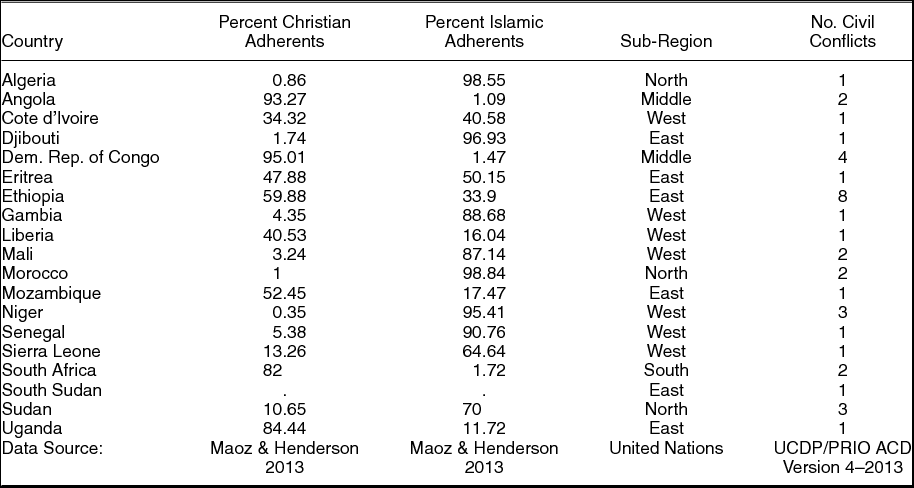
We used purposive stratified sampling to select 19 countries from the continent. Table 1 shows the dimensions on which the countries in our sample vary. Our data include groups from each major African subregion as well as groups from countries with majority Islamic populations (e.g., Algeria and Dijibouti) and those with large Christian populations (e.g., Democratic Republic of Congo and Angola).Footnote 14 The sample is stratified also to include countries with large numbers of conflicts and VPOs, like Ethiopia, and those with few groups and conflicts, like Gambia. Though it would be ideal to study women's participation in the population of VPOs or a random sample drawn from the complete global population, resource constraints hampered such a research design. However by using purposive stratified sampling, we were able to collect more detailed data on our sample of VPOs, in light of these constraints.
Attributes of Countries Included in this Stratified Purposive Sample

Our data reflect all VPOs that were active in each of the selected countries during the period of interest. The groups were culled from the Uppsala Conflict Data Project Actor Dataset (UCDP 2012), the Global Terrorism Database (START 2012), along with academic and journalistic accounts of violent conflict. We include splinter groups as long as they behave as independent actors. For example, al-Qaeda in the Islamic Mahgreb (AQIM) is organized into many “katibat” (brigades). Although some would code the AQIM katibat as distinct actors, we include only one observation for AQIM since the katibat largely lack independent strategic commands. In contrast, we include ULIMO-J and ULIMO-K, two distinct groups that emerged from a split in the United Liberation Movement of Liberia for Democracy (ULIMO), along with the original organization. Further information about our coding rules and variable measurement is available in the Online Appendix.
Dependent Variables
We code two dependent variables indicating women's VPO participation.Footnote 15 The first, women participants, is a binary indicator coded 1 when there is evidence that women took on any active role in an organization.Footnote 16 Only participation occurring within the context of a group is considered; women who acted alone or in unorganized groups are not reflected in these data, although they certainly do contribute to broader patterns of violence. The second variable, women in combat roles, indicates women's involvement in the direct use of violence. Specifically, it reflects evidence that women participated in direct combat as well as remote combat activities like detonating bombs.
We coded these variables largely from secondary sources including historical accounts of individual organizations and conflicts, memoirs, accounts of DDR processes, human rights reports, and accounts given by well-known organizations like Amnesty International and the Advocates for Human Rights, VPO statements and manifestos, and thousands of news articles obtained through LexisNexis. In some cases, there was a wealth of detailed information on women's participation, such as estimates of the number of women in a group, descriptions of their activities, and narratives about why they became involved. In other cases, we could only assess that women participated because a woman was arrested in connection with a violent event or confessed to having participated in a group after being caught and tortured.Footnote 17
Organizational Demand Variables
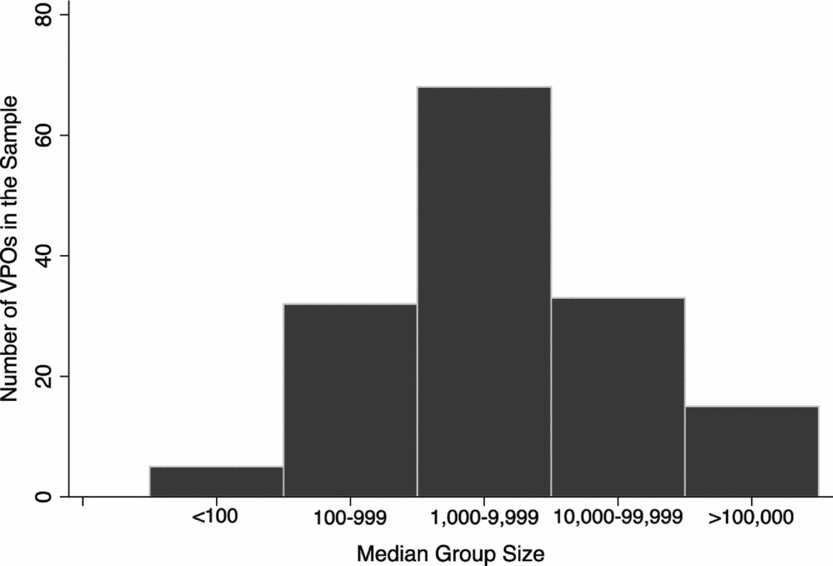
Our main independent variables represent indicators of organizational demand for women participants laid out in our argument. In order to test the effect of group size, we collected information on the number of active members in each VPO.Footnote 18 Figure 1 shows the distribution of organization sizes using median estimates. Groups in the sample operated with as few as ten members while other organizations were reported to have as many as two million members. Accurately assessing a nonstate actor's size is made difficult by the fact that there are often substantial discrepancies between estimates and a group's actual size. Estimates likely vary by source, given that most VPOs have incentives to overstate their strength while their opponents have incentives to understate the size of the threats they face. To minimize the potential for bias related to measurement error, we use a dichotomous measure of this variable in our models.Footnote 19 Small is a binary variable indicating groups with median sizes between 2 and 999 members. This cutoff value reflects organizations with group sizes that fall in the lowest 25th percentile of our data.
Distribution of VPOs by Size

To test our second hypothesis, we code a binary variable, Terrorist, indicating whether a given VPO is listed as a perpetrator of terrorism in the GTD, or there exists other evidence of terrorism as a dominant tactic. Ninety-four organizations in the sample are coded as having conducted terrorist attacks. Of these organizations, 77 were involved in reciprocated conflicts with the state. Fifty of the terrorist organizations sought overthrow of the existing government while 32 acted for some form of self-determination.Footnote 20
Our third hypothesis stipulates that groups with gender-inclusive ideologies will be more likely to include women. We code a group as having a Positive gender ideology if it declares publicly that women are integral to their movement or their struggle aims to liberate women. The Congolese National Liberation Front (FLNC), for instance, is listed as having a positive gender ideology because one of its stated aims was “to realize equality between man and woman” (FLNC 1977, 14). The Oromo Liberation Front (OLF) in Ethiopia is also coded as having a positive gender ideology as it announced in its political platform numerous goals regarding women's equality, including to “ensure the political, economic and cultural equality of women with men,” make certain that women have access to maternity leave, guarantee women's rights to organize themselves in order to protect their rights, and to remove laws that are deemed to be discriminatory against women.Footnote 21
Our final hypothesis examines the effect of intergroup competition on women's participation. Competition counts the number of other violent organizations operating in a state that can be considered to have the same enemy as the group in question. For a paramilitary group, for instance, the number of other paramilitary or self-defense organizations in the country would be coded as competitors. Alternatively, when groups are coded as rebel or terrorist groups, we count the number of other organizations that consider the state their primary enemy.Footnote 22 We measure this for the year marking the midpoint of each group's existence.
Control Variables
We also include a number of group-level characteristics that may affect the relationship between our main explanatory variables and groups’ inclusion of women. First, though our arguments focus on groups’ willingness and ability to encourage women's participation, forced recruitment and involuntary conscription are clear options for leaders to pursue new members and increase productivity (Eck Reference Eck2014). Anecdotal evidence suggests that VPOs using forced recruitment strategies can be rather indiscriminate in their coercion and are perhaps more likely to include an array of diverse members, including women and children. For example, the Patriotic Forces for the Liberation of the Congo (FPLC/UPC) in the Democratic Republic of Congo launched a massive conscription campaign to fill the ranks of its military. This operation sought to include “whoever was available” including women, men, children, and sometimes even previously demobilized individuals (Grover Reference Grover2010, 486). Forced recruitment might impact women's participation in VPOs for at least two reasons. First, groups recruiting by force can replace disgruntled members easily with new recruits. Second, as individuals forced to participate may be less invested in the politics of the group, leadership may enjoy fewer tests of their decision-making, especially as it relates to the inclusion of new members. Given this, we expect groups that recruit through force to include women both in support roles and in combat roles. To account for these dynamics, we code a variable Forced recruitment that indicates whether an organization has used coercive recruitment techniques.
Since broad political agendas may influence the mobilization potential of VPOs, we code whether the group's main aims were for self-determination or independence (Secessionist) and separately, whether they sought control of the state. Buhaug (Reference Buhaug2006) suggests weaker groups will be more likely to pursue limited aims of separation rather than aim for control of the entire state. As separatists are less likely to attract popular support, they may be more apt to include women to help them achieve their goals. Alternatively, as these groups tend to be smaller, they may be reluctant to include participants that may threaten cohesion.
We also record whether groups are motivated by fundamentalist Islamic ideals or the development of theocracies based on Sharia law (Fundamentalist). In some cases, radical Islamist groups like the GIA in Algeria act to reinforce women's exclusion from public life. Alternatively, Gonzalez-Perez (Reference Gonzalez-Perez2011) argues that many Islamist VPOs have engaged in a strategic reinterpretation of Islamic law to justify women's participation in suicide bombings. In both cases however, a fundamentalist Islamic orientation appears to influence a group's willingness to include women participants. To examine whether the primary target of a group has any effect on whether women are likely to participate in an organization, we code whether a group is a paramilitary or self-defense group.
Finally, we use a series of variables to capture supply-side dynamics in order to evaluate the relative explanatory power of our organizational demand variables. We operationalize the supply of potential women participants to VPOs as a function of women's social and political status in their respective societies. One could argue that if society generally accepts the notion that it is appropriate for women to participate in violence, nonstate actors may adopt similar positions on the issue.Footnote 23 To capture attitudes about the general social acceptability of women's participation in conflict, we include a binary indicator of whether women are present in the state military in the group's midyear.
In line with extant arguments suggesting women's willingness to participate in violent organizations is influenced by their desires for greater political rights and opportunities, we also include a pair of variables measuring whether women are afforded political rights by the state. We use the Cingranelli and Richards (Reference Cingranelli and Richards2013) Women's Political Rights variable to measure whether de facto and de jure gender equality exist in each country. This variable is coded “0” if women's rights are restricted by law, “1” if gender equality in politics is guaranteed by law but not in practice, “2” if political equality is guaranteed by law but participation is not equal in practice, and “3” if political equality is both guaranteed by law and practiced. We also employ an indicator of whether each state in question ratified the United Nations Convention on the Elimination of All Forms of Discrimination Against Women (CEDAW). Presumably, states that ratify CEDAW are more likely to strive to ensure that women have equal rights than states failing to ratify. CEDAW Ratification is coded “1” if the state ratified the treaty by the groups midyear and zero otherwise. As the treaty only went into force in 1981, we code missing values for all countries before this year.
We further relate the potential supply of women's participation to levels of state-sponsored violence. We utilize CIRI's Physical Integrity Rights Index to indicate levels of state repression, given that high repression may not only motivate individual women to participate in conflict but also encourage groups to be more inclusive in their outreach. This variable ranges from 0 to 8, with “0” corresponding to no respect for individual physical integrity rights and “8” corresponding to full respect.
DESCRIPTIVE STATISTICS
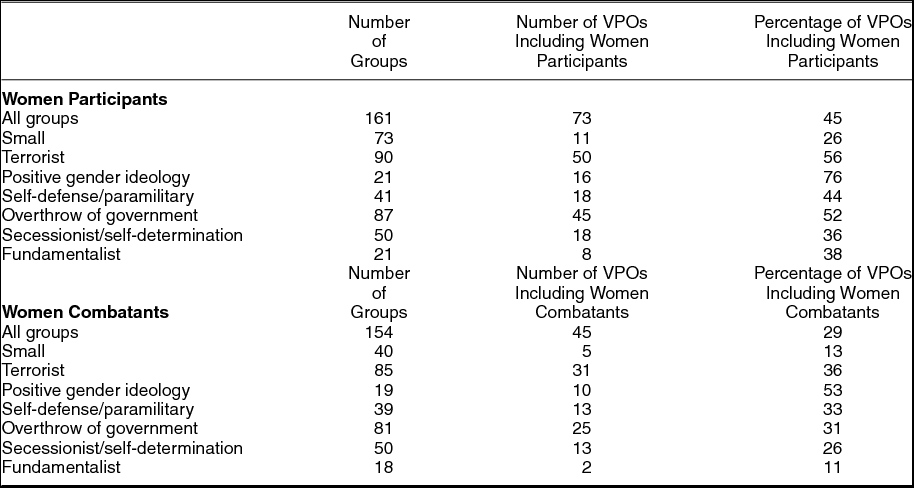
Table 2 shows that women have been quite active in the VPOs in our sample. Women participated in some capacity in about 45 percent of the groups.Footnote 24 The data show further that women participated in more than half of the terrorist organizations in our sample, three quarters of the organizations with gendered platforms, and around a quarter of small organizations.
Frequency of Women's Participation in Violent Political Organizations

Women also participated more often in VPOs seeking to overthrow the government than in groups seeking self-determination. Of the organizations involved in civil conflict with the state, 15 were involved in large-scale civil wars.Footnote 25 Thirteen of these rebel organizations (87%) included women members. Women were observed less often among the radical Islamist and self-defense and paramilitary groups.
Women less often participate in the actual commission of violence, although significant variation in the percentage of groups with women combatants exists. More than half of organizations with positive gender ideologies include women in combat roles. Thirty-six percent of the terrorist groups involved women in violent activities while only 13% of small groups used women combatants. Thirty percent of the groups seeking to overthrow the state, 33% of self-defense/paramilitary groups, 26% of self-determination groups and only 11% of radical Islamist organizations included women combatants. Women also engaged in combat in more than half of the organizations involved in intense civil wars. These statistics appear to support our theoretical expectations.
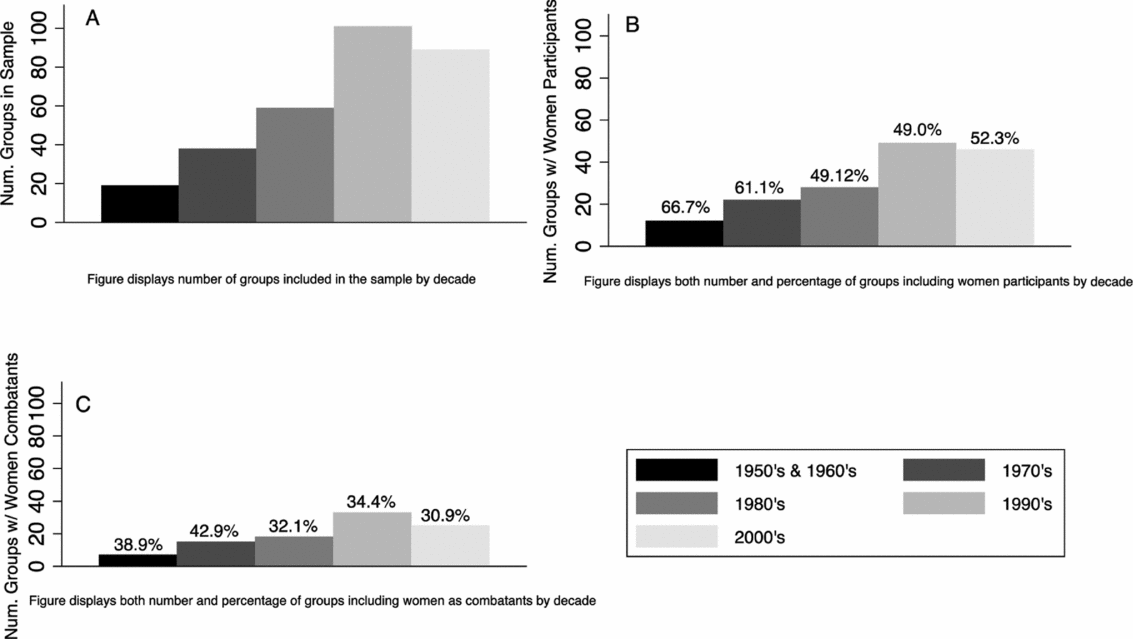
One advantage of using data on organizations active in a variety of time periods is that we can observe that women's participation has been a stable characteristic of violent political organizations in Africa. Figure 2 displays the distribution of groups with women participants over the time period under consideration. Footnote 26 Figure 2(a) shows the number of groups operating by decade; Figures 2(b) and 2(c) show the number and percentage of VPOs including women participants and combatants, respectively. Footnote 27 Figure 2 shows that the 1970s saw the highest percentage of organizations with women combatants, followed by the 1950s/1960s. This is unsurprising, since many of Africa's nationalist and independence movements, like those in Algeria, Morocco, Eritrea, and Angola took place during these years.Footnote 28 By the 1980s and 1990s almost half of the VPOs in our sample had women participants and almost one-third integrated women as combatants. The percentage of VPO's including women rises slightly to 52% during the period 2000–2011, although interestingly the proportion of VPOs with women combatants was also at its lowest during that time.
Distribution of VPOs by Decade

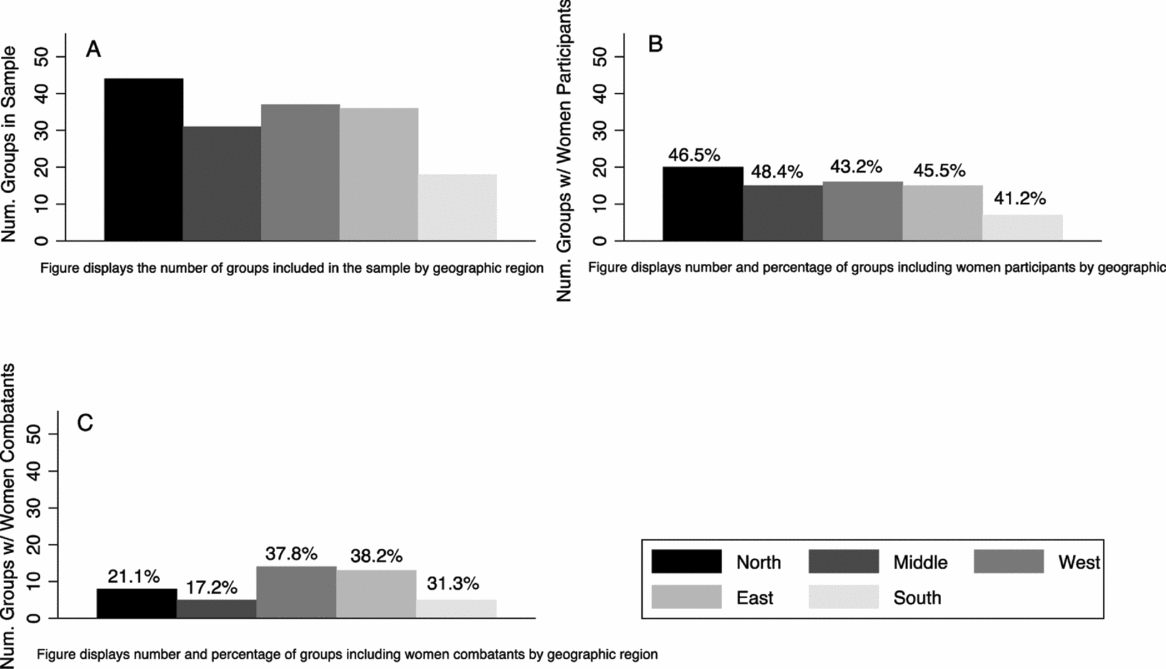
Figure 3 shows the distribution of VPOs by geographic subregion. Women's combat engagement varies dramatically across Africa's subregions though there is not much regional variation in generalized participation. Middle Africa saw a higher percentage of organizations with women participants while Southern Africa had the smallest percentage of organizations with women members. The difference between these regions is just 7 percentage points. Despite a large pool of VPOs with women participants, Middle Africa had the smallest proportion of VPOs utilizing women in combat roles, followed by North Africa. West and East Africa have the highest percentages of VPOs including women in combat roles, both around 38%.
Distribution of VPOs by Geographic Region

STATISTICAL RESULTS
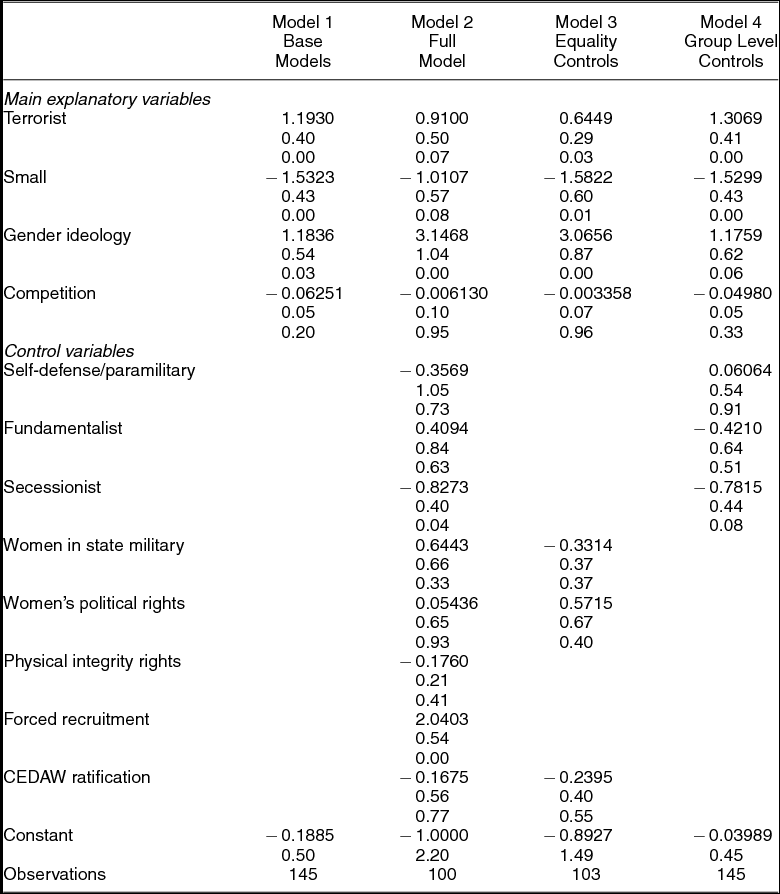
Since our dependent variables are binary, we use logistic regression models to evaluate our hypotheses in a multivariate setting.Footnote 29 Each table of regression analyses includes four sets of results. In the first column of each table we report our base model results, which include only independent variables highlighted in our hypotheses. The second column shows the effects of the full set of our explanatory variables. The third column shows how our theoretical variables perform when we control only supply-related characteristics, and the fourth includes controls for any additional group-level covariates.Footnote 30
The results in Table 3 highlight the effect of group-level characteristics on women's overall participation in violent organizations and offer strong support for three of our four hypotheses. In accordance with H1, small organizations are significantly less likely to include women than larger groups. Consistent with H2, the results show that organizations using terrorism appear to be more likely to include women than those that do not employ terrorism. As expected (H3), VPOs espousing positive gender ideologies are more likely to have women members than organizations that do not explicitly state their support for women's participation, rights, or concerns. We find no effect for intergroup competition, contrary to our fourth hypothesis. The statistically significant and positive effect of forced recruitment on the likelihood of women's participation corroborates our expectation that VPOs recruiting through conscription are more likely to have women among their ranks than those relying exclusively on volunteers. Secessionist aims have a negative and statistically significant effect on women's participation.
Determinants of Women's Participation in Any Role in Violent Political Organizations

Notes: Coefficients, robust standard errors clustered on country and p-values are presented in the first, second, and third rows, respectively.
None of the state-level variables reflecting supply-side explanations emerge as significant predictors of the presence of women participants in these organizations. Neither respect for citizens’ physical integrity rights, women's participation in the state military, the level of women's political rights, nor the state's ratification of CEDAW have statistically significant relationships to women's participation in our sample. The lack of a clear relationship between these supply-related indicators may suggest that models of women's participation relying on these explanations alone may be underspecified. The significant relationships between our demand-related indicators and the likelihood of women's participation suggest strongly that explanatory factors at the organization level should be taken more seriously in future research.
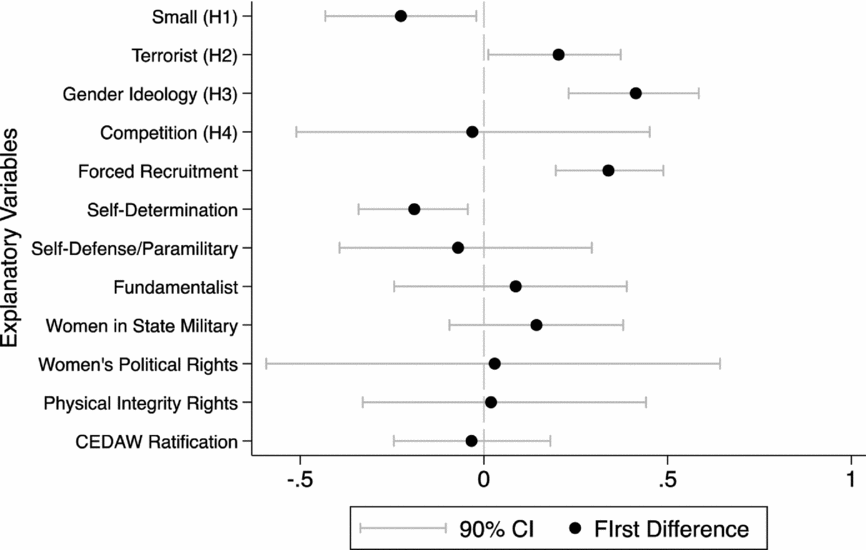
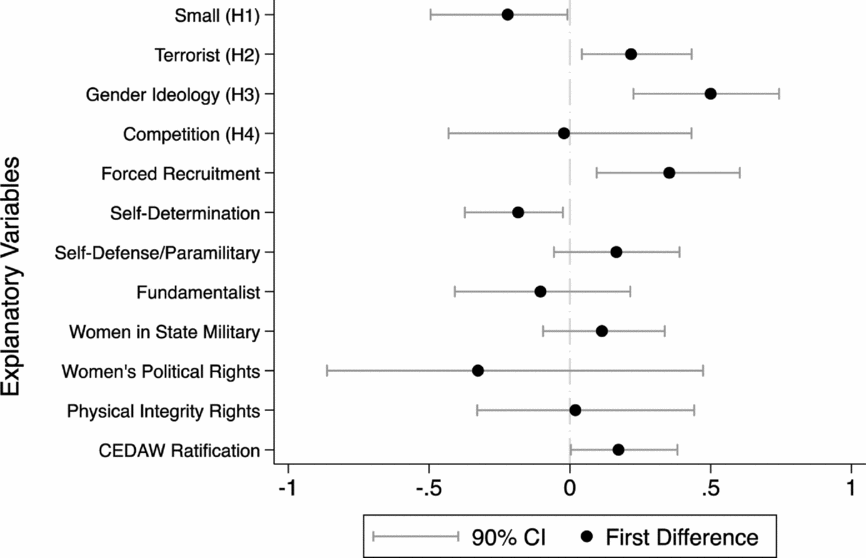
We look to the first differences, or changes in the probability of women's participation as our covariates go from their lowest to highest values, to shed light on the substantive impact of these statistical relationships.Footnote 31 These are displayed in Figure 4. Positive gender ideologies have the largest substantive effect as VPOs without positive gender ideologies have a 0.53 probability of including women while those with gendered ideologies have a probability of 0.94, denoting a substantial 78% change. By comparison, the probability that a group has women participants increases by 63% when it specializes in terrorist tactics and by 64% when it adopts forced recruitment strategies. A group contracting from a membership of at least 1000 individuals to a smaller size yields a first difference of −0.22, corresponding to a 43% change in probability. Intergroup competition exerts the smallest impact. Specifically, the probability of female membership decreases by 0.03 when a VPO moves from an environment of minimum to maximum competition, though this first difference is statistically insignificant.
Change in Probability of Women's Participation in Any Role

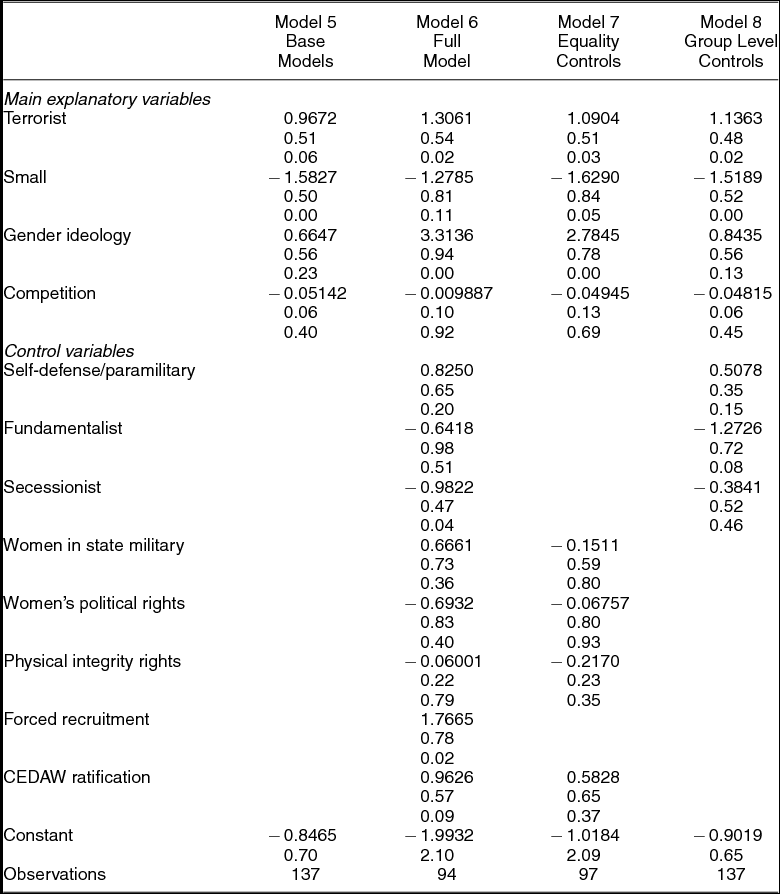
In Table 4, we examine whether our hypotheses extend to the special case of women's participation, engagement in combat roles. These results demonstrate that a tactical specialty in terrorism consistently predicts women's participation in combat roles. Small VPOs are less likely to include women combatants in three quarters of the models while VPOs with positive gender ideologies are more likely to deploy women for combat in half of the models. Again, the number of rival organizations bears no significant relationship to the probability that a VPO will include women in combat positions. Together, the depressant effect of small VPO size and the lack of statistical significance for intergroup competition suggests that women's participation in VPOs may not generally follow a “logic of desperation,” despite the fact that organizations utilizing coercive recruitment strategies are more likely to include women combatants.
Determinants of Women's Participation in Combat Roles in Violent Political Organizations

Note: Coefficients, robust standard errors clustered on country and p-values are presented in the first, second, and third rows, respectively.
Women appear less likely to participate in combat in organizations characterized as Islamic fundamentalist or secessionist, though these results appear sensitive to model specification. We find that neither the degree to which a state guarantees women's political rights domestically, nor women's participation in the state military organization influences women's combat participation. A state's ratification of CEDAW, however, does bear a positive influence on women's combat participation in one model.
Figure 5 displays the substantive effect of each covariate on the probability that women perpetrate violent acts. Positive gender ideology is the largest determinant of women's participation in combat roles, as it was for women's general participation. When groups adopt positive gender ideologies, the probability of women participating in combat increases by 129%. The probability of woman combatants increases by 126% when an organization adopts a tactical specialty in terrorism compared to the 118% increase in probability associated with a change from voluntary to forceful recruitment. The probability of women combatants decreases by 57% when a VPO is reduced to a small size.
Change in Probability of Women's Participation as Combatants

While our statistical analyses establish broad patterns across cases, we also take a qualitative look at these relationships to explore more deeply the causal relationship between women's participation and VPO characteristics. A case illustration of women's participation in the Eritrean Liberation Front (ELF) and Eritrean People's Liberation Front (EPLF) from 1961 to 1991 is ideal for this purpose. The existence of multiple VPOs operating in the same territory, within the same time period, and with the same immediate enemy allows us to hold constant state-level, supply-related conditions, including the level of repression, women's political and social rights, and the nature of the organizations’ shared enemy. It also presents the advantage of allowing variation on group-level, demand-related characteristics. Furthermore, these groups are representative of the VPOs in our data on almost all dimensions.Footnote 32 With the following illustration, we demonstrate that institutional differences between the organizations largely explain the significant variation in female participation across these groups. We also show that while supply-side explanations clearly account for women's inclinations toward joining both organizations, they did not determine their opportunities to do so.
ILLUSTRATIVE CASE: ERITREA (1961–1991)
The ELF and EPLF figured prominently in Eritrea's 30-year war of independence with Ethiopia. In 1961, The ELF was formed by a group of exiles as an Islamist movement seeking to liberate Eritrean Muslims from domination by majority-Christian Ethiopia (Iyob Reference Iyob1995; Woldemikael Reference Woldemikael and Young1993). The organization's failure to advance an inclusive nationalist agenda led to an early membership drawn exclusively from the majority-Muslim rural lowlands. After experiencing a substantial loss of manpower in the 1960s due to capture, desertion, and internal disputes, the ELF made an earnest attempt to diversify its recruitment by accepting a small number of Christians (Iyob Reference Iyob1995; Pool Reference Pool2001). In the late 1960s, accusations of civilian abuse, including allegations of rape, led factions within the group to initiate a reform process aimed at restoring both internal and external support (Iyob Reference Iyob1995). These attempts were met with violent reprisals against reformists, forcing some to flee to neighboring Sudan while others formed splinter groups in 1970. Three distinct groups emerged to form the EPLF, the organization that would go on to win the war of independence against Ethiopia in 1991.Footnote 33
Though Eritrea was split evenly between conservative Muslim and Christian communities, Selassie notes that even at the outset of the war, “the entire society practice[d] traditional values that suppress women” (Reference Selassie, Doornbos, Cliffe and Ahmed1992, 67). Universally, women had no voice at home or in public (Hale Reference Hale2001, 155) and tended to be uneducated and were generally excluded from political engagement. Further, restrictions on women's ownership of land or property left them with no independent productive capacity (Leisure Reference Leisure, Bystydzienski and Sekhon1999; Silkin Reference Silkin1983). Cowan (Reference Cowan1983, 147) observed that women's statuses in Eritrean society were so low that the birth of a boy warranted a slaughtered sheep while silence was the best response for a girl. In total, the disenfranchisement of women in Eritrean society was underscored in the adage, “Where is the gain if one marries a woman to give birth to a woman?” (NUEW 1980, 12). Given their positions in society, it is unsurprising that many Eritrean women were inclined to participate in a movement that might offer them transcendent opportunities or that men would resist their participation.
Women's Participation in Eritrean VPOs
The ELF and EPLF were active concomitantly in Eritrea, yet differed considerably in their openness to women participants. The EPLF included women in all aspects of the organization throughout much of its existence, while only a marginal number of women became involved in the ELF, primarily in support roles and beginning much later in its history.
In line with its conservative Islamic perspective on women's participation in public activities, the group's membership was entirely male in its early years. Women who did aid the struggle were not recognized as full-fledged members or even affiliates of the group (Mason Reference Mason, Ram and Summy2007, 114).Footnote 34 Even without recognition, women volunteered because they believed that participating in the revolution would help them earn greater social rights (GUEW n.d.). By the late 1960s, the ELF began to allow women's participation in small numbers (Bereketeab Reference Bereketeab2009, 209), with women participants supporting the organization as nurses and cooks; others provided shelter or aided the front by fundraising, distributing information, and protesting. While some women engaged in smuggling weapons, transmitting messages, and reporting enemy movements, very few engaged in open combat or leadership roles.
Because of its limited capabilities, the organization engaged predominantly in sporadic assaults against police and military targets (Pool Reference Pool1980, 40). Given this, its premium on participants who could carry out such surreptitious missions was high, and it opened up important opportunities for women to become engaged. For example, in one instance where a woman was intercepted while transmitting ELF documents, she was interrogated but released with a simple warning not to associate with “bandits.” Mason (Reference Mason, Ram and Summy2007) points out that a man in that position would likely have been imprisoned or tortured. Women were able to go undetected because, as one Eritrean put it, “[N]o one ever thought a woman would be hiding a gun” (Israel et al. Reference Israel, Lyons and Mason2002, 207).
In 1971, the year following its fracture, the ELF held a national congress during which members discussed the growing calls from women participants that their roles in the struggle be formally recognized. From almost the start of their inclusion, prominent women had been demanding reform regarding women's rights and freedoms (Mason Reference Mason2001). In addition, the new EPLF splinter group announced its intention to incorporate women's issues into their agenda and allow their full participation in 1970 (Fekadu Reference Fekadu2008), having previously criticized the ELF for failing to articulate any policies regarding women (Krosch Reference Krosch2005, 8). In an attempt to assuage growing internal dissent and address these critiques, the ELF agreed to facilitate women's participation in the struggle in 1971 (Mason Reference Mason2001; NUEW 1999) and initiated its first women combatants in 1973. Importantly, the EPLF also formally moved to utilize women in combat in 1973 (Bereketeab Reference Bereketeab2009; Connell Reference Connell1993, 66).
ELF women that participated in combat roles often paid particularly steep penalties: unaccompanied and unveiled women on the front lines were assumed to be sexually available and often subjected to predatory behavior by their male comrades, including rape and other sexual assaults (Mason Reference Mason2001, 7). Despite women's growing participation in the group, a majority of ELF members never really believed that women should be direct participants in the violent movement (Cowan Reference Cowan1983, 148; Mason Reference Mason2001, 3).Footnote 35 The group's more conservative leaders were generally “anxious to end Ethiopian rule but not to see Eritrean society changed” (Connell Reference Connell2001, 346) and its original leadership and main support base in Barka resisted increases in women's involvement (Connell and Killion Reference Connell and Killion2010, 547).
Despite internal discord over the politics of women's participation, the ELF continued to augment its official position toward women and draw in more women participants. In 1974, the organization created the Eritrean Women's General Union (GUEW) in response to increasing demands from women members (GUEW n.d.). In 1975, the group inserted language into their political program defending women's place in a liberated Eritrea (Mason Reference Mason2001). These changes appear to have been mainly on the surface however, as the group retained many of the modes of women's oppression including child betrothal, polygamy, and female circumcision (Mason Reference Mason2001).
The EPLF split from the ELF over core strategic goals: Rather than focusing solely on the creation of a sovereign Eritrean state, the Marxism-inspired EPLF was interested in fomenting a revolution that drastically altered society (Bernal Reference Bernal2000, Reference Bernal2001). The EPLF considered women's participation and emancipation to be vital elements of this goal, as women's liberation and national liberation were inextricable (Zerai Reference Zerai1994). Even the organization's slogan “No Liberation Without Women's Participation” underscored this perspective (Bernal Reference Bernal2001, 145).Footnote 36
In its very first political program written in 1971, before any women were included, the EPLF declared that the Front did not discriminate based on gender and that it was dedicated to eradicating all forms of political and economic oppression (Weldehaimanot and Taylor 2011, 582). The emphasis placed on gender only increased with time. By 1977, for example, among eight other points devoted to women's issues the EPLF's political program stated that they aimed to develop “[A] broad program to free women from domestic confinement, develop their participation in social production and raise their political culture and technical levels” (NUEW 1980, 19; Wilson Reference Wilson1991, 161).
In 1973, the EPLF received three women attempting to join and provided them with military training. Shortly thereafter, the organization began to openly recruit women (Bernal Reference Bernal2001). It is estimated that up to 40% of the EPLF's membership and 30–35% of those occupying combat roles were women (Mason Reference Mason, Ram and Summy2007; Pateman Reference Pateman1990). Women were appointed to serve on the group's central committee (Burgess Reference Burgess1989), and were often trained as mechanics, electricians, engineers, and barefoot doctors, areas generally considered men's domains (Hale Reference Hale2001; NUEW 1980; Silkin Reference Silkin1983).Footnote 37
After emerging victorious from their war with the ELF and making major gains in their war against the Ethiopian military in 1975, the EPLF saw a flood of women's participation (Bernal Reference Bernal2000; Cowan Reference Cowan1983). Muslim and Christian women, peasant and nomad women, and women from rural and urban areas all joined the EPLF (Bernal Reference Bernal2000; Cowan Reference Cowan1983). Girls participated, sometimes recruiting their mothers. While women joined to assist the EPLF in liberating their country, they also did so to escape rape and sexual torture at the hands of Ethiopian troops (Cowan Reference Cowan1983), repressive arranged marriages, and other terrifying circumstances (Bernal Reference Bernal2000; Wilson Reference Wilson1991). Like the women attracted to the ELF, women that joined the EPLF viewed their participation as a way to liberate themselves from society's oppressive strictures (Bernal Reference Bernal2001; Hale Reference Hale2001), These women believed in the group slogan “Equality through Equal Participation” and the group's goal of elevating women's place in society (Bernal Reference Bernal2000, 71; Zerai Reference Zerai1994, WS-66). Notably, “Farewell kitchen, I have broken your shackles” became a popular maxim among EPLF's female participants (Bernal Reference Bernal2000, 70). Additionally, women joined to benefit from the programs offered to the organization's combatants, particularly those in education and health (Burgess Reference Burgess1989).
In the EPLF, women served as intermediaries between the armed front and the population and were instrumental in socializing and recruiting other women for the struggle (Silkin Reference Silkin1983). Civilian women in EPLF-controlled areas were also taught to read and encouraged to participate in civic engagement. They soon began to hold posts in People's Assemblies established by the EPLF, a feat impossible before the occupation.Footnote 38 The organization also redistributed assets to those previously unentitled to own property, especially women, and made major revisions to the marriage contract ensuring women more equitable unions and divorces (Cowan Reference Cowan1983; Leisure Reference Leisure, Bystydzienski and Sekhon1999; Silkin Reference Silkin1983). These advances were highly important in motivating women to join, as participation offered opportunities to remove the barriers that forced them into subordinate positions in society.
The EPLF was instrumental in the establishment of the National Union of Eritrean Women (NUEW), founded in 1979 to manage women's demands and facilitate their mobilization and organization (NUEW 1980, 2). Incorporating women into the organization, however, was not without its critics. Selassie (Reference Selassie, Doornbos, Cliffe and Ahmed1992) argues the first women fighters in the EPLF were not entirely welcomed by their male comrades, as men feared including women meant giving up their privileges and prospects for advancement within the organization. Isolated incidents of sexual harassment were even reported (Israel et al. Reference Israel, Lyons and Mason2002). Though the EPLF was generally able to use the organization's egalitarian principles to silence those critical of women's participation within the group, criticism from outside continued. Zerai (Reference Zerai1994, WS-65) maintains that priests threatened to excommunicate families that allowed women to take part in EPLF activities and other individuals went so far as to plan the assassinations of the propaganda-unit members that came to talk to girls.
Despite such challenges, the EPLF remained committed to women's participation and advancement during the struggle for independence. The same cannot be said of the ELF. Given that both groups operated concurrently in the same conservative society for two decades, it is unlikely that state- or society-level factors adequately explain the trajectory of women's participation across the two organizations. Differences in women's participation across organizations cannot be explained solely by individual-level motivations, either, given that women throughout Eritrea faced similar conditions and female members from both organizations expressed similar reasons for participating. Key variation at the organization level, however, is much more instructive. The guerrilla tactics and covert activities used heavily by the ELF played a role in motivating the group to include women for targeted activities, both formally and informally. The organization's religious conservatism, however, contributed to leaders’ apprehension in incorporating women fully. In contrast, the EPLF's egalitarianism and commitment to equal rights for women, allowed it to both attract and include women in large numbers. The influence of intergroup competition on patterns of women's participation is evident also in this case. External pressure from the EPLF on the ELF's “woman problem” played a large part in driving the ELF to incorporate women increasingly. While early in the resistance some non-Muslim women aided the ELF because they wanted to be involved yet had no other options, the EPLF's founding presented women with a credible alternative to the ELF. It is reasonable to infer that had the ELF not taken the subsequent actions on increasing women's access to the organization, actual and potential members would have been siphoned off by this new opportunity for women to participate. Along with women's greater expected benefits given the EPLF's platform, this may have had large and quite detrimental effects on the ELF's organizational viability.
DISCUSSION AND CONCLUSION
Our study highlights the utility of focusing on channels through which women participate in conflict rather than the background conditions that produce violence and influence individual's willingness to participate in it. This is in stark contrast to most previous scholarship on the topic, which prioritizes individual- and state-level explanations for women's participation in political violence without considering whether there are systematic factors that explain variation in groups’ receptivity to it. The empirical analyses clearly demonstrate the salience of group-level variables—particularly group size, positive gender ideology, and the use of terrorist tactics—in explaining women's participation in VPOs. The empirical findings suggest also that forced recruitment and secessionist aims emerge as strong predictors of women's overall participation: violent organizations that use coercive enlistment are much more likely to have women participants than groups that rely on volunteers, as are those that mobilize for withdrawal from the state. Interestingly, fundamentalist Islamic ideology does not bear a consistent relationship to either women's overall or combat participation.
State-level factors, including those measuring whether women have equal rights in society and whether the state engages in widespread repression, do not appear to be related to women's VPO participation. At first look, it seems that researchers and practitioners alike ought to use caution when relying solely on supply-side dynamics, or factors pushing individual women toward participation in violent politics, to explain cross-organizational variation in women's participation or the roles they occupy, although they may explain the rate at which they join. Since our supply-side factors are measured only at the state level, however, we cannot rule out the potential impact that indicators measured at the individual level may have on women's decisions to join VPOs.Footnote 39
Consistent with the statistical analyses, the case illustration demonstrates clearly that positive gender ideologies and tactical specialties in terrorism facilitate and encourage groups to extend group membership to women. While in the statistical models, intergroup competition does not seem to influence the likelihood that a given group will include women, it does emerge as a meaningful explanatory factor in the case narrative. The illustrations, along with the statistical work, also suggest that our opening assumptions about group rationality were both useful and appropriate for understanding women's VPO participation. If the organizations in our sample had failed to behave rationally, we would have observed a far less robust performance from the variables representing the costs and benefits that can accrue to VPOs when women participate. The case illustration further draws out the ways in which these groups use weighted assessments of their strategic environment and recruitment needs to craft their outreach to women as potential group participants. Overall, our data suggest that violent groups and their potential recruits do tend to act in ways that will maximize benefits while minimizing costs, much as a rational actor would.
Although it is clear that women do take part in violent political activities, academic studies have given short shrift to questions regarding the frequency of women's engagement in violent politics as well as those of how and why women's involvement might vary across organizations. The lack of inquiry into these questions is troubling particularly given the theoretical and practical implications of understanding why women might be compelled to participate in violent politics. For instance, scholars studying the microfoundations of political violence highlight the importance of material, nonmaterial, and/or coercive incentives for leaders who need to successfully mobilize and recruit members (e.g., Gates Reference Gates2002; Weinstein Reference Weinstein2005). However, most models have overlooked the potential for gender-based variation in individuals’ receptiveness to these inducements. By overlooking gender as an important dimension on which differential recruitment strategies may emerge, scholars are at risk of drawing inappropriate conclusions about how VPOs allocate scarce resources for growth and realize their mobilization potential.
From a policy perspective, insufficient attention to the range of women's experiences in and with armed conflict may actually discourage their reintegration into postconflict societies and support additional destabilizing pressures.Footnote 40 Given recent arguments that highlight the importance of postconflict justice institutions in stemming conflict recurrence (e.g., Gates et al. Reference Gates, Binningsbo and Lie2007), insufficient attention to how and when women participate in conflict can also damage the potential effectiveness of conflict resolution, postconflict reconciliation, and restorative justice efforts by meaningfully yet arbitrarily excluding some offenders from prosecution while also preventing some victims from receiving justice. For instance, while women's participation in disarmament, demobilization, and reintegration/rehabilitation (DDR) initiatives is often invoked as critical for their success (Coleman Reference Coleman2004; European Parliament 2006; United Nations 2012), such policies are often developed in a way that reinforces “the ideal of the female war victim” (MacKenzie Reference MacKenzie2009, Abstract) rather than with recognition of the (true) range of women's roles in and experiences during violent conflict. This perspective is reinforced by anecdotal accounts, such as reporting by nonprofit advocacy groups in Sudan that despite women's extensive participation in the SPLM/A, women often face more stringent eligibility requirements for ex-combatant DDR benefits than men. As a result, women are often turned away when attempting to turn in weapons as part of these processes because of assumptions that they were merely civilians seeking to gain benefits advertised for ex-combatants.Footnote 41 The results from this project may provide support for those who advocate for systematic accounting of women's participation in order to demonstrate that women have been involved actively in a number of violent organizations.
By first examining how women's participation varies across VPOs, this study lays a clear foundation for future work focused on its implications. Whether women exert pacifying or provocative effects on VPO behavior remains an open empirical question that should be explored in future research, particularly in dialogue with the recent research on women's participation in rape and other forms of gendered violence (e.g., Cohen Reference Cohen2013). Also, scholars have noted that ideological commitments, identity labels, fictive kinship, and nonmaterial incentives can be important tools of mobilization, recruitment, and control for group leaders, as they often reinforce collectively oriented thinking and encourage followers to accept present costs for the promise of future benefits (Atran Reference Atran2003; Gates Reference Gates2002; Weinstein Reference Weinstein2005). Based on our research, gender-based targeting also appears as a potentially fruitful strategy through which conflict entrepreneurs can frame problems and encourage collective action. Looking ahead, future research might combine insights on the politics of credible signaling with the dynamics of targeted recruitment to ask whether women are more effective at gender-based recruitment than men. Finally, although we did not collect time-varying data due to resource constraints, such data would be of great benefit so that others might examine more nuanced hypotheses about the development of women's recruitment processes, diffusion, and learning across organizations and time.
Without assessments of what drives women to participate in politics through violence, we are left with an incomplete picture of what encourages women to realize their political agency writ large. Much political science research has been dedicated to problematizing gender-based differences in conventional political processes, such as representation through voting (Inglehart and Norris Reference Inglehart and Norris2000; Studlar et al. Reference Studlar, McAllister and Hayes1998) or running for public office (Fox and Lawless Reference Fox and Lawless2004), security-building through state military service and leadership (Caprioli and Boyer Reference Caprioli and Boyer2001; Carreiras Reference Carreiras2006), or nonviolent advocacy through protest and demonstration (Baldez Reference Baldez2002; Paxton, et al. Reference Paxton, Hughes and Green2006).Footnote 42 However, these works tend not to consider these forms of participation relative to the behaviors that we explore here.
While we do not attend to the related question of whether women use VPO participation as a substitute or a compliment to nonviolent or mainstream political activity in this article, we find it important to stress that participation in violence is often used as a means for individuals to seek representation or communicate political preferences. This is particularly relevant for individuals who, like many women, may feel marginalized, disenfranchised, or otherwise excluded from conventional political life. With this in mind, we consider our research to be a useful tool for contextualizing not only extant and future studies of women in conflict but scholarship on women's political participation writ large.



Comments
No Comments have been published for this article.