Safe evacuation is of paramount importance in a disaster setting. Due to physical and/or cognitive disorders, chronic health factors, and socioeconomic limitations, elderly, disabled, and/or ill persons are at higher risk than the general population of elevated mortality and morbidity associated with evacuation after a disaster.Reference Jia, Tian and Liu1, Reference Rafiey, Momtaz and Alipour2 The latest systematic review on postevacuation mortality claimed that unplanned evacuation seems to have a strong negative effect on the survival of such vulnerable populations.Reference Willoughby, Kipsaina and Ferrah3
Dialysis patients are a unique population in that they are highly dependent on medical technology to sustain their lives until death or successful renal transplantation. They require detailed arrangements in advance of traveling away from their home dialysis sites.Reference Kopp, Ball and Cohen4, Reference Kleinpeter5 Interruptions in basic infrastructures (eg, water and electricity) for the dialysis apparatus may translate into a life-threatening event for themReference Kleinpeter5, Reference Bailey and Deshazo6; it is well acknowledged that disasters are an abundant source of such interruptions.Reference Zoraster, Vanholder and Sever7 For example, the 2005 Hurricane Katrina in United StaFukushima incidenttes caused 94 dialysis centers to close for at least 1 week, affecting 5849 dialysis patients. As a result, 148 died within a month after the hurricane.Reference Kopp, Ball and Cohen8
The decision to evacuate or not to evacuate vulnerable population(s) should arise from a judicious, evidence-based perspective.Reference Willoughby, Kipsaina and Ferrah3, Reference Dosa, Grossman and Wetle9–Reference Pierce, Morley and West11 Research supports the elevated risk of mortality due to evacuations for institutionalized patients (ie, those admitted to hospitals or nursing or retirement facilities and receiving long-term care for chronic illnesses and/or rehabilitation therapy).Reference Willoughby, Kipsaina and Ferrah3 There is little research and knowledge about the health consequences of evacuation in disaster contexts related to dialysis patients who are likely being treated in ambulatory care settings rather than as hospital inpatients.
This research compared survival and mortality between evacuated and nonevacuated hospital dialysis patients from the Fukushima nuclear power plant incident area. (The incident was triggered by an earthquake and massive tsunami that occurred on March 11, 2011). Data were obtained from Tokiwakai Group hospitals (located in and around Iwaki City, approximately 50 km south of the Fukushima Dai-ichi nuclear power plant, Fukushima prefecture, Japan).
Postdisaster responses are region-specific and may vary from location to location depending on local conditions and health care systems. In this context, a unique, independent study in Fukushima could provide new insights into the strategy to prevent the disaster-related death of vulnerable people, particularly in light of the increasing severity and frequency of disasters worldwide.Reference Ochi, Tsubokura and Kato12, Reference Coleman13 Empirical evidence from Tokiwakai Group hospitals might be helpful in revealing the characteristics of evacuation of dialysis patients under certain circumstances.
METHODS
Settings
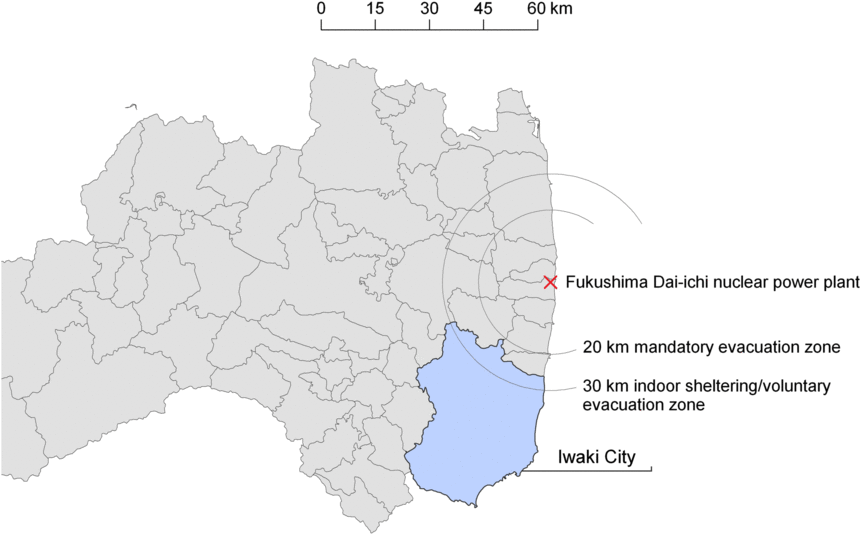
Tokiwakai Group is a private medical group that was established in 1988 primarily to provide dialysis and urology services and is based in Iwaki City, Fukushima Prefecture (Figure 1). Iwaki is the largest city on the coastline of the prefecture in terms of area (1232 km2) and population (0.34 million). There are 9 hospitals that offer dialysis services in Iwaki City, 4 of which are operated by Tokiwakai Group. Approximately 1000 patients had undergone dialysis treatment at 1 of the 9 hospitals in the city at the time of the incident, and the 4 Tokiwakai Group hospitals covered more than 50% of the patients.
The Location of Iwaki City (Blue) and Fukushima Prefecture (Gray) and the Geographical Check changes. As meant? Scope of Evacuation Instructions Issued in March of 2011

On March 12, 2011, the Japanese government issued a mandatory evacuation order for those living within a 20-km radius of the Fukushima nuclear plant. All residents in this zone were forced to evacuate to outside the zone. In addition, the government issued indoor shelter and voluntary evacuation instructions for residents of the 20- to 30-km zone. Although most areas of Iwaki City are located outside of these zones (Figure 1), the instructions caused dysfunction in hospitals, clinics, and welfare facilities as well as loss of medical supplies across the city. Several hospital directors of the 4 Tokiwakai Group hospitals in the city (outside the evacuation zones) decided to evacuate some of their patients because of poor hospital resources and workload issues among the remaining staff (not because of radiation concerns). Some patients in the hospitals arranged and performed evacuation for themselves (ie, self-evacuation).
Design and Participants
All patients who had undergone dialysis treatment at 1 of the 4 Tokiwakai Group hospitals in Iwaki City at the time of the Fukushima incident (March 11, 2011) were considered in this study. In addition, the Tokiwakai Group operates 1 hospital in the mandatory evacuation zone (outside Iwaki City) that evacuated all of its patients after the incident. We also considered the patients of this hospital. Thus, a total of 5 hospitals were included in this study.
Data on patients, including sex, age at endpoint with death or withdrawal (ie, hospital change), and other demographic and clinical characteristics, were obtained from their medical records. Other information collected included the starting date of dialysis, primary disease at the starting date of dialysis, and the number of hospitalizations.
Evacuation History
Patients who were evacuated after the incident, including the self-evacuated, were tracked until March 3, 2017, (study end) by hospital staff, and data were collected along with the date of evacuation and site of evacuation. In the present study, we defined all those who performed evacuation after the incident as “evacuees” and all others as “nonevacuees.” Our major interest was the comparison of survival and mortality between evacuees and nonevacuees after the incident.
Statistical Analyses
Postincident Survival Probability Curve
The Kaplan-Meier product-limit method was used to assess survival probability curves. Survival time for evacuees and nonevacuees was measured from the date of the incident until the end of the study period, death, or withdrawal. The probability of survival of evacuees and nonevacuees was plotted against the time of follow-up. A univariate analysis of survival was carried out using the log-rank test and the Wilcoxon-Breslow test for equality of survival functions.
Postincident Mortality
The mortality rate after the incident was calculated as the number of deaths divided by the sum of person-days at risk. Mortality was measured from the date of the incident until the end of the study period, death, or withdrawal. Postincident periods were measured separately for evacuees and nonevacuees.
In addition, significant differences in postincident mortality risk between evacuees and nonevacuees were tested with the Bayesian survival analysis with Weibull multivariate regression, which is one of the most common methods used in time-to-event data analysis.Reference Congdon14 The Weibull regression model provides an estimate of the hazard function for time-to-event (eg, death) as well as coefficients for covariates (ie, the effect of covariates on the function).Reference Zhang15 The hazard function, which is a function of time, describes how the event probability varies over time. The time-to-event was measured from the date of the incident until the end of the study period, death, or withdrawal. Estimates were computed using Markov chain Monte Carlo, and uninformative priors were assumed for all parameters. Estimates with the posterior 95% credible intervals (CrI) not crossing 1.0 were considered to be statistically significant. The regression models included a random effect at the hospital level to control for the fact that the data on individuals who have undergone dialysis treatment at the same hospital were correlated. Other variables considered included sex, age at end point, primary disease at initial dialysis, number of hospitalization episodes, and evacuation. Our major interest was the comparison between “yes” and “no” with respect to the covariate “evacuation.”
Sensitivity Analyses
We performed 2 sensitivity analyses. First, several previous studies in the Fukushima context showed that most evacuation-related deaths occurred among those who performed an evacuation within a week of the incident.Reference Nomura, Blangiardo and Tsubokura16, Reference Nomura, Gilmour and Tsubokura17 These lessons were learned from the data of residents of nursing homes located in the 20- to 30-km voluntary evacuation zone. Although the context of that study was different, we similarly aimed to rule out the possible confounding effects of evacuation timing on mortality as much as possible. Therefore, we exclusively regarded patients who performed evacuation within a week of the incident as evacuees, while all others, including those who evacuated after March 18, 2011, were regarded as nonevacuees (sensitivity analysis #1). Evacuees whose data for the date of evacuation were not available were excluded from this analysis.
Second, age is highly associated with evacuation-related mortality risk.Reference Nomura, Blangiardo and Tsubokura16, Reference Nomura, Gilmour and Tsubokura17 Therefore, we considered in another sensitivity analysis only the elderly patients with an age above 70 years to investigate the elderly patient–specific survival/mortality risk associated with evacuation (sensitivity analysis #2).
All statistical analyses were conducted using STATA/IC 15.
Ethics Approval
Ethical approvals for the study were granted by the ethics committees of Jyoban Hospital, Tokiwakai Group, Fukushima, Japan, and Seisa University, Japan. The ethics committee agreed that written consent was not required for each patient.
RESULTS
Basic Characteristics of Patients
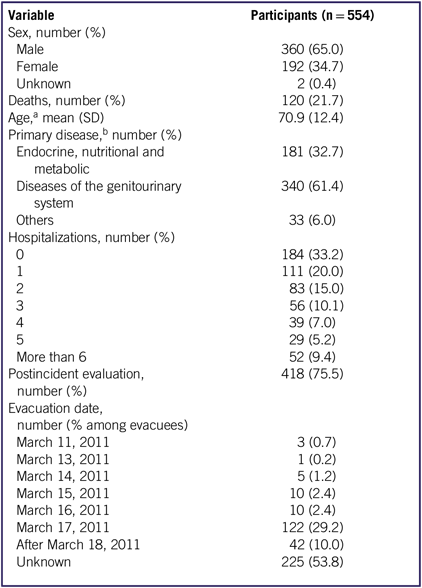
There were 629 dialysis patients who had undergone dialysis treatment at 1 of the 5 Tokiwakai Group hospitals as of the incident date. Of these 629 patients, 428 evacuated after the incident (evacuees). Seventy-five patients were excluded because they lacked necessary records for analyses or their survival could not be tracked. In all, 554 patients (88.1%) were analyzed in the study (Table 1). Of those, 3 patients had been hospitalized at the time of the incident.
Participant Demographics

a At death or withdrawal, or at the end of the study period (March 3, 2017).
b At initial dialysis.
The mean age of the patients at the study end point was 70.9 years with standard deviation of 12.4. Most participants had diseases of the genitourinary system (n = 340, 61.4%). Fifty-two patients (9.4%) were hospitalized more than 6 times.
Evacuation History
Out of 554 patients, 418 (75.5%) performed evacuation. The date of evacuation was available for 193 evacuees (46.2%). Of the evacuations, 122 (63%) were performed on March 17, 2011. Tokyo Prefecture served as the most frequent site of evacuation (n = 69, 28.8%), followed by Niigata Prefecture (n = 61, 25.4%) and Chiba Prefecture (n = 38, 15.8%). Distance from the center of Iwaki City to these prefectures is approximately 200 to 300 km. Note that the previous studies demonstrated that evacuation distance was not necessarily the most significant factor associated with the postevacuation mortality rate.Reference Nomura, Gilmour and Tsubokura17
Probability of Survival
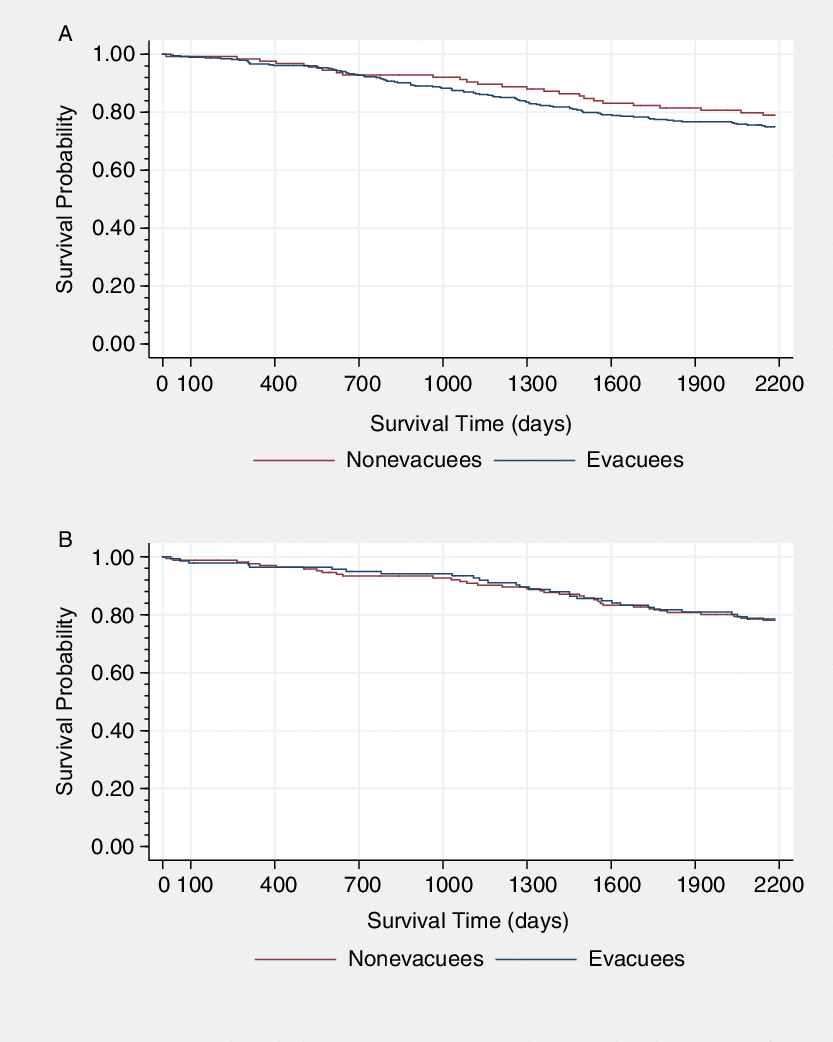
During the study period, 120 (21.7%) patients died: 94 evacuees and 26 nonevacuees. Time-dependent survival probability for postincident evacuees and nonevacuees are shown with Kaplan-Meier curves (Figure 2). Analysis time starts from the date of the incident (March 11, 2011). There was no statistically significant difference between the survival functions in evacuees and nonevacuees (log-rank test: P = .4, Wilcoxon-Breslow test: P = .3; Figure 2A). A sensitivity analysis (#1) that exclusively considered those who performed evacuation within a week of the incident as evacuees returned similar results (log-rank test: P = .9, Wilcoxon-Breslow test: P = .9, Figure 2B).
(A) Kaplan-Meier estimate of survival in nonevacuees and evacuees with (B) a sensitivity analysis that considered those who evacuated within a week of the incident as evacuees while all others, including those who evacuated after March 18, 2011, were regarded as nonevacuees. Those whose evacuation date was not known (225 out of 418) were excluded from the sensitivity analysis.

Mortality Rate
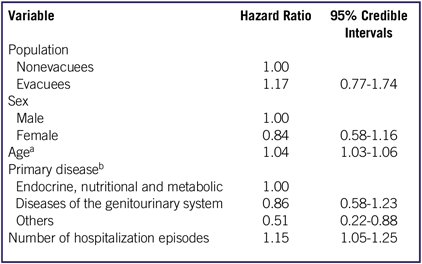
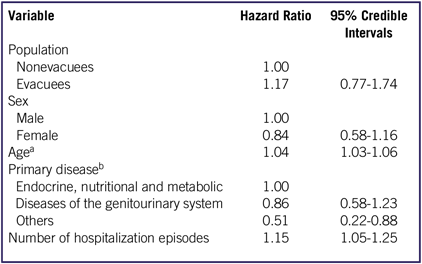
During the study period, the mortality rates of evacuees and nonevacuees were 0.13 and 0.10 per 1000 person-days, respectively. Table 2 shows the Bayesian estimate, expressed as a multiplicative change (ie, hazard ratio) in the adjusted mortality rate, which was obtained using the Weibull regression. After adjusting for covariates, mortality risk among evacuees was not statistically significantly different from that of nonevacuees, with a hazard ratio of 1.17 (95% CrI: 0.77-1.74). A higher age and greater number of hospitalization episodes were significantly associated with higher mortality risk, adjusted for covariates: 1.04 (95% CrI: 1.03-1.06) and 1.15 (95% CrI: 1.05-1.26), respectively. Adjusted for covariates, sensitivity analyses #1 and #2 yielded similar, nonsignificant results with hazard ratios of 0.88 (95% CrI: 0.55-1.31) and 1.31 (95% CrI: 0.79-2.14) for evacuees and nonevacuees, respectively, although CrIs were wide.
Random-Effects Regression Model Showing Impact on Mortality or Covariates, Including Evacuation Impact
a At death or hospital change, or at the end of the study period (March 3, 2017).
b At initial dialysis.
DISCUSSION
This study compares mortality between evacuees and nonevacuees among dialysis patients following Japan’s 2011 Fukushima nuclear power plant incident. Evacuees had a similar mortality rate as nonevacuees, with a hazard ratio of 1.17 (95% CrI: 0.77-1.74), after adjustment for covariates, including primary disease and number of hospitalization episodes (Table 2). It should be noted that age is an important factor that affects survival in disasters; younger patients are more likely to survive hazardous events than older ones are.Reference Nomura, Parsons and Hirabayashi18 In this study, the sensitivity analysis #2 exclusively considered participants who were more than 70 years of age, and demonstrated similar results with a nonsignificant difference in mortality rate between evacuees and nonevacuees. Given previous evidence of elevated mortality risk in the most vulnerable populations postevacuation,Reference Dosa, Grossman and Wetle9, Reference Dosa, Hyer and Thomas10, Reference Nomura, Gilmour and Tsubokura17, Reference Brown, Dosa and Thomas19 these findings may highlight appropriate selection of evacuees and successful management of their transportation by Tokiwakai Group hospitals.
The analyses are subject to some limitations. First, there was no baseline data available to consider the level of mortality before the Fukushima incident. Therefore, it was impossible to determine if postincident mortality in evacuees and nonevacuees was higher or lower or at a similar level to the preincident mortality. The present study was only able to address the postincident mortality difference between evacuees and nonevacuees.
Second, out of the 418 evacuees, the date of evacuation was available for only 193 patients (46.2%), and these data were considered in the sensitivity analysis #1. Note that no statistically significant difference in proportion of death among evacuees with or without known evacuation date was observed (19.2% vs 25.3%, P = .1).
Third, although there were 9 hospitals in Iwaki City that provided dialysis therapy before the incident, data were only obtained from 4 Tokiwakai Group hospitals in the city, representing about 50% of the total dialysis patients in the city. Also, we excluded 75 patients (11.9%) whose survival was mostly not traceable from the analyses. These might represent serious cases in which the patient self-evacuated in the immediate phase of the incident when hospitals were in a state of confusion, which would make it very challenging to follow these patients. In addition, the reasons for evacuation (including self-evacuation) were not random. There is a possibility that some selection bias is present because of these reasons, but unfortunately the data are not available to test for it. However, the statistical methods used increase study generalizability. A Bayesian approach was used to analyze survival in this study, which includes adjustment for the patient-specific elements in the study (such as age, primary disease, and number of hospitalization episodes). Therefore, it is likely that the relationships and effect sizes for covariates estimated in the present study are generalizable beyond the specific hospitals studied.
Finally, out of the 5 Tokiwakai Group hospitals considered in the present study, 1 hospital is located in the 20-km mandatory evacuation zone, while the other 4 hospitals are located outside the 20- to 30-km voluntary evacuation zone. These hospitals might not necessarily be comparable, as postincident circumstances faced by the hospitals might differ in different zones. It is also unlikely that they represent the wider population of evacuees across Fukushima Prefecture.
The findings in the disaster context can be contrasted to those of previous studies that addressed evacuation-related mortality in vulnerable populations. In the case of the 4 recent storms in the United States (Hurricanes Katrina and Rita in 2005 and Hurricanes Gustav and Ike in 2008), the evacuation of elderly nursing home residents resulted in increased mortality and morbidity.Reference Dosa, Grossman and Wetle9, Reference Dosa, Hyer and Thomas10, Reference Brown, Dosa and Thomas19 Dosa et al. (2012) demonstrated that mortality risk increased 2-fold among the 36 389 nursing home residents exposed to the storm. The experience of Hurricane Katrina also showed that if the lead time for hazard forecasts and early warning is limited and, thus, preparation time for evacuation is insufficient, even the best plans of specific facilities may be insufficient to prevent a significant increase in evacuation-related morbidity and mortality and support from government both before and after a disaster is essential.Reference Blanchard and Dosa20, Reference Archibald and McNeil21 In the case of the Fukushima incident, Nomura et al. (2013) reported a 2.68 (95% CI: 2.04-3.49) times increase in mortality among the 328 nursing home residents up to 1 year following the evacuation, compared to the preincident mortality levels.Reference Nomura, Gilmour and Tsubokura17
Evacuation of institutionalized patients in response to a disaster threat is typically performed with staff who may not be familiar with the residents.Reference Brown, Dosa and Thomas19 Staffing, supplies, equipment, transportation, individual identification of residents, transfer of records, and responses to family inquiries are prepared in the limited hours leading up to the departure; therefore, facility-specific factors may have a strong influence on the mortality and morbidity associated with evacuation.Reference Castle22 For the nursing homes addressed in Nomura et al. (2013), evacuations were inevitable because of staffing deficiencies that resulted from the lack of daily necessities and nursing care equipment such as medicines and medical gas (oxygen).Reference Nomura, Gilmour and Tsubokura17, Reference McCurry23 Regardless of the tremendous effort, most evacuations were performed in an unplanned and congested manner (eg, inadequate transportation infrastructure, long transfer distance, and poor preparations for care provision at evacuation sites).
These studies indicate that evacuation may not be the best life-saving strategy for vulnerable people if it is performed in a hasty, unplanned manner.Reference Nomura, Blangiardo and Tsubokura16, Reference Nomura, Gilmour and Tsubokura17, Reference Murakami, Ono and Tsubokura24 It is preferable to seek alternatives, such as sheltering-in-place, except for cases where there is a possible direct threat to safety (eg, lethal or harmful levels of radiation exposure).
However, according to a previous study,Reference Nomura, Shimada and Ozaki25 the mortality risk of sheltering-in-place in a harsh environment (eg, poor resources and staffing deficiencies resulting from voluntary staff evacuation and resulting workload issues among the staff) might be comparable to that of an unplanned evacuation. It is therefore imperative that potential risks of nonevacuation, which are mostly unique to the older, vulnerable population, as well as the factors that affect the decision for nonevacuation, are better understood through further research in disaster preparedness policies.
It is important to acknowledge that preferred responses differ in different disaster events. Some natural disasters destroy large parts of the infrastructure, but could be forecasted through a variety of means and methods; while accidental, human-caused disasters (such as nuclear incidents) may cause not only serious health consequences but also complex environmental and societal damage. However, different disaster events have in common that preferred responses may not always be available or feasible postdisaster. As a result of disasters, lack of basic health care resources (including equipment, supplies, and manpower) is known to last for only weeks to months.Reference Ochi, Tsubokura and Kato12 Therefore, if nonevacuation with sufficient resources is not guaranteed, evacuation could be a reasonable option. Here, the present study adds evidence on survival of evacuees after the Fukushima incident. If performed in a well-planned manner with satisfactory arrangements for appropriate selection of evacuees and their transportation, evacuation could be a reasonable option, one that might save more lives of vulnerable people.
Acknowledgments
We offer special thanks to Ms Natsunmi Tsubura, Ms Ayaka Teshima, and Ms Yumi Kondo. They helped and provided hospital data for this research.
Contributors
All the authors conceived and designed the study and take responsibility for the integrity of the data and the accuracy of the data analysis. Y. Matsuzaki, Y. Sonoda, J. Takasaki, Y. Sato, H. Shimmura, and Y. Kodama acquired the data. S. Nomura and Y. Kodama analyzed and interpreted the data. S. Nomura conducted statistical analysis and drafted the article. All the authors made critical revisions to the manuscript for important intellectual content and gave final approval of the manuscript.
Funding
This study is supported by Grants-in-Aid for Scientific Research from Ministry of Education, Culture, Sports, Science and Technology of Japan (15K11547 and 18K10082). The funding sponsor had no role in the design of the study; in the collection, analyses, or interpretation of data; in the writing of the manuscript, or in the decision to publish the results.
Competing Interests
The authors declare no conflict of interest.