Clostridium difficile infection (CDI) is the most common healthcare-associated infection and is associated with considerable morbidity.Reference Ananthakrishnan 1 – Reference Magill, Edwards and Bamberg 9 In 2011, there were an estimated 453,000 cases of CDI in the United States contributing to 29,000 deaths (6.4% of cases).Reference Lessa, Mu and Bamberg 7 Consequently, CDI-related morbidity exerts a significant toll on patients and the healthcare system, with the costs attributable to CDI, with estimates ranging from $1.3 to 4.8 billion annually.Reference Dubberke and Wertheimer 2 , Reference Wilcox, Cunniffe, Trundle and Redpath 6 , Reference Kyne, Hamel, Polavaram and Kelly 10 , Reference Mergenhagen, Wojciechowski and Paladino 11 The consequences of CDI are compounded by the fact that an index episode, often occurring in a vulnerable population of older patients with significant comorbidity, is followed by a cascade of recurrences with progressive impairment of health status and poor outcomes.Reference Kelly 3 , Reference Garey, Sethi, Yadav and DuPont 12 – Reference Surawicz, Brandt and Binion 15 Between 20% and 30% of patients with an index episode of CDI will develop at least 1 recurrence, and as many as 60% of those go on to develop subsequent recurrences.Reference Kelly 3 , Reference Garey, Sethi, Yadav and DuPont 12 – Reference Surawicz, Brandt and Binion 15 In the past decade, an expansion in the therapeutic armamentarium for management of CDI has occurred (1) with the availability of antibiotics that cause less disruption to the microbiome such as fidaxomicin,Reference Louie, Miller and Mullane 16 (2) with monoclonal antibodies targeting humoral anti-toxin immunity,Reference Lowy, Molrine and Leav 17 and (3) with the restoration of the microbial diversity through fecal microbiome transplantation (FMT).Reference van Nood, Speelman, Kuijper and Keller 18 , Reference van Nood, Vrieze and Nieuwdorp 19 While similar to vancomycin in effectiveness for treatment of the index episode, the newer treatment strategies demonstrate superior efficacy in achieving a sustained cure with fewer recurrences.Reference Cohen, Gerding and Johnson 8 , Reference Johnson 13 , Reference Surawicz, Brandt and Binion 15 , Reference van Nood, Speelman, Kuijper and Keller 18 , Reference Aslam and Musher 20 , Reference Debast, Bauer and Kuijper 21 However, the newer strategies are also more expensive, restricting their widespread use.Reference Konijeti, Sauk, Shrime, Gupta and Ananthakrishnan 22 , Reference Varier, Biltaji and Smith 23
Decision models have attempted to inform cost-effectiveness of different strategies to treat recurrent CDI.Reference Konijeti, Sauk, Shrime, Gupta and Ananthakrishnan 22 , Reference Varier, Biltaji and Smith 23 The key determinant of cost-effectiveness of each treatment and its position within the therapeutic algorithm is not only the ability to prevent recurrent CDI but also, importantly, the downstream cost associated with each recurrent episode. However, there are few accurate estimates of the costs associated with recurrent CDI.Reference Ghantoji, Sail, Lairson, DuPont and Garey 24 – Reference Shah, Aitken and Barragan 28 The few prior studies have focused on hospitalized patients or inpatient costs alone.Reference Miller, Hyland, Ofner-Agostini, Gourdeau and Ishak 27 , Reference Shah, Aitken and Barragan 28 Up to a quarter of patients with CDI are diagnosed in the ambulatory setting,Reference Khanna, Pardi and Aronson 29 so these cost are likely underestimates of the actual burden of recurrent CDI.
Thus, we performed this study (1) to identify the health consequences of recurrent CDI including need for repeat hospitalization, intensive care unit (ICU) stay, and surgery; (2) to determine costs associated with recurrent CDI and identify determinants of such costs; and (3) to compare the outcomes and costs of recurrent CDI to those who develop reinfection.
METHODS
Study Population
Our study population consisted of patients with recurrent CDI receiving care within the Partners Healthcare network in Boston. Patients with recurrent CDI were identified using a 2-step process described previously.Reference Wen, Barber and Ananthakrishnan 30 From among all patients with at least 2 International Classification of Diseases, 9 th edition (ICD-9) codes for CDI (008.45) from January to December 2013 (n = 591), we applied a previously validated algorithm (≥3 ICD-9 codes for CDI and ≥2 prescriptions for vancomycin) with a negative predictive value of 90% in excluding recurrent CDI. Because the positive predictive value of this algorithm was poor, manual chart review was performed for each patient who passed this filter, and a confirmed diagnosis of recurrent CDI was established based on physician adjudication. This procedure yielded a final cohort of 185 patients with at least 2 distinct episodes of CDI during the study period. Among these, 98 patients were classified as having recurrent disease when the second infection occurred within 56 days after the end of treatment of the index infection.Reference Cohen, Gerding and Johnson 8 The remaining 87 were deemed to have a re-infection (ie, a second episode occurring 56–365 days after the index episode).
Outcomes and Covariates
The primary outcome for our study was healthcare utilization associated with recurrent CDI measured by (1) the number of office visits and emergency room visits for diarrhea; (2) the number of recurrent CDI-related hospitalizations; (3) CDI-related diagnostic testing and pharmacologic costs; and (4) the cost of ICU stay and surgical treatment of CDI. The costs associated with recurrent CDI were noted over a 1-year period from the time of recurrent CDI.
Information on relevant covariates was obtained from the medical record including age at diagnosis of CDI, gender, race, comorbidity burden quantified using the Charlson comorbidity index,Reference Charlson, Pompei, Ales and MacKenzie 31 and treatment used for the index CDI episode.
Estimation of Healthcare Costs
Because the actual direct healthcare costs for each patient was not available, we estimated costs based on previously published estimated costs (Supplemental Table 1).Reference Surawicz, Brandt and Binion 15 , Reference Konijeti, Sauk, Shrime, Gupta and Ananthakrishnan 22 Costs for stool testing for C. difficile by enzyme-linked immunosorbent assay (ELISA) and pharmacologic costs for each course of treatment were inferred from a published cost-effectiveness model.Reference Konijeti, Sauk, Shrime, Gupta and Ananthakrishnan 22 The cost of FMT was also inferred from the decision model and included costs of donor testing as well as colonoscopic administration.Reference Konijeti, Sauk, Shrime, Gupta and Ananthakrishnan 22 Costs for emergency room visits were obtained from the Medicare fee schedule (www.cms.gov; common procedure terminology [CPT] code 99284). The cost of inpatient stay was obtained from the Healthcare Cost Utilization Project (HCUP) Nationwide Inpatient Sample, the largest all-payer hospitalization database. The total cost of a hospitalization with a primary or secondary diagnosis of CDI ($9,845) was averaged across the mean length of stay for such hospitalizations (5.9 days), yielding a per day estimate of $1,669. All costs were updated to 2016 US dollars using the consumer price index adjustment.
Statistical Analysis
Continuous variables were summarized using means and standard deviations and were compared using the t test. Categorical variables were summarized using proportions and were compared using the χ2 test with the Fisher’s exact modification when appropriate. First, total costs associated with recurrent CDI were calculated and averaged to provide a per-patient estimate. We calculated the proportion of such costs that were attributable to diagnostic testing, treatment, outpatient care, hospitalization, and surgery. We performed a forward stepwise multivariate linear regression analysis to identify independent determinants of total per-patient healthcare costs, and we selected for inclusion those variables significant at P<.05 in univariate comparisons. Using the methods noted above, comparisons were performed between those with recurrent disease and reinfection. All statistical analyses were performed using Stata 14.0 (StataCorp, College Station, TX). The study was approved by the Institutional Review Board of Partners Healthcare.
RESULTS
Study Cohort
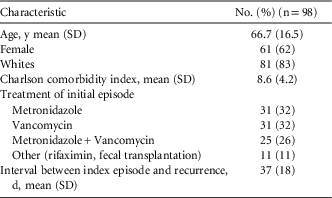
Our study population included 98 patients who developed recurrent CDI. Nearly two-thirds of the cohort were women (62%) and most were white (83%). The most frequent comorbidities were a history of malignancy (85%), diabetes (45%), and chronic kidney disease (53%) with a mean Charlson index of 8.6 (Table 1). The mean age of patients was 67 years (range, 21–100 years). The mean interval between date of diagnosis of initial infection and recurrent infection was 37 days (interquartile range [IQR], 23–57 days). The most common treatments for the index episode were vancomycin alone (32%) or metronidazole alone (32%) with one-quarter of patients (26%) receiving a combination of both antibiotics.
Characteristics of Patients With Recurrent Clostridium difficile Infection

Healthcare Burden and Costs Due to Recurrent CDI
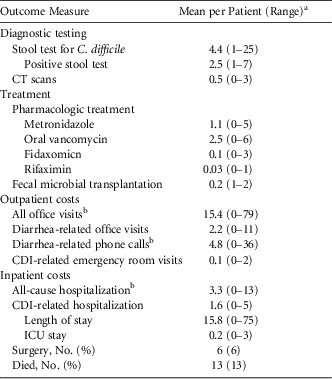
Information on healthcare utilization (at least 1 healthcare contact or prescription) was available for 95 patients with recurrent CDI. Table 2 presents the healthcare burden and costs in this population. A total of 95 patients accounted for 414 stool tests over the 1-year period, with a mean of 4.4 stool tests per patient (range, 1–25). Among these, a mean of 2.5 stool tests per patient were positive for C difficile toxin. A total of 233 distinct prescriptions for vancomycin were dispensed at a mean of 2.45 prescriptions per patient (range, 0–6). In addition, there were a mean of 1.1 prescriptions for metronidazole (range, 0–5) and 0.14 prescriptions for fidaxomicin. In total, 11 patients underwent a single FMT, and 3 patients each received 2 fecal transplants during the 1-year period following the recurrent CDI episode.
Healthcare Burden Associated With Recurrent Clostridium difficile

NOTE. CT, computed tomography; CDI, Clostridium difficile infection; ICU, intensive care unit.
a Data could be obtained for 95 / 98 patients with recurrent CDI.
b Not included in calculation of healthcare costs.
Reflecting the level of comorbidity in this population, there was a mean of 15.4 office visits per patient during the year following the episode of recurrent CDI (IQR, 6–18 visits), among which 2.2 were diarrhea related. An estimated 94% of patients required another hospitalization during the study period with 84% having at least 1 CDI-related hospitalization (147 CDI-related hospitalizations; mean, 1.6 per patient). The mean length of stay of CDI-related hospitalizations was 16 days (range, 1–75 days). Of these, 18 days were in the ICU (mean, 0.18 days per patient). In total, 6 patients (6%) underwent CDI-related surgery. Approximately 40% of patients were discharged to short-term rehabilitation facilities, and 13 patients (13%) died.
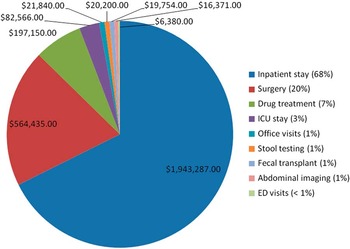
The healthcare cost estimates incurred per patient and in the entire population are presented in Table 2 and Figure 1. The mean total CDI-associated downstream healthcare cost per patient was $34,104 (range, $831–$146,353). Of these costs, those associated with hospitalization accounted for the major proportion ($30,122 per patient; 68% of total costs). Surgery-related costs accounted for the next-largest fraction (20%), with treatment costs (medication and FMT) accounting for 8% of total costs incurred. If this cost per patient were applied to the estimated 83,000 recurrences in the United States,Reference Lessa, Mu and Bamberg 7 it would account for approximately $2.8 billion annually.
Relative contribution of different factors to recurrent Clostridium difficile infection (CDI)–associated costs. The total mean cost per patient was $34,103. All costs in United States dollars. All numbers represent percentages.

Predictors of Healthcare Costs
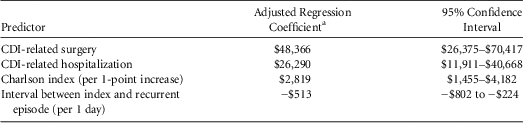
Table 3 presents a multivariate regression model of predictors of recurrent CDI–associated healthcare costs. The strongest determinants of costs incurred in the year following recurrent CDI were the need for CDI-related surgery (+$48,366) and or hospitalization (+$26,290). A longer interval between initial episode and recurrence was associated with lower costs (−$513). Greater Charlson comorbidity but not older age was also associated with higher recurrent CDI–associated healthcare costs. The type of treatment used for the index or recurrent CDI episode did not predict healthcare costs or patient outcomes.
Predictors of Recurrent Clostridium difficile Infection (CDI)–Associated Healthcare Costs

NOTE. All costs in United States dollars.
a Additionally adjusted for age, gender, and race/ethnicity.
Comparison of Recurrent CDI and Reinfection
Supplemental Table 2 presents a comparison of patients with recurrent CDI to those who developed a reinfection diagnosed 56 days after the initial episode. Patients with recurrent CDI were older (67 years vs 60 years) but similar in distribution of gender and comorbidity. There were no differences in the initial treatments used in both populations. A comparison of the healthcare utilization between the 2 groups revealed greater numbers of stool tests performed (mean 4.4 vs 3.3 tests per patient per year; P = .01), positive stool tests (2.5 vs 1.8; P = .0001), and prescriptions of oral vancomycin (2.5 vs 2.0 prescriptions per patient; P = .04) in those with recurrent CDI compared to reinfection. Patients with recurrent CDI also incurred more ER visits but were similar in the number of inpatient or outpatient office visits. There were no differences in CDI related length of stay or duration of ICU stay, but patients with recurrent CDI were more likely to require surgery for their CDI (6% vs 0%; P = .03). In terms of healthcare expenditure, recurrent CDI was associated with higher mean testing and treatment costs per patient but a similar overall cost per patient.
DISCUSSION
Clostridium difficile infection is the most common healthcare-associated infection and accounts for significant morbidity and mortality;Reference Ananthakrishnan 1 – Reference Magill, Edwards and Bamberg 9 its tendency to recur contributes to this prevalence.Reference Kelly 3 , Reference Johnson 13 , Reference McFarland, Elmer and Surawicz 14 , Reference McFarland, Surawicz, Rubin, Fekety, Elmer and Greenberg 26 , Reference Abou Chakra, Pepin, Sirard and Valiquette 32 Recurrence rates in the literature vary from 5% to 50%, with an estimated likelihood of 20%–30% after the index episode, and 45%–65% with subsequent recurrences.Reference McFarland, Elmer and Surawicz 14 , Reference Surawicz, Brandt and Binion 15 , Reference Aslam and Musher 20 , Reference Debast, Bauer and Kuijper 21 , Reference McFarland, Surawicz, Rubin, Fekety, Elmer and Greenberg 26 , Reference Aslam, Hamill and Musher 33 – Reference Bauer, van Dissel and Kuijper 35 Because most existing treatments, except for metronidazole, are similar in their effectiveness in treating the index episode,Reference Louie, Miller and Mullane 16 cost-effectiveness and positioning of different strategies to manage CDI are determined by their ability to prevent recurrence and the cost of recurrent disease.Reference Mergenhagen, Wojciechowski and Paladino 11 , Reference Konijeti, Sauk, Shrime, Gupta and Ananthakrishnan 22 In a comprehensive study of healthcare costs associated with recurrent CDI, we estimate a 1-year downstream cost of $34,104 per patient with recurrent CDI. Extrapolating to the entire United States population, recurrent CDI may be associated with an annual cost of $2.8 billion.
Few studies have attempted to quantify the costs incurred by recurrent CDI, though several have examined the economic impact of CDI overall.Reference Dubberke and Wertheimer 2 , Reference Kyne, Hamel, Polavaram and Kelly 10 , Reference Mergenhagen, Wojciechowski and Paladino 11 , Reference Ghantoji, Sail, Lairson, DuPont and Garey 24 , Reference Shah, Aitken and Barragan 28 , Reference Aitken, Joseph and Shah 36 – Reference Song, Bartlett, Speck, Naegeli, Carroll and Perl 40 Initial estimates of the cost associated with each CDI episode used state hospitalization discharge databasesReference O’Brien, Lahue, Caro and Davidson 39 or linear regression and propensity score matchingReference Dubberke and Wertheimer 2 , Reference Kyne, Hamel, Polavaram and Kelly 10 , Reference Dubberke and Olsen 37 , Reference Dubberke, Reske, Olsen, McDonald and Fraser 38 and estimated the attributable cost for each case to be between $3,006 and $15,397.Reference Dubberke and Wertheimer 2 Extrapolating the burden of CDI to the United States overall in 2008 resulted in total acute-care facility costs from CDI ranging between an estimated $1 billionReference Dubberke and Wertheimer 2 , Reference Dubberke, Reske, Olsen, McDonald and Fraser 38 and $4.8 billion.Reference Song, Bartlett, Speck, Naegeli, Carroll and Perl 40 However, some limitations of the prior work included lack of differentiation between index and recurrent CDI and inclusion only of costs incurred during the initial acute care stay. Indeed, increasing the window of downstream costs to also include hospitalizations within 180 days after the index episode doubled the attributable cost per case.Reference Dubberke, Reske, Olsen, McDonald and Fraser 38 Few studies have specifically estimated treatment costs associated with recurrent CDI. A systematic review by Ghantoji et alReference Ghantoji, Sail, Lairson, DuPont and Garey 24 estimated the costs per case of recurrent CDI to be $18,067. However, subsequent studies have suggested that the actual cost may be higher. Shah et alReference Shah, Aitken and Barragan 28 quantified the inpatient treatment costs associated with CDI among hospitalized patients in a cohort of 540 patients with primary CDI, among whom 95 patients (18%) experienced recurrent episodes. The CDI-attributable median length of stay was 8 days greater for those with recurrent disease, resulting in a median cost of $28,218, which is twice that of primary infection.
The median cost of recurrent CDI in our study was higher than previously noted and is likely due to a few methodological differences. First, most previous studies of index or recurrent CDI focused almost entirely on acute-care facility costs.Reference Dubberke and Wertheimer 2 , Reference Kyne, Hamel, Polavaram and Kelly 10 , Reference Mergenhagen, Wojciechowski and Paladino 11 , Reference Ghantoji, Sail, Lairson, DuPont and Garey 24 , Reference Shah, Aitken and Barragan 28 , Reference Dubberke and Olsen 37 , Reference Dubberke, Reske, Olsen, McDonald and Fraser 38 , Reference Song, Bartlett, Speck, Naegeli, Carroll and Perl 40 Prior studies have suggested that between 50% and 85% of recurrent CDI episodes result in rehospitalization.Reference Aitken, Joseph and Shah 36 , Reference Olsen, Yan, Reske, Zilberberg and Dubberke 41 Our estimates fall within this range and suggest that two-thirds of the downstream costs of recurrence are attributable to hospitalization costs. The mean length of stay in our study of 16 days was similar to that by Shah et al,Reference Shah, Aitken and Barragan 28 but it was higher than that reported previously by McFarland.Reference McFarland, Surawicz, Rubin, Fekety, Elmer and Greenberg 26 When colectomy costs are included, the proportion of inpatient costs rose to 80%. Notably, however, a significant fraction of the estimated costs in our study were incurred in the outpatient setting or were related to diagnostic testing and treatment. Thus, studies exclusively focusing on inpatient costs may underestimate the economic burden of recurrent CDI. Second, prior studies have examined costs incurred during the hospitalization for recurrent episode alone but not other downstream costs incurred by the patient such as persistent diarrhea requiring outpatient evaluation, stool and radiologic testing, or pharmacologic treatment even in the absence of a confirmed episode of recurrence. In our estimate, these costs also compound the cost of recurrent CDI where, with 1 episode of confirmed recurrence, there may be persistent concern for future recurrence for both the patient and treating providers. This concern may lead to inappropriate testing such as a need to demonstrate ‘a cure’ by a negative stool test, or empiric treatment of persistent diarrhea with 1 or more courses of oral metronidazole, vancomycin, or fidaxomicin. Thus, we analyzed costs for up to 1 year after the recurrent episode (although the recurrence occurred within 8 weeks of the index episode) because we believe this method provides a more comprehensive and realistic estimate of the downstream burden of recurrent disease.
The overall cost of an episode of reinfection was similar to that of recurrence, suggesting that all patients with a prior history of CDI may be considered as a group at risk for incurring high healthcare costs. The more frequent utilization of stool testing, pharmacologic treatment, and CDI related surgery, arguably more disease specific than total healthcare costs, suggesting that recurrent CDI may be associated with a greater adverse impact on patient outcomes than reinfection. This finding is consistent with those reported when results are compared to an index episode of CDI. Importantly, recurrent CDI offers a more defined window for intervention aiming at prevention and may be a more suitable target for controlling CDI-related costs.
There are several implications to our findings. Interest in the economic burden of CDI is driven by the prevalent nature of this infection and resultant prolongation of hospitalization stay and associated high healthcare costs.Reference Dubberke and Wertheimer 2 , Reference Mergenhagen, Wojciechowski and Paladino 11 , Reference Ghantoji, Sail, Lairson, DuPont and Garey 24 Up to a one-third of patients with an index episode of CDI and nearly two-thirds of those with 1 or more recurrences will have an episode of recurrent disease;Reference Kelly 3 , Reference Cohen, Gerding and Johnson 8 , Reference McFarland, Elmer and Surawicz 14 , Reference McFarland, Surawicz, Rubin, Fekety, Elmer and Greenberg 26 , Reference McFarland 42 therefore, the downstream costs incurred are of significant importance to the patient and the healthcare system. Positioning of the various existing and emerging treatments for prevention of recurrent CDI is complicated by the fact that differences in the upfront cost of a course of treatment may influence provider and institutional preferences such that more effective but also more expensive options are restricted for use later in the course of CDI for multiply recurrent disease. However, doing so may result in accrual of significant economic costs by the initial episode of recurrence. Initial decision models for management of CDI have been limited by lack of accurate data to inform burden of recurrent disease.Reference Konijeti, Sauk, Shrime, Gupta and Ananthakrishnan 22 , Reference Lapointe-Shaw, Tran and Coyte 43 With emerging data, including ours, accurately quantifying the full downstream costs of recurrent CDI, and with the availability of newer therapeutic options, such decision models can be updated to accurately inform our practice regarding to the most effective and cost-effective method to treat this disease.
We readily acknowledge several limitations to our study. It was a single-center study based at a referral center. Consequently, the severity of our patient population (and consequently the associated costs) of our patient population may be higher than in a population-based setting. Second, we were not able to account for indirect costs, which include those associated with a rehabilitation facility stay or lost economic productivity. It will be important for future studies to examine the indirect cost of CDI as well. Third, we may have underestimated the costs incurred by patients who sought care outside of our healthcare system. Fourth, we did not specifically examine the costs associated with multiply recurrent episodes of CDI; rather, we quantified all costs incurred during the 12 months after the first recurrence. We believe that such cost estimates may be a more realistic estimate of the burden of recurrence because even without microbiologic confirmation of a second recurrence, patients may be placed on empiric treatment for CDI or incur costs related to persistent diarrhea. Because none of the patients in our study had other underlying diarrheal diseases including inflammatory bowel disease, we believe our estimates can be considered attributable to recurrent CDI.
In conclusion, we have demonstrated a significant healthcare burden associated with recurrent CDI, estimated at $34,104 over 1 year after the recurrence, which translates to $2.8 billion nationally. There is an important need for tools to predict those at risk for recurrent disease as well as therapies that reduce rates of recurrence, and thereby decrease associated morbidity. Accurate estimates of the comprehensive cost and quality of life impairment by C. difficile are essential to optimally position various strategies for management of this common healthcare-associated infection to improve patient outcomes.
ACKNOWLEDGMENTS
Financial support: This study was supported by research funding from Cubist/Merck to Dr Ananthakrishnan.
Potential conflicts of interest: Dr Ananthakrishnan has served on the scientific advisory boards for Merck, Summit Pharmaceutics, Takeda, and Abbvie, and he is supported by the US National Institutes of Health (grant no. DK097142). Rodrigues and Barber have no conflicts of interest.
SUPPLEMENTARY MATERIAL
For supplementary material/s referred to in this article, please visit http://dx.doi.org/doi:10.1017/ice.2016.246.