Visual inspection is highly subjective and cannot detect microscopic contamination. Microbiological culture methods have long turnaround times and delayed results, making them unsuitable for real-time guidance of cleaning activities. Although ATP bioluminescence assay can rapidly reflect organic contamination, its cost is high, and it cannot distinguish different cleaning stages such as routine cleaning versus terminal disinfection. Reference Sanna, Dallolio and Raggi1,Reference Richard and Bowen2 Fluorescent marker methods, as emerging semiquantitative assessment tools, have been increasingly applied in health care environmental cleaning evaluation due to their speed, intuitiveness, and low cost. Reference Boyce, Havill and Havill3,Reference Hung, Chang and Cheng4 However, existing studies predominantly use single-color marking. Reference Boyce, Havill and Havill3,Reference Hung, Chang and Cheng4 Moreover, there is a lack of quantitative indicators for cleaning blind spots. To address these research gaps, this study proposes and applies dual-color fluorescent tracing technology with the cleaning blind-spot index (CBI) to precisely identify cleaning weaknesses and improve operating room cleaning quality.
This prospective interventional study was conducted at a tertiary care hospital from October 2024 to April 2025. Ten Class III clean operating rooms were selected as study sites. The study comprised a 2-week baseline period followed by a 6-month intervention period. Seventeen high-touch surfaces were selected in each operating room based on previously published criteria, Reference Richard and Bowen2–Reference Jennings, Johnson and Brady5 including instrument cart rails, anesthesia machine control panels and buttons, operating table adjustment buttons, and infusion pump buttons. Medical-grade fluorescein sodium gels were used. The blue marker (3M Clean-Trace Fluorescent Marker Gel) was used for routine cleaning assessment between consecutive surgeries. The green marker (Hygiena Verify Fluorescent Marker) was used for terminal disinfection assessment after daily surgery completion. Markings were applied by trained research personnel without the knowledge of cleaning staff before cleaning or disinfection procedures began. After cleaning or disinfection completion, surfaces were examined using a portable ultraviolet light in a dark environment. Reference Boyce, Havill and Havill3–Reference Jennings, Johnson and Brady5 A surface was considered qualified if the fluorescent marker was completely removed, with the pass rate calculated as the percentage of surfaces with complete removal. Each marked surface was divided into 1 cm × 1 cm grids, and CBI was calculated as the percentage of grids with residual fluorescence.
A 2-week baseline survey was conducted, completing 400 marking assessments across 10 operating rooms. Initial pass rates, CBI values, and heatmaps were analyzed to identify primary cleaning blind spots, including instrument cart rail gaps and equipment button recesses, and to identify process deficiencies. Based on baseline survey results, a 6-month intervention was implemented. Informed by Wong et al. Reference Wong, Huang and Yang6 and Bowen, Reference Richard and Bowen2 we developed a Three-Color Cleaning Toolkit: red precision brush gaps (gaps/rails),yellow microfiber cloth (flat surfaces), and blue antistatic wipe (electronics). All tools were single-use centrally processed. Routine cleaning closed-loop consisted of operating room use → blue marker assessment → rapid cleaning with yellow or blue tools → feedback. Terminal disinfection closed-loop consisted of end of daily surgery → green marker assessment → comprehensive cleaning and disinfection with full three-color toolkit → head nurse verification → data entry → monthly performance linkage. Monthly CBI heatmaps and rankings for each operating room were publicly displayed. Cleaning pass rates, CBI values, and single assessment times were compared before and after intervention. Data were analyzed using SPSS version 26.0. Continuous data were expressed as mean ± standard deviation, with preintervention and postintervention comparisons using paired t-tests. Categorical data were expressed as rates (percentages), with comparisons using χ 2 tests. A P value less than .05 was considered statistically significant.
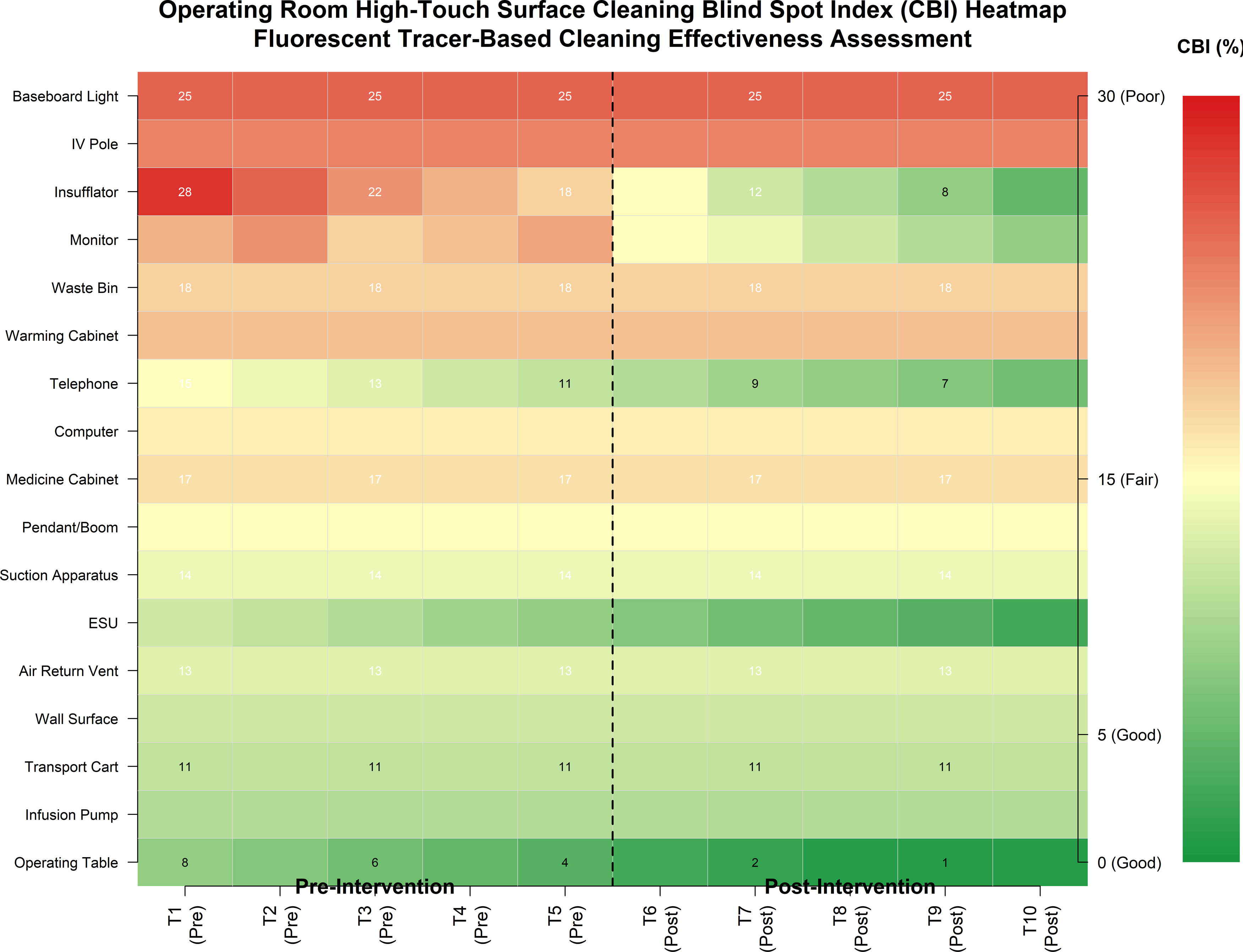
After intervention, the overall cleaning pass rate of operating room high-touch surfaces significantly increased from 72.1% to 94.3% (χ2 = 45.32, P < .01). The CBI decreased from 18.7% ± 4.2% before intervention to 4.3% ± 1.5% after intervention, with cleaning quality grade improving from Moderate to Excellent (t = 15.47, P < .001) (Figure 1). Blind spots with high CBI values were mainly concentrated in structurally complex areas, including instrument cart rail interiors, anesthesia machine button gaps, and equipment cable interfaces (Figure 1). After intervention, through targeted cleaning with the red precision brush, CBI values in these areas decreased most markedly, with the cleaning rate of instrument cart rails improving by 42%. The assessment required 4.8 ± 1.2 minutes and cost < 10 RMB per evaluation, substantially lower than ATP testing.
Cleaning blind-spot index (CBI) heatmap of operating room high-touch surfaces. The heatmap displays CBI values across 17 surfaces at 10 time points (T1–T10). CBI is calculated as (number of grids with residual fluorescence / total number of grids containing the marking point) × 100%. Darker shades represent higher CBI values (poorer cleaning), and lighter shades represent lower CBI values (better cleaning). The vertical dashed line separates the preintervention period (T1–T5) from the postintervention period (T6–T10). Summary data: pass rate increased from 72.1% to 94.3% (χ2 = 45.32, P < .01); mean CBI decreased from 18.7% ± 4.2% to 4.3% ± 1.5% (t = 15.47, P < .001).

Figure 1. Long description
A heat map representing the cleaning blind-spot index (CBI) of operating room high-touch surfaces. The heatmap displays CBI values across 17 surfaces at 10 time points (T1 to T10). The CBI is calculated as (number of grids with residual fluorescence / total number of grids containing the marking point) times 100 percent. Darker shades represent higher CBI values (poorer cleaning), and lighter shades represent lower CBI values (better cleaning). The vertical dashed line separates the preintervention period (T1 to T5) from the postintervention period (T6 to T10). The surfaces include Baseboard Light, IV Pole, Insufflator, Monitor, Waste Bin, Warming Cabinet, Telephone, Computer, Medicine Cabinet, Pendant/Boom, Suction Apparatus, ESU, Air Return Vent, Wall Surface, Transport Cart, Infusion Pump, and Operating Table. The color scale ranges from 0 percent (good cleaning) to 30 percent (poor cleaning). Notable trends include a general improvement in cleaning effectiveness post-intervention, with lower CBI values observed in the post-intervention period compared to the pre-intervention period. Specific surfaces such as the Insufflator and Monitor show significant improvements, while others like the Waste Bin and Warming Cabinet exhibit more consistent but still notable improvements.
The substantial reduction in CBI underscores the value of targeted feedback. The dual-color system enables independent assessment of routine cleaning and terminal disinfection, precisely identifying weak links in the process. This study has several limitations. First, it was a single-center study with limited sample size. Future multicenter studies are needed to validate the generalizability of this system. Second, the study focused on the physical removal effect of cleaning. Future research should correlate fluorescent marker removal rates with microbiological sampling results to further validate biological significance. Third, future studies should evaluate whether improved cleaning monitoring translates to reduced surgical site infection rates, the ultimate clinically relevant outcome. In conclusion, dual-color fluorescent tracing with CBI precisely identifies cleaning weaknesses. The Three-Color Toolkit and closed-loop management significantly improved cleaning pass rates and eliminated blind spots, providing a practical solution for operating room environmental cleaning.
Financial support
This work was supported by the funds of the Medical Leading Discipline of Ganzhou City, and the Ganzhou City Science and Technology Guidance Plan Project (No. 2025ZSFCE0389).