Introduction
The association between experiencing a traumatic event and developing post-traumatic stress disorder (PTSD) is clearly outlined within its diagnostic category (Pepper & Agius, Reference Pepper and Agius2009). However, the relationship between experiencing trauma and developing psychosis is more tentative due to the often long and complex pathway (Morrison et al. Reference Morrison, Frame and Larkin2003). Experiencing early traumatic events, including sexual abuse, physical abuse, domestic violence, bullying, physical injury, and physical assault, are predictive of psychosis (Read et al. Reference Read, van Os, Morrison and Ross2005; Kelleher et al. Reference Kelleher, Harley, Lynch, Arseneault, Fitzpatrick and Cannon2008; Shelvin et al. Reference Shelvin, Houston, Dorahy and Adamson2008; Bebbington et al. Reference Bebbington, Jonas, Kuipers, King, Cooper, Brugha, Meltzer, McManus and Jenkins2011). Research indicates that around 50–98% of people with psychosis report a history of trauma (Read et al. Reference Read, van Os, Morrison and Ross2005), with an average of 3–4 traumatic events per individual (Goodman et al. Reference Goodman, Rosenberg, Mueser and Drake1997; Mueser et al. Reference Mueser, Goodman, Trumbetta, Rosenberg, Osher, Vidaver, Auciello and Foy1998). In a study examining adults who experienced voices, around 70% reported a traumatic event preceding a voice (Romme & Escher, Reference Romme and Escher1989). These results were replicated in subsequent studies where it was found that the onset of hallucinations was triggered either by a traumatic event or a memory which reminded them of the trauma (Honig et al. Reference Honig, Romme, Ensink, Escher, Pennings and deVries1998).
A dose-response effect has also been identified between trauma and psychosis (Janssen et al. Reference Janssen, Krabbendam, Bak, Hanssen, Vollebergh, de Graaf and van Os2004; Read et al. Reference Read, van Os, Morrison and Ross2005; Bentall et al. Reference Bentall, Wickham, Shelvin and Varese2012). In two large community samples, experiencing two or more types of trauma significantly predicted psychosis (Shelvin et al. Reference Shelvin, Houston, Dorahy and Adamson2008), and the number of traumatic events were positively related to experiencing delusions (Scott et al. Reference Scott, Chant, Andrews, Martin and McGrath2007). A recent large-scale review illustrated that adverse experiences in childhood significantly increase the risk of psychosis, with an average odds ratio of 2.8 (Varese et al. Reference Varese, Smeets, Drukker, Lieverse, Lataster, Viechtbauer, Read, van Os and Bentall2012). This review also found positive dose-response relationships in 90% of datasets which investigated such associations. Furthermore, Bentall & colleagues (2012) found that specific adverse events were associated with specific symptoms of psychosis; rape, physical abuse and being in local authority care were associated with auditory hallucinations and physical abuse, institutional and local authority care was associated with paranoia. In a more recent study they also identified that communication deviance is linked with thought disorder, childhood sexual abuse is associated with auditory hallucinations and paranoid delusions (Bentall et al. Reference Bentall, de Sousa, Varese, Wickham, Sitko and Haarmans2014).
Both PTSD and psychosis have a comprehensive evidence base supporting their relationship with trauma which has led researchers to investigate their similarities. Around 12–29% of people with psychosis have a dual diagnosis of PTSD (Buckley et al. Reference Buckley, Miller, Lehrer and Castle2009). Similarities between the symptoms of PTSD and psychosis have been noted (Morrison et al. Reference Morrison, Frame and Larkin2003; van der Vleugel et al. Reference van der Vleugel, van den Berg and Staring2012): hallucinations in psychosis have been likened to flashbacks in PTSD as they both present in visual or auditory modalities, and are usually experienced as unpleasant and uncontrollable; paranoia in psychosis can be likened to hypervigilence in PTSD; avoidance of specific situations or behaviours in PTSD can be similar to safety-seeking behaviours or negative symptoms in psychosis.
Although many studies have identified specific traumatic events that predict psychosis, less is known about the specific PTSD symptoms resulting from a traumatic event and their relationship with psychosis. A relationship between psychosis and PTSD has been identified among combat veterans (Butler et al. Reference Butler, Mueser, Sprock and Braff1996); however, little is known about the emerging relationship between PTSD and psychotic symptoms in the general population. To our knowledge, no research has been conducted examining this relationship. Furthermore, there has been no investigation of the dose-response relationship between PTSD and psychosis which would be important to consider due to the dose-response relationship trauma has with psychosis.
This study aimed to examine the relationship between symptoms of PTSD and psychotic experiences, specifically auditory hallucinations and paranoia, as these have been highlighted to have most overlap (Morrison et al. Reference Morrison, Frame and Larkin2003). It was hypothesized that there would be a significant relationship between PTSD symptoms and psychotic experiences (auditory hallucinations and paranoia), and that this relationship will be dose responsive.
Method
Design
Data from the Adult Psychiatric Morbidity Survey (APMS; McManus et al. Reference McManus, Meltzer, Brugha and Bebbington2007) was used to examine the aim of the present study. The APMS was conducted by the National Centre for Social Research and the University of Leicester between October 2006 and December 2007. The aim of the APMS was to provide up-to-date information about the prevalence of psychiatric problems among people in Great Britain, as well as their associated social disabilities and use of services. For the purpose of this study, the independent variables used were experience of trauma, reliving and arousal symptoms. The dependent variables were auditory hallucinations and paranoia.
Sample
The study employed a sample of adults, aged ⩾16 years (age at which individual consent can be given) in England living in private households. People living in institutions were not recruited. The survey employed stratified cluster sampling using postal sectors as the primary sampling unit (PSU) and the small user postcode address file to identify suitable households. In total, 7403 adults participated. Trained researchers conducted computer-assisted face-to-face interviews which lasted for approximately 90 min. Data was collected by trained research assistants thus reflects the respondents’ personal appraisals of their experiences. The interviews included structured assessments which screened for a range of mental health problems, use of services, risk factors, and sociodemographic information. Further details of the survey aims and methodology can be found in the user guide (McManus et al. Reference McManus, Meltzer, Brugha and Bebbington2007).
Measures
Traumatic event
Participants were asked if they have ever experienced a traumatic event ‘like a major natural disaster, a serious automobile accident, being raped, seeing someone killed or seriously injured, having a loved one die by murder or suicide, or any other experience that either put you or someone close to you at risk of serious harm or death’ which was taken from the Structured Clinical Interview for DSM-IV (SCID) – non-patient version (First et al. Reference First, Spitzer, Gibbon and Williams2002). Participants who responded ‘yes’ were asked when the traumatic event occurred. If this occurred since the age of 16 years, follow-up questions regarding experiences of PTSD were asked.
Trauma Screening Questionnaire (TSQ)
Experiences of PTSD were examined using the TSQ (Brewin et al. Reference Brewin, Rose, Andres, Green, Tata, McEvedy, Turner and Foa2002). NICE guidelines identify the TSQ as one of two screens with the greatest potential for use in primary care (McManus et al. Reference McManus, Meltzer, Brugha and Bebbington2007). The questionnaire includes 10 items which requires a yes or no response. The first five of the items relate to ‘reliving’ of the traumatic event and the second five items relate to experiencing ‘arousal’ subsequent to the trauma. All 10 items were used in the analysis of this study. Example statements included ‘upsetting thoughts or memories about the event that have come into your mind against your will’ and ‘irritability or outbursts of anger’. Respondents were asked to choose either ‘yes’ or ‘no’ to the symptom stated. One point was given to each item scored ‘yes’ and a total of ⩾6 points out the possible 10 indicated a positive screen for PTSD. The TSQ has been illustrated to have a sensitivity of 84%, specificity of 95% and a predictability of 90% in identifying PTSD in relation to a number of different types of trauma (Brewin et al. Reference Brewin, Rose, Andres, Green, Tata, McEvedy, Turner and Foa2002).
Psychosis Screening Questionnaire (PSQ)
The PSQ (Bebbington & Nayani, Reference Bebbington and Nayani1995) was used to assess respondents for possible psychotic experiences. The items included in this questionnaire are based on the World Health Organization (WHO) International Classification of Disease (ICD-10) on Mental and Behavioural Disorders, and consist of two main types: schizophrenia and affective psychosis. The screening questionnaire was based on the respondents’ experiences over the last year. It does not examine the history of the psychotic experiences. The items used in this study related to experiences of paranoia and auditory hallucinations:
PSQ3B: Felt group of people was plotting to cause you serious harm.
PSQ5A: Heard voices saying quite a few words or sentences.
A dichotomous response of ‘yes’ or ‘no’ was required, answering ‘yes’ indicating a positive screen for paranoia or auditory hallucinations, respectively. The PSQ uses two rather than a single item to assess each psychotic symptom. An initial item screens for potentially psychotic experiences while the follow-up item then only applies to those responding positively to the first and provides a more conservative measure. The PSQ has been shown to have a sensitivity of 96.9%, a specificity of 95.3% and a predictability of 91.2% in identifying psychosis (Bebbington & Nayani, Reference Bebbington and Nayani1995).
Statistical analysis
Initially, data screening, descriptive statistics and cross-tabulations were produced using SPSS v. 20 (IBM Corp, 2011). To determine whether the independent variables were related, χ2 values were calculated with Bonferroni corrections for multiple comparisons. All further analysis was conducted using Stata v. 9 (StataCorp, 2011). The association between PTSD symptoms, auditory hallucinations and paranoia were examined via multiple logistic regression analyses with either the presence of auditory hallucinations or paranoia as the outcome variable. An initial covariate model was estimated that included ethnicity (white v. non-white), education (entered as four dummy variables: degree, A-level, GCSE, Other, with no qualifications as the reference category) and other psychotic experiences (i.e. if the outcome were paranoia, auditory hallucinations were included as a covariate to control for the overlap in symptoms and vice versa). We then included two trauma symptom variables; the total number of reliving symptoms and the total number of arousal symptoms. These were estimated as sets of four categorical dummy variables (i.e. 1, 2, 3, 4 or 5 symptoms), with no symptoms representing the reference category. This allowed an exploration of the dose-response relationship between trauma symptoms, auditory hallucinations and paranoia, following the procedure adopted by Bentall & colleagues (2012).
In order to account for non-independence due to clustering at the PSU level (in this case, postal sectors in the UK; McManus et al. Reference McManus, Meltzer, Brugha and Bebbington2007), we estimated clustered, robust standard errors (Rogers, Reference Rogers1993). Sampling weights were also applied that adjusted for the probability of selection within households (a single individual was selected per household), non-response bias, age, sex and region. Comparisons between covariates only and the full models were made using the adjusted Wald test, whereby we tested the null hypothesis that B = 0 for the trauma symptoms variables (as these were categorical variables this test was undertaken across the resulting dummy variables). Where this test is non-significant, it suggests there is no added benefit to including the trauma variable in the model.
Results
Demographics
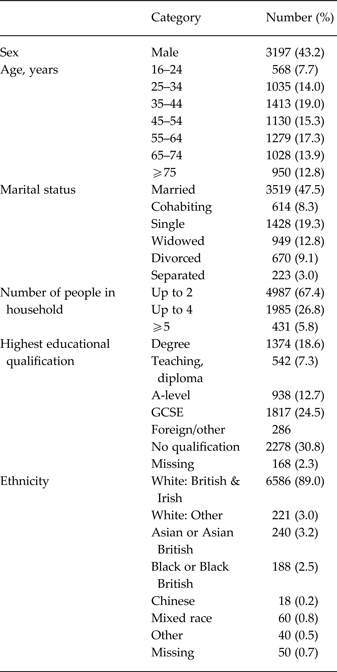
Information regarding the demographics of the respondents included in the analysis is given in Table 1. With weights applied the sample is representative of the population of adults living in private households in terms of socio-demographics (e.g. age, sex, region) as indicated in the recruitment process (McManus et al. Reference McManus, Meltzer, Brugha and Bebbington2007).
Sample demographics

A-level, Advanced level qualification; GCSE, General Certificate of Secondary Education.
Data screening
Missing data was minimal for all variables (⩽3.07% per variable) and missing cases were therefore excluded from the analysis. There was no evidence of multicollinearity between study variables, with all tolerance statistics >0.40 (Menard, Reference Menard1995).
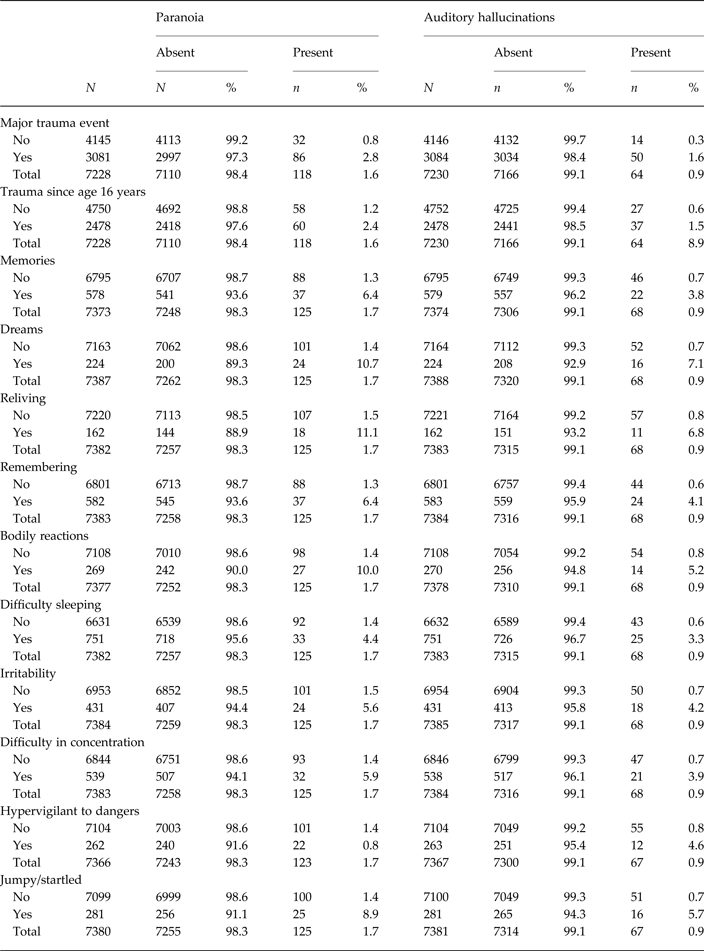
Exploratory bivariate associations between the symptoms of PTSD, auditory hallucinations and paranoia have been conducted and are summarized in Table 2. All these associations were statistically significant (p < 0.005). In this analysis, 72.9% of people who experienced paranoia and 78.1% of people who experienced auditory hallucinations in the past year had also experienced trauma. Around one third of people who experienced paranoia and auditory hallucinations experienced each PTSD symptom. All associations were significant to p < 0.001.
Cross-tabulations of post-traumatic stress disorder and psychotic experience frequencies within the sample

Cross-tabulations of the frequencies of people who experience paranoia and auditory hallucinations who also experience post-traumatic stress disorder symptoms.
The relationship between trauma symptoms, auditory hallucinations and paranoia
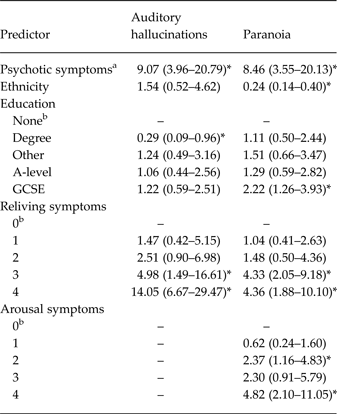
Logistic regression analyses were undertaken with paranoia as the outcome variable. The adjusted Wald test for both arousal (F 5,257 = 5.61, p < 0.01), and reliving (F 5,257 = 5.17, p < 0.01) symptoms, were significant, supporting the inclusion of these variables in the model. Odds ratios and associated 95% confidence intervals for variables in the final model are reported in Table 3. It can be seen that for both reliving and arousal symptoms the odds of experiencing paranoia roughly increase with greater numbers of trauma symptoms, compared to those with no symptoms, suggesting a dose-response relationship.
Odds ratios and associated 95% confidence intervals from logistic regression analyses exploring dose-response relationship between number of post-traumatic stress disorder symptoms (reliving and arousal) and psychotic experiences (auditory hallucinations and paranoia)

A-level, Advanced level qualification; GCSE, General Certificate of Secondary Education.
a Presence of auditory hallucinations controlled for where paranoia was outcome, presence of paranoia controlled for where auditory hallucinations are outcome.
b Reference category.
* Significant at p < 0.05.
This analysis was repeated with auditory hallucinations as the outcome variable. The adjusted Wald test was significant for reliving (F 5,257 = 3.56, p < 0.01), but not for arousal (F 5,257 = 1.80, p = 0.13) symptoms, suggesting that only reliving symptoms made a meaningful contribution to the model. Arousal symptoms were therefore excluded from the final model. Odds ratios and associated 95% confidence intervals for variables in the final model are reported in Table 3. Again, it can be seen that the odds of experiencing auditory hallucinations increase with greater numbers of reliving trauma symptoms, compared to those with no symptoms, suggesting a dose-response relationship.
Stata's linktest command did not identify any evidence of specification error in the final regression models. DFBeta values were inspected for the regression models to identify influential cases. There were no cases with DFBeta values >1 (in a non-weighted, non-clustered model), calculated in SPSS suggesting no influential cases were present (Field, 2000). A sensitivity analysis was undertaken exploring the impact of outlying cases on the regression model. Cases with standardized residuals >3 were removed and the regression analyses were re-run. As it is not possible to calculate standardized residuals in the weighted model, this sensitivity analysis was undertaken in non-weighted, clustered (by PSU) logistic regression analyses. Removal of outliers (n = 1) made no substantive difference in the model predicting hallucinations, with reliving symptoms continuing to make a significant contribution to the model (χ2 4 = 45.56, p < 0.01). In the model predicting paranoia when weights were no longer applied, reliving symptoms continued to contribute to the model (χ2 4 = 20.20, p < 0.01), but arousal symptoms no longer made a significant contribution to the model (χ2 4 = 9.30, p = 0.05). The removal of 17 outliers made no substantive difference to these findings. These results need to be interpreted with caution, as they are based on an unweighted analysis. The associations with arousal are less robust than those with reliving in predicting paranoia.
Secondary analyses: individual trauma symptoms as predictors of auditory hallucinations and paranoia
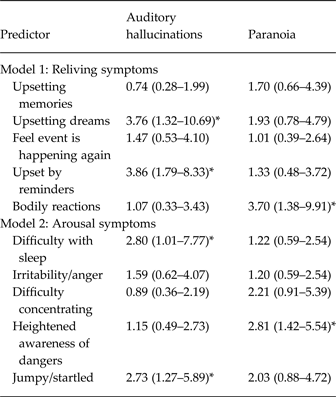
We conducted a series of secondary analyses to explore the relationship between individual trauma symptoms with auditory hallucinations and paranoia. Logistic regression analyses were conducted to explore the relationship between individual reliving or arousal symptoms and the two outcome variables (paranoia and auditory hallucinations). In each analysis, ethnicity, education and the other psychotic experience (i.e. this would be paranoia if auditory hallucinations were the outcome) were included as covariates. The results of these analyses are reported in Table 4. The results indicate that greater odds of experiencing auditory hallucinations were associated with experiencing upsetting dreams, being upset by reminders of the trauma, disturbed sleep and being readily startled. Greater odds of experiencing paranoia associated with bodily reactions to reminders of the trauma and a heightened awareness of danger.
Odds ratios and associated 95% confidence intervals from logistic regression analyses exploring relationship between individual post-traumatic stress disorder symptoms (reliving and arousal) and psychotic experiences (auditory hallucination and paranoia)

* p < 0.05; ethnicity, education and other psychotic symptoms controlled for in analyses.
Discussion
To the best of our knowledge this is the first study to explore the association between the number of PTSD symptoms experienced and the odds of reporting auditory hallucinations and paranoia in a general community sample. It was hypothesized that PTSD would be significantly associated with paranoia and auditory hallucinations. The results support this hypothesis. It was illustrated that over 72% of participants who reported auditory hallucinations and/or paranoia also had a traumatic experience, similar to results found by Read and colleagues (50–98%; Read et al. Reference Read, van Os, Morrison and Ross2005). Traumatic events were significantly associated with the odds of auditory hallucinations and paranoia, with greater odds associated with a greater numbers of trauma symptoms, which also supports previous findings (Shelvin et al. Reference Shelvin, Houston, Dorahy and Adamson2008). Reliving symptoms were associated with both auditory hallucinations and paranoia, and arousal symptoms were associated with paranoia but not auditory hallucinations. Reliving symptoms showed significantly higher odds ratios than arousal symptoms.
Dose-response relationships were identified between reliving symptoms and auditory hallucinations and paranoia, respectively, and between arousal symptoms and paranoia. Results illustrated that if an individual experienced ⩾4 reliving symptoms they had more than 14 times the odds and four times the odds of experiencing auditory hallucinations and paranoia, respectively, and if experiencing ⩾4 arousal symptoms they had just under five times the odds of experiencing paranoia (keeping other covariates constant). This is a similar response rate found in a study which examined the dose-response relationship between trauma and psychosis (Bentall et al. Reference Bentall, Wickham, Shelvin and Varese2012). It is likely that if an individual experiences an increase in trauma they are more likely to have a complex reaction incorporating PTSD symptoms, auditory hallucinations and paranoia. This may, therefore, support the notion that common mechanisms underlie the development and severity of these experiences.
A number of common psychological processes may explain the similarities between PTSD, auditory hallucinations and paranoia. Morrison & colleagues (2003) state that a common attributional style can develop following a traumatic event, since people who experience trauma often search for meaning and such appraisals of the trauma can impact on their beliefs about themselves, others and the world. Similar processes are observed in people who experience auditory hallucinations and paranoia in the context of a diagnosis of schizophrenia. Appraisal of trauma is often negative and ongoing, which leads to a current sense of threat (Morrison et al. Reference Morrison, Frame and Larkin2003). Consequently, common psychosocial mechanisms may be in place following trauma that account for the emergence of the symptoms of both PTSD and psychosis. It is also possible that current PTSD symptoms may affect the development of threat-related appraisals of psychotic experiences, which has been shown to be the case in a study of voice-hearers (Andrew et al. Reference Andrew, Gray and Snowden2008). Thus, the presence of PTSD symptoms may themselves represent an important risk factor for experiencing auditory hallucinations and paranoia in psychosis (Scott et al. Reference Scott, Chant, Andrews, Martin and McGrath2007). Similarly, experiencing specific PTSD symptoms was associated with specific experiences of psychosis (auditory hallucinations and paranoia). Dreams, reminders/flashbacks, difficulty sleeping, and feeling jumpy/startled were associated with experiencing auditory hallucinations. Auditory hallucinations, more specifically voices, have been conceptualized as intrusions into awareness (Morrison, Reference Morrison2001). Research has illustrated that voices often occur following a trauma (Romme & Escher, Reference Romme and Escher1989) and often include content and themes which related to a previous trauma (Read & Argyle, Reference Read and Argyle1999). Therefore, it may not be surprising that such PTSD symptoms are significant predictors of psychotic experiences. Dreams, or nightmares, as a response to PTSD are noted to occur because of unprocessed memories relating to the trauma (Ehlers & Clark, Reference Ehlers and Clark2000). Similar to voices, they are uncontrollable intrusions which are often related to a specific trauma event. Moreover, flashbacks are also involuntary intrusions into awareness where the individual feels as if they are re-experiencing the trauma (Ehlers & Clark, Reference Ehlers and Clark2000). Difficulty sleeping and feeling jumpy/startled may be seen as physiological consequences of experiencing an intrusion may maintain intrusive experiences via increased arousal. Significant relationships have been identified between sleep deprivation and experiencing hallucinations (Luby et al. Reference Luby, Frohman, Grisell, Lenzo and Gottlieb1959) and sleep deprivation has also been shown to be a significant predictor of paranoia (Freeman et al. Reference Freeman, McManus, Brugha, Meltzer, Jenkns and Bebbington2011, Reference Freeman, Stahl, McManus, Meltzer, Brugha, Wiles and Bebbington2012, Reference Freeman, Startup, Myers, Harvey, Geddes, Yu, Zaiwalla, Luengo-Fernandez, Foster and Lister2013).
It is also possible that dissociation is a shared mechanism that underlies these PTSD and psychotic experiences. Dissociation has been found to be associated with experiencing voices, flashbacks and dreams which may explain the predictive relationship found in this study (Moskowitz et al. Reference Moskowitz, Schafer and Dorahy2011). Spiegel hypothesized that people experience a trauma-induced dissociation which results in detachment from the reality of the outside world leading to PTSD and/or psychotic symptoms (Spiegel, Reference Spiegel2006). Therefore, it appears likely that one of the main differences between these PTSD and psychotic symptoms is the way they are appraised by the individual, i.e. interpreted as a voice rather than a flashback or intrusive thought pertaining to the initial trauma. Heightened awareness of dangers and bodily reactions were identified as significant predictors of paranoia. Paranoia has been described as a heightened attention to threat-related stimuli, which is an almost identical process to that in PTSD (Bentall et al. Reference Bentall, Corcoran, Howard, Blackwood and Kinderman2001). However, it seems that the only difference between paranoia and a heightened awareness in PTSD is the appraisal of the cause of the threat, i.e. trauma. Cromby & Harper (Reference Cromby and Harper2005) have stated that paranoia is understandable as those who have psychosis are more likely to have more threatening experiences and face social inequality. For example, in a previous population survey, paranoia was directly associated with being in institutional care and experiencing bullying (Bentall et al. Reference Bentall, Wickham, Shelvin and Varese2012). Therefore, paranoia may be an adaptive response to life threats or trauma in this group. Furthermore, bodily reactions when reminded of the event were also predictive of paranoia. It is widely acknowledged that threat experiences activate the amygdala and cause bodily arousal initiating a fight-or-flight response which can be considered a comparative response (Gilbert, Reference Gilbert2010). The relationships found between specific symptoms of PTSD and specific psychotic experiences supports the hypothesized overlap in mechanisms and constructs that has been proposed (Morrison et al. Reference Morrison, Frame and Larkin2003).
This study benefited from using a large nationally representative sample of the population. A sample size of this magnitude increases the reliability of results and reduces the chances of selection bias which impact on correlations between variables (Bentall et al. Reference Bentall, Wickham, Shelvin and Varese2012). Furthermore, it will also shrink standard errors and provide a more precise estimate of the effect side than in a smaller sample. There are a number of limitations regarding the variables used in this study. First, the cross-sectional design of the study limits the ability to truly examine the link between PTSD and psychotic experiences. This causal relationship would be examined effectively in a longitudinal design. Another limitation was that the TSQ only interviews those who have experienced a traumatic event since the age of 16 years about their experiences of PTSD symptoms and, therefore, this data does not capture those who experienced childhood trauma, which is most predictive of psychotic experiences (Morrison et al. Reference Morrison, Frame and Larkin2003; Varese et al. Reference Varese, Smeets, Drukker, Lieverse, Lataster, Viechtbauer, Read, van Os and Bentall2012). However, the emergence of significant and meaningful associations in the present study suggests that trauma experienced later in life may, nonetheless, be important in terms of the development of psychosis, and the fact that such associations were found despite the exclusion of childhood trauma suggests we are likely to be underestimating the strength of these associations. The psychosis variables only examined experiences within the last year which may exclude some of the sample who did experience psychosis but were not identified by these variables. Nonetheless, assessing lifetime psychotic experiences may present other problems such as increasing the impact of recall bias. Experiences of psychosis were only assessed using two individual items on the PSQ. The paranoia items in particular have been shown to provide a conservative cut-off for the presence of psychotic symptoms increasing the likelihood of false negatives. Future studies will need to be more extensive in their assessment of trauma and psychosis to ensure all people who have these experiences are examined.
A further limitation to the study is the ability for individual items to reliably assess the diagnostic category which they characterize. For example, participants may endorse paranoia and hypervigilance while considering the same experience. Similarly, auditory hallucinations may overlap with upsetting intrusive memories, and subthreshold auditory hallucinations and paranoia are relatively common in the general population (Lawrence et al. Reference Lawrence, Jones and Cooper2010; Freeman et al. Reference Freeman, McManus, Brugha, Meltzer, Jenkns and Bebbington2011). Therefore, participants may be endorsing items reflective of their experiences but not representative of the diagnostic category.
Previous research has illustrated that psychotic symptoms such as auditory hallucinations can be a similar phenomenon across different diagnostic categories (Waters et al. Reference Waters, Allen, Aleman, Fernyhough, Woodward, Badcock, Barkus, Johns, Varese, Menon, Vercammen and Laroi2012). For example, a study illustrated that auditory hallucinations in schizophrenia and borderline personality disorder has similar characteristics such as perceived location (Kingdon et al. Reference Kingdon, Ashcroft, Bhandari, Gleeson, Warikoo, Symons, Taylor, Lucas, Mahendra, Ghosh, Mason, Badrakalimuthu, Hepworth, Read and Mehta2010), psychotic experiences are often reported by patients with both affective and anxiety disorders (Varghese et al. Reference Varghese, Scott, Welham, Bor, Najman, O'Callaghan, Williams and McGrath2009) and psychotic experiences and affective symptoms often co-occur within adolescence (van Rossum et al. Reference van Rossum, Dominguez, Lieb, Wittchen and van Os2009). A wide variety of both medical (e.g. dementia) and psychiatric conditions (e.g. substance abuse) can lead to experiences like hallucinations. Schizophrenia has 15% co-morbidity with depression and 47% with co-morbid substance abuse which may act as mediatory or moderating factors between PTSD and psychosis (Buckley et al. Reference Buckley, Miller, Lehrer and Castle2009).The possibility that these co-morbid conditions accounted for the association identified in the current study was not formally tested. Future research could explore the impact of these co-morbid difficulties on the link between PTSD and psychosis symptomology.
It is also important to note that although experiencing symptoms of PTSD is predictive of psychosis, not all people who experience PTSD symptoms will also experience symptoms of psychosis. In particular, only a minority of those experiencing trauma go on to experience psychotic symptoms. Further research could consider possible moderating processes that may determine whether or not trauma leads to psychosis.
This study is lacking in its implications of the biological association between PTSD and psychosis. Other research suggests that biological responses to childhood trauma may result in changes in the hypothalamic-pituitary-adrenal axis functioning (Heim et al. Reference Heim, Newport, Heit, Graham, Wilcox and Bonsall2000; Nemeroff, Reference Nemeroff2004) and reduced cortical thickness (Habets et al. Reference Habets, Marcelis, Gronenschild, Drukker and van Os2011) which may be linked to the development of psychosis. Gene–environment interactions of psychotic symptoms and PTSD have also been suggested in adult male war veterans (Pivac et al. Reference Pivac, Knezevic, Kozaric-Kovacic, Dezeljin, Rak, Matijevic, Pavelic and Muck-Seler2007). Furthermore, evidence indicating that some antipsychotics may be helpful in alleviating PTSD symptoms that are co-morbid with psychosis (Adetunji et al. Reference Adetunji, Mathews, Williams, Budur, Mathews and Mahmud2005) suggests that that there may also be shared biological factors.
Given the overlap in PTSD, auditory hallucinations and paranoia outlined in this study, a comprehensive clinical assessment would be important in people who present with psychosis. Although the link between trauma and psychosis has a large evidence base it is still often not considered in routine clinical practice (Read et al. Reference Read, Hammersley and Rudegeair2007). One study offers advice about broaching the topic of trauma with clients and comments upon potential barriers (Read et al. Reference Read, van Os, Morrison and Ross2005). The findings also suggest that caution should be taken when diagnosing a psychotic disorder in order to allow for diagnostic uncertainty. Clinicians should thoroughly examine a service user's past history to ensure that experiences of psychosis are understood in the context of any traumatic experiences. Understanding psychotic symptoms in context will allow for full consideration of the impact of trauma and consideration of PTSD-based treatment. Detailed examination of any co-morbities which have a strong link between PTSD and psychosis, such as depression, drug and alcohol use (Buckley et al. Reference Buckley, Miller, Lehrer and Castle2009), should also be prioritized within a detailed clinical assessment.
Flexibility in pharmacological and psychological treatment is also important and it may be helpful to focus on treating symptoms regardless of the diagnosis. For example, pharmacological treatments may be considered in response to the specific needs of the client. It may be the provision of antidepressants, which are the recommended first-line pharmacological treatment for PTSD (NICE, 2005) for trauma-related psychotic symptoms may be helpful. However, there is little research examining this (Hamner et al. Reference Hamner, Faldowski, Ulmer, Frueh, Huber and Arana2003), but there is some suggestive evidence that antidepressant medication may be helpful in preventing the onset of psychosis in individuals at ultra-high risk (Cornblatt et al. Reference Cornblatt, Lencz and Obuchowski2002). This could also be the case for psychological interventions; since we have theorized that similar cognitive mechanisms appear to underlie both PTSD and psychosis, including threat appraisals, negative beliefs about self, responses and control strategies such as safety-seeking behaviours and dissociation (Larkin & Morrison, Reference Larkin and Morrison2007). Therefore, consideration of psychological treatments for PTSD such as eye-movement desensitization, prolonged exposure or cognitive behaviour therapy based on a model of PTSD may be beneficial for those with psychosis. Recent research appears to suggest that such approaches are promising (Jackson et al. Reference Jackson, Trower, Reid, Smith, Hall, Townend, Barton, Jones, Ross, Russell, Newton, Dunn and Birchwood2009; de Bont et al. Reference de Bont, van den Berg, dvan der Vleugel, de Roos, Mulder, Becker, de Jongh, van der Gaag and van Minnen2013; Van den Berg et al. Reference Van den Berg, De Bont, van der Vleugel, De Roos, De Jongh, Van Minnen and Van der Gaag2015).
The overlap between PTSD and psychotic symptoms may indicate the benefits of preventative treatment for those who are suspected of developing psychosis. There is a large literature showing the efficacy of early detection and intervention for people who experience psychosis (Bird et al. Reference Bird, Premkumar, Kendall, Whittington, Mitchell and Kuipers2010; Morrison et al. Reference Morrison, Stewart, French, Bentall, Birchwood, Byrne, Davies, Fowler, Gumley, Jones, Lewis, Murray, Patterson and Dunn2011). Research has illustrated that approximately 70% of those identified at risk of psychosis have experienced a trauma, with those who experience child sexual abuse being most likely to develop psychosis (Bechdolf et al. Reference Bechdolf, Thompson, Nelson, Cotton, Simmons, Amminger, Leicester, Francey, McNab, Krstev, Sidis, McGorry and Yung2010). Given the predictive ability of PTSD symptoms, screening for PTSD symptoms within an at-risk population and offering treatment for those PTSD symptoms may prevent the onset of psychosis. However, further research will need to be conducted.
Conclusions
The present study demonstrates associations between symptoms of PTSD and psychosis, as well as a dose-response relationship between these symptoms. We theorize that similar cognitive mechanisms may underlie both PTSD and psychosis, but the way in which the experiences are interpreted by the individual give rise to the differences in PTSD and psychosis. This has important implications for the treatment of both PTSD and psychosis and more flexibility is required when considering appropriate interventions. Further research is needed to examine the longitudinal relationship between trauma, PTSD and psychosis. Treatment interventions, both psychological and pharmacological, for PTSD symptoms in those who experience psychosis also need further examination and development.
Declaration of Interest
None.