

Introduction
Any state that does not exert exclusive control over an infinite source of natural wealth deals with this dilemma: its capacity to rule depends on its ability to levy taxes, while imposing taxes presupposes administrative strength and legitimacy. Tax revenue is indispensable to secure domestic order, protect inhabitants against foreign intrusions, and retain the legitimacy of the state as a tax-levying and debt-creating institution. Apart from securing law and order, tax revenue is a precondition for large-scale investments in collective goods such as education, health care, and infrastructure. Taxes also matter for the development of property rights institutions, which have to be defined or redefined in order to assess personal income, property, or the value of traded goods and services. Taxes also redistribute income and wealth, which may provoke or prevent social conflicts over public resources. Indeed, a growing body of economic historical literature asserts that choices concerning the design of tax regimes have had far-reaching and long-term economic and political consequences.
Colonial tax systems have shaped state–economy relationships in the formative stages of many present-day nation-states, therefore offering a fruitful angle to study global economic and institutional variation. This article focuses on colonial taxation during the heyday of British imperialism (1870–1940). The modern British empire was the biggest colonial empire in terms of space and population in history and thus allows us to compare a considerable number of colonies, dominions, and protectorates, while controlling for metropolitan institutional variation.Footnote 1 Using a newly constructed dataset of urban unskilled wages, the article develops a measure of income-adjusted tax levels that is used to assess some important hypotheses concerning the extent of extraction and inequality of British colonial fiscal systems.
The nature, function, and long-term economic and institutional consequences of colonial tax systems are severely contested in contemporary literature. One of the key issues concerns the question of the extent to which colonial taxes played a role in the establishment of so-called ‘extractive’ or ‘developmental’ institutions in former European colonies. How ‘absolutist’ was colonial rule and did the application of absolutist colonial rule imply that the interests of native tax-payers and native economic agents were largely neglected? Did the inhabitants of non-settler colonies face excessive levels of taxation? This article argues that colonial fiscal regimes were predominantly determined by local circumstances. Consequently, there are not only large differences to be found in the rates and source composition of taxation between the typical ‘settler colonies’ (i.e. the self-governing dominions) and the marginally settled ‘extractive colonies’, but also within specific regions such as British tropical Africa. More provocatively, it will be argued that there is little evidence for the view that the prototypical ‘extractive colony’ was characterized by higher than average rates of colonial taxation. On the contrary, we find a negative correlation between settler mortality rates (a proxy for settlement conditions) and colonial tax levels, and a positive correlation between the latter and long-term economic growth. This suggests that possible growth-impeding consequences of colonial taxation may not have been related to supposedly high rates of extraction but rather to the weak foundation that they provided for solid public finance development in the post-independence era.
Colonial rule, extractive institutions, and fiscal policy
In a couple of recent articles on Spanish imperial fiscal policy, Grafe and Irigoin have challenged the meta-narrative that ‘Spain was absolutist, interventionist, centralist, bureaucratic, and constitutionally disinclined to grant its subjects much local government, while striving to extract revenues from them’.Footnote 2 According to the authors, the Spanish crown was continuously engaged in bargaining and negotiating over taxes with various political institutions, such as the Cortes, the nobility, city councils, town administrations, and the Church. The constraints to Spain’s misperceived ‘absolutist power’ are revealed, among other means, by the limited amount of direct and indirect tax transfers to the Iberian peninsula, indicating that the colonies had relatively autonomous fiscal systems that were not primarily aimed at resource extraction for the benefit of the metropolis. In addition, the authors argue that the elaborate system of redistribution of imperial revenue within Spanish America showed the importance of the bargaining position of local elites: colonial taxes were negotiated on the basis of consensus, rather than coercion, and contributed to a broad-based development of the colonial economy, supported by a systematic redistribution of resources from the core to the periphery of the Spanish American empire.Footnote 3
The measures to assess the extractive nature of the Spanish fiscal policies in the early modern era cannot be applied to the modern British empire because the definition of the adjective ‘extractive’ depends on historical context. Unlike the early modern Spanish empire, Britain did not institute any systematic interstate transfers of tax revenue from the colonies to the metropolis, and the redistribution of tax revenues between colonial states hardly occurred. One of the overarching principles of British colonial rule held that colonial states had to be financially self-sustaining.Footnote 4 According to Davis and Huttenback, the military expenses for imperial defence by the metropolis even involved a subsidy from British tax-payers to the overseas citizens, although British India supplied and paid for a considerable number of Indian troops deployed in battles both inside and outside the Indian subcontinent.Footnote 5 The question concerning the extent of ‘absolutist power’ employed to implement and expand colonial taxes arouses a similar type of discussion however.
This study deliberately adopts a very narrow definition of the term ‘extraction’, focusing on variation in colonial tax levels and neglecting the expenditure side altogether.Footnote 6 The main purpose is to scrutinize some of the grand hypotheses raised in recent literature regarding the ‘extractive features’ of colonial taxes, namely that disproportionately high rates of colonial taxation were most likely to be found in colonies with low levels of European settlement and ruled by hegemonic colonial powers.
According to Acemoglu, Johnson, and Robinson (henceforth AJR), extractive institutions were imposed in non-settler colonies to exploit local natural and human resources in the interest of European merchants and entrepreneurs, who refrained from settling in the colony and, consequently, never came to share identical interests with the native population. Indeed, AJR conclude that ‘Overall, there were few constraints on state power in non-settler colonies. The colonial powers set up authoritarian and absolutist states with the purpose of solidifying their control and facilitating the extraction of resources.’Footnote 7 Developmental institutions emerged in the neo-European settler colonies, where European settlers were granted political voice to hold the local administration accountable for property rights protection, public good provision, and equal representation. Such developmental institutions were conducive to economic and social development because they encouraged settler communities to engage in free enterprise and economic exchange and guaranteed a comparatively equal distribution of economic opportunity.Footnote 8
The view that near absolutist colonial governments were engaged in relentless revenue extraction, particularly in colonial Africa, stands in a firm tradition of scholarship represented by historians such as Crawford Young and Mahmood Mamdani, who have described the colonial state primarily in terms of its hegemonic power. Fiscal policy fulfils an important role in their argumentation because it constituted one of the main channels of resource extraction and the supreme channel to display authority and legitimacy.Footnote 9 For Mamdani, the organization of taxation along the lines of British indirect rule (which he calls ‘decentralized despotism’) corrupted local authority structures because it left local chiefs with unchecked powers of revenue collection: ‘District level autonomy at times reached the level of a fetish … The result was a pervasive revenue hunger all along the chain of command, from the central to the local state, leading to efforts to tax or impose fees on anything that moved.’Footnote 10 Taxes are placed in the centre of the extractive institutions hypothesis when AJR replicate Young’s quote of a French government official in Africa, who reflected upon his duty as follows: ‘The European commandant is not posted in a region, is not paid to observe nature, to carry out ethnographic, botanical, geologic or linguistic studies. He has a mission of administration … to impose regulations, to limit individual liberties for the benefit of all, to collect taxes.’Footnote 11
Various scholars have criticized this view, for interconnected reasons. The criticism focuses on the claim that colonial governments possessed the ‘near absolutist power’ to impose taxes straight away. They did not in early modern Spanish America, as Grafe and Irigoin argue, nor in the lightly administered colonies of tropical British Africa or British India. Colonial governments needed to anticipate the responses of the native population when pursuing fiscal reforms, and low tax rates could provide a more stable political economic equilibrium when they served to prevent social unrest and political disorder. Given the small size of colonial governments, the logistic capacities were too limited to collect taxes effectively. This forced governments to choose between maintaining a low-profile tax system (for instance, largely based on easily collectable customs duties) or entering into negotiations with indigenous representatives (kings, chiefs, sultans, or village heads) over the collection and distribution of tax revenue.Footnote 12 Austin argues that the extortion of absolutist rule in areas with high rates of European settler mortality, such as tropical Sub-Saharan Africa, is logically inconsistent: extractive power presupposes a continuous presence of coercive means. Austin is also critical about the fundamental neglect of African economic agency in AJR’s hypothesis. Relocating the imperial army from region to region was a very costly effort. Hence diplomacy was generally preferred over confrontation. Excessive taxation incurred the risk of revolts and expensive military expeditions to restore order. In other words, the imposition of high tax rates in non-settler colonies may simply not have been the most sensible economic choice.Footnote 13
Apart from political economic considerations, there were also many practical constraints.Footnote 14 These varied from adverse geographical or economic conditions to the design of pre-colonial tax institutions. As pointed out by Herbst, pre-colonial tax systems in Africa were often decentralized and organized on the basis of informal institutions. Given low population densities, pre-colonial states did not effectively control territorial borders, as the marginal costs of securing extensive borders were much higher than expected marginal tax revenue.Footnote 15 Herbst argues that the weaknesses of post-colonial fiscal systems in Africa are the result of colonial neglect:
Not surprisingly, the colonial governments were unable to solve the revenue problem because there was not a fundamental change in the nature of population distribution and because economic development, except in the settler economies, was extremely slow. … Reflecting their modest motivations for ruling in Africa, the states the Europeans created did not develop impressive institutions for collecting revenue.Footnote 16
Transforming the patchwork of fluid pre-colonial societies into centralized colonial states with centralized tax regimes was a time-consuming and complicated task that required substantial administrative effort. Colonial governors critically depended on the cooperation of local rulers to levy taxes. Their cooperation was not self-evident and negotiation about tax rates was a crucial part of the political game of ‘indirect rule’. Lange has demonstrated that British colonies governed by indirect rule fared economically worse in the long run than directly governed British colonies. One of the possible causal channels, according to Lange, is an undersupply of growth-promoting public goods as a consequence of insufficient public revenue.Footnote 17 Taking these views together, we arrive at the opposite end of the ‘extractive institutions’ hypothesis: low rates of colonial settlement are reflected by comparatively low rates of taxation. It is not the excessive level of extraction but rather the failure to construct a solid system of public finances that has impeded long-term economic development.
Measuring and comparing tax levels across the British empire
This section develops a cross-colony and temporal comparison of income-adjusted per capita public revenue for the benchmark years 1871, 1911, 1925, and 1937, covering the big wave of imperial expansion up to the Second World War.Footnote 18 The data are derived from various issues of the colonial statistical tables, abstracts, blue books, and statistical yearbooks of the dominions. The discussion below will mainly focus on the year 1911, which is convenient for comparative purposes because of the large-scale population census executed in the British empire. The analysis includes thirty-four British colonies, excluding the numerous tiny island possessions. The smallest colony included in terms of population size is British Honduras (present-day Belize), with an estimated population of 40,500 in 1911; the largest is British India, with an estimated population of 315 million. For a complete source description, see the Appendix Tables 1–2.
I start with a comparison of gross public revenue (henceforth GPR) per capita levels. This measure reveals the differences in revenue-raising capacity of various colonial governments in absolute terms. Such differences may be caused by variations in colonial wealth as well as in the effectiveness of the state as a tax-collecting institution. It also provides an impression of the differences in colonial governments’ capacity to invest in social, economic, or strategic public goods, which are crucial for the long-term development of the state and the economy. Before I present the results, it is important to note that the analysis concentrates on the central colonial government budgets, except for the colonies with a federal budget structure, where provinces or states collected and allocated a substantial share of public revenue. Hence, for Australia, Canada, South Africa, and British India, the GPR data refer to the aggregated accounts. New Zealand, which formally seceded from the Australian Commonwealth in 1907, has been included as a separate colony. British India is exclusive of the princely states, but includes provincial revenue of the states that were formally under British rule. Finally, since the tax revenue of the local authorities in the UK comprises such a large share of total public revenue, the UK estimate is included twice, excluding and including local revenue.
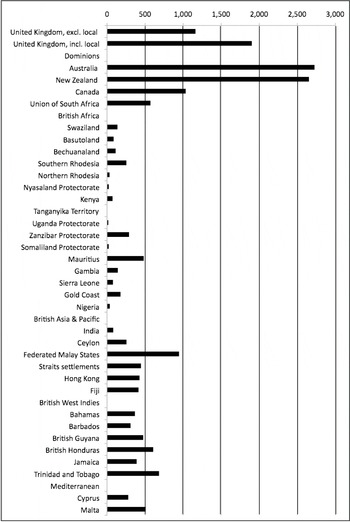
Figure 1 presents the GPR per capita figures of 1911. It shows that the cross-colony differences in per capita GPR on the eve of the First World War were vast. In Australia, the revenue per head of the population (£11.36) was 162 times larger than in Nyasaland (£0.07). The unweighted average per capita budget of the four self-governing dominions was about thirteen times larger than in the average African colony. The GPR per capita level of Britain’s supreme crown colony, India (£0.26), compares much better to Africa. The Federated Malayan States brought up almost £4 per person, about sixteen times as much as in British India. Given the sheer size of British India, the state budget still amounted to £82.8 million in 1911, whereas Australia, the richest dependency, raised £50.6 million.
Gross public revenue per capita in the British empire, 1911 (in current £). For sources, see Appendix Tables 1–2.

Within British Africa large differences can be observed as well. Bechuanaland (Botswana), Somaliland, Uganda, and Nyasaland (Malawi) generated considerably lower amounts than South Africa, Southern Rhodesia (Zimbabwe), Zanzibar, or Mauritius. The last colony, often cherished as the African ‘miracle economy’, raised more than two pounds per head in 1911, which was at least four times as much as the African continental average and comparable with the British West Indies and the Asian trade hubs such as Hong Kong and the Straits Settlements.Footnote 19
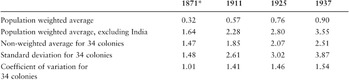
One explanation for the small size of government revenue in British Africa is that these territories had been colonized relatively late. Except for Mauritius and South Africa, the African colonies had only become fully integrated in the empire after 1880. Table 1 shows the temporal development of GPR per capita in constant British pounds of 1911.Footnote 20 The table presents population-weighted and unweighted per capita GPR figures, as well as the cross-colony standard deviation and coefficient of variation. For a correct interpretation of these statistics we need to consider the impact of India separately. In the unweighted average it is counted simply as one of the thirty-four colonies, but, when we take population into account, it constitutes about 78% of the entire sample in 1911. So the population-weighted estimate is shown twice, including and excluding British India. The UK has been excluded throughout.
Gross public revenue per capita of thirty-four British colonies, 1871–1937 (in constant 1911 £)

Note: 1871 includes 21 colonies; 1911, 1925, 1937 includes 34 colonies. The UK is excluded.
Sources: author’s own calculations from sources listed in Appendix Tables 1–2. The price deflator is taken from Lawrence H. Officer, ‘What were the U.K. earnings rate and consumer price index then? A data study’, Chicago: University of Illinois, http://www.measuringworth.org/ukearncpi/ (consulted on 21 April 2009).
The table shows that colonial revenues had grown considerably between 1871 and 1937. The increase from £1.47 to £2.51 per colonial inhabitant was 76%. Although the 1871 estimate is derived from a smaller sample, excluding most of the poorer African colonies, the spatial variation, as expressed by the coefficient of variation, remained virtually unchanged between 1911 and 1937. This is an important observation because it shows that colonial governments in British Africa did not manage to increase their revenue-raising capacities compared to colonies with already strongly established administrations. The African colonies remained fiscal and financial backwaters after the First World War.
Transforming GPR per capita figures into estimates of comparative tax levels requires two more steps. First, fiscal revenue needs to be separated from non-fiscal revenue. Second, we have to control for differences in per capita income levels to obtain a relative, rather than an absolute, estimate of comparative tax levels. The first step is less complicated than the second. The colonial blue books and dominions’ yearbooks provide detailed accounts of revenue and expenditure, with a high level of standardization in the accounts. This makes it possible to distinguish fiscal revenue, including items such as customs duties, excises (tobacco, liquor, salt), government monopolies (opium), sales taxes, and various direct taxes on income, land, property, inheritances, or harvests. We also categorized various types of stamp duties, licences, and administrative fees as fiscal revenue. Non-fiscal revenue sources tended to be dominated by a few big items such as post and telegraph receipts, railway revenues, land sales, and rents from government property.Footnote 21 School or medical fees paid to the state were considered as non-fiscal revenue. Appendix Table 2 presents the percentage shares of fiscal revenue in total public revenue for each colony in 1911, 1925, and 1937 and also shows the per capita tax revenue estimates.
The next step is to control per capita tax revenue for cross-colony variations in per capita income. Ideally we would like to express tax revenues as a percentage share of GDP, as is common practice in public finance literature.Footnote 22 However, for the great majority of British colonies between 1870 and 1940 there are no (reliable) GDP estimates. A different approach is to control per capita tax revenue for variation in wage rates. Wage data are more widely available and allow us to express the average tax level as the number of working days required by a specific occupational category to fulfil the per capita tax sum. Given the occurrence of regional, occupational, and gender wage differentials, this approach is inferior to the use of GDP data but can be regarded as a ‘second-best’ alternative.Footnote 23
For comparative purposes we used the daily wage rates of adult male unskilled workers engaged in construction or manufacturing trades. Unskilled workers perform manual and physical labour tasks that do not require very specialized types of knowledge, skill, experience, or responsibility. This makes the task content more comparable across regions than that of skilled labourers. Besides, urban wage-earners usually receive monetary wages excluding payments in kind, which are more common in rural occupations or domestic services. Since colonial blue books provide information on the minimum and maximum wage levels, we computed average daily wages assuming a lognormal wage distribution (i.e. biased towards the minimum wage rate).
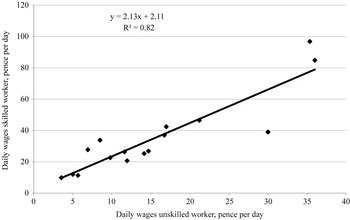
In some cases in 1911, urban unskilled worker’s wages were not reported, but we do have the wage levels of skilled construction workers such as carpenters, joiners, masons, and bricklayers. These data were used to estimate the wages of unskilled construction workers according to a simple linear regression estimate of the skill premium in all British colonies, excluding the four dominions and Southern Rhodesia.Footnote 24 The regression yielded an equation of y = 2.13x + 2.11, where y is the average skilled wage rate and x is the unskilled wage rate. The equation indicates that the average skill premium in urban trades was 113%. A scatter plot of the sample is presented in Appendix Figure 1. The value of 0.82 for R 2 suggests that this is a pretty reliable approximation of the unskilled–skilled wage gap in the urban building industry. Wages paid to unskilled workers employed by the colonial government were only included if we had no other alternatives. In a few cases, we had to resort to the wages of coolies or porters working on government estates or infrastructural projects.
Including colonies with highly discriminatory labour markets is somewhat more complicated. In countries with large ethnic wage inequality and a substantial European population, imputing the native wage would inflate the average tax level, but taking the European wage would do the opposite. Especially in South Africa and Southern Rhodesia, native and non-native wage rates were highly dispersed. In 1914, a native African worker would make between 15 and 27 shilling in the building industry, while an average white adult male would earn around 135 shilling per week. This is a huge wage gap. Given the fact that Europeans constituted around 10% of the population in South Africa and 2–4% of the population in Southern Rhodesia, this can affect our income-adjustment method considerably. Hence, for these two countries we constructed a population-weighted average of the native and non-native unskilled wage rate. In the sensitivity analysis presented further below, I will discuss some other potential wage-related biases.
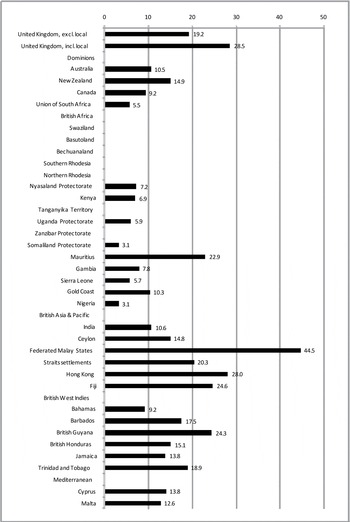
Figure 2 presents the cross-colony comparison of tax levels for the year 1911.Footnote 25 The daily wage rates and the number of working days forgone are presented in Appendix Table 2. As we expected, controlling for wage levels largely reduces the observed cross-colony differences in GPR per capita. The absolute gap in GPR per capita levels between Nyasaland and Australia has turned into a relative gap of about 80%. Nevertheless, tax rates in the majority of British African colonies still appeared to have been considerably lower than the imperial average. Moreover, within Africa the differences are large: for instance, the wage-adjusted per capita tax level in the Gold Coast was four and a half times as high as in Uganda. (Mauritius confirms its status as an outlier.)
Working days required by adult male unskilled urban workers to fulfil the per capita tax revenue in the British Empire, 1911. For sources, see Appendix Tables 1–2.

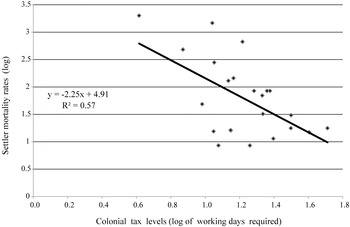
The intra-regional variation provides precious little evidence for the hypothesis that low levels of European settlement are related to high incidence of taxation, as AJR suggest.Footnote 26 As displayed in Figure 3a, by plotting the unweighted average tax levels of 1911, 1925, and 1937 against AJR’s European settler mortality rates (both in logarithm) we obtain a negative correlation, with an R 2 of 0.565. Hence, colonies with high barriers to European settlement had lower tax levels on average. This finding raises more support for the hypothesis that under-administered colonies tended towards a ‘low-tax’ political economic equilibrium.
Average tax levels (1911–1937, log) versus settler mortality rates (log). Sources: see Appendix Table 1. Settler mortality rates taken from Acemoglu, Johnson, and Robinson, ‘Colonial origins’, p. 1398.

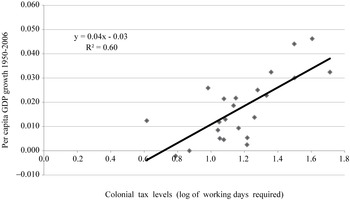
When plotting average tax levels against long-term economic growth rates another interesting pattern emerges. Figure 3b demonstrates a strong positive correlation between colonial tax levels and average annual GDP per capita growth rates between 1950 and 2006, with an R 2 of 0.602. If the observed correlation reflects more than just a coincidental relationship, it suggests that high colonial tax rates either had a direct impact on long-term growth or reflected the presence of factors spurring long-term growth, or both. High colonial taxes may reflect favourable economic conditions such as a better integration into the world economy, a more diversified production structure, or strong and stable state institutions. High colonial taxes per se provides for a stronger foundation for macroeconomic stability and long-term commitments to the accumulation of growth-promoting public goods such as health care, education, and infrastructure. The possible channels of causation warrant further research that goes beyond the scope of this article, but the observed correlation offers a promising starting point.
Average tax levels (1911–1937, log) versus GDP per capita growth (1950–2006). Sources: see Appendix Table 1. GDP per capita growth from Angus Maddison, Statistics on world population, GDP and GDP per capita, 1–2006 AD, http://www.ggdc.net/maddison/content.shtml (consulted on 21 April 2009).

This section concludes with an analysis of the development of tax levels in the British empire during 1911–37. Table 2 reveals some important general patterns. First, tax rates have increased in almost all colonies and dominions during that period. Especially between 1911 and 1925 the increase was large: the required number of working days increased from 14.1 to 19.1. The overall rise in colonial taxes was accompanied by notable convergence of tax levels across colonies. Although the coefficient of variation of 1925 suggests an increase in variation, this trend is exclusively driven by Hong Kong, the Straits Settlements, and British Malaya. Revenue from export duties on rubber and tin enhanced per capita revenue in Malaya, while commercial and business licenses, stamp duties, fees, and assessed taxes spurred government revenue in the two city-states. Moreover, the lucrative opium monopoly accounted for approximately 20% of GPR in Malaya, 18% in Hong Kong, and a staggering 36% in the Straits Settlements around 1911. These three colonies are good examples of places where high per capita tax rates corresponded with high growth rates in the post-colonial era.
Aggregate income-adjusted tax levels in the British empire, 1911–1937

Sources: see Appendix Tables 1–2.
When we remove these three colonies, however, the coefficient of variation decreases from 0.52 in 1911 to 0.44 in 1925 to 0.39 in 1937. The convergence in tax levels is mainly caused by British Africa. Particularly during the period of high inflation during and after the First World War, nominal wages in many African colonies were not fully adjusted to increasing price levels, while customs duties automatically kept pace with inflation. In Kenya, Uganda, Tanganyika (present-day Tanzania), and Nyasaland this resulted in a large rise in the number of working days forgone, although it should be noted that the pre-1914 levels were rather low.
A sensitivity analysis
The population and wage data we use in this study contain some serious limitations for comparative purposes. This section discusses the most important drawbacks and the extent to which they may bias our findings. It is good to note at the outset that the expected biases work in opposite direction, so they partly compensate each other.
First, let us consider the problem of inaccurate population estimates. While the census returns in the self-governing dominions such as Canada and Australia are generally considered to be fairly accurate, in the more peripheral colonies the censuses of 1911, 1921, and 1931 did not produce much more than population ‘guesstimates’. In his magnum opus on the demography of the British empire, Kuczynski makes clear that there are two fundamental reasons why these inaccurate census returns were likely to underestimate, rather than overestimate, the actual population size. First, in lightly administered areas not every tribe, community, or village in the rural hinterland could be reached with the limited time and administrative capacity allocated to the census-taking committee. Census committees were chronically understaffed and native authorities were not always prepared to cooperate voluntarily (if they disposed of the skills to produce an accurate head count in the first place). Second, the enumerated often had a clear incentive to oppose participation, for fear of the census being used for tax purposes.Footnote 27 The Colonial Report on the Northern Territories in the Gold Coast Protectorate underlines exactly these two arguments when evaluating the 1911 census returns:
These figures must not be taken as giving an accurate idea of the population in the Protectorate. This will be readily understood when it is borne in mind that only three special enumerators were appointed. … The fear of taxation amongst the natives throughout the Protectorate deterred numbers from putting in an appearance to be counted, which is not to be wondered at, as in the adjacent territories of France and Germany all natives are taxed.Footnote 28
For the population count in 1890, the Governor of the Gold Coast sent a letter to the native kings that illustrates the dependence of the colonial administration on the native rulers in a more subtle manner:
I wish you to clearly understand that I am not asking you to do this in order to tax your people, or for any purpose but your good. The Government in requiring this information has no intention to tax you or interfere in your country, and I only want the information to give to the Queen. As a loyal King you will, I am sure, help me. You will see that it is for your advantage that I should know how many people belong to your country in the same way a shepherd counts his sheep to know how many look to him for protection and care.Footnote 29
The Nigerian census of 1911 gives us some impression of the possible margins of error. The census produced a figure of 8,110,631 native inhabitants, which was generally considered too low by the British administration. The official estimate was therefore raised to 9,269,000, but the colonial report of 1910–11 put the total population figure at 10,000,000. The colonial report of 1912 adopted the official figure of 9.3 million but commented that tax records revealed this figure to be ‘a conservative one’.Footnote 30 Note that the discrepancy between the lower and upper bound estimate is almost 20%! And this does not seem to be uncommon when we read Kuczynski’s account of census-taking in British Africa. Hence, the population figures used in this study almost certainly overestimate the per capita tax level in the least-administered colonies. The case of Nigeria suggests that biases may fall in a range between 0 and 20%, but we cannot exclude the possibility that these are occasionally much higher.
Despite the obvious shortcomings we chose to use unadjusted population estimates. First, we do not dispose of a uniform rule of thumb that can be applied to make corrections: we would turn a problematic estimate into an equally problematic alternative estimate. But there is also an intuitive argument: those parts of the population that were left uncovered in the census usually did not appear in the tax rolls either. The ‘uncounted’ resided in the hinterlands, where the colonial administration had no means to obtain the information necessary to effectuate its tax policies. Indeed, one of the major reasons for a population count was to (re-)establish the colonial tax base but, ironically, population census estimates were often checked or even partly constructed on the basis of existing tax rolls. Hence, for some colonies, especially in British Africa, the population data used in this study offer a better proxy of the tax-paying population than of the actual population.
Apart from the impact on our quantitative analysis, this discussion reveals a point that is of great relevance for the research question we posited: to what extent should we regard colonial taxes as a form of extractive institutions imposed by absolutist colonial powers? The way in which population censuses were conducted shows that the colonial governments had to overcome large barriers in order to establish a tax system that incorporated all available potential tax-payers. Even when colonial powers pretended to be ‘absolutist’, they clearly did not have the administrative capacity to substantiate this.
The second potential bias stems from our use of urban unskilled wages. Urban wage earners usually earn higher nominal incomes than subsistence farmers or rural day labourers. When the position of urban wage workers in the national income distribution differs across colonies, our comparison becomes flawed. In the economically more developed colonies, urban wage workers were probably closer to the bottom of the income distribution than elsewhere, and, although the share of wage earners in the economically active population increased rapidly, they still represented a minority in tropical Africa for instance.Footnote 31 The question how the spatial comparison of tax levels would change if we were to substitute rural for urban unskilled wages is therefore a valid one.
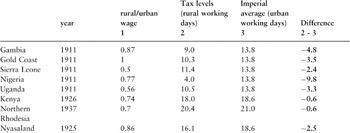
Table 3 provides a tentative answer to this question. We computed rural–urban wage gaps for unskilled workers for those colonies where we could obtain agricultural wages that explicitly included the costs of food rations and housing. In the third column, we show the impact of using rural wages on the position of the African colonies in our imperial comparison. The table shows that imputing rural wages does not lift the estimated tax levels in the ‘extractive’ colonies of Africa to levels exceeding the imperial average in the majority of cases. There is an important difference, however, between the colonies of Kenya and Northern Rhodesia (which both had a limited form of European settlement) and the West African colonies, as the tax levels in the former come rather close to the imperial average, while they stay substantially below that level in the latter colonies. In the next section I will discuss this distinction further.
Tax levels in a selection of British African colonies (1911–1937), expressed in number of working days required by agricultural labourers

Sources: see Appendix Tables 1–2.
If we could control our estimates for underestimated population size, however, it is highly likely that all British African colonies would display levels substantially below average. Indeed, when taking all the quantitative evidence together there seems to be little support for the view that colonies with low levels of European settlement were subjected to excessive levels of colonial taxation, at least not from a comparative perspective. The fact that so many colonial governments even lacked the necessary information about the number of taxable persons reflects the major constraints of supposedly absolutist colonial governments to expand colonial taxes.
Tax level is not the same as tax burden
The conclusion that the level of taxation was comparatively moderate in British Africa (except for Mauritius) does not necessarily imply that taxes were less burdensome than elsewhere in the empire. One of the consequences of the limited administrative capacities of African colonial governments was that parts of the native population were incorporated, while others were left outside the system. The burden therefore fell unequally on the shoulders of the incorporated. Moreover, when household incomes are limited, relatively low tax rates can have a disproportionately large effect on living standards. In economies based on barter or non-cash forms of exchange (e.g. cowries, iron bars, commodities), the demand to pay taxes in cash raised the transaction costs of labour, especially when husbands or sons had to migrate for work on estates or in mines.
There exists a large literature on the coercive features of colonial fiscal policy emphasizing that taxes were raised not just for revenue purposes but also with the objective to strengthen the legitimacy of colonial rule as such.Footnote 32 Taxes were used to mould colonial subjects into ‘governable persons’ or to undermine the position of traditional chiefs and promote the rule of loyal chiefs.Footnote 33 One of the major limitations of the comparative approach adopted in this study is that it does not allow for an encompassing assessment of the tax burden, including the more invisible and incomparable effects of coercion. Nevertheless, I will try to push our analysis (and conclusions) a bit further by focusing on some of the distributional implications of colonial taxation in British Africa.
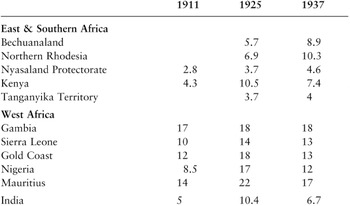
In view of the discussion in the previous section, there can be no doubt that the gaps in nominal and real incomes across the British empire were enormous. Yet, even within British Africa the urban unskilled wage differences were vast. Table 4 shows the nominal urban unskilled wages of native labourers in India and British Africa (1911, 1925, and 1937) as presented in Appendix Table 2. Whereas in East and Southern Africa the nominal daily wages of native workers were on the whole slightly or even substantially lower than in India, the nominal wages in West Africa were substantially higher, as much as in the order of one to four.Footnote 34 In a recent working paper, van Waijenburg and I show that these gaps also exist in terms of real wages. We adjusted urban unskilled wages for the price level of a standard consumption basket, including among other items a staple crop such as maize, rice, or cassava, meat, sugar, and cotton cloth.Footnote 35 Wage gaps between the Gold Coast and Kenya in the 1920s were found to be in the order of three to one. The evidence presented here is also consistent with the poverty and development indicators constructed by Bowden, Chiripanhura, and Mosley, suggesting that the differences in livings standards across British Africa were substantial, especially between the territories with limited European settlement in East and Southern Africa (Kenya, Northern Rhodesia, South Africa) and the so-called ‘peasant-export colonies’ such as the Gold Coast and Uganda.Footnote 36
Nominal wages of urban unskilled workers in British Africa (by region) and India, 1911, 1925 and 1937, in pence per day

Note: Mauritius refers to wage of unskilled agricultural worker.
Sources: see Appendix Table 2.
Regarding the higher poverty incidence, the burden of taxation in East and Southern Africa must have been substantially larger than in West Africa, Uganda (Central Africa), or Mauritius (an island). This conclusion can only be further corroborated by a comparative analysis of the source composition of colonial taxes. Although the term ‘British empire’ suggests a legal and political entity, colonial tax systems were mainly determined by local circumstances, rather than by all-embracing metropolitan policies. Consequently, the sources of taxation were very different across the British empire as well as within British Africa. The composition of taxes matters for the distribution of its burden.
Customs revenues, which often accounted for 70–90% of import duties, had a less regressive impact than direct native taxes and it was generally acknowledged that trade taxes posed a much lower political risk than direct taxes.Footnote 37 The ‘visibility’ of direct taxes was much larger than that of trade taxes and this played an important role in native people’s perception of colonial tax pressure. Import duties were mainly levied on luxury items such as spirits, beer, wine, tobacco, firearms, gunpowder, and manufactured cloths. They raised the price of specific consumer goods for which domestic substitutes existed in most cases, so they could easily be escaped by low-income or low-cash consumers and offered some protection to local produce as well. If tariffs were raised on food products, they were usually quite low. Besides, much of the imported food such as wheat and rice was consumed by European minorities and African elites, rather than the lower-income groups consisting of rural or urban wage workers or subsistence farmers. The hut, head, or poll taxes were, for many families, inescapable, however. The flat rates of these head taxes, pressed disproportionately hard on the shoulders of the poorest households.
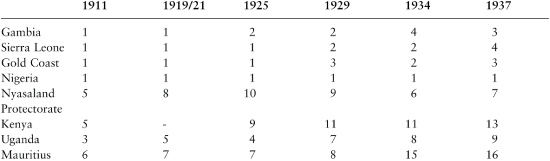
Table 5 presents the number of working days required to match per capita fiscal revenue excluding customs revenue. The data refer to eight British colonies in six benchmark years between 1911 and 1937. Excluding customs revenue, it appears that the comparative tax level in the four British West African colonies was very low, between one and four working days. In Uganda, Kenya, Nyasaland, and Mauritius, the share of internal direct and/or indirect taxes was much larger and the taxation levels also increased substantially during the interwar years.
Number of working days required to match annual average per capita fiscal revenue, excluding customs duties, 1910–1938

Sources: see Appendix Tables 1–2.
In particular, the landlocked colonies facing huge coastal access barriers provided limited opportunities to base colonial state finances on international trade flows. Colonies such as Uganda, Nyasaland, Northern Rhodesia, Swaziland, Basutoland, and Bechuanaland recorded comparatively low shares of customs revenue (around 20–30%). In these territories the native hut, head, or poll taxes constituted the main source of government revenue. In British West Africa, on the other hand, customs revenues accounted for approximately 60% of gross public revenue in Nigeria and the Gold Coast, 53% in Sierra Leone, and even 79% in the Gambia in 1911. Coastal access and higher levels of commercial and economic development can explain a good deal of these intra-regional differences. In particular, the growth of agricultural export sectors, such as cocoa in the Gold Coast and palm oil in southern Nigeria, reduced the necessity of imposing direct taxes in these areas.Footnote 38
However, native taxes also enhanced the supply of wage labour for European enterprises, be that for agricultural estates, mines, railways, or trading companies. The problem of labour scarcity was a bigger issue for the colonial governments in East and Southern Africa than in West Africa, for at least three reasons. First, population density was generally lower.Footnote 39 Second, native tribes were generally less inclined to work for wages. And third, the demand for native wage labour was larger because of significantly higher rates of European settlement and European entrepreneurial activity. In West Africa, the native peoples remained, by and large, in control of the vital sectors of commercial production. Plans to alienate large tracts of native land, as was common policy in the East and Southern African colonies were never effectuated in the West. As Austin argues, the colonial governments in West Africa did try it, but concluded that it was politically unwise and economically unnecessary to bring about the economic dynamism needed for colonial state development.Footnote 40
Native direct taxes never became a key source of state revenue in West Africa. In the Gold Coast colony and Ashante territory, the potential resistance was so large that the colonial administration did not even suggest the implementation of a head or hut tax. In Nigeria, a native income tax was only established in 1927, followed by a non-native income tax some years later, in 1931. Also in Nigeria, the introduction of direct taxation generated strong social upheaval, culminating in the ‘Igbo Women’s War’ in the heart of Nigeria’s palm-oil belt.Footnote 41 If we compare the eventual native and non-native tax ordinances, it appears that their design was almost identical: a progressive tax rate and an exemption for the first thirty pounds of earned income. This did not affect the poorer parts of the working population: an urban unskilled wage worker would make some fifteen to twenty pounds a year in the 1930s, which was far below the exemption threshold. Hence the income taxes were targeting the relatively well-off, not the poor. In 1937, direct taxes constituted 11.6% of total public revenue, which is a far from negligible share but much lower than in the eastern and southern parts of British Africa or the self-governing dominions.
In Sierra Leone, plans to introduce a hut tax in 1898 (5 shillings for a two-room house; 10 shillings for larger dwellings) in the Protectorate were almost immediately followed by large uprisings of the Temne tribe, under the leadership of Bai Bureh, in the north, and of the Mende tribe in the south. The so-called ‘Hut Tax War’ required an intervention from the British imperial army to restore order. The revolts cost the lives of an estimated thousand soldiers (mainly Creoles from the coast-based colony of Freetown), traders, and missionaries. With the backing of the Colonial Secretary Joseph Chamberlain, the local colonial government in Sierra Leone pursued its plan to impose the tax, but the local chiefs retained a strong voice in the negotiations. The chiefs became responsible for the collection of the tax, a position that they, reportedly, often exploited for their own benefit.Footnote 42 In 1911, the ‘house tax’ contributed 11.7% to state revenue, declining to 6.3% in 1925.
Resurging waves of protest against the hut tax became directed more and more firmly against local chiefs who abused their position as tax collectors to enrich themselves. The chiefs supplemented their incomes by collecting all sorts of fees and levies, besides their official title to a share of the hut tax. The British were not able to take away the resentment of the people against these abuses. In 1937, the colonial administration proposed, as part of a wider administrative reform, to improve the accountability of tax collection by prohibiting the personal reception of any tax, labour tribute, or customary levy. In exchange for a share of the hut tax, the chiefs would now receive an official government salary. A decade later, however, about half of the chiefdoms were still refusing to carry out this administrative reform.Footnote 43
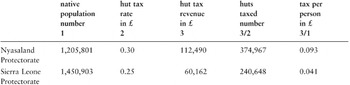
A final comparison of the protectorates of Sierra Leone (West Africa) and Nyasaland (East Africa) offers further insight into the variegated impact of native taxation in British Africa. In 1924–25 the official rate of the native head tax was 6 shilling per native male adult in Nyasaland and 5 shillings in Sierra Leone, and the (known) size of the native population – as reported by the colonial authorities – was more or less comparable, at approximately 1.2 million and 1.4 million respectively. However, Table 6 shows that the collected amount of hut tax revenue was almost twice as large in Nyasaland. Obviously, this difference cannot entirely be explained by the higher tax rate in Nyasaland, especially not when we take into account that most of the difference should have been compensated for by the larger population size in Sierra Leone. Reconsidering the wage levels presented in Table 4, it becomes clear that the income levels in Nyasaland certainly cannot explain the gap: wages in Sierra Leone were at least three times those in Nyasaland. Why then was the per capita native tax revenue in Nyasaland more than twice as large, and, adjusted for income, perhaps even six times as large?
The proportion of native hut tax revenue in the protectorates of Nyasaland and Sierra Leone, 1924–25

Sources: Blue book of Nyasaland Protectorate, 1925, Zomba; Blue book of Sierra Leone, 1925, London: Government Printing Office.
The distribution of the tax burden in the indirectly ruled colonies depended to a large extent on the bargaining powers of local chiefs. The British deliberately differentiated tax rates between various communities or tribes in view of the different capacities to comply.Footnote 44 Native chiefs or village heads provided information about the number of taxable families to the colonial government and local rulers were responsible for the collection of direct personal taxes. Native rulers held much of the power to decide how much each family had to pay and how much of the revenue would be creamed off before it was handed over to the central colonial authorities. In view of the experienced hostilities, the British opted for a ‘low tax’ political equilibrium in Sierra Leone. The fact the interior of Sierra Leone was one of the most inaccessible areas for Europeans, because of the high incidence of malaria, may have added to the lack of control that the British could exert in the region.Footnote 45
In Nyasaland, the government was clearly more able to effectuate native taxation. Adult males over sixteen years of age constituted about one third of the population and this is similar to the share of the total population paying the full 6 shillings. A substantial share of the adult male population migrated to the mining areas in South Africa (the Rand area) or Southern Rhodesia to earn cash wages.Footnote 46 These earnings could easily be taxed at the border crossings, thus avoid much of the logistic complexity of the head tax collection. The contrast between Nyasaland and Sierra Leone, and on a wider scale between West and East Africa, illustrates our point that the rates of extraction by means of native taxation varied largely in response to the economic and political agency of different native societies.
Conclusion
A comparative survey of colonial taxation in the British Empire between 1871 and 1937 yields little evidence for the idea that tax levels in non-settler colonies in general, and in the colonies facing the highest barriers to European settlement in particular, were structurally higher than in the neo-European settler colonies. On the contrary, the rapid economic development of Australia, New Zealand, and Canada was accompanied by relatively high rates of taxation, providing the state with a strong fiscal basis to maintain macroeconomic stability and to commit consecutive administrations to investments in growth-promoting public goods.
Colonial governments operating in the peripheral areas faced numerous practical and political constraints to enlarge their revenue base. These constraints varied from logistic barriers and chronic administrative understaffing to the more fundamental political choice concerning the trade-off between the expansion of taxation and the maintenance of domestic order. The idea that the British were able and, if so, willing to extort some kind of absolutist rule in the extractive colonies, allowing them to make sovereign choices in the design of the colonial fiscal system, is not supported by the quantitative evidence presented above and is also rejected by much qualitative historical evidence.
This is not to say that taxes in the peripheral regions of the British empire were less burdensome. It just points out that, in many non-settler colonies, overall levels of state revenue were too small to meet the requirements of state-led economic development. The strong correlation between comparative tax levels and long-term growth recorded in this study warrants further investigation. We should especially examine the hypothesis that the absolute levels of revenue extraction were far too low to create the right conditions for a sustainable constructive role of the post-colonial state in post-colonial economic development.
The source composition of colonial taxation had important implications for the distribution of the tax burden. In large parts of British Africa, discriminatory direct taxes, although modest in absolute returns, far outweighed the contributions of taxes targeted at the non-native residents. What the native tax-payer received in return for these sacrifices has not been addressed here, and is a major limitation of this study. It does not require much calculation effort, however, to see that the distributional implications of different fiscal regimes within British Africa were much worse for the poverty-ridden peoples in the eastern and southern parts of the continent (where Europeans settled in limited numbers) than in the West African colonies (where they did not settle at all). In places where the indigenous societies were able to take the initiative in exploiting new commercial opportunities and kept the colonial government and potential European settlers at arm’s length, native living standards were rising. Indeed, in the area with the highest settler mortality rates in the world, the presumed hegemony of colonial governments appears highly doubtful.
Appendix
List of primary sources
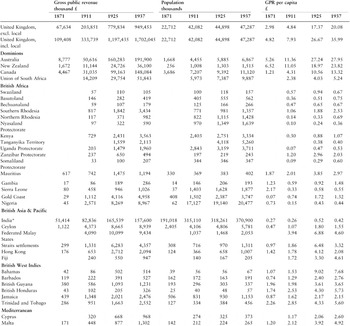
Gross public revenue, population size and gross public revenue per capita in thirty-four British colonies, 1871–1937

Note: Population data for 1925 were reconstructed by taking a non-linear growth trend between the census estimates of 1921 and 1931, in order to include in our estimates the (in many cases) more accurate information stemming from the 1931 census. For all benchmark years on display we allowed the data to deviate one year from the year indicated. Thus the benchmark year 1911 refers to an observation in the period 1910–1912. The reason for this is that the financial and fiscal years often run from March to March or June to June, so that part of the year 1925 is included in the accounts of 1924–25 and the other part in the accounts of 1925–26. Whenever possible the book-years 1910–11, 1925–26, and 1937–38 were taken, but in some cases the data refer to either the previous or subsequent book-year.
Sources: Gross Public Revenue figures are obtained from various issues of the colonial blue books of the Bahamas, Barbados, Basutoland, Bechuanaland, British Guyana, British Honduras, Ceylon, Cyprus, Fiji, the Gambia, the Gold Coast, Hong Kong, Jamaica, Kenya (East Africa Protectorate), Malta, Mauritius, Nigeria, Northern Rhodesia, Nyasaland, Sierra Leone, Somaliland, the Straits Settlements, Swaziland, Tanganyika, Trinidad and Tobago, Uganda, and Zanzibar for the years, or surrounding the years, 1871, 1911, 1925, and 1937. Data for Australia are taken from The official yearbook of the Commonwealth of Australia; for Canada from The statistical yearbook of Canada; for the Federated Malay States from Manual of statistics relating to the Federated Malay States; for British India from Statistical abstract of British India; for New Zealand from The New Zealand official yearbook; for the Union of South Africa from Official yearbook of the Union and of Basutoland, Bechuanaland Protectorate and Swaziland; for Southern Rhodesia from the Official year book of the colony of Southern Rhodesia (Salisbury); for the United Kingdom from Statistical abstract for the United Kingdom. In cases of data gaps and to check existing observations various issues of the following publications have been consulted: Statistical abstract for the several colonies and other possessions of the United Kingdom; and Statistical tables relating to the colonial and other possessions of the United Kingdom. Full titles are given in the list of primary sources below. Population figures are obtained from various issues of Statistical abstract for the several colonies and other possessions of the United Kingdom. For the UK we used Angus Maddison, The world economy: a millennial perspective, Paris: OECD, 2001.
Tax revenue per capita, urban unskilled daily wage rates, and income-adjusted level of taxation in thirty-four British colonies, 1911–1937

Notes: Fiscal revenue includes all types of direct and indirect taxation, including customs revenue, excises, harbour dues, government licences, stamp duties, and fees of court or office. Schooling and medical fees were considered non-fiscal revenue. Non-fiscal revenue mainly consists of rents from government property, land sales (not to be confused with land revenue, which may include taxes on land or harvests), and interest or receipts from public transport and communication services or utilities (gas, electricity, sewerage, water). Wage data refer to the estimated average of the minimum and maximum reported daily wage, taken from a lognormal distribution of unskilled adult male daily wages in the construction or manufacturing trade. For the cases of Cyprus, Fiji, Sierra Leone, and Uganda in 1910–11 and Tanganyika in 1925, the wages have been estimated on the basis of the regression presented in Appendix Figure 1. For the Gambia in 1925–26 and 1937–38, only average wages were available, instead of minimum and maximum rates.
Sources: Fiscal revenue and wage data were obtained from various issues of the colonial blue books of the Bahamas, Barbados, Basutoland, Bechuanaland, British Guyana, British Honduras, Ceylon, Cyprus, Fiji, the Gambia, the Gold Coast, Hong Kong, Jamaica, Kenya (East Africa Protectorate), Malta, Mauritius, Nigeria, Northern Rhodesia, Nyasaland, Sierra Leone, Somaliland, Straits Settlements, Swaziland, Tanganyika, Trinidad and Tobago, Uganda, and Zanzibar for the year, or surrounding the year, 1871, 1911, 1925, and 1937. Data for Australia are taken from The official yearbook of the Commonwealth of Australia; for Canada from The statistical yearbook of Canada; for the Federated Malay States from Manual of statistics relating to the Federated Malay States; for British India from Statistical abstract of British India; for New Zealand from The New Zealand official yearbook; for the Union of South Africa from Official yearbook of the Union and of Basutoland, Bechuanaland Protectorate and Swaziland; for Southern Rhodesia from the Official year book of the colony of Southern Rhodesia; for the United Kingdom from Statistical abstract for the United Kingdom. UK wage data were obtained from Department of Employment and Productivity, British labour statistics: historical abstract 1886–1968, London, 1971. In case of data gaps and to check existing observations, various issues of the following publications have been consulted: Statistical abstract for the several colonies and other possessions of the United Kingdom; and Statistical tables relating to the colonial and other possessions of the United Kingdom.
The list of primary sources presented here only refers to the original titles of the serial publications. Many of the titles underwent minor changes over the years. For reasons of space these changes are not mentioned here, except where they might arouse confusion about the exact sources we used.
Blue book for the colony of Bahamas, Nassau, New Providence: issues of 1910–11, 1925, and 1938
Blue book for the colony of Barbados: issues of 1910–11, 1925, and 1938
Blue book of the Bechuanaland Protectorate, Colonial Office: issues of 1910–11, 1925, and 1938
Blue book of British Guiana, Georgetown: issues of 1910–11, 1925, and 1938
Blue book of British Honduras, Belize: issues of 1910, 1925, and 1938
Blue book of Ceylon, Colombo: issues of 1910–11, 1925, and 1938
Blue book of Cyprus, Nicosia: issues of 1910–11, 1925, and 1938
Blue book of Fiji, Suva: issues of 1910, 1925, and 1938
Blue book for the colony of the Gambia, Government Printing Office: issues of 1910–11, 1925, and 1938
Blue book for the Gold Coast colony, Accra: issues of 1910, 1925–26, and 1938
Blue book of Hong Kong, Victoria, Hong Kong: issues of 1910, 1925, and 1938
Blue book for the island of Jamaica, Kingston: issues of 1911–12, 1925, and 1938
Blue book of the British East Africa Protectorate, Nairobi: issue of 1908; this publication changed into the Blue book for the colony and protectorate of Kenya, Nairobi: issues of 1926 and 1938
Blue book of Malta, Government Office: issues of 1910–11, 1923, and 1938
Blue book for the colony of Mauritius, Port Louis: issues of 1910, 1925, and 1938
Blue book for the colony and protectorate of Nigeria, Lagos: issues of 1914, 1925, and 1938
Blue book of Northern Rhodesia, Livingstone: issues of 1925 and 1938
Blue book of Nyasaland Protectorate, Zomba: issues of 1910–11, 1925, and 1938
Blue book of Sierra Leone, Government Printing Office: issues of 1910, 1925, and 1938
Blue book of the Somaliland Protectorate, Colonial Office: issues of 1910–11, 1925, and 1938
Blue book for the colony of the Straits Settlements, Singapore: issues of 1910, 1925, and 1938
Blue book of the Tanganyika Territory, Dar es Salaam: issues of 1925 and 1938
Blue book of Trinidad and Tobago, Port-of-Spain: issues of 1910–11, 1925, and 1938
Blue book of the Uganda Protectorate, Government Printing Office: issues of 1910–11, 1925, and 1938
Board of Trade, Statistical abstract for the several colonies and other possessions of the United Kingdom, London: various issues between 1865 and 1937
Board of Trade, Statistical abstract for the United Kingdom, London: various issues between 1871 and 1946
Census and Statistics Department, The New Zealand official yearbook, Wellington: issues of 1925 and 1938
Commercial Intelligence Department, Statistical abstract for British India, Calcutta: various issues between 1911 and 1940
Commonwealth Bureau of Census and Statistics, The official yearbook of the Commonwealth of Australia, Melbourne: issues of 1912, 1926, and 1938
Dominion Bureau of Statistics, The statistical yearbook of Canada, Ottawa: issues of 1912, 1926, and 1939
Government Statistical Bureau, Official year book of the colony of Southern Rhodesia, Salisbury, Southern Rhodesia: issues of 1930 and 1938
Manual of statistics relating to the Federated Malay States, Kuala Lumpur; issues of 1910, 1926, and 1938
Statistical tables relating to British self-governing dominions, crown colonies, possessions and protectorates, London: various issues between1860 and 1911
Union Office of Census and Statistics, Official yearbook of the Union and of Basutoland, Bechuanaland Protectorate and Swaziland, Pretoria: various issues between 1910 and 1940
Appendix Figure 1.