




No CrossRef data available.
Article contents
- Abstract
- A DOMINICAN FRIAR AS AUTHOR OF THE POPOL WUJ
- DIEGO REINOSO
- NIM CH'OKOJ
- REINOSO VERSUS NIM CH'OKOJ
- KEEPER OF THE MAT VERSUS VICE-KEEPER OF THE MAT
- DON JUAN CORTÉS
- DON JUAN DE ROJAS
- Q'OJA AND TZ'IKINJA
- WHO WROTE THE POPOL WUJ ?
- WHY WAS THE POPOL WUJ WRITTEN?
- WHEN WAS THE POPOL WUJ WRITTEN?
- RESUMEN
- ACKNOWLEDGMENTS
- References
AUTHORS OF THE POPOL WUJ
Published online by Cambridge University Press: 04 March 2004
Article contents
- Abstract
- A DOMINICAN FRIAR AS AUTHOR OF THE POPOL WUJ
- DIEGO REINOSO
- NIM CH'OKOJ
- REINOSO VERSUS NIM CH'OKOJ
- KEEPER OF THE MAT VERSUS VICE-KEEPER OF THE MAT
- DON JUAN CORTÉS
- DON JUAN DE ROJAS
- Q'OJA AND TZ'IKINJA
- WHO WROTE THE POPOL WUJ ?
- WHY WAS THE POPOL WUJ WRITTEN?
- WHEN WAS THE POPOL WUJ WRITTEN?
- RESUMEN
- ACKNOWLEDGMENTS
- References
Abstract
Pre-Hispanic America's most celebrated literary monument, the Popol Wuj, was written in the 1550s, although our only copy is an early-eighteenth-century text by the Dominican friar Francisco Ximénez. We lack direct information about the Popol Wuj's authors. Some scholars have proposed that the indigenous scribe Diego Reinoso was its creator. However, Reinoso wrote another K'iche' document, the Título de Totonicapan, and a close examination of that text learns that he disapproved of the political faction represented in the Popol Wuj. Its advocates were a lineage called Nim Ch'okoj, Great Kinkajou. Dennis Tedlock has suggested that the Nim Ch'okoj were the Popol Wuj's composers. They introduce themselves at the end of the text as the Fathers and Mothers of the Word. A scrutiny of both documents and early Colonial papers reveals that, by the 1550s, a political conflict was under way between the two highest offices in the K'iche' power structure: the Keeper of the Mat and the Vice-Keeper of the Mat. The Popol Wuj seems to have supported the first faction, and the Título de Totonicapan supported the second faction.5 My translation here is tentative. Wachib'al(al) means “image” or “depiction” but also “representative.” The author may actually refer to a drawing in a pictographic document or may want to say that, through these offices, the three main chinamit were represented in the power structure of Ismachi, and later in that of Q'umarkaj.
Information
- Type
- Research Article
- Information
- Copyright
- © 2003 Cambridge University Press
The Popol Wuj is probably the most famous Maya document. Scholars of every possible discipline within Maya studies have used it. They consider the text to be pan-Maya or, even more widely, pan-Mesoamerican. The Popol Wuj has gained almost biblical status. Regarding it that way can be risky, however, because scholars can forget that the text was written by flesh-and-blood people and reflects the cosmological vision and political history of a specific group. Which people and whom they represent is the topic of this article.
There are two crucial understandings of which one needs to be aware when using the Popol Wuj. First, the text is the product of an oral tradition. The Maya writing system, even at its florescence during the Classic period, was not equipped to compose the long and intricate stories and dialogues that one finds in the Popol Wuj. One of the most beautiful examples that still exists, the Dresden Codex, quickly shows the limitations of the Maya script: It consists of terse and condensed sentences combined with pictures that were intended for a narrator to initiate his story or for a priest to explain his divination. In other words, the text and image served as mnemonic devices. As the translator Dennis Tedlock (1996:28) has pointed out, the structure of the Popol Wuj clearly betrays its origin as a narrated text.
This observation has important implications. The text of the Popol Wuj as it has come down to us was created at the very moment it was written in the 1550s; it is not a literal transcription from a hieroglyphic or pictographic book, as scholars have sometimes assumed (Sam Colop 1999:13; Tedlock 1996:28–29). I am not suggesting that there were no pre-Columbian documents in the Guatemalan highlands. On the contrary, the Popol Wuj itself mentions these books, and Spanish officials testify to having seen them, as we will later see. I am only saying that the myths and stories that ended up on paper are an interpretation and elaboration of the mnemonic topics dictated by earlier pre-Columbian codices. Thus, the Popol Wuj reflects the history and cosmological vision of the 1550s.
A second issue to take into account when interpreting the Popol Wuj is that sixteenth-century Mesoamerican historians were preoccupied with the glory of their own lineage or nation rather than with describing objective history. They did not differ in that aspect from their contemporaries in other cultures. History was a normative matter; facts were structured according to mythical models. The K'iche' Maya did not distinguish between myth and history, which is why Tedlock (1996:95) prefers to use the term “mythistory” to clarify the nature of the Popol Wuj. Thus, every lineage creates a migration tale that begins at a center called Place of Cattail Reed, or Tullan. The lineage then wanders through darkness, suffering times of hardship until the sky begins to color and the sun rises for the first time (López Austin and López Luján 1998). Conversely, the so-called myths of the Popol Wuj contain historical information, as they are the fruit of interpreting minds. In short, one may posit that the many tales of the Popol Wuj—some mythical, others historical in character—served to aggrandize their authors.
Once one recognizes these issues, one comes to understand how necessary it is to know the identity of the document's authors to arrive at a sound interpretation of the text (Akkeren 2000a, 2000c). Unlike most other indigenous documents, the Popol Wuj lacks signatures and internal information about its authors. K'iche' scholars have suggested three possible viewpoints: first, that the Popol Wuj was written not by Maya scribes but by a Spanish friar; second, that it was written by a scribe named Diego Reinoso; and third, that it was written by the representatives of a lineage named Nim Ch'okoj.
A DOMINICAN FRIAR AS AUTHOR OF THE POPOL WUJ
René Acuña (1998) has put forward the view that the Popol Wuj was written by a Dominical friar. Before inquiring into that viewpoint, it should be said that I agree with Acuña that the Popul Wuj has been “more used than studied” (Acuña 1998:93–94). Acuña is better acquainted than any other scholar with the historical background of the Popol Wuj and the writings of the Franciscan and Dominican friars of the early Colonial period and has firsthand knowledge of these texts (Acuña 1969, 1975, 1982, 1991; Coto 1983 [1656]; Guzmán 1984 [1704]). More than two decades ago, he expressed the controversial viewpoint that the Popol Wuj was not an indigenous product, and he has assembled evidence ever since that, he says, proves incontrovertibly that a Western genius was behind its creation:
Pero ese libro, porque ES UN LIBRO, lejos de ser una serie de tradiciones que un anónimo indígena extractó de antiguas pinturas, está diseñado y ejecutado, de arriba abajo, con conceptos occidentales. Tiene prefacio, escrito naturalmente después de haber compuesto la obra; tiene capítulos y, desde luego, cada capítulo, la respectiva cabeza que enuncia su contenido; tiene, en fin, un epílogo [Acuña 1998:25].
Acuña claims that the structure underlying the Popol Wuj reveals the use of Western literary concepts. It would be interesting to determine whether foreign concepts had already seeped into the indigenous narrative style by the time the Popol Wuj was put on paper; regardless, however, the presence of a literary structure in itself does not necessarily make the work a Western product. For instance, the Memorial de Solola (better known as the Annals of the Kaqchikels) created by the Highlands Maya reveals many elements—introduction, chapters—that Acuña classifies as “Western.” Yet these annals, which contain detailed information dating to the Early Postclassic period, could not have been written by friars (Akkeren 2000a).
Acuña points to the use of chapters in the Popol Wuj, which are marked by capitals and often start with the K'iche' demonstratives wae or are, which can be translated freely as “here we have” or “this is.” The indigenous author then gives a short summary of what will follow. Acuña claims that this is another Western device—and, indeed, the summary does recall such Spanish books as Amadis de Gaul and Don Quixote. However, this method of starting a text, especially one that refers to iconographic records—the mnemonic device of the narrator—can also be found on Classic Maya vessels. Collaborative research by Yuriy Polyukhovych, Barbara MacLeod, and Erik Boot in 2000–2001 has tentatively deciphered the first collocation of the Primary Standard Sequence as /lay/ (spelling la-LAY?-ya) or /a-lay/ (spellings 'a-la-LAY?-ya, 'a-LAY?-ya, 'a-LAY?), consisting of an optional focus marker /a/ and a demonstrative /lay/; it can be translated as “(this one) here.” Thus, we have a Classic Maya antecedent of this formula. Other forms are /a-hay/ and /a-b'ay/, both close synonyms of /a-lay/ (this one). Slightly different introductory clauses can be found in the Late Classic to Terminal Classic lintel texts at Chichen Itza, where they read /way/ (spelling wa-ya) or /a-way/ (spelling 'a-wa-ya) and have the same meaning “(this one) here” (Erik Boot, personal communication 2002; Boot 2003).
Acuña also believes that the Popol Wuj was composed by a friar because it discusses subjects that are so wide apart thematically and geographically that no K'iche' scribe could have masterminded its entirety. Indeed, Acuña was the first to recognize that a great part of the Popol Wuj—that is, the mythical parts 1–3—originated in the Verapaz area, not in the K'iche' highlands. He denominates the two last parts, which are more historical than part 1, “historia de los señores nahua-quichés”; they are more K'iche'-based, he says, and are of an entirely different order. Nevertheless, because the book demonstrates a well-constructed unity based on preconceived ideas, it must be the work of an outside editor, according to Acuña. The variation in tales makes it hard to “continuar susteniendo que hubo varios autores del PV, y que estos autores eran nativos nahua-quichés.” Because the Dominicans had just established the province of Verapaz when the Popol Wuj was written, and because they were well acquainted with its tales, Acuña suggests that one of them collected the stories and structured them into the whole (Acuña 1998:90).
I was not aware of Acuña's study when I proposed that the myths of the Popol Wuj, as well as sections in the more historical parts, were situated mostly in the Verapaz area (Akkeren 2000a, 2000b, 2002b). That idea emerged naturally from my reconstruction of the origin of the ruling Kaweq chinamit of Q'umarkaj-Utatlan. The chinamit—or parcialidad, as the Spanish called it—was a cluster of lineages organized in a corporate group that shared land. I found that important members of the ruling Kaweq chinamit, such as the Kaweq, the Kejnay, and the Chituy, migrated into the highlands through the Verapaz area at the end of the Classic period (Figure 1). They had lived there for quite some time before some families joined the K'iche' confederation. In Verapaz, they became familiar with the mythical material that they later incorporated into the Popol Wuj. The Memorial de Solola says that when the Kaweq and Kejnay joined the K'iche' confederation, they were famous dancers, and many of the myths in the Popol Wuj were enacted in dance dramas (Akkeren 2000a, 2003a, 2003b; Akkeren and Janssens 2003). However, other lineages of the Kaweq chinamit, such as the Ajpop (Keeper of the Mat), Ajpop K'amja (Vice-Keeper of the Mat), and priestly lineages of Tojil and Q'uq'kumats, seem to have come from the Pacific coast. There, they were exposed to strong Central Mexican influence, if they were not of Central Mexican origin themselves (Akkeren 2000a, 2002c). All these lineages contributed to the creation of the Popol Wuj.

Map of the area (drawn by the author).
Acuña further notes that no indigenous document displays as a profound a knowledge of mythical themes and tales as does the Popol Wuj, and thus, the sources to which the author could have resorted were limited. But friars had access to the sources, as well as to all the necessary material for assembling a book such as the Popol Wuj, he argues. He then points out that the famous Dominican friar Bartolomé de las Casas, the intellectual father of the Verapaz project, showed familiarity with the people and scenes in the Popol Wuj before that book was put on paper. Specifically, Acuña cites passages from Las Casas's Apologética Historia Sumaria, written between 1553 and 1559 (Las Casas 1967), as further proof that a Dominican friar created the Popol Wuj (Acuña 1998:85–86).
Later, I will return to the work of Las Casas and argue that the information about Utatlan in the Apologética resonates in the Título de Totonicapan rather than in the Popol Wuj. I will also suggest that Las Casas received his information from a K'iche' lord named Don Juan Tepepul 8 Rain, who was Vice-Keeper of the Mat, the second-highest position in the K'iche' state. Don Juan Tepepul 8 Rain is the Don Juan of Sacapulas whom Remesal mentions; he was also the father of Don Juan Cortés, the last Vice-Keeper of the Mat mentioned in the Popol Wuj.
No document is as rich in mythology as the Popol Wuj. It is therefore a masterpiece and an important legacy of the Maya. However, texts such as the Rab'inal Achi and the Memorial de Solola also show a thorough acquaintance with Maya mythology on the part of their composers.
There is more to say about Acuña's use of Las Casas. A crucial passage that he quotes, from the Apologética Historia Sumaria about the monkey twins (cf. Coe 1973), reveals the inaccuracy of his statements. In the Popol Wuj, Jun B'atz' and Jun Chowen, the older stepbrothers of the hero twins, are presented as jealous and evil beings who are punished for their behavior. In Acuña's excerpt of Las Casas, however, the monkey twins are the younger brothers and act as creators of the world and its creatures. The reason for this reversal is that the authors of the Popol Wuj had a long-time conflict with one of the main ruling lineages of Verapaz, named the B'atz', or Howler Monkey, lineage. The B'atz' lineage nurtured its own tale of the monkey brothers Jun B'atz' and Jun Chowen, identifying themselves with the creative nature of the animals. The tale had wide circulation; it was known in the Maya Lowlands during the Classic period and this is the version that reached Las Casas. The authors of the Popol Wuj used the tale, too, but they intertwined their animosity with the B'atz' lineage with this Verapaz myth, making the B'atz' brothers look bad (Akkeren 2000a).
The myth of the monkey twins is but one illustration of how even the so-called mythical parts of the Popol Wuj contain historical references. Myths were used as frameworks for structuring history, as I argued earlier. According to Acuña, no K'iche' author could have produced the Verapaz tales found in the Popol Wuj. I argue instead that no Dominican friar could have had the knowledge or artistic skills to weave these historical elements into the so-called mythical parts. They prove beyond doubt that the authors, who gave a derogatory twist to the monkey characters, were Maya—and, more specifically, enemies of the Verapaz B'atz' lineage.
Acuña's remarks are very useful in sharpening our ideas about the creators of the Popol Wuj. It is more than likely that some Western concepts had begun to penetrate the discourse of Maya lords and priests of Q'umarkaj when the book was written. Evidence of close contact between indigenous scribes and friars can be found in the Título de Totonicapan, which includes “Mayanized” excerpts from the Christian Bible. At the same time, the Spanish influence should not be exaggerated. A look at the indigenous tales that Las Casas was able to reproduce in his Apologética, or those that the well-informed Domingo de Vico reproduced in his Theología Indorum (Acuña 1985:281–307), shows that these authors performed meagerly: They were incapable of providing good descriptions, for example, of the Xib'alb'a ballcourt tale and the defeat of Seven Macaw. Thus, they may have heard about, or even seen, the proto-text of the Popol Wuj, but they could not re-create it.
DIEGO REINOSO
A second proposed author of the Popol Wuj comes from Antonio Villacorta (1926), who wrote that “un indio muy inteligente, de raza quiché,” who was subsequently baptized Diego Reinoso, was singled out by Bishop Marroquín to go to Santiago and be taught to read and write. Villacorta bases his argument on a quote from Francisco Ximénez, the Dominican who discovered the Popol Wuj:
[Y] se convence con lo que dice Diego Reinoso en sus escritos de noticias de aquellos tiempos (que fue un indio que el señor Marroquín llevó del pueblo de Utatlan y enseño a leer y escribir), que la conquista del Quiché que hizo Don Pedro de Alvarado fue a principios de abril por la Semana Santa de ese año de 24, por estas palabras: “Chupam ic abril Caztahibal pascua ulic Donadiu ah labal varal quiché,” que quiere decir: en el mes de abril por Pascua de Resurrección vino Donadiu (que es Alvarado), a guerrear aquí al Quiché; y más adelante: “Chupam ta xporox tinamit taxcach ahauarem taxtane patan rumal ronohel amac xpatanih chiquiuach camam cacahau paqueché,” que quiere decir: en la Cuaresma vino Donadiu capitán de la guerra aquí en el Quiché, y entonces se quemó el pueblo o ciudad y se acabó el reino y dejaron de tributar los pueblos de tributo que habían dado a nuestros padres y abuelos; y esta noticia de este testigo ocular de todo esto, es conforme al juicio que se puede formar de aqueste viaje [Ximénez 1977:132; italics in original].
The text by Reinoso that Ximénez mentions is lost today. Still, Villacorta determines from this excerpt that Reinoso's style is identical to the style of the Popol Wuj. Hence, he concludes, the famous K'iche' text must have been written by the same man.
I do not have to reproduce the lines that Villacorta selected from the Popol Wuj to support his argument to state that this was a very dangerous undertaking. Obviously, Villacorta did not know at the time about the existence of a Spanish version of the Título de Totonicapan, in which Diego Reinoso presented himself as one of the authors. The K'iche' version of the Título de Totonicapan was not discovered until 1973 and was published in 1983 (Carmack and Mondloch 1983). Thus, Villacorta could not have compared the two K'iche' styles. Still, he probably would have been more careful about his statement if he had, given the different approaches to similar topics in the texts.
Incidentally, the few lines mentioned in the quote from Ximénez are not from the Título de Totonicapan. They appear in another Colonial document, the Isagoge Histórica Apologética, written by an anonymous Spanish priest who belonged to the same Dominican order as Ximénez around the same time that the latter produced the Historia de la Provincia de San Vicente. But apart from the fact that the lines came from the hand of Diego Reinoso, a “Quiché lord from Utatlan,” we learn nothing from it (Carmack 1973:194).
Reinoso presents himself in the Título de Totonicapan about halfway through the text. His account of some stories diverges from what had been written so far, and he says that he intends to do better:

Here we read that Lajuj Noj is Diego Reinoso's father. According to Acuña, this would give the scribe a Kaqchikel descent (Acuña 1998:46). Indeed, Lajuj Noj is the name of the Ajpo Sotz'il (the title of one of the two Kaqchikel rulers), who probably died in the epidemic of 1521 (Recinos 1980:95–96). However, the name Lajuj Noj is a calendrical name, 10 Noj; it is also the indigenous name of Quetzaltenango, which today is known as Xe Lajuj Noj, or “Under 10 Noj.” The day name “Noj” is the equivalent of the Nahuatl Ollin, and Ol[l]intepeque is a town and mountain just north of Quetzaltenango. The area was conquered for the K'iche' by K'iq'ab', who may have been a family member or close friend of Lajuj Noj. Apparently, Lajuj Noj was a popular name. In the Memorial de Solola, an Aqajal lord carries the name Amulac Lajuj Noj Chicumcoat (Mengin 1952:Folio 23v). I therefore see no reason to define Diego Reinoso as being of Kaqchikel royal blood merely because of the similarity of his father's name.
Reinoso also carried the title popol winaq (council man). The precise function of the popol winaq is not known, although the title appears twice in the list of lineages belonging to the ruling Kaweq chinamit cited later. One of them seemed to have been in charge in of the ballcourt. Be that as it may, Diego Reinoso seems to have lived at least into his sixties. He was supposedly in his late teens when Marroquín took him to Santiago around 1535; a Diego Reinoso with a similar title is found among the signatures in the Título de los Indios de Santa Clara de Laguna in 1583 (Recinos 1984:172).
Villacorta claims that Diego Reinoso joined the Mercedarians, which is not altogether implausible. The first members of this order were introduced in Santiago by Reinoso's tutor, Bishop Marroquín. Villacorta believes that Diego Reinoso joined the order because, in the early colony, a Mercedarian friar named Diego Reinoso worked in the Mam area. He left a Mam grammar and vocabulary. No additional information about this Fray Diego de Reinoso can be found in this book, however, other than the fact that he was a “natural de la América Septentrional” (Reinoso 1916:43–44). Francis Gall seems to mention the same Diego Reinoso in his Diccionario Geográfico de Guatemala under the entry for “Tacna,” the volcano in San Marcos: “[Y] en una escritura de compra-venta que se realizó de parte del mercedario Diego de Reinoso a Blas de León Cardona en 1628” (Gall 1980:IV:16). This quote implies that the Mercedarian Diego de Reinoso who produced the Mam grammar was living at a later date. Still, it is possible that the Mercedarian Diego de Reinoso was a grandson or great-grandson of the Diego Reinoso Villacorta discusses.
Finally, because Diego Reinoso was a chief contributor to the Título de Totonicapan, a document that is considered related to the Popol Wuj, modern scholars such as Munro Edmonson (1971) and Robert Carmack (Carmack and Mondloch 1983:15) favor him as a possible author of that text. Nevertheless, I think a strong point against Reinoso is that the discoverer of the Popol Wuj, Francisco Ximénez, was aware of a scribe named Diego Reinoso and even possessed a document he had written but did not associate him with this manuscript.
NIM CH'OKOJ
Tedlock (1996:56–57) offered another possible identity for the authors of the Popol Wuj, based on the last lines of the text:

Tedlock asked why the last lines of the book had been dedicated to a lesser lineage named the Nim Ch'okoj, then realized that the authors were probably giving away their identity in this passage (Figure 2). The lines “givers of birth” and “mothers of the word, fathers of the word” led him to conclude that he might be looking at the authors of the Popol Wuj (Tedlock 1996:56–57).

Last page of the Popol Wuj (courtesy Edward E. Ayer Collection, Newberry Library, Chicago).
Nim Ch'okoj is, indeed, the name of an office. Each chinamit had a Nim Ch'okoj office, as one sees in the quote. The three chinamit of Q'umarkaj-Utatlan were the ruling Kaweq, which consisted of nine lineages, the Nijaib', and the Ajaw K'iche'. Interestingly, two slightly different lists of the Kaweq chinamit are mentioned in the Popol Wuj (Table 1).
The Kaweq chinamit within the Popol Wuj

The chinamit is a hierarchical group of lineages that runs from top to bottom. In the first list, the Nim Ch'okoj rank fifth; in the second list, they rank third, having changed positions with the Ajtojil, the Priests of the Tojil cult. One can argue that the first list was dictated by Tojil priests, because it is a part of the tale that is very Tojil-centered and because following the list is an inventory of temples, followed by a religious prayer (Figure 3). The second list ends in the quote given earlier and may have been produced by the Nim Ch'okoj Kaweq. They ranked themselves third, one place ahead of the Ajtojil. This position may reflect a deliberate historical distortion on the part of the Nim Ch'okoj Kaweq. Nim Ch'okoj offices in other chinamit are generally ranked rather low, as Table 2 illustrates.
Rankings of the Nim Ch'okoj


Central plaza of Q'umarkaj-Utatlán, with remains of Tojil temple (photo by the author).
The title “Nim Ch'okoj” refers to an office, but what exactly does does it mean? Nim causes no problem: It means “great.” Tedlock derives the meaning of “Ch'okoj” from a gloss given by Ximénez: chocoh (wedding or banquet) (Ximénez 1985:200). He follows Edmonson (1971:1677–1678) in this interpretation. Tedlock compares the Nim Ch'okoj to modern “father-mothers,” or heads of lineages, in the highlands who are important matchmakers and generally known for their eloquence. Hence, he translates Nim Ch'okoj as “Great Toastmaster” or “Master of Ceremony” (Tedlock 1996:57).
To reinforce this idea, Tedlock quotes a passage from the Popol Wuj that appears at the beginning of the Xib'alb'a tale, after the hero twins have defeated the last son of Seven Macaw. At this point in the text, Tedlock claims, the authors—or Great Toastmasters—propose a toast:
And now we shall name the name of the fathers of Hunahpu and Xbalanque. Let's drink to him, and let's just drink to the telling and accounting of the begetting of Hunahpu and Xbalanque. We shall tell half of it, just a part of the account of their father [Tedlock 1996:91].
I find this translation hard to accept. The toast comes out of the blue, and I do not recall encountering such behavior in any other highland text. What follows is the quote in question and my translation of it:

This translation makes more sense because the authors had already introduced the hero twins, Junajpu and Xb'alanq'e, in the narrative of Seven Macaw and his sons without explaining their genealogical background.
The crucial word in this discussion is the verb xqaqamuj, Tedlock's purported “let's drink,” which I take to mean literally “we have lowered a shade.” The original manuscript uses xcacamuh. As is usual when working with Ximénez's transcription, we have to reconstruct spelling. Edmonson and Tedlock read the verb as xqakamuj, deriving it from kamuj, which, according to Edmonson, means “to drink” (Edmonson 1965:55. I have not found that verb in any Colonial or modern dictionary. Its stem may have been kam (to take), and it may then have been used for the verb “to drink,” like the Spanish tomar, although it is unclear where the -uj suffix comes from. Even if that is accurate, the verb itself can still cannot be translated as “let's drink”; rather, it is “we have drunk.” I favor the hint given in the translations of Ximénez (Estrada Monroy 1973:Folio 12v), Adrián Recinos (1982), and Adrián Chávez (1997), who take the pivotal word in that collocation to be muj (shade). I think that we are looking at a composed verb x-qa-qa-muj, with the complete tense marker /x/, first-person plural /qa/, verb stem /qa/ (to lower), and /muj/ (shade), “we have lowered a shade.”
The divergent translation raises doubts about the relationship of the title Nim Ch'okoj to chocoh, the “banquet” gloss. Moreover, an examination of the Título de Totonicapan, which was written by indigenous scribes, reveals that the title Nim Ch'okoj is spelled with a glottalized /ch'/. We do know that Ximénez was sloppy in his orthographical conventions. To give just a few examples of this, I have compared Ximénez with the section of the Título de Totonicapan written by Diego Reinoso (Table 3). Tedlock (1996:335) recognizes the problem, too, but discards it by saying that the authors of the Título de Totonicapan changed the orthography from chokoj to ch'okoj to belittle the Nim Ch'okoj. I agree that the Título de Totonicapan's authors wanted to belittle the Nim Ch'okoj, but throughout the document, the word is written with the glottalized /ch'/ even when it is not referring to the Nim Ch'okoj lineages of the Popol Wuj. In addition, in the Título de Yax, a true follower of the text of the Popol Wuj, the title is also spelled “Nim Ch'okoj” (Carmack and Mondloch 1989:Folios 7r, 9r).
Orthographic differences between Ximénez and Reinosoa

Even when one knows the correct spelling of the title, however, it is difficult to come up with a proper translation. Are we dealing with a verb or a noun? The verb stem ch'ok seems to refer to the act of sitting—most likely, sitting on a ceremonial bench (Coto 1983 [1656]:50, 515). In that case, one should think of the stuccoed and painted benches found along the walls of Postclassic longhouses and religious complexes.
But if we are dealing with a noun, the correct translation of ch'okoj is “kinkajou,” the nocturnal animal called micoleón in Spanish (Potos Flavus; Figure 4) (Ajpacaja T. et al. 1996:70; Coto 1983 [1656]:248). I am inclined to accept the latter reading. In Classic times, scribes were often portrayed as animals, such as howler monkeys and vultures (Coe and Kerr 1998). There is good reason to believe that the animal functioned as the totemic emblem of a lineage with a similar name. Such was the case with the B'atz', or Howler Monkey, lineage. They represented a powerful lineage in the Verapaz area yet at the same time served as characters in a mythical tale recorded in the Popol Wuj. Proof of their historical and earthly existence is the fact that political reality—the long-standing animosity between the B'atz' and the authors of the Popol Wuj—influenced the course of the tale, turning the animals into jealous stepbrothers (Akkeren 2000a:101–111, 2002c:30–31).

Kinkajou.
“Kinkajou” seems to have been the name of an ancient lineage skilled in the art of writing and painting. But the Kinkajou also seem to have had other qualifications. In Yucatec, the name is kabkoh, reflecting oso melero, another Spanish name for the animal (Barrera Vásquez 1991:279). The kinkajou is mentioned several times in the Chilam Balam of Chumayel and identified by Ralph Roys (1967:79, 153, 158–159, 196–200) as the name of a lineage that, together with other lineages, appears to have had “Toltec” origin. Because we now know that Chichen Itza predated Tula's Tollan phase, we would more cautiously call that “Mexican” origin. In Nahuatl, the animal is called cuetlachtli (Seler 1960–1961:4:502–503). It is of interest that one of the main priests in Xipe Totec's cult—the one in charge of tying the captive to the gladiatorial stone ring, or temalacatl—was dressed like a kinkajou and known by the name “Old Kinkajou,” or Cuetlachhuehue (Figure 5) (Anderson and Dibble 1981:52). The K'iche' equivalent of the office of the Old Kinkajou may have been the Nima Ch'okoj, or Great Kinkajou. William Fowler (1989:234–236) has pointed out the importance of the Xipe cult among Pipil migrants on the Pacific Coast, where various life-size effigies of Xipe were found. The Xipe cult's influence is also evident among the K'iche' (Akkeren 2000a:161–162, 331–332). For example, a temalacatl is depicted on the map of the K'iche' capital Q'umarkaj-Utatlan in the Título de Totonicapan (Figure 6) (Carmack and Mondloch 1983:Folio i, 204). That would fit the idea that the main Postclassic cults of the K'iche'—those of Tojil, Q'uq'kumats, and Xipe—were introduced by Mexicanized lineages originating on the Pacific Coast (Akkeren 2000a:176–191, 2002c, 2003a). From other documents, we know that a Ch'okoj lineage had existed in the highlands at least since the Early Postclassic period (Recinos 1984:154).

Old Kinkajou priest in festival of Tlacaxipehualiztli (center right; Codices Matritenses de Sahagún, Folio 250r; Sahagún 1993; courtesy Palacio Real de Madrid).

Pictorial of central plaza of Q'umarkaj from the Título de Totonicapan (redrawn after Carmack 1981).
Concluding, Tedlock came up with a very valuable new insight into the authors of the Popol Wuj, even though the proper orthography of the title should be Nim Ch'okoj, likely to be translated as “Great Kinkajou.” Members of these families, who may have been priests in the Xipe cult, excelled in the scribal and painting arts and were hired by others, hereby integrating into these new chinamits.
REINOSO VERSUS NIM CH'OKOJ
Strangely, the hypothesis that the Nim Ch'okoj wrote the Popol Wuj is strengthened when one investigates Diego Reinoso's contribution to the Título de Totonicapan. Carmack and Mondloch see his share as rather prominent, and I agree. Oddly, though, his signature does not appear on the manuscript, although another scribe, Don Cristobal (no last name is given) is mentioned. Carmack and Mondloch (1983:266, note 366, 1989:211) suggest that Don Cristobal is the same escribano de cabildo who wrote the Título de Caciques in 1544 for a group of Mexican auxiliaries who settled in Totonicapan.
The Título de Totonicapan can be divided into three parts: a biblical account (Folios 1r–7r); a second part (Folios 7r–15r); and a third part, written by Diego Reinoso (Folios 15r–31r). There is good reason to believe that Reinoso is the author of the first part, as well, as I will argue later . The second part probably came from the hand of Don Cristobal.
Diego Reinoso is without doubt one of the best K'iche' historians of the highlands. He is familiar with the distribution of power in Q'umarkaj and the earlier K'iche' capital, Ismachi'. Interestingly, the part three of the Título de Totonicapan is the only part of the document in which the Nim Ch'okoj are mentioned, and they are mentioned there more frequently than in any other document. One suspects that the Nim Ch'okoj—specifically, the Nim Ch'okoj Kaweq—were a matter of special concern to Diego Reinoso. The reason for this is not clear, other than that they had already produced a text—a proto—Popol Wuj—that did not have his approval. In fact, in two passages in the Título de Totonicapan Reinoso addresses the Nim Ch'okoj Kaweq directly and makes politically deprecating statements about them.
In the first passage, which immediately follows his introduction, Reinoso describes the journey east to the city of Tullan, residence of Lord Nacxit, an event that falls in the initial phase of the K'iche' confederation. B'alam K'itze' sends his representatives to Nacxit and, they receive the insignia of rulership, including jaguar thrones, bone flutes, and rattles. Reinoso describes the event, leaving no doubt about the fact that the Nim Ch'okoj Kaweq did not get the lordly title:

True lordship, as one sees, was expressed not only in such status symbols as jaguar and puma thrones, but also in the privilege to perform auto-sacrificial rituals of fasting. This passage lists the instruments that are sometimes depicted in the hands of paramount lords on Classic Maya monuments (Martin and Grube 2000:126). That they were used to draw blood from the proper body is even clearer in a corresponding quote from the Título K'oyoi that deals with the paraphernalia and favors of lords. Notice that the instruments came from the east, too, and were handed out by Lord Nacxit:

These regalia and privileges were never given to the Nim Ch'okoj Kaweq, according to Diego Reinoso. All they received was a place on the ceremonial bench. Notice the occurrence in this context of the verb stem ch'ok (to sit), as mentioned earlier. Ch'okojil tem literally means “bench-sitter.”
In the second passage, Reinoso deprecates the Nim Ch'okoj Kaweq again when he gives his version of the ruling chinamit of Q'umarkaj-Utatlan:

Again, we meet the father of Diego Reinoso, 10 Noj, whose mother apparently was royalty. She was of Roqche' descent, a prominent Ilokab' lineage (Carmack and Mondloch 1983:255–256, note 319). We are further told that 10 Noj is a contemporary and political partner of K'iq'ab' because he was installed at the same time. K'iq'ab', a fifteenth-century lord of Q'umarkaj who expanded the state to its widest dimensions, is K'iche's greatest hero; the end of his reign was accelerated by an internal rebellion, which must have taken place around a.d. 1475. However, that Reinoso's father was invested at the same time as K'iq'ab' is historically impossible. K'iq'ab' took office around 1425, wheras Reinoso wrote the text around 1554, when he was probably 30–40 years old. He may have meant to say that his father was installed by K'iq'ab' at the end of that lord's reign, or he may have referred to a later, similarly named Lord K'iq'ab' of the tenth generation. Be that as it may, it leaves no doubt that Reinoso was politically affiliated with the descendants of K'iq'ab'.
The differences between this list and the one presented by the Nim Ch'okoj in the Popol Wuj stand out:

The Nim Ch'okoj Kaweq place themselves immediately beneath the Keeper and Vice-Keeper of the Mat, the two highest offices. In doing so, they differ even from an earlier list in the Popol Wuj (see Table 1). There is no mention of K'iq'ab' or K'iq'ab'-related people, as in the version by Reinoso, although technically they could have been included in the first two offices. The most dramatic discrepancy between the lists is that Reinoso accuses those in the third to seventh ranks in the Popol Wuj list of being “false lords,” seemingly to discredit a document they had written—namely, the Popol Wuj. To emphasize his scorn toward the authors of that text, he lists the Nim Ch'okoj Kaweq at the very end. Why is he so resentful? Apparently, for historical reasons.
Reinoso says that his father was a close companion of K'iq'ab's. I expressed my doubt earlier about the historical possibility of their being invested simultaneously. In any case, from the Memorial de Solola we learn that by the end of K'iq'ab's reign (around 1475 a.d.), various noble lineages rebelled against his government and ousted him from power. The Kaqchikel text specifically names the rebels, among which are the Chituy and Kejnay. These noble lineages also appear in the passage from the Título de Totonicapan. It is not unreasonable to theorize that the five lineages that Reinoso charges with being false lords constituted the political faction that caused the rebellion. Among them are the Nim Ch'okoj Kaweq.
This would explain why K'iq'ab' is underexposed in the Popol Wuj. There is no mention at all of the rebellion against him, and his achievements are described somewhat obligatorily when compared with the glorifying tone of the Título de Totonicapan. Of course, he was an important hero, and the authors of the Popol Wuj could not deny his existence, but they do not go out of their way to describe his feats, as Reinoso does (Akkeren 2000a:Chapter 8).
After establishing Reinoso's historical position, it is hard to maintain that he was one of the authors of the Popol Wuj. I therefore agree with Tedlock that the Nim Ch'okoj are a much better candidate. I further suggest that, although the authors claim to represent the Nim Ch'okoj lineages of the three ruling chinamit—Kaweq, Nijaib', and Ajaw K'iche'—the Nim Ch'okoj Kaweq are decidedly the most influential editors. On the final page of the Popol Wuj, they are mentioned as first out of three Nim Ch'okoj. “Editor” is probably the proper word, because we have seen that, even within the limits of the Popol Wuj, there are different opinions about the ranking of ruling lineages. There is good reason to assume that the Popol Wuj is a compilation of texts dictated by dance masters, priests, and historians (Akkeren 2000a:Chapter 3, 2002c:14–18). Tojil priests had great influence in the fourth part, but the myths of Seven Macaw's family and the hero twins fighting Xib'alb'a were contributed by Kaweq and Kejnay dance masters. Theirs are lowland lineages that entered the highlands through the Verapaz, area where they picked up the dance dramas (Akkeren 2003b; Akkeren and Janssens 2003). Significantly, they also make up the group of conspirators against K'iq'ab'. The Nim Ch'okoj, or Mothers and Fathers of the Word, must have edited these narratives into a unified whole and in the end must have added their version of the political power structure of Q'umarkaj-Utatlan.
Still, the conflict is not between Reinoso and the Nim Ch'okoj; it is more complicated. Reinoso and the Nim Ch'okoj seem to be spokesmen for two factions that can be traced back to the highest echelons of power inside the Kaweq chinamit: the Keeper of the Mat and the Vice-Keeper of the Mat.
KEEPER OF THE MAT VERSUS VICE-KEEPER OF THE MAT
According to the Título de Totonicapan, the origin of the conflict is in the remote past—probably the twelfth century—when the offices of Ajpop (Keeper of the Mat) and Ajpop K'amja (Vice-Keeper of the Mat) were handed out. The scribe Don Cristobal best expresses the Título de Totonicapan's viewpoint on this conflict, but there is no doubt that Reinoso agrees with his opinion (Carmack and Mondloch 1983:189, 195). Don Cristobal narrates that, at one point, the two sons of B'alam K'itze', founding father of the Kaweq, traveled to Tullan to receive the lordship and its accompanying insignia from the hands of Supreme Lord Nacxit. One son, K'okaib', is said to have traveled to a Tullan in the east; the other, K'oqawib', went to a Tullan in the west.
Throughout Mesoamerican history, various cities have been called Tullan; they are important cultural centers with an influential Feathered Serpent cult and a lord named Nacxit (López Austin and López Luján 1998). At the time of our events, Cholula was a Tullan and, probably, Chichen Itza (Jansen 1996; López Austin and López Luján 1998). Because the Título de Totonicapan refers to long voyages, one may hypothesize that K'okaib' went to Yucatan (east), and K'oqawib' went to Cholula (west).
Indeed, Don Cristobal says that the latter returned earlier to the highlands along the Pacific coast, along the common route to Mexico, seemingly after an unsuccessful mission (Carmack and Mondloch 1983:Folio 14v). While his brother was still away, K'oqawib' committed adultery with his sister-in-law, Tzipiawar, and fathered a child with her. The boy was still in the cradle when K'okaib' returned from the East, loaded with regal paraphernalia and lordly titles:

Generously, K'okaib' does not cast out the child but gives him his title and name. In a lovely tale of oral tradition, Don Cristobal describes how the second rank of Vice-Keeper of the Mat, and the name of its bearer, K'onache', came into being. The scribe derives the name from the verb xuk'onok'a, “to knock fiercely,” which, oddly enough, has the ominous literal meaning “knock on wood.” This interpretation appears to reflect a sixteenth-century desire to show K'onache's connection to a shameful event and thus his unworthiness to be a true lord. However, it is more likely that, as is the case for many names in the Popol Wuj and Título de Totonicapan, K'onache' starts with the prefix k'o (valiant), followed by na[h], a lowland denomination for “house” or “lineage” that is also used in the highlands, and che' (tree or wood)—that is, “Valiant Lineage Tree,” a name suiting a founder-like type,
Don Cristobal wants to make sure that the name K'onache' is contaminated “for times to come”—he will never become Keeper of the Mat, after all, just Vice-Keeper of the Mat. In the paragraph preceding this quote, Don Cristobal notes that when K'okaib' returns from the east, finds his wife with a child, and he is told that his brother is the culprit, he is saddened:

K'okaib' thus decides to divide the power unevenly, which is implied in use of the word jechb'al. The illegitimate child will inherit only the office of Vice-Keeper of the Mat, whereas K'okaib's son will become Keeper of the Mat.
This blunt conclusion was obviously necessary, because the authors of the Popol Wuj do allow the Keeper of the Mat title to descend from K'onache'. In their account, the first generation is B'alam K'itze', followed by his son K'okaib', followed by B'alam K'onache'. They write: “b'alam k'onache' xtikib'an ajpopol; roxle k'u ri (B'alam K'onache' started the office of Keeper of the Mat; it is, thus, the third generation) (Edmonson 1971:8387–8388).
Further examination of the Popol Wuj's version of the voyage to Nacxit confirms the argument that the document was composed by the three Nim Ch'okoj lineages of each chinamit. The ambassadors sent to the east—K'okaib' of the Kaweq, K'oakutek of the Nijaib', and K'oajaw of the Ajaw K'iche'—neatly represent the three ruling groups (Edmonson 1971:7230). Later I will elaborate on the argument that the representative of the Ajaw K'iche', K'oajaw (Valiant Lord) already carried a lordly title, much as the chinamit is called K'iche' Lords. They were the original founders of the K'iche' confederation, as I have explained elsewhere (Akkeren 2000a, 2002c, 2002d), but in the Popol Wuj they had to play a minor role because its content is dominated by the Kaweq interpretation of history.
DON JUAN CORTÉS
Thus, the Popol Wuj and the Título de Totonicapan seem to support two different claims regarding who can legitimately occupy the highest rank in the ruling Kaweq chinamit of Q'umarkaj-Utatlan. According to the Popol Wuj, the office of Ajpop (Keeper of the Mat) was occupied by Don Juan de Rojas. He is the fourteenth ruler in the line and is said to have been the son of Tecum and grandson of 3 Deer. The office of Ajpop K'amja (Vice-Keeper of the Mat) was in the hands of Don Juan de Cortés, son of Tepepul and grandson of 9 Dog. Both 3 Deer and 9 Dog were executed by the Spanish conqueror Pedro de Alvarado when he defeated and destroyed Q'umarkaj in 1524 (Edmonson 1971:8409–8422).
I will start with Don Juan Cortés because more information is available about him in Colonial documents (Carrasco 1967). The Maya nobleman apparently traveled to Spain in 1557, to see King Phillip I, in the company of a Dominican priest. A report of this visit says:
Don Juan Cortés cacique de Utlatlan y de todos sus pueblos y sujetos hijo legítimo que dizque es de Don Juan Chicueyquiagut [8 Rain] y nieto de Yeymazatl [3 Deer] me ha hecho relación que siendo los dichos sus padre y abuelo señores de la dicha provincia de Utlatlan y teniéndola y poseyéndola entró en ella Don Pedro de Alvarado … y que el dicho Don Pedro de Alvarado había quemado a su abuelo porque no le daba oro y muerto que fue el dicho Don Pedro y sus lugartenientes despojaron al dicho Don Juan Chicuetquiagut casi de toda la provincia y que había hechos muchos repartimientos de ella en los españoles que con él iban y dividió los pueblos y que así cada uno de los encomenderos hicieron y nombraron cacique a los indios que les parecían y de quien mejor se podían aprovechar y que como murió el dicho su padre y él había quedado muchacho no le habían querido obedecer ni tener por señor y cacique de la dicha tierra como lo habían sido todos sus pasados [Carrasco 1967:253; emphasis added].
These few lines give a good impression of the political situation of the K'iche' highlands some 25 years after the Conquest. The devastating first blow and the splitting up of the K'iche' confederation among the encomenderos created a situation in which the traditional power structure was disintegrating. It is highly interesting to note that Don Juan Cortés called himself the grandson of 3 Deer, which, according to the genealogy in the Popol Wuj, is incorrect. His grandfather was 9 Dog.
Don Juan Cortés was still young when he decided to go to Spain. He was born around 1530, making him a little older than 25 when he first set foot in Europe (Carrasco 1967:253, 255). He had never experienced a “pre-Hispanic” time; however, he did experience the Spanish repression. His father was Don Juan Chicuei Quiahuit (Don Juan Waxaq Kawoq in K'iche', or 8 Rain). Recinos suggests that he is the same person as the Quiahuit Kawoq mentioned in the Memorial de Solola, who, with the Kaqchikel lord Ajpo Sotz'il Kaj Imox (4 Crocodile), was hanged on May 26, 1540, by Pedro de Alvarado. This occurred when the adelantado was leaving Guatemala for an indefinite period to find a western sea route from Mexico to the Spice Islands (the Philippines). Before he left, the cabildo of Santiago wanted him to take care of the Kaqchikel and K'iche' lords, whom they had kept in prison for some time. The situation caused unrest among the Maya. The Memorial de Solola says that Alvarado hanged them, but Ximénez and Fuentes y Guzmán both allege that he took them with him on his fleet to Mexico and that they died on that trip. Apparently, Recinos had access to the Cabildo books in which the imprisoned K'iche' leader is called Tepepul (Fuentes y Guzmán 1972 [1699]:II:286; Recinos 1980:28, 109–110; Ximénez 1977:243). Alvarado did not make it back, either. He died in Michoacan a year later.
During the discussion of Las Casas's Apologética Historia Sumaria, I mentioned the cacique Don Juan of Sacapulas. The Dominican Antonio de Remesal (1988) discusses Las Casas's attempts to win the support of this cacique during the last months of 1537 to realize his plans for the first reduction in the valley of Rab'inal. The two men had long discussions. I posit that this Don Juan was not a lord of Sacapulas; rather, he was a lord of Q'umarkaj-Utatlan who had sought shelter in Sacapulas (Akkeren 2002a, 2003a). First, the lords of Sacapulas carried other Christian names: the heads of the ruling Q'anil and Ajtoltec lineages of Sacapulas were called, respectively, Don Francisco Marroquín and Don Martin Pérez (Hill and Monaghan 1987:47–48). Further, various passages that Las Casas included in the Apologética are undoubtedly inspired by the beliefs of the Ajpop K'amja party, such as:
El reino más poderoso que había en munchas leguas de circuito de lo que nosotros llamamos Guatimala, especialment hacia los altos y sierras, era el reino de Ultatlán [sic]. Este reino tuvo origen desta manera: que vinieron cuatro hermanos de hacia las provincias de Nueva España, y así parece por los ídolos y dioses que adoraban, y por decir que venieron de las Siete Barrancas….
De los cuatro hermanos, el mayor fue no de tanto talento como los otros, o por tener inclinación más blanda y humilde, y por esto no tractó de mandar ni señorear. El siguiente y mayor de los tres tuvo dos hijos, y para estos dos hijo procuró el señorío, y dejadas munchas cosas que desta historia cuentan, finalmente, acaeció que de los dos hijos de aquel segundo hermano, el padre constituyó por señor supremo que le sucediese inmediatamente al uno, otro que fuese como electo para serlo después que muriese aquél, según se acostumbra en nuestro imperio con el rey de romanos. Ordenó con inviolable orden para que no viniese a reinar hombre mozo y no experimentado y cognoscido de los hijos por el más prudente y hábil, que de los hijos destos hermanos hacían capitán mayor y capitán menor, y así eran cuatro, dos padres y dos hijos, los cuales tenían la misma orden en los asientos: el supremo y rey, primero, y luego el electo rey, y trás de éste el capitán mayor, y el postrero el menor [Las Casas 1967:I:499–500].
The tale is not identical to the one told in the Título de Totonicapan, but that may simply result from differences in translation. Nevertheless, both versions clearly contain the element of a supreme lordship descending from a legendary second personage in line. Then the Apologética provides a description of the four highest offices in the Utatlan political structure that is identical to that in the Título de Totonicapan. Compare the description with the passage quoted earlier: Keeper of the Mat, Vice-Keeper of the Mat, Great Warrior of the Keeper of the Mat, Little Warrior of the Keeper of the Mat. The latter two military offices are occupied by the sons of the former two; thus, when his father 8 Rain was still alive, Don Juan Cortés must have held one of them. The description of these four functions in the Apologética and Título de Totonicapan, however, differs entirely from the one in the Popol Wuj quoted earlier.
A few lines later, Las Casas depicts the famous canopy thrones associated with these four offices. Again, he appears to be reproducing of a section of the Título de Totonicapan, and once again the description is not found in the Popol Wuj (Carmack and Mondloch 1983:196).
Estos cuatro no tuvieron doseles [some lower-ranked lords], sino los cuatro que descendían del supremo rey o señor. El rey tenía cuatro doseles de plumas muy ricos, el uno encima del otro; caían las aguas de cada uno sobre el otro, no juntas, sino distintas, cosa digna de gran señor y no poco de ser vista y alabada. El electo para el rey tenía tres doseles, y los otros dos, cada uno dos [sic] [Las Casas 1967:I:500].
One can infer from the sources that Las Casas had his only prolonged interaction with K'iche' caciques when he visited the purported Don Juan of Sacapulas. At that time, the reigning Ajpop was dead, leaving Don Juan Tepepul 8 Rain as the highest K'iche' official alive. Las Casas must have thought he was dealing with the legitimate ruler. Remesal does not know how and when the K'iche' lord took a Christian name and believes he was baptized by a friar who had not yet arrived in the New World. I believe instead that Las Casas himself gave him his name (Remesal 1988:I:219–222; Akkeren 2002a).
If my hypothesis is correct, then Las Casas's information on the former K'iche' confederation came from the Vice-Keeper of Mat—the father of Don Juan Cortés. That information could have been polished further by Don Juan Cortés, who made his trip to Spain while Las Casas was working on the Apologética (1553–1559). Don Juan Cortés did carry written credentials with him when he went to Spain, as he explained at court, but they were stolen when his ship was seized by French pirates (Carrasco 1967:254). Perhaps he had taken a copy of the Título de Totonicapan. Don Juan Cortés was accompanied by a Dominican; thus, it is plausible that a meeting between the K'iche' lord and Las Casas was arranged.
This reasoning is not unfair, given the circumstances under which Don Juan Cortés traveled to Spain. In November 1555, the Dominicans friars Domingo de Vico and Andrés López were killed in a renewed effort to pacify and congregate the Acalan Maya (Recinos 1980:115–116; Saint-Lu 1968:275). This act of bloodshed was answered with a punishing expedition of friendly caciques. Among them were Don Juan Matactani B'atz' of Chamelco, in Verapaz, and a cacique (or caciques) “de la serranía de çacapula,” which, because his father, 8 Rain, was known as Don Juan de Sacapulas, may have included Don Juan Cortés (Saint-Lu 1968:276, 463). It cannot be a coincidence that Las Casas only highlights the reigns of only these two caciques in the Apologética when he elaborates on the pre-Columbian situation in Guatemala.
One should further take into account that the political climate for pacific conquest was changing rapidly in Spain and perhaps was accelerated by the death of the two Dominicans. During the 1540s, Las Casas had a strong influence on imperial policy in the newly won Americas, but by the beginning of the 1550s the use of violence against the indigenous peoples had grown. The greatest political-philosophy thinkers, such as Vittoria, Sepúlveda, and Motolinia, took part in the discussion. Precisely for this reason Las Casas started writing his Apologética. In that light, it is not unlikely that the Dominican invited Don Juan Cortés to renew his good relations with the man he believed was the legitimate ruler of Q'umarkaj-Utatlan and, at the same time, to update his knowledge of the pre-Columbian capital of the K'iche' confederation (Saint-Lu 1968:281–301).
DON JUAN DE ROJAS
What do we know about the Ajpop faction of Don Juan de Rojas? When Pedro Carrasco (1967:262) wrote his article, he did not notice the anomaly in the allegations of Don Juan Cortés and actually believed that he was the Ajpop. Carmack (1981:307–308), however, rectified the mistake, pointing to an interesting passage by the seventeenth-century Guatemalan chronicler Francisco A. de Fuentes y Guzmán:
[E]l último, a quien don Pedro de Alvarado le puso en posesión del señorío, que fue Chignaviucelut, por muerte de Tecum, su padre, a quien, el adelantado por su persona, mató en batalla, en el paraje y sitio de Pakajá de la jurisdicción de Xelahuh, o Quetzaltenango: mas este Chignaviucelut, joven de edad, inadvertido, también le mandó horcar dentro de breve a modo de justicia en el pueblo de Chiquimula de la jurisdicción de Totonicapán, por haberse rebelado, negando la obediencia y sujección, quedando desde aquel día olvidado y extinguido el señorío [Fuentes y Guzmán 1972 (1699):II:285].
Although Fuentes y Guzmán had access to various indigenous manuscripts—some of which are lost now—he was obviously confused. He did not distinguish between the two ruling offices, Keeper of the Mat and Vice-keeper of the Mat, and he mixed up the various rulers named Tecum. It is clear in the quote that he believed the Tecum Umam who died in the legendary battle of Quetzaltenango was the Ajpop of Q'umarkaj-Utatlan. According to this reading, 9 Jaguar must have been the successor to Tecum Umam, even though Jaguar 9 ruled for only a few weeks, because he was captured in the battle of Q'umarkaj and immediately hanged in Chiquimula (other documents claim the K'iche' lords were burned; Carrasco 1967; Recinos 1980). In Fuentes y Guzmán version, 9 Jaguar is succeeded by someone called Sequechul. He further notes that Sequechul was captured in 1526 and remained in prison until 1540, when Alvarado took him and the Kaqchikel Supreme Lord Sinacam (Ajpo Sotz'il) on his journey to Michoacan. The chronicler of Spanish heroism recounts that the nobleman Alvarado did not touch the indigenous lords; the Memorial de Solola, however, dryly reports that they were hanged.
Chignauiucelut is Nahua for 9 Jaguar (B'eleje Ix in K'iche'). This apparently was the calendrical name of the ruler, who is called “rey del Quiché” by Fuentes y Guzmán (1972 [1699]:III:15). Carmack (1981:301) suggests that 9 Jaguar is the calendrical name of the Tecum who succeeded 3 Deer, and that he was probably engaged in a guerrilla war against the Spanish after his hometown was burned, just as Tepepul 8 Rain was. Throughout the first half of the 1530s, he says, the highlands were in revolt. The time frame for this revolt can be identified even more precisely: From Colonial probanzas, we learn that a major uprising occurred in the area from Aguacatlan, Sacapulas, to Uspantlan at the end of 1534. The cause of the rebellion is described in the actas de cabildo:
The devil appeared before them and told them that soon all the Christians of this city [Santiago] would die and that they should kill those other Spaniards found in towns outside of the city. Thus it was that in some of these towns more than ten Spaniards were murderend and sacrificed, along with a great number of their Indians slaves and servants [Kramer 1994:122].
While Alvarado was in Spain, he left power in the hands of his brother Jorge, who marched to the region, crushed the rebellion, and punished its participants by “killing them, throwing them to the dogs, hanging them, and throwing them into pits” (Kramer 1994:122). One of the hanged prisoners must have been the highest K'iche' lord, Tecum 9 Jaguar, whom Fuentes y Guzmán mentions. Evidently, the second-highest lord, Tepepul 8 Rain, managed to escape the punishments, but he remained hidden in the area, the reason that Las Casas would later call him Don Juan de Sacapulas.
As for Sequechul, 9 Jaguar's purported successor, Carmack (1981:307–308) believes that he was not a K'iche' lord, as Fuentes y Guzmán claims, but a Kaqchikel lord—the Ajpo Xajil, in fact. However, that cannot be so, because we know from the Memorial de Solola that the Ajpo Xajil in power at that time, B'elej K'at (9 Net), died in 1532 when he was forced to pan for gold. He was succeeded—at Alvarado's instigation—by Don Jorge, who died a natural death in 1562 in Santiago de Guatemala (Recinos 1980:107, 120). It is therefore more logical to believe that Sequechul was Tepepul, the K'iche' lord who was hanged in 1540 along with Sinacam (the Ajpo Sotz'il 4 Imox) by Alvarado. Thus, in our reconstruction, and in the terminology of the Popol Wuj, 9 Jaguar would be from the Ajpop line, and Sequechul would be his contemporary from the Ajpop K'amja line. The latter simply lived longer than the former.
Another issue related to Sequechul-Tepepul needs to be clarified. Because I claim that Don Juan Tepepul 8 Rain and Don Juan de Sacapulas, the K'iche' lord who helped Las Casas found the town of Rab'inal, were the same, he cannot have been imprisoned at the time. The resettlement took place during the second half of 1537 and the first months of 1538. Remesal even describes how this Don Juan was invited to Santiago after the establishment of Rab'inal. According to Remesal, he was warmly welcomed in Santiago by Bishop Marroquín and Alvarado. However, the adelantado was not in the New World at the time but in Spain (Kramer 1994). If Don Juan de Sacapulas was indeed Tepepul 8 Rain/Sequechul, he must have been captured shortly after these events, to be hanged a year later. We have no account of that arrest.
Thus, Tecum 9 Jaguar may have been the father of Don Juan de Rojas. I assume that Don Juan de Rojas was a contemporary of Don Juan Cortés's. There is no record of when Don Juan de Rojas was born, but some indirect information is available. As I proposed earlier, Don Juan de Rojas's father died in 1535, leaving Don Juan Tepepul 8 Rain as the most powerful representative of the Q'umarkaj polity. Thus, Don Juan de Rojas must have been born before that time. In addition, Juan de Rojas appears to have taken his name from the Spanish captain and encomendero Diego de Rojas, whom Cortés sent to Guatemala a few months after Alvarado began his conquest campaign. He arrived in the second half of 1524 and headed a group of some 50 Spanish soldiers. He remained in Guatemala until the mid-1530s, then moved to Peru, never to return. During that period, he was one of the main captains and at times differed with Alvarado about the proper policy in the newly conquered area. Diego de Rojas had the usufructo of Alvarado's encomienda at Totonicapan. He further owned encomiendas near Sacapulas and Uspantlan. In other words, he was one of the principal Spanish military people who was visible in the K'iche' region (Kramer 1994:54–55). We can therefore assume that when Tecum's son was born, he baptized the boy Juan de Rojas after the Spanish captain. Consequently, the boy must have been born between 1524 and 1535, which indeed makes him Don Juan Cortés's contemporary.
It may be indicative of his personality that Don Juan Cortés sought to take the surname of a Spanish officer who ranked higher than Don Juan de Rojas. It is unlikely he ever met Hernán Cortés; he must have heard the name from the Spaniards or from the Mexican auxiliaries. Be that as it may, his claim that he was the legitimate descendant of the K'iche' dynasty, and his journey all the way to Spain to defend his cause before the Spanish crown, fits the image of an active and political mind.
Q'OJA AND TZ'IKINJA
Given the dissension between Don Juan de Rojas and Don Juan Cortés, there is a final issue that should be tackled. We have an indication from Reinoso that the Nim Ch'okoj lineages originated within the Ajaw K'iche' chinamit. At one point in the Título de Totonicapan, when listing the various offices and its origin, he says:

The last line, about the three lineages, refers to the period around a.d. 1300 when the K'iche' capital was Ismachi (Carmack and Mondloch 1983:240, note 234). Things were less evolved and differentiated than they were at the end in Q'umarkaj. The message seems clear, though. The Kaweq were and continued to be the “mothers”—that is, the “originators”—of the Ajpop and Ajpop K'amja offices. They were authorized to install office holders and hand out their corresponding seats on the stuccoed benches in the longhouse structures. The Nijaib' were the originators of the Q'alel office, and interestingly for our argument, the Nim Ch'okoj was an office that originated in the Ajaw K'iche' chinamit.
K'iche' scholars had already pointed out that it was not the Kaweq but the Ajaw K'iche' who were the real founders of the K'iche' confederation—hence their name, “K'iche' lords” (Carmack 1981; Akkeren 2000a:156, 2002d). At some point, the Kaweq took power, and they remained in that position until the Spanish arrived. When they wrote their Colonial documents, such as the Popol Wuj and the Título de Totonicapan, they adapted the early K'iche' history to their own needs and upgraded their first ancestor, B'alam K'itze', to founding father of the K'iche' confederation. But what has always gone unobserved is that, when the Popol Wuj lists the lineages that constituted the Kaweq chinamit and specifies the names of the lineages that provided the Ajpop and Ajpop K'amja offices, they were not Kaweq. They were Q'oja and Tz'ikinja (Table 1).
Q'oja (Four Hundred House) and Tz'ikinja (Bird House) are familiar highland lineages. We know that the first more or less historical lords of Q'umarkaj either married a Tz'ikin daughter, in the case of K'otuja, or married off a daughter to a Q'oja lord, in the case of Q'uq'kumats (Carmack and Mondloch 1983:Folios 24r–25r; Recinos 1984:132–149). In Chiya-Chutinamit, the Tz'utujil capital on the shore of Lake Atitlan, the Ajpop was provided by the Tz'ikin lineage, and the Q'oja was of slightly lower rank (Orellana 1994:81). There are indications that there was already a Q'oja lineage in Pa Amaq'a-Zacualpa, whose the history goes back to Classic times (Akkeren 2000a:139). And most important, there was a famous Early Postclassic Mam town called Q'oja in the Quetzaltenango area. The Mam lord of this town married the daughter of Q'uq'kumats. For some unknown reason, she was killed by her husband, causing a war between the K'iche' and Mam. In that battle, Q'uq'kumats lost his life. Two years after his father's death, K'iq'ab' took revenge, dealing a decisive blow to the Mam dominion in that area, after which it was colonized and became part of the K'iche' reign.
The true founder of the K'iche' confederation was the head of the Ajaw K'iche' lineage, who carried a Mam name, Q'aq'awits. Q'aq'awits was strongly related to the Quetzaltenango' area. The Kaqchikel Memorial de Solola describes in detail how Q'aq'awits descended into the Santa María volcano to conquer its fire, gaining dominion over the area in the process. Q'aq'awits appears associated with Q'oja blood. I have chosen the spelling Q'oja—which is still a working hypothesis—because I believe that the apparently highly noble lineage originated in a huge Late Classic center on the Pacific coast, known in the sources as Four Hundred Ceibas—Four Hundred Temple Pyramids (q'o means “four hundred” and ja “lineage”: Akkeren 2000a:Chapter 6). The area, known today as Tiquisate, yielded a lot of authentic Teotihuacan-style pottery, effigies, and figurines (Hellmuth 1975, 1978). Reinoso also explains that Q'oja was the first son of B'alam K'itze', and Tz'ikinja his first grandson.
Thus, according to Kaweq documents such as the Popol Wuj and Título de Totonicapan, B'alam K'itze' founded the K'iche' confederation. His name, B'alam K'itze', caused early translators a lot of trouble, but it is actually the Mam version of B'alam K'iche'. As I have suggested, when the authors of these Kaweq documents composed their testimonies in the 1550s, they created a founder who was connected to the Mam area of Quetzaltenango to emulate the historical founder of the K'iche' confederation Q'aq'awits of the Ajaw K'iche'. Apparently, this was necessary to link them to an ancient class of noble blood (Akkeren 2000a:173, 212–213, 2002c:42–44).
If the Q'oja and Tz'ikinja were related to the true founder of the K'iche' confederation, they may originally have belonged to the Ajaw K'iche' chinamit and were later adopted into the Kaweq chinamit. This would explain a possible connection between the Ajpop (read, Q'oja) faction and the Nim Ch'okoj, who in that case would both stem from the Ajaw K'iche'. That still leaves the position of the Tz'ikinja unsolved, but that is a matter for future research.
Regardless, a link can be made between the Tz'ikinja, or Bird House, and the lineage of the Ajpop K'amja of Don Juan Cortés. Indeed, tz'ikin means “bird,” and ja is “lineage.” Tz'ikin is also one of the twenty day signs, and its Mexican equivalent is quauhtli (eagle). In Spanish times, the lineage Tz'ikinajay was translated as “Casa de Águila” (see, e.g., Fuentes y Guzmán 1969 [1699]:I:70). This is revealing because on the second page of the Título de Totonicapan is a coat of arms representing the well-known double-headed eagle of the Hapsburg family, accompanied by the text “Auto del Señor D(on) Juo de Aguilar conquistador” (Figure 7; Carmack and Mondloch 1983:Folio ii). Carmack and Mondloch were not able to identify a Spanish conqueror named Don Juan de Aguilar. However, with the new insights on the political faction that this document endorses, it is more than likely that the name does not refer to a Spaniard at all. Rather, it is the Spanish rendering of the Tz'ikinja lineage—the name of Don Juan Cortés's family. That is why Don Juan Cortés was the first to sign the Título de Totonicapan—before Don Juan de Rojas—an anomaly noticed by Carmack and Mondloch (1983:265, note 363).

Pictorial from the Título de Totonicapan reading “Auto del Señor D[on] Jo [Juan] de Aguilar Conquistador” (redrawn after Carmack and Mondloch 1983).
If Don Juan Cortés is from the Tz'ikinja lineage, we can assume that Don Juan de Rojas is from the Q'oja lineage. How this can be made consistent with the fact that both lords also claim to be Kaweq and heads of a Kaweq chinamit still needs to be investigated. The best possible explanation is that the names Q'oja and Tz'ikinja refer to the noble lineage of their mothers. This may have been why, centuries earlier, K'okaib' decided not to cast out the child fathered by K'oqawib'. The mother of that child may have been a Q'oja woman—a descendant of one of the noblest families in ancient Mesoamerica (Akkeren 2000a:213–214). Be that as it may, Don Juan Cortés' relationship to the Tz'ikinja was important enough for the Título de Totonicapan to open with a Spanish-inspired coat of arms of his family.
WHO WROTE THE POPOL WUJ ?
Given the findings, I think that Diego Reinoso can be discarded as an author of the Popol Wuj. He is, rather, a spokesman for the party that opposed the political viewpoints of the Popol Wuj. I found more and substantial evidence for Tedlock's supposition that the authors of the Popol Wuj gave away their identity in the last lines: They were the heads of the Nim Ch'okoj who called themselves Mothers and Fathers of the Word. Nim Ch'okoj is the name of an office and its accompanying lineage; they appear in the three ruling chinamit of Q'umarkaj-Utatlan. It seems that they originated in the Ajaw K'iche' chinamit, the founders of the K'iche' confederation. I do not agree with Tedlock's translation of the name Nim Ch'okoj, however, and offer a new one: the Great Kinkajou. The Nim Ch'okoj Kaweq is the dominant group among the three Nim Ch'okoj; its members were passionate advocators of the faction led by Don Juan de Rojas.
Further, I found that Don Juan Cortés' viewpoints are expressed in the Título de Totonicapan, whose authors claim that the lineage that descended from K'onache' is not entitled to provide legitimate rulers, obviously speaking against the Ajpop faction in the Popol Wuj. K'onache' is a founding figure, as our tentative reading of his name, “Valiant Lineage Tree,” suggests, meaning that this power conflict goes back to the twelfth century. How the sixteenth-century power conflict corresponds to the issue of the dethroning of K'iq'ab' we do not fully comprehend. All the same, the Título de Totonicapan clearly alleges that the Ajpop should be a K'iq'ab' descendant, which can be interpreted as a strong hint that Don Juan Cortés was a member of the same lineage as K'iq'ab'. In this context, it is worth noting that in the Título de Totonicapan Don Juan Cortés carries the name of K'iq'ab' as a second title, unlike don Juan de Rojas (Carmack and Mondloch 1983:Folio 31v).
Thus, I believe it is fairly safe to say that the Popol Wuj was not written by followers of K'iq'ab'. Instead, it must have been produced by the faction that overthrew the K'iche' hero. The rebels included the Nim Ch'okoj Kaweq, Kejnay, Chituy, and probably the Ajtojil priests because of the Tojil-centered character of the Popol Wuj. A quick look at other documents, produced by the Kejnay-Chituy—the Título K'oyoi and the Título de Zapotitlan—shows that they follow the line of the Popol Wuj and accept K'onache' as the founder of the Ajpop office (Acuña 1982; Carmack 1973).
Having established this, it is puzzling that Don Juan Cortés declared before the Spanish crown that he was the grandson of 3 Deer, the Ajpop in the days of the Spanish Conquest and father of Don Juan de Rojas. That statement would put him in the K'onache' line, which he refuted. Was he trying to win the seat of Keeper of the Mat at all costs, or is there additional information we do not yet have?
If the Popol Wuj was indeed written by the Nim Ch'okoj Kaweq, Kejnay, Chituy, and Ajtojil, we should probably imagine the creation process as a series of sessions in which the representatives of these lineages—lords, priests, and dance masters—sat together with one or more scribes while each narrator-composer dictated his story. During the dictation, the narrator probably used pre-Columbian pictographic books as a mnemonic device—the books to which the Popol Wuj refers and that Zorita saw (see later). At the end, special Nim Ch'okoj scribes of three different chinamit took part in the editing, shaping the book into the integrated and literary unity that it became.
WHY WAS THE POPOL WUJ WRITTEN?
Generally, scholars of the highlands have argued that the Maya nobility and ruling lineages quickly understood that, to preserve some of their pre-Columbian privileges, they had to come up with documents. The Spanish authorities wanted written proof. That is certainly the case for many documents, but not for all. The Kaqchikel Memorial de Solola is undoubtedly written for private use: It contains annals that Classic-period Maya lords carved in stèles and Mixtec rulers painted in codices. The Rab'inal Achi is a dance drama, which has nothing to do with caciques' rights.
One can argue that the last pages of the Popol Wuj were written to persuade the Spanish of its authors' royal origin—and hence, of their legitimate rulership. They list the dynasties and lineages from the founder, B'alam K'itze', to Don Juan de Rojas. These pages have circulated as a separate document. However, they make up only a tenth of the entire text. Elsewhere the Popol Wuj spells out in detail the entire Maya pantheon and describes a decapitation in a ballcourt. Therefore, we can conclude that the authors did not write the Popol Wuj to appeal to European minds; if they had, they might have written a text like Reinoso's. A text such as the Popol Wuj would be viewed entirely different by a Maya audience, and that, I believe, is where to look for the reason for its existence.
Around a.d. 1475, K'iq'ab' was removed from power. Fifty years later, the first Spanish canons were heard. In that interval, the K'iche' state went through five pairs of rulers, if one believes the Popol Wuj. One ruling couple, an earlier Tepepul and Iztayul who succeded K'iq'ab', were captured during a fatal and, for the K'iche', devastating campaign against the Kaqchikel of Iximche' (Recinos 1980:86). The fifth pair found their end at the stake, burned by Alvarado in 1524. The K'iche' state was in crisis, and that only worsened with the arrival of the Spanish. It is no coincidence that the Popol Wuj, as well as the Título de Totonicapan, ended their histories with the drive to expand K'iq'ab' and the colonization policy that it evoked. He is the last ruler of any stature. Even the rebellion at the end of his life is excluded from the K'iche' documents; we have to read about that in a Kaqchikel source. After K'iq'ab', there was nothing left to be proud of and, therefore, nothing one would want to write down.
Q'umarkaj-Utatlan was set on fire, and the K'iche' lords had to go into hiding, fighting a guerrilla war against the foreign intruders. Tecum 9 Jaguar was caught and had been hanged by early 1535, and Tepepul 8 Rain suffered the same tragic fate in 1540. Their sons and successors were still children. With the explicit features of power gone, political structures collapsed, leaving a vacuum. Against this apocalyptic background, the Popol Wuj was written. This manuscript was never meant for the Spanish. Its authors were driven by the urge to re-establish the old order—the order of their lord, the young Don Juan de Rojas. They tried to do so by placing Don Juan de Rojas in a seemingly ongoing cycle of creations, peopled by godlike heroes who defeated false pretenders to rulership. Out of these sunless, gloomy epochs the first ancestor emerged to found the divine dynasty that eventually produced this young man, the only legitimate heir to the throne.
Dynastic propaganda through writing and iconography was not unknown to the Maya. Classic Maya rulers had resorted to during crises, and it is during those times that some of the longest Classic texts that have come down to us were created. A good example are the tablets of the Temple of the Inscriptions in Palenque. Around a.d. 600, Palenque and its dynasty were destroyed by two consecutive invasions of Calakmul and its allies. Worst of all, the intruders took the city's patron gods with them. Out of the ashes emerged a new lord, the famous Pakal. He commissioned the creation of a text that located him and his new reign within a dynastical sequence molded in a k'atun-history matrix. Pakal did so while linking himself to a remote past of mythical deities. Subsequently, Palenque's annals unfold until the hapless sackings of Calakmul and the removal of the patron gods. Finally, Pakal had his scribes record how the cult of these gods was carefully restored at the beginning of his reign (Schele and Mathews 1998:Chapter 3).
WHEN WAS THE POPOL WUJ WRITTEN?
Several authors have pointed to clues in the text that delimit the time of its composition (Tedlock 1996:56). For example, Santa Cruz is mentioned in the Popol Wuj; that was the Christian name of Q'umarkaj and later the name of the new colonial settlement and was officially given when the town was blessed by Bishop Marroquín in 1539 (Carmack 1981:306–307). Thus, the Popol Wuj must have been written after that date. There are other clues. Acuña discusses various datable Dominican influences in the text, resulting in a demarcation of seven years, between 1556 and 1563 (Acuña 1998:43–46). In an effort to establish the links among all extant K'iche' documents, Carmack and Mondloch claim that the style, structure, and content of the Popol Wuj lay at the basis of most of the documents. However, they add, the document found in 1704 by Ximénez in Chichicastenango, which became our copy of the Popol Wuj, was created later than the Título de Totonicapan. They base this statement on a change in a Nijaib' lord mentioned in the Popol Wuj that had not yet taken place in the Título de Totonicapan (Carmack and Mondloch 1983:266, note 364, 1989:10–15). The Título de Totonicapan was written in 1554.
I agree with Carmack and Mondloch that a text written earlier than 1554 was circulating in Q'umarkaj. It was not just a codex-style text but one written in Latin characters, and Diego Reinoso seems to refer to it. Recall that he belittled the Nim Ch'okoj, the presumed authors of the Popol Wuj. Thus, by 1554, at least a short version of the Popol Wuj's views of K'iche' history must have been put on paper.
As noted earlier, Reinoso wrote a substantial part of the Título de Totonicapan. He was selected by Marroquín to go to Santiago to learn to read and write Spanish in the 1530s. When Las Casas and his fellow Dominicans arrived in Guatemala in 1535, they started out by learning the K'iche' language, with Marroquín's help. Then, in 1537, they launched their missionary plan to pacify the Verapaz area, known then as Tierra de Guerra. They wanted to enter the area from the K'iche' and sought support from Don Juan of Sacapulas. They won the K'iche' lord's confidence by performing at his court the entire biblical canon in K'iche' verses, which they had been translating for six months.
Considering that Reinoso lived under the protection of Bishop Marroquín, and that the latter had helped the Dominicans master the K'iche' language, one can assume that Reinoso was present there, as well. Because he had good contacts with the Ajpop K'amja faction, he may actually have served as broker between Las Casas and Don Juan de Sacapulas, who is very likely to have been Don Juan Tepepul 8 Rain. If this is indeed the case, it can be argued that the first part of the Título de Totonicapan (Folios 1r–7r), the K'iche' translation of the first books of the Bible, consists in fact of the couplets composed in 1537 by Las Casas cum suis for their historical missionary step. Reinoso must have been one of its composers. He later used them in the Título de Totonicapan to show off his degree of acculturation in the hope that it would bring him and the Ajpop K'amja faction benefits from Spain.
Thus, K'iche' lords started to learn how to use the Spanish alphabet as early as the second half of the 1530s. Marroquín may have selected other bright noble boys and young men, and one of them may have been Don Cristobal de Velasco, the scribe from the Nim Ch'okoj Kaweq lineage whose signature appears on the Título de Totonicapan (Carmack and Mondloch 1983:Folio 31v). Don Cristobal seems to have named himself after the viceroy of Spain in Mexico, Luis de Velasco, who reigned from 1550 to 1564.
To reiterate, we should not forget that after Don Juan Tepepul 8 Rain was hanged in 1540, Q'umarkaj was without a lord, because the Keeper of the Mat and the Vice-Keeper of the Mat were dead. Don Juan de Rojas and Don Juan Cortés were still young then. In that period, the Nim Ch'okoj must have produced the first document that favored Don Juan de Rojas—the document that was so upsetting to Reinoso. From litigation papers, we know that Don Juan de Rojas was in power as early as 1550 (Lutz 1994:25–26, 263 note 28).
Perhaps the Nim Ch'okoj edited the final version of the Popol Wuj—the one found in Chichicastenango—to commemorate the abandonment of the old imperial city and the settling of the new town of Santa Cruz del Quiché. This move took place under the supervision of the visitador Alonso de Zorita, who gathered the people in various towns during his six-month visit to the K'iche' highlands starting in March 1555. A proper date for that resettlement would have been May 3, the day of Santa Cruz, but we know that Zorita was also busy establishing the town of Sacapulas in that month. A Dominican letter dated December 1555 reports that the town of Sacapulas was founded in May of that year (Percheron 1980:82; Vigil 1987:141, 145–146, 149).
Regardless, Zorita must have recorded his information about the poor conditions of the lords of Q'umarkaj, Don Juan de Rojas and Don Juan Cortés, while relocating them and their people from Q'umarkaj-Utatlan:
They [the lords] were as poor and miserable as the poorest Indian in town, and their wives fixed their tortillas for dinner because they had no servants, nor any means of supporting them; them themselves carried fuel and water for their houses. The principal lord was named Don Juan de Rojas, the second Don Juan Cortés and the third Domingo. They were all extremely poor; they left sons who were all extremely poor; they left sons who were all penniless, miserable tribute-payers, for the Spaniards do not exempt any Indians from payment of tribute [Vigil 1987:144].
Most interestingly, Vigil also reports that he was shown pictographic codices in which the K'iche' kept their history. They were explained to him by old K'iche' historians, who told him that the books went back eight centuries—that is, as far as the Late Classic period. As Zorita said:
I made a visit of inspection to this province. With the help of a religious of the Dominican Order, a great servant of Our Lord and very fine interpreter, a most learned and eloquent preacher who is now bishop [probably Fray Tomás Casilla], I learned with the aid of paintings that they had recorded their history for more than eight hundred years back, and which were interpreted for me by very ancient Indians, that in their pagan days they had three lords. The principal lord had three canopies or mantles adorned with fine featherwork over his seat, the second had two, and the third one [Vigil 1987:144].
Vigil suggests that the Dominican friar was Tomás Casilla, but he was in fact Tomas de Cárdenas, who was vicar of the convent of Sacapulas in 1555 (Saint-Lu 1968:261).
Apparently, the K'iche' still had these codices when they were resettled. Did they have to hand over these books to Zorita or the Dominicans? In any case, in the Popol Wuj they grieve for having lost possession of these codices—the reason they began to write their “mythistory” again, this time using a new writing system, the Spanish alphabet.
RESUMEN
El primer ejemplar del Popol Wuj escrito con letra latín se vió la luz entre los años 1555 y 1558. Aquel documento se ha perdido. El ejemplar más auténtico que esta disponible es la copia hecha al inicio del siglo XVII por el dominico fray Francisco Ximénez. Entonces, se desconoce a los autores del texto. Unos investigadores allegan que el Popol Wuj nunca fue escrito por gente maya sino por religiosos dominicos. Otros apuntan a Diego Reinoso, nombre de bautizo de un escribano k'iche'. Ambas sugerencias carecen de suficiente soporte. Curiosamente, investigaciones sobre la persona de Reinoso nos llevaba a la mejor opción entre todos los candidatos-autores del Popol Wuj: los principales de un linaje llamado Nim Ch'okoj.
Fue el traductor Dennis Tedlock quien señaló a los Nim Ch'okoj por primera vez. Cada una de las tres parcialidades gobernantes en la capital k'iche', Q'umarkaj-Utatlán, tenía su propio linaje Nim Ch'okoj. Son los principales de estos linajes los que colectivamente toman la palabra en las últimas lineas del Popol Wuj, llamándose a si mismos “madres y padres de la palabra.” Tedlock interpretó la frase como la revelación de su identidad por parte de los autores. La investigación presentada en este artículo afirma el papel de los Nim Ch'okoj aunque cambiamos su ortografía y la su traducción sugeridas por Tedlock. La traducción correcta parece ser Gran Micoleón. Es un título sacerdotal del culto del dios mexicano Xipe Totec, culto que provenía de los grupos pipiles de la costa pacífica.
Como queda dicho, la investigación sobre la persona de Diego Reinoso nos ayudó para fijar la identidad de los autores del Popol Wuj. A la vez nos aclareció el clima político en el cual el texto fue creado. Reinoso escribió gran parte de otro documento k'iche', Título de Totonicapán. En este manuscrito despreció a los Nim Ch'okoj varias veces, aparentemente porque estos últimos habían producido un texto con implicaciones políticas que no tenían su aprobación. Este texto era el Popol Wuj. Entonces, surge la imagen de una lucha entre dos linajes que reclutaron a los dos oficios más altos del poder k'iche': Señor del Petate versus Vice-Señor del Petate. El Popol Wuj, compuesto por los Nim Ch'okoj, muestra ser el portavoz del linaje del Señor del Petate, mientras el Título de Totonicapán, con Diego Reinoso como uno de sus más importantes contribuidores, era el portavoz del linaje del Vice-Señor del Petate.
Los últimos 50 años antes de la conquista española, el reino k'iche' estaba en crísis. Se veía perder gran parte de su poder al nuevo reino kaqchikel de Iximche'. Luego venían los españoles. Quemaron al Señor y al Vice-Señor del Petate y destruyeron Q'umarkaj. La situación sólo se agravió. El antiguo dominio k'iche' fue dividido entre los encomenderos españoles. Los dos sucesores del Señor y del Vice-Señor del Petate perdieron su vida en una lucha guerillera contra el invasor. Sus sucesores llamados don Juan de Rojas y don Juan Cortés en el Popol Wuj, eran todavía niños.
En este caos y vacío de poder fue escrito el Popol Wuj. Los Nim Ch'okoj que apoyaron a don Juan de Rojas reunieron a sus partidarios, los maestros de danza, los sacerdotes y los historiadores de la corte k'iche', y juntos crearon y redactaron un texto que hoy conocemos como el Popol Wuj. A su pretendiente al trono, o sea a don Juan de Rojas, le colocaron en un ciclo contínuo de épocas míticas llenas de personajes con falsas pretensiones al poder, y en estos tiempos de tinieblas emergió el padre ancestral que fundó la dinastia que en el transcurso de los siglos producía el único legítimo candidato para del título “Señor del Petate,” don Juan de Rojas.
ACKNOWLEDGMENTS
The first steps toward this article were taken during the long workshop on the Popol Wuj at the 2001 Maya Meetings in Austin. I thank Frauke Sachse and Ana Urizar for the inspiring debates we had about the subject. I am obliged to Allen Christenson, with whom I had many passionate discussions that have undoubtly enriched the article. I am indebted to Erik Boot for helping me with the reading of the various demonstratives in the Primary Standard Sequence and the lintels of Chichen Itza. Finally, I thank Mariolein Sabarte for proofreading the Spanish summary.
References
REFERENCES
Acuña, René
1969
Título de los Señores de Sacapulas. In
Folklore Américas, vol. 28, pp.
1–45.
Regents of the University of California,
Los Angeles.
Acuña, René
1975
Introducción al Estudio del Rabinal Achí.
Centro de Estudios Mayas, Universidad Nacional Autónoma de
México,
Mexico, DF.
Acuña, René
1982
Relaciones Geográficas del Siglo XVI: Guatemala.
Instituto de Investigaciones Antropológicas, Universidad Nacional
Autónoma de México,
Mexico.
Acuña, René
1985
La Theología Indorum de Fray Domingo de Vico. In
Tlalocan, vol. X, pp.
281–307.
Universidad Nacional Autónoma de México,
Mexico.
Acuña, René
1991
Arte Breve y Vocabularios de la Lengua Poqom, basado en los
Manuscritos de Fray Pedro Morán y Fray Dionsio de
Zúñiga.
Universidad Nacional Autónoma de México,
Mexico, DF.
Acuña, René
1998
Temas del Popol Vuh.
Instituto de Investigaciones Filológicas, ediciones especiales 10.
Universidad Nacional Autónoma de México,
Mexico, DF.
Ajpacaja T., Pedro F.,
Manuel I. Chox Tum,
Francisco L Tepaz Raxuleu, and
Diego A Guarchaj Ajtzalam
1996
Diccionario K'iche'.
Proyecto Lingüístico Francisco Marroquin,
Guatemala.
Akkeren, Ruud W. van
2000a
Place of the Lord's Daughter: Rab'inal, Its History, Its
Dance-Drama.
Center for Non-Western Studies Publications, Vol. 91.
University of Leiden, Leiden,
The Netherlands.
Akkeren, Ruud W. van
2000b
Sipakna en Rab'inal. In
Las Memorias del II Congreso Internacional sobre el Pop Wuj, pp.
109–113.
Centro de Estudios Mayas Timach,
Quetzaltenango.
Akkeren, Ruud W. van
2002a
Lugar del Cangrejo o Caracol: la fundación de
Rab'inal–Tequicistlán, Guatemala.
Mesoamérica
44:54–81.Google Scholar
Akkeren, Ruud W. van
2002b
How Our Mother Beloved Maiden Was Saved from an Untimely Death. A
Christianized Version of the Xkik' Tale of the Popol Wuj.
FAMSI Research. Available at:
http://www.famsi.org/reports/00010/index.html.
Akkeren, Ruud W. van
2002c
Winaq re Juyub'al Taq'ajal. Gente de los Cerros y Valles.
Una Sucinta Historia Prehispánica del Altiplano de
Guatemala.
Serie de Cuadernos Pedagógicos de Educación Maya y
Bilingue e Intercultural No. 4.
Proyecto Movilizador de Apoyo a la Educación Maya,
UNESCO/PROMEM/Países Bajos.
Akkeren, Ruud W. van
2002d
El lugar donde salió el primer Sol para los
K'iche': Jakawits, su nueva Ubicación. In
XV Simposio de Investigaciones Arqueológicas en Guatemala,
2001, vol. I, edited by
Juan Pedro Laporte,
Héctor Escobedo, and
Bárbara Arrayo, pp.
3–14.
Ministerio de Cultura y Deportes, Instituto de Antropología e
Historia,
Asociación Tikal, Guatemala.
Akkeren, Ruud W. van
2003a
Chi Raqan Unimal Tz'aq Unimal K'oxtun, Rabinal en la
Historia.
Memoria del Diplomado Cultural, Museo Comunitario Rabinal Achi,
Rabinal, Guatemala.
Akkeren, Ruud W. van
2003b
Kawinal or Forty Place. Stop on an Ancient Trade-Route. In
Misceláneas … En honor a Alain Ichon, edited by
Charlotte Arnauld,
Alain Breton,
Marie-France Fauvet-Berthelot, and
Juan Antonio Valdes, pp.
115–139.
Caudal, Guatemala.
Akkeren, Ruud W. van, and
Bert Janssens
2003
Xajooj Keej. Baile del Venado de Rabinal.
Museo Comunitario Rabinal Achi,
Cholsamaj, Guatemala,
in press.
Anderson, Arthur J.O., and
Charles E. Dibble
1981
Florentine Codex, Book 2: The Ceremonies.
Monographs of the School of American Research Part III.
School of American Research,
Santa Fe, NM, and
University of Utah,
Salt Lake City.
Barrera Vásquez, Alfredo
1991
Diccionario Maya.
Editorial Porrúa,
SA, Mexico.
Boot, Erik
2003
A Comment on the Initial Sign Collocation of Kerr No. 8123. In
The Maya Vase Data Base: An Archive of Rollout Photographs,
edited by
Justin Kerr.
Available at:
http://www.famsi.org:9500/dataSpark/maya.
Carmack, Robert M.
1973
Quichean Civilization.
University of California Press,
Berkeley.
Carmack, Robert M.
1981
The Quiché Mayas of Utatlán: The Evolution of a
Highland Guatemala Kingdom.
University of Oklahoma Press,
Norman.
Carmack, Robert M., and
James L. Mondloch
1983
El Título de Totonicapán. Texto facsimilar,
Traducción y Comentario.
Universidad Nacional Autónoma de México,
Mexico, DF.
Carmack, Robert M., and
James L. Mondloch
1989
El Título de Yax y Otros Documentos Quichés de
Totonicapán, Guatemala, Edición facsimilar,
Traducción y Comentario.
Universidad Nacional Autónoma de México,
Mexico, DF.
Carrasco, Pedro
1967
Don Juan Cortés, Cacique de Santa Cruz Quiché.
Estudios de Cultura Maya, vol. VI. Universidad Nacional Autónoma
de México,
Mexico, DF.
Chávez, Adrián I.
1997
Pop-Wuj, Poema Mito-histórico Ki-chè.
Traducción directa del Manuscrito.
Departamento de Edición y Publicación Timach,
Guatemala.
Coe, Michael D.
1973
The Maya Scribe and His World.
Grolier Club,
New York.
Coe, Michael D., and
Justin Kerr
1998
The Art of the Maya Scribe.
Harry N. Abrams,
New York.
Coto, Thomás de
1983 [1656]
[Thesaurus Verborum]. Vocabulario de la lengua Cakchiquel
v[el] Guatemalteca, nueuamente hecho y recopilado con summo estudio,
trauajo y erudición, edited by
René Acuña.
Instituto de Investigaciones Filológicas, Universidad Nacional
Autónoma de México,
Mexico, DF.
Edmonson, Munro S.
1965
Quiché-English Dictionary.
Middle American Research Institute No. 30.
Tulane University,
New Orleans.
Edmonson, Munro S.
1971
The Book of Counsel: The Popol Vuh of the Quiche Maya of Guatemala.
Middle American Research Institute, Publication No. 35.
Tulane University,
New Orleans.
Estrada Monroy, Agustin
1973
Popol Vuh. Traducido de la Lengua Quiché a la Castellana por
el R.P. Fray Francisco Ximénez, Edición Facsimilar,
Paleografía parcialmente modernizada y notas por Agustin Estrada
Monroy.
Editorial José de Pineda Ibarra,
Guatemala.
Fowler, William R., Jr.
1989
The Cultural Evolution of Ancient Nahua Civilizations: The
Pipil-Nicarao of Central America.
University of Oklahoma Press,
Norman.
Fuentes y Guzmán, Francisco A. de
1969 [1699]
Recordación Florida, vol. I, edited by
C. Sáenz de Santa María.
Bilioteca de Autores Españoles, Ediciones Atlas,
Madrid.
Fuentes y Guzmán, Francisco A. de
1972 [1699]
Recordación Florida, vol. II, edited by
C. Sáenz de Santa María.
Bilioteca de Autores Españoles, Ediciones Atlas,
Madrid.
Gall, Francis
1980
Diccionario Geográfico de Guatemala, vol. IV.
Instituto Geográfico Nacional,
Guatemala.
Guzmán, Pantaleón de
1984 [1704]
Compendio de Nombres en la Lengva Cakchiqvel, edited by
René Acuña.
Universidad Nacional Autónoma de México,
Mexico, DF.
Hellmuth, Nicholas
1975
The Escuintla Hoards: Teotihuacan Art in Guatemala.
Progress Reports 1(2).
Foundation for Latin American Anthropological Research,
Guatemala City.Google Scholar
Hellmuth, Nicholas
1978
Teotihuacan Art in Escuintla, Guatemala Region. In
Middle Classic Mesoamerica: A.D. 400–700, edited by
Esther Pasztory, pp.
71–85.
Columbia University Press,
New York.
Hill, Robert M., and
John Monaghan
1987
Continuities in Highland Maya Social Organization. Ethnohistory in
Sacapulas, Guatemala.
University of Pennsylvania Press,
Philadelphia.
Jansen, Maarten E.R.G.N.
1996
Lord 8 Deer and Nacxitl Topiltzin.
Mexicon
XVII(2):25–29.Google Scholar
Kramer, Wendy
1994
Encomienda Politics in Early Colonial Guatemala,
1524–1544:
Dividing the Spoils.
Dellplain Latin American Studies No. 31.
Westview Press,
Boulder, CO.
Las Casas, Bartolomé de
1967
Apologética Historia Sumaria, edited by
Edmundo O'Gorman,
2 vols. Instituto de Investigaciones Históricas,
Universidad Nacional Autónoma de México,
Mexico, DF.
López Austin, Alfredo, and
Leonardo López Luján
1998
Mito y Realidad de Zuyuá. Serpiente Emplumada y las
Transformaciones Mesoamericanas del Clásico al
Posclásico.
El Colegio de México, Fondo de Cultura Económica,
Mexico, DF.
Lutz, Christopher H.
1994
Santiago de Guatemala,
1541–1773:
City, Caste and the Colonial Experience.
University of Oklahoma Press,
Norman.
Martin, Simon, and
Nicolai Grube
2000
Chronicle of the Maya Kings and Queens: Deciphering the Dynasties
of the Ancient Maya.
Thames and Hudson,
New York.
Mengin, Ernst
1952
Memorial de Tecpan-Atitlan [Sololá].
Facsimile edition.
Sumptibus Einar Munksgaard,
Copenhagen.
Orellana, Sandra L.
1994
The Tzutujil Mayas.
University of Oklahoma Press,
Norman.
Percheron, Nicole
1980
Christianisation et Résistance Indigène dans le Pays
Quiché a l'Epoque Coloniale. In
Rabinal et la Vallée Moyenne du Río Chixoy. Baja
Verapaz-Guatemala.
Cahiers de la Recherche Coopérative sur Programme, Vol. 500,
No. 2.
Centre National de la Rechèrche Scientifique, Institut
d'Ethnologie,
Paris.
Recinos, Adrián
1980
Memorial de Sololá. Anales de los Cakchiqueles.
Título de los Señores de Totonicapán.
Dirección General de Antropología e Historia.
Editorial Piedra Santa Guatemala,
Guatemala.
Recinos, Adrián
1982
Popol Wuj. Las Antiguas Historias del Quiché.
Fondo de Cultura Económica,
Mexico, DF.
Recinos, Adrián
1984
Crónicas Indígenas de Guatemala. 2nd ed.
Publicación Especial No. 29. Academia de Geografía e
Historia de Guatemala,
Guatemala.
Reinoso, Diego de
1916
Vocabulario de la Lengua Mame. Compuesto por el Padre Predicador
Fray Diego de Reynoso, de la Orden de la Merced, edited by
Alberto María Carreno.
Sociedad Mexicana de Geografía y Estadística,
Mexico, DF.
Remesal, Antonio de
1988
Historia general de las Indias Occidentales y particular de la
gobernación de Chiapa y Guatemala.
2 vols.
Biblioteca Porrua, Editorial Porrua,
Mexico, DF.
Roys, Ralph L.
1967
The Book of Chilam Balam of Chumayel.
University of Oklahoma Press,
Norman.
Sahagún, Bernardino de
1993
Primeros Memoriales: Facsimile Edition.
Photographed by Ferdinand Anders.
University of Oklahoma Press,
Norman.
Saint-Lu, André
1968
La Vera Paz.
Esprit Évangelique et Colonisation,
Paris.
Sam Colop, Enrique
1999
Popol Wuj, Versión Poética K'iche'.
Proyecto de Educación Maya Bilingüe Intercultural,
Cholsamaj.
Schele, Linda, and
Peter Mathews
1998
The Code of Kings: The Language of Seven Sacred Maya Temples and
Tombs.
Scribner,
New York.
Seler, Eduard
1960–1961
Gesammelte Abhandlungen zur Amerikanischen Sprach und
Alterthumskunde.
5 vols.
Akademische Druck und Verlangsanstalt,
Graz.
Tedlock, Dennis
1996
Popol Vuh. The Definitive Edition of the Mayan Book of the Dawn of
Life and the Glories of Gods and Kings.
Simon and Schuster,
New York.
Vigil, Ralph H.
1987
Alonso de Zorita, Royal Judge and Christian Humanist
1512–1585.
University of Oklahoma Press,
Norman.
Villacorta, J. Antonio
1926
Fray Diego Reinoso, presunto autor del Manuscrito de
Chichicastenango.
Sociedad de Geografía e Historia de Guatemala
II(1):25–30.Google Scholar
Ximénez, Francisco
1977
Historia de la Provincia de San Vicente de Chiapa y Guatemala de la
Orden de Predicadores, Books 1 and 2, edited by
Carmelo Sáenz de Santa María.
Sociedad de Geografia e Historia de Guatemala,
Guatemala.
Ximénez, Francisco
1985
Primera Parte del Tesoro de las Lenguas Cakchiquel, Quiche y
Zutuhil, en que las dichas Lenguas se traducen a la nuestra Lengua,
edited by
Carmelo Sáenz de Santa María.
Publicación Especial No. 30.
Academia de Geografía e Historia de Guatemala,
Guatemala.
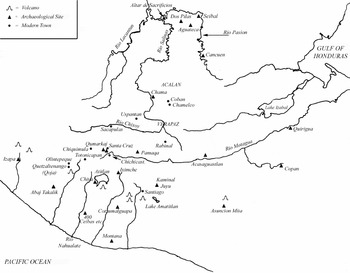
Map of the area (drawn by the author).
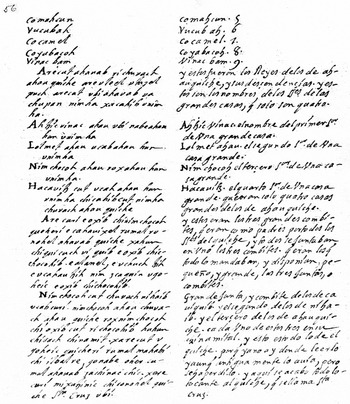
Last page of the Popol Wuj (courtesy Edward E. Ayer Collection, Newberry Library, Chicago).
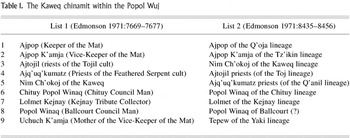
The Kaweq chinamit within the Popol Wuj
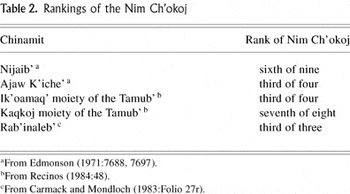
Rankings of the Nim Ch'okoj
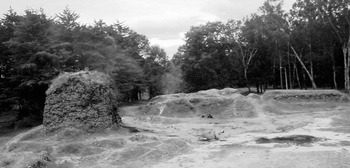
Central plaza of Q'umarkaj-Utatlán, with remains of Tojil temple (photo by the author).
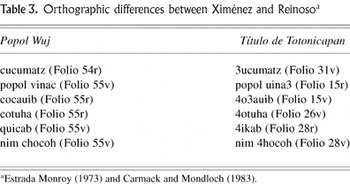
Orthographic differences between Ximénez and Reinosoa
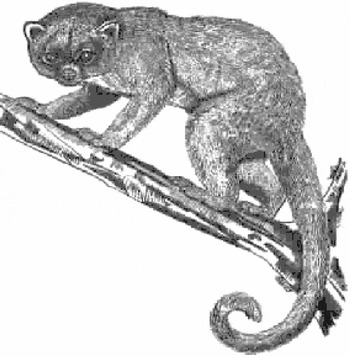
Kinkajou.
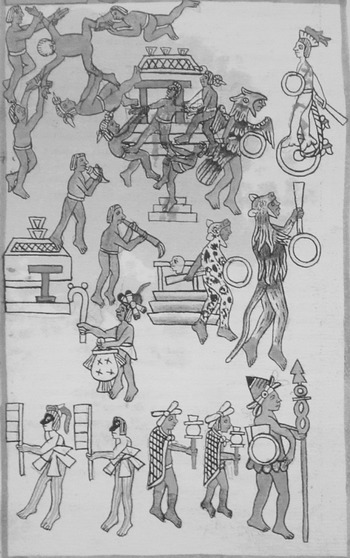
Old Kinkajou priest in festival of Tlacaxipehualiztli (center right; Codices Matritenses de Sahagún, Folio 250r; Sahagún 1993; courtesy Palacio Real de Madrid).
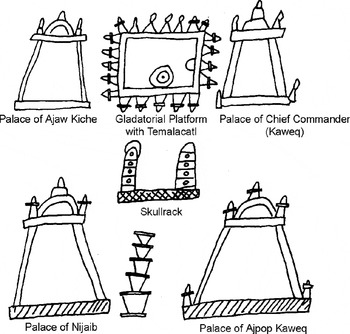
Pictorial of central plaza of Q'umarkaj from the Título de Totonicapan (redrawn after Carmack 1981).
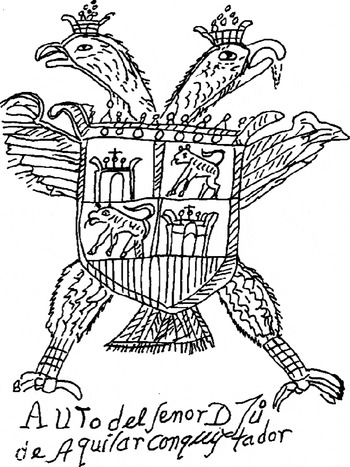
Pictorial from the Título de Totonicapan reading “Auto del Señor D[on] Jo [Juan] de Aguilar Conquistador” (redrawn after Carmack and Mondloch 1983).
 You have
Access
- 12
- Cited by