1. Introduction
One escape route out of a war of each against all is that of institutions establishing order (Brennan and Buchanan, Reference Brennan and Buchanan1985). At least, spontaneously evolving private rules of order may transform chaotic anarchy into ordered anarchy. Such rules may emerge where they are least expected, e.g. among agents who engage in conflict for a living, like pirates or prison gangs (Leeson, Reference Leeson2007; Skarbek, Reference Skarbek2011), or among warring hostiles (Leeson, Reference Leeson2009).
What contributes to the hope of escaping violence via this route is a widespread, positive understanding of what institutions do. Institutions are said to foster exchange and protect property rights (Ménard and Shirley, Reference Ménard, Shirley, Ménard and Shirley2008: 4); to help to solve the problems of cooperation and collective action (Nee, Reference Nee, Nee and Brinton1998: 8); to be the first step towards overcoming the Hobbesian problem of social order (Mantzavinos, Reference Mantzavinos2001: 83); to foster economic performance (North, Reference North2005; North et al., Reference North, Wallis and Weingast2009). Following North's (Reference North1990: 3) definition of institutions as humanly devised rules that shape interaction, one might summarize the predominant positive understanding of institutions saying that institutions are believed to be what governs behaviour – in a good way.Footnote 1
The purpose of this paper is to complement our idea of spontaneous order – i.e. of the path from a bellum omnium contra omnes to order, via the spontaneous emergence of conflict-appeasing institutions – with a more negative aspect. I shall argue that the spontaneous emergence of bellicose institutions may also lead to disorder. By disorder I mean a state that differs from chaotic anarchy in that institutions are present. Yet it is not a case of order that fosters exchange and secures property rights, but a dystopian ‘war-order’, which explicitly allows for conflict based on a framework of bellicose (i.e. conflict-kindling, war-mongering) rules. Disorder is a particularly violent form of ordered anarchy.
To show empirically how spontaneously emerging bellicose institutions may establish disorder, this paper discusses a case study from a virtual world. Virtual worlds are computer-created environments that visually mimic complex physical spaces, wherein people can interact with one another and with virtual objects in manifold ways (Bainbridge, Reference Bainbridge2007). They give rise to sophisticated governance systems and well-developed economies (Castronova, Reference Castronova2001, Reference Castronova2008; Lastowka and Hunter, Reference Lastowka and Hunter2004; Mildenberger, Reference Mildenberger2013a). Thanks to collaboration with the developer of the virtual world ‘EVE Online’ (EVE), the empirical part builds on the logged server data of EVE's 400,000 users in January 2011.
I shall first give some methodological considerations as well as sketch the political and economic environment of the chosen virtual world (section 2). I then develop a theoretical picture of what bellicose institutions are and how they differ from other kinds of weak, missing or perverse institutions (section 3). Section 4 examines empirically how a bellicose institution in EVE – notably an institution sanctioning suicidal attacks in a supposedly safe region – emerges, establishes disorder and rigidly persists. While there are many instances of spontaneous order in EVE, while the users are not generally speaking more conflict-loving, and while EVE's institutional matrix is adaptive, these rules continue to uphold disorder.
2. Methodology
Virtual-worlds research combines the control of laboratories and the ecological validity of fieldwork (Fiedler and Haruvy, Reference Fiedler and Haruvy2009). The rich data available allow us to zoom in on the phenomenon of interest, controlling for spurious factors, thus raising construct validity to levels usually seen only in experiments. Ecological validity is high, as users do not fulfil given tasks but act in a natural habitat. A major advantage of virtual worlds over laboratory experiments instituting anarchic settings in particular (e.g. Duffy and Kim, Reference Duffy and Kim2005; Powell and Wilson, Reference Powell and Wilson2008), is that experiments are often not complex enough to produce a situation resembling a true state-of-nature situation (Abbink, Reference Abbink, Garfinkel and Skaperdas2012).
Analysing conflict on the basis of logged server data and forum content overcomes the notorious lack of objective evidence owing to the chaotic and obscure nature of real-world anarchies. Social desirability bias (in the perpetrator's self-reports) is absent, as are reports trying to camouflage feelings of anxiety or embarrassment on the victim's side (Baumeister and Vohs, Reference Baumeister, Vohs and Miller2005). Propaganda and manipulated statistics do not come into play, nor do historical records written by the winner.
The external validity of virtual-worlds research
The main limitation of virtual-worlds research lies in its external validity. Notably, one might worry that virtual world data overstate the prevalence of conflict for various reasons. In this paper, virtual worlds are studied as an extreme rather than as a representative case and for their own sake. The goal is not to generalize to other situations or populations, but to complement the literature on the possibility of order under adverse conditions with a rare institutional arrangement that one could not easily install or observe in real life. Thus, external validity is not the main worry. Still, some remarks about external validity are in order to highlight that, in principle, it is not impossible to generalize to real-world settings.
First, one might worry about selection bias. For the virtual world examined, 95.7% of the users are male. This is a high quota, even compared to the average for other virtual worlds of around 85% (Yee, Reference Yee2006). As it is known that young males are the social group most prone to violence, virtual worlds are a tough but highly relevant case for emergent order. The examined virtual world features a smooth age distribution from 12 to 75 years (average age: 31). The users’ nationalities are diverse, with the top three being the United States (36%), the United Kingdom (11%), and Germany (9%). Yee (Reference Yee2006) finds that across virtual worlds, the largest fraction of users (about half) is full-time employed, with the second largest group being full-time students (around 20%).
As a second threat, anonymity – among subjects and between researcher and subject – is known to raise the potential for violent behaviour (Zimbardo, Reference Zimbardo and Miller2005). Given that anonymity increases the importance of local group norms (McKenna and Bargh, Reference McKenna and Bargh2000), and in light of these group norms stressing the need for cunning, caution, mistrust and the legitimacy of violence in the examined virtual world (Mildenberger, Reference Mildenberger2013b), we can expect interactions to be particularly conflict-prone. The fact that in virtual worlds users are exposed to more than pure text messages when interacting reduces anonymity (Messinger et al., Reference Messinger, Ge, Stroulia, Lyons, Smirnov and Bone2008). However, in the virtual world examined this effect is most likely offset by the fact that users are not predominantly controlling the bodily actions of a person, but are steering a space ship from a third-person perspective. Although users are anonymous online with respect to their offline lives, they are not anonymous within the virtual community as their characters acquire online reputations.
Third, virtual worlds are low-stakes environments – and low stakes are known to reduce economic motivations (Slonim and Roth, Reference Slonim and Roth1998). Although an exchange rate is set between real and virtual currency, users typically handle only small absolute amounts of money in virtual worlds. However, opportunity costs of prosocial behaviour also are low. For the examined virtual world it has been found that users play dictator games more altruistically than real-world subjects (Mildenberger, Reference Mildenberger2013b).
With respect to stakes, virtual worlds are a paradigm case of experimental realism in contrast to mundane realism (Aronson and Carlsmith, Reference Aronson, Carlsmith, Lindzey and Aronson1968). Users are immersed deeply and take the comparably small economic incentives very seriously while logged in. How invested users are is shown by the fact that the average user of the examined virtual world spends 17 hours per week online, for a period of two years, with the median age of an avatar being one year (Guðmundsson, Reference Guðmundsson2009). When a user devotes 17 hours per week – over a period of two years, paying a monthly subscription fee – we can be sure that he does care about how well he performs relative to the incentives and payoffs present in the virtual world, and in comparison to others. Given the considerable opportunity costs of the real temporal investment, it would be presumptuous and uneconomical to assume that users are ‘just playing around’ in virtual worlds.
The fourth threat is that online behaviour might have little in common with offline behaviour. It is likely that users take virtual conflict less seriously than real conflict, and thus engage more readily in it. For instance, neither legal penalties nor bodily harm are associated with virtual fighting. Still, Slater et al. (Reference Slater, Antley, Davison, Swapp, Guger, Barker, Pistrang and Sanchez-Vives2006) find that our natural inhibition to harm others transfers to online interactions. We cannot harm a character without triggering unpleasant stress reactions.Footnote 2 Whitty et al. (Reference Whitty, Young and Goodings2011) find that 80% of people show signs of emotional distress when breaking real-world taboos (like rape) in virtual worlds, even if they assert that they are readily able to separate virtual space and real world. They do not give any data on relative frequencies of taboo violation online and offline. But their findings suggest that real-world taboos transfer to virtual worlds.
Strong correlations have been reported between real-world personality traits and behaviour in virtual worlds (Yee et al., Reference Yee, Harris, Jabon and Bailenson2011). For instance, positive social interactions within virtual worlds, specifically helping other players and using friendly interactive emotes, are significantly correlated with the users having high levels of the HEXACO personality traits of both ‘agreeableness’ and ‘openness to experience’, which are known to underlie real-world helping behaviour (Worth and Book, Reference Worth and Book2014). Aas et al. (Reference Aas, Meyerbröker and Emmelkamp2010) find that if users complete personality questionnaires for themselves and their characters, no significant differences emerge between the two. Even unconscious behavioural regularities, e.g. that male–male dyads choose wider interpersonal distances than female–female dyads, transfer to virtual worlds (Yee et al., Reference Yee, Bailenson, Urbanek, Chang, D and Merget2007). If behavioural differences exist, some of them come down to our being more ourselves online (McKenna and Bargh, Reference McKenna and Bargh2000; Bargh et al., Reference Bargh, McKenna and Fitzsimons2002); or to virtual environments that elicit latent character traits, like everyday sadism, also showing up in similarly anonymous or institutionally weak settings in the real world (Buckels et al., Reference Buckels, Jones and Paulhus2013).
Note that in comparison to other methods virtual-worlds research minimizes biases affecting reliability. Virtual-worlds research features a high degree of inter-observer consistency. As the software gathers the observational data automatically, every researcher is confronted with the same data. As subjects in virtual worlds are in their natural habitats and unaware of being observed, they are not prone to testing biases of any kind. For the same reasons, reactivity effects play no role. Finally, observer effects are excluded. As the researcher uses already existing data, his personal characteristics cannot influence its reliability.
EVE Online
This paper examines the virtual world of ‘EVE Online’ (EVE). CCP Games released EVE in May 2003. It is a science fiction-themed world. Users navigate a space ship through a vast, three-dimensional universe. The main task is to compete in economic and military ways. Whatever goals the users set for themselves, money must be earned to achieve them. One can obtain money either by violent appropriation or by productive means. In January 2011, EVE had around 400,000 users and an average of around 30,000 concurrent users logged in at any time of the day.
EVE features an almost completely user-run economy. It possesses its own currency, ISK (‘InterStellarKredit’). The exchange rate between ISK and the Euro in January 2011 was about 1 EUR = 19.5 million ISK (Mildenberger, Reference Mildenberger2013b). EVE's economy is stable, with only mild inflation and deflation (Guðmundsson, Reference Guðmundsson2009, Reference Guðmundsson2010). More than one million individual trades are effected on EVE's markets on a daily basis. EVE's money supply M1 of 445 trillion ISK (23 million EUR) may serve as a benchmark for the size of the economy.
EVE's political environment is tripartite. High-security space (hisec) resembles a night watchman state. A computer-controlled police force actively enforces a basic set of property rights. In low security space (lowsec), laws are enforced only passively. In null security space (nullsec), full-blooded anarchy reigns. For example, if you destroy the ship of a fellow user in hisec, police forces punish this offence by destroying your ship in return. Additionally, your character's security standing is reduced. If a character's security standing gets too low, he is no longer allowed to enter hisec. For the same offence in lowsec, the security standing reduction is the only punishment. In nullsec no state-enforced legal rules exist whatsoever.
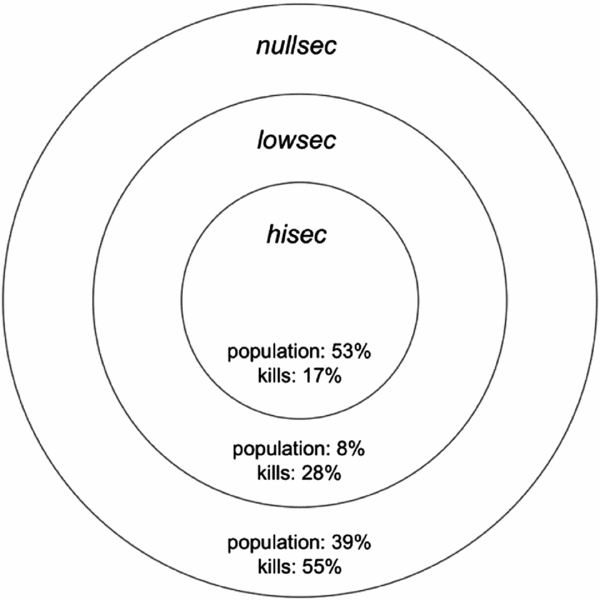
The effects of this governance system are manifest. Although more than half of the characters ‘live’ in hisec, more than half of around 320,000 ‘kills’ that happened in EVE in January 2011 took place in nullsec (Figure 1). A kill is the destruction of another user's space ship.
Illustration of the relative positioning of hisec, lowsec and nullsec – featuring population averages and share of total kills in January 2011.

Conflict in EVE takes on two main forms. First, there is large-scale warfare for territory between formal groups of users called ‘corporations’ (short: corps) or ‘alliances’. It takes place in nullsec, for nullsec is the only region wherein users can claim territory officially. The other main form of conflict is piracy. Piracy involves roaming around attacking ships in order to destroy and pillage them. Piracy is particularly predominant in lowsec along the trade routes leading from nullsec to the trade-hubs in hisec.
In contrast, the kind of conflict this paper focuses on are suicidal attacks, which take place in the supposedly safe haven that is hisec. Being a kind of guerrilla warfare, these attacks involve fewer people and take place on a much lower scale than piracy or warfare. Yet they have a substantial effect on the overall economy and bring disorder to hisec.
Data
For the institutional analysis a wide range of sources will be utilized to develop an encompassing picture, e.g. forum discussions in the official EVE forums, the official EVE wiki, game documentation and interviews with game developers. The protocols of the meetings of the ‘Council of Stellar Management’ (CSM) and CCP Games will also be referred to extensively. The CSM is a democratically elected political organization that formally represents the views of users vis-à-vis developers (Óskarsson, Reference Óskarsson2010). Dev blogs, i.e. short texts written by the developers in order to announce new developments in EVE to the user base (including the discussions they generate in the community), will be another preferred source.
As for the users’ behaviour and its payoffs, the data underlying the empirical part encompasses the unmediated, computer-created server logs of user interactions in January 2011. The dataset essentially draw on three files made available by CCP Games. The first file contains information on all kills in January 2011. It lists who killed whom where, and how much damage was done. The second file supplies information on the attributes of all characters in EVE. It lists their in-game IDs, how old and experienced the characters are (create date and total login minutes), and how much cash the character had at the time of the snapshot. The third file contains all characters’ financial transactions in January 2011. Taking these three files together, we can develop an encompassing picture of the monetary effects of conflict in EVE.
3. Bellicose institutions
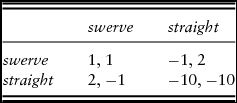
A bellicose institution is a particularly radical kind of a ‘perverse institution’ (Shirley, Reference Shirley, Ménard and Shirley2008: 611). It is a social rule shaping human interaction that officially sanctions the use of violence in situations in which violent behaviour leads to the destruction (not mere redistribution) of material social wealth. If one engages in conflict in line with a bellicose institution, material lose–lose situations for those involved are the consequence. For example, concerning a situation featuring the payoff matrix of a game of chicken (Table 1), such an institution would explicitly allow both of the players to choose the lower right corner, i.e. to crash (the conflict option).
Typical payoffs for a game of chicken.

Source: e.g. Hofbauer and Sigmund, Reference Hofbauer and Sigmund1998
Even if there is an option in which both players could achieve a non-negative payoff (the cooperation option in the top left), the bellicose institution still suggests opting for the conflict option. If there is the respective bellicose institution in place, even in a sequential chicken game the second-mover is officially allowed to choose ‘straight’ if the first-mover has already done so. Put differently, one is not frowned upon if one engages in the kind of violent behaviour sanctioned by the bellicose institution. Counterfactually, this allows us to see that real-world phenomena like road rage, vandalism or hooliganism are not supported by bellicose institutions.
Bellicose institutions are not about the mere physical possibility of engaging in violence, as given almost everywhere in the real and the virtual world. Bellicose institutions not only physically allow but normatively sanction violent conflict. This is particularly clear in EVE, in which (unlike in the real world) it would be easy to technically render any kind of violence impossible by coding the game in this way. As outlined below in section 4, this is precisely not what we see in EVE, in which there is a consensus among users and developers that violent conflict of a particular kind should be allowed. The community clearly desires this institution to exist and persist.
Note that ‘bellicose institution’ is not a normative term. We might agree or disagree with the governed community's internal view that violence in some particular forms should be allowed. To refer to something as a bellicose institution simply means to make the positive claim that an institution is conflict kindling, in the sense that its existence leads to violent conflict (in a situation in which non-violent means are, in principle, available), that it officially sanctions the use of violence, and that, if abided by, it leads to material lose–lose situations.
Abiding by some bellicose institutions has effects mainly for those directly involved in the violent behaviour. Duels for honour in Renaissance times and early modernity are a historical example of a bellicose institution, in that such duels escalate verbal conflicts about (supposedly) violated honour to violent physical conflicts (Frevert, Reference Frevert and Williams1995). Unlike feats of arms or champion warfare in the Middle Ages – which substituted single combat for warfare between large groups – or the lex talionis in antiquity – which prevented blood feuds from escalating further – duelling has conflict-kindling effects.Footnote 3 Some bellicose institutions also sanction behaviour with detrimental effects mainly on the social level, e.g. raising overall uncertainty and establishing disorder. Higher-ranking officers and military education establishments, for example, were often opposed to duelling, which was common among military officers, because of the threat that losing officers meant to the success of the war effort, and because officers were often trained at military academies at government expense (Holland, Reference Holland2003).
While institutions are typically believed to appease social conflict, i.e. to be ‘pacicose’, bellicose institutions incite conflict. This is why costly, prosocial peer punishment, e.g. punishment intended to induce cooperation (Fehr and Gächter, Reference Fehr and Gächter2000), could not be supported by a bellicose institution, whereas antisocial punishment, i.e. that those who punish defectors are punished in return by the defectors (Herrmann, Thöni and Gächter, Reference Herrmann, Thöni and Gächter2008), might be.
To abide by a bellicose institution means to engage in the violent behaviour sanctioned by the institution. While socially beneficial institutions are typically enforced either through law or through other mechanisms of social control (Mantzavinos, Reference Mantzavinos2001: 83), bellicose institutions are enforced passively. They are enforced by non-interference with violent behaviour. Put differently, bellicose institutions do not actively call for killing, they sanction letting die (see Thomson, Reference Thomson1976).
Compare bellicose institutions to other kinds of weak, missing or perverse institutions. Bellicose institutions are not social rules that condone egoistic behaviour. For instance, take a rule that advises you to opt ‘straight’ when your opponent has already chosen ‘swerve’ in a sequential chicken game. What characterizes such scenarios is that the advised action is one that redistributes wealth. In other words, this is a win–lose situation. Bellicose institutions only condone behaviour that has negative material consequences for both the victim and the perpetrator.
Bellicose institutions are not simply missing institutions. There is a difference between conflict neither being allowed nor prohibited in chaotic anarchy (as no rules exist), and the officially sanctioned violence characterizing disorder.
Bellicose institutions are not the rules that underlie ‘Nietzschean development failures’ (Hillman, Reference Hillman2004: 263), i.e. rules that may be said to unduly favour the rich and strong over the weak and poor. Instead, if the poor have a lower opportunity cost of fighting, it might very well be the case that bellicose institutions favour the poor. In the same context, bellicose institutions also are not the extractive institutions that Acemoglu et al. (Reference Acemoglu, Johnson and Robinson2001) describe as underlying the exploitation of colonies by colonizers. They do not aim at concentrating the political power in the hands of a few in order to extract valuable resources from the masses.
Bellicose institutions are not rules that are abused by economic and political powers to further their interests (Shirley, Reference Shirley, Ménard and Shirley2008: 612). They do not require bad people to unleash their destructive potential. Actors who blindly abide by them suffice to bring about the detrimental effects.
Finally, bellicose institutions are not dysfunctional rules from a temporal or spatial perspective. One might suspect that bellicose rules used to promote social welfare in the past, but are unable to do so any longer because circumstances have changed (North, Reference North2005: 122). But bellicose institutions have never been beneficial. Furthermore, bellicose institutions are not such that they work well in one geographic area – where the underlying beliefs and norms fit them – and produce negative outcomes in other areas. Notably, they are not those poor institutions that colonies inherited from their colonial masters (North, Reference North1990). Everywhere where bellicose institutions prevail they lead to destruction of social welfare if abided by.
4. Bellicose institutions and disorder in EVE
The central puzzle developers of virtual worlds have to solve is the same political economists face: to establish a well-functioning set of rules allowing for the thriving of the regulated community, and which notably addresses the ‘central problem of violence in human societies’ (North et al., Reference North, Wallis and Weingast2009: xi). Central planning is not a suitable strategy to this effect, as acts of social engineering rely on stereotypical assumptions about user motivations – and are thus doomed to fail (Morningstar and Farmer, Reference Morningstar, Farmer and Benedikt1991).
Nobody controls EVE . . . We can never be certain before something hits Tranquility [the name of the EVE server] and anyone that claims they can foresee all changes and their effects is plain ignorant. How can one assume what 130,000 people will do with something? (CCP Oveur*, 2006)Footnote 4
In many aspects, the developers of the game take over the role of the state in the virtual environment. But EVE users, i.e. the members of the virtual society, are typically able to substantially influence which laws are enacted. They might ‘vote with their feet’, i.e. quit playing and switch to another virtual world. This is why the developers, with their interest in creating a stable and growing virtual world, generally listen closely to what the community says and tend to follow their wishes. Since building up a distinguishable online identity in one community takes time, the viability of this ultima ratio of the user to emigrate is somewhat mitigated (Johnson, Reference Johnson and Ludlow2001: 330).
Overall, ‘it is hard to tell who has the biggest influence on the evolution of EVE . . . We [the developers] aren't alone in developing the game’ (Kjarval, 2010, personal communication).Footnote 5 The initial impetus for a new virtual law may be a new solution to a social problem that has spontaneously emerged within the community. ‘The big new inventions may come from the developers but the community does a lot of small things’ (Turbefield and Óskarsson, Reference Óskarsson2010, personal communication).Footnote 6
The most important difference between the virtual and the real world is that the developers are not only able to enact laws but also to define natural laws in the form of determining the game mechanics. In the virtual world as in the real world, institutions are the ‘rules of the game’ (North, Reference North1990: 3–4). But in the virtual world, the developers also are the creators of the game, and in this respect God-like. Their power extends beyond determining the economic and legal framework to setting physical laws. Every institution that the developers really want to enforce can easily be given a 100% compliance rate.
The practice of suicide ganking
Even in an environment as adverse as EVE, order spontaneously emerges. Most remarkably, virtual pirates abide by codes of conduct that substitute mutually beneficial exchange for destructive conflict – although the pirates derive utility from conflict (they willingly sacrifice money for opportunities to fight other users) (Mildenberger, Reference Mildenberger2015). But some spontaneously emerging institutions are bellicose institutions establishing disorder; namely those institutions sanctioning suicidal attacks in hisec.
The emergence of bellicose institutions in EVE
Since the launch of EVE, CCP Games has tried to attain two sometimes conflicting goals (Hinrichsen, 2010, personal communication).Footnote 7 On the one hand, with the underlying design idea of EVE as a very competitive game in economic and military ways, CCP was supportive of the idea that lots of killing would take place. On the other hand, they figured that there should be some relatively safe areas, notably intended to allow new users to get used to this new environment before actually being shot at. The second goal was the rationale behind programming a tripartite universe, featuring the safe haven of hisec in which the computer-controlled virtual police (called ‘CONCORD’) operates.
However, when EVE started out in May 2003, the tripartite design did very little in preventing conflict. Perpetrators quickly invaded hisec and killed new users. Only four weeks after publication, it became clear that CONCORD was ineffective: They fought with relatively weak weapons and arrived too late to actually destroy the ships of the attackers (CCP LeKjart* et al., 2003). CCP was forced to take action very early in the history of EVE:
We definitely underestimated the need for security in the first place. A lot of effort went into making hisec safer, as we intended it to be. The main efforts were to secure new players who are not profitable targets for griefers. The intention was to allow profitable . . . [killing] but making new player griefing more difficult. (Hinrichsen, 2010, personal communication)
The first measure that was taken was to give CONCORD ships better weapons and to make them arrive faster (CCP LeKjart* et al., 2003). This led to CONCORD now arriving in time every time somebody initiated aggression in hisec, and always eventually killing the perpetrator.
With CONCORD now being effective with their ‘an eye for an eye’-retaliation, a new phenomenon emerged: suicide ganking. In a suicide gank (SG) the perpetrators willingly accept that their ships will be destroyed by CONCORD but still proceed to initiate violence in hisec. In a typical SG, a group of perpetrators join forces, i.e. firepower, to quickly kill their chosen victim (before CONCORD arrives) only to get killed themselves by the police directly afterwards. Every perpetrator that acted aggressively will be killed. This is why the attacking group will typically bring along one character that stays passive during the encounter. He will be able to collect whatever is left over after the battle – notably the victim's cargo. By selling this robbed cargo later on in the in-game market, ISK can be earned. According to the gankers, it is the economic rationale of making profit on cargo thus robbed that motivates SGs (Destiny Corrupted*, 2011). The profit is meant to overcompensate the value lost in the perpetrators’ ships being destroyed.
It has always been the standpoint of CCP and the user base that, in principle, suicide ganking is an accepted practice (CSM and CCP Games, 2010: 15). As long as one is willing to incur the costs inevitably tied to this behaviour, it is all right to attack other ships in hisec. The practice of suicide ganking emerged spontaneously, in that nobody ever advised players to engage in this practice. The game mechanic that it is possible and allowed to initiate aggression in hisec is a formal institution that officially sanctions violent behaviour. It is a formal institution that puts the way of predation and conflict over that of production and exchange, as the favourite targets of suicide gankers are those defenceless transport ships that underlie the logistics of EVE's markets.
Suicide ganking mechanics as bellicose institutions
The game mechanics that allow for SGs are bellicose institutions, as they are not only conflict kindling but – contrary to the claims of the gankers – lead to lose–lose-situations. In January 2011, a total of 616 attempted SGs took place in EVE. Of these attempted SGs, 221 failed – i.e. CONCORD intervened before the victim could be killed – 395 were successful (failure ratio: 36%). A total of 2,322 perpetrators participated in these SGs and at least 647 victims were attacked.Footnote 8 On average, the attempted SGs involved four perpetrators and one victim.
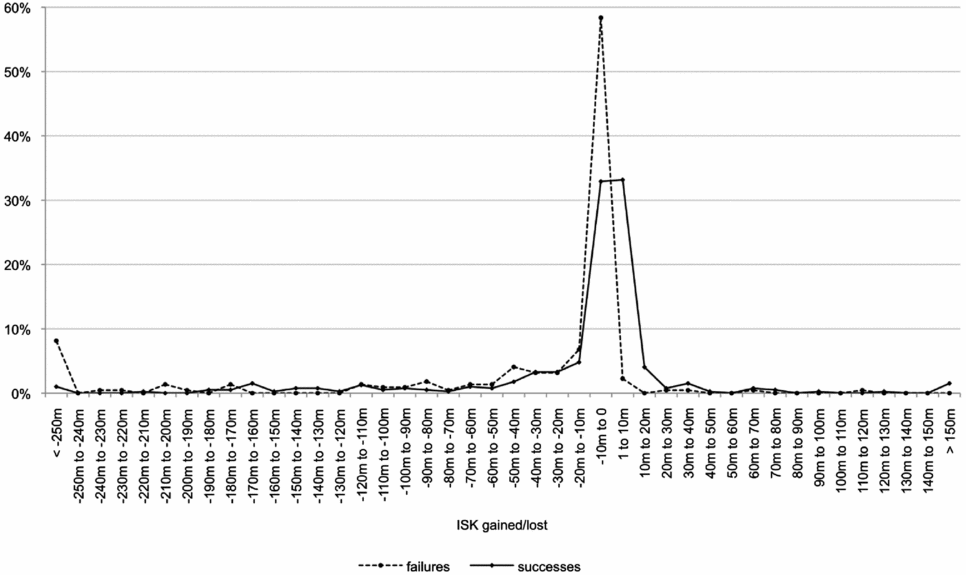
On average, each victim of a successful SG lost 247 million ISK (roughly 13 EUR). This high value suggests that targets are not picked at random. SGs equally lead to losses for the perpetrators. Adding up the benefits stemming from robbing the victim and the losses from being killed by CONCORD, the median loss per attempted SG amounted to 2.5 million ISK. Given that the distribution of gains and losses is approximately symmetrical, a Wilcoxon signed-rank test can be used to test the hypothesis that the median gain per attempted SG is positive. This hypothesis is rejected (W = 49,666, z = −10.13, p < 0.01 one-tailed). Even successful SGs led to a median loss of 0.8 million ISK. The hypothesis that the median gain per successful SG is positive is rejected (W = 30,406, z = −3.83, p < 0.01 one-tailed).
As regards the distribution of gains and losses from SGs, there are no big outliers that might induce attackers to think that SGs actually are profitable (see Figure 2). The vast majority of SGs are slightly unprofitable. Users can be expected to quickly learn about this.
Distribution of gains and losses for the gankers of the 616 SG attempts.

No obstacles prevent gankers from switching to more profitable activities. Engaging in SGs is not an ability-based decision (Mildenberger, Reference Mildenberger2013a). In EVE, users can engage in fighting, and profitably so, but only if they opt to fight against computer-controlled characters (so-called mission running). By mission running, hourly wages of 50 million ISK can easily be achieved for a decently experienced user.Footnote 9 Note that fighting computer-controlled characters tends to be easier than fighting human opponents (Mildenberger, Reference Mildenberger2013a). So it is not the case that less able fighters self-select into suicide ganking, while the most able fighters self-select into other forms of conflict. By opting for yet easier civilian professions (e.g. mining asteroids or trading), as much as 10 to 250 million ISK can be made per hour (Guðmundsson, Reference Guðmundsson2010, personal communication).Footnote 10
Long-term economic considerations do not motivate SGs either. Gankers are not rebels aiming for power (see Grossman, Reference Grossman1999). They are not fighting to obtain control over valuable resources, for no such resources exist in hisec (see Collier and Hoeffler, Reference Collier and Hoeffler2004). Gankers are not cultivating bad reputations in order to scare away potential attackers (see Schelling, Reference Schelling1978); instead they lose security standing, are outlawed, and become ‘free game’.
Some non-economic motivations for SGs can likewise be excluded. Ethnic or religious tensions are unheard of in EVE, as users do not reveal their offline identities Also, gankers do not kill based on personal motives of revenge or hatred. As Eriksen puts it: ‘There is nothing personal in suicide ganking. They [i.e. the victims] have done nothing to make you [i.e. the ganker] angry’ (2010, personal communication). Gankers are not animated by a desire to redistribute income or wealth from the rich to the poor. In fact, gankers are on average wealthier than their victims (Mildenberger, Reference Mildenberger2013a: 180–1).Footnote 11 Overall, as Eriksen (2010, personal communication) puts it, ‘if you are engaging in suicide ganking thinking that you will get rich from it, you have got something wrong’.Footnote 12 And although it is theoretically possible that SGs pay off, if only sometimes and for the most skilled of gankers, the overall finding that the suicide ganking mechanics qualify as bellicose institutions persists.
This is not to say that we have identified a robust institution that yields no benefit to anybody (see more on the potential functions of bellicose institutions below). It merely shows that material incentives cannot explain suicide ganking – an essential condition in a bellicose institution in the first place.
The rigidity of suicide ganking mechanics
Although the detrimental economic consequences of suicide ganking are publicly known, the bellicose institutions enabling it have been changed over the years, but not abandoned. The spontaneously emerged practice is kept in place by the deliberate choice of users and developers. For example, in 2008, the CSM decided to ask CCP to impede suicide ganking. The protocol of the meeting details:
CCP realized that even though they do not plan to remove suicide ganking completely, today's suicide gank mechanics are too biased in the ganker's favor, and they have set up a task force to look into suicide ganking . . .
For the short term, they plan to increase the security hit for crime in high-sec space. . . Mid term, the plans are to look into suicide ganking and the insurance payout.Footnote 13 (CSM and CCP, 2008: 9)
The mentioned changes to the security standing reduction were introduced shortly afterwards (CCP Fear*, 2008). The main effect of this was that repeated offenders were prevented from ganking over and over again in a short period of time. As users with too low a security standing are not able to enter hisec without immediately being attacked by the police, gankers now had to bring their security status back up between SGs, which takes considerable time and effort.
It is important to note that this decision to increase the security standing reductions was by no means made unanimously: ‘Alex (CSM Bane Glorious) said that most suicide gankers already thought of . . . regain[ing] security status as painful’ (CSM and CCP, 2008: 9). Furthermore, it is important to note that this decision did not have all the desired effects. Gankers found a way to circumvent this new rule by exploiting another institution of the game. Namely, the game mechanic that CONCORD does not attack characters flying around in a rescue capsule (a ‘pod’) was exploited:
[A] certain tactic is currently being employed by criminals, which allows them to operate in high-security space despite their negative security status. The tactic is as follows:
− Fly into . . . [hisec] in pod
− Let neutral [character]. . . pile up ships in safe spot . . .
− Board ships and fly to belt/station/gate
− . . . gank some targets
− Let neutral [character] . . . loot the wrecks
− Repeat. (CSM Ankhesentapemkah*, 2008)
Eventually, the promised mid-term counter measures came into effect: The insurance system of EVE was overhauled (CCP Chronotis*, 2010). By lowering the payouts, CCP encoded one of the traditional main complaints of the opponents of suicide ganking, namely that insurance payouts subsidize it. This concession was a compromise. CCP did not abolish insurance payouts altogether for ships being destroyed by CONCORD – which was the initial goal of the opponents.
It is noteworthy that it is not the developers who keep the bellicose institution in place, but that the user base, in principle, is pro suicide ganking. Since the first days of EVE, there have been constant discussions between ‘carebears’ on the one side and ‘PvPers’ on the other side. The term carebears refers to those mostly business-minded users who live in hisec, who typically do not venture into the more dangerous areas of EVE, and who compete mostly with other users via economic means. PvPers are those users mostly interested in competing by military means.Footnote 14 Whereas the carebears try to convince the developers to make initiating violence more difficult, the PvPers lobby for diminishing the possibilities of avoiding attacks even in hisec. It is a quarrel between the two paradigmatic lifestyles in anarchy, between producers and fighters, with the bellicose institution favouring the latter.
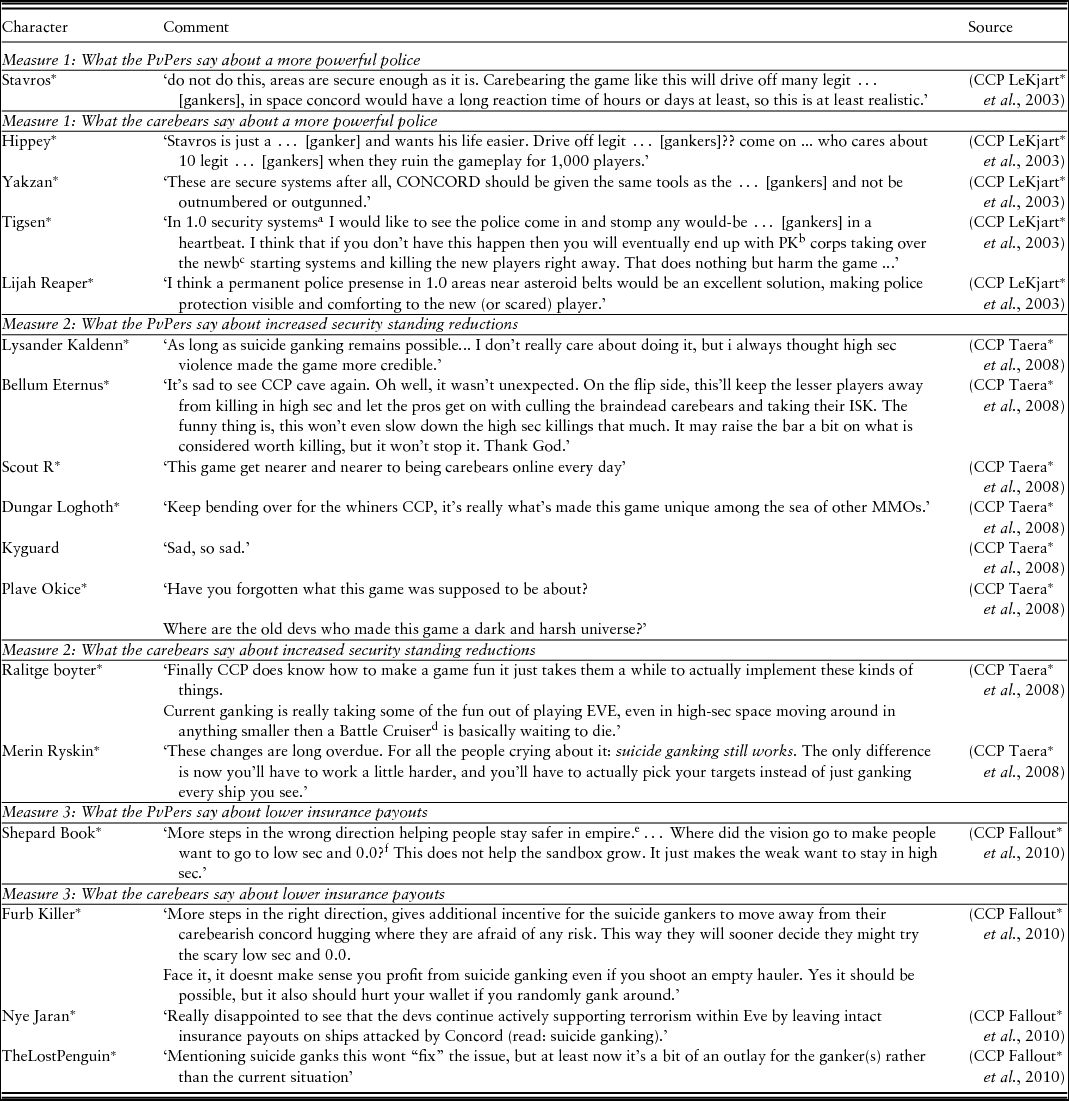
There are many technical terms used in forum discussions regarding the issue of suicide ganking mechanics that may hinder an easy understanding. To overcome this problem and to give at least a slight overview of the arguments exchanged, Table 2 reproduces some of the comments. For every one of the three outlined measures to make SGs more difficult, it gives some pros and some cons that were brought up by the users.
Comments on institutional changes affecting suicide ganking over the years.

Source: See right-hand column.
ai.e. hisec space
bPK = player killer, a person that regularly attacks other humanly controlled characters.
cA noob (also: newbie, newb) is a new player.
dA reasonably powerful class of space ships.
ei.e. hisec and lowsec space combined.
fi.e. nullsec space
What these citations show is that even carebears are not per se for abolishing the bellicose institutions allowing suicide ganking, but just against too biased a version of them. Importantly, users do not welcome direct, one-off interventions by the developers, but are looking for an institutional solution. The one time early in the history of EVE when developers themselves actively and directly addressed the problem – by boarding some particularly powerful virtual space ships available only to them to fight gankers – user criticism was massive (CCP Hellmar* et al., 2003).
Asked whether users like the unique institutional framework of EVE with all of its consequences or if they merely accept it, almost all developers agree that users actually like it (Eriksen, 2010; Guðmundsson, Reference Guðmundsson2010; Hinrichsen, 2010; Turbefield & Óskarsson, Reference Óskarsson2010; all personal communications). ‘People may rage on the forums but they don't quit’ (Guðmundsson, Reference Guðmundsson2010, personal communication).
The fact that the bellicose institutions allowing for suicide ganking are still in place is astonishing since EVE's institutional matrix is clearly adaptive – as shown by the changes made to the suicide ganking mechanics and myriads of other rule changes over the years. The argument that EVE might just be ‘too young’ for such a radical institutional change to happen should be weighed against the fact that – for a computer game – being eight years old (in 2011) is a biblical age.
Potential functions of bellicose institutions
To show that economic reasons cannot explain suicide ganking (as required for there to be a bellicose institution) is one thing. To answer the functional question of what the bellicose institution does for the users and why violence in line with it persists is a different thing.Footnote 15
From a preference perspective, gankers could be like ‘sadistic’ hooligans who derive utility from harming others (Leeson et al., Reference Leeson, Smith and Snow2012). They could also be merely enjoying conflict (or ‘winning’) for recreational reasons – in a setting where no user suffers bodily injury or physical death. In this case, the function of the bellicose institution would be to define the rules of engagement in the secluded social arena in which such behaviour based on ‘ludic’ (or highly competitively shaped) preferences is socially accepted. Note, however, that unlike, say, real-world boxing, suicide ganking has considerable external political and economic effects for EVE's overall economy. The about 4,000 SG-related kills in January 2011 translate to 0.5% of EVE's active population being killed in SGs (Mildenberger, Reference Mildenberger2013a: 195). So a suitable analogy might be a real-world boxing club roving around looking for trouble with non-boxers, and officially being allowed to do so, i.e. without their behaviour being frowned upon, thus establishing disorder.
In order to empirically disambiguate between different explanations for the gankers’ revealed preference for violence, psychological data would be needed. But even in absence of such data, there is a plausible answer to the question of what the bellicose institution of suicide ganking does for the users that closely fits the data presented above. This bellicose institution's function is to allow for the coexistence of two user types with different preferences. Carebears and PvPers are able to coexist in a way analogous to the way predicted by producer/scrounger models in biological backgrounds (see e.g. Hofbauer and Sigmund, Reference Hofbauer and Sigmund1998). In producer/scrounger games, there are evolutionarily stable equilibria that allow for the survival of both types of behaviour. Namely, when there are only producers (as there were in the very early days of EVE), a scrounger mutation is highly successful in an environment where there are no effective institutions preventing such behaviour. Similarly, a virtual world featuring only gankers would not be sustainable. In an equilibrium as presented by today's suicide ganking mechanics, both types can coexist, with their exact frequency depending on the game's parameters (which have been fine-tuned over time: strengthening CONCORD, cutting insurance payouts, etc.). Whatever motive actually underlies the PvPers’ revealed preference for violence, the bellicose institution allows PvPers to coexist with carebears, who have a revealed preference for peaceful business.
What remains puzzling is that the bellicose institution officially sanctions the use of violence. This is something not to be seen in purely positive biological contexts. The general legitimacy of suicide ganking is not questioned even by the victims, although a similarly stable equilibrium between PvPers and carebears would be conceivable if the practice were officially normatively condemned, but tolerated.
5. Conclusion
Given the very low costs of conflict in virtual worlds, we cannot easily generalize to other settings. Notably the fact that the use of violence as sanctioned by the bellicose institution is not normatively questioned makes it hard to identify real-life examples of bellicose institutions. Duelling, with its glorification of ‘satisfaction’ reached through fighting, is a historical example. But the institution has proven unstable as Enlightenment values changed attitudes towards public displays of violence. Arguably, this change of attitudes was so thoroughgoing that nowadays we only find persistent bellicose institutions in secluded social arenas like virtual worlds. Sanctioned fighting in ice hockey would be another case in point. Here a complex set of unwritten rules establishes an equilibrium between ‘enforcers’ excelling at physical play or fighting and more skilled ‘puck handlers’, with spontaneous or premeditated fights among enforcers regularly taking place. These fights are tolerated in the first place, i.e. nobody interferes with the outburst of violence (as viewers watch in excitement), and laxly penalized ex post. Maybe such institutional kindling of conflict is only sustainable precisely because these social arenas are secluded.
Still, the conclusion that bellicose institutions play no role in the wider public would be rash. Cultures of honour that are prone to violence persist in some regions (Nisbett and Cohen, Reference Nisbett and Cohen1996). And the World Development Report stresses that in underdeveloped countries with weak or missing ‘pacicose’ institutions small random groups of people engage in violent acts, locking the respective country in a ‘violence trap’, which is responsible for continued weak economic performance (World Bank, 2011). In such circumstances bellicose institutions and the disorder they uphold might be a factor to reckon with. Thus, it is certainly instructive to avail ourselves of the virtual evidence.