Previous research has shown that the state of the economy affects not only the electoral fortunes of government parties (Anderson Reference Anderson2000; Lewis-Beck and Paldam Reference Lewis-Beck and Paldam2000; Nadeau et al. Reference Nadeau, Lewis-Beck and Belanger2013), but also strategic choices regarding the timing of both early elections and cabinet replacements (Kayser Reference Kayser2005; Saalfeld Reference Saalfeld2013; Schleiter and Morgan-Jones Reference Schleiter and Morgan-Jones2009). Thus, incumbent parties use economic conditions to evaluate their future electoral prospects and decide whether to call an early election, recruit additional coalition members to secure a future parliamentary majority or leave a coalition. In particular, governments may seize the opportunity to call for early elections during times of relatively strong economic performance (Damgaard Reference Damgaard2008; Smith Reference Smith2003). By contrast, economic recessions may lead to infighting and conflict, which in turn can bring about the dissolution of the cabinet (Lupia and Strøm Reference Lupia and Strøm1995; Robertson Reference Robertson1983a).
Apart from the generic hypothesis that economic performance is likely to be directly linked to government survival, there have been few attempts in previous research to explore the relationship between the type of government in power and the state of the economy. By contrast, we argue that different types of governments are affected by macroeconomic changes in different ways and thus do not have the same ideal, or actual, response. Thus, the ambiguity of previous findings regarding the effects of the economy on cabinet termination can be partly explained by the problematic assumption that economic conditions will have similar effects on all types of cabinets.
In order to investigate the relationship between economic performance and cabinet duration, we utilize a data set containing information on 18 Western European democracies from 1945 to 2013. We measure economic performance through changes in unemployment and inflation during the term of office to capture economic improvements or deterioration during the government’s tenure. Following Arthur Lupia and Kaare Strøm (Reference Lupia and Strøm1995), we divide potential government dissolution types into technical (i.e. non-failure), early election and non-electoral cabinet replacement. Methodologically, we use the Cox proportional hazards model and a split sample approach to measure how the different government types are affected by similar changes in the economy.
Our results indicate that economic changes do matter for government terminations, but mainly affect coalition governments. Single party governments, regardless of whether they control a majority or minority of seats in the legislature, remain stable in the face of most economic changes. However, the risk of early termination for coalition governments increases significantly, indicating that these governments find it more difficult to deal with economic deterioration. Our results also show that during economic decline there is a difference between minority and majority cabinets when it comes to the type of termination that they opt for. Minority governments have an increased risk of early elections, not replacements, while majority governments, by contrast, become more likely to end through both types of termination.
Thus, the main contribution of this article is that it demonstrates that the state of the economy does not have a general impact on cabinet duration, but rather that cabinet duration varies, depending upon the type of government that is in power. Consequently, considering only the overall effect is likely to generate ambiguous results, as economic performance will have little or no effect on some governments, but will lead to early elections for some types of government, and lead to both early elections and replacement for others.
In the next section, we discuss the findings of previous research on the relationship between economic conditions and government termination. In the third section, we draw on theoretical models of cabinet termination to derive predictions of how the state of the economy can affect cabinet duration while distinguishing between different types of cabinets. In the fourth section, we discuss the research design and introduce our data. In the subsequent section, we present our empirical investigation of the conditional relationship between economic changes and cabinet duration. Finally, the concluding section discusses how our results differ from previous studies and presents implications for further research.
THE RELATIONSHIP BETWEEN ECONOMIC PERFORMANCE, GOVERNMENT TYPE AND THE LIKELIHOOD OF EARLY TERMINATION
The influence of economic trends on people’s voting behaviour has been intensively studied (Anderson Reference Anderson2000; Powell Jr and Whitten Reference Powell and Whitten1993), and a key finding in the literature on economic voting has been that the government’s management of the economy matters for its electoral outcomes. This is particularly true when responsibility for economic management is clear and voters know whom to reward or punish. However, far from all cabinets survive to the next scheduled election, as incumbent parties that recognize that their electoral fortunes are affected by the state of the economy can strategically engineer their own departure to maximize electoral support or to circumvent electoral loss.
Accordingly, several studies have investigated the relationship between economic performance and cabinet stability in Europe, but have varied in both their scope and in their main findings. Although many studies have found that both unemployment levels and inflation levels (Robertson Reference Robertson1983a; Saalfeld Reference Saalfeld2008) are associated with an increased risk of cabinet termination, some studies did not find a consistent effect for either unemployment, inflation or growth levels on government termination (Carmignani Reference Carmignani2002; Robertson Reference Robertson1983a; Warwick Reference Warwick1994).
It is well known from duration studies dating back to the 1970s that a government’s likelihood of survival until the next scheduled election depends on its type (Taylor and Herman Reference Taylor and Herman1971). It has, for example, been shown that majority governments are on average more stable than minority governments and that among majority governments minimum winning coalitions (henceforth MWCs) are more stable than surplus majority governments (for an overview, see Grofman and Van Roozendaal Reference Grofman and Van Roozendaal1997). Thus, although it has been acknowledged that different types of cabinets have a varying probability of calling early elections or ending through replacements, this is generally treated as an additive, and not as a conditional effect. That is, government type is generally seen as having an independent effect that is added to the effect of other explanatory factors, whereas our argument here is that changes in the economy affect different types of governments differently. In other words, that the state of the economy has an effect on cabinet stability that is conditional upon the type of government.
A few previous studies have taken steps in this direction. One example of such an approach is provided by Paul Warwick (Reference Warwick1994), who hypothesized that effects of economic conditions on socialist and conservative governments are likely to differ, due to the differences in their ideological stances on keeping either unemployment or inflation at acceptable levels. Warwick found that, on average, rising inflation was costlier for conservative and centre-right governments, whereas unemployment was more detrimental for socialist cabinets. More relevant in this context however, John D. Robertson (Reference Robertson1983a) distinguished between minority coalitions, MWCs and oversized coalitions in his analysis of how inflation and unemployment affected cabinet termination, suggesting that unemployment had significant negative impact on cabinet stability depending on the type of cabinet, and mainly affected minority coalitions and MWCs. At the same time, he did not find any indications that the other economic indicator used, rate of inflation, had any effect on the likelihood of cabinet termination for the three cabinet types.
For our study, we distinguish between four types of cabinets, namely single party majority cabinets, majority coalitions, single party minority cabinets and minority coalitions. In addition, where Robertson (Reference Robertson1983a) and other earlier studies only investigated the overall likelihood of premature cabinet dissolution, we also argue that the different types of termination need to be analysed separately. Thus, we follow Lupia and Strøm (Reference Lupia and Strøm1995) and recognize two types of discretionary terminations: early elections and non-electoral cabinet replacements.
Early elections refer to governments resigning and calling elections earlier than the next scheduled elections. They may do this for various reasons, e.g. changes in public opinion or losses of no-confidence votes in parliament. Calling an early election can be a major gamble for a government, and thus is most likely to occur when environmental conditions have substantially changed and the end of the scheduled term of office is approaching, when the incumbents do not expect to derive much utility from their remaining time in office (Diermeier and Stevenson Reference Diermeier and Stevenson1999; Laver Reference Laver2003).
However, early elections may be called in the absence of conflict between or within parties for strategic exploitation of dissolution powers, with timing designed to maximize incumbent parties’ electoral prospects in relation to changing conditions such as economic booms and busts (Bernhard and Leblang Reference Bernhard and Leblang2008; Kayser Reference Kayser2005; Smith Reference Smith2003; Strøm and Swindle Reference Strøm and Swindle2002). Thus, cabinets are likely to consider a dissolution at the most favourable time during the parliamentary term and there may therefore be an inverse relationship between a government’s remaining time in office and the likelihood of an early election, at least when the government has the power to dissolve the legislature at its own leisure.
Government replacement is the second main type of premature termination. In extreme cases, when allowed by domestic institutional rules (Laver and Schofield Reference Laver and Schofield1990), a replacement occurs when one government is completely replaced by another without an intermediary election. More commonly, a replacement government is created when one or more members leave or others join a coalition, thus changing the party composition of the government but without completely replacing it. Replacements can therefore lead to both expansions and reductions in the size of the government.
When formed, a government is in a state of equilibrium, since the one that initially formed was the best option under the circumstances. At the outset, then, the government should be stable, since no coalition member has a sufficiently strong reason to defect and no alternative coalition is sufficiently strong to present a viable alternative. However, two important factors change over time and could cause government members to re-evaluate their positions. First, as suggested by the established literature, payoff structures, and thus incentives for parties to remain in a government, change significantly as the term of office progresses (Browne and Dreijmanis Reference Browne and Dreijmanis1982; Laver and Shepsle Reference Laver and Shepsle1998; Lupia and Strøm Reference Lupia and Strøm1995). Since the time left in office gradually diminishes, the remaining value that the parties can hope to derive from government membership in terms of policy influence and office benefits declines over time (Strøm and Swindle Reference Strøm and Swindle2002). Thus, sacrifices that seemed worth making when plenty of time remained to enjoy the benefits of office might be considered too costly when the next election is approaching (Balke Reference Balke1990; Diermeier and Stevenson Reference Diermeier and Stevenson1999). This first reason is based on internal calculations of the individual coalition members that are inherent in the original government set-up.
The second reason is that aspects of the external environment can change and so-called ‘shocks’ can arise (Laver and Shepsle Reference Laver and Shepsle1998). External events, such as economic crises or drastic shifts in public opinion, can shake governments out of their initial equilibrium by forcing them to reconsider their policies or to think more carefully about their future electoral survival. For example, in Greece, the first Tsipras government, which lasted from January to August of 2015, called a snap election after it found it necessary to backtrack on some of its previous anti-austerity promises. To placate its debtors, the government had to change some of its key economic policies, which led to tensions within the coalition and within the Syriza party. Eventually, an early election to solve the conflicts within the coalition and to secure a new mandate from the population was deemed necessary.
In the case of the Tsipras government, policy changes came as a result of outside demands. In most cases, though, policy changes are needed to address faltering economic performance. When the initial policies that the government parties agreed on have to change, the different coalition members might have different preferred responses. Such disagreements over how to address economic problems can cause a party to leave in order to distance itself from a new set of policies that its voters might not support (Lupia and Strøm Reference Lupia and Strøm1995; Robertson Reference Robertson1983a). This in turn would lead to the formation of a replacement government. This was the case, for example, when the second cabinet of Icelandic Prime Minister Geir Haarde announced its resignation in January 2009, after months under the strain of an intensifying economic crisis in the country. When the social democratic coalition partner, which had long been openly critical of how Haarde’s Independence Party had managed the crisis, demanded to take over government leadership as a condition for its continued cooperation, the government broke down. It was then replaced by a coalition government between the Social Democratic Party and the Greens (Hardarson and Kristinsson Reference Hardarson and Kristinsson2010).
There are thus different causal paths connecting economic changes and government type to early termination. In particular, the ability of the government to deal with the economic shock by introducing new policies depends both on parliamentary support and on the ability to agree within the government about how to proceed. Since those abilities differ from government to government, we argue here that similar changes in economic performance are conditionally dependent on government type. The mixed findings in previous studies on how and when economic changes matter can therefore be explained by the fact that the effects of economic performance on cabinet stability are modified by the particular type of government that is in power.
THEORY AND HYPOTHESES
Although economic performance affects the incentive structures for all governments, there are several reasons to suspect that the strength of this effect differs between different types of governments. In this article, we distinguish between minority and majority governments, as well as between single party and coalition governments. We proceed by discussing these two pairs of opposites in the next two sections.
Minority and Majority Governments
First, there is there is a clear difference in payoff structures between minority and majority governments. Minority governments generally derive less value from their period in power due to the ability of the opposition to block their proposals in parliament (Laver and Schofield Reference Laver and Schofield1990). Although minority governments are not on average less successful in passing bills through the legislature (Cheibub et al. Reference Cheibub, Przeworski and Saiegh2004), they still need the support of at least one opposition party to gain the majority in parliament required to do so. This means that they need to compromise more in order to pass legislative proposals, and are less able to implement policies that they and their voters favour.
Holding the reins of office thus offers fewer immediate benefits for minority cabinets. This makes them less durable in the face of most eventualities, but economic downturns could be a particularly strong case in point. Their inability to take forceful legislative action in response to such events (without the support of other parliamentary parties) and the increased costs of staying in power associated with a struggling economy, could tip the scales in favour of government dissolution (Balke Reference Balke1990; Strøm and Swindle Reference Strøm and Swindle2002). The argument can therefore be made that payoff structures differ for members of minority and majority governments, in ways that cause the former to be more severely affected by economic downturns.
A second difference between minority and majority governments is that the type of termination they opt for in the face of economic troubles is likely to differ. The most likely response for a minority government should be calling for an early election, rather than the formation of a replacement government. If a member of a minority coalition decides to leave, it will be difficult for the remaining parties to continue governing. Minority governments are in a precarious position to begin with (which their higher termination rates demonstrate) and if a government party defects, it could be hard to find alternative coalition partners willing to join an unpopular minority government in a failing economy.
Majority governments, in contrast, could potentially survive the exodus of a smaller coalition member. Economic deterioration should therefore induce members of minority governments to call for early elections more frequently than governments with a parliamentary majority, since the latter type also has the option of forming a replacement government.
Our first two hypotheses are therefore:
Hypothesis 1: Minority governments are expected to be more strongly affected by economic downturns than majority governments.
Hypothesis 2: Minority governments are expected to end primarily through early elections. Majority governments can end through both early elections and replacements.
Single Party and Coalition Cabinets
Another theoretical distinction to make is between single party and multiparty governments, as coalitions derive less value from being in power than single party governments in terms of both office and policy benefits. In coalition cabinets, more actors compete for the fixed amount of influence and numbers of ministerial portfolios that are available. Thus, the utility that any single coalition member can expect to derive is likely to be reduced for each additional member (Browne and Dreijmanis Reference Browne and Dreijmanis1982; Dodd Reference Dodd1976). In coalition cabinets, policy becomes more diluted, which makes it more difficult for any single party to implement policies close to those it prefers or that would please its particular voters. Also, with more parties in power there are fewer ministerial positions and other office benefits for each individual member.
Moreover, and importantly for our purposes, coalition governments are likely to be more sensitive to changes that accrue during the term of office, particularly external developments such as poor economic performance (Laver and Shepsle Reference Laver and Shepsle1998). Although members forming a coalition can sign a coalition agreement at inception, and be in equilibrium at that point in time, when unexpected events arise it is more difficult for a coalition to agree upon a coherent course of action since the parties are likely to have different ideal responses. In particular, an economic crisis could lead to a policy shock (Laver and Shepsle Reference Laver and Shepsle1998) where the different government members have very different ideas about how to respond. For instance, some might favour public investment, others tax cuts, and with an ongoing crisis that also affects anticipated future electoral prospects for the different government parties, such policy differences could be a great source of friction. Crisis management is therefore more difficult for multiparty governments. Our third hypothesis states:
Hypothesis 3: Coalition governments are overall more sensitive to economic changes than single party governments.
When it comes to the governments that consist of only one party and that have a parliamentary majority – that is, single party majority governments – we have two opposing expectations. Based on the discussions above, we would expect single party majority governments to be the most stable of the different government types. These governments do not have to negotiate with any other parties about how to respond to external shocks, they can be confident about getting any proposed legislation through parliament and are likely to survive potential no-confidence votes. This gives single party majority governments both the flexibility and the ability to deal effectively with changing circumstances. This should make them resilient in the face of poor economic performance. Thus, our Hypothesis 4a states:
Hypothesis 4a: Single party majority governments are expected to remain stable in the face of poor economic performance.
However, a number of previous studies have shown that when responsibility for economic policies is clear, the effects of economic changes are larger. Both in the more general field of economic voting (Anderson Reference Anderson2000; Bengtsson Reference Bengtsson2004; Nadeau et al. Reference Nadeau, Lewis-Beck and Belanger2013) and in more recent literature on satisfaction with democracy (Kestilä-Kekkonen and Söderlund Reference Kestilä-Kekkonen and Söderlund2017) the empirical results show that economic performance matters and that the effect it has is magnified when the responsibility for economic management is clear. Voters generally dislike poor economic performance, but incumbents are more severely punished if it is clear to voters that they are responsible. Given that a single party majority government cannot blame the other parties for failures in economic management and policymaking, it may instead strategically call for early elections (Kayser Reference Kayser2005; Strøm and Swindle Reference Strøm and Swindle2002) or try to invite other parties to join the cabinet to circumvent a future loss of the parliamentary majority.Footnote 1 Consequently, and in direct contrast to Hypothesis 4a, there are reasons to believe that single party majority governments are more strongly affected by bad economic performance than other governments, because voters are able to attribute blame to them to a greater extent than they would other government types. Thus, our final hypothesis can be stated as:
Hypothesis 4b: Because of increased clarity of responsibility, single party majority governments will be more strongly affected by bad economic performance.
On theoretical grounds alone, it is difficult to determine which of these two hypotheses for single party majority governments is more plausible, and we will therefore allow our empirical models to adjudicate between them.
In this regard, it should also be noted that our hypotheses are primarily concerned with negative economic changes. Previous studies looking at opportunistic early elections (Kayser Reference Kayser2005; Schleiter and Tavits Reference Schleiter and Tavits2016; Strøm and Swindle Reference Strøm and Swindle2002) have suggested, though, that positive economic developments can in some cases propel a government to strategically schedule a new election to take advantage of the good times. However, in those cases the effects of economic changes seem to be contingent on other core factors, such as government type, electoral system and other national institutional factors. For that reason, we expect negative economic developments and their associated effect on government decision-making to have the clearest and most consistent cross-national effects.
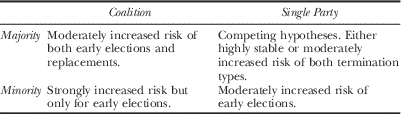
To summarize, we have two overarching theoretical arguments that are based on the idea that economic performance has a conditional effect on the likelihood of early government termination. A government’s minority or majority status and whether it is a single party or coalition government affect how easy or difficult it is for the government to respond to economic downturns and what kind of termination options (early elections or replacements) are available to it. This leaves us with four distinct types of government that should respond in different ways to the same changes in the economy. Our expectations for each combination of traits are summarized in Table 1.
Expected Effects of Poor Economic Performance for Different Types of Government

DATA AND METHODS
To investigate the connection between macroeconomic conditions and cabinet stability, our main source of data is the European Representative Democracy Data Archive (ERDDA), which contains data on parties, governments and institutions for 29 European democracies between 1945 and 2013 (Andersson et al. Reference Andersson, Bergman and Ersson2014).Footnote 2 However, we did not use the information on all countries included in the data set, because governments in Central and Eastern Europe (CEE) tend to end for slightly different reasons than those in Western Europe (Bergman et al. Reference Bergman, Ersson and Hellström2015).Footnote 3 Also, the data for CEE countries is from 1990 onwards whereas the data on the Western European countries goes back to 1945. Thus, both the termination dynamics (and probably responses to economic changes) and the temporal coverage differ between the two regions. As a result, we have chosen to focus exclusively on the 18 Western European countries to improve the homogeneity of the final sample, which included about 430 cabinets.
It should be noted that this restriction of the sample also serves to highlight the fact that our theoretical starting points are not universal. In particular, our theory applies to mature parliamentary democracies where ideological competition is relatively stable and where government parties are likely to have firm policy preferences. In CEE countries, in contrast, the swift changes in the party system and high voter volatility ensure that ideological lines of division are less fixed (Bielasiak Reference Bielasiak2005; Kitschelt Reference Kitschelt1995). Polarization is lower and left–right divisions are less entrenched in CEE. Since our theory is tied to policy conflicts and compromises and to the electoral effects of certain ways of dealing with economic deterioration, the posited causal chains are expected to be primarily at work in more stable party systems with established ideological conflicts.
As the ERDDA data do not include information on termination reasons after 1999 and use a definition of discretionary termination that included some terminations not attributed to cabinet instability, we updated and recoded this information to include all cabinet terminations up to 2013. Through our recoding we are also better able to distinguish between technical terminations (i.e. non-failure), early elections and replacements.
Regarding measurements of the state of the economy, the two most commonly used economic indicators to capture economic developments in previous studies have been inflation and unemployment levels (e.g. Damgaard Reference Damgaard2008; Robertson Reference Robertson1983a, Reference Robertson1983b; Saalfeld Reference Saalfeld2008). In addition, a few studies have (also) investigated the effects of GDP growth levels (Carmignani Reference Carmignani2002; Tzelgov Reference Tzelgov2011; Warwick Reference Warwick1994; Warwick and Easton Reference Warwick and Easton1992).Footnote 4 In these earlier studies, static measurements of economic conditions at the time of government termination have generally been used.
Here, in contrast, we try to capture economic performance by measuring changes in the rates during the government’s time in office. In particular, we use measures of unemployment and inflation and measure how these have changed from when the government was inaugurated to when it ended its reign. We focus on inflation and unemployment here, and exclude GDP growth, since these two have been the most popular measures in previous studies. In addition, GDP growth is often correlated with inflation and unemployment levels, so including it in the same models could obscure the results, especially when sample sizes are small. Unemployment and inflation constitute two distinct, but related, ways to capture the government’s economic track record that the voters are known to care about. There are two key reasons why it might be advantageous to look at changes in economic developments rather than static measures. First, the normal absolute levels of unemployment and inflation have changed over time. Unemployment levels in the 1950s and 1960s were very low by twenty-first-century standards, so the same level that would be a problem for the government in the 1960s would be considered a notable success today.
Second, it is likely that voters care more about economic momentum and trends – that is, the direction in which the economy is developing, than about the static levels. To take an illustrative example, Spain has had an official unemployment rate of 20–25 per cent for most of the time since the 2009 economic crisis. If the government managed to reduce this to, say, 15 per cent, it would likely be rewarded by voters, the prospect of which might well boost its stability. By contrast, an unemployment level of 15 per cent in most other countries would likely hurt the government’s standing with the voters. By instead looking at changes, the Spanish government in this example would be assessed on its improvement of the unemployment rate by five percentage points rather than its still comparatively high rate. In this way, momentum and changes in the rates contain information that is more valuable to voters, and thus to governments, than the absolute rates themselves. Thus, by looking at the changes in the rates during the government’s tenure, we control for both differences in starting values and in changes in the normal values over time.
We have no specific expectations for whether unemployment or inflation should be particularly important for certain government types or termination types. Both are treated as exogenous economic factors that have similar effects on the strategies and incentives of the parties in power.
To assess the stability of different types of cabinets and differences in their survival time (i.e. the time between their inception and termination), we need to define a new cabinet. In previous studies various definitions of a government replacement, and measurements of cabinet duration, have been applied (cf. Saalfeld Reference Saalfeld2008; Tsebelis Reference Tsebelis2002). In this study we use the following, widely accepted, definitions of the beginning, termination and duration of a cabinet. A cabinet is regarded as new following any general election or change of either prime minister or party composition, and ends when it officially resigns or (if sooner) on the date of the general election that ends its tenure (Müller and Strøm Reference Müller and Strøm1999: 16). The cabinets in the data set that were terminated for technical reasons (e.g. by regular elections, for constitutional reasons or the death of a prime minister), and those that did not terminate during the study observation period, were all right-censored (Allison Reference Allison1982) in the empirical models.
Methodologically, we use Cox proportional hazards models (Cox Reference Cox1972; Kleinbaum and Klein Reference Kleinbaum and Klein2005). More specifically, we first estimated a model with all government types pooled into one sample but divided based on termination type (i.e. early elections or replacements). This conforms to the standard praxis in the field and is done to have a baseline model with which to compare the more detailed analysis. This is then complemented by a second type of model where the sample is split up based on government type to investigate whether the effects of the economic changes are conditional on government type. This split sample approach is equivalent to testing the three-way conditional interaction effect of
 $$economic\,\,performance {\times} \left( {minority\mid majority} \right) {\times} \left( {single \,party\,\mid\,coalition} \right)$$
. However, for presentational purposes, as we have two economic performance indicators to test (both unemployment and inflation), including two such three-way interactions in the same model would be a lot harder to interpret than using a split sample approach.
In addition, to substantively interpret the results, we also plot changes in the relative risk of early termination. This essentially shows the hazard rate associated with particular variable changes as the variable goes from low to high values while the other variables in the model are held at their mean values. In our case, especially since the model is non-linear, this can help us substantively interpret the results of the Cox proportional hazards model to make the full impact on government duration easier to ascertain.
Variables
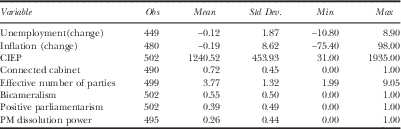
The main variables of interest here are two proxy measures of economic conditions: unemployment rate and inflation rate (measured as the consumer price index). Furthermore, several factors in addition to economic factors have been identified in the literature as potentially important for cabinet stability and should therefore ideally be included in the analysis. Thus, the estimated models below include a number of control variables, but these are not our main theoretical concerns in this article. We chose to include only the following, commonly used factors in the analysis. First, maximum possible duration was included, partly because it controls for differences in the length of the constitutional inter-election period (CIEP) or the remaining length of the tenure for cabinets formed during the CIEP. This variable also provides a proxy for the declining value of the time left in office as the CIEP draws to an end and the falling opportunity cost of early elections (Lupia and Strøm Reference Lupia and Strøm1995). Second, we include a measurement for the effective number of parties (Laakso and Taagepera Reference Laakso and Taagepera1979) which captures the fragmentation of the party system, provides a proxy for bargaining complexity and is at least weakly related to the availability of alternative governments.
Moreover, as argued by Warwick (Reference Warwick1994), the ideological distances of parties in governing coalitions are also important factors for cabinet duration, as more ideologically homogeneous coalitions tend to last longer than more heterogeneous coalitions. We therefore also included a proxy indicating whether coalitions are ideologically connected, called connected cabinet. We also consider the following institutional aspects at the country level: whether the prime minister has the power to unilaterally dissolve the parliament and call for early election, here called PM dissolution powers (Schleiter and Morgan-Jones Reference Schleiter and Morgan-Jones2009); whether there is a second chamber that can impact legislative decision-making (i.e. bicameralism); and finally, whether the government needs to pass an investiture vote to get into office (i.e. positive parliamentarism). Descriptive statistics for all variables used in the analysis are listed in the Appendix (Table A1).
ANALYSIS AND RESULTS
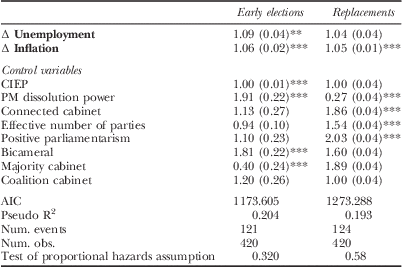
In order to pinpoint the impact of economic performance on different government types as clearly as possible, the analysis is done in two steps. First, we present what could be called a ‘standard model’ in Table 2, where we do not separate the different government types. This will be used as a baseline model with which our conditional models can be compared. In the second stage, then, we use a split sample approach and run separate regressions for each of the four government types considered here to test the conditional effects.
Additive Cox Regression Model (all governments in one sample)

Notes: *** p< 0.01, ** p< 0.05, * p<0.1. The coefficients are reported as hazard ratios and robust standard errors are in parentheses. Unemployment and inflation are measured as changes over the government’s term of office.
In Table 2 we can see that after controlling for other relevant variables, poor economic performance, regardless of whether it is unemployment or inflation, seems to increase the risk of government failure. More specifically, each extra step of inflation increases the risk of early elections by 6 per cent and replacements by 5 per cent, other variables held constant at their means. So, if inflation increases by three percentage points during the government’s tenure, the risk of early elections increases by 1.063, i.e. approximately 19 per cent.
As indicated by the larger hazard ratio, unemployment has a slightly stronger substantive effect, but only for early elections. With an odds ratio for early elections, each increase in unemployment leads to a 9 per cent increase in the risk of early elections. All in all, it seems as if both indicators of poor economic development increase the overall risk of government termination, but inflation affects both termination types and is also significant at the 1 per cent level making the effect of this variable more robust.
Many of the control variables also appear to be of importance, at least for one or the other of the termination types. This is in line with earlier findings. Interestingly, the not so frequently tested factor PM dissolution power has the hypothesized effect: it increases the risk of early elections but substantially lowers the risk of replacements. Most of the other variables seem to increase the risk of both early elections and replacements, but PM dissolution power seems to be consciously used to avoid replacements in favour of early elections (Schleiter and Morgan-Jones Reference Schleiter and Morgan-Jones2009).
Thus, with all government types aggregated in a single sample, poor economic performance does indeed seem to increase the risk of premature dissolution, a finding consistent with the results of most of the earlier studies.
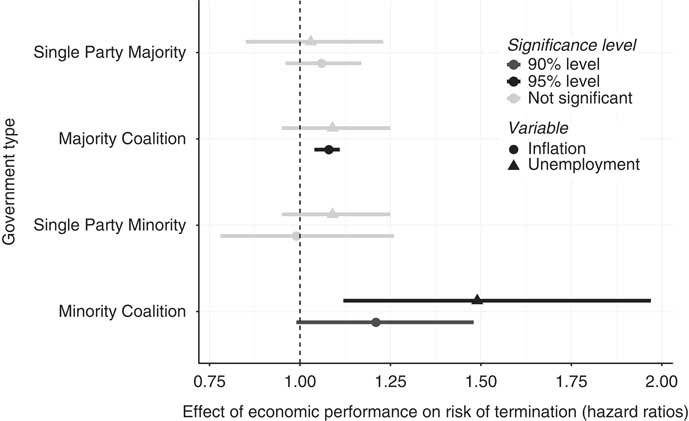
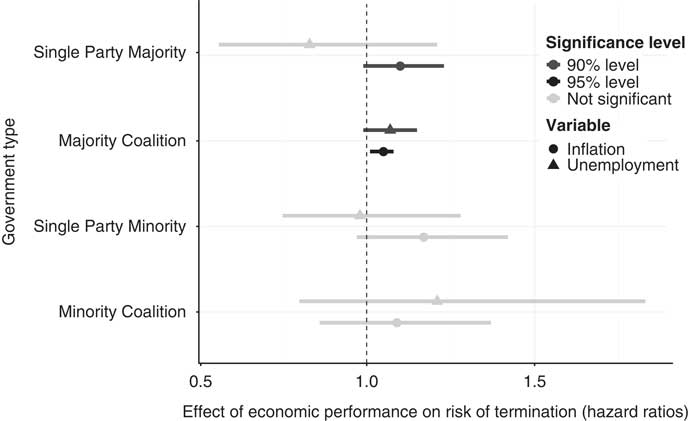
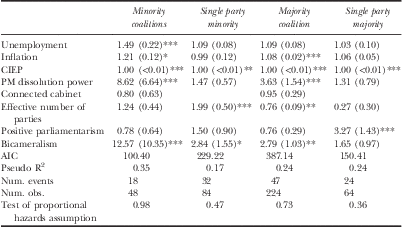
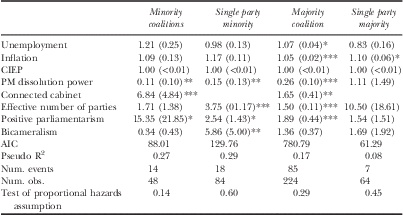
However, the question of whether all government types are equally affected by the same changes to the economy is yet to be answered, so we proceed by investigating the effects of economic performance separately for each government type. These results are reported in Figures 1 and 2.Footnote 5 In the figures, we only show the effects for the two economic predictors to make the results clearer, but the full results with all control variables and diagnostic information are available in Tables A2 and A3 in the Appendix. In Figures 1 and 2 the light grey lines indicate that the finding is not significant at conventional significance levels, whereas dark grey or black lines are significant at 90 and 95 per cent levels respectively. The dot or triangle in the middle of the line displays the hazard ratio.
How Economic Changes Affect the Risk of Early Elections for Different Government Types Notes: The model is a Cox proportional hazards model with robust standard errors. Black and dark grey lines indicate statistical significance at 95 and 90 per cent levels, respectively. The dots in the centre show the hazard ratios from the Cox regressions. The ‘wings’ show the 95 per cent confidence intervals. The dashed line at 1.0 indicates no effect. The full regression results are available in the Appendix.

How Economic Changes Affect the Risk of Replacements for Different Government Types Notes: The model is a Cox proportional hazards model with robust standard errors. Black and dark grey lines indicate statistical significance at 95 and 90 per cent levels, respectively. The dots in the centre show the hazard ratios from the Cox regressions. The ‘wings’ show the 95 per cent confidence intervals. The dashed line at 1.0 indicates no effect. The full regression results are available in the Appendix.

The results in Figures 1 and 2 show that the effect of economic performance on the risk of termination does indeed vary depending on the type of cabinet. Starting with the effect on early elections in Figure 1, we see that two government types, namely minority coalitions and majority coalitions experience increased risk of early elections when inflation increases. Minority coalitions appear to be affected by both unemployment and inflation (but inflation only at the 90 per cent significance level) whereas majority coalitions are primarily affected by inflation. The effect of unemployment on minority coalitions is the single largest effect in substantive terms in any of our models. With a hazard ratio of 1.49, an increase of the unemployment rate by two percentage points during the government’s term of office more than doubles the risk of ending through early elections for a minority coalition. The hazard ratio for majority coalitions, by contrast, is only 1.08. This is in line with our hypothesis that minority governments are more strongly affected in substantive terms by the same change in economic performance. The other two government types, single party minority and single party majority governments, appear to not be significantly affected.
In Figure 2 we can see the effect of economic performance on the risk of replacements. The most susceptible government type is majority coalitions; for this type of cabinet both unemployment and inflation appear to have a substantial and statistically significant effect on the risk of termination by replacement (though the effect of inflation is significant at the 90 per cent level). In addition, single party majority governments may be affected by rising inflation levels (at the 90 per cent significance level). Moreover, inflation increases the risk of a replacement termination for majority coalitions by 1.08 on average, which means that if inflation were to increase by three percentage points during the term of office, say from 1 per cent to 4 per cent, the risk of termination would increase by 26 per cent, other variables held constant at their mean values. In contrast, neither of the two types of minority governments appear to have experienced increased risk of ending through a replacement following an economic downturn.
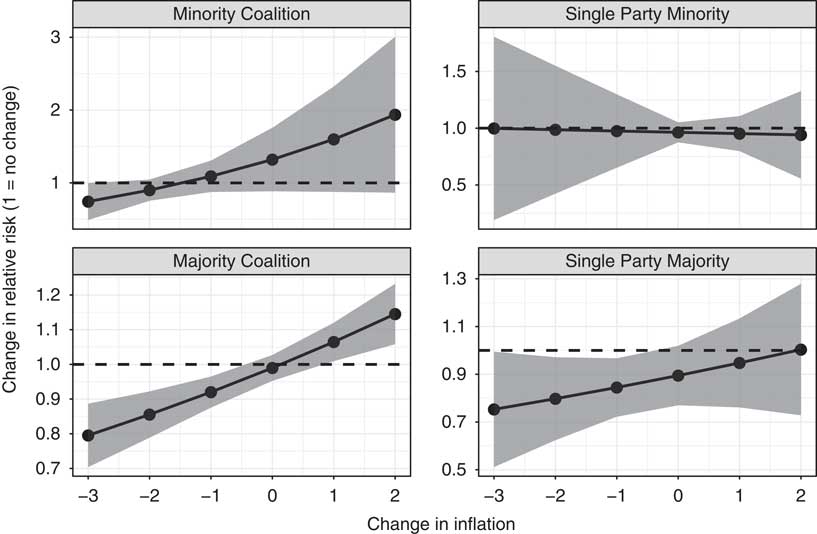
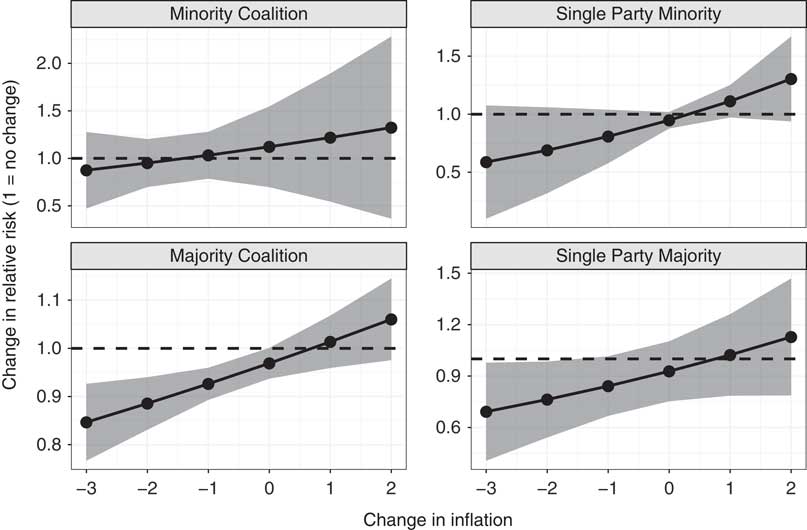
Compared to the regression with all governments pooled into one sample reported in Table 2, in the split sample models it is evident that in some cases only certain government types drive the aggregate results. Thus, even though both our economic variables were both substantially and statistically significant in the ‘standard’ regression in Table 2, the results in Figures 1 and 2 show that it is in fact only some of the government types that experience an increased risk of breakdown following an economic downturn. However, we can get much more revealing and substantively meaningful information on how the risk develops for the different types of cabinets for the same economic effect by plotting relative risk ratios. Thus, Figures 3 and 4 show the relative risk ratios for inflation on the risk of early elections and replacements, respectively.
Changes in Risk of Early Elections as Inflation Increases Notes: The graph shows how the risk of early election develops as the change in inflation goes from negative to positive, with other variables held constant at their mean values. The y axes are scaled differently in the four plots in order to display the trends more clearly.

Changes in Risk of Replacements as Inflation Increases Notes: The graph shows how the risk of ending through a replacement develops as the change in inflation goes from negative to positive, with other variables held constant at their mean values. The y axes are scaled differently in the four plots in order to display the trends more clearly.

Figure 3 shows changes in the risk of early elections as inflation goes from low to high, with other variables from the empirical models held constant at their mean values. That is, the figure tells us how the likelihood of premature dissolution in the form of early elections changes when the government’s track record goes from reducing the inflation rate by three percentage points to increasing it by two.
The four plots show in stark contrast how the likely effects vary from government to government. For the two types of cabinets where inflation significantly increases the risk, minority coalitions and majority coalitions, we see a linear or curvilinear increase in the risk. For example, for majority coalitions, if the government manages to reduce inflation by three percentage points, the likelihood of early election drops by about 20 per cent. By contrast, if inflation increases by two percentage points, the government experiences a 15 per cent increase in the risk, other variables held constant at their mean values. Moreover, the change in the risk is curvilinear. Hence, the more inflation increases, the faster the risk grows. This suggests that performing badly on inflation quickly becomes a liability for these governments.
These effects are even stronger in substantial terms for minority coalitions. On average, if a minority coalition was to reduce the rate of inflation by 3 percentage points, this would cut the likelihood of early elections by around 40 per cent on average. For single party governments, in contrast, regardless of whether they are in a minority or majority, we see no statistically significant changes (that is, the confidence interval at −3 also covers the mean estimate at +2, which means that it cannot be statistically confirmed that anything changes). For single party minority governments, the average relationship even appears to be reversed. The mean estimate here actually suggests a downward trajectory for the risk as inflation increases, but the confidence intervals indicate that we cannot really say which way the risk is going. The results for early elections taken together thus suggest that the same changes in the economy affect single party and coalition governments in quite different ways.
If we instead turn to the empirical results for replacements in Figure 4, we find similarly stark discrepancies between the different types. But this time, as foreshadowed in our hypotheses, the differences are between majority governments on the one hand and minority governments on the other. Here we can also see that those differences are substantively important. A single party majority government cuts its risk of ending through a replacement by around 30 per cent in those situations where it manages to reduce the rate of inflation by three percentage points. For majority coalitions, a three percentage point reduction in inflation leads to a 16 per cent reduction in the risk. Minority governments, in contrast, are not significantly affected by changes in inflation.
Turning to the hypotheses that we formulated in the theory section, we can see that most of the general expectations were confirmed by the empirical results even if some of the details were not. Our first hypothesis was that minority governments would be more strongly affected in substantive terms. This expectation finds empirical support. The largest effect measured here by far was the effect of unemployment on the likelihood of early elections for minority coalitions, where each extra step leads to a 49 per cent increase in the risk. The second largest effect also befell minority coalitions, since a one percentage point increase in inflation was found to lead to a 21 per cent increase in the risk of early elections for them. Majority governments are also affected by bad economic performance, but these effects are consistently a lot smaller in substantive terms.
Our second hypothesis was that minority governments would primarily be affected in the direction of early elections and not replacements, whereas majority governments could be moved in both directions. The reason for this expectation was that it would be difficult for minority governments to survive the reduction in size that would follow from defection of a coalition party, making early elections a more plausible choice. This hypothesis finds support in the empirical data, since all of the significant effects on minority governments are in the direction of early elections. For replacements, economic changes were never close to having a statistically meaningful effect. For majority governments, in contrast, poor economic performance was found to lead to a higher risk of both early elections and of replacements.
One slight deviation here from our expectations was that single party minority governments do not seem to become more likely to hold early elections when the economy turns sour. Although their single party status was expected to make them relatively stable, their constrained ability to pass legislation to address economic problems was believed to increase the likelihood of early elections. However, this expectation finds no support in the data.
Strong empirical support was, however, found for our third hypothesis – that coalition governments are more sensitive to economic changes since they find it more difficult to agree on a coherent response. All but one of the statistically significant effects found here befell coalition governments and these effects were also generally stronger in substantive terms.
Finally, our fourth hypothesis was concerned with single party majority governments, and this hypothesis was divided into two competing expectations. First, we could expect this type of cabinet to be especially resilient to changes in economic performance since it does not need to compromise on policy and is fully able to pass legislation in parliament. Second, and conversely, the clarity of responsibility hypothesis (Powell Jr and Whitten Reference Powell and Whitten1993) suggests that single party majority governments are most easily identified as responsible for policy outcomes by voters and should therefore be likely to react more strongly to economic downturns. In this respect, we found moderate evidence in favour of the latter expectation. Single party majority governments experience increased risk of replacements when inflation rises, suggesting that their full discretion over policy is not enough to shield them from the effects of a deteriorating economy. This effect was, however, only significant on the 90 per cent confidence level, which suggests that more research needs to be done to determine whether the finding is robust.
Overall, our results indicate that the assumption of a homogeneous effect of economic performance on all types of governments is flawed. Although the results reported from the joint model in Table 1, where we do not distinguish between different government types, show that the economic variables are both substantially and statistically significant, further analysis shows that these results appear to be driven mostly by coalition governments. Economic downturns appear to be easier to manage for single party governments. Parties in coalition governments can agree to many things in advance through coalition agreements (Müller and Strøm Reference Müller and Strøm1999), but when an external, unforeseen, economic shock arises it seems that multiparty governments find it more difficult to devise a joint solution. In addition, the finding from the joint model in Table 2, that poor economic performance (inflation, in this case) leads to an increased risk of replacements, is driven entirely by majority governments. These findings together confirm the main argument of this article, that the effect of economic performance on cabinet stability is most likely conditional on government type. Thus, modelling the effect of the economy as conditional on the type of cabinet in power should improve our empirical understanding of its effects.
CONCLUSION
This article takes its point of departure from the idea that governments differ in several respects that matter for how they respond to exogenous shocks. Here exogenous shocks were operationalized through changes in the unemployment and inflation rates. Since minority and majority, coalition and single party, governments have slightly different interests and abilities to withstand the pressure caused by a changed external environment, there are good theoretical reasons to believe that they have different responses to the same changes in the economy. This means that poor economic performance is likely to have a diverse effect on cabinet stability that is directly conditional on the type of government that is in power.
To test these expectations, we first ran a ‘standard’ model that did not distinguish between different types of cabinets and found that rising unemployment and inflation levels lead to an increased risk of both early elections and replacements. However, when the different government types were treated separately, we could see that coalition governments were far more likely to experience increased instability, whereas single party governments in most cases were unaffected. In addition, our results indicate that majority coalitions tend to end through both replacements and early elections, whereas minority coalitions only become more likely to hold early elections. Finally, minority governments, in particular minority coalitions, are more strongly impacted in substantive terms.
These findings suggest that the relationship between economic performance and government stability is more complex than previous studies have implicitly assumed. Although the results in the baseline model where all government types were pooled show that both unemployment and inflation have significant effects, this result is driven almost entirely by coalition governments.
Thus, overall, these findings suggest that separate treatment of different cabinet types is valuable for identifying causal processes and pinpointing mechanisms that bring about government collapse. Economic changes are examples of environmental changes that can break initial governmental equilibria. Other factors, such as the relative popularity of cabinet parties and changes in the salience of different political issues, could also change the power dynamics and incentive structures (Müller and Strøm Reference Müller and Strøm1999: 285). In all of these cases the causal processes leading to cabinet termination could vary depending on the type of government in office. In such cases it would also be valuable to take the conditional relationship into account.
Appendix
List of Variables

Full Cox Regression Results: Early Elections

Full Cox Regression Results: Replacements

ACKNOWLEDGEMENTS
We gratefully acknowledge the financial support of the Marianne and Marcus Wallenberg Foundation (MMW 2011.0030) that made this research possible. We also thank the anonymous reviewers of this journal.