Anthony Braxton is one of my favorite authors of speculative fiction.1 For me, he's right up there with the writers of The Epic of Gilgamesh and the Rig Veda, for his invention of myths and mythical characters; with the Lotus Sutra and the Diamond Sutra, for his esoteric-cum-poetic fast tracks to enlightenment; with Homer, Lucian of Samosata, and Aristophanes, for the elements of improvisation, irony, and drollery, and dubious heroisms added to the mythic-esoteric mix. Braxton is a torchbearer for Plato, Sir Thomas More, and Jonathan Swift for his utopian/dystopian themes and an heir apparent to H. G. Wells, and to Ralph Ellison's unique treatment of invisibility. Braxton's vision of sentient artificial intelligence keeps company with Mary Shelley, Isaac Asimov, Steven Barnes, Philip K. Dick, and the geniuses behind the second Battlestar Galactica television series. Braxton's work, with its theological/philosophical concerns, couched in childlike fun and wildness, sits companionably on my shelf next to that of C. S. Lewis and J. R. R. Tolkien. In listening to Braxton's music, I often ponder the subaltern themes and visions of Franz Kafka, Doris Lessing, and Samuel R. Delany.
But I don't mean to make the case for Braxton's written texts alone as comparable to those of world literature and its genres. Rather, I hear and read his employment of that mother of all technologies, the tool (techne) of language, as a driving force behind his conception and experience of his music. Braxton's music can also be read as extensions of his way with words, beyond complementary homologies and into further utterances of them. Such extensions, read as texts and narratives themselves, inform and satisfy me as a vibrant part of the literary-imaginary universe invoked above.2
From his first gestures in the 1960s, Braxton's music and its relationship with language have developed in an unbroken line as traceable as a good genealogy. Braxton's texts have evolved over the years from the earliest quasi-scientific liner notes to the more ruminative, extended abstractions of the 1,800-page, three-volume Tri-Axium Writings (Reference Braxton1985), the more poetic-vignettish additions to those elements in his five-volume Composition Notes (1988), and in recent decades the most literary style of his larger-scale music-theatrical projects (e.g., Compositions 173 and 174), a more recent set of composition notes, and the libretti for his important Trilliumopera series of the 1990s. In that range are found redolences with pulp science fiction, religious fables, philosophical epigraphs, and narratives around many other themes.
In 1996, I worked as Braxton's graduate teaching assistant to help produce and premiere the opera Trillium R (1991): Shala Fears for the Poorat John Jay College of the City University of New York. The opera seemed to me to be something of a summative gesture of all that had come before in his work. The libretti for the Trilliumseries developed from the Tri-Axium Writings, which discusses historical, sociopolitical, and philosophical issues in the abstract. The Trillium operas engage those issues in plot and character development.3
As the opera's title signals, all four acts of Trillium R explore some aspect of social injustice. Act 1 is set in a generic corporate boardroom, where nine CEO-types plot mass exploitation for their profits. Act 2 moves to the humble kitchen of a working-class couple struggling to survive in such a profit-driven society, and Act 3 explores the fear and loathing humanity harbors of contagious disease and people afflicted by it. Finally, Act 4, the most ominous, presents a fantastic vision of an elite cult, whose evil extends far beyond the mere greed of the boardroom into the bloodthirsty war plans of a superpower.
Real corporations, people, diseases, nations, times, and places are not named here, leaving all shoes that fit ready to wear. To call up some of the writers mentioned above, Acts 1 and 4, which could be set anywhere from the early 1900s to the late 2100s, resonate with the depictions of the extraterrestrial overlords of Earth, both good and bad, in Doris Lessing's novel Shikasta or C. S. Lewis's That Hideous Strength.4 The intellectual, cultural, gender, and political range suggested by those two comparisons, as well as by the science-fiction genre itself, suggests the ideological and aesthetic flexibility in Braxton's musico-literary imagination—something Howard Zinn or Noam Chomsky would appreciate, as well as, say, evangelical Christians concerned about human rights, family values, or the environment.
Before focusing on Braxton's libretti in some detail, a scan of their development from his work as a whole will establish the macro-context for the specific work engaged here and at the same time provide a glimpse of how Braxton does and does not use technologies and tropes (branching from the overarching root techne, language). This approach will allow me to present and argue for my reading of the artist's oeuvre and public persona as a seamless text comprising subtexts of speculative fictions.
Five Short Tall Tales Long Told
Trope One: The humble but plucky saxophone that dreamed it was a talking grand piano, then an orchestra comprising every instrument in the world, then the whole living multiverse and all life-forms in it. . .then woke up and realized that it was indeed, all three.
In Braxton's operas, a pool of twelve characters (six males and six females) enact the stories of a planned opera series comprising thirty-six acts. Each act can be performed alone or in any combination and sequence; Shala combines four of these into Trillium R. The characters, some with names suggesting glossalalia, are conceived as archetypes in human form. They play a range of different roles from act to act, sometimes villainous, sometimes virtuous, from the human perspective—much like Hindu devas, or Greek gods. The effect is of a tableau of reincarnation, each act a life, or of a view of the same universal human dramas playing out in different people, times, and places.
These characters are personifications of the twelve “sonic units” (language types) Braxton worked out on his alto saxophone over time, beginning in the 1960s, when he first began using that instrument as a tool for composing, as an alternative to the piano:
1. Shala (long sounds, stable)
2. Ashmenton (long sounds, active)
3. Helena (trills)
4. Zakko (staccato sounds)
5. Ntzockie (intervallic sounds)
6. Joreo (multiphonics)
7. Sundance (short sounds)
8. Bubba John Jack (angular sounds)
9. Ojuwain (legato sounds)
10. David (diatonic, scalar)
11. Alva (gradient sounds)
12. Kim (sub-identity sounds)
Braxton's notion of sonic units developed from his “language musics,” musical gestures such as long tones, trills, multiphonics that, as a performer working in what he called “physicality and moment dynamics,” contained the potential of fostering a personal voice. Each sonic unit functions as a “word” of sorts; the words are combined and sequenced into “geometric schemes”—improvised or composed gestures in the given “language”—and each scheme ends and transcends itself as one of twelve “identity states.” Keeping with the language analogy, the identity states correspond to that elusive essence the “sign” “signifies,” the meaning that emerges from the sonics as phonics and their interrelationships in the flow of musical time. Conceived as the one “moment” circumscribing that flow's infinity of moments, an identity state can include “dreams” and “sound imagery,” to name two elements that, in Braxton's terminological conception, pertain most directly to the process of composing the operas.5
The technology used here, then, is that of the acoustic musical instrument—still Braxton's favored tool, both as player and composer. Many others have used this technology, but few in the same “speculative” way. Some have given us memorable characters—Hawk, Bird, Trane, Machine Gun—but these seem more aptly conceptualized as characters in a tale already under way. Pythagoras, the ancient Chinese literati qin players, John Cage, Harry Partch, or Karlheinz Stockhausen would be the more apt comparisons—those who have spawned and spun philosophy, system, mythoi, and cosmology from such instruments. The alto saxophone has been Braxton's stylus, his draftsman's compass. Even when he has used it as a virtuoso improviser, the drafts of thoseBraxton texts become subsumed within his larger oeuvre as composer-cum-system builder.6
Trope Two: The utopian world of T-CK (Tri-Centric Kickitabout), where all the men and boys are smart and nice, all the women and girls are likewise, and all really are trying the “good idea someone should try sometime” that Charlie Parker, echoing Gandhi, defined as “civilization.”
Braxton's definitions of “tri-centric” have spun through various contexts over the years. The most solid of these contexts are music-specific: the notated (as thesis) has engaged with the improvised (as antithesis) to result in the “active existential” (as synthesis), a paradigm redolent of Trinitarianism and Hegelianism (or, closer to home, Muhal Richard Abrams's notion of the “triverse”). Closest to this study, Braxton writes in the Trillium R liner notes:
The name Trillium is an extension from my philosophical writings—Tri-Axium—and represents the third partial of my life's work—that being music (sound logic) systems, thought (philosophical) system, and ritual and ceremonial systems (belief). . .. The primary generating number for my ritual and ceremonial musics is the number three.
“Kick it about” is how Braxton often describes sessions of his group music making. The technology of this trope, then, is the band itself, the social technology of organizing the collective: its internal dynamics and their effects on the rest of the world. This socio-musical technology has often been discussed as a speculum of the larger society. Deconstructing the hierarchical organization of Western ensembles from symphony orchestras to jazz bands, music collectives, especially since the 1960s, have forged and wielded their mission statements and profiles to make pointed statements about new social orders, values, and protocols.7
Both the character and the structure of the groups Braxton assembles to play his own music emerge directly from his way of speaking both to and about those groups, and from his way of writing about his music. Particularly through their populations of six males and six females, Braxton's most recent groups “speculate” the twelve characters of his opera series as part of their own mythical world. Just as Braxton gives his fictional opera characters lives of their own to play out, so, too, has he delegated to these bandmates more and more of his functions as leader, conductor, and orchestrator of musical events. His expressed desire to disengage from the Romantic convention of concertizing from the stage to a passive audience (preferring, for instance, to disperse into crowds in outdoor public places) is a further extension of this organizational techne that leads to what Braxton calls “multiple hierarchies.”
The identity of Braxton's groups has evolved along with his music and writing into something uniquely utopian. Whether checking into the “family” as an honored guest for a spell or working as one of its core of regulars, a performer becomes a “friendly experiencer” traveling the contours of the beneficent host's compositional roadways and architectures, encouraged to relax, make oneself at home, and add to the unscripted parts of the fun and creative merriment. There are darker forces at work in the texts and sounds this crew and its captain articulate; as we will see in more detail, neither the experiences nor the experiencers of the libretti are always so friendly. But the affect of the band itself suggests a u-(as opposed to dys-)functional family. Well behaved, courteous, noble, nimble, never discouraged or surly, always looking after one another, never self-exalting at one another's expense, this is civil society at its best, a “u-functionality” far beyond mere “professionalism.” The groups and his music are designed to encourage balance among individual freedom of expression, musical initiative, imagination, and responsibility to the group identity.
Trope Three: Portraying outer space not as a metaphor for blackness, nor as escape from or transcendence of physicality, cerebrality, oppression, or mundanity, but rather as inner space, as habitable and traversable as Earth's terrain, without the need for spacesuits, spacecraft, or transporters (scientific technology).
This narrative takes us into an exploration of how the electronic technology of sound generation has been used iconically to evoke fantasies of space travel in both trans-European and trans-African musics (to use Braxton's descriptors).8 Braxton has worked with electronic musicians and instruments throughout his career, and many have read space analogies into the results. More salient, however, is the apparent absence of this theme in Braxton's most adventurously “literary” fancies, given his childhood fascination with rocket science, and the science-fiction affect of much of his work all along. I draw trope three from Braxton's conflation in the Trillium libretti of human characters with cosmological “forces” that appear unconstrained by the usual mortality of the forms they take on.9 Braxton's libretti are too archetypally unspecific to feel real—they could be happening in another dimension, galaxy, or universe—yet, much like ancient and traditional myths, they are also earthly and human enough to feel like the same characters our current myths cast as ship-bound, suit-bound, technology-crutched space travelers or colonists. Shala, for example, moves from one character to another, much like some Vodun loa roaming around from one possessed body to another.
I read several uniquely Braxtonian elements into this twist on that tale. One recalls the saying “feet firmly planted in midair.” As Braxton has eschewed the notion of “free” music as limited and reactive, he has also not played the space trope as a trump card standing for freedom or for ethnic identity, whether by working it as a metaphorical otherness or as a liberation from or superiority to (the) ground and gravity (of inhumane social/political realities). From his earliest literary-cum-theatrical imagery, we've seen pieces set in carefully detailed trains, park systems, castles, halls of mirrors, interstate highway systems, cities, mountains, forests.. . .but only occasional and passing allusions to their unearthly counterparts in the “spaceways” so sounded and charted by one of his musical heroes, Sun Ra. A more Braxton-resonant image, from real space lore, might be the post–moon landing vision of the earth itself as a spaceship we're all in together, for better or worse.
Braxton's work with electronics has served to expand his acoustic palette, rather than to add the one silvering that will turn all his pictures into spacescapes.10 If anything, the electronics inject something more like mysterious radio waves and noises from space to add to the organic Brownian motion already going on down here. Their mystery is that they could be meaningless space noise, or communications from sentient life-forms—or both. Once his scored and unscored events are set in motion, the space they suggest—with their multiplicities of lines, forms, and intervallic acrobatics—is more recursive, fractal, string-theoretically infolding into dimensions too small to detect, rather than out to wider wilds. Like the devas, who are also completely human characters, the monism of Braxton's narratives counters every dualistic fancy of an “otherworldly” space. This world, inner and outer, is part of “space,” and all of us are forces already inhabiting it naturally. No need to go anywhere, every need to be everywhere.
In the 1996 production of Shala, no electronics were used, but some of the lower-tech devices did suggest one aspect of this Braxtonian space: the dance of chance. First, Velcroed to the characters' limbs were Styrofoam-tinfoil-hanger-wire replicas of the three geometric symbols at the heart of Braxton's Tri-Metric/Centric system: the square (for fixed logics, such as notated music); the circle (for unprescribed, spontaneous musication); and the triangle (for improvisatory alterations of fixed material).11 For Braxton, these geometric fundamentals, rich in history as symbols in a panoply of indigenous and occult religious systems and mythologies, symbolize the forces of cosmic and universal processes incarnate in musical and human-cultural forms. The evocative effect, found also in his pictographic titles, is of invisible Platonic ideals (the abstract perfect shapes that do not exist in nature) and their contingent expressions in space-time (people) walking around together in a visible connection.
Second, the characters, moving about the stage in the flow of the story, suddenly struck poses, chosen at will from a pictorial list that included Nazi salutes, ballet gestures, and the pose of Rodin's The Thinker, that seemed disjunct from all else while possessing expressive and historical associations of their own. This homegrown technology of play broadens and maximizes the potential for those divinatory messages that arise from such approaches—surprising instances of unorchestrated synchronicity and order, epiphanous revelations and inspirations, along with measures of random and mundane meanings that are sought in indeterminacy by those attracted to them. The fun in giving all the characters a big box full of geometric symbols to grab and don, and lists of poses to strike at random, lies in the symbolism that emerges of itself when they do so. The fun in constructing a character from the sound-induced trance that dreamed him up is to let him take over his own life and tell his own stories, rather than to serve as a puppet symbol of his creator's saxophone sound, strategy, or vision.12
Trope Four: The really strange world where the sentience of artificial intelligence (AI) in all of its forms knows itself to be one and the same as that of biological life-forms. The characters in this world may be complete androids, complete humans, or cyborg mixes of the two. The playing field is level; they are all in the same family, and their stories unfold without their essential differences being even a bump in the road.
This takes us beyond the sound synthesis of trope three into algorithmic sequencing and programming, and the potential for computers “smart” enough to compose, improvise, and interact with humans. Again, language insinuates: the “words” 1 and 0, and the sequences thereof. If Braxton's sonic units “speculate” electronic sound synthesis, his geometric schemes likewise reflect the digital sequencing and programming of those sounds. The “identity states” category, then, signals where he comes down on the question of sentience and soul emerging from AI: he likes the idea. It reflects the same process he experiences in the evolution of his own sonic units, through stacks and lines of them to a finished gesture in time with a life of its own. However, as with his use of electronic synthesis, Braxton's use of this technology remains on his own carbon-based footing, however firmly planted in midair its feet might seem.
Excerpts from Braxton's notes for a class on the history of AI at Wesleyan University convey the composer's thinking and feeling about this technology. He argued in a classroom debate on the proposition that “computers can think,” that “human perception is only one example of consciousness, and the study of AI should extend into trans-human states and goals,” and that “this viewpoint also extends to animal and plant consciousness as part of the greater consciousness existing on earth (including rocks and minerals).”13
That, of course, can be read as either magical or theological thinking. As the latter, it is the statement of an animist, or a pantheist. Thinking artistically, it also bespeaks any artist's rapport with his or her medium. When a musician commits so much energy, thought, and physical engagement to an instrument, it rises from the level of inanimate object to a beloved companion, a fellow physical organism with a mind and voice and moods and surprises of its own. Not only medium but expression—the poem's lines, the novel's characters, the painting's images—goes beyond the creator's self into an identity of its own.
Computer technology as homunculus, then: a simulacrum of its human maker that, however bereft of this or that crucial definitive human trait, commands the fear, respect, and affection of its maker for its mysterious suggestiveness of an equal and independent consciousness—absurdity and impossibility aside—of which the maker is bereft. This model, surely the one favored by the Star Trek and later by the Battlestar Galactica scriptwriters, as well as the most literary science-fiction writers tackling the issue (preeminently, Philip K. Dick), suggests why the earlier “strong” (objectivist) AI scientists such as Schank and Winograd and their counterparts in more general discourses (positivists, behaviorists, grand narrativists) and in music theory (the “total serialists,” for one example) came to seem inadequate in their overadequacy.14 The best systems and uses of musical-notation-cum-programming were increasingly those that spelled out only so much information, leaving most to be filled in by their user.
How is all this applied to musical discourse and to the larger cultural discourse music “speculates?” Braxton hints at his answer in another part of his class notes when he expresses his dissatisfaction with most computer music:
With the exception of a handful of composers (notably Karlheinz Stockhausen and the American composer George Lewis) I have not been very impressed with computer music—and this is especially true for the interactive computer experimental musics. For my musical taste, much of this music was either too mechanical or too predictable.15
Having had some knowledge of the specifics of his likes and dislikes, I read “mechanical” to mean overdetermined (inflation of human agency). The critique of “predictability,” paradoxically, involves underdetermination—a deflation of human agency, as when the rhythmic and sonic vagaries of some natural process or mathematical premise are harnessed as music, with little or no human engagement other than the conception and initiation of the analogous technological process. Both of these extremes correspond to Western theological positions: on the “too mechanical” hand, a mechanistic Calvinism—specifically, the doctrine of predestination, God's foreknowledge that defines the absence of human free will; on the more laissez-faire hand, Deism's “watchmaker God,” who creates and then withdraws from the creation to let it play out its own life.
These positions played major roles in early American intellectual history yet have become historical cul-de-sacs, largely through challenges posed by African American and Native American presences. Paganism, animism, and what we might call “humanimism” provided the rationales and impulses that provoked the mystical, occult, Millennialist, and Pentecostalist turns in nineteenth-century European American culture—in other words, those aspects of the Judeo-Christian mythos and tradition that stress the union rather than separation of spirit and matter, heaven and earth, diverting it from those Enlightenment theologies (if we grant Calvinism as reactive against the Enlightenment) that were still essentially Platonic in their spirit-matter split.
In any case, as with the space trope, Braxton eschews the use of robots as metaphors for subaltern or threatening others; the drama of Commander Data as Pinocchio or the Cylons as complex Frankenstein monsters is not indulged. Nor has Braxton pursued the kind of friendly co-creative partnership with interactive technology advanced by Lewis and others. Braxton's use of both synthesizer and sequencer has been more Borg-like, picking up this or that sound/instrument/player as interesting additions to his existing sound cosmos/cosmology. “The machine must be live and intelligent,” says Lee Perry of the recording studio,16 much like Glenn Gould.17 However, Braxton cares only that the studio capture, not commandeer, his own live intelligence. The studio becomes a tool to “speculate” Braxton's own live performances, not an instrument in its own right.18
The closest that the process of creating Shala came to anything like creative sequencing was Braxton's writing each act independently, then ordering the results intentionally, an aesthetic decision signaled by the fact of four independent and untitled one-act operas now combined and ordered to express Shala fearing for the poor.19 This strategy recalls a biological version of AI's layerings of simplicities unto complexities not limited by either animacy's agendas or inanimacy's designs. Past musical statements are enfolded into present ones, recasting them as musical DNA, showing the present as extending teleologically back to its own evolutionary precursors. The identity state emerging from that trans-temporal metageometric scheming might be likened to the latest iteration of screen androids that look more human than earlier models—like Battlestar Galactica's humanoid Cylons who “evolved” from the more obviously mechanical “toasters.”
Trope Five: About the invisible man who spent his whole life in the public eye, growing more famous for better reason every day, and finally dying old and happy, never having been seen.
For H. G. Wells and Ralph Ellison, invisibility is not a happy state. Youthful fantasies of it are those of freedom, but exile and cloaking rather than solution of problems is the reality of the characters in these authors' works. Braxton's “treatment” of the theme of invisibility stems from his public persona as an artist defying easy categorization, who has often spoken of himself and been spoken of as unseen, in exile, going undetected by several different radar screens. In this, of course, he is in the company of all those other men and women “not seen” in their time, from Van Gogh to Herman Melville to Charles Ives, to name a few who easily spring to mind; whether he fits in such company is for later generations to decide. However, many of Braxton's own choices and ways of working align him with the happier invisibility of the anonymous bards, minstrels, and artisans in other times and places who have done their work more for God and people than for fame or fortune. Sometimes the best place to hide is in plain sight.
In Shala, each of the characters—whose vocal parts are entirely notated, with no improvisatory sections—is accompanied throughout by an associated solo instrumentalist who both improvises and plays scored lines. Dressed in hooded black robes, without personal identity, visible gender or race, these musicians came across in the 1996 production as invisible to the characters in the drama; shadow figures from the spirit world, influencing and being influenced by “their” people. These virtuoso improvisers provided some of the most striking and exciting musical moments of the entire production. The composer, usually as visible as his bandmates or the ensembles he conducts, was hidden from sight with the rest of the orchestra in the pit, in fine Wagnerian tradition.
The Libretto
Shala's rhythm was shaped by language, as a kind of “text painting.” “The story comes first,” Braxton told me of his way of making the opera. Since the music is conceived as a text painting, the human/word is restored to primacy, via an interdependence with, rather than dominance over, the rest of the world. The word is thereby redeemed from both modernism's undue primacy and postmodernism's reactively iconoclastic (de-centering, deconstructive) overthrow of authorship/humanity/language (ego, reason, thought, logic). Humanity/language is reinstalled as both determined/determinant and not, redeemed from the either/or snare.
After writing his own libretto on a word processor, Braxton broke the text down syllabically into one long penciled line at the tops of blank sheets of 11′,×,17′ paper positioned in the horizontal landscape rather than vertical portrait position. Underneath that line of text the composer wrote rhythms derived from the cadence and accents of the words, in the form of notes free of staff or meter. The note positions might rise or fall to suggest the inflected speech, but for the most part details of pitch were worked out after the rhythms. From those rhythms, Braxton would rough out the flow of meters suggested by the spoken phrases, assigning counter-rhythms to particular instruments. In turn, the process of deriving music from speech influenced him to write more text, or to change the text slightly for delivery and/or meaning.
Players are asked to adhere to the written rhythms, but pitches, though mostly fixed in both orchestral and vocal parts (except for improvisational sections), are not always strictly determined. Braxton does not always specify the clef or even provide a staff for a given part; in such cases, players are asked to play the pitch wherever they feel it on their instrument and in relation to the ensemble at the moment of performance. The practical result is usually something intervallically close to what is written anyway, just by virtue of how the players do hear and interact with each other and the material; this reflects Braxton's usual indifference to exactness of pitch, favoring instead the kinds of rhythmic, inflective, intervallic and textural-timbral effects that are often best accomplished by suggesting rather than precisely specifying pitch.
Thus, even in this 1996 performance of Shala, in which the players (most of whom were Braxton regulars in other projects) were provided with definite clefs and pitches, the composer himself did not put the soul of his meaning into their matrices; he did not work in rehearsal to ensure that each matrix was executed with a certain nuance, or an imposed or cajoled expressivity. Even the notes of the most pitch-specified parts—the singers'—all come with the “x” on their stems that denotes Sprechstimme.
This outline moved to score paper and, in that draft, to greater definition. Orchestration was determined, sections and instruments were worked for color, timbre, volume, texture; the pitches of the vocal line suggested their lines and harmonies.
In Act 2, Ashmenton and Ntzockie are seeing their only son David off into the world to start his life as an adult. David appears only during the first few lines of the scene, which is sung mostly by his parents as proud, brave, morale-building encouragement for a son who may be going on his first trip away from home—to college, or even to war; his destination is unspecified. The boy affectionately deflects his parents' fussing with the mix of humility and fearlessness of a good (and untested) youth; he says little else for himself, then leaves. The talk of the parents then turns cloudier.
The casting of Ashmenton and Ntzockie in the 1996 production was not conceived as a statement about race, but as it happened, baritone Melton Sawyer, playing Ashmenton, was African American, and the rest of the family was white. The libretto itself, however, was decidedly conceived and written by Braxton with overt social and political points. Both the depiction of the characters and the actual lines they sing carry clear positions:
There are several different lives available on this planet—everything is related to whether or not there are means. The culture is unhealthy in so many different ways. . .the reality of attraction has helped to erode the sanctity of marriage and commitment.20
Racial identities were not a factor in either conceiving the characters or casting their singers.21 Nonetheless, the pairing of an African American man with a European American woman and son in this particular scene clearly worked on a mythopoetic level as an all-white or all-black cast would not have. It could easily be read as emphasizing “humanity” more than “race,” but it could also invoke American racial problems and solutions beyond the pale or ken of the homogeneous. For me, the basis for that experience lay in my knowledge of the way Braxton's casting unfolded, but I think an uninformed audience member might have gained a similar impression from the sheer feel of the music, the libretto, and other aspects of the production. Somehow, knowing that the uncoerced universe is telling you something is more compelling and engaging than feeling you are watching a person grind an ax; it is perhaps even more compelling—this may sound cold—than feeling you are watching a person reveal, in all sincerity, dignity, and honesty, his or her most cherished inner truths or wounds. Of course, all three together—universe, ax, bared soul—make for the best combination.
For the rest of the scene, the couple expresses a mixture of their worst fears, and their fondest memories of love and family life, their hope and trust in a good outcome despite the odds:
What are we going to do, Pa? There is no way that we can get the money he needs to succeed at college. . .. The present-day images of youth and materialism have served to reawaken our separateness as individuals rather than as one nation or people.
Their intermittent declarations of love for each other unify the act, acting as a guiding light through the darkness of an evil society where good can yet survive, healthily enough, “in the cracks.” After airing these deepest fears, loves, and hopes, they call it a day and go to bed contented and fulfilled.
This act works as a ray of goodness against the portrayals of evil that define the other three acts. In Act 1, Ashmenton is the head of a venal board of directors planning the ruin of the general economic and social good for its members' personal gain, and Ntzockie and David are among his most eager minions; in Acts 3 and 4 (sans Ntzockie) Ashmenton and David are key players in, respectively, a mob-hysterical attack on innocent scapegoats (contaminated/contagious “others”) and, in something more like a war room than a boardroom, a powerful cult's initiation of an initially naive and later cynical aspirant into their deepest, most esoteric evil.
Through all four acts, good and evil unfold through a certain pattern: a single voice for good within a collective always succumbs to a greater number for evil. Shala, a member of the board, is the one voice for good in both the first and last acts, but in both acts she must confront the collective she is part of that constitutes evil. In both acts, her individual integrity sometimes fails in the face of greed:
Count me in, people. I've waited too long for this opportunity. Another victim on this level becomes only an aesthetic question.
At other times, her struggle to speak up for good is simply dismissed by another character as hypocritical posturing:
Spare me, Shala! You, of all people! No one has benefited more from our products than you. . ..
In this, as in the rotations from villains to victims of the characters through the four acts, we can read the true-to-life mix of good and evil in the human condition.
On the other hand, in the two middle acts, the love of a man and woman together, though not changing the threatening evil collective, keeps the lovers safe from it even in its midst. Act 3 portrays different lovers, even more vulnerable and threatened than Act 2's, and craftier and bolder in response. Ntzockie, as Ashmenton's wife in Act 2, utters the most pointed social and cultural critiques, in lines more typically expected from male characters:
Attraction on this level is political manipulation, but nobody seems to care any more. We must seek to install evolutionary images in the media that can positively motivate all of our people.
Ashmenton, by contrast, expresses his thoughts about general sociocultural issues in terms of his domestic situation and roles (provider, husband, father):
I've worked at the plant for forty years, Ma, and you are a witness to my efforts. . .. What can we do for our child that does not involve prayer? What can we do for our child that doesn't involve coming to terms with our limitations?
Ntzockie, too, speaks in her own, similar terms, but then breaks into a less personal, more public voice:
The reality of attraction in this context involved gaining correct information about the historical complexities of our situation and balancing that knowledge with present-day political decisions.
As she articulates those complexities and decisions from the high ground and climax of this scene for a good five or ten minutes, Ntzockie breaks off sporadically to exchange declarations of love with Ashmenton. Here, as throughout the libretto, conventional lines for conventional emotions are mixed in with the distinct Braxton abstraction-speak that the last excerpt exemplifies. One may read irony in lovers, parents, friends expressing themselves in this way; I tend rather to read it as Braxton's “ritual and ceremonial” language, the terminology he has created to speak about and from the archetypal world behind and between the real world's conventional lines. The man here is the earth, the home front; the woman is his tree of life in her proper soil. He supports her; she reaches for the sky in the larger world to sing their best song. When her inspiration subsides, his gravity wells up to receive her in the way convention would have us expect the woman to welcome the man home from his hunt.
Again, all this would carry a powerful charge even as a racially homogeneous scene. The devotion of the man bespeaks qualities of manhood that counter the prevailing images (in both the opera and, by implication, the real world) of violence, misogyny, lust for power and dominance. Similarly, the clear ability of the woman to cultivate a self-actualization that liberates not only her conventionally domestic emotions towards husband and son but also her humanity in the larger society—indeed, the former depends on the latter for its liberation—to empower her to speak as intellectual and activist in the context rather than in defiance of her family ties also says and counters much.22
This scene would also have much to say to us if the casting were specified as interracial, but what it would then have in common with the homogeneously cast versions would be its feel as a script, something someone intended to tell us, something carefully crafted to make points he wishes us to take.
Consider, instead, what the scene says to us when we know, or intuit, that it is not prescribed nor intended so but is the result of an aesthetic approach that values indeterminacy as something more rather than less authorially powerful and orderly, sometimes, than prescription. In this instance, it is like the difference between seeing two people who have come together for reasons they know well and moralize about—the conventional sanctity of marriage, or a statement about interracial marriage in America, something conceived and embraced by an idealist, a moralist, a person of principle—and two people who have simply fallen in love, in mystery, and are compelled to make things work, whatever the odds, because. . .well, just because they are who they are, they can do no other. When we rule chance out of the aesthetic approach, we can suspend our disbelief; we can let the artist intend and shape these characters and their issues for us, assessing them on the basis of their conditional believability. But once we acknowledge divinatory, revelatory results in the chance approach, we see that revelation is its nature—the similarity to life as it is, to the blossoming of any and all things out of unmanipulated potential. How, after that, can we go “back to the farm” of art that is bereft, or comparatively starved, of that unforeseen?23
Accepting indeterminacy de-problematizes the image of an African American man taking on the supporting, nurturing role in his relationship with the European American woman—a problematic image indeed when seen as metonymic of black manhood and white womanhood, or black culture and white culture in America. If the casting were prescribed, a conscientious critic would have to question the sensitivity of the prescription. Since it is not, what can one say? The same thing one might say to such a couple in real life. What critic could be so thoughtless and insensitive as to challenge such a couple (or their equally “problematic” gender-reversed counterparts) on such grounds?
The Score
The following score examples from Act 2 of Shala show what we might call Braxton's “trialectic” among orchestra, soloist, and singer, which suggests call-and-response between collective (scripted orchestra), “invisible” soloist (unscripted improviser), and (scripted) individual character. The vocal line stands as a clear point of definition, unfolding at roughly twice the rhythmic pace of the orchestra; the solo instrumentalist shadows the vocal line, signifying closely on it, as well as reading complementary written figures spun from it; and the orchestral lines comprise a chorus-like ground that, as we have seen, was unearthed through that sung line's point of definition—much as Schenker unearthed the Urlinie from the surface elaborations that he heard in common practice–style European works.
This structural approach is very much in line with Braxton's approach to composition through the single-line alto saxophone. A surface is immediately intuited, then the depths it may imply are more deliberately intuited through that surface—the reverse of a pianistic, theme-and-variations composer who establishes a foundation in harmonic-metric matrices and melodic flows then elaborates on them for surfaces more arbitrary than those. Braxton's depths in the orchestra are rather the more arbitrary, expressing the potential implied by, and less definitive than, its actualization in the singers and soloists; the orchestral role could as well have been played through other notes, also reversing Schenker's emphasis.
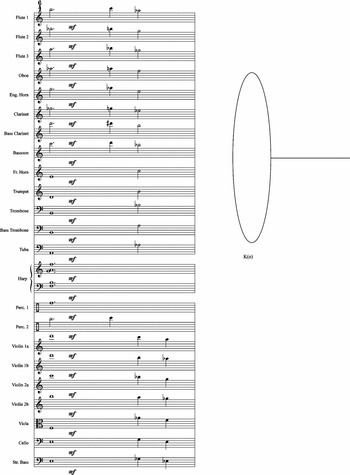
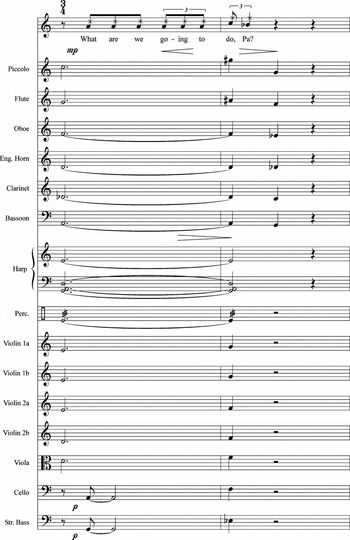
Example 1 (259c)24 introduces the scene from Act Two discussed earlier. As the curtain rises on the scene with Ashmenton, his wife, Ntzockie, and their son David, the full orchestra is ending its opening eleven bars of long tones morphing through increasing shifts of pitch, duration (from seven beats to one beat), and volume (pp to mf).
Anthony Braxton, shape Trillium R (1991): Shala Fears for the Poor (Composition No. 162), mm. 1232–33. Courtesy of Anthony Braxton.

This shape-shifting roil moves through moments defined by conventional meter—everything from 2/4 to 6/4—moments we will later see tailoring the lengths of the sung phrases. The double arrow signals a grand pause, and a player chosen from the orchestra during rehearsals takes the part signaled by the oval, of free improvisation. The K(o) directs the improviser to play something moderately (K) opposed (o) to what the orchestra is doing, so this will likely be a lively, bright articulation in contrast to the amorphous sound painting; the strings make four short statements, two with tremolos, during this improvisation.
The effect of the whole event is of a spark igniting out of some ruminant mass, illuminating that mass in turn. Braxton the conductor cues the entrances and exits of these kinds of improvisations and written accompaniments; the improvisations, scored so, are virtually always conceived as part of the flow and texture of the score, rather than as a showcase of virtuosity riding wildly above it. The orchestra resumes its ruminations.
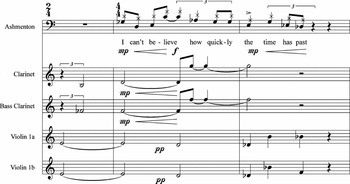
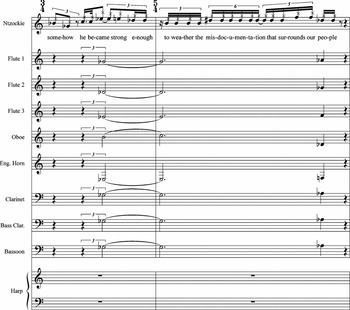
Ashmenton, the character who grew out of the second sonic unit, the “house of accented long sounds” (Braxton also calls his sonic units “houses” or “lands”), is the first to speak, and Example 2a (261) shows his second phrase. Braxton makes much use of duplet figures, from divisions of three (as at the start of this passage) up to seven, to get the phrases to float above the pulse and meters; in performance, he conducts the beat very clearly throughout to anchor such floats.
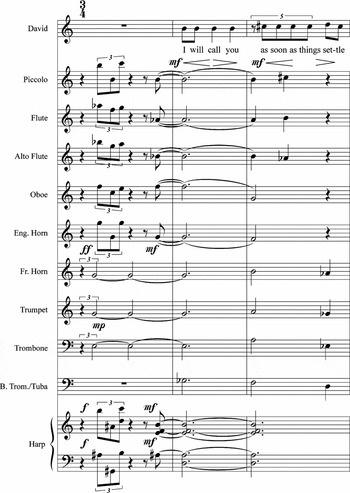
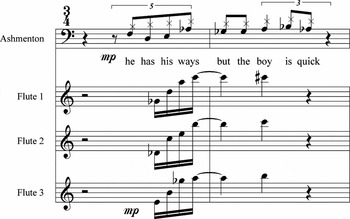
Example 2a shows four orchestra parts that echo the vocal line; the rest of the orchestra continues to play, too, but these parts are selected as an example of those echoes. The clarinets echo the word “believe,” and the violins, more loosely, reflect the phrase “the time has past.” This is the score's first example of such links, which occur increasingly as the work proceeds. Example 2b, some pages later (280), shows the links in more developed form. The winds and harp effect a condensed presentiment (in 3/4) of the words “I will call you” with their triplet and following note, while the strings and brass, conversely, expand the rhythm in their various sets of three, imaging “things settling.” Example 2c (309) exemplifies an orchestral gesture mirroring the idea of the boy's quickness, rather than any such quickness borne by the words that describe it.
Braxton, shape Trillium R, mm. 1263–65. Courtesy of Anthony Braxton.

Braxton, shape Trillium R, mm. 1351–53. Courtesy of Anthony Braxton.

Sometimes, to enhance the emotional charge of the words, the transparencies of musical stillness and silence are preferred over imitative motion. In Example 3a (282) the orchestra frames the seven syllables of the first phrase with one note, thus foregrounding its “identity state” as a phrase, a unified thought, more than the musicality of its syllabic-inflective flux.
That single note poignantly distinguishes the phrase from the single-syllable second one—“Pa?”—by changing notes, then resting. Example 3b (315) is another particularly elegant (through the harp) application, to a particularly powerful statement.
We have, then, two uses of musical rhythm that serve to showcase two different aspects of speech: its flow, where rhythm's reliability as expression gives way to its phenomenology as time-bound acoustic flux, “mere” music more than “sheer” logic; and its moment, where transcendence of the unreliable flow and flux of speech stands forth in a timeless (and also musical) meaning greater than the linguistic sign pointing to it—again, as with Braxton's “identity states.”
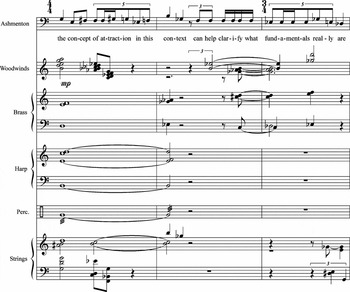
Example 4 (293) presents another kind of line for which the latter emphasis seems to be inordinately favored. Again, Ashmenton's remark that “the concept of attraction in this context can help clarify what fundamentals really are” is just the kind of Braxtonian phrase that has been represented by journalists and critics as particularly abstruse—yet for Braxton himself, acts as a clarifier.
In this example I can't help but read into the spare wisps of accompaniment a clearing of the air for the speaker and his audience, and into the choice of two-beat patterns a move to stress the words “context” and “concept.” The ability of music to foreground this or that aspect of speech is manipulated here to selectively bring into focus a meaningfulness that might otherwise be obscured or abstracted by the naked words and their tangle.
Example 4 opens up other areas of interest. First, Ashmenton's “shadow” soloist becomes visible. A diamond clef sign signals the player's option of any (or no) clef; a 2/4 bar following the phrase signals a free improvisation that accompanies the singer's subsequent two pensive lines, following the one shown. The effect: Ashmenton wanders into the heart of something with his abstract generalization, which in turn evokes a sudden thrashing by the soloist of the implications of his statement's potential, provoking Ashmenton to clarify what he means specifically in the next two lines. Those lines and the soloist's improvisation comprise a duet that flits through a few bars, just as vague realizations, little bolts from the blue, or miscellaneous cogitations do come and go through life's moments.
Braxton, shape Trillium R, mm. 1483–84. Courtesy of Anthony Braxton.

Braxton, shape Trillium R, mm. 1363–64. Courtesy of Anthony Braxton.

Braxton, shape Trillium R, mm. 1509–10. Courtesy of Anthony Braxton.

Braxton, shape Trillium R, mm. 1410–12. Courtesy of Anthony Braxton.

Improvisational and written-out sections occur in roughly equal measure throughout the soloist parts. An ear trained by only a couple of rehearsals, or even by the first half hour of the unfolding performance, can instantly discern between the soloists' improvisations and their renderings of notation. The latter provide definition from a realm (thought, spirit) where definition is most often either obscured (by too much merely suggestive dimness, as in the orchestra) or overwhelmed (by too much brilliant declamation, as in free improvisations) to the realm of human life (that of the singers), where definition is always uncertain.
Note also the meter flow in these passages. Framing the duple rhythm in the four key words—CON-cept, CON-text, (at-)TRACT-ion, CLAR-(i)fy—are, satisfyingly, two 4/4 bars (both limned and offset by the orchestra). The 3/4 frame of the phrase's wrap-up serves to blossom its climax, and finally the 2/4 that follows serves as both ending pause and transitional pickup to the next phrase; each of the three phrases unfolds in similar configurations of four, three, and two. Other parts of the score have condensed versions of this pattern of fluxing meters tagged by the shortest one—sometimes as short as 3/8 or even 1/8—after phrase-based meters that may go down to 1/4. The effect is of a flexible iambic musicality; pulses come and go through variously sequenced ups and downs, longs and shorts, strongs and weaks, rather than through well-defined channels of repetitive rhythmic bedrock.
This approach to pulse has been long and carefully cultivated in Braxton's work, and it clearly evokes the tradition of the lone jali singer-player-storyteller much more keenly than that of the master drummer who has developed his own soloisms through learning the interacting parts in an ensemble—reflected in the jazz drum kit—which he then internalizes and signifies on.25 The approach also reflects the more flexible-but-taut rhythmic universe of Carnatic music, itself intimately bound up with speech acts both mnemonic and poetic, and, once again, stems from Braxton's composerly orientation to the nature and role of his single-line instrument, the alto saxophone generator of the “language musics.” These musical examples convey the core of Braxton's approach as a composer working from, with, and against the language of the “stories that come first,” the creative idiosyncracies of both of which constitute his signature style. Consider now the meta-meaning (the “identity state,” if you will) for which the “text” of his work functions as sign.
Words of Power, Powerless Words
The theorist in me turns naturally to the composer's own words about the Trillium operas:
Trillium is conceived as a vehicle for family and cultural fundamentals/involvement as a consistent component in African/trans-African vibrational dynamics, as well as corresponding to the greater implications of the trans-European and Asian vibrational dynamics. Trillium is conceived as a world culture statement that respects composite humanity and the “realness” of apparent existence.26
I will look down the European side to consider Braxton's work as a literary construct and to worry through the issue of “the death of the author.” will look down the African American side to see his music as a work of “orature,” complicating, contesting, and reconstructing the European fundamentals. Finally, I will look down the Asian side for theoretical frames that will account for both the plenum and the void of language that, along with the question of the nature of authorship, go far towards explaining Braxton's work as more the world's than America's—barring future possible transformations of same, given our ever-increasingly pluralist demographics and sheer time.
Some years back, one of my previous studies of Braxton's music was critiqued by an anonymous peer reviewer for a journal. The reader dismissed my subject as undeserving of the attention I was paying it, because “Braxton is talking to no one but himself.” This remark struck me as coming from someone who might have read the plays and sonnets of Shakespeare and then wondered: “Is this guy in love with his own voice or what?” However, it stuck in my mind, and coalesced into a more general musing on words and how they are received. That cogitation took me over the well-trod terrain of postmodernist scholarship's wranglings over language, both spoken and written.
Beginning with Ferdinand de Saussure's analysis of language's structure, through the morphing of his structuralism into everything cultural, from kinship systems and mores to cosmologies and art forms and events, the Word (per the first chapter of the Book of Genesis and the first lines of the Gospel of John as much as per Foucault) has become the Author of All—including Itself—as all has become “text.” This Western intellectual history has permeated music scholarship as much as it has any academic discourse. Its potent charge has two distinct resonances with traditions both oral (African American, in Braxton's case) and literate—both equally central to Braxton's heritage and work.
In the oral universe, the spoken word has a life of its own. Once such a “speech act” is “performed,” its intents and effects are not easily reversed; think of the power of blessings and curses throughout much of the traditional world, the still-vital tradition of oaths and vows in modern public ceremonies, or the life-or-death obsession with accuracy and faithful rendering in some African oral history and storytelling traditions. In the literate universe, laws and contracts, scriptures and scientific treatises constitute the very foundation of knowledge and social structures. Once “graven in stone,” as it were, you can only hope they favor you—or that you have some engravers and stones of your own.27
Conversely, language—again, both spoken and written—has also been impugned as a house of mirrors, rooted in nothing but itself in the end. Most famously among other French poststructuralist philosophers, Barthes's “death of the author” and deconstructions have reigned as the intellectual coin of the realm in the academy's recent decades; Jean Baudrillard's implosion of slippery signs into a self-referential hyperreality added insult to the injury of language's integrity. Laws are “made to be broken,” contracts “just a piece of paper,” a man “only as good as his word.”28
Braxton's personal relationship with language—as publicly documented as the above-mentioned discourses—reflects, as I read it, the same double edge of tryst and joust. His words have been read by some with sheer bafflement, by others with scornful derision of them as pretentious obfuscation and solipsism.29 Fanning the focus out to African American music and linguistic histories generally reveals a similar double edge—on the one hand, a penchant for allusion, metaphor, dancing around, “signifyin'” rather than directly stating a thing; on the other, a rock-solid belief in the value and necessity of the personal voice and original statement as a musical and lingual gold standard—all in contrast to directly stated Western ideals of often disastrously unnuanced and one-sided “truth” and a subjugation of the personal ego to one's role in hierarchy, as with the performer's abdication to the composer in music. As with Braxton's personal experience, Eurological critics of “jazz” musicians from Louis Armstrong to Ornette Coleman have dismissed their improvisations of musical identity as derivative charlatanism—sometimes clownish, sometimes pseudo-intellectually pretentious. In the end, however, it is enough to say that something either speaks for or to you, or it doesn't—or, as Braxton might say, it's about “affinity dynamics,” “the concept of attraction,” or “gravitational intrigue.”
So far, this analysis of Braxton's word-music dynamic has been expressed in the same terms I might have applied to more conventional scores, or to transcribed performances of improvisers—a rationalist-structuralist discourse, embedded in the Western discourses and conventions of staves and clefs and notated pitches and meters, of the jazz improviser, and of the concert composer and performer. The analysis also revealed elements more specific to African American culture, and even deemed essential by Floyd:
• strong bonds between speech and music;30
• informal and formal approaches;31
• high in expectations of both individual and collective, in cooperation rather than conflict;32
• improvisatory;33
• antiphonally, timbrally, texturally, kinetically, and rhythmically conceived, and dense, its juxtaposition of compositions reflecting/extending the additive juxtapositions of rhythmic patterns of a West African drum ensemble;34 and finally,
• mythically charged.35
Also specifically African American (though shared with other cultures) is the lack of understanding or respect and instances of hostility in critical reception, which Floyd alludes to in the context of other composers and improvisers.36 This constitutes a transrationalist-poststructuralist description.
The deva-like African mythological character Esu resonates with trickster figures throughout the world. Its tradition as Hermes in the West includes the usual traits of sheer childish mischief, the outrageous and egregious pranks of the outcast—but it also includes the discipline of the scholar and seer. Hermes, like the Egyptian Thoth, governs arts and letters, draws the lines of borders (and crosses them freely), and regulates and guides the concourse of a people.
In what way do these seeming polar opposites of constructive responsibility and disruptive irresponsibility converge? In the fact that people are resistant to change, even if it is an inevitable and desirable thing. Change is experienced as an insult to the soul of what is immutably good, what tradition confirms, even when it is in fact the very engine of that tradition.
In all, Braxton's use of language as a tool in his work as composer resonates with the Schopenhauerian maxim to the effect that music expresses what words lack both the power and precision to express. In showing language's power as creative agency, not only for his music but for the whole theatrical production of his operas, Braxton shows the nature of both its “trickery” and its real substance as sign: language evaporates in the moment of its meaning by invoking and evoking that which it means, in the same moment showing itself to signify a whole universe beyond such slippery signs, contesting poststructuralism's prime tenet of language as self-referential solipsism.
Invoking the West for structuralist and African America for poststructuralist theoretical closure to this meditation on language as both void and plenum seems a natural enough place to conclude, but the song sung by a thousand tongues may need a few more eyes to theorize. Braxton has always professed a universalist goal for his music; his early years in Japan and Korea and his recent decades at an academic world center of both experimental and world music have informed his work with other tongues, palpably and specifically all along the way. Moreover, the musical playing field of his purview is richly more multicultural today than when he first entered it. Not only is Braxton not “talking only to himself” these days, but he is speaking volumes to many more hearers than ever, and drawing from many more sources of musical Weltanschauung than the initial European/American modernist and African American engagements of his formative years.37
As Braxton's music and musical field have done, my mind turns to the Indian, Asian, and indigenous shamanistic cosmos of North America for the insights that shine brightest for me. Once again, my likening of the Trillium characters to Hindu devas and, more broadly, Braxton's vision of “multiple hierarchies” and of the composer “fading into his own parade” invite comparisons of the new physics with Hinduism, in its monistic balance between the monotheistic One (Brahman) and the polytheistic Many (330,000,000 devas). Like the devas Vashni and Kali, Shala can be a benign character in one act and a malign character in another. The absolutist, monotheistic-hierarchical Western aspects of Braxton's work are complicated by this comfort with supple multiplicity beyond either/or, beyond power-over, beyond fixed good/evil. Furthermore, Hindu mythology has it that human language is only a quarter of the language extant.
Similarly, this liberation of the plenum is grounded in the Buddhist reality of ma, the silence and void of potentia from which all actu springs. This ground itself is liberatory, as demonstrated by what Indian American pianist-composer Vijay Iyer has said about Bud Powell “teaching” him how to play certain challengingly active music: “When I hear Bud playing at these very fast tempos, there's always this relaxation in it that I found I had to reach for in order to really be at home inside of this composition that I had created, which was derived from the South Indian rhythmic concepts.”38
The eye of the hurricane: I've experienced it firsthand as a player in Braxton's groups, large and small. The more one quiets the mind and relaxes the body, the more naturally one can hear and play (and distinguish among) the most intense, complex, busy musics. Trumpeter Dave Douglas, one of our bandmates in the 1990s, alluded to it in the liner notes for 9 Compositions (Iridium) 2006, discussing one of the live performances, “metered” by a large hourglass, conspicuously placed at the front of the stage:
Time changes. It has been clear to me from the start of the piece that the hourglass held all the grains that we were going to hear, and as a result of knowing that I started to process the passing of time differently. In a way, through all the changes the music gave me a feeling of permanence. Of immediately knowing: We're here. We have always been here, we always will. There is infinite variation. Music will continue. The timelessness of existing in this moment.. . .To be honest, I saw that some of the less intrepid listeners were getting the same idea, but it was having a different effect on them.39
As Douglas suggests, this ground of infinite void, constantly birthing infinite plenum, is clearly a major stumbling block on the road from talking the talk to walking the walk of universality. But there is another, even greater block. The elephant in the room is that Braxton's language-cum-music has always reached for the universal, but has also always been a peculiarly Braxtonian techne. “Composition 40B,” played on a whim alongside “Composition 358,” laced with improvisations by the composer and his student protégés; words such as “Trillium. . .is an attempt to better appreciate universal ‘balances’ and vibrational oppositions as well as the beauty and unbeauty (beauty) of existence and sound wonder”—this is the music/message we should receive as universal? Maybe this message does have its charms, but what music or language could possibly function as universal anyway? What does it mean? Isn't this what got “whiteness” into trouble—passing as universal? Where does the very idea stop being a beautiful religious or mystical vision of utopia and start being cultish hubris and rubbish?
Go back further than Indo-European polymorphs and hierarchies, further even than fecund Asian voids: the shamanistic Urgrund invoked by the Ghost Trance Music was no less present in all that came before it in Braxton's oeuvre. It takes us to a pre-civilizational place before All and Nothing became limiting poles, before their hierarchies hatched from them. The Western mind is Christianized to see I AM as grandiose, thus either dismissed or deified. Daoism, shamanism are the contexts that counter that. Gods, people, forces, forests, trees. . .the lines between them all are not so clear; they, too, are monistic, not dualistic. Their widest balance between everything and every other thing teaches us about the furthest extreme of imbalance suggested by, say, the claim that “I and the Father are one; no man comes to the Father except through me.” Exclusivity, arbitrary parochial authority, the Western core. . .and yet how is it different from the Buddhist truth that Brahman (the universal) and atman (the particular) are one and the same?
Braxton has done his work. If it is indeed as universal as it aspires to be, we do indeed have to come to it through him. But that simply means we have to “let Braxton be Braxton,” not that we have to idolize him unreservedly or neglect him utterly. We rather have to do as he has done, make our own cosmos on our own path, and honor him as a son/brother/father holding us to that standard.
The “thousand tongues” in my title comes from a hymn by the man whose namesake is Braxton's academic home:
O for a thousand tongues to sing
My great Redeemer's praise
The glories of my God and King,
The triumphs of his grace!40
Charles Wesley could not have imagined what it was he was asking for. I am only glad to have overheard Anthony Braxton talking to himself.