





1 The meromorphic solutions of some PDEs
In this section, we consider meromorphic solution
 $h(z)=h(z_1,...,z_n)$
of the following partial differential equation:
 $$ \begin{align} h_{z_1}=R_1[\phi_1(h)+R_2\phi_2(h)], \end{align} $$
where
 $R_1(\not \equiv 0)$
,
 $R_2$
are two rational functions on
 $\mathbb {C}^n$
,
 $\phi _1$
and
 $\phi _2$
are two meromorphic functions on
 $\mathbb {C}$
. This PDE is originated from the algebraic equation
 $P(f,g)=0$
, where P is a polynomial on
 $\mathbb {C}^2$
. Let P be an irreducible polynomial mapping from
 $\mathbb {C}^2$
to a plane algebraic curve C in
 $\mathbb {C}^2$
. Then a theorem of Picard in [Reference Green10] says that if the genus of the Riemann surface associated with the closure of C in
 $\mathbb {P}^2$
is bigger than one, then any such map is constant. One version of the Uniformization theorem in [Reference Ford9] shows that the curve C of genus g can be parameterized by (i) rational functions if
 $g=0$
, and (ii) by elliptic functions if
 $g=1$
. In 2008, Coman–Poletsky [Reference Coman and Poletsky5, Theorem 5.2] obtained the following theorem.
Theorem A Two meromorphic functions f and g on
 $\mathbb {C}^n$
satisfy
 $P(f,g)=0$
, where P is a polynomial on
 $\mathbb {C}^2$
, if and only if one of the following holds:
(i) There exists a meromorphic function h on
 $\mathbb {C}^n$
and rational functions
 $R_1, R_2$
on
 $\mathbb {C}$
so that
 $f=R_1(h)$
and
 $g=R_2(h)$
.
(ii) There exists an entire function h on
 $\mathbb {C}^n$
, and elliptic functions
 $\phi _1,\phi _2$
with the same periods, so that
 $f=\phi _1(h)$
,
 $g=\phi _2(h)$
.
We assume that
 $f=\frac {u}{P_1}$
and
 $g=\frac {u_{z_1}}{P_2}$
in equation
 $P(f,g)=0$
, where
 $u=u(z_1,...,z_n)$
is a meromophic function on
 $\mathbb {C}^n$
,
 $P_1(\not \equiv 0)$
and
 $P_2(\not \equiv 0)$
are two rational functions on
 $\mathbb {C}^n$
. Then,
 $$ \begin{align} P\left(\frac{u}{P_1},\frac{u_{z_1}}{P_2}\right)=0. \end{align} $$
Due to Theorem A, one gets that
 $$ \begin{align*} \frac{u}{P_1}=f_1(h),~~\frac{u_{z_1}}{P_2}=f_2(h), \end{align*} $$
where
 $f_1$
,
 $f_2$
and h satisfy the conclusion of Theorem A. Suppose that
 $f_1\not \equiv 0$
. Then,
 $u=P_1f_1(h)$
,
 $u_{z_1}=P_2f_2(h)$
and
 $$ \begin{align} h_{z_1}=\frac{P_2f_2(h)-\frac{\partial P_1}{\partial z_1}f_1(h)}{P_1f_1'(h)}=R_1[\phi_1(h)+R_2\phi_2(h)], \end{align} $$
where
 $R_1=\frac {P_2}{P_1}(\not \equiv 0)$
,
 $R_2=-\frac {\partial P_1}{\partial z_1}\frac {1}{P_2}$
are two rational functions on
 $\mathbb {C}^n$
,
 $\phi _1=\frac {f_2}{f_1'}$
and
 $\phi _2=\frac {f_1}{f_1'}$
are meromorphic functions on
 $\mathbb {C}$
. By Theorem A, one gets that both
 $\phi _1$
and
 $\phi _2$
are rational functions or elliptic functions. Therefore, (1.3) is a special case of (1.1).
Now, we consider the equation (1.1). For two functions
 $f,~g$
on
 $\mathbb {C}$
, we define a set
 $E(f,g)$
as
 $E(f,g)=\{z\in \mathbb {C}:f(z)=g(z)=0\}$
. And
 $\sharp\kern-1.2pt E(f,g)$
is the number of elements in
 $E(f,g)$
. More specifically, we obtain that
Theorem 1 Suppose that h is a nonconstant meromorphic solution on
 $\mathbb {C}^n$
of (1.1).
(1) If
 $\sharp\kern-1.2pt E(\phi _1-a,\phi _2-b)\geq 5$
for two constants
 $a, b\in \mathbb {C}$
, then
 $h_{z_1}$
is a rational function; In particularly, if
 $\sharp\kern-1.2pt E(\phi _1-a,\phi _2-b)=\infty $
, then
 $h_{z_1}=R_1[a+R_2b]$
.
(2) If
 $\phi _2$
is a rational function on
 $\mathbb {C}$
, then
 $\phi _1$
is also a rational function on
 $\mathbb {C}$
. Furthermore, if h is transcendental, then
 $$ \begin{align} h_{z_1}=B_0h^2+B_1h+B_2, \end{align} $$
where
 $B_i$
(
 $i=0,1,2$
) is a rational function on
 $\mathbb {C}^n$
.
Remark 1 If h is an entire function in (1) of Theorem 1, then the condition
 $\sharp\kern-1.2pt E(\phi _1-a,\phi _2-b)\geq 5$
can be weakened to
 $\sharp\kern-1.2pt E(\phi _1-a,\phi _2-b)\geq 3$
. Meanwhile,
 $h_{z_1}$
reduces to a polynomial on
 $\mathbb {C}^n$
.
Remark 2 If
 $\phi _2$
is a transcendental meromorphic function and
 $\phi _1$
is a rational function on
 $\mathbb {C}$
, then the same argument as in the proof of (2) yields that
 $R_2=0$
. Furthermore, if h is transcendental, then (1.4) also holds. Unfortunately, for the case that both
 $\phi _1$
and
 $\phi _2$
are transcendental meromorphic functions on
 $\mathbb {C}$
the method in the proof of Theorem 1 does not work. We leave this case for further study.
From Theorem 1, we prove the following result.
Corollary 1 Suppose that h is a nonconstant meromorphic solution of (1.1). If
 $\phi _1$
and
 $\phi _2$
are two nonconstant meromorphic periodic functions on
 $\mathbb {C}$
with the same periods
 $\tau $
. Then,
 $R_2$
reduces to a constant A,
 $\phi _1+A\phi _2$
also reduces a constant C, and
 $h_{z_1}=CR_1$
is a rational function on
 $\mathbb {C}^n$
.
Below, we turn attention to meromorphic solutions of (1.2). By combining Theorem 1 and Corollary 1, we immediately get the following result.
Corollary 2 Suppose that u is a nonconstant meromorphic solution of (1.2). Then, u can be written as
 $u=P_1f(h)$
, where f and h satisfy one of the following assertions.
(i) f is an elliptic function on
 $\mathbb {C}$
, h is an entire function and
 $h_{z_1}$
is a polynomial on
 $\mathbb {C}^n$
;
(ii) f is a rational function on
 $\mathbb {C}$
, h is a meromorphic function on
 $\mathbb {C}^n$
, and
 $h_{z_1}$
is a rational function or
 $h_{z_1}$
satisfies the following equation:
 $$ \begin{align} h_{z_1}=B_0h^2+B_1h+B_2, \end{align} $$
where
 $B_i$
(
 $i=0,1,2$
) is a rational function on
 $\mathbb {C}^n$
.
Remark 3 In [Reference Saleeby28], Saleeby described meromorphic solutions of
 $P(u,u_{z_1})=0$
, where P is a polynomial on
 $\mathbb {C}^2$
. Meanwhile, Saleeby gave an outline of an algorithm for finding meromorphic solutions of
 $P(u,u_{z_1})=0$
of genus 0. Some ideas of our theorems are based on Saleeby’s results. And some related results can be found in [Reference Li20–Reference Li and Saleeby22, Reference Saleeby26, Reference Saleeby27].
Remark 4 It should be emphasized that if
 $P_1$
and
 $P_2$
are constants in (1.2), then the coefficient
 $B_i$
(
 $i=0,1,2$
) of (1.5) in (ii) of Corollary 2 reduces to a constant. In [Reference Saleeby28], Saleeby obtained the forms of meromorphic solutions on
 $\mathbb {C}^2$
to (1.5) when
 $B_i$
is a constant.
Below, we give an application of the above results. Let us denote by W the class of meromorphic functions on
 $\mathbb {C}$
that consists of elliptic functions, rational functions and functions of the form
 $R(e^{as})$
, where R is rational and
 $a\in \mathbb {C}$
. Consider a Briot–Bouquet differential equation
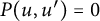
 $$ \begin{align} P(u, u') = 0, \end{align} $$
where P is a polynomial on
 $\mathbb {C}^2$
. We state the following result, which can be found in [Reference Eremenko, Liao and Ng7].
Theorem B Every meromorphic solution
 $u=u(s)$
on
 $\mathbb {C}$
of (1.6) belongs to W.
In [Reference Eremenko, Liao and Ng7], it says that Theorem B was known to Abel and Liouville, but probably it was stated for the first time in the work of Briot and Bouquet in [Reference Briot and Bouquet2, Reference Briot and Bouquet3]. Some further studies which are related with Theorem B can be found in [Reference Eremenko6, Reference Eremenko, Liao and Ng7, Reference Hille13–Reference Hille15]. Below, due to the theorem of Coman–Poletsky (Theorem A), Corollary 2, and Remark 4, we offer a proof of Theorem B.
Proof of Theorem B
Suppose that
 $u(s)$
is transcendental. From Corollary 2, Theorem A, and Remark 4, we get that
 $u=f(h)$
,
 $u'=g(h)$
, where f, g, h are three functions on
 $\mathbb {C}$
which satisfy one of the following assertions.
(1)
 $f,g$
are two elliptic functions with the same periods and
 $h'$
is a polynomial;
(2)
 $f,g$
are two rational functions, h is a transcendental meromorphic function and satisfies the following equation:
 $$ \begin{align} h'=B_0h^2+B_1h+B_2, \end{align} $$
where
 $B_i$
(
 $i=0,1,2$
) is a constant.
We firstly consider (1). It is easy to get
 $h'=\frac {g(h)}{f'(h)}=\alpha (h)$
, where
 $\alpha =\frac {g}{f'}$
is also an elliptic function. Note that
 $h'$
is a polynomial. Therefore,
 $\alpha $
is a constant and h is a linear function, which implies that
 $u=f(h)$
is also an elliptic function, so
 $u\in W$
.
Next, we deal with (2). Suppose
 $B_0=0$
. Solve the differential equation
 $h'=B_1h+B_0$
yields that
 $h(s)=Ae^{B_1s}+B$
, where
 $A(\neq 0),~B$
are constants. Then
 $u=f(h)\in W$
, since f is a rational function.
Below, assume that
 $B_0\neq 0$
. Rewrite (1.7) as
 $$ \begin{align} h'=B_0(h-a)(h-b), \end{align} $$
where
 $a, b$
are two constants. It is easy to see that a and b are Picard exceptional values of h. Suppose that
 $a=b$
. Solve the differential equation (1.8) leads to
 $h(s)=a-\frac {1}{B_0s+C}$
, where C is a constant. So,
 $u=f(h)$
is a rational function, a contradiction. Thus,
 $a\neq b$
. By the fact that a and b are Picard exceptional values of h, we can set
 $\frac {h-a}{h-b}=e^\gamma $
, where
 $\gamma $
is an entire function. Rewrite it as
 $$ \begin{align} h=\frac{be^\gamma -a}{e^\gamma-1}. \end{align} $$
Substitute (1.9) into (1.8) yields that
 $\gamma '=-B_0(b-a)$
is a constant. So,
 $\gamma $
is a linear function, which together with (1.9) implies that
 $u\in W$
.
Thus, we finish the proof of Theorem B.
Before the proofs of main results, we assume that the reader is familiarity with the basic notations of Nevanlinna theory, and we utilize four results of a meromorphic function f on
 $\mathbb {C}^n$
(see, e.g., [Reference Hayman16, Reference Nevanlinna23, Reference Steinmetz30, Reference Vitter32]).
(a). The Nevanlinna second fundamental theorem
 $$ \begin{align*}(q-2)T(r,f)\leq \sum_{j=1}^q\overline{N}\left(r,\frac{1}{f-\omega_{j}}\right)+S(r,f)\end{align*} $$
for any q distinct complex numbers
 $\omega _{1}, \ldots ,\omega _{q}\in \mathbb {C}\cup \{\infty \}$
, where
 $S(r,f)$
denotes any quantity satisfying that
 $S(r,f)=o\{T(r,f)\}$
as
 $r\rightarrow \infty $
outside a set of r of finite Lebesgue measure.
(b). Suppose that f and g are two meromorphic functions on
 $\mathbb {C}^n$
. Then,
 $T(r,\frac {1}{f})=T(r,f)+O(1)$
,
 $T(r,fg)\leq T(r,f)+T(r,g)$
and
 $T(r,f+g)\leq T(r,f)+T(r,g)+O(1)$
.
(c). Suppose that a is a rational function on
 $\mathbb {C}^n$
, f is a transcendental meromorphic function on
 $\mathbb {C}^n$
. Then,
 $T(r,a)=S(r,f)$
.
(d). The logarithmic derivative lemma
 $m\left(r, \frac {f_{z_j}}{f}\right)=S(r,f)$
,
 $j=1,...,n$
.
2 Proofs of the Theorem 1 and Corollary 1
Proof of Theorem 1
We firstly consider the case (1). Assume that
 $z_0\in E(\phi _1-a, \phi _2-b)$
. Then,
 $\phi _1(z_0)=a$
and
 $\phi _2(z_0)=b$
. If
 $h(\alpha )=z_0$
, then, substituting
 $\alpha $
into (1.1) yields that
 $$ \begin{align} \begin{aligned} h_{z_1}(\alpha)&=R_1(\alpha)[\phi_1(h(\alpha))+R_2(\alpha)\phi_2(h(\alpha))]=R_1(\alpha)[\phi_1(z_0)+R_2(\alpha)\phi_2(z_0)]\\ &=R_1(\alpha)[a+R_2(\alpha)b], \end{aligned} \end{align} $$
which implies that
 $\alpha $
is a zero of
 $h_{z_1}-R_1[a+R_2b]$
. For each
 $z_0\in E(\phi _1-a, \phi _2-b)$
, the above discussion shows that all the zeros of
 $h-z_0$
are zeros of
 $h_{z_1}-R_1[a+R_2b]$
. Suppose that
 $h_{z_1}$
is transcendental. Then,
 $h_{z_1}-R_1[a+R_2b]\not \equiv 0$
. Obviously, h is transcendental and
 $T(r,R_1[a+R_2b])=S(r,h)$
. Suppose that
 $q=\sharp\kern-1.2pt E(\phi _1-a, \phi _2-b)\geq 5$
. Observe that all the poles of
 $h_{z_1}$
are poles of h and
 $h_{z_1}$
just has multiple poles. Suppose that
 $\beta $
is a pole of
 $h_{z_1}$
with multiplicity m. Then
 $m\geq 2$
and
 $\beta $
is a pole of h with multiplicity at least
 $m-1$
. So,
 $N(r,h_{z_1})\leq 2N(r,h)$
. Together with the second fundamental theorem, one obtains that
 $$ \begin{align} \begin{aligned} (q-2)&T(r,h)\leq \sum_{z_0\in E(\phi_1-a, \phi_2-b)}\overline{N}\left(r,\frac{1}{h-z_0}\right)+S(r,h)\\ &\leq \overline{N}\left(r,\frac{1}{h_{z_1}-R_1[a+R_2b]}\right)+S(r,h)\leq T\big(r,h_{z_1}-R_1[a+R_2b]\big)+S(r,h)\\ &\leq T(r,h_{z_1})+S(r,h)=m(r,h_{z_1})+N(r,h_{z_1})+S(r,h)\\ &\leq m\left(r,\frac{h_{z_1}}{h}\right)+m(r,h)+2N(r,h)+S(r,h)\leq 2T(r,h)+S(r,h), \end{aligned} \end{align} $$
which is a contradiction since
 $q\geq 5$
. Therefore,
 $h_{z_1}$
must be a rational function.
In particularly, suppose
 $q=\sharp\kern-1.2pt E(\phi _1\kern1.4pt{-}\kern1.4pt a, \phi _2\kern1.4pt{-}\kern1.4pt b)\kern1.4pt{=}\kern1.4pt\infty $
. Observe that
 ${h_{z_1}\kern1.4pt{-}\kern1.4pt R_1[a\kern1.4pt{+}\kern1.4pt R_2b]}$
is a rational function. Without loss of generality, we assume that
 $$ \begin{align} T\big(r, h_{z_1}-R_1[a+R_2b]\big)\leq A \log r,~~as ~~r\rightarrow\infty, \end{align} $$
where A is a positive constant. For each
 $z_0\in E(\phi _1-a, \phi _2-b)$
, the above discussion shows that all the zeros of
 $h-z_0$
are the zeros of
 $h_{z_1}-R_1[a+R_2b]$
. If
 $h_{z_1}-R_1[a+R_2b]\not \equiv 0$
, then,
 $$ \begin{align*} \begin{aligned} &T\big(r, h_{z_1}-R_1[a+R_2b]\big)\geq N\left(r, \frac{1}{h_{z_1}-R_1[a+R_2b]}\right)\\ &\qquad\qquad\geq \sum_{z_0\in E(\phi_1-a, \phi_2-b)} \overline{N}\left(r, \frac{1}{h-z_0}\right)\geq (A+1)\log r,~~as~~r\rightarrow\infty, \end{aligned} \end{align*} $$
since
 $q=\sharp\kern-1.2pt E(\phi _1-a, \phi _2-b)=\infty $
. This contradicts (2.3). Therefore, one gets that
 $$ \begin{align} h_{z_1}-R_1[a+R_2b]=0. \end{align} $$
Below, we consider case (2). Rewrite (1.1) as
 $$ \begin{align} \frac{1}{R_1}h_{z_1}-R_2\phi_2(h)=\phi_1(h). \end{align} $$
On the contrary, suppose that
 $\phi _1$
is a transcendental function. Note that
 $\phi _2$
is a rational function. It follows from (2.5) that h is transcendental. By [Reference Chang, Li and Yang4, Theorem 4.1], we have
 $$ \begin{align} \lim_{r \rightarrow \infty}\frac{T(r,\phi_1(h))}{T(r,h)}=\infty. \end{align} $$
Suppose that
 $\deg \phi _2=d$
. Then, (2.5) yields that
 $$ \begin{align*} \begin{aligned} T(r,\phi_1(h))&= T\left(r,\frac{1}{R_1}h_{z_1}-R_2\phi_2(h)\right)\\ &\leq T(r,R_1)+T(r,R_2)+T(r, h_{z_1})+T(r,\phi_2(h))+O(1)\\ &\leq T(r, h_{z_1})+T(r,\phi_2(h))+O(\log r)\\ &=m(r,h_{z_1})+N(r,h_{z_1})+d T(r,h)+S(r,h)\\ &\leq m\left(r,\frac{h_{z_1}}{h}\right)+m(r,h)+2N(r,h)+d T(r,h)+S(r,h)\\ &\leq (d+2)T(r,h)+S(r,h)=O(T(r,h)), \end{aligned} \end{align*} $$
which contradicts (2.6). Thus,
 $\phi _1$
is also a rational function.
Note that
 $\phi _1$
and
 $\phi _2$
are rational functions. We rewrite (1.1) as
 $$ \begin{align} h_{z_1}=R_1\phi_1(h)+R_1R_2\phi_2(h)=R(h), \end{align} $$
where
 $R(h)$
is a rational function in h, whose coefficients are rational functions. If h is transcendental, then, either [Reference Saleeby28, Proposition 1] or [Reference Tu31, Corollary 3] yields that (2.7) becomes the following equation:
 $$ \begin{align*}h_{z_1}=B_0h^2+B_1h+B_2, \end{align*} $$
where
 $B_i$
(
 $i=0,1,2$
) is a rational function on
 $\mathbb {C}^n$
.
This finishes the proof of Theorem 1.
Proof of Corollary 1
We know that
 $\phi _1$
and
 $\phi _2$
are two nonconstant periodic functions on
 $\mathbb {C}$
with the same period. Suppose that
 $z_0\in \mathbb {C}$
is not a pole of
 $\phi _1$
and
 $\phi _2$
. And assume that
 $\phi _1(z_0)=a$
and
 $\phi _2(z_0)=b$
. Then
 $\sharp\kern-1.2pt E(\phi _1-a, \phi _2-b)=\infty $
. It follows from (1) of Theorem 1 that
 $$ \begin{align} h_{z_1}-R_1[a+R_2b]=0.\\[-34pt] \nonumber \end{align} $$
Because
 $\phi _2$
is nonconstant, there must exist a point
 $t_0$
such that
 $\phi _2(t_0)=d\neq b$
and
 $\phi _1(t_0)=c\neq \infty $
. Then
 $\sharp\kern-1.2pt E(\phi _1-c, \phi _2-d)=\infty $
. The same argument as above yields that
 $$ \begin{align} h_{z_1}-R_1[c+R_2d]=0. \end{align} $$
Combining (2.8) and (2.9) leads to that
 $R_2=\frac {c-a}{b-d}=A$
, a constant. Rewrite (1.1) as
 $$ \begin{align} \begin{aligned} h_{z_1}&=R_1[\phi_1(h)+A\phi_2(h)]=R_1\phi_3(h), \end{aligned} \end{align} $$
where
 $\phi _3=\phi _1+A\phi _2$
is also a periodic function. Furthermore,
 $\phi _3$
is a constant. Otherwise, the left side of (2.10) is a rational function and the right side of (2.10) is a transcendental meromorphic function, which is impossible. Let
 $\phi _3=C$
. Then,
 $h_{z_1}=CR_1$
.
This finishes the proof of Corollary 1.
3 The factorization of meromorphic functions on
 $\mathbb {C}^n$

In this section, we turn attention to the factorization of meromorphic solutions of some certain PDEs. If
 $h=f(g)$
is a meromorphic function on
 $\mathbb {C}^n$
, where
 $g: \mathbb {C}^n\rightarrow \mathbb {C}$
is an entire function and
 $f:\mathbb {C}\rightarrow \mathbb {P}=\mathbb {C}\cup \{\infty \}$
is a meromorphic function, then h is said to have a factorization with right factor g and left factor f (g may be a meromorphic function on
 $\mathbb {C}^n$
when f is a rational function from
 $\mathbb {C}$
to
 $\mathbb {P}$
). A meromorphic function h is said to be prime if every such factorization implies that either f or g is linear. Furthermore, h is said to be pseudo-prime if every factorization of the above form implies that either f is a rational function or g is a polynomial.
The first prime function
 $e^s + s$
on
 $\mathbb {C}$
was introduced by Rosenbloom in [Reference Rosenbloom25]. Some further results on the factorization of meromorphic functions on
 $\mathbb {C}$
can be found in [Reference Gross11, Reference Gross, Yang and Osgood12, Reference Noda24]. Observe that
 $e^s + s$
is a solution of the following equation:
 $$ \begin{align} f^{(n)}(s) + a_{n-1}(s)f^{(n-1)}(s) + \cdots + a_0(s)f(s) = a(s), \end{align} $$
where
 $a(s)$
,
 $a_0(s)$
,
 $\ldots $
,
 $a_{n-1}(s)$
are rational functions on
 $\mathbb {C}$
. Therefore, it is natural to consider the primeness or pseudo-primeness of meromorphic solutions of (3.1). It is pointed out that the meromorphic solutions of (3.1) maybe not prime. Steinmetz in [Reference Steinmetz30] proved that any meromorphic solution on
 $\mathbb {C}$
of (3.1) is pseudo-prime. Later on, Chang–Li–Yang generalized this result from one variable to several variables as follows.
Theorem C Let m be a positive integer and
 $$ \begin{align*}D^{(m)} F(z)+A_m(z) D^{(m-1)} F(z)+\cdots+A_1(z) F(z)+A_0(z)=0 \end{align*} $$
be a differential equation, where the coefficients
 $A_j(z)$
,
 $0 \leq j \leq m$
,
 $z=(z_1,...,z_n)$
, are rational functions in
 $\mathbb {C}^n$
and the operator
 $D^{(l)}=\frac {\partial ^{l_1+\cdots +l_n}}{\partial z_1^{l_1} \cdots \partial z_n^{l_n}},~~ l=l_1+\cdots l_n,~~(1 \leq l \leq m)$
. Then any meromorphic solution
 $F(z)$
of finite order must be pseudo-prime provided that
 $F(z)$
is not a constant along each
 $z_j$
-axis
 $(1 \leq j \leq n)$
.
Here, for a meromorphic function f on
 $\mathbb {C}^n$
, the order of f is defined as
 $$ \begin{align*} \rho(f)=\limsup_{r\rightarrow\infty}\frac{\log T(r,f)}{\log r}. \end{align*} $$
If
 $\rho (f)$
is finite (respectively infinite), then f is of finite order (respectively infinite order).
In [Reference Chang, Li and Yang4], Chang–Li–Yang offered an example to show that in contrast to the case of one complex variable, the condition “finite order” in Theorem C can not be dropped.
Below, we continue to study the pseudo-primeness of entire solutions to certain PDEs. Consider
 $P(u,u_{z_1})=0$
, where u is an entire function on
 $\mathbb {C}^n$
and P is a polynomial on
 $\mathbb {C}^2$
. From Theorem A, we see that u has a factorization
 $u=f(g)$
, where
 $f,g$
satisfy some conditions. So, it’s natural to ask whether u is pseudo-prime or not? In this section, we consider this question and obtain the following result.
Theorem 2 Suppose that an entire function
 $u=u(z_1,...,z_n)$
on
 $\mathbb {C}^n$
is a solution of the following PDE:
 $$ \begin{align} P(z,u,u_{z_1})=\sum_{\lambda \in I} a_\lambda(z) u^{\lambda_0}u_{z_1}^{\lambda_1}=0, \end{align} $$
where I is a finite set of multi-indices
 $(\lambda _0, \lambda _1)$
with nonnegative integers
 $\lambda _0, \lambda _1$
, and
 $a_\lambda (z)(\not \equiv 0)$
is a rational function on
 $\mathbb {C}^n$
. If u is of finite order and
 $u_{z_1}\not \equiv 0$
, then u is pseudo-prime.
Remark 5 For the case
 $n = 1$
, Liao–Yang in [Reference Liao and Yang19, Theorem 2] proved that any entire solution of (3.2) must be pseudo-prime. The main theorems in this section are inspired by Liao–Yang’s result. Below, we offer two examples to show that the conditions “finite order” and
 $u_{z_1}\not \equiv 0$
are necessary.
Example 1 Consider
 $$ \begin{align*}u(z)=e^{{z_1}+\phi\left(z_2, \ldots, z_n\right)}, \end{align*} $$
where
 $\phi \left (z_2, \ldots , z_n\right )$
is a transcendental entire function on
 $\mathbb {C}^n$
. Obviously, u is an entire solution of infinite order to
 $P(z,u,u_{z_1})=u_{z_1}-u=0$
. But u is not pseudo-prime, since
 $u=f(g)$
, where
 $f=e^s$
on
 $\mathbb {C}$
and
 $g={z_1}+\phi \left (z_2, \ldots , z_n\right )$
on
 $\mathbb {C}^n$
.
Example 2 Suppose that
 $f(s)$
is an entire function of finite order on
 $\mathbb {C}$
which is not pseudo-prime. Let
 $u(z)=f(z_2)$
. Obviously,
 $P(z,u,u_{z_1})=u_{z_1}=0$
, and u is of finite order but not pseudo-prime.
It is pointed out that Examples 1 and 2 can be found in [Reference Chang, Li and Yang4], given by Chang–Li–Yang.
Let I and J be finite sets of multi-indices as in Theorem 2. Next, we consider more general PDEs
 $$ \begin{align} P(z,u,u_{z_1},u_{z_2})=\sum_{\lambda \in I} a_\lambda(z) u^{\lambda_0}u_{z_1}^{\lambda_1}+\sum_{\mu \in J} b_\mu(z) u^{\mu_0}u_{z_2}^{\mu_1}=0, \end{align} $$
where
 $a_\lambda (z)(\not \equiv 0)$
,
 $b_\mu (z)(\not \equiv 0)$
are rational functions on
 $\mathbb {C}^2$
, and
 $z=(z_1, z_2)$
. Then, we obtain the following result.
Theorem 3 Suppose that
 $u=u(z_1,z_2)$
on
 $\mathbb {C}^2$
is a nonconstant entire solution of (3.3). If u is of finite order and
 $u_{z_1}\not \equiv 0$
,
 $u_{z_2}\not \equiv 0$
, then one of the following assertions holds.
(1) u is pseudo-prime;
(2)
 $I=J$
, and u has the form
 $u=f(g)$
, where f is transcendental meromorphic function on
 $\mathbb {C}$
with at most one pole, g is a transcendental entire function on
 $\mathbb {C}^2$
satisfying that for any
 $\lambda =(\lambda _0, \lambda _1)\in I$
there exist co-prime polynomials
 $c_\lambda $
,
 $d_\lambda $
such that
 $c_\lambda g_{z_1}+d_\lambda g_{z_2}=0$
and
 $\left[\frac {c_\lambda (z)}{d_\lambda (z)}\right]^{\lambda _1}=-\frac {a_\lambda (z)}{b_\lambda (z)}$
.
Remark 6 Suppose that
 $a_\lambda (z)=\alpha ({z_2})$
and
 ${b_\lambda (z)}=\beta ({z_1})$
are two polynomials on
 $\mathbb {C}$
for some
 $\lambda \in I$
. Then,
 $c_\lambda (z)=P_1(z_2)$
and
 $d_\lambda (z)=Q_1(z_1)$
reduce to a function of one variable. And
 $c_\lambda g_{z_1}+d_\lambda g_{z_2}=0$
becomes
 $$ \begin{align*}P_1(z_2) g_{z_1}+Q_1(z_1) g_{z_2}=0. \end{align*} $$
Solving the above PDE yields that
 $g=\gamma (Q({z_1})-P({z_2}))$
, where
 $P(z_2)=\int P_1({z_2})d{z_2}$
,
 $Q(z_1)=\int Q_1({z_1})d{z_1}$
are two polynomials on
 $\mathbb {C}$
, and
 $\gamma $
is an arbitrary entire function on
 $\mathbb {C}$
. Furthermore,
 $u(z_1,z_2)=f(\gamma (Q({z_1})-P({z_2})))$
.
It is pointed out that the case (2) indeed occurs in Theorem 3, which can be shown by the following example.
Example 3 Consider that
 $u(z_1,z_2)=e^{\sin (\frac {{z_1}^2-{z_2}^2}{2})}$
. Then, u is an entire solution of
 $z_2u_{z_1}+z_1u_{z_2}=0$
. It is easy to see that
 $u=f(g)$
, where
 $f(s)=e^s$
and
 $g(z_1,z_2)=\sin (\frac {{z_1}^2-{z_2}^2}{2})$
are two transcendental entire functions and
 $z_2 g_{z_1}+z_1 g_{z_2}=0$
. So, the assertion (2) occurs.
In Theorem 3, if we add some conditions to guarantee that the assertion (2) cannot occur, then entire solutions of (3.3) must be pseudo-prime. Inspired by this idea, we get a corollary by Theorem 3.
Corollary 3 Suppose that entire function u of finite order on
 $\mathbb {C}^2$
satisfies (3.3) and
 $u_{z_1}\not \equiv 0$
,
 $u_{z_2}\not \equiv 0$
. Then, u is pseudo-prime if u satisfies one of the following conditions.
(1)
 $I\neq J$
;
(2) There exists an index
 $\lambda =(\lambda _0, \lambda _1)\in I\cap J$
such that
 $\lambda _1\geq 2$
and
 $\frac {a_\lambda (z)}{b_\lambda (z)}$
is a nonconstant irreducible polynomial.
We pay attention to entire solutions of some well-known PDEs. From Theorems 2 and 3 and Corollary 3, we immediately get the following results. It is noted that some of them may have been recorded in the literature, the author is not able to find such a reference.
Corollary 4 Suppose that
 $u(z)=u(z_1,z_2)$
is an entire function of finite order on
 $\mathbb {C}^2$
and
 $u_{z_1}\not \equiv 0$
,
 $u_{z_2}\not \equiv 0$
. Then u is pseudo-prime, if u satisfies one of the following PDEs.
(1) Inviscid Burgers’ equation
 $u_{z_1}+uu_{z_2}=0$
;
(2) Riccati equation
 $u_{z_1}=a u^2+bu+c$
, where
 $a(\not \equiv 0)$
, b, c are rational functions on
 $\mathbb {C}^2$
;
(3) Malmquist–Yosida equation
 $u_{z_1}^m=\sum _{i=0}^{2m}a_iu^i$
, where m is a positive integer,
 $a_{2m}(\not \equiv 0)$
,…,
 $a_0$
are rational functions on
 $\mathbb {C}^2$
;
(4) PDEs of Fermat type of
 $au^m+bu_{z_1}^n=1$
, where
 $m,n$
are two positive integers,
 $a(\not \equiv 0)$
and
 $b(\not \equiv 0)$
are two rational functions on
 $\mathbb {C}^2$
.
In the above theorems and corollaries, the condition “finite order” is necessary. Below, we omit this condition by considering a system of Malmquist–Yosida type of partial differential equations, which is inspired by a theorem of Hu–Yang in [Reference Hu and Yang17, Theorem 6.2]. In fact, we obtain the following result.
Theorem 4 If a transcendental meromorphic function
 $u(z)=u(z_1, ..., z_n)$
on
 $\mathbb {C}^n$
satisfies the following system of partial differential equations:
 $$ \begin{align*}(u_{z_i})^{m_i}+\sum_{j=1}^{m_i-1}a_{i,j}(u_{z_i})^{j}=\sum_{l=0}^{2m_i}b_{i,l}u^{l}, \quad i=1,2, \ldots, n \end{align*} $$
where
 $m_i$
(
 $i=1,...,n$
) is a positive integer and
 $a_{i,j}, b_{i,l}$
are rational functions on
 $\mathbb {C}^n$
, then u is of finite order. In particularly, if u is an entire function on
 $\mathbb {C}^n$
, then u is pseudo-prime.
Remark 7 In [Reference Hu and Yang17, Theorem 6.2], Hu–Yang considered the pseudo-primeness of meromorphic solutions of a certain system of partial differential equations. In Theorem 4, if u is meromorphic function on
 $\mathbb {C}^n$
, we have not deduced that u is pseudo-prime and leave it for further study.
Remark 8 In [Reference Zimogljad33], Zimogljad proved that every entire transcendental solution of a second-order algebraic differential equation on
 $\mathbb {C}$
with rational coefficients has a positive order. Therefore, as Theorems 2–4, one can consider the pseudo-primeness of entire solutions of some second-order PDEs, such as Burgers’ equation
 $u_{z_1}+uu_{z_2}=vu_{{z_1}{z_1}}$
, one-dimensional diffusion equation
 $u_{z_1}=vu_{{z_2}{z_2}}$
and some generalizations of them, where v is a constant.
4 Proofs of the Theorems 2 and 4
In order to prove the above theorems, we employ the following lemmas. The first one is a theorem of Brownawell in [Reference Brownawell1], which is a generalization of the remarkable Steinmetz’s Reduction theorem in [Reference Steinmetz30].
Lemma 1 Let
 $$ \begin{align*}\begin{array}{ll} F_1, \ldots, F_k: \mathbb{C} \rightarrow \mathbb{P}^1, ~~ h_1, \ldots, h_k: \mathbb{C}^n \rightarrow \mathbb{P}^1 \end{array} \end{align*} $$
be meromorphic functions, none of which is identically zero. Also let
 $g: \mathbb {C}^n \rightarrow \mathbb {C}$
be a nonconstant entire function. For some
 $C>0$
, suppose that the characteristic functions satisfy
 $$ \begin{align*}\sum_{j=1}^k T(r,h_j) \leq C T(r, g)+S(r,g). \end{align*} $$
If
 $$ \begin{align*}F_1(g) h_1+F_2(g) h_2+\cdots+F_k(g) h_k=0, \end{align*} $$
then there exist polynomials
 $Q_1(z), \ldots , Q_k(z)$
not all identically zero in
 $\mathbb {C}[z]$
such that
 $$ \begin{align*}Q_1 F_1+Q_2 F_2+\cdots+Q_k F_k=0. \end{align*} $$
The second one is due to Strelitz in [Reference Strelitz29].
Lemma 2 Every entire transcendental solution of a first-order algebraic differential equation with rational coefficients has an order no less than 1/2.
The last one is given by Chang–Li–Yang, which is contained in the proof of [Reference Chang, Li and Yang4, Theorem 3.1]. It also appears in [Reference Hu and Yang17]. For
 $n=1$
, see Edrei–Fuchs in [Reference Edrei and Fuchs8].
Lemma 3 Let
 $g:\mathbb {C}^n\rightarrow \mathbb {C}$
be a transcendental entire function, and let
 $f:\mathbb {C}\rightarrow \mathbb {P}^1$
be a meromorphic function of positive order. Then,
 $F=f(g)$
is of infinite order.
Proof of Theorem 2
The following proof is relied heavily on the proof of Liao–Yang in [Reference Liao and Yang19, Theorem 2]. Assume, to the contrary, that
 $u=f(g)$
where
 $f:\mathbb {C} \rightarrow \mathbb {P}^1$
is a transcendental meromorphic function and
 $g: \mathbb {C}^n \rightarrow \mathbb {C}$
is a transcendental entire function. Substituting
 $u=f(g)$
into (3.2) yields that
 $$ \begin{align} \sum_{\lambda \in I} a_\lambda(z)[f(g(z))]^{\lambda_0}\left[f^{\prime}(g(z))\right]^{\lambda_1}[g_{z_1}(z)]^{\lambda_1}=0. \end{align} $$
Obviously,
 $g_{z_1}\not \equiv 0$
, since
 $u_{z_1}\not \equiv 0$
. Since g is transcendental, one gets that
 $$ \begin{align*}T(r,a_\lambda(z)[g_{z_1}(z)]^{\lambda_1})\leq C T(r, g)+S(r, g), \end{align*} $$
where C is a fixed positive constant. By Lemma 1, there exist polynomials
 $Q_\lambda $
which are not all identically zero such that
 $$ \begin{align} \sum_{\lambda \in I} Q_\lambda(s)[f(s)]^{\lambda_0}\left[f^{\prime}(s)\right]^{\lambda_1}=0. \end{align} $$
In [Reference Liao and Yang19, Theorem 2], Liao–Yang proved that f has positive order. For the sake of completeness, we will state their proof in all details. We know that
 $u=f(g)$
is an entire function. If
 $\alpha \in \mathbb {C}$
is a pole of f, then
 $\alpha $
must be a finite Picard exceptional value of g. Observe that g is a transcendental entire function. Picard’s little theorem tells us that g has at most one finite Picard exceptional value. So, f has at most one pole on
 $\mathbb {C}$
. If f is an entire function, then, Lemma 2 yields the order
 $\rho (f)>0$
. If f has one pole at a with multiplicity m, then we can write
 $f(s)=\frac {h(s)}{(s-a)^m}$
, where h is an entire function on
 $\mathbb {C}$
. Taking derivative of f yields that
 $f'(s)=\frac {h'(s)(s-a)-mh(s)}{(s-a)^{m+1}}$
. Substitute the forms of f and
 $f'$
into (4.2) yields that
 $$ \begin{align*}\sum_{J \in \Lambda} P_J(s)[h(s)]^{J_0}\left[h^{\prime}(s)\right]^{J_1}=0, \end{align*} $$
where
 $P_J(\not \equiv 0)$
is a polynomial. Then again by Lemma 2 we get
 $\rho (h)>0$
. So,
 $\rho (f)=\rho (h)>0$
. The above discussion yields that f is of positive order. By Lemma 3, one can get a contradiction.
This finishes the proof of Theorem 2.
Proof of Theorem 3
Suppose that the conclusion (1) is invalid. Then, we can set
 $u=f(g)$
, where
 $f:\mathbb {C} \rightarrow \mathbb {P}^1$
is a transcendental meromorphic function and
 $g: \mathbb {C}^n \rightarrow \mathbb {C}$
is a transcendental entire function. Substituting
 $u=f(g)$
into (3.3) yields that
 $$ \begin{align} &\sum_{\lambda \in I} a_\lambda(z)[f(g(z))]^{\lambda_0}\left[f^{\prime}(g(z))\right]^{\lambda_1}[g_{z_1}(z)]^{\lambda_1} \nonumber\\& \quad +\sum_{\mu \in J} b_\mu(z)[f(g(z))]^{\mu_0}\left[f^{\prime}(g(z))\right]^{\mu_1}[g_{z_2}(z)]^{\mu_1}=0. \end{align} $$
Suppose that
 $\Lambda =I\cap J$
. Then, we rewrite (4.3) as
 $$ \begin{align} &\sum_{\lambda \in I\setminus \Lambda} a_\lambda(z)[f(g(z))]^{\lambda_0}\left[f^{\prime}(g(z))\right]^{\lambda_1}[g_{z_1}(z)]^{\lambda_1} \nonumber\\& \quad +\sum_{\mu \in J\setminus\Lambda} b_\mu(z)[f(g(z))]^{\mu_0}\left[f^{\prime}(g(z))\right]^{\mu_1}[g_{z_2}(z)]^{\mu_1} \nonumber\\& \quad +\sum_{\lambda \in \Lambda} [f(g(z))]^{\lambda_0}\left[f^{\prime}(g(z))\right]^{\lambda_1}[a_\lambda(z)g_{z_1}(z)^{\lambda_1}+b_\lambda(z)g_{z_2}(z)^{\lambda_1}] =0. \end{align} $$
Obviously,
 $$ \begin{align*}T(r,l(z))\leq C T(r, g)+S(r, g), \end{align*} $$
where
 $l(z)\in \{a_\lambda (z)[g_{z_1}(z)]^{\lambda _1},~~b_\mu (z)[g_{z_2}(z)]^{\mu _1},~~ a_\lambda (z)g_{z_1}(z)^{\lambda _1}+b_\lambda (z)g_{z_2}(z)^{\lambda _1}\}$
. If
 $I\setminus \Lambda \neq \emptyset $
or
 $J\setminus \Lambda \neq \emptyset $
, then the same argument as the proof of Theorem 2 yields a contradiction. Below, we assume that
 $I\setminus \Lambda = \emptyset $
and
 $J\setminus \Lambda =\emptyset $
. That is
 $I=J=\Lambda $
. Then, (4.4) becomes
 $$ \begin{align} \begin{aligned} \sum_{\lambda \in \Lambda} [f(g(z))]^{\lambda_0}\left[f^{\prime}(g(z))\right]^{\lambda_1}[a_\lambda(z)g_{z_1}(z)^{\lambda_1}+b_\lambda(z)g_{z_2}(z)^{\lambda_1}] =0. \end{aligned} \end{align} $$
If one of
 $a_\lambda (z)g_{z_1}(z)^{\lambda _1}+b_\lambda (z)g_{z_2}(z)^{\lambda _1}~~ (\lambda \in \Lambda )$
is not identically zero, then the same argument as the proof in Theorem 2 yields a contradiction. Therefore,
 $$ \begin{align} a_\lambda(z)g_{z_1}(z)^{\lambda_1}+b_\lambda(z)g_{z_2}(z)^{\lambda_1}=0,~~\lambda\in \Lambda. \end{align} $$
Rewrite (4.6) as
 $[\frac {g_{z_2}}{g_{z_1}}]^{\lambda _1}=-\frac {a_\lambda }{b_\lambda }$
. Furthermore, we can derive that
 $\frac {g_{z_2}}{g_{z_1}}=\frac {c_\lambda }{d_\lambda }$
, where
 $c_\lambda (z)$
and
 $d_\lambda (z)$
are two polynomials on
 $\mathbb {C}^n$
and
 $[\frac {c_\lambda }{d_\lambda }]^{\lambda _1}=-\frac {a_\lambda }{b_\lambda }$
.
This finishes the proof of Theorem 3.
Proof of Theorem 4
The following proof is based on the idea of Hu–Yang in [Reference Hu and Yang17, Theorem 6.2]. We firstly prove that there exist two positive constants
 $\sigma $
and
 $r_0$
such that for
 $|z|\geq r_0$
,
 $$ \begin{align} \frac{|u_{z_i}|^2}{(1+|u|^2)^2}\leq |z|^\sigma,~~i=1,...,n. \end{align} $$
On the contrary, for any
 $N>0$
, there exist an index
 $i\in \{1,2,...,n\}$
and a sequence
 $\{\nu _t\}\subset \mathbb {C}^n$
such that
 $$ \begin{align} |\nu_t|=r_t\rightarrow \infty,~~as~~t\rightarrow\infty,~~\frac{|u_{z_i}(\nu_t)|^2}{(1+|u(\nu_t)|^2)^2}\geq r_t^N. \end{align} $$
Without loss of generality, we assume that
 $$ \begin{align} N=2(1+\max_{i,j,l}\{\deg a_{i,j}, \deg b_{i,l}\}). \end{align} $$
From (4.8), one gets
 $$ \begin{align*}|u_{z_i}(\nu_t)| \geq(1+|u(\nu_t)|^2)r_t^{N/2}\geq r_t^{N/2}\rightarrow\infty, ~~as ~~t\rightarrow\infty. \end{align*} $$
Further, for t large enough, we get that
 $$ \begin{align} \bigg| (u_{z_i})^{m_i}+\sum_{j=1}^{m_i-1}a_{i,j}(u_{z_i})^{j}\bigg|_{z=\nu_t} &\geq |u_{z_i}(\nu_t)|^{m_i}\left[1-\sum_{j=1}^{m_i-1}\frac{|a_{i,j}(\nu_t)|}{|(u_{z_i})^{m_i-j}(\nu_t)|}\right]\nonumber\\& \geq \frac{1}{2}(u_{z_i})^{m_i}(\nu_t), \end{align} $$
since
 $\frac {|a_{i,j}(\nu _t)|}{|(u_{z_i})^{m_i-j}(\nu _t)|}\rightarrow 0$
as
 $t\rightarrow \infty $
for any
 $j=1,...,m_i-1$
. Meanwhile, we have
 $$ \begin{align} \bigg| (u_{z_i})^{m_i}+\sum_{j=1}^{m_i-1}a_{i,j}(u_{z_i})^{j}\bigg|_{z=\nu_t}=\bigg|\sum_{l=0}^{2m_i}b_{i,l}u^{l}\bigg|_{z=\nu_t} \leq \sum_{l=0}^{2m_i}|b_{i,l}(\nu_t)||u^{l}(\nu_t)|. \end{align} $$
For t large enough, combining (4.10) and (4.11) yields that
 $$ \begin{align} \begin{aligned} \frac{| u_{z_i}(\nu_t)|^{m_i}}{(1+|u(\nu_t)|^2)^{m_i}}\leq \frac{2\sum_{l=0}^{2m_i}|b_{i,l}(\nu_t)||u^{l}(\nu_t)|}{(1+|u(\nu_t)|^2)^{m_i}}\leq 2\sum_{l=1}^{2m_i}|b_{i,l}(\nu_t)|<r_t^{\frac{N}{2}}, \end{aligned} \end{align} $$
which implies that
 $$ \begin{align} \frac{| u_{z_i}(\nu_t)|^{2}}{(1+|u(\nu_t)|^2)^{2}}< r_t^{\frac{N}{m_i}}\leq r_t^N. \end{align} $$
By (4.8) and (4.13), we derive a contradiction. Thus, (4.7) is valid. Without loss of generality, we assume that (4.7) holds for any
 $z\in \mathbb {C}^n$
. The same argument of Hu–Yang in [Reference Hu and Yang17, Theorem 6.2] yields that u is of finite order. For the sake of completeness, we give it in all detail. So,
 $$ \begin{align} A_u(r) &=\frac{i}{2 \pi} r^{2-2 n} \int_{C^n|r|}\left(1+|u|^2\right)^{-2} d u \wedge \overline{d u} \wedge v^{n-1} \nonumber\\& = n^{-1} r^{2-2 n} \int_{C^n|r|}\left\{\left(1+|u|^2\right)^{-2} \sum_{i=1}^n\left|u_{z_i}\right|{}^2\right\} v^n \nonumber\\& \leq r^{2-2 n+\sigma} \int_{C^n|r|} v^n=K r^{\sigma+2}, \end{align} $$
where K is a positive constant. By the definition of
 $T(r,u)$
(see, e.g.,[Reference Kujala18, Reference Steinmetz30]), one gets that
 $$ \begin{align*}T(r,u)=\int_{r_0}^r A_u(t) \frac{dt}{t} +O(1)\leq \frac{K}{(\sigma+2)} r^{\sigma+2}+O(1). \end{align*} $$
Therefore, u is of finite order. Furthermore, if u is a transcendental entire function, then by Theorem 2, u is pseudo-prime.
This finishes the proof of Theorem 4.
Acknowledgements
The author is grateful to the reviewers for valuable suggestions and comments.



