Introduction
Mononchs are predatory nematodes in various environments (Ahmad and Jairajpuri Reference Ahmad and Jairajpuri2010). Within the order Mononchida Jairajpuri, Reference Jairajpuri1969, the genus Mylonchulus Cobb, Reference Cobb1916 is widely distributed globally (Ahmad and Jairajpuri Reference Ahmad and Jairajpuri2010; Shokoohi and Moyo Reference Shokoohi and Moyo2022). However, a similar genus, namely Paramylonchulus Jairajpuri and Khan, Reference Jairajpuri and Khan1982, is less widespread (Ahmad and Jairajpuri Reference Ahmad and Jairajpuri2010). These nematodes are vital since they feed on other nematodes, especially plant-parasitic ones (Ahmad and Jairajpuri Reference Ahmad and Jairajpuri2010). Historically, Jairajpuri & Khan (Reference Jairajpuri and Khan1982) proposed Paramylonchulus as a new genus based on the absence of subventral teeth, presence of a narrow buccal cavity, and mono-prodelphic female gonad; they transferred seven species of Mylonchulus with the above-mentioned characters. Then, Loof (Reference Loof1993) considered the Paramylonchulus as junior synonyms of Mylonchulus. Next, this genus was considered a valid taxon, and a new species of Paramylonchulus was described by Anandi et al. (Reference Anandi, Mohilal and Dhanachand1997). During extensive work on Mononchida, Paramylonchulus was considered a valid genus with 15 nominal species (Ahmad and Jairajpuri Reference Ahmad and Jairajpuri2010). This genus was identified previously in several countries, including Austria, former Czechoslovakia, El Salvador, Georgia, USA-Hawaii, India, Mauritius, Poland, Singapore, and Thailand (Ahmad and Jairajpuri Reference Ahmad and Jairajpuri2010). However, Paramylonchulus has not yet been reported from Iran.
This paper describes a new species belonging to the genus Paramylonchulus. Therefore, the study’s aims were to 1) describe the new species of Paramylonchulus and 2) study the molecular characterization and phylogenetic position of the new species based on 18S rDNA.
Materials and methods
Sampling and processing of nematodes
The nematodes were extracted using the tray method (Whitehead & Hemming Reference Whitehead and Hemming1965). The nematodes were fixed with a hot 4% formaldehyde solution and processed to anhydrous glycerin by the method of De Grisse (Reference De Grisse1969).
Morphological and morphometrical analysis
Measurements and drawings were done using an Olympus BX51 (Tokyo, Japan) light microscope with a drawing tube. The light microphotographs were prepared using an Olympus BX51 microscope with a digital DP72 camera (Olympus) and differential interference contrast (DIC) optics.
Statistical analysis
The morphometric data were taken from the fixed specimens. Species close to the new species of Paramylonchulus from Iran, based on the key provided, were selected for statistical analysis (Ahmad and Jairajpuri Reference Ahmad and Jairajpuri2010), namely P. californicus (Jairajpuri, Reference Jairajpuri1970) Jairajpuri and Khan, Reference Jairajpuri and Khan1982; P. japonicus Dhanachand, Rombati & Anandi, Reference Dhanachand, Rombati and Anandi1995; and P. noreasus Rahman & Jairajpuri, Reference Rahman and Jairajpuri1984, along with the molecularly close P. mulveyi (Jairajpuri, Reference Jairajpuri1970) Jairajpuri and Khan, Reference Jairajpuri and Khan1982, were included in the analysis. Species selection for statistical analysis was based on the presence of post vulval uterine sac, longer than corresponding body diameter, developed caudal glands, body length less than 1.5 mm, and tail not S-shaped. Eleven morphometric characters, viz. body length (L), ‘a’ (body length/greatest body diameter), ‘b’ (body length/distance from anterior to pharyngeal-intestinal valve), ‘c’ (body length/tail length), V (% distance of vulva from anterior/body length), buccal cavity length, buccal cavity width, spicules length, gubernaculum length, supplementary organs number, and tail length were used for discriminant analysis (DA). The DA was performed for females and males separately. Data on morphometric measurements of the species were analyzed using XLSTAT (Addinsoft 2007). Using a stepwise model, the characters mentioned above were used for DA to evidentiate the degree of similarity between P. iranicus and the above-mentioned species of Paramylonchulus.
DNA extraction, polymerase chain reaction (PCR) and sequencing
DNA was extracted from a single female. The nematode was squashed in TE buffer (10 mM Tris-Cl, 0.5 mM EDTA; pH 9.0, Qiagen, Hilden, Germany) on a clean slide with a cover slip and the pressure of a plastic probe. The supernatant was extracted from the tube and stored at –20°C. Following this step, the forward and reverse primers, SSU_F_04 (5′-GCTTGTCTCAAAGATTAAGCC-3′) and SSU_R_81 (5′-TGATCCWKCYGCAGGTTCAC-3′) (Carta & Li Reference Carta and Li2018), were used in polymerase chain reaction (PCR) for partial amplification of the 18S rDNA region. The PCR products were sequenced in both directions using the same primers used in PCR with an ABI 3730XL sequencer (Massachusetts, USA). After DNA amplification, four μl of product from the PCR product was loaded on a 1% agarose gel in TBE buffer (40 mM Tris, 40 mM boric acid, and 1 mM EDTA) for evaluation of the DNA bands. The PCR product was stored at –20°C.
Alignment and phylogenetic inference
The sequences for phylogenetic analysis were selected based on the study by Koohkan et al. (Reference Koohkan, Shokoohi and Mullin2015). Finally, these sequences were aligned using the Q-INSi algorithm of the online version of MAFFT version 7 (http://mafft.cbrc.jp/alignment/server/; Katoh & Standley Reference Katoh and Standley2013). The Gblocks program (version 0.91b), which has all three less stringent parameters (http://phylogeny.lirmm.fr/phylo_cgi/one_task.cgi?task_type=gblocks), was used for post-editing of both alignments, i.e., to eliminate poorly aligned regions or divergent positions. The model of base substitution was selected using MrModeltest 2 (Nylander Reference Nylander2004). The Akaike-supported model, a general time reversible model including among-site rate heterogeneity and estimates of invariant sites (GTR + G + I), was used in SSU analyses. Bayesian analyses were performed using MrBayes v3.1.2 (Ronquist & Huelsenbeck Reference Ronquist and Huelsenbeck2003), running the chains for 5 × 10⁶ generations for both datasets. After discarding burn-in samples, the remaining samples were retained for further analysis. The Markov Chain Monte Carlo (MCMC) method within a Bayesian framework was used to estimate the posterior probabilities of the phylogenetic trees (Larget & Simon Reference Larget and Simon1999) using the 50% majority rule. Bathyodontus mirus (Andrássy, Reference Andrássy1956) Andrássy in Hopper & Cairns, Reference Hopper and Cairns1959 (AY284744) and B. cylindricus Fielding, Reference Fielding1950 (AY552964) were used as outgroup taxa. The phylogenetic program output files were visualised using Dendroscope V.3.2.8 (Huson & Scornavacca Reference Huson and Scornavacca2012) and re-drawn in CorelDRAW v. 2017 (Ontario, Canada). The original partial 18S rDNA sequence of P. iranicus sp. n. was deposited in GenBank under the accession number OQ101907.
Results
Paramylonchulus iranicus sp. n.
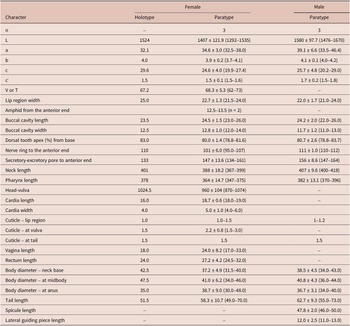
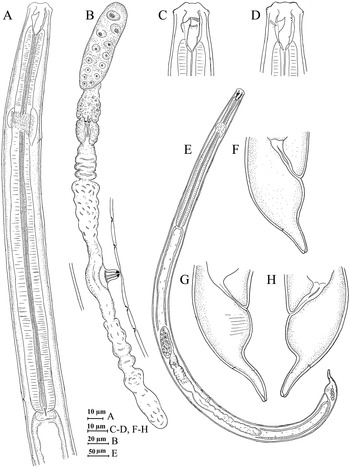
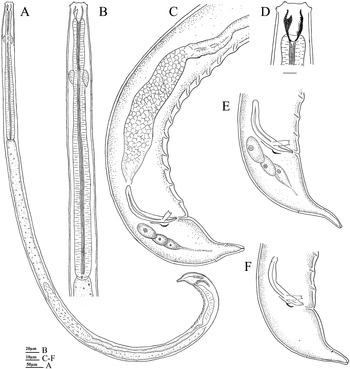
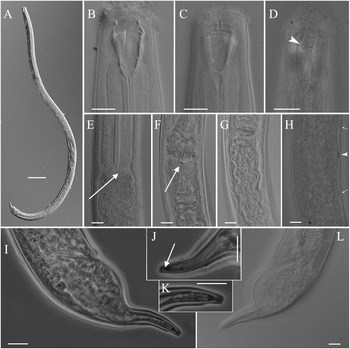
Morphometric data of Paramylonchulus iranicus sp. n. are described in Table 1 and Figures 1–4. Female: Body cylindrical (Figure 1E), ventrally curved after fixation. Cuticle smooth under LM, 1.5–3.0 μm thick at mid region. Lip region slightly offset, having six lips bearing 6 + 6 + 4 papillae. Amphids opening oval, aperture 3–5 μm wide, located at 12.5–13.5 μm from anterior end. Buccal cavity large, goblet-shaped, about 1.8–1.9 times as long as wide, with 2 μm thick cuticularised vertical walls. Dorsal wall bearing a sharp, 5–6 μm long and 3–4 μm wide dorsal tooth, directed forward, located in the anterior half of the buccal cavity, its apex situated at 78.8–81.6% from base of stoma; two foramina present at the base of buccal cavity lying close to each other, 4–6 μm long. Three to four transverse rows of rasp-like denticles on sub-ventral walls at level of dorsal tooth. Submedian tooth absent. Nerve ring at 26–27% of neck length. Excretory pore opening at 37–40% of the neck length. Cardia conoid, surrounded by intestinal tissue. The reproductive system mono-prodelphic. The anterior ovary more or less straight, reflexed, and with one to two rows of oocytes. Oviduct 70–80 μm long, 1.6–1.8 times as long as corresponding body diameter. Uterus 42–53 μm long, 1–1.2 times as long as corresponding body diameter. A post vulval uterine sac present, 135–162 μm long, 3.4–3.9 times as long as vulval body diameter length, filled with sperms. Vagina with parallel walls (Figure 1B), less than half of corresponding body diameter, pars refringens vaginae with two drop-like sclerotised pieces. Vulva, a transverse slit, located posterior to the body. Two prevulval papillae, located 36–40 and 18–27 μm anterior to the vulva, respectively, and two post vulval papillae, located 24–32 and 39–53 μm posterior to the vulva, respectively, present. Rectum 0.7–0.8 times as long as the anal body diameter. Tail sigmoid, sharply bent ventrad with digitate posterior portion slightly but clearly bent dorsad. Three caudal pores observed. Caudal glands grouped, spinneret bearing terminal opening.
Morphometric data of Paramylonchulus iranicus sp. n. (all measurements in μm in form: mean ± SD (range), except for ratio)

Paramylonchulus iranicus sp. n. Female. A: Neck. B: Reproductive system and vulval region with advulval ventromedian vulval papillae. C–D: Buccal cavity. E: Entire body. F–H: Tail.

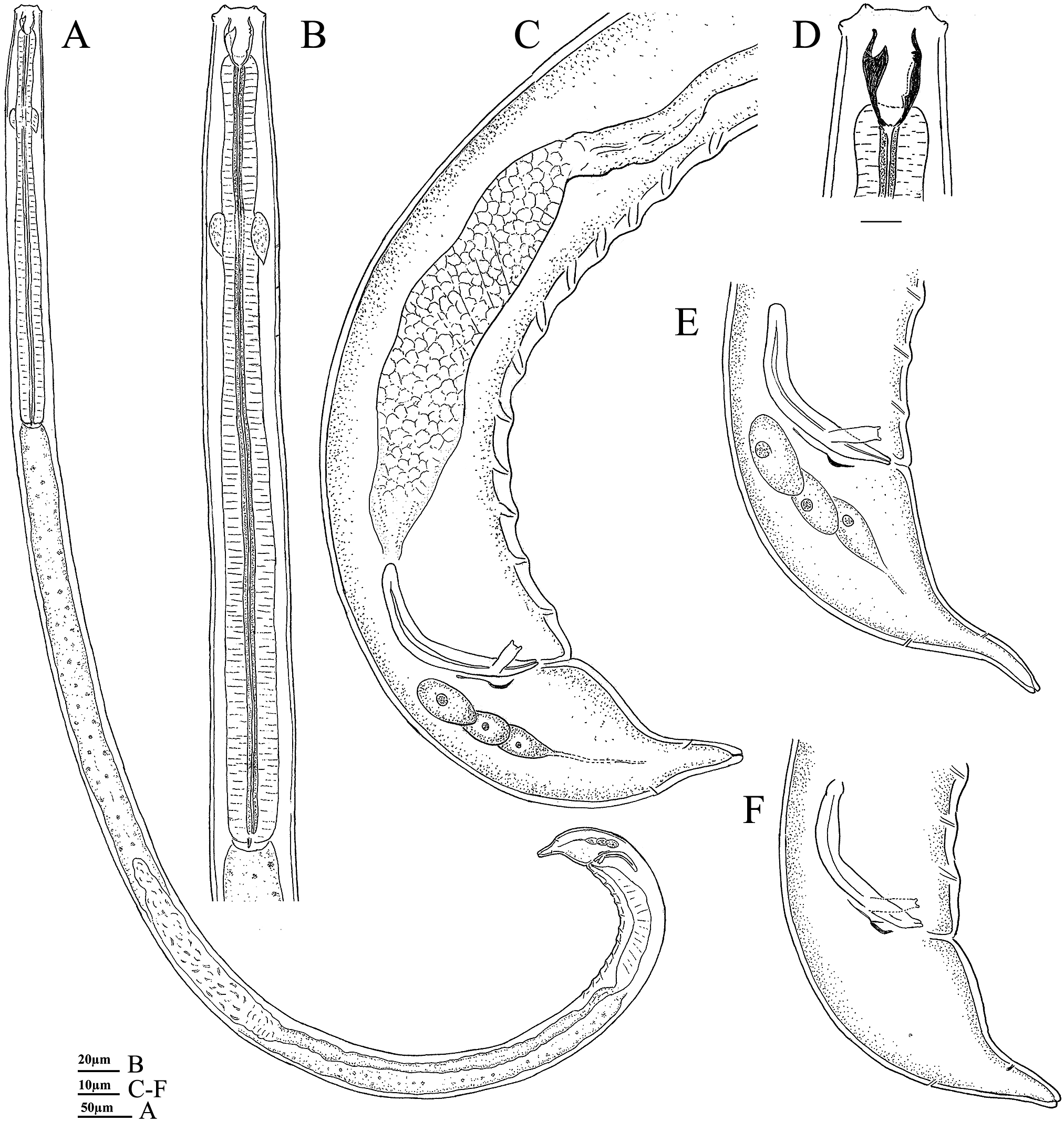
Paramylonchulus iranicus sp. n. Male. A: Entire body. B: Neck. C: Posterior end. D: Buccal cavity. E–F: Tail.
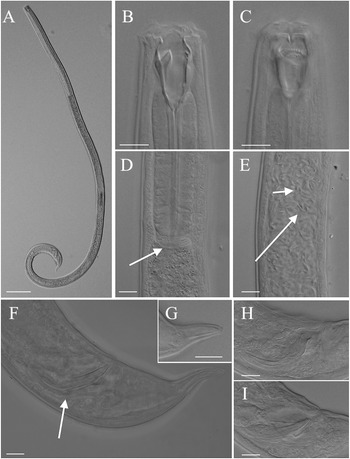
Paramylonchulus iranicus sp. n. Female. A: Entire body. B–C: Anterior end with buccal armature. D: Anterior end, surface view, amphid (arrow). E: Pharyngo-intestinal junction (arrow). F: Sphincter of reproductive system (arrow). G: Spermatheca. H: Vulval region with advulval ventromedian vulval papillae. I,L: tail. J–K: Tail tip (arrow indicating spinneret). Scale bar: A = 100 μm, B–L = 10 μm.

Paramylonchulus iranicus sp. n. Male. A: Entire body. B–C: Anterior end with buccal armature. D: Pharyngo-intestinal junction (arrow). E: Sperm cells (arrow). F: tail (arrow pointing to spicules). G: tail tip. H: Proximal part of spicules and Lateral guiding pieces. I: Distal part of spicules and gubernaculum. Scale bar: A = 100 μm, B–L = 10 μm.

Male: General morphology similar to that of females except for the male specimens being more strongly curved ventrally in the posterior region of the body (Figure 2A). The buccal cavity same as in the females. Lip region 21–24 μm wide. Apex of dorsal tooth 78.8–83.7% from the base of the buccal cavity. Genital system diorchic, each testis thin-walled, contains many immature germ cells and elongated spindle-shaped spermatozoa, 5–6 μm long. The two testes join to form a common vas deferens, which leads to the ejaculatory duct. Spicules slender, slightly curved ventrally, 1.2–1.4 times the corresponding body diameter long. The lateral guiding piece 0.3 of the spicule length, with a bifurcate distal end connected to accessory pieces by solid muscular. Gubernaculum wedge-shaped with more than a third as long as the spicule length, tapering at both ends. Caudal glands arranged in tandem leading to a common duct that opens terminally. Eleven to twelve ventromedian supplements are well-developed and regularly spaced (Figure 2C). The male tail similar to that of females.
Diagnosis
Paramylonchulus iranicus sp. n. is characterized by its medium sized body (1292–1535 μm long in females, and 1476–1670 μm long in males), lip region slightly offset, buccal capsule of medium size (22–26 × 11–14 μm), 3–4 rows of rasp-like denticles, no submedian tooth, pro-monodelphic reproductive system, two prevulval and two post vulval papillae present, post vulval uterine sac 135–162 μm long, female tail 49–70 μm long (c = 19.9–27.4, c’=1.5–1.6), male tail 55–73 μm (c = 20.2–29.0, c’=1.5–1.8), and spicule 46–50 μm long. Tail shape in both sexes sigmoid, sharply bent ventrad with digitate posterior portion slightly but clearly bent dorsad, and a terminal opening of the spinneret.
Relationships
According to the key to the species of the genus Paramylonchulus provided by Ahmad and Jairajpuri (Reference Ahmad and Jairajpuri2010), the new species is close to P. californicus, P. japonicas, and P. noreasus, which form a group characterized by a body length of about 1.5 mm, a post vulval uterine sac 1–4 times as long as the corresponding body diameter; however, they differ from it by not having an S-shaped tail. Furthermore, the new species differs from P. californicus in b value (3.7–4.1 in females and 4.0–4.2 in males vs. 3.1–3.8 in females and 3.4 in males), c value (19.9–27.4 in females and 20.2–29.0 in males vs. 32–47 in females and 26 in males), post vulval uterine sac (3.4–3.9 vs. 2 times corresponding body diameter), male supplementary organs (11–12 vs. 9), and tail length (49–70 μm in females and 55–73 μm in males vs. 30–40 μm in females and 46 μm in males) (Jairajpuri Reference Jairajpuri1970; Ahmad and Jairajpuri Reference Ahmad and Jairajpuri2010). Compared with P. japonicus, it differs in buccal cavity length (23–26 μm in females vs. 16–19 μm in females), post vulval uterine sac (135–162 vs. 110 μm), a value (32–38 in females vs. 37–41 in females), spicule length (46–50 vs. 33 μm), and male supplementary organs (11–12 vs. 10) (Ahmad and Jairajpuri Reference Ahmad and Jairajpuri2010). Compared with the P. noreasus (Rahman and Jairajpuri Reference Rahman and Jairajpuri1984; Ahmad and Jairajpuri Reference Ahmad and Jairajpuri2010), it differs in a more anteriorly located vulva (66.3–69.4 vs. 78.6), in tail length (49–70 μm in females and 55–73 μm in males vs. 47 μm in females and 48 μm in males), spicule length (46–50 vs. 56 μm), gubernaculum length (8–11 vs. 14 μm), and male supplementary organs (11–12 vs. 8). Additionally, compared with P. mulveyi, it differs in body length (1.2–1.5 vs. 0.89–1.02 mm), V (62–73 vs. 75–78), lip region width (21–24 vs. 16–20 μm), buccal cavity length (23–26 vs.15–19 μm), caudal gland arrangement (tandem vs. grouped), post vulval uterine sac (present vs. absent), and tail length (49–70 vs. 39–48 μm in females).
Type locality and plant association
The new species were collected in the Shastkala forest soil, Golestan Province (GPS coordinate: N: 36°46'5.9052"; E: 54°23'11.421"), around the rhizosphere of Alnus subcordata.
Type material
A female holotype and two female and two male paratypes were deposited in the nematode collection of the Plant Protection Department, College of Agriculture, Gorgan University, Iran. One paratype female and one paratype male were deposited in the Laboratory of Nematology, Aquaculture Research Unit of the University of Limpopo, South Africa.
Etymology
The specific epithet refers to the country (Iran) where the species has been recovered.
Discriminant analysis
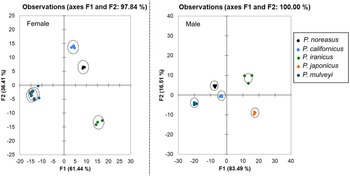
According to the key provided by Ahmad & Jairajpuri (Reference Ahmad and Jairajpuri2010), the closest species based on morphology (P. californicus, P. japonicus, and P. noreasus) and molecular analysis of 18S rDNA (P. mulveyi) were included in the DA with the new species. DA using morphometric features of females and males of P. iranicus sp. n., showed a clear separation of those five species. Furthermore, accumulated variabilities of 97.84 and 100% were observed in female-based and male-based DA for discriminating the mentioned species (Figure 5). The results confirmed that P. iranicus sp. n., is a different species indeed. However, the DA plot revealed that the Paramylonchulus species could be better classified based on the important male characters.
Discriminant analysis (DA) plot showing the discrepancy between Paramylonchulus iranicus sp. n. and closely related species of Paramylonchulus based on female and male important characters.

Molecular phylogenetic status
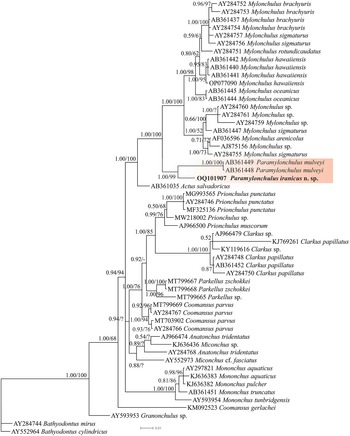
The nucleotide Basic Local Alignment Search Tool (BLASTn) search revealed that this population has 96% similarity with P. mulveyi (Jairajpuri, Reference Jairajpuri1970) Jairajpuri & Khan, Reference Jairajpuri and Khan1982 (acc. nrs., AB361448; AB361449). The consensus tree inferred using our 18S rDNA marker (Figure 6) indicated that the mononchids included in the molecular study were grouped into nine clades, including I) Mylonchulus spp. (e.g., M. sigmaturus (Cobb, Reference Cobb1917) Altherr, Reference Altherr1953; M. oceanicus Andrássy, Reference Andrássy1986; M. brachyurus (Bütschli, Reference Bütschli1873) Cobb, Reference Cobb1917; M. hawaiiensis, (Cassidy, Reference Cassidy1931) Goodey, Reference Goodey1951; M. rotunicaudatus Skwarra, Reference Skwarra1921; M. arenicolus Clark, Reference Clark1961; II) P. mulveyi and P. iranicus sp. n.; III) Actus salvadoricus Baqri & Jairajpuri, Reference Baqri and Jairajpuri1974; IV) Clarkus papillatus (Bastian, Reference Bastian1865) Jairajpuri, Reference Jairajpuri1970; Prionchulus punctatus (Cobb, Reference Cobb1917) Andrássy, Reference Andrássy1958; P. muscorum (Dujardin, Reference Dujardin1845) Wu and Hoeppli, Reference Wu and Hoeppli1929; V) Parkellus zschokkei (Menzel, Reference Menzel1913) Ahmad & Jairajpuri, Reference Ahmad and Jairajpuri2010 and unidentified Parkellus; VI) Coomansus parvus (de Man, Reference De Man1880) Jairajpuri & Khan, Reference Jairajpuri and Khan1977; VII) Anatonchus tridentatus (de Man, Reference De Man1876) Cobb, Reference Cobb1916; Miconchus cf. fasciatus (Cobb, Reference Cobb1917) Andrássy, Reference Andrássy1958; and unidentified Miconchus; VIII) Mononchus aquaticus Coetzee, Reference Coetzee1968; M. truncatus Bastian, Reference Bastian1865; M. tunbridgensis Bastian, Reference Bastian1865; and M. pulcher Andrássy, Reference Andrássy1993; IX) Coomansus gerlachei (de Man, Reference De Man1904) Jairajpuri & Khan, Reference Jairajpuri and Khan1977.
The Bayesian tree of known and newly sequenced Paramylonchulus iranicus sp. n. from Iran based on 18S rDNA region.

Discussion
The genus Paramylonchulus was established by Jairajpuri and Khan (Reference Jairajpuri and Khan1982) for the species differing from Mylonchulus by having a pro-monodelphic reproductive system, narrow buccal cavity, and lacking a subvental tooth (Ahmad and Jairajpuri Reference Ahmad and Jairajpuri2010). Therefore, in a general view, Mylonchulus and Paramylonchulus are very similar. The members belonging to Mononchida were differentiated using multivariate analysis, as indicated for Mylonchulus (Shokoohi and Moyo Reference Shokoohi and Moyo2022). The post vulval uterine sac is one of the most important characteristics to determine Paramylonchulus species (Ahmad and Jairajpuri Reference Ahmad and Jairajpuri2010). The evaluation of the relationship between the close species of Paramylonchulus, including P. iranicus sp. n., is shown in Figure 5, which classified them into four and five separate groups based on the female and male essential taxonomic characters. DA clearly separated P. iranicus sp. n. and verified the new species. The data obtained agree with previous findings (Shokoohi and Moyo Reference Shokoohi and Moyo2022). The DA plot revealed that the Paramylonchulus species could be better classified based on the important male characters with 100% support. The new species had a higher b value (4.0–4.2) compared with the b value of the species included in the DA, which ranged from 2.9 to 3.5. Furthermore, the new species had more male supplementary organs (11–12 vs. 8–10 for the rest of species included in the analysis). Results also indicated that DA is a useful statistical tool for distinguishing the Paramylonchulus species.
The consensus tree inferred using our SSU sequence alignment (Figure 5) indicated that the Mylonchulus species stand close to Paramylonchulus. The same result was obtained by previous studies (Van Megen et al. Reference Van Megen, Van Den Elsen, Holterman, Karssen, Mooyman, Bongers, Holovachov, Bakker and Helder2009; Olia et al. Reference Olia, Ahmad, Araki, Minaka, Oba and Okada2008; Shokoohi et al. Reference Shokoohi, Mehrabi-Nasab, Mirzaei and Peneva2013; Koohkan et al. Reference Koohkan, Shokoohi and Mullin2015; Vu Reference Vu2021; Vu et al. Reference Vu, Rybarczyk-Mydłowska, Susulovsky, Kubicz, Flis, Le and Winiszewska2021; Shokoohi and Moyo Reference Shokoohi and Moyo2022). The present results show that the new species is well separated from other Mylonchulus species. However, P. iranicus sp. n. stands close to P. mulveyi. The main difference between the two species is the reproductive system; in the latter species, the post vulval uterine sac is missing. However, only P. mulveyi was studied using 18S rDNA, for which Olia et al. (Reference Olia, Ahmad, Araki and Minaka2009) verified its phylogenetic position. Therefore, Mylonchulus mulveyi was transferred to Paramylonchulus by Jairajpuri and Khan (Reference Jairajpuri and Khan1982). Later in 2010, Ahmad & Jairajpuri also followed the taxonomic status of P. mulveyi. In conclusion, morphological features demonstrate Paramylonchulus is a valid taxon; however, to be verified by molecular characters, more representatives of the genus are needed to discuss its position. Therefore, as the new species, P. iranicus sp. n. stands with P. mulveyi in the same subclade. It should be noted that 14 species of Paramylonchulus have not yet been molecularly studied. In conclusion, the result of the phylogenetic analysis showed that Mylonchulus and Paramylonchulus are monophyletic taxa according to the available sequences. However, a close relationship between the two taxa was observed using 18S rDNA.
Acknowledgments
We appreciate the University of Gorgan for financially supporting the project. In addition, support from the Aquaculture Research Unit of the University of Limpopo for the statistical analysis is also acknowledged.
Financial support
This project was financially supported by the Gorgan University of Agricultural Sciences and Natural Resources.
Competing interest
The authors declare that they have no conflict of interest.
Ethical standard
In addition, the work was done in an ethical manner.