INTRODUCTION
The Seisonacea is an aberrant group of marine rotifers that lives as epizoonts on the crustacean genus Nebalia. Species of Seisonacea display several traits that are atypical for rotifers, for example, reproduction by obligate amphimixis and the presence of fully developed and probably diploid males. These putative plesiomorphic traits have led many authors to suggest Seisonacea as being the sister group to other rotifers (Melone et al., Reference Melone, Ricci, Segers and Wallace1998; Mark Welch, Reference Mark Welch2000, Reference Mark Welch2001; Sørensen et al., Reference Sørensen, Funch, Willerslev, Hansen and Olesen2000). However, more recent studies based on molecular and combined molecular and morphological evidence place Seisonacea in the clade Hemirotifera together with Bdelloidea and Acanthocephala (García-Varela & Nadler, Reference García-Varela and Nadler2006; Sørensen & Giribet, Reference Sørensen and Giribet2006). Hence, the evolution and exact phylogenetic position of the Seisonacea are still unclear, but with their aberrant morphology and special biology they remain among the most enigmatic and fascinating of rotifer taxa.
Seisonacea currently consists of three valid species. Seison nebaliae Grube, Reference Grube1861 and Paraseison annulatus (Claus, Reference Claus1876) have been known for more than 100 years, whereas S. africanus Sørensen, Segers & Funch, Reference Sørensen, Segers and Funch2005 was described more recently. The two former species both used to be designated as part of Seison Grube, Reference Grube1861, but prompted by the description of S. africanus and the subsequent revision of the genus (see Sørensen et al., Reference Sørensen, Segers and Funch2005), P. annulatus was moved from Seison and allocated to the reestablished genus Paraseison Plate, Reference Plate1887.
The three currently known species of Seisonacea all appear to have a restricted geographical distribution. Seison nebaliae and P. annulatus have been recorded on several occasions in the Adriatic Sea, the Tyrrhenian Sea, the Balearic Archipelago and along the Atlantic coast of France (Grube, Reference Grube1861; Claus, Reference Claus1876; Plate, Reference Plate1887; Illgen, Reference Illgen1916; Ricci et al., Reference Ricci, Melone and Sotgia1993; Ahlrichs, Reference Ahlrichs1995; Segers & Melone, Reference Segers and Melone1998), and their distributions appear to be restricted to the Mediterranean Sea and the European west coast. A single record of S. nebaliae from the Sea of Okhotsk, north-western Pacific, exists (Markevich, Reference Markevich1993) but the identity of this species is questionable. The third species, S. africanus, was described from Gazi Bay in Kenya, and has not been recorded elsewhere (Sørensen et al., Reference Sørensen, Segers and Funch2005). Other reports of species of Seisonacea are limited to records of unidentified specimens from Chile (Leung & Mohr, Reference Leung and Mohr1969) and California (Menzies & Mohr, Reference Menzies and Mohr1952). The present study describes the first species of Paraseison outside Europe. The species lives as epibiont on Nebalia hessleri Martin, Vetter & Cash-Clark, 1996 and was collected from a locality close to San Diego, California.
MATERIALS AND METHODS
Specimens of the leptostracan crustacean Nebalia hessleri were collected at several occasions during spring and summer 2007 from the species' type locality at the southern rim of La Jolla Canyon (32o52.5′N 117o15.5′W) off the coast of La Jolla north of San Diego, California. The locality is situated at about 19 m depth, and the specimens were collected from thick decaying seagrass mats by the second author and Eddie Kisfaludy. The samples always yielded N. hessleri, whereas the collected specimens were only occasionally inhabited by seisonids. Several collections after 2007 did not yield any further infected N. hessleri.
Specimens of N. hessleri were identified and examined for rotifer epibionts with a Leica MZ9.5 dissecting microscope. When present, species of Paraseison were attached to the inside of the carapace only. Specimens that remained attached during the examination were gently detached with a thin needle. The specimens were subsequently relaxed in a magnesium chloride solution isotonic with seawater, and then fixed in 4% formaldehyde.
Specimens for light microscopy (LM) examinations were dehydrated through a graded series of glycerin, mounted in 100% glycerin, and examined and photographed using Nomarski differential interference contrast with an Olympus BX51 microscope equipped with an Olympus DP20 digital camera. Habitus drawings were made with a camera lucida. Specimens for scanning electron microscopy (SEM) were dehydrated through a graded series of ethanol, transferred to acetone and critical point dried. Trophi were extracted using dilute sodium hypochlorite and prepared for LM and SEM examinations, following the procedure given by De Smet (Reference De Smet1998). Trophi for LM were mounted in Fluoromount-G, whereas trophi and whole specimens for SEM were attached to a carbon pad on an aluminium stub and sputter-coated with a platinum/palladium mix. All mounts for SEM were examined with a JEOL JSM-6335F field emission scanning electron microscope.
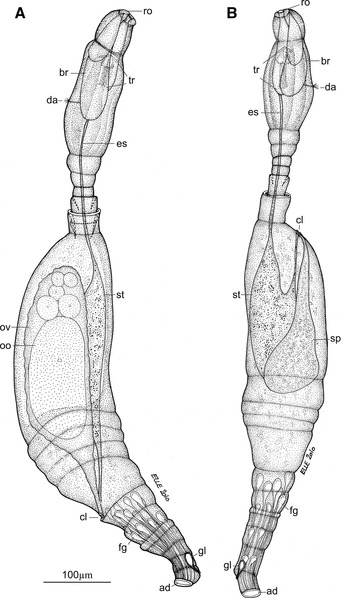
Line art illustration of Paraseison kisfaludyi sp. nov. (A) Female habitus, lateral view; (B) male habitus, lateral view. ad, adhesive disc; br, brain, cl, cloaca; da, dorsal antenna; es, oesophagus; fg, foot gland; gl, gland; oo, oocyte; ov, ovarium; ro, rostrum; sp, spermatophore-forming organ; st, stomach; tr, trophi.

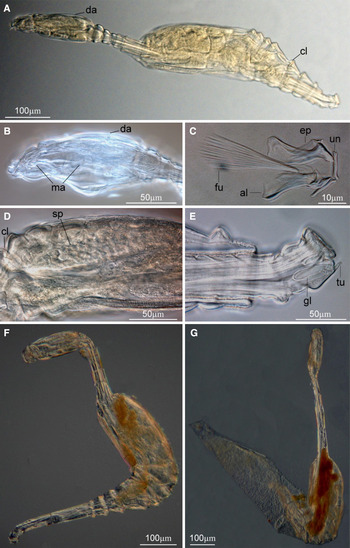
Light microscopic photographs of Paraseison kisfaludyi sp. nov. (A) Female specimen, lateral view; (B) close-up of the head showing the mastax; (C) isolated trophi; (D) male reproductive apparatus; (E) foot with foot glands; (F) live specimen with fully extended foot; (G) live specimen with fully extended neck. al, alulae; cl, cloaca; da, dorsal antenna; ep, epipharynx; fu, fulcrum; gl, gland; ma, mastax; sp, spermatids; tu, tubule; un, unci.

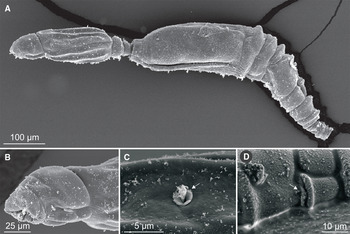
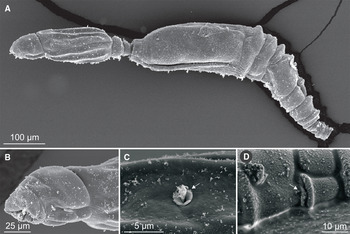
Scanning electron microscopic photographs of Paraseison kisfaludyi sp. nov. (A) Female specimen, lateral view; (B) close-up of rostrum; (C) dorsal antenna, see arrow; (D) female cloaca, see arrow.
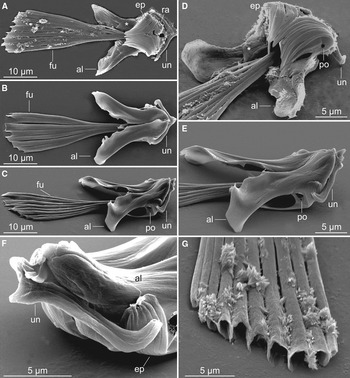
Scanning electron microscopic photographs of trophi of Paraseison kisfaludyi sp. nov. (A) Dorsal view; (B) ventral view; (C) ventrolateral view; (D) rami and epipharynx, dorsocaudal view; (E) rami, ventrolateral view; (F) close-up of uncus–ramus connection; (G) close-up of lamellae in distal tip of fulcrum, dorsal side to the right. al, alulae; ep, epipharynx; fu, fulcrum; po, pore; ra, rami; un, unci. The additional rami components () are labelled with an asterisk in (A) and (D).

TYPE MATERIAL
Holotype: adult female, mounted in glycerin on a glass slide for LM, collected on May 20, 2007 from deep inside large decaying seagrass deposits in La Jolla Canyon, north of San Diego, CA, USA, by G. Rouse and E. Kisfaludy; coordinates: 32o52.5′N 117o15.5′W; water depth: 19 m. Specimen deposited at the Scripps Institution of Oceanography Benthic Invertebrate Collection, accession no. SIO-BIC A2182.
Allotype: adult male, mounted in glycerin on a glass slide for LM. Collection data are the same as for holotype; deposited at the Scripps Institution of Oceanography Benthic Invertebrate Collection, accession no. SIO-BIC A2183.
Paratypes: three males mounted in glycerin on a glass slide for LM (accession no. ZMUC ROT-297 to 299); one set of trophi mounted in Fluoromount-G on a glass slide for LM (accession no. ZMUC ROT-300); one female (accession no. ZMUC ROT-301) and two specimens of unknown sex (accession no. ZMUC ROT-302 to 303) mounted for SEM, and four sets of trophi mounted for SEM (accession no. ZMUC ROT-304 to 307). Collecting data are the same as for holotype; deposited at the Natural History Museum of Denmark.
DIAGNOSIS
Body length from 815 to 890 µm. No differences in the size between female and male specimens. Body divided into head, neck, trunk and foot. Head with one anterior constriction at the base of the rostrum, and two constrictions close to the neck. Neck has three telescopically retractable pseudosegments, and foot has six telescopically retractable pseudosegments. A non-retractable ring present between second and third pseudosegment of the foot. Trunk has four annulations in its posteriormost part. Trophi has rami, extending caudally into well developed alulae. Epipharynx is asymmetrical, with largest half to the right, consisting of 7 lamellae, and smallest half to the left, consisting of 5 lamellae. Unci is S-shaped, interlocking with rami. Fulcrum lamellar, consisting of 8 to 10 tubular lamellae. Longest lamella present about one-third from dorsal margin of fulcrum.
ETYMOLOGY
The species is named kisfaludyi after Eddie Kisfaludy who worked at the Scripps Institution of Oceanography and first brought Nebalia hessleri to G.W.R., resulting in the discovery of the new species.
DESCRIPTION
The body is distinctively divided into four regions: head, neck, trunk and foot (Figures 1, 2A, B, D–G & 3A, B). The head is elongate and offset from the neck by two conspicuous constrictions. The mouth is terminal, slightly orientated towards ventral side, and surrounded by a well developed rostrum (Figure 3B). Rostrum and head are divided by a distinct circular constriction. The corona is completely reduced. Externally the head is characterized by a broad, ventral, longitudinal furrow and additional thinner, longitudinal furrows on the dorsal, lateral and ventral sides. A dorsal antenna is located at about 1/4 from the neck joint; lateral antennae are not present (Figures 1, 2A, B & 3C). Internally, the head contains two salivary glands, each with one nucleus, the mastax (detailed description of hard parts below), a large, caudally extending brain that fills up most of the dorsal part of the head, and paired, elongate retrocerebral sacs.
The neck consists of three pseudosegments that can be retracted telescopically. Anteriorly, the first neck pseudosegment joins the rings that mark the intersection with the head. In completely retracted condition no pseudosegments are visible. Internally, the neck has a straight oesophagus and an undetermined number of longitudinal retractor muscles (Figures 1, 2A & 3A).
The trunk is fusiform and semiloricate, and divided into a smooth, parallel-sided anterior part with paired longitudinal ventrolateral and dorsolateral sulci, and an annulated posterior part that tapers gradually towards the foot (Figures 1, 2A & 3A). The anteriormost part is delimitated by a ring, which joins the neck. In the posterior part, at 2/3 from the junction with the neck, four annulations are present and divide the posterior part of the trunk into four non-retractable rings. The posteriormost ring is conspicuously longer than the three anterior ones. Anterior to the annulated trunk part, the outer integument appears wrinkled on the dorsal and ventral side, whereas it is completely smooth laterally. Internally the oesophagus leads to the stomach that fills up most of the trunk. Posteriorly the stomach narrows and leads, in females, to a dorsal cloaca that opens dorsally in the posterior part of the trunk, just at the junction between the foot and the trunk (Figures 1A, 2A & 3D). The male cloaca is located dorsally, in the anteriormost part of the trunk, close to the neck (Figures 1B & 2D). The trunk musculature consists of a pair of ventral retractors that attach near the neck and extend to the annulated part of the trunk where it apparently splits into two end points that attach in the lateroventral part of the trunk wall. Another set of retractors attaches dorsally at the beginning of the annulated part of the trunk and extends caudally into the foot. Females have paired ovaries, whereas males have large paired testes filled with rounded spermatids (Figures 1 & 2D).
The foot consists of six telescopically retractable pseudosegments and a distal adhesive disc. An additional ring (apparently not retractable) is present between the second and third foot pseudosegment (Figure 1A, B). Internally the foot is filled with numerous foot glands of varying lengths. A small ovoid gland with a tubular outlet is situated on the ventral side of the foot, close to the adhesive disc (Figures 1 & 2E).
The trophi are fulcrate and identical in both sexes (Figures 2C & 4). The rami are slightly asymmetrical and consist of anteriorly rounded heads that extend caudally into broad alulae. The ramal inner margins are smooth and actual teeth are not present (Figure 4A–F). Only at the anteriormost point of each ramus, a short row with 3 to 4 flattened, knob-like projections is present (Figure 4F). The projections appear to interlock with the distal parts of the unci. Posteriorly, the rami extend into a pair of large alulae (Figure 4A–E). Alulae consist of two projections with strongly sclerotized outer margins, dilated distally, and wide inner lamellae. A pore is present anteriorly and laterally close to the transition of rami into alulae (Figures 2C & 4A–E). One additional pair of elements may furthermore be present on the dorsal side of the rami, near the transition into the alulae (marked with * on Figure 4A, D). Each element resembles a lamellar plate, but since they are partly covered by the epipharynx, it cannot be determined whether they are isolated sclerites, or just thickenings of the rami. A paired lamellar epipharynx is present on the dorsal side of the ramus heads. The right half (7 lamellae) is larger than the left (5 lamellae; Figure 4A, D). The fulcrum is elongated and dilated dorsoventrally in its distal half, smoothly narrowing to an acute point anteriorly. It is made up by 8 to 10 parallel, smoothly tapering lamellae. The shortest lamella is the ventralmost one, whereas the longest is present about one-third from the dorsal side (Figures 2C & 4A–C, G). Unci are elongated and S-shaped, and apically connected with projections of rami (Figures 2C & 4A–F).
MEASUREMENTS
Total length 815–890 µm; head 132–156 µm; neck 187–246 µm; trunk 308–400 µm; foot 142–170 µm; trophi 51 µm; rami 25 µm; fulcrum 39 µm; and unci 10 µm.
DISCUSSION
Notes on diagnostic traits
Based on its trunk annulations and trophi morphology, the new species should be assigned to the genus Paraseison, that currently accommodates only one other species, P. annulatus.
Paraseison annulatus and P. kisfaludyi sp. nov. are most easily distinguished by differences in their trophi morphology. Trophi in the new species are longer (51 µm) than in P. annulatus (37 µm). Furthermore, the morphology of the fulcrum differs between the two species, both regarding the number of lamellae (7–8 in P. annulatus versus 8–10 in P. kisfaludyi sp. nov.) and the relative length of lamellae. Paraseison annulatus possesses a remarkably long lamella on the ventralmost fulcrum margin, whereas P. kisfaludyi sp. nov. does not show any conspicuous long lamellae and has its longest one located medially in the fulcrum, slightly closer to the dorsal side. Other minor differences are in regard to the morphology of the epipharynx and rami. The epipharynx of both species is slightly asymmetrical but in P. annulatus the largest epipharyngeal half is located to the left, while in P. kisfaludyi sp. nov., the largest part is to the right. We would not consider this asymmetry as a fixation artefact because not only the size but also the number of lamellae in the epipharynx halves differed in all examined specimens of P. kisfaludyi sp. nov. Also the rami are strongly asymmetrical on the anteriormost side in P. annulatus while only a slight indication of asymmetry can be observed in P. kisfaludyi sp. nov.
Further differences between the two Paraseison species are in regard to the external body morphology. However, the lack of general morphological information revealed through SEM studies on P. annulatus hampers a detailed comparison between the two species. Comparison with LM observations on P. annulatus (see Claus, Reference Claus1876; Ricci et al., Reference Ricci, Melone and Sotgia1993) indicate that both species have four annulations in the trunk, three telescopically retractable segments in the neck and six in the foot. However, the foot morphology of P. kisfaludyi sp. nov. differs slightly from P. annulatus by the presence of an additional, non-retractable ring that is inserted between the second and third pseudosegments of the foot. It should, however, be stressed that this ring is most easily observed with SEM, hence it could have been overlooked in P. annulatus. Another difference is in regard to the dimensions of the neck pseudosegments that are equally long in P. kisfaludyi sp. nov., whereas their lengths increase from anterior to posterior in P. annulatus.
The overall sizes and dimensions of P. kisfaludyi sp. nov. are near or within the ranges of the seisonacean species known from Europe, while S. africanus is smaller (S. africanus males = 352–536 µm, females = 447–566 µm according to Sørensen et al. (Reference Sørensen, Segers and Funch2005); S. nebaliae males = 1.1 mm, females = 0.8 mm according to Ricci et al. (Reference Ricci, Melone and Sotgia1993); up to 2.5 mm according to Remane (Reference Remane and Bronn1929–1933); P. annulatus males = 0.4–0.7 mm, females =~1 mm according to Plate (Reference Plate1887)). Opposed to other species of Seisonidea, where the males usually are slightly smaller than females, P. kisfaludyi sp. nov. does not display any conspicuous metric sexual dimorphism.
Notes on geographical distribution for Seisonacea
The present contribution represents the first description of a seisonacean rotifer species from the American coasts. The only other known species of Paraseison, namely P. annulatus, has been reported from the Mediterranean Sea and the Atlantic coast of Western Europe (Claus, Reference Claus1876; Plate, Reference Plate1887; de Beauchamp, Reference de Beauchamp1907; Remane, Reference Remane and Bronn1929–1933; d'Hondt, Reference d'Hondt1970; Koste, Reference Koste1975; Ricci et al., Reference Ricci, Melone and Sotgia1993; Ahlrichs, Reference Ahlrichs1997; Segers & Melone, Reference Segers and Melone1998). Within Seisonacea, the geographical range of P. annulatus and Seison nebaliae appears to be quite similar, whereas S. africanus was described from the Indian Ocean off the coast of Kenya (Sørensen et al., Reference Sørensen, Segers and Funch2005). The discovery of P. kisfaludyi sp. nov. from the coast of California supports the importance of collecting effort in order to understand the biogeography of Seisonacea, and it demonstrates that the apparent restricted distribution of this group undoubtedly is a consequence of sampling bias. In fact, the occurrence of named and described species from all major oceans, now including the Pacific, and additional recordings of unidentified Seisonacea from the north-western Pacific (Markevich, Reference Markevich1993) and the coast of Chile (Leung & Mohr, Reference Leung and Mohr1969) indicate that the group has a cosmopolitan distribution.
The evolution and phylogenetic significance of Seisonacea
The few differences between the two species of Paraseison most likely reflect a relatively recent, probably allopatric, separation of the two species. Contrarily, the more prominent differences, mainly in trophi morphology, between the two genera Seison and Paraseison, undoubtedly translate into a different function of their mastaxes, which relates to differences in their ecology and feeding habits. Food specialization is likely to have played an important role in the evolution of the two sister genera. Seison species are commensals and food specialists, possibly feeding on bacteria ingested by suction, resulting from a pumping action of the mastax. Contrarily, observations on stomach contents from P. annulatus, resembling nebalian haemolymph, could imply that Paraseison species are ectoparasites, and it has been suggested that their unique mastaxes and trophi are used to pierce the tegument of its host by protruding the sharp tip of its fulcrum through the mouth, and sucking out haemolymph of its host (see Ahlrichs, Reference Ahlrichs1995; Segers & Melone, Reference Segers and Melone1998). All species belonging to Seisonacea are peculiar in their close association with the leptostracan crustacean Nebalia. This suggests that both genera may be derived from a common ancestor that already lived in close association with Nebalia, and that the stem species of the two genera subsequently evolved through sympatric speciation as a result of adaption to different food sources.
As stated above, our knowledge on the exact phylogenetic position of Seisonacea within Rotifera is still unclear, and it remains uncertain whether they represent the sister group to all other rotifers (Melone et al., Reference Melone, Ricci, Segers and Wallace1998; Mark Welch, Reference Mark Welch2000, Reference Mark Welch2001; Sørensen et al., Reference Sørensen, Funch, Willerslev, Hansen and Olesen2000) or if they are highly derived hemirotiferans (García-Varela & Nadler, Reference García-Varela and Nadler2006; Sørensen & Giribet, Reference Sørensen and Giribet2006). However, with its intriguing biology and peculiar morphology, the taxon undoubtedly plays a key role in understanding the evolutionary history and phylogenetic relationships of rotifers and platyzoans in general. With the description of the new species P. kisfaludyi sp. nov. we hope to provide new information on taxonomy, distribution and morphology of Seisonacea, in an attempt to facilitate future comparative and phylogenetic studies of rotifers and associated clades.
ACKNOWLEDGEMENTS
We wish to thank Eddie Kisfaludy for his assistance collecting infected specimens of Nebalia, and Stine Elle for providing the line art illustrations of Paraseison kisfaludyi sp. nov. This work was supported by the European Commission's (FP 6) Integrated Infrastructure Initiative Programme, Synthesys to F.L. (DK-TAF-180), and by the Danish Natural Science Research Council (Grant No. 09-066003) to M.V.S.