1. INTRODUCTION
There is currently much interest in propagating high intensity laser pulses through plasmas over large number of Rayleigh lengths, both from the standpoint of basic physics and potential applications in advanced fusion energy, X-ray lasers, ultrahigh-gradient electron accelerators, fast ignitor concept, and laser induced lightning (Tajima & Dawson, Reference Tajima and Dawson1979; Umstadter et al., Reference Umstadter, Kim and Dodd1996; Tabak et al., Reference Tabak, Hammer, Glinsky, Kruer, Wilks, Woodworth, Campbell and Perry1994; Mackinnon et al., Reference Mackinnon, Borghesi, Gaillard, Malka, Willi, Offenberger, Pukhov and Meyer-Ter-Vehn1999; Sprangle et al., Reference Sprangle, Esarey, Ting and Joyce1988; Li et al., Reference Li, L'Huillier, Feray, Lompre and Mainfray1989; Kasparian et al., Reference Kasparian, Rodriguez, Mejean, Yu, Salmon, Wille, Bourayou, Frey, Andre, Mysyrowicz, Sauerbrey, Wolf and Woste2003; Pepin et al., Reference Pepin, Comtois, Vidal, Chien, Desparois, Johnston, Kieffer, Fontaine, Martin, Rizk, Potvin, Couture, Mercure, Bondiou-Clergerie and Lalande2001; Rodriguez et al., Reference Rodriguez, Sauerbrey, Wille, Wostle, Fujii, Andre, Mysyrowicz, Klingbeil, Rethmeier, Kalkner, Kasparian, Salmon, Yu and Wolf2002; Chen et al., Reference Chen, Unick, Vafaei-Najafabadi, Tusi, Fedosejevs, Naseri, Masson-Laborde and Rozmus2008; Neff et al., Reference Neff, Knobloch, Hoffmann, Tauschwitz and Yu2006; Yu et al., Reference Yu, Yu, Xu, Tian, Chen and Wong2007; Zhao et al., Reference Zhao, Yeh, Diels and Wang1993; Braun et al., Reference Braun, Korn, Liu, Du, Squier and Mourou1995; Yang et al., Reference Yang, Zhang, Yu, Li and Wei2001, Reference Yang, Zhang, Li, Chen, Teng, Wei and Sheng2002; Fontaine et al., Reference Fontaine, Vidal, Jiang, Chien, Comtois, Desparois, Johnston, Kieffer, Pepin and Mercure1999). The success of these applications depends critically on the long distance propagation of laser pulses in plasma. In order to attain high intensities, laser pulses are normally focused tightly, which due to diffraction, results in a short interaction length (1–2 Rayleigh length, R d = kr 02, where r 0 is the spot size and k is the propagation vector of the laser beam). Thus, diffraction broadening of a laser radiation is one of the principle phenomenon inhibiting the effective use of energy of the laser in many applications. Due to the diffraction effect, the intensity of radiation decreases as the laser propagates. Therefore, guiding of the laser radiation becomes essential. Several methods have been proposed to extend the propagation distance of pulses beyond this diffraction limit(Rayleigh length), as reviewed in Esaray et al. (Reference Esaray, Sprangle, Krall and Ting1996, Reference Esaray, Sprangle, Krall and Ting1997).
For optical guiding of laser pulses in plasmas, the plasma channels have to be prepared. For perfect guiding, a plasma density with a minimum on the axis and a parabolic increase toward the edge is required. For this, two pulse technique allows the guiding of a laser pulse having high intensity of the order of 1014–1018 W/cm2. In this technique, the physics of guiding the laser pulse is as follows, a plasma channel is created by focusing a laser prepulse on picosecond time scale (Durfee & Milchberg, Reference Durfee and Milchberg1993) via tunnel and impact ionization. Since the prepulse has a gaussian intensity radial profile, therefore, the plasma density that results spontaneously, has a peak on the axis and falls rapidly with radial distance away from the axis, before the diffusion sets in. The refractive index is minimum on the axis and increases toward the edge and hence the medium behaves as a defocusing medium. As a result, the ionization produced by the laser becomes axially nonuniform. Further, the plasma channel evolved from such a density profile on a nanosecond time scale, after the laser prepulse is gone, will also have an axial variation of plasma density.
After the laser prepulse is gone, the plasma created by the prepulse diffuses radially away from the axis and therefore the plasma density becomes minimum on the axis as compared to the density at the edge of the plasma channel, where the density is maximum. Therefore, the refractive index becomes maximum on the axis and decreases toward the edges and thus the medium behaves like a focusing medium.
When a delayed second laser pulse is passed through the plasma channel, it diverges due to diffraction and converges due to refraction. However, when both the convergence and divergence parameters are equal, then the delayed laser pulse propagates without convergence and divergence. In an axially nonuniform plasma channel, this condition cannot be satisfied throughout the channel, hence the beam radius changes as it propagates.
Durfee and Milchberg (Reference Durfee and Milchberg1993) successfully demonstrated laser guidance of delayed second laser pulse upto several rayleigh lengths in a plasma channel formed by a laser prepulse. Liu and Tripathi (Reference Liu and Tripathi1994) used a paraxial ray approximation to explain the self-defocusing of the laser prepulse and laser guiding of the second delayed laser pulse in the evolved axially nonuniform plasma channel. The paraxial theory of Akhmanov et al. (Reference Akhmanov, Sukhorukov and Khokhlov1968) and Sodha et al. (Reference Sodha, Ghatak, Tripathi and Wolf1976) had been the most popular theory. Despite its mathematical simplicity, the problem regarding this theory is that in the self focusing mechanism, it takes into consideration only the region of the beam close to the beam axis. Fibich (Reference Fibich1996) has highlighted the importance of non-paraxiality in the self focusing phenomenon. However, these days nonparaxial theories are also important for the higher power laser beams. The moment and the variational methods are more relevant these days. In Section 2, we have developed a moment theory of self-defocusing of ionizing prepulse. In Section 3, guidance of the second pulse in the preformed plasma channel has been investigated by the moment method approach. Equations of the beam width parameters have been solved numerically using Runge–Kutta method and the results are discussed in Section 4.
2. SELF-DEFOCUSING OF PREPULSE
Consider the propagation of a gaussian laser beam of frequency ω through a gas along the z-axis. The laser ionizes the gas via tunnel ionization in a time shorter than the pulse duration of the laser. Characteristics of the plasma produced through the ionization of gas by a laser prepulse are calculated using the tunneling model of Keldysh (Reference Keldysh1965).
In tunnel ionization, the rate at which the plasma density increases is given, for singly ionized gases by
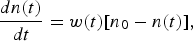
where n(t) is the time dependent electron plasma density, n 0 is the initial neutral gas density, and w(t) is given by Keldysh (Reference Keldysh1965)
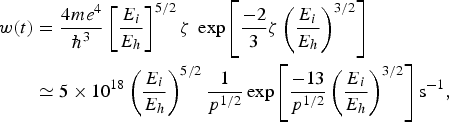
Here E i is the ionization potential of an atom, E h is the ionization potential of hydrogen,  , where
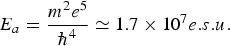 , is the atomic unit of the electric field and |E| is amplitude of the laser field, p is the laser power density in units of 1014 W/cm2, e and m are electronic charge and mass, respectively, and
 , where h is the Plancks constant.
In the experiment performed by Durfee and Milchberg (Reference Durfee and Milchberg1993), a laser prepulse (10.6 µm, ~100 ps) forms a channel for the second delayed pulse, and the laser intensity used was in the range 1013 – 1014 W/cm2. Sharp plasma density fallout was observed in Durfee and Milchberg's experiment, which was modeled by Liu and Tripathi (Reference Liu and Tripathi1994) as
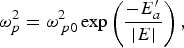
where 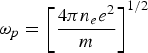 is the electron plasma frequency,
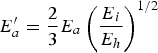 and ωp02 is a constant depending on the neutral particle density.
The electric vector E of the main beam satisfies the wave equation

and E can be written as

Initial intensity distribution of the main beam is assumed to be Gaussian and is given by

where A 00 is the maximum amplitude of electric field at r = 0 i.e. on the axis of the laser beam, r 2 = x 2 + y 2 and r 0 is the initial width of the laser beam at z = 0, which is defined as the beam radius at which the intensity of the beam becomes 1/e times to its maximum value (A 002) at r = 0.
The transverse intensity distribution of the laser beam for z > 0 can be written as (Akhmanov et al., Reference Akhmanov, Sukhorukov and Khokhlov1968)

where r 0 represents the initial beam width at z = 0 and r 0f 1 represents the beam width of the prepulse for z > 0. Therefore, the function f 1 is termed as the dimensionless beam width parameter of the prepulse with f 1 = 1 at z = 0 (c.f. Eq. (23)). It is assumed that the gaussian beam during its propagation in the plasma channel retains its gaussian character. All the theories such as the paraxial, moment, and the variational etc. are based on the premise that self similar solutions are the valid solutions.
The permittivity (ε) of the plasma may be written as

where

and

Now using Eq. (5) in the wave Eq. (4) and neglecting ∂2A/∂z 2 by using Wentzel-Kramer-Brillouin (WKB) approximation, we get

Neglecting ∂2A/∂z 2 implies that the characteristic distance of intensity variation is much greater than wavelength or in other words the solution of Eq. (11) can be obtained for a slowly converging/diverging beams.
Eq. (11) has been solved by Liu and Tripathi (Reference Liu and Tripathi1994) by using the paraxial ray approximation. We know that when high power laser beams are involved in laser plasma experiments, one must follow methods based on moments of nonlinear Schrodinger Eq. (11)
Now Eq. (11) can be rewritten as

where
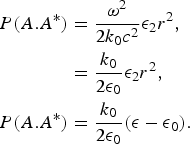
Now from the definition of second order moment, the mean square radius of the laser beam is given by

From above, one can obtain the following equation

where I 0 and I 2 are the invariants of Eq. (12) (Lam et al., Reference Lam, Lippman and Tappert1977)
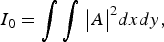

where from Vlasov et al. (Reference Vlasov, Petrischev and Talanov1971)

and

From Eqs. (7), (14), and (16), it can be shown that
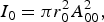

Now from Eqs. (15), (20), and (21), we get.

where ξ = (z/k 0r 02) is the dimensionless distance of propagation
By using Eqs. (8), (10),(13),(17)–(19), and (22), we get following equation for the beam width parameter f 1

Initial conditions for numerically solving Eq. (23) is f 1 = 1,  at ξ = 0.
3. GUIDED PROPAGATION OF SECOND DELAYED PULSE
After the prepulse has passed, the plasma moves radially away from the axis. The density profile of the plasma on the arrival of the delayed second laser pulse has been given by Liu and Tripathi (Reference Liu and Tripathi1994).

where α1 and α2 are monotonically decreasing functions of z;

The electric field vector of the second laser pulse can be expressed as

Now using Eqs. (24) and (25) in wave Eq. (4) and neglecting  by using WKB. approximation, we get

Eq. (26) can be written as

where
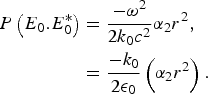
For a gaussian ansatz
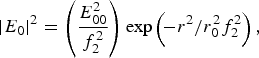
where f 2 is the dimensionless beam width parameter of the delayed second pulse (c.f. Eq. (39)).
From the definition of second order moments, the mean square radius (a′) and its variation with the distance of propagation can be given by following two equations


where I 0 and I 2 are the invariants of Eq. (27) (Lam et al., Reference Lam, Lippman and Tappert1977)
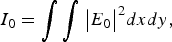

where from Vlasov et al. (Reference Vlasov, Petrischev and Talanov1971)

and

From Eqs. (29), (30), and (32), it can be shown that
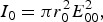

Now from Eqs. (31), (36), and (37), we get

By using Eqs. (28), (33)–(35), and (38), we get following equation for the beam width parameter f 2 of the second delayed pulse

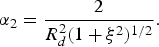
we have numerically solved Eq. (39) by taking initial conditions f 2 = 1,  at ξ = 0 and for a model α2(z) (Liu & Tripathi, Reference Liu and Tripathi1994)
4. DISCUSSION
Eqs. (23) and (39) for the beam width parameter of the first ionizing laser prepulse and the second delayed laser pulse have been solved numerically for the following set of parameters.

So in the present work, we have taken ωp0 = 0.3 × 10¹⁴ s−1, intensity of the laser beam 2.5 × 10¹⁴ W/cm2 and plasma density n e = 1.7 × 1017 cm−3.
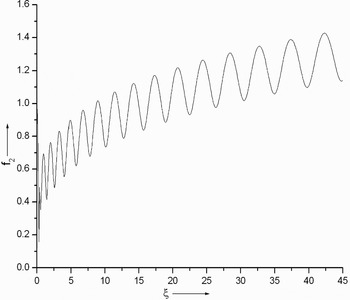
The results are depicted in the form of graphs in Figures 1 and 2. Eq. (23) is second order nonlinear ordinary differential equation, which governs the variation of beam width parameter f 1 of the prepulse with a dimensionless distance of propagation (ξ). There are three terms on the right-hand side of Eq. (23), the first term is due to diffraction divergence and the second term is due to nonlinear refraction, which is responsible for the self-defocusing of the prepulse. Initial contribution due to the third term at ξ = 0 is zero, which evolves with the distance of propagation and hence counteract the diffraction and self-defocusing of the prepulse.
Beam width parameter f 1 of the laser prepulse plotted against the dimensionless distance (ξ = z/R d) of propagation for the following set of parameters

Dotted curve corresponds to the case when only diffraction divergence term is present. Semidotted curve corresponds to the case when only first two terms, diffraction divergence and nonlinear refraction are present. Solid curve corresponds to the case when all the three terms are present.

Beam width parameter f 2 of the second delayed laser pulse plotted against the dimensionless distance(ξ = z/R d) of propagation when α1 = 0.875 and  .

Figure 1, represents variation of the beam width parameter f 1 of the prepulse with a dimensionless distance of propagation (ξ). Dotted curve corresponds to the case when only diffraction divergence term is present and the other two terms are ignored. Semidotted curve corresponds to the case when only the first two terms, diffraction divergence and nonlinear refraction are considered. Solid curve corresponds to the case when all three terms are taken into account. From Figure 1, it is observed that in all the cases, the beam width parameter f 1 increases monotonically and leads to defocusing of the ionizing pulse.
It is observed from the semidotted curve that there is a sharp defocusing of the ionizing pulse when the first two terms are taken. This is due to the fact that the first diffracting term is supplemented by the second refractive induced defocusing term.
When the prepulse propagates there is finite contribution from the last term, which prevents the prepulse from sharp defocusing as evident from the solid curve in Figure 1 and hence make significant contribution in the formation of plasma channel. This term is missing in the case of Liu and Tripathi (Reference Liu and Tripathi1994).
Eq. (39) is also a second order nonlinear ordinary differential equation, which governs variation of the beam width parameter f 2 of the guided pulse with a dimensionless distance (ξ) of propagation. Here the first term on the right-hand side of Eq. (39) is due to diffraction divergence and the second term is due to nonlinear refraction, which counteracts the diffraction and is also responsible for the guidance of the laser pulse. There is an additional third term  in the present study, the initial contribution of this term is zero as
 at ξ = 0. However, as the beam propagates, this term supports the second nonlinear refractive term and hence contributes significantly to the guidance of the laser pulse.
From Figure 2, it is clear that initially f 2 decreases with ξ, acquiring a minimum f min ≃ 0.16 at around ξ = 0.3. It is further seen that f 2 varies in the range 0.16 < f 2 < 1.414 as ξ goes from 0 to 42. This may be compared to Liu and Tripathi (Reference Liu and Tripathi1994), where f 2 varies in the range 0.75 < f 2 < 1.414 as ξ goes from 0 to 6 (Fig. 2 of Liu and Tripathi (Reference Liu and Tripathi1994), variation of f 2 has been shown in the range 0.75 < f 2 < 1.3 as ξ goes from 0 to 3.5.). Thus Liu and Tripathi observed guiding only over six Rayleigh lengths, whereas in the present investigation laser guiding over 42 Rayleigh length has been observed. This is due to the fact that Liu and Tripathi used paraxial ray approximation, which over emphasizes the regions close to the beam axis. Moreover, on comparing Eq. (39) of the guided wave with that of Eq. (22) of Liu and Tripathi (Reference Liu and Tripathi1994), we observe that there is an additional term  in Eq. (39), which prevents the guided wave from defocusing and hence makes a significant contribution for the propagation of delayed laser pulse over several Rayleigh lengths.
5. CONCLUSIONS
In the present research work, we have studied the optical guiding of laser pulse in an axially nonuniform plasma channel by the moment theory approach. In the earlier investigation by Liu and Tripathi (Reference Liu and Tripathi1994), the guided laser beam propagated only a few Rayleigh lengths. However, in the present investigation laser guiding over 42 Rayleigh lengths has been observed. The discrepancy arises due to the fact that Liu and Tripathi (Reference Liu and Tripathi1994) used paraxial ray approximation, which has inherent limitation as it presumes that only the regions close to the beam axis take part in self focusing. We have used the moment theory, which is a global approach, and does not suffer from such limitations. With the moment theory approach an additional term became available to counteract the diffraction effects and thereby extended the range of guided propagation.
Results of the present investigation are useful to the physics of laser-induced fusion and other heating experiments, where the guiding of the laser beam in the plasma is very important.
ACKNOWLEDGMENTS
The authors are thankful to the Ministry of Human Resources and Development of India for providing financial assistance for carrying out this work.