INTRODUCTION
Despite the increasingly urgent need to conserve biodiversity, there is still little systematic knowledge about factors affecting the willingness of societies to act accordingly. Factors believed to influence individual judgements concerning animals or their treatment include the physical characteristics of the species in question (Burghardt & Herzog Reference Burghardt and Herzog1980, Reference Burghardt, Herzog and Hoage1989; Kellert Reference Kellert1980, Reference Kellert1996; Plous Reference Plous1993; Knegtering et al. Reference Knegtering, Hendrickx, Van der Windt and Schoot Uiterkamp2002; Serpell Reference Serpell2004). An analysis of the US Endangered Species Act (ESA) of 1973 (Wilcove et al. Reference Wilcove, McMillan and Winston1993; Metrick & Weitzman Reference Metrick and Weitzman1996, Reference Metrick and Weitzman1998) and of Dutch species legislation from 1857 to 1995 (Knegtering et al. Reference Knegtering, Van der Windt and Schoot Uiterkamp2000) revealed that the relative involvement of species in legislation may vary greatly, depending on the taxonomic group (taxon). This suggests that at the very least physical characteristics as embodied in taxa may affect public conservation decisions.
A species’ body size is also believed to be an important physical characteristic affecting human responses (Burghardt & Herzog Reference Burghardt and Herzog1980, Reference Burghardt, Herzog and Hoage1989; Kellert Reference Kellert1980, Reference Kellert1996, p. 100) and is partly independent of taxon. It has been argued that larger animals are usually preferred by people (on a like/dislike scale; Kellert Reference Kellert1980). It has also been argued that a large size will contribute positively and a small size negatively to an individual's concern for the treatment of an animal (Burghardt & Herzog Reference Burghardt, Herzog and Hoage1989). However, systematic empirical evidence on the importance of species’ size is scarce in relation to both the level of individual response to species and public decisions on species, including decisions on their conservation. This can be considered to be a deficiency, as species size may well be an important factor affecting the willingness to conserve biodiversity and because species diversity is predominantly made up by small-bodied species. Two reasons for this predominance are that many species are inherently small due to the taxon to which they belong (for example insects), and that within taxa, most species tend not to be large but of intermediate size (Blackburn & Gaston Reference Blackburn and Gaston1994a).
Examining evidence related to public decisions, it is clear that many countries have developed legislation for commercial marine fisheries that sets minimum sizes of fish that can be caught by regulating the size of the mesh in the nets (De Klemm & Shine Reference De Klemm and Shine1993, p. 106). For other marine species groups, including molluscs and crustaceans, so-called minimum landing sizes have also been set (Shelmerdine et al. Reference Shelmerdine, Adamson, Laurenson and Leslie2007; Robinson Reference Robinson2008). This suggests that within one and the same marine species legislators tend to only permit use of larger individuals. A greater physical length also increased the likelihood that vertebrate species would be protected under the ESA of 1973 and that public money was spent on subsequent species recovery (Metrick & Weitzman Reference Metrick and Weitzman1996, Reference Metrick and Weitzman1998).
At the level of individual response, bushmeat hunters in both the Amazon and Congo basins showed preferences for large-bodied animals (Fa et al. Reference Fa, Peres and Meeuwig2002). Likewise, several studies, including willingness-to-pay surveys, show that anglers tend to prefer catching larger fish species or larger individuals within fish species (see for example Wheeler & Damania Reference Wheeler and Damania2001; Arterburn et al. Reference Arterburn, Kirby and Berry2002; Loomis Reference Loomis2006). In relation to zoo animals, it has been demonstrated that larger animal species generated longer viewing times by zoo visitors (Bitgood et al. Reference Bitgood, Patterson and Benefield1988), which suggests that individuals favour larger species. Larger mammals were also preferred by zoo visitors, both in terms of the proportion of long-term observers among visitors and of preferences for animals shown on postcards (Ward et al. Reference Ward, Mosberger, Kistler and Fischer1998; however, see Balmford Reference Balmford2000 and Ward Reference Ward2000). In relation to conservation, ratings by representatives of Dutch non-governmental organizations (NGOs) of the willingness of their own organization to support public conservation measures for species varied significantly with species size. On average the ratings were higher for larger species (Knegtering et al. Reference Knegtering, Hendrickx, Van der Windt and Schoot Uiterkamp2002). Regarding the biological knowledge of species, taxonomists tend to describe small-bodied species in a taxon after they have first described the large-bodied species (Blackburn & Gaston Reference Blackburn and Gaston1994b).
Furthermore, in an examination of photographs in books on penguins, the body length of penguin species correlated positively with the mean representation of the species in the books in terms of photo area (Stokes Reference Stokes2007). In Papua New Guinea, the prices of ornamental butterfly specimens correlated positively with species wing size (Slone et al. Reference Slone, Orsak and Malver1997).
Finally, a common way to treat people with a fear of a certain animal is desensitization through gradual exposure to specimens or representations of them with an increasing body size. Examples of animals concerned are earthworms (Kuroda Reference Kuroda1969) and spiders (for example Nelissen et al. Reference Nelissen, Muris and Merckelbach1995). The approach suggests that of species groups perceived as frightening, smaller species evoke weaker fear responses than larger species.
In summary, these studies generally suggest that with an increasing body size, a variety of values assigned (Brown Reference Brown1984) to species also become stronger, including values related to the use and protection of species. It is conceivable if different interests have different aims regarding a single species, conflicts between the interests may be more intense when such species are of larger body size. It is uncertain however, which choices public decision-makers tend to make in such cases.
We aim to quantitatively and longitudinally investigate the possible role of body size in national species-specific decisions that cover a broad range of objectives, including the protection of species. The longitudinal approach is prompted by the notion that perspectives regarding human-species relationships are subject to change over time. It is conceivable that this may affect possible size-dependent involvement of species in relation to different objectives. Because possible effects of the variable size may be mixed up with those of the variable taxon owing to differences in the absolute size range of species belonging to different taxa (for example absolute sizes of large mammals tend to be considerably larger than those of large insects), we considered the relationships between species’ sizes and legal objectives within taxa (see also Knegtering et al. Reference Knegtering, Hendrickx, Van der Windt and Schoot Uiterkamp2002).
The paper presents a longitudinal analysis of a full body of species legislation in the Netherlands enacted in the period 1857–1995. Based on an earlier dataset (Knegtering et al. Reference Knegtering, Van der Windt and Schoot Uiterkamp2000) and including size data of species, average sizes of species under legislation were assessed throughout the period for three different legal objectives defined by permitted levels and purposes of taking (such as catching or killing of wild animals and also subsequent possessing). (1) ‘Control’ involved prevention or reduction of the presence of the individuals of a species to protect human interests. In principle, allowing or encouraging extreme taking levels of species listed could meet this objective. (2) ‘Use’ was the utilization or profitable taking of animals or animal products. In principle, allowing the taking of species listed to a certain extent would meet this objective, but overexploitation was avoided. (3) ‘Protection’ related to the prevention of any form of taking of individuals of a species without intending enhancement of future use. In principle, no taking of the species listed would be allowed.
We aimed to answer the following three questions in relation to the different taxa considered:
(1) Did the average body size of species subject to the legislation differ between legal objectives?
(2) What were the average body sizes of protected species compared to those of species subject to use or control?
(3) How did average body sizes of species subject to the legislation change over time for different legal objectives, including protection?
METHODS
All of the wild animal species that were known or expected to have been present on Dutch territory (overseas territories excluded) during the period 1857–1995 and that had been explicitly named or listed in national Dutch legislation as species, were traced in legislation and recorded according to the procedure described in Knegtering et al. (Reference Knegtering, Van der Windt and Schoot Uiterkamp2000).
Less specific species names (for example ‘a falcon’ or ‘frogs’) were also registered as representing a specific species or a number of specific species if: (1) these names were listed among specific names, (2) clearly one particular species was meant, or (3) expressions explicitly referred to groups of species (for example ‘all species of bats’). In such cases, assumptions were made about the specific species involved. For the purpose of the present study, these assumptions were more specific than those described earlier by Knegtering et al. (Reference Knegtering, Van der Windt and Schoot Uiterkamp2000), and are briefly explained per taxon below (see also Appendix 1, see supplementary material at Journals.cambridge.org/ENC).
We recorded the periods that regulations applied to a particular species as well as the main legal objective(s) with respect to the species (see above). For each species, the recorded data were chronologically ordered and assigned to taxonomically different species groups (such as birds and mammals). For the present study, the body size (in mm) of the adult or imago phase of each species was also recorded (Appendix 2, see supplementary material at Journals.cambridge.org/ENC). If sources provided size ranges or different sizes for males and females for a given species, the mean values of the measurements were used to obtain a single size measurement for the species. For each taxonomic group and each legal objective, the average of the body sizes of the species recorded was calculated for each distinct subperiod (that is periods of one or more years in which there were no changes in the species sets subject to certain objectives).
Assumptions about specific species involved
Birds
It was assumed that the bird species subject to the Bird Acts of 1912 and 1936 (which, with the exception of certain categories, protected ‘all birds belonging to a European species’ and appearing on Dutch territory) included all species listed in a survey by Van den Berg and Bosman (Reference Van den Berg and Bosman2001, p. 39–367), insofar as the species were reported to have been first recorded in the Netherlands before 1857, excluding the species labelled by the authors as ‘very rare’ or ‘rare’. We also used these criteria in assumptions about subsets of bird species involved in early hunting legislation and regulations related to the Useful Animals Act of 1880. For the 1914–1995 period, however, the species that were reported in Van den Berg and Bosman (Reference Van den Berg and Bosman2001) as first recorded after 1857 or as ‘very rare’ or ‘rare’ were considered if their names explicitly appeared in bird or hunting legislation concerning the 1914–1995 period. We consulted additional sources (Schlegel Reference Schlegel and Herklots1852; Buve & Drijver Reference Buve and Drijver1937) to assist in the interpretation of ambiguous bird names in early hunting legislation (such as ‘divers’).
Mammals
Among mammals, regulations under both the Useful Animals Act 1880 and the Nature Conservation Act 1967 protected all indigenous bat species without mentioning specific species. We assumed here that only the species that had been known or present during the entire 1900–1995 period (according to Koomen et al. Reference Koomen, Van Nieukerken, Krikken, van Nieukerken and van Loon1995) were involved for both periods concerned. We assumed that ‘all’ cetaceans protected under the Nature Conservation Act 1967 included all cetaceans labelled as ‘indigenous’ by the Dutch Species Catalogue (Reference Dutch Species Catalogue2008).
Amphibians and reptiles
The Useful Animals Act 1914 protected ‘frogs’; we assumed that this involved only Rana species. The later Nature Conservation Act of 1967 protected all species of ‘frogs’, ‘toads’, ‘salamanders’, ‘lizards’ and ‘snakes’, which we assumed included all amphibian and reptile species labelled as ‘indigenous’ by the Dutch Species Catalogue (Reference Dutch Species Catalogue2008).
Fish
A Fishing Act 1908 order (1944) listed ‘shark (several shark species)’, which we assumed were the same species specifically named in fishing legislation from 1963 onwards. We assumed gurnard (Trigla) and sandeel (Ammodytes) species involved in orders under the Fishing Acts of 1908 and 1963 included those listed in Nijssen and De Groot (Reference Nijssen and De Groot1987).
Molluscs
Fishing Act 1908 orders listed freshwater mussels, specifically referring to the genera Unio and Anodonta. We conservatively assumed that the legislation only concerned Unio pictorum and Anodonta cygnea. A Fishing Act 1908 order also listed cephalopods, referring to the genera Sepia, Loligo and Octopus. We assumed that these were the same species as those whose specific names appeared in fishing legislation from 1963 onward.
Statistical analysis
We performed one-way analysis of variance (ANOVA) to assess, within a distinct subperiod, if the average size of the species that had been subject to legislation in that period differed statistically significantly between legal objectives. Consequently, this was only possible for periods in which two or three legal objectives simultaneously applied to a taxonomic group. For analytical purposes, body size was chosen as the dependent variable and legal objective (three possible levels: control, use and protection) as the independent variable. For body size, common logarithms of the recorded species sizes were used to approach normal distributions of the data. For each taxonomic group, the significance level of α = 0.05 was divided by the number of tests performed for that taxonomic group (Bonferroni correction). Bonferroni post hoc tests were additionally performed for the periods in which the three main legal objectives simultaneously applied to a taxonomic group, to assess for which actual levels of legal objective size differences were statistically significant. For the periods that different legal objectives simultaneously applied to one and the same species (in a minority of cases for birds and mammals), the species concerned were included in the ANOVA for each objective separately. Trends in average body sizes over time were evaluated on the basis of visual inspection of data.
RESULTS
Over the period studied, most taxonomic groups were subject to different regulations and corresponding legal objectives. This included objectives that seemed incompatible with one another, such as protection versus use or control (see definitions above). For example, bird species were subject to regulated use and control by successive hunting acts and, secondarily, by bird acts, as well as to regulated protection by the Useful Animals Act 1880 and subsequent bird acts (see also Knegtering et al. Reference Knegtering, Van der Windt and Schoot Uiterkamp2000).
Involvement of species in objectives
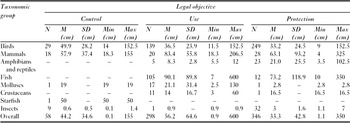
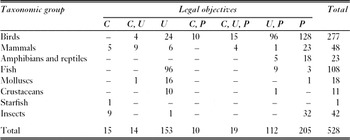
Of the 528 species considered in the present study (1857–1995), a total of 346 were subject to protection (66%), 298 to use (56%) and 58 to control (11%) (Table 1). Although the majority of these species (71%) had been unambiguously subject to either control, use or protection over the period, a considerable number of species (29%) had still been subject to more than one different legal objective over the period (Table 2). Data inspection showed that in most cases this concerned separate periods. Nonetheless, a total of 27 bird and two mammal species had been simultaneously subject to two different legal objectives (control and use or use and protection) in some periods.
Legal objectives distinguished in Dutch species legislation and size measurements of the species that had been subject to these objectives over the entire period 1857–1995. N = total number of species involved, M = average body size of the species, SD = standard deviation, Min = the size of the smallest species, Max = the size of the largest species. – = no data. Overall sizes should be considered to be approximate, as body sizes of species of different taxa were measured differently.

Estimated numbers of species that were subject to Dutch species-specific legislation over the 1857–1995 period for different taxa and the different main legal objectives that applied to the species over time. Legal objectives: C = control, U = use, P = protection, – = no data.

Mainly with respect to vertebrate species, the legal status of many species has been subject to change over time, particularly when comparing the objectives protection and use. Of the 249 bird species assumed to have been subject to protection in the 1857–1995 period, 111 (45%) had also been subject to use at other times during this period. Of the 28 mammal, 23 amphibian and reptile and 12 fish species assumed to have been subject to protection, 5 (18%), 5 (22%) and 9 (75%) respectively had also been subject to use (Table 2). With regard to crustaceans and molluscs, species were much more straightforwardly subject to one of the legal objectives. In addition to starfish (assumed to refer to only one species), this was particularly the case for insects, as not a single insect species was subject to more than one legal objective over time (Table 2).
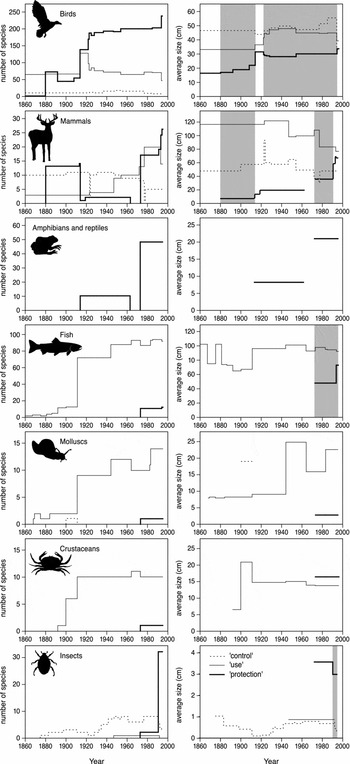
In the species set we analysed, the numbers of species of each taxon (with the exception of starfish) assumed to have been subject to the legal objectives control, use and protection show different trends over time (Fig. 1). Generally, for all taxa, the numbers of protected species increased over time. Numbers of protected birds showed the greatest overall increase from 1880. Numbers of fish, molluscs and crustaceans subject to use also steadily increased, whereas those of birds, and later also of mammals, decreased after a peak. Numbers of birds, mammals and insects subject to control gradually increased over time and then decreased again, although insect numbers did so later (Fig. 1).
Estimated numbers of wild animal species of seven taxonomic groups subject to Dutch species-specific legislation and their average sizes throughout the 1860–1995 period for the legal objectives control (dashed line), use (fine line) and protection (heavy line). For amphibians and reptiles subject to protection during the 1914–1963 period, limited use was also permitted. Grey areas cover all subperiods in which average body sizes differed statistically significantly between legal objectives. (Appendix 3, see supplementary material at Journals.cambridge.org/ENC).

Body size and legal objectives
Species subject to protection tended to be relatively smaller (average size = 33.3 cm, that is the approximate size of a common tern Sterna hirundo), the species subject to use relatively larger (average size = 56.2 cm, or the approximate size of the European hare Lepus europaeus) and species subject to control to be relatively intermediate in size (average size = 44.2 cm, or the approximate size of a beech marten Martes foina) (Table 1).
During the periods in which more than one legal objective simultaneously applied to a taxonomic group, relative differences in average body sizes of the species subject to the objectives were fairly consistent in pattern over time. In other words, if, within a certain period, the species of a taxon subject to one objective were, on average, smaller than the species subject to another objective, this pattern often continued in subsequent periods, despite changes in the species being subject to legislation (Fig. 1). Analysis of variance showed that size differences for birds were statistically significant within all distinct subperiods considered within the periods 1880–1914 and 1922–1994 (Fig. 1; Appendix 3, see supplementary material at Journals.cambridge.org/ENC). This was also the case for mammals for the subperiods within 1880–1914 and 1972–1991, for fish for subperiods within 1973–1995, and for insects for the subperiods within 1991–1995 (Fig. 1). In all cases p < 0.001, except for fish in the period 1994–1995, where p < 0.01 (Appendix 3, see supplementary material at Journals.Cambridge.org/ENC).
Over time, protected species of birds, mammals, fish and molluscs (although the last only concerning one protected species) were, on average, smaller than the species subject to use (Fig. 1). Post hoc analysis indicated that for birds this difference was statistically significant within the majority of subperiods analysed, and for mammals for some of the subperiods (Appendix 3, see supplementary material at Journals.cambridge.org/ENC). For fish, analysis of variance had already shown that size differences for protection and use were significant. Within insects and crustaceans, protected species were larger than species subject to use (Fig. 1). However, in these cases only one insect species was used and only one protected crustacean species was involved.
Over time, the protected species of birds, mammals (most of the time) and molluscs (although only concerning one controlled species), were, on average, also smaller than the species subject to control (Fig. 1). Post hoc analysis for birds indicated that for the majority of the subperiods analysed, this difference was statistically significant. For mammals, this was only the case in a few subperiods (Appendix 3, see supplementary material at Journals.cambridge.org/ENC). For insects, however, species subject to protection were, on average, larger than controlled species (Fig. 1). Average size differences between species subject to control and use seemed less consistent in pattern. Bird species subject to control were, on average, generally larger than those subject to use, whereas for mammals this was reversed. According to post hoc tests these size differences were statistically significant in only a few cases (Appendix 3, see supplementary material at Journals.cambridge.org/ENC). For insects, controlled species were, on average, also smaller than the species subject to use during the 1947–1992 period, although the latter only concerned one species. In molluscs, however, this was reversed during the 1900–1911 period, although only one controlled species was involved (Fig. 1).
Trends in average body size
Protection
Throughout the period 1860–1995, the average size of protected bird, mammal, amphibian and reptile and fish species increased. In most cases, increasing mean body sizes coincided with increasing numbers of species protected (Fig. 1). The average size of bird species subject to protection gradually increased from c. 17 cm (namely the size of the nightingale Luscinia megarhynchos) in the period 1860–1880 to 33 cm in 1994. The average size of protected mammals increased from c. 7 cm in 1880 to 67 cm in 1994, with an interruption between 1963–1973, when no mammals were protected. The average size of amphibians and reptiles subject to protection also increased, from 8 cm during the period 1914–1963 to 21 cm by 1973, also with an interruption during 1963–1973. Since the first legal protection of fish species in 1973, the average maximum size of protected fish species increased from c. 47 cm in 1973 to 73 cm in 1994 (Fig. 1). In contrast, since insect species became subject to protection in 1973, the average size of the species involved has decreased from 3.6 cm to 3.0 cm since 1991 (Fig. 1). The average size of mollusc and crustacean species subject to protection has remained constant over time, at 2.8 and 16.5 cm, respectively (Fig. 1).
Use
No general trends could be observed in the average size of species subject to use over time. For some taxa, average size increased, for others, it decreased, while for yet other taxa, average sizes oscillated to a decreasing extent or remained constant (Fig. 1). Simultaneously, until the last decade of the twentieth century, the numbers of species formally subject to use had often increased over the period 1860–1995 (Fig. 1). The average size of bird species subject to use increased from c. 33 cm, 1857–1914 to 48 cm in the period 1937–1954, and then decreased to c. 39 cm in 1994. Over time, the average size of mammals subject to use decreased from 117 cm in the 1860–1923 period to 77 cm in 1990. In contrast, the average size of molluscs subject to use increased over time, from 8 cm in 1868 to c. 23 cm since 1983. Over the period 1857–1914, the average size of fish species subject to use fluctuated between 67 cm and 102 cm, and during the period 1914–1994 it remained c. 92 cm. Between 1892 and 1911, the average size of crustaceans also fluctuated between 65 cm and 21 cm and reached c. 14 cm thereafter. During the period 1914–1963, in addition to protection, use was secondarily involved in relation to amphibians and reptiles (namely limited catching or possession of frogs was permitted for terrarium purposes), which had an average size of c. 8 cm (see above). During the period 1947–1992, honeybees Apis mellifera, which have an approximate size of 9 mm, were subject to legislation related to their use (Fig. 1).
Control
Throughout the period 1860–1995, mammals, birds and insects showed differing average size trends for the species subject to control (Fig. 1). Prior to 1977, the average size of birds subject to control was, with some small fluctuations, c. 47 cm. After 1977, average bird size increased to a peak of c. 55 cm in 1985 and then decreased to c. 33 cm in 1994. Between 1860 and 1900 and since 1978, the average size of mammals subject to control was c. 48 cm. However, during 1900–1978, the average size fluctuated between 30 cm and 93 cm. The average size of insects subject to control fluctuated over time, first decreasing from 1 cm (the size of the Colorado beetle Leptinotarsa decemlineata) in 1875 to 1 mm in 1911, later increasing to almost 8 mm for the period 1961–1977, and subsequently decreasing to c. 3 mm in 1994 (Fig. 1).
DISCUSSION
The present study quantitatively and longitudinally investigated the possible role of body size in the relative involvement of animal species in national species-specific legislation in the Netherlands over the period 1857–1995. Three legal objectives were distinguished, namely control, use and protection. The results show that, for most taxa, the average body size of species differed between different legal objectives for most of the periods in which more than one of these objectives applied to a taxonomic group. For birds, mammals, fish and also molluscs, species subject to protection were, on average, smaller than the species that were subject to use throughout the period studied. Protected bird, mammal and mollusc species were, on average, also smaller than the species subject to control for most of the periods analysed. In contrast, protected insect species were, on average, larger than the insect species subject to control or use. Throughout the period studied, the average size of the protected bird, mammal and amphibian and reptile species considered, and also fish species, increased. No such general pattern could be observed for use: for some taxa, sizes increased over time, for others size decreased, while for others sizes varied constantly with a tendency to decrease, or remained constant. Mammals, birds and insects showed different trends in average size values of species subject to the control objective over time.
On the basis of the present study, we can conclude that for a long period of time species body size most probably did affect the decisions made by Dutch legislators in relation to the objectives being applied to wild animal species, including protection. For birds, mammals and fish, the species subject to protection were, on average, smaller than the species to which use applied. Thus, the legislator apparently often had a preference to permit the use of, on average, the larger species within these taxa. A related finding is that for birds, mammals, amphibians and reptiles, and also fish, Dutch species law has demonstrated a trend toward the legal protection of generally larger species over time, suggesting that the legislator initially excluded larger species from protection, but later incorporated these species into conservation legislation.
An explanation for the persistent preference of legislators to allow the use of larger species within vertebrate taxa may be owing to pressures arising from conflicting societal interests. Interests concerned with legal protection (for example animal and bird protection organizations) and interests concerned with the use of species (such as hunting organizations) are likely to have competed with respect to the same species, the results indicating that, at least in relation to birds, mammals and fish, considerable percentages of the species subject to protection had also been subject to use at other times over the period 1857–1995 (Table 2). It is likely that there would have been more interest in using larger species than smaller species, not least because larger species provide more meat or produce larger eggs. Moreover, societal willingness to protect species only developed gradually during the 20th century, whereas the importance of the use of species gradually decreased over time (Kellert Reference Kellert1985; Wildes Reference Wildes1995; Knegtering et al. Reference Knegtering, Van der Windt and Schoot Uiterkamp2000). As a result, societal forces over time may have tended to maintain the use of larger species as much as possible, and to eventually give up the use of smaller species in favour of conservation interests. Dahles (Reference Dahles1990, p. 40) supported this, reporting that in the early 20th century Dutch hunters supported the legal protection of small perching birds but opposed the legal protection of larger birds such as pigeons and geese. That large species may eventually have become subject to protection after they had first been subject to use (or control) is further illustrated by some underlying data related to the present study. For example, in 1994, four of the ten largest mammal species subject to protection had previously been subject to use, including, for example, the grey seal Phoca vitulina.
Another way by which the average size of protected species may have increased over time is that large species may have become subject to protection, having not been previously subject to legislation. For example, in 1914 both the number of bird species that were subject to protection as well as their average size increased (Fig. 1). Data inspection shows that the latter was at least partly the result of the addition of ‘new’ large species to legislation, as 19 of the 20 largest bird species that were subject to protection in 1914 had come under legislation for the first time, including, for example, the crane Grus grus.
For birds and mammals, species subject to control were often, on average, also larger than species subject to protection. In the vast majority of cases, these species were subject to control because of feeding habits that were perceived to be harmful to human interests. Such species included predators (such as carnivorous and piscivorous species), in addition to species that fed on crops. The fact that predators tend to be relatively large (see also Cohen et al. Reference Cohen, Pimm, Yodzis and Saldaña1993) may well have contributed to the average size measurement.
At first glance, the finding that in relation to birds, mammals and fish, the species protected by the Dutch legislator were, on average, often smaller than the species to which use applied, appears to contradict the findings of Metrick and Weitzman (Reference Metrick and Weitzman1996, Reference Metrick and Weitzman1998), who revealed that greater physical length increased the likelihood that vertebrate species would be protected under the US ESA. However, the ESA was effective in the last decades of the twentieth century and the present analysis has shown that the average size of several groups subject to protection in the Netherlands was also larger during these decades than in earlier periods. Furthermore, the ESA is concerned with the protection of both species’ individuals and habitats. At least the protection of the habitats of larger rather than smaller species does not necessarily increase interference with other interests. In contrast, when mainly regulating the taking of species’ individuals (in the context of the present study), protection of larger rather than smaller species implies prohibiting, for example, the use of larger species. This may directly interfere with the interests of societal groups who assign stronger use values to larger species.
The findings of the present study also seem to contradict qualitative observations by De Klemm and Shine (Reference De Klemm and Shine1993), who suggest that many countries protected large mammal species before they made efforts to protect small mammal species. The present study has shown that for several species groups, including mammals, Dutch species law reveals a trend towards the legal protection of, on average, larger species over time. Conceivable reasons for this discrepancy are differences in definitions of protection (for example according to our definitions, species could be subject to use irrespective of closing of hunting seasons; see Knegtering et al. Reference Knegtering, Van der Windt and Schoot Uiterkamp2000), that the observations of De Klemm and Shine concerned a more recent period and that there are fewer large mammal species in the Netherlands.
From the present study, it can also be concluded that size patterns of insect species under legislation considerably differ from those of birds, mammals, fish and molluscs. In contrast to mollusc species, insect species subject to protection were, on average, larger than the species subject to use or control. Moreover, the results indicated that larger species were protected first, followed by the incorporation of smaller species. The finding is consistent with the absence of interests competing for the same insect species. Legal protection of large insects will not have interfered with societal interests related to, for example, the consumption of such insects. In Western countries such as the Netherlands, the use of insects for food is rare (DeFoliart Reference DeFoliart1999).
This study of the legal regulation of the taking of species has revealed that generally it was often smaller, not larger species that were protected by Dutch national law between 1857 and 1995, with the exception of insects. As we argue above, this may be due to the presence (or, in case of insects, absence) of interests concerned with the use of larger species. As it has also been reported in the case of habitat conservation that the willingness to conserve often favours larger species (Metrick & Weitzman Reference Metrick and Weitzman1996, Reference Metrick and Weitzman1998; Knegtering et al. Reference Knegtering, Hendrickx, Van der Windt and Schoot Uiterkamp2002), caution is needed when generalizing findings from one conservation context to another.
Both the present study and that by Knegtering et al. (Reference Knegtering, Hendrickx, Van der Windt and Schoot Uiterkamp2002) clearly suggest that body size matters in public species conservation, albeit in different ways and depending on the context. Nevertheless, empirical data on the effect of species size on the societal willingness to conserve are still scarce. For this reason, further empirical and systematic research on this issue is recommended.
ACKNOWLEDGEMENTS
We thank Berend Aukema, Niels Daan, Edi Gittenberger, Bas de Groot, Joep de Leeuw, Theo Peeters, Aad Smaal and Jan Wattel for their advice, and help with the interpretation of species names. We also thank Wim Stevens of the library of the Ministry of Agriculture, Nature and Food Quality for his assistance in consulting sources, as well as Marijtje van Duijn, Anne Jelle Schilstra, Arco van Strien and especially Leo Soldaat for their advice on the analysis. Finally, we thank Dick Visser and Dirk de Jong for their graphical work. Edo Knegtering produced this work in his personal capacity.