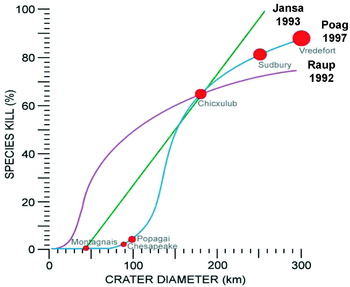
Around 150 confirmed Phanerozoic bolide impact craters with a diameter of greater than 1 km survive on the Earth's surface, of which three are in the 100 km range or greater. Despite the dramatic and extensive immediate effects of impacts, most leave little to no permanent geological record other than a crater, so that links to extinction statistics are commonly speculative. The impact-kill curve generated by Raup (Reference Raup1992) (Fig. 1) used an exponential curve based on crater diameter to predict extinction, and craters in the order of 100 km and above were regarded as purveyors of mass extinction. This was modified by Poag et al. (Reference Poag1997, Reference Poag, Koeberl and Reimold2004) who moved the ascent point on the kill curve beyond 100 km (Fig. 1) in recognition of craters in the 90–100 km diameter range (e.g. Manicouagan, Popagai and Chesapeake, Fig. 2), that evidently lack any immediate extinction. Further modification by Kring (Reference Kring2002) took account of possible changes in survival thresholds through time.
The Raup ‘Kill Curve’ with subsequent modifications. Note that Sudbury and Vredfort are Precambrian impacts not further considered in this paper. Manicouagan would plot next to Popigai and Chesapeake Bay.

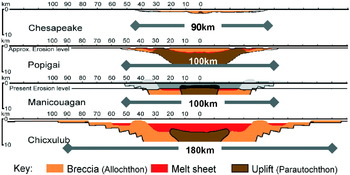
Generalized cross sections of four large terrestrial impact craters. Chicxulub (Hildebrand et al. Reference Hildebrand1998a,Reference Hildebrand, Pilkington, Ortiz-Aleman, Chavez, Urrutia-Fucugauchi, Connors, Graniel-Castro, Camara-Zi, Halpenny and Niehausb) (bottom), Manicouagan (Grieve & Head Reference Grieve and Head1983), Popigai (Masaitis et al. Reference Masaitis, Naumov, Mashchak, Dressler and Sharpton1999) and Chesapeake Bay (Poag et al. Reference Poag, Koeberl and Reimold2004) (top).

Direct linkage between crater diameter (energy) and loss of taxa, over-simplistically implies rigid processes and a quantifiable critical threshold below which events should be benign. This approach, however, only allows for one variable – crater size – which although seemingly quantifiable for any given extraterrestrial bolide impact, ignores a plethora of terrestrial variables. Chicxulub, at c. 180 km (Yucatan, Mexico, c. 65 Ma, Fig. 2) and Manicouagan at c. 100 km (Quebec, NE Canada, 214 Ma, Fig. 2) are two of the largest and best-known terrestrial impact craters, and both relate to known distal ejecta layers that confirm their widespread effects (Smit Reference Smit1999; Walkden et al. Reference Walkden, Parker and Kelley2002). However, whilst of a similar order of magnitude in size, and having struck the Earth at similar latitudes (c. 26–29°N), these two impacts represent opposite extremes in terms of their evident biotic effects. Whereas Chicxulub has been implicated in the loss of up to 65% of species at the end of the Cretaceous (the K/T event) – one of the so-called ‘top five’ mass extinctions – the late Triassic Manicouagan event has little to no associated extinction (Hallam Reference Hallam2002; Tanner et al. Reference Tanner, Lucas and Chapman2004).
In our view this contrast stems from a range of variables only one of which, impact magnitude, is proxied by crater diameter. Crucial variables relating to place of impact include structure and composition of the upper crust, surface environmental conditions and regional climate, whilst those relating to timing include ambient biodiversity, climate and global plate distribution. Added to this, late Cretaceous biotas might already have been stressed through flood basalt volcanism, whilst multiple impacts are a possibility (Kelly & Gurov Reference Kelley and Gurov2002; Keller Reference Keller, Adatte, Stinnesbeck, Rebolledo-Vieyra, Fucugauchi, Kramar, Stüben and Morgan2004). Multiple impacts and flood basalts may also have been a feature of the Late Triassic (Spray et al. Reference Spray, Kelley and Rowley1998; Tanner et al. Reference Tanner, Lucas and Chapman2004).
The respective craters as indicators of scale of impact
Immediately following a large impact a crater quickly evolves from a bowl-shaped transient crater, the size of which is largely proportional to the energy released in the impact, to a broader, shallower and more complex structure modified by rim collapse, debris fallback and central rebound. These transformations obscure the dimensions of the transient crater, and dynamics vary with the angle, size, speed and composition of the impactor, and with the environment, stratigraphy, structure and rheology of the target. Furthermore, where crater diameter is uncertain or misinterpreted it opens confusion over the scale of the event (Collins & Wunnemann Reference Collins and Wunnemann2005; Turtle et al. Reference Turtle, Pierazzo, Collins, Osinski, Melosh, Morgan, Reimold, Kenkmann, Hörz and Deutsch2005).
The Chicxulub impact structure (Fig. 2) is thought to be c. 180 km in diameter, although estimates have varied widely (Morgan Reference Morgan and Warner1997). Obscured by later sediment, it is detectable only through geophysics and coring. The site was a variable-strength, ocean margin carbonate platform. Recent seismic and numerical modelling suggest that the impactor opened a transient crater 80–100 km wide by c. 33 km deep (Morgan et al. Reference Morgan and Warner1997, Reference Morgan, Warner, Collins, Melosh and Christeson2000; Hildebrand et al. Reference Hildebrand1998; Collins Reference Collins, Melosh, Morgan and Warner2002). This quickly modified to form a final crater c. 150 km×5 km with multiple ring faults extending the estimated diameter to beyond 300 km (Urrutia-Fucugauchi et al. Reference Urrutia-Fucugauchi, Marín and García Trejo1996). Multi-ring basins indicate a low-viscosity or low-strength layer beneath the surface (Melosh & Ivanov Reference Melosh and Ivanov1999) and/or a thin, weak lithosphere. As a passive margin site with a low-strength surface layer comprising a few kilometres of wet, porous sediment, Chicxulub was probably structurally less confined than a continental interior site, and prone to ring faulting and collapse.
The late Triassic Manicouagan impact structure (Fig. 2) is quite different. The impactor struck a continental interior comprising a thin veneer of Palaeozoic sediment over a high-strength crystalline Proterozoic (Grenville) basement. This 65 km crater has been deeply eroded by one or two kilometres and the original diameter is accepted as c. 100 km. Melt sheets and breccias extend to the edge of the visible structure, where probable slump blocks suggest crater rim collapse, but a multi-ring structure has not been found (Grieve & Head Reference Grieve and Head1983). The transient crater was probably 60–80 km in diameter (Orphal & Schultz Reference Orphal and Schultz1978; Grieve & Head Reference Grieve and Head1983), much the same as the present-day diameter.
The Manicouagan transient crater was thus around 70% of that at Chicxulub, indicating a difference in kinetic energy yield up to a factor of five (Walkden & Parker Reference Walkden and Parker2006). This difference is substantial, but for these impacts the energy yields are of such a magnitude that they are capable of exceeding the physical thresholds that limit the effects of lesser impacts (Toon et al. Reference Toon, Zahnle, Morrison, Turco and Covey1997), and both have the potential to be globally significant events (Walkden & Parker Reference Walkden and Parker2006). Other factors must therefore account for variability on a global scale, and at Chicxulub these seem to have been geographical, geological and biological factors linked to time and place.
Location and timing as overriding controls
In terms of timing, the Chicxulub event (Fig. 3(a)) occurred during a phase of unprecedented global biodiversity. Continents were disassembled, global sea level was close to a record high, and global climate was generally warm and humid (Benton Reference Benton, Briggs and Crowther2001; Skelton Reference Skelton2003). Recognizing that there may also have been short-term volcanic-induced stresses on the planet, it was a bad time for a big impact.
(a) The late Cretaceous world; (b) the late Triassic world.

By almost complete contrast, the late Triassic world featured the highly assembled supercontinent of Pangaea (Fig. 3(b)). The planet was experiencing relatively low biodiversity with near-record low sea levels and extensive aridity in low to mid-latitude continental interiors (Tanner et al. Reference Tanner, Lucas and Chapman2004). Not only was the timing of the impact more fortunate but its location, right at the centre of the northern arid belt some 3000 km from the nearest ocean (Fig. 3(b)), was probably the least damaging. This was a vast area already degraded by mid-continent aridity, with low regional biodiversity. Furthermore, because dust from mid-latitude impacts becomes strongly smeared east to west during re-accretion, the massing of Pangaea in a relatively narrow 120° north–south longitudinal zone (Golonka Reference Golonka, Kiessling, Flügel and Golonka2002) meant that, once clear of the continent, much of the dust generated at Manicouagan must have been dissipated at sea.
Dust not only has a passive effect through atmospheric loading but it can also generate an infrared (IR) energy burst during re-entry (Toon et al. Reference Toon, Zahnle, Morrison, Turco and Covey1997; Kring & Durda Reference Kring and Durda2002; Durda & Kring Reference Durda and Kring2004; Robertson et al. Reference Robertson, McKenna, Toon, Hope and Lillegraven2004). The effects are controversial (Belcher et al. Reference Belcher, Collinson and Scott2005), but following the K/T impact, an IR burst may have led to widespread desiccation of ground flora followed by wildfires and release of soot and CO2. The reality of dust released at Chicxulub is evidenced by the K/T boundary layer worldwide (Smit Reference Smit1999; Claeys et al. Reference Claeys, Kiessling, Alvarez and Koeberl2002) but little was known of the dust released from Manicouagan until a distal deposit was located c. 2000 km up-range (east) of the impact site in south-western Britain (Walkden et al. Reference Walkden, Parker and Kelley2002). The anisotropic world distribution of dust from Manicouagan was subsequently modelled (Wrobel & Schultz Reference Wrobel and Schultz2003), predicting a layer of 50 mm or more in south-western Britain, close to the actual average of the known deposit and within the same order as our own calculations (Walkden et al. Reference Walkden, Parker and Kelley2002). This distal layer, which includes both dust and spherules from Manicouagan, confirms the magnitude of the event (Thackrey et al. Reference Thackrey2008), but the potential for damage from radiation, including wildfires and resultant pollutants, was minimised in the late Triassic both by the sparseness of the mid-latitude flora and by the unusual massing of continents.
With regard to location, the Chicxulub target was a shallow marine carbonate platform with 2–3 km of limestone, dolomite and evaporites. This wet, volatile setting is widely seen as the cause of significant collateral damage. Although doubt exists over the scale of volatile releases from carbonates and sulphates (Osinski & Spray Reference Osinski and Spray2001, Reference Osinski and Spray2003), general models invoke large volumes of CO2, SO2, SO3 and H2O from Chicxulub with direct consequences for the global heat budget and environmental acidification (Pope et al. Reference Pope, Baines, Ocampo and Ivanov1997; Toon et al. Reference Toon, Zahnle, Morrison, Turco and Covey1997; Hildebrand Reference Hildebrand1998a,Reference Hildebrand, Pilkington, Ortiz-Aleman, Chavez, Urrutia-Fucugauchi, Connors, Graniel-Castro, Camara-Zi, Halpenny and Niehausb; Smit Reference Smit1999; Gupta et al. Reference Gupta, Ahrens and Yang2001; Pierazzo et al. Reference Pierazzo, Hahmann and Sloan2003; Kring Reference Kring2003). By contrast, only 25 m of surviving carbonates are known from the slumped blocks at the margin of the Manicouagan crater (Murtaugh Reference Murtaugh1976). Evaporites are unknown and surface water was scarce at this arid intra-continental site. The surface geology at Manicouagan must have generated orders of magnitude less atmospheric pollutant than at Chicxulub.
Arising directly from the shallow shelf ocean margin location of Chicxulub were the added effects of shelf-wasting through slope failure and slumping (Claeys et al. Reference Claeys, Kiessling, Alvarez and Koeberl2002) and the more widespread and disastrous effects of tsunamis (Toon et al. Reference Toon, Zahnle, Morrison, Turco and Covey1997; Ward & Asphaug Reference Ward and Asphaug2000). Disruption following Chixculub may even have extended to stable ocean current systems, causing ecosystem damage and climate change (Pope et al. Reference Pope, Baines, Ocampo and Ivanov1997). Considering that the Manicouagan impact was deeply intra-continental then none of these effects would have significantly affected the Triassic biosphere. In short, regardless of the actual scale of the two impacts, Manicouagan was a far less damaging location.
Testing size, location and timing with respect to other terrestrial impacts
The two best further candidates for comparison are the Siberian Popigai structure (100 km) (Masaitis et al. Reference Masaitis, Naumov, Mashchak, Dressler and Sharpton1999; Vishnevsky & Montanari Reference Vishnevsky, Montanari, Dressler and Sharpton1999) and the US East Coast Chesapeake Bay structure (80–90 km) (Poag et al. Reference Poag, Powars, Poppe, Mixon, Edwards, Folger and Bruce1992; Poag & Aubry Reference Poag and Aubry1995; Poag et al. Reference Poag, Koeberl and Reimold2004). In terms of regional environment, regional biodiversity and local geology, these two craters are respectively ‘Manicouagan-like’ and ‘Chicxulub-like’, but since both date radiometrically around 35.5 Ma (Poag & Aubry Reference Poag and Aubry1995; Bottomley et al. Reference Bottomley, Grieve, York and Masaitis1997), they are not separated by the same time-defined biodiversity contrast that separates Manicouagan and Chicxulub. The two impacts have been linked to known strewnfields (Langenhorst Reference Langenhorst1996; Deutsch & Koeberl Reference Deutsch and Koeberl2006) and may form part of a multiple event. Nevertheless, no immediate extinction effects are known at this time.
Popigai was a two-layered target comprising up to 1 km of late Precambrian to Palaeozoic sediments over a high-strength crystalline basement of Precambrian metamorphics. Local target rocks generally lacked carbonates and evaporates (Masaitis Reference Masaitis, Dressler, Grieve and Sharpton1994; Masaitis Reference Masaitis1998; Vishnevsky & Montanari Reference Vishnevsky, Montanari, Dressler and Sharpton1999). The crater shows central and annular uplifts (Fig. 2), but there are no obvious ring collapse features (Ivanov et al. Reference Ivanov, Artemieva and Pierazzo2004). With a possible transient crater diameter of up to 60 km (Vishnevsky & Montanari Reference Vishnevsky, Montanari, Dressler and Sharpton1999), the Popigai crater matches Manicouagan in scale, structure and intra-continental location. At 74°N (time of impact) the site was inside the Tertiary arctic circle and was probably tundra, so that the event also matches Manicouagan in terms of the regionally low levels of biodiversity at the time and place of impact. It is no surprise, therefore, that Popigai failed to dent late Eocene biodiversity. It was evidently a Manicouagan-type impact where location and geology permitted a relatively benign event.
Chesapeake Bay is buried close to the continental margin (Fig. 2). As a shallow marine target within a warm temperate belt of moderate to high biodiversity it was potentially a Chicxulub-like event. The target comprised a weak water-saturated sediment column over granite basement (Collins & Melosh Reference Collins and Melosh2004). Widespread biotic damage should be expected from such a location for the same reasons Chicxulub proved damaging, but no immediate biotic effects are recorded. A likely explanation is that the Chesapeake Bay impact was not as large as the crater footprint suggests. Despite the c. 85 km diameter, the known depth is little over 1 km (Fig. 2(d)) and thus not in the same league as the other impact structures. Recent modelling (Collins & Melosh Reference Collins and Melosh2004) has suggested that the final crater diameter may have only been in the region of 30–40 km. Had the impact really been on the scale of Chicxulub, Manicouagan and Popigai, the story would have been very different.
Revising the kill curve
The introduction of factors relating to time (plate distribution, global environmental conditions, worldwide biodiversity) and place (local geology, local environment, local biodiversity) moves us on from the simple kill curve. A more holistic approach, integrating impact magnitude and environmental vulnerability with extinction risk, is taken in Figure 4. The geological record provides constraints to the diagram, because small impacts have negligible extinction potential regardless of site vulnerability, whilst very large impacts, (e.g. craters more than 200 km diameter), will cause significant extinction regardless of location. These constraints condition the gradients used.
Extinction risk of four large terrestrial impacts estimated as a function of crater size and time/place vulnerability. Shaded circles reflect actual data. The Chesapeake Bay crater (1) is repositioned (red) to reflect its misleading crater size and overestimated effects. Other numbered circles represent theoretical exchange of the Manicouagan (2) and Chicxulub (3) impactors between their respective sites. Thus the Manicouagan impactor at the Chicxulub site (2) has higher extinction risk than at its actual time and place, and the Chicxulub impactor at the Manicouagan site (3) has a lower extinction risk.

The Manicouagan and Chicxulub events are placed respectively low and high on the ‘vulnerability’ axis to reflect the issues discussed above. In these positions they correspond to the starkly different extinction outcomes. Popigai and Chesapeake are placed respectively below and above average vulnerability, and neither corresponds to significant extinction. This diagram also permits us to model alternative scenarios. Thus a reversal of the impactors that caused the Chicxulub and Manicouagan craters (discussed in Walkden & Parker Reference Walkden and Parker2006) shows how a Manicouagan-sized impact at the time and place of Chicxulub would have been more damaging than the actual Manicouagan event, and how a Chicxulub-sized impactor at the time and place of Manicouagan might not have had the disastrous consequences of the actual Chicxulub event. The Chesapeake Bay crater is misleadingly large and resulted from an impact at a geologically low-strength site, and its potential biotic effects have therefore been overestimated.
Conclusions
In most cases, crater diameter is all the data we have from which to determine scale of impact, but its unqualified use in estimating likely biotic effects ignores factors linked to time and place such as target lithology, palaeogeography, climate and biodiversity (Fig. 5). Time and place determine the degree of local, regional and planetary vulnerability to impact-induced extinction, and vulnerability can be expressed against size in a simple three-dimensional diagram (Fig. 1) that moves us on from kill curves (Fig. 1). The new diagram, unlike the over-simplistic kill curve, provides a qualitative rather than quantitative result. However, this is the best that can be expected as there is no quantitative relationship between crater diameter and biotic damage. The late Triassic Manicouagan and the mid Tertiary Popigai impacts were relatively benign largely through sheer good luck; they struck at times and/or in places that minimised the damage. The end Cretaceous Chicxulub event remains our best candidate for a major impact-induced extinction, but we suggest it became a major environmental disaster more for reasons of where and when it struck, rather than how big it was.
The influence of factors relating to crater size, impact timing and impact location (size, time and place) upon extinction risk.