A fundamental theme in contemporary political economy is the relationship between global economic interdependence and national politics.Footnote 1 The global economic crisis (GEC) of 2008–9, which led to the largest decline in global economic output in half a century, illustrates the interconnectedness of national economies in the contemporary global order. As it was a global economic crisis, history and recent research suggest that it should lead to political change – regime change, government turnover, cabinet collapses and the like – around the world.Footnote 2 This is especially the case for emerging and transition economies, which are often considered uniquely vulnerable to international economic shocks. But, while several governments in emerging Europe have collapsed as a direct consequence of popular outrage at the severe economic dislocation that has accompanied crises there, such experiences among emerging economies are comparatively rare.
Beyond these cases – Iceland, Latvia, Ukraine and a few others – most other crisis-affected economies have experienced neither political turnover nor regime change. In Ecuador, hit hard by the crisis, the incumbent Rafael Correa of Alianza PAIS handily defeated his main challenger in April 2009. In Malawi, which enjoyed breathtaking growth in 2008 only to resort to emergency International Monetary Fund (IMF) loans following a sharp deterioration in its terms of trade, incumbent Bingu wa Mutharika from the United Democratic Front won re-election easily in May 2009. Between September 2008 and June 2010, no authoritarian regime succumbed to pressures for regime change as a result of the GEC. Despite global economic distress, political change outside the advanced industrial economies has been rare.
Peter Gourevitch, noting the absence today of the ‘roiling political turmoil of the 1930s’, has called the political consequences of the GEC one of the central areas of research for comparative politics.Footnote 3 Placing the ‘non-transitions’ of 2008–10 in comparative perspective, and focusing on the emerging and transition economies, this article argues that terms of exposure to the GEC explain the relative scarcity of political turnover around the world. Incumbent governments' responsibility for the current crisis, and in turn their responsiveness to its domestic economic effects, determine the patterns of political change and political stability in its wake.
‘Terms of exposure’ refers to the channels through which the GEC caused economic hardship in affected countries. The majority of economies outside Western Europe and the United States experienced the GEC as a trade and investment shock, one unrelated to domestic financial sector excesses, identifiable policy errors, high corruption or economic misconduct, or failures of leadership. This had two consequences for political change in the emerging and transition economies. First, with a few exceptions, these countries have experienced less severe crises than they might otherwise have. Trade and investment shocks in countries such as Turkey have been less severe than the domestic financial crises in countries such as Hungary and the Ukraine, which were directly exposed to financial distress due to their overheated and under-regulated financial sectors. Second, incumbent governments in those emerging countries that experienced external trade and investment shocks have been able credibly to portray themselves as innocent victims of the economic difficulties that they currently face. They have not faced successful, broad-based, anti-incumbent political challenges, whereas governments in countries such as Iceland and Latvia have.
This argument accounts both for the clustering of political upheaval in emerging Europe and the surprising scarcity of crisis-related political turnover in other emerging economies. An important distinction is made in this article between democratic transitions (in authoritarian regimes) and government turnover (in democracies). Both are instances of political change, but terms of exposure explain government turnover only. Few authoritarian regimes were directly exposed to the GEC, and none experienced democratic transitions as a result of it. By contrast, government turnover varies as a function of the type of vulnerabilities that countries faced prior to the crisis, and neither economic performance nor IMF involvement has any consistent relationship with government turnover. Of course, the experiences of some countries are exceptional – for example, Taiwan's cabinet resigned in 2008 following the government's disastrous handling of Typhoon Morakot. But, because the aim of this article is to outline how a global economic crisis affected national politics rather than to explain all recent instances of political turnover, these exceptions do not undermine the general argument. Instead, they confirm that direct exposure to the GEC is a sufficient but not necessary condition for democratic political change.Footnote 4
The focus in this article is on the short-term political consequences of the GEC: because the GEC is still a recent event, it is impossible at this stage to know what its long-term political consequences will be. Likewise, while I address the possible links between the GEC and the Arab Spring in the conclusion to this article, these recent revolutions do not appear directly related to the GEC, and therefore they lie beyond the scope of this argument. Even if the GEC does have downstream political effects that we cannot observe today, scholars must nevertheless develop the tools to understand the short-term effects of the crisis, and explain why these vary from country to country.
This argument confirms the important effects that global economic integration has on national politics. However, it also shows that the specific ways in which emerging and transition countries globalize have consequences for their governments' vulnerability to externally driven economic crises. The next section begins by placing the current global economic downturn in historical perspective, and then reviewing the links between economic crises and macropolitical change. Existing perspectives offer useful clues regarding the absence of political turnover amidst economic turmoil in particular national context, but none alone can explain the broad pattern of non-transitions in the non-industrial economies in the wake of the GEC. The following section outlines an alternative approach, focusing on variation in pre-crisis vulnerability and outlining its consequences for political change. The conclusion discusses the broader theoretical implications of this argument for the study of globalization, interdependence and political change, and speculates about the possible long-term or indirect political effects of the GEC.
CRISIS AND POLITICAL CHANGE
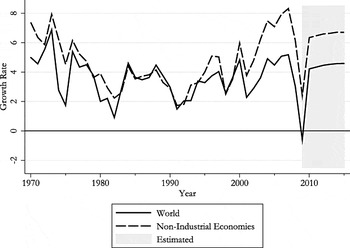
In terms of contraction in real economic output, the GEC was easily the worst economic slowdown in 40 years. This is true for both the advanced industrial economies – where the crisis originated and where its effects are the most acute – and for developing, transition and emerging economies (see Figure 1). Viewed relative to the industrial economies, the impact of the crisis has been smaller in the emerging and transition economies. But viewed relative to past instances of global economic turmoil, the GEC rivals the most severe shocks to the non-industrial economies since the 1960s. The current crisis must be understood as a global crisis rather than simply as one of high-income or advanced industrial economies.Footnote 5
Economic Growth in Historical Perspective.

Note: ‘Growth rate’ is year-on-year real GDP growth. ‘Non-industrial’ excludes Australia, Austria, Belgium, Canada, Cyprus, the Czech Republic, Denmark, Finland, France, Germany, Greece, Ireland, Israel, Italy, Japan, Luxembourg, Malta, the Netherlands, New Zealand, Norway, Portugal, Singapore, Slovakia, Slovenia, South Korea, Spain, Sweden, Switzerland, Taiwan, the UK and the USA. Source: IMF, World Economic Outlook: Rebalancing Growth, Washington, DC, International Monetary Fund, 2010.
Historically, such global economic slowdowns have been associated with higher frequency of government change and regime collapse. Of course, the link is imperfect: in one of the most systematic studies of the political economy of regime change, Haggard and Kaufman stress that economic crises in general frequently prompt transitions from authoritarianism, but that economic crises alone are neither necessary nor sufficient to explain patterns of political change.Footnote 6 Although financial crises often prompt anti-incumbent protest and elite infighting, each of which may lead to government turnover or regime change, there are a variety of exceptions. Some authoritarian regimes (Chile in the 1980s, Malaysia in the 1990s) are able to weather financial crises relatively successfully. Likewise, many democratic regimes (India in the early 1990s, Argentina in the early 2000s) withstand financial crises, even if the incumbent governments that preside over the run-up to a crisis are replaced.
Government turnover has occurred in some hard-hit countries, but by no means all of them. No authoritarian regime has collapsed as a result of this crisis, and governments in hard-hit democratic countries remain in office. One potential explanation for the absence of political turnover and regime change is that outside the advanced industrial economies and the European periphery, the crises were relatively mild. This is because shallow crises, all else being equal, are less likely to result in government turnover or regime change than severe crises. A related argument is that the type of crisis affects the likelihood of regime change: whether a crisis is inflationary or recessionary, related to debt or currency issues.Footnote 7 Electoral institutions may also mitigate the political consequences of economic crises. In consolidated democracies especially, governments can rely on wide acceptance of democratic institutions to remain in office until a subsequent election (in countries where election dates are fixed) or to avoid calling elections until the crisis has passed (in countries where election timing is at the incumbent's discretion). For these reasons, the effects of the GEC on government turnover in democracies may not yet be apparent; for example, Armenia's president Serzh Sargsyan was elected just prior to the onset of his country's crisis, and remains in office.
Election timing cannot explain all cases of non-transitions. The case of Malawi, where incumbents faced both an acute economic crisis and an election yet emerged unscathed, is a critical counter-example. The literature on economic voting in both new and consolidated democracies, in fact, rejects a simple relationship between economic conditions and support for incumbents even when electoral calendars allow voters to punish governments during crises.Footnote 8 Electoral responses to poor economic conditions depend on institutional rules that clarify incumbents' responsibility for economic outcomes.Footnote 9 They also depend on the extent to which economic outcomes actually depend on government policies.Footnote 10 Alternatively, in weakly institutionalized or unconsolidated democracies, a description which fits many of the crisis-affected transitional economies, voters may not have sufficient trust in democratic institutions to use elections to sanction incumbent governments for poor economic performance.Footnote 11 These perspectives suggest that the GEC might not have translated into demands for new democratic governments in some countries because citizens cannot see how to link poor economic performance to politicians' behaviour.
In the case of transitions from authoritarianism to democracy, coalition theorists draw attention to the social groups that support incumbent regimes and their expectations about the likely outcomes of a democratic transition. Haggard and Kaufman use the examples of Chile and South Korea in the early 1980s to argue that these military regimes were able to survive economic meltdowns because their supporters in the private sector feared that democratization would empower groups whose policy preferences ran counter to theirs.Footnote 12 Pepinsky argues that the political consequences of financial crises depend on the distributional struggles over adjustment policies that these crises activate.Footnote 13 These and other arguments indicate that, while financial crises may create precipitating conditions for political regime change, individual country trajectories are shaped in the end by configurations of power and interests that are specific to individual countries. These arguments would suggest that across the non-democratic countries that have suffered from the crisis, there was a high degree of popular support for incumbent regimes' responses to the challenges that they face.
Similarly, in democracies, the literature on comparative mass political behaviour finds that the effects of economic conditions on anti-incumbent voting will depend on certain cognitive or behavioural factors in addition to the institutional factors outlined above. These include whether voters punish governments for past performance or try to anticipate future performance;Footnote 14 whether voters make decisions based on their own experiences or on those of a broader political community;Footnote 15 and individual understandings of objective economic conditions.Footnote 16 These arguments do not address directly the role of economic crises (rather than economic conditions in general) in shaping the likelihood of government turnover, but the links between these literatures are straightforward. However, these literatures draw primarily on voting behaviour at the individual level, and therefore are unsuited to explaining macropolitical outcomes without consideration of the broader national political contexts in which anti-incumbent voting takes place.
The conclusion from these various literatures is that bouts of economic hardship such as the GEC should increase the frequency of both government turnover and regime change, but there are principled reasons to expect that some regimes and governments might nevertheless be able to survive. Strong party institutions have bolstered Singapore's authoritarian regime; continued growth and a strong policy response kept China's regime secure; President Sargsyan in Armenia is fortunate to have been elected in 2008, prior to the onset of the crisis; and Ecuador's political institutions may make it unlikely that voters would hold individual Alianza PAIS politicians responsible for that country's economic hardship.
Viewed together, however, these explanations ignore one commonality across the non-transition/non-turnover cases: these countries all experienced the GEC as an external trade and investment shock. This sets them apart from countries such as Iceland, the Ukraine and other emerging European economies which experienced domestic financial crises as a consequence of the GEC – and where incumbents in democracies have proven wholly unable to withstand mass pressures for political change. The argument in the next section integrates the insights from these literatures to argue that countries' terms of exposure to the GEC explain cross-national variation in political change in its wake.
TERMS OF EXPOSURE AND POLICY RESPONSIBILITY
In a world of global economic interdependence, economic hardship may originate either from domestic economic conditions or as a consequence of exposure to global markets. A recent study by Alcañiz and Hellwig shows that citizens in highly open economies often attribute blame for policy outcomes to international actors rather than to their own governments.Footnote 17 In the context of the GEC, non-industrial countries experienced economic hardship in one of two ways: as a result of their own failures of financial regulation and policy missteps, or as a consequence of the economic hardship experienced by their trade and investment partners. These are differences in countries' terms of exposure to the GEC. Voters seeking to attribute blame to politicians face the task of distinguishing between the actions of politicians and of broader market and social forces as the causes of economic conditions.Footnote 18 This article argues that citizens consider political leaders in the countries that experienced domestic financial crises to have been far more responsible for domestic economic hardship than leaders in countries experiencing external trade and investment shocks.
More precisely, one can identify three groups of countries based on their terms of exposure to the present crisis. One group, ‘the sinners’, comprises countries in which lax financial regulation, easy credit conditions and booming asset prices led to unsustainable borrowing at the household level, combined with dramatically overleveraged financial sectors.Footnote 19 Emblematic of these countries is the United States, but similar economic dynamics were at play in several advanced industrial economies in Europe, most notably Ireland, Spain and the United Kingdom.Footnote 20 These are the countries whose government policies and private sector behaviour are broadly considered to have been responsible for the GEC. It is of course impossible to understand the GEC aside from broader developments in the global economy. Arguably, high savings rates in developing Asia were instrumental in financing the United States' current account deficit, which set the background conditions for the US financial crisis.Footnote 21 But the sinners are primarily advanced industrial economies, even though they include emerging economies such as Latvia, Mongolia and the Ukraine.
A second group of countries, ‘the saints’, did not experience the same unsustainable financial excesses as did the countries identified as sinners above, despite having embraced global trade and financial markets. This group comprises most of the emerging economies of Asia and Latin America, some transition economies in Eastern Europe and the former Soviet bloc and a number of developing economies in sub-Saharan Africa. Denoting these countries as saints in no way implies that these countries face no significant political or economic problems. Many of these countries are corrupt and undemocratic, and in many of their governments have failed to provide for basic human needs or to eliminate gross inequalities of welfare and opportunity among their citizens. Indeed, many of these economies had ‘overheated’ financial sectors prior to the onset of the GEC, and they have experienced sudden and painful economic reversals.Footnote 22 But they are saints in the narrow sense that the factors that directly contributed to the GEC elsewhere in the world did not appear in them, either because of sensible financial policies or because of good luck.
The third group, ‘the bystanders’, includes the handful of countries that have few direct links with the global economy. These include countries maintaining autarkic economic stances (DPR Korea) and those whose economies are so chronically mismanaged (Zimbabwe) or opaque (Burma) that international markets have found it difficult to penetrate them – the exceptions being certain primary commodities and illicit trade and smuggling. The bystanders are poor, but have suffered little from the GEC due to their insulation from global markets.
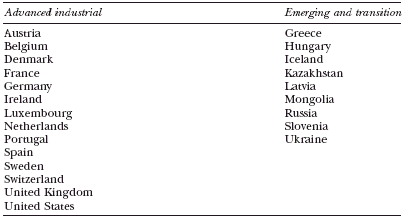
A straightforward way to operationalize the distinction between the sinners and the saints/bystanders is by examining the domestic financial consequences of the GEC. Lax financial regulation, easy credit conditions and booming asset prices in the sinners resulted in either systemic domestic financial crises or near-crises that were only avoided after costly policy interventions. In the saints and the bystanders, no such financial crises or near-crises took place (despite what were in some cases sharp economic downturns). By observing financial sector outcomes and policy responses from the period 2008–9, then, it is possible to identify the sinners. Laeven and Valencia classify countries as having either experienced a systemic crisis or as borderline cases that nearly meet their criteria as having experienced systemic crises.Footnote 23 Together, these countries are the sinners (see Table 1).
Sinners During the GEC (2008–9)

Note: Advanced industrial economies are defined geographically to include all high-income Western European countries that are EU members, along with Switzerland and the United States (as well as Canada, Japan and Norway, not listed above). Financial market developments since late 2009 have revealed that the economies of Ireland and Portugal probably share more features with those of Greece and Iceland than with the rest of Western Europe, meaning that they could be classified as ‘emerging’ as well but are not for political reasons.Footnote 24 Classifying Ireland and Portugal as emerging economies would only strengthen my findings.
Source: Luc Laeven and Fabian Valencia, ‘Resolution of Banking Crises: The Good, the Bad, and the Ugly’, IMF Working Paper 10/146, 2010.
Most of the sinners are advanced industrial economies, but sinners among the emerging and transition economies provide critical insights on the ways in which terms of exposure shape political change in emerging economies.
Sinners, Saints and the Effects of the Crisis
Corporate and consumer excesses combined with policy missteps among the sinners in the advanced industrial economies caused the GEC, but its economic effects have been broadly shared among sinners and saints alike.Footnote 25 With the economic contraction in the industrial world leading to lower demand for exports as well as tightening global credit markets leading to an abrupt shortage of outward investment from the industrial economies, a crisis originating in the industrial economies has become a global crisis.
Apart from the industrial economies, most of the sinners are in emerging Europe. These countries, like the sinners among the advanced economies, had financial sectors that participated directly in the financial bubble. Iceland's experience is perhaps best known.Footnote 26 There, a round of sustained financial liberalization dating from the early 1990s had by the early 2000s contributed to several pathologies that are familiar from other recent financial crises in the developing world. By 2007, bank assets were about nine times larger than Iceland's GDP, and concentrated overwhelmingly in only three institutions. Iceland's stock market index nearly quadrupled between 2003 and 2007, and by 2007 housing prices had risen 89 per cent from 2000 prices. A highly overvalued krona and nearly complete liberalization of cross-border capital flows encouraged massive foreign currency borrowing by individuals and firms alike: by 2007, Iceland's net external debt was 234 per cent of GDP.Footnote 27 Given these risks, a financial crisis in Iceland may have been inevitable, but the GEC fed Iceland's collapse by removing the ability of Icelandic banks to roll over their short- and medium-term debts through further overseas borrowing. The GEC has devastated Iceland. Not only have its three main banks collapsed, but the knock-on effects of the crisis have dramatically cut domestic purchasing power, hammered housing and stock prices, and fed a surge in unemployment. The causes of the present crisis are similar, if their effects somewhat less dramatic, in Latvia,Footnote 28 the UkraineFootnote 29 and several other Eastern European economies.
Unlike these sinners, however, most of the world's other globally oriented economies did not experience anything like the sustained borrowing and overheated equity prices that are the hallmarks of Iceland's experience. In these and other saints, those countries whose financial sectors were not exposed to the same sorts of risks that Iceland and other sinners were, the economic effects of GEC have been altogether different.
Consider the case of Singapore. Long considered one of the best governed of the newly industrialized states of Asia, with competent leaders, a meritocratic bureaucracy and a professional regulatory apparatus, Singapore has nurtured a financial system that has historically proved to be relatively immune to the excesses that have plagued its neighbours.Footnote 30 Despite deep integration into the global financial architecture, and its status as a regional financial hub that intermediates between capital originating in industrial economies and other regional economies, Singapore's financial sector remains fundamentally solvent. Yet Singapore's real sector has suffered a serious blow due to the country's reliance on exports. Prior to the country's vigorous adjustment measures, the IMF estimated that Singapore's economy would contract by 10 per cent in 2009, with unemployment jumping from an estimated 2.1 per cent in 2007 to 8.6 per cent in 2010.Footnote 31 For Singapore the GEC led to a severe trade shock, not a financial crisis. In the event, Singapore's policy response – to combine lower interest rates with significant fiscal stimulus – allowed it to avoid a severe growth contraction.Footnote 32
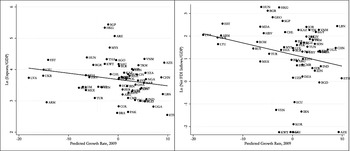
Singapore's experience in the GEC is emblematic of most trade-dependent emerging economies. The only difference is that Singapore's exceptionally large dependence on trade has meant that the domestic effects of its trade shock are particularly severe. The story is similar in Latin American countries such as Mexico, whose economy relies on exports to the United States. The same is true for Argentina, Angola and a number of other countries, each also dependent on exports to the advanced industrial economies and each similarly vulnerable to the current economic reversal. Figure 2 reveals the relationships between pre-crisis trade and investment and growth in 2009.
Trade, Investment, and Predicted Growth.

Note: The vertical axis Ln(Exports/GDP) in the left panel is the natural log of exports as a percentage of GDP. The vertical axis Ln(FDI inflows/GDP) in the right panel is the natural log of inward foreign direct investment flows as a percentage of GDP. All data for exports and foreign direct investment from 2007, except for Tanzania (export data from 2006), Syria (FDI data from 2006), and UAE (export data from 2006). Angola, Azerbaijan and Saudi Arabia had negative net FDI inflows in 2008, so were coded at the minimum value all countries with positive net inflows.
Source: IMF, World Economic Outlook: Rebalancing Growth, Washington, DC, International Monetary Fund, 2010; World Bank, ‘World Development Indicators’, 2011, available at www.worldbank.org/data.
Figure 2 also makes clear that the Baltic states, along with Hungary and the Ukraine, are among the worst hit of all emerging and transition economies even though (with the exception of Hungary) they are not the most open to trade and investment, reflecting the importance of direct financial sector vulnerabilities in transmitting the effects of the crisis to them. While the sinners experienced the worst of the GEC, both sinners and saints have suffered severe economic hardship as a result of it.
The story differs somewhat for large emerging economies, including the BRIC economies (Brazil, Russia, India and China) as well as their counterparts such as Bangladesh, Indonesia and Nigeria. Due to their large internal markets, these countries have experienced a slowdown in economic growth rather than an economic contraction. Russia, classified by Laeven and Valencia as a ‘borderline’ case of a financial crisis, is the sole sinner among these large economies. But also unlike the others, pre-crisis growth had been fuelled by rising petroleum prices, which fell during the crisis,Footnote 33 only to rebound strongly thereafter. Experiences differ as well in the countries identified above as bystanders. These chronic underperformers enjoyed few of the fruits of the expansion prior to the GEC, and have therefore faced few of its consequences.
Terms of Exposure and Political Change
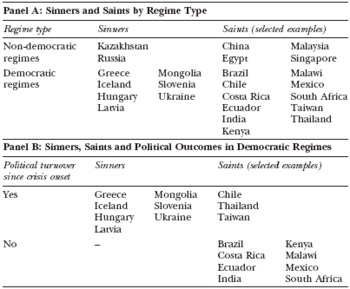
There is a clear link between terms of exposure to the crisis and the political consequences of the GEC in emerging and transition economies (see Table 2). The relationship between terms of exposure and political change is most clear when separating democracies – defined here in minimalist terms as governments which submit themselves to regular, free, fair and irreversible electionsFootnote 34 – from non-democracies. The latter have proven wholly resilient in the face of the crisis, but only two of the nine sinners, Russia and Kazakhstan, are non-democratic regimes (see Panel A in Table 2). These are also the only two sinners that rely heavily on petroleum resources, which gave their regimes the policy flexibility and access to resource rents to manage the political consequences of the crisis.Footnote 35 Given the paucity of non-democratic sinners, and their unique resource endowments, we can learn little about the effects of the GEC on democratization from their experiences.
Sinners, Saints and Political Change

Note: Political turnover includes any of the following: a parliamentary vote of no confidence, the resignation of a government, or an election in which an incumbent party lost control of government or the presidency. See text for specific details on political turnover in sinners.
Among democratic governments, however, both terms of exposure and political outcomes vary. Panel B in Table 2 distinguishes between sinners and saints among the democracies, comparing countries that have experienced political turnover between 1 January 2008 and 1 June 2010 with those that have not. Incumbents have lost national elections in every country identified as a sinner.
-
In Greece, the opposition Panhellenic Socialist Movement unseated the incumbent coalition headed by Prime Minister Kostas Karamanlis in October 2009 parliamentary elections.Footnote 36
-
In Hungary, the rightist Fidesz-Hungarian Civic Union won a majority of seats in April 2010 parliamentary elections, ending the coalition government headed by the social democratic Hungarian Socialist Party.Footnote 37
-
In Iceland, the majority centre-right Independence Party suffered a crushing defeat in April 2009 parliamentary elections at the hands of a centre-left coalition.Footnote 38
-
Latvian Prime Minister Ivars Godmanis, along with his entire cabinet, resigned in October 2009 in response to popular dissatisfaction with the steps his government was forced to take to rescue Latvia's financial system from collapse.Footnote 39
-
In Mongolia's May 2009 presidential election, former pro-democracy activist Tsakhiagiin Elbegdorj defeated the incumbent Nambaryn Enkhbayar of the Mongolian People's Revolutionary Party, which had held the presidency since the collapse of the USSR. In June 2008 Enkhbayar had presided over parliamentary elections marred by accusations of fraud, which resulted in deadly post-election violence.Footnote 40
-
Slovenia's centre-left Social Democrats defeated the incumbent Slovenian Democratic Party in the September 2008 parliamentary elections.Footnote 41
-
In the Ukraine, opposition leader Viktor Yanukovych defeated both the incumbent Viktor Yushchenko and Prime Minister Yulio Tymoshenko in the January 2010 presidential election.Footnote 42
By contrast, among those identified as saints – those countries that have not experienced financial collapses even though many underwent severe economic setbacks – most incumbents have won the elections that they have faced. Of course, in countries such as Mexico with fixed electoral calendars, presidential elections have yet to be held, so the fate of incumbent presidents remains unclear. Even with this caveat, the relationship between terms of exposure and political change is apparent: political turnover has been uniform among democratic sinners, but far less common among the democratic saints.
The Ukraine illustrates the links between pre-crisis vulnerability and political change, having experienced many of the symptoms of financial overexpansion similar to those experienced by the other sinners in emerging Europe: high inflation, a boom in consumption, sustained capital inflows and a fragile and overexposed financial sector. When the crisis hit in mid-2008, the financial sector neared the brink of collapse, the value of the hryvnia plummeted and the government approached the IMF to secure a substantial (and painful) rescue package.Footnote 43 Large anti-government protests followed, led in many instances by those from the hard-hit eastern portion of the country until presidential elections in early 2010, in which opposition leader Viktor Yanukovych handily defeated both the incumbent Viktor Yushchenko and Prime Minister Yulia Tymoshenko. With the onset of the crisis, the governing parliamentary coalition (including blocs led by Yushchenko and by Tymoshenko) has chosen not to call early parliamentary elections for fear of defeat.
Of course, the GEC does not explain all cases of political turnover. In several saints, such as Chile and Thailand, incumbents have lost elections. But such experiences are instructive. Thailand appears in Table 2 as a saint that has experienced political turnover, in this case the fall of Samak Sundaravej's government in September 2008, followed by the formation of a new government under Abhisit Vejjajiva amidst heavy popular protest. But the GEC did not cause Thailand's political crises. Rather, Thailand's political turmoil is the outgrowth of a long process of political contestation that has pitted the allies of the populist former prime minister Thaksin Shinawatra against opponents drawn from the traditionally conservative Thai political establishment.Footnote 44 The Thai political crises of 2008 and 2009 would have occurred with or without the GEC. Chile's 2010 presidential elections yielded the first centre-right government since the end of the Pinochet era in 1990. However, incumbent Michelle Bachelet – whose popularity among voters remained one of the highest ever recorded for a post-1990 presidentFootnote 45 – was forbidden by law from running for a consecutive term. Close inspection of these cases confirms that factors external to the GEC explain why particular governments among the saints have succumbed to challengers. Among democracies, direct exposure to the GEC through an overheated but under-regulated financial sector is a sufficient but not necessary condition for government turnover.
Mechanisms
Terms of exposure may explain political turnover in two ways. The first possibility is that sinners on average have experienced the worst economic contractions, making them more likely to experience political turnover. If so, terms of exposure are important background factors that shape the severity of countries' economic crises, but crisis severity is the proximate cause of political change. Such an explanation sits awkwardly with the data. By any metric, the economic difficulties experienced by small trade- and investment-dependent economies were large and painful. Further, it is not true that all sinners experienced severe crises on the order of Iceland and the Ukraine; Mongolia's GDP growth bottomed out at ‘only’−1.6 per cent in 2009.Footnote 46
An alternative mechanism can explain political change in sinners following relatively shallow economic contractions (for example Mongolia) as well as political continuity in saints following severe economic crises (for example Malawi) by focusing directly on the terms of exposure themselves. In sinners, irrespective of crisis severity, clarity of responsibility is high because the paths leading from policy to crisis are clear. Voters have good knowledge of the policies that led to the financial meltdowns that they currently face, partially because incumbent politicians themselves touted these policies prior to the crisis. Governments rode high on expectations of future economic progress, and they coupled this with the constant promotion of the lending, spending and consumption practices that drove financial sector overheating and which ultimately left their citizens reeling. Despite prolific debate about which specific policies may have encouraged these practices, no credible political movement in any sinner believes that its crisis is the result of anything other than financial sector excess.
In saints, paths of responsibility are far less clear, both to voters in democracies and to regime supporters in non-democratic regimes, because aside from the sudden reversal in capital flows and the abrupt slump in exports, nothing obvious has changed. Financial sectors in the saints remain solvent, and exchange rates have depreciated but not collapsed. Governments in the saints have successfully portrayed the economic hardships that they experience as externally generated. As the Economist characterized political responses to the GEC among Asian countries in early 2009,
The Western consensus in favour of globalisation lured them, they say, into opening their economies and pursuing export-led growth to satisfy the bottomless pit of Western consumer demand. They have been betrayed. Western financial incompetence has trashed the value of their investments and consumer demand has dried up. This explanation, which absolves Asian governments of responsibility for economic suffering, has an obvious appeal across the region.Footnote 47
Colourful comments by Brazil's former president Luiz Inácio Lula da Silva illustrate a similar sentiment there: ‘this is a crisis that was caused by white people with blue eyes…and before the crisis, they looked as if they knew everything about economics’.Footnote 48 Likewise, Romanian president Traian Băsescu, who avoided succumbing to a stiff political challenge in Romania's 2009 presidential election, claimed, ‘there were smart guys coming to Romania, who had studied at Harvard and Oxford, and they invented how to increase the value of one's shares without actually having money’.Footnote 49
During the GEC, politicians exploited responsibility to their own benefit. Where it was possible to attribute responsibility for the crisis to external economic conditions or actions beyond the control of incumbent regimes, incumbents did so. Where the GEC has exposed systemic or near-systemic domestic financial insolvency, politicians were unable to shift blame abroad in ways that could protect their tenure in office.
Policy responsiveness also helped incumbents communicate to their citizens that they were doing all in their power to ease this hardship. Among the saints, policy responses to the crisis have been swift and active, and have for the most part heeded the IMF's adviceFootnote 50 to combine cautious monetary easing (to balance the need for looser money against the worry that such easing might prompt further capital outflows) with more aggressive fiscal stimuli.Footnote 51 These governments have also taken swift actions to ensure financial sector stability.Footnote 52 Such policy responses are relatively uncontroversial from the standpoint of consumers, businesses and the financial sectors in these countries; where criticisms exist, they have been about their scope or depth. Incumbent politicians in the saints have been content to emphasize the external origins of the crisis and to highlight their own steps to minimize its domestic impacts. Most have also carefully reminded their citizens that economic recovery will depend on the recovery of the advanced industrial economies, something beyond their control. Recovery, in other words, will be driven by the same kinds of trade and investment ties that had driven pre-crisis growth.
Furthermore, many countries have sought IMF support during the GEC,Footnote 53 yet there is no evidence that the IMF's participation in recovery programmes explains political change. IMF scholars argue that borrowing governments incur ‘sovereignty costs’ when approaching the IMF; all else being equal, governments prefer not to incur these costs, and for various reasons they can expect to be punished domestically for having sought IMF support during crises.Footnote 54 IMF programmes in Greece, Hungary, Iceland, Latvia, Mongolia and the Ukraine have been unpopular. But IMF programmes have also been extended to other democracies with troubled economies (Costa Rica, Malawi, Romania and others) in which incumbents have prevailed in elections. These loan agreements, moreover, clearly indicate that the international economic environment rather than domestic financial sector vulnerability explains the need for a loan. In the case of Costa Rica, for example, the IMF supplied funds ‘to support the country's strategy to cope with the adverse global economic environment’.Footnote 55 In short, IMF participation does not explain the cross-national pattern of political change during the GEC, and the IMF itself recognizes the distinction between governments that were responsible for systemic domestic financial crises and those that were simply vulnerable to the knock-on effects of economic crises among the advanced economies.
In sum, terms of exposure explain two important features of the GEC. First, saints, unlike sinners, have largely escaped blame for the domestic economic consequences of the GEC. Second, saints have maintained active policy responses to the crisis that are broadly popular, even when these require IMF support, while the sinners have been forced to adopt broadly unpopular policy responses. Both factors made political survival more difficult for incumbent governments in sinners than in saints.
This argument is subtle and deserves further emphasis. Incumbent governments in the saints have not been able to deflect all popular criticism of their policies, and some of these incumbent governments have fallen to electoral challenges. Yet democratic governments in the saints have not faced significant domestic opposition to their handling of the economic consequences of the GEC in their countries. Where incumbent governments have lost power, it has been as a result of factors orthogonal to the GEC. Democratic governments in the sinners, by contrast, have uniformly fallen victim to domestic political challenges motivated by popular outrage at the domestic consequences of the GEC. This argument explains the asymmetry in government turnover between saints and sinners – some saints have experienced government turnover, but the sinners all have.
CONCLUSION
Amidst one of the worst global economic crises of the past century, government turnover and regime change in emerging economies have been comparatively rare, and clustered overwhelmingly in emerging Europe. This raises old questions about the conditions under which economic crises cause political change. Many emerging and transition economies suffered serious economic reversals during the GEC, but the sinners experienced systemic financial crises while the saints suffered from trade and investment shocks. Among democracies, being a sinner has proved to be a sufficient (but not necessary) condition for political change. Terms of exposure explain why political change has been comparatively rare, and why it has occurred in the places where it has.
One open question is why some countries were sinners and others were saints, and why the sinners were primarily in emerging Europe rather than among other developing, transition, or emerging economies. While a full answer is beyond the scope of this article, several factors are probably at play. One is the combination of financial liberalization with substantial inflows of foreign capital from Europe's industrial economies. These were new challenges for small peripheral European economies that, for better or worse, had already been faced in much of Asia and Latin America by the beginning of the 2000s. A closely related factor is the adoption (or planned adoption) of the euro, which encouraged these capital inflows and liberalization measures as well as constraining immediate policy responsiveness in Greece, Hungary, Latvia and Slovenia. In other emerging and transition economies, where these precipitating conditions were absent, economies avoided the financial excesses that eventually resulted in systemic financial crises. Economies such as China, which maintains restrictions on capital inflows and tight control over domestic finance, also remained insulated from direct financial contagion from the crisis. Further research may help to discover whether these fortuitous policies that insulated countries from direct financial sector vulnerability during the GEC are the product of conscious policy decisions by skilled policymakers, are merely accidental, or are the unintended consequences of previous policies adopted to solve other problems.Footnote 56
The argument that voters and regime supporters have only punished incumbent regimes among the sinners rests on assumptions about policy knowledge and voter sophistication with regards to the origins and nature of current economic conditions that are unlikely to hold for all citizens. There is a lively debate among scholars of comparative mass public opinion about whether voters effectively attribute blame to politicians for events that are under their control.Footnote 57 Yet this theoretical framework provides a straightforward logic that explains more cross-national variation in political outcomes than any competing explanation. It also captures the often-surprising tenor of electoral campaigns in the saints. Despite abrupt economic reversals, campaigns in Costa Rica, Malawi and other saints simply have not targeted incumbents for economic management in the way that campaigns in the sinners have. And finally, it fits well with recent findings about the relationship between trade exposure, external debt and popular attribution of responsibility for economic conditions in developing democracies.Footnote 58
The final open question is about the long-term political effects of the GEC. Economically, the GEC has not yet led to a paradigm shift in economic thinking or models of growth in most industrial economies.Footnote 59 Writing ten years after the Asian financial crisis, though, MacIntyre and others found that throughout Asia – even in countries that did not experience a financial crisis – the crisis catalysed important downstream economic and political changes that were independent of their direct effects.Footnote 60 The GEC may have such catalytic effects on domestic politics around the world as well.
These long-term, indirect effects emerge because crises interact with pre-existing political conditions to empower or weaken different groups within a country, or to expose the contradictions or inconsistencies of existing political arrangements.Footnote 61 It is hard to predict what the indirect effects of the GEC will be, but it is possible to identify two countries whose recent experiences suggest what kind of long-term consequences of the GEC are possible. The first, Ecuador, shows how the GEC may actually have strengthened an incumbent leader. President Rafael Correa is a popular leader known for his scepticism of international markets. He famously pledged, prior to the crisis, to ‘consign neoliberalism to “the trash bin of history” ’,Footnote 62 a popular stance domestically, but one that earned him widespread criticism globally. For Correa's government, the GEC simply confirms its policy outlook, bolstering his government's domestic credibility despite mounting economic difficulties. Ecuador shows how the present crisis may further pre-existing political trends to help strengthen an incumbent government.
Malaysia, by contrast, shows how the same crisis may interact with pre-existing political trends to undermine an incumbent authoritarian regime. Before the onset of the current crisis, in March 2008, Malaysia's long-ruling Barisan Nasional regime lost its two-thirds majority in the country's parliament for the first time since 1969.Footnote 63 Malaysia's recent economic prospects have dimmed considerably, due primarily to declining exports. The government does not face any charges of responsibility for the crisis, but its new prime minister, Najib Abdul Razak, faces a difficult task of expanding the economy while both protecting Malaysia's policies of ethnic favouritism to please the regime's constituents and reassuring the regime's newly energized opponents that policies are not excessivly corrupt or chauvinist. In this way, the GEC has created new political challenges in Malaysia that are more acute than ever before, but which stem from pre-existing political developments not associated with the crisis. Similar issues are at play elsewhere. Even China's regime – highly institutionalized, with an impressive record of economic growth, and well-shielded from the GEC – closely monitors the potential downstream effects of the GEC on what one observer calls the ‘vast patronage system that has been underwritten by a long period of economic growth’.Footnote 64
It is tempting, but inaccurate, to interpret the political revolutions in the Middle East (collectively known as the Arab Spring) as revealing the long-term consequences of the GEC in another set of emerging economies. These popular mobilizations against entrenched dictatorships – originating in Tunisia before spreading to Egypt, Libya, Bahrain, Yemen and Syria – are best understood as driven by long-term processes of political repression, unbalanced growth and state decay. These economies were indeed saints by the standards set forth in this article, yet the Middle Eastern dictatorships that toppled during the Arab Spring (and those which have wobbled but not fallen) did not do so as a consequence of economic dislocation stemming from the GEC. Unemployment had been stubbornly high in Egypt, Tunisia and Libya for decades, and economic performance in 2010 was no different from the average over the previous decade (Egyptian GDP growth in 2010 was 5.2 per cent, compared to an average of 5.1 per cent in 2001–9).Footnote 65 Crony state capitalism and the grinding economic hardship experienced by ordinary Egyptians had long preceded the GEC and were not noticeably worsened by it. One recent review of the Egyptian revolution terms it a ‘crisis of neoliberalism’, but pointedly draws attention to the decade of social mobilization that preceded the January 2011 uprising.Footnote 66 The diffusion of social mobilization to some (but, critically, not all) neighbouring countries following the Jasmine revolution in Tunisia followed in ways consistent with recent findings about the historical pattern of the diffusion of revolutions.Footnote 67
Even though the evidence currently available does not indicate that the Arab Spring is a consequence (either direct or indirect) of the GEC, the implication of this discussion is that future research on the long-term political effects of the GEC must be sensitive to the economic dislocations, policy feedback effects and changes in the distribution of power and resources that form the basis of existing political orders – even in the countries where surface political arrangements remain unchanged. This is all the more important as, at the time of writing, economic conditions appear to be worsening again in the advanced economies, generating fears around the world of a second global downturn. These will give a broader long-term context to the scarcity of political change in emerging economies over the short term.